The Princess and Curdie

The Princess and Curdie by George MacDonald, 1883.

This is the sequel to The Princess and the Goblin, but it isn’t as well-known. Personally, I prefer The Princess and the Goblin, but it’s worth explaining what this book is like and how this two-book series ends.

When we last met Curdie, he was living in a cottage in the mountains and working in the mine with his father. At the beginning of this story, he is still there and still working in the mine. Most of the goblins who inhabited the mines were drowned at the end of the previous book. The beginning of the story briefly recounts the previous adventure and how the king offered Curdie a position in his guard after he helped to rescue the princess and fight the goblins. Curdie turned down the position to remain with his parents, and the king accepted his decision because he approved of the boy’s loyalty to his family. Since then, the king took Princess Irene away with him, and Curdie has missed her.

Since the old, castle-like manor house where the princess spent her earliest years flooded at the end of the story, Curdie has wondered what happened to the great-great-grandmother the princess always spoke of. Nobody ever saw her leave the house, but then again, nobody but the princess and her father ever saw her at all. Curdie’s mother says that she once saw a mysterious light, like the kind Princess Irene said that her great-great-grandmother had, but Curdie still thinks maybe the princess just dreamed that she had a great-great-grandmother, even though he once followed the magical string that the great-great-grandmother gave her.

As Curdie grows up, he believes in fewer things than he once did and focuses more on being a miner than on the little things he once noticed in the upper world. The book describes him as becoming mentally dull and more rigid and common in his thinking. Like other common and mentally-dull people, he is starting to follow the path of being so afraid of being fooled into believing something foolish that he is at risk of making a fool of himself because he is unable or unwilling to think about things deeply, consider possibilities, and believe things that he should:

“There is this difference between the growth of some human beings and that of others: in the one case it is a continuous dying, in the other a continuous resurrection. One of the latter sort comes at length to know at once whether a thing is true the moment it comes before him; one of the former class grows more and more afraid of being taken in, so afraid of it that he takes himself in altogether, and comes at length to believe in nothing but his dinner: to be sure of a thing with him is to have it between his teeth. Curdie was not in a very good way then at that time.”

Curdie’s parents worry about this change in him and find themselves wistfully thinking about how he was when he was younger. Curdie no longer makes up the songs and verses he used to because it is no longer necessary to scare the goblins away. He seems to have lost much of his former creativity, imagination, and mental flexibility because he has not been exercising them, and with them, he has been losing his critical-thinking and analysis skills and his ability to look outward and see the big picture of life and other people.

One day, Curdie makes a bow and arrows, and he uses them to shoot a pigeon. As he watches it die, he is horrified at what he has done. He suddenly remembers what the princess said about her great-great-grandmother keeping pigeons, and he feels terrible that he has killed something so lovely. His remorse stirs his heart and brings back the memories and feelings of the boy he used to be. Then, the pigeon moves, and he realizes that it is still alive, and he sees the globe of light of the great-great-grandmother. Curdie hurriedly takes the injured pigeon to the old castle. The door is open, so he goes inside and follows the sound of a spinning wheel to find the princess’s great-great-grandmother, seeing her for the first time.

Curdie admits what he has done to the great-great-grandmother and gives her the bird. The two of them discuss right and wrong, and Curdie comes to realize that he has done a great many wrong things for some time because “I was doing the wrong of never wanting or trying to be better. And now I see that I have been letting things go as they would for a long time. Whatever came into my head I did, and whatever didn’t come into my head I didn’t do.” In other words, Curdie has fallen into the habit of being thoughtless, and this is the first time in a long time that he’s paused to think about things he’s been doing or could have been doing instead. He realizes that he has even been grumbling about his work and not adequately helping his parents, and even though he noticed that they’ve been seeming unhappy and he suspected it had to do with him, he never once asked them how they felt or why.

After they have this talk and Curdie realizes the real problems behind the things he’s done and is genuinely sorry for them, the lady tells him not to worry because the pigeon will recover now, and she will take care of it. She merely gives him the caution to “Do better, and grow better, and be better. And never kill anything without a good reason for it.” Curdie offers to destroy his bow and arrows, but the lady tells him not to because there are bad things that need to be killed and that the bow and arrows may be useful someday. She also tells him that there are people who tell stories about her and laugh about her, and she asks that Curdie not laugh with them or side with them.

Curdie goes home and tells his parents what happened. They believe him and say that he should do what the lady says. The next day, when the other miners are telling stories about the lady, saying that she’s an evil witch, Curdie has to fight to hold his tongue. When they press him for what he thinks, he only says that he thinks that, if they’re going to tell stories about her, they’d better be sure that they’re true because she wouldn’t like to be slandered. The others laugh at him for being afraid of her or for wanting to defend her.

The lady appears to Curdie and his father again later. She tells them that they have the blood of the royal family in their veins, and she hints that there is a special destiny in store for Curdie. Curdie tries to ask her some questions about who she really is and about her changing appearance, but all she says is that she has many names and can appear in many different forms, and even different people see her differently. She tells Curdie to come see her alone in her tower the next night.

When he sees her the next time, the lady asks if he is ready for a difficult trial. She says that it will hurt and that it will require trust and obedience, but it will be good for him. When Curdie tells her to command him, she tells him to put both of his hands into her fire. He does it quickly, trying not to think about it, and it does hurt at first. However, it stops hurting, and when he takes his hands out of the fire again, he discovers that they are softer than they were before. The roughness and callouses from his work in the mines are gone. The lady tells him that his hands have changed more than that. She says that he will now be able to feel when he touches the hand of a man who is actually a beast on the inside, but he will lose that gift if he uses it for a selfish purpose. To demonstrate the gift, the lady calls a strange creature called Lina to them, and when Curdie feels the creature’s paw, it feels like a child’s hand. Although the creature appears strange and menacing, it’s actually good and gentle on the inside.

The lady tells Curdie to tell his parents that he must go to the king’s court the next day. She has given his father an emerald that they can use to see if he is all right during his travels because its appearance will change if he isn’t. The lady also sends Lina with Curdie to help him on his journey. Curdie is a little uneasy about that because he can tell that Lina is one of the goblins’ creatures, but Lina is genuinely helpful to him, and he becomes fond of her.
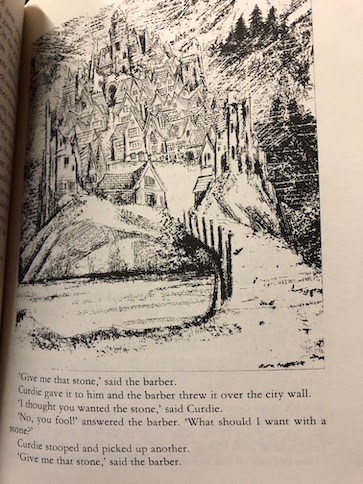
When they finally reach the king’s city, Curdie meets the king’s baker. The baker stumbles on a stone sticking up out the street and curses the king for not maintaining that road. Curdie argues that the baker himself bears some responsibility for watching where he’s going, especially since he says that he’s tripped on that stone before and knows it’s there. However, Curdie has his pickaxe with him and sees an easy way of dealing with the problem. He breaks up the rock that’s sticking out of the road, but a piece of it flies out and breaks the barber’s window. The barber comes to complain about it, and he insists that Curdie pay him more than the window is actually worth. Curdie gives him what he thinks is a fair price, and he feels the animal paw in the barber’s hand, showing what kind of man the barber is and that Curdie’s gift is still working.

There are other cruel, hard-hearted, immoral, and brutish people in this city, and sadly, some of the nicer people tend to be on the receiving end of the malicious gossip of the others. Curdie and Lina are taken in by a woman who is rumored to be a witch simply because she prefers to live quietly and not gossip like the others. Of course, everyone immediately begins gossiping about Curdie and his strange animal companion. The local magistrate believes the slander of a couple of people whose dogs Curdie had to kill because they were trying to kill him and Lina. These people claim that the dogs were harmless and Curdie killed them for no reason. When the magistrate and his soldiers come to arrest Curdie, he says that he’ll surrender, but he refuses to restrain Lina so they can kill her. Lina chases off the crowd that’s gathered to watch, but then, she vanishes herself, and Curdie is arrested. Fortunately, Curdie manages to escape and reunite with Lina. Then, he and Lina find their way into the king’s cellar and kitchen. There, he finds that the king’s servants are drunk and passed out. His touch tells him that these people are beasts inside. Going further into the palace, he finds the king’s chamber, and there, he meets Princess Irene again.

Princess Irene recognizes Curdie again immediately. It’s been less than two years since they last saw each other. She was about eight years old then, so she can’t be more than ten years old now, but Princess Irene seems older than she should be because of everything that’s been happening in the king’s palace. Her father has been ill for a year and is not in his right mind. Princess Irene thinks that the entire kingdom is concerned for him because that’s what the lord chancellor has told her, but Curdie knows that isn’t true because he hasn’t heard a word about there being anything wrong with the king outside of the palace. Princess Irene says that the king has also asked for Curdie, and his staff claimed that they tried to send for him but couldn’t find him. Curdie knows that definitely isn’t true because, until he started his journey to the king’s palace, he had been living in the same cottage where he always lived, and no one from the palace tried to find him or sent him any message.

It’s obvious that there are wicked people in the palace. These people are responsible for the king’s current condition, and they’re trying to keep the public from finding out what’s been happening. With his gift of telling who is a beast on the inside, can Curdie help Princess Irene to find and deal with the conspirators and restore the king to his right mind?

The book is public domain now. It is available to read online through Project Gutenberg (multiple formats) and Internet Archive (multiple copies). You can also listen to a LibriVox audio reading online through YouTube or Internet Archive.

My Reaction and Spoilers

As with the first book, royalty is used to represent people with the best morality in the story. Curdie and his family have royal blood because they are more wise and moral than other people around them. It feels a bit classist to think that royalty is supposed to be morally superior to everyone else just because they were born into a particular family. That certainly isn’t how these things work in real life. Just think of Prince Andrew. However, this type of comparison does fit with the fairy-tale setting of the story.

In spite of whatever royal blood he has, Curdie isn’t perfect. He was falling into bad habits until he realizes that he has done a terrible thing by shooting the pigeon, which causes him to seek out the great-great-grandmother Princess Irene told him about and to do some soul-searching about his behavior. During the time when Curdie is being thoughtless and falling into bad habits, he is portrayed as being too common, like the other men working in the mine. However, I would argue that the bad habits of the miners, like their wild, gossipy stories and rude joking and teasing, are not because they lack royal blood but because they lack thought. Curdie and his father say as much when they’re talking in the mine. The other miners are being thoughtless, and they’re simply not making any effort to be more thoughtful. More than any royal blood, Curdie proves himself worthy by his ability to be thoughtful about other people, and he gets that ability by wanting to improve himself and making the effort to do what it takes to improve.

A large part of this book comes off as a lecture about morality, but that’s not unusual for a Victorian era children’s book. The Princess and the Goblin had some of that, too, but this book has much more. That might be part of the reason why this book seems like it’s less well-known than the first book, but the ending of the book is also strange and kind of depressing.

As one might expect in a fairy-tale story of this kind, Princess Irene marries Curdie (not immediately, because they’re still children, but eventually), and the two of them are said to rule their kingdom wisely for many years. It seems like a happy ending because, thanks to Curdie’s ability to sense the true nature of people, they are able to surround themselves with the best people, and the city becomes less wicked under their rule. However, the story doesn’t end there. In the final paragraphs of the book, it says that Curdie and Irene had no children to inherit the crown. Without a blood heir to the kingdom, someone else was chosen to rule instead, and this person was wicked and greedy, so the royal city went back to being wicked. In fact, this new king was so greedy and stupid that he had his people mining continuously, right under the city itself, to bring him riches. They eventually completely undermined the entire city, so the city physically collapsed in on itself, destroying it completely and killing everyone there. I guess that’s meant to explain why this fairy tale kingdom no longer exists, but that’s quite an ending to this story! With this royal family apparently having some kind of magic about them, it seems incredible that their kingdom would have gone this way, but then again, maybe the author just didn’t want to write about them anymore.

Note to the wise: Wherever your source of wealth comes from, for the love of all that is good in the world, don’t mine your support beams! They serve a purpose and need to stay there for a reason.

A Child’s Garden of Verses

A Child’s Garden of Verses by Robert Louis Stevenson, illustrated by T. Lewis and Sara Gutierrez, 1989.

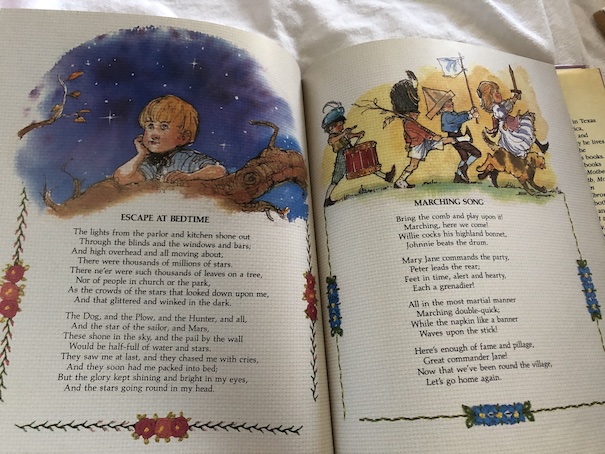
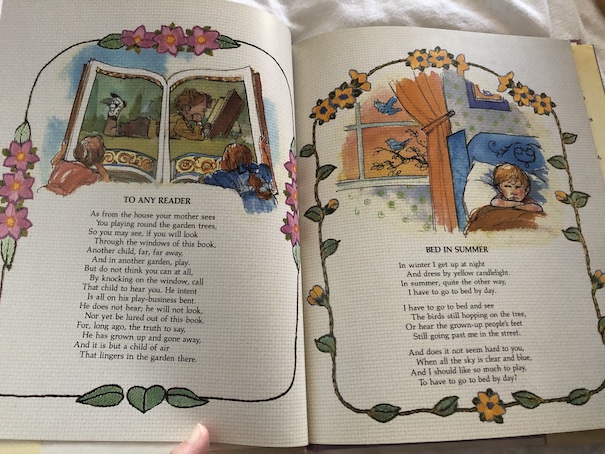
This is a reprinting of the classic collection of children’s poems by Robert Louis Stevenson first published in 1885 as Penny Whistles. What makes this edition of the book different from other printings is the illustrations, which are an unusual combination of watercolors and embroidered borders. Mary Pope Osborne, author of the Magic Tree House series wrote an introduction to the book about the life of Robert Louis Stevenson and his youth in Scotland in the 1850s, which inspired his poems for children. (See my list of Books from 1850s for the types of books children were reading during this time period, but remember that they also would have read books that were published in previous decades.)

The poems have gentle themes from the lives and fantasies of children, like games of pretend, bedtimes, and the little things that children notice and that adults often take for granted, like shadows and the beauty of stars. Some of them have things that are now anachronistic, like lamplighters, but they’re still imaginative and enjoyable for all ages.

I’ve always liked Robert Louis Stevenson’s children’s poems, and this book has my favorites! My personal favorites are:

To Any Reader – Robert Louis Stevenson speaks to children reading these poems about the child he used to be and how the poems are like a window on his childhood, although his own youth is long gone.
Escape at Bedtime – About a child who sneaks out of bed at night to look at the stars.
The Swing – I mentioned this one before because it’s included in another collection of poems, and I’ve often thought of it when I’ve been on swings.
Picture Books in Winter – A child enjoys picture books indoors when it’s cold outside.
The Land of Storybooks – About the adventures that children who love books enjoy in their imaginations.

However, my mother’s favorite children’s poem is Bed in Summer because it reminds her of her own childhood and having to go to bed while the sun was still shining in summer and other children in the neighborhood were still playing outside. (I didn’t have this experience when I was growing up because I never lived in a place that had daylight savings time, which changes the clocks by one hour, providing an extra hour of daylight before sunset. Arizona is very hot, so there’s a benefit for doing things after the sun has set, and few people have any interest in pushing back time to maximize the scorchingly hot daylight hours. My childhood memories include going to parks with my parents after the sun set and being put to bed after we got home.)

There are many copies of this book available in various printings online both at Internet Archive and Project Gutenberg because the text of the original book is now public domain. I didn’t see this particular printing with these illustrations available online, but if you just want to read the poems, there are plenty of other copies of the book to choose from!

The American Girl’s Handy Book

The American Girl’s Handy Book by Lina Beard and Adelia B. Beard, 1887.

This is a Victorian activity book for girls, focusing particularly on outdoor seasonal activities and celebrations. Earlier, I covered The Girl’s Own Book, which is a similar type of Victorian activity book for girls, but there are important differences between the two. For one thing, they were published over 50 years apart, which means that the girls who read this book when it was new would likely be the granddaughters of girls who had grown up with The Girl’s Own Book. For another thing, this book is organized by the seasons and has a more outdoor focus. There is a reason for the somewhat different focus of this book, but I need to explain a little about the authors.

The book is now public domain and available to read for free online through Project Gutenberg and Internet Archive.

Historical Background

Lina Beard (“Lina” was short for Mary Caroline) and Adelia Beard were sisters. Their brother, Daniel Beard, was the author of The American Boy’s Handy Book, published a few years before The American Girl’s Handy Book. Like their brother did in his book, Lina and Adelia set out to make a book of activities specifically for an audience of American children, taking into account the sort of environment that the children would live in and the language they would use. In the preface to the book, they say that they had the idea to write a book of activities for girls after the publication of their brother’s book, thinking about times when they have heard girls wish for an activity book of their own whenever a new one for boys appeared. (There were previous activity/how-to books for girls, like The Girl’s Own Book, but their comments indicate that there were more books of this type for boys than for girls.)

Both Lina and Adelia would later be founding members of the Camp Fire Girls, the first major scouting organization for girls in America, during the 1910s, while Daniel Carter Beard was one of the founders of the Boy Scouts of America. (Camp Fire Girls was founded before the founding of the Girl Scouts. Today, it is now a co-ed scouting organization simply called Camp Fire.) Their family believed in appreciating nature and the benefits of exercise and outdoor life, and these concepts are reflected in the activities in of the Handy Books.

However, even though they valued exercise and healthy outdoor activities for girls and the subtitle specifically mentions “outdoor fun”, this book has plenty of indoor activities for girls as well. This is probably partly because they would have appealed to girls of the period and their parents, but it’s also because the book takes the realities of weather into account. An ideal time for forming walking clubs and enjoying the beauties of nature would have been in the spring, but not so much in the heat of summer, when making fans and playing relatively sedentary games would have helped keep them cool, and not in the winter, when things were covered in snow and girls would have to take their exercise indoors and work on indoor crafts and needlework. Overall, the The American Boy’s Handy Book has more outdoor activities than The American Girl’s Handy Book, but the Beard sisters also wrote other activity books, some of which have even more of an outdoor or camping focus.

Contents of the Book

The activities in this book are organized by season, and I liked the organization much better than the organization in The Girl’s Own Book. The organization by season is the same as in The American Boy’s Handy Book. Within each section, there are more specialized sections, focusing on particular pastimes and holidays in each season.

Spring

The holidays that appear in this section are April Fool’s Day, Easter, and May Day. May Day isn’t a major holiday in modern times, but schools in the 19th century commonly had May Day celebrations.

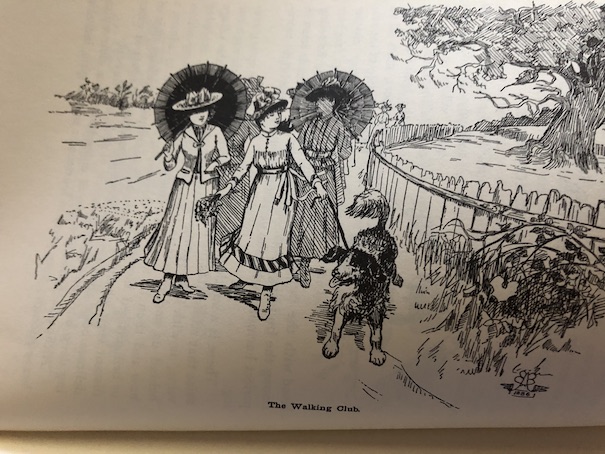
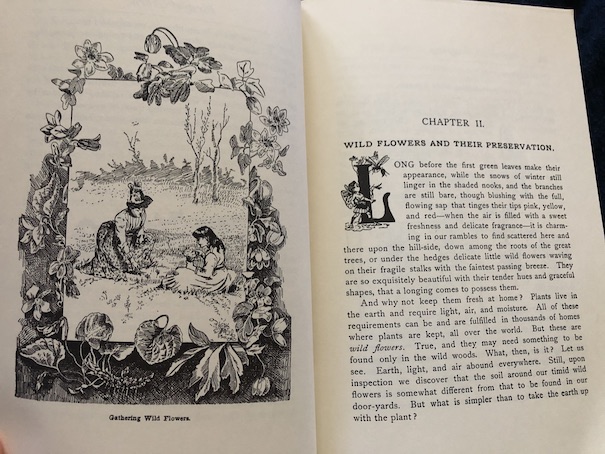
The recommended outdoor activities for spring are lawn tennis (this section includes instructions for making your own lawn tennis net), forming a walking club, and picking and preserving wildflowers. The wildflowers section is the longest section in this part of the book, and it has a surprising array of methods for preserving wildflowers, including crystallizing them.

Summer

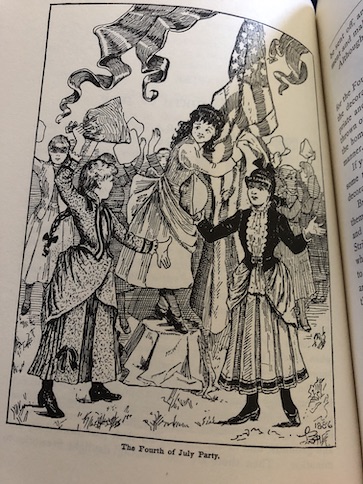
The holidays in this section are Midsummer Eve and the Fourth of July. Midsummer Eve isn’t a common holiday for modern girls to celebrate, but the Midsummer activities of the 19th century involve fortune telling.

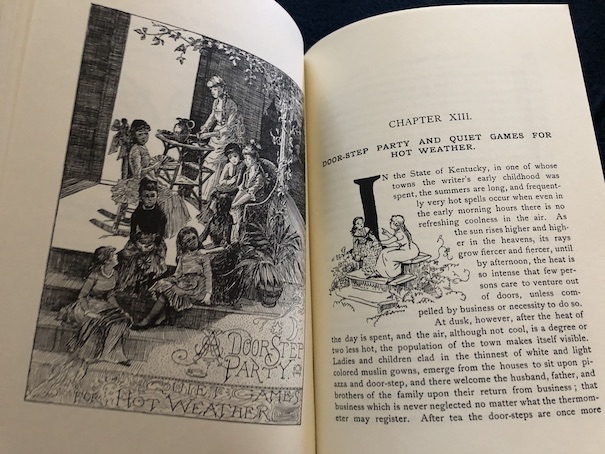
Summer provides many opportunities for outdoor activities. There are tips for holding various types of picnics and decorating a seaside cottage, and there are suggestions for using plants in art and making dolls out of corn husks and flowers. However, summer is also very hot, and in the days before air conditioning, people would have also wanted ways to relax and keep themselves as cool as possible in the heat. The summer section of the book has instructions for making fans and hammocks and playing relatively quiet games.

Autumn

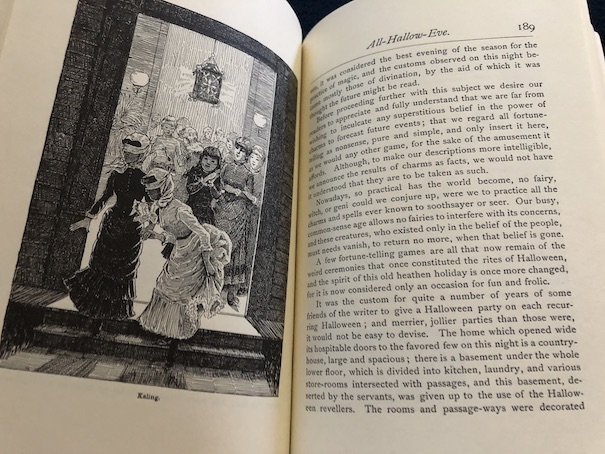
This section begins with suggestions for celebrating Halloween and ends with Thanksgiving. The Victorian era was the beginning of Halloween parties as we know them today. There would have been games for children and romantic divination games for young adults, particularly young women and girls.

The Thanksgiving section offers tips for putting on a kind of Thanksgiving play, but it’s not historically accurate by any means, and the American Indians aren’t portrayed well. The whole thing is more like a series of joke skits.

The nature themes in the Autumn section focus on nutting parties and making decorations from autumn foliage. A nutting party is a sort of walking party and picnic, where the girls enjoy the beauties of nature, gather chestnuts, and roast and eat the nuts afterward.

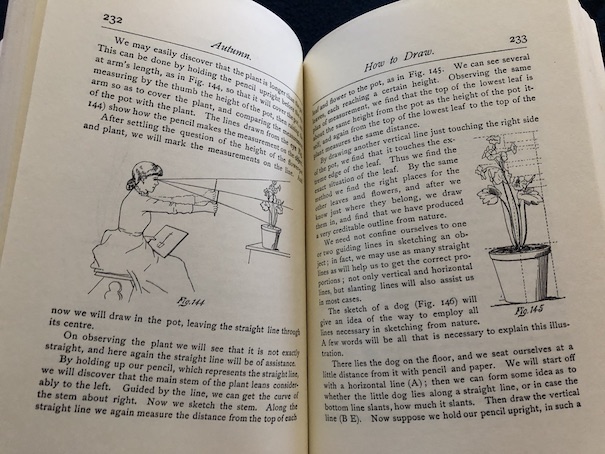
Most of the autumn activities focus on various types of art, including drawing, painting in oil and water colors, making picture frames, making clay and wax models, making plaster casts, and painting china.

I was fascinated by the arts and crafts information because I always enjoyed arts and crafts, but I’d like to draw your attention to one activity that doesn’t quite fit with the others in this section: making a tin-can telephone. This fascinates me because telephones were a relatively new invention at the time this book was written, but the tin can variety apparently weren’t far behind.

Winter

This section begins with Christmas activities and games and tips for making homemade presents. The other holiday celebrations included are New Year’s Eve, a special Leap Day party (for years with Leap Days), and Valentine’s Day.

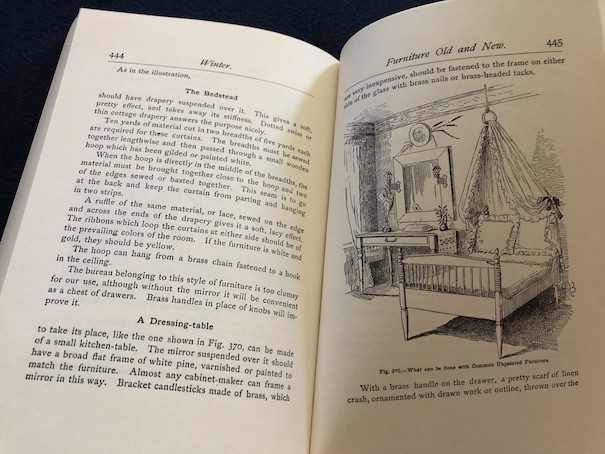
Most of the activities in this section are indoor activities, like studying heraldry and making your own coat of arms with suggested symbols, doing needlework, making book covers and scrap books, and making things from stuff that otherwise would be thrown away. (They didn’t have the term upcycling back then, but that’s basically what this activity was about.) There are a couple of sections about decorating a room, decorating windows and mantle pieces and making and decorating furniture.

There is also a section with recipes for different types of candy.

For exercise, there is a section about doing indoor exercises. There is also a section about creating booths for a fair, which surprised me because I wouldn’t have thought of that as a winter activity. Then again, people can begin planning early for later events.

The American Boy’s Handy Book

The American Boy’s Handy Book by Daniel Beard, 1882.

This is a Victorian activity book for boys, focusing particularly on outdoor seasonal activities. It was not the first book of its kind during the Victorian era, but the author explains in the preface that he wanted to create a book of sports, games, and activities that would be better than the ones that he knew from his own youth, with instructions that were well-written, complete, and easy to follow, particularly written for American boys, without some of the foreign phrases found in other books or tips that would be impossible for them to use, like recommendations for shops in London that sell equipment for the various activities and pastimes.

The book is now public domain and available to read for free online through Internet Archive.

Historical Background

Daniel Beard wasn’t just an author who had an interest in providing useful guides to fun activities for American boys; he was also a social reformer who was one of the founding members of the Boy Scouts of America. Before the Boy Scouts of America was founded in 1910, there were other, smaller scouting organizations throughout the United States, and Daniel Beard had founded one of these groups in 1905, which he called the Sons of Daniel Boone. This group later went through a couple of name changes before Beard joined the Boy Scouts of America and merged his group with theirs.

The Beard family in general believed in the benefits of exercise, appreciation of the natural world, and healthy outdoor activities for youth people, both male and female. Daniel’s sisters, Lina and Adelia, would later be founding members of the Camp Fire Girls, the first major scouting organization for girls in America, during the 1910s, a cause which Beard also supported. (Camp Fire Girls was founded before the founding of the Girl Scouts. It had the opportunity to merge with the Girl Scouts at one point but didn’t. Today, it is now a co-ed scouting organization simply called Camp Fire.) A few years after the publication of The American Boy’s Handy Book, Lina and Adelia published their own book of activities specifically for American girls called The American Girl’s Handy Book, which had somewhat of an outdoor focus but not as much as The American Boy’s Handy Book or some of the other books that they would later write. These were not the only books that the Beards published, and they would later go on to write more books about activities and wilderness skills for boys and girls.

Contents of the Book

The activities in this book are organized by season, which makes sense because of the largely outdoor focus of the activities. Within each section, there are more specialized sections, focusing on particular pastimes in each season. The American Girl’s Handy Book follows the same seasonal organization, but The American Boy’s Handy Book doesn’t mention holidays as much as The American Girl’s Handy Book. There is only one holiday section in this entire book, and the holiday is the Fourth of July. Later editions of the book also have some extra notes and projects in the back.

My copy of the book has a foreword written in modern times, part of which notes that some of the activities in the book are not really recommended for modern children because they are not suitable for kids living in urban or suburban environments and because some of them are outright dangerous and involve fire. At least, children should not attempt these activities without close supervision and help. Some 19th century people managed to play with fire and not hurt themselves, partly because more of them lived in the countryside, away from houses that could be set on fire, and like the author of this book, also lived in places in the Midwest and East Coast that see a lot of rain, keeping plants and fields from drying out and becoming more flammable, and could also be near lakes, ponds, and rivers. However, not everyone lives in those types of places these days. (If you want an indication of what could possibly go wrong with trying some of the more flammable activities in the book, consider what’s happened with some of the more flammable or explosive gender reveal parties in modern times. Consider your environment before deciding whether these activities are feasible.) Also, not everyone from the 19th century or 20th century pulled off these activities unscathed, and it’s the ones who did get hurt or caused serious damage that make the concern. The writer of the foreword describes how a 19th century boy lost a leg attempting the fire balloon activity with his friends years before this book was published. (The fire got out of control, and his leg was badly burned when he tried to put the fire out.) That being said, there are many interesting activities in this book that are perfectly harmless and fire-free and that kids from any era can try, even those who don’t live in the countryside.

Spring

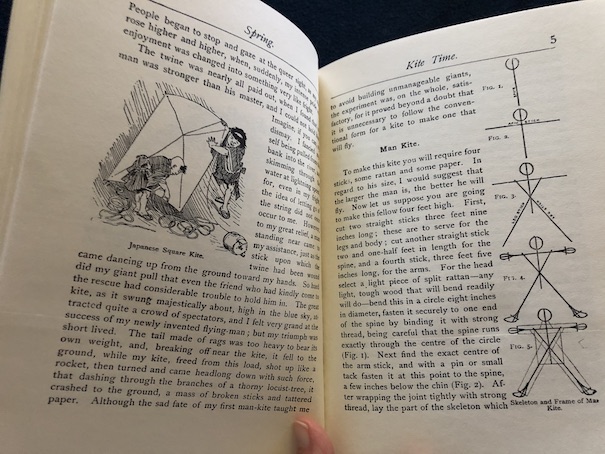
The spring section is mainly about making and flying kites and going fishing. The kites section explains how to make different types of kites in different shapes, like people, frogs, butterflies, fish, turtles, and dragons. One of these designs, called The Moving Star, involves attaching a lit lantern to the tail of a long kite. This kite is meant to be flown at night, so the light will bob in the air. It’s an interesting concept, although the instructions mention that certain types of lanterns are likely to just set fire to the kite. (I think I know how the author knows this.) The book provides instructions for making a custom lantern that will work better. This custom lantern featured a candle that is stuck between nails that are supposed to hold it in place, and it is supposed to be covered with red tissue paper (which is also sure to catch fire if that candle gets loose and falls over while it’s flying around). I’ll admit that the effect is probably neat, if you can pull it off without setting fire to something, but setting something on fire seems to be a likely outcome. This is one of the activities which wouldn’t work well for modern kids, especially if they live in places with highly flammable brush or dead grass and weeds or in the middle of areas with a lot of houses or apartments that would be set on fire if the flying lantern gets out of control (which is, apparently, a distinct possibility). Of course, thanks to modern technology, a battery-operated light could be an option.

There is also a section about war kites, which can be used for kite fighting.

The rest of the spring section is about different methods of fishing, how to make fishing tackle, and how to keep aquariums.

Summer

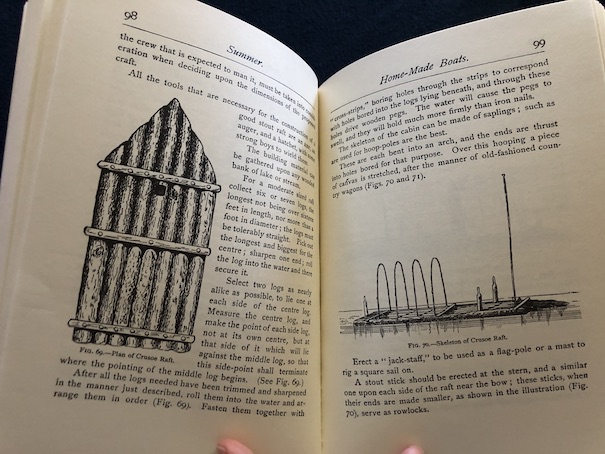
The summer section has more variety, although many of the activities are ones that modern boys can’t do if they live in an urban or suburban environment. There is more information about fishing in this section and how to make and sail different types of boats. I thought that the water telescope, which can be used to look at things under water, was really interesting. The book provides two sets of instructions for making a water telescope, one wooden and one metal.

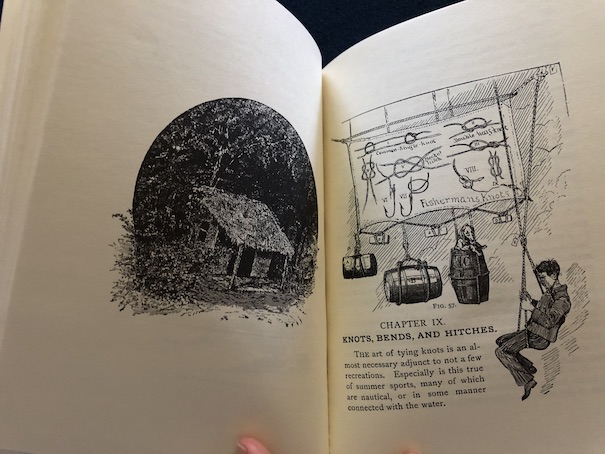
There is also information about different types of knots and how to tie them, blowing soap bubbles with a clay bubble pipe, and how to camp outside without a tent. The section about soap bubbles mentions “an aged negro down in Kentucky” whom the author knew as a child called “Old Uncle Cassius.” Uncle Cassius used to smoke a corn cob pipe, and he liked to amuse the children by blowing soap bubbles. The reason why the author brings up the subject of Uncle Cassius is that he had a particular trick where he would blow smoke-filled bubbles by filling his mouth from smoke from his own pipe before blowing some through the bubble pipe. The term “negro” is a bit archaic now, and I wouldn’t recommend smoking in general, but the author’s memories of Uncle Cassius seem to be fond ones, which is nice. The book doesn’t say whether or not Cassius was a slave, but the author was born in 1850, so my guess is that Cassius was either a slave or had been one earlier in life.

The section about soap bubbles also describes how children can use the gas from the gas lighting in their homes to blow bubbles, another activity that modern children can’t do.

As I mentioned before, fire is important to certain activities in this book. For Fourth of July, there are instructions for making a special kind of balloon that rises with heat produced by fire. They’re sort of like sky lanterns, made of paper. However, instead of having a place to set a small candle, these balloons have a “wick-ball”, which is a ball of rolled-up wick string, the kind used in an oil lamp, which is then soaked with alcohol and set on fire. The author notes that other people who make this type of balloon use small sponges instead, but he doesn’t think they’re as good because they don’t burn long, and as they burn out, the balloon comes back down, near where it started. He prefers to make a wick-ball so that it will continue burning and float out of sight. (I can’t help but notice that the sponge balloons, not burning for long and coming down nearby would also probably be easier to control and monitor for fire risk than the wick-ball balloons, which will float off to God-only-knows-where and get caught on who-knows-what before fully burning out.) The author says that he used to experiment with these as a child and has notes about which shapes are unsafe. Generally, it’s best to make them large and round, without a long neck at the opening. (As I said, the modern foreword in my copy notes that these types of balloons are actually dangerous and that kids have been injured trying to use them. This is why you don’t tend to see this type of activity suggested in modern children’s hobby books. Try it only at your own risk and remember that you’re responsible for any fires you start in the process. If you live in an urban setting or an area with a high risk of wildfires, don’t do it at all.)

There is quite a lot of information about activities involving real birds, like collecting bird nests and raising wild birds. (The modern view is that wild animals should be left wild and not kept as pets.)

There are also instructions for different types of hunting and how to make hunting weapons, including blow guns. In Meet Samantha from the Samantha, An American Girl series, she mentions that she read the instructions for how to make a boomerang in The American Boy’s Handy Book and that she wants to make and sell boomerangs to raise money to buy a new doll until her grandmother talks her out of it because that isn’t a proper activity for young girls. This is the part of the book where the boomerang instructions are, p. 190. Meet Samantha doesn’t say why Samantha was reading The American Boy’s Handy Book instead of The American Girl’s Handy Book in 1904, but that passage is mainly there to show the difference between what were considered acceptable activities for girls vs. acceptable activities for boys.

Autumn

The autumn section is much shorter than the previous two sections. It has information about trapping animals and practicing taxidermy. There is also a section about how to keep and train a pet dog. (Remember, that’s a commitment for life, not just for autumn.)

The part that I liked the best was the section about how to be a “decorative artist.” It teaches boys about photographic paper, how to make shadow pictures, and how to enlarge and reduce images.

Winter

The winter section has both indoor and outdoor activities, and the outdoor activities are designed for places with snow. (The author was born in the Midwest and lived on the East Coast of the United States, so these are the environments he considers for his outdoor activities.) He describes snowball fights, snow forts and houses, snow statuary, different types of sleds and sleighs, snow-shoes, and how to fish in winter.

For the indoor activities, there are instructions for making puppets and a script for a puppet show version of Puss-in-Boots. There are also tips for making costumes for people, so children could perform their own theatricals.

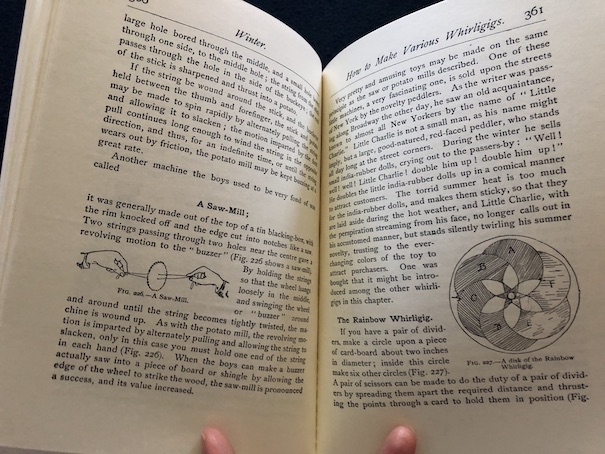
I particularly liked the sections about how to make and use magic lanterns and how to make different types of whirligig toys. The magic lantern was a kind of early slide projector. The whirligigs were homemade toys that would spin.

Sixteen and Away from Home

Sixteen and Away from Home by Arleta Richardson, 1985.

The year is 1889. Mabel O’Dell turns 16 years old at the beginning of the book, and her mother gives her a journal as a present. Soon, she and her best friend, Sarah Jane Clark, will be starting the final years of their education at the academy in town. Mabel worries about going to the academy, first whether they’ll pass the entrance exams, and then whether they’ll be homesick because they will have to board in town. Sarah Jane assures her that it will be okay because they’ll be going together, and they’ll probably be too busy at school to think about homesickness much. Mabel’s mother is a little worried about the foolishness that young women can get into when they’re on their own. However, the girls do pass their exams and are admitted to the academy, and their parents agree to let them go.

In town, the girls will be staying with Sarah Jane’s Aunt Rhoda. Aunt Rhoda’s housekeeper, Lettie, seems to resent the girls being there for reasons they don’t understand. When school begins, the girls are shocked to learn that they’ll have to wear bloomers for “physical culture” classes. The teacher gives them a sewing pattern so they can make the uniform themselves. The girls imagine that their parents would be shocked to see them running around without skirts on. Fortunately, Mabel and Sarah Jane will have all the same classes, along with all of the other first year students. They have to take Grammar and Rhetoric, Biology, Latin, History, Calculus, and Physical Culture (physical education or PE).

They also quickly realize that the class troublemaker is going to be Clarice Owens, who unfortunately sits near Mabel because they all sit in alphabetical order by last name. Clarice deliberately picks on Mabel and Sarah Jane for coming from the countryside, calling them “hayseeds.” Mabel is disgusted because she can never think of a good comeback until after Clarice walks away. (Yeah, I’ve been there before.) Sarah Jane thinks she’s jealous of Mabel for being prettier. Mabel doesn’t really believe that, but she appreciates the thought. Molly, one of the other town girls, is friendlier. She says that she knows Clarice has always thought she was better than everyone, but she’s not usually this deliberately mean. Mabel says that maybe it would help if they knew the reason.
Through the rest of the school year, Clarice tries one scheme after another to cause trouble for the girls, especially Mabel. Mabel tries to be as patient as she can with Clarice, trying to let her know that she’d rather be a friend than an enemy, but Clarice gets angry and upset when Mabel tells her that she forgives her for all the awful stuff she does. Mabel thinks that there’s something hurting Clarice and affecting her behavior, although Molly tells her that she shouldn’t waste her sympathy on Clarice because “she gets what she wants.” Molly thinks that they should just be grateful for those times when Clarice isn’t immediately stepping on them to get what she wants because that happens, too.

When Mabel is injured in a sledding accident and has to stay in bed for awhile, she worries about falling behind in her classes. Lettie talks to her and brings into question the reason why she’s so concerned about her standing in class. Is it really because she loves learning, or is it because she’s trying to compete with the other students? Mabel starts to consider how too much competitiveness can spoil a person’s attitude and take the enjoyment out of things. Competition has much to do with Clarice and her attitude.

Things get worse when Clarice’s grandmother becomes ill and her parents arrange for her to stay in the house with Mabel and Sarah Jane while they go to see her grandmother. Clarice is rude to the servants in Aunt Rhoda’s house and sneaks out of the house during the night. Lettie tells the girls that Clarice’s mother was strong-willed as a girl, and she’s given a lot of her attitude to Clarice. There was a boy that Clarice’s mother had always wanted for herself, but he married someone else. Although Clarice’s mother also married and had a child, she never completely got over losing her first choice to someone else. Since the man she originally loved has a son the age of her daughter, Russell Bradley, she might be hoping that Clarice will marry him. Clarice certainly is interested is Russ … who is apparently more interested in Mabel.

Mabel considers that allowing Clarice to be with Russ and not trying to compete with her would help settle things between them, but as Sarah Jane says, Russ’s feelings on the issue matter. To get the most out of her education, Mabel needs to focus on her love of learning instead of comparing herself to her classmates, and to get the most out of their relationships with other people, all of the girls need to focus on caring about other people and their feelings.

The book is part of the Grandma’s Attic series. It is available to borrow and fread for free online through Internet Archive.

My Reaction

The problem with Clarice and her mother and their attitudes and expectations is that they do not take anyone else’s feelings into account other than their own and don’t even inform people of what they really want, yet they expect everyone else to somehow accommodate their wishes and feel toward them exactly how they want them to feel. These are not reasonable expectations at all. For most of the book, Mabel is completely unaware that Clarice’s meanness comes from the fact that she sees her as competition, and even then, it’s not really clear at first what Clarice is trying to compete for. Mabel didn’t ask or agree to be Clarice’s competitor in anything, and she’s not even trying to be. In fact, she’s been trying everything that she can to avoid it. Russ also apparently has no idea what Clarice is really after because he doesn’t have the same feelings about Clarice that she has about him. He’s just trying to live his life and focus on his own feelings and interests, and as far as he’s concerned, Clarice doesn’t really enter into it. Russ has no obligations to Clarice and her mother, and even Mabel doesn’t have the right to tell him how to feel or what to do to get rid of Clarice’s ire.

When Clarice pulls one last trick on Mabel, and she still forgives her, Clarice finally tells her that she gives up because, “You can’t go on disliking someone who refuses to be disliked.” I have to admit that I found the end to be a bit unbelievable. I’ve never encountered anybody who was that much of a pain and who ever let someone else’s kind behavior stand in the way being a pain. The response that I’ve usually seen is that they congratulate themselves on finding someone who’s never going to fight back and use that opportunity to run roughshod over them. They usually blame the kind person for making it easy to take advantage of them. As even the book says, people cannot decide how anyone else should feel or force them to feel anything in particular. It just doesn’t work. Mabel cannot “refuse to be disliked” because what Clarice likes or dislikes is all in her own mind. All that Mabel can decide is how she feels and what she’s going to do about it.

What Mabel really does decide is that, whether she likes or dislikes Clarice, she’s not going to compete with her and try to fight or match her meanness. It isn’t so much a matter of likes and dislikes in the end as Clarice discovering that she’s running a race with no other runners. If there’s no one to race against, there isn’t really a race at all, and no one cares if you walk off with the trophy or not. Maybe there was never even a trophy there to begin with.

If I’ve said it once, I’ve said it a million times, I don’t like bullying or one-upmanship, and I have no interest in sympathizing with anyone who does those things. Part of the trouble I have with overly-competitive personality traits is the same trouble that actors sometimes suffer when they’re out in public: they don’t always know when to stop acting, stop posing, or stop performing. Overly-competitive people don’t know went to stop competing. Where does the one-upmanship end and the human person actually begin? Or is that their personality all by itself? Do they have any interests outside of being competitive, or are they only about competition just for the sake of competition? Do they wan to be good at something for a purpose or because they just love it, like the love of learning, or is everything they do just about trying to look better than someone? I was reading this article recently, about how trying to keep up an image all the time too often leads to a person having no real substance or sense of self.

By herself, Clarice doesn’t present much to connect with or sympathize with. Clarice doesn’t really seem like a real person to me. She’s rather a one-dimensional character. This is a problem with a lot of bullies in children’s books. She apparently has very generic family issues that are supposed to explain her behavior with little insight into how she really feels about anything. At least, that was how she seemed to me. The explanation behind these family issues comes from a youthful romantic trauma of her mother’s, but what does that really mean to Clarice herself? She seems to have some kind of fear of being second-best, possibly because her mother has pushed her in that direction, but again, we return to the question of second-best at what? Is it that she fears being rejected by classmates or potential boyfriends, or does she fear not living up to her mother’s expectations? If her mother is still pining for her first boyfriend, what does that say about her parents’ relationship with each other? Does her mother view her own husband as second-best, the consolation prize in the contest of life, and what does that mean for Clarice’s relationship with her father? What does Clarice really want out of life and what, specifically does she want to be the best at doing? The idea of romance with Russell may be wish-fulfillment for her mother, but what do she and Russell really have in common? What does she have in common with anybody, when we mainly see her in competition with everyone?

I wouldn’t have nearly as much patience with her as Mabel because, when it comes right down to it, I wouldn’t see Clarice’s friendship as a prize worth winning. Mabel went through quite a lot to get through to Clarice, but her efforts only pay off right before the end of the book, so we don’t really see much of what Clarice is like after she says that she’s giving up the competitive mean girl act. Apparently, Mabel will get the benefit of not having to put up with Clarice’s mean tricks from now on, which is something, but if Clarice isn’t being mean and sneaky, what is she? Who is she, really?

In real life, people have hobbies, interests, and life goals, but Clarice doesn’t seem to have much that really interests her. Are Clarice’s goals really hers or her mother’s, as they hint? What does Clarice want, or has she even thought about what she wants? In modern times, a sixteen-year-old still has years of education ahead of her because more people attend college these days, but once Clarice finishes at the academy in town, her education is likely over. She only has a couple of years left to think about a direction for her life before she has to get on and live it as a full adult. Even if her destiny seems to be someone’s wife and mother, connecting with someone emotionally to the point where they would want to be married and sharing a life with her would be difficult for someone who has no real interests to connect to or a sense of how to build a shared life with someone else. For a while, she seemed to do well at memorizing the reading from Alice in Wonderland that she was going to perform with Mabel at the end of the school year, but that was just another part of her tricks so that she could back out at the last minute and let Mabel down. It was all part of an act by itself. Does Clarice really like acting? Does she like books? Does she like anything?

Clarice doesn’t even seem to have any close friends of her own, which is very unlike the real-life bullies I’ve known. Most of them do have friends and hangers-on who enjoy their mean humor (the thing that often binds them together and bolsters their bad behavior) or who put up with it because of some other benefit they get from that friendship, but Clarice doesn’t seem to have anybody and isn’t really offering anything. It just doesn’t seem realistic and makes me feel like Clarice is there mostly to be the cardboard cut-out of a nemesis. That may be why she gives up so easily in the end.

I would have found her change more believable if Russ had straight-up told her that her mean tricks and selfish attitude are the reasons why he doesn’t like her and isn’t interested in her. That would have been motivation for Clarice to change because it would give her both something to lose by not changing (Russ and others getting angry and saying they’ve had enough of her attitude) and something to gain by taking on different habits (like the possibility that Russ might change his mind if she can demonstrate that she can do as many unselfish deeds as Mabel, something that might actually appeal to Clarice’s competitive personality). I would also have found it believable if Clarice changed her mind about Russ because she ultimately realized that Russ is what her mother wants for her, not what she wants for herself, and that there are other possibilities that she likes better. I would also have liked it if Clarice had been planning to back out on the reading of Alice in Wonderland in order to ruin the presentation for Mabel but changed her mind at the last minute because she realized that she loves the story or performing so much that she just can’t bring herself to miss the event, that she has found something that she loves doing more than causing problems for someone else. Reassessing the consequences of behavior or finding different goals are the kinds of self-motivation that provoke real people to change.

On the other hand, maybe the real issue is Clarice has sensed that she’s fighting a losing battle for Russ, and as Sarah Jane noted, you can’t control the way other people feel. If Russ doesn’t love Clarice, he’s just not going to love her. Perhaps she can tell, even when he’s with her, that he’s not thinking of her and just isn’t going to be interested in her the way she is with him. There’s only so much effort that a person can pour into getting someone’s attention before it starts to get really awkward when they don’t get the attention they’re looking for. Even if Russ doesn’t spell it out for her, she can probably tell that she doesn’t want to be with someone who clearly doesn’t want to be with her. Clarice still might not know quite what she really wants yet, but she might have figured out that’s one thing she doesn’t want, to be with someone who doesn’t think of her as his first choice or even much of a choice at all. All along, she’s been trying to compete with someone who doesn’t even want to compete for a prize that doesn’t want to be won by her because he’s already picking another winner. It brings us back to the idea of one person attempting to run a race all alone. It’s not really a race, it’s just one person running down the street, getting sweaty and tired, with no real prize to win, and who is there to care when they start or stop? That might actually be the most believable explanation of them all.

The books in this series have Christian themes, including this one. As the characters discuss the problem of Clarice and other situations, they often turn to the Bible for inspiration, sometimes discussing specific quotes that relate to the concepts they consider, like forgiveness and revenge.

On a fun note, I liked the description of the Halloween party activities. I was born around Halloween, and I often have a Halloween-themed birthday party. I’m sometimes fascinated by the traditions of Halloweens past. In the book, they call it a Halloween party, but the activities are more harvest-themed than spooky. They bob for apples and run races with apples balanced on their heads, and they also play tug-of-war and Skip to My Lou.

Kate Greenaway’s Book of Games

Kate Greenaway’s Book of Games by Kate Greenaway, 1889.

A book about children’s games with rules and general pastimes. The book doesn’t distinguish between the two, but I do because, to me, games have specific rules whereas more general pastimes and toys do not.

Many of the games and pastimes would be familiar to people in modern times and are still popular. Some games are like playground games (some of them are even still played on playgrounds today) that require running and motions, and others are more talking games (some of those have become classic road trip games, played in the car). Pastimes include making soap bubbles, flying kites, and using swings.

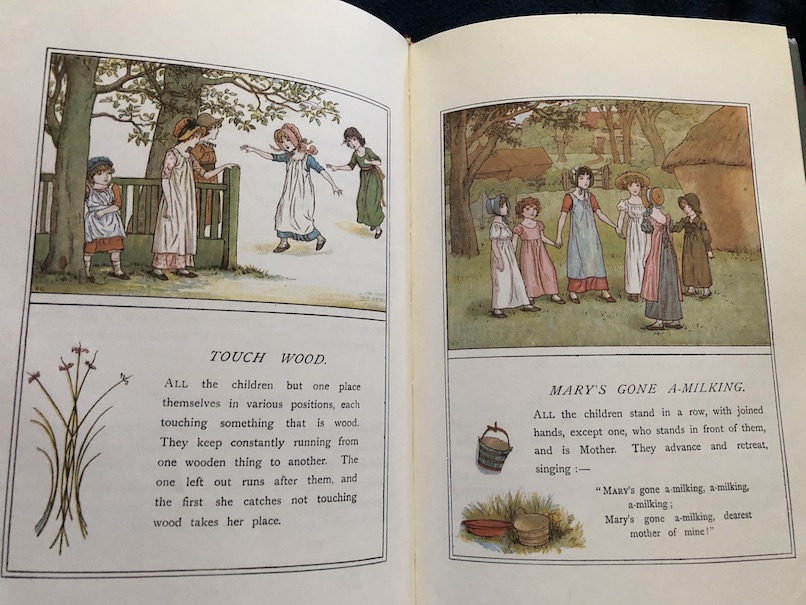
The book includes games like I Love my Love with an “A”, Blind Man’s Buff, Frog in the Middle, Russian Scandal (This is an old name for the Game of Telephone, before the invention of the telephone became really popular. I’ve also heard it as Russian Gossip, although I don’t know why it’s specifically “Russian.”), French and English (which is basically Capture the Flag), Oranges and Lemons (which is played like London Bridge is Falling Down, only with a different rhyme), and Twenty Questions. Some of the less familiar ones, especially to young Americans today, might be Puss in the Corner (a game that involves players running and changing places with each other and the person who is left without a place being “it” or the “puss”), Mary’s Gone A-Milking (a chase game with a song), What Is My Thought Like? (a talking/guessing game that involves creativity), and The Old Soldier and Judge and Jury (which are both talking games with words that are forbidden to say).

One of the interesting things about this book, besides noticing which games are still played and which are more obscure now, is that the children in the pictures are actually wearing clothes that are from an earlier part of the 19th century from when the book was written. This is a classic feature of Kate Greenaway’s illustrations, also seen in her other books. Modern people who are less familiar with the evolution of 19th century clothing might not notice that detail.

This book is still in print in modern times. It also available to borrow for free online through Internet Archive (multiple copies).

For more information about Victorian games in general, see the Victorian Games section of my Historical Games site. History and games are both hobbies of mine.

Five Little Peppers and How They Grew

FiveLittlePeppers

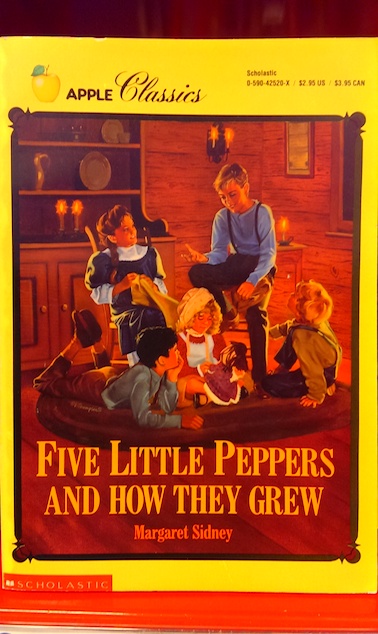
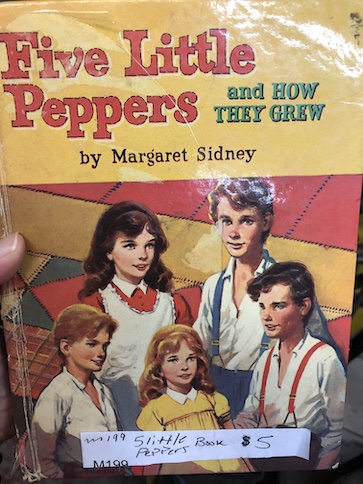
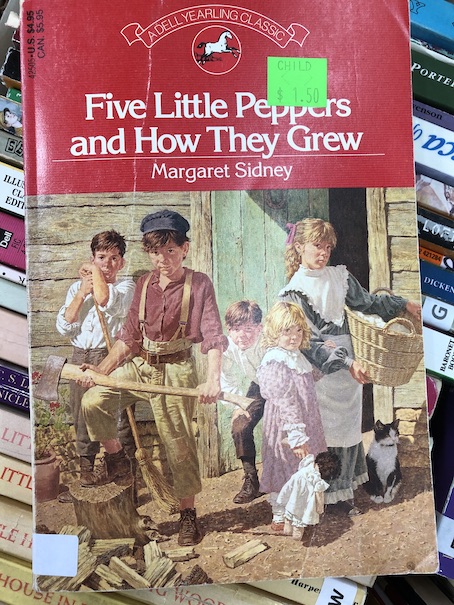
Five Little Peppers and How They Grew by Margaret Sidney, 1881.

Mrs. Pepper is a widow who lives with her five children in a little brown house.  Since her husband died when their youngest was a baby, she has supported the family by sewing.  The children try to help, but they are still very young.  The oldest, Ben, is eleven years old, and Polly, the next oldest is ten.  Their mother worries about providing them with an education, but they are barely scraping by as it is.

The family manages to get by, helping each other through crises, such as the time when everyone was catching measles.  Sometimes, they also get help from friends.

One day, when Phronsie (short for Sophronia), the youngest Pepper, about four years old, wanders off by herself, she is found by a boy named Jasper King and his dog, Prince.  They look after her until her brother, Ben, comes to take her home.  Jasper enjoys meeting the Pepper family.  He doesn’t have any siblings himself, and he thinks that it must be fun to live in a family of five.  Jasper and his father are spending the summer at a hotel in nearby Hingham, and Jasper thinks that it’s dull.  The Pepper children invite him to come visit again, saying that they will teach him how to bake like Polly does.

Jasper isn’t able to return to their house right away because he gets a cold, and Jasper’s father has been ill.  Phronsie thinks that it would be nice to make him a gingerbread man.  Together, the children make up a little basket of goodies for Jasper and his father.  The Kings are charmed by the gift, and Mr. King decides that he would also like to visit the Pepper family.  Unfortunately, due to Mr. King’s poor health and some business he has in “the city”, their visit to the area is cut short.  The Pepper children are sad that Jasper will be leaving so soon, but they invite him to return next summer.

Jasper continues to write letters to the family while he’s in the city, studying with the private tutor he shares with his cousins.  He remembers the Pepper children telling him that they don’t really celebrate Thanksgiving or Christmas because they never have enough money to buy a feast or Christmas presents.  However, he urges them to try to celebrate Christmas this year, even if it’s only in a small way.  The Pepper children make small presents for each other, like paper dolls, doll clothes, toy windmills, and whistles, and put some greenery around for decoration.  Jasper also sends the family some surprise presents.

However, Jasper’s father says that he doesn’t want to visit Hingham again because he doesn’t think that the climate there is good for him.  Instead, Jasper persuades his family to let him invite Polly for a visit.  It takes some persuasion for the Peppers to agree because Mrs. Pepper is hesitant to accept favors and Polly worries about homesickness, but they are persuaded when Jasper says that he has been unwell and that Polly’s visit would cheer him up.  In the city, Polly gets her first taste of formal education, even having a music teacher.  However, she does get homesick, so the King family sends for little Phronsie to cheer her up.  The King family is charmed by both of the girls, and Mr. King gives Phronsie many dolls to play with.

One day, when Polly realizes that she has forgotten to write a letter to their mother because she was so busy with her lessons, Phronsie decides that she will write one herself and mail it.  She doesn’t really know how to write, but she scribbles something as best she can and slips out of the house to find the post office.  She is almost run over in the street, but fortunately, Mr. King finds her and brings her home.  She isn’t hurt, but the incident worries Mr. King.

After some thought, Mr. King decides to invite the rest of the Pepper family for a visit.  The day that the rest of the Peppers arrive, Phronsie surprises a pair of thieves in the house.  The thieves get away, and the excitement from the incident makes the Peppers’ arrival less exciting than it should have been.

The Peppers fit so well into the household that Mr. King invites the family to live with them permanently.  He offers Mrs. Pepper a job as housekeeper and says that he will help the children with their education.  Mrs. Pepper accepts, and it leads to the surprising revelation that Mrs. Pepper and John Mason Whitney, the father of Jasper’s cousins, are actually cousins, making them all cousins of the King family as well.

This book is mentioned in the book Cheaper By the Dozen as a book that Mrs. Gilbreth liked to read to her children.

The book is currently available online through Internet Archive. It is part of a series.

Toby Tyler

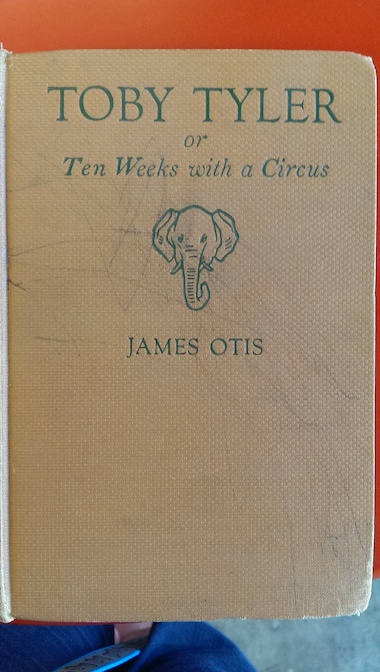
TobyTylerToby Tyler; Or, Ten Weeks with a Circus by James Otis, 1881.

Toby Tyler is an orphan who lives with a church deacon he calls “Uncle Daniel.” Uncle Daniel isn’t really his uncle, but he raised Toby after he was abandoned as a baby. Toby doesn’t know anything about his parents. Uncle Daniel is stern with him and says that Toby eats more than he earns, making it a hardship to care for him. Toby is cared for, but life with Uncle Daniel isn’t exactly happy.

Toby has a fascination for the circus, although Uncle Daniel says that the show isn’t any good, and it’s all a waste of time and money. The circus is certainly cheap, as Toby can see from the first. When he tries to buy some peanuts, he only gets six for the penny he gives, and all or most seem to be bad. The lemonade is basically water with lemon peel in it. But, to Toby’s surprise, the man who sells the snacks at the circus, Mr. Lord, offers him a job. He says that people who work for the circus get to see the show as often as they like, and he could use a boy to help him as an assistant.

TobyTylerPicToby think that it sounds like an exciting offer, and Mr. Lord persuades Toby that the best way would be for him to sneak away at night because his Uncle Daniel might disapprove and stop him from taking the job. Not taking that as a warning, Toby agrees. Toby feels a little guilty about running away and surprisingly homesick, but he decides to stand by the agreement he made with Mr. Lord and see what possibilities life with the circus might have for him.

Life with the circus turns out to be very different from what Toby is used to and what he expects. It’s noisy and dirty, and no one seems to particularly care about Toby or his welfare. Mr. Lord also turns out to be even sterner than Uncle Daniel, not even telling Toby what he expects him to do, just expecting him to do it. Toby works hard, and Mr. Lord acknowledges that he’s better than the other boys who have helped him, but he’s still a temperamental man and hard to please. Like Uncle Daniel, he fusses about how much Toby eats. Toby also has to sell snacks inside the big top under the watchful eyes of Mr. Jacobs, who threatens him with violence if he doesn’t make sales or if people try to cheat him.

However, Toby does succeed in making a few friends in the circus. The first friend he makes is a monkey that he calls Mr. Stubbs. Mr. Treat, who plays the part of the Living Skeleton in the circus sideshow, and his wife, who is the Fat Lady, have seen Mr. Lord mistreating other boys, and they intervene to make sure that Toby is all right, giving him food when Mr. Lord doesn’t. Unlike everyone else Toby has known, Mrs. Treat lets him eat as much as he wants without worrying, saying that some people just need more food than others. Like her husband, Toby seems to have the ability to eat a lot while still being small and skinny.  Mrs. Treat herself maintains an enormous size while hardly eating anything. She says that’s just how some people are.

When Mr. Castle teaches Toby to do trick riding, his status goes up in the circus, and he is no longer under Mr. Lord’s thumb. As far as the Treats are concerned, Toby could stay with them forever. However, life in the circus isn’t what Toby had once thought it was, and Toby can’t get rid of the thought that he’s made a terrible mistake by running away from Uncle Daniel. He wants to go home and make things right with him.

In the Disney movie, Toby stays with the circus, doing well with his trick riding act and having happy adventures with his monkey friend. Unfortunately, in the book, Mr. Stubbs is accidentally shot by a hunter and dies. The book was meant to teach moral lessons about responsibility, whereas the movie was just about fun and adventure.

In the end of the movie, Toby stays with the circus even while being reunited with the people who raised him and missed him when he ran away, giving an all-around happy ending. In the book, Toby feels terrible about the death of Mr. Stubbs (although it wasn’t really his fault), and the hunter who shot him is very sorry because he hadn’t realized that he had shot someone’s pet. To make up for it, he helps Toby to get back to Uncle Daniel. At first, Toby is unsure that Uncle Daniel will want him back, but he misses his old home so much that he says he doesn’t care if Uncle Daniel whips him for running away. However, Uncle Daniel has also missed Toby since he disappeared. As stern and harsh as he could be before, Uncle Daniel genuinely cares about Toby and welcomes him back with open arms.  The ending implies that Toby’s future with Uncle Daniel will be happier than the past because they have much greater appreciation for each other now.

The book is now in the public domain and is available on Project Gutenberg.