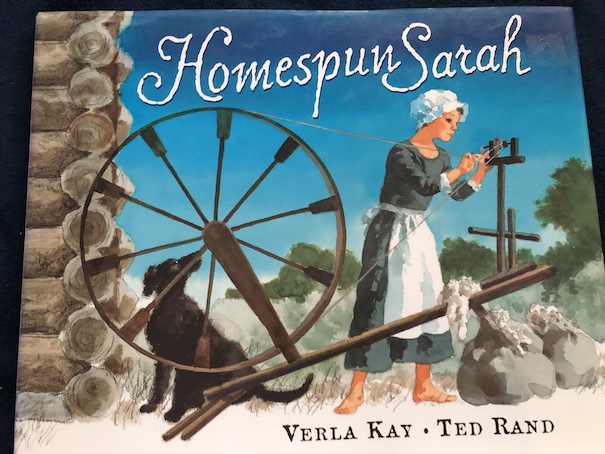
Homespun Sarah

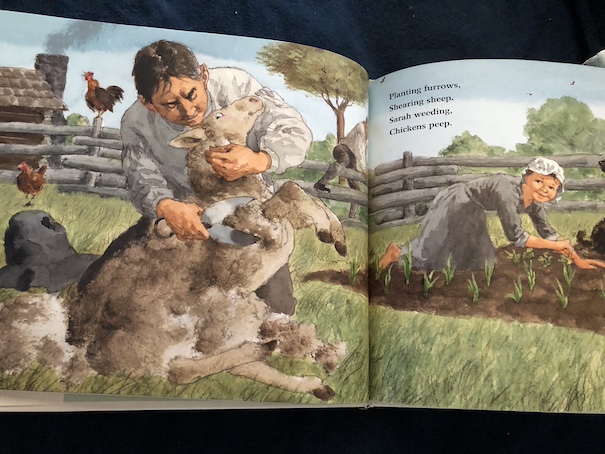
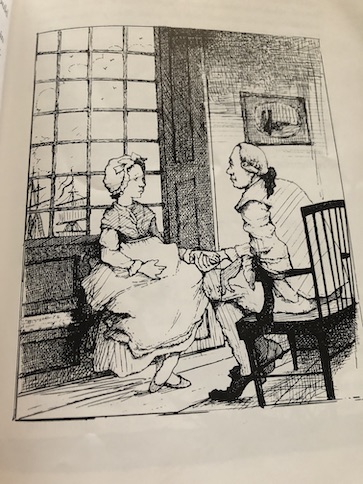
This picture book tells a story in rhyme about a girl living in 18th century Pennsylvania and what she and her family do to make her a new dress when she begins outgrowing her old one.

As Sarah gets dressed one morning, her old dress is noticeably tight, and it’s beginning to get too short for her. Because her family lives on a farm, they must produce most of what they need themselves, and that includes clothing. For Sarah to have a new dress, they must make one themselves entirely from scratch, which is what “homespun” means – they make the dress from homemade cloth from yarn that they have spun themselves.

Various family members carry out different household chores, and as the story continues, readers see how everything they do is not only a part of the family’s daily life but also contributes to the creation of the new dress. The family raises sheep, so they must start by sheering the sheep to get the wool for the dress.

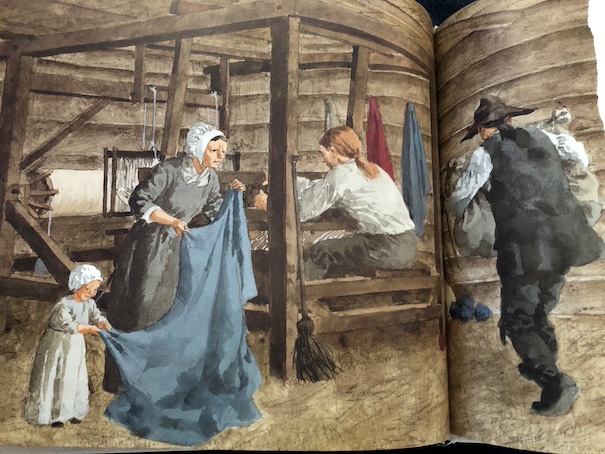
In between doing routine chores, like doing the laundry and making new candles, they card and comb the wool and spin it into yarn with their spinning wheel. The family also owns a large loom, which is how they weave the wool yarn and flax into cloth called linsey-woolsey. The cloth they make is blue and red, dyed using plants that they have produced and gathered.

Once they’ve made the homespun cloth, Sarah’s mother measures her to plan the size of the dress and sews the dress. Sarah gets a new red dress, while her younger sister gets a blue one. Sarah is excited about her new dress, which fits her much better than the old one, and spins around to show it off!

The author’s note at the beginning of the book says that the story is set in Pennsylvania during the 1700s, and she wanted to show how people lived during that time, having to produce everything or almost everything they used by themselves. It also shows various aspects of family life, from where and how they slept to what they ate. The characters in the book, even the children, are shown drinking beer, but the author explains that is because water wasn’t considered entirely safe to drink. The beer they drank back then was very weak and “barely alcoholic”, which was why the children could have it. (We have water treatment facilities and devices available in the United States in modern times to ensure the quality of the water, so this isn’t something that we typically do now, especially with children, and I have more to say about this in my reaction.)

The book is available to borrow and read for free online through Internet Archive.

When I was a kid, I often skipped over prefaces and author’s notes because I just wanted to get to the story, but the author’s note really adds some historical depth and helps to clarify some aspects of the story that children might misunderstand. For example, I thought that the clarification about the mention of the characters drinking beer was important. Alcohol, chemically speaking, is actually a mild poison. It’s mild enough that humans can have it in small amounts without dying or even becoming ill (although we can get sick or die from large amounts, and some people have a greater or weaker natural tolerance to it, compared to each other), but even weak alcohol might kill germs in water and make it safer for humans to drink. This is the way it’s being used in this book. Because this book is for children, it’s helpful to explain this so that child readers understand that what the characters have isn’t quite the same as modern beer and that it’s not okay for children to drink modern beer in the same way. I think this is good book for parents or other adults to read with kids, so the adults can point this out to kids and help them to understand other historical elements of the story that they might miss or misunderstand.

The author’s note also explains that, because people during the time the story is set, had to make their own clothes by hand, and making was a very time-consuming, labor-intensive process, people had far fewer clothes back then than they do now. It was common for someone to have only one set of clothes that they wore every day until they were no long usable. Getting a new set of clothes was an exciting occasion, and that’s what the story in the book tries to capture. When readers see what this family goes through to create just one new dress for a girl who is outgrowing her last one, they can understand how much that dress means to the girl who receives it.

I love books that show how things are made, so I appreciated this book for the process it shows. However, because the story is told in short, simple rhymes and focuses on the how the process would look to a casual observer without getting too detailed, I felt like there were many parts of the process that were implied rather than stated. For example, they don’t explicitly mention that the red and blue dyes for the cloth came from the red berries the girls gathered or the blue flowers of the flax plant, but it’s implied by the earlier mentions of these plants and the way the book showed the characters gathering them. That could be enough for a casual reader, but I’m the kind of person who likes hearing the details of the process, so I would have liked more detailed explanations.

I did appreciate the way the book showed aspects of daily life in the 18th century. Some of them are explained in the author’s note, but there are also other parts of daily life to notice in the pictures. One of my favorite ones was the way that the youngest child in the family is tied to her mother or older sister’s apron strings to keep her from wandering away and getting into trouble while they’re doing their chores.

Sign of the Beaver

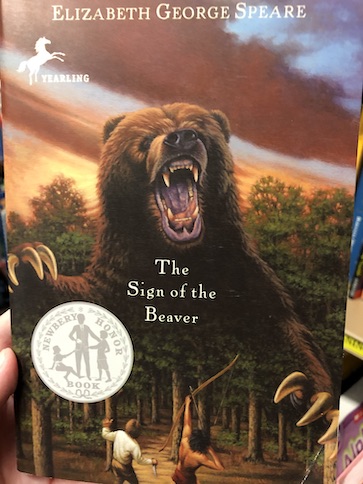
Sign of the Beaver by Elizabeth George Speare, 1983.

The story begins in the late 1760s with twelve-year-old Matt’s father leaving him alone in the log cabin that he and his father built for their family in the Maine territory. The rest of their family is still in Massachusetts, and Matt’s father is going to get them and bring them to their new home. Their family will be the very first to settle in what will soon be a new township. However, for now, Matt is alone at their cabin, surrounded by miles of wilderness, while he waits for his father to return and the rest of his family to arrive. Matt will be looking after the cabin and the field of corn that he and his father planted, but he finds the silence and solitude unnerving.

Before he left, Matt’s father left his watch and rifle with Matt. After his father leaves, Matt tries the rifle. He doesn’t hit anything, and he decides that it will take getting used to. He learns to hunt with it, and Matt finds that he is very busy with hunting, fishing, and chores, which helps pass the time. Every day, he makes a notch on a stick to mark the days that pass.

Gradually, Matt becomes aware that someone is watching him. Someone seems to be hiding and following him. Since there are no other white families living for miles around, he can only assume that it must be an “Indian” (Native American). They know that there have been some in the area, although they haven’t really met any yet. Matt finds the prospect a little worrying because he isn’t sure what to expect from them, but his father always told him that, if he met an Indian, he should just be polite and respectful. Matt is nervous that whoever is watching him is also hiding from him, though.

One day, Matt hears someone wearing heavy boots tramping in the woods, and Matt thinks that maybe his father has returned early for some reason. However, it turns out to be a stranger in a blue army uniform. Although Matt has missed having company, he finds himself reluctant to talk much to this stranger, and he doesn’t want the man to know that he is there completely alone. Still, the stranger is hungry, so Matt agrees to let him share a meal with him. The stranger, who calls himself Ben, stays the night with Matt, uninvited. Matt can’t bring himself to turn away someone who needs hospitality in the wilderness, and Ben tells him stories of his past adventures. Matt still has misgivings about Ben, and he’s sure his stories are tall tales. When Ben mentions leaving a town because there was trouble there, Matt thinks maybe Ben ran away because he’s a criminal. Matt plans to stay awake that night to keep an eye on Ben, but he eventually falls asleep. When he wakes up, Ben is gone, and so is his father’s rifle. Ben is a thief! Matt realizes that he was right to be suspicious of Ben and is angry that he let him get away with stealing the rifle.

Without that rifle, Matt can’t hunt. He can still feed himself through fishing, but he loses more of his supplies when he forgets to properly bar the door while he’s out fishing, and a bear eats most of the food in the cabin. Reduced to eating only fish, Matt gives in to temptation and tries to get some honey from some bees he finds in a nearby tree. It’s a bad idea, but this decision changes everything for Matt.

Matt is badly stung by the bees, and when he tries to escape them in the water, he nearly drowns. Fortunately, Matt is saved from drowning by the Indians who have been watching him. It turns out to be a grandfather and his grandson. The grandfather, Saknis, takes Matt back to his cabin, brings him food, and treats his wounds. When he realizes that Matt hurt his ankle and lost his boot in the water, he gives Matt a crutch to use for walking and a new pair of moccasins to wear.

Matt is both grateful for this much-needed help but also very self-conscious about it. He can tell that the grandson, Attean, doesn’t like him and thinks that he’s a fool for getting hurt like this, which is embarrassing. Matt also thinks that he should repay them for what they’ve given him, but he doesn’t have much to offer. The only thing he can think of to give them is the only book he owns, a copy of Robinson Crusoe. Matt is embarrassed when he realizes that the Saknis can’t read, and he thinks maybe he will be offended at this type of gift, but the older man realizes that Matt’s knowledge of reading is a gift that they badly need.

In broken English, the old man explains that his people have made treaties with white people before, but because they can’t read English, they never really know what’s written in the treaties. When white people break the treaties or tell them that they’re no longer allowed in certain areas of land, there isn’t much they can do, since they don’t even know for certain what was in the original agreements. He realizes that his people can’t afford to be ignorant. There are more white people moving into their territory all the time, and his people will have to know how to deal with them. Therefore, Saknis proposes a kind of treaty with Matt: they will continue to bring Matt food if Matt teaches Attean to read.

Attean immediately protests this plan. He really doesn’t like Matt, or any white people in general, and he doesn’t want these reading lessons. However, his grandfather is firm that this is something he needs to do. Matt also isn’t sure about this plan. He does owe them for their help, but he’s never taught anybody to read before. His own early lessons didn’t go particularly well, although he likes reading Robinson Crusoe now. Also, Matt thinks of Attean as being a “savage” and a “heathen” who doesn’t even really want to learn, so he’s not confident that the reading lessons are going to go well. Still, Matt does owe them for saving him and could use their continued help while he recovers from his injuries, so all he can do is try.

When Attean gets frustrated during the first reading lesson and storms out of Matt’s cabin, Matt thinks that the lessons are already over. Yet, Attean does return for more lessons. Gradually, Matt thinks of ways to make the lessons more interesting to Attean, reading the most exciting parts of Robinson Crusoe out loud to Attean to get him interested in reading the story himself and finding out what will happen to the main character. It isn’t easy to get Attean interested in learning because Attean is initially determined not to be interested or impressed by anything Matt has to say.

When Matt becomes curious about some of the things Attean and his tribe do, like how Attean hunts rabbits without a gun, Attean opens up a little and shows Matt some of the things he knows. Matt begins to admire some of the unique skills Attean shows him and learns to use them for himself. Matt is aware that his first efforts must look clumsy and childish to Attean as he tries to learn skills that Attean has known for years, but it puts the boys on a more equal footing with each other. Each of them has something to learn from the other, and it’s all right for each of them to look a little awkward to the other while learning. Matt gets embarrassed sometimes when he does something clumsy in front of Attean, but he learns that he must also persevere. Attean teaches him some good, practical skills for making things without using some of the manufactured goods that he and his father brought with them from Massachusetts. When Matt loses his only fish hook, Attean shows him how to make a new one. Attean teaches Matt to be self-reliant and to use new methods to accomplish his goals.

During the part where Matt reads the part of Robinson Crusoe where Robinson Crusoe rescues the man he calls Friday, and Friday, out of gratitude, becomes his slave, Attean protests that would never happen in real life. Attean says that he would rather die than become a slave. Matt is surprised because he never really thought that much about how someone like Friday would feel in real life. Matt learns to look at the story as Attean would, reading the best pieces to him, the ones that emphasize the friendship between the two characters rather than servitude.

Gradually, Matt and Attean become friends. Matt doesn’t think he’s very good at teaching Attean to read, but Attean does slowly learn. Although Attean resists learning to read because he’s trying to prove that he doesn’t need this skill that he associates only with white people, his spoken English becomes better as he and Matt talk. Attean admits that he tells parts of Robinson Crusoe to his people, and they enjoy hearing them, so Matt moves on to stories from his father’s Bible. Attean finds the Bible stories interesting and compares them to stories that his people already tell. (It is interesting, for example, how many civilizations around the world tell stories about great floods.) The boys are fascinated by the common themes in their stories.

The boys also enjoy doing things together, and Matt feels less lonely when Attean comes to visit. Matt doesn’t always like Attean because he has a disdainful attitude toward him, but they learn to trust each other, and they find interesting things to do together. Matt comes to realize that his irritation at Attean’s attitude is because it’s so difficult to earn Attean’s respect, and he really wants Attean’s respect. Although Matt doesn’t like Attean’s attitude toward white people, he does agree with Attean about some things, and he has to admit that he cares about what Attean thinks. Matt does get some respect from Attean later when the boys have a hair-raising encounter with a bear. Attean is the one who actually kills it, but Matt proves his usefulness during the struggle. Matt also comes to understand Attean’s resentment against white people when Attean eventually tells him that he’s an orphan and that his parents were killed by white people. That’s why he lives with his grandparents.

As time goes by, Matt becomes increasingly worried about whether or not his family will ever arrive. He worries that maybe something happened to his father and that the rest of the family won’t know where the cabin is and won’t be able to find him. When it passes the time when his family should have arrived, Matt fears that maybe they will never come at all. What if he is left alone? He has survived so far, with some help from Attean and his people, but can he live alone forever? Or could there be a place for him among Attean’s people?

Saknis has also been thinking about this, and he has noticed that Matt’s family has not yet come. He knows that it would be dangerous for the boy to remain alone in the cabin when winter comes. As the seasons change, the Native Americans are preparing to move to their winter hunting grounds. Saknis invites Matt to come with them, and Matt has to decide whether to accept the offer or stay and wait for his family.

This book is a Newbery Honor Book. It’s available to borrow and read for free online through Internet Archive (multiple copies).

My Reaction and Spoilers

This story reminds me a little of The Courage of Sarah Noble, where an 18th century white child who is afraid of Native Americans comes to learn more about them by living with them and interacting with them. I actually read The Sign of the Beaver when I was a child, and I only read The Courage of Sarah Noble as an adult. I’m not sure now if I prefer one of these books over the other. For a long time, I forgot the title of The Sign of the Beaver, although I did like this book the first time I read it. I remembered the concept of the boy living alone while he waited for the rest of the family to join him. One part that stuck in my mind the most was the part near the end of the story where Matt makes a cradle because he knows that his mother was expecting a baby when he last saw her and thinks that it would be nice to have a cradle ready for his new younger sibling, but when his family arrives, he is told that the baby died. That tragic image just stayed with me for years.

Some of the prejudiced language in the story, like “savage” and “heathen” and some anti-Catholic talk from Ben early on, is a little uncomfortable, but this is one of those stories about changing attitudes and overcoming prejudice. The main character has to show some fearful and/or prejudiced thoughts toward Native American initially for readers to appreciate how far he comes and how much his thinking changes after he makes friends with them and learns more about them.

Ben, of course, is a villain character, so his prejudiced talk is a reflection of that. He’s selfish and a thief, so his views of other people are based on what puts him in the best light or justifies things that he’s done. When he talks about the people of the last town he was in being against him and making trouble so he had to leave, both the readers and Matt realize that Ben was the one who started the trouble. Ben blames other people for problems he creates himself. The stories he tells Matt about his earlier, supposedly brave adventures are based around the French and Indian War, which is where the Catholics enter the discussion.

Several times during the story, Attean uses the word “squaw” to refer to women. I didn’t think too much about that sort of thing when I was a child because I assumed that both the author and characters in books that used that term knew what it meant and were using it correctly. Since then, I’ve heard that it actually has a rather vulgar meaning, although I’ve also heard conflicting information that it’s not always vulgar. The contradictory accounts make it a little confusing, but according to the best explanations I’ve read, the contradictions about the meaning of this word have to do with similar-sounding words in different Native American languages. Not all Native American tribes have the same traditional language, and some have words that sound like “squaw” and refer to females in a general way, while others have words with a similar sound that refer to female anatomy in a more vulgar way. For that reason, something that might seem innocuous to one native speaker might sound crude to another, and non-native speakers of any of the languages involved may not fully understand all the connotations of the word. In the end, I’m not sure how much of this the author of this book understood, but my conclusion is that it’s best not to use certain words unless you’re sure of their meaning, not only to you but to your audience. I only use the word here to make it clear which word appears in the book. Other than that, I don’t think this word is a necessary one, at least not for me. I understand what Attean is referring to in the context of the story, and I think that’s what really matters in this particular case. Whether that’s the right word for Attean’s tribe to use at this point in history would be more a matter for a linguist. I’m willing to accept it in the book as long as readers understand the context of the situation and are content to leave the word in the book and not use it themselves outside the context of the story.

When Attean talks about women in the story, it’s typically to point out certain types of work that he considers women’s work instead of men’s work. Matt is a little offended sometimes when Attean tells him that some chore he’s doing is for women instead of men. Matt’s family doesn’t have the same standards for dividing up chores as Attean’s tribe does, and the fact is that Matt is living alone at the moment. There are no women in Matt’s cabin, only Matt. Any chore that needs to be done right now is Matt’s to do because there simply is no one else to do any of it for him. I think when Attean tells him that he’s doing women’s work, he’s trying to needle Matt because, otherwise, he comes off as sounding a little dense. Sure, Attean. We’ll just have the women who aren’t here do this stuff that needs doing right now. During the course of the story, Matt comes to appreciate how the Native Americans live differently because it makes sense for the place where they live and their circumstances, but this is one instance where Attean could be a little more understanding about Matt’s circumstances.

One thing that I had completely forgotten about in this story was the part where Matt thinks about how Attean smells bad. Earlier, when I did a post about Mystery of the Pirate’s Ghost by Elizabeth Honness, I was irritated at the author for having one of the characters imagining smelly Native Americans because I had never heard of that as a stereotype before (I thought at the time), and I didn’t know where that idea came from. A site reader suggested that the trope came from the Little House on the Prairie series because there is talk like that in those books, but The Sign of the Beaver actually offers an immediate explanation as soon as Matt thinks about the cause of the smell. Matt realizes that Attean has smeared a kind of smelly grease on his body that is meant to repel mosquitoes. Matt has heard of people doing this before, and he understands that there is a useful purpose behind it, but he just hates the smell so much that he thinks he’d rather just put up with the mosquitoes. That explanation really helps to put everything into context. When there’s no explanation about things like this in stories, it makes it sound like Native Americans are just smelly because they’re “savages” who don’t bathe or something, but when you hear the explanation, it’s just that the smell is an inconvenient side effect from something that has a real, practical purpose. It might be unappealing to Matt, but there is a point to it. So, on the one hand, I feel a little bad about getting down on Elizabeth Honness for throwing that idea into her story without an apparent basis, but still irritated because, if she knew that was the explanation, she could have said something about it instead of just throwing that out there, like everyone reading the story would already know. I have similar feelings about some of the things Laura Ingalls Wilder put in her books, too. Context is important, and some authors are better at providing it than others. I also think that context is something that books from the late 20th century and early 21st century often provide better than books from earlier decades, although there are some exceptions.

At the end of the story, we don’t know for sure whether Matt and Attean will meet again. When Matt’s family arrives, they tell him that other white families will be arriving soon. Matt knows that the tribe he befriended will likely lose their hunting grounds to the town that will be built there. Matt is concerned for their future, but he is glad to be reunited with his family and still considers Attean his friend.
The Matchlock Gun

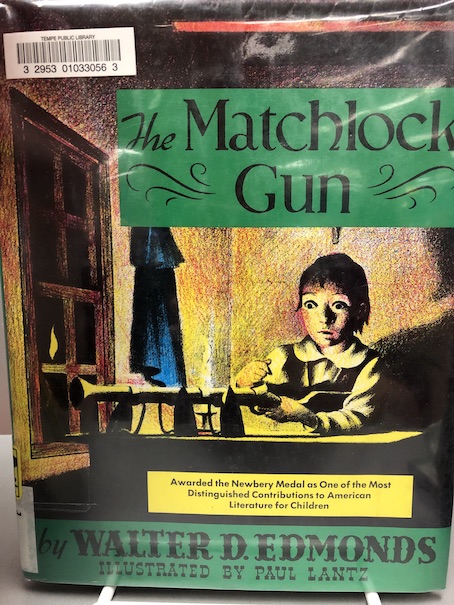
The Matchlock Gun by Walter D. Edmonds, illustrated by Paul Lantz, 1941, 1969.

Ten-year-old Edward Van Alstyne lives with his family on the mid-18th century American frontier in upstate New York, not far from Albany, during the French and Indian War. His father is captain of the Guilderland militia. Edward has had a long fascination for the large, old matchlock gun that his great-grandfather brought to America from Holland and wonders why his father never uses, preferring his smaller musket. His father shows him the old matchlock gun and explains to him how it works and how it’s old-fashioned, very large, and more difficult to use than his musket.

While Edward’s father, Teunis, prepares to go out on duty, Edward’s mother, Gertrude, worries about what will happen if Indians (Native Americans) attack while he is gone. Teunis doesn’t think that’s likely, but he says that Gertrude can take the children and go to his mother’s house. Gertrude and Edward’s grandmother do not get along because Edward’s grandmother has never approved of her. His grandmother never thought she was good enough for her son because she doesn’t come from a Dutch background, like they do, and because her family is poor. Gertrude would rather not turn to her for help except as a last resort, and Teunis doesn’t blame her.

Gertrude is still nervous after Teunis leaves, and she refuses to let Edward take some butter over to his grandmother’s house, as he often does. She doesn’t want the children going too far from the house, in case there’s trouble. Then, a family friend, John Mynderse, stops by with a message from Teunis, saying that he is fine, but the “French Indians” (the Native Americans aren’t actually French, but they’re allies of the French – I’ll explain below) have burned settlements, and he won’t be home tonight. It’s worrying news. Later, they see smoke on the horizon and worry about how far away it is, unsure of the exact distance.

Although Gertrude tries to be brave, she admits to Edward that she thinks that the fires are close. Edward asks if they should go to his grandmother’s house, but Gertrude would prefer to stay in their own house and wait for Teunis to arrive home. Privately, Gertrude has realized that the old brick house where the grandmother lives is more visible from the main road than their small wooden house. She doesn’t think that there’s anything they can do to help Edward’s grandmother, but she is hoping that she and the children will be overlooked if the Indians come through their area.

Gertrude begins coming up with a plan for defending their house, and she asks Edward if he would be afraid of firing the big, old matchlock gun. Edward wouldn’t mind firing the big gun, but it’s so big, he doesn’t know if he could manage to hold it. Gertrude says that she has a plan for that. Although they are inexperienced, Gertrude and Edward manage to get the gun loaded, and Gertrude chops a hole in the side of their house that they can fire through. Gertrude doesn’t expect Edward to actually aim the gun or hit anything. They just prop it up at the hole, and Gertrude tells Edward that, if she calls his name, he must use a candle to light the powder in the gun. When the powder is lit, Gertrude says that the big gun will go off with a huge bang and might scare off any attackers.

The Indians do come and attack the old brick house, and then, they come for the house where Gertrude and the children are. Gertrude is struck by a tomahawk as she runs for the house as the Indians approach, but she calls out to Edward, and Edward fires the gun. The attackers are killed in by the explosion from the gun, but the family’s house is set on fire. The children manage to drag their injured mother to safety, and Edward rescues the matchlock gun from the burning house.

When Edward’s father and the militia arrive, Gertrude is injured but still alive. The old brick house did not burn, as Gertrude had thought, but the barns were destroyed. The grandmother and her slaves barricaded themselves in the brick house. Edward is praised as a hero for defending his family at such a young age and for killing more Indians by himself than the adults did. (That last part is a little creepy, but they do praise him for that.)

This book is a Newbery Medal winner. It is available to borrow and read for free online through Internet Archive.

My Reaction

The Backstory

This is one of those books where I find the backstory much more interesting than the book itself. This is one of those historical novels for children written and published during World War II that looks back on American history and past conflicts, trying to reinforce historical lessons, instill patriotic feelings, and help children come to terms with the war that was happening around them at the time this book was new. This particular story takes place in the Hudson Valley in New York, not far from Albany, before the American Revolution in a community that’s largely settled by people of Dutch descent.

The family in the story is based on the real Van Alstyne family, and the incident with young Edward helping to protect his family from attackers by firing the family’s old matchlock gun really happened. The story emphasizes the family’s Dutch background. The mother of the family, Gertrude, is described as having a Palatine background, which means that her family was Germanic, but the major emphasis is on the Dutch influences in their background. There are Dutch words and phrases throughout the story.

The Foreword to the story explains the family’s history, but I actually recommend that readers save reading the Foreword last instead of reading it before reading the story. It explains not only the family’s past, but what happened to the family after the incident in the book. Little Trudy grew up and married a man named Hogle, and she became known as an excellent spinner, or spinster, in the professional sense rather that the unmarried sense. Her spinning ability was attributed to having to help her mother from a young age because her mother’s shoulder was permanently damaged from the tomahawk injury she suffered in the story. Trudy is credited as the one who passed on the story about her brother and the matchlock gun to future generations.

When interviewed about his historical novels, which were more for adults than children before he wrote this particular book for children, the author said:

“I want my readers to get out of my books a sense of the relation of history to the present day. History is often taught as a study of dead things and people; or else, and worse, from the debunking angle. What I want to show are the qualities of mind and spirit of plain, ordinary people, who after all carry the burden of human progress. I want to know about people, how they lived, what they hoped for, what they feared. I want to know what it was like to be born into this time or that, and what a man left behind when he died.”

I see the point about focusing on the lives of ordinary people because history is largely made up of daily life. Much of my historical education had this focus as well, not just focusing on the famous people or the major events, which are usually a reflection and extension of what’s happening on the ordinary and every day level. Much historical writing these days also does focus on debunking, which requires prior knowledge of what’s being debunked and why to be really effective, so I don’t think it works too well on level of children.

My personal approach to history, however, is to put things into context. I’ve given you the context of WWII, when this book was written and published, and the author’s view, but to get the full story behind this story, it helps to understand the French and Indian War. In the book, the attacking American Indians are just shown in their role as attackers, attacking innocent women and children and burning their homes. It’s a savage image that leaves a bad taste in the mouths of modern people, but it helps to understand what’s happening in the larger conflict.

In spite of its name, the French and Indian War was not fought between French people and American Indians. Instead, the French and Indian War, also called the Seven Years’ War (1754-1763), was fought between the British and the French, with the French aided by Native American allies. Both the French and the British were claiming territories for colonies in North America to support their empires, and as rivals for territory, each side was trying to assert its authority and control over certain regions. The Native Americans enter into the conflict because each side had Native American allies.

The reasons why Native Americans were willing to ally with these foreign powers and actively fight and risk their lives in the conflict were based on their perceptions of the treatment they were likely to receive from each side and the other tribes that were already allying with each side because of the war and their estimates of how the war was likely to affect their own territories and which side’s victory would be most likely benefit them. When European colonists entered North America, started their colonies, and began instigating these territorial conflicts, they were already entering a land inhabited by groups of people who had their own home territories and their own systems of alliances, relationships, and conflicts with each other. Essentially, the European colonists and this French and British conflict were destabilizing and unsettling Native American groups, and those Native American groups were trying to both work out new alliances with some of these newcomers that would grant them a greater degree of security and to push out groups of newcomers who seemed to represent the greatest threat to them and their territory. What each of these Native American groups wanted most out of this conflict was whatever they thought would best allow them to hold their own territory and put them in the strongest possible position to defend against rivals for that territory. Not all groups were eager to join this fight, but those who did believed that it was their best opportunity to protect themselves. In Walter D. Edmonds’s words, this is “what they hoped for, what they feared,” and this is what they were willing to kill and die for.

The reason why this war is important to American history is not only because it was a territorial struggle between major powers but also because it was one of the events that led to the American Revolution against Britain. The British colonist disputed having to pay Britain’s expenses for this war. The treaty and settlement that ended the war helped shape westward expansion that continued after the Revolutionary War. This war was also part of George Washington‘s early military experience, before he became the famous general of the American Revolution.

Part of what makes the Van Alstyne family’s experiences of this war both fascinating and tragic are that they belong to neither of the major sides of the war. They are not British or French. They are primarily of Dutch descent. That is emphasized repeatedly in the story. It’s how they think of themselves, and they are living among other colonists and settlers of similar backgrounds. Their misfortune is that they are living in one of the regions that is under dispute by larger powers. I think that’s part of the reason why the concept this story appealed to the author of the book. It’s about ordinary people caught up in larger events, and it shows the effect that larger conflicts have on ordinary people.

However, since the main hero of this story is a ten-year-old boy, I have to admit that it does make sense that the boy probably didn’t understand much about the larger conflict going on around him. The story only takes place over a little more than a day. His father leaves one evening, the children go to bed, the family is nervous the end day, they are attacked that night, and then, the father comes home. From the boy’s perspective, this attack on his family might have been the conflict in a nutshell. The territorial disputes between larger colonial powers was likely beyond him, which is why he doesn’t think about them during the course of the story. I still think that readers should understand it even if the characters don’t, though.

A Slave-Owning Family

One other thing that I think is important to mention is that there is slavery in the story, and Edward’s own family has slaves. In particular, Edward’s grandmother uses slaves. The slaves are not actually shown as characters in the story, but they are discussed. At one point in the story, Edward’s younger sister, Trudy, asks their mother why their grandmother has slaves and they don’t. Their mother explains that the old brick house where their grandmother lives and the land and slaves connected to it actually belong to the children’s father, as his father’s heir. So, technically, the slaves actually do belong to Edward’s father. However, their grandmother is very attached to the old brick house, so their father lets her live there and use the slaves to manage the house and estate.

A major reason why they explain all of this is so readers understand the setting of the story better and the relationship that this family has with the grandmother. Teunis built the wooden house where he lives with his wife and children so they could have some independence from his mother. He is willing to let his mother live by herself in the family’s big, old house with slaves to look after her and run the place, but it’s really better for his wife and children if they don’t live with her because of her attitudes. In particular, it’s her attitudes toward the mother of the family that make life difficult for them and leave them not wanting to get closer to her, not her attitudes about slaves. Teunis and Gertrude are willing to manage their smaller house without the help of slaves because it’s worth it to them to have to do without extra help in exchange for some separation from Teunis’s disapproving mother, which tells readers a few things about the grandmother we never see and the relationship the rest of the family has with her. Edward’s grandmother seems to be an overbearing and disapproving woman. While Teunis cares about her and her feelings, their relationship with her is better when they don’t live together in the bigger house, even though they could, making use of the household slaves themselves.

No one in the story disapproves of the idea of slavery, which also leaves a bad taste in the mouths of modern readers. Modern heroes and people who really believe in the ideals of freedom would have sympathy for enslaved people, not people actively practicing slavery itself. Since the family in the story is based on a real family, and keeping slaves was something that this real family actually did, it’s understandable from an historical viewpoint that the Van Alstynes are being described as they actually were. It’s important to acknowledge the way things actually were, even when they weren’t pleasant. But, there’s nothing that says that modern readers have like it. Just because the Van Alstynes are the main characters of this story doesn’t mean that you have to like everything about them or everything they do.

The focus of the story is a young boy who did a brave thing during an emergency situation and saved both his own life and the lives of his mother and little sister in the process. That’s ultimately what the author wanted the children of his time to take away from this story. His focus is on the boy and his family, and he doesn’t explain anything about larger social issues or even the background of the conflict they find themselves in. This is fairly short chapter book, a little less than 100 pages, and it seems aimed at younger elementary school students, not dealing with anything more complex than the main incident and adventure of the story. However, outside the story, readers can understand the wider context of things that happen in the story, and they can feel any way they want about that. If you understand the broader situation enough to have feelings about it, I think that’s a good thing.

For another review of this book, I recommend trying this one. It’s much shorter than mine, but it also has some thoughts about how people feel about historical aspects of this story.

Phoebe the Spy

Phoebe the Spy by Judith Berry Griffin, illustrated by Margot Tomes, 1977.

Phoebe Fraunces is a thirteen-year-old girl living in New York in 1776. The Fraunces family is black, but unlike most black people in the American colonies at the time, they have never been slaves. (There were some free black families who had never been slaves during this period of history, but they were uncommon.) Phoebe’s father, Samuel Fraunces owns a tavern called The Queen’s Head. It’s a popular place for people to meet, and Samuel Fraunces allows some prominent Patriots to meet there in secret and discuss their plans. Being party to such meetings could come with consequences as the colonies are on the brink of war.

One day, in April 1776, Samuel confides in his daughter that he has overheard something disturbing. He believes that George Washington’s life is in danger, that there are soldiers who are willing to kill their general for money. Samuel is worried about what he heard, but he isn’t sure what the plot against George Washington actually is and has no proof of what he heard. He’s afraid that if he tells Washington about what he heard too soon, without proof, the conspirators will just wait for a safer time to strike, so he asks Phoebe to help him uncover the truth. Samuel knows that George Washington will be coming to New York soon, and he has asked Samuel to help him find a housekeeper for the house where he will be staying. Samuel wants Phoebe to take the housekeeper position and to keep her eyes open for signs of danger.

Phoebe doesn’t know if she can do what her father wants her to do. She isn’t sure what she’s supposed to be watching for, and she doesn’t know how she could stop the plot if there is one. Her father tells her that she should look out for a man who is part of George Washington’s bodyguard and whose name starts with the letter ‘T’. This is all that Samuel was able to tell about the conspirator from the conversation that he overheard. He tells Phoebe to be careful, not to trust anyone, and to meet with him regularly in the market to tell him what she has learned. The two of them also discuss how odd it is that a man like George Washington, who owns slaves, would be at the center of a fight for freedom. Phoebe hopes that he will free his slaves after the war is over, although her father doubts that will happen. Still, the Fraunces family supports the cause of the Patriots, and Phoebe agrees to help her father find the conspirators and save George Washington’s life.

Phoebe is young to be a housekeeper, but she is accepted into Washington’s household. There, she meets Mary the cook and her son Pompey. Pompey also performs chores for the family, like carrying firewood. The work isn’t too hard for Phoebe because much of it is what she is accustomed to doing for her family’s tavern, like making beds, cleaning the silver, and making sure that meals are served on time. George Washington doesn’t say much when he’s around Phoebe, but she carefully observes the people around him. Every day, she goes to the market to buy food and see her father.

At first, Phoebe has nothing to report to her father. Everyone around George Washington seems to be nice or at least behaving normally, and nobody’s last name begins with the letter ‘T’. Mr. Green, a member of George Washington’s bodyguard, seems a bit unfriendly, but a younger man, Mr. Hickey, seems rather nice and sometimes gives Phoebe little presents.

However, there is a traitor among the household, and although it pains Phoebe when she learns who it is, she must do her duty and protect the life of the person she has promised to protect.

Some of the pictures in the book are black-and-white drawings, and some are in muted colors.

The original title of this book was Phoebe and the General. It is available to borrow and read for free online through Internet Archive.

Historical Background

The story is based on the real Fraunces family of New York. Samuel Fraunces really did own a tavern called the Queen’s Head and allowed Patriots to meet there. A note in the back of the book explains that after the war ended, he was given a reward by Congress, and he changed the name of the Queen’s Head to Fraunces Tavern. Fraunces Tavern still exists today, and it is still a restaurant, although part of it has been converted into a museum.

The racial identity of Samuel Fraunces has been in dispute for some time. No one is completely sure what he actually looked like. There is a portrait of a white man that has been reputed to be Samuel Fraunces, but the true identity of that portrait is in dispute. Samuel Fraunces is known to have had the nickname of “Black Sam”, but different sources describe the family differently. All that is known of Samuel Fraunces’s background is that he was born around 1722 and was originally from the West Indies. It’s possible that the Fraunces family may have been mixed race because some sources refer to Samuel Fraunces as “mulatto” (an old term for someone born to a white parent and a black parent, not considered a polite term now), which might explain the other, differing accounts of the family’s race.

The story of Phoebe Fraunces saving George Washington’s life is legend, but the facts regarding that incident are also in dispute. The legend might be based on a misunderstanding, and Samuel Frances’s real daughter, Elizabeth, does not seem to have been old enough at the time to have taken part in this adventure. The story has had a tendency to appear and reappear around patriotic milestones in the United States, first around the centennial in 1876 and then around the bicentennial in 1976, when this book was written.

The Cabin Faced West

The Cabin Faced West by Jean Fritz, 1958.

Ten-year-old Ann Hamilton hasn’t been very happy since her family decided to move West.  Her family lives in 18th century Pennsylvania, and moving West means homesteading in an area where there are few other families, none of which have girls Ann’s age.  Her father and brothers love the adventure of starting over in a new place on the western frontier (what is considered the frontier for their era), but Ann is lonely, surrounded by boys, and missing their old home.  When her father built their cabin, he purposely placed it so that the door faces to the west because he says that’s where their future lies.  Ann’s brothers, Daniel and David, also make up a rule that no one can complain about the west (partly because Ann had already been doing a lot of complaining), saying that anyone who does so will get a bucket of water poured over their head, and they make a game out of trying to catch each other complaining about something.  So, there is nothing Ann can do but suffer in silence and write in her diary, a present from her cousin Margaret when the family left Gettysburg.

There’s a boy close to her age who lives nearby, Andy McPhale, but Ann doesn’t think much of him.  He makes jokes about her being “eddicated” because she can read and write.  Sometimes, he seems like he wants to play with her, but she’s a girl, and he doesn’t want to play girl games.

Andy McPhale also worries about his mother.  His father believes in hunting and trapping more than planting.  Rather than grow some of their food, Andy’s father goes off for days at a time on hunting expeditions, leaving his family with very little while he’s gone.  Ann’s family thinks that this is a sign of poor planning for the future and don’t think highly of Andy’s father for it.

Later, they meet a young man named Arthur Scott who has just arrived in the area and is looking for land to settle on.  When Mr. Scott first arrives, he meets Ann on the road.  Ann has allowed the hearth fire to go out, and she is on her way to her aunt and uncle’s house to borrow some from them because she doesn’t know how to start a fire by herself.  Understanding her problem, Mr. Scott gives Ann a ride home on his horse and helps her to restart the fire, promising not to tell her parents.  They invite him to stay for lunch, and he talks about his time at Valley Forge with Washington’s soldiers when he was only 13 years old.  He was too young to fight, but he volunteered to drive an ammunition wagon.  Ann thinks of George Washington as a hero, and she finds it thrilling that Mr. Scott served with him.

Arthur Scott becomes a friend of the Hamilton family, and Andy McPhale seems jealous of him and the attention that Ann pays to him.  Then, Andy tells her that his family has decided to go back to town for the winter.  In the spring, they will return to the area and try farming, persuaded by their experiences working with the Hamiltons.  To Ann’s surprise, Andy offers for Ann to come with them.  She could visit Gettysburg and stay with her cousin Margaret again.  Ann has been lonely, being the only girl in the area, and it’s a tempting offer.  However, Ann feels like she must stay for her family’s sake and so she won’t feel like a deserter.  When a storm destroys a good part of her family’s crop, she feels terrible and wonders if it’s all really worth it.

In the end, there is a great surprise coming for Ann: she gets to meet her hero, George Washington, when he comes to see some land that he has purchased nearby.

The book is currently available online through Internet Archive (multiple copies).

My Reaction and Addition Information

I first read this book when I was a kid in elementary school. As the cover of the book says, the author won the Laura Ingalls Wilder Medal, which honors authors and illustrators for children who have made long-term contributions to children’s literature. Laura Ingalls Wilder was the author of the semi-autobiographical Little House on the Prairie books, but because those books contain uncomfortable racial language and situations, her name were removed from the award in 2018. The award still exists, but it’s now called the Children’s Literature Legacy Award, which is more descriptive of its purpose.

I liked this book as a kid, although I had forgotten many of the details before I reread it as an adult, and I’m not sure if I fully understood the history behind the story when I was a kid. I think stories actually become more interesting when you know the background, so I’d like to discuss the history a little.

The story is based on the real life of Ann Hamilton, the great-great-grandmother of the author of this book, who did get to meet George Washington in 1784. The author is essentially retelling an old family story. The real Ann Hamilton married Arthur Scott when she grew up.  The place where they lived, called Hamilton Hill in the story, is now called Ginger Hill. In fact, it seems that a member of the Hamilton family caused the name change, although that story isn’t really one for children.

One of the parts of the story that I always remembered from when I read it in school as a kid was the part where Ann talks about “mother’s fried wonders”, basically describing a fried donut. People in the 18th century did make various types of fried pastries, varying in style and name depending on where they lived. For an example of early American donuts, see this video by Townsends about 18th century doughnuts, where they make doughnuts and talk about the history and evolution of American “dough nuts” (they talk about the name and how it seems to come from the original shape – nut-shaped pieces of dough).

Felicity’s Craft Book

American Girls

Felicity’s Craft Book by Rebecca Sample Bernstein and Jodi Evert, 1994.

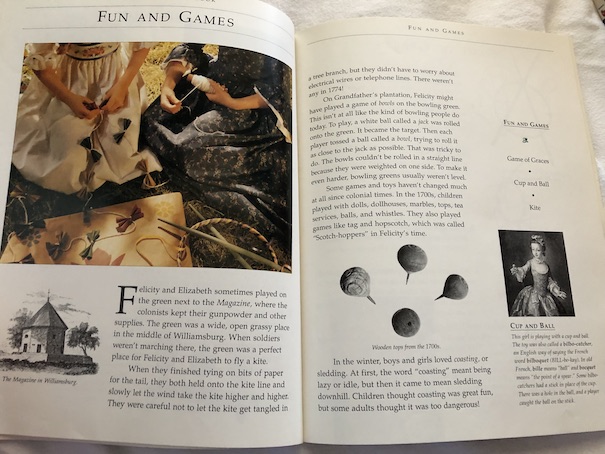
This is a companion book to the Felicity, An American Girl series.  It explains about the types of crafts that people would do in Colonial America and gives instructions for projects that readers can make at home.

In the beginning of the book, there is a brief history of crafting in America.  It explains that, in the earliest days of the American colonies, people had to get most of their goods from Europe because they had to spend their time and energy on building homes and establishing farms in order to survive.  However, as the colonies became more established, people were more able to make goods for themselves, both in their own homes and as professional craftspeople.  By the time that Felicity lived, during the late 1700s, there were many skilled craftspeople, and those craftspeople also trained new people in their professions in apprenticeships.

Before presenting craft projects that readers can make, the book also offers a few tips for safety and neatness while making things. The crafts are also divided into sections relating to topics like writing, sewing, games and toys, and scented objects that you can make with plants.

The projects explained in this book include:

A quill pen and two types of ink – The book gives instructions for making ink from different types of berries (such as raspberries, strawberries, and blackberries, which make red or purple ink) and walnut shells (which makes a brown ink).

A wax seal – To be used with sealing wax or wax from a candle. These were used to seal letters before the invention of envelopes with glue. (I know that there are people and companies that still make these because I have one myself and the sealing wax to use with it.)

Game of Graces – A hoop with a pair of sticks that were used for a tossing game.

Cup and Ball Game – A common toy in which a cup is attached to the end of a short stick and a ball is tied to it.  Players have to move the toy around and make the ball swing into the cup.

Kites – Made with lightweight paper.

Folding Fan – Made with poster board and ribbon.

Fancy Straw Hat – Explains how to decorate a hat with flowers and ribbon.

Fruit Pyramid – Used as a table centerpiece.

Cross-Stitch Sampler – A basic sampler using only the cross-stitch. (Colonial girls would create more elaborate samplers to show off the range of stitches they could make.)

Sachet – A small bag of potpourri (sweet-smelling dried plants).  Colonists would put sachets into trunks and wardrobes where they were storing their clothes to make them smell nice.  (Some people still do this in modern times.)  In a later part of the book, they also give instructions for making potpourri with herbs and flower petals.

Friendship Pincushion – An embroidered pincushion.

Tussie-Mussie – A small bouquet, like the kind that bridesmaids and flower girls might carry.  (The book says that people in Colonial times might carry one or maybe a pomander ball if they went to visit a sick person because they had an idea that breathing bad air would spread sickness and they were trying to freshen the air with fresh scents.  That’s not quite how sickness is spread, but they were partly correct about sicknesses being airborn.)

Pomander Ball – An orange scented and decorated with spices and cloves.  Besides freshening the air, they can also make nice decorations.

In the sections about different types of projects, there is additional historical information about life and crafts in Colonial America. Because, in the books, Felicity’s grandfather owns a plantation and one of the books takes place there, the craft book also has a section about plantations that includes a brief description of plantation life and slavery, noting that the lifestyle and pastimes that plantation owners enjoyed would not have been possible without their slaves to take care of the plantation chores for them.

The book is currently available online through Internet Archive.

The Ravenmaster’s Secret

The Ravenmaster’s Secret by Elvira Woodruff, 2003.

Forrest Harper is the son of the Ravenmaster of the Tower of London in 1735.  The story begins by explaining the tradition of keeping ravens at the Tower of London because of the superstition that the Tower would be conquered by its enemies if the ravens ever abandoned it.  This superstition led to the creation of the job of Ravenmaster, who looks after a flock of ravens that live at the Tower with wings clipped so that they can’t fly away.

Forrest Harper lives at the Tower with his parents and sisters, training to become a Ravenmaster, like his father.  He likes the ravens, and they like him.  He is pretty good at caring for ravens, but there is something that bothers him: he thinks that he isn’t brave enough and that others think that he is a coward, too.  He is smaller than the other boys and is often teased.  He has trouble cutting up the squirrels that the rat catcher’s boy (his only real friend, although his mother doesn’t approve of him) brings to him to feed to the ravens.  Even though it’s necessary, Forrest doesn’t like the sight of blood and feels kind of sorry for the squirrels.  Worse still, when Forrest’s family attends the public hangings (which were treated as a kind of festival day with music and entertainment in Forrest’s time), Forrest is unable to look at the criminals who are being hanged.  The one time he does try it, he throws up, and again, the other boys tease him mercilessly for it.  Forrest’s problem, as readers will see, isn’t so much that he’s a coward as he has more empathy than the other boys, both for animals and people, and that isn’t really as much of a problem as he believes.  His father tells him to ignore the bullies because they are foolish, and their foolishness will show in time.

Forrest sometimes dreams of going out into the wider world, beyond the Tower, where he could do something brave that would impress everyone.  The rat catcher’s boy, whose real name is Ned although most people just call him Rat, also dreams of running away because he is an orphan, treated harshly by his master and always in danger of being turned over to the chimney sweep to be used as a climbing boy.  He doesn’t think that Forrest has a real problem because his life at the Tower is pretty good, living comfortably at the Tower with his parents, whatever the local bullies say.  Still, the two boys often imagine what it would be like to go to sea together and have adventures.  When there is an announcement that a new prisoner will be arriving at the Tower, a Scottish Jacobite rebel, Forrest thinks that helping to guard a dangerous rebel will make the Tower bullies respect him.

To Forrest’s surprise and embarrassment, this rebel actually turns out to be a girl.  She is the daughter of the rebel Owen Stewart, who is being held in a different tower at the Tower of London (the Tower of London is actually a fortress with multiple towers – she is imprisoned in Bloody Tower and her father is in Bell Tower).  She has been charged with treason, along with her father and uncle.  Forrest isn’t happy about being given the task of taking food to a girl prisoner. 

However, Madeline McKay Stewart, the girl prisoner, is pretty tough in her own right.  Although Maddy’s been separated from her father and uncle and all three of them are likely to be executed, she is being pretty brave about it.  She talks to Rat and Forrest.  She is interested in Forrest’s pet raven, Tuck, and tells him about how she used to feed baby owls back home.  She talks about her life and family in Scotland, and Forrest realizes that he’s starting to think of her as a friend instead of an enemy to be guarded.

While Forrest is used to hearing English people criticize the Scots for being “savage,” he is astonished and a bit offended when Maddy talks about English people being “evil.”  For the first time, it makes him think of the situation from the other side.  He knows that not all English people are evil and realizes, having seen that Maddy actually has refined manners, that Scottish people aren’t “savage.”  One day, at Maddy’s request, he takes a message to her father in exchange for her ring, which he plans to sell in order to buy Ned back from the chimney sweep after the rat catcher loses his term of indenture to the chimney sweep in a game of cards, sparing him from the horrible life and health problems that the young climbing boys suffer.  Then, Owen Stewart gives Forrest a message to take back to Maddy.  Without really meaning to, Forrest realizes that he has suddenly become a go-between for the rebels and could be considered a conspirator under English law.

As Forrest considers the fate that lies ahead for Maddy and the nature of war between England and the Scottish rebels, it occurs to him that the adults in his life have often done the opposite of the things that they have always taught him were important.  His father always emphasized fairness, yet the war and Maddy’s possible execution are unfair.  Maddy shares Forrest’s feeling that the world might be a better place if people didn’t become adults and abandon their values.

Then, Maddy’s father and uncle are shot while attempting to escape, and Maddy is left completely alone.  Forrest feels badly for Maddy.  Soon after, he is unexpectedly approached by a carpenter who seems to know that he has become friends with Maddy.  The carpenter, who is a stranger to Forrest, tells him that Maddy will soon be executed by beheading but that he has a way to save her life.  Forrest has to decide if he is willing to trust the stranger and save Maddy, knowing that doing so would make him a traitor himself.

One of the parts of this story that interested me was how Forrest noted the hypocrisy in the adults around him as he was trying to decide what he should do.  Qualities that adults often praise and try to instill in their children are often ignored in the way that the adults live and even in how they treat other children, like Ned and Maddy.  Abandoning values, even the ones that they really want their children to have, isn’t something that adults have to do as they grow older, but it is something that some adults do if they think they must in order to live as they want to live or accomplish something that they want to accomplish.  The adults who think that Maddy should be beheaded would probably say that they were doing it for the greater good in promoting their cause against the rebels.  However, treating Ned as a piece of disposable property is something that they mostly do because they can and because they know that there is nothing that Ned can do to stop them.  Ned actually tries to repay his indenture legally with money that Forrest gives him, but although the sweep accepts the money, he refuses to let him go, saying that no one will take Ned’s word over his and that he could always use the money to make sure that Ned is hung as a thief if he tries to make trouble.  It is this type of attitude and situation that make the children realize that they are on their own to solve their problems and that working within the law is not going to be an option for them because the law is not just and it is not on their side.  It’s a frustrating situation, and I often feel frustrated when I encounter this type of thing in books, but fortunately, things do turn out well in the end.

This is one of those coming-of-age stories where a boy must decide what he stands for and where he really belongs.  Through Maddy and the inscription on her ring, which means “Face Your Destiny,” Forrest comes to understand the destiny that is right for him as he helps both Maddy and Ned escape to a better life elsewhere. 

The book also includes some interesting historical information. There’s a map of the Tower of London in the front of the book, and in the back, a short history of the Tower with information about famous prisoners and escapes. There is also a glossary of English and Scottish words that modern children (especially American children) might not know, such as breeches, wench, loch, and tattie-bogle (scarecrow).


The book is currently available online through Internet Archive.  (To borrow a book through Internet Archive, you have to sign up for an account, but it’s free, and then you read the book in your browser window.)

Spoiler: In the last chapter of the book, it explains what happened to the characters after the story ends.  Forrest does become the Ravenmaster after his father, realizing that it is the right kind of life for him and that he no longer desires to have adventures outside the Tower.  He has a wife and daughter, and years later, he receives a message from Ned, who says that he has become a captain in the Royal Navy and that Maddy has gone to live in the colonies with other Stewarts (something that my own Jacobite ancestors did, which is how I got to where I am now).

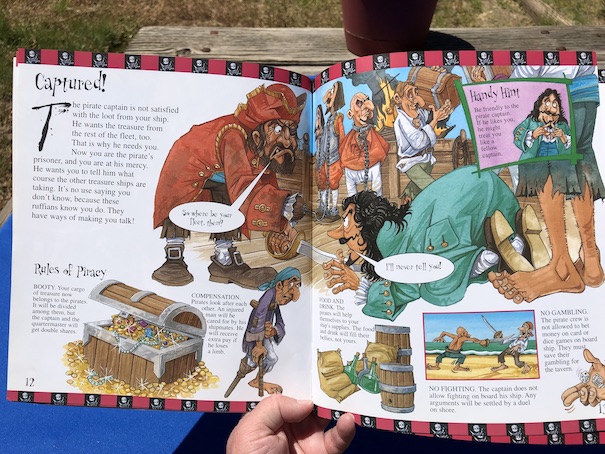
You Wouldn’t Want to Be a Pirate’s Prisoner

You Wouldn’t Want to Be a Pirate’s Prisoner by John Malam, 2002.

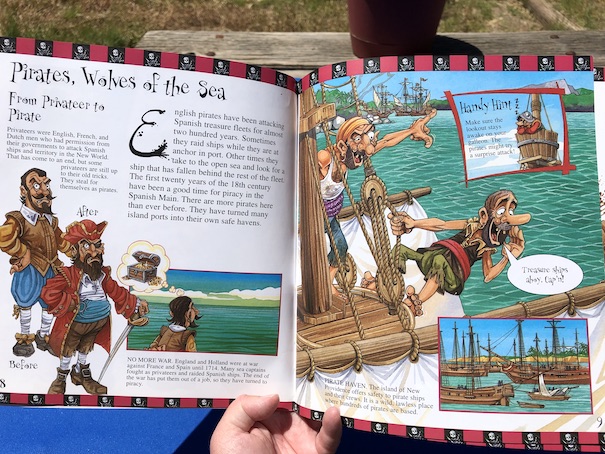
This picture book, which is part of a series, explains what it would have been like to be a pirate’s prisoner in the 18th century.  It sets the stage by casting the reader in the role of a Spanish ship captain in 1716.

The reason why the reader is cast as a Spanish captain, captured by English pirates, is because England and Holland had been at war with Spain until 1714.  During the war, the government of England (as well as Holland and France) authorized some ship captains to act as privateers, conducting raids on Spanish ships and outposts.  When the war ended and the privateers were dismissed from service, some of them continued to act as independent pirates.

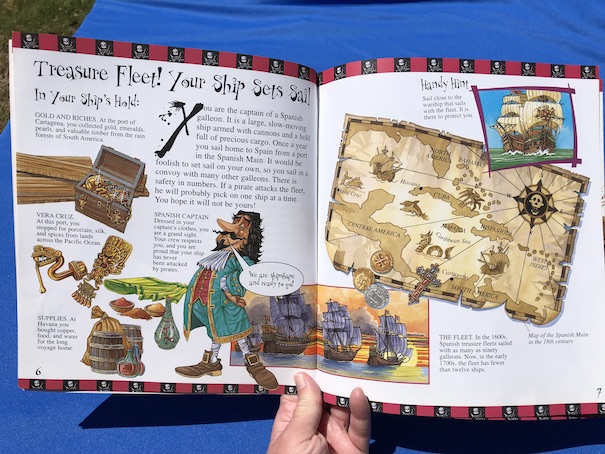
The book explains the geography of the “Spanish Main,” the area between the southern coast of North America and the northern coast of South America – basically, the Caribbean Sea and its islands and the Gulf of Mexico.  Spanish galleons in the 18th century carried gold and treasures from the Americas to Spain as well as timber from the rainforests and goods that were transported to the Americas across the Pacific Ocean, such as spices and silk.  All of these goods made Spanish treasure ships tempting targets for English pirates.

As a Spanish ship’s captain, there were a few precautions that you could take against pirate attack.  One of the most basic was traveling as part of a convoy because pirates would be more likely to attack a lone ship than one that was part of a group.  A fleet of ships would have a warship traveling with them for protection, and the closer your ship sailed to the warship, the less likely a pirate ship would try to separate you from the group and attack.

If the worst situation happened and the ship was taken by pirates, a captain could try to dress like other members of the crew to disguise his rank, but that didn’t always work.  The captain of the ship was in danger of being taken captive because he might have information that the pirates would find useful, like the exact route of other ships in a convoy.

The gruesome part of this book (and the source of the title, because this series basically focuses on the gruesome parts of history) is the part where they describe different forms of torture that pirates might use on a ship’s captain to convince him to tell them what they wanted to know.  Besides the direct physical abuse, pirates could also keep a captive in squalid conditions to make him weaker, more vulnerable, and exposed to disease.  In the end, they might simply decide to maroon the captive somewhere, even if they got the information they were after.

However, pirates could also face gruesome fates if they were caught. They could be hung and their bodies displayed publicly, as a warning to others.

The Courage of Sarah Noble

SarahNoble

The Courage of Sarah Noble by Alice Dalgliesh, 1954.

SarahNobleCookingIn 1707, a man living in Massachusetts named John Noble bought some land in Connecticut which had recently been purchased from a tribe of Indians (Native Americans) living nearby.  He planned to move his family there and start a new homestead, but with his children so young and the baby somewhat sickly, it was decided that he would travel to the new land ahead of his family and start building a new house there.  The only family member to accompany him was his eight-year-old daughter, Sarah, who came along to cook for him.  Before they leave home, Sarah’s mother tells her to “Keep up your courage,” something which Sarah repeats to herself from time to time.

SarahNobleFamilyOn the way to their new property, Sarah and her father have to camp out in the wilderness, although they do manage to stay one night with a family called Robinson.  The Robinson boys tease Sarah, saying that where she’s going, the Indians will probably chop off her head and eat her or do other horrible things.  Their sister tells Sarah not to worry because her brothers just like to tease.  Sarah’s father and Mistress Robinson also reassure her that the Indians in the area are friendly and that they sold their land knowing that new people would come there.
The Robinsons make Sarah uncomfortable.  Sarah later says to her father that there doesn’t seem to be love in the Robinson house. Her father agrees with the observation and says that the Robinsons should learn to watch their words and teach their children to do the same, adding “there are people in this world who do not help others along the way, Sarah, while there are those who do. In our home all will be treated with kindness-always, Sarah. The Indians, too, and they will not harm us.”  Although the Robinsons allowed the Nobles to stay the night in their house, they didn’t exactly make them feel welcome, and both of them realize that the things the boys were saying and their rough manner were clues to the Robinsons’ real attitudes and the kinds of things the parents talk about when no one else is around.

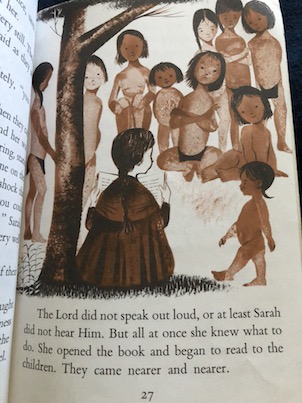
SarahNobleReadingWhen Sarah and her father reach the land that is to be their new home, they take refuge in a hollow place in a hillside, and John begins building their new house.  However, Sarah is still very nervous and lonely.  Then, while Sarah sits, reading the Bible, some curious Indian children from the nearby tribe come to see her.  She reads a Bible story aloud to them, and they listen, but she when she finishes the story, she can tell that they didn’t understand what she was saying.  Sarah can’t understand them, either, when they try to talk to her.  She gets impatient and snaps at them for not knowing English, and they run away from her.  Sarah is sorry about that because she realizes that she shouldn’t have been so irritable, and even if they couldn’t talk to each other, it was still nice to have people around.
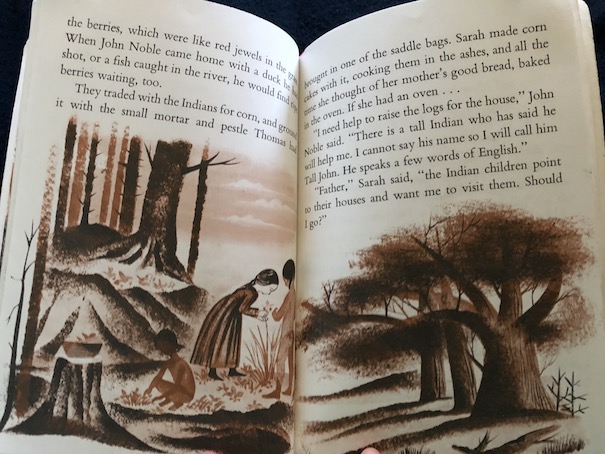
Fortunately, the Indian children come back to see her again, and they become friends.  She tries to teach them English, but they don’t make much progress at first.  Even without being able to talk to each other, though, they can still do things like picking berries together.

SarahNobleNativeAmericanChildren

Sarah’s father also becomes friends with an Indian he nicknames “Tall John” because he can’t figure out how to pronounce his real name.  John and Tall John trade with each other, and John allows Sarah to visit Tall John’s home to play with his children.

When John finishes building the house and it is time for him to go and fetch the rest of their family, he decides that it would be better for Sarah not to make the long journey again, so he leaves her in the care of Tall John and his family.

SarahNobleStaysBehind

At first, Sarah is a little worried about living with the Indians.  Being friends and visiting during the day is one thing, but what would it be like to actually live with them?  Although Sarah likes her Indian friends, it’s obvious that the stories that she’s heard all her life about “savage” Indians bother her, and she still has some prejudices and misconceptions to overcome.  There are also the worries that often accompany children who are staying with someone other than their parents: what if something bad happens, her father never comes back, and she never sees her family again?  Sarah worries that, even though the tribe that lives nearby is nice, there are other Indians who aren’t, and some of them might attack while her father is away.

Fortunately, things go well during Sarah’s time with the Indians.  She finds some of their habits strange, and she notices that Tall John’s children (nicknamed “Small John” and “Mary”) find some of her habits strange, like the clothes she wears and the way she prays at night.  Tall John’s family gives Sarah some deerskin clothing, like they wear, and some moccasins, which she finds surprisingly comfortable.  There is a scare about a possible attack, but that passes without incident, and Sarah ends up enjoying her time with her Indian friends, playing games and participating in chores with them.  Tall John and his wife treat Sarah like one of their own children.

When it’s time for her to rejoin her family, Sarah changes back to her old clothes, but they no longer seem as comfortable to her, and she decides to keep wearing the moccasins.  A little of her Indian friends has rubbed off on her, and she is a different person because of her experiences.  Sarah’s mother expresses some concern about her daughter having lived with “savages” (her word), but Sarah is quick to defend them, saying that they aren’t savages and that they’re friends.  Her father agrees that Tall John and his family are good people who took good care of Sarah.

This book is a Newbery Honor Book.  It is currently available online through Internet Archive (multiple copies).

My Reaction

Throughout the story, various characters have obvious prejudices about American Indians, and the language used isn’t what we would use today (ex. “Indians” instead of “Native Americans” and nobody says “squaw” anymore (or shouldn’t – white people used to think it simply meant “woman” but it has other connotations as well, better to just say “woman” when that’s what you mean)), but these are fitting with the time period when the story takes place.  The overall attitude of the story, especially Sarah’s evolving attitudes toward her new Native American friends, is good.  Sarah begins by being frightened because of all of the scary things people have told her about Indians, but once she begins spending time with them and living among them, she sees that the things she heard before weren’t true, and she values their friendship.  The parts where characters behave in prejudiced or condescending ways are uncomfortable, but you can’t have a story about improvement without someone behaving or thinking wrongly in the first place.  At least, that was my interpretation.  I understand that there are others who are more concerned.  At the end of the story, Sarah’s mother doesn’t seem convinced about the Indians, but I like to think that experience may change her as it did Sarah.  I think Sarah’s mother represents where Sarah came from but not where she ends up.  I think it’s important to explain to children the historical context of the story and put the emphasis on Sarah’s changing opinions.  Sarah’s experiences help her to see the truth about her new neighbors.

The author’s note in the beginning of the book explains that the story of Sarah Noble is based on the life of the real Sarah Noble, who did accompany her father to the family’s new homestead when the community of New Milford was forming in order to cook for him while he built the family’s new house.  The real Sarah did live with the nearby tribe of Native Americans for a time, although the author of the story had to invent some of the details of her stay.  It also says that the real Sarah maintained a friendship with the Indian the book refers to as “Tall John.”  The real Sarah become a school teacher as an adult, as the Sarah in the story said that she wanted.  She also married and had children.

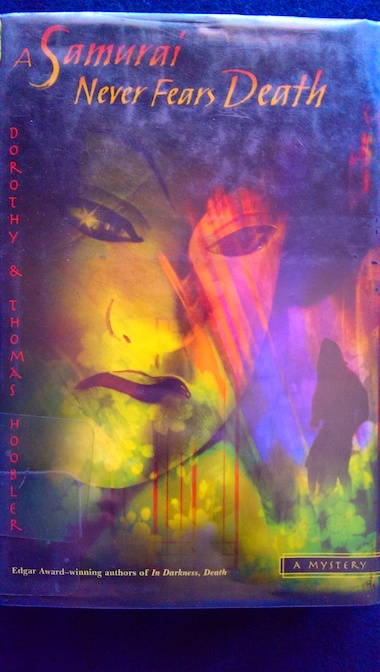
A Samurai Never Fears Death

SamuraiNeverFearsDeath

A Samurai Never Fears Death by Dorothy and Thomas Hoobler, 2007.

This book is part of the The Samurai Detective Series.

Sixteen-year-old Seikei returns home to visit his birth family in Osaka while Judge Ooka investigates reports of smugglers in the city.  Seikei is a little nervous about seeing his birth family because he hasn’t gone to see them since he was adopted by Judge Ooka about two years before.  All he knows is that his younger brother, Denzaburo, is helping his father to run the family’s tea business, which is probably a relief to Seikei’s father because Denzaburo was always more interested in the business than Seikei was.

However, things have changed in Seikei’s family since he left Osaka, and his homecoming isn’t quite what he imagined it would be.  Seikei had expected that his older sister, Asako, might be married by now, but she says that Denzaburo is keeping her from her dowry because he needs her to help run the family business.  Although Denzaburo enjoys business and the life of a merchant, it turns out that Asako has a better mind for it than he has.  The two of them have been running the family’s tea shop by themselves because their father is ill.  Also, although the family no longer lives above their shop, having bought a new house for themselves, Denzaburo says that he sometimes stays at the shop overnight to receive deliveries of goods.  Seikei knows that can’t be true because no one ever delivers goods at night in Osaka.  Denzaburo brushes off Seikei’s questions by suggesting that the three of them visit the puppet theater together to celebrate Seikei’s visit.

At the puppet theater, Seikei learns that Asako is in love with a young man who is an apprentice there, Ojoji.  Because Ojoji is only an apprentice, the two of them cannot afford to get married, something that Denzaburo laughs about.  However, before Seikei can give the matter more thought, they discover that one of the narrators of the plays has been murdered, strangled.

They summon an official from Osaka to investigate the scene, Judge Izumo, but Seikei isn’t satisfied with his investigation because it seems like Judge Izumo is quick to jump to conclusions.  Then, suspicion falls on Ojoji.  Asako doesn’t believe that the man she loves could commit murder and wants Seikei to ask Judge Ooka to intercede on Ojoji’s behalf, so Seikei begins to search for evidence that will help to prove Ojoji’s innocence.

The mysterious happenings and murders (there is another death before the book is over) at the puppet theater are connected to the smuggling case that Judge Ooka is investigating, and for Seikei, part of the solution hits uncomfortably close to home.  However, I’d like to assure readers that Asako and her beloved get a happy ending.

During part of the story, Seikei struggles to understand how the villains, a group of bandits, seem to get so much support and admiration from other people in the community, including his brother.  It is Asako who explains it to him.  It’s partly about profit because the outlaws’ activities benefit others monetarily, but that’s only part of it.  In Japan’s society, birth typically determines people’s roles in life, and each role in society comes with its own expectations about behavior, as Seikei himself well knows.  Seikei is fortunate that circumstances allowed him to choose a different path when he didn’t feel comfortable in the role that his birth seemed to choose for him; he never really wanted to be a merchant in spite of being born into a merchant family.  Others similarly do not feel completely comfortable with the standards that society has set for them, and their fascination with the outlaws is that the outlaws do not seem to care what society or anyone else thinks of them.  The outlaws do exactly what they want, when they want to do it, dressing any way they please, acting any way they please, and taking anything they want to use for their own profit.  Denzaburo, who was always willing to cut corners when it profited him, sees nothing wrong with this, and he envies the outlaws for taking this idea to greater lengths that he would ever dare to do himself.

The idea of throwing off all rules and living in complete freedom without having to consider anyone else, their ideas, their wants, their needs, can be appealing.  Asako understands because, although she is better at business than either of her younger brothers, she cannot inherit the family’s tea business because she is a girl.  She thinks that, because the system of society doesn’t look out for her interests, she has to look out for herself, and what does no harm and makes people happy (in the sense of giving them lots of money) shouldn’t be illegal.  At first, Asako sees their activities as victimless crimes. Although she doesn’t use that term to describe it, it seems to be her attitude.  However, do victimless crimes really exist?  Seikei has a problem with this attitude because what the outlaws are doing has already caused harm in form of two deaths and the risk to Ojoji, who may take the blame for the deaths even though he is innocent.  Asako might not care very much about the others at the puppet theater, but she does care about Ojoji.

It’s true that Seikei has defied the usual rules of society by becoming something other than what he was intended to be, and for a time, he struggles with the idea, comparing himself to the outlaws, who were also unhappy with their roles and wanted something different.  However, the means that Seikei used to get what he wanted in life are different from the means that the outlaws use, and Seikei also realizes that his aspirations are very different from theirs.  While Seikei had always admired the samurai for their ideals and sense of honor and order, the outlaws throw off the ideals of their society in the name of doing whatever they want.  Although the outlaws do benefit some of the poorer members of society, paying money for goods that the makers might otherwise have to give to the upper classes as taxes and tribute and trying to stand up for abused children when they can because their leader was also abused as a child, their main focus is still on themselves and what they and their well-paying friends want.  Seikei is concerned with justice and truth, which are among his highest ideals.  Even though he learns early on that, as a samurai, he could claim responsibility for the deaths at the theater himself because, in their society, a samurai would have the legal authority to kill someone for an insult.  Claiming responsibility for the killings would allow Ojoji to go free, and it would be one way to solve the problem quickly and make Asako happy, but Seikei cares too much about finding the truth behind the murders and bringing the real murderer to justice to take the easy way out.  It is this difference in ideals and priorities between Seikei and others around him which set them on different paths in life.

One thought that seemed particularly poignant to me in the story is when Seikei reflects that we don’t always understand the importance of the choices we make in life at the time when we have to make them because we don’t fully understand all the ways in which a single choice can affect our lives.  He thinks this when the leader of the outlaws offers to let a boy who was abused come with them and join their group after they intervene in a beating that the boy’s father was giving him.  They tell him that joining their group would mean that he could do whatever he wants from now on.  The boy, not being sure who they are or what joining their group would really mean for him, chooses to stay with his father.  Seikei wonders then whether the boy will later regret his decision or not.  His father obviously doesn’t treat him well and may not truly appreciate his show of loyalty by remaining, although joining the outlaws comes with its own risks.  It’s difficult to say exactly which two fates the boy was really choosing between in the long run and which would be likely to give him a longer, happier life, which is probably why the boy chose to stick with what he already knew.

There is quite a lot in this story that can cause debates about the nature of law and order, society’s expectations, and the effects of crime on society and innocent bystanders.  I also found Seikei’s thoughts about what makes different people choose different paths in life fascinating.  I’ve often thought that what choices a person makes in life  are determined about half and half between a person’s basic nature and the circumstances in which people find themselves, but how much you think that or whether you give more weight to a person’s character vs. a person’s circumstances may also make a difference.

The story also explains what fugu is, and there is kind of a side plot in which Judge Ooka wants to try some.  A lot of the characters think that the risk involved in eating the stuff isn’t worth it, but well, a samurai never fears death, right?

There is a section in the back with historical information, explaining more about 18th century Japan and the style of puppet theaters called ningyo joruri, where unlike with marionettes or hand puppets, the puppeteers are on stage with the puppets themselves, wearing black garments with hoods so that the audience will disregard their presence (except for very well-known puppeteers, who might reveal their faces).  For another book that also involves this style of puppetry, see The Master Puppeteer.