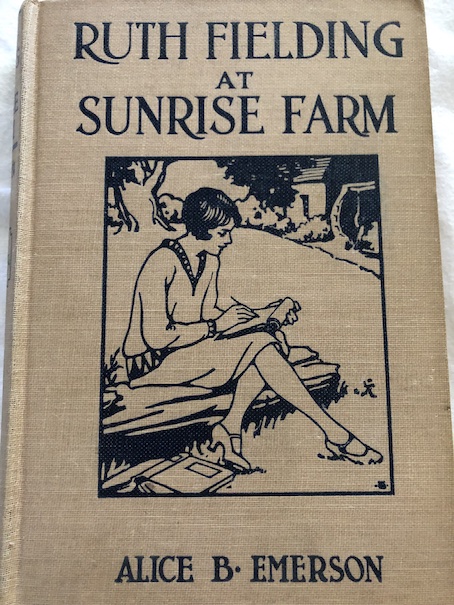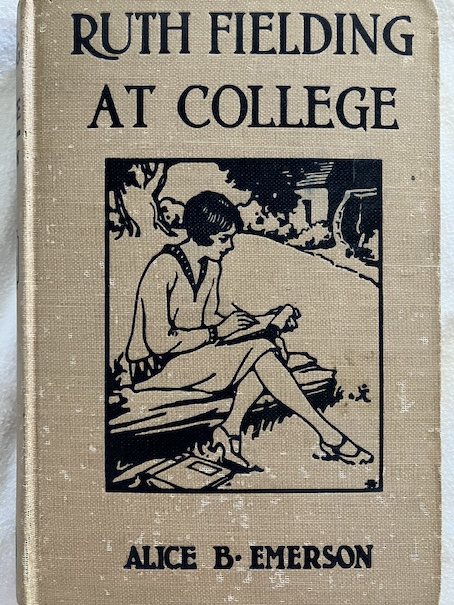
Ruth Fielding at College

Ruth Fielding

Ruth Fielding and her friends have graduated from their boarding schools, and now, they’re headed off to college! Ruth and her best friend, Helen, will be attending Ardmore, a college for young women only. Helen’s twin brother, Tom, will be going to Harvard. When they were at boarding school, they also attended girls’ only and boys’ only schools, but their schools were located near each other, and they were able to visit each other on weekends and attend joint social events held between the schools. Helen and Tom are close as twins, and Helen worries that she won’t be able to see her brother as often while they’re in college. Tom and Ruth are also fond of each other, and although they’re excited about college, they’re also a little sad at the idea of being apart.

While they’re having tea with Aunt Alvirah (the housekeeper), the hired hand working for Ruth’s Uncle Jabez, Ben, comes in and says that there is a boat adrift on the river that runs by the mill where they live. Everyone goes outside to have a look at the boat. At first, they think no one is in it, and Uncle Jabez says, if it’s abandoned, then he will go after it as salvage. Then, they see that someone is in it after all, just lying down in the bottom of the boat, but the boat is drifting toward the dangerous rapids below the mill! Whoever is in the boat seems incapacitated or unaware of their dangerous situation.

Uncle Jabez is less eager to go after the boat when he knows there’s somebody in it than he was when he thought he could get a free boat, but Ruth persuades him that they have to rescue whoever is in the boat. They manage to reach the boat, and they find an unconscious girl in it. They bring the girl back to the house with them, and Tom says that he will get a doctor. However, Aunt Alvirah doesn’t think that a doctor will be necessary because it looks like she has only fainted, and she thinks that the girl will be all right.

When the girl wakes up, she explains that her name is Maggie and that she was working at Mr. Bender’s camp for summer vacationers up the river. After the season ended, the vacationers left, and Mr. Bender paid her for her time at the camp, someone was supposed to give her a ride across the river with her luggage, but Maggie fell asleep while she was waiting in the boat. When she woke up, she was drifting down the river alone. She got scared, and she fainted. Ruth says, if her job is over, then she has no reason to return to Mr. Bender’s camp, and Maggie says that’s true and that she needs to find another job. Ruth says they can use their telephone to call Mr. Bender’s camp to explain the situation and reassure Mr. Bender that Maggie is all right.

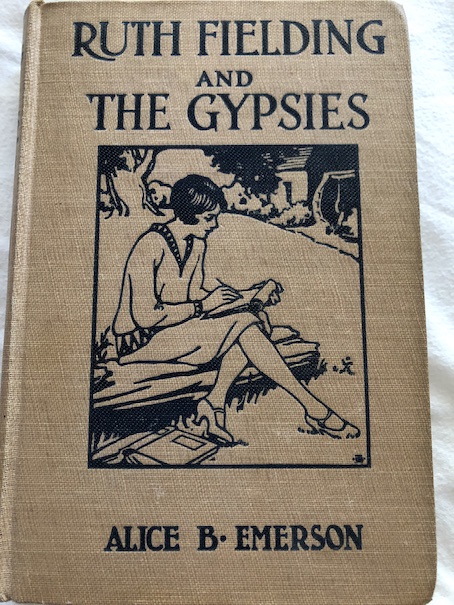
Ruth likes Maggie, and she notices, from the way she talks, that she seems more refined than most poor working girls. Aunt Alvirah is getting older, and she often has trouble with her rheumatism. Ruth suggests to Uncle Jabez that they hire Maggie to help Aunt Alvirah at the mill this winter while Ruth is away at college. Uncle Jabez is still a miser and he grumps about Ruth spending his money. Ruth has money of her own now, and she is willing to pay Maggie’s wages, although she says that Uncle Jabez must make sure that Maggie has good food because she looks undernourished. Ruth and Uncle Jabez often butt heads over the issues of money and Ruth’s education because Uncle Jabez never had much education and is both proud of the money he has now and is tight-fisted with what he has. At this point, the story explains some of the history of the characters. Since Ruth retrieved a stolen necklace for the aunt of one of her school friends and received a reward for it (in Ruth Fielding and the Gypsies), Ruth has had enough money to be financially independent of her uncle and to fund her education. She is also correct about Aunt Alvirah’s age and health, and she is concerned for the older woman’s future.

Aunt Alvirah welcomes the idea of help at the mill, and Maggie accepts the position. Ruth notices that Maggie studies an Ardmore yearbook, and she is surprised that Maggie is interested in the school. She has the feeling that there is more to Maggie’s past than she knows.

When Ruth and Helen go to Ardmore, some of the girls have already heard about Ruth’s reputation as a writer of movie scenarios from the movie that Ruth wrote and her classmates helped make to raise funds to replace a dormitory that burned at their school. Some of them are prepared to despise Ruth as being stuck up about her writing, although some who saw the moving picture liked it.

A girl named Edith thinks that they’ll have to “take her down a peg or two” as soon as she arrives. One of the other girls, Dora, reminds the others about the rules against hazing at the school. The rules have been strictly enforced since a hazing incident went too far last year and traumatized a student, Margaret Rolff, who was trying to join the Kappa Alpha sorority. Since that incident, the college has forbidden sororities to initiate freshmen or sophomore students as members and cracked down on hazing rituals. Edith, a sophomore, thinks that’s a shame because the sororities are fun, while May sarcastically remarks about how fun “half-murdering innocents” is. The students aren’t really supposed to talk about what happened to Margaret, although the sophomores don’t see why not because everybody who was at the school when it happened knows about the incident.

Margaret’s nerves were apparently shattered by the incident, and a valuable silver vase, an ancient Egyptian artifact, disappeared from the college library the same night. It isn’t entirely clear what the Kappa Alpha sorority told Margaret to do, specifically, but it seems that Margaret’s initiation task involved both taking the vase from the library and going to nearby Bliss Island alone at night. She was found there the next day in a terrible state. Nobody is sure what happened to the vase, and Margaret was apparently unable to explain it. She left the school soon after, and nobody knows where she is now. The vase might have been stolen by somebody else that night, or it might have somehow been lost in the confusion of the initiation stunt that went wrong. Because the Kappa Alpha sorority was responsible for telling Margaret to commit a theft from the school (or, at least, borrow a rare and valuable object without permission), they are raising money to replace the vase. The students’ opinions about the incident waver back and forth between thinking that Margaret was a naturally nervous and delicate person to be so dramatically affected by the incident to thinking that maybe she faked her trauma as an excuse to get away with the theft herself.

When the other girls start discussing Ruth Fielding again and how grand she must think herself, being involved with the movie industry, a plump girl who is listening to them starts laughing, but she refuses to tell the other girls why. Then, a wealthy-looking girl with a lot of fancy luggage arrives at the school, brought by a chauffeur. Her luggage is stamped with European labels and has the initials “R. F.” on it, so the other girls assume that this must be the overly-grand Ruth Fielding. The plump girl struggles not to laugh as she watches their reactions because she knows Ruth and knows that this girl is someone else.

Meanwhile, Ruth and Helen have traveled to the school by train and are coming from the train station by bus. They arrive at their college dormitory, Dare Hall, just in time to see the other girls giving “R. F.” a hard time because of her fancy luggage. When Edith addresses “R. F.” as “Miss Fielding”, “R. F.” corrects her in front of the other girls, telling her that her real name is Rebecca Frayne. The plump girl, Jennie Stone, laughs at Edith’s presumptuous mistake and greets the real Ruth Fielding and Helen.

Jennie Stone was one of their fellow students at their boarding school, Briarwood Hall, in upstate New York. She was affectionately known as “Heavy” because she’s always been “plump” (or, as the book sometimes calls her, “fleshy”). Ruth and Helen are surprised to see Jennie at Ardmore because they thought that she was lacking some credits to go to college, but Jennie says that she made up those credits, and she wanted to go to college because she really had nothing to do after graduating from Briarwood but eat and sleep and put on more weight. There is some joking about Jennie’s weight, and Helen gives her a teasing pinch, but Jennie reminds her that she has feelings, too. People in Jennie’s family are naturally big, but she is determined that, as part of her college experience, she will lose weight. She wants to keep busy and reform her diet. The mathematics instructor at Ardmore has been advising her about her eating habits, urging her to eat more vegetables. The teacher seems to be hard on Jennie on the point of her weight, but the teacher openly tells her that’s only because she cares about Jennie. She knows that Jennie will want to make friends in college, and she won’t want to get a reputation as the heaviest girl in her class. It’s hard on Jennie, but she appreciates the teacher’s advice and the fact that she cares.

The mathematics teacher, Miss Cullam, also privately confides in the girls that she’s worried about the incident that happened on campus last year. She has some suspicions about the older classes of girls, although she can’t really prove anything against them. Few other people know this, but Miss Cullam admits that she had hidden some papers for last year’s mathematics exam inside the vase that disappeared from the library. It was an impulsive move and only meant to be temporary hiding place for them, but when she tried to get the papers out of the vase, she couldn’t because they were stuck. She went to get some tongs to retrieve them, but by the time she returned to the library, the vase was gone. At exam time, several students that she had not expected to pass her class did unexpectedly well on their final exam. She can’t prove that they got hold of the papers from the vase, and she hates to think that any of her students would cheat, but she still suspects they did. It bothers her that she doesn’t know for sure that they didn’t. Although the vase had value itself, the mathematics teacher’s story raises the possibility that someone knew that the exam papers were in the vase and that was the motive for the theft.

Ruth, Helen, and Jennie talk about the politics between the freshmen, sophomores, and upperclassmen in college. Edith seems undeterred by her earlier mistake and still gives Ruth a hard time about her writing and budding movie career. It doesn’t entirely surprise Ruth that people would give her a hard time because she is a noticeable figure among the freshmen, and having been to boarding school, she knows how things typically work among cliques and class levels at school. Although some of what Edith says embarrasses her and hurts her feelings, she knows that it’s best not to make too much fuss about the things people say, and just wait for it to blow over. It helps that Helen and Jennie stand by her and stand up to the other girls on her behalf. Ruth is somewhat reassured that hazing is forbidden at Ardmore, so she expects that little will happen other than occasional mean comments.

Although hazing is forbidden on campus, the college does allow the upperclassmen some privileges over the underclassmen. They do it with a purpose in mind, using it as a tool to get the freshmen to bond with each other and solidify their class leadership. Few freshmen pay attention to the elections for class president until the seniors put up notices to tell the freshmen that they must all wear baby blue tams (hats), that no other colors will be allowed, and that the freshmen only have three days to comply. The freshmen aren’t sure what the upperclassmen will do if they don’t comply, and some of them are resentful about the upperclassmen commanding them to buy new hats. Helen, like some of the others, initially thinks they should just ignore the command and not bother, showing the upperclassmen that they won’t be bossed around, but Ruth decides that she would rather buy and wear one of the tams because she doesn’t want to draw unnecessary attention to herself and maybe more resentment from the older girls on campus. When they go shopping in town, they see that every shop is selling baby blue tams, and one shop keeper (described as a “Hebrew” for no real apparent reason and having an accent that seems to indicate that he’s an immigrant) comments that blue is their class color, which gives the girls a clue that this is an organized campus tradition or stunt with the support of the local businesses. Because those tams are everywhere in town and other freshmen are buying them, even most of the reluctant freshmen end up with one of those hats. After that, the freshmen realize that they need to get serious about organizing their class leadership so the upperclassmen won’t be dictating everything to them.

There is one hold-out among the freshmen who doesn’t buy one of the tams, and that’s Rebecca Frayne. She just keeps wearing the same tam she was wearing when she arrived at school. When the three days are up, and Rebecca still doesn’t have a baby blue tam, the upperclassmen start boycotting her. If she comes to class in her usual tam, they all get up and walk out. They even walk out on meals when they see her. This seems like more of a punishment for the upperclassmen, who have to leave without finishing their meal, than it is a punishment for Rebecca, and someone does point that out.

(I see what the students say about these traditions being bonding experiences, but I really don’t have any respect for these catty and manipulative tactics because it looks dumb, and I think it just disrupts class for everyone to have so many students walking out. I think my college professors would have counted them as absent if they walked out of class over a dumb hat because student social activities need cannot impact the education they are supposedly here to receive and have no place in the classroom. Whatever they do needs to be done on their own time, not on the teacher’s or the class’s time. Actually, I did have a professor who used to award extra points to students who showed up on days when class attendance was low due to bad weather or people ditching class for sporting events. He would have us take notes or a short quiz and write a special phrase at the top of the paper as a sign that we were there that day when others weren’t, like “Rainy Day Faithful” or “Sports Day Faithful.” I kind of wanted to see the instructors in the story do something similar. On the other hand, if they self-punish themselves by sending themselves away from the dinner table, I’m inclined to think it’s deserved. I’d be inclined to let them do that until they get hungry enough to stop. It’s a rare example of a problem that will eventually solve itself.)

However, Rebecca’s apparent defiance of the social order even gets on the nerves of her fellow freshmen. The others have come to appreciate the bonding experience of buying the matching hats and solidifying their support of their own class leadership. It was a ridiculous and high-handed order from the upperclassmen, but ultimately, a fun and harmless one, a reason for a short shopping trip, and only a minor expense that supports local businesses. The other freshmen don’t understand why Rebecca isn’t joining in with them in class solidarity. Rebecca doesn’t mix much with the other students, and the others think that she doesn’t want to be friends, although Ruth can see that the boycotting she’s suffering is hurtful to her.

However, there may be another explanation for Rebecca’s behavior besides defiance or stand-offishness. Ruth begins to realize that Rebecca not only always wears the same hat but that she’s only ever seen Rebecca wear the same three outfits, over and over. They’re good quality clothes, but it’s odd that she never seems to wear anything else. Although they all saw Rebecca arrive at college with a lot of luggage, more than the other students had, she either doesn’t seem to have many clothes or never wears the other clothes she brought. From the way she arrived and the amount of luggage she had, everyone expected that Rebecca would be the wealthy fashionista of their class, but that hasn’t been the case. Is Rebecca not as wealthy as they thought, and could her choice to not buy a blue hat be because she can’t afford one? But, if her luggage wasn’t full of fashionable clothing, what was really in her large trunk? Ruth becomes concerned about her and tries to figure out what’s really going on with Rebecca.

Meanwhile, Ruth, Helen, and Jennie have been exploring the area around the college. One day, the three of them go to Bliss Island to have a look around. Jennie is hoping that hiking around the island will help her in her quest to lose weight. While they’re exploring, Ruth thinks that she sees someone else on the island. She doesn’t get a good look at this other person, but she thinks it looks a lot like Maggie. Helen thinks that she must be wrong because Maggie is supposed to be helping Aunt Alvirah back at the mill. Later, Ruth sees a light on the island at night and realizes that someone must be camping there.

When Helen and Ruth go to investigate who is camping on the island, Ruth expects to find Maggie. Instead, they find a strange girl who seems to bear a resemblance to Maggie. This other girl seems suspicious and doesn’t want to explain much about herself. What is she doing on the island, and does it have anything to do with what happened on Bliss Island during the hazing incident?

The book is in the public domain and is available to read for free online through Project Gutenberg.

In a way, this story is what I had hoped that Ruth’s first adventures at boarding school in Ruth Fielding at Briarwood Hall would be like. It doesn’t have any spooky stories, but there is an unresolved mystery involving the initiation rituals of a campus sorority, the theft of a valuable object, and a possible cheating scandal. There also also mysteries about the behavior of other students and girls Ruth knows. At first, I thought there might be a connection between all of these things, but the mysteries aren’t call connected.

Ruth is correct that Rebecca isn’t as rich as she looked at first. When Ruth speaks to Rebecca privately, Rebecca explains that her family was once wealthy, and they still live in the biggest house in their small town, but the family’s fortunes have diminished over the years. Her aunt, who takes care of her, thinks it’s important to keep up appearances, which is why she has a few nice clothes but not many. The family has to make real sacrifices to keep up the pretense that they have more money than they really have, and Rebecca arrived at college thinking that she would have to make an impression on the others at the beginning that she came from money so they wouldn’t think that she didn’t belong.

Ruth explains to her that college isn’t really like that. Not everyone at college has much money, and many other girls get part time jobs, like waitress, to pay for their education. Belonging at college comes from participating in activities with everyone else, and Rebecca is pushing other students and potential friends away by not joining in the traditions of the college. Personally, I thought the other students were being too militant about this silly hat thing. I get how people can bond over shared traditions and how school traditions and spirit events are meant to be bonding experiences, but I just think that they went overboard, making too much of a big deal about this one student, with only Ruth thinking to actually talk to her and find out what’s going on with her. It does beg the question of whether the students are really focusing on this as some kind of school initiation/bonding ritual for the fun of it or because the older students are on a power trip and trying to exert control and be exclusive. In a lot of ways, I share Olivia Sharp’s feelings about exclusive clubs and initiation rituals from The Green Toenails Gang. It’s one thing if a club has a particular purpose, but being pointlessly exclusive is something else. This is something that Ruth actually addresses with the upperclassmen later, which was a relief.

However, even though Ruth is sympathetic to Rebecca, Ruth points out to Rebecca that her resistance to participation with the other students is causing problems in her relationships with others. When she doesn’t do what everyone else is doing, she isn’t sharing in their experiences and doesn’t bond with them. That’s when Rebecca says she really can’t afford to buy one of the blue tams, and her aunt would never allow her to take a part time job because that would ruin the pretenses the family tries to maintain about their actual money troubles. Ruth thinks the Frayne family pretenses are as silly as I thought the students’ militant hat ritual was, but she can see that a more creative approach is necessary to solve Ruth’s problem. Rebecca knows how to crochet, so Ruth suggests that she crochet a tam for herself in the baby blue color of their class because that would be cheaper than buying a tam. This will allow Rebecca to participate in this campus ritual and tradition but on her own terms and within her budget.

Then, Ruth quietly has a word with some of the senior students and freshman students about Rebecca’s situation to keep them from harassing Rebecca further while she’s working on her new tam and so they won’t give her a hard time about anything related to money. She even stands up to the seniors and tells them that, if their enforcement of the tam rules was for the sake of campus tradition and creating a memorable bonding experience among the students, they should have compassion for Rebecca and her situation, but if it was only to bully and exert power over the younger students, she will tell the other freshmen that’s the case, the freshmen will completely rebel, and everyone will stop wearing the hats or doing anything else the seniors say to do. If the upperclassmen continue to insist on leaving the dining hall in the face of their disobedience, the freshmen will make sure that the upperclassmen don’t eat on campus for the rest of the year. The seniors understand the situation, appreciate Ruth standing up for her classmate, and like her spirit, so they finally lay off their boycott of Rebecca.

Ruth also helps Rebecca solve her money problems when she realizes that Rebecca has brought something with her to college that is worth real money. Rebecca’s trunks were from the attic of her house, and she brought them just to create the illusion that she had more money and belongings than she really does, but she hasn’t appreciated the value of what they contain. Rebecca has many lessons to learn about the real value of many things. The contents of the trunk seemed a little anti-climactic at first because I had initially thought the story was building up the idea that she might be carrying something more suspicious, maybe something illegal or a smuggled person, but I liked the theme that Rebecca and her family know more about the superficial look of things rather than their true value.

The mystery of Rebecca and her behavior is an interesting side plot that adds dimension to the main plot and mystery, which concerns campus politics and initiation rituals and what happens when they go too far. Most of the rest of the plot and mysterious happenings centers around what happened to Margaret and the vase. In some ways, the solution to that problem turns out to be disappointingly simple. Margaret was a very nervous person who, although academically bright, was too easily influenced by other people and unable to stand up for herself. When Margaret got nervous and messed up the initiation ritual, she didn’t know how to explain herself and fix things. The situation does get resolved, and Margaret is fine. (You might have even guessed where she is through most of the story.)

However, I thought the story did a good job of demonstrating how social initiation rituals and school stunts can get out of hand when closed societies don’t consider how the things they do or ask others to do affect other people. The sorority didn’t really know Margaret as a person before they set her a task that was more difficult for her to do than it might have been for someone else, and Margaret was too timid, nervous, and anxious to be accepted by others to explain how she really felt about it or refuse to do it. This is part of the reason why the school later forbids the sororities from initiating freshmen and sophomores, so the younger students have time to get to know the campus and its groups, develop some confidence, and understand what’s acceptable for a group to ask and what isn’t. Having the sororities only recruit upperclassmen also gives them time to get to know prospective members and set appropriate tasks for people who know their own limits and when the groups are asking too much. The task should also not have involved taking a valuable object that didn’t belong to the sorority and putting it in a position where it could be lost. That is the Kappa Alpha sorority’s fault for setting a task that really wasn’t appropriate under any circumstances.

I liked the multiple mysteries of the story, the ones that connected to each other and the ones that were more stand-alone. There’s also a brief subplot where some of Ruth’s friends fake a haunting to get a relative of a faculty member to move out of her room in their dormitory so they can use the space. Before she came, that room was being used as a public sitting-room for the students, and they resent her taking it. The students involved in the plot don’t tell Ruth what they’re doing or ask her to join them, but they explain it to her when they’ve accomplished their goal. I appreciated that the plot was subtle, just making subtle noises at night using a rocking chair.

Up to this point in the series, Ruth Fielding and her friends were teenagers at boarding school. Now, they’re becoming young women and young men in college. I liked how aspects of their college life resemble their experiences at boarding school, but the characters show that they are now more experienced. The things that happen with the social politics on campus build on the girls’ earlier boarding school experiences, but they are now more aware of the dynamics of these situations and how to deal with them. There are some times when it’s better to go along with the group for the sake of building friendships, but there are also sometimes when they have to stand up for themselves and others and tell the groups on campus that they’ve gone too far. There are times when it’s better to take some teasing and let it go, and there are times when teasing and enforcement of group conformity goes too far, and someone needs to be told to stop and go easier on someone. They still have things to learn, but it was nice to see their development and the use of things they have already learned. Students like Rebecca and Margaret suffer more at college at first because they are more new to the large school environment, and they don’t understand what others expect from them or when and how to stand up for themselves. They need some help from compassionate, experienced students to find their way.

Readers also see main characters are continuing to build their future lives and develop as people. Ruth has already started her writing career, and through the story, we are told that she is still working on a play she’s writing, and she and her friends also take part in the filming of another movie during a school break. Ruth is planning to go further in her writing and movie career, and she is serious about using her education to develop her career.

We don’t know as much about what Helen and Jennie are planning for their futures. Helen’s family is wealthy, so she technically doesn’t need a career, but she is a serious student. Jennie’s trait of being overweight, something which has helped to define her character through the series is interesting in this story both because Jennie stands up for herself and emphasizes that she has feelings and so more than just a fat person to be made fun of, and she’s also decided that she wants to change her image. While her teacher urges her to eat healthier, Jennie also starts joining in the sports on campus. At first, it’s difficult for her, but she gradually becomes stronger and more athletic, and she enjoys it. College is a time for people to experiment with their lives, habits, and self-image, and Jennie specifically wanted to go to college for that reason as part of her personal development.

I didn’t like the repeated references to Jennie as “plump” or “fleshy.” I did like seeing her try new activities to change her appearance and develop different sides of her personality, but the older Stratemeyer Syndicate books do have this odd focus on describing characters’ weight. Heroines are usually described as “slim” or “slender”, pleasant sidekicks are “plump”, and villains and unpleasant characters are actually fat. These designations appear repeatedly in various Stratemeyer Syndicate series, although I think they finally stopped doing it after people raised public awareness about fat shaming. In Jennie’s case, I minded it less than I’ve minded the weight references less than I’ve minded it in other books because she does remind people of her feelings and because her decision to try to improve her weight situation was her own decision rather than one she was bullied into making and is an extension of her trying new activities, experimenting with her self-image, and the college experience of personal development. Jennie was at a point in her life where she felt the need for a change, so she’s just going for it.

At this point, I want to remind readers that characters who develop and change are rare in Stratemeyer Syndicate books, at least the ones that most people remember from their childhoods, because in the series that are still in print, the characters’ ages are frozen.

I’ve pointed this out before, but one of the hallmarks of most of the classic Stratemeyer Syndicate books that most people remember reading when they were growing up is that the characters never age. In series like Nancy Drew and the Hardy Boys, they’re always in their late teens or early twenties, and their exact age often isn’t specified. Readers just know that they’re old enough to be traveling around and doing things without adult supervision, sort of like the characters in the Scooby-Doo cartoons. Also, like Scooby-Doo cartoons, the series get redone about every decade or so to update technology, slang, and world circumstances so that the books take place roughly around the time when they were written. (For example, you won’t find any Cold War references in books written after the 1990s, and existing books for series that were still in print were rewritten and reissued in the mid-20th century, around the time of the Civil Rights Movement, to remove unacceptable racial terms and stereotypes.)

However, it’s worth reminding readers that this wasn’t always true of Stratemeyer Syndicate books. The oldest series produced by the Stratemeyer Syndicate are often unknown or forgotten by modern readers because the characters did age. As the series ran their course, characters grew up, graduated from school, married, and became parents themselves. When Stratemeyer Syndicate characters got too old to be teen detectives or young adventurers, the Stratemeyer Syndicate would simply stop producing their series and start a new one, often with characters who were somewhat similar to characters in previous series but not exactly the same, so they could continue writing series with similar themes and a similar feel, but also a little different. Ruth Fielding is one of those forgotten characters because she did age, and her series ended around the time that the first Nancy Drew books were published. Nancy Drew was meant to be the next generation series to Ruth Fielding, a similar character who has investigates mysteries and has adventures with her friends, but by that point, the Stratemeyer Syndicate realized that, if they never let Nancy age, they would never have to end her series or replace her with anyone else. This is the reason why 21st century readers know who Nancy Drew is, but not many people know Ruth Fielding.

Also, because Ruth Fielding books weren’t being produced during the mid-20th century, when existing Stratemeyer Syndicate books were being revamped and modernized, the Ruth Fielding books were not modernized. The movie industry, which becomes increasingly prominent in the books, makes silent movies because the stories are set in the 1910s. There are some racial terms in books, while not being deliberately insulting, also don’t sound right because they’re not polite by modern standards. It did throw me a bit when the book referred to a shopkeeper as being “Hebrew.” I think I might have heard this before in relation to Jewish people (I can’t remember where right now, although I think it might have been an older book as well), but not often. Using the word “Hebrew” in this way is acceptable in some languages, but not in modern English, and it is considered a derogatory reference by modern standards. It took me out of the story temporarily when I got to that part because I had to stop and think it over. I came to the conclusion that the kind of person who would use “Hebrew” instead of “Jewish” to describe a Jewish person sounds like someone whose primary knowledge of Jewish people comes from reading the Old Testament rather than talking to them in life. Then, after I considered that, I had to stop and consider how Ruth Fielding could know that the shopkeeper was Jewish without even knowing his name or him saying anything about it. I suppose it might have been his general look, but that’s not always reliable. More importantly, it’s a case of the author telling us something as if it makes a difference to the character or the scene when it doesn’t. This goes absolutely nowhere. Ruth has never seen this shopkeeper before because she’s new in town, and we never see him again. This is why writers are discouraged from bringing up people’s racial or ethnic backgrounds unnecessarily because it sounds like they’re trying to make a point about something when there’s no point. This is also why I don’t mind rewrites of books that include outdated or unacceptable racial terms because I read them as a distraction that actually takes away from the story. I suppose, from a scholarly viewpoint, it’s kind of informative about the way people spoke in the past, but from the point of view of someone just trying to enjoy the story, it acts like a speed bump that shakes the reader out of it.

I don’t think the Nancy Drew or Hardy Boys books ever connect the characters with any world events with known dates because that would also mark the characters’ ages relative to events and make it obvious that they don’t age over time, but the Ruth Fielding books do connect to world events, and we’re almost to the point in the series when the characters become directly in World War I. I’ll have more to say about that when we reach that point in the series.

Understood Betsy

Elizabeth Ann is an orphan who lives with her Great-Aunt Harriet and her first-cousin-once-removed Frances, who she calls Aunt Frances. Her relatives took her in when she was only a baby, after her parents died, and her life with them is the only one she has ever known. Her relatives love her, and Aunt Frances is particularly devoted to her. Ever since Elizabeth Ann came to live with them, she has devoted her entire attention to the little girl. She reads anything she can find about how to parent a child and makes it a point to know everything that’s going on in Elizabeth Ann’s life at school and sympathize with her over ever difficulty and misfortune she encounters. Elizabeth Ann certainly doesn’t lack for attention and affection, but Aunt Frances’s devotion and sympathy often go a little too far.

Aunt Frances is rather an anxious person, and she has unintentionally transferred many of her worries and anxieties to Elizabeth Ann, making her a rather timid and fearful little girl. She has also made it such a point to shield Elizabeth Ann with so much attention that Elizabeth Ann is never allowed to go anywhere or do anything by herself, making her feel like she can’t do things alone. Aunt Frances tries so hard to shield Elizabeth Ann from anything difficult or unpleasant that any difficulty she does encounter seems unbearable. While Aunt Frances’s intentions are good, and she tries hard to always understand and sympathize with Elizabeth Ann about everything, but there are some things about both Elizabeth Ann and herself that Aunt Frances doesn’t really understand. Then, when Elizabeth Ann is nine years old, something happens that changes her life forever.

When Great-Aunt Harriet gets sick, the doctor says that she must go to a warm climate and that Aunt Frances is going to have to take care of her. However, the doctor is adamant that Elizabeth Ann shouldn’t go with them because he doesn’t want to risk the girl catching Great-Aunt Harriet’s disease. Elizabeth Ann can’t imagine life without Aunt Frances, and Aunt Frances worries about where Elizabeth Ann will stay. Her relatives in Vermont, the Putneys, say that they are eager to have her. They would have taken her when she was a baby, but Great-Aunt Harriet and Aunt Frances never trusted the Putneys. They say that they are not sympathetic enough and that life on their farm would be too harsh for the delicate, sensitive little girl they have decided that Elizabeth Ann is. Instead, they decide that she should go live with some other cousins who live in the same city they do.

However, these relatives aren’t particularly eager to have her, and after Great-Aunt Harriet and Aunt Frances have already left town on their train, they discover that a member of their household has come down with scarlet fever (what strep throat can turn into if it isn’t treated with antibiotics) and that the household must be quarantined. There is a brief moment of panic when they realize that they can’t even bring the girl into their house. Then, they remember the Putneys. If Great-Aunt Harriet and Aunt Frances couldn’t bring themselves to send Elizabeth Ann to these other relatives, these cousins can. In fact, they must, and there’s no way Elizabeth Ann can argue, even though she is afraid of the Putneys because of all the negative things she’s heard her aunts say about them.

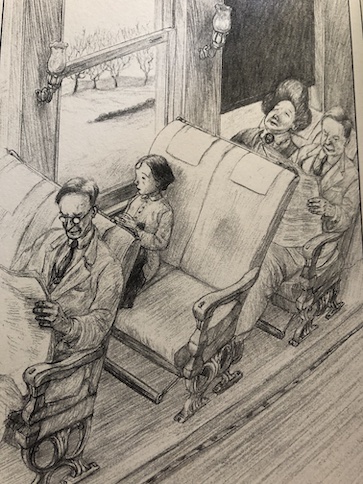
A relative who is traveling on business takes Elizabeth Ann partway by train and then makes sure that she gets on the right train to go to the Putney’s town in Vermont alone. Timid, fearful little Elizabeth Ann finds herself traveling completely alone for the first time to go to a place she’s never been and meet relatives she is sure she won’t like. Fortunately, many of Elizabeth Ann’s preconceived ideas are turned on their head from the first moment she steps off the train and is greeted by Great-Uncle Henry.

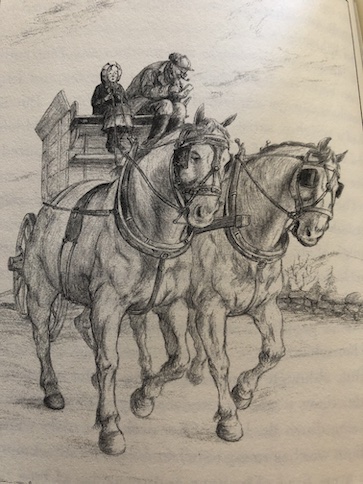
If it had been Aunt Frances greeting her, Aunt Frances would have immediately worried and fussed over her and asked her how she stood the ordeal of traveling. However, Uncle Henry acts like Elizabeth Ann hasn’t been through any ordeal at all. Instead, he just greets her cheerfully and helps her into his wagon. In fact, as they drive along, he unexpectedly gives the horses’ reins to Elizabeth Ann and lets her drive while he does some math. (We don’t know why he needs to do this; he just says he does.) He just tells her to pull on the left rein to make the horses turn left and the right rein to make them go right. Being handed this unexpected responsibility is terrifying for timid little Elizabeth Ann, and she has a moment of panic, worrying that she doesn’t always remember her left from her right. Then, Elizabeth Ann has an unexpected revelation: it doesn’t really matter if she doesn’t remember the names for the directions or which is which because she can just look and see where she wants the horses to go and pull the reins in that direction, no matter what that direction is called. After all, it’s not like horses really understand the words “left” and “right” anyway, just the direction of the pulling. This is an important revelation for Elizabeth Ann, who is usually accustomed to Aunt Frances doing everything for her, including her thinking. She has never really had to figure out things by herself before. When she voices this revelation to Uncle Henry, he simply agrees that she is correct, and Elizabeth Ann feels a rare sense of pride in her accomplishment.

When they reach the Putney Farm, Great-Aunt Abigail and Cousin Ann are glad to see her, but they don’t overly fuss, either. They call Elizabeth Ann “Betsy” and show her the hook where she can hang her cloak. Betsy is a little offended that they don’t help her take it off and hang it up for her the way Aunt Frances did. Their lack of fussing and expecting her to do things for herself makes her feel at first as if they don’t really care about her. Their farmhouse is also fairly small, it’s lit with kerosene lamps, and they do their own cooking instead of having a servant, like Great-Aunt Harriet and Aunt Frances did. These things make Betsy realize that the Putneys are poor, and she has a moment where she is overcome, thinking that she will be miserable in a poor, deprived household. Then, Aunt Abigail hands Betsy a kitten and tells her that, if she likes it, it can be her cat.

Betsy always wanted a kitten, but Aunt Frances would never let her have one because she was afraid that they would carry disease. Betsy forget her worries and misery while playing with the kitten, which she names Eleanor. She is also relieved that her relatives don’t fuss about her not liking certain foods. Aunt Frances always tried to make her eat her beans for nutrition, but the Putneys don’t care when she avoids them because she has a good appetite for everything else on the table. In fact, Betsy eats much more at the Putney farm than she ordinarily does because she is allowed to eat more of what she likes and nobody fusses over how much she’s eating or if she’s eating the right things. For her first night at the farm, Betsy has to sleep with Aunt Abigail because her room isn’t ready yet, but she ends up finding Aunt Abigail’s presence reassuring.

In the morning, her relatives decide to let her sleep in because she’s tired from traveling. When Betsy wakes up, she lies in bed for a while, waiting for someone to tell her to get up. When no one does, she get the idea, for the first time, that she can get up when she’s ready and doesn’t need for someone to tell her to do it. She also dresses herself and does her own hair for the first time. In a way, it’s a little thrilling because Betsy realizes that she can do her hair the way she wants it instead of the way Aunt Frances does it, and she copies a hairstyle she envied on one of her old classmates. However, it does bother her a little that her relatives don’t seem to care about whether or not she needs help and aren’t stepping forward to help her automatically. She does fine, but she’s accustomed to an adult hovering over her as a sign of caring.

Her relatives explain that they were letting her sleep as late as she wanted that day because they knew she would be tired. Cousin Ann gives her breakfast and lets her have as much milk as she wants because, unlike in the city, they produce their own milk from cows rather than buying it in quarts, so they don’t have strict limits on how much they can have in a day. Betsy is pleased by this, but she has another moment of panic when Cousin Ann tells her to wash her dishes after breakfast. Betsy has never washed her own dishes before and doesn’t know how. Seeing Betsy’s hesitation, Cousin Ann offers a view brief instructions, and Betsy accomplishes the task.

On her first day, she also sees Aunt Abigail making butter, something that Betsy has never seen before. She is accustomed to buying butter, not making it, and she didn’t even know before what butter is made from. Aunt Abigail is astonished that Betsy doesn’t know these things, but Uncle Henry points out that city life is different, and Betsy has probably seen things they haven’t, like how roads are paved. Betsy gets excited because roads being paved is a familiar sight to her, but she becomes embarrassed and confused when her aunt and uncle try to ask her questions about how the workmen do it. While she has seen roads being paved before, she took the sight for granted and never really noticed the details. Aunt Abigail suggests to her that she watch the butter making process closely and even take part in it so, if someone asks her later how it’s done, she can tell them all about it. Betsy accepts the lesson and even has fun making butter.

Then, her relatives surprise her by telling her that it’s time for her to go to school for afternoon lessons. They let her miss the morning lessons so she could rest, but now that she’s rested and had some time to look around the farm, she should go to the afternoon lessons. Worse still, they tell her that she should walk there by herself. Betsy panics again because Aunt Frances never let her walk to school by herself, but her relatives just give her a few directions to the school and a sugar cookie to take with her and send her out the door. Betsy could balk at this and say that she can’t do this and won’t, but their expectation that she can and will and her hesitancy to tell them differently make her walk down the road in the direction they say.

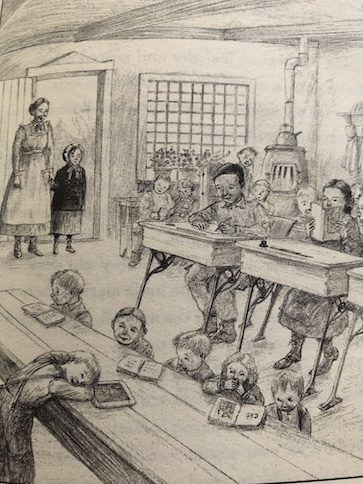
She almost misses the schoolhouse because it’s a much smaller building that she expected. Her school in the city was a multi-story building, but the local school is just a small, one-room schoolhouse. Fortunately, the teacher has been expecting her and looking out for her arrival, so she calls Betsy inside as she passes. Betsy is astonished at how few students there are, compared to her old school, and because there are so few, all the grades are just in that one schoolroom.

Even more confusingly, Betsy learns that this little school doesn’t do grades the way her old school did. Because there are so few students, and they’re all sharing the same room, it doesn’t matter too much what grade each student is studying in which subject. The teacher just moves them up and down as necessary to help them learn at their own, individual levels. At her age, Betsy knows that she should be in the third grade at school, but when the teacher has her read out loud with the other students at the third grade level, Betsy does much better than they do. She loves reading, and she reads all the time on her own, so she has progressed much faster in her reading skills than other children her age. Her teachers at her old school just never noticed because they were trying to keep track of so many students that they couldn’t pay that much attention to individual students’ progress. Her new teacher decides that she can read at a seventh grade level. Betsy is stunned and proud. The idea that she could move up multiple grade levels at once never occurred to her before as an option, but then, she worries that she can’t move up to seventh grade because she isn’t very good at math. She tries to explain this to the teacher, but the teacher isn’t concerned because she doesn’t make students study at one, consistent grade level for every subject. They can move ahead faster in some subjects than in others. When they’re struggling with one subject, she holds them back in that subject alone until they’ve mastered it. She does put Betsy back one grade level in math when she sees that Betsy is struggling, telling her that she can move up later when she’s had some time to review the material and improve.

It’s what Betsy really needs, but Betsy finds it disorienting that she isn’t part of one, consistent grade level at school. She says that she doesn’t know what that makes her, and the teacher replies that she is simply Elizabeth. Before, Betsy’s concept of school was that, every year, the students would simply move up one grade level, and that the goal of school was just for the students to move up through the levels appropriate to their age. Now, she is being introduced to the concept that the goal of education is for her to master the concepts being taught to her, regardless of the grade level, so that she will have the ability to do things like math, reading, and spelling. As long as she can learn to do these to a satisfactory level and keep improving, her specific grade doesn’t matter. In fact, when Betsy is upset later about failing an examination at school because she was nervous and made a lot of mistakes, Cousin Ann tells her that there’s no need to be nervous and that her grade on a single examination doesn’t matter because, regardless of how she did on that particular test, she knows that she actually does know the material and can use that knowledge in daily situations.

Betsy is also unexpectedly given the responsibility of looking out for a younger girl at the school, Molly. Because Molly is so good at reading, the teacher has Betsy listen to Molly read at the first grade level and asks her option of how Molly did and if she seems like she could manage the second grade level reading. Betsy has never had an adult ask her to supervise anyone younger before, and she unexpectedly discovers that she likes it and likes teaching someone younger. Later, Betsy is asked to hold Molly’s hand while they cross a log over a stream because the teacher wants older children to hold the hands of the younger ones and help them. Actually, holding Molly’s hand helps Betsy more than it helps Molly because Molly has walked on this log before and Betsy hasn’t, but being responsible for someone younger makes Betsy more bold. Although she would have been afraid to walk that log if she had to do it by herself, she can’t refuse when she has the responsibility of helping Molly. Later, she also helps to rescue Molly when Molly falls in a hole and needs help to get out. Betsy wanted to run for help at first, but when Molly begged her not to leave her alone, Betsy decides that she should do what Cousin Ann would do and figure out how she can use the things around her to solve the problem, spotting a branch that helps the younger girl climb out. Even though Betsy gets scared, when she has someone smaller than herself depending on her, she finds her courage.

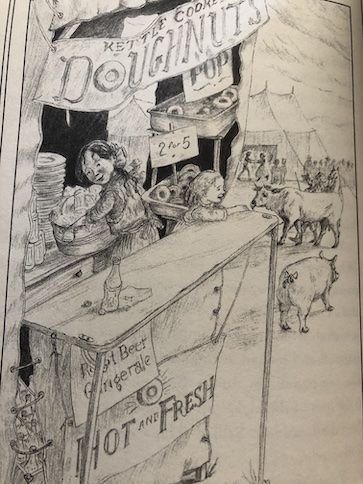
Betsy has other adventures with Molly and her other new friends while living with the Putneys. When Molly’s mother becomes ill and has to go to the hospital, Molly is upset because she will have to move in with some cousins in the city who don’t really want her. Having been in this type of situation before herself, Betsy is immediately sympathetic, and she gets her relatives to agree to let Molly stay with them. Molly becomes like a little sister to Betsy, and they share in other adventures together. Along with some other girls from their school, they form a sewing circle to make some clothes for a poor boy at their school who lives with a stepfather who spends all of his money on alcohol. The book doesn’t shy away from describing how the boy is neglected, and the girls in the sewing circle are moved to tears when they go to the boy’s house to deliver the new clothes and see the circumstances he lives in. The Putneys also become concerned about the boy’s welfare, and they help arrange for him to be adopted by a man they know who has been talking about adopting a boy. Later, for Betsy’s birthday, Betsy and Molly go to the fair with some neighbors, but they are accidentally left behind when the people who were supposed to give them a ride home had to leave to tend to an emergency. Betsy is terrified, but with Molly to look after, Betsy manages to keep her head and think of a way to earn some money so they can buy train tickets home.

Betsy has been living with the Putneys for about a year when she gets a letter from Aunt Frances, who says that she will arrive soon to reclaim her. Aunt Frances thinks that Betsy must have been having a miserable time without her, but Betsy has actually come to think of the farm as home and loves it there. She doesn’t want to hurt Aunt Frances’s feelings or seem ungrateful for all the love and attention that Aunt Frances has lavished on her over the years. It seems like Betsy has to resign herself to returning to her old life in the city … unless Aunt Frances has also been making some changes to her own life since they were last together. When Betsy and Aunt Frances meet again, they truly come to understand each other, and they find a way for them all to live their best lives.

This book is now public domain and is available to read for free online through Project Gutenberg and Internet Archive (multiple copies, including audiobooks).

I really enjoyed this book! I’d heard about it for years and never got around to reading it before. Dorothy Canfield Fisher was an early advocate of the Montessori method of education in the United States, and in particular, this book presents many of the principles of the Montessori method and how it can help children. The educational themes in the story are obvious when Betsy sees the differences between the one-room schoolhouse in the country and her old school in the city.

The benefits of the smaller class size are immediately obvious. Betsy loves reading but she always hated her reading class in school because each student took turns reading, so the most any particular student could read was one or two sentences, and even then, they might not get a turn if the class ran out of time before they got to all of the students. This description feels like an exaggeration of how reading classes might have gone at a bigger school, but there may be some truth in it. When I was at school, my classes typically had about 20 to 30 students in them, and when we took turns reading, we did more than that. It’s difficult to say for sure because I don’t think Betsy ever said exactly how many students were in her class, but I would think they would have to have at least twice as many as that to be as bad as she described. According to Going to School in 1876, some large city schools could have classes of 50 to 60 students during the late 1800s, so that is possible for a class in the early 1900s or 1910s as well. I do take the point that it’s easier for a teacher to keep track of the progress of individual students when the class size is smaller.

I also appreciated what the teacher said about allowing students to progress faster in subjects that are their strengths, even if they have to take extra time for problem areas in other subjects. When I reviewed The Beast in Ms. Rooney’s Room, there is a boy in that book who was held back a year in school because of his problems in reading, and he was embarrassed about not moving to the next grade with his classmates. If he could have moved forward in some subjects, it might not be so embarrassing for him to be held back in the one subject that gave him the most trouble. The problem is that he couldn’t do that because the classes at his elementary school are organized the way the ones at my old elementary school were – one single teacher at a particular grade level teaching all of the subjects for that grade level. Under that system, remaining at a particular grade level in one subject means remaining at that grade level, with that teacher for all subjects.

There is only one teacher at the one room schoolhouse in the story, so there’s no conflict about a student seeing one teacher for some subjects and another teacher for other subjects at a different grade level. All of the students are in just that one room with one teacher all the time, so the only difference when a student moves up or down in level for a subject is the book that the teacher gives them to study. That means that changes in grade level can be done informally for any or all subjects, whenever the teacher decides that a student is ready to move to the next level. The student just turns in their old book and gets a different one to study. If most grade levels were determined that easily for different subjects, I think there would be fewer parents who would be concerned about the prospect of holding a child back a grade temporarily to give them a better grounding for moving forward later, and students would experience less embarrassment about problem subjects if they could receive acknowledgement for better skills in other subjects. However, I can see that this system would be complicated in bigger public schools, and there would have to be a point when the student would have to master their series of subjects at a particular level to know when they could graduate from their school. I think that’s part of the purpose of the examinations Betsy describes in the book, but because the book only covers a single year, we don’t see what happens when a student is ready for graduation.

In the beginning, Aunt Frances, in spite of all of her good intentions and research into psychology and raising children, unintentionally transfers her personal anxieties to Betsy without really giving her the tools that she needs to manage them, so they feel overwhelming to Betsy. The solution to this problem, as presented in the book, seems to be mostly being around people who do not express worries about things (if they’re nervous about anything, they mostly cover it up and don’t talk about it, except for one time, which I’m going to talk about) and who present manageable challenges to Betsy to show her that she can handle more than she thinks she can. I like the part about giving Betsy manageable challenges and some basic instructions for how to accomplish them when she doesn’t seem to quite know what to do. If they had just thrown challenges at her with no instruction at all, in a kind of sink-or-swim fashion, I think she would have been just overwhelmed and more panicky. However, I think there’s a point in the story that could use more clarification.

The differences between Betsy’s sets of relatives is initially presented, particularly by the aunts she’s been living with, as one of understanding and sympathy. Great-Aunt Harriet and Aunt Frances initially don’t like the Putneys because they don’t seem sympathetic enough, especially with people who are sensitive and nervous. Aunt Frances dedicates herself to sympathizing with Betsy about everything and talking to her about everything in her life, and the book presents this as a negative because their sympathetic conversations about the worries they have end up being a way of making each other more nervous. I think, in real life, there’s a happy medium between never talking about worries and wallowing in them.

The first problem with Aunt Frances’s attempts to sympathize with Betsy is that she makes assumptions that things that bother her will also bother Betsy, and this becomes the way that she accidentally transfers her anxieties to Betsy. Second, when Aunt Frances sympathizes with Betsy about worries or problems, she tends to dwell too much on the problem itself and how bad it feels, magnifying the issue and making Betsy feel worse. What I’m trying to say is that Aunt Frances’s attempts to sympathize would have worked much better if she had been willing to listen to Betsy’s concerns and sympathize a little about how certain things can make a person nervous but then move on to offering practical tips to deal with these feelings and different ways of looking at situations to take some of the anxiety out of them.

I didn’t like it when Cousin Ann seemed to shut Betsy down when she was talking about how tests at school make her nervous because I don’t like the idea of shutting people down when they’re talking about something important to them, but what made it better to me was that she did listen to Betsy for a bit before that and had already offered her a different way to look at tests that makes them seem more fun and less scary. When Cousin Ann cuts the conversation short seems to be the point when discussing and sympathizing is about to turn into brooding and dwelling on the negative. My only thought on that conversation is that it might have helped for Cousin Ann to point that out. Rather than asking if Betsy really wanted to keep talking about this, which makes it sound like disinterest in what Betsy’s saying, I think it might have been better to point out that, if she keeps dwelling on the parts of the experience that make her feel bad, she won’t let herself move forward, to see the parts of the experience that could be exciting opportunities and possible triumphs. Perhaps, it would be good to add that one poor test experience doesn’t mean that others will feel the same way or that she can’t do better the next time, especially if she spends her time in between tests focusing on how much she enjoys what she’s learning and how it can be fun to show others what she’s learned and what she enjoys about her lessons, putting herself in a better frame of mind for the next time someone asks her questions about what she’s learned. I just think that approach would help emphasize the lesson that Cousin Ann would really like to teach Betsy about reframing challenges in her mind and also help clarify that she’s not ending the conversation because she’s not sympathetic but because it’s better to give the positive thoughts time to take hold rather than dwell on the worries.

I think it’s also important for both Betsy and Aunt Frances to recognize that it’s okay to feel nervous but that it’s possible to handle situations even though they make them nervous. As someone who has had life-long issues with anxiety, I can also attest that one of the best approaches is learning not to be afraid of feeling afraid of something. That is, learning to recognize that being nervous isn’t a sign that a situation is unmanageable or that the feeling of anxiety itself is necessarily going to be overwhelming, something that Betsy learns through practical experience in the story. There are still times in the story where Betsy is afraid and has to handle difficult situations, but she learns that she can proceed and do what she needs to do even though she’s nervous and isn’t sure at first how things will work out. It isn’t explicitly spelled out in the story, but this is probably the most important lesson that Betsy was missing from her time living with Aunt Frances.

There are no villains in this story. Although readers can see at the beginning that living with Great-Aunt Harriet and Aunt Frances has caused some emotional complications for Betsy because she has taken on their worries and anxieties, they do mean well and have made real efforts to understand Betsy and support her, as best they know how. Great-Aunt Harriet and Aunt Frances just have very different, more timid personalities than the Putneys and don’t find their style of communication reassuring or appealing. However, Betsy discovers, to her surprise, that she does come to appreciate the Putneys and that they are a good influence on her, helping her to come out of her shell, discover new abilities and interests, and develop some self-confidence.

At first, Betsy is a little offended that her Putney relatives don’t fuss over her like Aunt Frances did, and it makes her feel like they don’t care about her, but they do care. They are just more low-key in showing the ways that they care. They are a family that doesn’t like to fuss about anything. Personally, I thought that Cousin Ann should have let Betsy talk a little more when Betsy was distressed about doing badly on her exam, but I do see her point that Betsy’s talking about it seemed to be upsetting her more because she was dwelling on the problem rather than consoling herself and looking for solutions or new ways of thinking about the situation. Cousin Ann points out that exams aren’t always negative, and even when one doesn’t turn out so well, it’s not the end of the world, giving Betsy a new way of looking at the situation and defusing Betsy’s sense that every little setback is a tragedy.

The Putneys show how much they truly care when Betsy and Molly are accidentally left behind at the fair. When Betsy manages to get Molly home, she sees her relatives rattled and upset for the first time when they realized that the girls were lost, and they do some rare fussing over the girls, praising Betsy for her ingenuity in handling the situation. Although the Putneys normally make it a point to deal with things coolly and calmly, they do care about the girls and can get upset if they think there is a serious problem. They are not without feelings. They are also genuinely upset when they think Aunt Frances is going to take Betsy away, each finding their own way to show Betsy how much they care and how much they will miss her.

Fortunately, Betsy is allowed to stay with the Putneys in the end. When Aunt Frances comes to get her, she reveals that, in the year they’ve been apart, she has met a man and fallen in love. She is going to marry him, but marrying him means making some changes to her life, the greatest one being that they are not going to return to their old house. Great-Aunt Harriet has recovered from her earlier illness and has gone to live with another relative, and because her new husband has to travel constantly for business, Aunt Frances won’t be keeping a settled house at all. Aunt Frances, although usually timid, is actually looking forward to doing some traveling. She is still afraid of things like animals and would never be an outdoor/country kind of person, but travel to different cities sounds like her kind of excitement. However, she can see the difficulty of traveling with Betsy. Constantly moving would be difficult for her education, a complication that I was surprised that the characters didn’t spell out when they were talking to each other, given the educational themes of the story.

Betsy and Aunt Frances come to a new understanding of each other and the differences in the lives they want to live when they talk about what these changes would mean for their lives. Aunt Frances doesn’t want to simply abandon Betsy to the Putneys if she isn’t happy with them, but she can see that Betsy does like living there and would be happy to stay. Betsy hadn’t wanted to make Aunt Frances feel abandoned and unappreciated by telling her in the beginning that she wanted to stay with the Putneys, but when she learns that Aunt Frances will be happily married and enjoying the new experience of travel, she is able to tell Aunt Frances that she can see that having her come along would be inconvenient for her and that she would be happy to stay with the Putneys. Neither of them is offended or worried about living apart now because they can see that each of them will be happier with Betsy living with the Putneys. Aunt Frances is now free to get married and go where she wishes with her husband, assured that Betsy is doing fine and living in a stable home with people who care about her, even if it’s not quite living the lifestyle that she would like herself. Aunt Frances also promises to come visit sometimes, so it’s not a permanent goodbye.

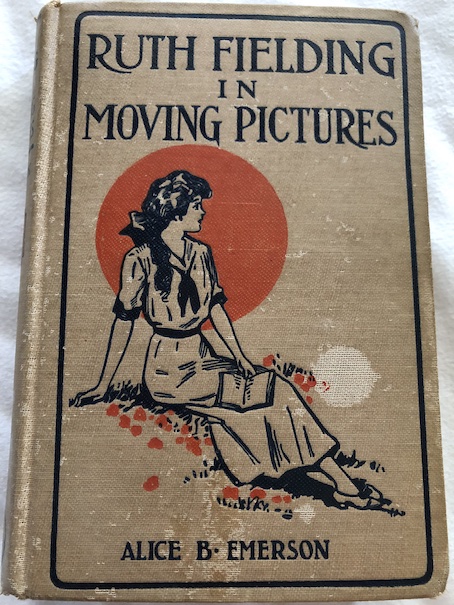
Ruth Fielding in Moving Pictures

Ruth Fielding

One day, while Ruth Fielding is out with her friends, Helen and Tom, they see a film crew working by the river. (Because this is the 1910s, they are making a silent film and using the kind of old-fashioned movie camera that needs to be cranked, like the one shown in the picture to the right.) They talk about whether to not they would like to be in movies themselves. The girls think it sounds exciting, but Tom thinks that they’re too young. The girls say that they are not too young because the actress who is being filmed looks like she’s about their age. As they watch, the young actress accidentally falls into the river, which is freezing cold because it’s winter. Ruth and her friends hurry to help pull her out before she drowns. When they get her out of the river, Ruth is appalled at how unconcerned the director is for the actress’s health while she’s clearly suffering from the cold. Ruth and her friends take the actress, Hazel Gray, back to the Red Mill where Ruth lives, where she can warm up and recover.

While Hazel is resting at the Red Mill, she and Ruth tell each other about themselves. Like Ruth, Hazel is also an orphan. Her parents were actors, and some friends raised Hazel to be an actress after her parents died. Ruth tells Hazel that she has been thinking about writing a movie scenario (script) just for fun, and Hazel offers to show it to the director if she does. Ruth isn’t sure she likes the idea because she didn’t like the director, Mr. Grimes. Hazel explains that, while the director can be callous and abrasive, he is a famous director who really knows his business and can help actors and scenario writers make their careers.

The next day, Mr. Hammond, the manager of the film company, comes to the Red Mill to see how Hazel is and to ask Ruth about how the accident happened. He seems concerned about whether or not Ruth’s description of what happened matches what Mr. Grimes told him. Ruth explains what she saw to Mr. Hammond, and she also tells him what she thinks about Mr. Grimes’s lack of concern about Hazel’s welfare. Mr. Hammond says that it’s impossible to change other people, indicating that he knows how callous and unpleasant Mr. Grimes can be, but he promises to make sure that Hazel gets a fair deal for her acting and the accident she suffered.

While he is there, Mr. Hammond becomes fascinated by the quaintness of the Red Mill. He thinks that it would make an excellent setting for a movie. Ruth says that she would love to write a scenario about the Red Mill herself. Mr. Hammond asks her if she’s ever written a scenario before, and Ruth admits that she hasn’t, but there has to be a first time for everything. Mr. Hammond is amused and says that he would be very interested in any scenario that Ruth might write. However, he suggests to her that, before she writes a scenario about the Red Mill, she write a short story about something else, something exciting, so he can see what her writing is like. Ruth happily agrees, and after she returns to boarding school with her friends, she starts writing.

Ruth and Helen are now seniors at their boarding school, and they are starting to think nervously about their lives after graduation. They know that they want to go on to college, but they find the prospect intimidating, too. Neither of them is quite sure what they want to do with their lives. The idea of growing up in general sounds frightening.

The girls aren’t the only ones showing signs of growing up but feeling awkward about it. Ruth finds herself getting unexpectedly jealous about Tom having a crush on Hazel. Helen says that Ruth simply hasn’t been paying attention to the things the boys are doing. All of Tom’s friends at his school have crushes on actresses, and they’ve been collecting pictures of them from the newspapers and pinning them up in their rooms. At the same time, Tom seems oddly sullen that other people are starting to treat Ruth and his sister as young ladies. It’s one thing for him to have a crush on Hazel, who is a couple of years older than they are, but he doesn’t seem to like the idea of Helen and Ruth seeming too grown up.

These things are in the back of Ruth’s mind as she finishes writing her story. After she sends her story to Mr. Hammond, a fire breaks out in one of the dormitories at the school because of a neglected candle. The dormitory that is destroyed is the one where Ruth lives with her friends. Ruth is tempted to try to save their belongings, but the teachers tell her that it’s just too dangerous. They’re just thankful that all the girls are safe.

After the fire, there is the question of rebuilding the dormitory. At first, they think that the insurance money will pay for a new dorm, but it turns out that the school’s forgetful headmaster accidentally let the insurance policy lapse. Some of the girls at the school are from wealthy families, and they are sure that their parents would be willing to contribute to the building of a new dorm, but Ruth sees a couple of problems with that. First, while the wealthier students’ families would certainly be able to contribute sizable amounts toward the building project, the families of poorer students may hesitate to contribute at all because they may be embarrassed that they cannot possibly match the donations the wealthier families can contribute. Second, the girls are overly relying on their parents. While the parents may be glad to help, Ruth thinks it would be better to find a way that the students themselves can contribute to the building fund. The other students agree that they would all like to find a way for everyone to contribute.

An idea for a group project the entire school can participate in comes to Ruth when Mr. Hammond sends Ruth a check to pay for her first story. He thinks that Ruth has a great talent for writing, and he’s going to make her story into a short, one-reel movie! That makes Ruth realize that, if she can write a short story for a short movie, she can write one for a long, five-reel picture. If she can write a long scenario for a movie, all of the girls in the school can be in the film! She thinks that she can persuade Mr. Hammond to produce the picture and distribute it to the surrounding town, and the royalties from the movie can pay for the dorm reconstruction.

Mr. Hammond agrees to help Ruth and her friends make a movie on behalf of the school, and the school’s headmistress agrees to allow the students to participate in the project. The donations that the school has already received from the parents have paid for the removal of the ruins of the old dormitory and the beginning of the construction of the new one, and the money the girls earn from the movie can pay for the completion of the building project. Ruth already has an idea for the plot of the movie, one about girls at a boarding school, so they can film the movie on their own campus. Mr. Grimes turns out to be the film director, and he is still temperamental, but he shows more patience when dealing with the students than he had before.

There are complications, of course. Hazel Gray is one of the professional actresses helping with the movie, and Ruth is still jealous about how fond she seems of Tom. Then, there is drama when the other girls learn which girl left the candle unattended and vent their wrath on her. The girl, Amy, was already a troubled student with an unhappy home life. Then, Amy gets upset when the boy she likes seems to be getting too friendly with Ruth, and she runs away. Ruth and the other girls have to search for her, and they learn the embarrassing secret behind the dormitory fire and some other secrets that Amy has been hiding from them.

This book is now in the public domain and available to borrow and read for free online through Project Gutenberg.

Not exactly a mystery, but there are some things that Ruth and her friends discover some secrets about their prickly fellow student, Amy, and when she runs away, the other girls have to figure out where she went and rescue her. Although Ruth and the other girls are unhappy with Amy because of the dormitory fire and because Amy frequently has a sour attitude, but they become more sympathetic when they learn more about some secrets that Amy is hiding. The embarrassing secret behind the dormitory fire is that Amy is afraid of the dark. She doesn’t want to admit it to the other girls because she doesn’t want to be teased, but that’s why she left a candle burning in her room; she was afraid of returning to her room after dark. The school has electric lights, but she grew up in a more old-fashioned town and isn’t used to them.

Worse still, Amy is terrified that her father will find out that she caused a fire at school. He is already harsh with her, and it has gotten worse since he remarried. He seems to view the child from his first marriage as a nuisance, and it seems like he sent her to boarding school to get her out of the way as he starts a new life with her stepmother. Actually, Amy’s father’s reasons for sending her to boarding school were not just to get her out of the way. Ruth and the others learn that part of Amy’s difficulties with her stepmother have partly been because Amy behaved badly toward her because her aunts disliked her and were a bad influence on Amy. It wasn’t just that the boy she liked seemed to like Ruth that made her run away; she had gotten an angry letter from her father that not only accused her of doing something bad before she left home but also saying that he has heard rumors about her involvement with the fire. He is coming to the school to find out for himself what she’s been doing there, and Amy is terrified of what he will do when he gets there.

To find Amy, the girls and Curly (the boy Amy likes) have to think of all the things they know about Amy and the places she could have gone. Curly knows more than the girls do because Amy confides in him. I appreciated that Ruth and the other girls are much more active in this story in solving the problem of Amy’s disappearance than they often are in other books. In the earlier books in this series, Ruth and her friends frequently rely on chance and coincidence to reveal hidden information and other people to carrying out the final action, but this time, they use their own reasoning to figure out where to look for Amy and go after her themselves. In some ways, I think that the more active roles that Ruth and the others play in the story are because they are growing up. Amy is younger than Ruth and her friends, and they feel responsible for her. In earlier books, adults and others were looking after them and helping them, but now, they are older than someone else. I’m looking forward to seeing how this develops in other books in the series.

When they find Amy, she has had a bad reaction from poison oak or poison sumac, and everyone feels sorry for her. Amy gets the first sympathy that she’s had for some time. Amy straightens out her relationship with her father when he comes and realizes that she was unfair to her stepmother. The other girls at school forgive Amy for the fire when they find out what she’s been through, and her father makes a generous donation to the building fund.

One of the most unique features of this book is that the characters are growing up, and it’s part of the story. That’s something that doesn’t happen in other, later Stratemeyer Syndicate books. In this book, Ruth and her friends graduate from their boarding school. As the girls think about their graduation and going on to college, they’re a little intimidated because they don’t know what they want to do with their lives, but Ruth discovers her talent for writing movie scripts/scenarios. (These are silent films in her time, so there’s no dialog for the “script.” Any dialog that the audience needs to understand would have been shown in text in the intertitles. I think that’s why they call this form of script a “scenario” in the book.) There is some awkwardness in the way the boys and girls in the story start looking at each other because they realize that they’re becoming young ladies and young men. They’re not used to thinking of themselves and each other in that way, and they’re developing crushes.

You won’t find this sort of thing much in the on-going Stratemeyer Syndicate book series, like Nancy Drew and the Hardy Boys. Those characters are frozen in age on purpose, and the Ruth Fielding series was part of the reason why. In early Stratemeyer Syndicate book series, like Ruth Fielding and the Rover Boys, the characters did age. They grew up, graduated from school, got married, and eventually, had kids of their own. The problem for the Stratemeyer Syndicate was that, when their characters got married and became parents themselves, they were starting to get too old to be teen detectives and young adventurers. Their child audiences wanted to read about kids like themselves or teenagers or young adults, not people who were more like their own parents. So, whenever characters started getting too old for the target audience, they would have to end that series and start a new one. After going through the Rover Boys and Ruth Fielding and some of their other popular series in this way, they realized that they could keep a book series going much longer if they just didn’t let the characters age.

That’s why Nancy Drew and the Hardy Boys are frozen in age somewhere in their late teens or early 20s, and the books typically leave it vague which it is. It’s mostly important that readers know that the characters are young but old enough to travel and have adventures by themselves. Nancy Drew is not going to school, and if she takes any classes in individual books, she isn’t studying for a degree. If she did, her series would eventually end because she would graduate and move on to adult life. Similarly, the Hardy Boys are learning to be private detectives by working with their father, who is a private detective, but they will always be in that apprentice phase, so their series can continue. There are times when the characters date other characters or have crushes, but their romances don’t progress to anything serious because that would also age the characters. Every decade or so, the books in those series get revamped or the characters get a new, updated series that incorporates modern technology and culture, but the characters stay roughly the same age throughout. It’s basically what happens with new Scooby-Doo cartoon series, but with books, and the Stratemeyer Syndicate did it with their characters first.

Part of the reason that I wanted to read the Ruth Fielding books was that I knew the characters would age, and I also knew that she was a kind of prototype for Nancy Drew. The Nancy Drew series started around the time Ruth Fielding’s series ended, as a replacement for Ruth Fielding. Fortunately, we’re not at the end of Ruth Fielding’s series yet. The series doesn’t end with her boarding school graduation. It continues through her time in college and into her career in the movies.

Ruth Fielding and the Gypsies

Ruth Fielding

Ruth Fielding and the Gypsies; Or, The Missing Pearl Necklace by Alice B. Emerson (Stratemeyer Syndicate), 1915.

Just as a quick note before I begin to describe the plot of this book, this book is part of the Ruth Fielding series, an early Stratemeyer Syndicate, before they started writing some of their more popular and best-known series, like the Hardy Boys and Nancy Drew. Some books in early Stratemeyer Syndicate series are awkward because they use racial terms that polite people would not use now. During the mid-20th century, around the time of the Civil Rights Movement, the Stratemeyer Syndicate revised the books it had in print, updating the technology and slang terms in the stories to be more modern and removing or altering some questionable racial terms and attitudes. Unfortunately, the Ruth Fielding series had already ended by that time, and these books were not among those that were revised and updated. I’ve explained this before on the pages for some the Stratemeyer Syndicate book series and individual book reviews, but I have to explain it again here because some people might object to the word “gypsy.” I know that’s not really the correct or polite way to refer to the Romany or “Travelers”, as they’re sometimes called, but it can’t be helped here because the Stratemeyer Syndicate put it right in the title. This is one of those books where I just can’t avoid it, and it’s all through the book. Some of the attitudes and stereotypes around the characters are also likely to be objectionable, but I’ll address that further in my reaction section.

The Ruth Fielding series is interesting because it was kind of a precursor to Nancy Drew, with a similar type of heroine, but one that, unlike Nancy Drew, grew up, went through school, and had a career during the course of the series. There are some aspects of this series and the development of the characters that I think were better done in this series than in the Nancy Drew series. There are also times when the books are surprisingly thoughtful about the conditions of life and society in the early 20th century, when they were written, and this book and the next one begin to mark a turning point in the main character’s life. Ruth is a poor girl, and before her education is over, she will have to seriously consider her career options, which is something you don’t see much in the Stratemeyer Syndicate series that are still in print because those characters never age. The characters in the earlier series did, which is why those series ended. There are some things in the series that I don’t like, like the racial terms and attitudes and when the stories are more adventure than mystery because I really prefer mystery, but this is what the books are like. In these reviews, I’m just explaining what the books and characters are like. On the bright side, if you don’t like what the books are like, you can consider that I read and reviewed them, so you don’t have to. You can find out what they’re like from my reviews and save yourself some time.

The Plot

Ruth Fielding is with her Uncle Jabez in a boat on the river near the Red Mill where they live when the boat overturns. Uncle Jabez falls out and hits his head. He almost drowns, but Ruth holds his head above water. She can’t pull him out of the river by herself, but she calls for help and attracts the attention of a passing gypsy boy. The gypsy boy, called Roberto, pulls Uncle Jabez out of the water.

Uncle Jabez is grateful, but the incident brings back an earlier argument about whether boys are more useful than girls. Uncle Jabez argues that boys are more useful than girls because they are stronger and can do heavier work, and he thinks that his near-drowning proves that. Of course, Ruth, Aunt Alvira, and Ruth’s friend Mercy are all offended by that assessment. Aunt Alvira points out that the boy who helped Uncle Jabez wouldn’t have been able to do that if Ruth hadn’t already been holding his head above water and calling for help. Ruth says that not all work is heavy work. Uncle Jabez says that girls are costly because they need money for education, and they’re not likely to have careers afterward, like men do. Ruth says that the reason why she wants an education is so that she can have a career and support herself.

Ruth knows that a poor orphan like her is lucky that she can attend boarding school with her friends. Her friend, Helen, is from a wealthy family, who is willing to fund her education in anything she wants to study, whether it eventually produces money or not, but Ruth doesn’t have that luxury. Eventually, she will have to get a job of some kind. Aunt Alvira says that, when she was young, most girls got a basic education and then got married, which is probably what Uncle Jabez is expecting Ruth to do. However, Aunt Alvira knows that modern girls have more ambitions. (Keep in mind that this story is set around 1915, contemporary to the time when it was written.) Ruth’s music teacher at school thinks that Ruth has a promising voice, and she wonders if she can train as a singer, although that’s not the kind of thing that her uncle would think of as something useful.

Before returning to boarding school with her friends, Ruth goes on a car trip with Helen and Helen’s twin brother, Tom. It turns out to be an unexpectedly eventful trip. Not long after setting out on the trip, they meet up with Roberto again and begin talking with him. The others ask Roberto about being a gypsy and if he wouldn’t prefer a more settled life with a regular job. Roberto says that, while he could work as a farmhand easily enough, few people would hire him for other jobs because he’s a gypsy, and people don’t trust gypsies. Besides, he sees little use in such a life. Tom says that he could afford better food and better clothes if he had a better job. Roberto says that he does well enough traveling around with his family, taking odd jobs, and helping his uncle at horse trades. He tells the others a little about his family and his life with them. After he leaves, Tom makes jokes about the rumors of gypsies kidnapping people.

Further down the road, Tom accidentally hits a lamb in the road with his car. The lamb is still alive, but its leg is broken. The farmer is angry, says that the lamb is useless now, and demands that Tom pay for the lamb. The price he demands is about twice as high as it should have been, but Tom pays it anyway to avoid further trouble. Then, they learn that the farmer, who doesn’t want to be bothered nursing the lamb until it heals, plans to simply kill it and feed it to his dogs. The girls are upset about the poor little lamb, and they plead for its life. Ruth is sure that the lamb can be healed. The farmer says that the lamb is his to do with as he pleases, but Helen points out that the lamb isn’t his anymore because Tom just paid for it. The farmer protests, but they take the lamb anyway. At first, Tom says that he doesn’t know what else to do with the lamb except take it to a butcher, but the girls persuade him to let them keep the lamb and try to help it.

Later, there is a storm, and the group seeks shelter in an old, empty house. The girls go inside while Tom parks their car in an old shed. The girls find the house spooky and wonder if it could be haunted. In some books, investigating a haunting in an old, abandoned house like this would be the main mystery, but in this one, it’s just one episode that gives them a clue to something else. While the girls are exploring the upstairs rooms and Tom is still outside, two strange men enter the house. The girls don’t let the men know they’re there. They’re not sure of who the men are or what their intentions are, so they listen to their conversation. They can’t understand everything the men say because half of their conversation is in an unfamiliar language, but from what the girls understand, they have either committed a theft or are going to be involved in one. The girls don’t want the men to find them or Tom, so they scare them out of the house by spooking some bats, which take flight and frighten the men away.

All of this would be exciting enough, but as they all travel further, Tom’s car breaks down. Tom leaves the girls and sets out on foot to get some help. The girls wait at the car for him, but it starts getting dark, and they start to get worried. A group of gypsies passes by with their wagons, and although Ruth isn’t sure it’s a good idea, Helen asks the gypsies if they can give her and Ruth a ride to her parents’ house. The gypsies ask the girls some questions, and then, they agree that the girls can come with them. Helen leaves a note for her brother that they’ve gone with the gypsies, but when she isn’t looking, one of the gypsies takes the note and destroys it.

It turns out that Ruth’s concerns about the gypsies were justified. The leader of this gypsy band is an elderly woman, who the girls recognize from Roberto’s stories as his grandmother, although Roberto is not currently among the group. The grandmother is a greedy woman, and she has realized from the girls’ car that at least one of them is from a wealthy family. To her, that means that they have relatives who would be able to pay a ransom for the girls. The girls become captives of the gypsies. The old woman also has an ability to hypnotize people with her eyes, and Helen seems particularly susceptible to it. During the night, while spying on the old woman, Ruth also learns that she is involved with the thieves they saw in the empty house.

The girls try to escape from the gypsies, and Helen gets away, but Ruth is caught. The old woman makes Ruth disguise herself as one of the gypsies so no one will notice her among the others. Can Ruth find a way to escape, or will Tom, Helen, or Roberto manage to help her?

This book is now in the public domain and available to borrow and read for free online through Project Gutenberg.

My Reaction and Spoilers

The Mystery/Adventure

The story covers not only Ruth’s adventures but the adventures of Ruth’s friends while she is captive, including Tom’s encounter with a suspicious farm couple and Helen’s frightening experience on a whitewater river. In the end, Roberto does help Ruth to escape. By the time Ruth returns to her friends and is able to tell her story to the authorities, the gypsies are well out of the area.

However, there is still something that bothers Ruth. She knows that Roberto’s grandmother had a valuable pearl necklace in her possession, apparently the spoils of the theft that the men in the empty house were talking about. Ruth wonders who they robbed and where the necklace came from. At first, it seemed like this plot line was going to be left hanging, but when Ruth returns to boarding school with her friends, she gets the answer. A new student is joining the school, Nettie Parsons, and she is the daughter of a multi-millionaire who made his money in sugar. She is the one who was robbed of the pearl necklace, which really belongs to her aunt, and there is a $5,000 reward for its return. $5,000 would be a pretty decent reward even in the 2020s, but it went much further in the 1910s. Ruth realizes that she knows who has that pearl necklace, and if she can get it back for Nettie, she would not only be doing a good turn for a classmate but getting the much-needed reward for herself. $5,000 would be enough to give Ruth some monetary independence and could fund her continued education.

Like other early Stratemeyer Syndicate books, the story is more adventure than mystery, although there are some mystery elements. Ruth gets some of the clues to the theft that the gypsies committed, but it’s more by coincidence than investigation that she discovers who the pearl necklace belongs to. Ruth does get the reward in the end, which allows her to finish at Briarwood Hall and go on to college in later books. However, while the old woman was apprehended with the necklace on Ruth’s information, I think it’s important to note that Ruth does not chase her down and apprehend her herself. Ruth is still at boarding school when others do that on her behalf, and she is then summoned to identify the apprehended suspect. On the one hand, this would never happen that way in a modern, 21st century book. In modern books, the girl heroines are much more active and would insist on catching the bad guys themselves. On the other hand, I have to admit that the way the book did it would actually be the more likely way this situation would play out in the real world, with the boarding school kid just providing information and being kept at boarding school while others apprehend the criminals. I think if the book was rewritten in the 21st century, Ruth would be more active in catching the criminals and retrieving the necklace, but there is some realism in the way the book actually ends.

Ruth’s career ambitions are not resolved in this story but are addressed more directly in the next book in the series.

Stereotypes and Racial Attitudes

I was curious about the notion that gypsies kidnap people because I’ve read about that in other books, and I wondered where that idea came from. According to an article that I found, it seems to come partly from traveling gypsies being used as scapegoats for missing or murdered children (like in old movies, where the small-town sheriff is anxious to blame a “drifter” for a crime) or as “bogeymen” in stories parents told to scare their children into not wandering away from home and also partly from people noticing children among traveling Romany groups who did not seem to resemble the people raising them, particularly if the children seemed to be lighter-skinned or have lighter hair or eyes than the adults. The reasons for the children not looking like the adults have been proven in modern times to be because the children were either adopted or were simply biological children who didn’t look like their parents through quirks of genetics, which sometimes happens. Light-colored eyes and light-colored hair are recessive traits, while dark eyes and dark hair tend to be more dominant traits, but even a dark-eyed, dark-haired person can carry the recessive genes for light hair and eyes, and those recessive traits can come out in the next generation. Basically, the children resemble previous generations in the same family, such as grandparents or great-grandparents, and if observers could see all the generations of the family together, it would be more clear how the traits were handed down to the children. (People also used to think that it was impossible for two blue-eyed parents to have a brown-eyed child, but that also happens sometimes because genetics can be complicated, eye color can be influenced by combinations of multiple genes together, and genetic mutations sometimes take place.) Basically, some people overreact when they see a child who doesn’t match the adults they’re with and start imagining kidnapping, but often, there are other, logical explanations, and being too quick to scream “kidnap!” causes problems. Some people do this to families who have had interracial adoptions. Personally, my brain would be more likely to consider possible divorces or previous relationships or possible affairs or maybe that the adult was actually a hired caretaker rather than a parent to be the next most-likely explanations after adoption for children who don’t look like parents, and I wouldn’t be eager to publicly ask questions about the sexual or reproductive history of total strangers. Unless the child appeared to be in immediate physical danger or was screaming, “Help!” or “This isn’t my daddy!” or something similar, I would be unlikely to interfere. “If you see something, say something” can be helpful, but it also helps if what you see is the big picture.

I also noticed that the gypsies in the story are described as being non-white people because they have darker skin, and even Ruth seems to dislike them and be suspicious of them for that alone. Granted, these particular people are actually criminals in the story who kidnap Ruth and Helen, but Ruth was thinking that just from looking at them. While I would have understood Ruth being reluctant to trust them because they’re strangers and because they know from the men in the empty house that there are thieves in the area, it’s their darker skin that bothers Ruth first. When Ruth first meets Roberto’s grandmother, Ruth thinks that the gypsy woman is too dark and strange/foreign to be trustworthy, and she later hates that her gypsy disguise involves bare feet and her skin dyed darker. She is ashamed of the way she looks in that disguise and thinks that she would be embarrassed for Tom to see her looking like one of the gypsies. Ruth’s prejudices bothered me more than if another character had done it because, while the older Stratemeyer Syndicate books do have inappropriate racial language and attitudes, the characters who are outright racists are typically the ones the stories show to be unfriendly antagonists or outright villains. From what I’ve seen so far, it’s rare for a friendly main character to be outright disparaging of racial appearances even if they have stereotypical notions about other people.

It’s really an irony that Ruth has prejudices against non-white people because the beginning of the story involves an argument with her uncle about his prejudices about girls. If this book had been written, or at least revised, during the 21st century, the rest of the story would have involved overturning both sets of prejudices. In the book as it is, nobody’s prejudices seem to be proven wrong.

Uncle Jabez’s assertions about girls’ usefulness go largely unchallenged. The girls are kidnapped when they’re by themselves, after Tom leaves them alone. Ruth copes decently with her captivity by helping Helen escape, but she needs help to escape herself, and men apprehend the criminals in the end, not Ruth herself. If Ruth’s uncle has any rethinks about the relative usefulness of boys and girls, he doesn’t mention it, and he isn’t presented with any strong evidence in favor of girls. Ruth is just content that she got the reward money for the return of the necklace, so she isn’t solely dependent on miserly Uncle Jabez’s grudgingly-given support.

There are no prejudices about gypsies proven wrong in the story. While I’m sure that most real-world Romany are not kidnappers, the gypsies in the books are criminals and kidnappers. Roberto is fond of his family and their traveling lifestyle, but at the end of the book, he accepts a new job as a gardener at Ruth’s school. He cuts his hair more like mainstream American styles of the time, and he starts wearing more mainstream American clothes. Ruth notes that his skin is still darker, but she is happy about these other changes. It is revealed that Roberto’s family came from Bohemia (a region now part of the Czech Republic) about ten years before, and his grandmother will now be deported back there, but Roberto wants to stay in the United States. He Americanizes his name and starts having people call him Robert. That’s quite a conversion from his attitudes much earlier in the book. Granted, having relatives arrested for theft and kidnapping can have an effect on a person, but from his earlier descriptions of his grandmother, I’m pretty sure that these sort of situations are not new to Roberto’s grandmother and the rest of their group. Maybe getting caught is new, but there is an implication that his greedy grandmother has done shady things before for the sake of money. But, part of the happy ending of this story is that Roberto gets assimilated into mainstream American society and becomes less ethnic, which is bound to leave a bad taste in the mouths of modern Americans.

So, Did I Like the Book?

I liked parts of it. As I pointed out, there are things in this book that are highly problematic for modern people, and I think the book as it is would be more suitable to adults who are interested in nostalgic children’s literature or the evolution of children’s literature. However, there are parts of the book I did find interesting, and I can see ways in which the book could be rewritten to make it both more exciting and more acceptable to modern people. For example, I really liked the part with the empty house where they overheard the thieves talking and the way the girls scared the thieves with the bats. If I were rewriting the story, I would extend that scene and leave out the part with the lamb, which didn’t contribute much to the rest of the story.

Of course, I would just have the criminals be part of a random criminal gang, not Romany. (How common were traveling caravans in the early 20th century anyway? I’ve never seen even one in real life. Was that really a common thing at one point so that it ended up in so many children’s books? From what I’ve read about Romany populations and migrations in the United States, some of the stereotypes about them had some basis in fact, like that some of them occasionally resorted to stealing to survive, but were exaggerated in the press for the sake of sensationalism, so I’m thinking that the prevalence of gypsy caravans and fortune tellers were probably also greatly exaggerated in literature.) I picture the criminal gang organized with the two guys who hide out in the old house being the thieves, and the others being a seemingly-ordinary and pleasant-looking couple who act as the fences of their stolen goods. Then, the girls could hitch a ride from this nice-looking couple after their car breaks down. At first, they wouldn’t know there was a connection between the “nice” couple and the thieves, but they would later accidentally see the couple talking with the thieves and the thieves handing over their goods. The girls would get caught spying on them, so the criminals would kidnap them because the girls now know too much.

Later, after the girls get away from the criminals, Ruth could find out that the necklace they saw being handed over wasn’t among the thieves’ belongings when the police caught up with them. Thinking about the place where the thieves were caught and something she may have heard them say, she could then realize that the thieves doubled back on their trail after the girls escaped from them, returning to their hideout in the abandoned house to hide the necklace because they still don’t know that the girls were in the house when they were talking there before. Then, Ruth could sneak away from her boarding school for a day to go back to the house and look for the necklace, finding it in a clever secret hiding place. I think that arrangement of events would make Ruth more active in solving the mystery, better justifying her acceptance of the reward at the end.

The Secret Garden

The Secret Garden by Frances Hodgson Burnett, 1911, 1987.

When Mary Lennox arrives in England following the deaths of her parents, people think that she is a peculiar child. She was born and raised in India. She is very thin, and her skin has a yellowish tint because she was frequently ill there. She also has a sour disposition, and it’s not just because she is grieving for her parents. Mary comes from a wealthy family, but she has been emotionally neglected for most of her life. She has not experienced real affection from anyone in her life, so she feels little affection for anyone. Her father worked for the British government in India, and between his work and his own illnesses, he never really had time for Mary. Her mother was a beautiful but frivolous woman who spent most of her time at parties or entertaining her friends. Her mother never really wanted a child at all, and she left Mary’s care and upbringing to an Indian nurse, with the instructions that the nurse keep Mary out of sight as much as possible. Her mother just didn’t want to bother with her. Because her mother didn’t want to be bothered with hearing Mary cry, even as a baby, the nurse and other household servants gave Mary anything she wanted and let her do as she pleased to keep her content. As a result, Mary became a spoiled and unmanageable child, and governesses who came to teach her never stayed very long because she was so temperamental.

Everything changed when Mary was nine years old. A cholera epidemic broke out, and Mary’s nurse was the first to die in their household. (Mary’s frivolous mother even admits, in Mary’s presence, that she was warned to leave the area weeks ago, but she wanted to stay for the sake of a dinner party. When the nurse dies, she realizes for the first time that she’s been a fool.) The other servants forgot about Mary in their panic, and people fled the area. Mary is discovered alone in the house by soldiers, who inform her that her parents died during the night. Mary is cared for temporarily by a clergyman and his family, but she doesn’t get along with the other children because she is spoiled and temperamental. She likes to play alone, pretending that she is planting a garden, so the other children tease her about being Mistress Mary, Quite Contrary from the nursery rhyme. Then, she is sent to England to live with her uncle, Archibald Craven, at Mistlethwaite Manor. She knows nothing about her uncle or England, only that her uncle supposedly lives in an isolated house and never sees people.

The trip to England opens Mary’s eyes a little to the world and the ways of other people. She begins to notice that other children are treated differently from the way she’s always been treated. Other children seem to belong to adults who care for them, their mothers and fathers. Mary has never really felt like she belonged to anyone. In fact, many of her mother’s friends were completely unaware that she even had a child because Mary was always kept out of sight, and her mother had always lived like she wasn’t a mother at all. Mary has so little connection to her own parents that she doesn’t miss them at all when they’re gone. People keep saying that it’s such a shame that her mother was so beautiful and charming and that her daughter is so unattractive and unpleasant, but the adults also comment to each other that if Mary’s mother had spent any time with her or cared for her, Mary might be very different. Mary doesn’t think of herself as being unpleasant, although she often thinks other people are unpleasant.

On her arrival in England, she is met by her uncle’s housekeeper, Mrs. Medlock, a no-nonsense woman. Mrs. Medlock tells her that her uncle’s manor is grand but gloomy and peculiar. It’s 600 years old, located near a moor, has over 100 rooms (most of them closed up and unused), is full of fine things, and has a garden around it. It all sounds very different from India, and Mary finds it hard to form an opinion about it. Mrs. Medlock is surprised at how unresponsive Mary is, and Mary says that there isn’t much point in her thinking or feeling anything because what she thinks and feels won’t change her situation. She has to go live at the manor whether she likes it or not. Mrs. Medlock admits that is true and that she doesn’t expect that Archibald Craven will pay much attention to her. He was married, and he and his wife loved each other very much, but his wife died, and that’s part of the reason why he lives like a hermit now. He also has a crooked back and doesn’t like for many people to see him. This begins to awaken some feelings in Mary. For the first time in her life, Mary feels a little sorry for her uncle, hearing about the sad death of his wife. It reminds her of something from a book. Mary begins to think that life at Mistlethwaite Manor sounds like it’s going to be lonely and dreary. Mrs. Medlock says that she will be expected to entertain herself most of the time.

Mary’s first impressions are indeed as lonely and gloomy as she expects. When she arrives, he is met by more servants, not her uncle. Mrs. Medlock is told that Mary’s uncle doesn’t want to see her and that she should be taken to her rooms. She is told that her uncle is leaving for London in the morning, and that she will be expected to keep to her rooms.

The only person who is pleasant to Mary is Martha, the house maid. Mary is surprised at Martha’s friendly and open manner because the servants in India always behaved in a servile way, even taking blows and abuse without complaint. When Mary sees the moor for the first time in daylight, Martha asks her if she likes it. Mary says that she doesn’t, but Martha tells her that it’s only because she’s not used to it and that she’ll like it better when she gets used to it. Mary asks Martha if she likes the moor, and Martha says she does. She describes to Mary all of the things that she likes about the moor, including the plants, the smells, the fresh air, and the sounds of the bees and birds. Martha waits on Mary a bit, but not in the way that the servants in India did. Mary is shocked to discover that there are some things that Martha expects her to do for herself, like dressing herself.

There is some racial talk at this point in the story, but the attitudes of the characters are somewhat mixed. Some of it seems to be inappropriate or derisive (mostly on Mary’s part), but some of it also seems friendly or interested in other races (mostly on Martha’s part). Martha says that things in India were different because there were more black people there inside of white people. The story uses the word “black”, apparently not making any distinction between people from Africa and people from India, like all non-white people are “black” by default. (My conclusion, from this part of the book and some later comments, is that Martha actually doesn’t know the difference.) Martha confesses that, when she first heard that Mary was coming from India, she might even be black herself. Mary is enraged at the idea that anyone would think of her as being “black” or a “native”, and she calls Martha a “daughter of a pig” because that’s what people in India would have thought of as one of the worst possible insults. Martha is unphased by this temper tantrum and just tells Mary that there’s no cause to be angry and that girls shouldn’t use language like this. Martha says that she wasn’t at all upset when she thought that a black girl might be coming to live at the manor because she’s never actually met a black person before and was looking forward to having that new experience. She says that she has nothing against black people and has heard that they are quite religious. Mary tells Martha that she doesn’t know anything about black people because they are only servants, not people, and she bursts into tears. Mary thinks this because the only non-white people she’s ever known were servants, and she doesn’t want to be thought poor and servile. To placate Mary, Martha admits that she doesn’t know much about these things, but Mary is the one who is about to get some new learning experiences.

Martha, who describes herself as being a somewhat common person, says that her mother always said that it’s a wonder that rich children don’t all turn out like fools because they don’t do many things for themselves, and she says that it will be good for Mary to learn how to do some basic things to take care of herself, like how to get dressed without help. Mary tells Martha that it was “not the custom” for children in India to dress themselves because that was only life she ever knew. The servants used to dress her and do things for her like she was a little doll instead of a person, and at first, Mary doesn’t know what to do or say when Martha speaks to her in a personal way, like a human being, or insists that she do things for herself. It helps that Martha comes from a large family with twelve children. She might know a lot about the world and other cultures, but she knows a lot about what to do with children and what children can be capable of doing, and these are things Mary needs to learn.

Mary is surprised when Martha tells her about one of her brothers, Dickon. Dickon has a way with animals, and he has tamed some wild animals, including a wild pony that he can now ride. Mary has never been allowed to have a pet before, although she has always wanted one. Mary has rarely been interested in anything, but Dickon begins to fascinate her.

Since there is little in the house to amuse a child, Martha insists that Mary go outside by herself and explore. Nobody will entertain Mary, so she must learn to play and amuse herself. For a start, Martha says that Mary can go look at the gardens. Intriguingly, Martha mentions that one of the gardens is locked. Mary asks why, and Martha says that the garden used to belong to Mrs. Craven and that Mr. Craven has kept it locked since she died ten years ago. He even buried the key somewhere. In spite of herself, Mary begins to be very curious about the locked garden and the reason why it is kept locked. As she explores outside, she discovers that the house is surrounded by several walled gardens, most of which have open doors in their walls. It is winter, so most of the gardens are bare. It is dreary, but Mary sees a robin and is cheered by its singing.

Mary is not accustomed to people liking her or to liking other people, but she begins making friends with the gruff old gardener, Ben Weatherstaff. He can whistle for the robin, and it comes to him, and that intrigues Mary. The gardener tells Mary about robins and about the friendly robin in particular. Seeing him interacting with the bird prompts Mary to mention that she is lonely, a revelation that surprises her. Her nurse didn’t like her, and she was never allowed to play with other children, so she has never had any friends. Ben Weatherstaff understands about loneliness because he doesn’t have much company, except for the birds. He is accustomed to plain speaking, and he comments that he and Mary have much in common, both being sour of disposition and plain looks. Mary is surprised at this candor and at the image it has given her of herself. The only people who interacted with her before were servants, who were paid to praise their employers. It never occurred to Mary before how other people really saw her and that her lack of human contact and affection is part of the reason why she feels so sour, behaves badly, and has trouble feeling emotional connections to other people because, to her, that was just normal life. The move to England is starting to show her that what she has always thought of as normal isn’t really, and her version of normal wasn’t even really healthy for her. She is touched when the robin acts like it wants to be friends with her, the first living thing that really seems like it wants to like her, and Mary finds herself liking a living thing for the first time, too.

It starts to become routine for Mary to explore the gardens every day, and she begins to grow healthier with the fresh air and activity. The cooler climate of England agrees with Mary more than the warmer climate of India, and her explorations and time alone awakens her mind and imagination. Martha’s practical mother hass Martha give Mary a gift of a skipping rope and tells her to have Mary spend as much time outside as possible. Mary begins to like Martha’s mother and Dickon from the stories Martha tells her about them. She’s not accustomed to liking people, and it surprises her that she can like someone just by description, without even seeing them. Martha poses a question to Mary about whether or not she likes herself, a question her mother once asked her when she was being critical of other people. Mary never thought about it before, but she has to admit that, now that she thinks about it, she doesn’t really like herself, and she can now see why other people didn’t like her before.

Mary begins to grow closer to Martha, who is also lonely, in her own way. She misses her mother and all her brothers and sisters when she’s working at the manor, and the other servants make fun of her for her common speech and Yorkshire expressions. Mary doesn’t make fun of her speech because, after living in India, she understands that some people just speak different dialects and doesn’t consider it unusual to not understand everything a person says, so Martha doesn’t mind spending time with Mary and talking to her, answering her questions as best she can. It isn’t always easy because, as she admits to Mary, there are things about the house and Mr. Craven that she’s not allowed to talk about. Mr. Craven is a very private person, and Mrs. Medlock won’t let the servants gossip too much.

Mary asks Martha more about the locked garden and why Mr. Craven hates it. Martha says that she might as well know that he used to love it when Mrs. Craven was alive because the two of them tended it together and spent a lot of time there. There was a tree with a branch shaped like a seat, where Mrs. Craven liked to sit. One day, the branch broke, and Mrs. Craven was hurt so badly by the fall that she died the next day. Ever since, Mr. Craven can’t bring himself to enter the garden or even hear anybody talk about it.

Something that Martha refuses to explain to Mary is the mysterious crying noises that Mary sometimes hears. She makes excuses, like it’s the wind or another maid with the toothache, but Mary is sure that it’s a child crying inside the house. Mary tries to explore the house, but Mrs. Medlock stops her from poking around too much. It’s only outside that Mary is truly free to explore.

Then, while watching the robin the garden, Mary finds both the key to the locked garden and the door inside. At first, the old garden looks dead, but then, she finds some tiny growing things. Mary begins tending the garden herself, realizing that, if she weeds the garden, there will be more room for the plants to grow. She asks Martha some questions about plants and gardening, and Martha explains some things, saying that Dickon knows more about gardening. Martha is pleased by Mary’s new interest in gardening. She doesn’t know that Mary has gotten into the locked garden, but her mother said that it would do Mary good to have a little space to make a garden for herself. Without telling Martha her secret, Mary says that’s just what she wants to do. Martha helps helps Mary write a letter to Dickon, asking for his help getting gardening tools and seeds and getting her garden started.

When Mary finally meets Dickon, she lets him in on the secret of the locked garden, but she swears him to secrecy about it. Mary has come to identify with the garden because, like Mary herself, it’s been neglected for a long time. For ten years, it was left alone, and nobody cared whether it lived or died, but Mary cares. She is determined to help it live, and she doesn’t want anybody to stop her. Dickon also finds the secret garden fascinating, and he is willing to help tend it in secret. He shows Mary how to tell which plants are alive or dead, and he explains what they will need to do to restore the garden to its former glory.

Mr. Craven inadvertently gives Mary permission for her secret activities when he sees her for the first time, to check on how she’s doing. He apologizes to Mary for being a negligent guardian, admitting that he has forgotten to hire a governess for her. He is forgetful because his health is poor, but he says that he does care about her welfare. Mary begs him not to give her a governess right away because her health is improving from playing outside in the gardens. Mr. Craven admits that what she says agrees with advice that Martha’s mother has given him about caring for Mary, so he says that she may go without a governess for now and may spend as much time outside as she likes. He asks her if she would like any toys, dolls, or books, and Mary asks him if she can have some earth for planting things instead. Mr. Craven says that she reminds him of someone else, but he agrees that she can have any patch of earth that she likes, as long as it’s not being used for anything else. He is going to be traveling abroad for his health until next winter, so Mary knows that she will have plenty of time for working in the secret garden and Mr. Craven’s technical, if unknowing, permission.

The mystery of the crying that Mary sometimes hears is solved when she boldly investigates the sound one night and finds a strange boy, about her age. She asks him who he is, and he says that he is Colin Craven, Archibald Craven’s son. When Mary explains that Mr. Craven is her uncle, the two of them realize that they are cousins. Colin explains that people aren’t allowed to see him or talk about him because he is ill. His father worries that Colin will have a crooked back, like he does, and Colin doesn’t want anybody to see him like that. He admits to Mary that people used to take him places when he was younger, and people would stare at him and whisper about him, and he hated it. He could tell that people thought he looked sickly and that they were sorry for him. Colin thinks that he is too sickly to live to adulthood because he has heard people talking about the possibility of him having a lump on his back and the possibility of him dying when they think he couldn’t hear them or couldn’t understand. However, he has understood all of it from a young age, and it has always terrified him. He doesn’t even trust his doctor because his doctor is a relative of his fathers and stands to inherit the manor if Colin doesn’t live to adulthood. Colin can tell that the doctor is hoping that will happen. The doctor hasn’t actively tried to harm Colin, but he hasn’t been very much help, either.

Colin is every bit as spoiled as Mary was when she first arrived in England. Like Mary, he has been shut away from most people and looked after by servants, who give him anything he wants and do whatever he says because they feel sorry for him and because he throws fits when they don’t. His father rarely sees him because he looks like his mother, which makes him sad, and he fears that he will see Colin become deformed or sicken and die. In meeting Colin, Mary finds herself confronted by a child very much like herself, but it turns out that she’s more than a match for him. In fact, she’s exactly what Colin has needed, to the amusement of all the servants. She doesn’t give in to Colin’s imperiousness nor his hysterics. She offers him the reassurance that he has needed that he is not deformed nor likely to die when he admits to her what his real fears have been. She provides him companionship and also gives him new things to think about besides his worries. Because he rarely leaves his room, he doesn’t know anything about the secret garden, but after she has determined that he can be trusted to keep the secret, she tells him about it. Colin badly wants to see it, and Mary asks Dickon to help take Colin out to see the garden in his wheelchair. As the children enjoy and work in the garden, restoring it to life, it also offers new life to the neglected children. As the flowers grow and bloom, the children blossom, too.

The book is public domain now, and you can read it for free online through Project Gutenberg and Internet Archive. You can also read it in your browser through Lit2Go, which also includes audio readings of each chapter. There have been many different printings of this book with different illustration. The edition I used for the pictures on this review was from 1987. It has been made into movies several times.

My Reaction

Benefits of Nature and the Power of Positive Thinking

I love the atmosphere of The Secret Garden! The old manor house is wonderfully old-fashioned and gloomy. Mary’s bedroom has tapestries on the walls, and the house is mysterious and maze-like inside and surrounded by walled gardens and the open moor. Like Mary at the beginning of the story, I’ve never lived anywhere with a moor, and Martha’s descriptions of the plants and smells of the moor helped.

One of the most prominent themes in the story is the love of nature. The children see miracles in nature, and they find their interactions with growing plants healing to their spirits and bodies. There is also a strong emphasis on the power of positive thinking. The children come to realize that many of their emotional and health problems stem from their negative thoughts, and they make a conscious effort to focus more on positive things, replacing old, negative habits with healthier ones. The improvements they experience in their lives and attitudes give them encouragement to keep working on improving their thinking habits.

Frances Hodgson Burnett’s thoughts on healing and the power of positive thinking come from a time in her life when she suffered from severe depression and “nervous prostration.” While struggling to recover from her emotional disorder, she researched Christian Science, metaphysics, New Thought, and spiritualism. The philosophies of the characters in the story seem to be an amalgamation of different philosophies and schools of thought, not strictly adhering to anything in particular. There isn’t anything particularly religious about the children’s thinking, which I think makes sense because these neglected children probably haven’t been schooled much in religion. The children’s thoughts seem to be based on bits and pieces that they’ve read or heard about from others and some pieces of Eastern philosophy from Mary’s time in India, along with some things which seem to be their own invention. Colin thinks that the healing he experiences and the power of nature are some form of magic, and he decides that he’s going to spend his life experimenting with this type of magic and telling others about his discoveries. I found this part of the story interesting because Colin’s scientific concepts of magic and magical experiments remind me of Gerald Gardiner and the origins of Wicca (this Timeline documentary on YouTube explains it – the part about his youth is 10:30 in – that’s the part that reminded me the most of this book). Gerald Gardner was ill as a child because he was an asthmatic. The climate in Britain, where his family lived, didn’t seem to suit him, so his parents arranged for him to travel with a nanny. He spent much of his youth living away from Britain, in areas with warmer climates. The change of climate helped him, but during his travels, he also developed an interest in ritual healing magic and folk remedies, which he also believed helped him, and he conducted magical experiments to perfect his rituals. He combined these ideas and experiments with his own research into spiritualism and philosophical systems to form Wicca. Gerald Gardner was born before The Secret Garden was written, but his magical experiments and promotion of the Wicca movement occurred decades after this book was written, in the 1930s and 1940s, so Frances Hodgson Burnett couldn’t have used him for inspiration. I think it’s more that he found inspiration from similar spiritualist and philosophical sources, and he also used the natural environment in dealing with a chronic illness, as the author and the characters in the book did.

I don’t really believe in the more magical/metaphysical aspects of this type of philosophy, but a person’s environment can have a very real effect on their emotional and physical health. In my list of Cottagecore books, I talked about how people found solace in nature during the stress of the coronavius pandemic, and people have sought comfort in nature and the countryside for other forms of stress for generations. It’s a theme that often appears in vintage children’s literature, which made assembling the list of books with Cottagecore themes easy. People are often calmed by environments with plants and rooms with windows that allow them to see the outside world because they feel more natural. The need to feel in touch with the natural world was something discussed in the documentary about Gerald Gardner. It seems to be a fundamental human need, although people may experience it in different ways or on different levels.

There are also some scientific reasons why a person’s environment and the amount of time they spend outdoors can influence their health. Colin thinks of his magical experiments as a form of science, but more measurable forms of science include temperature, humidity, and the influence of sunlight in producing vitamin D in the human body. It’s not as romantic to look at it from this point of view, but these things to make a real difference to a person’s health. Some people’s bodies seem better adapted to certain types of climate, and moving to a different environment can potentially improve their health, depending on what conditions they have. The reason why my family moved to Arizona from the Midwest was that my grandfather suffered from arthritis from a relatively young age, and he was told by his doctor that he would improve in a warm, dry climate. My mother was also frequently ill in the Midwest, and her doctor said that it was because the winters in Ohio were too long and the summers were too short, so she was vitamin D deficient. People absorb vitamin D through the skin from sunlight as well as food, so spending time outside regularly can help them absorb more vitamin D. (Don’t overdo the sun bathing. Some time in the sun is good and can give your vitamin D a boost, but too much can lead to sun burns and skin cancer. There are happy mediums.) After the move to Arizona, both my mother and grandfather improved in health because the climate was better for their health conditions, and both of them could spend more time outside throughout the year.

They’re not the only ones I know of who have experienced this. Arizona has also been a destination for people with asthma for decades because they also seem to benefit from a warm, dry climate with plenty of sunshine and outdoor activity. In the Timeline Documentary about Gerald Gardner, they mentioned that one of the things Gardner did for his health after he returned to live in England was to become a nudist. I wondered if part of that could have been to maximize the amount of exposed skin that could absorb vitamin D. From what I’ve read, there does seem to be a link between low levels of vitamin D and asthma, but I’m not a healthcare professional, so I can’t be completely sure. My knowledge of this sort of thing is mainly anecdotal.

In the story, Mary didn’t seem to do well in India’s hot climate, but she felt better in England, where the climate was cooler. (I wondered early in the book if it was partly because her parents had her dressed in fashionable English clothes that were unsuited to India’s environment, but the book doesn’t clarify that point.) In England, she spends more time outside, partly because she needs to find ways to entertain herself, and also because being outside feels more comfortable to her than it did in India, so she receives more of the benefits of outdoor, physical activity. It seems like the key is noticing what your body seems to need and finding an environment that supports those needs or making lifestyle changes that allow you to take better advantage of the environment where you are. Of course, if you’re dealing with an illness, you should discuss treatment and lifestyle with your doctor and follow their guidance.

Racial Issues

There are some racial issues in this book, as I described above. The characters in the story have some false notions about people from India, although I found it interesting that Martha, who has never met anyone from India or people from different races in general, seems more positive and open to the experience of meeting different types of people than Mary. Of course, Mary has met people from India before, so she’s not curious about them. She thinks that she knows what they’re like, but her attitude is colored by her dysfunctional upbringing and her overall negative view of life and people in general. Even though she speaks about the Indians she knew in a derogatory way, I notice that, as she and Colin begin healing, she draws on her knowledge of Indian mysticism. She didn’t like her life in India because she was unhealthy and unloved there, but it does seem to have left its mark on her.

I’m not sure whether different editions of this book have changed the parts about Mary’s racial attitudes or not, but I know that there are some simplified or abridged editions, for those who might enjoy the general story without dealing with the objectionable parts.

Ruth Fielding at Sunrise Farm

Ruth Fielding

Ruth Fielding at Sunrise Farm or What Became of the Baby Orphans by Alice B. Emerson (Stratemeyer Syndicate), 1915.

When the story begins, Ruth and her friends are at boarding school, and they are having a secret night meeting of their club, the Sweetbriars, to initiate some new members. Their initiation ceremony includes the story about the statue with the harp in the fountain that the girls were told during a scary initiation to another club in an earlier book, but the Sweetbriars are against tormenting and hazing new members. Instead of the scary ceremony, their initiation ceremony involves marching around the fountain while chanting a rhyme about the statue. There is supposed to be a mild prank of splashing the new members as if the fountain did it, but that’s as much hazing as the Sweetbriars will allow.

However, their ceremony is interrupted when one of the girls who is already a member of the club starts screaming. When everyone runs to see what happened, the girl who was supposed to do the splashing of the new members is all wet and says that someone pushed her into the fountain. She doesn’t know who did it, but she saw someone run away afterward. Ruth catches this mysterious lurker, and it turns out to be a younger girl who doesn’t belong to their school at all. The girl says that she had just been at the fountain, getting a drink of water. She says her name is Raby and that she ran away from some people called Perkins, who beat her. Ruth isn’t able to get much of Raby’s story that night, but she can tell that the girl is in trouble, so she says that if Raby will meet her the next morning, she can give her some money and help her.

The next day, Ruth’s friend, Madge Steele, invites Ruth and the other girls to spend part of the summer at a farm that her family bought near Darrowtown, where Ruth used to live with her parents before they died. The farm is called Sunrise Farm, and this trip is also meant to be a graduation party for Madge. Madge is older than the other girls, a senior at Briarwood, so these are her last few months at the school.

Ruth slips away from the others to bring some food to Raby, and she learns more about the girl’s plight. Raby explains that she’s an orphan. Raby is her last name, and her first name is Sadie. She was at an orphanage with her two younger brothers, a set of twins called Willie and Dickie. However, kids are only kept at the orphanage until about age 12, when they are put to work. Sadie is about 12 1/2 years old, and she was separated from her brothers when they were taken in by another family and she was sent to work for the Perkins family. The Perkins family acted kind in front of the adults at the orphanage, but they started treating her badly as soon as they got her to their home. Ruth is very much aware that she is also an orphan, and if it hadn’t been for her uncle and her friends, she would never have been able to go to a school like Briarwood and might have ended up in a situation very much like Sadie’s.

Ruth gets to see for herself what Mr. Perkins is like. While the girls are talking, he enters the school grounds to find her. Sadie runs away and hides, and Mr. Perkins grabs hold of Ruth. He has a whip with him, and he whips Ruth across the knees, demanding that she tell him where the runaway girl is. Mr. Perkins is interrupted by a stage driver, Mr. Dolliver, who sees what’s happening and yells at Mr. Perkins to leave Ruth alone and not to bother any of the girls at the school. Mr. Perkins claims that he didn’t know Ruth was a student, and Mr. Dolliver makes Mr. Perkins leave. When he’s gone, Ruth explains the situation with Sadie to Mr. Dolliver. Mr. Dolliver tells her that it’s against the law to help runaways. Ruth asks if that means that Sadie will be sent back to the Perkins family if she’s caught, and Mr. Dolliver says that’s probably the case: “Ye see, Sim Perkins an’ his wife air folks ye can’t really go agin’—not much. Sim owns a good farm, an’ pays his taxes, an’ ain’t a bad neighbor. But they’ve had trouble before naow with orphans. But before, ’twas boys.” Ruth says she hopes that the boy orphans also ran away from the Perkins family, and Mr. Dolliver says, “Wal—they did, by golly!” (Oh, surprise, surprise.)

Ruth begs Mr. Dolliver not to turn Sadie in if he sees her, and Mr. Dolliver says that his plan is to not see her, and he advises Ruth to do the same. Ruth tries leaving some food out for Sadie again, but she doesn’t return to the school. She hasn’t been returned to the Perkins family, either. Ruth is glad that she’s not with the abusive Perkins family, but she’s still worried about where Sadie went and what she’s going to do. As the school year comes to an end, Ruth gets a letter from Aunt Alvirah saying that her Uncle Jabez is willing to let her go to Sunrise Farm with her friends during the summer. Aunt Alvirah has hired a “tramping girl that came by” to help with the work around the Red Mill, so Ruth will be free for a relaxing visit. Ruth later learns that the “tramping girl” was Sadie, but Sadie has moved on to find work elsewhere by the time Ruth gets home from boarding school. Ruth hears stories about her from other people who employed her or helped her, and her best friend’s brother, Tom, says that he paid for her to get a ride on a train to a town called Campton.

Soon, it’s time for Ruth and her friends to go to Darrowtown and meet at Sunrise Farm. It’s an emotional journey for Ruth because she has bittersweet memories of Darrowtown from when she lived there with her parents, when they died, and the period when she was an orphan there, before she went to live with her great uncle. While she’s there, she stops to visit with Miss Pettis, a seamstress who looked after her before she went to live with Uncle Jabez. Miss Pettis is happy to see her, and the two of them spend some time catching up on what’s been happening to everyone since Ruth left Darrowtown.

When they all get to Sunrise Farm, Madge’s father is annoyed because he’s discovered that their neighbors, the Caslons, are having a bunch of “fresh air children” coming in the summer. (“Fresh air children” are children who come from the city, usually from unfortunate backgrounds, to experience the fresh air and wholesome activities of the countryside. There are still programs that do this, including the Fresh Air Fund in New York. In fact, I think that might be the program that the Caslons are supposed to be participating in as a volunteer host family during the story because it existed in this time period, and the series is generally set somewhere on the East Coast.) Mr. Steele thinks that the Caslons are bringing in a bunch of children to make noise and annoy him personally, but Madge says that she’s heard that they take in children like this every summer. Madge’s parents see this as a personal inconvenience to them. Ruth knows that Mr. Steele is a wealthy businessman who has always lived in the city. He doesn’t know much about the countryside, doesn’t understand the people who live there, and has little patience for any of it. When he bought Sunrise Farm, he did it with the idea of being kind of a gentleman farmer, but it’s starting to become obvious that he has little idea of what that means.

It turns out that Sadie’s little brothers are among the group of orphans who are visiting the Caslons this summer, and Sadie soon shows up, looking for them. At first, Mr. Steele thinks he should call the orphanage when Sadie shows up at Sunrise Farm, but after she rescues his young son from a runaway horse, Mr. Steele is grateful and decides not to. Instead, he plays host to Sadie and her brothers at Sunrise Farm. Then, they learn that a lawyer has been looking for the Raby family because they have inherited some property in Canada. When the Raby twins and some of the other “fresh air” boys run away and get lost on a prank, Mr. Steele and Mr. Caslon join together to find them and get a new respect for each other.

This book is now in the public domain and available to borrow and read for free online through Project Gutenberg.

My Reaction and Spoilers

This is one of the books in the series that is really more adventure than mystery. There are some moments of slight mystery, when Ruth wonders where Sadie is or where her brothers are, but those are cleared up pretty quickly, just by chance, without Ruth having to go out of her way to investigate. The Raby children’s unexpected inheritance is quite a convenient coincidence, but it still leaves the children’s custody to be decided. At first, I thought that they might stay with the childless Caslons, but Mr. Steele, having been won over by the children, agrees to look after them and manage their inheritance until they’re old enough to manage it themselves. It feels a little classist that rich Mr. Steele gets the children and manages their inheritance, but by the end of the book, the Steeles are getting along better with the Caslons, so I suppose they’ll be seeing each other on a regular basis. The Caslons will also probably continue to invite “fresh air” kids from the city to visit their farm.

I really appreciated the part in this book where Ruth gets emotional about returning to the town where she used to live with her parents before they died. Orphans are common in children’s literature, partly because their orphaned status can be a reason for leaving home and finding adventure. However, I’ve noticed that many children’s series don’t dwell on the loss of the parents for long after it occurs and the adventure starts. Even when a child grieves for the loss of a parent, that grieving doesn’t show up much in sequels in a series as the story focuses more on the orphan’s adventures and new friends, like they kind of got over it. The Boxcar Children, for example, rarely mention their parents at all, and their cause of death isn’t even described in the main series (except for the oldest edition of the first book, which has a really dark first chapter). Ruth Fielding, as a character, was kind of a precursor to Nancy Drew in the Stratemeyer Syndicate, and Nancy Drew also lost her mother, but she never really talks about it. Ruth is usually a pretty happy person, even in difficult circumstances, but I like this acknowledgement that she still feels something from the loss of her parents. Even though she tries to keep cheerful and busy, there are times when she can still get sad about their loss. It’s like that in real life. Even when someone has had a long time to get accustomed to a loss, they can still have moments when they think about it and feel sad. This is the type of character development that I like in the Ruth Fielding series that doesn’t appear much in other vintage children’s series.

This book also addresses the fact that, as orphans go, Ruth has been more fortunate than some. Ruth’s uncle isn’t rich, and he’s kind of a miser, but he still takes care of her, gives her a place to live, and makes sure that she gets an education. Uncle Jabez sometimes says that he doesn’t know what good a fancy education will do for Ruth and that other girls like her stay home to help with chores or go out and get jobs. However, Ruth’s friends are getting an education, so Uncle Jabez decided in earlier books that Ruth should go to the same school and not be left out. Ruth comes to see how other people look at orphans. People accept Ruth because she lives with her uncle and goes to school with girls from better-off families, but would they all look at her the same way if she’d been forced to grow up like Sadie?

Mr. Steele is rather self-centered, thinking only of his convenience in everything. He sees the presence of the young orphans next door as some kind of personal affront to him because he thinks they’re just there to cause noise and mess and make trouble for him. Madge and her mother don’t like that kind of talk, but Madge’s brother echoes everything his father says. Even some of the other guests at Sunrise Farm express similar sentiments about how troublesome the young orphans are or must be, even for the Caslons: “Just think of troubling one’s self with a parcel of ill-bred children like those orphanage kids.” However, when the young people talk to the Caslons, they learn that the Caslons love having the orphans visit them every year. While Mr. Steele tells himself (and anyone who will listen) that the Caslons have only decided to do this out of spite for him, they’ve actually been hosting orphans for years, long before they ever met the Steeles, and it has nothing to do with the Steeles. Their own two children died very young, and they find joy and fulfillment in helping to take care of other children. They know that kids cause a certain amount of noise, mess, and chaos, but they feel like the inconveniences are worth it because they truly enjoy the children and have fun with them.

There is also a theme in the story about neighbors, what makes somebody a good neighbor or a bad neighbor. Mr. Steele thinks that the Caslons are bad neighbors from the beginning, both because they invite the orphans to join them for the summer, which Mr. Steele thinks is going to cause him some kind of personal inconvenience, and because the Caslons refuse to sell their farm to him when he decides that he wants to buy them out, like he’s entitled to their farm and they’re somehow “bad” for not letting him have it when he wants it. From my perspective, Mr. Steele is the bad neighbor because he’s the one who comes in without knowing the things that people in this area do, and he expects everyone to change their plans even sell out to him just on his say-so. Mr. Steele wants everything to be about him, even when it takes place on someone else’s property, and it bothers him that other people’s property belong to them and not to him. It seems to me that various characters in the story rate their neighbors not on how their neighbors behave or what they actually do but on how they happen to feel themselves at that particular moment. Mr. Steele seems to be in a mindset where I would expect that anything a neighbor did on his own property would be some kind affront to him because what he really wants is the neighbor’s property itself. It feels to him like his neighbor is doing things to him because, in his mind, the neighbor’s property is already his, even though it’s not, so the neighbor is already committing a trespass just because they are on their own land and doing what they’ve always done there, which Mr. Steele doesn’t own outside of his own mind. Fortunately, Mr. Steele’s experiences with the Raby children and his acknowledgement that Mr. Caslon is more experienced with this area and better able to find the lost children than he is humble him a little and get him to take a different view of both the Caslons and the “fresh air” children.

Some of the characters seem to have poor priorities when it comes to figuring out who makes the best neighbors, and I think maybe they should take some of their neighbors’ actions under realistic consideration. I don’t know what Mr. Dolliver means when he says that Mr. Perkins “ain’t a bad neighbor.” That’s definitely not the impression I’m getting. When someone storms onto someone else’s property in a full rage and starts randomly grabbing and whipping a girl he’s never seen before, it’s not just a red flag anymore. A red flag would be a warning of potential danger, and this is full-on, uncontrolled physical violence in action in front of a witness! Ruth’s skin is described as having red welts from the whip! If this is part of Mr. Dolliver’s definition of a neighbor who “ain’t bad”, just how does he define a bad one? Honestly, where are the limits? It seems like the only thing Mr. Perkins has going for him is money from his “good farm” and “taxes”, which makes me think maybe the locals are easily bought off. As long as this neighbor seems to be contributing money (through direct or indirect means, through taxes) and there is the option to ignore his behavior, the local people seem content to ignore the behavior and accept the money.

From what Mr. Dolliver says about Mr. Perkins’s problems with other orphans before, his physical violence is repeated behavior. By Mr. Dolliver’s admission, the Perkins family has never had a different result with any orphan they’ve had in their custody. Each time, they mistreat the orphan and the orphan runs away in desperation, unable to return to the orphanage that’s supposed to be caring for them because the adults there seem to think that it’s more important to not say “no” to the Perkins family than to ensure the physical safety of children. I’m pretty sure they’re getting money for this, because otherwise, why in the name of all that is truly good, holy, and sane, would anybody ever let him have access to any other orphans after he’s already gone through multiple orphans in this fashion already? To very loosely quote Oscar Wilde, to lose one might be considered unfortunate, to lose two begins to look like careless, and to lose three or more brings everyone involved in the process into question. Insanity is doing the same thing over and over and expecting a different result each time. How many minors is the orphanage prepared to sacrifice to the Perkins family before they decide it’s enough, and at what point will it dawn on them that the Perkins family is the common element to the disappearance of all of the previous orphans?

I’m just going to say it: Mr. Perkins is a dangerous weirdo. He’s unsafe with vulnerable children or really anyone who gets in the way when he’s angry and is not in a position of authority or able to fight back. I’m sure his neighbors are either being bribed or they’re all in deep denial about it and that’s why they end up being complicit in the continuance and repetition of orphan abuse. I know that, as a character, Mr. Perkins is deliberately set up as a villain and an obstacle in the story to be escaped or overcome, but he’s such an over-the-top violent character, running around with a whip that he uses on total strangers, it just brings the orphanage, the neighbors, and everybody in the community who still calls this wacko a basically decent neighbor into question.

Ruth Fielding on Cliff Island

Ruth Fielding

Ruth Fielding on Cliff Island, or The Old Hunter’s Treasure Box by Alice B. Emerson (the Stratemeyer Syndicate), 1915.

Ruth Fielding and her friend, Helen, are waiting for their friend Jane Ann to arrive by train from her uncle’s ranch so they can all go off to boarding school together. Then, Helen’s brother, Tom, arrives with the news that the train has had an accident. They all get in Tom’s car and rush off to see if they can help Jane Ann.

When they reach the site of the train wreck, they discover that Jane Ann was rescued from the train by a young man named Jerry. Jane Ann is fine, but Jerry was hurt in the rescue. After a harrowing escape from a panther that was released during the train crash (Stratemeyer Syndicate books are like this. There has to be suspense and cliff hangers in every chapter.), they take Jerry to the Red Mill, where Ruth lives with her Uncle Jabez and have the local doctor come to treat him.

Jerry explains to the others that he wasn’t actually riding the train when it crashed. He had just been following the train tracks on foot while on his way to look for a job. Jerry used to live on Cliff Island with his Uncle Pete. Jerry is sure that his uncle actually owns the island because they always lived there, and he always said it was his. His uncle used to keep money and important papers in a lockbox hidden on the island because he didn’t trust banks, but there was a landslide that buried the box in its hiding place. After that, his uncle became distraught because the papers that proved he owned the island were in that box. Then, someone else, a man called Rufus Blent, claimed ownership of the land, and his uncle had trouble proving that the claim was false. Jerry’s uncle got into a physical fight with this man, and because he seemed so violent and unreasonable, the local authorities locked him up in an asylum, which is why Jerry is on his own now. Jerry is sure that Blent is on the island now, trying to find his uncle’s buried treasure box.

Jane Ann is touched by this story of injustice, and she immediately wants to write to her own uncle and get help for Jerry and his uncle, but Uncle Jabez urges caution, telling Jane Ann that they should verify Jerry’s story first before committing themselves to his cause. Uncle Jabez gives Jerry a job at his mill and a place to stay. Ruth and Jane Ann have plans to make for returning to boarding school and for preparing for Jane Ann’s first term there. Jane Ann doesn’t like her name, so they decide that when she starts classes, she’ll go by the name Ann.

Ann has a difficult time at school. She has never had formal education before, and she is behind the other girls her age. Some of the other girls at school tease her mercilessly about it, and after a particularly mean prank, Ann hits some of them until her friends finally restrain her. Ann is so upset that she thinks she can’t handle life at the school and doesn’t belong there. She thinks about running away, but she did that once before in a previous book, and after the last experience, she doesn’t want to do it again.

Ann later has a couple of opportunities to use some of the skills she learned from life on the ranch to save some of the other girls and an injured boy, and some of the girls who were mean to her apologize for the earlier prank. They say that they see her in a different light now and feel guilty about what they did earlier. The mean girls do start treating Ann better (their respect now having been bought), but the damage has already been done. Their belated improvement to the level of minimally-acceptable behavior isn’t enough to make Ann feel better before the school goes on winter break.

Mercy, who has been accustomed to being picked on by people because she uses crutches, understands Ann’s feelings and tells her that she should be mean back to people who are mean to her. Ruth thinks that sounds awful, but Mercy tells her that she doesn’t understand what it’s like. Mercy does use her disability to explain that she should have some allowances for her temperament and behavior, especially when people pick on her, although Ruth doesn’t think that’s quite right.

The conversation leads some of the girls to talk about their life goals. Mercy is glad that she’s able to go to school now because her disability made it difficult when she was younger. She’s determined to be the top of the class to show others that she’s as smart or smarter than they are, even if her legs don’t work as well. Mercy’s self-esteem suffered badly when she wasn’t able to walk, even with crutches, and people looked down on her (or at least, she felt like they did). Now that she can walk with crutches and go to school, she finds a new self-esteem in her ability to excel in her studies. That her ambitions are partly rooted in spite toward people who teased her in the past isn’t healthy, but she is determined to take her education as far as she can go and wants to get a scholarship to college. Other girls also start talking about their own ambitions and what they want from their education.

Rather than feeling better, Ann feels worse because she’s still not doing great at her studies, and she’s not sure about her own ambitions and what she really wants from her education. It makes her wonder what her real purpose is at the school and if she should really be there. The school friends are planning to spend the Christmas holidays together. Ann isn’t sure if she really wants to go with them after all, but they persuade her that she really does belong with them, and they want her.

Ruth hasn’t forgotten about Jerry and his situation. The family of a friend of hers at school, the Tingleys, has purchased some land on Cliff Island, where Jerry used to live, and they’re building a lodge there. The Tingleys have invited some of their children’s school friends, including Ruth, to the island over the Christmas holidays, and Ruth persuades them to hire Jerry to work at their lodge. Jerry is happy to be able to return to the island, and Ruth says that this will give him the opportunity to look for his uncle’s hidden box again. Jerry doesn’t have much hope of finding the box because it’s been buried, but Ruth thinks it could still be possible. Blent also seems to think it’s possible because he does everything he can to get Jerry fired and drive him away from the island.

The book is available to borrow and read for free online through Internet Archive (multiple copies) and Project Gutenberg (multiple formats).

My Reaction

Although books by the Stratemeyer Syndicate, especially the early ones, were criticized for being shallow and formulaic, I will say that they do have a way of making you care about the characters. In fact, I think that I found some of the characters in this book more personable than characters in the Nancy Drew books because there is more reflection on what people are feeling and why.

In particular, I really felt for Ann when she was being bullied, and I don’t blame her for hitting the ones responsible when she lost her temper. The other girls were deliberately mean and picked a fight. Learning that they get a fight when they pick one is a valuable life lesson. Actions have consequences, and these “girls” are too old to be doing this with any degree of innocence. I really wished that someone had made it clear to them that the situation was entirely their fault, not Ann’s, and that they failed in their obligations to behave respectfully to a classmate. A thoughtless prank that hurt someone unintentionally would be forgivable, but in this instance, it’s deliberate, calculated, and repeated cruelty. The book says that the mean girls pick on Ann even harder when they realize that they can hurt her and have hurt her, and deliberately hurting people who are obviously hurting for pleasure is really a very sick thing to do. I don’t like it that the book treats this behavior like it’s a normal thing for them to do. Even though I know this is something people do in real life, this type of behavior shouldn’t be normalized because causing pain for pleasure really is a disturbing thing to do when. The prank that broke Ann’s patience was dumb, but when you look at everything that led up to it and the emotions behind it, it says disturbing things about the nature of the people who did it. I always hate it when people give that sort of thing a pass without pointing out the full reality of their motivations to the people doing it.

I never really felt better about the mean girls during the course of the book, even after they started acting better because I didn’t like their motivations for fixing their behavior. The didn’t repent because they felt badly about hurting someone unfairly. Oh, no, they didn’t care that they had caused someone distress and hurt their feelings. No, they do it because Ann used her ranch skills to rescue people in danger. Not only that, but it took two such rescues, not just one, to get them shut their mean mouths. Yeah, it’s like in Rudolph the Red-Nosed Reindeer, if Rudolph had to do two missions to save Christmas instead of one. I now that the moral of Rudolph is supposed to be that people should be nice to other people because you never know if someone you don’t like might have something good to offer you later, but it leaves a bad taste in my mouth that they think that they’re entitled to be offered something in exchange for their good behavior instead of seeing good behavior and kindness as the minimal level of their own obligations. These mean girls (as all mean girls do) see themselves as being so self-important and such a high level of authority that other people have some obligation to prove themselves to them personally in order to be treated with even basic human respect, even though the reality from an objective observer is that the mean girls are nothing but a bunch of bratty, badly-behaved, immature children who should have their eyes opened to that reality. Their level of morality is that people have to buy their good behavior with some amazing deed or service. Otherwise, they’re fair game as bully prey. I’m not buying this, and I’m not buying their supposed reformation.

If relationships are really as transactional as the mean girls make them, someone should point out to them that they’re the most undeserving people of all because they have not offered Ann any sort of service to merit the payment she gives them. In fact, they are burdens to have around. If behavior is transactional, they’re actually in debt, and they’re not very good debtors. The whole thing about relationships being repaired when a victim becomes a hero to an abuser is a bad cliche. I think it sets terrible examples and warped views of human worth, but it’s admittedly a behavior I’ve seen in real life. When it comes to behavior, I prefer a line from an old Murder She Wrote episode, where a snobby man apologizes to being rude to Jessica Fletcher when they first met because he didn’t realize that she was “somebody” as a famous writer. She tells him that it’s perfectly acceptable to be polite to nobodies. Someone should really tell the mean girls that and make it stick. Fortunately, the mean girls do change their behavior for the long term. After they start treating her better, Ann has an easier time at school and can concentrate on her studies better.

There is a kind of parallel in the book between the way the mean girls at school treat Ann because they don’t think she’s good enough for “their” school (as if they owned it themselves instead of just being clients who have to pay money to go there) and how the local people, who are easily swayed by Blent, treat Jerry and his uncle. Mr. Tingley, who bought his property on the island from Blent, is appalled when Blent tries to not only drive Jerry away from the island but even gets together a posse to try to hunt him down with guns like an animal. The local authorities side with Blent because, first, they seem to be corrupt, and second, Jerry’s uncle was always a little strange, so they’re more than willing to believe that he was really crazy. Blent and his cronies even go so far as to kidnap Jerry and bribe the staff on a train to take him to another town, miles away. Tingley is horrified at the locals and what they’re doing. He recognizes that it’s difficult to fight them because they are presenting a united front in their wrongness and are laughing about his inability to stop them, so he has to call in some outside legal help. It’s not unlike the united school bullies, who think that their ability to get away with what they’re doing makes them superior and gives them the right to continue.

When Jerry’s uncle’s box is finally found, the papers inside establish the reality of the situation. Uncle Pete was in the process of buying the island from Blent, so Blent did originally own it. At the time of the box’s loss, Uncle Pete had paid most of the installments he owed to Blent, so although he hadn’t fully completed the transaction, it wasn’t true that he had no claim to the land, either. Blent covered up that he had already taken Uncle Pete’s money for the land or that they had been involved in a transaction at all, seeing it as his opportunity to not only keep Uncle Pete’s money but to make more by selling that same land to someone else. When his land fraud is uncovered, Mr. Tingley and Uncle Pete drag a humiliated Blent through the law courts. Since Mr. Tingley paid for the land he bought in good faith and with the entire amount, his sale stands, but Blent is forced to pay Uncle Pete back with interest. Mr. Tingley and Uncle Pete work out an arrangement where Uncle Pete will live on the island and work for Mr. Tingley, so Uncle Pete will be able to stay on the land he loves. Mr. Tingley also convinces Uncle Pete that banks are more trustworthy than hiding his money and important papers in a cave.

Ruth Fielding at Silver Ranch

Ruth Fielding

Ruth Fielding at Silver Ranch, or Schoolgirls Among the Cowboys by Alice B. Emerson, 1915.

In the last Ruth Fielding book, Ruth and her friends met a girl named Jane Ann who had run away from home. In this book, Ruth and her friends go to Silver Ranch in Montana, Jane Ann’s home, which is owned by her uncle, Bill Hicks. Ruth’s best friend, Helen, is surprised that Ruth’s Uncle Jabez let her come on the trip because he’s been very upset about the money he lost investing in a mine. Helen says maybe the investment will turn out fine after all, and Ruth says that the mine he invested in, the Tintacker Mine, is coincidentally nearby. It’s supposed to be a silver mine, although Uncle Jabez now doubts whether the mine is real or some kind of scam. The young man who talked him into investing hasn’t answered Uncle Jabez’s letters for months. So, while they’re staying at the ranch, Ruth plans to ask some questions in the area about the mine and see what she can learn.

On their first evening at the ranch, while they’re playing music, singing, and enjoying themselves, they suddenly get word that there’s a prairie fire up by Tintacker, and a cowboy says that it was probably set by “Bughouse Johnny.” (“Bughouse” is an old-fashioned slang word meaning “crazy”, so this is a descriptive nickname.) Ruth and her friends go to help the cowboys with the fire, and they watch as they slaughter three steers and use the carasses to smother the flames.

Ruth asks some questions about Tintacker, and the cowboys mention a new man who’s been hanging around that area. They don’t know much about him, but he’s pretty young, and they call him “the tenderfoot.” Ruth thinks he might be the young man her uncle has been looking for. She also asks them about Bughouse Johnny, but they don’t tell her much more than he’s a crazy guy who camps out in the area of Tintacker.

Ruth explains her uncle’s situation to Jane Ann’s uncle. Bill Hicks says that, as far as he knows, there’s no more silver left in the Tintacker Mine, and he thinks that Ruth’s uncle has been cheated. Ruth asks him if there’s any way that she can see the official papers associated with the mine, and Bill Hicks introduces her to a friend of his who is a lawyer, Mr. Savage. Mr. Savage confirms that ownership of the mine belongs to a man named John Cox, who bought out the other heirs of the mine’s original owners. Like Bill Hicks, Mr. Savage thinks that the mine isn’t worth anything, but if the young man Uncle Jabez invested with is John Cox, the investment is valid, just not one that’s likely to see a return. Ruth says that she will give the lawyer’s information to her uncle and that her uncle may ask him to act on his behalf later, depending on how he decides to handle this investment.

Ruth and her friends have some Western-style fun and adventures with Jane Ann, the cowboys, and the other locals. Jane Ann gets to show off her riding and ranching skills, and they all attend a local dance, where Ruth and her friends play matchmaker between a shy cowboy and the haughty schoolmistress he admires. They have a hair-raising encounter with a wild bear, and the man who saves them by shooting the bear turns out to be the man from Tintacker who Ruth wants to see.

When Ruth and one of Hick’s men go to see this man later, they find him deathly ill. If the man doesn’t recover, and if the mine turns out to be worthless, Uncle Jabez will lose his money, and there will be no way for Ruth to continue attending the boarding school she loves with her friends! However, the answer to the truth about John Cox’s identity is closer than Ruth and her friends suspect.

The book is available to borrow and read for free online through Internet Archive (multiple copies) and Project Gutenberg (multiple formats).

My Reaction

Like many other early Stratemeyer books, this story contains elements of a mystery but is really more of an adventure. I didn’t like parts of the adventure because there were repeated instances of characters being attacked by animals and then the animals needing to be killed. At one point, Ruth herself beats an attacking wolf to death, and I thought that was a shockingly violent scene for a Stratemeyer Syndicate book! Although, earlier Stratemeyer Syndicate books are quite different from the later ones.

The mystery part of the story focuses on the identity of John Cox, the man who convinced Uncle Jabez to invest in his mine, and the truth about his mine. I actually felt a little silly for not figuring out the true identity of John Cox sooner because he actually shares the same last name as one of the other regular characters in this series, and it’s not a coincidence. John Cox is Mary Cox’s brother.

Mary Cox, nicknamed “The Fox” by her schoolmates for being sly, is along on the trip with the other Briarwood Hall girls, although she is a nasty rival for Ruth in particular. Even though she has gotten along better with some of the other girls in the past, her snooty attitude and bad behavior have finally gotten on everybody’s nerves in this book.

When Mary is temporarily in control of a wagon Ruth and Helen are in, she does something reckless and almost gets them all killed until Ruth takes control of the reins and saves them. Everyone knows that the situation was Mary’s fault and that Ruth saved the day, and this is not the first time that Ruth has saved Mary from something. (By my count, it’s the third time.) However, Mary is ungrateful for her help and in denial that she did anything wrong (as usual). Just when everyone has decided that they’re completely fed up with her, the discovery of her brother changes things. While Mary is unmoved by Ruth saving her life, she is genuinely grateful to Ruth for saving her brother when he was ill and alone, which is astonishing for a girl who has never seemed to genuinely care about anybody else before. John Cox is an honest man, and Uncle Jabez’s investment turns out better than expected, guaranteeing that Ruth will be able to return to boarding school with her friends.

I want to warn readers that this is one of the Stratemeyer Syndicate books that has characters using racial slurs. The Ruth Fielding books were written before the Stratemeyer Syndicate revised its books in the mid-20th century to remove language like that. As in other Stratemeyer books, the use of inappropriate racial language is used to show which characters are crude and antagonistic, and in the case of this book, that character is Mary.

Mary Cox sneers at one of Bill Hick’s men, Jib, because he is of Native American descent, although Helen’s brother Tom stands up for Jib, pointing out that he’s much better educated than most of the men Mary knows, even though he works as a cowboy, and that Native Americans used to own the entire country before white people came, which is nothing to sneer at. Mary still insists on calling him a “savage”, mostly because Mary’s habitual method of communicating with people is to put someone else down so that she can look superior. This entire exchange takes place during an episode when Mary is trying to flirt with Tom, and bringing up racial slurs to put someone down during a flirtation with someone else is a very weird thing to do. It’s mostly a part of the story to show why Mary is such a pain. Tom just ends up being disgusted with her. It’s not the last time Mary uses racial slurs. At one point, she also calls the ranch cook a “fat and greasy Mexican squaw.” It’s pretty bad to see that kind of language in a kid’s book, even though it’s there to show that Mary has a nasty personality and behaves badly, which irritates and embarrasses people around her.

On a lighter note, the story is peppered with all sorts of Western words and slang. Since slang changes over time, and I’m not sure how people said things in the 1910s, I’m not sure how accurate the slang is for the time, but I’d like to call attention to a couple of words in the story that will be familiar to readers, but not in the way that they usually see them. “Cañon” is actually the Spanish word for “canyon”, pronounced the same way that we say in English, but the little tilde symbol over the ‘n’ adds the ‘y’ sound. The word that confused me the most was “kiotes,”, not because I didn’t know what they were talking about, but because that is not the Spanish version of the word. It looks like a phonetic spelling of the way we pronounce “coyotes” in English, but the Spanish word is also spelled “coyotes”, just pronounced a little differently. I didn’t know where the spelling “kiotes” came from, and I’d never seen it anywhere else before. I tried Googling it to find out more, and I saw a few mentions of the word with that spelling. One mention said that it was a Native American word, but it didn’t explain much more than that, so I can’t be sure. The book also uses the plural of “beef”, which is “beeves“, a word that used to be a joke with my brother and my friends the first time we heard it years ago because we thought it sounded funny. It also mentions the girls wearing “furbelow“, a word that I’d never heard before that means ruffles, pleats, or flounces in women’s clothing.

Ruth Fielding at Lighthouse Point

Ruth Fielding

Ruth Fielding at Lighthouse Point or Nita, the Girl Castaway by Alice B. Emerson (the Stratemeyer Syndicate), 1913.

When this story begins, Ruth’s friend Helen is finally being initiated into the society that Ruth and some of their friends founded at their boarding school, Briarwood Hall. In the second book of the Ruth Fielding series, when the girls started attending Briarwood, they found themselves caught between two rival social groups. One of them had the reputation for being led too much by the school faculty instead of the students themselves. Ruth, Helen, and some of the other girls craved more independence from the teachers. However, the other main social group, which was more student-led, was led by a sly bully of a girl named Mary Cox. That group had basically turned into a cult of personality centered around Mary Cox, where everyone else had to do whatever she said. The initiation into Mary Cox’s group was a mean trick, and Mary Cox, known as “the Fox” to many girls at school because of her slyness, used bullying tactics to dominate the other girls.

For awhile, Helen was a member of Mary Cox’s group, finding it exciting, but Mary Cox took exception to Ruth very soon after they first met because Ruth is more independent-minded and not easily led or intimidated by Mary. Although Ruth was one of the new girls at school and one of the youngest, she decided to assert her independence and create a new society without some of the problems that plagued the older ones. She found other interested girls who felt the same way she did, and they soon attracted more members who were similarly tired of the old groups. Ruth’s group is called the Sweetbriars, or S.B.s for short, although Ruth frequently reminds people that the group is not hers exclusively. To avoid the problem with Mary’s group, having everything monopolized by one person, Ruth established in the rules that leadership of the Sweetbriars will rotate, with no member serving as the club president for more than one year. That way, no one will have total control, and there will be opportunities for new people with fresh ideas to get more involved.

Helen, who eventually figured out what kind of person Mary was, stuck with her group for awhile anyway, out of loyalty to the membership, but since then, Mary’s group has fallen apart. Helen was one of the last to leave it, but Mary is still resentful that many of her old members have joined the Sweetbriars, including Helen.

Shortly after Helen’s initiation, Ruth and her friends are talking about taking a summer trip to a friend’s beach house. They started talking about their summer plans over the winter break, and now, they’re making the final arrangements. Mary, still looking for ways to cause trouble for Ruth and the Sweetbriars and regain her social dominance, tells Helen that the only reason she’s being invited to the beach house is because she’s now a Sweetbriar, implying that the other girls wouldn’t have wanted her around if she hadn’t joined their club. Frankly, Helen is a bit of a sucker and falls for Mary’s manipulation. She confronts the other girls about what Mary said.

The other girls all remind her that, first of all, they started planning this trip well before her initiation. Second, they are inviting people who aren’t part of the Sweetbriars. They’ve invited Madge, who is the student leader of the faculty-led social club, and she’s coming. They’ve also invited some boys, brothers of girls at the school and their friends, who attend the nearby boys’ boarding school. Helen says that Madge is also an honorary Sweetbriar, even though she’s in another club, and the other girls correctly realize that Mary’s comments to Helen were a manipulation to secure her own invitation. The girl whose family owns the beach house, Jennie Stone (nicknamed “Heavy” by the other girls because she’s “stout”), is actually one of Mary’s roommates at school, and she reminds Helen that she also invited Mary but that Mary was non-committal about accepting.

The girls debate among themselves whether or not Heavy should renew the invitation and encourage Mary to come with them. It’s pretty obvious to the girls (except maybe Helen) that Mary is being manipulative and probably has a trick up her sleeve. (They don’t call Mary “the Fox” for nothing, and if the reader has any doubts that this is a ploy, Mary is listening to this whole conversation through the keyhole.) Mercy, known for her outspokenness, thinks they should all just forget about Mary because her meanness will spoil the fun. Ruth doesn’t like Mary, either, but she can see that Helen will feel bad if they act exclusionary, and Mary will try to use that against them. Ruth tells Heavy that it’s only right for her to invite her roommate, and not only does Ruth want her to invite Mary, she insists on it.

So, Mary will be going to the beach house with the other girls, but before their trip even gets started, the situation is rocky. When the girls get on the boat that will take them from the school to the train station, Mary goofs off, teasing one of the other girls, and she ends up falling overboard. Since Mary can’t swim, Ruth has to jump in and save her. This is the second time that Ruth has saved Mary’s life since she arrived at the school. The first time, Mary credited the rescue to Helen’s brother, Tom, who also helped, but this time, Ruth gets the credit alone, and everyone witnessed it. One of the other girls says that Mary will have to change her attitude toward Ruth now, but Ruth knows that isn’t likely. Just because Mary might owe her some gratitude for the rescue doesn’t mean that Mary will like her, and Mary is the kind who would resent “owing” a person she doesn’t like.

Worse still, Ruth learns that her Uncle Jabez has lost a considerable amount of money in a bad investment, and he might not be able to afford to sent her back to Briarwood Hall! It’s a heavy blow because she’s finally settled in there and has a good group of friends. He’s become so paranoid about money again that he might also stop the money he was contributing toward Mercy’s education, which would be a double blow.

Ruth is an ambitious girl and determined not to give up on her education so easily. Raising the money for her next year’s tuition would be difficult all on her own, but Ruth knows that she has to find a way to do it over the summer. At first, she isn’t sure that she should go to the seaside with the others as planned, but Uncle Jabez surprises her by giving her some money and telling her to go. As the girls set out on their trip, Heavy also tells Ruth that Mary Cox’s family is having trouble. Mary’s father died a year ago, leaving the family with money problems, and her brother left college to tend to his father’s business affairs. Now, her brother has disappeared on a business trip, and she and her mother are worried about him. With the girls’ problems hanging over their heads, they all set off for Heavy’s family’s seaside bungalow at Lighthouse Point.

When the party arrives at Lighthouse Point in Maine, there’s a storm, and they hear that there’s a shipwreck on a nearby reef. The young people all go down to the seaside to watch the rescue efforts. At first, they think it’s all very exciting, but then, the destructive power of the storm and the real risk to the rescuers makes them realize the seriousness of the situation. They watch, horrified, as a lifeboat overturns in the storm. It seems like there won’t be any survivors of the wreck, but some people are saved.

Among the survivors is a girl who calls herself Nita. Nita, who is about the same age as Ruth and her friends, admits to being a runaway, but she is evasive about where she came from and what her situation is. The ship captain’s wife, Mrs. Kirby, is also rescued, and she says that it’s her impression that Nita was not well cared for when they first met and that Nita was trying to go to New York, possibly to stay with some relatives there. Nita says that she wants to go to New York, but she is still evasive about why, what she plans to do there, or if she knows anyone there.

In spite of her recent traumatic experience, Nita is very self-controlled, mentally sharp, and even a bit sly. The party of young people and Heavy’s Aunt Kate take Nita with them to the bungalow where they give her a bed and question her more about her past. She lets a couple of things slip, referring to a man named Jib Pottoway, who was a “part Injun” (that’s how Nita puts it, she means that part of his family is Native American, saying that “Jib” is short for Jibbeway, which is apparently either an older version or slang corruption of Ojibwe) “cow puncher” who lent her books to read. Nita apparently came east from somewhere in the western United States, having romantic notions from books about how poor girls can make friends with wealthy families in the east who can help them with their education and help them rise up in society. She’s been finding out that the realities of the east are very different from what she’s read in books, but she still has her stubborn pride. Nita says that she can move on if the others don’t want her around or if they’re getting too nosy about her past, but Aunt Kate is reluctant to let her go until she knows whether Nita is going to be able to manage on her own or has somewhere to go.

Since Nita has only the clothes she was rescued in and those are ruined, the part gets her some new clothes to wear. They notice that a somewhat disreputable man named Jack Crab seems strangely interested in Nita, as if he recognizes her from somewhere. There is an explanation later when Tom picks up a newspaper clipping that Jack Crab drops about a girl named Jane Ann Hicks, who has run away from her wealthy uncle who owns a ranch in Montana. Nita certainly first the description of the missing Jane Ann. In her uncle’s and the reporter’s words, “‘Jane Ann got some powerful hifalutin’ notions.’ She is now a well-grown girl, smart as a whip, pretty, afraid of nothing on four legs, and just as ignorant as a girl brought up in such an environment would be. Jane Ann has been reading novels, perhaps. As the Eastern youth used to fill up on cheap stories of the Far West, and start for that wild and woolly section with the intention of wiping from the face of Nature the last remnant of the Red Tribes, so it may be that Jane Ann Hicks has read of the Eastern millionaire and has started for the Atlantic seaboard for the purpose of lassoing one–or more–of those elusive creatures.” They’ve got her pegged, although the “or more” part of lassoing millionaires makes her sound more like a gold-digging adventuress than an overly-romantic teenager who’s read too many novels. However, if Nita really is Jane Ann Hicks with a wealthy, ranch-owning uncle, why would she need to find a wealthy benefactor to buy her the piano she says she wants and fund her education?

Nita runs away from the beach house, but unfortunately, she trusts the wrong person and is soon in need of Ruth and her friends to rescue her again.

The book is now public domain and is available to borrow and read for free online through Internet Archive (multiple copies) and Project Gutenberg.

My Reaction and Spoilers

Racial Language and Other Issues

I think I should start with a warning that there are some issues with racial language in this book, which is pretty common with early Stratemeyer Syndicate books. I already mentioned the word “Injun” and the newspaper article that mentions “Red Tribes” above. I also noticed that in the article that describes Jane Ann’s disappearance, it is mentioned that she was raised by her uncle alone at his ranch “for a woman has never been at Silver Ranch, save Indian squaws and a Mexican cook woman.” I’m sure they’d be thrilled to find that they don’t count. The Stone family’s cook at their beach house is a black lady called “Mammy Laura” who speaks in a stereotypical way with phrases like “lawsy massy.” (Although, to be fair, Mr. Hicks the rancher also speaks like a stereotypical cowboy, so stereotypes are being used in a very general way and not directed at any group in particular. I know, it’s still not great.)

It’s also a little uncomfortable how they keep referring to Mercy as “the lame girl” or “the cripple.” They don’t seem to mean it as an insult, more as a general description, and it’s true that it’s one of Mercy’s characteristics and a major part of her storyline in the first book. Her health has improved since then, although it’s established that she’s never going to be able to walk as well as other people and will always need some assistance, like crutches. It’s just that it feel like we’re being beaten over the head with it when they keep repeating that she’s “lame.” I think they’re trying to do it as a descriptor, trying to make the writing a little more colorful by referring to characters by some part of their appearance and not just by name, like how they keep calling Ruth “the girl from the Red Mill”, but it falls flat because it seems insensitive and shallow. First of all, this isn’t something that readers are likely to forget and need to be constantly reminded about Mercy. Second, it gives the impression that this is Mercy’s main characteristic. Mercy is the most blunt and sarcastic character among the girls, and she has quite a lot of personality, so she does have characteristics beyond her disability. Third, in the first book, they establish how much Mercy hates her disability and how bitter she was about it until she found a way to improve her situation, make friends, and move forward with her life and education. It doesn’t seem like she’d enjoy people constantly calling her “cripple” and “lame”, and it would be completely in character for her to bluntly say so if asked, so it’s a little uncomfortable when the invisible narrator of the book keeps doing it.

Heavy’s nickname is also a little irritating. She doesn’t seem to mind it, but this is a good opportunity to point out that older Stratemeyer Syndicate books do have a tendency to use characters’ weights as one of their defining characteristics. Even up through later series, like Nancy Drew, characters are often specifically described in terms like “slender”, “slim”, “stout”, etc. Typically, in Stratemeyer Syndicate stories, the slimmer characters are either the main characters or the nicer or more talented ones, while the fatter ones are either more comic relief, socially awkward, or villains. Actually, one of the things I like about Heavy is that she doesn’t fall into this pattern. Heavy is pleasant, cheerful, practical, and generous.

The Runaway

As Ruth considers Jane Ann’s position and why she would run away from her uncle, she remembers that she also considered running away from Uncle Jabez when she first came to live with him. Both Ruth and Jane Ann are orphans who depend on their uncles, who control the family finances and their education. Jane Ann’s uncle is far richer than Uncle Jabez, but he also has firm ideas about the kind of life Jane Ann is going to live as the future heiress to his ranch and what kind of education she’s going to need. He rejects the kind of education a girl would have on the east coast of the US as being too “effete” for a young woman who will someday have to manage a ranch with tough “cow punchers.” However, Jane Ann wants some of the refinements of east coast culture, like her own piano, an education, and the company of other girls her own age who share her interests, none of which are available at her uncle’s ranch. It’s true that Jane Ann has a lot of unrealistic notions about life from the books she’s been reading, but that’s largely because cheap romantic novels have been her main source of information about life outside of her uncle’s ranch. Getting an education and more interaction with the outside world would do her some good. Actually, I think Jane Ann’s problem does reflect a problem that exists even in modern education, when parents and instructors are so focused on job training and the roles they think the young are going to fill in life that they neglect the subjects that give students a broader view of life and how the world works, their roles as human beings outside of career roles, and their relationships to other human beings in the world.

When Mr. Hicks comes to the beach house later, looking for his niece, Ruth talks to him about what she knows about Jane Ann/Nita and what Jane Ann really wants. Mercy also adds some criticism because she has “a sharp tongue and a sharper insight into character”, pointing out to Hicks in no uncertain terms what a young girl needs and how she feels about things. Her criticism of the name “Jane Ann”, which seems as dull and plain to the other girls as Jane Ann thought it was herself, seems a little overdone. Jane Ann’s uncle picked that name because it was his grandmother’s name, and it is traditional for certain names to be reused in families. It’s not as romantic and modern as the girls think it should be, but it’s also simple and classic and could really belong to just about any time period, so I don’t think it’s as old-fashioned as they’re implying. I do appreciate Mercy’s straightforward talk and how she speaks her mind without being intimidated by either Hicks’s age or wealth. Mercy really is a character with a personality, which makes her different from some of the other cookie-cutter characters in Stratemeyer Syndicate books with little variation in their personalities, and she’s one of my favorites in this series.

Like other books in the series, there is an element of mystery, but the book tends to lean more toward adventure. However, as the series goes on, the stories are becoming more mystery, and this one is more mystery than previous books. There is first the question of who Nita really is. The newspaper clipping provides a clue, although it’s not a firm answer until Jane Ann’s uncle shows up, looking for her. Then, there is the question of where Jane Ann went after she left the beach house. Ruth is sure that Crab had something to do with her disappearance, but she and her friends have to do some intentional investigating and searching for Jane Ann to rescue her. In spite of some of the problematic language, I like the direction this series is heading.

At the end of the story, there is still something unresolved, and that’s how Ruth is going to pay for her boarding school. Jane Ann’s uncle offers a reward for rescuing her, but Ruth can’t bring herself to accept it because she doesn’t want it to appear that she was only helping Jane Ann for the sake of the money. Instead, she and her friends will be rewarded with a trip to the ranch where Jane Ann and her uncle live.

Odd Piece of Trivia

When Jack Crab tries to pester Nita about what her name is, Mercy bluntly tells him off using a children’s retort:

“Puddin’ Tame!” retorted Mercy, breaking in, in her shrill way. “And she lives in the lane, and her number’s cucumber! There now! do you know all you want to know, Hardshell?”

I not only appreciate that she pokes fun at Crab’s name, calling him “Hardshell“, but she brings up an interesting piece of children’s lore. The “Puddin’ Tame” retort was old-fashioned when I was a kid in the 1980s and 1990s, but it was a popular playground retort for decades, maybe over a hundred years, although I’m not sure of its actual age, and it’s possible that it’s still circulating in schools and playgrounds somewhere. When kids say it, the quick rhyme is more important than the meaning, although there are theories that “Pudding Tame” or “Pudding Tane” (as some people say it) is a reference to a devil character called Pudding of Thame.

Ruth Fielding at Snow Camp

Ruth Fielding

Ruth Fielding at Snow Camp or Lost in the Backwoods by Alice B. Emerson (the Stratemeyer Syndicate), 1913.

It’s shortly after Christmas, and Ruth and her friends, the Cameron twins, Helen and Tom, are home from boarding school. They’re excited because the twins’ father has purchased a snow camp, a kind of winter retreat in the woods, with a nice cabin that has enough room for the twins, Ruth, and some of their school friends. In fact, Mr. Cameron is allowing the young people to take a party of their friends there soon, before school starts again.

However, before they leave on their trip, Ruth and the twins have an unexpected confrontation with a neighbor’s bull that causes a boy hiding in a hollow log to be knocked into a freezing creek. They manage to rescue the boy and take him back to the Red Mill to warm up.

The boy reluctantly explains that he is Fred Hatfield and that he has run away from home, which is in Scarboro, New York, close to the snow camp. His father is dead, and he says that he has plenty of other siblings to help his mother at home. He is evasive about why he felt the need to run away, just saying that he was tired of where he was, and he’s sure his family won’t miss him. None of the adults are impressed by that explanation, saying that they’re sure that a mother would miss any of her children, no matter how many others she might have.

Ruth spots a newspaper clipping that Fred dropped, and when she picks it up and reads it, she realizes that Fred’s situation is more serious than anyone else thinks. At first, she doesn’t tell anyone else about the clipping, not sure how much she should reveal about what she knows (even to the readers). However, knowing that Fred might try to run away, she hides his trousers so he can’t leave in the middle of the night.

The next day, they tell Fred that the young people are going to the snow camp near Scarboro, and that Mr. Cameron will take Fred there on the train when he escorts his children and their friends there. As Ruth anticipates, Fred doesn’t want to go back to Scarboro. He tries more than once to run away, and one of his attempts to run and Ruth’s attempt to stop him cause them both to be separated from the rest of the party, lost in the winter woods. Fred isn’t happy with Ruth for tagging along with him and interfering in his business, and Ruth says that she’s not going to let him abandon her in the woods.

Together, they have a frightening encounter with a with a panther and get help from a hermit living in the woods. The hermit is a strange man who keeps rattlesnakes as pets, although the poison sacs have been removed. He teaches the Ruth and Fred to walk in snow shoes, and he helps them to reach the snow camp. They actually manage to get there before the rest of their party does, but Fred disappears just as they arrive.

When Ruth calls her friends in town to let them know that she’s all right and that she’s reached the snow camp, Mr. Cameron shocks her by telling her that the boy she’s known as Fred can’t possibly be the real Fred Hatfield. Mr. Cameron has learned from the local authorities that Fred Hatfield was killed in an apparent hunting accident months ago, although some people wonder if it was actually a murder. Fred’s half brother is being held by the authorities for Fred’s death. Did Fred just fake his death and run away? Or is the boy they know as Fred someone else entirely?

The book is now public domain and is available to borrow and read for free online through Internet Archive (multiple copies) and Project Gutenberg.

My Reaction and Spoilers

When we’re first told that Fred Hatfield was supposedly killed in a hunting accident, they mention that the boy’s body apparently rolled into a river after being shot, making it seem like Fred could still be alive, but then we’re told that the boy’s body was recovered from the river. That means that either Fred is actually dead and this new runaway Fred is an imposter or some other boy has been killed and Fred is just letting everyone think that the dead boy is him. Either way, there is a runaway boy whose identity needs to be established and a dead body whose identity also needs to be confirmed, and the circumstances of that death also need to be established. What really happened during that fateful hunting trip?

I liked the premise of this book because it’s much more of a mystery than the previous two books in the series. However, as an early Stratemeyer Syndicate book, there isn’t much deliberate investigation of the mystery. Most of the story is more adventure-oriented, and the characters learn the truth of the mystery almost by accident and through Fred’s eventual confession. In between, the characters have some outdoor winter fun. The girls make some homemade candy, which the boys spoil with a prank, causing some boy/girl rivalry. The girls get lost in a bad snow storm while trying to prove that they can be as daring and innovative as the boys when it comes to having fun and end up having to rescue Fred as well, which is when the solution to the story is revealed.
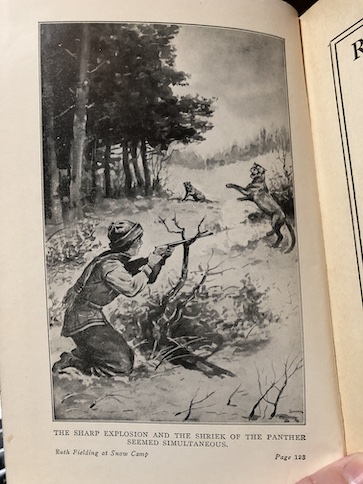
The solution is pretty much what people thought it was, which is a bit of a let down. At first, I thought that there might be more of a plot twist. Even the true identity of the dead body isn’t very exciting. Fred was labeled as a bad boy in the beginning, and that turns out to be true, but his half brother also admits that he was pretty hard on Fred at home because he’s smaller and not as physically strong as his older half brothers. They criticized Fred for not keeping up with the physical work they were doing and called him lazy, but realistically, Fred can’t do all the things they do, and his half brothers realize that they have to acknowledge and accept that. They say that they’re going to try to find him a different kind of work that he can do.

It’s not a bad ending, but I’d like to see a little more deliberate investigation from Ruth Fielding. I would have liked to see Ruth Fielding talk to other members of Fred’s family and maybe have one of them produce a picture of Fred to help establish his identity. Then, I’d like to have Ruth and her friends find Fred more deliberately than accidentally. The story isn’t bad the way it is, and there’s plenty of adventure, but as a mystery fan, I usually prefer more deliberate detective work.