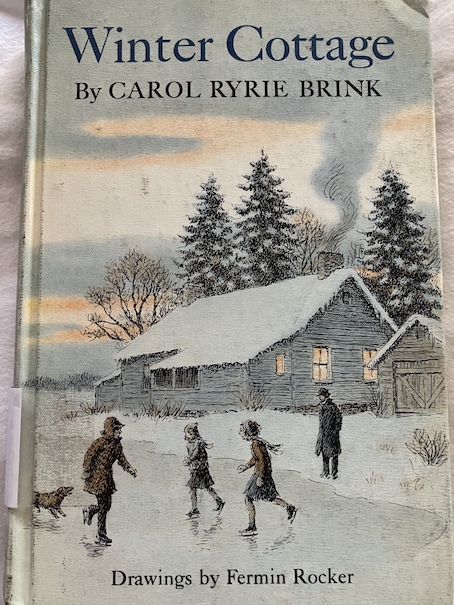
Winter Cottage

The Vincents own a summer cottage in Wisconsin. It was once an old farmhouse, so it is well-insulated and can be heated during the winter, but the Vincents only use it for about 2 or 3 months in the summer. The rest of the time it is empty and used by animals, like mice and woodchucks. However, that’s about to change.
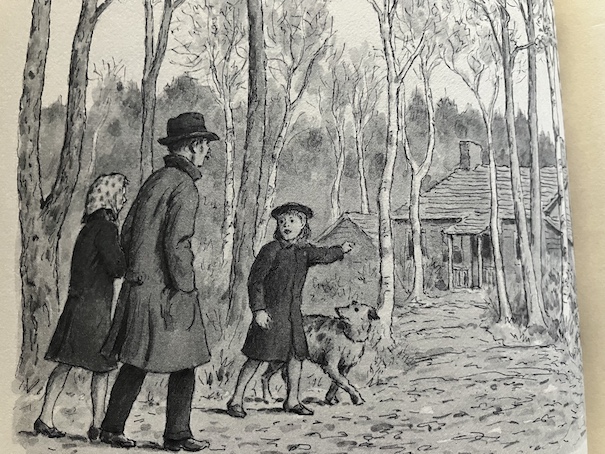
The year is 1930, the Great Depression has started, and many people are out of work and desperate to provide for their families. One such family, a father with his two daughters, happens to be passing near the Vincents’ empty summer house in the middle of October, when the Vincents have already long left the house, when their car suddenly breaks down. They were originally on their way to an aunt’s house to stay with her, but with their car broken down, they’re unable to continue their journey. Mr. Sparkes is a pleasant and easy-going man but impractical and a failed plumber. His eldest daughter, Minty, tends to deal with the practical aspects of things. Minty’s younger sister, Eglantine, called Eggs as a nickname, is the first to notice the empty summerhouse and suggests that, if they could get in, they could make some food. Needing a place to stay for the night and finding a window unlocked, they decide that they’ll go ahead and stay in the house. Although Minty has some reservations about staying in a house that belongs to someone else without their permission, she doesn’t have any better options, and she soon gets caught up in the excitement of exploring this unfamiliar house.
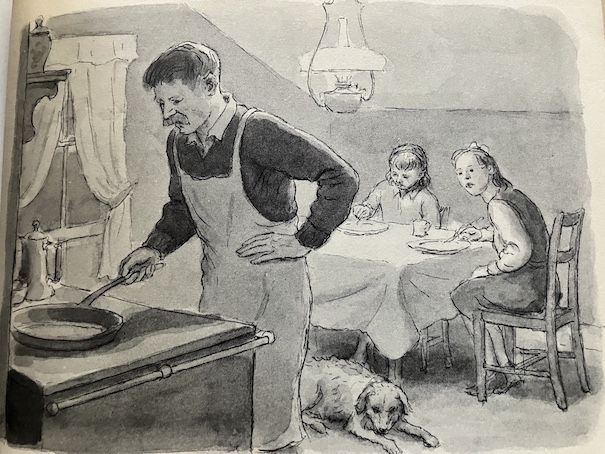
Mr. Sparkes feels like a failure because he’s been in and out of work, and typical jobs just don’t seem to suit him. Their Aunt Amy, the sister of the girls’ deceased mother, thinks that Mr. Sparkes is a failure and a silly, impractical man because he’s always quoting poetry, and his main talent seems to be making his special pancakes. There is some truth to what Aunt Amy says, and Mr. Sparkes acknowledges it. It seems like his only real talent is for making incredible pancakes, although his daughters reassure him that they love him and don’t see him as a failure. They were traveling to stay with Aunt Amy because they have no one else to stay with, but it’s clear from Aunt Amy’s letter that she isn’t looking forward to their arrival, and she also would not welcome their dog, Buster. Eggs says that she wishes they could just stay in this lovely cottage all winter, and Minty wishes the same thing, although she knows it isn’t really right for them to stay in this house without the owners’ permission. Mr. Sparkes likes the cottage, too, because it has a wonderful collection of books, including books of poetry.

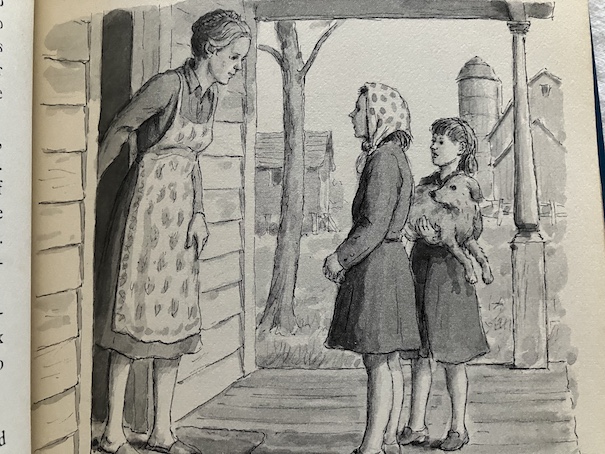
The next day, Mr. Sparkes tries to fix the car, but he’s a terrible mechanic. He takes the engine apart and doesn’t know how to put it back together. The girls go to a neighboring farmhouse and ask if anybody there knows anything about cars. Mrs. Gustafson sends her son Pete with the girls to look at the car, and he manages to put the engine back together again, but he isn’t skilled enough to figure out how to fix the original problem. He says that they had better call a mechanic in town to tend to it and that it would likely cost them about $10. The girls are worried because they know that’s about how much money they have left, and if they spend it all fixing the car, they won’t have enough left to buy more supplies and travel all the way to where Aunt Amy lives.
When they explain the situation to their father, Mr. Sparkes says that he thinks they should just stay in the cottage for the winter. Minty says that isn’t right because the house doesn’t belong to them, but their father says that it isn’t doing the owner any good to leave it empty all winter. To make it right, he suggests that they could rent it, so the owner would profit from their stay. The girls ask where he would get the money to rent the house, and their father says he doesn’t know, but he’ll have all winter to think of something. When they leave the cottage in the spring, he plans to leave the money in the cottage with a note, explaining why they stayed there. The girls are relieved that they don’t have to go to Aunt Amy’s house, but Minty is concerned that, by spring, her younger sister and impractical father will have forgotten all about the rent money for the cottage, and she makes up her mind that she will think of a way to get the money herself.

Eggs comes up with a possible way to make some money when she shows her father a contest magazine that she found at the last place where they camped. There are various contests in the magazine that offer prizes, like prizes for solving puzzles or adding the last line to a limerick. Mr. Sparkes is intrigued by the contests, and he says that they can pass the winter by trying them. He’s particularly interested in the contest to write a poem to advertise butter because he loves poetry and the prize is $1,000, which is an enormous sum to them.

Life in the cottage is idyllic. They have some groceries with them to get themselves started, and their father enjoys fishing in the nearby lake for more food. The girls find nuts and cranberries, and their father cuts wood for the stove in the cottage. Minty takes charge of the house, making sure that they keep it neat for the Vincents. The girls learn that the Vincents are the ones who own the house and that they have a daughter called Marcia when they find some of Marcia’s belongings. Sometimes, Minty and Eggs think of Marcia as a friend, and Minty sort of idealizes her in her imagination. Minty likes to imagine the comfortable life she thinks Marcia lives, wherever her family lives in the winter, and she is determined that they won’t let her down by not taking care of the cottage or finding a way to pay the rent.

Then, Mr. Sparkes gets sick, and the girls are frightened because they don’t have much medicine and don’t know what to do. They try to get help from Mrs. Gustafson, but she’s away from home. As Minty is leaving the Gustafson farm, she happens to meet a boy who’s been hunting partridges, and in her desperation, she begs him for help. At first, he is surly and suspicious with her, but when he begins to understand the situation, he agrees to come have a look at her father. The boy, whose name is Joe Boles, is carrying a professional-looking medical kit and seems to know what he’s doing as he attends to Mr. Sparkes. The girls are grateful for his help, and they invite him to spend the night in a spare room in the cottage.

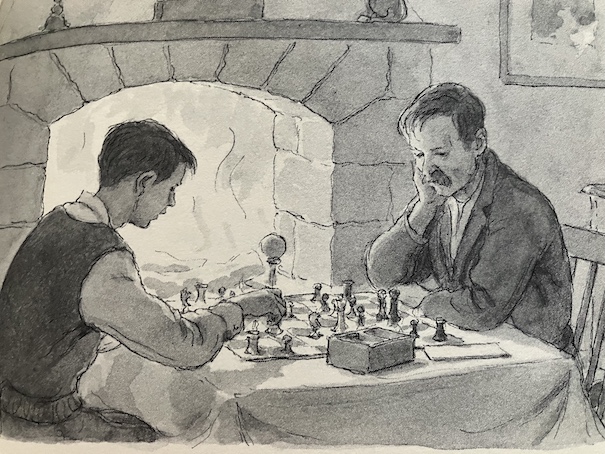
It turns out that Joe is also down on his luck. His father was a doctor, and the medical kit Joe carries used to belong to him. He gets his basic knowledge of medicine from his father and from his grandmother’s home remedies. Joe also wants to be a doctor, but he’s alone now and doesn’t know how he’s going to manage to get the medical training he really wants. Although he’s initially reluctant to explain how he came to be alone, he explains that his father was killed in a car accident. His mother is still alive, but she remarried to a man Joe can’t stand. Eventually, Joe just couldn’t take living with him anymore, so he ran away from home. Joe tells the family that he’s been camping in the woods. Running away from home may not have been the best decision Joe could have made, but he’s determined not to go back, and the family can’t criticize him too much because they’re also sort of running away and hiding out right now.

Joe seems to know what to do to help prepare the cottage for winter, and Mr. Sparkes says that they could use his help around the place. However, Mr. Sparkes admits to Joe that he can’t do much more for Joe than just give him a place to say for the winter, and a borrowed place at that. Joe says that’s fine, and he would like to stay with them for the winter, and he would be willing to pay for his room and board with his labor. The Sparkes family is thrilled to have Joe stay with them and help them. The only point that Mr. Sparkes insists on is that Joe write a letter to his mother to tell her that he’s safe so she won’t worry about him. He says that Joe doesn’t have to be specific about where he’s staying right now, but he knows that Joe’s mother will feel better, knowing that he has somewhere to stay for the winter.
With Joe, Minty and her sister explore the area more and visit the nearby Indian (Native American) reservation. Eggs is a little nervous about the Indians (the term the book uses) at first, worrying about scalping, but Joe tells her not to worry and that the locals are just curious about them. Joe worries less about people recognizing him as a runaway in the reservation village than in the town nearby because it’s a little more remote, although they do accidentally meet the local sheriff in the reservation store, who recognizes Minty from an earlier shopping trip to town. Joe does his best to stay inconspicuous.

While they’re in the reservation store, they learn that the reason why the sheriff is there is that the storekeeper’s son is in trouble. The son, who is a young man in his 20s, got drunk, broke into somebody’s house, ate some of their food, and fell asleep in their bed. The young man’s father argues with the sheriff that the son didn’t actually steal anything from the house, but the sheriff says that what he did was trespassing and that it’s illegal to break into someone’s house, stay there, and use their things without permission. He says that, for that charge, the son will have to spend a week in jail. This incident is troubling to Minty because she knows that she and her family also don’t have permission to use the house where they’re staying, and they’ve been there longer than this young man was in the house where he trespassed. When the sheriff points out that the weather is getting bad and offers to take the kids home, Minty panics at the idea of him finding out where they’re staying and tells him that they plan to spend the night at the reservation.

Of course, the kids don’t really have a place to stay on the reservation, and the weather is bad for camping. They are rescued by the village priest, who says that Joe can stay with him, and the girls can stay with Sister Agnes, one of the nuns who runs the mission school on the reservation. (“Indian schools” like this have a rather scandalous reputation these days for reasons I can explain below.) Minty says that they don’t have any money to pay for a place to stay, but Sister Agnes says that doesn’t matter because “God is your host.” In other words, they’re offering the children a place to stay out of kindness and Christian charity and don’t expect payment. There are some Native American children who also board at the school, some because their houses are too far away for them to travel back and forth between home and the school daily and a couple of children who are orphans and live at the school full time.

There is a scene where some of the Indians are playing drums and dancing, but not the ones living at the school. One of the nuns says that the dancers are “heathen Indians” and that “our Christian Indians don’t dance,” although Minty can tell that the Indian students at the school are feeling the rhythm of the song and enjoying it. Joe takes Minty and Eggs to see the dancers, and they find it fascinating. I didn’t like the “heathen” talk (although I think it’s probably in keeping with the historical setting of the story), but I did appreciate an observation that Minty makes, “Indeed it seemed to be a not entirely un-Christian gathering, for here and there among the gaudy beads was the gleam of a cross on the neck of some forgetful dancer.” That observation contradicts the idea that the dancers aren’t Christians because at least some of them seem to be. That and Minty’s observation that the girls at the school were interested in the dancing and drumming but were being careful not to show it hints at more complex feelings and social dynamics in this village. The people who run the school have some strong opinions about how proper Christians should act, but the Native Americans are still maintaining some traditional practices, and some people are walking a fine line in what they practice and believe.

One of the Indian girls at the dance invites Eggs to join in, and she does. Minty finds that amusing, and Joe tells her to let Eggs have fun because she’s enjoying herself. Sister Agnes asks them later if they enjoyed the dance, and Eggs says she did. Eggs later says that it seems like they don’t have much to do on the reservation, with no “picture shows” (movies) to see and not many toys, so she thinks that the dancing is part of their entertainment. Sister Agnes says, “They are heathen, but God will forgive them.” Minty isn’t too concerned about whether or not the dance might be “heathen” or sinful, but what Sister Agnes says makes her think about what God must think of her family for living in someone else’s house. She hadn’t given it much thought before, but she knows God must know what they’re doing, even if nobody else does, so she prays that He will forgive them, too, and thanks Him for being their host. Before they leave the reservation the next day, a girl Eggs befriended gives them a basket of wild rice, and Eggs give the girl her doll in trade.

When the kids return to the Vincents’ cottage, Mrs. Gustafson is there, visiting with Mr. Sparkes. Mrs. Gustafson seems to accept the idea that they’re renting the house from the Vincent family, although Minty is nervous when she mentions that she writes to them sometimes. Mrs. Gustafson also warns them to beware of strangers because, sometimes, gangster and criminals hide out in the isolated cottages in the area when things get too hot for them in Chicago. Joe has heard stories about that, too.
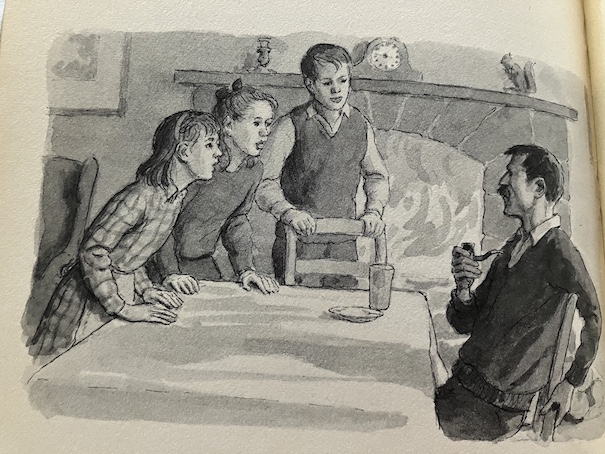
When the family starts getting replies to their contest entries, the results are disappointing. Many of the contests have catches because they expect entrants to buy things or subscribe to things. There is another contest that they hear about on the radio from a flour company, offering a large cash prize for the best breakfast recipe. Minty thinks that sounds better than any of the other contest options because of her father’s wonderful secret pancake recipe, although her father has become disillusioned with contests. They don’t have much time left to enter that contest, and Mr. Sparkes is reluctant to share the secret recipe. The kids end up spying on Mr. Sparkes to learn his recipe so they can enter the contest on his behalf.

Then, one night, they see a man lurking outside the cottage in a blizzard. Minty warns her father not to let the man in, remembering Mrs. Gustafson’s warnings about criminals hiding out in the area and how they shouldn’t open the door for strangers. However, Mr. Sparkes worries about anyone who might be lost in the blizzard, and he has the children invite the man in. The man has a young girl with him, who is half-frozen and dressed as a boy, for some reason. When Minty realizes that the child is a girl and not a boy, the girl asks her not to tell anyone right away. Minty can tell that there’s something strange about this father and daughter pair, and it makes her uneasy. Then, Minty hears a report on the radio about a stolen car and a reward for information leading to the thieves. Is it possible that this man and his daughter are the ones who stole the car? Minty might consider turning them in for the reward money that her family badly needs, but with the blizzard, they’re now trapped in this cottage with this strange man and the girl. The girl, who goes by the name Topper, is fun and good at planning entertainment, but can she or her father really be trusted?

The book is available to borrow and read for free online through Internet Archive.
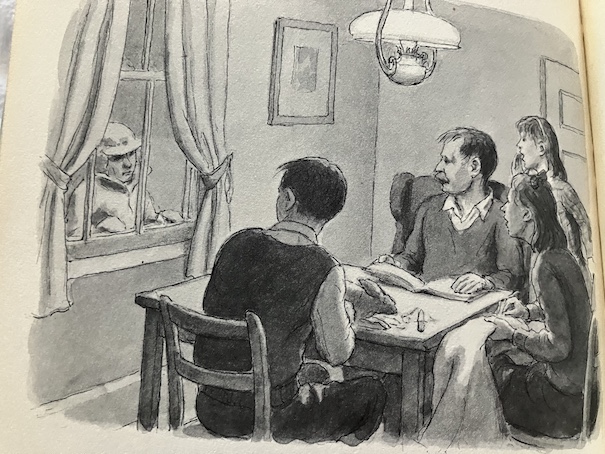
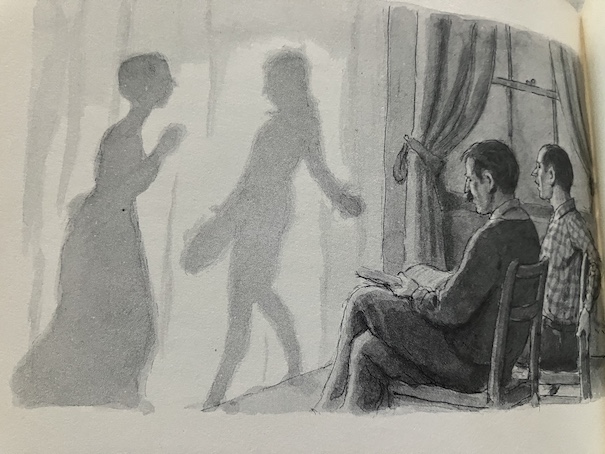
This book isn’t a Christmas story, although the title and some of the themes would have set it up well to be a Christmas story. It fits well with cottagecore themes, with the family, down on their luck, staying the winter in a cozy cottage and getting by as well as they can, enjoying simple pleasures. There’s a line in the story that I particularly liked, toward the end of the book, when the children put on a shadow play for their fathers:

“What a lot of fun you could have, Minty discovered, if you made unimportant things seem important and went about them with enthusiasm!”

I think that sentiment embodies the spirit of cottagecore. To really enjoy some of the simple pleasures of life, you do have to put yourself into the mindset that you’re going to enjoy them to the fullest! I read a book about Victorian parlor games that said something similar. A lot of old-fashioned entertainment and games are quite silly when you analyze them, but if you just throw yourself into them whole-heartedly, they can be great fun!
The family in the story is down on their luck and has their troubles, but their stay in the winter cottage is still an adventure, and they enjoy it. Their consciences do trouble them throughout the story because they’re aware that they’ve been using the cottage without permission of the owners. Minty in particular considers the morality of their actions and has a desire to make things right with the owners of the cottage. Fortunately, the story ends happily for the family, with their lives changed for the better. The people who own the cottage find out about them staying there, but they forgive them, and Minty finds a way to repay them for letting them stay.

The part of the story that I think is most likely to cause controversy for modern readers is the part where the children visit the reservation and the mission school. “Indian schools” have a sinister reputation in modern times because of their harsh treatment of their students and deliberate attempts to eliminate Native American culture. In the book, the nuns at the school make it clear that they don’t approve of traditional Native American practices, like the dance the children watch, because they don’t consider them to be Christian. They call such practices “heathen.” Their focus on discouraging their students from participating in traditional cultural practices is based on religious differences and a desire to convert people strictly to Christianity. However, I appreciated that Minty and the other children see both sides of the story and that Minty observes that some of the Native American dancers are wearing crosses, showing that the actual beliefs among the Native Americans are more nuanced than the nuns’ attitudes suggest.

This part of the story has some use of the word “squaw“, which is problematic because it has vulgar and derogatory connotations. The exact definition of the word varies in different Native American languages, but because it is considered vulgar and derogatory, modern people avoid it. At the time this story was first published, in the mid-20th century, many white people had the idea that “squaw” was sort of a generic word for women among Native Americans and didn’t realize the more vulgar side of the word, which is why it appears in some old children’s books, like this one. The word isn’t meant to be intentionally insulting here, although modern readers should understand that this word isn’t polite or appropriate. Apart from that, I appreciated how the main characters, especially Minty, see some of the prejudiced ways people, especially the nuns at the school, look at the Native Americans and their traditions and their realization that there are sides to their culture and practices that the adults have overlooked.
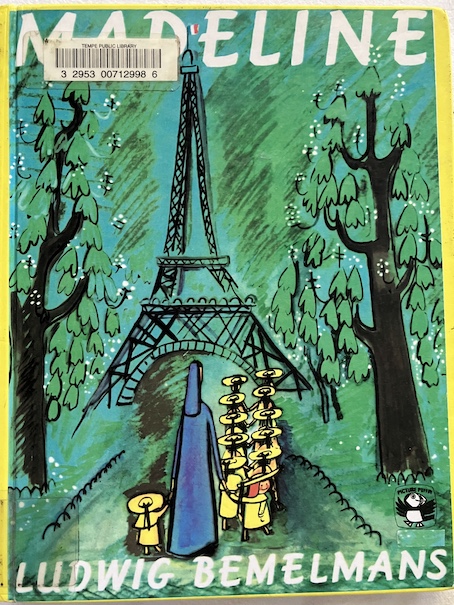
Madeline

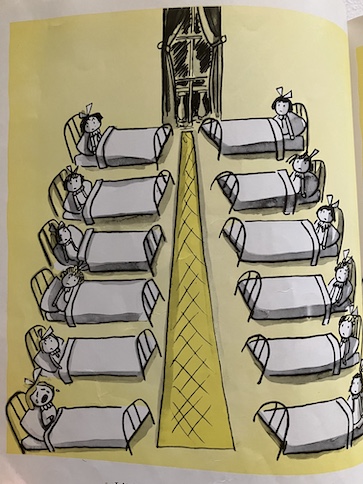
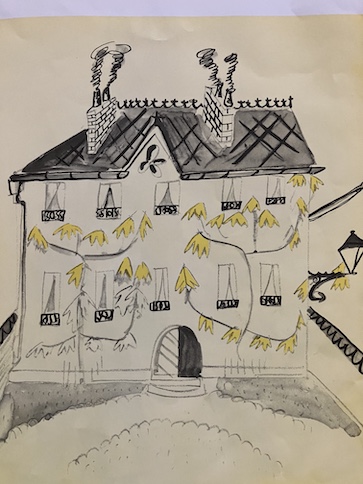
“In an old house in Paris
that was covered with vines
lived twelve little girls
in two straight lines.”

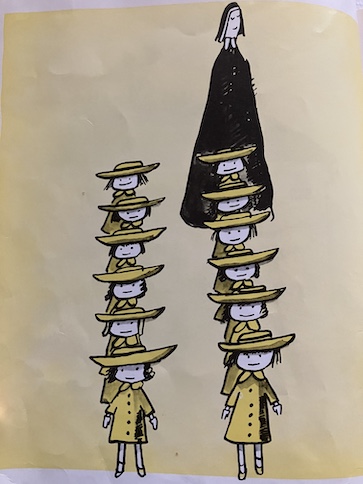
The Madeline stories are considered children’s classics today, and these words, which are the opening lines in other books in the Madeline series, introduce Madeline’s school. Madeline is a little girl who lives in a small boarding school in Paris, tended by Miss Clavel.

Madeline is the smallest girl at the boarding school. She’s a brave girl, who isn’t scared of either mice or lions at the zoo, and she sometimes does daring stunts that frighten Miss Clavel.

One night, Miss Clavel wakes up because Madeline is crying. She calls the doctor, who examines Madeline and rushes her to the hospital because she needs to have her appendix removed.

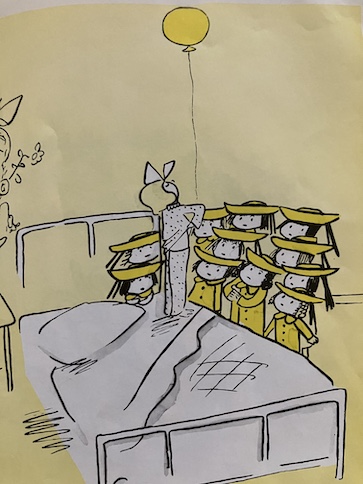
After the operation, Madeline has to stay in the hospital for a while. Miss Clavel brings the other girls from the school to visit her, and they are impressed by all the candy and presents that Madeline has received from her family. Even more impressive, Madeline now has a scar that she shows to the other girls.

After the other girls return home and go to bed, Miss Clavel wakes up to find them all crying. Madeline has made having her appendix out look like so much fun, they all want to do it!

I wouldn’t say that I was a particular fan of Madeline as a kid, but I did read at least some of the books in the series. As an adult, I had forgotten that they were told entirely in rhyme, even though I still sometimes get those opening lines stuck in my head.

I remember thinking as a kid that I wouldn’t want to have my appendix out! Even if you get presents and an impressive scar, having an operation always sounded awful to me. It didn’t occur to me until I was older, but the Madeline cartoons and movie tended to portray Madeline as an orphan, but she isn’t. She’s just a student at a small boarding school. This book is one of the stories that mentions her family, with her papa sending her a dollhouse as one of the presents she receives while she’s in the hospital.

I also didn’t realize, until I was researching this series for the blog, just how old the first Madeline book was. It was originally published in 1939, on the eve of WWII. I don’t think the books ever have anything in them to tie the stories to any particular events, and they seem almost timeless, although I suppose that the girls’ school uniforms are a little old-fashioned. This timeless, idealized portrayal of Paris was popular with the book’s original audience of Americans during WWII.

I was curious about the author, Ludwig Bemelmans. He was born in Austria and grew up in Austria and Germany during the late 19th century and early 20th century. As a young man, he was apprenticed to his uncle, who owned a hotel, but Bemelmans was difficult to manage and got into trouble while working there. He later told a story about shooting and wounding a headwaiter who whipped him, although that might have been just a tall tale. Eventually, however, his uncle decided that he couldn’t deal with him, so he told him he would either have to go to reform school or go to the United States, where his father was living after having left him and his mother years before. He moved to the United States and lived there during WWI. He spent some time working in a series of hotels and restaurants. He eventually joined the US Army in 1917, although they wouldn’t send him to Europe because the US was at war with Germany, and he was German. He became a US citizen in 1918, and he developed an interest in art. He worked as a cartoonist before writing and illustrating children’s books. He wrote the first seven of the Madeline books, and the last one was published after his death. Since then, his grandson, John Bemelmans Marciano has written other Madeline books.

Swallows and Amazons

Roger Walker is staying at a farm near a lake for the summer holidays in 1929 with his mother and siblings. His father is away on a ship, a destroyer, and the family write letters to him. The children are particularly waiting for a reply from their father because they’ve asked him for permission to do something special, and their mother says that they will be allowed to do it if their father agrees. What they want is permission to sail the family’s sailboat, the Swallow, by themselves and to camp out on an island in the middle of the lake. They are all thrilled when their father agrees that they can do it! Roger is especially thrilled because, until their littlest sister, Vicky, was born, he was the baby of the family, and he was often left out of things that the older children were allowed to do.

There are a couple of conditions on the permission for the children to go sailing and camping by themselves. The first is that the two oldest children, John and Susan, are in charge. Roger and their other sister, Titty, will have to follow their orders. Before the children can camp out, their mother also makes them tents to use, shows them how to set up the tents, and takes them on a sailing trip so she can make sure that the children know what they’re doing. The excited children prepare for their sailing and camping expedition, giving themselves sailing roles, working out ship’s articles, and gathering supplies. John will be the captain of their ship, while Susan will be the mate and cook. Roger is a cabin boy, and Titty is an able seaman.

When the children go to the island, they find a nice place to set up their camp and a harbor for their boat. Surprisingly, they also discover signs that someone else has been on the island before them, but they don’t know who that is. They begin to think of the mysterious people who have been there before as “Natives” of the island, and they also start to think of their mother and other adults who help them as “Natives.” Their mother plays along with it, as if she’s part of one of the stories the children have probably been reading. When their mother comes to bring them some supplies, the children also mention seeing a man with a parrot on a house boat. The man helping their mother, Mr. Jackson, says that the man often has his nieces with him, but they don’t seem to be with him this time. The children’s mother tells the children where to go to pick up milk, and she says that she wants the children to talk to her every couple of days so she will know they’re all right and so they can pick up more provisions from her.

The children continue with their camping and fishing, and they continue to notice the man on the houseboat, who they think of as being like a “retired pirate” with his parrot. They also notice that he has a small cannon on his houseboat. One day, the children spot another boat approaching the island, sailed by a pair of girls. The children hide and watch the boat. Then, it sounds like the cannon on the boat goes off, and the “retired pirate” is on the deck, appearing to shake his fist at the girls in the boat. The children from the Swallow think that the man on the houseboat might be firing at the girls! The girls also run a flag with a skull and crossbones on it up their mast. The girls are being pirates! The children try to follow the girls’ boat, the Amazon, to see who the girls are and where the boat docks, but they lose track of the Amazon.

The lady who gives the children their milk talks to them when they come to get their supplies. She tells them not to bother Mr. Turner, the man on the houseboat. The children realize that Mr. Turner thinks of them as a nuisance, although they don’t know why. The crew of the Swallow takes it as the “retired pirate” stirring up the “Natives” against them. Then, someone steals their boat, the Swallow, and the children are set upon by the pirate girls at their camp!

There is a battle at the camp between the Swallows and the Amazons, but one of the Amazons asks for a “parley.” The crew of the Swallow confronts the Amazons about the theft of their boat, and the Amazons confront the Swallows about the campers trespassing on “their” island. The crew of the Amazon says they’ve been coming to this island for years, and they’re the ones who built the little fireplace the Swallows found when they started setting up camp.

During their “parley”, the children sort of continue their imaginary roles as explorers and pirates in their talk, but they also reveal some of their real backgrounds. The two girls from the Amazon explain that Mr. Turner on the houseboat is their Uncle Jim. At least, they say that sometimes he’s their uncle and is nice to them. They’ve been visiting the island for years, and their uncle is the one who gave them their boat. However, this year, their uncle is a hostile “native” and their enemy. The Swallows say that Mr. Turner has apparently been complaining about them to the local adults, “stirring up the natives” against them, so he is their enemy, too. The Amazons, Nancy (real name Ruth) and Peggy (Margaret) Blackett, suggest a truce between the Amazons and the Swallows and an alliance against their shared enemy, the “pirate” Jim Turner, characterized as a Captain Flint type character. If the two crews are allied, it won’t matter who technically “owns” or controls the island because they have a shared mission against their enemies, particularly Uncle Jim, aka “Captain Flint.” The Amazons admit that they really have wanted to be allies all along. The Swallows agree to this plan, and the two crews sign a treaty with each other.

As the two crews celebrate their new alliance, the Amazons explain how their uncle came to be their enemy. Usually, their uncle likes playing with them when they visit during the summer, sailing and exploring with them and teaching them things he knows about sailing. However, this year, he’s writing a book about his travels, and he doesn’t have time for them. He gets upset when they disturb his work, and the girls’ mother has told them to leave him alone when he’s working. The girls feel betrayed that he isn’t paying attention to them and gets annoyed by them. The day when the crew of the Swallow thought the man on the houseboat fired his cannon at them, the girls say that it wasn’t the cannon. They set off a firecracker when Uncle Jim was asleep as a prank, and that’s why he was shaking his fist at them as they fled in their boat.

It sounds like the Blackett girls have been a nuisance to their uncle because they’re hurt that he’s not spending time with them, and they’re trying to get his attention. Still, the Swallows enjoy their new alliance with the Amazons. Each of the crews has some experience sailing, the Amazons having learned what they know from their uncle and the Swallows having been taught by their father. John is impressed by what the Amazons teach them, but there are a few things that they know that the Amazons don’t. The two crews learn from each other, and they begin planning war games with their two ships to practice for a battle with their sworn enemy. In between, they enjoy their camping and exploring activities.

It turns out that Mr. Turner on the houseboat has been blaming the children from the Swallow for his nieces’ pranks with fireworks, which is why he’s been complaining about them to local people. When Mr. Turner leaves a complaining note at the Swallows’ camp, John realizes why he resents them. John knows that he could tell Mr. Turner the truth about who had the fireworks, but he doesn’t want to tattle on the Amazons because of their alliance and because Mr. Turner is angry and offensive and accuses him of being a liar when he insists that he and his siblings didn’t do what he’s accusing them of doing.

The Swallows and the Amazons start a daring war game with each other, a contest for them to try to capture each other’s ship. The winning crew will have their ship declared the flagship of the fleet! The Swallows attempt to capture the Amazon after dark, but their attempt is foiled because the Amazons sneak out of their house and head for the island that night. Titty, left alone on the island to mind their camp, realizes that the Amazons are on the island and decides on a risky plan to take their ship herself!

However, the children aren’t the only marauders abroad that night. When Titty takes the Amazon, she overhears some men in another boat. Some charcoal burners told the children from the Swallow earlier that Mr. Turner should make sure that he locks up his houseboat securely because they’ve heard some talk that someone might try to break in, but they never delivered the message because Mr. Turner accused John and his siblings of setting off the fireworks, and they forgot they were going to tell him what the charcoal burners said. The men that Titty overhears are suspicious, and they seem to be hiding something. After the Swallows win the mock war, the Swallows tell the Amazons what the charcoal burners said, although the Amazons are reluctant to tell their uncle to lock up his boat because they want to stage their own raid on it.

The Walker family will be heading home in only three more days and bad weather may be coming, so the children have to hurry to make the most of their adventures as Swallows and Amazons. Titty tells her siblings about the men who seemed to be hiding something, and she thinks it’s some kind of treasure. Her older siblings think that she probably dreamed about hearing men hiding something because she fell asleep on the Amazon, but Titty persuades Roger to come with her to find the treasure.

The book is available to borrow and read for free online through Internet Archive. This is the first book in a series, and it’s been adapted for film and television multiple times.

The author of the story, Arthur Ransome, named the character of Roger after Roger Altounyan, who he met when the real-life Roger was a child, visiting grandparents in the Lake District of England with his sisters. (Real-life Roger Altounyan later became a doctor and pharmacologist, known for a pioneering treatment for asthma.) The names of the fictional Roger’s siblings are also based on the real-life Roger’s siblings. The name “Titty” is odd, but it’s actually a nickname. The real-life Roger had a sister, Mavis Altounyan, who was called “Titty” as a nickname after a children’s story, Titty Mouse and Tatty Mouse by Joseph Jacobs. The character of Titty is sometimes called “Kitty” in some adaptions of the story.

Although the story explicitly states the year as 1929 when the Swallows and Amazons sign their treaty with each other, most of the book could take place at just about any time during the 20th century and into the 21st century because the children are dedicated to camping and sailing and don’t use any form of technology that would firmly date the book. The book has a timeless quality, and it’s the sort of independent adventure that many children dream of having!

The books in this series have been popular in Britain since they were first published, and they have also inspired other books for children on similar themes, having outdoor adventures with minimal adult help or interference. Enid Blyton wrote several series for children on these themes after Swallows and Amazons was published, such as The Famous Five Series and Enid Blyton’s Adventure Series, and Elinor Lyon started her Ian and Sovra series in the 1950s, explicitly stating that she wanted to write books with similar adventures for children but with child characters who weren’t as competent as the children in Swallows and Amazons. The children in Swallows and Amazons are very knowledgeable about sailing and camping and seem to do almost everything right, and Elinor Lyon thought it would be more realistic if the children in her stories didn’t entirely know what they were doing but somehow managed to muddle their way through anyway. There are also similar books by American authors written after Swallows and Amazons, like The Invisible Island by Dean Marshall.

The children in the story take their inspiration for their imaginary play from books they’ve read, like Robinson Crusoe and Treasure Island. All of the children in the story seem familiar with sea stories and books about exploration and island adventures, and they make references to aspects of them and use those aspects when they’re playing. For example, they refer to adults and anyone who is unfamiliar to them as “Natives” and “savages”, and they call their bottles of ginger beer “grog”, while tea is “hot grog”, lemonade is “Jamaica rum”, toffee candy is “molasses”, and tins of corned beef is “pemmican”, living out their fantasy that they’re sailors exploring unknown territory. Later, they compare Jim Turner, the man on the houseboat, to Captain Flint and call him that for most of the story. Some of the language that the children use, like “natives”, “savages”, and the phrase “Honest Injun” are racially out of date and can have some offensive connotations. The children probably got those phrases from the books they’ve been reading, and they seem to think of them innocently, as part of their imaginary play, living out the stories they’ve read, but modern readers should be aware.

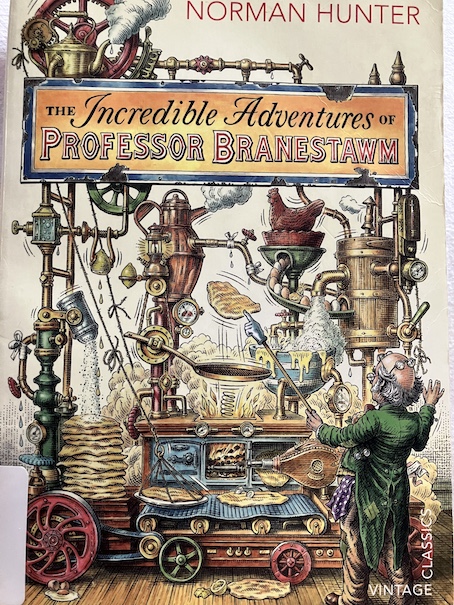
The Incredible Adventures of Professor Branestawm

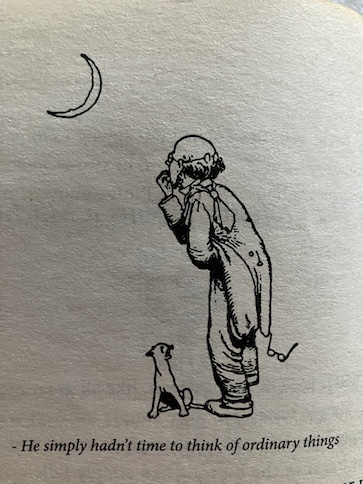
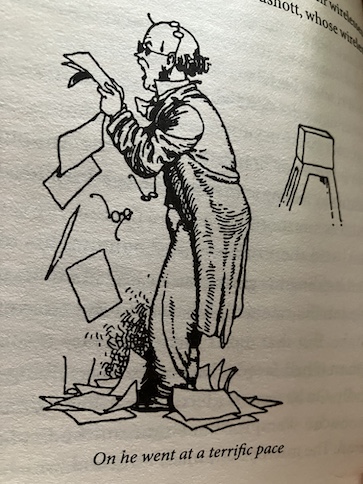
Professor Branestawm is a classic absent-minded professor. He’s is a balding man who wears several pairs of glasses, one of which is for finding the other pairs of glasses when he inevitably loses them. He’s a very clever man, but everyone knows that his inventions are likely to cause chaos. He’s not an easy person to talk to, so he doesn’t have many friends. His best friend is Colonel Dedshott, who is a very brave man.

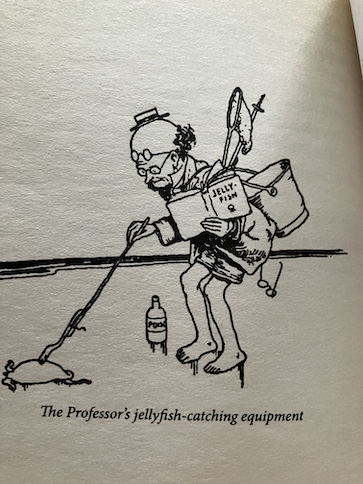
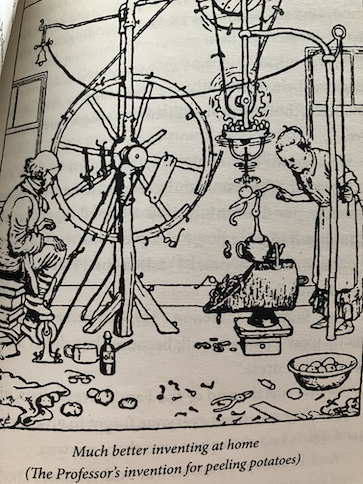
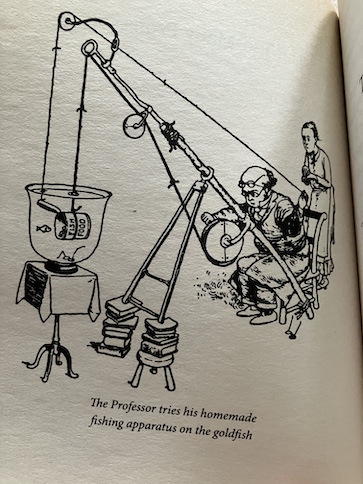
Every chapter in this book is about another of the Professor’s inventions and the adventures that the Professor, the Colonel, and the Professor’s housekeeper, Mrs. Flittersnoop, have with them and with various situations that the Professor creates with his absent-mindedness. The stories are accompanied by pen-and-ink drawings. I love the way almost every picture of the professor shows him shedding one or more of his many pairs of glasses and that the Colonel’s weapon of choice is a slingshot!

One day, Professor Branestawm invites the Colonel to his house to see his latest invention, which he says will revolutionize travel. When the Colonel arrives, Professor Branestawm explains his idea. First, he points out that, if you’re traveling somewhere, you’ll arrive in half the amount of time you ordinarily would if you travel there twice as fast. The Colonel says that makes sense. Then, Professor Branestawm says that, the faster and faster you travel, the sooner you arrive at your destination. That also makes sense. Further, Professor Branestawm says, you eventually start traveling so fast that you arrive before you even start, and if you go fast enough, you can arrive years before you start. The Colonel doesn’t really understand this, but he takes the Professor’s word for it. The Professor has built a machine that will allow them to travel that fast, and the Colonel is eager to try it. He suggests that they try going back in time to a party he attended three years earlier. The Professor insists that they take some powerful bombs with them, just in case of emergencies (don’t try to make sense of it, there isn’t any), and the Colonel has his trusty catapult (slingshot) and bullets with him.

It turns out that, rather than going to the party three years earlier, they arrive at the scene of a battle that took place in another country two year earlier. Although they already know how the battle turned out, the Professor and Colonel can’t resist joining in with their bombs and catapult, and they end up wiping out an entire army and changing the result of the battle in favor of the revolutionaries. The revolutionaries are so grateful to them for their help that they take them to the palace of their former king, put the two men on the enormous throne there, and make them the new presidents of the country. Professor Branestawm realizes that they’ve made a terrible mistake and changed history because the king’s army was the one that was originally supposed to win the battle. The Colonel, however, doesn’t care because he thinks it sounds like fun to be a president and can’t wait to do some ruling.

Of course, the ruling of the two presidents doesn’t go well. Neither one of them really knows anything about running a country. Since they blew up all the country’s troops, there are no troops left for the Colonel to review, and he ends up playing with toy soldiers. Meanwhile, the Professor really just wants to get back to his inventing. Eventually, the revolutionaries get tired of this and tell them that they’ve decided that they don’t want any presidents, so they’re giving them a week’s notice before they’re out of a job. The Professor and the Colonel try not to take any notice (ha, ha) of the revolutionaries’ attempts to dethrone them. This just leads to the revolutionaries trying to imprison them in the dungeon, so the Professor and the Colonel are forced to escape in the Professor’s machine, which takes them back to the exact time and location where they started. They arrive just as the Professor’s housekeeper brings them some tea, so they have their tea, go about their usual business, and leave it to the historians to deal with the complications of the two of them changing history.

When Professor Branestawm’s housekeeper puts a bottle of cough syrup with no stopper into the waste-paper basket, it accidentally creates a waste-paper monster! It turns out that it wasn’t really cough syrup in the bottle. It was a special life-giving formula that the professor invented. He only keeps it in a cough syrup bottle because cough syrup is the only thing that neutralizes the life-giving formula and stops it from bringing everything it touches to life, including the bottle holding it. Now that they’ve accidentally created a waste-paper monster, what can they do to stop it, especially since it seems to have the ability to use tools and is currently trying to saw down the tree where the Professor and his housekeeper are trying hide?

Professor Branestawm accidentally loses a library book about lobsters, so he goes to another library to get the same book. By the time that he needs to return the library book, he has found the first one and lost the second one. For a while, he manages to avoid library fines by continually returning and checking out the same book from both libraries because the libraries don’t notice which library the book is from. Of course, he eventually loses the first book, too. He tries to fix the situation by getting the same book from a third library and then one from a fourth library, when he loses the third book. Where will it all end? How many libraries will have to share this one book, and where on earth are all these books about lobsters going?

Professor Branestawm and his housekeeper go to the movies to see a documentary about brussels sprouts. (The housekeeper doesn’t care about brussels sprouts, but there’s a Mickey Mouse cartoon included with the feature, and she wants to see that.) When they get back, they discover that the house has been robbed! Professor Branestawm decides that he’s going to invent a burglar catcher, but the only burglar he catches is himself.

Professor Branestawm’s clock stops, so he takes it to a clock repair shop. It turns out that the clock has only wound down because the Professor has forgotten to wind it. The Professor decides that he’s going to invent a clock that will go forever and never need winding. (This story is set before clocks that don’t need winding became common.) The Professor does invent a clock that will never stop and never need winding, but he makes a critical mistake: the chimes never reset after they strike twelve. They just continue counting up and up, endlessly, with no way to stop them! Just how many times will they endlessly strike before something terrible happens?

The Professor visits a local fair and invites the Colonel to join him. The Colonel ends up winning most of the prizes for the various games, and the Professor accidentally gets left behind in the waxworks exhibit, being mistaken for a wax statue of himself. When the Professor decides that it’s finally time to get up and go home, the people who work in the waxworks think that a wax statue has come to life!

Professor Branestawm writes a letter to the Colonel, inviting him to tea, but because he is distracted, thinking about potatoes, he accidentally writes a muddled letter and then mails the paper he used to blot the letter instead of the letter itself. The message that arrives at the Colonel’s house is a backward, muddled mess, and he has no idea who sent it to him. Since it looks like it’s written in some strange language he doesn’t know, the Colonel decides to take it to the Professor to see if he can decipher it. The Professor fails to recognize the letter as what he sent and has forgotten that he sent it. Will the two of them figure out what the letter is about, or will they eventually just give up and have some tea?

Professor Branestawm’s housekeeper’s spring cleaning creates some chaos in the professor’s house, and the Colonel suggests that Professor Branetawm invent a spring cleaning machine. Predictably, the spring cleaning machine creates an even bigger mess and far more chaos.

Professor Branestawm invents a very smelly liquid that brings things from pictures to life. The things from the pictures go back to being pictures when the liquid dries. Of course, there are some things that cause big problems when they’re brought to life. Possibly the most chaotic pictures that come to life are pictures of the Professor and the Colonel and the professor’s housekeeper. Who is who and which is which?

Professor Branestawm is invited to give a talk on the radio, and the Colonel helps him to rehearse. However, because he gets mixed up, he almost misses his own talk, and when he finally gives it, he speaks too fast and discovers that the time slot for his talk is much longer than he thought it was. Listeners are confused, but everything is more or less all right when the Children’s Hour comes on.

The Professor and the Colonel are going to a costume ball. Since the Professor doesn’t know what to do for a costume, the Colonel suggests that the two of them dress as each other. This causes some confusion, and neither of them likes each other’s clothes. The Professor’s social skills aren’t even great at the best of times, and the truth is that he’d rather be inventing things at home in his “inventory” (pronounced “invEnt – ory” as in a laboratory where you invent things, ha, ha). Then, the Countess at the ball raises the alarm that her pearls are missing! Everyone is confused when they try to get “the Colonel” to find the thief, and he doesn’t seem to know what he’s doing. It takes a while for things to get sorted out, but at least the Professor and the Colonel develop a new appreciation for being themselves instead of being each other.

Professor Branestawm’s house has gotten so full of his inventions that it’s become difficult to live there, so he’s decided to move to a new house. Moving to the new house is an escapade, and when Professor Branestawm and his housekeeper get there, they discover that the water and gas haven’t been connected up yet. Professor Branestawm’s attempts to remedy the situation render the new house unlivable, so he is forced to move back to his older house.

Professor Branestawm invites his friends and various members of the community to his house for a party, where there will be tea and pancakes. Everyone is happy to go because of the promise of pancakes, but when they’re all there, Professor Branestawm reveals that the party is to unveil is newest invention: a pancake-making machine! As the library man predicts, the pancake-making machine goes wrong (just like the Professor’s other inventions), but it’s all right because the town council comes up with a new purpose for it.

Professor Branestawm takes a trip to the seaside. He asks the Colonel to join him and bring his book about jellyfish, but unfortunately, he neglects to tell the Colonel where he’s staying (partly because he forgot where he was supposed to stay and is actually staying somewhere else). When the Colonel tries to find the Professor, he accidentally mistakes an entertainer dressed as a professor for Professor Branestawm. When the entertainer isn’t acting like himself (so the Colonel thinks), the Colonel becomes worried and decides medical intervention is necessary.

The book is available to borrow and read for free online through Internet Archive (multiple copies). It’s the first book in a series about Professor Branestawm, and it was also adapted for television multiple times.

Kids won’t learn anything about real science from Professor Branestawm, but the stories in the book are funny and not meant to be taken seriously at all. Most of the stories are about some pretty silly things that don’t really mean much in the end, but when you think about it, the Professor’s antics do lead to some pretty serious consequences, from wiping out an entire army just for the fun of it (pretty horrific in real life) and changing the course of history to accidentally blowing up someone’s house with his perpetually-chiming clock. No matter what the Professor does, though, there never seem to be any lasting consequences.

Even when people around him brace themselves for when the Professor’s latest project inevitably goes wrong, everybody still thinks that the Professor is pretty clever. The Colonel always thinks the Professor is clever, and even when he knows that the Professor is bound to do something that’s going to cause chaos, he enjoys the excitement. The housekeeper sometimes goes to stay with her sister, Aggie, when the chaos and excitement get too much for her.

The stories are just meant to be enjoyed for their zaniness, and there’s no point in analyzing them much. You don’t have to worry about whether anything the Professor does makes sense or exactly how he got any of his inventions to work. You can just enjoy seeing how everything develops and watch the craziness unfold! It sort of reminds me of Phineas and Ferb’s summer projects, which cause some chaos but are ultimately funny and always disappear at the end of the day. Enjoying these stories is what they used to say in the theme song for the tv show Mystery Science Theater 3000:

“If you’re wondering how he eats and breathes
And other science facts,
Just repeat to yourself “It’s just a show,
I should really just relax …”

I can promise you that, no matter what happens in any of the stories, the Professor and his friends will ultimately be fine and will probably have a cup of tea (or “a cup of something”) afterward. This book was originally published in Britain the early 1930s, and it was read by children during the Great Depression. I can imagine that it might have given children then a good laugh and some escapism during troubled times.

Strangely, at least one of the Professor’s inventions, the clock that never needs winding, is a real invention that we have every day because time has moved on (ha, ha) since this book was originally written and published. In fact, it’s very unusual to find clocks that need to be wound these days. Of course, the part about the clock perpetually chiming more and more and blowing up when it gets to be too much is just part of the craziness of Professor Branestawm.

After the Sun Sets

This was my favorite book of fairy tales when I was a kid! I gave away my copy years ago and regretted it, but I was thrilled to find another copy later at an antique/vintage mall.

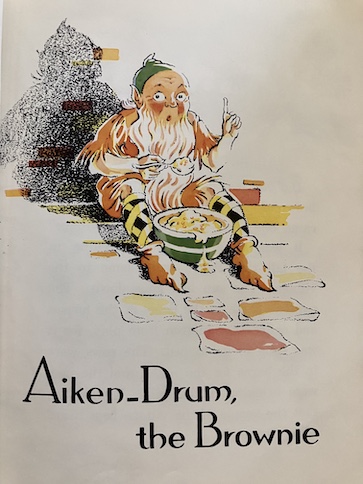
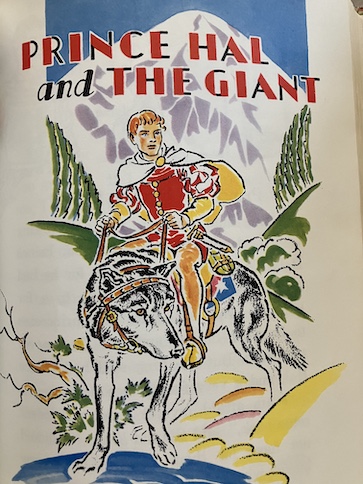
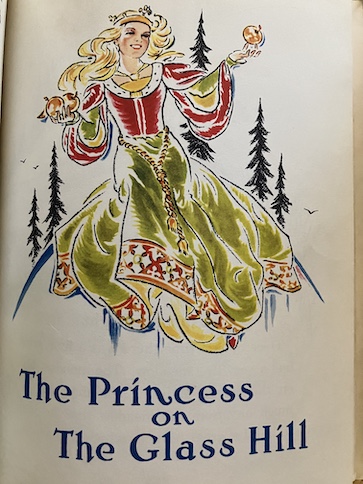
The collection includes some popular fairy tales that you can find in other fairy tale collections, like Cinderella, Brier Rose (the Sleeping Beauty story), and Hansel and Gretel. It also has some stories that are less commonly known these days, like Aiken-Drum, the Brownie and Prince Hal and the Giant. When I was young, my favorite stories in the book, the ones I read over and over, were Snow-White and Rose-Red, The Princess on the Glass Hill, and East of the Sun and West of the Moon.

One of the things that makes this collection unique is that it includes a section of poems at the back of the book. I love the one called Cinderella’s Song, and it was one of the reasons why I missed this collection so badly. I don’t think I’ve seen that poem in any other book.

The illustrations in the book are beautiful! I loved them as a child, and I still find them enchanting as an adult. Some are in black-and-white, but some are in full color.

I didn’t realize it when I was a kid, but this book is actually the third book in a series, The Wonder-Story Books, and it was a unit in The Row, Peterson Basic Reading Program. I have the 1962 edition, but the book is actually older than that. Its copyright was renewed multiple times.

The book is available to borrow and read for free online through Internet Archive. There is also an earlier edition of this book available through Internet Archive, and it doesn’t have the section of poetry included, so the poetry might only appear in the 1962 edition.

Aiken-Drum, the Brownie

Aiken Drum is a Brownie, a magical little man who likes to do chores for other people for little reward. Reward a Brownie too much, and he will leave.

Pat and the Fairies

Pat joins the fairies in a dance, and they loan him a pair of shoes when his wear out. When he later comes to return the shoes, he gets a wonderful reward. A greedy shoemaker tries to join the fairies in their dance and borrow a pair of shoes to get the same reward, but the fairies punish him when he tries to cheat them.

Change About

A husband grumbles about how little his wife accomplishes in the course of a day while she minds the house and their child and he works out in the fields. The husband and wife decide to switch places for a day to prove which of them works harder, and the husband has a surprise about what really happens at home while he’s away.

Cinderella

A girl who is abused by her stepmother and stepsisters receives magical gifts from her fairy godmother so she is able to attend the prince’s ball.

Snow-White and Rose-Red

A widow and her two daughters let a gentle talking bear spend the winter with them so he won’t freeze, but this bear is under a spell.

Snip, The Tailor

A tailor sets out to make his fortune. He uses his wits to defeat a pair of giants and win a castle and half the kingdom from the king.

Brier Rose

This is the Sleeping Beauty story. A young princess is cursed by a bad fairy. When she hurts her hand on a spindle, she and everyone in her castle falls asleep for a hundred years.

Prince Hal and the Giant

Prince Hal is the youngest of a king’s seven sons. The other six have left home to find brides and have never returned home. No one knows what happened to them. Prince Hal sets out to find what happened to his brothers. He finds out that they and their brides have been turned into stone statues in the house of a giant. Prince Hal must find a way to save them and the princess who has become the giant’s latest captive.

Hansel and Gretel

A pair of children are abandoned in the woods, and they find a strange house made of gingerbread. They are almost eaten by the witch who lives in the house.

The Princess on the Glass Hill

Every year on Midsummer Night, the hay disappears from a farmer’s field. Each of his sons tries to find out why, but each of them is frightened by the strange things that happen, until the youngest son faces the phenomenon and discovers a strange horse with a coat of mail that fits him perfectly. The same thing happens twice more so that the youngest son acquires three fine horses and three sets of mail. He keeps them secret at first, but later, he uses them to perform an amazing feat and ride to the top of a glass hill to win the hand of a princess.

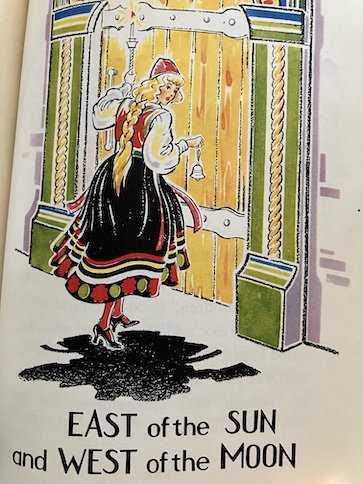
East of the Sun and West of the Moon

A white bear comes to a family with many children and says that he will make them rich if the eldest daughter, Freda, will come with him. At first, she doesn’t want to go, but when she does, he takes her to a magical castle. Unfortunately, she disobeys the bear’s instructions while she’s there. He is under a witch’s spell, and Freda must find a way to undo the damage she’s caused and break his spell, following him to the witch’s castle by riding the winds, east of the sun and west of the moon.

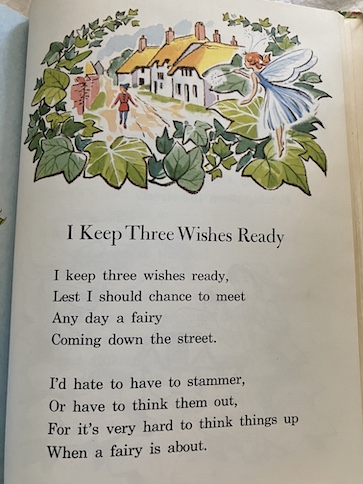
I Keep Three Wishes Ready by Annette Wynne – It’s good to know what you want to wish for, just in case you get the chance.

At the Zoo by A. A. Milne – There are many fascinating things to see in a zoo!

Some One by Walter de la Mare – Someone knocked at the door. Who?

Little Nut Tree by Mother Goose – A traditional rhyme about a magical tree. One of my favorites!

The Duel by Eugene Field – The gingham dog and the calico cat have a fight.

Queen Mab by Thomas Hood – About the fairy queen and how she gives pleasant dreams to children.

Cinderella’s Song by Elizabeth Madox Roberts – Cinderella confides her secret to her cat.

Trees by Harry Behn – Trees are wonderful things!

The Story of the Baby Squirrel by Dorothy Aldis – A child finds a baby squirrel and raises it. When it grows up, it runs away, but they think he’s probably still living with the other squirrels nearby. They sometimes see a squirrel who seems to be saying hello to them.

The Hens by Elizabeth Madox Roberts – It sounds like the hens are talking, but what are they saying?

Roads by Rachel Field – Roads might lead anywhere and to all sorts of wonderful things!

Washington by Nancy Byrd Turner – About George Washington. This one seems like an odd inclusion to me, adding a poem about a historical figure to a collection that has more fairy tale themes.

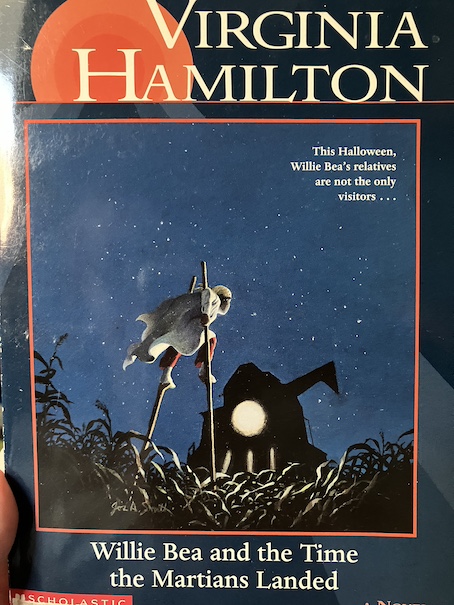
Willie Bea and the Time the Martians Landed

It’s Halloween 1938, and Willie Bea’s relatives have gathered at the old family farm, near where she lives. Money is tight because of the Great Depression, but one of her aunts lives and works in the city, making more money than the others, and is willing to help fund family dinners and provide a little extra for her nieces and nephews when they need something, like new clothes. The aunt is a little scandalous in their family for her multiple marriages, but the others appreciate her generosity, and the nieces and nephews like getting some extra attention and a few treats from her.

The family gathering is a bit chaotic with children running around and getting into trouble. One of Willie Bea’s cousins gets into particular trouble with her mother for using his bow and arrow set to shoot a pumpkin off of Willie Bea’s younger brother’s head. Their mother panics when she catches them doing it because he could have missed and killed the little boy, but Willie Bea tries to calm her mother. Willie Bea was less worried because she knows her cousin’s archery skill and that he wasn’t going to miss, but she understands that adults think of the risks and aren’t fully aware of what the kids are capable of doing. (I’m siding with the mother on this one. Even people who are very good at something can miss now and then, and it’s a big risk to take with someone’s life.) Willie Bea also realizes that the decision to use her little brother for the William Tell act actually came from another cousin because the cousin doing the archery wouldn’t have thought of it himself, and it’s not fair that her mother doesn’t know to blame this other cousin.

Willie Bea talks to her father about the incident, hoping that he’ll understand how unfair it is. However, her father tells her that what her cousin did was dangerous, no matter why he did it. Even though he has a reputation for being good with archery, even people who are good can still miss, and accidents can happen. (See?) Her father lets Willie Bea know that he’s aware that she and her cousins do risky things sometimes when they’re playing with each other, but as an adult, he and the other adults have a responsibility to tell them when something they’re doing is too risky and to put a stop to it. No matter how many times they’ve done some of these things without having an accident, some things are just accidents waiting to happen. They should never assume that an arrow can’t go wrong just because it hasn’t yet or that they can’t fall from a high place just because they haven’t fallen yet.

Willie Bea is a little embarrassed by the talk and feels like her father still doesn’t understand. However, Willie Bea herself has been starting to understand a few things about her relatives this Halloween, things that she either hasn’t noticed before or only half noticed. She can see that one of her cousins is too manipulative, noting the little tricks she uses to get her way and the things she says and does when she wants to be spiteful. She can see that her other cousin has trouble asking up for himself and is particularly vulnerable to manipulation.

Willie Bea also begins to notice things about the adults in the family and their relationships with each other. Aunt Leah, the aunt who has more money than the others and has been married multiple times seems glamorous and fascinating to Willie Bea. Aunt Leah is into horoscopes and fortune telling, and when she reads Willie Bea’s palm, she predicts something special for her. Although Willie Bea loves her own mother, she is intrigued by the family gossip that her father was seeing Aunt Leah before falling in love with her mother, and Willie Bea fantasizes about what it would be like to live with Aunt Leah in the city. She imagines that it would be exciting, and she asks her father why he chose her mother instead of Aunt Leah. Her father knows that Willie Bea doesn’t entirely understand what it’s like to make that kind of choice and what living with a woman like Aunt Leah would really mean. (It occurred to me that the multiple divorces Leah has had might be a clue.) He just explains to Willie Bea that his choice became clear after he got to know her mother as well as her sister, Leah. He knew her mother was the right choice because she was the kind of steady woman who would always be there for him.

That evening, while Willie Bea is putting together her hobo costume and the ghost costumes for her younger siblings and her parents are listening to the radio, Aunt Leah suddenly bursts in and starts having hysterics about it being the end of the world! It takes Willie Bea’s parents a while to get a clear answer from Aunt Leah about why she’s so upset. When she recovers enough to explain things, she says that she was listening to the radio, and she heard that Martians have invaded New Jersey! She describes the horrible, terrifying reports that the radio announcer made about the Martians destroying army troops with their deadly heat ray. Aunt Leah was so terrified by what she heard that she not only turned off the radio but unplugged it, and she says that she’ll never plug it in again, which might be a moot point, if aliens really are here to destroy the world. (If you know what was infamously broadcast on Halloween 1938, you know what Leah heard and that it’s not what she thinks it is.)

While Willie Bea’s parents are trying to decide what to make of Aunt Leah’s story, Willie Bea’s Uncle Jimmy arrives. He says that the rest of the family has also heard what Aunt Leah heard and that they’re all gathering at the old family farm. Rumor has it that people have seen the terrible invaders over at the Kelly farm. Willie Bea’s mother gathers the children and heads to the family farm that Willie Bea’s grandparents own to be with the rest of the family, while Willie Bea’s father tries to see if he can find the station that Leah was listening to and hear the reports for himself. It occurs to him that it might not be an invasion of the Martians but could actually be Germans and German war machines because they’ve all heard about the Nazi takeover of Germany, and he remembers the horrible Hindenburg disaster. If Germans could make a blimp that explodes into a fiery terror like that, then he thinks maybe they could make something that resembles an alien invasion.

At her grandparents’ farm, Willie Bea watches as various relatives panic, cluster around the radio, trade rumors, and try to figure what’s going on. Rumor has it that there are Martians on the Kelly farm, so Willie Bea convinces young Toughy Clay to go over there and try to see them for themselves. At Willie Bea’s insistence, they use the stilts that the children like to walk on to give themselves longer legs, so they can get there faster. Nothing is as it seems this Halloween, and Willie Bea’s expedition to see the Martians definitely doesn’t go as planned.

The book is available to borrow and read for free online through Internet Archive (multiple copies, including a short picture book version).

Almost of the characters in this book are African American. I don’t think it’s ever stated directly because there’s no need in the story to describe them, compared to anyone else, but I think it’s subtly implied. There is only one point in the story where race is mentioned at all, and that’s when Willie Bea is hurt, and the doctor comes to see her. Willie Bea describes the doctor as an old man who delivered most of the babies in her family and knows everybody in the community, and she says that he visits everyone, black or white, rich or poor. Willie Bea’s family is at the poorer end of the community because the doctor knows that people like them don’t normally call the doctor unless it’s something that they really can’t handle by themselves.

I found the family relationships in the story confusing at first. The kids are all referred to by nicknames, and when they are first introduced, it’s difficult to keep it straight who is whose sibling and who is a cousin, and who is older and who is younger. At least, that’s how it seemed to me. Relationships are explained gradually as the story continues, along with characters’ real names as well as nicknames, but it takes some time to get to the explanations.

The story has a slow start, and the real adventure doesn’t begin until about halfway through the book. In some ways, it’s a coming of age story for Willie Bea because she finds herself seeing her family in ways that she never has before, becoming more aware of different sides of their personalities and gaining more insights into their relationships with each other. She also comes to see firsthand what her father means about the stunts that she and her cousins pull and how she should never assume that they can’t get hurt just because they haven’t before. Much of this book is what I would call “slice of life”, a sort of glimpse into Halloweens of the past in a rural community, especially one particular Halloween that would have been memorable for anyone who was alive at the time in the United States.

The radio broadcast that has Willie Bea’s family and others in the community panicking over an alien invasion is The War of the Worlds, a play based on the novel of the same name by H. G. Wells. This type of panic over this particular radio performance was a real, historical incident because the radio play was presented in the format of news broadcasts at the time, and some people who tuned into the program late misunderstood what they were hearing and thought that it was a real news broadcast about an actual emergency. It wasn’t a widespread panic because, first, people who started listening to the broadcast from its beginning knew what they were listening to, and second, not everyone was listening to the broadcast at all. Still, there was enough panic over the radio performance that it became newsworthy and has become a piece of American history and lore.

I enjoyed the historical details in the story, particularly all the radio play references throughout the story. Willie Bea’s family likes to listen to radio shows, and I’m familiar with some of them because I also enjoy old radio plays. Her family likes to listen to The Shadow and Little Orphan Annie. Willie Bea likes to amuse her siblings by imitating people from the radio, singing theme songs and reciting jokes from Jack Benny, like the famous “your money or your life” joke.

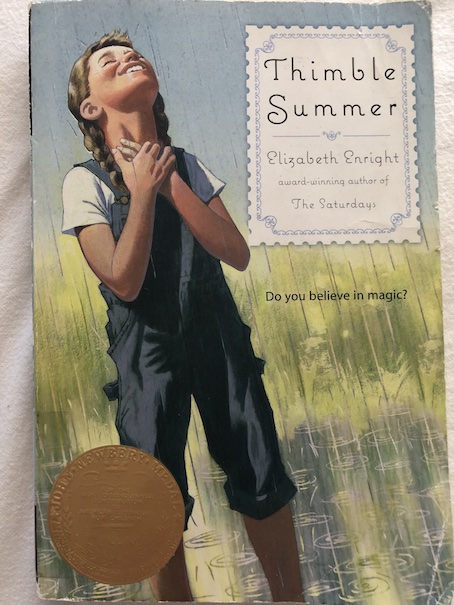
Thimble Summer

Thimble Summer by Elizabeth Enright, 1938, 1966.

It’s summer, and Garnet is a 9-year-old girl living on a farm with her parents and brothers in a rural community in Wisconsin. The story is episodic, with each chapter describing things that happen to Garnet over the course of one magical summer when she found a silver thimble down by the river. Garnet thinks that the thimble itself is magic, but maybe the magic is just in the happy summer adventures that follow.

The book is a Newbery Medal winner. It’s available to borrow and read for free online through Internet Archive (multiple copies, including one in Chinese).

The chapters in the book are:

The Silver Thimble

It’s been hot and rainless, and the crops are in danger of being ruined if they don’t get some rain soon. It’s a real worry because, if the crops are bad, Garnet’s family won’t be able to pay their bills. When Garnet and her brother Jay go swimming in the nearby river, Garnet finds a silver thimble. It’s a lucky find, and Garnet becomes convinced that the thimble is magic and that something wonderful is about to happen. Jay thinks that’s silly, but that night, the rain they’ve so badly needed comes! Garnet and Jay are so overjoyed with the rain that they go out running in the rain in the middle of the night, until they are frightened by lightning striking something, and their mother calls them back.

The Coral Bracelet

Garnet’s best friend is a girl name Citronella, who lives nearby. Citronella’s great-grandmother lives with her, and she tells the girls stories about what it was like when she was young. She tells them about Indians (Native Americans) who would sneak into her family’s house in bad weather to get warm and leave them presents as thanks. (I don’t know if any Native Americans ever did this in real life, but she says it like it really happened.) Then, she tells the girls about a special coral bracelet that she wanted at the general store when she was young and some foolish risks she took to get it.

The lucky thing that happens in this chapter is that Garnet’s father gets a government loan to build a new barn.

The Lime Kiln

The family needs to make lime for building their new barn. The kiln needs to burn for three days straight, and they all need to take turns tending it, day and night. Jay and Garnet are allowed to stay up all night there with their father. Friends help them, and neighbors come to visit and talk with them. Garnet brings along a picnic with sandwiches and apple pie that they eat at midnight.

The Stranger

While they’re tending the kiln, a strange boy comes along and asks them for food. His name is Eric, and he’s a parentless boy who travels around and makes his living from odd jobs. He tells them about his life and travels, and Garnet’s father hires him to help the family build the new barn.

Locked In

Garnet likes having Eric at the farm, but she’s also a little jealous that Jay wants to spend more time with Eric now than with her. Garnet starts spending even more time with Citronella, and the two girls build a tree house together. The girls tell stories in their tree house, and because it’s going to rain again, Garnet suggests that they go to the library in town. They get so engrossed in their books that they lose track of time and get locked in the library. Garnet thinks this is a fabulous adventure until Citronella points out that it’s Saturday, and the library is closed on Sunday. If they can’t find a way out, they could be there for the rest of the weekend!

Journey

It’s harvest time, and everyone is occupied in picking crops and canning foods. Garnet helps, and she is temporarily put in charge of the threshing machine. Unfortunately, she falls asleep and lets the straw stack pile up until it falls over and makes a mess. Eric tells her not to worry about it, but Jay yells at her and tells her that she had no business helping out as a girl and that she should be at the house with the women. Garnet is so upset at the way Jay has been critical of her lately that she decides to run away and hitchhike around, like Eric used to do.

“As a Ragpicker’s Pocket”

Garnet is still running away, and she takes a bus to the next town. By the time she has explored the town and looked at all the store windows, she isn’t so upset and can see the funny side of what happened with the thresher, and she’s about ready to go home. She buys a few things for her family at the dime store and a hot dog to eat. Then, she has a horrible realization: she’s out of money. How is she going to get back home?

Fair Day

Garnet goes to the fair with her family and neighbors, and she enters her pig, Timmy, in a contest. Timmy was the runt of his litter, but Garnet has taken special care of him, and she thinks that he has a good chance of winning a prize.

Ice-Cream Cones and Blue Ribbons

Garnet and Citronella enjoy the wonders of the fair while Garnet is waiting for the pig contest. They spot the lady sword-swallower darning her socks, they ride the rides, and they have snacks. The girls get stuck on the Ferris wheel when it stops working, and Garnet worries about getting down in time for the judging of the pig contest.

The Silver Thimble

The silver thimble hasn’t been mentioned since the first chapter, but when Garnet looks back on all the good things that have happened this summer, she’s still sure that it’s magic. All the good things that have happened started right after she found it. She shows the thimble to Eric, and the kids talk about what they want to do with their futures.

My Reaction

This story is more like a collection of stories, some of which continue each other. The book is somewhat episodic, leading up to the fair at the end of the summer. The stories are pretty gentle, slice-of-life adventures. Eric has had a hard life, but he doesn’t want to dwell on it too much, and things improve for him when he decides to stay with Garnet’s family. There are hints that Eric might marry Garnet someday, and the two of them might stay on the family’s farm. Eric has had enough of traveling in his young life, and he wants to be a farmer and thinks that he would like to save up money and buy land near the family’s farm. Jay wants to be a sailor or something else that will let him travel and see the world, although he thinks that he might want to come back to the farm when he’s done traveling and farm it with his father and Eric.

The book fits with the Cottagecore genre, and it would make good bedtime reading. Foodies will enjoy the mentions of old-fashioned treats, like apple pie, griddle cakes, and vinegar candy. Garnet also imagines that each of the kitchen things have their own personalities.

I liked Garnet’s name, which is very unusual in the early 21st century. Citronella is an even more unusual name, but I prefer Garnet. I think it’s charming, and it’s one of the less-common gem names used for girls. In the story, Garnet mentions that the librarian frequently gets her name wrong because gemstone names are popular in her time and area. There are other girls in town named Ruby, Pearl, Opal, and Beryl, and the library usually calls her Ruby, the most popular of the gemstone names.

There are some stereotypical mentions of Native Americans in the story. They’re not derogatory, and they’re minor parts, but there were a couple of things that struck me as being a little stereotypical, like the kids saying that they’re Comanche Indians doing a rain dance when they’re running around in the rain. I also didn’t care for the way the characters kept pointing out which people were “fat” or “fleshy.” They’re not really shaming these characters, just sort of remarking, but I just felt like it was rude and unnecessary. You see this sometimes in older children’s books. Fortunately, none of the fat characters are considered bad characters in this story, as they sometimes are in other books. There aren’t really any bad characters in the story in general. Jay is annoying at times and says things that put down his sister and girls in general in a bratty, macho kind of way, but nobody in the story is a villain.

Gone Away

I haven’t found a copy with its dust jacket intact.

Gone Away by Ruth Tomalin, 1979.

Time flies?
Ah no.
Time stays.
We go.

Sundial motto from the beginning of Gone Away

Francie is an only child living on a farm called Goneaway Farm in Sussex in the 1930s. It’s a very old farm, and there’s a story about it that, hundreds of years before, another family once lived there, another couple with only one child. One day, this family went to a fair in another town, Alchester, and for reasons nobody understands, they never returned to this farm. The farm stood empty for a long time before it had a new owner. Because this old family went away with no explanation, the farm came to be called Goneaway. In spite of this strange story and the age of the farm, Francie has never felt that the farm was haunted or that there was anything sinister about it. Then, Francie finds herself staying in a real haunted house.

There are no illustrations in the book. It starts with this quote.

Because the farm where Francie lives with her parents is far away from local schools, Francie studies her lessons at home with her parents’ help, but she often gets distracted by the animals on the farm and doesn’t focus on her lessons. Francie’s great-aunts, Aunt Berta and Aunt Fanny, live in Scotland, but when they come to visit the farm, they see how Francie isn’t getting her schoolwork done. The aunts are also concerned at how isolated Francie’s life is. There are no other children living nearby to be friends with Francie, and they think that her life must be lonely. They talk to Francie’s parents about sending her to boarding school, but they say that they can’t afford it. They can’t even afford a car, which is why they can’t drive Francie to school in town. The aunts remind Francie’s mother that she used to board in a private house with a nice family so she could attend school when she was young. Boarding with a family wouldn’t cost as much as a fancy boarding school, and she could come home on weekends. Still, Francie’s parents are reluctant to send her away because they think she’s too young, and they’re not ready to part with her.

When the aunts leave after their visit and her parents don’t bring up the subject of school again for a while, Francie is relieved. She loves her life on the farm, and she doesn’t want to leave. Yet, she also finds herself oddly disappointed, too. She’s read stories about children at schools, and their adventures do sound exciting. She thinks it would be ideal if she could go to school during the day and come home afterward, like other children do, but that just won’t work with her family’s circumstances. Her parents’ attempts to find friends for her just aren’t working, either. Her parents start inviting other farm families to visit on Sundays, but Francie doesn’t get along with their children. The reasons why she doesn’t get along with them are largely because the other children don’t behave well, but these incidents convince Francie’s parents that maybe the aunts were right and that Francie could benefit from going to school and meeting a wider range of other children.

Her parents write to the high school in Alchester and inquire about registering Francie. They arrange for Francie to take entrance exams, but Francie has mixed feelings about it. On the one hand, the idea of boarding and going to school, with the knowledge that she will come home on the weekends, seems exciting, but on the other hand, she worries that the children at the school won’t be any more friendly than the children of the nearby farm families. Her mixed feelings continue through the day when she and her mother visit the school. At first, Francie thinks that maybe she’ll flunk the entrance exams on purpose so she won’t have to leave her farm. Then, after the initial tour of the school, Francie thinks that going there may be exciting after all, so maybe she’ll try to pass the exams. The exams are difficult, and she expects she’ll fail them after all because she really can’t do the work. Her parents tell her not to worry because, if she fails this year, she can always study more and try again next year. However, it turns out that she did pass. The arithmetic portion of the exam really was too difficult for her because the person giving her the exam accidentally gave her a higher level test instead of the basic entrance exam, but Francie did an excellent job on the writing portion of the test.

Since Francie will be attending the school in Alchester after all, she and her mother begin shopping for her school uniforms and other supplies. Francie is still worried about the prospect of boarding with strangers in town, and her mother isn’t sure how to find a house or family willing to take her. A boarding prospect turns up because Francie is too small and skinny for even the smallest available size of the school uniform, and she and her mother have to visit a professional tailor. The tailor, Mrs. Majendie, also has a few rooms that she rents out to boarders. Francie isn’t sure that she’ll like boarding with Mrs. Majendie at first because she and her house seem a bit grand, her dog seems oddly bored and unresponsive to Francie’s friendliness, and her other boarder is the headmistress of another school in town, the Chantry School. However, the available room is beautiful, with a four-poster bed and tapestries, and the room has a view of the nearby churchyard, where the children from the Chantry School are playing among tombstones in the old graveyard. Mrs. Majendie says that the Chantry School was once a chapel, and her own house was once an old inn. She also says that a new housekeeper will be moving in soon with her daughter, who will attend the Chantry School. It all seems like a fairy tale kind of place to Francie, and she is reassured that there will be another girl living in the house with her, so she tells her mother that she would like to board there.

When she actually starts school, it goes pretty well. The classes aren’t too hard, the subjects are interesting, and she gets along well with the other girls. There is an older girl called Trixie who likes to play pranks on the younger students, and some of the girls tease Francie about her height, but the older girl who is assigned to look after her, Verity, tells Francie not to take any notice of those girls. At first, Francie is able to use her bicycle to get from school to the train station, so she is able to go home every night, but then, as the days grow shorter, and it gets dark sooner, she can’t do that anymore, so she starts to board in town with Mrs. Majendie.

Her boarding experience turns out to be different from what she first thought, though. It turns out that the new housekeeper isn’t very friendly, and her daughter decided to stay with her grandmother instead of coming to town with her mother, so the house is lonelier than Francie had expected. The atmosphere is also different in the winter than in the summer, when Francie first saw her room. The room seems colder, darker, and a little more sinister in the winter, and in the evening, there aren’t any children playing in the churchyard outside. At night, she hears strange sounds, like a tapping and a wailing. When Trixie learns that the place where Francie is boarding is Falcon House, she implies that there’s something really wrong with the place, but Francie assumes it’s just another of Trixie’s tricks. Then, when other students try to get Trixie to shut up and remind her that they all promised not to talk about it in front of Francie, Francie realizes that there really is something weird about the house. She tries to get Verity to explain it to her, but Verity refuses, which just makes Francie angry and more scared. Now, she knows there is a real secret about the house, but she doesn’t know exactly what it is.

A strange man comes to visit Falcon House, and Francie sees that his card says he is Dr. D. Bone Fane from the Circle for Psychical Research. Francie doesn’t know what it means, so she asks some of the other girls at school if they know. One of them, Bryony, says that she’s met this man before. He’s a ghost-hunter from the United States, investigating supposedly haunted places. Bryony’s father teaches in the Abbey choir school, and this man has been pestering him about stories of a haunting there, although Bryony’s father thinks it’s all boring nonsense. From this information, Francie realizes that Dr. D. Bone Fane is interested in Falcon House because he thinks it’s haunted. She confronts Verity about it, and Verity admits that there are stories of hauntings at Falcon house. Nobody’s ever actually seen the ghost that haunts the house, only heard things, and the only people who have heard the ghost are children. According to the stories, Mrs. Majendie’s own children were the last children to be haunted by the ghost, and they were so scared of the house that they begged their mother to send them to boarding school so they could get away from it. Francie is the first child to live in the house since the Majendie children grew up. Francie realizes that this is why the housekeeper didn’t bring her own daughter to the house and why she seems uneasy about Francie’s presence in the house. Mrs. Majendie even gave her nightlights as a gift because she was expecting Francie to be frightened. The headmistress at Francie’s school told everyone not to talk about the ghost stories, not because she believes in them, but because she was afraid that Francie would believe them and get scared. Everyone but Francie has known about the ghost stories from the beginning, and they’ve all been waiting to see what she will experience in the house, if anything.

The more Francie thinks about it, the more she realizes that she sensed the presence of the ghost on her first visit to the house. Besides the noises she’s been hearing at night, the dog in the house reacted to something at the top of the stairs, as if an invisible hand was petting him. When Francie returns to Falcon House after visiting Verity, it’s a stormy night, and she’s terrified about what might be waiting for her at the top of the stairs. However, when she gets there, and she realizes that it’s just her, the dog, and the ghost, she suddenly realizes that the ghost isn’t a menacing presence. The dog likes it, and it seems a little teasing, but it doesn’t mean Francie any harm. Strangely, its presence begins to feel reassuring to Francie because she’s no longer alone in the house, the only child among adults. The ghost is a child, too. In fact, it’s the ghost of the child from Goneaway, the one who disappeared hundreds of years ago, along with its parents.

The more that Francie investigates, the more she comes to realize that the ghost needs her help. Helping the ghost means learning the truth about the family who once lived on the farm that Francie calls home.

This book was originally published in the UK. The book is available to borrow and read for free online through Internet Archive. There is a sequel to this book called Another Day.

My Reaction and Spoilers

This book fits well with the Dark Academia aesthetic, and it could also be considered Dark Cottagecore because of the farm and countryside themes. When Francie is on the farm, she describes the animals and plants in the countryside. Francie’s school isn’t a boarding school, but she does have to board in a spooky place to go there. There are many literary references throughout the story, and there’s a note in the beginning of the book about the poetry references. Francie reads The Story of the Amulet by E. Nesbit for fun, and her class at school reads Treasure Island. She uses stories she’s read to help her understand what is happening around her. When she makes friends with a girl named Geraldine at school, Geraldine also uses story references to explain what she thinks is happening with the ghost.

When Francie first begins to interact with the ghost, she is only able to sense its presence but not really see it. As the ghost begins to interact with her, it gradually begins becoming more visible. At first, Francie can’t even tell whether the ghost is a boy or a girl, only that it’s a child about her size. She wonders why the stories she’s heard about this child and its parents never mention whether the child is a boy or a girl or what its name and age were. She thinks it’s sad that so many little piece of history get lost.

What she eventually realizes is that the child and its parents were probably plague victims because they disappeared around the time that the plague came through this area in the Middle Ages. She thinks that they probably caught the plague when they came to town for the fair and were buried in one of the unmarked mass graves she’s heard about, and that’s why they were never able to return home. When she talks it over with Geraldine, Geraldine realizes that the children who have been able to see the ghost were all suffering from homesickness when they first arrived at Falcon House. The ghost is awakened by feelings of homesickness in other children because that’s what the ghost has been feeling the entire time. What it wants is to go home to the farm, and Francie has to find a way to help bring it home with her. There is a twist in the ghost story later that leaves Francie wondering how much of what she’s perceived about the ghost is her imagination and another girl, the housekeeper’s daughter, sneaking around the house. However, there really is a ghost, and Francie does figure out how how to help it. It comes home for Christmas with Francie.

During the story, Francie struggles with the difficulties of being away from home and going to school for the first time, and she also starts to consider what it’s going to mean for her future. She still thinks of herself as living at Goneaway Farm, but then, the wife of a farm hand refers to her as becoming a “visitor.” Francie feels uneasy about that because she knows that the woman’s son also went away for school and decided that he would rather do something other than farming, so he now lives somewhere else. Francie still thinks of the farm as her home, and it upsets her to think of the farm without her or her life without the farm in her future. But, is that really what she wants? Before her great-aunts raised the issues of school and friends, Francie was content with her life and didn’t realize that either of those things was something she was missing or might want. Now that she’s going to school in town, meeting new friends, and experiencing some independence to explore the town on her own, what else might she discover that she wants and never knew she could experience before? Will the new things she learns and wants to experience mean giving up her old life, which she still loves? These are all questions that people have as they’re growing up and pursuing an education.

Nobody really knows where life will lead them when they’re just starting out, and that can be scary, but at the same time, growing up does mean change. The changes that Francie experiences are ones that she would have experienced anyway, eventually. Her mother understands some of how Francie feels because she also boarded as a child so she could go to school, but at the same time, Francie realizes that her mother doesn’t understand everything that she’s going through because she isn’t there with her every day. Her mother doesn’t fully know what her classes or teachers are like or what the other people she meets and lives with at Falcon House are like. For the first time in Francie’s life, she and her mother are starting to live different lives, and there are some things that Francie must experience and make decisions about on her own.

The practice of children from rural areas boarding at a private house to attend a day school in town is a real part of history, both in the UK and in the US. I covered that earlier when I reviewed Sixteen and Away From Home, a book set in the 19th century Midwestern US, and The Secret School, when a teenage girl named Ida wants to go to high school in the 1920s. Anne Shirley did the same in Anne of Green Gables, which is set in 19th century Canada. This is what children from rural areas in different countries have had to do if they wanted more schooling than they could get in their area.

There is a scene in the story with some gyspies. The book calls them both “gypsies” and “travellers.” One of them tells Francie’s fortune, which gives her hints about what to do. There is also a scene where girls from Francie’s school put on a performance, and there is a dancing dragon and a student who is dressed as a “Chinese boy” for part of it. The “Chinese boy” costume is only mentioned briefly and not described in detail. It’s the sort of thing that is discouraged now in school, people dressing up as people from other races.

The Story of Ferdinand

The Story of Ferdinand by Munro Leaf, drawings by Robert Lawson, 1936.

Ferdinand is a young bull living in Spain. He has been different from the other young bulls since he was a little calf. While the other young bulls liked to run around and butt their heads together, Ferdinand preferred to simply enjoy the peaceful countryside and smell the flowers. His mother sometimes worried about him, sitting all by himself under his favorite tree. She was afraid that he would be lonely, but Ferdinand told her that he just liked sitting under the tree and smelling flowers and that he didn’t want to play rough with the other young bulls. As long as Ferdinand was happy, his mother was content to let him do what he wanted to do.

As time went on, Ferdinand and all of the other young bulls grew up big and strong. The young bulls who had always played rough together were fascinated by the bull fights held in Madrid. They thought that it would be exciting to be picked to participate in the fights. But, Ferdinand had no interesting in fighting of any kind. Although he was big and strong, he still preferred to just enjoy his flowers and his favorite tree.

When some men come to the field to pick out bulls for the bull fight, the other bulls try to show off for the men. Ferdinand doesn’t, but by accident, he sits on a bee and is stung. When the men see him jumping around in pain, they assume that he must be the fiercest bull in the field!

Poor Ferdinand is carted off to Madrid, but no matter what the bull fighters do in the arena, they just can’t get Ferdinand interested in fighting them. There is only one thing that interests Ferdinand, and that’s flowers. When the men put him in the bull fighting arena, he just sits and looks at the pretty flowers that the women in the stands are wearing in their hair, enjoying the smell. They are so disappointed at the lack of fighting that they put Ferdinand back in the cart and put him back in the field … which is exactly where he wants to be.

The book is available to borrow and read for free online through Internet Archive (multiple copies, including some in different languages). It has been reprinted many times. It has not been out of print since its first publication, and it has been made into a movie.

My Reaction and A Little History

I remember that I didn’t care for this book when I first read it years ago. I was really worried for poor Ferdinand when he was picked to join the bullfight. Because the book is for young children, it doesn’t make it fully clear that the bullfight is supposed to end with the death of the bull. The bullfighters all have spears and swords “to stick in the bull”, and the book says it’s to make the bull mad, but adults and older kids realize that they’re really going to hurt and kill the bull during the fight. There are vultures in some of the pictures as a clue that death is a real risk.

Fortunately, nothing bad happens to Ferdinand in the story. Because Ferdinand is a peaceful bull, who has no interest in fighting and only wants to enjoy flowers, he is not exciting enough for the bullfight, so he gets sent home to the field and the peaceful life he loves. The other bulls may not know that their lives could be much shorter because of their willingness to fight.

It’s also interesting to note that this book was written in the 1930s, when the world was headed for World War II. It was also published shortly before the Spanish Civil War. Because of its pacifistic themes, it was banned by both Franco and Hitler. The author, Munro Leaf, said that he didn’t really mean the story to be a serious one, but its themes resonated with even the adults of his time, in different ways, as this article from Sotheby’s notes:

“In 1937 Leaf wrote that he had published a book he “thought was for children… but now I don’t know” and in 1938 The New Yorker wrote “Ferdinand has provoked all sorts of adult after-dinner conversations.””

It wasn’t just Hitler and Franco who were suspicious of the book’s intentions. Some people also suspected it of being “Red Propaganda” or “Fascist Propaganda”, presumably because some people feared the pacifism in the story would encourage people not to fight communists or fascists. Some people also questioned the book’s message on the topic of masculinity. I could see that the story could be regarded as a commentary on men who think they have to tough, macho fighters, like the bulls. Even though Ferdinand might be regarded as a failure as a bull for not engaging in the fighting and rough play of the other bulls and not going through with the bullfight, he lives a happier, more peaceful, and ultimately, longer life because of it. Maybe he’s not a failure after all but just smarter than the average bull. Ferdinand is certainly a non-conformist who finds a way to make it work for him. How any reader might feel about that could depend on what they think conformity means and how they feel about that.

However, the book also received a lot of positive support. There is an anecdote that Gandhi loved it, and President Franklin Roosevelt requested a copy. The Sotheby’s article also recounts a story that I first heard from my children’s literature teacher when I was in college, that 30,000 copies of the book were sent to Germany after World War II as a peace gesture. When my teacher told the story, she explained that few children’s books were published during the war (and if you’ve already read my review of Emil and the Detectives, you already know that even children’s books were not exempt from book burnings if they had anti-war themes), so the distribution of the copies of The Story of Ferdinand were welcome, and the children who received them loved the story.

Invincible Louisa

Invincible Louisa by Cornelia Meigs, 1933.

This is the story of Louisa May Alcott, the famous 19th century author who wrote Little Women and other books for children.

The book begins with Louisa May Alcott’s birth on November 29, 1832 in Pennsylvania and explains about her parents’ backgrounds. When Louisa’s mother, Abba (short for Abigail), had first become engaged to her father, Amos Bronson Alcott, people advised her not to go through with the marriage because Bronson didn’t seem like a very practical man and nobody really expected that he would amount to much. However, Abba genuinely loved him and understood him. They shared similar ideals, including Abolitionism and the practice of service and charity to others, although they didn’t agree about everything. Bronson was a scholarly man who worked as a teacher, although he struggled to get an education himself when he was young because he was born to a family of poor farmers. As a young man, he had worked as a traveling salesman and had seen much of life across the country. He was good at talking to people and was very good at speaking to children, which led him to eventually settle down to teaching.

The Alcott family was happy where Bronson Alcott was teaching in Germantown, but the death of his school’s patron was a heavy blow. Without his patron’s backing, the school didn’t last, so the Alcott family left Germantown and moved to Boston. Little Louisa enjoyed the busy city of Boston, but the book also describes a harrowing situation in which she almost drowned after falling into Frog Pond. This incident was a traumatic memory for Louisa, but it wasn’t just the trauma that left a mark on her. The person who rescued her from drowning was a black boy. (The book uses the word “Negro.”) Louisa never knew the boy’s name, but her gratitude toward her rescuer influenced her feelings toward black people for the better at a time when the country was heading toward Civil War over the issue of slavery.

The Alcott family had ties to some important people. Her father was friends with Ralph Waldo Emerson and Elizabeth Peabody, who was instrumental in the development of kindergarten education in the United States, worked at his school in Boston. Her mother’s elderly aunt, known as the formidable Aunt Hancock, had been the wife of the famous John Hancock. However, in spite of connections, Bronson met with opposition to his teaching when parents of the students learned that he was an Abolitionist. A friend of his, William Lloyd Garrison, was almost lynched by an angry mob for airing his views about ending slavery. When Bronson admitted a black boy as a student to his school, it was the last straw, and many parents withdrew their children. Louisa later remembered discovering that her parents helped to hide runaway slaves when she was young, but it isn’t clear at which of their homes they were doing this.

After his school in Boston closed, he moved the family to Concord. He didn’t have the heart to open another school, so he supported this family through farming. They were poor and lived very simply, but they enjoyed living in the countryside. However, her father did maintain some scholarly contacts and was involved with the Transcendentalist movement. In 1843, the family moved yet again to join a community of Transcendentalists, experimenting with a more isolated lifestyle. (A footnote in the book, added decades after the original writing, compares it to the communes of the 1960s and 1970s.) However, the community was not a success. When one of the leaders of the community suggested that Bronson give up his wife and daughters to live in the style of Shakers, Bronson discussed the situation with his family, and they all came to the conclusion that this community was asking too much. Giving up on his experimental lifestyle was difficult for Bronson, but Abba’s brother understood the situation and helped the family move to a new home. Eventually, the family resettled in Concord.

Compared to her sisters, Louisa was a boisterous and temperamental child. She loved running wild in the countryside, and her curiosity and impulsiveness sometimes got her into scrapes. She wasn’t as good at housework as her older sister, Anna. However, she was always imaginative. When the family returned to Concord, Louisa was able to have a room to herself for the first time, and she used her new privacy for writing stories. She created plays for her and her sisters to perform.

As she grew up, Louisa became increasingly aware of her family’s poverty and her father’s lack of understanding for the ways of the world. Her mother was frequently worn out from trying to make do and take care of the four girls in the family. She began making plans early that she would find a way to provide for her parents and her sisters when she got older.

At Concord, her family continued their friendships with Thoreau and Emerson, and Ralph Waldo Emerson allowed Louisa to read books from his library, She developed a kind of hero-worship of him as a teenager. The Alcott girls also attended a regular school for the first time. Louisa often felt awkward because she was taller than the other girls at school, but she was also very athletic. She frequently wished that she had been born a boy instead of a girl.

At age 16, Louisa began her professional life, giving lessons to Emerson’s children. She was a good teacher, although as an active person, she found quiet study and teaching for extended periods difficult. Her mind often wandered to ideas for romantic stories, and she wrote a collection of little stories for Ellen Emerson. However, the family was badly in need of money, and they had to leave Concord and return to Boston, where they would live with her mother’s brother.

In Boston, Louisa continued teaching and found work as a governess. She also picked up other odd jobs to help support her family. One of them, a job as a live-in companion for an invalid, turned out especially badly because the job had been misrepresented and turned out to be hard labor. She was paid very little for it, too. It was during this time that her father discovered the little stories that Louisa had written for Ellen Emerson. He took one of them to a publisher he knew, and the story was published. Encouraged, Louisa and her father had the rest of the stories published in a collection called Flower Fables, Louisa’s very first book.

This did not bring her instant success as a writer, though. The family’s lives were filled with ups and downs, and they moved house multiple times. Louisa left her family to pursue an independent living for a time, although she made very little money, taking teaching jobs, sewing, and anything she could find. It was during this time that Louisa’s two younger sisters became ill with scarlet fever while the family was engaging in their usual charity work. Elizabeth had it particularly badly, and her health was never good after that. Louisa rejoined the family when they once again returned to Concord, where Elizabeth passed away. Elizabeth’s death was reflected in Louisa’s semi-autobiographical Little Women with the death of Jo’s sister Beth.

The Alcotts had been such a tight-knit family that separations of the sisters were bitterly painful, but every family experiences change over time. After Elizabeth’s death, Anna became engaged to marry John Pratt. It upset Louisa because it felt like she was losing another sister. Louisa once again set out to try to make her own living, but for a long time, it seemed like nothing would go right for her. It was difficult for her to find work, and opportunities seemed to disappear when she was about to take them. At one point, she was in such despair that she even considered suicide. Fortunately, after hearing an uplifting sermon about girls who were in her position, she renewed her determination to succeed, and she received a job offer from someone she had worked for before. Meanwhile, her father was finally starting to have some success with his educational lectures, and he even became superintendent of schools in Concord.

During all of these trials and tribulations for Louisa and the Alcott family, the country was headed toward Civil War. The Alcotts were still Abolitionists, and Louisa’s father had even been involved in a riot in Boston where a mob of citizens had tried to rescue a runaway slave who was about to be returned to the slave owner. After the war started, Louisa felt the urge to do something to help the side of the Union, so she volunteered as a nurse. Conditions were rough at the hospital where she worked, and she was put to work immediately with no training. She had some talent for nursing and a good bedside manner, having nursed Elizabeth through her final illness, but nothing could have prepared her for dealing with the war wounded. It was difficult and often heart-wrenching work, and it took a toll on her own health. After only about a month of working there, she caught typhoid, and her father was summoned to come and take her home.

Louisa eventually recovered from her illness. She felt like a failure for not being able to complete the full term she had originally promised to the hospital, but her nursing experiences helped further her writing career. The letters that she had written to her family about the people she met and her experiences at the hospital were so interesting that they had them published as “Hospital Sketches”, and they were extremely popular. So many people had friends or family who had gone away to war that they were anxious to know as much as they could about what was happening to them and others like them. The success of the “Hospital Sketches” led publishers to ask Louisa for further writings.

When Louisa recovered further, she felt restless, so she accepted a position as a nurse/companion to a friend’s daughter, who was unwell but wanted to go on a trip to Europe. Traveling as a nurse/companion didn’t give Louisa all of the freedom she would have liked to see and do everything she wanted, but she did get to see many things in Europe. She was able to visit the home of the German philosopher Goethe, and she attended a public reading by Charles Dickens. During their travels, she also met the young man who would be the inspiration for Laurie in Little Women.

She started writing Little Women after she returned home from Europe, at the suggestion of her publisher, who thought that she should write books for girls. When her publisher read it, he wasn’t sure that it would be successful at first because its tone was different from the popular children’s books for girls at the time. He tested it out by giving copies to his niece and some other girls who were about the same age, and they all loved it, so he went ahead and published it. It was so successful that it provided Louisa and her parents with financial stability for the first time, and readers wanted more! Much of the story was based on Louisa’s own life with her sisters and on people they knew, but she changed some parts for the sake of the story. Since the real Louisa never married, she made up a fictional husband for her story counterpart, Jo. In the story, Jo marries a German professor, and in the sequel, she and her husband start a school for boys based on Louisa’s father’s theories about the ideal school. Many of her father’s theories about education were very progressive for the time, and since he never got the chance to try all of them, Jo and her husband did in the story.

Even though she never fully recovered her health after having typhoid, she continued to write books for children, and she visited schools to speak to children. The book explains how these other books were also inspired by aspects of Louisa’s life. She and her youngest sister, May, took another trip to Europe together. May always had a talent for art, and Louisa funded her further travels and studies in Europe. May eventually married, but sadly, she died not long after the birth of her only child, a daughter named after Louisa. In accordance with her wishes, May’s infant daughter was brought to Louisa to raise, and Louisa treated her like her own daughter, calling her Lulu as a nickname. The book ends with Louisa’s death, mentioning that she made one of Anna’s sons her heir to perpetuate her copyrights. In the back of the book, there is a chronology of events from Louisa May Alcott’s life.

The book is a Newbery Medal winner. It is available to borrow and read for free online through Internet Archive (multiple copies).

My Reaction

I bought my copy of this book at a Scholastic Book Fair back in the 1990s, but I didn’t notice until I was an adult that the book was originally published in the early 1930s. I think part of the reason why the author was interested in doing a biography of Louisa May Alcott at that particular time was that it was around the 100th anniversary of her birth. I appreciated how later reprintings of this book also tried to keep it up-to-date and relevant for modern readers, including the addition of the footnote in the book about communes of the 1960s and 1970s.

Something that shows how 19th century society was different from modern society is the qualifications required for certain types of jobs. In the past, there were relatively few professional and educations qualifications required for teachers and nurses. In the 21st century, both teachers and nurses are required to have college degrees and relevant certifications to apply for their jobs. Nobody in the 21st century gets those jobs without having the requisite professional credentials (with the exception of homeschooling families, where the teachers are the parents). It would be useless to apply for such careers without having all of the education and certification required. In the 19th century, it was sometimes more important to just find someone willing to do the job, whether they had any particular qualifications to do it or not. Where the need was sufficiently great, like in the hospitals tending to the war wounded, they would take almost anyone who showed up and was willing to take the job with the hardships and blood involved. (There is one episode where Louisa witnesses an applicant being turned down because, while this person wanted to help the war effort, they didn’t have the stomach or stamina for the demands of the job. Next to that, medical knowledge was less important.) I explained dame schools when I reviewed Going to School in 1776, and the concept still applied in the mid-19th century. Dame schools were informal schools set up by people, often women, who were simply willing to take on the job of teaching local children. They got the jobs chiefly because they were the people who were willing to do them in the area. The quality of education these informal teachers could provide varied drastically, depending on the individual teacher. Some of them were actually well-read individuals with a gift for teaching (this is what Louisa and her father were like, in spite of their relative lack of formal education), while others provided little more than day care while the children’s parents worked. In the section of this book that explains Bronson Alcott’s history, there is some discussion of how education levels and quality varied across the country in the mid-1800s.
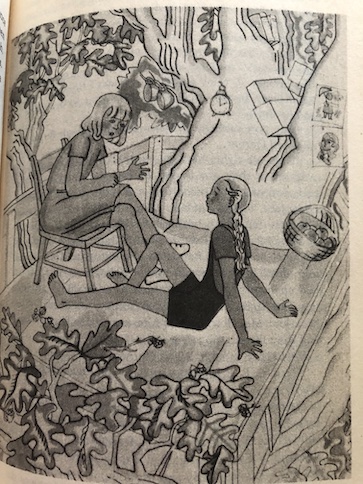
Parts of this book and the lives of the Alcott family also offer a different perspective on what it means to be successful in life. Through most of their lives, the family has little money, and Louisa and her father often struggle to find jobs and get recognition for their work. Louisa May Alcott is famous now, but early in her life, she felt like a failure. She struggled to find and keep jobs and had health problems that interfered with her ability to find and keep work. In the end, it wasn’t having money that made her famous but her talent and perseverance. There were times when she wanted to give up, and she even felt suicidal at one point, but she kept going in spite of everything. Even her father eventually managed to carve out a career for himself that suited his real talents. Their early problems didn’t mean that they were worthless or incapable. Their talents were just unusual, and they needed time to find their proper niche in life, the right circumstances to demonstrate what they could do, and the right people to recognize and appreciate their abilities.