Little House in the Big Woods

Little House on the Prairie Series

Little House in the Big Woods by Laura Ingalls Wilder, 1932.

The story begins “60 years ago”, in a little house in the woods in Wisconsin, where a little girl named Laura lives with her parents and her two sisters, Mary and Carrie. Mary is older than Laura, and Carrie is younger. Their father hunts for meat for the family in the woods, and although Laura worries about the wolves in the woods, she and her family are safe in their little house.

Much of the family’s time is occupied with getting and preserving food. Food preservation is important because not every hunting trip is successful, and they need to make sure that they make the best use of every animal they get, as well as dairy products and produce. Laura and Carrie like to play among the food being stored in the attic. One of their favorite chores is helping their mother mold butter into shape with their butter mold, and often, the highlight of their day is getting something special to eat.

The story begins in winter, and Christmas is coming. The girls help their mother to prepare some special foods and treats, like apple pie and vinegar pie. They make candy by pouring a molasses syrup over snow to freeze it. The girls’ aunt, uncle, and cousins come to visit, staying overnight. The children have fun playing in the snow, making what they call “pictures” by throwing themselves down in the snow and seeing what type of shapes they can make with their bodies. The family has a feast, during which the children are not allowed to talk because “children should be seen and not heard”, but they don’t really mind because the food is really good, and they can have as much as they like. The children believe in Santa, and they are happy with the simple presents they receive: a pair of red mittens and a peppermint stick each.

Laura also receives a very special present: her first real rag doll. Her older sister already has a rag doll, but up to this point, Laura didn’t. Her only doll was made from a corn cob. Children of their time don’t get many presents, and the youngest children don’t get any at all or only have improvised toys. The other children aren’t angry or jealous because Laura has received this extra present because she is younger than they are. Only the babies in the family are younger than Laura, and the older chidren know that Laura didn’t already have a doll, like they do. Laura isn’t being favored; it’s just that she is now old enough to get this kind of present.

Although the family is safe when they’re in their log cabin, there is a genuine risk of attack from wild animals when they’re outside. Members of the family talk about close encounters they or other people had with panthers or bears. Laura’s Pa has a humorous encounter with a tree stump that he mistakes for a bear in the snow, while Ma actually slaps a bear because she mistook it for the family cow.

As the seasons change, the family activities change. They help relatives make maple syrup, and they have a dance. The girls have their first trip to town with their parents. Pa gathers honey, and Ma makes straw hats. Pa helps a relative with his harvest, and a cousin who plays mean tricks instead of helping gets his comeuppance.

I couldn’t find a copy of this book to read online, probably because of the racial language in the story, but there are shorter books on Internet Archive based on individual incidents in this story, like the winter and Christmas scenes. I thought those were the best parts of the story anyway. I would recommend those shorter books and picture books over the original for young children.

My Reaction

Things I Liked and Didn’t Like

It’s been a long time since I first read this book, and honestly, I didn’t like it as much as I did the first time. I remembered kind of liking it when I was a teen. I can’t remember exactly how old I was the first time I read it, I might have been a young teen or tween, but I know I didn’t read Little House on the Prairie books as a young child. My mother wasn’t really into the series herself, so she didn’t read them to me or recommend them much. (She preferred Nancy Drew, and really, so did I.) I know I lost interest in the series after reading only one or two more books because it seemed like that poor family was always getting sick everywhere they moved, and I found that depressing. This book series is one of the reasons why I don’t believe that exercise and organic food by themselves keep a person from being sick. This family had both, and it never helped them. During the course of the series, they catch everything from malaria to scarlet fever or meningoencephalitis, whichever it was that eventually made Mary go blind. It’s like all of the diseases my characters died from in the Oregon Trail computer game but in book form. Come to think of it, people on the Oregon Trail were also exercising and eating organic, and I’ve seen the real tombstones of pioneer children. I believe in sanitation and vaccinations.

As an adult, I found much of the first half this particular book boring or frustrating. That’s surprising because I usually like books with details about life in the past, and many of the details in this particular book echo stories passed down in my own family. (I also had ancestors with strict traditions about not working on Sundays, and they also ate cold meals on Sundays because they had to do all the Sunday cooking the day before.) I found some of the early parts of this story grating. The main reason is that this book is not actually a single story. There is no real, over-arching plot. It’s basically a collection of episodic reminiscences and family stories. I found some of them interesting, but not the early parts.

The book isn’t bad because the writing quality is pretty good, but in the first part of the book, there are long descriptions of hunting and food. I hated the descriptions of how they processed animals they hunted and butchered. I’m sure they’re true-to-life, but I’m the squeamish type. The parts where they talk about foods they like are better. They have kind of a cozy feel, with homemade meals and goodies that have kind of a nostalgic feel. However, I’m not that much of a foodie, and I’m not into “food porn” or long detailed descriptions of things other people are eating. There are limits to how much of that I can take before I start wanting more plot to happen. I think food descriptions are good when used to add color and atmosphere to a story, but it’s too much when they start turning into the story itself. Ideally, a good food description in the book will make me think of a story I liked the next time I eat that particular food. When it’s too overwhelming, there isn’t much of a story to be transported to. Part of the reason why Laura dwells on the subject of food is that this family has to struggle and work hard to get it. It’s not always guaranteed, and when there is something extra, there’s reason for celebration. They are poor, and treats are rare. I think that part of the reason why this book was so popular during the 1930s, when it was first published, was that many other children were growing up in a similar situation during the Great Depression.

When there is more action in the first part story, it’s typically that someone has a close encounter with a dangerous wild animal, like a panther or a bear. Most of this isn’t something that little Laura witnesses directly, but people will tell her stories about family members who had this happen to them. It happens repeatedly throughout the book. One really exciting encounter with a wild animal who wants to eat someone makes for a good adventure story, but when it happens repeatedly, the novelty goes out of it. It starts to become more like, “Oh, another animal attack incident story. Everybody’s got one.” Ma slapping the bear was something special, though. After the other descriptions of animal attacks, Pa’s mistaking a stump for a bear and Ma actually slapping a real bear felt like the punchline of a joke.

People in Laura’s family carry guns with them whenever they go out both for hunting purposes and because they are living in a real wilderness full of dangerous animals, and there is always a real possibility that they might have to defend themselves from a bear, panther, or wolf. They also eat bear when they can get one, and Laura likes the way it tastes. One of the chores that the kids find fun is when they help their father make his own bullets using molten lead in a bullet mold. I actually know someone who does this in modern times. Some modern gun hobbyists do, but I’m not into guns myself, so I didn’t find that as interesting as other types of home crafts. As the book continued and the seasons changed, there was more variety in activities for the family, and I started getting more interested.

The books in this series are semi-autobiographical, based on the real life and childhood of the author, Laura Ingalls Wilder. Laura Ingalls Wilder is actually the Laura from the book. That’s partly why the book isn’t structured liked a story so much as a collection of reminiscences, because this is just about what she remembers from her early life and family. I appreciated some of the small details of daily life, like the log cabin where the family lives, the butter mold with the strawberry shape, the trundle bed where the girls sleep, the lanterns they use for lighting, the family’s Sunday traditions, how the ladies prepared for their dance, and how they made maple syrup and straw hats. The parts of the story that I didn’t like so well were the parts where she goes on about the parts of life in the past that interest me the least. I don’t like hunting, I have no interest in guns, I don’t like hearing about butchering animals, and I’m not the kind of person who gets excited about animal attacks. (I never liked watching them on National Geographic, and I refuse to watch Shark Week or anything like it.) The parts I liked better were about using items that people just don’t use anymore and often don’t even have in their homes and the things the family did for fun and entertainment or celebrating holidays.

One of best scenes in the book, which is probably many people’s favorite, is the Christmas episode. It’s charming how Laura and her family make candy by pouring molasses syrup over snow. People can still do this today if they want to try an old-fashioned treat. It’s also heart-warming that they spend Christmas with visiting relatives, playing outside in the snow and enjoying a few simple presents, mostly handmade. They take great pleasure in simple activities and small presents because much of the rest of their lives were about chores and basic survival, and special treats and presents of any kind were rare. I thought about this book during the covid pandemic, when many people couldn’t safely visit with family or friends for Christmas. This is just one household of people, with just a few relatives visiting for a day, enjoying a few simple pleasures and homemade food and fun. It can be possible to enjoy very simple, homemade activities if you take the time to fully appreciate them and really throw yourself into making the most of them. The Christmas scene was the one that really stayed with me from my first reading when I was young, and it was the main reason why I wanted to read it again. I forgot most of the rest of the book.

Racial Language Issues

One thing that many people find distasteful about the Little House on the Prairie books these days is that books in the series have inappropriate racial language. This sort of thing went completely over my head when I was a kid because I didn’t know what some of these words meant, but it really jumps out at me now. At one point in the story, Laura’s father plays his fiddle and sings a folk song called Uncle Ned (that link is to a page from Missouri State University with words and music), which is about a black man who dies and uses the word “darkey” repeatedly. To be completely honest, I listened to the entire recording of this song, and I have no idea why anybody would like it. It’s not the only song Pa sings in the story about someone dying, and I can’t figure out why he thinks any songs like that are fun. They just sound depressing to me. But, Uncle Ned stands out from the other songs because of the racial slur.

I want to stress that it definitely is a slur. “Darkey” was not a polite term even during the time the story was set. People said it, but it was rude and insulting slang, not a word for polite conversation. Black people did have feelings about racial terms, and there were terms that were preferred and polite and terms that were considered demeaning and insulted and were known to be deliberately condescending. This particular term belongs to the second category. Black people weren’t always able to openly express their real feelings about the rude terms because of threatened violence for anything they might say, but their inability to speak openly about the issue doesn’t change the reality of the issue. There were 19th century white people who were well aware of what terms were polite and which were impolite, and they made active efforts to teach children to speak politely, such as the editors of this 19th century children’s magazine and Rev. Jacob Abbott, author of the Stories of Rainbow and Lucky (1859-1860), among other children’s books. Both of those sources are older than Laura Ingalls Wilder, pre-Civil War. Abbott made it a point to include a conversation between a grandfather and grandson in one of his Rainbow and Lucky stories to teach children the polite way to address black people of their time (“black” was one of the less preferred terms until the Civil Rights era, when people wanted to distance themselves from older racial terms and their accompanying emotional baggage, but the advice to care about others’ feelings and what they want to be called still holds true):

“I don’t know who they are, grandfather,” said he, after gazing at Handie and Rainbow a moment intently. “One of them is a black fellow.”
“Call him a colored fellow, Jerry,” said the old man. “They all like to be called colored people, and not black people. Every man a right to be called by whatever name he likes best himself.”
“But this is a boy,” replied Jerry.
“The same rule holds good in respect to boys,” added the old man. “Never call a boy by any name you think he don’t like; it only makes ill blood.”

True politeness requires consideration for others’ feelings, not denial of them, which would be the exact opposite of politeness by literal definition. Politeness is about avoiding what would offend others and emphasizing behaviors others find pleasant, not about doing only what pleases oneself or choosing to take personal offense at the idea of considering another’s feelings.

So, what’s the deal with Pa Ingalls? If other white adults of this era cared and tried to teach their children to care, why doesn’t he? Some people might point out that he’s just singing a song and that he didn’t write the song, which is true. In this particular instance, he’s effectively quoting someone else. That being said, this is just the first instance of questionable racial terms and attitudes in this series, and some of the later ones are worse. After thinking it over, I think what it comes down to is that the Ingalls family has little need to consider how people of other races feel specifically because of the way they live. Most of the time, there are simply no “others” in their lives to consider.

Nobody thinks anything of this type of language in the story or comments on it because, remember, this family lives in a log cabin in the woods with no close neighbors. They rarely go to town, and when they visit with other people, it’s usually other relatives, like the children’s aunt and uncle or grandparents. What I’m saying is that, when you live alone much of the time or surrounded only by people like you, especially close relatives, you don’t have to put much energy or thought into how to live with other people. The Ingalls family doesn’t have to think about any of this, so they just don’t think about any of this. But, when it comes right down to it, that’s certainly not the kind of life I’ve lived or the kind of life modern 21st century children live.

Since my first encounter with this book, I grew up in a city, in multicultural society full of people to interact with every day, and I got a higher education with a heavy focus on cultural issues. Some of the words in this book went over my head the first time, but I grew up. This book did not grow with me, and the racial language is one of the parts that not only doesn’t hold up but feels worse when you’re older and know better. This is not a book that has greater depth and provides more insight when you go back and read it as an adult with more life experience, as some children’s books do. Instead, it brings out some uncomfortable realizations about characters you liked before and the lives they live.

I’ve read that some newer printings of these books have changed the problematic parts, which is actually very common with older classic children’s books that are still in print. The same thing was done to old Stratemeyer Syndicate books like the Bobbsey Twins, Mary Poppins books, and various books by Enid Blyton. I was surprised when I found out what some of the original editions of those books were like. However, I haven’t seen a new copy of any of the Little House on the Prairie books to know how much has changed. There are parts of this series that I remembered from reading them the first time, mostly the Christmas scenes, but I’m just not really into this series. There are others I like better. Overall, I really prefer the Grandma’s Attic series to the Little House on the Prairie series because it also has details of daily life in the past, but I feel like it has more variety and warm humor to the stories in those books, and there are no inappropriate racial terms. My own grandmother grew up on a farm in Indiana, and she specifically recommended the Grandma’s Attic series to me, saying that it reminded her of her youth. She never mentioned or recommended Little House on the Prairie books, so I suppose she wasn’t as into those, either.
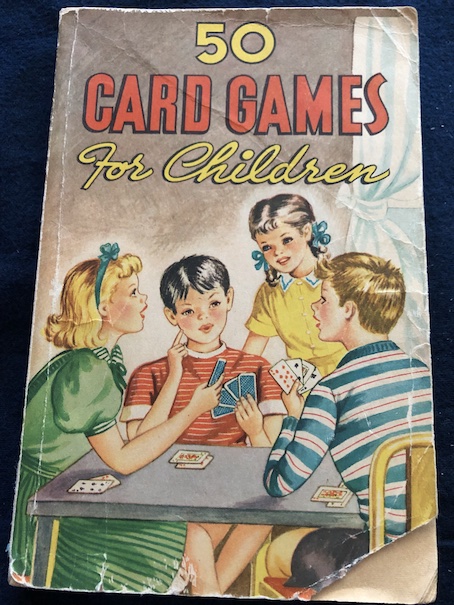
50 Card Games for Children

50 Card Games for Children by Vernon Quinn, 1933, 1946.

I love games of all kinds, and I was fascinated by this vintage children’s book about card games! Along with the card games, there is also a section in the book with card tricks. The vintage pictures in the book are also nice.

If you’re curious about what kind of card games children were playing during the Great Depression and around the time of WWII, this book offers some interesting insights! There were many games in the book that were already familiar to me, but there were some others that I had never heard of before.

The book is available to borrow and read for free online through Internet Archive.

Sections in the Book:

Card Games that Are Fun to Play

That struck me as an odd title for the very first section of the book, like whatever follows is going to be games that are not fun to play, but basically, this section contains multiplayer card games specifically aimed at children. It becomes clear when you study not only the contents but the titles of the other sections, which are about solitaire games, card tricks, and a section about popular card games that adults play.

I recognized a number of popular children’s card games in this section, like I Doubt It, War, Concentration, Hearts, Old Maid, and “Go Fishing” (which is what they call it instead of Go Fish, which is what I’ve always heard it called). There were some other games that I didn’t recognize, like The Earl of Coventry, Rolling Stone, Frogs in the Pond, and My Ship Sails.

Twelve Games of Solitaire

I was familiar with Klondike, Canfield, Pyramid, and Around the Clock (which I always called Clock Solitaire). I had never heard of Pirate Gold, Spread Eagle, Lazy Boy, or Down the Stairs before.

Twelve Card Tricks

These are magic tricks with cards. Some of them sound a bit complex when you’re reading the descriptions, but I think they would be more clean when actually trying them with a deck of cards.

Some Games That Grown-Ups Play

The games in this section are Rummy, Casino, Seven-Up (also known as High-Low-Jack), High Five, Cooncan, and Five Hundred. Actually, I have seen Rummy decks specifically for children, usually Animal Rummy, but that’s still a Rummy version, so that game isn’t just for adults.

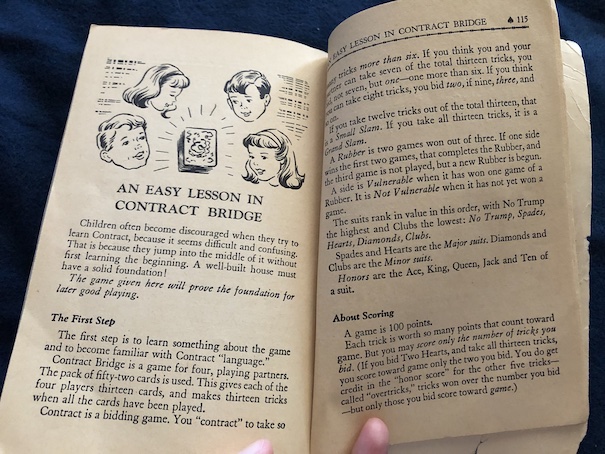
An Easy Lesson in Contract Bridge

I never thought of Bridge as being easy because I’ve always been intimidated by the concept of bidding. I understand trick-taking games like Whist, but I haven’t wanted to try Bridge because of the bidding. Actually, I think this basic description for children is a good tutorial for people like me, who find the bidding concepts confusing.

Mary Poppins

Mary Poppins by P. L. Travers, 1934.

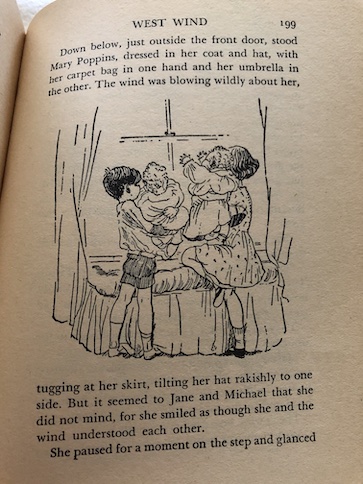
This book is a classic piece of children’s literature! This is the first book in a series of about the adventures of the Banks children with their magical nanny, Mary Poppins.

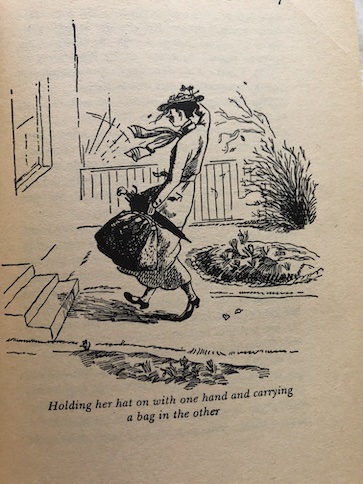
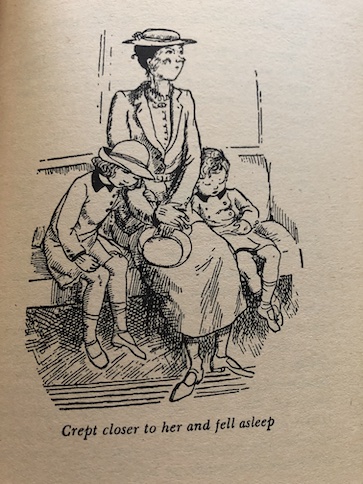
Mr. and Mrs. Banks of Cherry-Tree Lane have four children: Jane, Michael, and the infant twins, John and Barbara. When the story begins, the children’s nanny has just suddenly left her job with no real explanation. Mrs. Banks is beside herself, wondering what to do about this household upheaval, and Mr. Banks offers the practical suggestion that she should advertise for a new nanny in the newspaper. Mrs. Banks decides that’s a good idea, but a strange wind from the East brings an unexpected answer to this domestic problem.

When Mary Poppins arrives at the Banks’ house to take the position of nanny, it seems like she was blown there by the wind. When the children ask her, she says that’s indeed what happened, but she offers no other explanation. Mrs. Banks discusses the position of nanny with her, but it turns out that it’s more like Mary Poppins is interviewing her and evaluating the children to see if they’ll do. Mary Poppins refuses to provide references when Mrs. Banks asks for them (I would find that worrying), saying that people don’t do that anymore because it’s too old-fashioned. Mrs. Banks actually buys that explanation and doesn’t want to seem old-fashioned, so she stops asking. Mary Poppins basically grants herself the position of nanny as if she were doing the Banks’ family a favor. Maybe she is.

Jane and Michael can tell right away that Mary Poppins is no ordinary nanny. When she begins unpacking her belongings, it seems at first that her carpet bag is empty, but she soon starts pulling many different things out of it, including some things that should be too big to be in the bag at all. Then, she gives the children some “medicine” (she doesn’t say what kind of medicine it is or what it’s supposed to do) that magically tastes like everyone’s favorite flavor.

From there, the story is episodic. Each chapter is like its own short story.

On her day off, Mary Poppins meets up with the Match Man called Bert, who also paints chalk pictures, and when he doesn’t have enough money to take her to tea, they jump into one of his chalk paintings and have a lovely tea there. The children aren’t present for that adventure, but they do go to tea at Mary’s uncle’s house.

Mary’s uncle, Mr. Wigg, is a jolly man … maybe a little too jolly. It’s his birthday, which has filled him full of high spirits, and he literally can’t keep his feet on the ground. When they arrive, he’s hovering in the air. He says that it’s because he’s filled up with Laughing Gas because he finds so many things funny. It’s happened to him before, and he can’t get down to earth again until he thinks of something very serious. The whole situation is so funny that Jane and Michael begin to laugh and find themselves floating in the air, too. Even though Mary isn’t amused and doesn’t laugh, she makes herself float in the air also and bring up the tea table so they can all have their tea in midair. The merriment only ends when Mary Poppins finally tells the children that it’s time to go home, which is very serious indeed.

Mary Poppins understands what animals are saying, helping to sort out matters for a pampered and over-protected little dog who desperately wants a friend to come live with him. Then, when the children see a cow walking down their street, Mary Poppins says that cow is a personal friend of her mother’s and is looking for a falling star. On Mary Poppins’s birthday, she and the children attend a bizarre party in the zoo where the animals are their hosts.

There is an episode in the book which has some uncomfortable racial portrayals. It takes place when Mary Poppins shows the children how a magical compass can take them to different places around the world, and they meet people who are basically caricatures of different racial groups. (This episode has resulted in the book being banned by some libraries. P. L. Travers received complaints about it in her lifetime, and she revised the scene in later printings of the book, which is why you’ll see books labeled as “Revised Edition.” I have more to say about this scene, but I’ll save it for my reaction.)

Mary Poppins and the children visit a bizarre shop where the owner’s fingers are candy and grow back after she breaks them off and gives them to the children. (That’s actually pretty freaky.) The children save the gold paper stars from the gingerbread they buy at the shop, and later, they see Mary Poppins and the shop owner and her daughters putting the stars up in the sky.

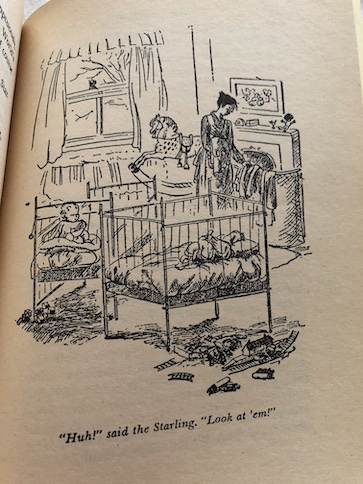
There is a story about the babies, John and Barbara, and how they understand things that the adults and older children don’t, like what animals, the wind, and sunshine are saying. They are sad to learn that they will forget these things as they grow up.

Toward the end of the book, Mary Poppins takes the children Christmas shopping, and they meet Maia, one of the Pleiades (here she is considered to be a star as well as a mythological figure, and she looks like a young, scantily-clad girl), who has come to Earth to do her Christmas shopping as well.

In the end, Mary Poppins leaves the Banks family suddenly when the wind changes directions, flying off into the sky on the wind with her umbrella. She does not say goodbye, and the children are very upset. Mrs. Banks is angry with Mary Poppins for her sudden departure on a night when she was counting on her to be there to take care of the children. The children try to defend her, though, and say that they really want her back, even though she’s often cross with them. However, she does leave behind presents for the children that hint that she may come back someday.

The book is available to borrow and read for free online through Internet Archive (multiple copies).

My Reaction

In some ways, the Mary Poppins in the original books isn’t quite as pleasant as Julie Andrews in the Disney movie version. The Mary Poppins in the book is vain and stuck up. She can be intimidating in her manner, refuses to answer questions, and even gets rude and snippy with the children. She was a little like that in the movie, but in the book, she’s even more so. After any strange or magical thing happens and the children want to talk about it, Mary Poppins gets angry at them and denies that any such thing happened at all. I found that rather annoying because it’s kind of like gaslighting, denying things happened when they really did happen. I think we’re meant to assume that’s because the adults aren’t allowed to find out that magical things have happened because they might put a stop to it or because Mary Poppins realizes that the children can only enjoy this kind of magic for a brief phase of their lives and that they’ll have to grow up in the more mundane world, just like the little twins can’t help but lose their ability to talk to animals. It’s a little sad, but I think it’s meant to provide some kind of rational explanation about how magic can exist in the world but yet go unnoticed by most people.

There is a Timeline documentary that discusses the life of P. L. Travers and how she felt about the Disney movie version of Mary Poppins. Although many people came to know and love the character through the Disney movie, and it made the books much more popular, P. L. Travers thought that the animated portions were silly and the characters weren’t represented as she wrote them.

I’d like to talk more about the racially-problematic episodes with the magic compass. A compass that can take people to different areas of the world just for asking is a good idea, but the people they meet in the places they go are all uncomfortable caricatures of different races. The one part that I’m not really sure about is how seriously these were meant. When I was trying to decide what to say about this, I considered the idea that aspects of this part of the story may have been meant as a parody of things from other children’s books and popular culture at the time. I have seen even older vintage children’s books that poke fun at concepts from earlier stories, so it occurred to me that this book might be making fun of concepts about people from around the world that young children of the time might have from things they’ve read in other books. There is a kind of humor throughout the book that involves puns and plays on certain ideas, like the way her uncle insists that he floats when he’s in a humorous mood because he’s buoyed up by “Laughing Gas”, which is not what real “Laughing Gas” is. It’s like what a child might picture as “Laughing Gas”, if they didn’t already know what that term means. It’s possible that part of this scene might be parodying other children’s fantasy books about magical travel, but it’s still very uncomfortable to read the original version of this scene, if you don’t have one of the revised editions of the book.

On the other hand, I suspect that the author isn’t really that thoughtful or self-aware by the way the adult characters speak throughout the book series. At the end of the book, when Michael is upset at Mary Poppins suddenly leaving and he throws a fit and argues with her, his mother tells him not to act like a “Red Indian.” I’m not entirely clear on what that comment was supposed to mean in that context, but Mrs. Banks uses it as if she does, so it seems that there is some implied insult there, maybe equating Michael’s behavior to being “savage” or “uncivilized” or something of that nature. Even Mary Poppins herself uses racial language throughout the series, using words like “hottentot” or “blackamoor” to criticize the children when they misbehave. It makes me think that the author was accustomed to that kind of talk herself. If Mary Poppins can get snooty as a character, I think I have the right to express my disapproval of her behavior as well.

While I like the basic character of a magical nanny who takes children on magical adventures, I don’t like either those comments or the compass scenes because the obvious caricatures are uncomfortable, and I don’t think they make good story material for children. I would recommend saving that version for adults who are interested in reading or studying nostalgic literature and use the revised versions for children, who would probably just prefer to have a story they can enjoy for fun without needing a lesson on racial attitudes of the past to understand it. If they’re curious, they can always have a look at the original later, when they’re old enough to understand it better and put it perspective. In the revised compass scenes in later books, some printings still have people but some of the offensive words removed, and in later printings, the children meet different types of animals instead of people.

The Box of Delights

The Box of Delights by John Masefield, 1935, 1957.

This book is a sequel to The Midnight Folk. Since the events of the previous book, Kay Harker has become a student at a boarding school, and he is now returning home for Christmas.

At the train station, Kay panics when he realizes that he can’t find his ticket, but it is returned to him by a nice old man with a dog named Barney. Kay also sees some men who seem to be looking for someone else. He overhears their description of the man they’re looking for, but they seem to conclude that the man isn’t on the train. Kay thinks that they might be police detectives, looking for an escaped criminal. His conclusion is proven correct when a porter tells him later that the detectives caught the man they were looking for, trying to disguise himself as a duchess. Kay asks what the criminal did, and the porter says that he’s murderer who killed his father-in-law in a very brutal way. Now, the detectives are taking him away in a special card with an armed guard, and he will probably hang for the crime. Kay finds the story thrilling, but he wonders if the guard made it up or embellished it. When he buys a newspaper, he doesn’t see anything about a murder like the porter described in it.

Kay enjoys the train ride home because, when he went to school, it was by car, so he’s seeing things on the journey home that he hasn’t seen before. On the train, he meets a couple of men dressed like theology students, but whether they’re really theology students is questionable. They sometimes speak to each other in a foreign language that Kay thinks might be Italian, and they trick Kay into playing a card game for money that’s like the Shell Game. Kay only plays once, and when he realizes that he’s been tricked, he decides the men are sinister. The two men ask Kay about the countryside, and one of them refers to him as “Mr. Harker” when Kay never introduced himself. Kay asks the man how he knew his name, but the man never really explains. When Kay arrives at his train station and meets Caroline Louisa, who looks after him, he realizes that his coin purse and watch are missing. Strangely, when he checks for them, he finds the ticket that he thought that he’d lost, so the ticket the nice man gave him must have been his own.

The nice man with the dog is also at the train station. Caroline Louisa thinks that he looks like a Punch and Judy man, and when Kay asks him, he simply says that he is a showman. He also seems to speak in odd riddles, telling Kay that “the Wolves are Running” and asking him if he will do anything to stop them biting. Kay says that he doesn’t know what he means. Rather than explaining, the man asks him to go to a shop in town to buy some muffins, and while he’s there, to look for a lady wearing a ring like the one he’s wearing and give her the message that “The Wolves are Running.” Kay is surprised that this man also seems to know his name and won’t explain how.

When Kay returns to Caroline Louisa, he mentions the men on the train who knew his name, and she says that they probably read it on his luggage labels. Without telling Caroline Louisa why, Kay asks if they can stop in town to buy some muffins. Caroline Louisa also mentions that the four Jones children, Peter and his three sisters, will be spending Christmas with them because their parents have to go abroad. Kay gets along pretty well with the Jones children, and Peter will be sharing a room with him. Kay says that he will have to get some extra presents for the Jones children in town as well. They stop in town, Kay buys the muffins as he was told, and sees the woman that the old man described with a ring like his. Not knowing why it’s important, Kay passes along his message to her, and she nods to him. Then, Kay notices that there are people in town with Alsatians, and they seem to be on the scent of something. Kay wonders if they could police dogs, and Caroline Louisa says she doesn’t know, but she doesn’t like them herself because they remind her too much of wolves.

When they get home to Seekings, the four Jones children are already there. (We did not met them in the previous book, so these are new characters to readers, although Kay has already met them at this point.) Kay thinks of Peter as “a good honest sort of chap.” Of his three sisters, Kay thinks of Jemima as being the smart one. Maria is untidy and has a toy pistol. She has a fascination with gangsters, like in the movies, and she wishes that they could find a gang of robbers and have a battle with them. Susan looks like a small fairy.

Kay gets the idea of inviting the man they’ve come to think of as the Punch and Judy man to the house to perform for them. When he goes back to town to invite him, another man wearing the same ring as the others stops him and tells him to pass on the message that “Someone is safe.” Kay thinks that the message is intended for the Punch and Judy man and passes the message on to the old man when he sees him. He tries to ask the old man what he’s been talking about when he talks about the “Wolves”, but he’s evasive. Instead, he tells Kay that he will come perform a Punch and Judy show for the children at Seekings at the time he was thinking of. Kay asks him how he knew he was going to make that request, but he ignores the question. The old man produces the image of a Phoenix in the fireplace at the pub where they are talking, and he says that he has other wonders in a little box that he will show him later.

When the old man, whose name is Cole Hawlings, comes to Seekings to perform for the children, he does many magic tricks that appear to be real magic. After his performance, some Christmas carolers come to the house, and Kay spots three men, who seem to be spying on the house, trying to see into the study. One of them is one of the men who tricked him with the card trick on the train. Cole Hawlings is very nervous about these men and starts talking about wolves running again.

Caroline Louisa is unexpectedly called away to tend to her sick brother, and while Kay is seeing her off, the other children are approached by one of the spying men, who asks where Hawlings went. Maria, who didn’t actually see Hawlings leave, mistakenly says that he left with the carolers. As Kay returns to the house, he overhears the spying men talking about it. They are definitely after Hawlings, and they are associates of Abner Brown, the villain from the previous book. Kay realizes that his old enemy has returned, and once again, he will have to face off against evil magic.

When Kay meets up with Hawlings again, Hawlings says that it’s not really him that the wolves are after but the Box of Delights that he carries. He gives it to Kay for safe keeping. Kay doesn’t fully understand the purpose of the box, although Hawlings shows him how to use it to return home without any time seeming to have passed. The next day, Kay brings Peter with him when he goes to see Hawlings, and the boys witness Hawlings being kidnapped and dragged into an airplane! They try to report it to the police, but the police don’t believe that they witnessed a kidnapping, and someone else turns up in another town, claiming to be Hawlings. Where is the real Hawlings, why do Abner Brown and his people want his box so badly, and what is Kay going to do with it?

The book is available to borrow and read for free online through Internet Archive (multiples copies). There have been multiple dramatizations of the book, and you can sometimes find them or clips of them on YouTube.

My Reaction

I felt like this story was more cohesive than The Midnight Folk, which seemed more disjointed. It is still episodic and tries to work in various elements from children’s fantasies, stories, and folklore. When Kay opens the box, he finds a strange book, and when he opens the book, he finds himself in a forest with Herne the Hunter, a character from folk legends. Herne turns Kay into different animals. After a delightful adventure exploring the woods with Herne in different animal shapes, Kay finds himself back in his own bedroom with hardly any time having passed. Later, the children use the box to shrink themselves to hide from the villains and meet fairies. Aside from the traditional and folklore elements, there are also elements of modern stories and fantasies. The children have a fascination with gangsters (probably from movies of the time), and the villains have some pretty impressive equipment, like a taxi that turns into an airplane and airplanes that fly silently, seeming to combine more modern technology with an element of fantasy or magic.

I also liked the addition of Peter and his sisters because it gave Kay other children he could talk to and who could see the things he sees and share in his adventures. Kay doesn’t tell his friends everything, although they do share in various parts of his adventures, and I’m actually amazed that they take these parts in stride and don’t ask as many questions as I think they should be asking. The adults around them are completely oblivious to the magical happenings, with the exception of Hawlings.

As an historical food note, the police inspector recommends to Kay that he have a hot milk drink called a posset, and he describes what goes into one, but the version that he describes is non-alcoholic. The original drink was an alcoholic beverage, but presumably, this one was toned down for children. The way they describe it in the book, it sounds similar to a non-alcoholic eggnog, but served hot.

Ben and Me

Ben and Me by Robert Lawson, 1939, 1967.

I remember reading this book in elementary school. It’s about Benjamin Franklin’s friendship with a talking mouse (fictional, of course), and how his mouse friend helped inspire him in his work.

The book begins with the author saying that this manuscript, supposedly written by Amos the mouse, was found in a small compartment in a room in an old house that was being renovated. The little compartment was furnished with miniature pieces of Colonial style furniture. The author goes on to say further that the manuscript has been authenticated as being early American and that the National Museum of Natural History has confirmed that the handwriting of the manuscript was done by a mouse. (I’d love to see comparisons of different animals’ handwriting and hear their explanation of how the handwriting of a mouse differs from the handwriting of other members of the rodent family, but trust us, kids, this is all very scientific.) The author says that this account of Benjamin Franklin’s life differs from the stories told by later scholars, but he trusts the descriptions of this mouse who was so close to Benjamin Franklin. (Yeah, sure, why not?)

In the “manuscript”, Amos says that he’s writing not long after the death of his friend, Benjamin Franklin, and some people have attempted to write about the life of Benjamin Franklin, but Amos isn’t satisfied with their accounts of his life and wants to write the truth himself. (Benjamin Franklin also wrote a famous autobiography, but they don’t mention that. I know that this is a story about a talking, writing mouse, but I’m just saying.) Amos says that, much as he liked Ben Franklin, Franklin was kind of stupid at times and that, as Franklin’s secret adviser, he was actually the source of many of Franklin’s greatest ideas.

Amos says that he was born into a large family of poor church mice. Then, during the winter of 1745, food grew scarce, and as the oldest of his siblings, Amos decided to set out to seek his fortune and maybe a way to help provide for the rest of his family. It’s a cold night, and lured by the smell of cheese, Amos finds his way into the house where Ben Franklin lives. He finds Franklin sitting and sneezing in a chilly room near a small fireplace. Ben is trying to write, but because of the sneezing, he’s not making much progress. Amos, cold and tired, climbs up on Ben and curls up in his fur cap and goes to sleep.

When Amos wakes up in the morning, the fur cap is hanging on the bedpost, and the room is still cold. Amos talks to Ben, recommending that he put more wood on the fire. Ben doesn’t question why a mouse is talking to him and just retorts, “Waste not, want not.” Amos points out that there will be plenty of waste and extra expenses if the cold makes him sick. Ben agrees with that and decides to use more wood on the fire. Then, Amos points out to him that the fireplace would be more effective at heating if it was in the middle of the room, explaining how his family used to gather around a hot chestnut to warm themselves. Ben is intrigued by the idea, and they discuss how a fireplace could be located in the middle of the room and how to handle the smoke from the fire. Ben excited sets to work building the stove according to Amos’s suggestions. His first attempt is a bit crude, but the stove works much better at heating the room than the fireplace did, and Ben is pleased. He shares some bread and cheese with Amos, and the two of them become friends.

Ben begins writing about the design of the stove as if he had created it all by himself, but Amos points out that Ben had acknowledged his contribution. Amos doesn’t care about getting fame or public credit for his contribution, but he needs food and has a large family to help provide for, so he and Ben work out an agreement: in exchange for Amos’s companionship and help, Ben agrees to leave regular supplies of food at the church for Amos’s family and to provide Amos and any descendants he may have food and a home in his fur cap. Ben sews some special compartments in the fur cap so that Amos has secure places to sleep and store a little food. There’s also a little compartment near Ben’s ear where Amos can quietly whisper suggestions to Ben.

Life with Ben isn’t easy. Amos hates it when Ben goes swimming and leaves his cap on the ground. One day, a dog steals the cap (along with Amos), and Ben has to chase the dog in order to get the cap and Amos back. Ben promises not to take the cap off his head ever again.

Amos also doesn’t like Poor Richard’s Almanack and doesn’t consider the facts or maxims it offers to be worth much. Ben points out that people do use his paper and its predictions of sunrise, sunset, and high and low tide, and the money the paper makes helps support them both. It also seems weird to Amos that Ben attributes everything to do “Poor Richard” when there is no such person. Amos starts substituting his own name for “Poor Richard” in the paper, and he also changes some of the predictions of times for the tides. It turns out that this is one area where Ben knows better than Amos because Amos predicts the wrong time for high tide and some ships are stranded. Confronted by the angry men from the ships, Ben points out that the paper with the wrong time says “Amos” instead of “Poor Richard”, so it can’t be his work. The angry people realize that Ben is right, and Amos realizes that he shouldn’t interfere with the paper.

Amos also hates it when Ben starts to experiment with electricity and Ben shocks him. He tells Ben to leave him out of his electrical experiments. However, Ben continues his experiments with a group of other interested people, disappointed that Amos doesn’t seem to understand what he’s trying to accomplish. Amos finally reads Ben’s writings about electricity and his experiment, and when a boy Ben got to assist him at one of his meetings uses Ben’s electrical device to shock the governor, Amos urgently whispers to Ben to stop the boy. Ben doesn’t consider the experiment to be a failure because it very effectively demonstrated how electricity affects human beings, although some people, including the governor, start avoiding Ben after the experience.

Then, Ben starts wondering if lightning and electricity are the same thing. Amos says he doesn’t care because both to those things should be avoided, whether they’re the same or not, and Ben says that he has “no vision.” Ben’s first experiment with lightning rods is frightening, even terrifying Ben to the point where he modestly refuses to take credit for the invention. In spite of that scare, Ben continues to wonder about the nature of lightning. He starts taking Amos with him while he flies kites for fun, and he rigs up a little car on the kite string for Amos so Amos can ride on the kite and come down when he wants to. Ben suggests that Amos that he could get a better view of lightning and describe it to him if he stays on the kite during a storm, and Amos refuses to consider it, but one day, Ben tricks him into doing it anyway. Amos is angry at Ben for making him suffer through the storm while he took shelter in a shed and refuses to discuss what he experienced with him. Burned with electrical shocks from the storm, Amos returns to his family at the church, where they dress his wounds, and he rests.

Ben comes to see Amos about their earlier agreement. Amos tells him that the electrical experiments were never part of the agreement and he will never return to him while he is doing these things. Ben agrees to stop all of the electrical experiments, and he and Amos write a new agreement with each other.

At this time, troubles are arising between England and the Colonies, and Ben is concerned. He tells Amos that he needs his skills for gathering information and asks him to accompany him to England to present the Colonies’ case before the King and Parliament. Amos initially agrees to go, but he backs out of the voyage when he sees that Ben has attached lightning rods to the ship. Pointing out to Ben that the lightning rods are a violation of their agreement, he returns to the church and lets Ben go to England alone.

While Ben is gone, Amos hears the people of Philadelphia talking about current events, like the stamp taxes, and how they feel about them. Amos finds himself siding with the colonists and wanting to do something to help, and he realizes that Ben is his best chance for helping to accomplish something. When Ben returns from England, Amos rejoins him, and he goes with Ben to the committee meetings he attends, including the one for writing the Declaration of Independence. Amos helps Ben by gathering information from other people. Amos meets another mouse named Red, who comes to Philadelphia with Thomas Jefferson and starts preaching revolution to the mice in town. Amos borrows some of the pieces of writing from Red’s Manifesto and tells them to Ben, who in turn, tells them to other members of his committee so they get included in the Declaration of Independence.

Then, George Washington says that the Colonies could really use some help and support from another country. Amos persuades Ben to suggest France. George Washington accepts the suggestion, and Amos accompanies Ben to France to ask for help from the French government. Ben enjoys the attention he gets from the ladies in France, frequently dining with his admirers. Amos is afraid of the ladies’ pet dogs and cats, though, so he persuades Ben to put most of his attention on a woman who doesn’t have cats. It turns out that this lady also has a mouse who lives with her named Sophia. Sophia is actually married, but her husband has been exiled to the United States, and her children are being held in the palace of Versailles. Amos wants to help Sophia, but he’s not sure how until after the Revolutionary War ends and Red arrives in France with Thomas Jefferson. Amos explains the situation to Red, and Red is more than eager to help assemble a force to stand up to the oppressive aristocratic French mice.

The mouse battle that follows terrifies the human French court, but the mice successfully rescue Sophia’s children. Ben suddenly finds himself a social outcast for bringing mice to the royal court, so he’s ready to return home, bringing Sophia and her children with them. Ben is welcomed home as a hero by the humans. Sophia is reunited with her husband, and Amos remains a friend of the family. Three of Sophia’s oldest children marry Amos’s three youngest siblings, tying their families together.

The story ends with the mice giving Ben a nice, new hat for his birthday. Ben keeps the old one just as a house for Amos to live in, but Amos is mostly retired, his time occupied by teaching his young nieces and nephews.

The book is available to borrow and read for free online through Internet Archive (multiple copies). There is also a Disney film based on the book that is also on Internet Archive (about 21 minutes long).

My Reaction

I remembered liking this story when I was a kid, but I’m not as fond of it now. I don’t like books with intentionally stupid characters, and in this case, the intentionally stupid character is a real, historical person, which doesn’t seem fair. I know it’s supposed to seem humorous, but it just doesn’t seem to hold up after all these years.

I also hated the part where Ben intentionally kept the poor mouse up in a kite for half an hour during a terrifying storm. It’s just so cruel, even though it’s supposed to humorous. What can I say? I have a soft spot for cute, fuzzy animals, and I just don’t like to think of any little animal suffering, even if it’s in blatantly ridiculous circumstances.

I had forgotten about the Disney cartoon, although I think I remember seeing that when I was a kid, too.

Dancing with the Indians

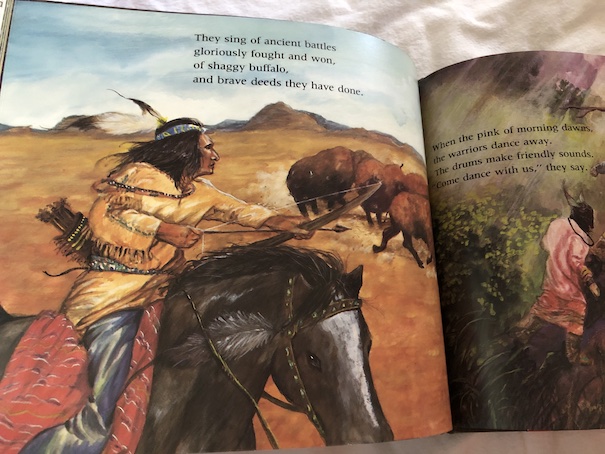
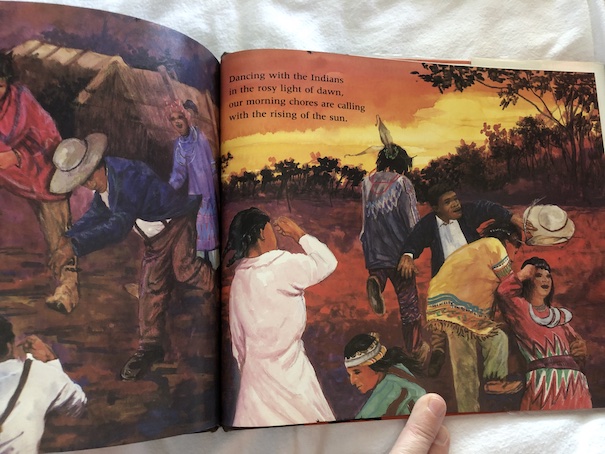
Dancing with the Indians by Angela Shelf Medearis, illustrated by Samuel Byrd, 1991.

I love books with historical background, and this is a fascinating picture book that is based on the history of the author’s family. Like the author’s earlier book, Picking Peas for a Penny, it is told in rhyme, from the point of view of the author’s mother as a child in Oklahoma during the 1930s.

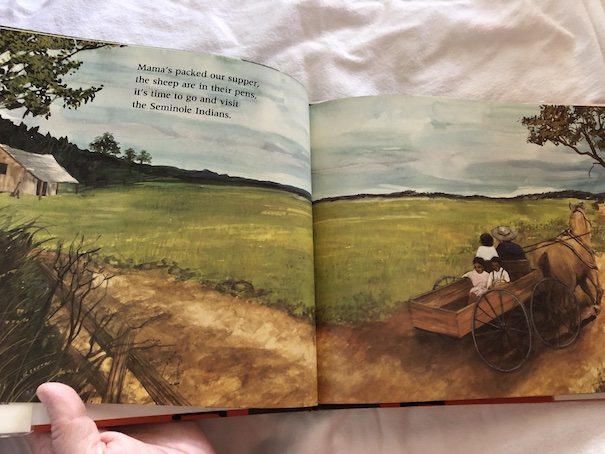
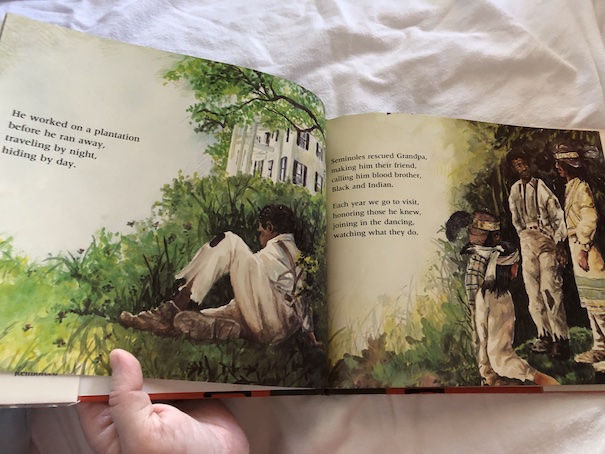
The girl and her brother are going with their parents to visit the Seminole American Indians. As they travel in their wagon, the parents explain to the children the history of their family. Many years before, the girl’s grandfather (the author’s great-grandfather) escaped from slavery and ran away to Oklahoma, where he was accepted by the Seminole tribe. Ever since, his descendants have continued to visit the tribe and join in Seminole celebrations and ceremonies as part of their extended family.

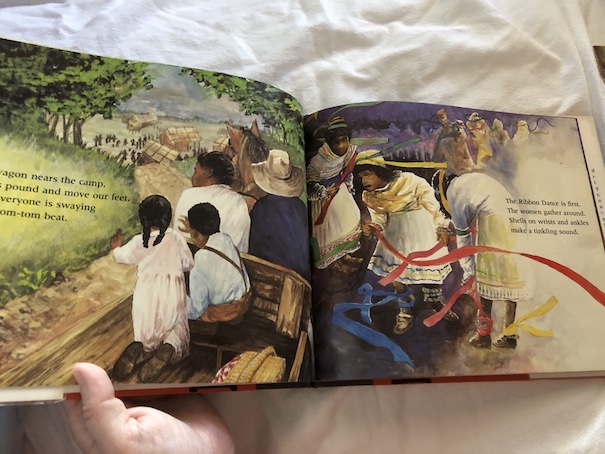
The night is an exciting celebration with dancing, drumming, and songs and stories of past triumphs.

They all dance and celebrate through the entire night, until morning. As the family returns home to tend to their farm, the father promises them that they’ll return to dance with the Indians again.

I liked this book because it explains an aspect of American history that I don’t remember being discussed much when I was in school. In fact, I think that the first time I saw anything that explained that escaping slaves sometimes headed west instead of north before the Civil War was in a Disney Adventures magazine, where they were talking about cowboy, specifically mentioning black cowboys. However, another option was for escaped slaves to join up with Native American tribes. The Seminole tribe of Florida and Oklahoma was one group that was known to accept escaped slaves and adopt them into the tribe, starting in the early 1700s continuing into the 1850s. Some of the escaped slaves married into the tribe. The African Americans who joined the Seminoles and their descendants came to be called Black Seminoles. Parts of the two cultures intermingled. Black Seminoles adopted Seminole traditions, and they also introduced Seminoles to aspects of their traditions. The relationship has had complications as well, and even in modern times, there are debates about how much Black Seminoles count as part of the tribe and how much they should be entitled to certain benefits

This is a Reading Rainbow Book. The book is available to borrow and read for free online through Internet Archive (multiple copies).

Picking Peas for a Penny

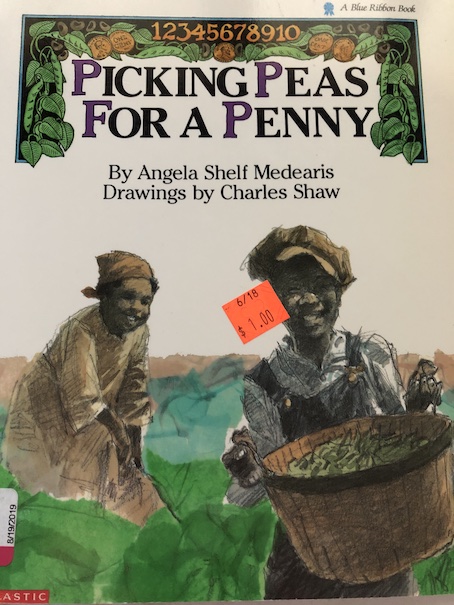
Picking Peas for a Penny by Angela Shelf Medearis, drawings by Charles Shaw, 1990.

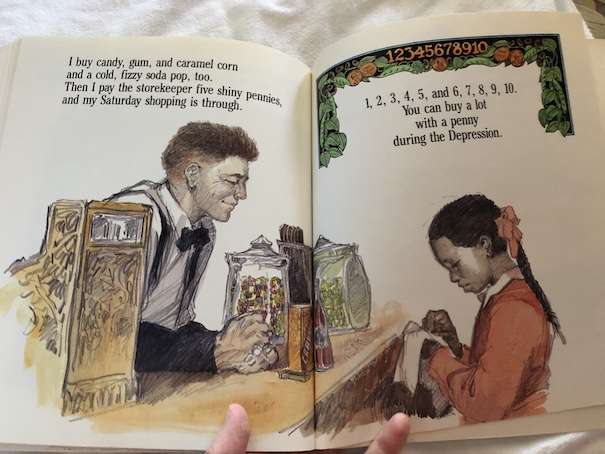
This picture book is based on stories from the author’s family and is told from the point of view of her mother, when she was a child in Oklahoma in the 1930s. The story is told in rhyme with a kind of sing-song counting from one to ten as they pick peas and put them in their baskets.

The 1930s was the time of the Great Depression. Many people were out of work, but this African American family has a farm and makes money by growing and harvesting crops. It doesn’t pay much, and everyone needs to help, but because times are hard, they are glad that they are able to do the work and earn the money.

It’s hard work that takes all day in the hot sun, but the girl telling the story says that she and her brother have a little fun while they’re doing it, too. Their grandmother tells them not to goof off because they work to finish. The grandfather of the family offers the children a penny for every pound of peas they pick and says that he’ll take them into town to spend it, so the children start a pea-picking race with each other.

After the work is done, they visit the general store in town, and the children have the opportunity to buy treats for themselves. They only have pennies, but it’s enough to buy some penny candy and soda pop. After the hard work they’ve done, it feels like a rich reward.

In the back of the book, there’s a picture of the author’s family. Although the story itself doesn’t mention it, the name of the girl in the story is Angeline.

The book is available to borrow and read for free online through Internet Archive.

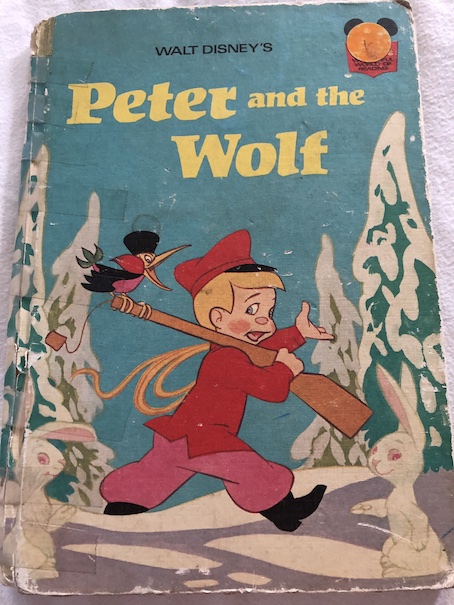
Peter and the Wolf

Peter and the Wolf by Walt Disney Productions, 1974.

This is the picture book version of Disney’s cartoon from 1946 based on Peter and the Wolf, which was originally a musical symphony for children, written by Sergei Prokofiev in 1936 for the Central Children’s Theatre in Moscow.

Young Peter lives with his grandfather near a forest in Russia. Peter’s grandfather warns him to stay away from the forest because there are hungry wolves there, but Peter thinks that he can catch a wolf himself. One day, while his grandfather is asleep, Peter sneaks out of the house to go catch a wolf.

Along the way, Peter’s friend, Sasha the bird, also warns him that there really are dangerous wolves in the woods and that he can’t hope to catch one with his toy gun. Peter insists that he’s going to try anyway, and Sasha says he’ll go along and help.

As they venture further, they are also joined by Sonia the duck. Ivan the cat tries to eat Sasha, but Peter makes him let Sasha go. Then, suddenly, a wolf appears!

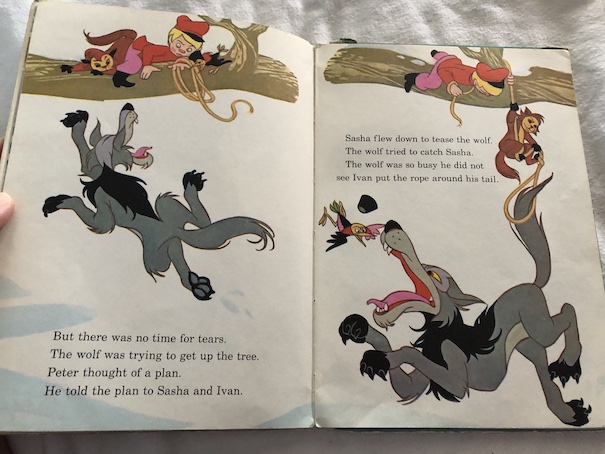
The wolf chases Sonia, and at first, the others think he actually caught and ate her. They manage to catch the wolf by the tail. Sasha attracts some help from some passing hunters.

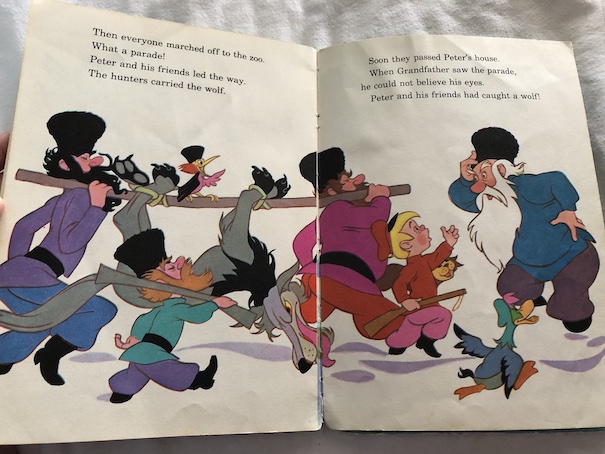
At first, the hunters want to shoot the wolf, but Peter asks them to take the wolf to the zoo instead, realizing that the wolf was just hungry. It tuns out that Sonia is safe after all, and they all take the wolf to show Peter’s grandfather.

The book is available to borrow and read for free online through Internet Archive (multiple copies).

The Little Engine That Could

The Little Engine That Could by Watty Piper, 1930.

A little train is pulling a load of things for children over a mountain. The train is carrying toys of all kinds and also good, healthy food for the children.

Unfortunately, something goes wrong, and the engine pulling the train breaks down. The toys aboard the train know that the children over the mountain are waiting for them and that they will need the food on the train, too. Other train engines pass by, and the toys try to get them to help pull the train.

However, even though these other train engines are not currently pulling loads of their own, each of them has a reason why they cannot help to pull the train with toys and food for children. One engine is old and doesn’t think that he’s strong enough to pull even this small train. The bigger, stronger engines think of themselves as being too important to pull this small train because they handle more important things, like passenger cars or freight for adults, not children.

The toys are despairing, but then, a small blue engine comes along, and they ask her if she can help them. At first, the little engine isn’t sure that she can help because she is only a small engine and has never been over the mountain before, but the toys explain how important it is to get the toys and food to the children, so the Little Engine agrees to try.

As the Little Blue Engine pulls the toy train over the mountain, she gives herself positive self-talk, telling herself “I think I can-I think I can.” When she succeeds in her mission, everyone is happy, and she says, “I thought I could!”

This classic picture book is often used to show children the benefits of positive thinking and being willing to try. Instead of focusing on doubts about herself or reasons not to try, the Little Blue Engine makes the decision to try and tells herself that it’s possible for her to succeed. The Little Blue Engine doesn’t know if she can accomplish the mission (she “thinks” she can, although she doesn’t “know” if she can), but when she is willing to try, she discovers that she actually can. Even though she is small and seems less important than the bigger trains, she accomplishes more because she is willing to do what the bigger trains will not, taking part in something that is outside of her basic, required job. I also like how the book shows that it is sometimes the small, less prestigious tasks that make the biggest difference. Taking food and toys to children doesn’t seem important to the big trains, but it matters to the children and their families over the mountain.

However, this is not the first form of this story. The story of the little train engine that is able to go over the mountain because it thinks it can is actually based on an earlier form of the story that was originally part of a sermon from the early 1900s.

The book is available to borrow for free online through Internet Archive (multiple copies). There are also different cartoon versions of the story.

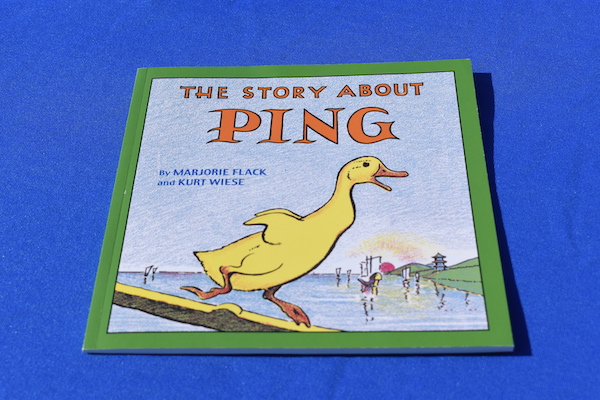
The Story About Ping

The Story About Ping by Marjorie Flack and Kurt Wiese, 1933.

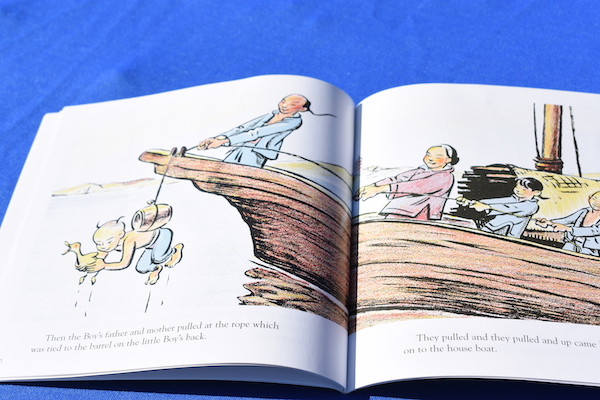
Ping is a small duck who lives with his family on a boat on the Yangtze River in China.  Every morning, the master of the boat lets the ducks out to look for food on the river, and every evening, he calls them back. 

However, Ping hates it that the master gives the last duck to return at the end of the day a spank on the back, so when he realizes that he is late to return one day, he hides and is left behind.

After sleeping on the river bank overnight, Ping sets out to find his family the next day.  However, there are many different boats on the river, and he has trouble finding the one where his family lives.  As he searches, he is captured by a boy who brings him onto his family’s boat.

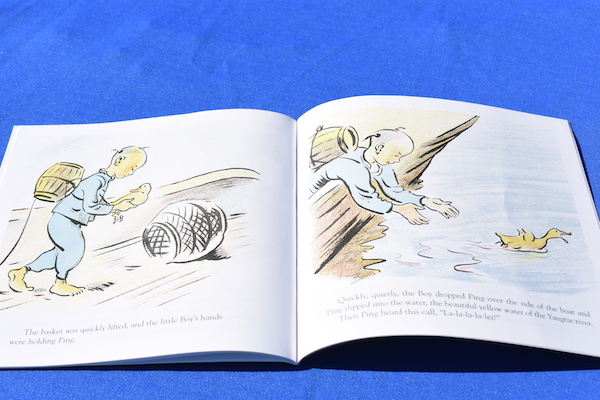
To Ping’s horror, the family who captured him plans to eat him for dinner!  However, the boy who grabbed Ping out of the water thinks that he’s “too beautiful to eat.”  Without letting his family know, the boy frees Ping from the basket where he is being held captive.

As Ping swims away from the boy’s boat, he hears the master of his family’s boat, calling out for the ducks to return.  This time, Ping does return to his family’s boat, even being willing to take a spank for being late, glad just to be safe with his family.

In a way, this little story reminds me of one of the short humor stories in Wayside School is Falling Down.  In that story, a boy at a very strange school gets tired of following the school’s rules.  Some mysterious men explain to the boy that the rules are meant to keep the students safe and choosing whether or not to follow the rules means choosing between freedom and safety.  The story and the boy’s choice are meant to be humorous, but it is a good point about the purpose of rules.  Probably, the reason why the master on Ping’s boat spanks the last duck is to give all of the ducks a reason to hurry back to the safety of the boat.  Ping doesn’t really appreciate that until he sees the dangers that wait for a small duck, alone on the river.  In the end, he is willing to accept some discipline because he wants the safety it promises.  It’s not the usual message in a lot of modern children’s books, especially in the United States, where people and book characters tend to value freedom over safety (the choice made by the boy in the Wayside School book).  However, in this book, Ping and his family have something between total freedom and total captivity – they are allowed to swim pretty freely during the day as long as they return to the boat for safety at night. They get both some freedom and safety in exchange for following the master’s routine. Ping’s danger only comes when he breaks away from that entirely.

But, if you think that analysis is getting too deep, Ping’s adventures and his return to the safety of his family are endearing for lovers of animal stories. Kids who encounter this story will be reassured that Ping is still able to return to home and safety after his adventures!

The story has appeared in film and on television more than once. The book is available to borrow and read for free online through Internet Archive (multiple copies).