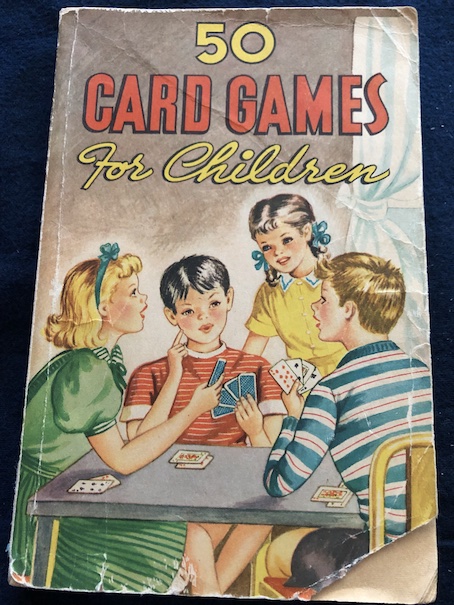
50 Card Games for Children by Vernon Quinn, 1933, 1946.
I love games of all kinds, and I was fascinated by this vintage children’s book about card games! Along with the card games, there is also a section in the book with card tricks. The vintage pictures in the book are also nice.
If you’re curious about what kind of card games children were playing during the Great Depression and around the time of WWII, this book offers some interesting insights! There were many games in the book that were already familiar to me, but there were some others that I had never heard of before.
The book is available to borrow and read for free online through Internet Archive.
Sections in the Book:
Card Games that Are Fun to Play
That struck me as an odd title for the very first section of the book, like whatever follows is going to be games that are not fun to play, but basically, this section contains multiplayer card games specifically aimed at children. It becomes clear when you study not only the contents but the titles of the other sections, which are about solitaire games, card tricks, and a section about popular card games that adults play.
I recognized a number of popular children’s card games in this section, like I Doubt It, War, Concentration, Hearts, Old Maid, and “Go Fishing” (which is what they call it instead of Go Fish, which is what I’ve always heard it called). There were some other games that I didn’t recognize, like The Earl of Coventry, Rolling Stone, Frogs in the Pond, and My Ship Sails.
Twelve Games of Solitaire
I was familiar with Klondike, Canfield, Pyramid, and Around the Clock (which I always called Clock Solitaire). I had never heard of Pirate Gold, Spread Eagle, Lazy Boy, or Down the Stairs before.
Twelve Card Tricks
These are magic tricks with cards. Some of them sound a bit complex when you’re reading the descriptions, but I think they would be more clean when actually trying them with a deck of cards.
Some Games That Grown-Ups Play
The games in this section are Rummy, Casino, Seven-Up (also known as High-Low-Jack), High Five, Cooncan, and Five Hundred. Actually, I have seen Rummy decks specifically for children, usually Animal Rummy, but that’s still a Rummy version, so that game isn’t just for adults.
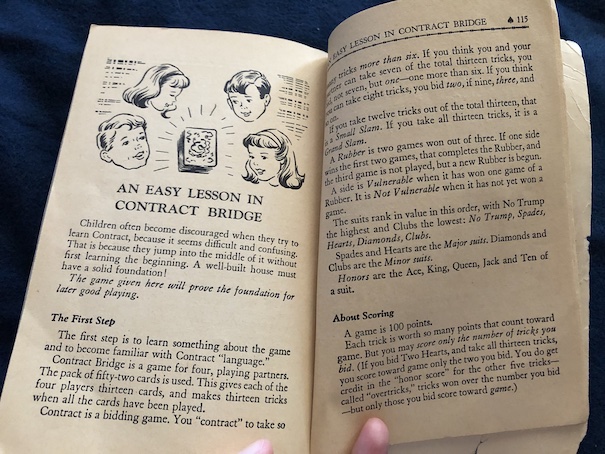
An Easy Lesson in Contract Bridge
I never thought of Bridge as being easy because I’ve always been intimidated by the concept of bidding. I understand trick-taking games like Whist, but I haven’t wanted to try Bridge because of the bidding. Actually, I think this basic description for children is a good tutorial for people like me, who find the bidding concepts confusing.
The Poky Little Puppy by Janette Sebring Lowrey, illustrated by Gustaf Tenggren, 1942, 1982.
This is a famous class children’s book, the first in a series from the Little Golden Books collection! In fact, it was one of the original first 12 Little Golden Books that were published in 1942.
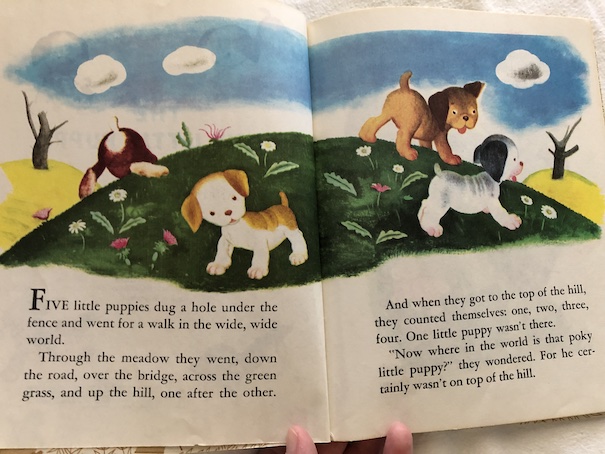
Five little puppies like to dig holes under the fence and go exploring. Then, four of the puppies realize that one of their brothers isn’t with them. They look around and find him sniffing at the ground. When they ask him what he’s doing, he says that he smells something.
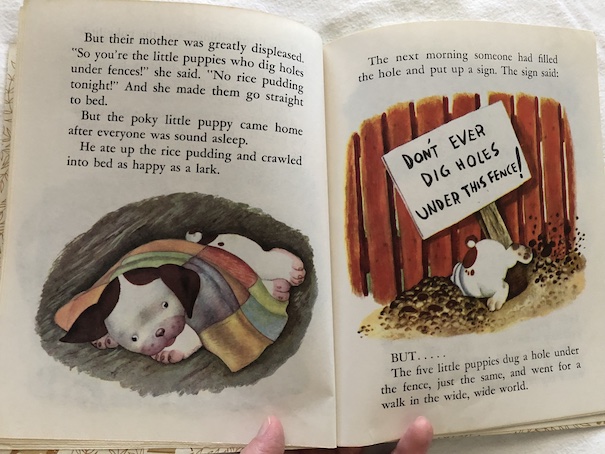
The puppies realize that the smell is rice pudding, and they hurry home to get some. However, their mother is angry about the holes they dug and sends them to bed without dessert.
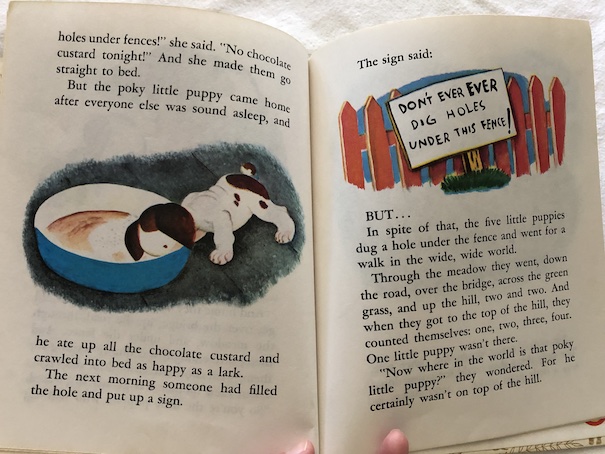
The puppy who originally smelled the rice pudding is slower than the others (or “poky” as the book describes him, which is why he’s called the Poky Little Puppy). He comes home later than the others, and while everyone is asleep, he eats all the rice pudding himself.
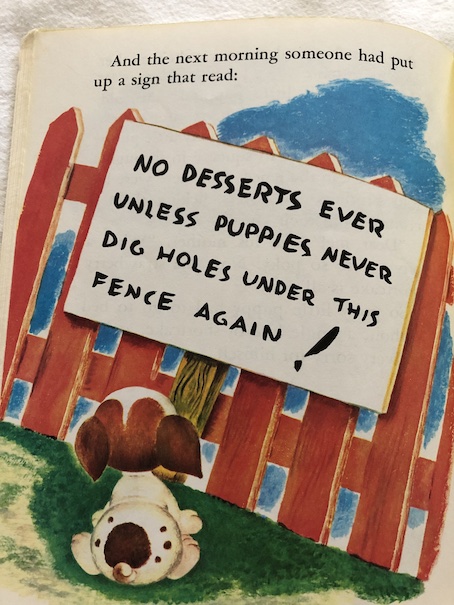
The next day, their mother puts up a sign telling them not to dig holes under the fence, but the puppies ignore it and dig holes anyway so they can go exploring. While they’re out, the Poky Little Puppy hears something.
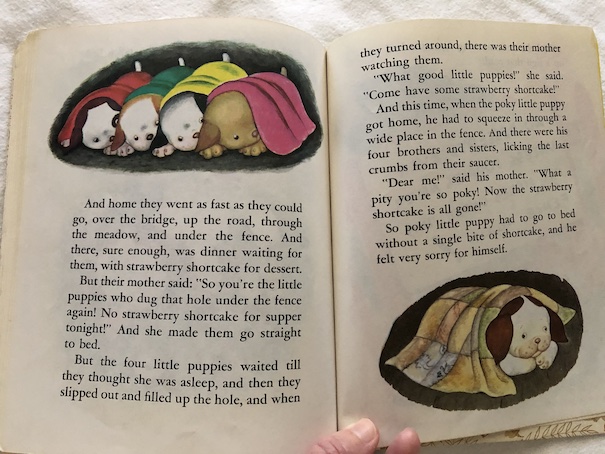
The other puppies realize that it’s the sound of chocolate custard being dished up, and they hurry home to get some. Again, they’re punished for digging holes, and they’re sent to bed without dessert. And again, the Poky Little Puppy comes home last and eats all the dessert while everyone is in bed.
The next day, the puppies dig holes again, but this time, when they hurry home for dessert and their mother is mad at them, the four puppies who got home quickly fill in the holes they dug. Their mother, seeing that they fixed the holes, decides to let them have their dessert. The Poky Little Puppy, who came home late again, doesn’t get any because the others ate his share, too.
The book is available to borrow and read for free online through Internet Archive (multiple copies).
My Reaction
This is a very simple story, but I remember liking it as a kid. Kids like stories with repetition, so the repeated incidents in the book appeal to them. The Poky Little Puppy thinks that he’s found a trick to getting all the dessert by staying out late enough that his mother has gone to bed and can’t tell him to go to bed without dessert. But, his trick stops working when the other puppies clean up their act and get the dessert before he even gets there. In the end, all of the puppies learn that digging holes means no dessert for any of them anymore.
Mary Poppins Opens the Door by P. L. Travers, 1943.
This Mary Poppins book was written during World War II, and the author has an acknowledgement in the first chapter that things have changed because of the war. Like other Mary Poppins books, each chapter is its own short story, and the first one takes places on Guy Fawkes Day. A note at the beginning explains what Guy Fawkes Day is, and it also mentions that people haven’t celebrated it since the war began. However, the author says that she is sure that the situation is only temporary and that people will celebrate it once again after the war is over.
Sadly, people reading older versions of Mary Poppins books also have to be warned about the racial language. The stories are magical, but at the same time, one of the most grating things about the original printing of this book is that characters have a tendency to use racial language or racial terms as insults. When characters, even Mary Poppins, are irritated with each other, they’ll call people things like “Hottentot“, “black heathen”, “Blackamoor“, and similar things, implying that these people are behaving like “savages.” Some of the words the books use would be considered offensive by themselves, but it’s worse when they’re specifically used as insults. These incidents don’t take place in every story, but they happen throughout the original printing of this book, and they’re also found in other old Mary Poppins books. On a somewhat lighter note, I liked the character of Mrs. Clump, even though she’s an antagonist in one of the stories, because she used “vampire” and “pirate” as insults. If someone is going to use insults, I like them imaginative and funny like that. Fortunately, later reprintings of this book revised or removed the inappropriate racial language, so some people who grew up with the revised versions may not have even been aware that they were ever there.
This is the third time that Mary Poppins returns to the Banks household to be the children’s nanny. In the previous two books in the series, she came suddenly and left suddenly, without warning. Mrs. Banks finds it upsetting that Mary Poppins comes and goes so unexpectedly because she never knows if she can count on her to be with the children or if she will disappear suddenly. All the same, Mrs. Banks is always grateful when Mary Poppins comes because she’s so good at putting the household in order.
The book is available to borrow and read for free online through Internet Archive (multiple copies).
Stories in the Book:
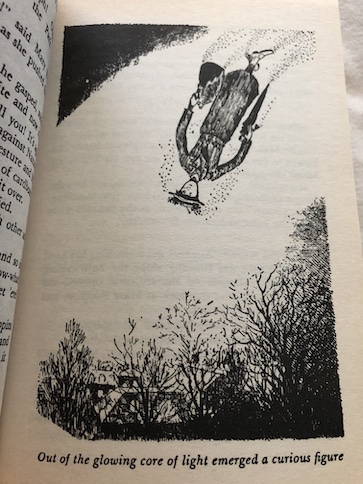
The Fifth of November – Mr. Banks is in a bad mood and declares that he won’t be home for dinner that night, upsetting his wife and children because it’s Guy Fawkes Day, and the family wants him to help set off fireworks. He won’t even shake hands with the chimney sweep, even though that’s supposed to be good luck. Part of the trouble is that the family is missing Mary Poppins, and they haven’t found anyone to replace her, leaving the house in disorder. Mrs. Banks considers hiring Mr. Banks’s old governess, but the children beg her not to because they know how strict she is. The discussion is interrupted by the chimney sweep. Mrs. Banks doesn’t remember scheduling the chimney sweep for the day, and the household staff panic at the idea of having to clean up after the chimney sweep. The chimney sweep offers to take the children to the park and set off some fireworks to give the household time to prepare for him, and the children eagerly accept. The chimney sweep and the park keeper set off fireworks with the children. For some reason, though, there are no sparks from the last rocket, and they can’t figure out why. As everyone else starts heading home, the children see something odd in the sky, a strange spark. It gets larger, and the children recognize it as Mary Poppins.
The children are overjoyed to see Mary Poppins again, and she takes them home. Mrs. Banks is also glad to see Mary Poppins again even though she’s still irritated at the way that Mary Poppins comes and goes suddenly without word or warning. Mr. Banks’s mood improves as well. Mary Poppins immediately starts making herself at home and putting things in order. She measures the children, but instead of learning their heights, she learns about bad habits they’ve developed. The children ask Mary Poppins if she’s going to stay with them this time, and she says that she’ll stay “until the door opens.” Jane is upset because the nursery door opens all the time, but Mary Poppins tells her that she means “the other door” without explaining what that means.
Mr. Twigley’s Wishes – When Mrs. Banks says that she needs to find a piano tuner, Mary Poppins recommends her cousin, Fred Twigley. She takes the children to Mr. Twigley’s house to see him. Mrs. Clump, the housekeeper, tries to send them away, but Mary Poppins pushes in anyway. Mr. Twigley has locked himself in a room. When Mr. Twigley finally lets Mary Poppins into the room with the children, they can’t see him at first. When Mary Poppins asks him what’s going on, Mr. Twigley explains that he’s been “wishing” and that he’s hiding from Mrs. Clump. He makes himself visible again and explains that, at certain times and under certain conditions, he has the ability to make seven wishes that come true. It’s a tricky business because it’s easy to waste wishes on whims and random thoughts. Mrs. Clump is scheming to marry him because she wants him to use his wishes to give her what she wants, and Mr. Twigley doesn’t want to marry her. When Mrs. Clump tries to come see him, Mr. Twigley suddenly wishes that he was somewhere safe, and he finds himself on one of the music boxes that he’s been making. Then, suddenly, the children also find themselves on music boxes. Mrs. Clump brings a policeman to deal with the chaos, and Mr. Twigley also traps Mrs. Clump and the policeman on music boxes. Mrs. Clump promises that she won’t try to force Mr. Twigley to marry her anymore if he lets her go. What Mrs. Clump had wanted Mr. Twigley to wish for her was a golden palace, so he shrinks her, turns her into a mechanical woman, and puts her into a music box golden palace.
The Cat that Looked at a King – Michael has a toothache the day after his birthday, and Mary Poppins says that it’s because he’s eaten too many sweets. Michael angrily tells Mary Poppins not to “look at him like that.” Mary Poppins says that “Even a cat may look at a king,” and the children and Mary Poppins talk about what the phrase means and if it’s true. A china cat from the mantelpiece comes to life and runs off. Mary Poppins tells the astonished children that the cat has gone to see the queen.
Mary Poppins begins telling the children a story about a king who thought that he knew practically everything, but he kept wondering about all sorts of random things that he doesn’t know. He would think of all sorts of random questions and then send his subjects out to find the answers for him. He kept everyone so busy with finding out random information and writing it down that ordinary tasks would be neglected. The queen feels neglected by the king, the kingdom is poor, buildings are crumbling because they aren’t being maintained, and the castle is infested with mice. Then, a cat comes to the castle and hunts the mice. Then, it sits on the king’s desk and stares at him. The king asks him what he’s doing, and the cat says that he wants to look at him. The king says the cat can look at him, and when the cat has had a good look, the king asks the cat what he thinks. The cat doesn’t think much of the king, and the king is offended because he thinks that his great knowledge deserves more admiration than that. The cat says that it knows everything, and the king says that’s impossible because even he doesn’t know everything. The cat says that cats know everything, and the king challenges the cat to prove it. The cat agrees to the challenge but sets the condition that whichever of them wins gets to govern the kingdom. As the king asks questions, the cat replies as if they’re all riddles. The king says that he’s not being serious and is missing the point, and the the cat says that all questions must have a point and his ridiculous questions don’t have one. The king is unable to answer any of the cat’s questions, but the queen, a page, and the prime minister can, so the cat says that he has the right to rule the kingdom with the help of the people who could answer the questions.
However, the queen, the page, and the prime minister all refuse to serve the cat because they are all dedicated to the king. The king repents of his foolish pride in his supposed knowledge and says that he’s not sure of who he is really anymore. The cat tells the king to look at him, and the king sees his own reflection in the cat’s eyes. When he sees himself, the king remembers that he’s actually King Cole, a merry old soul, and that he has no need of all these useless facts he’s been obsessing about. The cat says that he will let King Cole have the kingdom back if he can be allowed to visit the queen sometimes, and they agree.
The Marble Boy – Mary Poppins takes the children to the park, and although she doesn’t want to admit it, she is irritated that an old man is sitting in her favorite seat, reading a book. When the man closes the book and gets up, a statue of a boy with a dolphin suddenly leaps down from its pedestal and begs him not to stop reading yet because he’s been reading over the man’s shoulder and wants to finish the story. The shocked man apologizes but says that he has to get home to tea. The marble boy asks him if he can have the book, and the man is reluctant to part with it because he’s been wanting to read it for years, but he finally hands it over and leaves.
Jane and Michael ask the marble boy who he is and how a statue can read and jump off its pedestal. The boy says that his name is Nelius. He is an ancient statue from Greece that was separated from the rest of his family. He is often lonely, but he likes observing people in the park and reading over their shoulders. Mary Poppins, who Nelius says he knows because she’s an old friend of his father, tells Nelius to get back on his pedestal, but Nelius begs her to let him play with Jane and Michael awhile longer. Mary Poppins agrees that he can play with the children for the afternoon, but then, he has to get back on his pedestal before he’s missed.
Nelius enjoys spending time with Jane and Michael and going to the book stall with them. However, he does attract unwanted attention. Mrs. Lark sees his dolphin and thinks that he’s cruelly removed a fish from the water, and she says that she’s going to report him. Various people worry because Nelius is running around naked, so Mary Poppins gives him her jacket to wear. At the end of the afternoon, Nelius gives Jane the book the man gave him, asking her to let him read it over her shoulder, and he gives Michael some money that the man at the book stall gave him to buy clothes. By now, people have noticed that the statue is missing, and the mayor is demanding that the park keeper explain the situation.
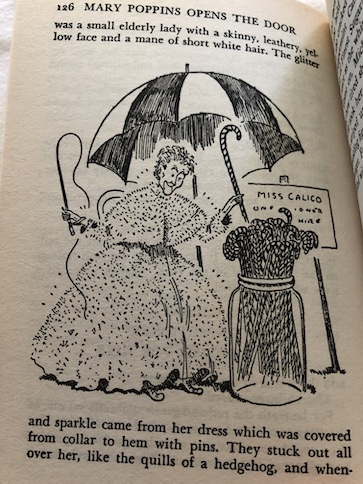
Peppermint Horses – Jane and Michael take their father’s walking sticks because they want to play horses with them, like they’re riding hobby horses. Mary Poppins gives the the walking sticks back to Mr. Banks and takes the children and Robertson Ay, who works for the Banks family, on errands. The children get tired of walking and start getting cross. Then, they see a woman named Miss Calico with what looks like a bunch of large candy canes and a sign that says she has horses for rent. The children are confused because they don’t see any horses. It turns out that Miss Calico’s candy canes are magical mounts that people can ride. Mary Poppins rents some of these peppermint horses for the children and Robertson Ay, and they ride them home through the sky, along with other people they know. Mary Poppins rides on her umbrella instead because she never uses walking sticks. The children want to keep their magical candy canes forever and continue to ride them, but they’re only rented. Miss Calico comes around at night and collects them.
High Tide – Mary Poppins takes the children to visit Admiral Boom and his wife because their parents want to borrow a bottle of port from them. They give them the port and a seashell for the children to enjoy. Michael is curious about what port tastes like, and Jane is fascinated by the seashell. She says that she would like to go see the sea.
That evening, while Mary Poppins is still having her half day out, the children hear a voice from the seashell telling them to dive in. They do and find themselves under the sea. The voice from the shell was a trout, and the trout introduces them to other sea creatures and takes them to a garden party that the creatures are having to celebrate high tide. Of course, Mary Poppins turns out to be the guest of honor.
Happy Ever After – It’s New Year’s Eve, and Michael wants to know what happens between the first chime at midnight and the last chime because he’s been told that the old year ends at the first chime and the new one starts at the last chime. Mary Poppins refuses to answer. She takes the children’s toys away from them, lines them up, and puts open books in front of them, also without explaining why, just telling the children to go to sleep.
The children wake up at the first chime of midnight and see their toys come to life. The toys lead the children to the park, where they see all sorts of storybook characters. (Friday from Robinson Crusoe is a rather uncomfortable character.) They explain that the period between the first chime and last chime of midnight on the New Year is called “the Crack”, and it’s the only time of year when characters can come out of their books, provided that they’re left open, and all be friends with each other, even if they’re enemies in their stories. It’s the only time when they truly have Happily Ever After. So, they all have a party to celebrate the Crack, and naturally, Mary Poppins is the guest of honor.
The next day, Michael asks Mary Poppins if they’ll ever have happily ever after themselves, and she says that depends on him.
The Other Door – Mary Poppins’s friends show up to say goodbye to her, although they try not to let the children know that Mary Poppins is about to leave. They all have a dance together, and Mary Poppins takes the baby home from the park before the other children. Jane and Michael realize that Mary Poppins is about to leave when her friends talk about “the door.” They rush upstairs to the nursery, but they don’t see her until Jane spots her in the reflection of the nursery in the window. The door in the reflection is the “other door” that she’d been talking about, and that’s the door that Mary Poppins goes through to leave. The children’s parents come into the room, and the children tell them that Mary Poppins is gone. Mrs. Banks is upset, but Mr. Banks dances because he likes the music from her goodbye party, which is still going on. The family thinks that they see a shooting star, but that’s Mary Poppins leaving. Still, they make a wish not to forget Mary Poppins.
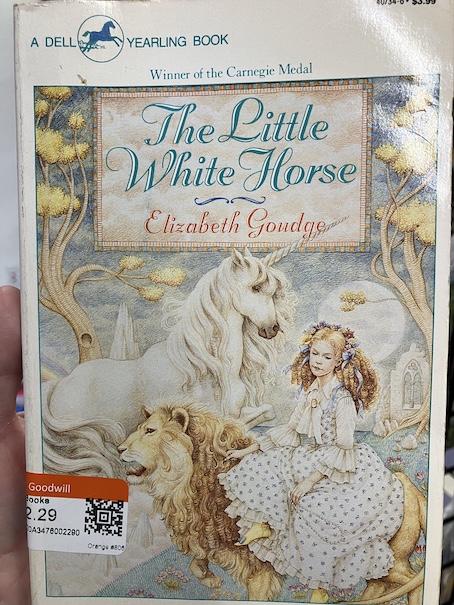
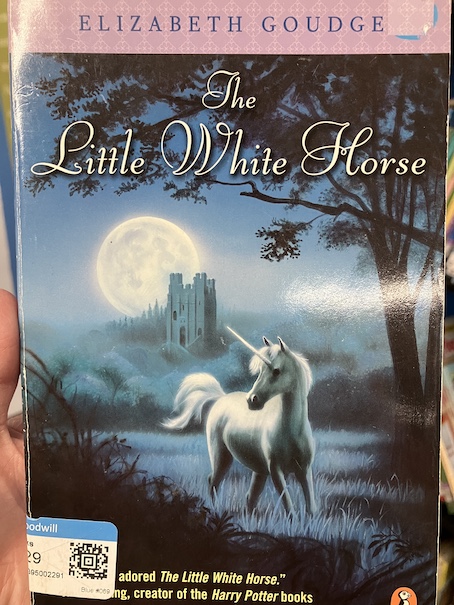
The year is 1842, and Maria Merryweather is on her way to her family’s ancestral home, Moonacre Manor. Thirteen-year-old Maria is an orphan. Her mother died when she was a baby, and now, her father has died. Their house in London had to be sold to pay his debts, and now, Maria is going to live with a distant cousin, Sir Benjamin Merryweather, in the country. She is traveling with her nurse, Miss Heliotrope, who has taken care of her since she was little and is like a mother to her, and her dog, Wiggins. Maria and her father were never really close. Maria isn’t sure that she’s going to like living in the country because she is accustomed to city life and the luxuries that come with it. She fears that life in the country will be rough and full of deprivation.
Maria begins to feel better when she actually sees Moonacre. It’s a lovely, romantic, castle-like manor house. The manor also gives her an odd feeling of home because so many Merryweathers have lived there for so long. Sir Benjamin welcomes her, and she likes him immediately. Oddly, Sir Benjamin refers to has as “one of the silver Merryweathers”, saying that she was born during a full moon. It’s true that Maria has unusual silvery gray eyes. Sir Benjamin says that he’s a “sun Merryweather”, born at midday, but that’s okay because moon Merryweathers and sun Merryweathers get along well. He does have a rather warm, sunny appearance.
Sir Benjamin shows them around the manor and to their rooms. The furnishings are a little shabby, but they’re quite comfortable, and they like their new rooms. Maria is charmed because her room is in a turret, and it has a very small door that’s really only big enough for a small girl like her to get in. Miss Heliotrope is worried that she won’t be able to get into Maria’s room if she is ill and needs her, but Maria is sure that isn’t going to be a problem. She loves the room because it just seems so perfect for her. Wiggins even seems to be getting along with Sir Benjamin’s big, old dog, Wrolf, although Maria has some doubts that Wrolf is actually a dog because he doesn’t look like any dog she’s ever seen before.
At dinner that evening, Sir Benjamin talks about giving Maria riding lessons, saying that he has a little gray pony who would be just right for her. Maria mentions a beautiful white horse that she saw from the carriage as they were approaching the manor, but Miss Heliotrope didn’t see it and thinks she just imagined it. Miss Heliotrope thinks that Maria imagines things all the time, like the little boy named Robin, who had a feather in his cap and was a childhood playmate, but Maria insists that the boy really did exist and so does the little white horse. Thinking about Robin makes her wish that he was here to keep her company at Moonacre, but she hasn’t seen him for a couple of years and doesn’t know where he is.
There are a few odd things that Maria and Miss Heliotrope notice about Moonacre, though. Aside from the odd dog, Wrolf, Sir Benjamin seems oddly evasive about who and where the servants are. They never see them, yet someone has been doing the cooking and cleaning and making fires in the fireplaces. There’s even a fire in Maria’s room, but she can’t figure out how anyone got in to make one since the door is too small for even an adult Miss Heliotrope’s size.
The next day, a riding habit appears in Maria’s room. It’s very nice quality, even though Maria can tell that it’s second-hand because it’s an older style and a little worn and has the initials LM on it. Maria like it, but who used to own it, and who put it in her room? In the parlor attached to her room, Maria also sees an old painting that contains a white horse and an animal that looks something like Wrolf, although she’s still not quite sure what kind of animal it is. (What’s that “brave-looking” animal that has a tawny mane and a tuft on its tail? I’m sure if we think about it, it will come to us.)
Sir Benjamin tells Maria that she shouldn’t wander the countryside alone, but she is free to explore as long as she’s with her pony Periwinkle or Wrolf. The one place he doesn’t want her to go is Merryweather Bay because there are rough fishermen there. He refers to Maria as a “princess” and the area around Moonacre as her “kingdom,” and from the way he says it, it seems that he somehow means that literally. Even the local people seem to have some kind of awe and respect for her.
Maria finds the nearby village of Silverydew charming. The Old Parson introduces her to the children of the village, and they tell her about the mysterious “Black Men” (because they all wear black, not their race) who hang out in the woods and by Merryweather Bay. They set traps for animals and steal livestock from the locals, and everyone is afraid of them.
Maria also discovers that Robin is here in the village of Silverydew, and he rescues her from an encounter with the Black Men. Robin tells her that her ancestor, Sir Wrolf, who founded the Merryweather family, was the one responsible for making the Black Men as evil as they are, and because of that, his soul has been unable to enter Paradise. Locals say that his spirit rides around nearby Paradise Hill, weeping because of what he did, and he will continue to do it until someone finds a way of solving the problem he caused.
Maria asks what exactly Sir Wrolf did, and Old Parson tells her the story of Sir Wrolf and how he acquired the lands around Moonacre. At first, Sir Wrolf just owned the land where the manor house sits, but he wasn’t satisfied with that. Although he was known for being brave and jovial, he was also a greedy and selfish person who thought that he was entitled to take anything he wanted from anyone. First, he kicked the monks out of the monastery on Paradise Hill and used the monastery for a hunting lodge. A fierce lightning storm made him abandon it later because he believed that it was sent by the monks as punishment. Then, he decided that he wanted the woods and bay around Moonacre for hunting and fishing, but they belonged to another nobleman called Black William. He tried various ways to take those lands from Black William, including direct warfare, but he was unsuccessful. Then, it occurred to him that Black William had a lovely daughter, his only child, and if he married her, he would share in her inheritance. Sir Wrolf put on a show of apologizing to Black William and demonstrating that he had mended his ways so he could win the affection of Black William’s daughter. The daughter, who was called the Moon Princess because she was as fair and lovely as the moon, believed that Sir Wrolf was sincere and married him. Sir Wrolf did end up falling in love with his bride, and they had a child together, but the lands he expected to acquire through her were still on his mind. Then, Black William suddenly remarried, and his new wife gave birth to a son, who replaced the Moon Princess as the heir to Black William’s lands. Sir Wrolf was outraged by this reversal of fortune, and while he ranted about it, he let slip how he had married his wife in the hopes of getting her lands. The Moon Princess was shocked and hurt, and although her husband insisted that he had come to love her even though he had married her for selfish reasons, she no longer believed him. She grew to hate him for his deception and even turned against the son they had together. She wanted no part of Sir Wrolf’s life anymore. Then, worse still, word reached them that Black William had mysteriously disappeared and his young son was dead. Although there were no indications of foul play, and it was possible that neither of them had really died at all, the Moon Princess came to believe that her husband was a murderer. One day, she rode away on the little white horse that her husband had given her when they married, and she was also never seen or heard from again. With Black William and his son and daughter gone, Sir Wrolf finally had possession of the lands he had coveted for so long, but he was no longer happy. He genuinely missed his wife and felt guilty for what he had done, and he couldn’t enjoy his prize.
The Old Parson explains that the sins of the past still affect the present and will continue to do so until someone makes them right again. The Black Men who now inhabit the disputed lands are probably the descendants of Black William’s supposedly dead son. The Old Parson believes that the boy’s mother probably feared what Sir Wrolf might do to the boy when his father left them, so she pretended that he was dead already. Every generation of Merryweathers since then have tried to push the Black Men out of the disputed lands, but they’ve never been successful. Also, every generation, a young woman very much like the Moon Princess comes to Moonacre, and she gets along well with the sun-like Merryweathers, but so far, a quarrel has always separated them. Maria worries about that because she likes her cousin Sir Benjamin and doesn’t want to leave Moonacre. Old Parson tells her that part of the legend of Moonacre is that, some day, there will be a Moon Princess who will come and will not leave. The legend states that she will right the wrongs of the past and make peace again, but only if she can get over the prideful nature that all Moon Princesses have and love a poor man who is below her station. The townspeople are in awe of Maria because they hope that she will turn out to be that Moon Princess.
Maria adopts the mission of righting past wrongs, reconciling old quarrels, and bringing peace to the valley once again, but she’ll have to be careful. Not everyone is ready for peace yet, and she has to guard against falling into the same bad habits that others have before her. Before she can complete her destiny, she must speak directly to the Black Men in their castle and when she does, they make a bargain with her. They agreed to end their poaching and thievery if she can prove that Black William wasn’t murdered by Sir Wrolf and if she will restore not only their lands but the pearl necklace that belonged to the original Moon Princess. However, that necklace has been missing since the first Moon Princess disappeared. How can Maria give them something that she doesn’t have and doesn’t know how to find?
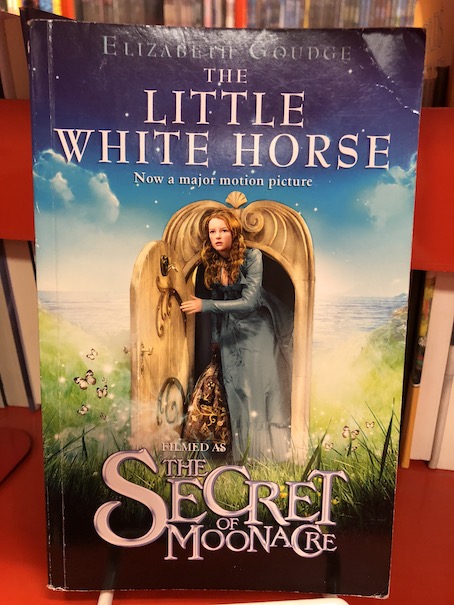
The book is available to borrow and read for free online through Internet Archive (multiple copies, including one in Chinese). There is also a movie version of the story called The Secret of Moonacre.
My Reaction and Spoilers
I didn’t read this book as a kid, but it’s one that I’ve been meaning to read for some time. I saw the movie version years ago, and I was curious about what the book was like. The movie and the book set up a somewhat different situation for the quarrel between the two families. In the movie, the quarrel was about the fabulous pearls owned by the first Moon Princess and not about land. Also, Loveday and Robin were members of Black William’s family in the movie, which they weren’t in the book, changing the dynamics of their relationships with Sir Benjamin and Maria.
This story is an enchanting light fantasy. The setting by itself is magical, and Maria’s rooms in the manor are like every little girl’s dream! The story also includes odd, seemingly intelligent animals with unusual capabilities, such as the Zachariah the cat, who takes messages for people and lets them into the manor house or guides them around, and Wrolf, who is clearly a lion, even though everyone calls him a dog. The fact that Wrolf is a lion dawns on Maria toward the end of the book, and Robin confirms that’s true, saying that they all keep calling him a dog because it sounds less scary, and they don’t want to alarm anyone.
Maria’s family history is not something to be proud of, as Old Parson points out. Her ancestors were not the greatest people, in spite of their land-ownership and high status. People are looking to Maria to be better than the others who came before her and to make past wrongs right.
From Robin’s mother, Loveday Minette, who also becomes like a mother to her, Maria learns a little more about what it means to be one of the Merryweather “Moon Princesses.” Gradually, it is revealed that Loveday was the last Moon Princess before Maria. She was in love with Sir Benjamin, and the two of them were going to be married, but like all Moon Princesses and Merryweather men, they had a stupid quarrel and parted. Loveday married someone else and had Robin, but even though she has remained near Moonacre and secretly helps the household, she has been careful not to see Sir Benjamin ever since. Over the years, she has come to realize that she made a terrible mistake with Sir Benjamin and regrets it, but like other Moon Princesses, she has too much pride to admit that she was wrong and apologize. She is more mature now, and she sees that, in some ways, she was aggravating to Sir Benjamin and provoked him, and having provoked him to anger, because Moon Princesses tend to love men with tempers (one of the curses of the Merryweather men), was too proud to make up with him. By the same token, Sir Benjamin was legitimately disrespectful of her and her feelings, and when he attempted an apology, it was a half-hearted effort that attempted to preserve his pride more than demonstrate care for Loveday’s feelings, which is why Loveday didn’t feel like she could accept it.
Members of the Merryweather family and the people they marry have a tendency to attach enormous importance to and emotional investment in small things (geraniums, the color pink, etc. – they either passionately love these things or are violently or oppressively against them), and then they blow up at each other when their partner doesn’t feel exactly the same way about them, taking it as personal insult if someone likes something they don’t like or doesn’t like something they do like. (Like in the Internet meme, “Stop liking what I don’t like!”) They don’t know how to tolerate interests they don’t share, not sweat the small stuff, or live and let live. I would say that a lot of it has to do with poor relationship skills and, ultimately, a lack of respect for other people, even the people they love. They don’t respect each well enough to find out why the other person cares so much about something that seems small and annoying. They are self-absorbed in their own feelings, seeing situations only from their own point of view and putting their own feelings first. They see every conflict as some kind of contest about who’s right, with the drive to win against each other, which puts them both in a position of being on opposite teams instead, where one of them has to get the better of the other in some way, instead of on the same winning team. The result is that neither of them ever really wins, and even if one of them defeats the other in something, they ultimately end up losing their whole relationship, so it’s a net loss for everybody.
This is the cycle that has repeated for generations in this family. Loveday realizes that, for this destructive cycle to end, the Moon Princess has to learn not to provoke the one she loves as well as overcome her sense of pride. Also the Moon Princess’s love (it’s pretty clear to everyone that it’s going to be Robin, in this case) has to learn to control his temper, not respond to things as if they were some kind of personal attack, and consider the well-being of others, especially his princess. Both of them need to learn caring and consideration for others and how to put aside pride and self-interest for the sake of peace, both in their personal relationship with each other and for the sake of the wider community. Loveday emphasizes to both Maria and Robin that they must not quarrel with each other. People are depending on them to put things right in the area, and their own future happiness depends on learning to get along with each other.
The things Loveday and other adults emphasize for the children are personal skills that real people do need to learn in order to have relationships with other people and be mature members of a peaceful, stable community:
Don’t aggravate people. You can’t have peace if you’re always teasing or provoking people, and picking fights.
Choose your fights carefully, and wherever possible, avoid turning small disagreements into big fights. Remember that any battle comes with a cost, and the costs of petty fighting are higher than the rewards.
Be considerate of other people’s feelings and respectful of their property. You don’t have the right to do what you want with other people’s property just because you want it or it bothers you that they have it.
Understand that nobody is perfect, including you.
It is not your partner’s responsibility to please you in every way or give you everything that you want. It is your responsibility to deal with your own emotions and control your own choices and behavior.
Sometimes, you really are in the wrong, and you can’t always have everything you want. Accept both of these facts with maturity and take responsibility for your choices.
Being wrong can be embarrassing, but not nearly as embarrassing or destructive as not dealing with situations that need attention or problems that need to be solved.
The problems you cause affect more than just you, and problems do not go away when they are ignored.
Whatever the circumstances, no matter who or what you’re dealing with, it’s never just about you.
The word “responsible” has two meanings. The first is being at fault. (Sir Wrolf was responsible for the situation in the valley and the problems it caused.) The second just means taking charge of a situation and doing what needs to be done, sometimes because you’re the only one who can or is willing to do it. (Maria didn’t cause the problems, but she was responsible because she fixed the problems.) The second type of “responsible” is necessary for successful relationships, no matter who the first type applies to.
Love requires understanding and accepting each other and allowing each other to be their own person with their own likes and dislikes.
Caring means making each other a priority, working as a team, and doing what’s best for the team, even if it requires some compromise and self-sacrifice.
Building a shared life or solving shared problems is team effort, not a competition with each other. There is no “winning” unless it’s a shared victory. Otherwise, everyone loses.
It’s not exactly a spell, but the children’s mission is based around learning to function as a couple and to control their tempers and personal behavior. Magical things do start to happen when they learn to consider others’ feelings and not just their own.
There does seem to be some magic in the story. Robin later explains to Maria that the reason why nobody else could see him playing with her in London when they were younger is because he was always in or around Silverydew or Moonacre. He says that he traveled to London to play with her when he was asleep, so he wasn’t physically there. It’s like a form of astral projection or out-of-body experience. Also, like Sir Benjamin’s “dog” turns out to be a lion, the “little white horse” turns out to be a unicorn.
I couldn’t help but notice that all of the known Moon Princesses since the first one and the men that they seem to love before before they quarrel with them seem to be cousins of each other. Loveday Minette and Sir Benjamin were cousins of each other because their fathers were brothers, and Maria and Robin are more distant cousins of each other because their grandfathers were brothers. The idea of marrying a cousin or even loving them romantically seems odd for modern times, but that did happen in noble families in the past, so it might not seem so odd for the characters and others in the story.
This book also taught me what a mangel-wurzel is. They just mention it in passing, like readers should know what it is. It has such a strange name that I had to look it up. It’s a kind of beet, and apparently, it has also been used to make “punkies” or jack o’lanterns in areas where people didn’t grow turnips, before people adopted pumpkins for the purpose. Just an odd bit of trivia.
Mrs. Piggle-Wiggle by Betty MacDonald, 1947, 1957, 1975, 1987.
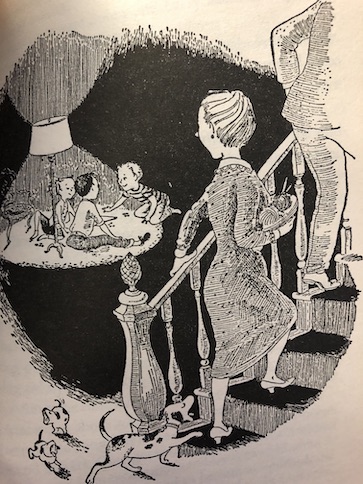
This book has been printed and reprinted many times over the decades. The edition that I used for this review is the same one that I read when I was in elementary school, printed in the 1980s. One of the reasons why the edition matters is that the illustrations were different in the first printings in the book. In 1957, the illustrations were replaced by the ones you see here, which continued to be used in later printings.
Mrs. Piggle-Wiggle is a widow who lives in an upside-down house. Her husband was a pirate, and she has magical cures for the bad habits of the children who live in her neighborhood. Sometimes, she doesn’t need magic for a particular child’s bad habit, just using psychology. Sometimes, certain behaviors, like staying up all night instead of going to bed, are their own punishment, and Mrs. Piggle-Wiggle advises the parents to let the children do them for a certain period of time so they can find out for themselves why these things are a bad idea, usually with very funny results. This book is the first book in the series, and it particularly uses more psychology than magic.
As an adult, I actually prefer the psychological cures to the magical ones. These stories are meant to be humorous rather than practical, and because of that, they’re not realistic. First, they never really go into the psychological reasons why some of these kids do the things they do, like becoming over-protective of their belongings or suddenly becoming afraid of taking baths. Then, when children suffer the consequences of their misbehavior, the consequences are humorous and exaggerated, like the boy whose room gets so messy that he actually traps himself inside until he decides to clean up and the girl who gets so dirty that her parents can grow radishes on her. However, the fact that there are consequences for the children’s behavior is a useful touch of realism. It gives parents or teachers the opportunity to talk to kids about what they expect would happen if they actually did any of the things kids do in the stories and think about some of the consequences of their own actions. These are stories that can make kids chuckle and then make them think.
I think it’s important to point out that Mrs. Piggle-Wiggle never actually blames the children for their bad behavior, seeing it more as an affliction that they need to be cured from. She likes all children in spite of their bad habits and bad behavior (something I admit that I find hard to do with people in real life), and she wants to cure them of their problems so that other people will see how likeable they are underneath. Even though Mrs. Piggle-Wiggle likes the children, she doesn’t spare them from the consequences of their actions because that is part of the cure that the children need to become the best versions of themselves. Sometimes, the consequences are the cure by themselves, and those are the stories I like best. After all, what makes bad habits “bad” is that they have bad consequences to them. They cause problems, both for the person behaving badly and others. Maybe, sometimes, people need to see the problems for themselves and experience the consequences directly before they find the motivation to fix their behavior. I can believe that part of these stories is realistic. The rest of it is just for fun.
The Mrs. Piggle-Wiggle books are collections of short stories, and each one focuses on a different child or set of children, their particular problems or bad habits, and Mrs. Piggle-Wiggle’s solutions for them.
The book is available to borrow and read for free online through Internet Archive (multiple copies).
The Stories in this Book:
Mrs. Piggle-Wiggle, Herself
This section of the book introduces and describes Mrs. Piggle-Wiggle. She is a small woman with a hump on her back, which she says contains magic. (The hump isn’t really shown in the pictures of her in the book, but she’s supposed to have one.) She has very long brown hair, which she usually wears up, but sometimes, she lets it down so that children can comb and braid it or style it in different ways. Her eyes are also brown, and her skin is described as being a “goldy brown.” (Her racial identity is not specified because it’s not important to the stories. The pictures show her as being white, so maybe she just has a tan, but I find the written description interesting because it could leave the character open to different interpretations and playable by different types of actors. Her description could fit quite a lot of people, really.) She wears brown clothing (although that’s not how she’s shown in the pictures) and smells like sugar cookies. She claims not to know her own age, saying that it doesn’t matter, since she’ll never get any bigger than she is now.
Mrs. Piggle-Wiggle is a widow, and she tells the children that her husband was a pirate who buried treasure in the back yard before he died. She has no children of her own, but she loves all the neighborhood children, and she frequently looks after them and has them come over to play. She doesn’t often speak to the children’s parents because she gets nervous around adults. She also has a dog named Wag and a cat named Lightfoot.
Mrs. Piggle-Wiggle lives in a little brown house that is upside down. She says that her house is upside down because, when she was a little girl, she used to look up at the ceiling when she was in bed and wonder what it would be like to walk on the ceiling, so when she grew up, she purposely built her house upside down just to find out. The only parts of the house that are normal are the kitchen, the bathroom, and the stairs because none of them would work properly if they were upside down.
When I was a kid, I thought that the upside-down house was the best part of the stories. When people walk around inside it, they have to step over the sills of the doorways because what should be the tops of doors are not flush with the ceiling the way the bottoms are flush with the floor, and these doorways are upside down. Mrs. Piggle-Wiggle put little steps into and out of doorways to help with that, but kids like to jump the doorways as a challenge. Mrs. Piggle-Wiggle lets them make chalk marks to record the lengths of their jumps. Also, because the ceilings are now the floors, the chandelier is on the floor of the living room, shining upward instead of down, and kids sit around it like it’s a camp fire. The children can also use the slanting ceiling-floors of the house as slides.
Most of this part of the book is backstory for Mrs. Piggle-Wiggle, but it explains that the first neighborhood child she made friends with was a girl named Mary Lou, who was running away from home because she hated doing the dishes so much. Seeing Mary Lou going down the sidewalk in the rain with her suitcase, Mrs. Piggle-Wiggle invited her in for tea and cookies, and Mary Lou told her about her problems. Mrs. Piggle-Wiggle tells Mary Lou that she really likes washing dishes because it’s fun to pretend that she’s a beautiful princess who was captured by an evil witch who makes her do all the cleaning and that the only way she can escape is to have everything clean by the time the clock strikes. Mrs. Piggle-Wiggle draws Mary Lou into a game of pretend, where they both pretend that they’re cleaning the kitchen for the evil witch. Then, Mrs. Piggle-Wiggle puts on her witch’s costume, pretending to be the witch, inspecting the kitchen to make sure that it’s clean.
It’s so much fun that Mary Lou gets over hating washing the dishes. When she tells her parents about Mrs. Piggle-Wiggle, they let her spend time with Mrs. Piggle-Wiggle, and she brings her friend, Kitty, to visit when Kitty says that she hates making the beds at her house. Mrs. Piggle-Wiggle plays a similar game of pretend with Kitty and Mary Lou, where they pretend that they are making beds for a cruel queen who will throw them in the dungeon if the sheets are wrinkled.
Gradually, Mary Lou and Kitty start bringing their siblings and other friends to see Mrs. Piggle-Wiggle, and Mrs. Piggle-Wiggle gets to know all of the children in the neighborhood. She shows them how to make chores fun, teaches them to do things like bake cookies and pies, and lets them dig for pirate treasure in the backyard. Because she is so good with children, parents in the neighborhood call her to ask for help and advice when they’re having problems with their kids.
The Won’t-Pick-Up-Toys Cure
Hubert Prentiss’s grandfather gives him many wonderful toys, but Hubert doesn’t like putting them away. It’s very difficult to get around his room, and the problem gets worse all the time. Hubert’s mother tries asking other mothers what they do with their children, but they either don’t have the same problem or don’t know what to do. Then, one of them suggests asking Mrs. Piggle-Wiggle because she’s so good with children. Mrs. Piggle-Wiggle has met Hubert before because he’s come to her house with the other children.
Mrs. Piggle-Wiggle suggests that Hubert’s mother let Hubert make his room messy and that she not try to pick up after him or even enter his room. Then, when the room gets to the point that it’s difficult for Hubert himself to even go in or out, to give her a call. After a week, Hubert’s room is so bad that he can’t open his bedroom door and can’t even use his bed. His mother has to feed him through his bedroom window. Even though she’s only able to give him things like peanut butter sandwiches through the window and Hubert doesn’t have anywhere comfortable to sleep anymore, he’s still not motivated enough to leave his room and put away all his toys. However, Mrs. Piggle-Wiggle has a plan to motivate Hubert enough that he’s willing to finally clean his room just to get out.
The Answer-Backer Cure
When Mary O’Toole’s teacher picks her to stay in at recess and help clean up the classroom, Mary is so irritated that she tells the teacher to do it herself and to let her go play with the other kids. Her mother tells her that was a rude thing to say to her teacher, but it’s just the beginning of Mary’s bad habit of being rude and impudent to people. Mary thinks that it makes her look smart to contradict people, and her new responses to any order or request her parents and teacher make are “Why should I?” and “I’ll do it because I want to but not because you tell me to.” (Nobody but you cares why you do it, kiddo. They just want it done because they just want to get through the day and accomplish things. You can either be the one who makes that easier or the one who makes that harder or more unpleasant, but things are still going to need to be done either way.)
Mary’s mother goes through the usual routine of calling other mothers for their opinions, and one of them suggests talking to Mrs. Piggle-Wiggle. Mrs. Piggle-Wiggle’s solution is to let Mary keep her parrot, Penelope for awhile. Penelope is as rude as Mary is and repeats many of the things that Mary herself says. At first, Mary thinks it’s funny, but gradually, she begins to see how annoying it is and realizes how she sounds when she talks that way. Her dad actually laughs when he hears how much the parrot sounds like Mary, which makes Mary mad. Penelope also uses remarks that Mary thought that she’d made up herself, but she says them before Mary actually said them around her, making Mary realize that she’s not even as clever and original as she thought she was. When she sees how annoying it is to be around someone as rude and negative as she was, Mary apologizes to her teacher and gives it up.
(Actually, I know a lot of adults who talk just like Mary – “I’ll do it because I want to but not because you tell me to.” If they don’t use those exact words, it’s solidly the exact same attitude. They say they do it specifically because they’re adults and nobody should be telling them what to do under any circumstances, even if it’s something important. For them, it’s a kneejerk reaction to being told something, anything, no matter the circumstances and with little thought or attention to what they’re being told and whether it’s actually worthwhile. I always think of this story whenever I hear them talking that way.)
The Selfishness Cure
Dick Thompson is selfish and greedy. It’s no fun for other kids to come play at his house because he won’t share any of his toys or let anybody touch anything that belongs to him. It’s always “MY” this and “MY” that and everything is “MINE!” Dick’s mother realizes that something must be done when she gives Dick a box of peppermint sticks specifically to share with other kids in order to teach him how to share, and he actually hits Mary O’Toole on the hand with his baseball bat for trying to take one.
When Dick’s mother calls his father at work and asks him what they should do, the father’s first suggestion is a good, hard spanking because that’s something Dick can keep all to himself, but the mother is upset at the idea of more physical violence. The father then suggests that she talk to Mrs. Piggle-Wiggle because she’s helped other children in the neighborhood.
Mrs. Piggle-Wiggle’s Selfishness Cure is her special Selfishness Kit. It contains a variety of padlocks that Dick can use to lock up his stuff. It also has labels and paint that Dick can use to label all of his stuff, and it even has a pastry bag for labeling Dick’s food as his with frosting. The idea is to indulge Dick’s desire to prevent anyone from touching anything that belongs to him until it becomes so much of a hassle that he decides that it’s too much trouble.
At first, Dick is really happy that he can label everything he owns with his name and write “DON’T TOUCH!” on it, but as predicted, it turns out to be a big problem. Because Dick has everything, including his lunch, marked with his name and “DON’T TOUCH”, it isn’t long before everyone at school knows and is laughing at him. Plus, as my mother says, “With some kids, you can tell them not to touch something, and they won’t touch it, but there are also kids who, when you tell them not to touch something, just can’t wait to touch it.”
The Radish Cure
Patsy is a perfectly ordinary girl, but one day, she suddenly decides that she hates baths and refuses to take another one. There is no explanation why, and none of the other mothers in the neighborhood seem to be having that problem with their children, but Mrs. Piggle-Wiggle has a solution.
Mrs. Piggle-Wiggle tells Patsy’s mother to led her go several weeks without washing at all, letting her get as dirty as she wants. Then, she should get a packet of small radish seeds and plant them on Patsy. When Pasty sees that she’s sprouting radishes, she suddenly decides that she’s ready for a bath.
The Never-Want-To-Go-To-Bedders Cure
The three children in the Gray family never like going to bed. Every night, when it’s time for bed, they beg to be allowed to stay up a little later and insist that nobody else in the neighborhood goes to bed as early as they do. It often takes about an hour of whining, complaining, and arguing before their parents are able to get them to bed.
Mrs. Gray goes through the usual routine of asking other parents if they have this problem with their children, but none of her friends do, so she asks Mrs. Piggle-Wiggle what to do.
Mrs. Piggle-Wiggle’s advice is to let the children stay up as late as they want to. Mrs. Gray worries that not getting enough sleep will be bad for the children’s health, but Mrs. Piggle-Wiggle says that a day or two with less sleep won’t make much of a difference, and by that time, they’ll realize why going to bed at night is a good idea.
The Gray children think it’s great at first that their parents no longer tell them to go to bed and even let them stay up half the night, but soon, they’re falling asleep in the middle of the day, missing movies that they go to see when they fall asleep in the theater and missing out on fun activities with other kids either because they’re asleep or too tired to enjoy them.
The Slow-Eater-Tiny-Bite-Taker Cure
A boy named Allen has suddenly become obsessed with eating his food very slowly, taking super-tiny bites. It’s a very odd habit, and it makes meal times difficult because he eats very little and take a very long time to do it. I’d be worried if he was having difficulty swallowing, but his mother calls Mrs. Piggle-Wiggle.
Mrs. Piggle-Wiggle gives his mother sets of dishes in different sizes, from fairly large to ridiculously tiny. At each meal, Allen’s mother uses progressively smaller dishes. Allen is fascinated by the tiny dishes, which fit his new dainty eating, but he’s getting weaker because he’s been hardly eating anything.
I actually found the descriptions of his weakness a little alarming, but his mother then reverses the order of the dishes she gives him, starting with the smallest and then moving to the biggest. As Allen realizes that he feels better when he starts eating more food, his appetite returns, and he gets his strength back.
The Fighter-Quarrelers Cure
Twins Joan and Anne Russell have been fighting with each other a lot, and it’s driving their parents crazy. The twins argue with each other over everything, like who is wearing whose clothing and who had more bacon or the biggest slice of melon on their plate at breakfast, and they even pinch and slap each other. Sibling quarrels are pretty common, but Mrs. Russell asks Mrs. Piggle-Wiggle if there’s anything they can do to end this constant fighting.
Mrs. Piggle-Wiggle advises the girls’ parents to make notes about the types of petty things that the girls argue about and spend a day having staged arguments of their own in front of the girls to show them what it’s like to be around that type of arguing all the time.
From the moment they wake up the next day, the twins suddenly find themselves in the awkward position of trying to reason with their parents and referee their quarrels as they become witnesses to the same kinds of petty behavior they’ve been doing themselves. Finally, the girls have had their fill of fighting, and with their petty quarrels now in perspective, the entire family promises each other that they won’t fight like that again.
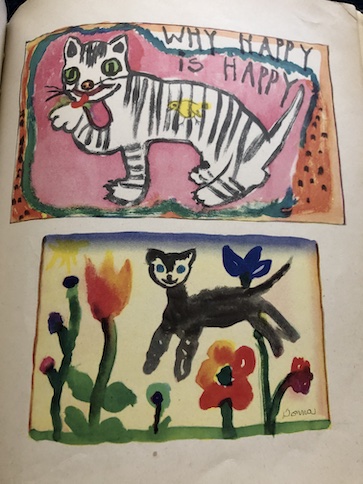
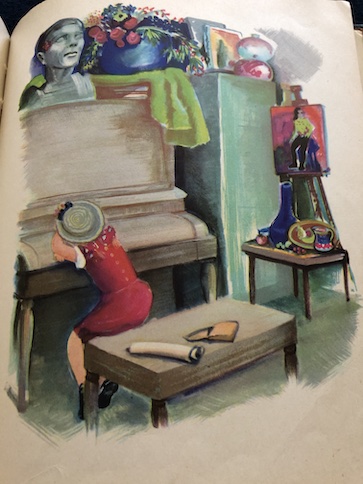
Patty wants to paint a picture of her kitten, Happy, to hang in her room. However, she has trouble creating a painting that truly satisfies her. Her first attempt doesn’t really look like her kitten. Patty is taking an art class at a local museum, and her mother suggests that she take her picture of Happy to her teacher and ask her how to make it better. Through Patty’s efforts to paint a realistic picture of her kitten, she comes to learn more about art.
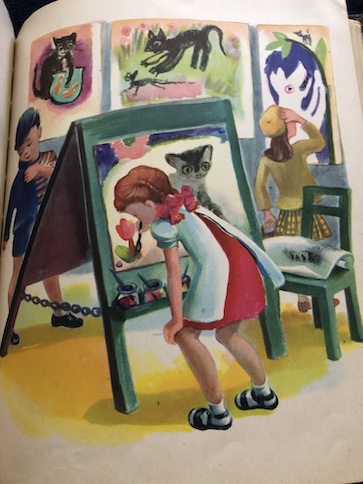
Patty’s teacher suggests that Patty actually bring her kitten to class so that everyone can observe and paint him. When Patty takes her kitten to her art class, the whole class looks at Happy, pointing out parts of the the cat, like his whiskers and his little padded feet with retractable claws. Every part of Happy, including the shape of his eyes and his powerful back legs that are good for jumping, is suited to making him a good hunter because cats often hunt for their food. Studying the form of the cat helps the children understand how to draw him.
The fun part of the book is when Patty studies all of the different ways her friends in class draw the kitten, seeing how everyone looks at the kitten differently and uses different art styles, some drawn better than others because all the artists are children. The children’s pictures in the book look like pictures that would be painted by real children.
The children in the art class paint the cat in different ways and different imagined settings, indoors and outdoors, depending on their interests and how they see the cat and his personality. The boy who drew Happy in a cartoon style, with a bird in his stomach and a caption, wants to be a cartoonist, which is why his style was a good choice for his painting. Patty, on the other hand, wants her painting to be realistic for the way she sees her kitten.
The book explains how Patty learns new art techniques to make her painting look more realistic. She studies the lines that people use in their paintings and compares them to her cat, seeing that curved lines for the cat’s body make him look more realistic. Patty’s teacher points out that one of the mistakes that she’s made in her first efforts is giving Happy a body more the size of an adult cat than a kitten. A kitten’s body looks smaller when compared to the size of the head. To make her picture more realistic, Patty has to learn to draw her kitten’s body parts and features in the right proportions. Patty also notices that the edges of another girl’s cat painting look fuzzy because she’s painting in watercolor and the edges of her painting are wet and running. Patty likes the fuzziness of that painting, so she decides to use that technique on purpose to make more realistic, fuzzy fur. Her teacher shows her how to use that technique with more control by putting a wet blotter under her paper. I like how the book describes Patty’s observations of both her kitten and other people’s pictures and how she uses them to improve her own painting.
At one point in the story, Happy disappears from the art class, and Patty is afraid that she’s lost her kitten forever. Fortunately, she finds Happy hiding in the art room, taking a nap, and he is fine.
In the end, Patty produces a painting that satisfies her because it really looks like her kitten, the way she sees him.
This is one of those vintage children’s books that I would like to see in print again! It’s a nice story, and I really liked the way the book examines the different ways that people look at art and the styles they use. There’s no wrong way to paint something, but the book explains how learning different techniques can help artists to express themselves and their vision the way they want. Patty knows when she’s doing well at her painting when the picture she paints looks more like the vision she has of her kitten.
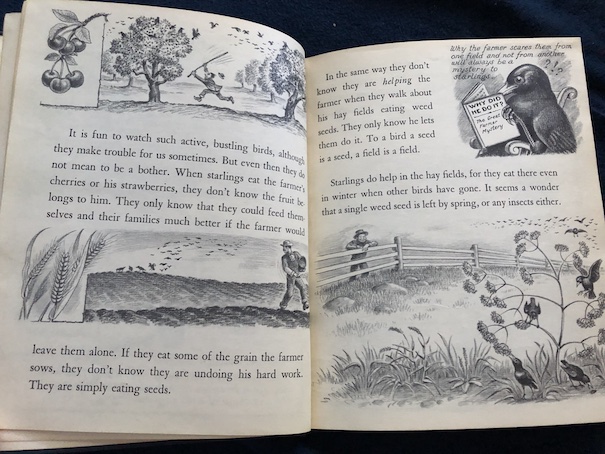
The title of the book tells you what it’s about; this is a children’s picture book about starlings. That sounds pretty straight-forward and even a little dull, but there is more to learn about starlings than I imagined, and the author of this book has an imaginative way of explaining information. I love books that cover odd topics in detail, and I enjoyed the whimsical quality of this book. The pictures are detailed black-and-white drawings, some with captions like comics. Most of them explain the anatomy of the birds or their habits, but they have some unique ways of expressing educational information.
The book begins by describing the singing of starlings and then explains how farmers view starlings. Starlings can be a pest to farmers when they eat their fruit or the seeds the farmers are trying to plant, but they can also be helpful when they eat weed seeds and prevent weeds from coming up in the farmers’ fields. Of course, the birds don’t know when they’re helping or hindering because, as far as they’re concerned, they’re just there to eat any food that happens to be available at the moment. I like the little picture of the bird reading a mystery book, trying to figure out why farmers don’t mind when they eat some seeds and try to scare them away from others. That’s an example of the whimsy I was talking about.
The book continues describing what starlings eat and places where they like to roost, and it explains how they affect people living in cities (mainly, messing up their cars). There were times when people in cities considered them such a nuisance that they would shoot them, and some poor people hunted them for food. Actually, the entire reason why we have starlings in the US is that people over-hunted other types of birds (there is a disturbing picture of hunters with piles of dead birds at one point in the book), and birds are an important part of the ecosystem. Even though they can annoy farmers when they eat seeds and fruit, they also eat bugs that are pests to crops.
I was really struck by the passage that explained how starlings were first brought to the United States and why they were brought here:
“Some people think that starlings have no right to food or nesting-places because they are not ‘American birds.’ Yet all the starlings you see were born in America. So were their parents and grandparents and great-great-grandparents and all their relatives clear back to 1890. In that year their ancestors were caught in Europe and brought in cages to America. So many American birds had been killed at that time by our own ancestors that our crops were growing wormier and wormier each year, while insect pests grew worse and worse. So starlings were imported to help us fight the insects. They were freed in Central Park in New York City and left to look out for themselves.”
This explanation uses simplified language for children, and it also oddly evokes imagery of human beings. We don’t normally refer to animals as “foreigners” because animals don’t speak different human languages or have allegiances to foreign governments like people from other countries do. When we talk about new species that have been introduced to an environment where they did not originally belong and quickly spread out and multiple, we usually call them “invasive species.” In that case, the ecological concern is that the new invasive species will disrupt the balance of the natural environment and crowd out native species, but the author is trying to point out that the situation with the starlings was different. The starlings were introduced to the environment in the US on purpose, not by accident, and it was done specifically because they were meant to a solution to a problem. The environment had already been disrupted by humans who had moved into areas where they had not lived previously and where they killed too many of the native species themselves without regard to what that would do to the natural environment and their own farming. The introduction of the starlings was meant to restore a balance that had been lost. However, the people who had originally caused the problem didn’t see it that way, seeing the starlings as pests because they were “foreign.” While birds in general may occasionally be a nuisance because they don’t understand human priorities, they still perform useful functions for human beings as they go about their lives, just being the birds they are – eating annoying weed seeds and bugs and scavenging food from what humans throw out.
“People who think that starlings should be starvelings because they are ‘foreigners’ should remember that these American-born birds save much of what they themselves throw away and are still helping us to fight insects as they did in 1890.”
I understand what the author is trying to explain about balance in the ecological system, but I was struck by the human imagery that the passage evokes: “Foreigners” who came to New York City, not unlike immigrants fresh off the boat from Ellis Island during the 19th century, set free to make their way in a strange environment among people who often regarded them as worthless pests, disliking them while still using the useful services they provided. The comparison still fascinates me. At first, I wasn’t sure that the author meant to make that broader comparison here. I thought he probably used that language just to simply the ecological concepts for children’s understanding, but the author does make another comparison a little further on:
“So let’s be fair. If American-born starlings are foreigners, then so are all people in America except the Indians (Native Americans). So are many kinds of birds, animals, and plants. Our ancestors brought them here from other countries. But if all these creatures, and ourselves, are American now, then so are the starlings. Yes indeed!”
So get off your high horse, starling-haters.
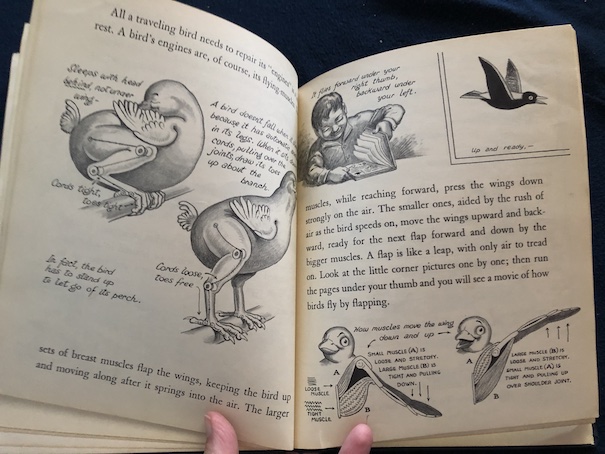
At several points in the book, the author compares birds to airplanes, explaining their muscles and flying mechanisms like machinery. I liked the page where the author compares different planes and helicopters to types of birds (cruisers being like gliding eagles and albatrosses, fast-turning speed planes like starlings and swallows, and hovering helicopters like humming birds). The parts that describe how birds cling to branches as they sleep and how their wings move look accurate and helpful. The part about how a bird creates eggs is hilarious. The text about the formation of the egg inside the bird isn’t bad. It completely skips over the subject of the fertilization of eggs (understandably), and the picture show the bird as a kind of egg-making factory with little men assembling the parts of the egg in stages instead of showing a bird’s reproductive anatomy.
In the upper right corners of this section of the book, there are little squares with a flying bird because part of the book is meant to be uses as a flip book to see a bird flying. The page shown above with the boy flipping through the book shows how to use the flip book portion.
There is a section of the book that explains how baby birds develop in the egg and eventually hatch.
There is also a section in the book that shows how adult starlings will prepare a nest for their eggs and how they raise their babies.
As I was reading the book, I wondered who the author, Wilfred S. Bronson, was. Bronson was an artist specializing in natural history, and he wrote and illustrated other books for children about animals and natural history. In the years before he wrote this particular book, he served in the US Army during World War I and painted murals for the Works Progress Administration (WPA) during the Great Depression. He also participated in expeditions to gather specimens and create illustrations of wildlife for botanical gardens and museums.
I haven’t found a copy of this particular book to read online, but it was republished in 2008 and is still available from Amazon.
This is a reprint of an earlier book, and it’s interesting because this was part of an educational science series. The author was from the University of Chicago, and the accuracy was verified by Walter H. Chute, the Director of the John G. Shedd Aquarium at the time.
As a child, I was never particularly interested in fish. My mother had a fish tank with pet fish, but I lived pretty far from large bodies of water and never went fishing. For years, this book, probably purchased at one of the many used book sales my family attended over the years, went unread. However, as an adult, I like reading children’s books about very specific topics because they often include some fun and usual facts.
The book begins by explaining to child readers how goldfish are similar to and different from human beings. It seems pretty straight forward, but they point out some thoughtful similarities and differences. Both fish and humans need to breathe, but they do it in different ways, which is why humans drown in water and fish effectively drown in air. The book also points out that goldfish cannot move their heads independently of their bodies in the way that humans do.
In the section called “The Story of the Goldfish”, the book explains how wild goldfish were first kept as pets in China and Japan. Wild goldfish actually have a variety of colors, but hundreds of years ago in China, people liked the yellow or gold ones best as pets, and they began deliberately breeding fish with these colors, which is how they came to be known as “goldfish.”
The book defines “fish” as creatures with gills, fins, and backbones but no arms or legs. It uses this definition to separate fish from other aquatic creatures like whales (no gills, actually a mammal with lungs), jellyfish (no fins, gills, or backbone), crabs (gills but no fins, arms and an exoskeleton instead of a backbone), and starfish. It also explains the difference between fish that live in salt water vs. fish that live in fresh water.
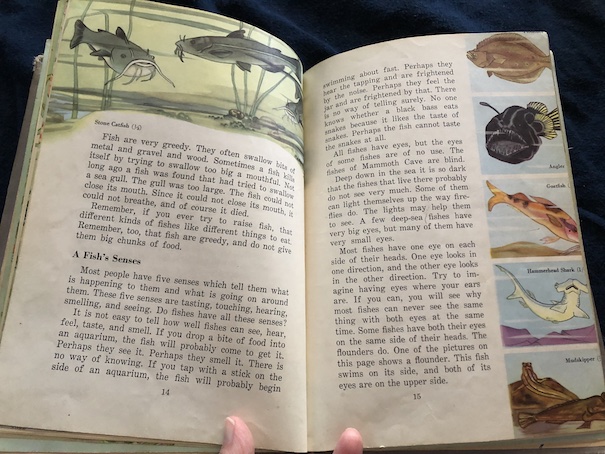
The book explains what different types of fishes eat, how they’re born (most hatch from eggs), how they defend themselves, and how they migrate. In one section, the book explains how fish have some or all of the five senses that humans have (sight, hearing, smelling, taste, and touch), but they have them to different degrees and use them in different ways.
The book presents information about some specific types of fish, and it even mentions that some types of fish are endangered species. I usually associate environmental messages with the late 20th century, but this book discussed the over-fishing of sturgeon and the ecological dangers of erosion caused by deforestation on river banks and factory waste dumped in water in the mid-20th century.
The book ends with a list of tips for observing fish.
The book presents a pretty comprehensive beginner’s guide to fish in general, and I really appreciated the mentions of environmental issues. My one criticism is that the book could use more pictures and especially bigger pictures. All of the pictures are in full color, but most of them are rather small, just in the corners or edges of the pages, which are mostly full of text. I just think that larger pictures would be more appealing and more child-friendly. There are even places where the edges of the pictures and their captions are cut off by the edges of the book (as shown in two of the pictures of pages above), which looks clumsy and annoying. The book seems pretty authoritative, but I think it could have been presented better. I’m not sure how people who originally read this book looked at it, but I didn’t like the size and positioning of the illustrations.
I couldn’t find an online edition of this vintage nonfiction children’s book, but I did find online editions of other nonfiction books for children by the same author through Internet Archive.
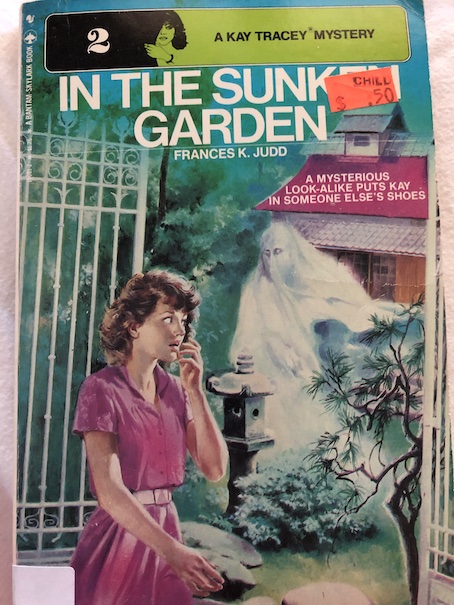
In the Sunken Garden by Frances K. Judd (Stratemeyer Syndicate), 1952 (revised from 1941 edition), 1980.
Kay Tracey discovers that she has a doppelganger when she’s running some errands for her mother and some people in town act like they know her even though she’s never seen them before. As she heads home, a dog even follows her car, as if it thinks that she’s his owner. Kay is bewildered by this, but she decides to take the dog home with her until she can figure out who really owns him.
This is just the beginning of Kay’s entanglement with her mysterious double. Ronald Earle, the boy who likes Kay, gets angry because he thinks that he’s seen her out riding with someone else in his car after turning down a ride with him to attend her mother’s luncheon party. Kay straightens Ronald out only to be confronted with her cousin, Bill, who returns home, very upset because he has heard that Kay was in a car accident and is now in the hospital. Bill is relieved to see Kay perfectly fine at home, but that still doesn’t clear up the question of who this mysterious double is.
According to the hospital, the girl who was in the car accident told them she was Jane Barton, but she checked herself out of the hospital because she only had minor injuries. That isn’t the end of the matter, though. A man named Joe Craken shows up and accuses Kay of wrecking his car in the car accident. He says that the police identified her as the driver of the other car in the accident based on her physical description. With Joe Craken attempting to sue her for damages and the injuries done to a passenger in his car, Kay needs to find her mysterious double!
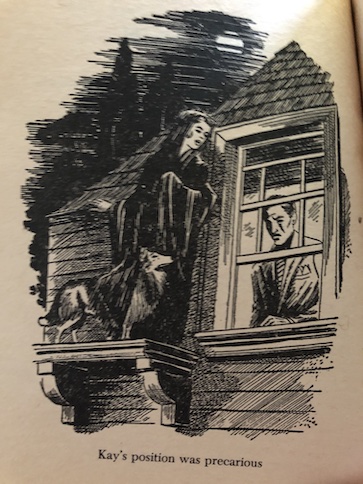
This mysterious double seems to have some connection to the old Huntley place, a mansion outside of town. The Huntleys were distant relatives of Ronald’s, and Kay learns about the family scandal from someone who used to work for the family. Years ago, Mrs. Huntley’s sister, Trixie Rue, was a dancer with a promising career, but she gave it all up to get married. Unfortunately, the marriage didn’t really work out, and she and her husband fell on hard times. Mrs. Huntley gave her sister some money to help her get by, but apparently, it wasn’t enough because the sister resorted to stealing to help support herself and her baby daughter and ended up having to leave town in disgrace. Does this local scandal have any bearing on the sudden appearance of Kay’s double? One night, while having a look at the old Huntley mansion, Kay sees a ghostly white figure dancing in the garden. Was it her mysterious look-alike or someone else? Before the mystery is over, Kay’s look-alike will need her help as much as Kay needs hers.
The book is available to borrow and read for free online through Internet Archive.
My Reaction
The various parts of this mystery fit together much better than the first Kay Tracey book I read. The first book I read in this series seemed rather awkward, but there is a more cohesive thread in this story. The mysterious double, the Huntley family scandal, and the ghostly dancing figure in the garden all fit together in a way that makes sense. However, there are two sets of villains in this story, and although Kay was not involved in the car accident, it turns out that, rather than her double trying to fob off responsibility on Kay, it’s actually the driver of the other car who was responsible for the accident and had always planned on trying to blame Kay for the accident to extort money from her. It was just his bad luck that he crashed his car into the car Jane was driving instead of Kay’s. This story also has a side plot involving a benefit show that Kay and her friends are putting on with others who are also taking dance lessons, and there’s more rivalry with Chris Eaton, the nasty snob they know from school.
I still find that the Kay Tracey books aren’t particularly good on readability, though. The language is a little old-fashioned, and at times, the plot seems to drag. I think this is one of the better books, plot-wise. The story felt more cohesive than the previous one and mystery stories with mysterious doubles, long-lost relatives, spooky mansions, and inheritance are pretty classic and compelling. However, I did get a little bored while reading it because I just didn’t find the writing style to be very engaging.
The Double Disguise by Frances K. Judd (Stratemeyer Syndicate), 1952 (revised from 1941 edition), 1980.
Kay and her friends, Betty and Wendy, stop to help a woman who was knocked down at the train station. As they help the woman up, a man who claims to be the woman’s son picks up the woman’s suitcase and takes her purse away from Kay. However, the man is not the woman’s son and runs away with her things while Kay and the other girls focus on the woman. The woman, Alice Janey, is very distressed when she finds out that she’s been robbed, and Kay invites her to come stay at her house with her mother and cousin, who is a lawyer, while the police try to find her missing belongings.
The invitation to stay at the Tracey house turns out to be fortuitous because Alice Janey is actually an old friend of Kay’s mother, Kathryn. Kathryn Tracey tells Miss Janey that she’s sure Kay and her friends can help her because they’ve solved mysteries before. (Even though my copy of the book numbers this as the first book in the series, when the series was published for the first time, it was much further along in the series. The order of the books was changed in different reprintings, so the girls have had other adventures before this.) Miss Janey used to live in their town, Brantwood, and she has now returned in order to finish some work that her late father was doing. Her father’s old papers were in the suitcase that was stolen. Miss Janey thinks that the person who stole her suitcase was after those papers.
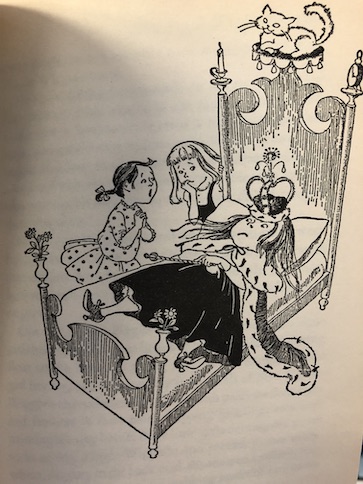
The next day, Kay takes Miss Janey to the house that she’s purchased on the edge of town, but the house is somewhat lonely and isolated. Miss Janey is a bit nervous about being there alone, so she asks Kay if she’s willing to stay with her until she can get a housekeeper. During the night, Kay wakes up because she hears voices, and she discovers Miss Janey talking to a woman who looks like a witch and seems to be some kind of medium or fortune-teller, telling her where to find her missing suitcase and purse. The next day, Miss Janey claims that she a dream about where to look for the purse and suitcase, not saying anything about the witch woman. Kay knows that Miss Janey is hiding something, but she’s not sure why.
When Miss Janey goes to the empty old house that the witch woman described as the place where she would find her bags, Kay and her friends follow her. The bags are there, but they’re empty. Miss Janey disappears, apparently taken away by a couple of men, and she later turns up at her own house.
As Kay befriends Miss Janey, Miss Janey opens up to her and explains a few things. She admits to Kay that she’s been consulting with the fortune teller, Nanna, for some time. Although Kay is suspicious of Nanna, Miss Janey trusts her. Miss Janey also explains that she used to help her late father in his chemical research and that she now has a laboratory set up in her house. Specifically, she’s trying to finish a formula that her father started working on for a substance that is like glass but which has more uses. She was carrying the formula in her bags when they were stolen, and that’s what the thief must have wanted. This technological development would be very valuable, at least when it’s finished, and the thieves might not have realized that the formula was incomplete.
The situation becomes more complicated when Kay discovers that the men who removed Miss Janey from the old house before are detectives who are investigating her because they suspect her of participating in a fraud that has robbed widows of their money. Kay knows that Miss Janey would never take part in such a thing, but this fraud has a connection to the theft of Miss Janey’s formula.
My Reaction
I found this book rather meandering and disjointed. It started off with a pretty strong premise – a lady has her bags stolen at a train station, and it turns out that she’s carrying an unfinished chemical formula that may be worth a lot of money once it’s finished. The fact that the formula is incomplete adds a complication to the story. Are the people who stole the formula capable of completing it on their own or will they have to trick or force the original owner to finish it for them?
Then, the plot is further complicated by a mysterious fortune teller who turns out to own the house where she told the lady her bags would be found. Is she in the plot to steal the formula? There’s a pretty case for it because it would explain how she seems to know things that she shouldn’t know otherwise, and also it turns out that the thieves have actually been renting her house and using it as a base for their plots without her knowledge, so that plot angle doesn’t really go anywhere in the end.
But, then, the plot is further complicated by a couple of detectives who suspect Miss Janey of being part of a fraud to steal money from widows. A widow’s son is briefly arrested breaking and entering because he entered the mysterious old house for his mother’s money, while various other people have entered and left that same old house with no complaints from anyone. Kay and her friend Ronald see a couple of men at the house who dress as women, and realizing that they must be part of the fraud, try to turn them over to the police only for them to drag Kay with them as a hostage when they go rob a train like bandits from a old western movie, resulting in her being temporarily accused of being their accomplice. Then, a vial marked “POISON” (not any specific poison, mind you, just “POISON” – why a chemist would have something with such a vague label is beyond me) is stolen from Miss Janey’s laboratory and ends up in the hands of the widow’s son. However, they don’t really explain why he had it or what he meant to do with it, he doesn’t use it on anybody, and he tells Kay that the fortune teller make him hand it over to her before Kay even reaches him, so that plot point doesn’t go anywhere, either. All the while, the school mean girl and Kay’s nemesis, Chris Eaton, competes with her to solve the mystery in a vague sort of way and spreads various wild rumors about her at various times that don’t really do anything and also don’t really go anywhere but provide temporary distractions from the plot.
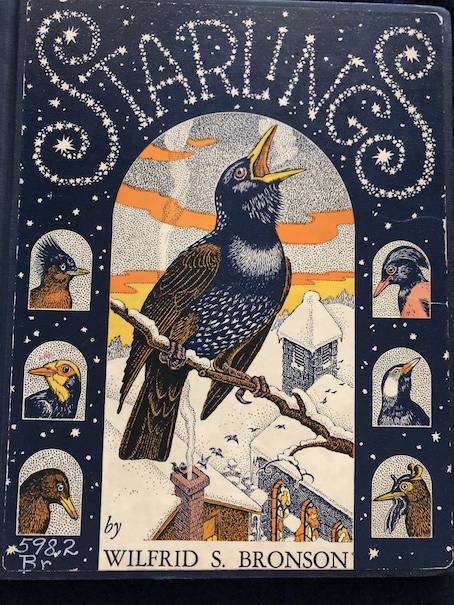
Why would people who steal chemical formulas and have the connections to sell them also perpetrate financial frauds targeting widows and also rob trains? This criminal group is quite diversified. The book also has the criminals speaking a foreign language at times because, with such diversified skills, why wouldn’t they also be from some exotic foreign country? It never even leads anywhere. At first, I thought that they were setting it up for the thieves to also be spies, but that is also never explained and doesn’t go anywhere. The “double disguise” part of the story is that the two thieves are men who also periodically disguise themselves as women, but Kay actually sees them putting on their disguises at one point, so that isn’t a plot twist for very long.
The scene with the sleigh crash happens toward the end of the book, and they get one of the thieves from the wreckage. Kay locates the thieves’ apartment and finds the items they stole there, but she doesn’t get the other thief herself. The other thief gets away from her, and a detective just tells her that they caught him at the hospital, visiting his partner in crime. The end. It ends happily, but it was a confusing ride with a lot of points that didn’t really go anywhere along the way.