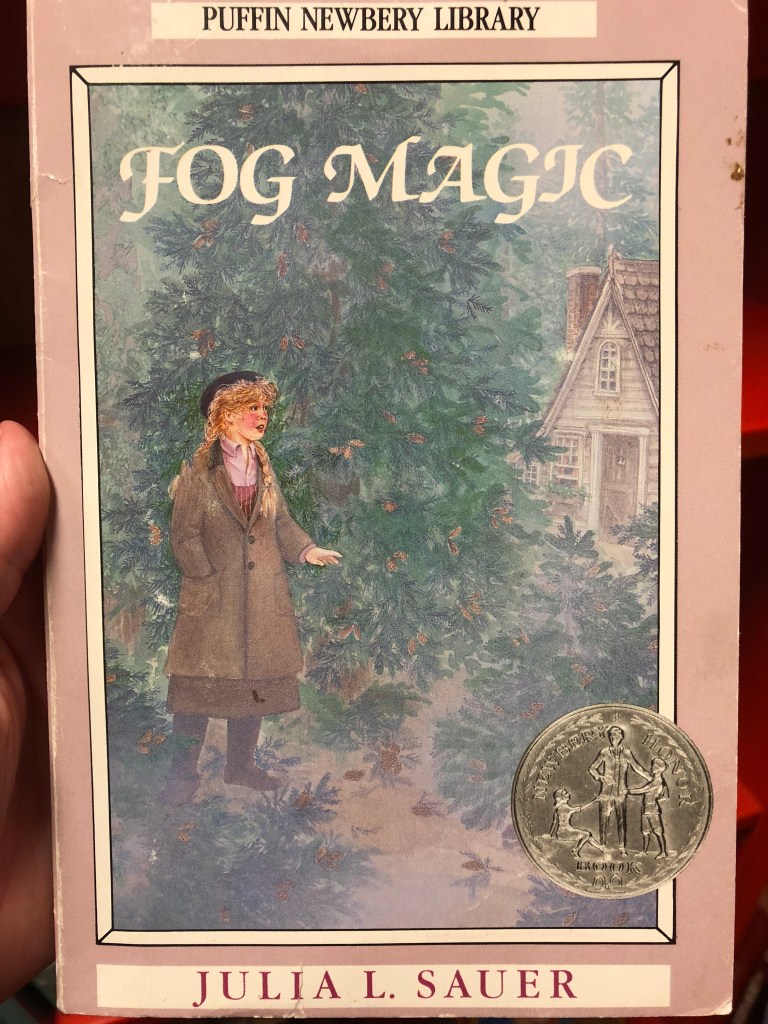
So Dear to My Heart

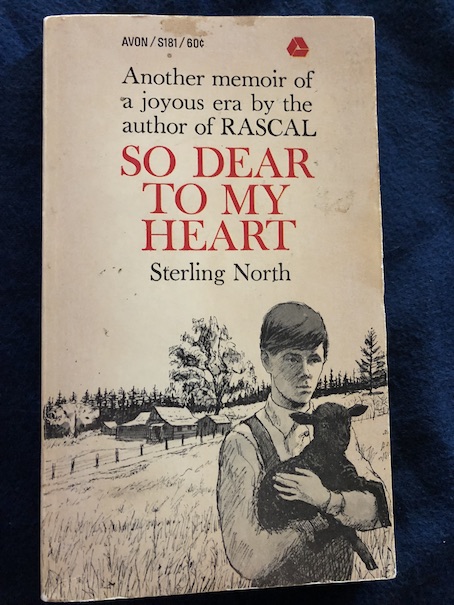
So Dear to My Heart by Sterling North, 1947.

The original form of this story was actually from 1943, when the book was called Midnight and Jeremiah. In that book, the black lamb was named Midnight, not Danny, and many of the subplots that came to dominate this edition of the book didn’t exist. This edition of the book was rewritten and published after the Disney movie of of the story, which is why it was given the same name. The Disney movie was half live-action and half animated, and it made some changes to the story that were reflected in this rewrite/reprint. Naming the lamb “Danny” after the race horse Dan Patch was Disney’s idea. I actually think that I would have liked the original book better because I didn’t like the way some of the characters were portrayed in this book.

I have to admit that I was really frustrated with one of the characters in the story, and because of that, I found it difficult to wade through the parts dealing with her. However, it is important to actually finish this story once you begin because, otherwise, you won’t get the full picture of the story. It’s not that the ending is particularly surprising, and I can’t say that I ever really became fond of the character I didn’t like, but the more you pay attention to how the story gets to the ending, the more you realize what the one of the points of this story really is. This story is about the love between a boy and an animal. It has Christian themes and themes about hatred, prejudice, and loss. However, what struck me the most in the end is that this is also a story about knowledge and perspective. Knowledge and being open to knowledge can change a person’s perspective, but also having a different perspective in the first place can give a person knowledge or leave them more open to gaining it.

I’ll warn you that this is going to be a rather long review, and parts are going to seem a little repetitive because the way my review is organized is based somewhat on the way this book was organized, giving bits and piece of information about the same underlying situation accompanied by reactions to it. At the end, I’ve also included some odd historical information that relates to things mentioned in the story.

Jeremiah Kincaid, called Jerry, lives with his grandmother on the Kincaid family farm in Cat Hallow outside of the small town of Fulton Corners, Indiana in 1903. His parents are dead, having died in a fire when he was young. The full circumstances behind their deaths are not explained until the end of the book, and there are a few things in the book about their deaths and some current happenings that seem a bit mysterious. This book is not really a mystery story, but in way, parts of it play out a little like a mystery because there are missing pieces of information that need to be filled in before you really understand what’s going on. Knowing exactly what happened to Jerry’s parents and why eventually helps Jerry and his grandmother to resolve some of their feelings about their deaths and their relationship with each other. For most of the book, Granny Kincaid thinks she knows what happened, but it doesn’t take long for readers to realize that she’s unreliable as a narrator. Jerry’s Granny Kincaid is a very strict and strongly religious woman, and she is the character I did not like, who almost discouraged me from finishing the book. It wasn’t being strict and religious that made me not like her. I wouldn’t have minded that so much by itself; it’s the rest of the story of what she is that got to me. In a way, that feeling of not wanting to look further also plays into the story and the desire of whether or not you want to know more about what is behind a bad situation. In an odd way, Granny actually did remind me of something, but I’d like to save what she reminded me of until near the end because it will make more sense then.

When the book begins, Jerry is angry with Granny for selling his beloved bull calf to a butcher. Jerry loved the calf because he had raised it himself, but to Granny, it was just part of the routine of farm work. To Granny, animals are meant for food unless they are specifically work animals. Jerry feels more of a personal connection to the animals, which is also important to the story. Jeremiah longs for an animal that he can actually keep and love. This is what guides Jerry throughout the story.

Jerry gets his chance of an animal to love when the new lambs are born and one of them is a black lamb, rejected by its mother. Granny would be content to let the little black lamb die, thinking of it as an evil omen. Her casual cruelty and callous attitude when Jerry points out that it’s just an innocent lamb who couldn’t help being born black and is scared and hungry and will surely die without care were, frankly, pretty disgusting from my perspective. Granny is very religious but without compassion or empathy. For her, animals are to be used, and whatever or whoever is meant to die isn’t something she’s going to bother herself about. Not only that, but part of her callous, unfeeling nature is based on bitterness toward events in her own past, which are clarified through the story. There is/was a bitter history between the Kincaids and the Tarletons, who owned the next farm over, and Granny knows that the little lamb was sired by the Tarletons’ old black ram. Even though I didn’t like Granny, I kept reading because the most compelling part of the book is learning the full history of the Tarletons and the Kincaids, which comes out bit by bit as the book goes on. The way that this knowledge of the family’s history is given to the readers, piece by piece, is important. Each time that Jerry learns a little more about his family’s history, the story changes a little, giving not only Jerry, but the readers, a slightly different impression of what happened and why.

To help explain it, I’ll give you a kind of summary of what Jerry learns in the first chapters of the book. In her youth, Granny Samantha Kincaid married David Kincaid, Jerry’s grandfather, who is now deceased. David’s rival for her affection was Josiah Tarleton. Before Samantha and David were married, the two men had a terrible fight over her which had left David the victor but permanently injured. Following the marriage of the Kincaids, Josiah settled on a farm near theirs. Over the years, the Kincaids experienced hardships of various kinds, while Josiah became a wealthier man and flaunted that wealth at the Kincaids to show Samantha what she had missed by not marrying him. Even after Josiah married a woman named Lilith, things were still bitter between the two families. Samantha became convinced that Lilith was a witch who cursed their sheep with illness, although David said that was only superstition. Although Lilith is now dead (as are Josiah and David), Samantha is still afraid of anything associated with the Tarletons, thinking of it as evil. That is Granny Samantha’s frame of mind, as it has been for years, and that is the basic reason why she regards the black lamb as evil, because of its association with the Tarletons. As far as the beginnings of the bitter Kincaid/Tarleton feud goes, it’s an accurate description of the situation. From this basic description, it sounds like the Tarletons were mean, greedy, and vindictive, lording their better fortune over the Kincaids and maybe even doing things to make life harder on them. However, that is not the entire story. That description barely scratches the surface of the real situation.

Granny is a callous person with some vindictiveness of her own. Jerry himself has been on the receiving end of Granny’s callousness, and the story mentions that his birth was “unwanted,” like the lamb’s, something that he senses from his grandmother (a major reason why I didn’t like her). Part of the reason why Jerry craves love in his life and shows it to the animals is because he doesn’t get it from family, what’s left of it. Jerry insists on taking care of the little unwanted lamb, naming him Danny. He persuades his grandmother that the lamb will give good wool. As the lamb grows and gets into trouble, Granny says that it’s proof that she was right to think of the lamb as evil. However, Jerry defends the lamb, saying that Danny is just an animal that doesn’t know what it’s doing and forbidding his grandmother to turn Danny into food, a sentiment echoed by Uncle Hiram.

“Uncle” Hiram Douglas is the local blacksmith, a family friend, not related by blood to anyone else in the story, although he acts as a father to Jerry, having no children of his own. Uncle Hiram knew both the Kincaid and Tarleton families for years, observing their feud from a different, more distant perspective, and his account of what happened is more reliable than Granny’s. He was careful not to involve himself directly in the families’ troubles because their situation was toxic, and he knew it. Early in the story, Uncle Hiram sees the parallels between Jerry and his lamb, both of which have been deprived of love and proper care through no fault of their own. He tells Jerry that both of them are from good stock and not to pay attention to the superstitious nonsense that Granny tells him. It is Uncle Hiram who suggests to Jerry that he should take Danny to the County Fair when he’s bigger and show him off because Danny has the potential to be a champion. Jerry seizes on the idea, and it gives him hope. For much of the story, saving his lamb from Granny and taking Danny to the fair are his main goals.

It is Uncle Hiram who tells Jerry more about his grandmother’s long-standing feud with Lilith Tarleton and how she blamed Lilith for an unexpected flood that almost drowned his grandfather and killed some of their sheep (one of many unrelated things that Samantha blamed on Lilith). Samantha had been so sure that Lilith was a witch and caused the disaster with a curse that she actually hid in a place where she knew Lilith would go and waited for her to come along so that she could throw rocks at her, stoning her as a “witch”, and this incident is generally known in the community. Josiah Tarleton may not have been a nice person, but for all of her Bible-quoting, Granny Samantha has a fierce temper and an unpredictable nature. The picture of what happened between the Tarletons and the Kincaids changes a bit with the added information of Samantha’s sneak attack on Lilith.

The book continues like that, shifting back and forth between things happening in the present and Hiram’s explanations of the past. As the descriptions of the past become more detailed, Granny’s views are increasingly shown to be wrong, and her behavior more erratic and hateful. I did not find Granny a likeable or sympathetic character, to say the least. She struck me immediately as callous and unhinged, and that image stayed with me throughout the story. She is unfair and has double standards for how she views the world and human behavior. When misfortune happens to someone else, like an innocent black lamb (as well as other people, as described later in the story), Granny says it’s just the will of God and she doesn’t care, but if misfortune happens to her, it’s evil black magic and she’ll stone the first person she doesn’t like as the one responsible for it. This is how her mind works. When Jerry interacts with the people of the nearby town, readers discover that Granny is hardly seen as a pillar of the community. In fact, she hardly interacts with the community at all. Even the men down at the general store joke about Granny Kincaid being a witch herself. Jerry hears them joking, and it leads him to talk to Hiram more about his family.

When Uncle Hiram explains about the jokes the men make that both of Jerry’s grannies were possibly witches, more of the conflict between the Kincaids and the Tarletons is revealed. Samantha Kincaid doesn’t like to talk about Jerry’s father, who is her dead son, or his wife and is often deliberately callous with Jerry because Jerry’s mother was actually Arabella Tarleton, Lilith’s daughter. Up until this point in the story, Jerry was completely unaware of this or the fact that Lilith was his grandmother, too. Now, Jerry knows that Samantha’s son, Seth, married Arabella, and both of them died in a fire, something which Samantha blames on Arabella. With this information, the story shifts again, looking a little like a Romeo and Juliet type of situation.

Uncle Hiram doesn’t believe in witches at all, and he explains the truth about his grandmothers to Jerry. He says that, whatever Granny Kincaid says, Lilith was never an evil person, and he doesn’t really think that Granny Kincaid is, either. I’m still a little less charitable toward Granny here. Granny’s behavior and attitudes show a definite sadistic streak. I’m not talking about the way she sees animals mainly as food because that’s just a natural side of farming. Samantha is a vindictive person, with an inability to put blame where blame is due, choosing instead to take it out on an innocent victim, possibly because the innocent victim is more vulnerable to attack or because she can’t handle the thought of what or who is really at fault for a situation. In her attacks, she frequently resorts to physical violence, even inflicting harsh physical punishment on Jerry and also some twisted psychology, when you consider some of the things that Granny says to him.

As even more of the history of these two families comes out, you learn that there are pieces of the story that Samantha is deliberately ignoring or distorting in her accounts of what happened. First, Samantha blamed Lilith for Josiah’s jealous vindictiveness, rubbing his successes and the Kincaids’ hardships in her face because she refused his “love.” At least, he did this up until he also suffered hardships and lost much of his money later in life. This is another part of the story that is revealed later. At first, the characters make it sound like Josiah was more prosperous overall and had less hardship than the Kincaids, but it was more the case that his hardships came a little later in life, something that changes his story a bit. The reality of the situation is probably that the families were more equal in terms of their wealth and luck than earlier described. Their farms are literally right next to each other, outside of a small town where nobody is truly rich. Also, one of the misfortunes Josiah suffered was the early death of his wife. It turns out that Lilith died much earlier in life than any of the older generation of adult characters, not even living to see her own children grow up. Samantha and Lilith actually knew each other for far less time than it would sound from the way Granny talks. After Lilith’s death, Josiah seemed to kind of give up on life and generally let his children run wild because he didn’t quite know how to deal with them. In spite of Lilith’s death, Samantha continued to blame Lilith for everything that went wrong in her family’s lives. None of it was Lilith’s fault, but Samantha decided it was because she could not or would not see Josiah, or even members of her own family, for what they really were and Lilith for what she was. Lilith was a gentle soul who died relatively young, but she remained the evil witch and lurking spirit that haunted Samantha’s own troubled mind.

So, what was Lilith really like, and how do I know that she was a gentler person? Uncle Hiram explains that, unlike Granny, Lilith actually loved animals, just like Jerry does. Her father in Kentucky knew the famous Audubon who studied birds, and Lilith was also something of an amateur naturalist. People in Indiana distrusted her because she was more educated than most, and they thought it was weird that she knew all the “fancy names” for different birds and plants. Hiram understands the names that Lilith was using because he actually interacted with Lilith as a friend, and hearing her explanations broadened his experiences. The people who just thought Lilith was strange and “witchy” never figured it out. If I had to live with people like that, I’d probably be more trusting of animals than my fellow human beings, too. Hiram suspects that Josiah may have harbored feelings for Samantha even after his marriage to Lilith (the fuel for his vindictiveness, wanting to see his former love suffer for rejecting him) and that Lilith indulged her love of nature as an escape from her husband’s uncomfortable preoccupation with a woman who never returned his affections (and who lived on the next farm over and liked to call her a witch and throw stones at her like a crazy person for things she never did and possibly knew nothing about before the sneak attack – no, I just can’t let that slide – going out into nature to escape from her husband and study the plants and animals was what Lilith was doing when Samantha violently attacked her), leading to Lilith’s reputation for being a bit strange and possibly a witch.

This picture of Lilith is vastly different from the picture that Granny had given Jerry and even what other townspeople say about her, and it is much more truthful. (There is also more evidence that supports it later in the story.) Lilith was a spirited and loving young woman who defied her father to marry Josiah. She was loyal to him in spite of his obsession with Samantha, and she ran a tidy household, educating her children herself as best she could and teaching her daughter to play the violin. This was the person Granny considers to be evil, even beyond the grave, in contrast to herself.

At one of the points in the story where they discuss Seth and Arabella’s wedding, Granny says that deceased Lilith’s spirit was angry because Josiah, who was still alive at the time, kissed her hand at the wedding. Josiah was a drunkard who had taken a liberty, by Granny’s description, but poor dead Lilith was still the bad one. (Another thing we learn along the way was that Josiah’s mind deteriorated in his final years, an apparent combination of drinking and stress from the early loss of his wife and other hardships his family suffered. This comes from Hiram, not Granny, whose own mind I found suspect from the first.) Possibly, Granny could not bring herself to fully label Josiah has the bad one because he always liked her. Granny is actually somewhat vain and self-centered, and although she was not in love with Josiah and would never return Josiah’s feelings, I get the impression that she was flattered by them. That two men fought over her, even though she had a clear preference for one of them, and that one of them continued to follow her and dwell on her made her feel good, if a bit awkward that Josiah was the more prosperous of the two for a time as well as somewhat vindictive. Lilith, as Josiah’s wife, took at least some of Josiah’s attention away from Samantha when she entered the picture, and I suspect this was probably the basis for her becoming the bad one in Samantha’s mind, for representing a competitor for Josiah’s feelings, even though Samantha was married to the man of her choice and wouldn’t have wanted Josiah anyway. Sometimes, even people who do not want something in particular for themselves still feeling strangely resentful when someone else gets it, especially if the other person seems to benefit from it. Early on in their marriages, Lilith seemed to have gotten the better deal by marrying the richer man … until more of the story is told, and you find out that wasn’t quite the case. It didn’t take that long for things to turn rough for the Tarletons, and Lilith’s life didn’t have a very happy ending.

Uncle Hiram says that he has tried to explain all of this to Granny for the last 30 years, but “She don’t listen, or she don’t understand, or she don’t want to know-cain’t quite figger it out.” (This is one of those books where the author uses misspellings to convey accent.) My theory is what I said before, that Granny blames the wrong person for the source of problems and that blame is based solely on personal dislike. Lilith got the man Granny could have had, even if he was a self-centered jerk who Granny didn’t really love, and a more comfortable, prosperous life (at least, for a time, in a way, on the surface), while Granny’s husband was injured by Josiah and constantly struggled to make a living in the face of repeated misfortunes that were mostly random chance. The longer Granny harbored that irrational hate, nursed it, and indulged it, the more difficult it was to let go of it, not only because it had become habit but because of what it would mean to her personally to admit that she had done something horribly wrong. If Lilith was really her opposite in everything, and it turned out that Lilith was a really good person and a good mother, educated and nature-loving, what would that make Samantha? It would mean that she was not “on the side of the angels” and righteousness, that she was the one causing harm to the innocent rather than being the poor, injured party herself. (I still remember that Samantha is the one who hides in bushes and throws rocks at unsuspecting people, not Lilith. Once you know certain things, you can’t un-know them.) It would be a difficult thing for her to take, the realization that she might be more witch than the supposed witch and hardly an angel. As I said, people in the community have noticed it, too. Lilith may have seemed “witchy” to them because, as Hiram said, she was a little different and they didn’t really understand her, but Granny is witchy for much more obvious reasons.

At one point, Hiram tells Granny directly that she’s being unfair to Jerry and not raising him with the love he really needs, and she angrily tells him that she has to be this tough to keep Jerry from going the way of his parents, whose souls she considers sinful. During the course of the story, she actually tells Jerry that his parents are not in heaven, making up a song about them and how their marriage lead to hell. This is a terrible thing to tell a child and a twisted upbringing to give an orphan! Hiram tells Granny that, while she’s had to struggle and work hard all her life, she’s not the only one who works hard, suffers hardship, and is a good person and that the way that she’s behaving is unfair, but she only responds by both complaining and bragging at the same time about how hard she works and how often she prays and how much she’s done for Jerry, as if that entitles her to behave the way she does. Samantha is stuck on herself but can’t see it because she phrases her vanity in terms of her hard work and personal suffering, which she considers virtues, ignoring the bad behavior she has indulged in and the suffering she herself has caused. The book calls it her “proud bitterness.” (Insert wordless scream of frustration here.)

Because Jerry is Lilith’s grandson as well as hers, Granny Samantha sees evil in him, like she does in the lamb, and Jerry senses that she does not really love him. That is the strongest reason why I dislike Samantha as a character, plus her vindictiveness toward the innocent and helpless and inability to establish limits on how she indulges her vindictiveness. Although I think the author meant us to see her more as sad and warped by sadness than bad, I didn’t really see her that way myself. To me, she was irrational and possibly dangerous, given her history of physical attack, not “purely on the side of the angels” as Uncle Hiram characterizes. Seriously, hiding in the bushes to throw stones at a “witch” is not a healthy coping mechanism. The guys down at the general store know this and that is why they make witch jokes, but Granny doesn’t seem to have grasped how this looks even to people in her own town. Living alone with her grandson on their isolated farm has kept her steeping in her own bitterness and out of touch with reality. Only Uncle Hiram’s influence has allowed Jerry to get in touch with the truth of his family’s past and situation, and this is a central part of the plot.

I’m down on Granny Kincaid a lot, as you can tell by my repeated rants against her, but part of what makes characters like this so frustrating is that they are so obvious as plot devices. If Granny were a kinder, more reasonable person, this book would both be much less frustrating and much shorter. She is deliberately uncaring and unreasoning because she has to be in order to complicate the plot. She is one of the obstacles that Jerry must overcome. There’s no use arguing with Granny because she will and must remain resistant to persuasion, providing necessary plot tension, until the point in the story where the other characters either find a way to get around her or she has a change of heart and redeems herself. Given that Granny is Jerry’s grandmother and that this story has religious themes, I guessed that we would be going the redemption route eventually. However, I also knew that, with about 200 pages in the book, I’d probably have had more than enough of Granny by that point, which made me wonder if it would be worth it. I wouldn’t say that the redemption was worth it for Granny’s sake because I still didn’t really like her at the end, but by the time I got through all of the information that I’ve provided so far about the Kincaid and Tarleton families, I began to notice how the story about the families shifts slightly with each new piece of information about them, as seen from Hiram’s more neutral perspective. There is a larger point to be made here as the story continues, and Jerry learns more about the circumstances of his parents’ deaths, clearing up some additional plot holes that have been left hanging.

What’s left to tell? Notice that, while I told you that Jerry’s parents died in a fire, the Kincaid farm is obviously still standing and so is the Tarleton farm. They have not burned to the ground. So, where was this fire that killed Jerry’s parents? Also, if Josiah, Lilith, and Arabella Tarleton are all dead, who is running the Tarleton farm? Remember, Danny the lamb was sired by the Tarletons’ old black ram. Who owns that ram? Keep these points in mind for a moment.

Getting back to Jerry’s goal of taking Danny to the fair to win a prize, Granny is naturally resistant to the idea of going to the fair at all, but Hiram starts to win her over by suggesting that she show some of her weaving there (a successful appeal to her vanity), and Jerry promises to earn the money they need to go. Earning the money to go to the fair provides another obstacle for Jerry to overcome. Jerry begins hearing violin music at times, although he’s not sure where it’s coming from. He begins to think that it might be his mother’s spirit, trying to encourage him in his goals. There is also a scare when Danny is lost during a storm, and Jerry fears that he will never see him again.

The loss of Danny during a terrible storm is the turning point in the story and the real beginning of Granny’s redemption. Jerry doesn’t know whether Danny is surviving the storm or not, and Granny becomes truly worried about how upset that Jerry is and how she is unable to comfort him. She tries to tell him that whatever happens to Danny is the Lord’s will, and Jerry stuns her by saying that the Lord can’t have his lamb. Granny chastises him for blasphemy, but he refuses to take back what he says. Granny worries that Jerry might feel the wrath of God for what he says, and she actually tries to say that it’s her fault that Jerry says these things, that maybe she hasn’t raised him right, in the hope of sparing him from God’s wrath. This is the most concerned that Granny has been for Jerry since the book began. Jerry says that love isn’t evil, and for the first time, Granny admits that it isn’t, unless a person loves himself more than God. When Jerry asks how he can love a God who took away both his parents and his lamb, Granny is at a loss for an answer. She tries to explain that God is both all-merciful and all-powerful, but Jerry says that if God was really all merciful, He wouldn’t have let his parents die, and if He was all-powerful, He could have saved them. This is part of the age-old problem of why bad things happen to good people. Was there something wrong with God, perhaps even his non-existence? There are some who would argue that. Or was the fault with the people involved in the story, that their fate was punishment for their sins or brought about by their wickedness, as Granny has always believed? Granny has always believed that her son died because of his sins and that Arabella was the one who led him into sin. This belief has been the basis of all of her harshness with Jerry. However, there is another possibility, that is it all more a matter of perspective, that there is more information missing from this story which would make the situation more clear.

Granny’s inability to answer Jerry’s questions about the nature of God and prayer and why bad things happen to good people are what bring about a change in her. The older I get, the more I think that a little uncertainty in life, and even in religious faith, can be a good thing. Uncertainty is what keeps people open to knowledge because they feel like there is more that they don’t know. People who think they know everything they need to know tend to close the books because they don’t feel the need to learn more. People who are sure that they are doing everything that God wants don’t ask themselves what more they need to do, whereas people who aren’t sure are open to improvement. Some of the least confident people in life are the ones who are actually doing the most and trying the hardest because they constantly question what they’re doing, check themselves, and are the most open to learning and improvement along the way, the exact opposite of the Dunning-Kruger Effect. There have been many famous people who have experienced severe self-doubt, and sometimes, that’s what pushes people on to greatness. Even saints, viewed by others as having a special relationship with God and providing others with help and a sense of peace, often experienced their own dark times, self-doubt, and even doubt in God and their service to them. The great thing about saints isn’t that they were superior humans without flaws and human troubles but that they didn’t let those things stop them from doing the great things that they were meant to do. Perhaps the key is in seeing doubt not as defect but as a tool and uncertainty not as a failing but as a guide to learning and improvement.

Up to this point in her life, Granny Samantha felt absolutely certain about everything. She was as certain of Lilith’s wickedness as she was of her own faith in God. She had thought of all of the family’s misfortunes only in terms of what had happened to her, and now she realizes that Jerry was the one who was truly punished by the loss of his parents while being just an innocent baby, with no sins that needed to be punished. Now, Granny is confronted by the fact that she really doesn’t know everything and that some things may not actually have a definite explanation, or at least not one that is easy to find. Granny experiences doubt for the first time. It affects her so deeply that she tells Hiram that she told God that it’s about time that He answered her prayers about something or she might stop believing in the power of prayer and that He should really let Jerry find his lamb. She feels a little odd about saying this to God, even though she felt strangely better after saying it, but Hiram tells her that he doesn’t think it’s so bad. He says that he’s experienced his own doubts over the years and that he thinks that prayer is basically a way of telling God how you feel and letting him share the burden of worries. It’s natural for human beings to feel things like doubt, worry, and anger when things are going wrong and everything seems unfair. Granny admits that she has felt better since she has admitted her true feelings to God, like she truly has left the problem with Him, instead of keeping all of those negative feelings to herself, as she has for years.

Fortunately, this story does have a happy ending. Jerry does find Danny again after he is lost, and they do manage to go to the fair. Danny does not win the livestock competition because, as a black lamb, the judges decide that he is in a class by himself, but noting his quality, they give Jerry and Danny a special award for being unique. But, what’s important happens while Jerry is still searching for Danny and how he learns the final pieces of the puzzle concerning his parents’ death.

While Jerry was searching for Danny, he also met and connected with his Uncle Lafe, Arabella’s brother and Danny’s only other living relative besides Granny. Lafe is somewhat slow mentally, what the other characters call a “moonling.” He is referred to in passing a few times earlier in the story, but no one explains much about him other than his mental slowness. His slowness was considered one of the misfortunes of the Tarleton family because it caused his parents some worry. Even though Lafe is still living on the Tarleton farm next door and is the owner of the black ram, Jerry has not seen or spoken to him up to this point. However, like Arabella before him, Lafe knows how to play the violin and has kept the violin that once belonged to his sister. Jerry had heard him playing at other times earlier in the story, taking comfort in the playing and believing that it was his mother’s presence, trying to communicate with him. Lafe doesn’t talk much, and although he can read and write a little, he’s not very good. He shows Jerry Lilith’s old collection of books, showing that she was an educated woman, as Hiram said. Lafe cannot read well enough to read all of the books, and Jerry admits that he can’t read that well yet, either. Lafe also shows Jerry where he recorded Jerry’s birth in their old family Bible, a common practice in old times, before modern birth certificates. Jerry realizes that, in spite of the rift between the Tarletons and the Kincaids and the fact that Jerry has never really met his uncle before, his uncle has always accepted him as a full member of his family, giving Jerry an unexpected feeling of belonging.

Before the story is over, Uncle Hiram tells Jerry the final truth about his parents’ deaths. Both Seth and Arabella were fed up with life in Cat Hollow. They were tired of their parents’ feud and the limited opportunities for life there. Arabella loved horses and had real skill with them, so they took a horse with racing potential and tried to start a life in horse racing in Kentucky, where Arabella’s grandfather lived, where both of their families had lived before coming to Indiana. Their involvement in horse racing and gambling was what made Granny decide that they were sinful people. They later died in a burning stable in Kentucky. Granny told Jerry that she believed that Arabella had sent Seth into the burning stable to kill him on purpose, using their race horse as an excuse. She said that they had been living apart before that and that Arabella probably just wanted to get rid of Seth. When Jerry asked her how Arabella managed to die in the fire as well, Granny says that she could never figure it out.

This final piece of the puzzle is solved when the man who managed Arabella’s grandfather’s horses explains the night of the fire to Granny and Jerry. Seth had temporarily gone to Chicago to find a job to support his wife and child, but he had returned to where Arabella was staying with her grandfather to visit her. The fire broke out at night, and when Seth realized that his wife’s beloved horse was in danger, he insisted on going into the barn to try to save it. Arabella actually tried to stop him, but he ran in anyway. Arabella ran into the barn after him to try to save him, and they were both killed. After her earlier humbling at Jerry’s unanswerable questions, admitting her true emotions about the family’s misfortunes, and the victories of both Jerry’s lamb and her quilts at the fair, Granny is finally in a state of mind where she is able to except the truth of her son’s death. It was not caused by his sinfulness, but his love and a set of unfortunate circumstances, and Arabella had tried to save him at the expense of her own life. This knowledge helps Granny to make peace with the ghosts of the past.

I do feel like Granny receives this new picture of what happened to her son with less comment and emotional release than I would have expected. For most people, this would have been a very emotional moment, perhaps with crying or a sense of guilt for having put all the blame in the wrong place for years. Granny even made a quilt depicting a demonic marriage and writing a song to sing to her grandchild about how his parents were wicked and in hell, for crying out loud! So, what does Granny actually say about this final revelation?

“Wal,” said Samantha, “it jest goes to show. Cain’t never tell about true love. Guess I’ll have to change the last few verses of my song ballad.  Burned to a crisp in each other’s arms, no doubt.  It’s a real sad story.”

And that’s her final word on the matter. Great. I guess it just “goes to show” why I really don’t like Granny: she doesn’t have much emotional range or empathy even after her redemption experience. All through the story, it was all about her: her husband who was hurt by the rival for her affections, her husband who was almost killed in a flood, her son who was taken from her, and her duty to raise her grandson. When it was all about her, she had her deepest emotions and was wrathful and vengeful, and after she is made to realize that it’s not really all about her and never was, all we get is, “it jest goes to show” and “it’s a real sad story.” On the plus side, she did demonstrate some real caring for Jerry’s welfare before the end, but she’s never going to really feel bad about all the bad things she did or show a sense of regret, and that’s all there is to it. It’s good for Jerry because the past finally seems to be dead and behind them, and Hiram comments that, one day, Jerry will also inherit the Tarleton properties from his Uncle Lafe as well as the Kincaid properties, which will put him on a much better footing in life. But, somehow, it just seems unfair that Granny never seemed completely sorry for her role in all of this misery that went on for years, and I was left feeling it more than she was.

Something that I didn’t mention earlier, that I was saving for the end and my final reaction, is that Granny’s obsession with the supernatural and her belief in Lilith as a witch/witch’s ghost may not be based not only on her upbringing and religious beliefs but also in an odd human phenomenon that even modern people experience. People expect the world to make sense, and we are all hard-wired to look for cause and effect. Granny has a long history of misinterpreting cause and effect, but she’s not the only one. A few years ago, I attended a lecture given by a group of ghosthunters in my home town. This group said that they are sometimes called in to investigate people’s homes when they think that they are being haunted. In one of their explanations, they implied, although did not explicitly state, that there are psychological roots in much of the haunting phenomena that they investigate. What they actually said was that most of that people who called them in to investigate hauntings were people who were already in very troubled circumstances in their lives. These were people who had suffered financial problems, work problems, marital problems, health problems, or problems with their children, and often some combination of these. Then, in all of these cases, something mysterious happened that they couldn’t explain, and it was just the last straw. People in a happier, healthier, and more stable frame of mind might shrug off something unusual that happened as just momentary bad luck or coincidence, but when someone is already on edge or paranoid, they begin to notice more and more odd things happening that they would otherwise ignore, drawing connections between them in their minds to the point where they become convinced that they are haunted and/or cursed. The ghosthunters did not call these people liars or delusional, and from the way they told their stories, they suggested that, because these people believed that they were haunted, in a way, they became haunted. For example, one man suffered a series of disasters after buying an odd mask at a garage sale to use as a wall decoration, and he became convinced that the mask was cursed. One of the ghosthunters actually said, “I don’t think this mask was cursed before he bought it. I think it became cursed because he bought it.” The disasters that befell this man would have happened to him anyway, with or without the mask, but because they happened around the time when he bought it, he kept attributing every bad thing to the mask, and it did take on a negative influence in his life. It even began to affect the ghosthunters in a negative way after they removed it from his house because they were influenced by the negativity that this man had associated with the mask, making them wonder if some problems they experienced around that time were also associated with it, even though they said that they really didn’t think so. In an odd way, the man actually became the curse on his own cursed mask because of his attitude, just as Granny may actually have been the witch that she always claimed Lilith was, even though she couldn’t see it herself. From this psychological perspective, Granny Samantha’s weird witch obsession becomes more understandable, and she does look a little more like a sad victim of circumstance. Josiah Tarleton set up a toxic situation in the beginning with his early rivalry with the Kincaids, rubbing his early successes and their misfortunes in their faces, so when bad things happened that might have happened anyway, whether the Tarletons had bought the farm next door or not, Granny developed an association between them and her misfortunes that she interpreted as cause and effect. Although, I kind of suspect that Samantha may have been a little unbalanced even before all that, making her more of a candidate for going superstition crazy than her husband, who tried to tell her that it was all just coincidence. Still, I can see that repeated misfortunes can have a negative affect on someone’s view of the world. I have to admit, even now, thinking about it from that angle, I still don’t like Granny for the way she affected innocent people around her and didn’t seem to show remorse for her actions, but this explanation for Granny’s thinking does make sense.

However, I think that the overall message of the story was a good one. Life doesn’t have convenient, tidy answers that can just be summed up in one brief paragraph of explanation. There is no short, easy answer to the question of why bad things happen to good people, and much of the time, we don’t get the full story of what actually happened in the first place because we can’t see it from every perspective, from all of the people involved. I had wondered how the Tarletons responded to Samantha throwing rocks at Lilith, but the story never said. Did they just let the matter slide because the townspeople had also been whispering that Lilith was a witch? Did Josiah actually stand up for his wife in some way? Did David tell Samantha to back down because he didn’t really believe in superstition, and she was acting crazy? At the end of the story, we still don’t know what actually caused the stable fire that killed Jerry’s parents. Was it a human accident or negligence, deliberate arson, or a lightning strike? Even the man who was there at the time doesn’t know or doesn’t say. By that point, it doesn’t matter, because what the characters were most concerned about was the relationship between Jerry’s parents and the character of the the Tarletons, especially Arabella. Having established that, they feel no need to inquire further into the matter. What happened in the past was a combination of bad luck, random chance, and personal choice on the part of the people involved, when they decided how to respond to the emergency. What mattered in the end was how everyone felt about it and what they decided to do because of it. When their feelings and circumstances changed, they were free to make a different choice of what they would do. Being open to new information is key to considering a situation from a different perspective, and a different perspective helped them to gain the new information they needed.

In the original book, Midnight and Jeremiah, the family’s money troubles and the fair are more the central plot than these family issues. Also, the lamb, Midnight, doesn’t get lost until after the fair is over. Uncle Hiram (who is apparently really Jeremiah’s uncle in the original book) and the town decide to celebrate the lamb’s victory at the fair, but the celebration startles the lamb, so it runs off in fright. Jeremiah eventually finds him near the nativity scene at the church on Christmas Eve.

The book is available to borrow for free online through Internet Archive.

As a historical footnote to this story, Jerry mentions early in the book that his family and some others in their little town have Scotch-Irish ancestry and that they migrated into Indiana from Kentucky. This is something that older families in Indiana did during the pioneering and homesteading days of the 19th century. Another book that I reviewed earlier, Abigail, is about a family who traveled to Indiana from Kentucky in a covered wagon, which is what both the Kincaids and the Tarletons did when the grandparents in the story were younger, actually around the time when Abigail takes place. Their circumstances would have been very much like the people in that story, and the girl in the story of Abigail, Susan, also learns how to weave using a loom very much like the one Granny uses in this book.

Scotch-Irish (sometimes called Scots-Irish) is not a term that is generally used outside of the United States because Scotland and Ireland are separate countries. Basically, what it refers to is people with ancestry from Scotland (largely Presbyterian) and Ireland (more specifically Ulster Protestants, who also had some Scottish and/or English ancestry) who came to the Americas in the 18th and 19th centuries, settling in the upper parts of what is now the southern United States but ranging as far north as Pennsylvania, generally covering the Appalachian region and states like Kentucky and Virginia. Regardless of which wave of immigration in which individual families first arrived or what mix of ancestries they had at that time, having settled in the same regions of the United States, families intermarried. If an individual has one of those factors in their background, it’s highly likely that they also have the other somewhere in their family tree. Even those with mostly Scottish or English ancestry tended to come to the Americas by way of Northern Ireland, which is why they and their descendants are often referred to by this combined name. Even though England isn’t mentioned in the term Scotch-Irish, these families also often have English ancestry, which you can see in many of their surnames. In fact, some argue that they may be ultimately more English in their origins than anything else. It would take closer examination of an individual’s family tree to mark their exact ancestry or combination of backgrounds, and in casual daily life in the United States, it wouldn’t really make a difference. The communities they formed in the United States lived basically the same sort of life, making them virtually indistinguishable and often interrelated. Sometimes, this name has been considered somewhat pretentious in its use, partly because one of the purposes behind its adoption was to distinguish people with Protestant ancestry from Irish Catholics who came to the United States later. Irish Catholics represent a different group of immigrants here. In spite of that, Scotch-Irish is a commonly-accepted description in the United States and gives a fair explanation of an individual’s family history when you understand basically what it means. Many of their descendants still live in the Appalachian region, but others have branched out to different parts of the country, as the families in this story did. They can be found everywhere in the United States in modern times.

Throughout the story, characters sing old folk songs and hymns, some that are traditional and some that they made up, sometimes accompanied by playing a dulcimer, a folk instrument found in many forms that is also used in Appalachian folk music. The Appalachian dulcimer is probably the one that the characters in the book used, given their background. One of the songs that stood out to me was Putting on the Style. This song comes in different versions, and I’d heard of it before seeing it in this book. It’s basically about how people play roles when they’re out in public and how the way they behave is partly because they’re fond of the image, not because it’s how they actually are in private. As the characters head to the fair at the end of the book, they sing this song and make up some verses of their own.

As another odd historical note, early in the book, when Jerry thinks about and describes the small town of Fulton Corners and how it is more exciting to a young boy than most people would think, he mentions the “haunted graveyard” because it looks old and creepy and is the kind of thing that a child might imagine to be haunted. He mentions that the monuments in the graveyard have different shapes and that the shapes mean things, like a lamb for a dead baby. This is true, and I’ve seen graves like that, even in Arizona, where I grew up. Modern American graveyards don’t do this and tend to have simpler markers, but in the 19th century, people used certain shapes to explain something about the deceased person. Lambs were for babies and very young children because they symbolized innocence and youth, and broken columns indicated a person who died unexpectedly in the prime of life. Jerry mentions other symbols in the story. Part of the reason why I know this is because I took a historic tour of the local pioneer cemetery in Phoenix, and also because there was an article in the local paper awhile back about some hikers who stumbled across an old graveyard that was once part of a ghost town, and they helped themselves to a lamb statue that they thought would make a good lawn ornament. At the time, they didn’t know the significance of the statue, but to anyone who realizes what they took, it’s horribly creepy. The author of the article told them to put it back. This is kind of an odd digression from the story, but since this is one of few books that mentions this odd historical detail, I decided to explain it here.

Molly’s Cook Book

American Girls

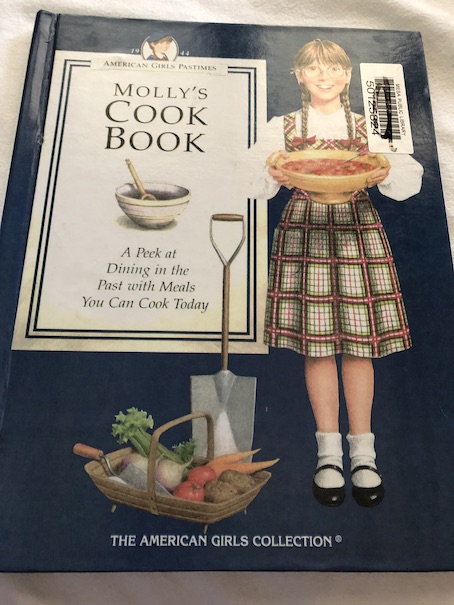
Molly’s Cook Book by Polly Athan, Rebecca Sample Bernstein, Terri Braun, Jodi Evert, and Jeanne Thieme, 1994.

This is a companion book to the Molly, An American Girl series.  It has recipes from the 1940s that people would have made during World War II.  A section at the beginning of the book explains how shortages and rationing during the war changed the way that people shopped for food and cooked.  For example, people on the homefront didn’t have many canned foods because many canned foods were shipped overseas to soldiers and much of the metal that would have been used to make more cans for food was being used to make other war supplies.  Because certain types of food were in short supply, individuals and families would receive ration books, which contained stamps that represented which types of foods they would be able to buy and how much.  Cookbooks printed during the war focused on creating meals that used little or no rationed products.  People also planted Victory gardens and grew their own vegetables to fill out their meals.

The cookbook is divided into sections for different meals:

Breakfast – Fried Potatoes, Toad-in-a-Hole (not the British dish – this is eggs cooked in a frame of bread, what I first learned to make as Eggs-in-a-Frame), Fried Bacon, Quick Coffee Cake, and Frozen Fruit Cups.

Dinner – Vitamin A Salad (made with carrots and lemon gelatin), Deviled Eggs, Carrot Curls and Celery Fans, Vitality Meat Loaf, Parsley Biscuits, Volcano Potatoes, and Applesauce Cupcakes.

Favorite Foods – French toast, Waldorf salad, PBJ Roll-ups, Jelly Flags, Victory Garden Soup, Nut-and-Raisin Bread, and Fruit Bars.

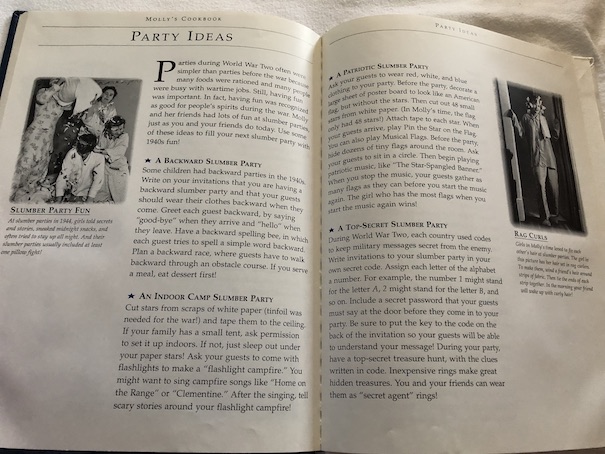
In each section of recipes, there is more historical information about food in World War II.  There is also a section in the back with party ideas from the 1940s.

For more World War II recipes, I recommend The 1940’s Experiment, which is a blog with recipes from World War II and an explanation of how they can be used to both save money and lose weight because they were intentionally designed to make maximum use of limited resources, both economically and nutritionally. In Molly’s Cook Book, there is a chart that government experts during World War II used to give people guidance on how to budget their food money among seven food groups. The diet that they recommended, both nutritionally and to limit certain rationed foods, was heavy on vegetables and fruits and lighter on meats, grains, and dairy products. This type of diet is basically in keeping with modern nutritional advice, which also emphasizes the importance of vegetables and fruit.

The book is currently available online through Internet Archive.

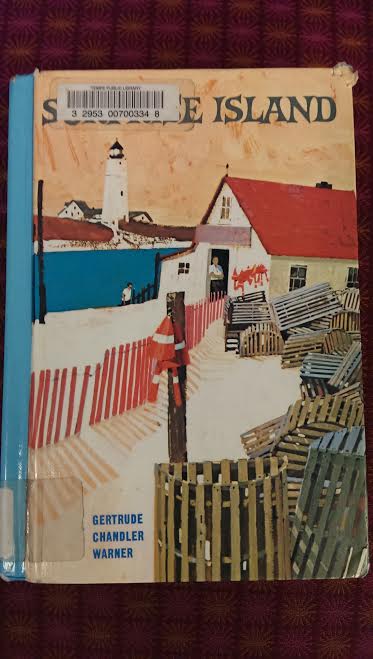
Surprise Island

The Boxcar Children

Surprise Island by Gertrude Chandler Warner, 1949.

Mr. Alden has promised his grandchildren a special surprise for their summer vacation. He tells them that, years ago, his father bought a small island because he kept horses and wanted a quiet place for them.  The island has only one little yellow house, a barn, and a fisherman’s hut where Captain Daniel lives.  Captain Daniel operates the motorboat that can take people to the island.  Mr. Alden plans to take his grandchildren to the island to look over the house, and if they like, they can spend the summer there.  The children think that it sounds like fun.

When they get to the island, the children decide that they want to stay in the barn instead of the house.  Captain Daniel also tells them that he has a young man staying with him, a friend who hasn’t been feeling well.  The Aldens’ old friend, Dr. Moore, has come to see the island with them, so he looks in on the young man.  It turns out that the young man was in an accident and had lost his memory for a time, although he has been gaining it back.  He says that he used to live with an uncle but that he didn’t want to go home again until he was sure that he was completely well.  He is going by the name of “Joe”, which is short for his middle name, Joseph.  Captain Daniel says that he’s known the young man all his life, and Dr. Moore also seems to know him, but Joe doesn’t seem to want to talk about himself to Mr. Alden.

The kids enjoy setting up housekeeping in the barn.  It reminds them of when they used to live in an old boxcar.  They use old boxes for furniture, dig for clams, and eat vegetables from the garden that Joe and Captain Daniel have tended for them.  Their grandfather allows the children to stay on the island in Captain Daniel’s charge, but they are mostly allowed to take care of themselves.  Joe sometimes brings them supplies that they ask for from the mainland.  (One of the themes of the Boxcar Children Series is self-sufficiency.  At one point, Jessie comments about how much better things seem “when we have to work to get it.”)  For fun, they go swimming, and Joe spends time with them, telling them about different types of seaweed.  They are surprised at how knowledgeable Joe is.

Henry gets the idea that they can set up a kind of museum of interesting things that they find on the island, like samples of different types of seaweed, shells, flowers, pictures of birds that they’ve seen, etc.  The other children think that it sounds like fun, and they begin thinking about the different types of things that they can collect.While they’re searching for things to collect and add to their museum, the children find a cave and an old arrowhead and ax-head.  They are authentic Indian (Native American) relics!  When they show Joe what they’ve found, he gets very excited, especially when they tell him that they saw a pile of clam shells, too.  Joe explains to the children how Native Americans used to use shells as money called wampum.  He thinks that what they saw was wampum, which the people who used to live there might have made after drying the clams to eat later.  Joe explains to the kids some of the process they would have used to turn the shells into wampum.  He’s eager to go to the cave and look for more Native American artifacts with them, but he urges them not to say anything to anyone else about it because other treasure hunters will probably show up if they do.  The children agree to keep their find a secret until their grandfather returns.

When they return to the cave with Joe, they make an even more incredible find: a human skeleton with an arrowhead inside.  It looks like they’ve found the bones of someone killed by an arrow!

The book is available to borrow and read for free online through Internet Archive.

My Reaction

As with some other vintage children’s mystery series, the early books in the series were more adventure than mystery.  The most mysterious part of this book concerns the real identity of the young man they call “Joe.”  The truth begins to come out when a strange man who calls himself Browning comes to the island in search of a young man who disappeared the year before while doing some exploring for him.  The young man he’s looking for worked for a museum.

This is the book where Violet first learns to play the violin.  This is a character trait that stays with her for the rest of the series.

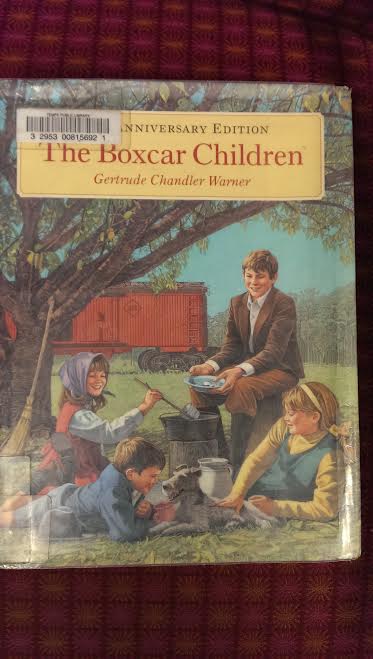
The Boxcar Children

The Boxcar Children

BoxcarChildren#1 The Boxcar Children by Gertrude Chandler Warner, 1924, 1942.

“One warm night, four children stood in front of a bakery.  No one knew them.  No one knew where they had come from.”

These are the words that begin not only this story but a series that has been loved by generations and continued well beyond the death of the original author.

The four Alden children are on the run following the deaths of their parents.  Their nearest remaining relative is a grandfather they have never met, and although he should have custody of the children now, none of the children want to go live with him.  All that they know about him is that he is apparently a mean old man who opposed their parents’ marriage.  Henry, the eldest at fourteen, and Jessie, who is twelve, have taken charge of the two younger children, ten-year-old Violet and seven-year-old Benny.  They have a little money, and they’re now traveling on foot in search of a new home.

The first place they stop is a bakery in a nearby town where no one knows who they are.  They don’t have much money, but they know they are going to need supplies for their journey.  The stingy baker and his wife agree to give the children some food and a place to sleep for the night in exchange for some help in their shop.  The children are willing to work and accept the offer.  However, Henry and Jessie overhear the couple talking about them.  They like having the children to help in the shop, but Benny is too young to be of much help.  They are considering taking Benny to an orphanage and keeping the others.  Not wanting to be separated, Henry and Jessie wake Violet and pick up Benny, moving on.  Now, they have a second set of people they’re avoiding, besides their grandfather.

Seeking a place where they can stay while not being noticed by people around them, the children eventually find an old, abandoned boxcar on a disused piece of train track on the edge of some woods.  They take shelter there from the rain and decide that they can turn it into their new home.  There are blackberries growing nearby that they can eat and a stream where they can keep milk cold.  Henry finds odd jobs in a nearby town to earn more money, and the others discover an old dump where they retrieve some old, cracked dishes and other useful items.

It seems like an idyllic life at first.  The children are free of adult control, although they do have to work to create a household for themselves and find food.  They adopt a stray dog they call Watch (he’s their new watchdog), and Henry makes friends who appreciate what a hard worker he is.  However, some of these new friends start to wonder about Henry, where he comes from, and where his parents are.

The children soon realize that someone is spying on them.  Is it someone from the town?  Could the baker and his wife still be looking for them?  Or is it someone sent by their grandfather?  When Violet is suddenly taken ill, the others realize that they need help and someone to trust.

Getting help for Violet does mean that the children’s secret is revealed to everyone, although they learn some important things in the process.  They discover who was spying on them and why and also discover that their grandfather is a nicer person than they thought and truly cares for them.

Although this series is very popular, most people don’t know that the story they read as children was actually a shortened version of the original story that was written in 1924.

The newer, popular version of the book is available online through Internet Archive.  The older version is now public domain and available online through Project Gutenberg.

Comparisons to the Older Version and My Reaction

Along with shortening and simplifying the story from original the 1924 version, the newer version from 1942 changed some of the characters’ names (the children had the same first names, but their family name was originally Cordyce, not Alden) and removed some parts that might be objectionable for young children.

Although the original story doesn’t completely clear up some questions that were left unresolved in the current version, like what the children’s parents were like, precisely how they died, and why they quarreled with the children’s grandfather in the first place, it did supply a few more details in the first chapter.  The original story begins when the children move to a new town with their father.  No one knew exactly where they came from, and the children pointedly refuse to say.  However, they do tell their neighbor, a baker, that their mother is already dead.  Their father is drunk, and the baker thinks that he looks like he’s in such bad condition that he isn’t likely to last much longer.  That turns out to be true when he dies (apparently from alcohol-related causes) soon after.  When they question the children about whether or not they have other relatives, young Benny blurts out that they have a grandfather before the others silence him.  The adults press the children for answers, and they reluctantly admit that there is a grandfather, but they say that he did not like their mother and would treat them cruelly if they were sent to him (or so, apparently, their parents had led them to believe).  The only one of the children who has even seen the grandfather is Jessie (actually called Jess in this version of the story), and it was only from a distance because her father happened to see him passing by and pointed him out.  Later, the children hear the baker and his wife talking, saying that they have no choice but to try to find the grandfather, and the children decide to run away to avoid going to live with him.  The questions of how their mother died and why the grandfather didn’t like her in the first place are never answered.

James Cordyce (the children’s grandfather in the original book, their grandmother is also apparently dead) is a wealthy man who owns steel mills, and he is impressed by the children’s ingenuity and resourcefulness at managing their own affairs while living on their own.  He tells Henry that he wants him to take over the steel mills one day, and the book says that Henry does so when he grows up and does a wonderful job of managing them.  Mr. Cordyce tells the other children that he wants them all to go to college, and then they can do whatever they like when they grow up, which the book says also happens.

Although the books never actually say so, my theory is that Mr. Cordyce/Alden was a hard-headed businessman, particularly when he was younger, driven to succeed and not emotionally demonstrative, and that this attitude caused a rift between him and his son, who may not have shared his father’s business skills and interests.  The grandfather may have wanted his son to follow in his footsteps when the son had other ambitions.  The son may have seen his father as a cold and ruthless businessman and conveyed that impression to his own children after marrying a woman his father disapproved of (Because her family was poor? Because they were unambitious?  Because she had some objectionable personal habit?  There’s no telling), but because he may not have told the children the whole reason why he thought that the grandfather was cruel, the children imagined that he was worse than he really was.

We don’t know what the children’s father did for a living after his feud with his father or exactly where they lived (perhaps in Greenfield or close by so that Jessie was able to catch sight of her grandfather one day).  Why the father took to drinking is also never explained, but I think it may be implied that he did so out of grief for his dead wife.  I think that Henry and Jessie probably had to manage the household for their parents following their mother’s death (and maybe before that if she suffered from ill health), which is part of the reason why the children are so self-sufficient and seem more tied to each other than to any adult.  In any case, the original book says that Mr. Cordyce is interested when the doctor who befriends the children says that Henry and Jessie have business management skills, so I think it sounds like he was thrilled to find out that he might have more in common with his grandchildren than he did with his son and hopeful that Henry would make a better successor in the family business.  But, that’s just the way I read it.

One other point that the original book covered was Watch’s origins.  The later version just has Watch as a stray who the children adopt, but the original story explained that he had just been purchased from a kennel by a wealthy woman when he was lost.  The kennel owner tries to reclaim the dog (kennel name Rough No. 3) on behalf of the woman, but the grandfather offers to buy the dog for much more than the original price.  The kennel owner says that it’s up to the woman who bought him, and they invite the woman to the house.  After hearing how attached the children have become to Watch, the woman allows them to keep him.

Cheaper By the Dozen

CheaperDozen

Cheaper By the Dozen by Frank B. Gilbreth, Jr. and Ernestine Gilbreth Carey, 1948.

These are the real reminiscences of children from the Gilbreth family about their unusual childhoods during the 1910s and 1920s.  There are a couple of movies based on this book, including the 2003 movie that features the dad who is a football coach, but that story is fictional and bears almost no resemblance to the actual lives of the real Gilbreth family.  The older 1950 movie with Myrna Loy as the mother is closer.  The only parts that they have in common are that there were a dozen children in the family, and they had some unusual systems for handling their chaotic household.

The father of the Gilbreth family, Frank Gilbreth, Sr., was a motion study and efficiency expert.  He was one of the early pioneers in the field, studying the ways that people do things, whether it was routine household chores or making things in factories and trying to find ways to help them perform their tasks more efficiently.  Saving time was a passion for him, and he often used his own children and household as guinea pigs for his projects.  His wife, Lillian Gilbreth, was also a psychologist and engineer and was his partner in his work, continuing it after his death.

Part of the reason Frank Gilbreth was so interested in efficiency was that, in his early life, he worked with his hands and built a reputation as an efficient worker.  Later, he also learned that he had a heart condition that might cause him to lead a shorter life.  He had wanted a large family, and he and his wife had agreed that they wanted an even dozen of children, six boys and six girls.  He got his wish, but he was concerned about helping his children to make it as far as they could through school and giving his large household a structure that would last even after he died.

The stories in this book are mostly funny stories as his children fondly remember the things their father taught them and the usual systems in their house that were designed to keep a dozen children in order.  The stories jump around a bit in time, and it isn’t always clear exactly which children were alive at certain points in the stories.  Whenever Jane, the youngest, is mentioned, the stories take place between 1922 and 1924, and there should be eleven living children in the family at most.  Although the Gilbreths did have a total of twelve children, as they had hoped, they were all single births (no twins or other multiples), spaced out over 17 years.  Also, although this book does not mention it (the sequel, Belles on Their Toes contains a brief footnote), one of the older girls in the family (Mary) died very young of diphtheria, before her youngest sister was born, so there was no point at which all twelve children were together.  Even so, the Gilbreths always referred to their children as their “dozen,” and the stories make it sound like all twelve were together.  (This article explains a little more about Mary’s death and its effect on her family and the reasons why the books explain little about it.)

The children’s birth order isn’t specified in the stories, but for reference, these are their birth and death dates (courtesy of Wikipedia):

Anne Moller Gilbreth Barney (1905-1987)

Mary Elizabeth Gilbreth (1906–1912)

Ernestine Moller Gilbreth Carey (1908-2006)

Martha Bunker Gilbreth Tallman (1909-1968)

Frank Bunker Gilbreth Jr. (1911-2001)

William Moller Gilbreth (1912-1990)

Lillian Gilbreth Johnson (1914-2001)

Frederick Moller Gilbreth (1916-2015)

Daniel Bunker Gilbreth (1917-2006)

John Moller Gilbreth (1919-2002)

Robert Moller Gilbreth (1920-2007)

Jane Moller Gilbreth Heppes (1922-2006)

Wikipedia also claims that there was a thirteenth baby, an unnamed stillborn daughter, but this child isn’t mentioned in the books, and I don’t know for sure if that’s true.  Most of the children lived to adulthood, married, and had children of their own.

Racial Language Warning: I usually make notes about racial language in the books I review.  There are a couple of things I’d like to point out, although I also have to point out that, since this book is non-fiction, the people writing it were quoting people from memory.  Just be prepared for a few things that people said back in the 1910s/1920s that wouldn’t be acceptable in modern speech.  They aren’t central factors in the stories, but they are there.  For example, one of the children’s grandmothers used to get dramatic when threatening the children with punishment and say that she would “scalp them like Red Indians.” (I’m not completely sure if she meant that the Indians would get scalped like that or do scalping like that, but I’m guessing that she probably wasn’t being particular.)  The mother of the family also frequently used the word “Eskimo” to describe bad language or “anything that was off-color, revolting, or evil-minded.”  Most of the time in the book, she says it kind of like the way some people say, “Pardon my French” when using bad language, and her definition of bad language was pretty mild.  I’ve never heard the word “Eskimo” used in that sense anywhere else, and it makes me cringe here.  There is some pay-off to the word when a couple of pet canaries whose full names the mother had declared were “Eskimo” escaped during a boat ride, and one of the kids tries to explain to the boat captain that he’s upset about “Peter” and “Maggie” being lost but he can’t say their last names because they’re “Eskimo,” making the captain think that a couple of Alaskan natives have mysteriously disappeared over the side of his boat.  It reminded me of something similar in Fudge-A-Mania, where Fudge accidentally made people think that his lost pet bird was his crazy uncle.  When sharing this book with children, like other older books, it might be a good idea to make it clear that they shouldn’t try to imitate some of the expressions the book uses because it might cause problems and misunderstandings.  There is also a Chinese cook in one chapter who speaks a kind of pidgin English that no one should imitate, either.

Overall, these are calm, funny stories about a somewhat eccentric family that can make nice bedtime reading.  The book is currently available online through Internet Archive.

Chapters

Each of the chapters in this book talks about a different topic or period in the family’s life:

CheaperDozenShavingWhistles and Shaving Bristles

Introduces the father of the family and his experiments in motion study.  Frank Gilbreth was highly self-confident and frequently took at least some of his children (and sometimes the whole family) with him on visits to factories where he was helping to increase their efficiency.  He gave the children notebooks and pencils and had them take notes about what they saw.

To keep the household orderly and make sure that each child got ready for school on time and did their chores and homework, the parents instituted a chart that each child had to initial after completing certain routine tasks such as brushing teeth or making beds, and there was a special whistle that their father would give to get all of the children to come quickly for a meeting.  The father would sometimes take moving pictures of the children doing chores, like washing dishes, so that he could study their motions and determine if there were wasted motions that could be eliminated so that the task could be completed more efficiently.  He also used himself as a guinea pig, always trying to do daily tasks, like buttoning his coat or shaving, more quickly and efficiently.

Pierce Arrow

The family moves from their home in Providence, Rhode Island, to Montclair, New Jersey.  This chapter explains the move and also the father’s love of practical jokes.  Before taking the family to their real new house, he takes them to one that’s really old and run-down so that the new one will look that much better when they get there.  When they get their large Pierce Arrow car, big enough to carry the whole family, the father tricks each of the kids into looking for the “birdie” in the engine and then honks the horn to scare them.  He thinks it’s funny until one of the kids does the same thing to him.

CheaperDozenCarOrphans in Uniform

This chapter explains that the mother of the family was a psychologist.  While the father instituted systems and dealt out discipline, the mother was often the one who made the systems work, resolving conflicts among the children and making sure that everyone was doing what they needed to do and that they had everything they needed.  Older children also helped by looking after a designated younger sibling.

Much of the chapter explains how things often happened on family outings.  They always took roll call because there were a couple of incidents when children had been left behind by accident on earlier trips.  As a large family, they also attracted a lot of attention.  Sometimes, their father would try to get discounts on things like ticket prices and toll booths by pretending that his children were the nationality of whoever seemed to be in charge, and he was pretty good at guessing that correctly.  All of the Gilbreths were either blonde or red-haired, so Mr. Gilbreth was known to gleefully pretend that they were Irish, when in fact, their heritage was Scottish.  He always thought jokes like that were funny, but finally his wife and children put a stop to his playacting the day that the family was mistaken for an orphanage on an outing.

Visiting Mrs. Murphy

The family enjoyed going on picnics together.  While they were eating, the father would often try to squeeze in an educational lesson, pointing out things like the way ants work together, how a nearby bridge would have been constructed, or what was going on at a nearby factory.  The children learned a lot from him, especially how to notice details in the world around them, but they noted that it was their mother who often put the lessons in perspective for them by pointing out the human side of each of these things, such as describing the fat queen ant in a colony with all of her slaves (their word, I’ve usually heard them referred to as “workers”, but you get the idea) waiting on her or the workmen on a construction project in their jeans, stopping for lunch.  Their father was also pleased by the mother’s descriptions, which complemented his lessons so well.  These stories help explain how the parents worked well together as a team.

The “visiting Mrs. Murphy” was a euphemism for going to the bathroom in the woods because the family didn’t really trust public restrooms.

Mister Chairman

This chapter explains a little about Frank Gilbreth’s youth and how he got his start.  His father died when he was young, and his mother encouraged her children to get the best education they could.  However, Frank Gilbreth decided to get a job instead of going to the Massachusetts Institute of Technology like his mother planned because he was concerned about the family finances and his sisters’ education.  He became a bricklayer and drove his supervisor crazy because he always had tips for working faster and more efficiently.  Eventually, the supervisor adopted some of his suggestions, and Frank discovered his passion for motion study.  He worked his way up in construction until he became a contractor, and he was also hired to study working methods in the factories he built.  He became a wealthy man and met his wife as she passed through Boston on her way to a trip in Europe.  Lillian was from a wealthy family in California, and she had a college degree in psychology.  Although many people didn’t take female scholars seriously in those days, Frank did, and the two of them became a team, both personally and professionally.  They were both interested in the psychology of management, and they applied many of the principles from the professional world to their household and vice versa.

To help organize household tasks and make family decisions, Frank created a Family Council with himself as the Chairman and his wife as the Assistant Chairman that was similar to an employer-employee board.  For the most part, it did help to keep order in the family, but once in a while, the Chairman was overruled, including the time when the children ended up persuading their parents that they should get a family dog.

Touch System

This chapter goes into more detail about how responsibilities and chores were assigned in the family.  It also describes how the father arranged to make best use of “unavoidable delay” in the bathroom by putting Victrolas with language lessons in the children’s bathrooms, so they could learn while bathing or brushing their teeth.  He also taught them how to take baths efficiently, so that they could be in and out of the bathroom as quickly as possible.  Mr. Gilbreth took every opportunity and free moment to improve his children’s minds, including teaching them ways to perform complex math problems at the dinner table.

While working as a consultant for the Remington typewriter company, Mr. Gilbreth developed a system for teaching touch typing, and he taught it to his children.

CheaperDozenSchoolSkipping Through School

Not knowing how long he was going to live, Mr. Gilbreth was anxious to see as many of his children get through school as he could, and he had great confidence in their abilities, so he often pushed his children to skip grades in school, using persuasion and his bombastic personality to get their schools to agree.  The children’s mother, however, saw her children more as individuals who needed time to grow up emotionally and socially as well as intellectually and tempered her husband’s enthusiasm for skipping grades.

The parents also had their children attend church and Sunday School, although the father wasn’t very interested in organized religion.  Lillian volunteered for a number of church projects and committees.  Once, as a joke, a friend of hers who had eight children of her own, referred her to a birth control advocate who was looking for someone local to volunteer to promote the movement.  The friend thought that it was a great joke, and the family saw the humor and made the most of it when the advocate showed up at their house.

Kissing Kin

When the United States joined World War I, Mr. Gilbreth offered his services to the U.S. Army.  While he was working at Fort Sill, Mrs. Gilbreth took their children (they had seven at the time) to visit her relatives in California.  The Mollers were a wealthy family, and the children enjoyed being spoiled by their grandparents and their aunts and uncles after the arduous train journey there.

Chinese Cooking

At first, the children felt like they should be on their best behavior when visiting their grandparents and aunts and uncles.  However, the adults were a little worried about how subdued the children were, and constantly being on their best behavior grew more difficult for the children.  One day, when the adults made the children wear new outfits that they hated for a special party, the children finally rebelled and got them all wet by playing in the garden sprinklers.  From then on, everyone was much more relaxed and informal.

The grandparents had servants, and Billy became rather attached to their Chinese cook, Chew Wong (I’m not completely sure if “Chew” was his real name or a nickname), who was known for being somewhat temperamental.  The cook enjoyed Billy’s company also, although when Billy got troublesome, he sometimes picked him up, held him in front of the oven, and threatened to cook him.  It was an empty threat, but one day, Billy (five years old at the time) pushed the cook when he was standing in front of the oven, also joking that he was going to cook him, and the cook apparently got his hands burned.  (This incident alarmed me a bit.  It seems that the cook wasn’t badly hurt, but still, that’s the kind of problem that horseplay like that can cause, and it could have been really serious.  The cook is described as speaking a kind of heavily-accented pidgin English.)

On the way home, all of the children came down with whooping cough.  When they picked up Mr. Gilbreth, Mrs. Gilbreth told him that next time, he could take the kids to California, and she would go to war instead.

Motion Study Tonsils

The family didn’t get sick very often (and tried hard to ignore it when they did), but this chapter describes what happened when the children all came down with measles and when several of them needed to have their tonsils taken out at the same time.  Their father decided to turn the tonsil operations into a motion study experiment.

Nantucket

The family had a vacation home in Nantucket, Massachusetts that they called “The Shoe” (after the nursery rhyme about the old woman who lived in a shoe and had so many children that she didn’t know what to do).  Although the father promised the kids that there would be no lessons and studying over the summer, he still found ways to teach them things by turning the lessons into games, like when he painted Morse code messages all over The Shoe and offered prizes to the children who could solve them.

This chapter also explains about the Gilbreths’ concept of “therbligs.”  The word comes from “Gilbreth” spelled backward, and it refers to a single unit of thought or motion.  Every task a person does is composed of a certain number of therbligs.  Reducing the amount of time needed for each therblig makes a task more efficient.  They taught this concept to their children as well, putting symbols representing the different possible therbligs on the walls of The Shoe as well.

For a while, The Shoe became a point of interest on local tours.

The Rena

The Rena was a catboat that the family owned.  Their father liked to run it like he was a real ship’s captain.

CheaperDozenBabyBathHave You Seen the Latest Model?

The births of new children were a regular experience in the Gilbreth family through much of the children’s early lives.  This chapter explains how the parents approached the births.  They decided very early in their marriage that they wanted a large family, choosing the number twelve as their target on the day they were married.

Mr. Gilbreth had a lot of theories about babies which he started testing on their first child, Anne.  He refused to allow people to speak baby talk around the babies (although he caved in and did it sometimes himself) so they would learn to speak properly.  He hired a nurse who spoke German in the hopes that the baby would start learning a second language immediately, and the nurse’s horror, he once tried to see if babies have an innate ability to swim by trying Anne in the bathtub. (No, they don’t, and he was careful not to let Anne almost drown.)

Mrs. Gilbreth had her first seven children at home, finding the hospital too dull because they wouldn’t let her work on anything while she was there.  As time went on, the children in the family began to wonder more about where the babies came from, although they knew that it involved their mother spending the day in bed, the doctor coming, and sometimes hearing their mother yell (she was embarrassed that they’d noticed).  Their mother tried to explain babies to them in terms of bees and flowers, but she was too shy to give them any real, direct information about it, and their father didn’t want to discuss the subject with them at all.  This chapter also mentions that part of the family tradition was that the mother would read the book The Five Little Peppers to her children while she was recovering from a birth.  (I also reviewed this book.)

Flash Powder and Funerals

Mr. Gilbreth loved taking pictures of his children (using a frightening amount of flash powder whenever he was in charge of it) and also frequently used pictures and movies of his children as part of his projects or as promotional images.  One of the most bizarre promotions they did was when Mr. Gilbreth was hired by a company that made automatic pencils.  They took pictures and movies of the Gilbreth children burying a coffin full of regular old wooden pencils.  The kids had to bury the coffin and dig it up again multiple times while they took all the pictures and movies they wanted.  Then, when the filming was over, Mr. Gilbreth made them dig up the coffin again and use all the wooden pencils in it so that none of them would go to waste.

Sometimes, these pictures and promotions were embarrassing to the children when they were made public and classmates and teachers talked about them at school.  Some of the reporters who interviewed the family for human interest pieces made up bits of dialogue to make their stories more interesting and embarrassed the family.  (Ex. “I am far more proud of my dozen husky, red-blooded American children than I am of my two dozen honorary degrees …”)

Gilbreth and Company

This chapter explains what it was like for special visitors to come to the Gilbreth house.  Most people found it pretty strange, with so many young children and the strict household rules which the children would also try to enforce on visitors.  The chapter mentions that Mrs. Gilbreth never liked using physical punishments on the children, but Mr. Gilbreth used them regularly.  Mrs. Gilbreth kept trying to tell him that he shouldn’t spank the children on various body parts because of the harm it could do.  At one point, Mr. Gilbreth asks her, irritably, “Where did your father spank you?  Across the soles of the by jingoed feet like the heathen Chinese?”  (It was a thing, but not exclusively Chinese.)

In particular, this part of the book describes two special visitors to the Gilbreth house: the father’s older sister, the children’s Aunt Anne, who came to look after the children while the parents were out of town, and a female psychologist who was trying to analyze the children for a paper she was writing.  The children generally liked Aunt Anne, who also gave them music lessons, even though none of them had any talent for music.  However, they started playing pranks on her when she started getting too militant with them, replacing the routines that their father gave them with ones of her own.

The children were more offended by the visiting psychologist, who asked them deeply embarrassing questions (ex. “Does it hurt when your father spanks you?”) and who seemed to have an agenda to prove that, while the Gilbreth children were smart, they were socially or behaviorally abnormal for living in such a large family under unusual systems.  The children also played pranks on her, getting hold of the answers to the intelligence test that she was giving them so they could give her either abnormally correct answers or psychologically abnormal answers and purposely behaving abnormally in her presence, intentionally twitching and scratching themselves.  Eventually, the psychologist caught on to what they were doing and left in a huff.

Over the Hill

This chapter is about family entertainment.  The Gilbreths liked to go to the movies about once a week, often staying to see films twice.  (Films were silent at this point.)  The father loved the movies as much as the kids, if not more so.  The children also sometimes put on little shows or skits for their parents.  In particular, they liked to do imitations of their parents, many of which involved either taking the children places or being asked questions about what it was like to have so many children.  Mr. Gilbreth also liked to do a “Messrs. Jones and Bones” cross-talk routine like the ones from minstrel shows, where a pair of actors perform pun-based jokes, except that he would play both parts himself, putting on accents like the black-face minstrels.  (Ex. “And does you know Isabelle?” “Isabelle?” “Yeah, Isabelle necessary on a bicycle.”)  The jokes are corny puns, but it’s a little uncomfortable now that I’m old enough to know the origin of this act.  It went over my head as a kid.

CheaperDozenUnderwearFour Wheels, No Brakes

The oldest girls in the family were getting old enough to start dating in the early 1920s, around the time that flapper culture was beginning.  Their parents were fairly conservative in their habits, and the girls argued with them about being allowed to bob their hair and wear the latest fashions, like short dresses.  The parents finally broke down and allowed the girls to have their hair professionally bobbed after Anne gave herself a dreadful bob.  The father drew the line on make-up, however.

Motorcycle Mac

During the early 1920s, girls often referred to their boyfriends as “sheiks” in reference to the popular silent movie The Sheik.  The father of the family often chaperoned his daughters on dates or had one of their brothers do it, although he eased off after getting to know some of the young men better.  The younger siblings enjoyed teasing the older ones about their dates.  My favorite episode when I first read this as a kid was the time when one of Ernestine’s boyfriends climbed a tree outside of her window to spy on her, hoping to see her getting undressed, and the other siblings decided to teach him a lesson by pretending that they were going to set the tree on fire and roast him alive.  (They didn’t do it, they just threatened to.  It’s a dangerous prank, but effective.)

The Party Who Called You…

Mr. Gilbreth knew that he had a bad heart condition even before his last two children were born, and he made preparations that would help his wife to run the household efficiently after his death.  He died in his 50s while he was on his way to a series of conferences in Europe.  He had called his wife from the train station and was on the phone with her when he had his fatal heart attack.

The book ends with describing what his wife and children did after his death.  One of the things that I found most touching was the way that the children described the changes in their mother after her husband died.  They said that in their mother’s youth, she had been accustomed to other people making decisions for her, first her parents, then her husband, who guided their work and who had the idea of the large family in the first place.  In some ways, their mother had been a very nervous, anxious person, afraid of things like going out alone at night, lightning storms, and making speeches (although she did them anyway).  After her husband died, Lillian’s fears seemed to drop away because the thing that she had always feared the most, losing her husband, had happened, and she discovered that she and the children could still manage.  When Lillin’s mother suggested that she move the family out to California to be close to their relatives there, Lillian held a Family Council with the children to decide what they were going to do.  Lillian said that she planned to continue their father’s work, even going to Europe in her husband’s place to present his papers, and that would mean that the children would have to take on greater responsibilities in running the house and caring for the younger children.  The children agreed, and although money was tighter than it was before, they were able to carry on.

Annie’s Promise

AnniesPromise

Annie’s Promise by Sonia Levitin, 1993.

This is the final book in the Journey to America Saga.  Annie, the youngest of the Platt girls, is more of a tomboy than her older sisters.  Her father thinks that she’s been growing up too wild in America, running around and climbing like a boy.  This summer, in 1945, while her best friend goes to visit their family’s farm in Wisconsin, Annie’s father wants her to stay home and help him with sewing for his coat business, and Annie’s mother has a list of chores for her to do.  It all sounds so boring and dreary.  Twelve-year-old Annie longs for excitement, but because of her recent appendix operation and her migraine headaches, her parents worry about her health.

Then, Annie gets the opportunity to attend summer camp.  She wants to go and do all the fun summer camp activities that other girls do, but her parents worry at first.  They worry about Annie’s health, and they don’t know who is running the camp or what they do there.  Annie’s older sisters, Ruth and Lisa, tell their parents that it’s normal for girls in America to go to summer camp and that the experience might do Annie some good.  When the family doctor says that Annie is healthy enough to go, her parents finally agree.

At first, camp is hard.  Annie faints soon after her arrival, and she worries that maybe her parents were right about her being delicate.  However, one of the counselors tells her that these things happen and that she was probably just overtired, overheated, and still suffering from the rough bus ride to the camp and that she will be fine after she rests.  Annie is physically fine, although one of the other campers, Nancy Rae, makes a big deal about the incident, calling Annie a “sickie” and other names.  Nancy Rae is a terrible bully, and Annie nearly drowns in the lake after accepting a dare from Nancy Rae to swim across it, in spite of not being a good swimmer.  Annie overhears the counselors saying that Nancy Rae should probably be sent home for goading Annie into a dangerous stunt, but they know that Nancy Rae comes from a bad home and that her father abuses her.  For her own sake, they decide to give her another chance.

However, even knowing Nancy Rae’s troubled history doesn’t help Annie when Nancy Rae keeps picking on her and a black girl named Tallahassee (Tally, for short).  Nancy Rae calls Tally and her younger brother (who is also at the camp) “nigger” and says that Annie is a “nigger-lover” when she tries to protect the younger brother from one of Nancy Rae’s tricks that could have really hurt him.  (Note: I’m not using the n-word here because I like it. I’m just quoting because I want you to see exactly how bad this gets.  Nancy Rae uses this word multiple times, and so do others when quoting her. This book is not for young children.  Readers should be old enough to understand this word and beyond the “monkey see, monkey do” kind of imitation some kids do when they learn about bad words.  The management assumes no responsibility if they aren’t.)  Nancy Rae is a thrill-seeker, who frequently does wild stunts to get attention and tries to make other girls hate Annie as much as she does.  At one point, she snoops through Annie’s things and tries to take her diary.  Eventually, she figures out that Annie is Jewish and makes fun of her for that, painfully reminding Annie of what it was like living in Nazi Germany and of her relatives, who died in the concentration camps.

Finally, Annie reaches the breaking point with Nancy Rae.  At a camp talent show, she arranges with other kids to dump horse manure on Nancy Rae’s head after she finishes singing a song.  Nancy Rae is so humiliated by the experience that she ends up leaving camp.  Annie is relieved that she is gone, but one of the camp counselors, Mary, makes her feel guilty about her revenge because she sees Annie as being stronger and more talented than Nancy Rae and wishes that she could have made Nancy Rae her friend instead, giving the bully a chance to improve herself.  (I disagree with what the counselor says, but I’ll explain more later why.)  Annie feels badly about how things turned out, but the incident blows over, and the rest of camp is a great adventure for her.

At camp, Annie mixes with different kinds of children from the ones she usually sees in her neighborhood and at school, and everything is a learning experience.  She becomes friends with Tally and gets a crush on a boy named John.  There is an ugly incident in which an assistant in the camp kitchen tries to molest Annie when he finds her alone (this really isn’t a book for kids), but the camp counselors dismiss him for what he did.  Annie and Tally talk about many things together, and Tally is very understanding.  The incidents with Nancy Rae and the kitchen assistant bring up the subjects of people who try to victimize others and how to deal with them.  Annie resents that people like that force others to be on their guard, limiting them in ways that they can behave in order to avoid being victimized, but Tally says that there’s no help for that.  As long as people like that exist, she says, protecting yourself is a necessity.  They also compare the way Annie feels when John gives her a little kiss to the repulsed and frightened way that she felt when the kitchen assistant tried to force himself on her.  Both incidents involved a kiss, but the way it was delivered and the person delivering it made each experience feel very different.  In the end, Annie’s crush on John turns into friendship rather than love as she realizes that the kiss was just a friendly gesture.  It is a little disappointing to her at first, but it is still a learning experience for her.

Annie learns that everyone at this camp has been through something bad in their lives.  Annie’s family are war refugees, but Tally’s father has been married three times, and she’s often the one to take care of the house and her younger brother, while her current stepmother cleans other people’s houses for money.  Other kids are poor or orphans or have fathers in jail.  The camp gives them a chance to get away from their problems for awhile, to make new friends, and to develop talents that they can be proud of.  Annie really blossoms at camp, learning to ride horses and work on the camp newspaper.  As Annie’s session at camp comes to an end, Mary offers Annie a position as a junior counselor for the final session of camp, helping the young children.  Annie is enthusiastic about the prospect, but family dramas at home threaten to derail her plans.  Ruth’s fiancé is shell-shocked from the war and has broken off their engagement.  Lisa is tired of arguing with their parents about every small piece of independence in her own life and has decided to move to a place of her own.  With all of this going on, and their parents upset about everything, what chance is there that they will sign the permission slip that Annie needs to become a junior counselor?

This book shows how much the lives of the girls in the Platt family have changed since they first left Germany for America.  It’s partly because they are living in a different country, partly because times and habits are changing everywhere, and partly because all of the girls are growing up and making decisions about what they really want to do with their lives.  The older girls in the family, Ruth and Lisa, are women now and thinking about careers and marriage.  As the girls suffer disappointments and changes of heart, their parents suffer along with them, and Annie realizes that she has to make up her own mind about what she really wants.  As Annie tries to decide what she really does want, her parents struggle to cope with all of the changes in their daughters’ lives and in the changing world around them.  They fight against it in a number of ways, and when things go wrong, whether it’s Annie’s illnesses or the older girls’ romantic problems, they tend to get angry or panic.  As the book goes on, it becomes more clear that what the parents really feel is helplessness.  More than anything, they’ve wanted life to be better for their daughters in their new country, and it upsets them when things don’t work out.  They want to help guide their daughters and make their futures work out for the best, but in the process, they often come across as too controlling or making the wrong decisions because they don’t fully understand the girls’ feelings or situations.

Ruth and Lisa each suffer romantic disappointment before they settle down.  Ruth had a fiancé, Peter, who went away to fight in World War II, but having seen the prisoners in the concentration camps, he has returned disillusioned and dispirited.  He was Jewish, but now comes to associate his religion and heritage with pain and suffering and wants to give it up, breaking off his engagement to Ruth in the process.  At first, Ruth is angry with him, saving that it’s like he wants to give up on his whole life, on the whole world.  The girls’ father says that he wants to kill Peter for leading his daughter on, but part of his feelings turn out to be his own feelings for somehow failing his daughter, that he is somehow to blame for allowing this disappointment.  When Lisa is upset because the young man that she’s been seeing says that he doesn’t want to get married, she argues with her parents about the course of her life and leaves home to live on her own.  Her parents see that as turning her back on their love and protection, but Lisa says that she just wants the independence that other girls have.  Even Annie feels abandoned by Lisa because Lisa was always there to comfort her as a sister and help her persuade their parents to listen to her, but Lisa says that she has to deal with problems on her own and that Annie will understand someday, when she’s in the same position.  Annie realizes that, in a way, she already is in the same position.

The one time that Tally comes to visit Annie at her house and the girls go to the beach together, Annie’s parents make a scene when she gets home because she’s left sewing all over the house and eaten more food than she should have.  Tally was going to apply for a sewing job with Annie’s father, which would have helped both of them, but Annie’s parents send her away, thinking that she’s a bad influence who encouraged Annie to goof off.  Then, Annie hears her own parents use the n-word.  It’s the final straw for Annie, and she runs away to camp.

The people at camp are glad to have her because they need her help, but being there, helping them, and thinking about her own life and future help Annie to realize what’s really important to her.  She’s been feeling bad about the hate she got from Nancy Rae and the hate that she felt from her parents with their insults to her friend.  However, her parents don’t really hate her, and in spite of what they’ve done, she doesn’t really hate them.  She realizes that, before she does anything more with the camp, she needs to go back and see them.

Annie rethinks what Nancy Rae was really about, how she was filled with hate for everyone, dealing out hatred because of all that she’d received from everyone else.  The counselors realized that she needed love more than anything, but Nancy Rae’s own hateful behavior pushed away the people who would have given her more positive attention and Annie’s revenge (although provoked) ended her camp experience.  Annie realizes that she doesn’t want to go down the same path and that she must mend her relationship with her family.

I said before that I disagreed with the counselor’s approach to the problem of Nancy Rae and what she said to Annie about her revenge.  I see what they were trying to do with giving Nancy Rae another chance, but what bothers me about it is that they act like Annie was in a much less vulnerable position to Nancy Rae and that she should have been strong enough to take what Nancy Rae dished out without hitting back, and I don’t think that’s true.  All of the kids at the camp were there because they had something troubling in their lives, some vulnerability, including Annie.  To say that Annie was more fortunate and more talented and that it should have been enough was to discount the harm that Nancy Rae was doing.  I know that the counselors were trying to make the camp experience positive for Nancy Rae, but she was making the camp experience more negative for everyone else around her and needed to be stopped.  Everyone suffers from something in life (as this book also demonstrates), but not everyone chooses to become a bully because of it.  Nancy Rae made that decision herself, within herself, and for herself alone.

Part of the problem, I think, was that there were no obvious consequences for Nancy Rae’s bad behavior, and therefore, she had no reason to stop doing what she was doing.  The lack of punishment and the inequity of the situation was what finally sent Annie over the edge with her.  Since the counselors didn’t make it obvious that Nancy Rae was in the wrong, Annie felt that she had to, and that says to me that there was a lack of responsibility and accountability.  I think that life is a balance and that both positive reinforcement (giving rewards to people who do good) and negative reinforcement (punishment for bad behavior) are necessary.  I believe in plain speaking, and if I were in the counselors’ position, I would make it plainly and specifically clear that no campers were to use the n-word, to mess with others’ belongings, or to do the other things that Nancy Rae was doing and that there would be consequences for doing so, telling them exactly what those consequences were so that no one could say that they were surprised.  I would also make it clear to Nancy Rae that I knew exactly what she was doing and why she was doing it and that it was unacceptable.  When we choose what we do and say in life, we all consider (or should consider) what we want to happen in life, and I would put it plainly to Nancy Rae how she really expects others to react to her and how their reactions would change if she did things differently.  Clearly, no one has ever told her that in her life before, and it was about time that she heard it from someone.  I suppose we could guess that the counselors may have said something of the sort to her out of hearing of the others, but I would also say the same thing to Nancy Rae’s victims.  Letting them know that I’d dealt with her adequately might head off their attempts to deal with her themselves and talking about what our behavior might lead others to do might also discourage revenge.

Also, the counselors were counting too much on the idea of friendship with Annie to get Nancy Rae to stop treating her badly, but that’s not at all the way that bullies work.  One of the primary reasons why people bully is that they know that there are a lot of people who like mean humor, and they use their bullying to bond with those people, not their victims.  Their friendships are formed on mutual contempt for the victim and the fun of humiliating that person.  They’re getting everything they want through their bullying, so there’s no reason for them to stop until someone else gives them consequences and puts an end to their bully support network.  I think that the counselors should have also talked to the people Nancy Rae was trying to bond with, explaining that they know what Nancy Rae is attempting to do and telling them that they would also be punished if they tried to help her, further cutting off one of Nancy Rae’s incentives to keep doing what she’s doing.

I’m not saying that it’s a perfect solution or that it would be guaranteed to work, just that I believe in being direct rather than letting things slide and just hoping that people will someday see the light.  Sometimes, people just need to have things spelled out for them in no uncertain terms.  If they chose to ignore what you say, then it’s on their own head, and they can’t say otherwise because you were clear and backed up your words exactly how you said you would.  I do think that the counselors were right that, in the long term, revenge never turns out well.  It often turns into a vicious cycle, as Annie later considers.  However, in this case, some proper handling in the first place, with consequences as well as words, might have headed off the situation before it got that far.

We don’t know what eventually happened to Nancy Rae by the end of the story, but I’m not sure that Annie is right to think that she wronged her.  In fact, she might have actually done her some good.  Sometimes, seeing others react badly to bad treatment can make a difference to someone’s future.  In my experience, people sometimes don’t realize that they’ve pushed another person too far until that other person finally reacts and says or does something.  Realizing that they’ve pushed someone too far can give them a reason to change because they realize that people won’t put up with their behavior forever.  Part of me thinks that maybe, at some point in the future, Nancy Rae might look back on this experience and quietly admit to herself that she had provoked it, being more careful the next time not to pick fights because she can be humiliated or excluded when people get fed up.  It might even help Nancy Rae to realize that she doesn’t have to put up with her father’s ill treatment forever because she also has the right to lose patience with bad treatment, too.  At least, I hope that this was a learning experience for her.

Annie realizes that both her parents and Nancy Rae are angry and hateful because of what they’ve suffered in their lives, but the problem is that both of them are taking it out on the wrong people.  Annie’s parents, at least, seem to realize that what they did was going too far and taking out their feelings on someone who didn’t deserve it.  By the time that Annie arrives home, they are also ready to make their peace with her and even support her return to the camp as a junior counselor, if that’s what she really wants to do.

The final days of World War II frame this story, beginning with the reports of Hitler’s death in the late spring of 1945 and ending with the bombings of Hiroshima and Nagasaki and the Japanese surrender in August.  With the end of the war comes a new chapter in the lives of the Platt family.  They’ve been through a lot together, but in spite of the girls growing up, moving out, and arguing with their parents, they still are a family.  There are no more books in the series, but Annie explains that Lisa gives up the dream she once had of being a dancer because she doesn’t think that she’s star material and because she decides that what she really wants is to get married and have children of her own.  In the end, she and her boyfriend get married, and she is happy with her life.  Similarly, Ruth, who is now a nurse, meets a new love when she visits Annie at camp and later marries him.  Annie realizes that she has found what she loves most in teaching young children, taking care of animals, and writing, and these things will form the basis of what she does with her future life.

Caps for Sale

CapsSale

Caps for Sale written and illustrated by Esphyr Slobodkina, 1940.

A peddler who sells caps likes to carry his wares on top of his own head, stacked in order of color.  One day, when he has trouble selling his caps, he decides to take a nap under a tree.  When he wakes up, he is astonished to see that all of his caps are gone!

He looks around frantically for his caps and realizes that the tree is full of monkeys, all wearing his caps!  At first, he doesn’t know what to do about it.  He tries shouting at the monkeys, shaking his fists, and stamping his feet, but it doesn’t help.  The monkeys just imitate everything he does.

CapsSaleMonkeys

Finally, in frustration, he throws his own cap to the ground, and the monkeys do that same thing, giving him back his caps.  The peddler is able to reclaim all of his caps, and he goes on his way.

This book is considered a children’s classic!  The story is simple, but the repetition of the peddler’s attempts to get his caps back and the “monkey see, monkey do” imitation are fun for kids.

The book is currently available online through Internet Archive.

Fog Magic

Fog Magic by Julia L. Sauer, 1943.

Greta loves fog and always has, although other people can’t understand it.  When she is ten years old, she begins to get the sense that there is something in the fog that she should find.  One day, when she goes looking for a lost cow from her family’s farm, she sees a house in the fog that isn’t there when the fog is gone.  Apparently, there used to be a house on that site, but it’s gone now.  Except when there’s fog.

From then on, Greta loves to walk in the fog.  When she does, she meets people from the past.  One day, she meets a woman named Laura Morrill, who recognizes her as being from the Addington family and says that her name must be Greta.  According to Laura, there’s always a Greta in every generation of Addingtons and that there’s always a child in every generation who has a great love of fog.  Greta’s ability to use the fog to travel back in time and see her town as it once was is apparently inherited.

Greta makes friends with Retha Morill, Laura’s daughter.  However, when Mrs. Morrill gives her a piece of pie to take home, it disappears, making Greta realize that she can’t bring things from the past to the present.  Retha’s parents seem to realize it, too.  When Retha offers her a little silver egg cup to take home, Mrs. Morrill suggests that perhaps it would be better for Greta to leave it at their house and use it when she comes.  Greta also has the feeling that, when the fog starts to lift, she needs to go home, and Mrs. Morrill agrees.

On another day, Greta and Retha spot an older girl in the woods.  Retha seems to know who she is and calls out to her, but she runs from them.  They try to catch up to her, but she gets away, and Retha is upset.  It turns out that the girl is named Ann, and she was falsely accused of theft.  When it was discovered that she hadn’t stolen anything, the townspeople had tried to find her, but she’s been hiding from them ever since, too afraid to come back.  At first, people had thought that maybe she had gone to another town to find work, but now that they know that she’s been living alone in the woods, they’re worried about her.  The story also upsets Greta because she has heard a local ghost story about a girl who haunts the woods after being falsely accused, and Greta takes that to mean that Ann will die.  The Morrills assure her that they will look out for Ann.

Greta is tempted to talk to Retha about her mysterious time traveling in the fog, but Retha stops her from talking about it.  Retha says that even her mother doesn’t want to talk about where Greta goes while she’s not with them, only saying that both men who go to sea and the women who wait for them on shore “have to learn to be content and at peace shut in by their horizon.”  To Greta, that means that she should be content with wherever she is while she’s there and with the fog that allows her to see her friends in the past.

The more Greta visits the Morrills, the more she gets caught up in the lives and troubles of the people living in the past.  At one point, Greta and Retha talk about some of the sad things that have happened to people the Morrills know, and Retha asks Greta if there is sorrow where she lives.  Greta has to admit that there is.  People generally do have their troubles, no matter when they live.  Retha says that her mother says that living and dying are both natural things, so there is no use being sad about them, except when the death is an unnatural one, like in a war.  There is no war going on in Retha’s time, but Greta lives during the time this book was written, in the middle of World War II.  Greta is aware of the war and says that sometimes people have to fight whether they want to or not, but Retha doesn’t think so.  Greta realizes that she can’t make Retha understand the circumstances of the world in the future.

However, as Greta’s twelfth birthday approaches, she has the feeling that things are changing.  Her birthday will be the last time that she can visit her fog friends, but they give her a special present to remember them by.  Greta’s father seems to know what Greta has been doing in the fog, and he reveals to her, without actually saying it, that he once did the same thing himself.  He says that when people grow up, they leave the things of childhood behind, but each of them is able to keep a special birthday gift from the past as a reminder that some things do last.

The ending of the story implies that, although Greta’s adventures in the fog were real, not purely imaginary, she has to give them up to make room for the new things that will enter her life as she grows up.  Her life lies in her present and future, so she can’t keep going back to the past.  However, her experiences with her friends in the past are part of what has made her more mature, and they will stay with her forever.

The book is a Newbery Honor Book. It is available to borrow and read for free online through Internet Archive.

My Reaction

The idea of magic and magical adventures ending at a certain age, as the person begins to grow up, is a classic idea in children’s literature. Sometimes, in other books, it’s implied that the reason this happens is because the “magic” was all imaginary, and the child in the story grew out of that particular kind of imagining, but that isn’t the case in this story. The explanation in this book for why the magic has to end is simple but makes sense. The characters don’t really analyze the issue too deeply, simply taking it in stride. We never find out why this particular family seems to have this tradition of going back in time in the fog as children, and the characters seem to decide that there is no reason to find out why.

Unlike in some modern books, there doesn’t seem to be any particular mission for Greta (or her father or any other generations before her) to fulfill in her time traveling. Greta is mostly an observer of the events in the past, not really participating in them directly or changing them in any way. She doesn’t even seem to influence the thoughts or attitudes of people in the past much. When she talks about the concept of war with Retha, she doesn’t try to change Retha’s mind about it or tell her about World War II and other future events because she realizes that each of them really belongs to two different times and sets of circumstances, and each of them needs to live in their own time, dealing with their own situations. It is their differing situations which give them their attitudes. The Morrills seem to be aware that Greta comes from the future, but they treat the subject carefully, never directly stating where she is from, just hinting at it. From they way they act, it seems as though they’ve met other members of Greta’s family before, but again, the ties between their two families (if any) are never explained, and none of them seems to want to delve too deeply into the matter. For the most part, they just seem to take the whole situation as being a natural part of life in their families and in the area where they live, something just to be enjoyed and not questioned. In fact, some of their attitudes seem to imply that they fear questioning too deeply, as if that in itself might end the magic too soon.

Although the story leaves the reasons behind the time traveling very open and unresolved (probably, other children in Greta’s family will be doing this in the future, also not really knowing why), it is really a very calm story. Not having a special mission to complete in the past leaves Greta free to simply enjoy the company of the people in the past, observing their lives without the stress of needing to solve their problems for them, and readers can similarly enjoy the ride without worrying that anything really bad will happen. You do end up being interested in what happens to some of the characters, like the woman who is in danger of losing her family’s home, but events unfold in the way Greta knows they will. She’s sad when she knows that certain people are going to die (not the woman whose home was in danger, that works out well) and there is nothing she can do about it, but it all seems to be part of the natural circle of life, something that matures Greta when she realizes it.

One of the fun things that I liked about the book were some of the unusual first names of the characters, like Retha, Eldred (Retha’s father), and Ardis (Mrs. Stanton).

The House Without a Christmas Tree

Addie Mills starts the story reminiscing about a special Christmas that she had when she was young and living in a small town in Nebraska with her father and grandmother in the year 1946. The story talks about the things that she did with her friends while they were getting ready for Christmas and buying presents for each other and such, but it mostly centers on how badly Addie wants a Christmas tree.

Addie is ten years old, and she can’t remember ever having a Christmas tree in the house. Apparently, the last time there was a tree in the house was when Addie’s mother was still alive, when Addie was a baby. Addie tries to talk to her father about it, but he just gets angry. Addie’s father doesn’t want a Christmas tree because it reminds him of Addie’s mother, and he still misses her.

Addie feels self-conscious because other families have Christmas trees, and she schemes to find a way to get one. When Addie wins a tree in a guessing contest at school, beating a girl from a needier family, Addie’s father gets angry and makes a scene, which makes Addie feel terrible. She gives the tree to the other family, and worries that her father doesn’t really love her. 

Seeing Addie’s desperation, Addie’s grandmother lectures Addie’s father, saying that his grief over his dead wife is keeping him from being happy and is making his daughter miserable too.  In the end, Addie’s father sees the importance of the tree to Addie and decides that it’s time the family had one again.

This book is a little unusual in that the movie version came first, and then the book was written.  Sometimes, you can find the movie or clips of it on YouTube.  The book is currently available online through Internet Archive.  There are also other books in the Addie Mills series.

Some people in real life also struggle with Christmas because Christmas can sometimes bring out sad memories or highlight losses. Christmas is often a time of reflection, the last major holiday before the end of the year and a very sentimental and idealized time, but life isn’t always idea. People who have suffered a loss or are unhappy with their lives in some way tend to reflect on what they don’t have, whatever or whoever is missing from their lives. This is how Christmas is for Addie’s father at the beginning of the story, and Addie’s grandmother is correct that either wallowing in sad memories or trying to hard to avoid them is holding Addie’s father and Addie herself back. It’s time for them to move on and build new memories with each other.

I like the story because the characters are very realistic. Addie and her father, like real people, often find it difficult to communicate and understand each other, but in the end, family love wins over the situation. Addie does get the tree she’s been longing for, and for the first time, her father talks to her about her mother. The Christmas tree and coming to terms with the memories of Addie’s deceased mother help the family to heal old wounds and establish better relationships with each other.

Changes for Molly

American Girls

MollyChanges

Changes for Molly by Valerie Tripp, 1988.

MollyChangesLetterMolly’s family has wonderful news!  Molly’s father is coming home from the war to take charge of a veterans’ hospital right in their home town!  Everyone in the McIntire is happy, but Molly has one worry: In her father’s letter, he talked about how much her brothers and sister have grown and changed since he’s been away, but not her.  Molly still feels like plain old Molly, and she thinks that her father will look at her like she’s still a dumb little kid.  What can she do to show her father that she’s grown in the last two years, like her siblings have?

One thing she can do is get the role of Miss Victory in her dance school’s performance.  She’s favored to get the party anyway because she dances it so well.  But, with her plain, old, straight braids, Molly thinks that she looks too plain and little-kid like to get the part.  What she wants more than anything is to have curls.  Miss Victory’s pretty crown would look great on a girl with a head full of curls.

MollyChangesPinCurlsHer friends try to help her by buying a box of hair permanent and offering to help her use it, but it soon becomes obvious that they really don’t know what they’re doing.  Fortunately, Molly’s older sister, Jill, catches them before their experiment goes too far and talks them out of it.  Molly’s older sister likes to trade hair tips with her friend, Dolores, and she’s more experienced with doing hair.  She says that if curls are important to Molly, she’ll help her to set her hair in pin curls until it looks the way she wants.

As Jill helps Molly with her hair, Molly talks to her about how grown up she is and how she still feels like such a kid who hasn’t changed much since their father went away.  Jill says that she doesn’t think that it’s true.  Jill is five years older than Molly, and she tells her that growing up is something that takes time.  A ten-year-old like Molly just isn’t going to be the same as a fifteen-year-old like Jill, and she shouldn’t try to be.  Jill says that the war and their father’s absence has made them all grow up a little faster than they would have otherwise.  They’ve had to become more mature, more accustomed to making little sacrifices and making do.  In a way, Jill envies Molly for having some of her childhood left to spend with their father when he comes home.  Jill has already left a lot of hers behind.  But, she says that even if Molly doesn’t look very different on the outside, she’s changed somewhat on the inside.  She’s developed a more mature outlook on the world.  She’s become more aware of some of realities of life and what’s important (at one point in the story, she and her friends talk about the people they know who have returned from the war permanently injured and some, like their teacher’s fiancé, who were killed and will never come back), and she’s starting thinking about other people more (Jill reminds Molly of how understanding and generous she became when Emily was staying with them).  Molly just wishes that she would look more mature on the outside, too.  More than anything, she hopes that her father will arrive home in time to see her as a beautiful Miss Victory!

Molly gets part of her wish in getting the role of Miss Victory, but it seems like everything is ruined when she comes down with a bad ear infection and won’t be able to be in the performance at all.  Her father’s arrival home is also delayed, so Molly is stuck at home alone while everyone else is at the performance.  But, just when Molly is feeling horrible and gloomy, what seems like a disappointment turns into something good when she is the first person to welcome her father home, a father who is glad to see her looking just the way he remembered her, braids and all!

In the back of the book, there is a section of historical information about the end of World War II and what happened when soldiers began returning home.

The book is currently available online through Internet Archive.

MollyChangesHistorical