This Mary Poppins book is supposed to take place during the first three books in the series. It’s a collection of incidents that take place in the park. Each chapter is a short story, and each of the stories can stand alone.
I thought that the stories were fun, but there are a few instances of racial language that I didn’t like in the original version of the book. At various points throughout the original version of book, Mary Poppins chides the children for things they’re doing by calling them “Blackamoors”, cannibals on an island, or “Hottentots. ” In other words, she’s implying that they’re being “savages.” I know that notions of “savage natives” appear in other old children’s books, but I don’t think it’s a good idea to give modern children these ideas, and I don’t like it that Mary Poppins uses racial words as insults for the children in the story. Fortunately, later printings of this book rewrote these scenes to remove inappropriate racial language.
When I was writing this review, I told my brother the plot of one of the stories in the book,Lucky Thursday, and we had a good laugh over it. It was a pretty funny story to read. My brother asked whether the story was supposed to have a moral or teach children anything. I thought about it, and I suppose that part of the moral could be “Be careful what you wish for”, but in the end, I don’t think any real lessons were learned.
The book is available to borrow and read for free online through Internet Archive (multiple copies).
Stories in the Book:
Every Goose a Swan – When everyone seems to be daydreaming and pretending that they’re someone they’re not, Mary Poppins tells the children a story about a vain goose girl and the others around her who have grand ideas about who they think they really are. When someone points out the realities of being the people they like to think they are, they all decide that maybe it’s better to just be themselves.
Faithful Friends – Miss Andrews, a neighbor of the Banks families, has been advised to go traveling for the sake of her health by her doctor. Before going away, she asks the Banks family to look after her “treasures” during her absence. Mrs. Banks puts them in the nursery because she knows that Mary Poppins will look after them, although Mary Poppins is a little put out by this extra duty. The “treasures” turn out to be a collection of random knickknacks, battered and incomplete. The children are particularly interested in a pair of hunters with lion friends, but one of them is mostly missing, and they think that the lion missing his hunter looks rather sad. By coincidence (apparently), they meet a couple of policemen who are reminiscent of the hunters. One of them used to live near a jungle but had to return home because he lost a foot, like the knickknack hunter. He’s been sad since he got back because he says he’s missing a friend. However, he gets his friend back when a loose lion suddenly appears in the park. When children get home, the missing hunter is back in the knickknack, and the lion looks happy.
Lucky Thursday – Michael is unhappy because the other children got to go to the park while he had to stay home with a cold. The only interesting thing that happens is that he sees a strange cat out the window. Michael goes to bed in a bad mood, but the next day, all sorts of lucky things begin happening. However, it turns out that it’s not quite as lucky as he thinks. First, he doesn’t take care of some of the nice things he receives and loses them. Then, the mysterious cat leads him on what seems like a magical journey from the park to a castle of cats, and he is told that everything he’s received has been because he wished on the Cat Star the night before. Part of what he wished was just disgruntled grumblings, though, and part of the cats’ idea of fun and games is to make Michael answer riddles. If Michael answers the riddles correctly, he’ll get to marry one of the cat princesses, and if he doesn’t, he’ll have to work in the kitchen of the castle with other children who made foolish wishes. Michael does answer the riddles correctly, but he doesn’t want to marry a cat, and he has a desperate struggle to escape from the castle of the cats. He only manages to escape when he blows Mary Poppins’s whistle.
The Children in the Story – The park keeper isn’t very happy about the fair set up near the park because it always leaves such a mess. Mary Poppins and the children are also in the park, and Jane is reading aloud from The Silver Fairy Book. She and Michael start talking about the princes in one of their favorite stories. Then, the three princes come out of the story to see Jane and Michael. The princes say that Jane and Michael are the children in the stories they read, and they’ve entered their own book to visit them. They say that they’ve visited generations of other children before.
The princes have brought their unicorn with them, and when adults around them start noticing that there’s suddenly a real unicorn in the park, they start panicking and arguing among themselves about whether the unicorn belongs in the zoo, in a museum, or as a sideshow at the fair. The adults seem to feel like the princes and unicorn are vaguely familiar, but they can’t seem to remember why. Most adults forget about the princes when they get older, but not all. Bert the matchman remembers, and it turns out that Mary Poppins has also been nanny to the princes.
The Park in the Park – The children are playing in the park on a hot day. Jane is making little figures out of plasticine and a little park for them all. Michael is hungry, and the baker figure comes to life and gives him pie. The children get to know the other figures, and Jane is amazed that the characters have lives that she didn’t create for them. The figures don’t seem to remember that Jane made their little world, and Jane and Michael are astonished to realize that they have now become child-size in the little park she created.
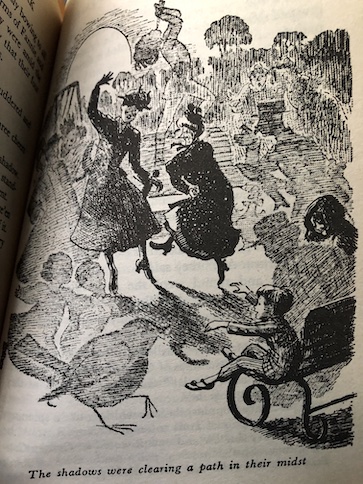
Hallowe’en – On Halloween, as the children are heading home with Mary Poppins with nuts and toffee apples, they meet the strange Mrs. Corey and her tall daughters. The children are told to be careful of stepping on shadows and that they should take care of their own shadows so they don’t run away. Mary Poppins hurries the children home and to bed, but the children find leaves that seem to be invitations to some kind of party. The children look outside and see shadows without people in the garden. The children follow the shadows, including their own, to the park. There, they see the shadows of everyone they know and even nursery rhyme characters. Mrs. Corey, her daughters, and Mary Poppins are there, and they explain that it’s the night before Mary Poppins’s birthday, and that’s what the celebration is about. They all dance with the shadows until Mrs. Boom arrives, upset, because her husband is distressed that his shadow is missing. Soon, other people also arrive to reclaim their shadows.
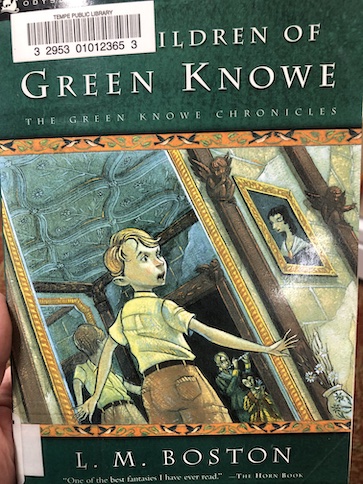
The Children of Green Knowe by L. M. Boston, 1954, 1955, 1982, 1983.
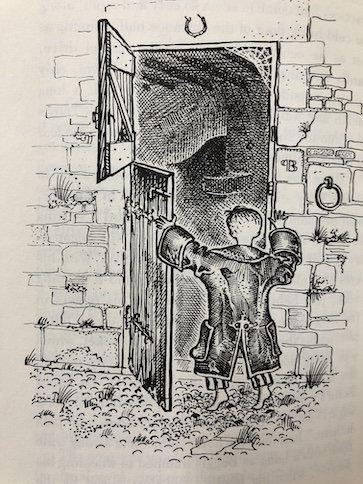
Seven-year-old Toseland is traveling by train to stay with his great-grandmother Oldknow at the old family home, Green Noah, for Christmas. His mother is dead, and his father now lives in Burma with his new wife, who Toseland doesn’t know very well. He has no brothers or sisters, and he spends most of his time at boarding school, so he is often lonely, wishing that he had a family outside of school, like the other boys. His great-grandmother is the only other relative he has, and he has never met her before. He is a little nervous at the idea of meeting her because he knows that she must be very old.
When Toseland arrives at the station, it’s raining, and there has been flooding, but there is a taxi-man waiting to take him to the house. When he arrives, he is immediately fascinated by the large, old house and all of the things in it. It reminds him of a castle, and he marvels at how his great-grandmother could live in such a place. He is surprised at how at home he feels there and how easily he likes and gets along with his great-grandmother. For the first time in his life since his mother died, he really feels at home, and when he asks if the house partly belongs to him, too, his great-grandmother reassures him that it does.
The two of them talk about what to call each other. Toseland’s great-grandmother asks him to call her Granny (although she is still often called Mrs. Oldknow throughout the book), and she asks him if he has any nicknames. Toseland says that the boys at school call him Towser and his stepmother calls him Toto, but he doesn’t like either nickname. Granny Oldknow says that Toseland is a family name and there have been other Toselands before him. The last one was his grandfather, and his nickname was Tolly, so Granny asks him if he would like to be called that also. Toseland says that he likes that nickname better than the others, and his mother used to call him that, so he is called Tolly from that point on.
Granny Oldknow shows Tolly to his room and helps him begin to unpack. It’s a wonderful room with many old toys that used to belong to the other children who have lived in the house in the past. Among the toys is an old dollhouse which Tolly realizes is a miniature version of the house they’re in. When he finds the miniature version of his room, he notices that there are four beds in it instead of one. He asks Granny Oldknow if other children stay at Green Noah, and she cryptically says that they do sometimes, and he might see them, but they come when they want to.
Tolly becomes fascinated by a portrait of three children in old-fashioned clothes with their mother and grandmother. Granny Oldknow tells him that those three children lived in the house long ago. The oldest boy was an earlier Toseland, who was nicknamed Toby. His younger brother was named Alexander, and their little sister was named Linnet. Granny Oldknow had been an orphan when she was a child and was raised at Green Noah by an uncle. Because she was an only child, she often lonely and liked to pretend that the children in the picture were her siblings, so Tolly decides that he’d like to do the same thing.
Tolly asks his great-grandmother questions about Toby, Alexander, and Linnet and learns details of their lives. Toby had a sword because he was going to be a soldier when he grew up, a pet deer, and a horse named Feste who loved him. Alexander had a book in Latin that he loved to read and a special flute. Linnet used to keep birds in a wicker cage that is still in Tolly’s room, along with the toy mouse that used to belong to Toby. Sometimes, Tolly thinks that toys in his room move when he’s not looking, and at night, he hears children moving about and laughing, and he thinks that it’s the three children from the painting.
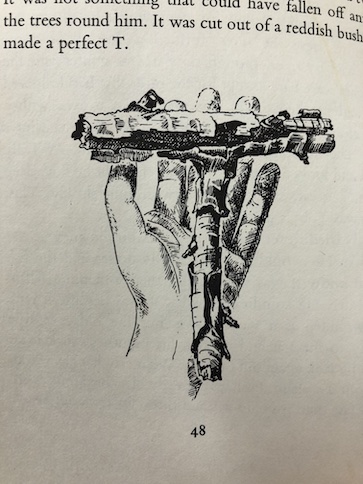
Tolly comes to the conclusion that the three children are still around Green Noah and that they’re playing hide-and-seek with them. He tries to play with them, too, and the children apparently give him a twig in the shape of a ‘T’. Granny Oldknow tells him that she used to play hide-and-seek with the children when she was young, and they would give her an ‘L’ twig because her first name is Linnet, like the little girl in the painting. Later, he hears the children singing Christmas carols. Tolly becomes frustrated that the children tease him and never really show themselves to him, but Mrs. Oldknow tells him that “they’re like shy animals” and that he has to give them a chance to decide that they’re ready to come to him.
He finds the key to the old toy box in his room, and inside the box, he finds more things that belonged to the three children. When he shows them to Mrs. Oldknow, she talks about how things were when the three children were alive at Green Noah. Tolly is shocked when he realizes for the first time that Toby, Alexander, and Linnet are all dead. Mrs. Oldknow gently tells him that they lived at Green Noah centuries ago and could not be alive now. Sadly, the children all died young in the Great Plague during the 17th century. Their illness was sudden and brief, and they all sickened and died in one day along with their mother. Tolly and his great-grandmother are descended from the children’s older brother, who wasn’t at home when this happened. However, the children never left Green Noah, which used to be called Green Knowe years ago. Tolly still loves the children, even though they’re ghostly and elusive. He craves the sense of family he gets from them, having been deprived of family feelings for so much of his young life.
Mrs. Oldknow continues to tell Tolly stories about the three children and other members of his family. As his connection to his ancestors grows, Tolly begins to catch glimpses of the children more and more, and eventually, he’s able to see them and talk to them. He asks the children about their mother, and the children say that she’s in heaven but doesn’t mind them coming back to visit their old home from time to time. The children don’t seem sad at being dead, enjoying the freedom of playing around their old home with the animals and the spirits of their old pets, who keep them company. Their final illnesses had only lasted a few hours before they died, and their deaths happened so long ago that they say that they hardly remember the Great Plague and what it felt like. Tolly is still sad and frustrated that the children appear and disappear so suddenly, but his attachment to them grows and so does his attachment to Green Noah itself. As Christmas comes, Tolly develops a bond with his family, both living and dead, and a realization that the old family home that connects them is also his home, a place they can all return to.
The book is the first in a series and is available to borrow and read for free online through Internet Archive (multiple copies).
My Reaction and Spoilers
This is a ghost story, but it’s not a scary ghost story. There’s nothing frightening about the three ghost children. It’s sad that they died so young, but at the same time, they’re not very sad about it themselves. They seem to enjoy playing together endlessly with the animals around their old home and seeing the new relatives who inhabit the house, their older brother’s descendants. Even their former pets are no longer sad at the children’s passing because they are also spirits who continue to play with them through the centuries. There is one semi-scary part of the story involving a witch’s curse placed on an old tree called Green Noah, which is how the name of the house was changed from Green Knowe, but Tolly is protected by the ghosts of his ancestors.
There is never any desire for the characters to rid Green Noah of its ghosts. They are family and are part of the place, as much a part of it as the living are. The ghosts do not feel trapped there, either. They are just revisiting the home they loved and the family members who now live there. They can come and go as they please, and the ghost children often do.
This also is not the kind of story where a child knows that a place is haunted but can’t convince the adults or tries to hide the ghosts’ presence from the adults. Mrs. Oldknow is fully aware that the ghosts are there and has known about them since her own childhood. Generations of children in the family have probably known about them and played with them, and they are also not the only family ghosts who inhabit the old house. At one point, Tolly and Mrs. Oldknow hear a woman singing and the rocking of a cradle, and Mrs. Oldknow says that she’s heard it before around Christmas, a grandmother singing to a baby. Tolly is confused because even little Linnet wasn’t a baby when she died, and Mrs. Oldknow says that this isn’t the children’s grandmother but somebody from generations earlier than the three children. This grandmother ghost has been around so long that Mrs. Oldknow doesn’t know who she or the baby are supposed to be, although we are told that they are about 400 years old, where the three children died about 300 years earlier. Generations of the same family have lived in the house and have all left their mark on it, and part of them is still there. Now, Tolly has also become part of this family home, and it’s also a part of him. The ghosts are hesitant to fully show themselves to Tolly at first and seem more attached to Granny Oldknow, probably because she’s lived there longer, since she was an infant. The ghosts know her, and she knows all of their stories. However, they are all family, and Tolly develops a new connection to his family as his great-grandmother tells him the stories about them, and he can hear and see the ghosts more often.
Really, that feeling of connection and connectedness is the primary focus of the story. In the beginning, Tolly is lonely, feeling like he doesn’t have a family and doesn’t belong anywhere or to anyone. His father lives far away in Burma with his new wife, and Tolly doesn’t feel connected to them. His mother is gone, and he spends most of his time at school, even having to remain there during the holidays when other students are going home to their families. His great-grandmother inviting him to Green Noah is the first time that Tolly feels a real connection to anyone in his family since his mother’s death, and through her stories and his encounters with the ghosts, he comes to see that he really is part of a much larger family, going back ages. Just because most of his family is now dead or scattered doesn’t mean that they’re not his family. They still love him, and he loves them, even across the centuries. Green Noah really is a family home, and it’s a place that family can return to, even those who seem to be gone forever. It’s a place that has known both the joys of a happy family and the tragedies of loss that families experience from time to time. Through it all, it’s still home, and importantly, it becomes the home that Tolly has been wishing for.
The story takes place in the days leading up to Christmas, and by Christmas, Tolly has received important presents. First, the ghostly Alexander grants him the give of his special flute, which had been a reward from King Charles II for singing so beautifully for him when he was alive. Tolly also has musical talents, and his great-grandmother decides to switch him to a different school so he can develop his talents and so he can stay at Green Noah during his school holidays. On Christmas, Tolly also receives his own pet dog, very much like the one that the ghostly Linnet owned, and he names his dog after hers, just as he has been named after all the other Toselands who have gone before.
In some ways, the story reminds me a little of When Marnie Was There (some people might know the story from the Miyazaki movie version), which has similar themes of family and belonging and ancestors reaching out across time to remind children that, while life is brief and often complicated, love is eternal and everyone belongs somewhere and to someone. However, The Children of Greene Knowe is a much gentler story, and it also contains some shorter stories about Tolly’s family.
How; Sign Talk in Pictures by Iron Eyes Cody, 1952.
I like nonfiction books on esoteric topics! This one has kind of a kitschy feel to it. It’s partly the “How” in the title, like the way Native Americans talk in old movies, but it was written around the time those old black-and-white westerns were made, and this sort of movie theme is actually a major issue with both the book and the author. We found this book as a library discard, and part of the interest for me is that another book by the same author (available through Internet Archive) was used as recommending reading in a later book on the same subject.
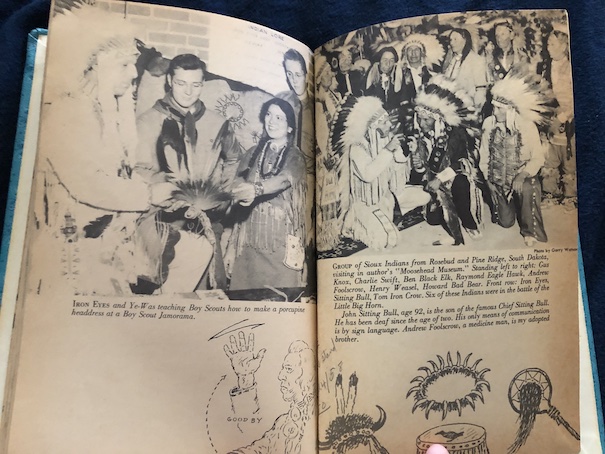
The author and his wife appear frequently in pictures in the book, demonstrating different signals in Indian sign language. Part of the book near the beginning explains about the author’s life, and what it says actually isn’t true, but the real story of the life of “Iron Eyes Cody” is pretty interesting. The main reason for the deception is that Iron Eyes Cody was an actor known for playing Native Americans in films, beginning in the 1920s. To support his film persona, he claimed to be of Native American descent, but the truth is that both of his parents were Italian. His birth name was Espera Oscar de Corti. In the book, he says that he was born on his family’s ranch in Texas, but he was actually born in Louisiana, and his parents owned a grocery store. The family did live in Texas for awhile. After his father died, he and his brothers moved to California to pursue acting careers, changing their last name to Cody. As part of his film persona, he was known to wear his Native American costumes on a daily basis, as if he were living a Native American lifestyle. Many people really believed he was Native American, but this costume quality is part of what gives the book that kitschy vibe. If you think that you’ve never seen or heard of Iron Eyes Cody before, it’s actually very likely that you have because one of his acting roles was that of the “Crying Indian” in the “Keep America Beautiful” anti-pollution PSAs of the 1970s. Yep! He’s that guy, and that’s the man who wrote this book.
So, you can disregard many of the details of Cody’s brief autobiography (there’s a fanciful story there about how he got the name “Iron Eyes”, but Chief Iron Eyes was actually the name of the character he played in the 1948 movie The Paleface with Bob Hope), but what is real is that he was married to an archaeologist of Native American descent, Bertha Parker (referred to as Yeawas in the book and also appearing in pictures to demonstrate the sign language), and they had two adopted children, also of Native American descent (one of which appears in pictures in the book). Outside of his acting work, Cody supported many charitable causes that helped Native Americans and promoted the study of Native American culture. He had a collection of Native American costumes and art that he called the Moosehead Museum, and he offered lessons in Native American arts and crafts, songs and dances, and lore out of his home. (The book doesn’t really offer details about how that worked, but my guess would be that his wife, the archaeologist, provided much of the instruction or at least educated Cody about these subjects before he taught others.) Cody also worked with the Boy Scouts, helping with Scout-O-Ramas and acting as an adviser about Indian (Native American) lore. He also sometimes helped the Girl Scouts. The book is dedicated to “the youth of America, especially the Boy Scouts of America.” If you would like to know a little more about Cody, I recommend this YouTube video and this one.
On the one hand, a person who is deceptive or misleading about their identity and credentials is worrisome and probably rightly considered unreliable. However, as near as I can tell (not being an expert on this topic myself), the information presented here seems reasonably accurate, and I think that’s probably due to research, consulting with experts, and the influence of the author’s wife, who did have credentials as an archaeologist and ethnologist and had connections to other scholars through her museum work. One of the beginning sections of the book is called “A Brief History of Sign Language by Bertha Parker Cody” with an accompanying list of works consulted (texts spanning 1880 to 1926, the 19th century ones apparently written by army officers because their ranks are given, if you’re curious – Bertha’s a woman after my own heart because she also added a note to her citation about a book with a particularly good bibliography section, and I’m a great believer in notes).
So, now that you know who’s talking here, let’s discuss what they have to say about Indian Sign Language, the main topic of this book.
In a foreword to the book, F. W. Hodge, director of the Southwest Museum in Los Angeles, where Bertha Parker used to work, discusses the concept of sign language and non-verbal cues used in communication by people all over the world. People in different countries, speaking different languages, might recognize a nod of the head as meaning “yes” or a finger placed against the lips as a gesture to be quiet, but sign languages convey much more than these simple ideas, allowing people to hold entire conversations. The Indian Sign Language presented in this book was used by many different tribes, ranging from Canada all the way south to Mexico. If members of different tribes encountered each other, they could use this language to communicate, no matter which language they spoke verbally. When people of European descent learned this sign language, they also gained the same ability to communicate with a wide range of Native Americans, without even needing to speak a single word aloud. Hodge said that this was an uncommon skill for people of European descent, although he does mention one of the army officers referenced by Bertha Parker Cody in her essay.
In her essay, Bertha Parker Cody also explains the concept of sign language, referring to it as a kind of “universal language.” She explains how people have used hand signs and gestures to convey ideas and concepts throughout history. She says that the reason why this type of universal language based on gestures was necessary because, in the territory now known as North America, there were once more than 500 different spoken languages among Native Americans. Even groups who were living no more than 10 miles away from each other might be speaking completely different languages, but they would need to be able to interact with each other and communicate. It is unknown exactly who invented this particular system of sign language (although there are some possible theories), but it was particularly developed by the Plains Indians because they were nomadic buffalo hunters, often encountering other tribes as they followed the herds. As an added benefit, because the language is completely silent, hunters could use it without startling their prey, and warriors could use it with each other before a surprise attack on an enemy. Chiefs of tribes would even use sign language to convey important messages because it would guarantee that people would pay attention and focus on the hand signs to interpret what they were saying. She explains that there are signs that the language changed over time and variations existed among different tribes, there was enough commonality that members of different tribes could communicate with each other effectively. She concludes by saying that their hope was that this book would help to keep knowledge of this sign language alive among young people at a time when it was falling out of use and living knowledge.
The actual vocabulary of the sign language is presented in sections organized alphabetically, with drawings and photographs of Cody and his wife performing each of the hand signs.
The book ends with a section about hand signs for numbers and counting and a section presenting examples for forming complete sentences using the hand signs presented in the book.
The final part of the book contains an Acknowledgement from Cody to all of the people who helped with the research and writing of the book, including the photographer and the artist who did the drawn pictures.
My Reaction
I’ve already given some of my thoughts and reactions in the review above, but there is one more thought that I had about this book. I completely understand why this book was library discard. It is an older book, and there are newer ones that cover the same topic as well or better. The author is an actor who is not as culturally relevant as he once was, and although it wasn’t known at the time of his popularity, he was deceptive about his life and past. In some ways, though, reading and researching this book and its background was educational. The education I would say that I got from this book wasn’t just about sign language but also about perceptions vs. reality, the roles people play, the personas created by the movie industry, and also the expectations of the public and the credentials we require or are willing to accept from those with a message to spread.
That last part is the most complicated part, but the resources that I consulted to get the details of Cody’s life pointed out that he did genuinely encourage interest in Native American culture and support causes important to Native Americans, which begs the question of whether he would have been accepted in that role of spreading interest and providing support if it had been known at the time that he was not actually a Native American himself. The truth is that he was something of a fake and a poser. He wasn’t really what he pretended to be, and in a sense, he was acting in a permanent role, even outside movies. He was given roles as a Native American in films because his physical appearance made it credible that he could have been one, and as far as movies are concerned, that’s really all that matters. Average people believed he really was a Native American because he was a good actor and convincing, and they didn’t know enough about real Native Americans to spot the parts about his dress and act that didn’t quite ring true. However, I think that Cody’s interest in Native American culture was genuine, probably the most genuine part of his performance, and he appears to have taken a genuine pride in it. A person lying about their background is deceptive and makes other things that they do suspect, but I’m still left with some questions. If he had been honest about his family’s background, would his interest in Native American culture been accepted or would people have sneered and said that he should have stuck to speaking only about the culture his family came from? Is it possible for someone to adopt a new culture not based on family or upbringing but pure personal interest and choice, and if so, could it ever be as deep or authentic as the culture one is born into and brought up in? Or, will it only ever just be an act or a deception, something that might only fool those who don’t know how to see the reality? What is the difference, or is there one? Could the person doing it even get so deep into the act that they themselves don’t know the difference anymore?
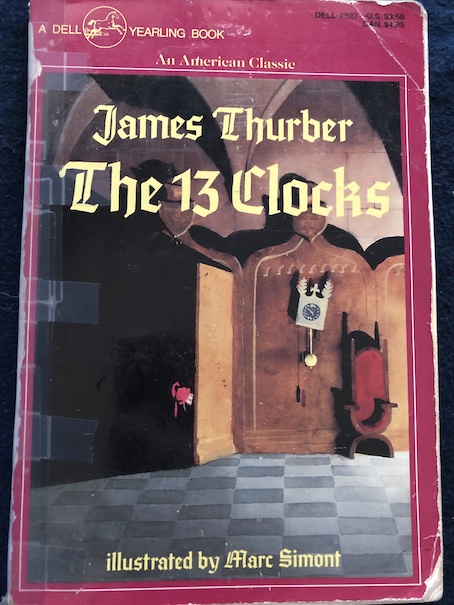
An evil Duke lives with his niece, Princess Saralinda, in a castle with 13 clocks that do not work. The Duke is a cold-hearted man, so cold that his hands are always cold, and he has frozen all of the clocks. Time itself seems frozen in the cold castle. The Duke comes to believe that he has actually “murdered” time, that it will never again be “Now” in the castle. The Duke is afraid of “Now.” “Now” has urgency and consequences, and he hopes that by stopping time, he will never have to confront “Now.”
One of the Duke’s fears is of his niece’s suitors. Princess Saralinda is lovely and as warm as the Duke is cold, so the Duke does not want to let her go. He needs her warmth as relief from his own coldness. Every time a potential suitor attempts to call on Princess Saralinda and ask for her hand, the Duke thinks up some impossible task for the suitor to accomplish with a sentence of death for failing to accomplish the impossible so Princess Saralinda will never be married.
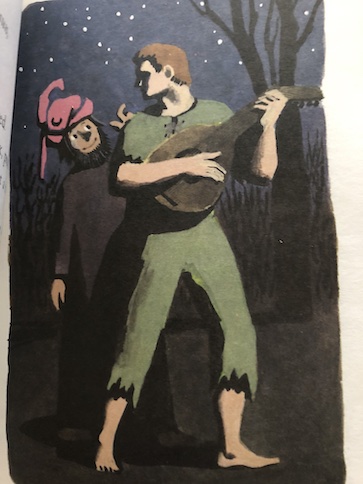
Then, a prince comes to town disguised as a minstrel named Xingu, which is dangerous because using a name that starts with ‘X’ is one of the things that the Duke sometimes kills people for doing. The prince is a youngest son, and as youngest sons often do in fairy tales, he has gone into the world to seek his fortune, adventure, and the lady of his dreams. At the town’s inn, the minstrel prince hears stories about Princess Saralinda, her suitors, and the Duke’s impossible challenges. In spite of the gruesome consequences for failing to complete the impossible tasks, the prince finds himself contemplating how he might be able to gain entrance to the castle and try his hand at defeating the Duke and winning the princess.
The minstrel prince begins making up a joking song about the Duke, and the people in town are nervous because the Duke kills people for any form of impertinence. One of the Duke’s spies, known as Whisper, witnesses the song and runs off to tell the Duke about it. Then, the prince is approached by a strange little man who calls himself the Golux and who offers to help him, although he freely admits that he makes up stories and often forgets what’s made up and what’s real. The prince doubts how helpful he can be, but the Golux suggests a story he can tell the Duke when the Duke considers killing him and feeding him to his geese, that Princess Saralinda can only be married two days after his death. The Duke would do almost anything to prevent Princess Saralinda’s marriage, so he wouldn’t kill him if his death might be the omen that causes her marriage to happen.
Soon, the Duke’s guards come to arrest the minstrel prince and take him to the dungeon. When he is brought before the Duke, the minstrel prince tells him what the Golux told him to say. The Duke isn’t sure whether he’s telling the truth or not, but since he’s not sure if he can kill him outright, he decides to set one of his impossible tasks for the minstrel to complete. The minstrel says that he can’t do an impossible task because he’s not a prince (as far as the Duke knows), but the Duke says that they’ll make him one just so he can do it.
As the guards escort the minstrel prince back to the dungeon, he sees Princess Saralinda, and she wishes him well, which is all that she can say in her uncle’s presence because she’s under a spell. The minstrel prince falls in love with her, and he realizes that his love is returned when she later manages to give him a rose.
In the dungeon, the minstrel prince encounters the Golux again and asks him how he got in and if there’s a way out, but the Golux is evasive, just telling another one of his stories about his mother being a witch and his father a wizard. However, the Golux has a useful suggestion for managing the Duke’s next impossible task: control what the task is through reverse psychology. He doesn’t use those exact words, but he tells the minstrel prince to beg the Duke to set him any task he likes but not to send him out in search of a thousand jewels. The Duke, being evil, will automatically set him the one task he begs not to be given. The minstrel prince says that he still can’t give the Duke a thousand jewels because he doesn’t have any jewels. The Golux points out that he’s no ordinary minstrel. He is actually Prince Zorn of Zorna, and his father will surely supply the jewels he needs. That’s all very well, but the prince isn’t sure if the Duke will give him the time he needs to reach his father and return.
Sure enough, the Duke sets the prince the task of getting a thousand jewels, but the matter is complicated because it turns out that he’s aware of who the prince really is. Knowing that it would take Prince Zorn 99 days to get the required jewels from his father and return, the Duke gives him only 99 hours to do it, and he further requires that all of the 13 clocks in the castle strike five o’clock (they are frozen at 10 minutes before five o’clock) when he returns with the thousand jewels.
The stakes of the task are high for both the Prince and the Duke because, as a guard explains to Prince Zorn, the Todal, which is a kind of blob monster in the service of the devil, waits to gobble up the Duke if the Duke fails to be sufficiently evil. If Prince Zorn passes whatever test the Duke sets for him, rescues the princess, and escapes, the Todal will surely put an end to the Duke.
The book is available to borrow and read for free online through Internet Archive (multiple copies).
My Reaction and Spoilers
This isn’t a princess book for young children because it has some dark content in it. The Duke is cruel to animals and has even killed children. The cruelty and killing isn’t described in detail, but the story is better for older elementary school children or middle school level. I’d say about 9 or 10 years old and older.
Through the course of the story, it’s revealed that Princess Saralinda isn’t actually the Duke’s niece. He later confesses that he actually abducted her from a castle as an infant, and even he isn’t completely sure of her true identity. Even as a child, she had that magical, glowing warmth that the Duke craves. He’s been raising her with the idea of marrying her himself when she’s old enough. He’s been unable to marry her up to this point because her former nurse was a witch and cast a spell that prevents him from marrying her until she’s 21 years old, and that time is approaching soon.
Part of the fun of this book is that it draws on many elements from fairy tales, like the woman who can cry jewels, which somewhat resembles the fairy tale about the kind girl whose words produce jewels and flowers when she speaks. The solutions to many of the problems in the story are also riddles. For example, if nothing makes a person laugh or cry, then literally nothing is what you have to provide. In the case of how to get the clocks moving again, Princess Saralinda has been the key all along. The clocks aren’t dead, merely frozen, and her warmth can get them moving again.
Of course, it all ends happily. Princess Saralinda’s true identity is established by the end of the story, and Prince Zorn is able to marry her. The Duke is thwarted and eaten by the Todal.
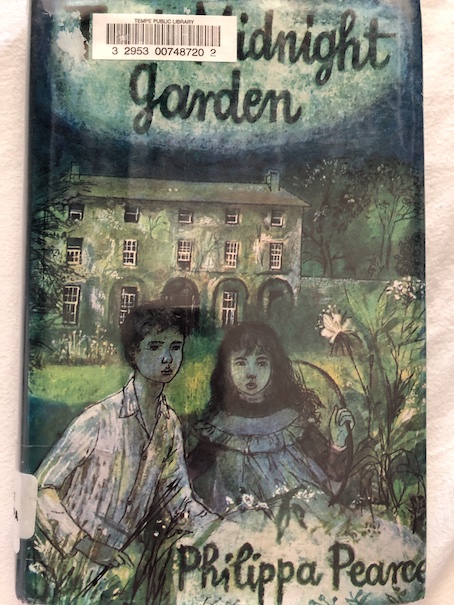
This is one of the most famous time slip stories for children! I remember either reading it or having it read to me when I was a kid, but I have to admit that I really remembered only the broad strokes of the story until I reread it as an adult.
When the story begins, Tom Long is sad and angry because his brother, Peter, has caught the measles, and it’s going to ruin their summer holidays. The two of them originally planned to spend the summer building a tree house in the apple tree in their backyard garden, but now, Tom is being rushed away from the house (sent into exile, as he thinks of it) so that he won’t catch the measles from his brother. Tom thinks that he would rather be sick with Peter than sent away by himself.
Tom is going to stay with his Uncle Alan and Aunt Gwen. His aunt and uncle are kind people who like kids, and in a way, it makes Tom feel worse because it makes him seem unreasonable for resenting spending the summer with them. If they were cruel, he could run away and everyone would tell him he was right for doing so, but when people are nice to you, there’s less to complain about, and Tom is in a complaining mood. The major problem with staying with Uncle Alan and Aunt Gwen is that they live in a small flat with no garden. Tom can’t even get out and see the sights of the city because he’s supposed to be in quarantine for awhile, just in case he’s already caught the measles from Peter and it hasn’t started to show yet. (It takes about 10 to 14 days after infection before measles symptoms start to show, so Tom has to stay in quarantine that long to be sure he’s not sick. Anybody with experience of coronavirus quarantines knows the drill, even if they didn’t before.) So, basically, Tom is going to be temporarily shut up like he’s sick, with the goal of making sure that he’s not sick and not going to be, but without the company of his brother or the comforts of his own home. They’re doing it for Tom’s welfare because measles can have serious side effects, and it’s not something anybody wants to get. There are sound reasons for trying to both protect Tom from infection if he hasn’t been infected already and also trying to protect others that Tom might infect while they’re waiting to make sure that he’s really okay, but it’s still a depressing situation. They’re planning on Tom quarantining for ten days with his aunt and uncle, just about a week and a half, provided that he doesn’t show any symptoms that would force him to quarantine for longer. The only people Tom is allowed to see during his quarantine period are people who have already had measles and are now immune to it, like his aunt and uncle.
The flat where Uncle Alan and Aunt Gwen live is in an old house in or near Ely, England that has been divided up into flats. It’s not a bad house, but Tom doesn’t think it seems particularly welcoming. He’s also a little offended that the guest room where he’s supposed to be staying used to be a nursery and has the characteristic bars on the windows that old-fashioned nurseries have to keep children from falling out. Aunt Gwen explains that those are left over from when the house used to be a private home and aren’t meant for him, but Tom is in no mood to be treated like he’s a baby. The one feature of the house he likes is the old grandfather clock that belongs to Mrs. Bartholomew, the owner of the house and his aunt and uncle’s landlady, who lives upstairs. The clock’s chimes can be heard all over the house, and it’s something of a joke and a source of irritation to the people living in the house because, even though the clock keeps perfect time, it never chimes the right number. The chimes are always some random number for no apparent reason. Of course, there is a reason.
Tom is bored and restless. All he has for entertainment is crossword puzzles, jigsaw puzzles, and his aunt’s old books from when she was a kid, and the books are just school stories for girls, so Tom doesn’t find them interesting. Tom helps his aunt in the kitchen, and he loves her cooking, but it’s a bit rich and gives him indigestion. Because of that, he often has trouble sleeping, but his aunt and uncle insist that he get ten hours of sleep a night because that’s what kids his age are supposed to need. They won’t let him read or get up or do anything when he can’t sleep, so he just has to lie awake, bored.
One night, while lying awake in bed, Tom hears the clock downstairs strike thirteen. That strikes him as odd because he’s never heard a clock strike thirteen times before, and he didn’t even think it was possible for a wrong clock to do that. He starts considering that maybe there is actually a hidden, thirteenth hour of night that his uncle knows nothing about, so that one free hour should belong to Tom, to with as he wishes. He’s not sure that idea really makes sense, but he feels compelled to get up and go downstairs to investigate.
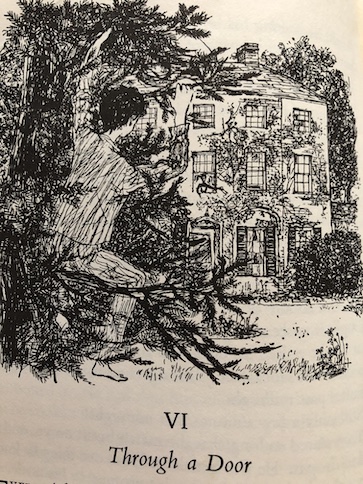
When Tom gets downstairs, he can’t read the clock because it’s too dark, and he can’t find the light switch. Then, he gets the idea to open the back door so he can read the clock by moonlight. However, when he opens the back door, he sees a beautiful lawn and garden instead of the empty yard his aunt and uncle told him was there. At first, Tom is angry that they lied to him about there not being a garden. He thinks to himself that he’s going to come back and see the garden in daylight. As he’s heading back inside to look at the clock, he encounters a young maid. He’s surprised to see the girl enter someone else’s flat without knocking or ringing the bell in the middle of the night. Then, he begins to notice that the house is different from the way he saw it during the day. The grandfather clock is still there, but the laundry box, milk bottles, and travel posters have been replaced by an umbrella stand, a dinner gong, an air gun, and a fishing rod. The girl calls out that she’s lit a fire in “the parlour,” and Tom watches as she crosses to another room, kind of melting through the door instead of opening it like a living person would. Is Tom seeing a ghost? Then, the vision fades, all of the old-fashioned furnishing are gone, and everything in the downstairs hall looks the way Tom remembered it from his arrival.
In spite of realizing that the house might be haunted, Tom is happier from his adventures and knowing about the beautiful garden outside. He now has something more exciting to think about than just being bored. However, he’s still mad at his aunt and uncle for keeping him in the dark about the garden outside. He tries to hint to them that he knows about it, but when he mentions seeing hyacinths blooming, his aunt tells him that’s impossible because it’s summer, and hyacinths are out of season. Tom is unsettled by that, and he runs downstairs to check. When he gets there, the lock on the back door is different from what he remembered the night before, and when he opens the back door, there’s no garden there, only the dust bins his aunt and uncle mentioned and a man working on a car. Tom asks the man, who lives in the flat where Tom saw the maid enter to light a fire if he has a maid, and man tells him no. Tom tries to ask him about the garden, but he starts crying when he realizes that the garden couldn’t have been real. The man tries to ask him what’s wrong, but Tom doesn’t want to explain it. He stops Tom from running into old Mrs. Bartholomew, who has come downstairs to wind the grandfather clock. Tom watches the winding process with fascination and feels calmer.
Tom begins to reason out how he could have seen a garden the night before when there isn’t one there now. He’s sure that he didn’t just dream it or imagine it, so he decides to conduct an investigation. He considers the different pieces of the puzzle – the house that looks different at night, the clock that chimes thirteen times, and trees that are now in the backyards of neighboring houses but which must have been part of the large garden he saw. Tom begins writing a series of letters to his brother about what he’s experiencing and his investigations into it, which he asks Peter to burn after reading. At night, he stays up, waiting for the clock to chime thirteen again … and it does. When it does, everything is as he saw it before – the different furnishings downstairs, the different latch on the back door, and best of all, the garden.
Tom visits the garden every night, noting that every time he goes, it’s a different time of day or a different season of the year. Time in the garden doesn’t correspond to time in the real world. Months can pass between his visits, even though Tom goes there every single night. It seems like, no matter how long Tom spends there, exploring, only a few minutes of the night has passed when he returns. One night, he sees a tree struck by lightning, but the next time he looks, the tree is just fine. Tom starts a discussion with his aunt and uncle about time without fully explaining why he wants to know how time works. When he poses the question of how a tree could fall over and then be standing upright again later, his aunt thinks that he’s talking about fairy tale or something he dreamed or imagined. His uncle says that it’s impossible without turning back the clock. The mention of a clock being turned back intrigues Tom, but his uncle says that’s just an expression, meaning to relive the past, which nobody can actually do. It’s a clue to Tom, though, about what’s really happening in the garden.
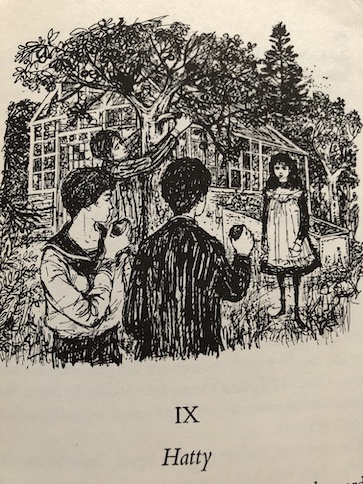
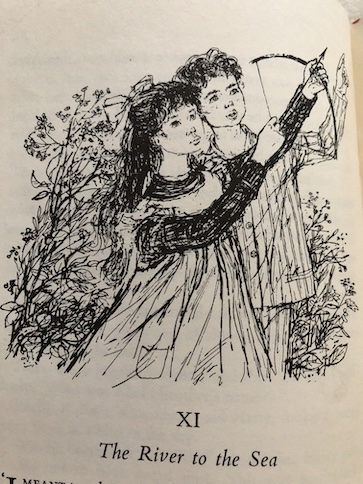
Tom also quickly realizes that he seems to have little substance when he’s in the garden. He can climb trees in the garden, but he can’t open doors by himself, for some reason. If he concentrates hard, he can walk through doors like a ghost, which is both frightening and fascinating. Also, most of the people he encounters can’t see him. Animals react to his presence, but people tend to look through him or past him and don’t seen to hear anything he says. There are three brothers who spend time in the garden, and Tom thinks that he’d like to be friends with the middle boy, James, but James never sees or hears him. The boys have a younger cousin, Hatty, who follows them around. They’re not very nice to her and often ignore her or exclude her from their activities, but Tom discovers, to his surprise, that Hatty can both see and hear him. Hatty becomes Tom’s friend, and they begin talking to each other, playing, and exploring the garden together.
Hatty is a sad and lonely girl who often plays imaginary games by herself in the garden. She tells Tom that she’s a captive princess, that the cruel woman who claims to be her aunt isn’t really her aunt, and that the mean boys aren’t her real cousins. The truth is that Hatty is an orphan and that her aunt resents her being her responsibility. Hatty’s aunt and cousins have money and servants, but Hatty is emotionally neglected. She has no one to be close to and share secrets with except for Tom.
Tom is so captivated by his shared time in the garden with Hatty that he tells his aunt that he’d like to stay longer. His uncle is mystified that Tom is really that interested in staying with them because he knows their apartment is boring, but his aunt is enthusiastic about him spending an extra week beyond his quarantine so she can show him some of the sights of the city. Then, Tom catches a cold that requires him to stay in bed for longer, but he is still able to visit the garden at night.
By this time, Tom has figured out that the garden once existed in the history of the house and that Hatty was someone who lived in the house at some point in the past, but he doesn’t really understand how or why he is able to visit her in the no-longer-existing garden at night. He still thinks that Hatty might be a ghost and even the garden might be some kind of ghost that haunts the house. However, Hatty tells Tom that she thinks he’s the ghost. Tom denies it, knowing that he’s not dead in his own time, but it’s true that, whenever he’s in the garden with Hatty, he is somewhat non-corporeal, unable to affect physical objects but able to walk through solid objects when he tries, and he is invisible to most people. Tom says that the only reason why he can walk through closed doors is that the garden itself, and every physical thing in it, is a ghost – he’s not passing through them so much as they’re passing through him because he’s solid, and they’re not really. Tom and Hatty argue about who’s a ghost and who’s not because, from each of their perspectives, they’re both real and alive, but yet, the entire situation is unreal. Tom sees pieces of the past changing and disappearing, and he knows what’s real in his time. However, Hatty can also say the same – she knows what’s real in her time, and Tom has a definite ghostly quality when he’s in her garden. What is the truth, and how long can the two of them continue meeting like this?
The book is available to borrow and read for free online through Internet Archive (multiple copies, including one in Chinese). It’s been made into tv versions (parts sometimes appear on YouTube) and a movie in 1999. The movie is also available online through Internet Archive.
If you’re interested in other time slip stories, see my list of Time Travel books.
My Reaction and Spoilers
Things to Do
First of all, I just have to get it out of my system: Tom’s family is not a creative bunch. I know the aunt and uncle took Tom in on short notice, but I’m just saying that with a little imagination, they could find more things for Tom to do during his quarantine. Two weeks is not that long if you have things to do and think about. There were always art supplies at my house when I was a kid, and even if you don’t have them on hand, paper and colored pencils or crayons aren’t very expensive. The cooking is a good activity, and maybe the aunt could teach Tom some new recipes that he could make by himself. With as much as the aunt is cooking, she’s also probably using things that come in boxes and cans, and boxes and cans can be made into things. Also, they could get the kid a book on something more interesting he can learn and use, like magic tricks he can practice or secret codes. They wouldn’t have to buy him books for just a couple of week, either. They could just go to the local library and ask the children’s librarian for some recommendations. They could teach him how to fold different kinds of paper airplanes or carve things out of soap (save the shavings in an old nylon stocking – it’s almost like soap on a rope you can use in the shower) or make a kite he can fly in the park when his quarantine ends. Heck, if he had a deck of cards, he could at least learn different types of solitaire games. There are over one hundred variations, and the kid just has to be entertained for a couple of weeks, 14 days. The activities don’t have to be very impressive if you can think of enough of them to have a different one each day for him to try to break up the monotony of the the more usual stand-bys, like reading and puzzles. Just to prove that it’s possible, I made a list:
Drawing – I mentioned before that paper and crayons or colored pencils aren’t too expensive, and he doesn’t need to be any good at it. It’s just a challenge and would give him something creative to do, maybe while listening to music on the radio or something. Bonus points if you know enough about art to tell him about different styles of art and suggest that he try some different styles, like cubism or surrealism. He could also use art supplies to map out things, like a plan of the tree house he and Peter want to build. After he’s done that, he could draw a creative map of an imaginary castle or mansion or a haunted house or an entire amusement park or an elaborate clubhouse he would build if there were no restrictions on space or money. It doesn’t have to be possible or even drawn particularly well as long as it’s entertaining.
Paper airplanes or origami – You can make some fun things out of folded paper, and if you know how to make different styles of paper airplanes or can find a book about it, you can conduct tests to determine which styles fly the best. Yes, you then have a lot of paper airplanes laying around, but if your goal is to pass the time, cleaning up also takes up time.
Card games – I covered that. There are a lot of things you can do with a deck of cards, even if you’re just playing solitaire. He could try to build a house of a cards. He could also learn card tricks and the order of poker hands. (I know that not every family would be okay with a kid learning the rules to a gambling game, but my parents never minded as long as we didn’t gamble with money, and it’s the sort of mildly daring activity that appeals to kids. Besides, this kid has nobody else to play with right now, except for his aunt and uncle.)
Magic tricks – I covered this one. There are (and were back then) books of magic tricks that a boy could study, many of which use ordinary objects that a person could find around the house. He could practice a new trick each day or spend an entire day with one book, trying anything that looks interesting.
Secret codes – Again, they had books about this even back then, and once you know a few principles, you can start making your own codes. When I was a kid, I liked to experiment with basic alphabet shifts, and secret codes often formed the basis of treasure hunts that I had with my brother. Tom can’t have a treasure hunt for his brother yet, but he could be encouraged to plan one. Give him a notebook where he can practice his codes and make notes of possible hiding places. He can also write coded messages to send to his brother and challenge him to read them.
Current events – Kids don’t often read the newspaper, but his aunt and uncle could introduce him to features of the newspaper and what’s happening in the world. A new newspaper arrives every day, and it’s a source of reading material. At least, he could look at the comics or the sports pages, if he likes sports.
Model town or castle – As I said, there are probably cardboard boxes and cans being thrown out of this house, and they could be appropriated for some kind of craft project, ideally one that would take awhile for Tom to build and that he could add to each day. One of the best things to make out of random junk would be a town or a castle. Tin cans are towers and turrets, and cardboard boxes are the main buildings. Cover the outsides of the cans and boxes with plain paper and draw on them for decoration. Make people out of paper and cardboard. It could turn out amazing if he’s willing to put the time into making it as detailed as possible, but if it doesn’t turn out amazing, it’s okay because it was just junk anyway.
Plan for the future – This quarantine will end. Tom can mark off days on the calendar until he’s in the clear. Give Tom a guidebook to the city and tell him to make a list of places he wants to go and things he wants to do when the quarantine is over. It could be amusing for at least an afternoon. He’ll learn about the sights and landmarks of the city and be mildly entertained thinking of fun things to do in the near future. It will give him something to look forward to. It’s also an incentive for Tom to behave himself because his aunt and uncle can tell him that they’ll take him places he wants to go if he’s good about abiding by the rules of the quarantine until it’s over. Admittedly, Ely is one of the smallest cities in England, so there wouldn’t be as many sights to see as in London, and Tom already knows about the Cathedral, but there are shops, restaurants, and museums there. Some of them were founded after the 1950s, but there were some in Tom’s time, too. He visits at least one museum with his aunt at the end of the quarantine and goes to the movies with her. If they can’t find enough to do just in Ely when Tom’s quarantine is over, they could also spend a day visiting surrounding towns.
Discover or develop your mental powers – The amusement potential with this one depends on whether the kid has reached that phase where kids get fascinated by things like psychic abilities. Many kids go through a phase like that, and since Tom seems to like the idea of being in a haunted house, he’s probably the right age. If you can get him a book about psychic powers or telekinesis, he’d probably find it a fascinating read. The aunt and uncle could talk to him about whether or not such things actually exist, and he could try to test himself to see if he has any such powers. I had an English teacher in middle school who actually did that with us. There was only one test I really did well. Most people don’t do those types of tests well at all, but it’s amusing for at least an hour or two to try or talk about. If he happens to do better than average on anything, he could brag about it to his brother and his friends, telling them that he discovered and honed his psychic powers in a spooky old house during his vacation.
Write a story or poem – All you need is paper, a pencil, and some imagination. Writing a long story and trying to do it well could cover the entire quarantine period by itself, it would give him something to think about, and he’d have something to show for his relative isolation. Of course, the real goal is to be entertained and pass the time, so the story or poem doesn’t have to be great. It can be as crazy as Tom wants to make it, as long as he’s amused.
Start learning a language – Two weeks isn’t enough to really learn to speak a language, but it’s enough to learn a few words and phrases. If his aunt or uncle has an old textbook lying around from their student days, they could use that, or they could pick up a used one cheaply or get one from the local library. It might make Tom groan because it’s a little like school, but it would be a challenge to practice using words from another language. Of course, that depends on which words and phrases the kid learns. There can be a lot of amusement potential in learning to insult people in other languages, although that lesson should also come with the warning that you never know which languages other people might know.
Board games – A classic! If they’re not into card games, Tom can spend evenings playing board games with his aunt and uncle. Most people have chess and checkers sets (his uncle does offer to teach him chess later in his visit), and Monopoly and Clue (or Cluedo) were common back then. Monopoly games are notorious for taking a long time to finish.
Invent a game – There are a lot of things you can do if you have paper and pencils, and one of them is to design your own board game. It can be about anything, and the rules can be anything you want. When you think you’ve got it the way you want, try playing it and see if there are any adjustments you need to make. Tom can also make his own jigsaw puzzles by cutting up a picture he’s drawn or gluing a magazine picture to a piece of cardboard and cutting it up. The cardboard can come from an empty cardboard box or he can remove the cardboard back of a drawing pad, if he no longer needs it.
Jokes – Get Tom a joke book and have him mail his brother a new joke every day. When he’s done reading the book, they could challenge him to try to make up some jokes of his own. Sending and receiving mail is an activity by itself, and Tom does write to Peter during the story.
Learn to dance – This is assuming that the aunt and uncle also know how to dance, but I think it was pretty common back then for people to know at least a couple of basic dances. Tom could practice with his aunt in their living room (if they have to rearrange the furniture to do it, that’s another time-consuming activity), and it would give him something to do for some mild exercise. Even if a boy might be embarrassed to dance with his aunt, nobody’s going to see them while he’s in quarantine, he doesn’t have to tell people who taught him, and if he’s willing to learn, it could help him later at school dances.
See? If you think about it, there are plenty of things to do for just a couple of weeks. There are even more if you’re willing to invest in buying things like craft kits or model kits or other things necessary to start a new hobby, but I was trying to be as basic as possible, mostly relying on inexpensive books and paper and pencils. However, the plot of the book requires Tom to be bored and lonely, so they can’t do those things, and that brings us back to the story.
Measles
How readers receive the beginning premise of the story, that Tom was sent away from home because his brother has the measles, depends partly on their generation. I have never actually seen a live case of the measles in my entire life, as of this posting. I was born in the early 1980s, and growing up, everyone I knew who had the measles was an older person who had it as a child in the 1950s or earlier, before the time that this story was written. Vaccines against measles have been available in the United States since the early 1960s, too late for my parents but well before I was born.
I know that this disease still exists, and it’s been the subject of recent controversy because there’s been a recent outbreak in the American Southwest among unvaccinated people (2025), but I grew up in a community where measles vaccines were required for going to public schools. Because all of the kids I knew when I was young went to the same school with the same requirement, everybody I knew in my own generation was vaccinated, and none of us ever got measles.
I’m pointing this out because the first generation of children to read this story would have found the situation familiar, but it’s not something that happened to me or anybody else I knew as a kid. When I was a kid, I used to think of measles as an old-timey old people’s disease, one of the diseases that your characters could get in the Oregon Trail computer game that could either delay or kill your characters, but not something that I ever expected to encounter in the real, modern world. When I read books like this as a child, that was kind of how I thought about it. For me, it marked the time period of the story as “old.”
The closest equivalent from my youth was chicken pox because that was a spot-causing disease that I knew people had to be quarantined for, and it was unavoidable because there was no vaccine available in my earliest years. I did have chicken pox as a small child, which is why I have a scar on my face now, and I was isolated from other children when it became obvious that I had it. However, my younger cousins were vaccinated for chicken pox when that vaccine became available in the 1990s, so they’ve never experienced the disease that afflicted me. For the next generation, I get to be the older person who has a story about an old-timey disease because life moves on. It’s just part of the cycle of time and history. But, just as background for my mindset as a child reader, when I was a kid, I pictured measles as a kind of old-fashioned but more serious chicken pox. That’s not medically true because they’re separate diseases, but I just never saw or experienced actual measles, and that was the closest equivalent I could imagine at that age.
For younger generations, the covid pandemic of the 2020s might be what they picture when someone talks about quarantines.
The Truth About Hatty (Spoilers)
So, what is the truth about Hatty and the midnight garden? This is a time slip story, not a ghost story, although sometimes the two of those go together in books. In this case, the time slip is not based around ghosts but around memory. When Tom is seeing the garden as it was in the past, he is seeing it as it existed in Hatty’s memories. He is somewhat correct in saying that he is non-corporeal there because the garden itself is non-corporeal – it’s a memory. Hatty is still alive in Tom’s time, and Tom is able to enter the garden when she revisits it in her memories and when she remembers him.
The twist in the book (spoiler) is that Hatty is Mrs. Bartholomew, the current owner of the house and the landlady of the flats. When Tom is trying to figure out whether Hatty’s a ghost, he briefly considers asking Mrs. Bartholomew about the history of the house, but he rejects the idea because his aunt and uncle told him that Mrs. Bartholomew only moved to this house fairly recently, after the death of her husband, so Tom assumes that she has no connection with or knowledge of Hatty and her family.
I liked the part where Tom tries to do some research and figure out what time period child Hatty lives in based on the types of clothes people wear in her time. He has some difficulty finding a good source with details about the variations in clothing styles over the years. He does realize that Hatty was a child in the Victorian era, between the 1830s and the early 1900s, but he ends up guessing earlier in the Victorian era than she actually lived, which is why he thinks she’s definitely dead and a ghost instead of an elderly lady in the 1950s.
As Tom continues his time travels into the past, Hatty gradually ages because Mrs. Bartholomew is remembering different times in her life. Eventually, Tom sees Hatty fall in love with a young man she calls “Barty.” Tom is hurt because, when she falls in love with Barty, Hatty seems to forget about him and is suddenly unable to see him any more. It’s because Mrs. Bartholomew’s focus is shifting in her memories, focusing more on remembering Barty than remembering Tom. The last time when Tom tries to go back in time, the garden is suddenly not there, and he crashes into the dust bins outside. His aunt and uncle think he was walking in his sleep, and Tom is depressed that Hatty seems like she’s gone forever. He learns the truth when Mrs. Bartholomew insists that he come upstairs and apologize for waking her by knocking over the dust bins.
Mrs. Bartholomew thought for years that Tom was some kind of ghost who became harder and harder to see as she got older, probably because, as she got older and started thinking about other things, like Barty, she wasn’t concentrating so much on Tom. The night when the garden didn’t appear, Mrs. Bartholomew was dreaming about her wedding, so she wasn’t thinking about the garden. When Tom crashed into the dust bins, he called out her name, and she woke up and recognized his voice. Tom is happy that Hatty remembered him all these years, that she didn’t deliberately forget him, and that she’s not dead or a ghost. Mrs. Bartholomew tells him about what happened in her life after to marriage to John Bartholomew/Barty. Hatty and her husband moved away from the house, and they had two sons, who both later died during World War I. She and her husband continued living together for many years, until his death, when she returned to the house where she’d grown up.
The Time Traveling
So, now you know who Hatty is, but what does the clock and its thirteen chimes have to do with her memories and Tom’s time traveling? The mechanics of the time traveling in time slip stories are rarely fully explained, but the characters in this book do consider and discuss the possibilities. Part of it seems to involve the Biblical reference engraved on the clock about “Time no longer” from Rev. 10 1:6. I thought it was an interesting approach, bringing religious references into the story. When Tom tries to talk to his uncle about how time works, his uncle goes into scientific theories of time and gets annoyed with him when he tries to talk about the angel in the Bible. After talking to his aunt, Tom gets a sense that his uncle believes in a different version of “Truth”, and that makes it difficult to talk to him. Most of what his uncle says about more philosophical and scientific explanations of time goes over Tom’s head.
What Tom eventually figures out from bits and pieces of his uncle’s explanation and his own reflection about his time-traveling experiences, is that perspective matters in relation to time. He has his perspective of how time moves – he’s been traveling back to the garden every night for a few weeks during the summer. However, Hatty has her own perspective of time – Tom has appeared to her in the garden roughly every few months over a period of about ten years of her life. When Tom considers the situation from Hatty’s point of view, he decides that people’s individual experiences of time are just pieces of the much larger experience of time and history. This is the point when Tom realizes that neither he nor Hatty are ghosts, just two people whose experiences of time have crossed. When Tom enters into Hatty’s time, she perceives it as the present and him as a ghost because he’s outside of his natural time period and not fully a part of her present. Similarly, the maid appeared ghost-like to Tom at first because she had somewhat entered into Tom’s present before fading back to her present, appearing to vanish like a ghost. Time in the garden appears to jump around because Tom is entering into different sections of Hatty’s time. That’s why he sees the tree in the garden standing, then struck by lightning and fallen, and then standing again, and it’s also why he sees Hatty as being around his age, then younger, and then getting older. All of those things he sees are just sections of Hatty’s timeline that Tom experiences in isolation from each other, a different one every night.
Toward the end of the book, Tom tries to take advantage of the way time seems to stand still in his own time while he’s in the garden, so he can stay longer with Hatty. He thinks maybe he’ll stay for days or even forever, safe in the knowledge that time back home is standing still, and he can return there whenever he wants, enjoying carefree days of playing in the garden forever. However, he has not fully reckoned that time is still passing for Hatty even when it seems to pause for him while he’s in her time. Hatty has gradually grown up, and is moving forward with her life. She can’t stay a little girl, playing in the garden forever.
When Tom talks to the elderly Mrs. Bartholomew later, she observes that “nothing stands still, except in our memory.” When she was younger, she had always thought that the garden would stay the same forever, but it didn’t. She realized that when she saw the tree in the garden get struck by lightning. Everything changes, sometimes gradually, and sometimes suddenly, but time always moves forward. The property was eventually split up by her cousin James when he was having trouble with his business and needed money. He sold off pieces of land at a time, so parts of the garden were built over by new houses. Eventually, all that was left was the main house and part of the old yard. When James decided to sell off what was left and move to another country to start over, Hatty and Barty bought the old house and some of Hatty’s favorite things, including the grandfather clock. Hatty admits to Tom that she used to intentionally misunderstand what time it was chiming on the clock and often got up extra early in the morning to go play in the garden. This is apparently the source of the clock’s weird chimes that don’t match the real hour. The clock is now connected to Hatty’s memories of the house and the garden, and Hatty’s memories are what controls what time it is in the garden when Tom makes his nightly visits.
Old Hatty was controlling the timing of Tom’s visits through her memories, although young Hatty was unaware of it. However, Tom realizes that even old Hatty wasn’t completely in control, either. Old Hatty comments that this summer, she’s thought of the garden far more than she ever had before and how much she wanted someone to play with when she was little. Tom realizes that old Hatty is describing his desires. When he first came to his aunt and uncle, he was bored and lonely and just wanted to play with someone, like he would have with his brother in their garden. It seems like Tom’s mood influenced Mrs. Bartholomew’s memories and dreams of the past, and their shared wish for friendship produced the midnight garden, so they could play there again.
In the end, Tom decides that “Time no longer” means that both the past and the present are both real and connected, not separate from each other, just as he and Hatty were always both real and connected to each other through their sharing of the same time. They were not separated by time but joined each other in it.
According to Wikipedia, the theory of how time works in this story is based on a book called An Experiment with Time by J. W. Dunne. When he was young during the late 19th century, Dunne had dreams that seemed to be visions of the future, seeing himself flying in a sort of airplane before airplanes had even been invented. He eventually became an airplane designer, and he also theorized about the nature of time. Dunne’s theory of time, called serialism, postulates that human beings are only conscious of traveling along a base timeline, where we experience the past, present, and future of our physical lives, but that there is also a higher level of time that can be experienced by a higher level of the mind or human spirit. Part of his theory states that, while people eventually die a physical death in the lower timeline, their spirit or consciousness lives on in the higher timeline for eternity. This is partly the conclusion Tom comes to when he starts seeing his time and Hatty’s as being part of some bigger timeline, and it’s referenced by the phrases “time no longer” and “exchanged time for eternity.”
How Did They Live? Greece edited by Raymond Fawcett, 1951, 1953.
This is a non-fiction book, part of a series about life in the past, but it’s told in the form of a story where the readers are visiting a man living in ancient Athens named Simonides. The story is told from the point of view of “we” as “we” visit Simonides, and he shows us around Athens.
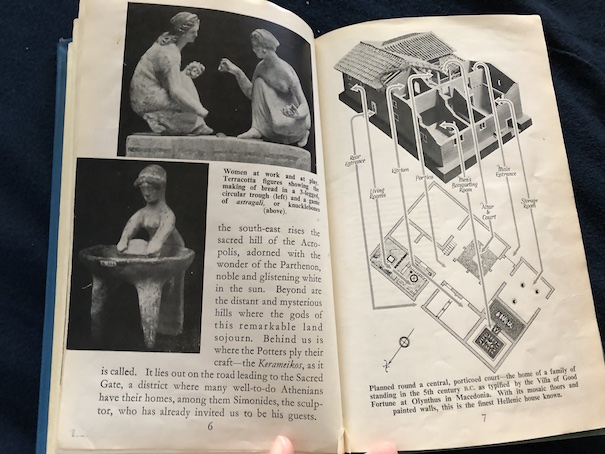
At the beginning of the story, Simonides meets us at the Temple of Hephaestus. The book provides a map and a description of the city so we know our way around. Simonides is a sculptor, and he lives in a nice house in an area of the city with well-to-do people. The book provides a map of the interior of Simonides’s home. His house is bigger and nicer than those of poorer people, and he also owns slaves. (The women playing a game on this page are playing Knucklebones, a precursor to modern Jacks but played with animal bones.)
Athens, like other cities in Greece at this time, is actually a city-state, an independent state with its own government, separate from other Greek city-states. Simonides explains that he served in Athens’s army when he was younger. Now, as a sculptor, he works with an artist producing public art in Athens. During a war with Sparta, many homes and buildings were badly damaged, so they’ve been rebuilding what was ruined and creating new public monuments.
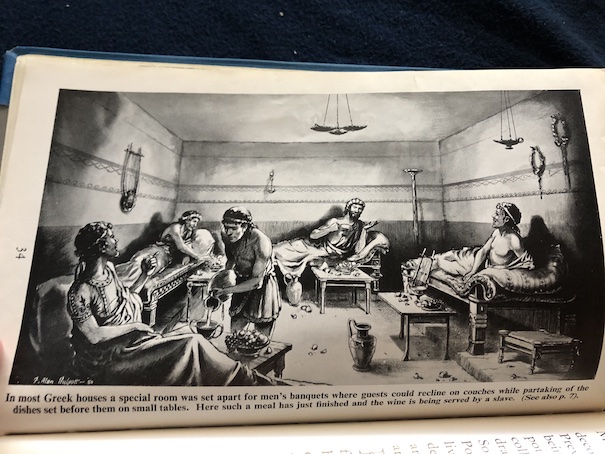
Simonides takes his guests into a special dining room, where we can relax. Guests are only allowed into areas of the men’s quarters of the house. The women’s quarters are strictly private, and we are told that the women in Athens spend most of their time at home, tending to household tasks. Usually, they only go out for special occasions, like festivals or plays. The Athenian women do not have the rights to property and having a say in public life that the men do. However, women from wealthy families lead comfortable lives and authority with in their houses. The book puts it, “Besides running the household she has her little vanities and the universal feminine interest in dress and adornment to help her and, in spite of her seclusion, she contrives to keep herself pretty well informed about what is going on in the city.” The part about the “little vanities” seemed a little insulting to me because I personally don’t like vain and shallow women who can’t think outside of the clothes closet, and I know plenty of women who aren’t in clothes and fashion. It seems like one of those cases where interest in these things might not really be “universal” but it’s something that women do because there just isn’t that much else for them to do. If they had more options of other activities, some of them might have found other things to do. The book goes on to describe various styles of women’s dress, hair, and makeup.
As the guests, we are invited to spend the night at Simonides’s house, and the next day, slaves bring us water to wash in and a breakfast of pieces of bread in wine. Then, we visit the agora (marketplace) with Simonides. There are people hanging around, socializing with friends, and the book describes the tunics and mantles they wear. After Simonides makes his purchases, he has his slaves carry them home. As we wander through the public meeting places, Simonides explains about the local philosophical groups that meet there, like the Stoics. We even meet Socrates as a young man.
After the shopping and visiting the public meeting places, we return to Simonides’s house for the midday meal of fish, vegetables, fruit, and bread. After the meal, Simonides’s wife, Hestia, explains more about the lives of women and children in Athens. As explained before, women have fewer rights than men, and female children do not receive as much education and training as boys do. Children younger than seven are all raised in the women’s quarters of the house. They play with toys like rattles, dolls, balls, spinning tops. Girls like to play on swings and see-saws and learn to dance, while boys play with kites, hoops, and hobby-horses. They all listen to stories like Aesop’s Fables to learn moral lessons. At the age of eight, boys begin to go to school, and at the age of eighteen, they join the army. Meanwhile, girls are taught to handle domestic tasks.
After that, we make a visit to the Acropolis to see the Parthenon, which is the Temple of Athena. The carved figures in the pediments of the building tell stories from the life of Athena. That evening, Simonides invites some friends to the house for a dinner party in his banquet room, where people eat while reclining on couches.
The next day, we learn about pottery and how it is made. The book describes the types of pictures and designs painted on pottery and says that the style with red figures painted on a black background is a newer style. Before, black figures were painted on a red background.
Toward the end of the book, we attend the Panathenaic Festival, which is meant to honor Athena. The festival includes athletic competitions and music and literature contests. There is a procession of important public officials and animals to be sacrificed to Athena. We (the guests) ask Simonides to explain more about the religion and gods of Ancient Greece, and he does. Religion is an important part of public life in Athens, but the book includes a suggestion that Simonides might not actually believe in the gods and goddesses of Ancient Greece: “We do not ask Simonides if he himself believes in these gods. But we have an idea that, like many other Grees, he may not do so, for he suggests that a knowledge of the gods has been handed down from the poets of old and the sculptors have clothed the ancient myths in beautiful forms.” That’s not much of an explanation, although I suppose it’s reasonable that people would believe in the religion of Ancient Greece to varying degrees, and there would have been at least some disbelievers. That’s found in pretty much every religion. There are also people around the world in modern times who engage in religious traditions less out of personal belief than out of civic or cultural participation (like this description of Shinto in modern Japan), which is the implication about the people in this story.
The book ends with a visit to Olympia to see the ancient Olympic Games.
My Reaction
I love books that explain daily life in different time periods, and I thought this one was pretty well done. It covers a few days in the life of Ancient Athens and also does a good job of explaining the wider society of Athens. Most of the perspective is on a fairly wealthy family and their slaves. I found parts about the descriptions of the lives of women and slaves distasteful, but the descriptions and attitudes of the people seem pretty accurate for the time and place. My feelings were more about not liking the lifestyle and circumstances than about disagreeing with the author. There are more details about the raising and schooling of children and about food and clothing than I’ve included in this description.
I particularly liked the maps of the city and the interior of the house. I also liked the way they included Greek words and explained their meanings, like kerameikos (pottery, note the resemblance to the word “ceramics“). Even though I took a philosophy class in college and learned about the Stoics, I didn’t remember the professor explaining that the origin of the word “Stoics” was the stoa, the public gathering place like a covered porch where they would meet.
I was confused for a moment when the book explained that Simonides doesn’t bow when he meets people “as we would do.” As an American, I wondered, “Who’s ‘we’?” Americans aren’t in the habit of bowing to random people we meet on the street, either. I checked, and the book was printed in England. British spellings in the book (“honour” vs. “honor”) also confirm that this is a British book. I didn’t think that people in England in the 1950s bowed to people either, except maybe during important events with royalty and nobility. The most I would ordinarily expect would be a nod or bow of the head to acknowledge other people, and people in the US do that, too.
When I first read this book, I didn’t have a copy of it because copies are collector’s items, and many of them are too expensive for me to afford, but after I read this book online, I managed to find a physical copy at an affordable price! I didn’t read this book as a child, but it’s exactly the kind of book I would have loved with atmospherically magical places (although no real magic), mysterious memories, and an orphan with a hidden past. This book was my introduction to the the Ian and Sovra series, although it’s the third book in that series. It’s available to borrow and read for free online through Internet Archive.
Thirteen-year-old Cathie lives at St. Ursula’s Home for Female Orphans in Birmingham, England. She has lived there ever since she was a young child and was found wandering the streets of London after a bombing raid during World War II. When she was found, she was wearing only a nightgown and clutching a locket that held a picture of a dark-haired woman and some dried flowers. She was unable to tell anyone her full name, only calling herself something that sounded like “Cathie.” (Hint: It “sounded like” Cathie. It wasn’t actually “Cathie.”) There was a label attached to her clothes, but it was torn. It only had the first part of her name (“Cat”) and the words “Passenger to” followed by what looked like the beginning of a place name that started with the letter “K” followed by “via” and what looked like the beginning of King’s Cross. If the label had been intact, there would have been no trouble identifying the child at all. The authorities made inquiries for her family or anyone who could identify her, but no one came forward. The conclusion was that her parents must have been killed in the bombing raid and that she had no other living relatives. Her family, whoever they were, was probably not from London because she was found near some railway station hotels, which had been destroyed. Most of the people staying there were killed, and the hotel records were also destroyed, leaving no further clues to Cathie’s identity. Cathie was sent to the orphanage and given the full name of Catherine Harris, but she knows that isn’t her real name. She has no recollection of the traumatic night of the bombing, but she has a vague sense that she has a real home and family somewhere else and a desperate need to discover her real identity.
One day, while reading a poem by Wordsworth aloud, a description of the seaside awakens a memory in Cathie of her early childhood. She’s had dreams of the seaside before, but she’s never been to the seaside since coming to the orphanage. Her memory of it is so clear that she’s sure that it’s not a dream but a place she’s actually been in the past, perhaps even the place where she used to live. She clearly remembers playing in the white sand on the beach, but she just can’t remember where the beach is.
When Miss Abbott, the headmistress of the orphanage, chides her for stopping her reading of the poem aloud, Cathie is upset that she disrupted her vision and her attempts to remember and screams, throwing the book across the room. Later, when she is called to the headmistress’s office to explain her fit of temper, she explains about the memory. The headmistress once again tells her the story of the night when she was found and shows her the locket and label that were found with her. The authorities honestly tried everything to locate her family and learn her original name, but since all attempts failed, the headmistress tells Cathie that she’s going to have to reconcile herself to not knowing. They’re not even completely sure whether the locket is Cathie’s or not because she was carrying it instead of wearing it, so it might have been something that she just found in the rubble after the bombing and picked up.
The headmistress says that she’s known other girls before whose birth names and parents were unknown, and it’s common for them to imagine some grand past or wealthy relations, pretending that they’re the long-lost daughters of a duke or something, but she wants Cathie to be more practical than that. Her parents are almost certainly dead, and if Cathie had any living relatives, Miss Abbott thinks they would have claimed her before. Miss Abbott thinks it’s unlikely that Cathie will ever get the full story of her past, no matter what she may or may not remember from a seaside holiday. Even if she somehow managed to locate the beach she’s thinking about, Cathie’s parents are dead, and there would be no one waiting for her there. Miss Abbott wants Cathie to focus on the here and now, applying herself to making a future for herself and making friends with other girls. Miss Abbott says that family isn’t everything because even blood family members aren’t always supportive to each other, but learning how to make and keep supportive friends will ensure that Cathie won’t be lonely. She says that Cathie will have a much easier time making and keeping friends if she improves her attitude and learns to keep her temper. It’s actually not bad advice if it’s really impossible for Cathie to learn about her past or if she genuinely has no relatives, but Cathie has a strong sense that isn’t the case for her.
Cathie can’t stop wondering about her memory of the sea and her mysterious past. She’s sure that the locket really did belong to her, but she can tell that the picture in it is much too old to have been her mother because of the woman’s hairstyle, which looks like styles from about 100 years earlier. The woman is standing in front of some mountains, and Cathie wonders if those mountains are a real place as well. She keeps thinking that, if she can get away from the orphanage and see other places, maybe she could find the place she remembers and learn who she really is.
As punishment for her temper tantrum, Cathie is sent to do some mending work for Miss Langham, who owns a big house nearby, instead of going to the pictures with the other girls. Cathie doesn’t mind too much because they were going to see a movie that she didn’t really want to see, and she also likes sewing and Miss Langham. While the two of them have tea in Miss Langham’s garden, Cathie brings up the topic of mountains, and Miss Langham mentions that she likes mountains, too. When she was younger, she used to go for mountain hikes. Cathie shows Miss Langham some embroidery work that she’s been doing with a floral design based on the little flowers in her locket, which look like silver buttercups. Miss Langham recognizes the flowers as Grass of Parnassus, which grows in marshy places, but not in Birmingham. She says that she used to see those flowers when she was younger and went hiking in the mountains in Scotland.
For the first time, Cathie realizes that she might not be English at all. If she had come from somewhere else, that might explain why no one in England knew who she was. The place that she’s remembering might be somewhere in Scotland. If she had really been a passenger from King’s Cross station in London, the train that brought her there might have been the Flying Scotsman, which Cathie knows comes to that station. Cathie tries to think of a place in Scotland that starts with ‘K’, which might have been where she was originally from. Feeling increasingly stifled by the strict rules of the orphanage, the lack of privacy at the orphanage, the bleak city, and Miss Abbott’s attempts to get her to stop dreaming about her past, Cathie begins plotting how she can run away to Scotland and start looking for the secrets of her past.
The next time she sees Miss Langham, she shows her the locket with the flowers, and Miss Langham confirms that the flowers are Grass of Parnassus. She also notices something that no one else who has looked at the locket has noticed – the little ribbon that’s holding the flowers together has a tartan pattern (a special kind of plaid pattern). When Cathie looks closer, she sees that the woman in the picture in the locket is wearing the same tartan. Cathie is excited because she realizes that this is confirmation that she was originally from Scotland. Even better, Miss Langham tells her that there are tartans that are specific to certain families or clans. Miss Langham doesn’t know enough about tartans to recognize which clan’s tartan is in the locket, but Cathie realizes that if she can find someone who can identify tartans, she has the key to learning who her family is! (Yes, the tartan pattern in the story is a real tartan, and it is one of the tartans shown on the tartan site page I linked. I checked after I knew what family to look for. But, it’s tricky to figure it out based only on the description in the book because some clan tartans share color combinations. To really identify which is which, you’d have to actually see and recognize the patterns of the colored lines and squares in the tartan. There are no pictures in the book.)
Miss Langham begins to like Cathie and sends an invitation to the orphanage to invite her to spend a few days with her in her home. Since Cathie has been pretty well-behaved lately, Miss Abbott decides to let her visit Miss Langham for a few days, although she has some misgivings because she can tell that Cathie has been acting oddly, as if she were keeping a secret. This visit to Miss Langham is critical because it gives Cathie the means to go to Scotland and try to find her home and family.
When Cathie goes to Miss Langham’s house, she isn’t there. Instead, Mrs. Riddle meets her and apologizes to her on Miss Langham’s behalf. The visit is canceled because Miss Langham’s brother is ill, and Miss Langham has gone to see him. There was no time to inform the orphanage of the change in plans before Cathie left because they don’t have a telephone. Cathie is bitterly disappointed because she had been looking forward to the visit, but Mrs. Riddle gives her some tea and cake and a note that Miss Langham left for Cathie. The note tells Cathie where to find some money that Miss Langham left for her to pay for purchasing the embroidered place mats that Cathie had been making with the Grass of Parnassus design. Suddenly, Cathie realizes that she now has money that no one else knows about. Her clothes already packed in her luggage for a few days away, including some holiday clothes that are different from the orphanage uniform, and no one is expecting her back at the orphanage for days because they all think that she’s with Miss Langham. Her opportunity to escape has come!
Feeling obligated to let everyone know that she isn’t dead when they discover that she’s missing, she adds a note of her own onto Miss Langham’s note that asks her to tell Miss Abbott that she has gone back to the place where she came from. Cathie thinks that, when the message reaches Miss Abbott, Miss Abbott will assume that Cathie has gone to London, the place where she was found as a young child. But, she has a few critical days to reach Scotland before her disappearance will even be discovered. She changes into her plain holiday clothes and goes to the train station in Birmingham. After she gets on the train, she uses her sewing things to remove the distinctive red trim on her coat so it won’t look like it’s part of an orphan uniform anymore.
The first place she goes is Derby, and she decides to hitchhike further north from there to save some money. She gets a ride from a truck driver (lorry driver, this is a British book), but he gets concerned that she might be a runaway or in some kind of trouble. He notices that the name she gives him isn’t the same as the one written on her luggage, a detail that Cathie had forgotten. At least, the driver has no bad intentions toward her and is kind enough to be genuinely concerned for her welfare. He tries to take her to a police station in Sheffield, but Cathie slips away from him and hides in the back of his truck, so he’s tricked into taking her further. When she gets the chance, she gets out and hides in the back of another truck that takes her almost to the border of Scotland. When this driver discovers her, she makes up a story about hitching rides to Scotland because she’s going there for a job in Edinburgh. She decides to take a train the rest of the way to Edinburgh, but by this time, Miss Abbott has already discovered that Cathie is not with Miss Langham. At first, Miss Abbott does think that Cathie might be going to London because of her note, but the police report of a possible runaway in Sheffield gives Miss Abbott the idea that Scotland might be Cathie’s intended destination. Cathie narrowly avoids being picked up by the police as she falls asleep in the waiting room of the train station because they think that she’s already left on an earlier train.
Once Cathie successfully reaches Edinburgh, she isn’t quite sure what to do next, but she enjoys being in the city, feeling like Scotland is the right place for her to be. Then, she spots a boy and a girl who are about her age, noticing that the boy is wearing a tartan kilt (but not the tartan in Cathie’s locket). When the boy, Ian, trips and drops the parcels he’s carrying, Cathie helps him. She makes friends with Ian and Sovra (the girl), and they invite her to come with them to see Edinburgh Castle. They notice that she speaks with an English accent and ask her about where she’s from. She confides in them about running away to find where she’s from, hoping that the answers lie in Scotland. Ian and Sovra are thrilled by Cathie’s story.
Ian and Sovra Kennedy don’t actually live in Edinburgh but on the west coast of Scotland. They’re only in Edinburgh temporarily to help their Aunt Effie. The name of their town is Melvick, and they live in a house called “Camas Ban”, which they tell Cathie means “White Bay” because of the white sand on the beach there. More than ever, Cathie is sure that she’s headed in the right direction!
Ian and Sovra catch the train home while Cathie returns to the cafe where she ate breakfast, searching for her locket, which she lost earlier. By the time she finds it and returns to the station, they are already gone, but Cathie asks about other trains to Melvick. There is going to be another train to Melvick early in the morning, and Cathie is told that it goes straight through to Melvick via Kinlochmore, with no changes necessary. Kinlochmore is the first Scottish place name Cathie has heard that starts with a ‘K’, and from the description of the area that Ian and Sovra gave her, which include a beach with white sand and mountains, Cathie is convinced that is where the secrets of her past can be found!
Cathie is on the right trail for finding the answers that she seeks, but getting caught is still a concern. The police and Miss Abbott are still looking for her, and she’s running out of money. Ian and Sovra help her and hide her in their secret hidden cottage (from the first book in the series), but unbeknownst to all of them, they’ve actually met Cathie before. Cathie really is remembering the beach near their home, and while she doesn’t remember the two of them, there was a time when they were all there, back before Cathie’s parents were killed in the Blitz and Cathie was known by her real name … Catriona, or as her parents used to call her, Catri.
My Reaction and Spoilers
One thing that I appreciated about this story is that there are no evil characters in it. None of the strangers Cathie meets wish her harm, and they even try to help her, although she dodges some of their help because it would take her back to the orphanage instead of allowing her to move forward on her mission. The orphanage where Cathie lives isn’t terrible. It’s kind of like a boarding school, so she is being educated, and she is not starved or beaten there. The worst Cathie can say about it is that the discipline is somewhat strict and she never has real privacy from the other girls.
Miss Abbott is the closest that Cathie comes to having an antagonist, and she does give Cathie punishments early in the story for the emotional and discipline problems she has while trying to revive her memories and reconnect with her past. In modern times, I think most caregivers would recognize the emotional turmoil Cathie is experiencing and be more patient and supportive to help her work through her feelings and memories, but Cathie’s orphanage doesn’t seem to offer professional counseling. Miss Abbott isn’t trying to harm Cathie. She does repeat the story of Cathie’s past when she asks her to, and when she lectures her on her behavior or gives her punishments, it’s not blind, unfeeling discipline; she explains her reasons to Cathie and tells her not just what she doesn’t want her to do but how she wants her to act and why. Miss Abbott is strict, but she actually does care what happens to Cathie and is trying to do what she thinks is best for her. The only reason why she doesn’t want Cathie to pursue the past in the beginning is that she thinks that it’s hopeless, and she’s pretty clear about that. She’s seen other girls pine for families they just don’t have or who are never going to reclaim them, for whatever reason. She thinks that there just isn’t enough information for Cathie to reconnect with her past and that she has no living relatives to find. Thinking about what she’s lost and will never find could just lead to more frustration, anger, and depression for Cathie. Even if she could find the beach she once visited as a young child, what would she do if there’s no one there waiting for her? Miss Abbott wants Cathie to reconcile herself to her loss and focus on the present and the future, building skills and relationships with the people around her, because she thinks that is what will lead Cathie to a better life. Cathie admits that Miss Abbott is nice, but she likes to plan other people’s lives, and she didn’t like the life that Miss Abbott had planned for her. In some books, that might actually be the moral of the story, learning to reconcile with the past and move forward without getting all of the answers, but this is is a sort of mystery/adventure story, so Cathie is on the path to finding the answers she seeks. It is a pretty calm, relaxing sort of adventure story, though, because no one is trying to harm Cathie, and the only threat is that they will put an end to her inquiries and take her back to Birmingham.
I liked the part of the story where Ian and Sovra are talking about which of the adults in their family and community would be most likely to give Cathie away to the authorities if they found out about her, and Ian says that even the two of them might turn Cathie in if they were a lot older. Cathie demands to know what he means by that, and Ian explains that it has to do with priorities. Kids and adults have different priorities. The biggest concern for the adults would be that Cathie is running around unsupervised and might get into all kinds of dangerous situations on her own, with no adult to supervise and take care of her. They would feel like they have to reign her in for her own good, and they’re also probably angry with her for causing them worry about her. However, Ian says, explaining the priorities that he and Sovra share with her as children, “You see, we know what’s more important. It doesn’t matter a bit if people are worried about you and rushing around looking for you. It does matter a lot for you to find out who you are.” Maybe he and Sovra would feel differently about it if they were older than Cathie and directly responsible for her safety, but as friends and equals in age, they put their concentration on helping her to accomplish her mission instead. It’s not that the kids and adults have different understandings of the situation. Both understand what Cathie is trying to do and both know know that there are risks involved in what Cathie is doing, but the main difference between them is that the children think that it’s still possible for Cathie to accomplish her mission to find out about her past, and the adults in Cathie’s life have already given up on that possibility and are just concerned with keeping her safe.
One of my early thoughts about the book was that Cathie’s parents might not necessarily be dead, since we don’t know in the beginning why Cathie was in London during WWII or how she got there. However, they really were killed in the bombing attack the night that Cathie was found, and they really are dead. For a long time, Cathie’s other relatives have assumed that Cathie/Catri died with them because the place where she was found wasn’t the place where they expected her to be and where they had been making inquiries for her and her parents. When they never heard from any of them again and they found out that there also had been a bombing in the area where they were supposed to be around the time when they disappeared, they had assumed that the whole family had been killed. Not everyone who died in bombing raids was able to be identified, so there were times when families weren’t notified of deaths and had to assume them from the circumstances and lack of contact from their relatives.
Stories about mysterious orphans with unknown pasts are staples of children’s literature and make great topics for mystery stories, but one of the fascinating things about this particular story is that it’s the kind of thing that could and did happen around the time of WWII. The time period really makes this story because it’s not only plausible that an orphan could go unidentified for a long period of time, but this is just the time and place where that would actually make sense. England was a war zone in World War II. It wasn’t actually invaded, but it was bombed frequently. People were killed, and children were separated from their parents in the chaos. In this era of chaos and sudden death, children were sometimes born out of wedlock to parents having a wartime fling and grew up without knowing who their parents were, or at least not knowing who their fathers were. That could account for some of the other children at the orphanage with unknown parents, but not Cathie. Some children were abandoned by desperate parents or were accidentally left when arrangements for unofficial adoptions suddenly fell through. Those are all things that really happened around that time, but that isn’t Cathie’s story, either.
In modern times, DNA evidence can help solve mysteries of this type, and it has helped to solve some past mysteries for people who were adopted as children, but back in the 1940s and 1950s, that wasn’t an option. Also, in modern times, Internet news stories and televised communication methods would also have helped the story of the found girl travel further, making it more likely that it would reach her relatives or someone who knew them. During this time, they would have been relying solely on newspapers and radio, and there might not have even been a picture to accompany a news story about the found child that would help someone recognize her. Modern methods don’t always solve every mystery, but they can help a great deal. That’s why this story really only works for this time period – a time when chaotic events happened that separated families and orphaned children and when modern investigative tools were unavailable.
Early in the story, I had thought that Cathie might have been about to head on her way out of London to somewhere else at the time of the bombing as a child evacuee because many children were sent away from London for safety from the bombings around that time. That wasn’t the case with Cathie, but it would have been a plausible explanation for the tag on her clothes. Child evacuees were known for having tags with their names attached to their clothes, and some children never returned home to their families when the war ended because their parents had died or had abandoned them. However, that’s not the case in this story, either. At the time her parents were killed, young Catri was actually traveling with her parents en route to another destination. The stop in London was unplanned, and they never made it to the place where they were supposed to be because of the bombing. It was just a case of bad luck and being caught up in the larger chaos of the war happening around them. The story does provided details of exactly how that happened, but since the book is available online, I decided not to include some of that information to preserve some suspense for people who want to read the story.
The special magic of this book isn’t just that Cathie discovers her identity, but how she does it. Readers know that when Cathie sets out on her journey, she’s likely to find some answers or at least a new home that will be better for her than the orphanage because the title of the book is “Run Away Home.” But, in the beginning of the story, readers are not quite sure how Cathie will do it and exactly what waits for her at the end of her journey. It’s the journey toward the truth and her special connection to the other children who help her that make the story satisfying. Little by little, Cathie uncovers pieces of the past. There are some lucky coincidences where she connects with people who were already connected to her and who can explain the past to her. When she comes to Melvick, Ian and Sovra hide her in a shieling or hut that they found hidden behind a waterfall in the first book of this series, which is a magical place to stay. For the first time in her life, Cathie has time alone where she can explore the beach and nearby mountains, and she enjoys the peace and serenity of the countryside more than the big city where she had been living. The characters in the book mention that, during WWII, parts of the west coast of Scotland were blocked off to visitors, except people who lived there or had relatives in the area, due to military exercises. The fact that Cathie definitely remembers being there during that time tells her and others that she either lived there or had family there, and it wasn’t just a one-time beach holiday.
At one point, Alastair Gunn and Dr. Kennedy figure out that Cathie is some sort of runaway, and Ian is physically punished for hiding her. I thought at that point in the book, Alastair handled the situation clumsily, saying too soon that Cathie can’t stay hiding there without first questioning her more closely about what she’s doing there and where she came from. I habitually ask a lot of questions, and it seemed to me that the adults in the book act too soon without finding out what they need to know about the situation. In their place, I would have wanted to get the situation straight before declaring anything or punishing anyone. At that point, the adults hardly know what the kids have been up to. By the time Miss Abbott arrives in Melvick, there is no need for her to return to the orphanage. Just when Cathie is thinking that she’ll have to reconcile herself to not knowing about her past and build a new future in the new home she’s been offered, the final pieces of the puzzle of her life fall into place, and Cathie gets the answers she’s been looking for. Even Miss Abbott is satisfied that Cathie has finally found the home she’s been looking for. After this book, Cathie becomes one of the major characters in this series.
I also liked this book for explaining the meanings of some Gaelic terms and place names. The Scottish characters do use some words that American readers might not be familiar with, like “dreich” and “havering,” but their dialogue is still easy to understand. The book doesn’t go overboard with trying to write to show the characters’ accents, which can get confusing and annoying in some books. The Scottish characters use “och” as an expression sometimes, but they don’t overdo it.
This is the first book in the Ian and Sovra series, which takes place in Scotland.
Ian and Sovra Kennedy are brother and sister, and they live by the sea in western Scotland. Their father is the doctor in their small town. One day, after Ian and Sovra have been asking their dad to rent a boat for them so they can explore some of the islands just off the coast where they live, their father tells them that he has bought a boat for them. It’s just a small boat for rowing, but it’s theirs, and it gives them the freedom to explore that they want. There is one island in particular that they want to explore, the one they call Castle Island. Its real name is Eilean Glas, which means “Gray Island”, but they like to call it Castle Island because there’s a square-shaped rock in the middle of the island that looks somewhat like a castle. However, their visit to this particular island has to wait for the end of the book because other events intervene to distract them.
When the children come back from trying out their boat for the first time, they hear their parents arguing about how to accommodate some house guests. Their father’s fishing friend wants to come for a visit. He was going to rent rooms in town for himself, his wife, and their daughter, but the innkeeper has had a stroke and can’t handle guests right now. So, Dr. Kennedy has offered to host the family, but the Kennedy house isn’t very big. If the guests use the children’s rooms, Ian and Sovra will have to camp out in the bothy, which is an old hut in back of the house. Ian and Sovra sometimes camp there anyway for fun, but it does get damp when it rains. Mrs. Kennedy doesn’t like the idea of the children sleeping there if the weather gets bad, but the children think that it sounds like fun and tell their mother that they’ll be fine and that they want to do it.
Dr. Kennedy’s friend is named Tom Paget. Dr. Kennedy doesn’t like Mrs. Paget, although it isn’t completely clear why. All he says about her is that she likes to wear a cloak and paint with water colors, which doesn’t sound very objectionable by itself. (I was actually a little irritated at Dr. Kennedy because he makes repeated comments about how much he doesn’t like Mrs. Paget without offering any more information than that. If she’s just a little eccentric in her style of dress and likes art, so what? I found the parts in the book where they get nitpicky and really down on her irritating.) Their daughter Ann is about the same age as Ian, and because Dr. Kennedy hasn’t yet met her, he’s not sure what she’s like until the family arrives, although he makes a point of saying, to his children, directly, that he hopes Ann isn’t like her mother. (Nope, no further information about why, and Dr. Kennedy sounds rather rude.) Dr. Kennedy’s comments about Ann and her mother leave Ian and Sovra feeling unenthusiastic about their guests, so they plan to spend most of their visit staying out of their way and possibly avoiding Ann, too, if she turns out to be like whatever her mother is like. (Way to go, Dr. Kennedy. Let’s start this whole experience off on a bad foot with everyone primed to hate your house guests, shall we?) Ian thinks that their whole camping outside the house experience would be even more fun if they were further from the house, so they won’t have to deal with the guests poking their noses into the bothy to see where they’re staying or worrying about whether Ann will want to join them because that would be bad for vague reasons.
Ian and Sovra start camping out in the bothy before the guests actually arrive to get things in order. However, they accidentally set fire to the bothy during an accident with their camp fire. With the bothy burned, where are Ian and Sovra going to camp out while the guests use their rooms? Their parents won’t let them have a tent because it won’t be dry enough if it rains. Fortunately, an important discovery that Ian and Sovra make turn this misfortune into an adventure.
While their parents worry about finding them another place to stay during their guests’ visit, the kids go exploring further in their boat. Their boat gets caught in a whirlpool and is drawn around the back of a waterfall, where they find a hidden cave. More importantly, someone else discovered this cave a long time ago. There are stone steps carved into the rock and a metal ring set into the wall for tying up boats, showing the children that this is an intentional landing spot. When they go up the stone steps, they discover an old, abandoned cottage hidden in a green hollow. (They call it a shieling.) The old cottage is in remarkably good condition for being abandoned for a long time, and Ian thinks that if they clean it up, it would be the perfect place for the two of them to stay during the guests’ visit. Sovra thinks that their parents aren’t likely to agree because the cottage is too far from their own house and rather isolated, and the landing place behind the waterfall is too dangerous. However, Ian is sure that there’s a better landing place somewhere else, if they approach from another side. Upon further exploration, the kids find a collection of cottages that were once a tiny village, older than the shieling they found and abandoned for a long time. The little abandoned village does have a landing place, and they decide that was probably how the people who once lived in the shieling got to where they built their home. They have to be careful, though, because the area is surrounded by a bog that might contain quicksand, and they’re not sure how to get across or around the bog. In the end, they decide that the waterfall entrance is actually the best way to reach the shieling, and they learn to navigate the currents around the waterfall safely.
The children’s father finally gives them permission to camp out in the old shieling, although their mother still has misgivings because the parents aren’t completely clear on exactly where the children will be camping and haven’t seen it yet themselves. The children describe the shieling to their father and tell him that it’s over near Lochhead, another town nearby. Dr. Kennedy is satisfied from their description that the house will be safe to camp in and says that they can communicate with them daily by sending them a message by the postal van from Lochhead, and if they need anything, the parents will send it to them by the same van the next day. Their mother is still uneasy, but since their father is convinced that it will be fine, she finally agrees to let them go. Ian and Sovra are thrilled at having this secret house all to themselves, but Ian says that they will need to keep it a secret and be careful not to leave signs that they’re there, just in case someone still owns the old house and doesn’t want them there, even if they’re not using the house themselves right now.
The children’s discovery and use the shieling is not only the beginning of this story but also the rest of the series. The children’s secret hiding place not only provides them with a secret place of their own but also leads them to some important discoveries about their own family and other people. This book in particular focuses on the missing chieftain of the Gunn clan, who has been presumed dead, but it takes awhile for that mystery to enter the story.
While Ian and Sovra are enjoying their freedom in their secret house, the Pagets arrive with their daughter, Ann. Mrs. Paget turns out to be a somewhat eccentric woman, sometimes overly enthusiastic about little things, raving about them with some cutesy talk. She often elaborates her daughter’s name from Ann (which is what it really is) to the longer Annabel or Annabella (neither of which is her actual name) and referring to the absent Ian and Sovra as the “dear little children.” (Yeah, it’s kind of an annoying cutesiness, but I still think that Dr. Kennedy shouldn’t have been maligning her before she arrived.) Mrs. Paget isn’t just a hobby painter; she has actual shows of her work and has been successful at selling her paintings. When she arrives, she tells the Kennedys that she wants to find the best places in the area to paint, and she’s particularly interested in things like old castles, old bridges, and waterfalls. (I think you can see where this is going.) The Kennedys mention that there are abandoned villages in the area.
Mrs. Paget thinks that sounds exciting and asks about the history of these villages. The Kennedys say that they don’t know the full story behind them, but Donald, the old man they bought the boat from, might know. They think that the people who used to live there probably moved to the bigger cities to find work or something. (This is something that actually did happen to small villages in Scotland in real life. If you’d like to know more about the circumstances and see pictures, I suggest looking at Hirta Island. Although it looks like a pretty spot, living conditions there were harsh, and after a young woman died there who might have been saved if she had lived near a city with a hospital, the people decided that it was too isolated, and they didn’t have the population levels and support they needed to stay there.)
Poor Ann is bored and disappointed by the absence of Ian and Sovra. (Yeah, thanks again, Dr. Kennedy, for all the negative talk that made them not want to even meet poor Ann and be friends with her. In his first message to the children after the guests arrive, Dr. Kennedy makes fun of Mrs. Paget’s sandals, which he says are “made of pink string” and says he doesn’t know why Mrs. Paget wants them to meet Ann. Oh, I don’t know Dr. Kennedy. Let’s all think hard about this. Could it possibly be because Ann is lonely, there are no other kids in the area, and she could use a friend? Why is Dr. Kennedy so mean and weird about this? He’s an adult, for crying out loud! Ian and Sovra think that it would be “frightfulness” if they have to meet Ann and actually “be nice to” her if she’s like her mother. Keep in mind that they still don’t even know what Mrs. Paget is really like because they haven’t met her, and oh, noes, how awful to be nice to somebody who’s a little strange or eccentric during a temporary visit. What a family!) Ann often finds family holidays boring because she’s an only child. When her mother is busy painting and her father is busy fishing, Ann has very little to do and nobody to talk to. Ian and Sovra know that the Pagets have arrived, but they try to avoid meeting them, both because they think that they won’t like the Pagets, not even Ann, and because they want to keep the house where they’re staying a secret.
The very first time Ian sees Ann, he tries to run away from her and ends up falling and getting hurt. Ann tries to help him, although he resists at first, partly because he is afraid that if his mother finds out that he’s hurt, she’ll put an end to the camping trip. Ian messes up Ann’s name, calling her “Animosity,” and I’m not sure if he did it on purpose or because he actually has a head injury from his fall. (Actually, it was probably on purpose because he does it repeatedly from this point on in the story. No, Ian, “animosity” is what your family cultivates for other people and what I’ve been feeling each time your dad criticizes Mrs. Paget behind her back.) Ann messes up Sovra’s name, asking if Ian is saying “Sofa”, but I cut her more slack because Sovra is a more unusual name, and she’s not doing it deliberately. She’s just asking if she heard that right. Ian does explain that although Sovra mostly spells her name “Sovra” for school, her name is really supposed to be the Gaelic word “Sobhrach”, which means “Primrose.” Same name and pronunciation, but different spelling. Ann likes the name for being unusual. Ann goes to get some water for Ian, and while she’s gone, Sovra finds Ian and helps him into their boat. By the time Ann gets back, they’re gone.
Sovra worries about whether Ian has given away their secret to Ann. Ian says he doesn’t think so, but he has been rambling and not thinking straight since he hit his head, so he can’t be sure. He’s dizzy and disoriented and definitely showing signs of having a concussion. He should be checked out by a doctor, who happens to be his dad in this area. However, Sovra takes Ian back to the shieling. Ann worries about where Ian disappeared to, but she realizes that he couldn’t have gone anywhere by himself in his condition, so someone else must have come and helped him. She doesn’t mention what happened when she returns to where her mother is painting by the abandoned village because she doesn’t know where Ian is and can only assume that someone took him somewhere to get help. Both she and her mother spot smoke rising from the hollow where the shieling is, and Ann wonders if that could be Ian and Sovra’s campsite, although she isn’t sure. When Ian and Sovra get another note from their parents, it says nothing about Ian’s injury, so they realize that Ann didn’t tell the adults about it, and they begin to think more highly of her for keeping their secret. (Yeah, as if that was the smartest or most caring thing she could have done. But, these are kid priorities. You’d think with a father who’s a doctor that they’d know better than to be too cavalier about head injuries, though.)
However, soon, there are other things on the kids’ minds. When Ian went to go see Donald about a bung for their boat, he noticed that Donald has a special two-handled cup called a quaich, and his quaich has a symbol on it that’s the same as a symbol that was carved into the hearth of the shieling. Ian and Sovra wonder if that means that Donald actually owns the shieling. When they ask him about it, he tells them that the symbol is a juniper sprig and it’s the badge of the Gunn clan. Donald questions them about why they want to know, and they carefully say that they’ve seen the symbol carved somewhere else. Donald realizes what they’re talking about, and he tells them that he once helped to build the little house where they’re staying. Years ago, his cousins lived in the little abandoned village, and he found that secret cave behind the waterfall himself when he was young. He’s the one who created the secret landing place and stone steps. The Gunns once owned the village and the land around it, but the head of the family, Colonel Gunn, died without children. Since then, Kindrachill House, the bigger house where Colonel Gunn lived, has been empty. Colonel Gunn did have a nephew named Alastair, but everyone believes that he died somewhere in the Far East. Alastair used to live in the shieling where Ian and Sovra have been staying. Donald gives the kids permission to continue staying there, since it seems that the original owner isn’t coming back. He also tells them that there’s a superstition in the Gunn family that, when Kindrachill House is empty, the heir to the estate will not arrive until someone lights a fire in the hearth. Ian wonders if they really have to light a fire only in the hearth at Kindrachill to make the legend come true or if it would count that they’ve been lighting fires in the hearth at the shieling, where Alastair used to live and where he carved his family’s crest in the hearth. Sovra says that it doesn’t really matter since Alastair’s dead and can’t come back … but is that really true?
When things in the shieling are moved around when Ian and Sovra aren’t there, they assume that Ann has found their hideout. They know that she’s been looking for it. Later, she admits to them that she has been there, having figured out a way to get there that Ian and Sovra don’t even know about, but she didn’t move all of the things that have been moved. Someone else who knows about the shieling has been there. They know it’s not Donald because he has trouble walking and can’t make the trip to the shieling by himself. So, who else could it be?
The book is available to borrow and read for free online through Internet Archive (multiple copies).
My Reaction and Spoilers
The location of the story gives it an almost timeless quality. The children spend much of their time in nature, with few references to modern technology, so the story could take place in many time periods. However, the book is set contemporary to the time when it was written, in the mid-20th century, after WWII. That time period is especially important in the third book in the series. This first book in the series could take place during many possible decades, but the third book can only be set during the 1950s because WWII is important to that story.
There is a slight element of mystery to the story, but the kids aren’t actively trying to solve the mystery element. Mostly, it’s a kind of adventure story with elements of slice-of-life about how these kids spend their summer in an exciting location with a somewhat mysterious history. Little pieces of the situation are gradually revealed to the characters during their adventures. Kids like stories about other kids who have adventures without adult supervision, and parts of the story are about the fun things they do, setting up house in the old cottage and enjoying themselves in and around the secret hideaway.
The Kennedys’ Attitude Problems
I have to say that I didn’t like the attitudes of any of the Kennedys. I actually read the third book before this one, and I liked the characters better in that book. In this book, both the parents and the kids seem to be some kind of snobs. They’re negative and mean about Mrs. Paget and her daughter for little reason. Granted, I don’t like cutesiness much, but Mrs. Paget just seems to be a mildly eccentric artist who dresses a little oddly and acts overly enthusiastic about some things. I didn’t think there was any call for a medical man like Dr. Kennedy, who should be at least somewhat understanding about human nature because of his profession, to be so mean about the way Mrs. Paget dresses or try to discourage his children from being nice to Ann. There’s almost a mean girl exclusiveness quality to the Kennedys’ behavior. Most of the men I know have little knowledge about women’s clothes, but Dr. Kennedy sounds like a middle school mean girl, nitpicking the way the poor woman dresses. He even writes about it in the notes that he sends to his kids during their camping trip. The pink rope sandals bother him so much that he wants to put that in writing to his kids who aren’t even there and who should be polite to this guest when they actually meet. Dude, you live a “simple” life in a cottage near a small town on the coast of Scotland. You’re not exactly in a high society fashion district, and there are few people around to see or care what anybody dresses like. So what if she likes to wear cloaks with sandals? It’s an odd clothing choice because it seems to indicate that she’s dressing for two different types of weather at once, but it’s harmless. Calling the landscape “delicious” and the children “dear little children” (“dear” seems overly generous to me, but Mrs. Paget doesn’t know any better) might seems a little sappy, but again, so what if she’s somewhat sappy and romantic in her speech? Calling her daughter Ann by much longer names which she could have just named her in the beginning, like Annabel or Annabella, is also a little odd, but if Ann doesn’t seem to care, why should anybody else? Families do sometimes have odd nicknames for kids, and it’s not the worst I’ve ever heard. Going from a shorter name to a longer one is the opposite of what most nicknames do, but again, it’s just harmless eccentricity. None of the things Mrs. Paget does seem really that bad. Mrs. Paget doesn’t do anything rude or mean, and she seems like a pretty unobtrusive guest. Mostly, she just wants to find pretty spots where she can sit most of the day and work on her paintings while her husband fishes, so if they don’t like her cute, sappy talk, they don’t have to hear it much. She only seems to return to the Kennedy house to eat and sleep, and that’s literally the least a host can provide a house guest.
The Kennedys are fine in the scenes when they’re just by themselves, but when their guests are around, they’re barely holding back inner meanness and rudeness for the guests that seems completely undeserved. That was a constant source of tension for me while reading the book. When Mrs. Paget is asking about beautiful spots in the area with enthusiasm and interest in their history, Dr. Kennedy is thinking about the best way to answer her questions quickly so he can just talk to her husband (about fishing, I guess), like he just wants her to shut up. The men are going to go off fishing together, during which they’ll have hours to talk about anything they want, and Dr. Kennedy thinks it’s such an imposition to talk to Mrs. Paget for a few minutes when they first arrive about the area where he lives and its history, for which Mrs. Paget has only expressed admiration and interest. Mrs. Kennedy also seems oddly defensive to Mrs. Paget about the “simple” life they lead, which she seems to think is too simple for Mrs. Paget, but Mrs. Paget reassures her that isn’t the case, that she thinks the area is charming and the children’s camping trip sounds like fun. Mrs. Paget seems overly enthusiastic about how great it all is. Whether she’s really that enthusiastic on the inside, I couldn’t say, but at least she speaks positively and makes an effort to show interest. She is definitely interested in the artistic possibilities of the area and sincerely curious about its history. She follows up her curiosity by asking Donald about what he knows, which shows effort.
Meanwhile, the Kennedys are trying to hide their negativity, which seems to spring from ideas they have about Mrs. Paget that aren’t born out in real life. There’s little indication of how the Kennedys got these ideas except their own inner negativity and insecurity. When I was a kid, my mother would tell me to be nice to other people and to make visitors feel welcome, and even if I wasn’t having fun with particular visitors, to remember that their visit was only temporary and make the best of it until it’s over. You can feel any way you want, but you still have to behave yourself. Being nice to a temporary guest is not a terrible imposition, and putting up with a less-than-ideal guest is completely bearable and encourages return hospitality. The Kennedys don’t impart these lessons to their children, and the father seems to particularly discourage this thinking. This is the type of family that breeds little bullies, people who think that generally being nice to people is a terrible burden to endure. It really struck me as pretty rotten for Dr. Kennedy, a grown man in a position of trust and responsibility for the welfare of people in their community, to try to discourage his children from meeting and being nice to Ann, a lonely child who never did anything to Dr. Kennedy and doesn’t deserve this bad treatment from him, smearing her reputation and making it difficult for her to make friends. Why is Dr. Kennedy trying to get his kids to be mean to Ann instead of telling them to be kind to a guest and make friends?
Of course, I really know why the Kennedys have to be this way. It’s a plot device. Their reasons for not liking Ann and her mother don’t have to be fair or make complete sense because it’s the results that matter. It’s all to set up part of the conflict of the story. If Dr. Kennedy was nicer about Mrs. Paget and encouraged his kids to be nice to Ann, they wouldn’t be so worried about having Ann around or joining them on their camping trip. Ian wouldn’t have been so worried about Ann seeing him that he tried to run from her, fell, and got that concussion. If the kids were friendlier with each other, Ann wouldn’t have needed to get a ride from a stranger or might have told them about the man she met who gave her a ride and who turns out to be important. Quite a lot of the problems the kids encounter would have been different or simplified if characters were nice with each other and worked together more. It’s a theme that appears often in literature, and actually, quite a lot in real life, too. It doesn’t make it any less annoying for me.
Character Development
The parts where I thought Ian and Sovra were at their best were when they were completely by themselves. They seem to have a good brother-and-sister relationship and know how to function as a team. Even when one of them messes something up and they criticize each other, they still have each other’s back and work together to clean up their messes. However, I never really got to like Ian and Sovra as people during this book because of their meanness and snobbishness, which is ironic because they later say that they don’t like Ann because she thinks that she’s better than they are. This seems to be a retroactive decision by the author because she doesn’t show that trait right away. It seems to surface later in the story, long after Ian and Sovra have decided that they don’t like Ann and need to avoid her and think it would be frightful to be nice to her.
My favorite characters in the story are thoughtful Ann and kind Alastair. Yes, Alastair does appear in the story. He’s not dead. Ann is the first to meet Alastair on his arrival back in the area, and he helps her when Ian and Sovra have been mean to her, stealing her shoes so she can’t follow them back to their secret house from the beach and leaving her to limp back to the Kennedy house over rocks with a hurt foot. Ann vents to Alastair about her troubles with the Kennedys without knowing who he really is, and he tells her that he’s sorry that she’s having such a bad time and that the Kennedys have been unpleasant to her. Finally, a voice of reason and compassion in the story! Ann doesn’t mention this encounter with Alastair to anybody at first because she doesn’t know who he is, that they all think he’s dead, or that his return has any special meaning.
Little by little, Ian and Sovra do start to feel guilty about the way they’ve treated Ann and start looking at her differently, noticing the things she does well and acknowledging some of the skills and knowledge she has. Eventually, Sovra does apologize to Ann for stealing her shoes. When Ann is seasick the first time they take her out in their boat, she admits that she’s not as used to sailing as they are, which makes her seem less superior than Ian and Sovra thought she was. Ann even apologizes for talking like she knows everything when she doesn’t, but I still thought it was weird because that wasn’t the impression that I was getting from her until after Sovra and Ian started saying that’s what she was doing. The apologies they each give each other and their mutual acknowledgement of each other’s faults and strengths help them come to a better understanding of each other and resolve their conflicts.
Ann also proves to Ian and Sovra that she does know things that even they don’t know about the shieling and the area around it because of the questions her mother asked Donald about the history of the area. Donald told Mrs. Paget that there was once a pathway between the abandoned village and the shieling that was lost years ago, apparently swallowed up by the bog, and nobody knows quite where it is now. However, this summer has been drier than normal in the area, and Ann realizes that the path might have been exposed again by the lower water levels in the bog. She carefully observes the area from a high vantage point when they go hiking in the mountains until she spots where the path goes and marks it on her map. Then, the next time her mother goes to the village to paint, she scouts for the beginning of the path from the ground, finding a series of stepping stones through the bog.
When Ian and Sovra ask her later how she got to the shieling when she didn’t know about the waterfall entrance, she explains to them what she did, and they ask her to show them where the path is. I liked this part because Ian and Sovra were smug earlier about Ann’s map, saying that they didn’t need any local maps like that because everyone knows where everything around here is anyway, and their big source of pride with Ann was that they know more about the area than she does. (They thought that her explanations of what’s on her map when they asked her to show it to them earlier was just her trying to be “superior” to them.) They do know a lot from living there for their whole lives, but the problem is that they count too much on that sometimes and don’t think to ask the questions Ann and her mother do because Ann and her mother are aware of what they don’t know and are actively trying to learn.
I also liked it that when Ian and Sovra finally let Ann join them camping at the shieling, they also let her take over the cooking. Earlier, they took exception to her father saying that she’s an excellent cook because they saw it as bragging and acting superior, but Ann really is good at cooking and likes doing it, and Sovra admits that she isn’t terribly good at it and doesn’t really like it herself. I was relieved when the characters stopped worrying about who was superior to who and who was acting superior when they shouldn’t and just let people do what they’re good at and interested in doing, acknowledging when someone does something well without adding a kind of put-down onto it, like Ian and Sovra did earlier.
Alistair
Getting back to Alastair’s return, he eventually shows up at the shieling and talks to the children, explaining what happened to him. He says that he tried to talk to them before, but they weren’t at the shieling the last time he stopped by. His plane was wrecked in the Pacific (They don’t say that it happened during the war, so it might not have been. I thought they might have been implying that he was a pilot in the war, but that would play with the timing of later books in the series.), as they heard, and he spent some time living with a native group on an island. The natives were friendly enough and helped him, but it took him awhile to learn enough of their language to really communicate with them and figure out how to get to a place where he could arrange passage home. That was when he first learned that he’d been declared dead. Since then, he’s been reestablishing his identity and checking on the estate that he’s inherited. By the time that Alastair finally shows up at the shieling and introduces himself to the children, they’ve heard that Kindrachill House is supposed to be sold to pay the mortgage. When they ask Alastair about it, he confirms that he doesn’t have the money he needs to pay the mortgage. He almost didn’t come back to the area at all because he didn’t think there was anything there for him. However, it turns out that he’s an art lover, and when he went to a showing of Mrs. Paget’s paintings in Glasgow, he saw the painting she did of the old village and how she included the smoke rising from the shieling where Ian and Sovra were staying. That made him want to return to his old cottage and see who was there. So, the legend about a fire in the hearth bringing the Gunn heir home comes true.
There is an argument among the four of them whether Ian and Sovra should get the credit for Alastair’s return because they lit the fire in the hearth at the shieling or whether Mrs. Paget should get the credit because her painting is what drew it to Alastair’s attention, but it’s a good-natured debate. There is still the problem of the mortgage that needs to be paid, but Ian, Sovra, and Alastair find the solution to the problem when they finally go take a look at Castle Island, and Ann rescues them when they accidentally maroon themselves there. Since Ian was the first to spot the solution to their problem, Alastair thanks him by giving him the shieling so he and his sister can use it whenever they want. Alastair is able to save Kindrachill House and takes up his role as chieftain of the Gunn clan, which sets up the other stories that follow in this series.
My Favorite Parts
The best parts of the book for me were its timeless quality and the location. A secret house, forgotten by everyone, accessed by going behind a waterfall and climbing a hidden stone stairway is just the sort of place I would have loved as a kid. Even as an adult, I love the idea of a secret hideaway in a picturesque spot. The location and atmosphere are what I recommend to other readers the most. The imagery of the setting is wonderful, and it’s a great place to escape to mentally, if you can’t get to such a spot physically.
I also like books that bring up interesting facts and bits of folklore for discussion. At one point in the book, Ian explains singing sand to Sovra, which is dry sand that makes a sound when people walk on it under the right conditions. (This YouTube video demonstrates what singing sand can sound like on Prince Edward Island.) A less pleasant but still informative part is when Sovra breaks the necks of the fish they catch to kill them quickly. I’m not sure if I’ve heard of other people doing that when they fish or not. It makes sense when they explain it, but I know very little about fishing. I’ve never lived near bodies of water and haven’t gone fishing, and I get squeamish about things, so I’ve never asked.
On a day of heavy mists, Ian and Sovra are also fascinated with how muffled and mysterious the land looks and talk about how it probably inspired stories they’ve heard about ghosts and “second sight” and doppelgangers (although they say it as “doublegangers”). Ian explains how doppelgangers are like “the wraith of someone who’s still alive, so there are two of them.” This piece of folklore is why we refer to people who bear a strong resemblance to each other without being actual twins as doppelgangers. (Some people also call them “twin strangers.”)
The Silver Spoon Mystery by Dorothy Sterling, 1958.
A group of families move into the new suburb built on The Hill overlooking the town of Dwighton. The kids in the new neighborhood become close friends, visiting each other’s houses, playing games, and running around town together. It’s idyllic, but then the boys in the group start playing baseball together, and they begin excluding the girls from the group, even though they’ve all played baseball together before and the girls are good at it. The boys also stop working on the tree house that the kids were all making together, taking some of the tools and materials and building themselves a clubhouse near the baseball field with a sign that says, “NO GIRLS ALLOWED.”
The girls are offended at suddenly being shunned by the boys, so they decide that they need to have some special project, something that will show the boys that girls are just as good as they are and that the girls don’t have to rely on the boys to have some fun. They decide to start a neighborhood newspaper, writing about local events and having fun stuff, like jokes. The newspaper is a success, and adult neighbors buy copies. Then, the boys decide to start a competing newspaper themselves. One of the girls, Peggy, is upset because she’s sure that the boys’ newspaper will be more successful. Some of the boys are older than the girls so they might write better, there are more boys than girls in the group so they have more people to gather news and sell papers, Davey is better at drawing cartoons than the girls are, and worst of all, the boys splurged to buy a hectograph, which uses a gelatin substance for making copies of writing and drawings (as in this video) and will allow the boys to print papers by the hundred (“hecto” means one hundred, and that’s how many copies a hectograph makes at a time). (This is before home computers, so the characters have to rely on manual printing methods. People used hectographs to make copies before modern copy machines, but modern hectographs still exist, and some people use them for artwork or tattoo stencils.)
Peggy’s afraid that the girls won’t be able to compete with the boys’ advantages and thinks that the boys are mean for trying to steal their business. Peggy’s mother tells her that she shouldn’t worry about being better than the boys but focus on being different. She says that the girls should make sure that their paper has different content from the boys’ paper so people will still have a reason to buy theirs even if they’ve already bought the boys’ paper. If the boys’ paper has cartoons, the girls’ paper should have things the boys wouldn’t think to include, like recipes, poems, and fictional stories that could be written and submitted by local people.
Peggy gets an idea from what her mother says, but it’s not a good one. Peggy still wants to show up the boys, and she thinks that the best way to do it is to get a “scoop”, meaning printing an exiting news story that the boys won’t have in their paper. The problem is that the girls don’t know where they’re going to get an exciting news story that the boys don’t know anything about. Nothing that exciting is happening in their town anyway. There haven’t been any shocking events, no murders, no robberies. Peggy tells the other girls that means that they have write about something that hasn’t happened yet. Peggy poses the idea of writing about someone stealing the silver on display at the local library that was made by the silversmith who was the founder of their town. Of course, the problem with that is that the silver hasn’t actually been stolen. One of the girls, Ellen, objects to writing a story about something that hasn’t happened because that’s not actually “news.” However, Peggy talks the other girls into it by saying that they would be writing about it as fiction because people write fictional books all the time, and that’s allowed. Ellen still isn’t convinced, but Peggy goes ahead and writes the story anyway. (Basically, she’s turning the girls’ newspaper into a tabloid, although the kids don’t seem to quite get the difference, even though Ellen can tell that this isn’t right for a newspaper.) The girls all discuss how they would go about stealing the silver spoons from the library, if they were going to do it, and Peggy writes the story from their speculations.
You just know that there’s going to be trouble with Peggy trying to sell a story that everyone knows didn’t happen, but what actually happens is even stranger. After the girls sell their paper with the spoon theft story, Peggy gets home to find a policeman, Lieutenant Peters, waiting for her with her mother. Lieutenant Peters wants to talk to Peggy about the robbery at the library because it turns out that the very night when Peggy was writing her big fictional scoop about silver spoons being stolen from the library, someone was in fact stealing silver spoons from the library, and this thief apparently did it the way Peggy described in her story. Lieutenant Peters wants to know everything that Peggy knows about the theft, and he won’t believe that Peggy wasn’t there to witness it because her description of what happened is so accurate. She even has a description of the thief in her story. Since the theft happened in the middle of the night, Peggy points out that she was asleep in bed, but even Peggy’s mother isn’t sure that Peggy didn’t sneak out. When Peggy’s friends show up at her house, Lieutenant Peters questions them too and comes to the conclusion that Peggy and maybe also her friends stole the spoons themselves to make their story true. Lieutenant Peters says that they’ll be forgiven if they give the spoons back, but the girls can’t do that because they don’t have them.
As Lieutenant Peters and Peggy’s mother continue to question the girls about their story, the girls admit that they made up the whole thing as a fictional story just to attract attention to their paper. Lieutenant Peters catches the boys listening in on their conversation and questions them about what they know about the situation. The boys don’t really know anything about the theft, either, but they were pretty sure that Peggy made up the story she wrote, and they’re fascinated that she might be about to be arrested and taken to “children’s jail.” Peggy’s mother believes her that she just made up the story and it’s all a coincidence that someone happened to steal the silver spoons from the library around the same time, but Lieutenant Peters isn’t convinced.
Word of the spoon theft spreads across town quickly, partly because of Peggy’s story in the neighborhood newspaper and partly because of the story in the regular news. People call Peggy’s house to ask for details, and kids at school look at Peggy and her friends suspiciously, wondering how much they had to do with the theft. Peggy is especially offended when Davey says that his father thinks that it’s an unlikely coincidence that Peggy would write a story about the theft and then the theft would just happen. Before the boys started their “no girls allowed” stuff, Peggy and Davey used to be close friends. However, Davey assures her that he doesn’t think that she’s responsible for the theft. He also tells her that he and the other boys are sorry about pushing the girls by trying to compete with their paper, and they’ve decided to give up theirs and let the girls use the hectograph. The kids discuss trying to investigate the crime themselves because, until the real thief is found, people are going to keep looking at the girls suspiciously.
Most of the neighborhood kids, both boys and girls, join the investigation as the “Hill Detective Club”, except for one of the older girls who is studying for exams and Davey’s older brother, Allen, the only boy who’s mad at the other boys because they don’t want to play baseball now. (Allen is apparently the one who started all the “no girls allowed” stuff because he didn’t make the high school baseball team and he’s been ultra-serious about practicing during the neighborhood games. He’s trying to organize a game between the boys in the neighborhood and their fathers. The book doesn’t explicitly say so, but there might also be an element of embarrassment for him that some of the girls play better than he does. Peggy is described as being the fastest runner in the neighborhood, and Ellen is a good batter.) As they begin their investigation, the kids visit the scene of the crime and study the ways the thief could have gotten into the library, starting to separate the made-up details from Peggy’s fictional story from the real facts and circumstances of the case. Peggy admits that her mind is biased because she still thinks of her story as the way things happened and her fictional suspect as the type of thief they’re looking for, but the truth is that they don’t know for sure how the crime actually happened or what type of person they’re looking for.
When the kids talk to one of the librarians, Miss Bancroft, they learn that the police did find a few sets of fingerprints on the case that held the silver spoons: Miss Lowell, the head librarian; Mrs. Simpson, a descendant of the town’s founding father and part of the local antiquarian society; and Mr. Weatherspoon, who owns a local antique store. Could one of these people be the thief?
The book is available to borrow and read for free online through Internet Archive.
My Reaction
To begin with, this book seems like it’s meant for fairly young elementary students. It tries to teach readers the meaning of some of the words in the story because some of the characters don’t know the meanings of various words the other characters use or words that they encounter in various places, like “descendant” or “optometrist.” The kids in the story are a variety of ages even though they all play together in the neighborhood, and I could understand why some of the younger kids would struggle with bigger words, but there were times when I thought that they were carrying it a little far. Peggy is twelve years old, so it seems like she should have been old enough to know what an optometrist is. Has she never had her eyes checked before? Actually, maybe she never has. If her vision is good or seems good, maybe her family just doesn’t bother. I guess it’s educational for young readers just branching out into chapter books.
I like books that bring up interesting historical topics. The parts about older printing/copying techniques and Mrs. Simpson’s old electric car with the steering stick instead of a steering wheel (possibly a Baker Electric, like the one Jay Leno owns, or something very similar – this video explains the history of the Baker Electric and shows what it’s like to drive it) were interesting, and one of the characters in the story explains more about the history of the town’s famous silver spoons to the kids. Although the town, its founder, and the spoons are all fiction, spoons of this sort did exist in real life. The silver spoons are specifically christening spoons. It used to be traditional to give presents made of silver to new babies and their parents for the child’s christening. One of the most popular presents of this type was small silver baby spoons, especially with special designs or engravings to remember the child’s birth. The character explains why this particular set of spoons is so distinctive, talking about their unique design, how antique dealers would be able to look them up in a reference book and learn their history, and how each of the of the spoons is marked with the maker’s hallmark, the special symbol that the maker would use to identify himself.
Part of the mystery hinges on the coincidence of the theft occurring just when Peggy decides to write a sensational story about an imaginary theft to get attention for her neighborhood newspaper. For readers, the question is whether the timing of the actual theft is really just coincidental or if there’s a direct connection between the story of the theft and the theft itself. I would have been very disappointed in the book if it was just a coincidence, so I immediately approached the story with the idea that the timing of the theft was a clue. I enjoyed considering different possibilities. My first thought, when the theft happened mysteriously immediately after Peggy and her friends invented their theft story, was that someone overheard the girls talking about how they would commit a theft like that and decided to use their imaginary scheme as their own. However, the conversation between Peggy and her friends took place in Peggy’s room, which was pretty private. For someone to overhear them, it would have to be someone in Peggy’s own house, possibly family or a neighborhood friend, or someone listening in from outside, probably one of the neighborhood kids. Those possibilities didn’t seem likely. Then, I remembered the Nero Wolfe murder mystery story Not Quite Dead Enough. What if the theft didn’t occur when the police thought it did (mostly because they believed Peggy’s original story) but actually at the point where the theft was supposedly discovered? The person who claimed to discover the theft was one of the people with the strongest motives to commit it, and this person could have done it after reading the fake news story, seeing an opportunity to make it true and cast suspicion on Peggy’s fictional suspect. The mystery is simple enough to figure out for an adult who likes mystery stories, but probably much more mysterious for kids. Once the kids realize who has the spoons, there is also the additional challenge of proving it and getting the spoons back without getting everyone in trouble.
I thought it was interesting that the story shows some of the problems with sensationalist or tabloid style “news” stories, or “yellow journalism“, as it used to be called. It’s the sort of “news” that relies on flashy and misleading headlines, buzzwords and catch phrases that appeal to its fans and rile them up emotionally, hyperbole and emotionally-charged language, conspiracy theories, pseudoscience, and poorly-qualified or debunked “experts”, to draw readership and advertising money. Basically, they aren’t really “news.” They don’t try to describe things as they actually happened for informative purposes. These are “news” stories that are less about fact than about entertaining their audience or shocking people and stirring up strong emotions to grab people’s attention. That’s basically what Peggy was trying to do with her fake news story, even if she wasn’t quite thinking about it in those terms. Just like tabloid or sensationalist news, Peggy’s story was almost a kind of fan fiction based on the real world. That is, she took real things and situations that she knew existed (the silver display at the library) and wrote an exciting conspiracy story around them that didn’t actually happen (the made-up theft) as a shocking, attention-getting entertainment piece to encourage people to buy the paper she and the other girls were selling. She thought what she was doing was like harmless entertainment, but it wasn’t because it was based on something real, and her made-up story had real consequences. Not only is there a direct connection between the fake story and the real theft, but Peggy’s fake story confuses people, including the local police and insurance investigator, because they have trouble telling how much of Peggy’s story is false, and it biases their minds and the direction of their investigations. Even Peggy herself sometimes gets confused during the investigation, mixing up details from her made-up story with real events. Even though she wrote the fictional story herself, knowing it was fictional, she gets hung up on the way she imagined things would happen when she invented the story and needs to be occasionally reminded to look at the situation as it actually exists, not as she imagined it would be. If the author of the fictional news story can’t even keep her own fiction and the real facts straight in her mind at first, how can the police or anyone else?
Sensationalist journalism can and has led to real problems in real life, setting up dangerous situations by stirring up the emotions of people who may already be unbalanced and suggesting unrealistic events or courses of action that interfere with people’s sense of reality and ability to make informed, reasoned decisions (something else that ties in with the story). In a famous real life case from the early 1900s, the famous newspaper publisher William Randolph Hearst had his own reputation seriously damaged when he published articles written by two of his columnists smearing President McKinley’s reputation and seemingly recommending his assassination. (“If bad institutions and bad men can be got rid of only by killing, then the killing must be done.”) These articles were published only months before President McKinley was actually assassinated. Hearst had used yellow journalism in his papers for years to manipulate public opinion to further his political causes and gain readership. (“War makes for great circulation,” Hearst said after successfully urging public opinion in favor of the Spanish-American War.) After the assassination of the president, people made a connection between the assassination the articles in Hearst’s papers seemed to be advocating (although they called it a “mental exercise” and a joke) and the assassination that actually happened. Whether Hearst actually wanted McKinley to be killed by someone or whether the man who assassinated McKinley was directly inspired by those sensationalist articles is questionable, but the suspicion that was what happened, in a sort of “Will no one rid me of this turbulent priest?” kind of moment, did seriously damage Hearst’s own political ambitions. Hearst did intentionally want to smear McKinley’s reputation, but his lack of consideration for the possible results of his stories, which seemed to be advocating an actual murder that did occur soon after, caused the public to turn against Hearst himself.
We frequently caution people to be careful of what they read because you can’t trust everything, which is sensible advice, but I’d go a little further and say, be careful of why you choose to read what you’re reading and why believe what you read. Was it because the information was presented logically and authoritatively, or is it because you decided ahead of time what you were going to read because of something you already believed or something you already knew you really wanted to do? Picking the right information source is good, but it may be even better to ask yourself what you, as an individual, plan to actually do because of the news sources you’re following. Is it a good thing to do that’s going to help someone or something that’s going to hurt people? Take a look in the mirror once in a while and question your motives as one of your own primary sources of information. You are the one who chooses what news sources you consume. You are the one who decides what you believe because you always have the choice to accept or reject anything you hear from someone else. You are the one who decides what your standards are and where your limits are set. You are the one person who knows exactly what you’re willing to do to accomplish your goals. You are the one who moves your body to the locations you decide to go and makes your mouth say the things it says and your body do the things it does. You are the one who has ability to say “yes” or “no”, not only to other people but yourself when necessary. Anything you may decide to do involves not just a single choice but multiple choices along the way that can only be made by you, so you’re going to have to be your own fact checker at every step, not just about what other people are telling you but what you’re telling yourself and why.
Sensationalist news stories are intentionally emotionally manipulative in order to get people hooked on reading that source, but you’re the only one who gets to decide if you’re hooked and what you’re going to do about it. The next time you read something that makes you really mad at somebody, before you do whatever you’re considering doing about it, pause a moment to ask, not just whether the source you just read might be wrong, but “What if I’m wrong? What if I’m wrong about this situation, and I’m about to do the wrong thing? Am I prepared to face the consequences for my actions if this turns out to be serious?” The reason for asking these questions is, if the consequences of what you’re planning to do are serious, there will be a point where people won’t want to hear about what you believed or thought you believed or what someone else told you earlier. If you’re the one who did the thing, you’re the one who’s going to be facing the consequences for that thing. There’s a point where everyone has to accept the consequences for themselves all by themselves. (To put a finer point on it, riot and people will riot with you, but you’ll be tried as an adult alone.)
Twelve-year-old Mitch Adams is a newsboy for the summer, but the bicycle that he uses to deliver his newspapers is old and frequently breaks down. He often has to stop and fix it, which means that getting anywhere and delivering his papers takes him longer than it does for the other newsboys. If he doesn’t do something about it soon, his bike might break down completely, and he won’t be able to keep his paper route.
However, the paper he works for is having a contest for the newsboys, and the prize is a new bicycle. If Mitch can win the new bike, his problems will be solved. He’s been saving some money that he could use to get a new bike, but he’s hoping that, if he wins the new bike, he can use the money to buy a special present for his mother – a piano to replace the one they had to sell because they needed money after his father died. It’s an important present because his mother now has a job playing the piano for a dance studio, and she’s been thinking that, if she had a piano of her own again, she could also give piano lessons. In order to win the newspaper contest, Mitch has to be on time with his route, not get any complaints from customers, and sign up more new subscribers this month than any of the other newsboys. Mitch has been working hard at it, and by his count, he’s tied for first place with another boy. If he can keep up the good work to the end of the week, he stands a good chance of winning.
Mitch also has ambitions of becoming a reporter some day. When one of the best reporters for the paper, Jim McCain, says he wants to talk to Mitch about something, Mitch is delighted. Jim invites Mitch to meet him at the newspaper office early the next day so he can show him how the reporters get information from the police and fire department for their stories. Mitch is excited because he’s been asking Jim about that and agrees to meet Jim the next morning.
The next day, Jim actually lets Mitch do some of the calling to the fire department himself after first coaching him about what to say. In particular, he teaches Mitch to base his questions around the “five W’s” – who, what, when, where, and why – that make up a story. Because they live in a small town, there isn’t any particularly startling news from the fire department or the police, but Jim explains that people will want to know what’s happening in the area anyway. Some people may have heard the sounds of a fire engine recently, so they’ll check the newspaper to find out where the fire was, even if it was just a little brush fire.
After Mitch is done with his work for the newspaper, he meets his friend Lyle and Lyle’s younger brother Beanie for a bike ride and a cookout. As they look for a good place to set up a camp fire, they find an abandoned cabin in the woods and decide to take a look inside. There’s not much there, and the boys think that it might be fun to fix it up like it’s their secret hideout and camp there some night. They give the old house the nickname “Spook Cabin” because Beanie thinks it’s kind of creepy. Exploring a little further, they also discover that there’s a tree house in one of the trees surrounding the cabin that’s hard to see from the ground.
Soon, some exciting news comes to Mitch’s paper after all. There was bank robbery in a nearby town. One of the robbers got away, and the police are searching for him. Police officers patrol the town, on the lookout for the fugitive.
Then, a report about a campfire that was left unattended comes from the local fire department. From the description of the campfire, Mitch knows that his friends were the ones who set it because they made it the way they said they would for sending smoke signals. However, they never would have left their fire unattended. Mitch knows that something bad must have happened, and his friends need his help!
The book is available to borrow and read for free online through Internet Archive.
My Reaction
This is a pretty short chapter book, and I thought it was pretty obvious where the missing bank robber was going to end up, but I really liked the story. The part I liked best was all of the information about how a newspaper works, or rather, how it worked in the mid-20th century. The book would have been educational for its time, and it still is, but many of the processes involved in putting together a newspaper would be done electronically now, using computers. The characters in the story are using manual typewriters, printing presses, and teletype machines. There’s a scene where Mitch asks Jim how the teletype machines work, and Jim explains that they’re “a combination telegraph and typewriter.” The machines in the story would be considered antiques or at least somewhat outdated now, but Jim’s tips for asking the right questions to write a story still apply. When I was a kid, though, my teachers usually said it as the “five W’s and an H” – to write a story or essay, you need to know who, what, when, where, why, and sometimes how something happened.