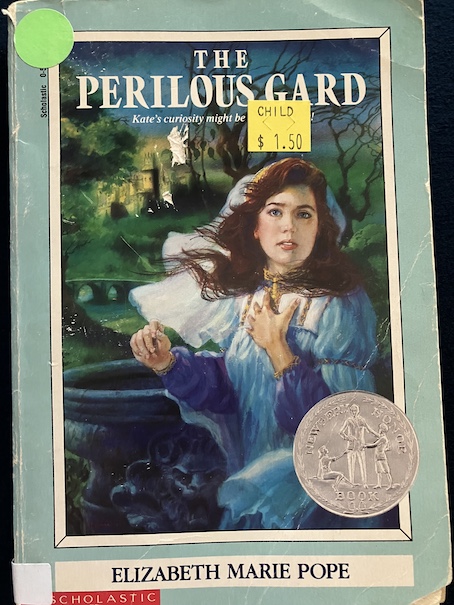
The Perilous Gard by Elizabeth Marie Pope, 1974.
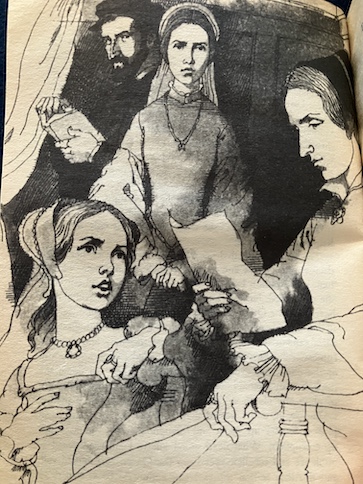
Kate Sutton and her sister, Alicia, live in the household of Princess Elizabeth in the year 1558. Alicia hates the Hatfield palace because it’s dreary and poorly maintained, apparently on purpose because Queen Mary Tudor resents Princess Elizabeth and wants her and her household to be uncomfortable. Kate and Alicia are maids in the household, and Alicia decides to write a complaining letter to Queen Mary about the condition of the house. Alicia thinks of herself at trying to help Princess Elizabeth by explaining how bad the conditions there are, but her letter gets heated and insulting toward the queen. Alicia is accustomed to getting away with things and with people not being angry with her because she’s pretty. However, Kate has to be the one with a brain, and she sees immediately that Alicia’s letter is bound to cause trouble.
When Princess Elizabeth receives a reply to Alicia’s letter, she summons the sisters to see her. Queen Mary is very direct in her letter about what she thinks of Alicia Sutton’s letter, but she ultimately blames Kate for it because Alicia is a favorite of hers and Kate reminds her too much of her father, who she never liked. She believes that Alicia is only a sweet innocent and that Kate is a corrupting influence, which is unfair. Queen Mary has decided to separate the sisters, taking Alicia into her own household and sending Kate to Sir Geoffrey Heron at his house, Elvenwood Hall, in Darbyshire. The queen wants Kate to stay at Elvenwood Hall and out of her sight or hearing from now on. Kate has no idea where Elvenwood Hall is, other than in Darbyshire, and she doesn’t know Sir Geoffrey Hall. Although Alicia is initially pleased that the queen doesn’t blame her, she becomes remorseful when she realizes that Kate is taking the blame for the letter, when she knew nothing about it. She offers to write to the queen again and confess everything, taking full responsibility for the letter, but Princess Elizabeth, Roger, and Kate herself all tell her not to. The queen’s mind is made up, and another of Alicia’s letters might make it worse.
Princess Elizabeth asks her tutor, Roger, if she knows anything about Sir Geoffrey Heron, and he says that he’s heard of him. The house, Elvenwood Hall, has another name, Perilous Gard. The word “gard” indicates that the place was once a castle, but Roger knows that the house has been rebuilt with old parts cleared away. The other part of the name “perilous”, indicates that there is a superstitious element to the place, like places rumored to be inhabited by fairy folk or associated with pagan religion. One of his old pupils told him some stories about the place, but Roger would rather not repeat them. The accounts that Roger has heard of Sir Geoffrey say that he is an honorable man, so he thinks that Kate will be safe in his household.
Other than that, Kate has little idea of what to expect from Elvenwood Hall. She doesn’t think that Alicia’s dire fears that Kate will be thrown into a dungeon are true. The queen wants her out of her sight, and that’s why she’s sending her to a relatively remote area where she won’t have to deal with her and putting her under the supervision of a supporter of hers, who is supposed to keep her out of trouble. Kate isn’t actually under arrest.
The journey to Elvenwood Hall is rough. On the way, the traveling party meets an old harper, Randal, who Sir Geoffrey says is a little addled since he suffered from a serious illness. When they tell the harper that Kate is coming to stay at Elvenwood, Randal asks if she might be lost like the last girl. Sir Geoffrey seems upset about what Randal says and hurries Randal away to get some food. Then, Kate hears a laugh and sees a strange woman looking at them from the hill. Then, her horse acts up, and when Kate looks again, the woman is gone.
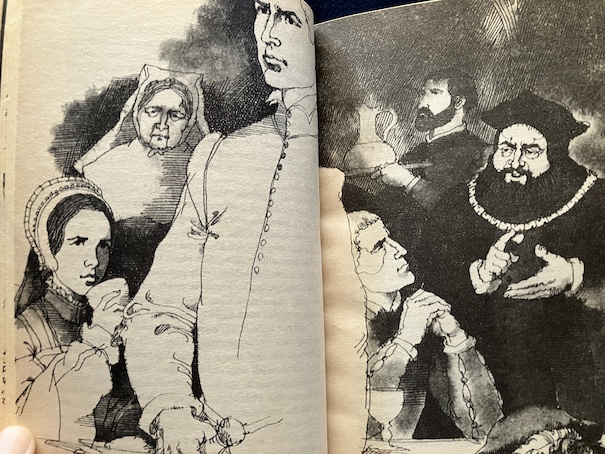
When Kate sees Elvenwood Hall, it doesn’t seem to be very old due to the recent rebuilding, and its interior is luxurious, compared to the house where Princess Elizabeth is living. It is surrounded by ancient stone walls and battlements, and the older parts of the house are more castle-like and crumbling. Sir Geoffrey is still in the process of renovating the castle and turning it into a luxurious manor. The elderly Dorothy, former nurse to Sir Geoffrey’s wife, is the manor’s housekeeper, and Master John is the estate’s steward. Master John seems cold and unfriendly, but he is in charge whenever Sir Geoffrey is away.
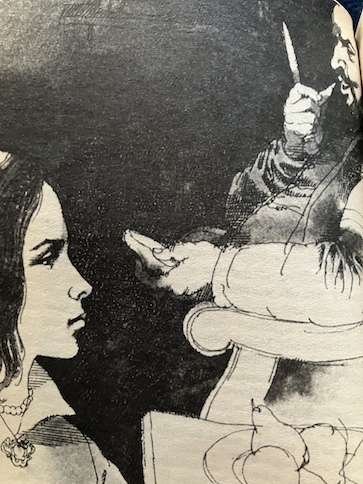
Much to Kate’s dismay, Sir Geoffrey will be leaving Kate under Master John’s supervision while he makes a trip to Norfolk. Kate gets the impression that Sir Geoffrey doesn’t like being at Elvenwood, in spite of its renovations, but under the queen’s orders, Kate is required to stay at Elvenwood and not to travel away from it. Sir Geoffrey also tells her that the queen will not allow her to write to anyone or communicate with anyone outside of Elvenwood without Sir Geoffrey’s permission, of in his absence, Master John’s permission. Sir Geoffrey says that he will not be back at Elvenwood until All Saints’ Day, so Kate will be under Master John’s authority for months.
Elvenwood used to belong to Sir Geoffrey’s wife’s family, the Wardens, and old Dorothy doesn’t like Sir Geoffrey or any of the Heron family. Dorothy says that Sir Geoffrey’s brother, Christopher Heron, was responsible for the death of Sir Geoffrey’s daughter, that he had admitted it, and that Sir Geoffrey never punished him for it. Sir Geoffrey knows that Dorothy has been gossiping with Kate, but he is not upset with Kate for it. He also doesn’t offer any further explanations about what Dorothy said before he leaves on his trip to Norfolk.
Elvenwood Hall is pretty comfortable and nobody there mistreats Kate, but she is often lonely because the place is isolated. The farthest Kate is allowed to go from Elvenwood Hall is to the nearby village, but there isn’t much there. When Kate visits the village, people stare at her and act like they’re afraid of her. Even the village priest makes the sign of the cross at her, as if he thinks that she is something evil. Mostly, Kate has Dorothy as her companion.
Then, one day, she notices a pair of visitors, and Dorothy says that they are pilgrims, coming to visit the holy well on the grounds. Kate knows that some people believe that holy wells have the power to heal or make people more beautiful. Dorothy says that the holy well in the cave here will take away sorrow and pain, if a visitor offers a gift in exchange. The gift is for “those who rule over the well”, who Dorothy says were in this land long before saints and Christianity, but she hesitates to say more about it. She says that Kate can ask Master John, if she wants to know.
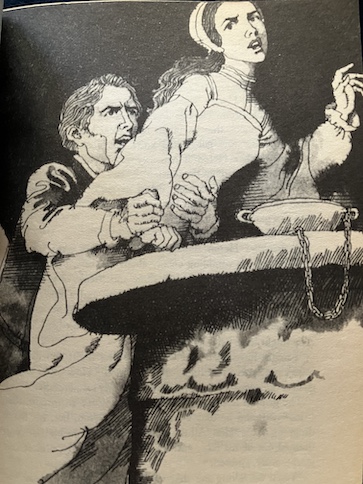
When Kate decides to take a look at the well herself, Christopher Heron finds her, grabs her, and hauls her away from it. Kate is startled, and he explains that he thought that she would fall in and be lost in the chasm under the rocks there. Kate thinks that’s silly because the well has a wall around it, but Christopher explains that’s what happened to Sir Geoffrey’s daughter, Cecily. At least, that’s what Christopher thinks happens to her.
He explains that Cecily was a little girl and that her mother was dead when he and his brother came to live at Elvenwood. One day, Sir Geoffrey left on one of his trips, and Christopher was responsible for Cecily. Cecily liked playing a kind of hide-and-seek game, but that day, Christopher found her antics irritating. He left her with Master John and went for walk to visit the well. However, he spotted Cecily following him, so he made a mock wish at the well that Cecily, being a spoiled child, would be in the care of someone else. And, that was the last time he saw Cecily. He supposes that she must have fallen when he wasn’t looking, although he didn’t actually see her fall, and they never found her body. They only found one of her shoes on the path. Christopher feels horribly guilty about losing Cecily, and he knows how her loss has hurt his brother, who has been the only person who loved and cared of him since his mother died giving birth to him. For him to lose Cecily when Geoffrey trusted him to take care of her was terrible, and he knows that his brother has not looked at him in the same way since. As a penance, Christopher has been living in the old leper’s hut on the estate whenever his brother is not in residence.
It’s sad, but Kate thinks that Christopher has been spending too much time feeling sorry for himself. She thinks it would be more sensible if he made a confession to the local priest to clear his conscience rather than brooding over what he could have done or should have done. Christopher says that it’s none of her business what he does, and he will give himself whatever penance he thinks is fitting. Kate thinks that Christopher is indulging in pride and self-pity over what was merely an accident.
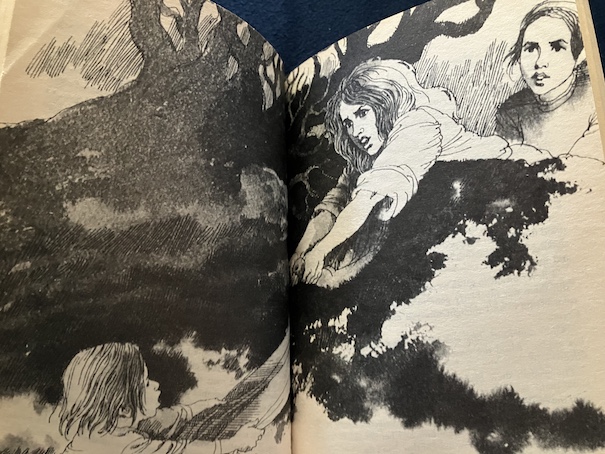
When Kate helps to rescue a local boy from a flooded river, his grateful mother talks to her about the guardians of the well, insisting that it’s really the fairy folk. She says that they live in a cave under the hill, that the strange woman Kate saw on the hill is their queen, and that they sometimes steal away children to be their slaves … or worse. She and others in the village think that’s what really happened to little Cecily and that the people at the castle know it, too. She thinks they’re purposely letting Christopher blame himself so that Sir Geoffrey won’t learn that his daughter is really alive and a captive of the fairies.
It does seem to Kate that everyone but the Herons genuinely believes in the fairies and that’s what Dorothy was talking about when she was talking about the guardians of the well being older than the saints. She reflects that Roger believed that the stories about fairies are just references to pagan gods and religious practices, and she starts to wonder if the people of Elvenwood, or the Perilous Gard, are secretly practicing pagan rituals with their traditions about the well. If the fairies are only superstition and the remnants of old religion, though, who was the mysterious woman who was watching Kate’s arrival? Could that have actually been a real fairy queen?
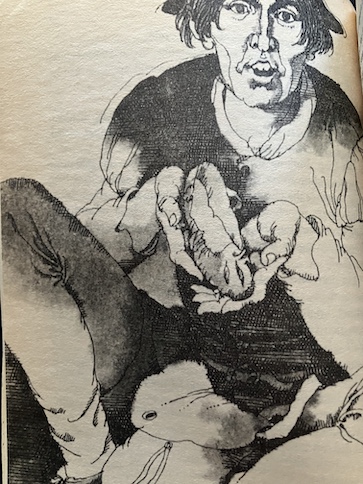
Kate tries to discuss it with Christopher, but he’s convinced that he knows what must have happened to Cecily. Then, they have an encounter with Randal, who tells them that the fairies have stolen away his wits. He knows he’s a bit addled and missing some memories, but he insists that the fairies did it to him because they couldn’t use a musician as one of their sacrifices, so they sacrificed his wits instead. Then, he claims that he has seen a little golden-haired girl dancing with the fairies and that she gave him her slipper to show to someone. To their astonishment, Randal produces a little girl’s slipper that matches the one Cecily lost on the path the day she disappeared! This slipper is much more worn than the other one, indicating that the girl who wore it continued to wear it after she disappeared.
Realizing that Cecily is still alive, Christopher wants to make a thorough search of the chasm beneath the well, but Kate urges caution. Whatever is going on at the well and whatever happened to Cecily, she’s sure that the people at the castle know about it, like the woman from the village said. If they don’t want to find and rescue Cecily themselves, it’s because they have something to hide. Sir Geoffrey’s wife seemed eager to leave this place, where Kate is now trapped by the queen’s orders, after her marriage, and Sir Geoffrey only returned here after she was dead, apparently unaware of the dark things that have happened here and still may be happening. Whatever is going on, the people of Perilous Gard are involved, and Kate and Christopher cannot expect any help from anyone in the castle.
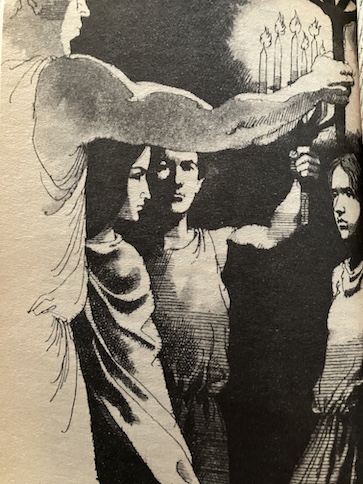
People leave coins and gold as gifts to the well when they ask it for something, and Christopher wonders if that could be the secret source of money for the estate that has funded all the luxurious renovations. Master John could be secretly taking all of the offerings the pilgrims leave. On the other hand, the name of the family that once owned this estate was “Warden”, a name that indicates the caretaker for something. Were they once the caretakers of the well, of a remaining cult of pagans that still practices the old religion and its rituals … or perhaps of actual fairies? What was Sir Geoffrey’s wife afraid of in her old family home, and where is little Cecily now? Was she taken as a hostage to ensure that Sir Geoffrey wouldn’t interfere with whatever the people at the castle are doing … or as a potential sacrifice to fairies or pagan gods? They reflect that the story of Tam Lin, about a lover who rescued her beloved from the fairies, was set on All Hallow’s Eve (Halloween). Cecily’s father plans to return on All Saint’s Day, the day after All Hallow’s Eve (November 1). Kate and Christopher need to get word to Sir Geoffrey or rescue Cecily themselves before it’s too late!
This is a Newbery Honor Book. It is available to borrow and read for free online through Internet Archive (multiple copies).
My Reaction and Some Spoilers
This book was fascinating and suspenseful! From the beginning, I wasn’t really sure whether or not this was a fantasy story. It turns out that it’s what I call pseudo-fantasy. It has all the trapping of fantasy, and there are points when it seems like something supernatural might be happening. However, it seems that, in the end, the “fairies” are humans practicing pagan rituals and who have convinced themselves that they are somehow different from the other humans who live above ground, out of the caves. There may be things that indicate that they might be more than that, but overall, Kate believes from the very beginning, that they are merely humans with strange and dangerous practices. As she puts it, “There were never any heathen gods, only heathen people who believed in them.”
Ancient Religion and Folklore
In their attempts to free Cecily, Christopher and Kate become the captives of the “fairies”, and Christopher is in danger of being used as one of their sacrifices. During their captivity, Kate gets to see some of their practices, and she realizes that they control people through things they give them to drink that affect their minds, and she learns what she needs to know about their rituals and beliefs to thwart their plans. In real life, there are a lot of gaps in our knowledge of pre-Christian religion in Britain because the practitioners didn’t leave written records. Mostly, what know about them is based on archaeology and accounts left by the Romans, which may not be entirely accurate. In the story, the “fairies'” beliefs are based around the idea of sacrifices, energy from humans and the earth, pieces of folklore, and probably the use of some kind of psychedelics. The most interesting and revealing part of their beliefs comes when Kate discusses the need for sacrifice with the fairy queen, and the two of them face off with their respective religious beliefs. During their discussion, they compare their beliefs on the subject of God/gods, power, and the purpose of sacrifice.
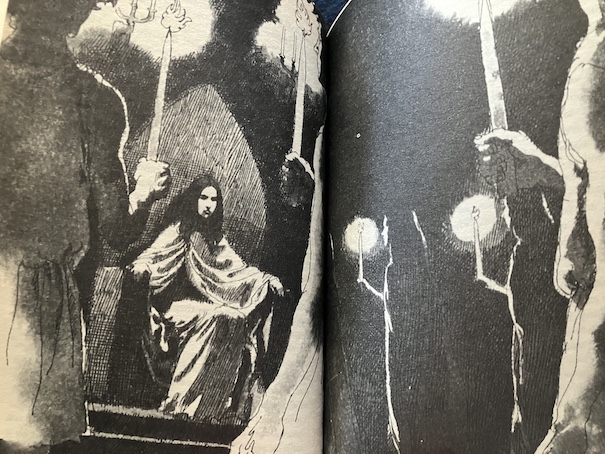
The fairy queen says that sacrifice is necessary to take the power from a human life and put it into the land and people through to keep them alive. In spite of her group’s isolation and life in the caves, she seems to understand some of the basics of Christianity, and she says that Kate should understand the notion of sacrifice because Christianity is built around one particular sacrifice. The fairy queen compares Christ’s sacrifice to the sacrifices that her cult holds – one person must give their life for the sake of the others as a way of transferring their life energy. Kate is a Christian, and she knows this description of Christ’s sacrifice isn’t completely accurate, but she tries to convince the queen that Christ’s sacrifice makes other sacrifices unnecessary. She says, since Christ gave Himself for the sake of humanity, He has guaranteed humanity’s safety so no others need to pay the price He paid. The queen argues that Christ’s sacrifice happened a long time ago, that His life energy has passed, and their cult holds a sacrifice on All Hallow’s Eve every seven years to renew the energy. Kate argues that Christ was special as the son of God, the only God that truly exists, and that His energy never dies, that it has transferred to living humans. She uses the story of Christopher’s namesake, St. Christopher, as an example of Christ’s power extending to humans. Unfortunately, the queen takes that to mean that Christopher holds some of Christ’s power in him, so sacrificing Christopher would not only give them the power of his life force but the power of Christ as well. Kate realizes that she can’t persuade the fairy queen or make her understand because the queen will just take everything she says and try to fit it into her views and what she has already decided needs to be done.
The philosophical and theological discussion between the two of them was fascinating, but the only way Kate can disrupt the sacrifice and save Christopher is to use the power of stories these people already believe. Kate never cared much for folk tales and ballads before, but she knows that the queen believes in the legend of Tam Lin and that the method the heroine from that story is the only one that can save a sacrifice like Christopher. When Kate finds out that the queen completely believes in that story, she realizes that she has to use the heroine’s solution from the story to rescue Christopher.
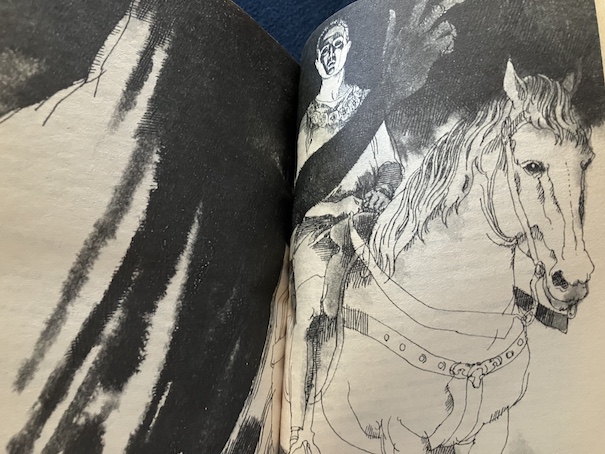
This is a point where the actual ritual differs from the magic in the story of Tam Lin. In the story of Tam Lin, he is physically changed into various forms that are frightening or difficult to hold onto, but his lover has to keep hold of him for him to be released from the magic. In this story, Christopher is not actually transformed into anything. It’s more psychological. The fairies believe that people who are going to be sacrificed need to give themselves to the sacrifice willingly, so they use psychological manipulation to convince Christopher that he has nothing to live for, playing on his feelings of guilt for not protecting his niece better and other traumatic pieces of his past, like his mother dying while giving birth to him and his father resenting him because of it. To hold on to him, like the heroine in the story, Kate has to speak up and convince him that the fairies are lying to him and that he does have things to live for. She needs to hold on to his mind and get him to assert his own will to survive while the fairies try to convince him that the only purpose he has left is to offer himself for sacrifice. “Holding on” in this case means holding on to one’s sense of self and one’s purpose, even in the face of doubts, insecurities, personal trauma, and the toxic influence or manipulation of other people.
Personal Growth
In her arguments with Christopher to get him to see that his life is worth living, Kate also confronts her own inner demons and insecurities – that everyone prefers her pretty sister, that she was blamed for things her sister did, etc. Their experiences with the fairies and confronting their personal demons are traumatic for Christopher and Kate, but they grow through them and come away with a better sense of self and greater self-assurance. Kate’s growth shows in the end both because she other women realize that she no longer fits into her clothes and will need new ones and in her maturity with dealing with her old insecurities when she sees her sister again.
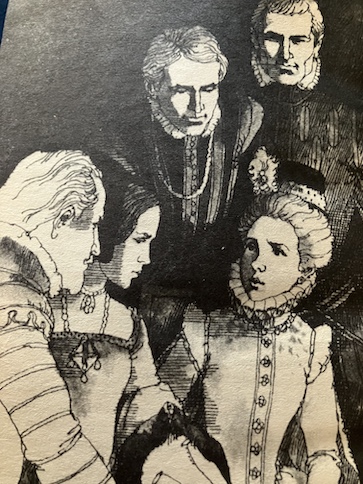
There is a point when, because Alicia is thoughtless in the way she talks and has a habit of giving people the wrong impression about things, Kate thinks that Christopher has fallen in love with Alicia as the prettier sister and that he is going to marry her. This is crushing for Kate because Alicia is often favored by people and because she has fallen in love with Christopher through their shared experiences. The fairy queen makes a last appearance in which she offers to give Kate something to make Christopher fall in love with her, but Kate rejects it. While it would hurt for Christopher to reject her in favor of Alicia, and it would add to past hurts she’s had about Alicia being the favored girl, Kate has grown emotionally through the story. She is above the manipulations of the fairies, and whatever she encounters in her life that might cause her hurt, she has the emotional strength to handle it and do the right thing in spite of it. Her rejection of using dirty tricks is rewarded when Christopher proposes to Kate. Her doubts of his love were only because Alicia is thoughtless in the way she says things to people and because of Kate’s remaining insecurities. Kate is happy that she can accept Christopher’s honest love for what it is without attributing it to any manipulation. They’ve been through the worst together, they’ve seen each other’s insecurities, and they love each other all the more for it.
It isn’t just Christopher and Kate who grow through their experiences. Sir Geoffrey realizes that his own bad decisions and blindness to what was going on contributed to the danger his daughter was in. He had no idea what his steward was involved in and what was going on around the castle. He also realizes that little Cecily needs the attention of someone who can devote herself more to the little girl without distraction and a life in a more settled place with greater access to broader society, so he sends Cecily to her aunt’s house in London. Sir Geoffrey’s acceptance of his own failings absolves Christopher of the last of his guilt over Cecily’s disappearance/abduction.
I also appreciated that characters in the story didn’t hate each other even when they had suffered hut because of them. Sir Geoffrey didn’t stop loving his brother when he thought that Christopher had failed to protect Cecily. He found the loss of his daughter difficult to take, and his brother’s role in that was hard on his feelings for his brother. However, Sir Geoffrey never sought to banish or punish Christopher for it, and when he finds out that Christopher is in trouble, he races to the rescue! In the end, Kate also cares about Alicia. Even when she was punished for the letter that Alicia wrote and thought that she might lose Christopher to her, she didn’t let spite and resentment take over. I appreciate the characters’ growth, and I also liked the way they dealt with their emotions when they were hurt and things were difficult. They still care for their family members because, deep down, they still love them and want to do right by them, even when it isn’t easy.

















 Jestress's Forgotten Books and Stories