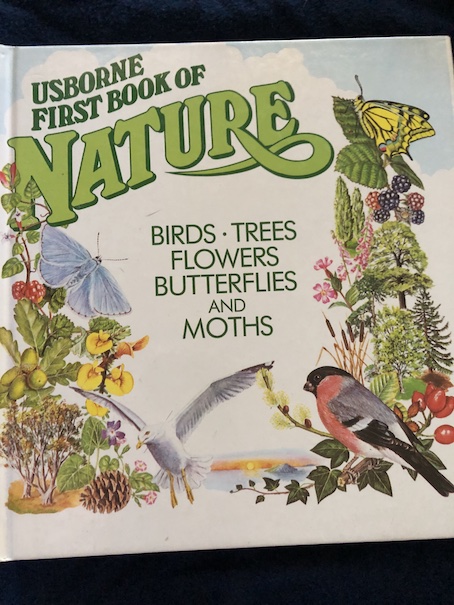
Usborne First Book of Nature

Usborne First Book of Nature designed by David Bennett, 1980.

I remember getting this book as a present from my grandmother as a child because my grandmother was an amateur naturalist. Although it’s a nonfiction book, I’m sentimental about it for that reason.

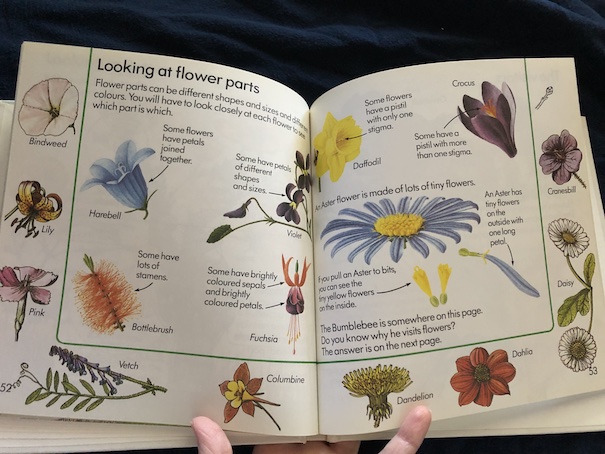
The book is divided into four sections covering different types of plants and creatures (each of which has its own book in the Usborne collection, but this book is a compilation):

Birds

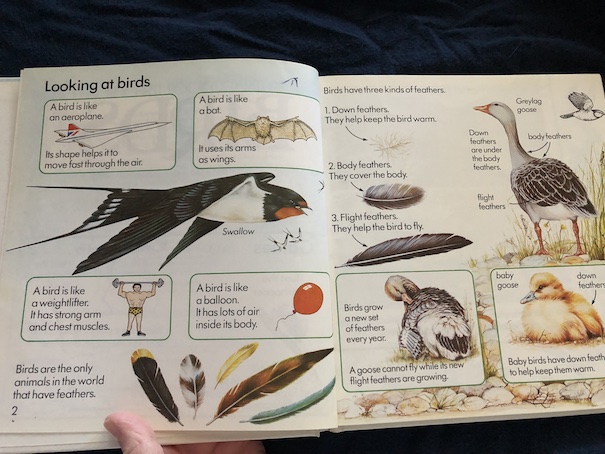
This chapter explains about the parts of birds, like the different shapes of beaks and feet different birds have, aspects of birds lives and behavior, and how birds fly.

Trees

This chapter explains the parts of trees, like how roots and twigs grow and the differences between different types of leaves, tree flowers, and seeds.

Flowers

This chapter explains the parts of flowers and about pollen and seeds. It also points out the creatures that like to visit flowers, like bees and hummingbirds.

Butterflies and Moths

This chapter explains the similarities and differences between butterflies and moths and what their life cycles are like.

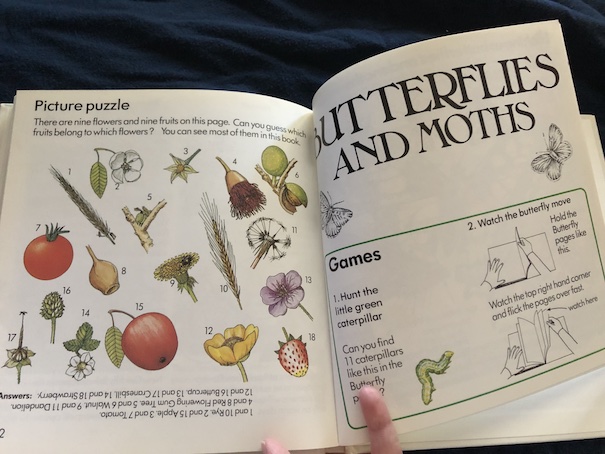
One of the best parts of this book is that it is designed to be interactive as well as informative. Some of the activities are explained at the beginning of each chapter, and there’s a puzzle or game at the end of each chapter. The upper right corners of each chapter have images that are meant to be used as a flip book. In the bird section, readers can quickly flip the pages to watch a bird fly. In the tree section, a leaf bud opens. In the flower section, a flower opens. In the butterfly and moth section, a butterfly opens and closes its wings.

Each chapter also has a game where you hunt for different creatures within the pages of that chapter and see how many you can find, and then, there’s another game or puzzle at the end. At the end of the bird chapter, there’s a picture puzzle where you have to find all the birds hidden in a black-and-white picture. At the end of the tree section, you have to find how many products are made from or come from trees in a busy market scene. At the end of the flower chapter, you have to match up different types of fruits with their flowers. The butterfly and moth section doesn’t have a game at the end.

This book is available to borrow and read for free online through Internet Archive.

The Prince and the Golden Ax

The Prince and the Golden Ax by Deborah Nourse Lattimore, 1988.

This story is based around the ancient Minoan civilization and the destruction of the island of Thera. Thera was a real place, and it was actually destroyed, but the story itself is fiction, based upon the pieces of information that the Minoans left behind about their culture.

When the story begins, the city of Knossos on Crete is the home of the Goddess Diktynna. Princess Illyra and her brother, Akros, are on their way to Crete from Thera with their fleet of ships. Akros is eager to show off his skills at the games on this feast day, although Illyra cautions him to not show off too much and to remember to honor the goddess.

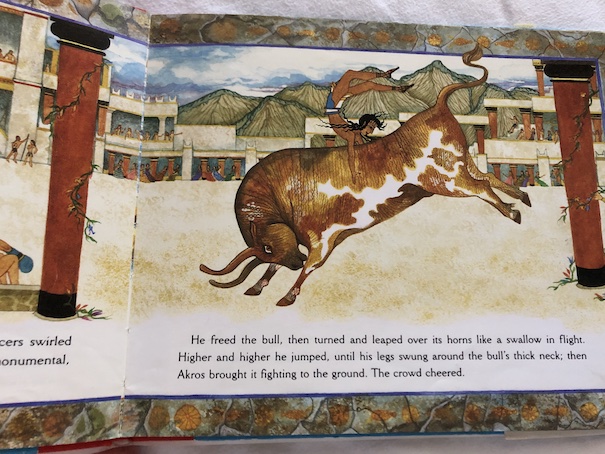
When they arrive at Crete, they are shown the goddess’s shrine with her statue holding the golden ax that is the source of her power. Akros is impressed by the golden ax and begins to think that if he had the ax, he could use it to bring glory to Thera. At the feast games, Akros shows off his ability to wrestle a bull. Full of pride for himself, he declares that he’s even better than the goddess because he did it without a golden ax. The goddess is angered by his comments and causes an earthquake.

The priestess says that Akros has challenged the goddess, and in order to make amends, Akros must find the golden-scaled fish of the Eastern Isle and obtain a bronze ax. If he fails to complete this task, the goddess’s golden ax will destroy Thera. Akros has no choice but to accept the challenge.

Illyria has the ability to use magic, and she helps her brother to complete the task successfully, but Akros can’t resist bragging about how easy it all was, angering the goddess again. This boast earns him a more difficult task, to capture a griffin and earn a silver ax.

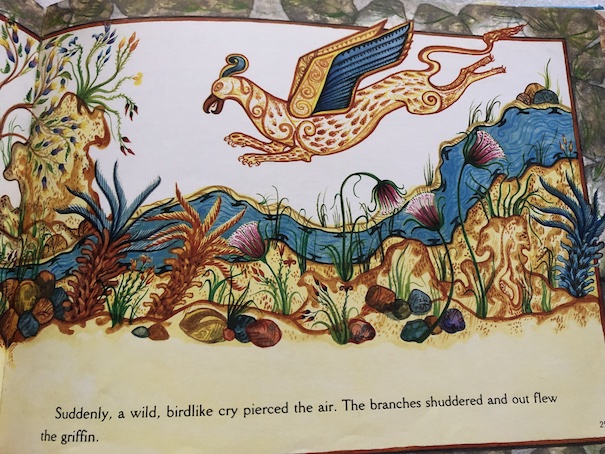
Once again, Illyria helps Akros to succeed in his task, but when he is presented with the silver ax, Akros insists that it’s not good enough for him and that he wants the golden ax. The priestess says that only a godlike hunter can have that ax, and if he tries to get it, his homeland will be destroyed. Still, Akros insists that he can prove that he’s good enough by catching a creature that no one, man or god, has ever caught before.

What Akros has in mind is catching the blue monkeys on the island of Thera. This time, Illyria refuses to help him because the blue monkeys are sacred. At first, Akros thinks that he’s managed to capture the blue monkeys without her help, but they have abilities that he never expected. As promised, when Akros fails to accomplish his boast, the island of Thera is destroyed, and Illyria and Akros only narrowly escape.

The book ends with the discovery of the remains of the palace of Knossos centuries later, when the image of the goddess and a small ax are discovered.

My Reaction

I knew at the beginning of the story that there couldn’t be a happy ending because I already knew what happened to the real island of Thera, now called Santorini. The island was largely destroyed by a volcanic eruption during the Minoan period, a cataclysm that may have sparked the legend of the sunken island of Atlantis. However, this story does not mention Atlantis, instead using the statue of a goddess found in the remains of the palace of Knossos as inspiration. In spite of the ending, I wouldn’t call this a sad story. The book doesn’t dwell on the aftermath of the destruction of Thera, and we don’t actually see much of the civilization of Thera, so there isn’t much for us to miss when it’s destroyed. The colorful pictures throughout the book are beautiful and actually feel rather cheery.

Something Upstairs

Something Upstairs cover

Something Upstairs by Avi, 1988.

This story begins with a famous quote:

Those who cannot remember the past are condemned to relive it.

Santayana

It’s an appropriate quote for the story, which is about memory and a repeated wrong that has led to a seemingly endless cycle of violence. The story is framed as having been told to the author by the boy who actually had this frightening adventure.

Kenny Huldorf is unhappy when his parents decide to move the family from California to Rhode Island. Kenny was happy in California, the weather was much better there, and the streets and buildings in Rhode Island all seem small and old. The house they move into is called the Daniel Stillwell House, and it was built in 1789. Right from the beginning, the house gives Kenny a strange feeling, like there’s something or someone there when there shouldn’t be anyone or anything.

Kenny starts to feel better when his parents give him the big, renovated room with the private bathroom in the attic of the house. He likes that room, but there are two smaller rooms off the attic that haven’t been renovated, and they give Kenny a strange feeling. His parents think they were probably old servants’ quarters. One of them has a stain on the floor that makes Kenny think of death, and even more frightening, Kenny gets an odd sense that, somehow, it’s a death he may be responsible for. For a time, Kenny tries to tell himself that it’s nothing but an old stain and occupies himself with unpacking and getting settled. Since school hasn’t started yet, Kenny gets bored and does some exploring of the area. He starts wondering about the history of the town and the house.

Then, one night, Kenny hears a strange sound from the room with the stain. When he goes to investigate, he sees a pair of ghostly, glowing hands reaching up out of the stain on the floor. The hands pull the rest of the ghostly person out of the floor, and Kenny can see that it’s the figure of a boy. When the boy tries to reach out to him, Kenny reacts defensively, and the ghost boy seems frightened and vanishes. The next day, Kenny asks his parents if they believe in ghosts. His father says he doesn’t but that Providence is a very old town and a lot of things have happened there over the years. His mother later says that she doesn’t really believe in ghosts either, but she believes that places have memories. Kenny’s parents conclusions seem to be that Kenny is sensing the general history of the town, but Kenny feels that it’s something more specific than that, that the ghost he saw is a specific person from a specific incident in the history of the house.

The family was given a scrapbook with a list of former owners of their historic home, so Kenny decides to do some research about the past owners and see if he can learn more about where the ghost came from and who it is. When he arrives at the local Historical Library, Kenny is surprised to find out that someone there is expecting him. He is directed to the office of an historian named Pardon Willinghast. Willinghast tells Kenny that he keeps track of the owners of historic homes, which is how he and others at the library recognized his last name, and he expected that someone from the Huldorf family might come to ask about the house. Kenny gives him the list of past owners and asks what Willinghast can tell him about them. Willinghast looks at the list of names and says that there probably won’t be much about them in the library but that he’ll do some research and see what he can find. Kenny also gets the idea to have the local pharmacy test a sample of wood from the stained floor to find out what the stain is.

The next time Kenny sees the ghost, he tries to talk to the ghost boy and ask him who he is. The ghost has trouble talking but manages to communicate one word: “slave.” The pharmacy tells Kenny that the stain on the wood is human blood. They can tell that the stain is more than 100 years old, which is why they haven’t reported it to the police, like they’d have to with a recent blood stain. When Kenny talks to Willinghast again, he wants to know about people who lived in his house over 100 years ago who might have owned slaves, which limits the scope of his investigation to the first three families who owned the house. Willinghast is oddly vague in his reply, and when the subject of abolitionists comes up, he makes vague references to “agitators” and people who want to “rush history.” When Kenny tries to ask him about a murder that may have occurred in the house, Willinghast becomes agitated himself and tries to discourage Kenny from inquiring further. He says that if a slave was murdered, it probably wouldn’t even have been reported in a newspaper because it wouldn’t have been considered important.

However, now that Kenny understands that a young slave was murdered in his house and is still haunting it, he can’t leave the situation alone. He continues trying to communicate with the ghost boy, and the ghost gradually finds it easier to talk to him. He says that his name is Caleb and indicates that he is tied to the stain on the floor. He can’t seem to move very far from it. He says that he’s a memory of what happened there. He is aware that he was murdered, but he doesn’t know who did it because he was killed in his sleep. He senses that he was killed by someone who wanted to keep him a slave because he and other black people were trying to free themselves from slavery. Kenny asks Caleb if there’s anything he can do to help him, and Caleb asks him to find his murderer. Kenny asks how he can do that when the murder happened so long ago.

Then, the attic changes, and Kenny finds himself back in the past, in Caleb’s time. Kenny looks out the window and sees a strange man in a black cape watching the house. As he explores the town, he witnesses a public argument about slavery and someone asks him to deliver a note. The next morning, Kenny is back in his own bed, in his own time. When Kenny talks to the ghost again, he describes what he saw in the past, and Caleb recognizes these events and people as being part of the circumstances that led to his death. He has trouble believing that Kenny really cares about what happened to him so long ago. He says that white people have broken their promises to him before, but Kenny insists that he does care and that he wants to not only solve his murder but prevent it so Caleb can finally be free from haunting that room.

However, that’s going to be even more difficult than Kenny thinks. On his next trip into the past, he discovers who their true enemy is: Pardon Willinghast. Willinghast isn’t just an historian. Almost like Caleb, Willinghast is memory, a piece of the past that keeps coming back to haunt the people who live in Caleb’s old house and who have tried to help Caleb before. Willinghast has figured out that if someone from the future comes to the past and they lose something they’ve carried with them or if they get hurt or change themselves in some way, they can get stuck in the past, seeming like ghosts to the people there. (Or, so he says.) He has used this knowledge before against other people who have tried to help Caleb, blackmailing them into helping him instead. Now, he has the lucky key chain that Kenny always carries with him. Until Kenny gets this key chain back, he’s stuck in the past, and Willinghast won’t return it until Kenny does what he wants. In fact, he implies that Kenny is already doing what he wants, leaving Kenny to wonder if he’s accidentally leading Caleb into a trap while trying to help him escape from one.

Kenny set out to help Caleb, but he’s in danger of becoming a part of the same cycle of murder that has been repeated over and over for almost 200 years. As Kenny tries to help Caleb, he knows he’s being manipulated by Willinghast into playing a role in a very old story, but since he doesn’t have a copy of the script, he struggles to figure out what has to change to break the cycle. Can he find a way to break cycle and escape without either himself or Caleb losing their lives?

Th book is available to borrow and read for free online through Internet Archive (multiple copies).

My Reaction and Spoilers

This is a book that I remembered from when I was a kid, but strangely, I’m sure that I never heard the end of it back then. I’m having trouble remembering exactly why I never heard the end. I think it might have been one that a teacher was reading aloud, and maybe I was absent the day she finished it. Either that, or I started reading it myself and chickened out before the end because I was spooked.

This book poses a kind of “gun-to-your-head” type of decision, forcing both Kenny and the readers to consider what they would do if they were forced to make a choice between two horrible options. In this case, Kenny is put into the position of being pressured into committing a murder or being trapped forever in the past. Willinghast committed the original murder, and he tells Kenny that the only way he’ll return his keychain to him and let him go home is if he shoots Caleb himself this time. Willinghast is confident that he can force Kenny to do what he wants because he’s done the same to others before him. Other past owners of the house have tried to help Caleb before, but Willinghast has manipulated each of them into betraying Caleb and shooting him instead. These are the betrayals that Caleb referred to earlier. Willinghast claims that each of these people has lost their memory of what they’ve done when they return to their own time, so Kenny won’t have to worry about feeling guilty about killing Caleb. But, if Kenny gives in, he knows that Caleb will remain a ghost, and someday, someone else will also be in Kenny’s position, another pawn in Willinghast’s sick game of endlessly repeated murder. As long as Willinghast gets his way, not only is Caleb going to be his perpetual murder victim, but every person who tries to help will continue to be victimized and forced to participate in his bloody crime.

There is also a deeper theme to this story. Violence begets violence, and hate begins hate. Murder, revenge, hatred, and yes, also slavery and racism, are part of violent cycles that draw other people into them long after the original deed was done. People are haunted by the past in many ways … especially those who feel like they’ve got something to prove about it. It’s a theme that’s been very much on people’s minds in the early 21st century, and there are many, like Kenny, who are unwilling to be pulled into going along with violence, murder, racism, and everything that goes with it just to save some past people’s public images or some modern people’s egos.

Willinghast has correctly realized that the reason why he’s able to come back is because he’s a part of Caleb’s memory as his original murderer. Every time Caleb’s ghost tries to solve his murder and change the past, Willinghast gets reawakened to interfere. In his role posing as the historian, he rewrites the accounts of Caleb’s death in the archives to trick the people trying to help him. He’s not about truth but manipulation, much like the pseudo-historians who resurface to tell “their truth” when certain controversial topics come up. He has a vested interest in lying to cover up his own shameful deed and to force others into helping him get things his way. Willinghast does not care either about accurate history or about the welfare of future generations; he only uses them to cover up his own misdeeds. He’s used other people to repeat his dirty work before, and he’ll do it again, blaming Caleb each time for bringing it on himself by trying to survive instead of just accepting his own murder and staying dead … unless things are different this time around. The violence ends when someone finally says no and refuses to play along. So, what Kenny is really looking for, in this situation where he seems to be given a choice between two horrible options, is a third option that allows both him and Caleb to escape.

Because the story is framed as one being told by Kenny to the author later, readers know from the beginning that Kenny finds another solution to the problem that doesn’t include murdering Caleb or being trapped in the past as a ghost. The suspense comes from the readers wondering how he’s going to do that. Kenny’s solution isn’t entirely peaceful (spoiler) because he ends up shooting Willinghast, but that could be seen as an act of self-defense, not only saving himself but also Caleb and all of Willinghast’s future victims. It seems like eliminating Willinghast was the only way to end the cycle of murder because it wasn’t really Caleb’s attempts to save himself or bring his murderer to justice but Willinghast’s attempts to cover up his crime that kept the cycle going. Willinghast blames Caleb for trying to avoid being murdered, but the truth is that it’s his original act of murder that created this situation from the beginning and his continual cover-up and recruitment of unwilling abettors that has kept the cycle going. Readers can debate whether there was another way to solve the problem, but once Willinghast is gone, the cycle is broken.

Some might also point out that the reason why Willinghast targeted Caleb in the first place was that Caleb shot one of Willinghast’s associates first, but the reason why Caleb did that was that Willinghast’s associates were violently targeting a black neighborhood, and Caleb was trying to hold them off. Once again, violence begets violence until someone decides not to participate. In the end, Kenny commits a violent act, but the cycle ends because he gets the one person who was at the center of all of the other violence from the beginning. Kenny also remembers everything that happened when he returns to his own time, which brings up a point that I’ve already mentioned but I’d like to explain in more detail: Willinghast is a liar.

The only reason why Kenny knows, or thinks he knows, that Willinghast has power over him and can prevent him from returning to his own time as long as he holds one of his belongings is because Willinghast says so. Nobody else in the story says that, and frankly, Willinghast is a known liar. He was never a real historian. He’s only another ghost from the past masquerading as one to trick people into doing his bidding. He fakes historical records to manipulate people. He is an admitted murderer. He said that Kenny wouldn’t remember what happened in the past when he returns to his own time, so he wouldn’t have to feel guilty about shooting someone, but Kenny remembers everything. This didn’t occur to me when I first encountered this story as a kid, but looking at it now, I can’t help but think, why the heck should Kenny believe anything that Willinghast says about how the time travel works?

At the point in the story where Willinghast tells Kenny that he’s trapped in the past as long as he has his key chain, Kenny already been to the past once and returned from it without either Willinghast’s help or interference. Kenny did not get to the past by Willinghast’s power, but through Caleb’s memories. Willinghast was counting on Kenny to be frightened and confused so that he would rely on his word for what’s going to happen to him in the past and feel like he had something real to lose for not going along with his plans, but even as I read the story, I doubted him. I think what he said about Kenny needing his key chain to return home might have just been another of Willinghast’s lies. I don’t recall seeing anything in the story that proved that Willinghast was right, and it seems that none of his other victim/accomplices put his lies to the test to find out. There is no one else trapped in the past as a ghost because we never see any such people in the story. So, if that hasn’t actually happened to anyone before, how would Willinghast or anyone else know that such a thing was even a possibility?

The fact that Kenny remembers shooting Willinghast also suggests that everything Willinghast said may have been a lie. He claimed that none of the other time travelers retained their memories, so Kenny wouldn’t remember if he shot Caleb. If Kenny wouldn’t remember shooting Caleb, how would he be able to remember shooting Willinghast? Unless Willinghast needs to be alive after Caleb’s death to rewrite people’s memories, it sounds like the idea that Kenny wouldn’t remember what happened in the past was a lie. We never see or hear from the other people Willinghast manipulated, so we don’t know for sure that they had no memories or guilt over what happened. That could be another subject for debate among readers, but from what I saw in the story, I’m thinking that Willinghast should be considered a liar on everything he said. I think the real trap wasn’t that Willinghast was holding Kenny in the past so much as Willinghast was making Kenny believe that he was. Although he tried to make Kenny believe that he only had two choices, Kenny himself found a third one. Perhaps there were other possible choices, but we know that there was at least one more option than Willinghast led Kenny to believe he had.

Because there are violent themes in this story, it isn’t for very young kids, but it does combine some historical details with excitement for kids who enjoy scary stories. There is also some use of the n-word on the part of the villains in the story, so be warned. The story is thought-provoking on the subjects of history and personal choices.

In the end, after Kenny has finished telling his story to the author, he says that he knows that Caleb survived the room where he was murdered before and no longer haunts it. Caleb ran away after Willinghast was dead, but Kenny doesn’t know where he went after that or what happened to him. He finds himself worrying that the violence caught up with him again somewhere else and that maybe he’s just haunting a different house now because the memory of all that was done to him will never end. This is the final question the story leaves readers. Is that how it really is? Is there an end to the wrong, or are Caleb and others like him still ghosts who haunt us all?

This story reminds me somewhat of a YouTube video made by Kaz Rowe in 2022 about the history of ghost hunting. While talking about the history of belief in ghosts and our society’s fascination with ghosts and ghost stories, Kaz Rowe points out that many of our historical American ghost stories focus on moments when our society failed and innocent or vulnerable people suffered. The ghosts that haunt our society often represent unresolved situations – unpunished crimes, unacknowledged injustices, perpetuated wrongs, and tragedies that can’t be undone. There is a feeling that there was more that our society could have done and should have done to prevent needless death and suffering, and that’s probably true. Perhaps some of these problems were the result of people who thought (or convinced others) that they only had one option or just one choice between two bad options – black-and-white thinking, if you will – so they made terrible choices, never considering or choosing to acknowledge that there might be other ways. One of the difficult parts of studying history is considering the choices not made and the things people of the past left undone. It does create an unsettling a sense of the unresolved, that the past is still with us and haunting us today. What Kaz Rowe was talking about is that part of the interest in communicating with ghosts is that sense of the unresolved. There were people in the past who needed help and didn’t get it, people whose voices weren’t heard when they needed someone to listen, and people who suffered when no one seemed to care. When people reach out to ghosts, they seem to be saying that, even if no one heard them or cared about them in their time, someone does care now and wants to hear what they have to say. We don’t have the ability to go back and change the past, like the character in the story, but there may be the hope that caring and listening can, in some way, offer peace to the ghosts of the past because someone finally understands what they went through and how they felt.

Do I think Caleb and others are still haunting us? Yes, after a fashion, I think so. There is the haunting feeling of a past that can’t be changed or entirely made right. Caleb isn’t haunting Kenny’s house anymore, but he is haunting Kenny’s mind because of the shared trauma of what they went through and Kenny’s lingering fears about Caleb’s life after the events.

In that sense, I would say that maybe the ghost hunters have it right. Maybe the best thing to do with the ghosts of the past is not to be afraid of them but to pay attention to them and see them and their situations for exactly what they were. The haunting in the back of our minds comes from our inability or unwillingness to see what we can sense is there and is begging to be seen. That feeling comes from the human impulse to investigate and understand. It’s the unknowables and uncertainties in life that are the most frightening. When you know, even when you know the worst, you stop worrying so much about it. There are no more unanswered questions and things that just don’t add up, the questioning little voices in your head fall quiet, and the ghosts have nothing more to say because they’ve been heard and seen.

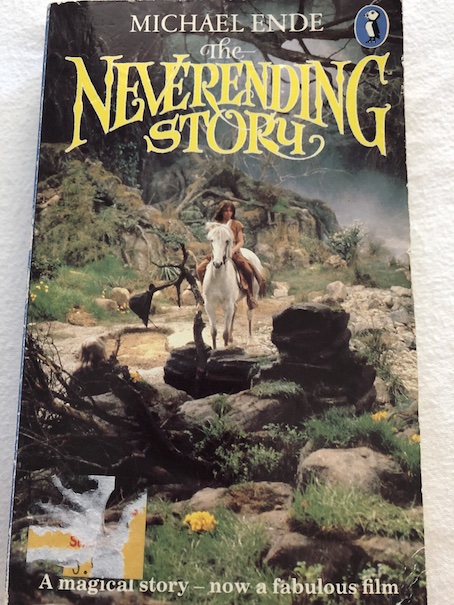
The Neverending Story

The Neverending Story by Michael Ende, 1979, 1983.

Bastian Balthazar Bux has problems. He’s smaller and fatter than the other boys, no good at sports or fighting, and not even a particularly good student.  Because of this, other kids tease him, bullies chase him, and the one time that he tried to talk back to them, the mean kids shoved him into a trash can, so he was afraid to ever try it again.  One day, on the way to school, he seeks sanctuary from his bullies in an old bookshop that belongs to Carl Conrad Coreander.  Bastian loves books more than anything.  In fact, his love of books and his imagination are his only apparent strengths at this point in his life.

Coreander doesn’t like children, and as soon as he sees Bastian, he makes it clear that the boy isn’t welcome in his shop, that he doesn’t carry books for children, and that he won’t sell Bastian any books for adults. Coreander says that children are just noisy and make messes and ruin books.  Bastian protests that not all children are like that, and the two them talk about why Bastian is there and why the other children bully him.  Bastian says that one of the reasons why the other kids think he’s odd is that he likes to make things up, like imagining places and characters and odd names. He rarely shares these things because nobody else seems interested. Coreander asks what his parents have to say about all of this, and Bastian reveals that his mother is dead and his father doesn’t take much interest in him or things that happen to him in his daily life.  Coreander is rather condescending to Bastian but also strangely interested in some of the details about him and his life.

When Coreander gets up to take a phone call, Bastian finds himself looking at the book that Coreander was reading when he came into the shop.  It’s called The Neverending Story, a title which captures Bastian’s imagination at once because he always hates it when a book he likes ends. The book seems to call to Bastian, and he suddenly feels like he has to have it.  Because Coreander has already made it clear that he won’t sell any books to Bastian, Bastian simply snatches up the book and leaves the shop with it.

After he’s out of the shop, Bastian suddenly feels guilty for stealing the book, even though he still feels compelled to have it and read it. He knows that he can’t take the book home with him because, even though his father doesn’t notice much, he would notice if Bastian showed up at home when he’s supposed to be at school.  Bastian knows that he’s already terribly late for school, but he can’t bring himself to go to class, especially not with a stolen book.  Desperately, he tries to think of a place to go.  Then, he remembers that his school has an attic.  Hardly anybody goes up there, and even those who do don’t go there very often.  He can hide there for a while and read.

Without giving much thought to how long he’s going to hide and what he’s going to do for food when he gets hungry, Bastian hurries up to the attic of the school, locks himself in, and starts to read The Neverending Story.

From this point on, most of the book is the story in the book Bastian stole, but at the same time, it’s also a story about Bastian himself.  There are periods when things in the story remind Bastian of things happening in his life or times when he pauses to think about what his class at school would be doing at this time without him, things that he’s glad to be missing himself.  However, gradually, Bastian himself starts to enter the story.

The Neverending Story Begins

The story in Bastian’s book takes place in the magical land of Fantastica.  The first characters we meet are messengers who are on their way to see the Childlike Empress who rules the land.  Within that land are many fantastical people and creatures who inhabit countries of their own, but strange things are happening here that have nothing to do with the usual magic of Fantastica.  A small group of messengers who happen to meet each other talk about what they’ve observed and why they need to talk to the Childlike Empress.  Whole sections of their countries and even some of the people and creatures who normally inhabit them have simply disappeared.  By “disappeared”, they mean that nothing is left in their place.  Whenever people try to look at the areas that used to be there, they see absolutely nothing, as though they have all gone blind when looking in their direction.  Nobody knows why this is happening, and people are panicking.

The Childlike Empress lives in a beautiful tower.  When the messengers arrive there, they discover that so many messengers have arrived from every corner of Fantastica that they have to make appointments and wait their turn to talk to the Childlike Empress.  Everyone seems to have the same problem, and to make matters worse, word has spread that the Childlike Empress is ill, and the doctors can’t seem to understand the nature of her illness and have no idea what to do to help her.  The messengers wonder if the Childlike Empress’s illness could have something to do with all the strange things that have been happening.  All of the creatures in the kingdom know that the very existence of their kingdom depends on the well-being of the Childlike Empress.  If anything ever happened to her, the rest of them would simply cease to exist.

At this point in the story, Bastian is reminded of his mother’s death and stops to think about her.  He remembers being at the hospital with his father while his mother was undergoing an operation to try to save her life, but unfortunately, it was unsuccessful.  After that point, Bastian’s father changed, becoming mentally and emotionally withdrawn, so it seems as though Bastian not only lost his mother completely but also part of his father.  His father continues to look after him physically and even gives him nice things, like a bicycle, but he rarely takes much notice of his son’s day-to-day life, making Bastian feel almost like he isn’t there himself.  His father no longer talks to him about ordinary, everyday things, and he’s always preoccupied with his grief.

The doctors trying to treat the Childlike Empress say that she doesn’t have any obvious symptoms of illness.  For some reason, she simply seems to be fading away, making it seem likely that her malady is tied to the fading away of Fantastica itself.  Chiron the centaur, the greatest of the healers, says that the Childlike Empress has said that someone must go on a quest to find the solution to her problem. She doesn’t say what the solution is, but she has chosen the hero who will go on this quest by name and has given Chiron her medallion to give to this hero.  The Childlike Empress’s amulet, Auryn, takes the form of the twined snakes (it’s a sort of elaborate ouroboros) that appears on the cover of the book that Bastian is reading.

Chiron takes the medallion to the Greenskins, a people who resemble nomadic Native Americans who hunt purple buffalo, to find the hero called Atreyu.  Atreyu turns out to be a 10-year-old boy, and Chiron is upset at first that a child so young has been given this important mission.  Even though he is doubtful that a child could save the Childlike Empress, he has to trust the empress’s decision.  He explains the situation to Atreyu and his people, and Atreyu sets off on his quest, although he has little to go on.

Bastian comes to identify somewhat with Atreyu, who is an orphan, raised communally by his people.  In a way, Atreyu is like what Bastian himself wishes he was.  Atreyu is also an orphan, but where Bastian feels neglected by his remaining parent and has no one else to rely on, Atreyu is regarded as the “son of all” his people, with everyone raising him.  Bastian wishes that he could feel like he could rely on everyone around him to care about him.  Atreyu is also strong and brave, which Bastian is not, or at least, he doesn’t feel like he is.

Atreyu travels far and asks everyone where he stops if they know how to help the Childlike Empress, but no one does.  However, in a dream, a purple buffalo tells him that he must visit an ancient woman called Morla, who lives in the Swamp of Sorrows.  She is the oldest creature in Fantastica, and she will know the answer.  Atreyu loses his beloved horse in the Swamp of Sorrows because the horse is overtaken by a dreadful depression and cannot save himself from being dragged down into the swamp.  (This was the worst part of the movie version of this story for me as a kid although somewhat less traumatic in the book.)  Atreyu is protected from the depression by the Childlike Empress’s amulet and is able to reach Morla.

Morla turns out to be a giant and ancient tortoise.  She does know the answer to the problem, but Atreyu has trouble persuading her to explain it at first because Morla is so old that she has come to feel like life is meaningless and doesn’t really care if she and everyone else disappears or not.  Fortunately, Atreyu’s arguments with her revive enough of her interest for her to talk to him. Morla says that the Childlike Empress has always been young because her life isn’t measured by time like others’ lives.  The Childlike Empress’s life is measured by names.  She has had many, many names over the years, most of them forgotten now, and even Morla doesn’t know what her current name is.  In order for her life and existence to be renewed, the Childlike Empress needs a new name.  Atreyu asks Morla how she can get one, and Morla says that she doesn’t know who can give her a new name, only that it can’t be anyone from Fantastica.  Atreyu must visit the Southern Oracle to find the answer.

At this point, Bastian thinks it’s too bad that he can’t give the Childlike Empress her name because thinking up unusual names is something that he’s really good at, and this might be the one place where his talent has a use and people who would welcome it.  However, the things that are happening in the story are so scary that Bastian is also grateful that he is safe where he is, just reading about them.

Bastian reads that Atreyu wanders out of the swamp on foot. He doesn’t know where he’s going, and he lost all of his supplies with his horse.  Then, Bastian hears the clock chime and knows that school is out for the day. As the other children leave the school, Bastian has to decide what to do. He knows that he really should go home and own up to his father about stealing the book, but when he gets up to go, he has the feeling like he has to keep reading, to finish what he’s started, like Atreyu, who is still fulfilling his mission in spite of hardship.  Bastian feels a little proud of making a difficult decision because he’s not running away from his responsibilities so much as continuing a quest of his own.  He knows that he must finish that book. Indeed, he must because the existence of Fantastica now depends on him.

As he continues reading and following Atreyu’s adventures, Bastian begins to feel more like the story isn’t just a story, that there is something more to it. When Atreyu reaches the Oracle, which communicates only through rhyme, it tells Atreyu that nobody in Fantastica can give the Childlike Empress a new name because the truth is that all of them are only characters in a book who exist as they are because of the needs of the story.  The people of Fantastica didn’t invent their world, they don’t create it as it exists, and they don’t have any real power to change anything, even a name.  All of those powers belong to humans who live in what they call the “Outer World.”  The Oracle says that generations of human children have read the book that contains all of Fantastica, and they are the ones who have used their powerful imaginations to give the Childlike Empress new names, over and over.  The problem is that the book has not been read by anyone for too long and children tend not to believe in stories like theirs anymore, so it has been too long since the Childlike Empress was given her last name. The memories of all the names she’s been given have faded, so she is losing her ability to maintain her existence and the existence of all of Fantastica.  They need a human child with the ability to believe in Fantastica and think of a new name to rename the Childlike Empress.  They need Bastian … if Bastian can manage to believe in himself as the hero of his story.

The book is available to borrow and read for free online through Internet Archive (multiple copies, plus a computer game about it and the theme song from the movie). It was originally written in German, and the version I have is the English translation. There is a movie version from the 1980s that is very well-known among people who were young then and fantasy fans. There are also two movie sequels that aren’t as well-known.

My Reaction and Spoilers

I saw the movie version of this book long before I ever got hold of a copy and way before I was old enough to read a book that long.  The movie was big in the 1980s, when I was a young child, and it has a magical and very 1980s theme song that was also used as a cultural reference in the show Stranger Things.  I’m actually attached to that song because it’s one of the sounds of my early childhood. For reference, I’m younger than all the Stranger Things kid characters are supposed to be, even Erica, but old enough to have memories of the time period of that show. The mall scenes in that show are practically right out of my childhood. Those electronicized ‘80s songs, bright-colored clothes and clothes with paint splatter designs, Cold War with two Germanies – East and West – these things were all part of my early life, and that is the time period when this book was popular and the movie was new.  As Stranger Things points out, things like fantasy books and movies and playing Dungeons and Dragons were all considered part of nerd culture back in the day.  To a certain extent, they still are, but Harry Potter brought a renewed interest in and popularization of fantasy books in the late 1990s.

The story is about the power of imagination and the roles that fantasy play in human lives.  The story actually gets deep in places about the philosophy of stories and how people use them.  It explains that humans fear stories, particularly fantasy stories, because, when fantasy characters get out in the real world and take over people’s minds, they can cause madness and delusions or be used as lies by unscrupulous people to fool and manipulate others.  They don’t use the word “propaganda”, but that’s part of what they imply, and it’s a fitting concern for the Cold War era when this story was written.  Madness can also be a real risk for people who can’t separate reality from fantasy, as shown in Bastian’s further adventures in Fantastica, described below.  Humans are creatures that live and function in the real world, and while we sometimes venture into the realm of fantasy and stories, we can lose ourselves if we don’t know how to keep the two separate in our minds.  So, what’s a human supposed to do?

The book suggests the idea that people can’t simply avoid fantasy entirely for fear of the effect that it might have on them, like people who refuse to allow children to read fantasy books.  Even though people like that might think they’re smart for avoiding “lies” and “delusions”, but the problem with that is that there are many types of delusions that people have, even in their everyday lives, and people who are convinced that they’re being thoroughly realistic and avoiding any sort of fantasy actually make themselves vulnerable to lies and delusions of other kinds.  Anybody who’s lived through the era of accusations of “fake news” should be able to grasp that concept.  A real world fact is that people use stories of all kinds to explain and understand the world around them.  We all use stories, and those stories have shades of emotion and varying degrees of elements of fiction.  The principal of Fantastica is that fantasy is fine when people approach it as fantasy, coming to it willingly in the full knowledge that it is fantasy.  Even in fantasy stories there can be elements of realism, such as the reality of human emotions, but people can pick out the real bits from the fictional ones when they know what they’re dealing with and are willing participants, not having it pushed at them by people who are actively seeking to trick them. 

People with broad, real-world knowledge, who are used to stories of various kinds in the real world, get accustomed to distinguishing between different types of stories and recognizing fictional elements from false ones.  There have been a couple of times when I’ve actively pointed out to people on my neighborhood website who shared “shocking” stories about horrific kidnapping attempts of kids or young women that those stories were false.  The local police have even said that they were false, but I knew that they were even before getting that confirmed with the local police.  How?  I’ve seen them before, or ones very much like them.  Honestly, they were basically the type of kidnapping stories that appear on Wattpad, the infamous Internet home of badly-misspelled stories of that ilk, and because I read fanfiction, I’ve seen them before in all their grammatically-incorrect glory.  I recognized elements of the fake stories from ones that I read before in the full knowledge that they were completely fictional and probably written by teenagers, most of whom don’t understand how chloroform actually works.  I could see their ridiculously complicated premises anywhere and go, “Yep, it’s one of those stories.”  The people attempting to share these stories as shocking things that their neighbors need to know about have probably never read Wattpad or any similar amateur fiction and equally don’t know how chloroform works.  They just experienced a feeling of shock when reading these stories on Facebook (yes, that is where they said they got them) and did what they automatically do when they feel shocked about something, passed it on to someone else without asking someone more knowledgeable.  Some of the other people reading their posts on the neighborhood website called the local police to check their stories, but the original posters did not do that before posting them. It seems that never crossed their minds.  I’m telling you this because I’m pointing out that I’m immune to this particular kind of shocking fake kidnapping story because I’ve seen it before, I’m familiar with the general format, and I actually did look up what chloroform does and how it works because I was curious.  I’ve sort of inoculated myself against this sort of story.  I don’t feel shocked when I see it.  I roll my eyes. 

I’m not saying that it’s completely impossible to fool me on anything because human beings are limited, and I can’t say that I’ve heard every story out there, but I’ve heard quite a lot of them.  I’m a voracious, long-term reader in different genres, fictional and non-fiction, badly-written and award-winning.  I don’t fear fiction or fantasy or even “fake news” because I’ve seen it before in various forms.  I know how to verify information and already have reliable sources of information lined up on various subjects.  Above all, I have the knowledge that I’m always responsible for myself and in control of myself and that no amount of fiction or “fake news” can ever make me do anything without my consent.  Even people under hypnosis can’t be made to do anything that is truly against their will or morals, and I’m pretty comfortable with my sense of self and what I’m willing or not willing to do.  (By the way, I got the Pfizer vaccine back in April 2021 and the Moderna booster in December 2021, and I’m perfectly fine. It’s not poison, unlike some of those idiot horse cures some people try when they’re so afraid of being tricked by some people that they leave themselves open to being tricked by other people, who can see their real fears. It’s also not magnetic.  I used to stick coins to my skin way back in elementary school in the early 1990s, although I preferred the trick where you roll a coin down your forehead and nose. Sticking coins to your skin works because of sweat, not magnetism, like that trick of sticking a spoon to your nose because you licked it first. This is a digression, but honestly, how does anyone get out of childhood without knowing how that works? I wasn’t aware that anybody who had ever been to school with other kids in their childhood hadn’t seen this stuff before.) Fear is one element I know that can cloud people’s perceptions about what’s real and what’s not, and while I’m naturally a nervous person in a lot of ways, this isn’t something that scares me at all.  I’m not afraid of being tricked.  I never was.  I was a fan of magic tricks at a young age, and that led me to read about magic and the tricks that people use. None of them scare me because I’ve done them before myself and know how they work.  It’s like that with fiction, too.  Been there, done that, seen it, know it, and I urge other people to do the same.  This kind of mental vaccination works as well as the other kind.  At least, it always has for me.

Book vs. Movie

There are many incidents in the book that are not in the movie, although some appeared in the first movie sequel.  In fact, the original movie really only covers about the first half the book.  Rather than ending with Bastian giving the Childlike Empress her new name, Moon Child, while she and Atreyu are at the Ivory Tower where she lives, Bastian hesitates because he’s not sure what he’s supposed to do, if he’s really chosen the right name, if he’s really going to enter Fantastica and how, and above all, if a small, weak boy like himself can really be a hero.  Seeing that his indecision could ruin Fantastica forever, the Childlike Empress finds a way to put the story into a loop, repeating over and over, making it truly a never-ending story until Bastian finally names her.

After Bastian names her, Moon Child gives him the last grain of sand from Fantastica, like in the end of the movie, so he can rebuild it.  At first, Bastian isn’t sure how, but she explains to him that he can do it with his wishes. He has as many wishes as he wants, and he can wish for anything and everything.  Bastian feels overwhelmed at the thought that he can think of anything, and that makes it difficult to think of anything because he doesn’t know where to start. Yet, Bastian must make wishes to rebuild Fantastica.  From here, I’ll basically describe Bastian’s continuing adventures in Fantastica, although I’m going to leave out a lot of detail and individual incidents and characters because there’s far too much to describe:

Bastian’s Continuing Adventures

To get him started, Moon Child asks Bastian what made him hesitate before to name her.  Bastian explains how he doesn’t look or feel like a hero should. He thinks that heroes should be like princes, handsome and strong, not small, weak, and fat like himself.  With this first wish, Bastian becomes a handsome prince.  Moon Child gives Bastian the Auryn, which gives him the power to control things in Fantastica and yet keep him safe from all dangers at the same time.  Using it, Bastian makes himself strong and brave as well as handsome, and his wishes take him on new adventures through new lands, creating things as he goes.

Then, his wish for companionship leads him to find Atreyu.  He is glad to be reunited with him, but Atreyu remembers Bastian’s real appearance because he saw him in a mirror before.  By now, Bastian’s memories of his former self are fading.  The people of Fantastica appreciate Bastian’s ability to make new stories because they lack that ability themselves, but it starts getting out of hand.  Bastian’s creations start getting out of his control, and Atreyu realizes that Bastian is losing more and more of his memories, forgetting who he really is and what his home is really like.  As Bastian loses touch with his real self, he also gets confused about what he really wants, and his confusion is causing his wishes to produce uncontrollable results. To make matters worse, Bastian is losing his desire to return home along with his memories of home.  His friends are distressed because they know that Bastian must return home in order to inspire other children to come to Fantastica.  If he doesn’t, other children won’t come and give Moon Child new names in the future, and Fantastica will be in danger once again.  Basically, Bastian has lost of the plot of his own story.

Persuaded by his friends, Bastian makes a wish that will help him figure out what to do: he wants to see the Childlike Empress/Moon Child again.  Although Atreyu and Falkor wanted him to make a new choice to guide their quest, they’re not convinced this is the right one because one of the rules of Fantastica is that nobody can see her more than once.  Bastian says that he thinks he’s different because he’s human and not from Fantastica, and he’s already seen her more than once.  As they continue their journey, Bastian continues losing more and more of himself, getting offended with his friends because they treat him like a child, forgetting that’s what he actually is.

At one point, an evil character separates Bastian from his friends by feeding his vanity.  As Bastian loses more and more of his memories, he becomes uncertain about whether or not he really wants to continue his journey to see Moon Child, forgetting his original reason for wanting to see her.  They do finally arrive at the Ivory Tower, but the Childlike Empress is not there, and nobody knows where she is.  At the evil character’s urging, Bastian tries to make himself emperor in her place, thinking that she has left Fantastica forever and that the reason she gave him Auryn is because she wanted him to be her successor.  However, the other residents of Fantastica know that it’s not right.  Atreyu and Falkor end up leading the forces of Fantastica against Bastian to get the amulet, return his memories, and put things right.  I don’t like stories where people turn against their friends like Bastian does because it’s pretty uncomfortable.  In this case, many people are killed in the battle against Bastian, Bastian wounds Atreyu, and the Ivory Tower collapses.

At first, Bastian blames Atreyu for his own failures and tries to go after him to get revenge, but along the way, he stumbles on a town occupied with former emperors and empresses of Fantastica.  A little monkey explains to Bastian what the town is and who the people there are.  All of the people in the town were people who tried to take over Fantastica but lost their minds in the effort.  They’re humans and have lost their memories and now do crazy things.  Because they’ve lost their minds and memories, they’re unable to wish themselves home.  This is what happens to humans who lose their desire to go home to the real world.  Readers can look at it as people who become detached from reality and live in a madness based on fantasy.  Humans need reality to keep themselves grounded and sane, and they need their memories and their pasts to help themselves build a future.

The monkey shows Bastian how he taught the crazy ex-emperors a game where they spell words with alphabet blocks.  Most of what they create is gibberish, but the monkey says that, when they’ve played for a hundred years or so, they’ll occasionally spell out a poem, and since they play endlessly, they’ll eventually spell out all of the works of literature, poking fun at the theory that monkeys pounding endlessly on typewriters could do the same thing.  Bastian is horrified and questions the monkey about how he can avoid this fate.  Auryn is a liability because it’s removing the memories that Bastian needs to return home, yet the monkey says that Bastian will need Auryn in order to return home.

As Bastian journeys further, he finds a land where people always work together and use the word “we” instead of “I.”  It’s inspiring in a way, but Bastian is troubled because, in a land where nobody is distinctive or special, everyone is easily replaceable in the work force, and nobody seems to really love anybody else as an individual.  Here, Bastian realizes that his true wish, one that he has long forgotten, is not to be the strongest or handsomeness or most powerful but simply to be loved.  He wants to be loved for the person he really is, even with all of his imperfections.  The problem is that Bastian is uncertain now about who he really is because he’s changed so much since he came to Fantastica and has lost his memories of who he used to be.

Journeying further yet, Bastian meets a singing woman.  He has a strange feeling like he wants to run to her, hug her, and call her “Mama,” but he knows that this woman is not his mother.  He remembers that his mother is dead, and she was a very different woman from this one.  This is a plant woman who grows fruit herself.  The strange woman gives him some fruit to eat and begins telling Bastian a story.  The story she tells is Bastian’s own story, the story of how he came to Fantastica, how he gave the Childlike Empress her name, and how he had made wishes that were both good and bad and lost himself along the way.  The house where the woman is called the House of Change, which not only changes itself but changes people who are there.  The woman says that Bastian’s problem is that he always wanted to be someone else other than what he was, but at the same time, he didn’t want to change himself.

During his time in the House of Change, Bastian becomes like a child again, and the plant woman, Dame Eyola, is motherly to him, fulfilling the need for love that Bastian has had for so long.  He feels guilty about all the things that he’s done since he arrived in Fantastica, but Eyola comforts him and advises him to seek the Water of Life.  However, when he does, she cautions him that it will be his last wish.  Bastian is afraid because he knows now that every time he wishes, he will lose a part of himself.  Still, Dame Eyola fills up him with her motherly love, and Bastian finds himself needing less love himself and wishing that he also had the ability to love someone.  This is his last wish.  With that wish, Bastian forgets his parents, his last memory aside from his own name.  Dame Eyola says that Bastian will be able to give that kind of love to others when he has drunk the Water of Life, and he will only be able to return to his own world when he brings some of that Water of Life back to his world with him.

To get to the Water of Life, Bastian must pass through a picture gallery of forgotten dreams and find one of his own forgotten dreams.  His wish is to love someone, but to do that, he must choose someone in particular to love and forget the last person he still remembers – himself. 

Bastian has to dig to find his forgotten dream because it’s buried, but when he finds it, it’s a dream of his father, sad and trapped in ice, begging him to help free him.  Bastian’s troubled relationship with his father has been at the heart of most of his feelings, but now, he finds himself wanting to help his father.  He now has the power to reach the Water of Life.  There is another problem that he has to deal with before he can reach the Water of Life, and he encounters Atreyu and Falklor again. 

The Water of Life is inside Auryn itself, and Bastian reaches it when he finally takes it off.  When the three of them get to the Water of Life, he has trouble reaching it because he’s lost all memory of himself.  However, Atreyu speaks on his behalf as a friend because he remembers who Bastian really is.  Bastian sheds all of the changes that he’s gained in Fantastica, becoming fully himself again and actually being happy with himself for the first time, able to truly love himself and love other people.  Bastian wants to bring some of the Water of Life to his father.

There is some consternation when the white snake of the Auryn realizes that Bastian has left uncompleted stories in Fantastica.  It wants Bastian to stay in Fantastica and finish them all, but Bastian says he’ll never get to go home if he does that.  However, Atreyu and Falkor promise to complete all of the unfinished stories on Bastian’s behalf, and the snakes of Auryn allow Bastian to go home.

Bastian finds himself in the school attic once again.  He’s not sure how long he’s been there, but his clothes are still wet, like they were from the rain when he started reading.  Bastian remembers that he should return The Neverending Story to the bookshop, but he can’t find it.  It seems like the book has disappeared.  He decides all he can do is talk to the owner of the bookshop and explain the situation.  As he walks through the school, he can’t find anybody and worries that he’s completely alone in the world.  He’s forgotten that it’s Sunday, and there’s no classes on Sunday.  Since the school building is locked, he has to let himself out through a window and climb down some scaffolding, a fear that would have been terrible for him before his adventures in Fantastica.

Bastian goes home and sees his father, who is glad to see him.  His father hugs him.  He’s been worried about him and wants to know where he’s been.  Bastian learns that he’s only been missing for a day.  Bastian explains the whole entire story to his father, and his father listens in a way he hasn’t before and actually understands.  When his father holds him on his lap and cries, Bastian knows that his father has received the Water of Life.  His father says that things are going to be different between them from now on.  At this point, Bastian’s adventures might seem like the imaginings and dreams of an unhappy and neglected boy and his father’s changes as the realization that both he and Bastian experienced loss and that Bastian badly needs his love.  However, the story isn’t quite over yet.

The next day, Bastian feels compelled to visit Mr. Coreander and explain to him about the book.  When he does, Mr. Coreander questions him about which book he took.  Bastian tells him, but Mr. Coreander says that none of his books are missing.  He denies ever having had a book called The Neverending Story.  Bastian insists that he’s telling the truth, and Mr. Coreander says that he’d better tell him the whole story.  Bastian once again tells the whole story.  When he’s finished, Mr. Coreander says that Bastian isn’t a thief because the book he took wasn’t from his shop.  He says that the book is from Fantastica and it has now moved on to another reader.  Mr. Coreander admits that he knows about Fantastica, and the book that Bastian read is only one door into it.  Mr. Coreander didn’t read that one, but he has read others, and he also gave the Childlike Empress a name.  He says that maybe Bastian will find other books that will return him to Fantastica.  When Bastian says that he was told that he could only meet Moon Child once, Mr. Coreander reveals a secret that only humans know: humans can see the Childlike Empress again if they give her a different name.  People can only see her once under each name she has, but humans can name and rename her again and again.  Mr. Coreander appreciates that he can discuss Fantastica with Bastian because there aren’t many people who have experienced what they’ve experienced, and Mr. Coreander thinks that Bastian will guide others to Fantastica and all of them will also bring back the Water of Life.
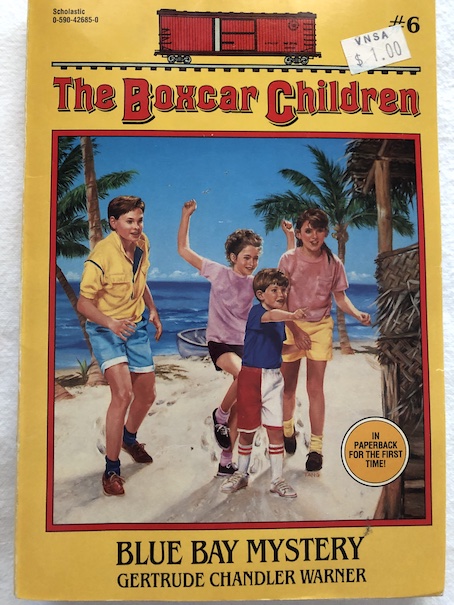
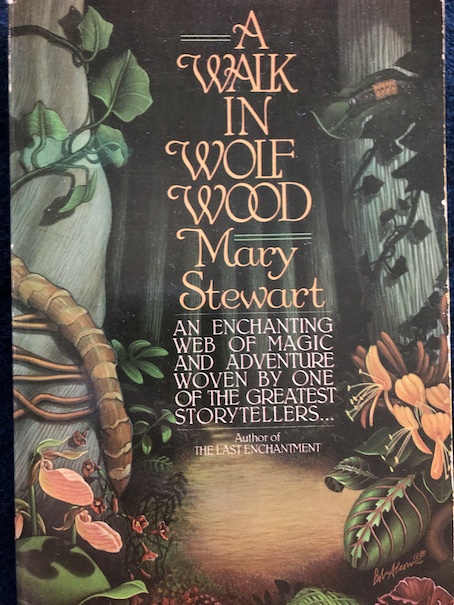
A Walk in Wolf Wood

A Walk in Wolf Wood by Mary Stewart, 1980.

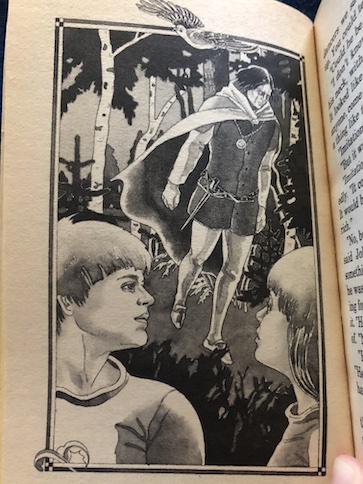
John and Margaret Begbie are traveling with their parents through Germany, and the family stops to have a picnic in the Black Forest. From their picnic spot, they can see the old castle on the hill that they visited earlier that day. The children’s parents doze off after lunch, but the children stay awake and see a strange man. The man walks by their picnic spot wearing an old velvet costume and a dagger in his belt, and the children see that he’s crying. The kids worry about the man because he seems so deeply distressed. They decide to leave a note for their parents and follow the man to be sure that he’s alright.

As they go after the man, they spot what looks like the tracks of a large dog, but the man didn’t have a dog with him. The kids realize that these are actually wolf tracks, and John remembers that their father told them that this area is called Wolfenwald, which means Wolf Wood. Then, they find the man’s gold medallion lying on the ground. Going a little further, they find an old cottage. The cottage looks abandoned, but they decide to explore around it anyway, just in case the man went inside. No one answers their knocks on the door, but they see the man’s clothes on the bed inside the house. They decide to leave the medallion with the man’s clothes and go back to their parents, but they suddenly notice that it has become night, and when they try to leave the cottage, they are confronted by a large wolf!

John frightens the wolf away by flinging the medallion at it. When the wolf is gone, the children decide that they have no choice but to risk going through the woods in the dark to find their parents. However, when they arrive at the picnic spot again, their parents aren’t there. The children find the note they left and a bar of chocolate. They eat the chocolate and lie down to wait for their parents to return for them, but the next thing they know, they are woken by the sound of a horn and the horses of a group of hunters. The hunters are pursuing the wolf. When they wave down one of the horsemen, he offers them a coin to tell him where the wolf is. Margaret points the man in the wrong direction to get the hunters off the trail of the wolf. The children aren’t really sure whether it’s a real wolf or just a dog that resembles one, but Margaret has the sense that the wolf needs their help.

The children also need help. They notice that the horsemen are dressed strangely, like people out of the past, and the coin that the man gave them is stamped with the year 1342 although it looks new. Even more strangely, the children suddenly realize that they understood what the man said even though neither of them can speak German. Is this is a dream, or have they gone back in time?

Not knowing what else to do, they decide to return to the cottage and see if the man who owns the medallion is there and can explain things. The man does have an explanation. He explains that he was the wolf. The man, whose name is Mardian, is a werewolf, and Margaret saved his life when she diverted the hunters. Mardian says that he and his family served the dukes who have ruled this land, and he and the current duke grew up together and were best friends for years. However, after suffering a terrible injury at the hands of an enemy and losing his wife, Duke Otho became a changed man, angry and bitter. In a fit of temper, he even accused Mardian of plotting against him. A real enemy in Otho’s circle, an enchanter called Almeric, used Otho’s suspicions to try to eliminate Mardian. When his plots to kill Mardian failed, Almeric used sorcery to turn him into a werewolf. Now, Alermic has promised a reward to the hunter who kills the wolf, and in the meantime, he has disguised himself as Mardian and taken his place in the duke’s castle. So far, the duke hasn’t even noticed that Mardian has been replaced by an imposter. Mardian believes that Alermic will use his position to kill both the duke and his young son so he can take the dukedom for himself. Can the children help Mardian expose the imposter and break the spell?

The book is available to borrow and read for free online through Internet Archive (multiple copies).

My Reaction

In order to reach the duke and get his help to expose the imposter, the children must disguise themselves as other children from this time period and join in the life of the duke’s castle. Mardian gives them a plausible cover story, in case anyone asks them who they are. They carry off the charade very well, and there are so many people and children in the castle that two more aren’t questioned. John is even mistaken for another boy, called Lionel. John doesn’t know who or where the real Lionel is, although he theorizes that the real Lionel might have died young because many children of this time period did. While real-life castles were full of many different types of people of all ages, I do find it a little difficult to believe that so few people are surprised by children who suddenly appear without any introduction. There does seem to be the implication that people do come and go from this castle, making it difficult to keep track of everyone.

Margaret and John also experience the different expectations people of this time have for girls and boys. John is immediately put to work as a servant, waiting on the noblemen of the duke’s court as a page along with the sons of the nobles. He also has to dodge the rough games that the other boys play that are meant to prepare them for war. On the other hand, Margaret is taken to the nurseries with the other young girls of the castle and lectured about how she should be quiet and modest. The girls are much more closely supervised than the boys, although she finds a way of slipping away from the others to meet with John.

I liked some of the descriptions of the Medieval food in the book. At one point, Margaret thinks she’s eating turkey (a bird native to the Americas and not found in Europe during this time period), but John tells her that it’s actually swan and peacock, birds which were eaten around this time. There are a few instances where alcohol is mentioned because people during this time period drink wine and small beer. The duke also insists that a boy bring him his favorite posset, a drink I discussed in my earlier review of the The Box of Delights.

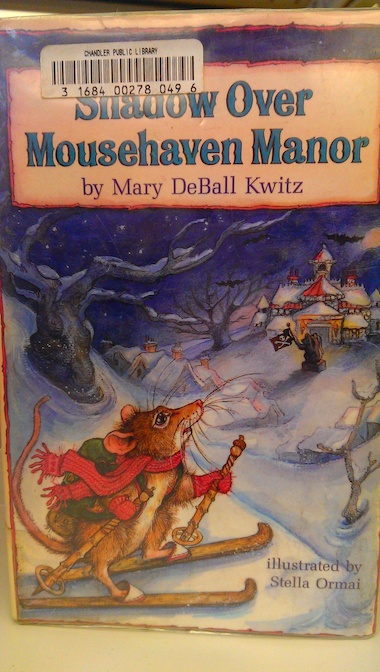
Shadow Over Mousehaven Manor

Shadow Over Mousehaven Manor by Mary DeBall Kwitz, 1989.

Minabell Mouse is happily looking forward to her Aunt Pitty Pat visiting her for Christmas with her new husband, Magnus, but she receives an urgent message from Magnus, saying that her aunt is very ill and may not survive much longer. He urges Minabell to home to her aunt’s home, Mousehaven Manor right away and bring the copy of her aunt’s will that her aunt left with her. With her home suddenly damaged badly by a storm, Minabell does immediately set out for Mousehaven Manor, crossing the Illinois prairie through the tunnel called Rodent Run, which small animals use to travel in safety. Before she leaves home, one of her friends gives her a Christmas present to take with her, something long and thin. It’s awkward to carry, but her friend insists that she take it with her and open it on Christmas. Another friend warns her to beware of the tough Chicago rats who are a gang of criminals who have invaded Chicago’s City Hall.

On the way, Minabell Mouse stops to rest and has a fearful encounter with a group of rats carrying a pirate flag with the name “Prairie Pirates” on it. She witnesses them murder a chicken at a farm, pluck it, and carry it off. It’s horrifying, and Minabell is lucky that the pirates didn’t see her. She is alerted by a stranger who makes her keep quiet.

The stranger introduces himself as Secret Agent Wendell Weasel, a member of the Illinois State Ski Patrol, a form of animal law enforcement. Minabell asks Wendell who those pirates were, but before he answers her questions, he insists that she identify herself and tell him where she’s going and why. Minabell explains to Wendell about her aunt, and he looks at the copy of the will she is carrying, which leaves everything to her, as her aunt’s closest relative.

Wendell urges Minabell to turn around and go home because it’s too dangerous for her to continue her journey. The Prairie Pirates are a band of Chicago rats, and the “Sungam” that they heard the pirates chant is the code name of their leader. Wendell says that he can’t tell her more than that because the information is classified, but he says that if Minabell really thinks about the word “Sungam”, she will see that there is a good reason not to go to her Aunt Pitty Pat and Uncle Magnus. (Hint, hint.) Of course, Minabell doesn’t see what Wendell is talking about at first and continues her journey because she thinks Aunt Pitty Pat needs her. She does, but not in the way Minabell expects.

Minabell does realize the significance of the word “Sungam” when she uses it to frighten off cats who attack her. Puzzling over the word more, Minabell tries writing it out in the snow and sees that it’s “Magnus” spelled backward. Minabell realizes that her aunt has actually married the leader of the Prairie Pirates! The Prairie Pirates have taken over Mousehaven Manor, and her beloved aunt is their prisoner! (Flying their pirate flag over the house isn’t the most subtle way to lure an innocent victim into their new hideout. I don’t think it even counts as a hideout anymore if you have a banner advertising that you’re there. Even if Minabell hadn’t already figured out the code name clue, the flag is a dead giveaway. Just saying.)

There is still time for Minabell to turn back before meeting the pirates, but she can’t leave her aunt in danger and Mousehaven Manor occupied by the enemy. However, she’s going to have to come up with a clever plan, or she’s going to be in danger, too.

I haven’t found a copy of this book online, but there is also a sequel called The Bell Tolls at Mousehaven Manor. There are only two books in the series.

My Reaction and Spoilers

I had to get this book because I vaguely remembered a teacher reading it to my class years ago in elementary school. There was a lot about the book that I forgot over the years. I had completely forgotten that it was actually a Christmas story. My strongest memory of this story was actually a small detail, but one that they repeat during the book. Minabell has a little ritual that she does whenever she needs to remember something, particularly when she needs to remember where she hid something. I had forgotten the rhyme she says, but I remembered her writing what she needs to remember on her forehead with her finger. That struck me as actually a clever trick because writing something, even if you never look at it again, helps things to stay in your memory because you really need to concentrate in order to write, and you can remember the act of writing, which brings back the memory of what you’ve written. When I was a kid, after hearing this story, I used to do that sometimes, write something on my forehead with a finger to help me remember.

Reading the book as an adult, the Sungam/Magnus clue is pretty obvious. The plot also sort of reminds me of The Mysteries of Udolpho, which I read several years ago because I really like Jane Austen’s Northanger Abbey, which references and parodies that book. The connection that book and this one is that part of the long, rambling, episodic plot of The Mysteries of Udolpho involves an aunt who has cluelessly married the leader of a gang of bandits, and the leader of the gang just wants to acquire her money and property. This book is a little different because the mouse aunt has not actually married the rat; he’s just holding her captive so he can take over her house and use it as the base for his gang and claiming that they’re married to justify occupying the manor. Like in The Mysteries of Udolpho, the bandit leader holds the aunt and her niece captive at an isolated manor house, trying to get the aunt to not only sign over all her money and property to him but also her niece’s inheritance. That’s why Magnus told Minabell to bring her copy of her aunt’s will. He needs to change the will so that it leaves Mousehaven Manor to him.

So, strangely, Shadow Over Mousehaven Manor is a little like The Mysteries of Udolpho for children. I actually recommend it more than The Mysteries of Udolpho because The Mysteries of Udolpho is rather long and disjointed. Both books contain some admiration of the beauties of the countryside while the character that travel, but the scenery descriptions are much longer in The Mysteries of Udolpho, and Shadow Over Mousehaven Manor is just more fun to read because it involves talking mice and pirate rats. The mice in this book are also much more sensible than the humans in The Mysteries of Udolpho. The mouse aunt knows darn well what Magnus is, while the human aunt was completely clueless almost up to the point where her husband caused her death. I’ve amused friends sometimes with describing The Mysteries of Udolpho, and I might put my short (short-ish) explanation of the plot (plots) of the book on the Internet sometime just for fun, but I mostly recommend reading that book only if you’ve already read and like Northanger Abbey.

I’m going to include some spoilers for the story because this book isn’t currently available to read online. Minabell has the presence of mind to realize that, before she attempts to enter Mousehaven Manor and save her aunt, she needs to hide the will she is carrying because she can’t let it fall into Magnus’s hands. When she does reach the manor, she is also imprisoned with her aunt in the manor’s dungeon, along with a friend who came to try to help her. (I don’t really know why any mansion in the US, mouse or human, needs a dungeon, but maybe mouse history in the US was more feudal than human society or something. It doesn’t really matter. It’s just a really cool mouse manor house, and it has a dungeon. It also has secret passages.) They get out of the dungeon because the aunt remembers an old song that has a clue to a secret way out of the dungeon, and they find their way to the belfry tower, where they ring the bell to signal for help. There, they meet a family of bats hibernating in the bell tower. The bell wakes them up, and one of them helps them reach their friends. Minabell, her aunt, and their friends battle the pirates and drive the out of Mousehaven Manor. They celebrate with a big New Year’s party, and Minabell decides that she wants to continue living at Mousehaven Manor with her aunt.

The House on Hackman’s Hill

House on Hackman's Hill cover

The House on Hackman’s Hill by Joan Lowery Nixon, 1985.

This creepy book is interesting partly because it is told in two parts. About half the story is a flashback that explains the history of the house and the mummy inside it, and the rest continues in the present day.

The very beginning of the story is in the present, starting with a pair of cousins. While they are visiting their grandparents, Jeff tells his cousin Debbie that he’s found out about an old, abandoned house nearby that supposedly contains a hidden mummy and that there’s a reward for anybody who finds it. Debbie doesn’t believe him at first, but he says that he heard all about it from their grandparents’ neighbor, Mr. Karsten. Jeff persuades Debbie to come with him to check out the old house. Debbie comes and takes pictures of it because she’s interested in entering a photo contest.

The place looks really creepy, and they have the odd feeling like somebody is watching them, even though the house is supposed to be empty. Debbie says that they should ask their grandparents what they know about the old house. At first, the grandparents don’t want to talk about it. They just say that it’s an old house and not very interesting. Debbie asks them directly about the mummy, and they say that there are a lot of rumors about the old place, but they don’t really believe them. The kids decide to talk to old Mr. Karsten again. Mr. Karsten says that he knows all about the old house on Hackman’s Hill because he lived there for awhile when he was young, back in 1911.

Paul Karsten’s Story

Paul Karsten’s mother was a secretary, and she went to work for Dr. Hackman, the former owner of the house, after the death of her husband. Dr. Hackman was a strange man with changeable moods. He was pleasant enough to Mrs. Karsten, but he hated children and didn’t really like having her son Paul in his house. Dr. Hackman was a history professor, specializing in Egyptology. He was approaching retirement, and he wanted to devote himself to his papers and his collection of Egyptian artifacts. Mrs. Karsten’s job was to help him catalog his collection, and Dr. Hackman offered such a good salary, Mrs. Karsten couldn’t refuse. The mummy was delivered the same day that Paul and his mother moved into the house.

Paul was given a room in the tower of the house, and while he thought that it had a great view at first, he got nervous when he noticed how the tower room was situated on the edge of a cliff. One of Dr. Hackman’s servants, Jules, makes a comment about how Paul should be careful because they don’t want “another accident”, refusing to say more about whatever “accident” occurred there before. Paul was uncomfortable with the house and with Dr. Hackman. He tells his mother that the house frightens him and that he wants to leave, but his mother reassures him that the place only looks strange because of the Egyptian artifacts. Paul found the artifacts he once saw at a museum exhibit frightening and he’s particularly disturbed by a statue that Dr. Hackman has of a man with an animal head, but his mother says that’s just a statue of an Egyptian god.

Paul had notice earlier that a long box had been delivered to the house, and he gives into temptation and tries to look inside. However, he is stopped by Jules. Jules and his wife Anna warn Paul that this house isn’t very good for children and that Dr. Hackman doesn’t like people nosing around or messing with any of part his collection. At dinner, Paul admits to Dr. Hackman that he tried to look in the box and apologizes for his curiosity. Dr. Hackman accepts the apology, and before Paul goes to bed that evening, Dr. Hackman shows him the mummy case that was in the box. Paul asks him if it’s real, and Dr. Hackman says it is. Paul says that he heard that it’s illegal to take real mummies out of Egypt, but Dr. Hackman says that there are ways, if you’re willing to pay for it, and he was. Dr. Hackman says that his eventual goal is to turn his house into a museum of Egyptian artifacts so that scholars will come there to study them and read his papers, and he will be famous. He also says that he knows how to protect himself from the mummy’s curse. The talk of curses scares Paul, but Dr. Hackman says that nothing has ever happened to him personally because of any tomb curses … implying that something might have happened to someone else.

When Paul tells his mother that Dr. Hackman has a real mummy, she is worried and upset. She doesn’t like the idea of people obtaining artifacts through unethical or illegal means, although she knows that the laws are poorly enforced. Mrs. Karsten doesn’t believe in superstitious curses, but soon, strange things begin to happen. While putting away his things in his room, Paul discovers a strange, triangular piece of gold metal with some kind of design on it. When he goes up to bed, he feels like someone is there in the room, although he can’t find anyone. During the night, he wakes up, sees that one of his windows is open, and feels an odd urge to walk toward it, but fortunately, his mother comes to check on him and stops him. Paul and his mother both realize that they were woken by the sound of a cry in the night. His mother supposes that it was some kind of night bird, but Paul knows that it was probably something to do with the curse.

Paul insists that Jules and Anna tell him about the accident that took place in his room. They say that they weren’t working for Dr. Hackman when it happened, but they know that the person who fell from the tower room was a guest of Dr. Hackman’s, he was from Egypt, he died when he fell, and his body was shipped back home. At first, Paul thinks that the gold piece he found probably belonged to the Egyptian guest, but that’s not quite it.

Dr. Hackman gives Paul the job of polishing some of his statues, knowing that they bother him. It amuses Dr. Hackman as a mean joke. However, Paul’s fear of them fades while working with them because he begins to appreciate their artistry. Dr. Hackman is surprised that Paul is able to see that and not just be afraid of the statues. Paul asks him about the statue of the man with the animal head, and he explains that it’s a statue of Anubis, the god of the dead, and scares Paul again by saying that Anubis is the one responsible for the curses on tombs. He says that Anubis’s head is a jackal head and that jackals hunt at night and have a bark like a cry. This confirms to Paul that the curse was responsible for the cry he and his mother heard.

Paul eventually comes to realize that the strange gold piece attracts the mummy and the mummy’s curse, which is why Dr. Hackman knows that he’s in no danger. Dr. Hackman put it in the tower room to make sure that the mummy’s wrath would only come to whoever was in that room … and that’s why he made sure that Paul was given that room, too. To protect himself and his mother, Paul knows that he has to get rid of that gold piece.

Mr. Karsten finishes his story by explaining to Jeff and Debbie where he hid the gold piece and how Dr. Hackman disappeared, apparently a victim of the curse. Nobody ever discovered what happened to Dr. Hackman, and the mummy disappeared that same night, but a museum has offered a reward for anybody who finds the mummy. Mr. Karsten says that various people have tried to stay in the house and find the mummy, but nobody has succeeded. Everyone has been frightened off after just a single night in the house.

Jeff doesn’t believe in curses, and Debbie agrees to accompany him into the old house to find the mummy and claim the reward.

Return to the Present

The rest of the story is about Jeff and Debbie’s adventures with the house on Hackman’s Hill. Jeff says that he thinks all the spooky curse stuff was just put on by Dr. Hackman, who was a mean old man having a joke by scaring a kid with all that talk of curses. Dr. Hackman was definitely a mean old man who enjoyed scaring young Paul Karsten, but questions still remain. How much of what Paul experienced was really real, and what happened to Dr. Hackman? If the curse was just something he made up, why did he scream the night he disappeared, and where did he go?

Jeff’s idea is that all the creepy stuff happened at night, so the best time to go look for the mummy would be during the day. (That’s actually pretty sensible. Why go to a supposedly haunted house during the night if you don’t have to?) The kids make a plan and put together a collection of useful supplies and food for their mummy hunt. They decide to go while their grandmother is busy watching her favorite soap opera and their grandfather is in town, arranging some sort of surprise for them.

When they enter the house, they discover that everything is still inside. All of the furniture and Egyptian artifacts are like Mr. Karsten described them. Debbie has an instant camera that with takes pictures that develop themselves. (No brand name mentioned, but basically, a Polaroid instant camera or something very similar. Those were popular when I was a kid in the 1980s and into the early 1990s, especially for families and amateur photographers. They’re not as popular now with the popularity of smart phones and digital photography, but they’re still around. Although police photographers now use digital cameras, instant cameras have been used in accident and crime scene photography because they produce quick results, the photos last for a long time, and because they develop immediately after being taken, they can’t be digitally altered. What I’m saying is that Debbie has made a good choice for recording their adventures and any evidence that they uncover, and it pays off almost immediately.) When Debbie takes a picture of the statues that Mr. Karsten told them about, she notices something frightening right away: the Anubis statue doesn’t show up in photographs.

Jeff discounts the photographic evidence because Debbie’s hand shook, and the picture is somewhat blurred. However, the kids start hearing noises in the house. Then, Debbie notices that a bad snow storm is approaching. She wants to leave the house immediately, but Jeff realizes that they can’t because they’d never make it back to their grandparents’ house by the time the storm hit. Night approaches, and the kids are about to see just how true Mr. Karsten’s story was. The kids are trapped in the house by the snow storm, but they’re not there alone.

The book is available to borrow and read for free online through Internet Archive (multiple copies).

My Reaction and Spoilers

I thought that this was a fun, creepy story. The creepiness is tempered somewhat in the first half of this story because it’s told in the form of a flashback. We know during the first part of the story that Paul survives his ordeals and lives to old age because he’s telling the story of what happened when he was young to Jeff and Debbie as an old man. When Jeff and Debbie go into the house themselves, it’s less certain what’s going to happen.

There are points in the story after Jeff and Debbie enter the house where it seems uncertain how much of what Paul Karsten experienced was supernatural and how much might have been due to the machinations of Dr. Hackman, who seems to have been a very disturbed man by himself. They soon discover that the house has secret passages that could allow Dr. Hackman to move around the house unseen and create some strange phenomena himself to scare or harm people in the house. There was a point where I thought perhaps everything would turn out to be part of some elaborate plot by Dr. Hackman or someone else, but (spoiler) there is real supernatural phenomena happening.

Before the end of the book, Jeff and Debbie discover both where the mummy is hidden and where Dr. Hackman hid the mummy’s golden eyes, which Anubis has been searching for all this time. They also learn what really happened to Dr. Hackman all those years ago. He apparently did become the victim of the curse that he had tried to evade by inflicting it on others. When the story ends, it seems that the curse is ended permanently, although Jeff and Debbie do manage to get some things out of the experience.

I liked how, even though the story does turn out to be supernatural, the author introduced the idea that it might not be because that element of uncertainty kept the suspense going for longer and introduced some interesting possibilities for readers to consider. It also made it a little more plausible that the kids would be willing to enter the house because they could believe that the house itself was harmless without Dr. Hackman there to continue his plots.

Susannah and the Poison Green Halloween

Susannah and the Poison Green Halloween by Patricia Elmore, 1982.

This is the second book the Susannah Higgins mystery series.

Halloween doesn’t start out well for Susannah’s best friend, Lucy. Her father accidentally threw out her costume, thinking that it was trash because it was mostly made out of tin foil. (She was planning to be the Death Queen character from a comic book.) As she desperately tries to put together a last-minute costume for Susannah’s Halloween party, her father tries to buy her a costume at the discount store. Unfortunately, all the discount store left was a Little Bo Peep costume. Lucy thinks that she’s going to be mortified, showing up in something so childish when she told everyone her costume would be really cool. When another girl from school, Carla, comes by and teases her about her costume, Lucy gets the idea to make it a kind of double costume, painting her face an evil green so she can rip off her sweet Little Bo Peep mask and be the sinister Death Queen underneath.

Carla says that the secret identity costume idea is pretty good, but before she can go to the party, she has to buy a costume of her own. She had to wait for her stepfather’s pay day because her parents bought a new dress for her older sister, Nadine, for a high school dance earlier. As Carla explains about her delay in getting her costume, she mentions her sister’s social worker coming to dinner. Susannah asks why Nadine has a social worker, and Carla says that her sister got into trouble with drugs a couple of years before, but she’s not really supposed to talk about it. Lucy and Susannah want to do some trick-or-treating before the party, and Carla asks if they’ll wait for her to get her costume first. The other girls aren’t willing to wait, but they say that they’ll get some extra candy for her when they start out, and they’ll meet her at her family’s apartment at the Eucalyptus Arms apartment house. In her recounting of that Halloween night, Lucy says right out that it was at the Eucalyptus Arms that someone gave them poisoned candy.

When they reach the Eucalyptus Arms, Carla isn’t home yet, but they meet up with Knieval Jones (Lucy’s nemesis and Susannah’s occasional helper from the previous book), who is dressed like a vampire, and get some stale granola bars from Carla’s sister, Nadine. A nice lady name Mrs. Sweet gives them homemade cupcakes, and Mr. O’Hare, who is a vegetarian and thinks that sugar is poisonous, gives them organic treats from the natural food store. However, the strangest experience they have is in Mr. Mordecai’s apartment. Mr. Mordecai is a strange man with whitish eyes. He insists that they come in and pay their respects to the deceased “Jeremiah.” There is a coffin in the room with a wreath on it. The kids are spooked, but Susannah notices something odd about the wreath, which gives her an idea of who/what “Jeremiah” is. Mr. Mordecai gives them popcorn balls, and they leave.

They meet up with Carla, and Susannah’s grandfather, Judge Higgins, drives all four children to the party. However, Knievel and Lucy get into a fight over their treat bags, spilling both of them into the gutter and ruining their candy. Lucy is mad at Knievel, but then Knievel suddenly gets sick. At first, Lucy thinks that he’s just eaten too much because he’s been sampling his treats and stealing some of hers. Knievel misses the party because he’s sick, but it turns out to be much worse than that. The next day, the police come to the school to tell them that Knievel was poisoned and to interview the children about everything that happened the night before.

Because Lucy and Knievel spilled and ruined their bags of candy, it’s hard to say exactly what Knievel ate before he got sick, and Lucy never ate any of it. Carla had the same treats as the others, and she is also ill and being examined by a doctor, just in case she was also poisoned. Susannah turns her treat bag over the police for analysis. She never touched her candy because she had more than enough to eat at the Halloween party.

By process of elimination, they determine that the poisoned treats had to come from one of the apartments at the Eucalyptus Arms, and that it must have been in something homemade or unwrapped, not wrapped, commercially-made candy. Lucy says that they really know better than to eat unwrapped treats from a stranger, but Susannah points out that Knievel was hungry and ate treats almost as fast as he got them, regardless of whether they were wrapped or not. There are only a handful of suspects who could have handed out the poison in homemade or unwrapped treats, but which of them did it and why?

The title of the book is based on the fact that the apartment house is painted an ugly shade of green and all of the questionable treats the kids received were colored green.

The book is available to borrow and read for free online through Internet Archive (multiple copies).

My Reaction

One of the best things about this book for me is that it was originally published in the year I was born, and it’s a Halloween story, and I happened to be born only a few days before Halloween. Even if I hadn’t already read and liked the first book in this series, that would have endeared me to this book right away. I originally read the first book in the Susannah Higgins series as a child in elementary school, but I think that’s the only book in the series that I read at the time. It might have been that the library didn’t have the full series and the first book was the only one I could find or that book was one of the many that I found at a used book sale and the others weren’t there. It’s been so long that I can’t remember. I just remembered one scene from the first book for years, and it took me a long time to figure out what I was remembering.

Because I was very young during the early 1980s, it was a long time before I understood that this was a period when people were especially worried about the possibility of poison and razor blades in Halloween candy. Like other kids of the 1980s and 1990s, I had to watch those Halloween safety videos that warn you to be careful and to inspect candy for signs of tampering before eating it. (Specifically, I saw this video, which I found one day on YouTube. I watched this 1970s film on reel-to-reel when I was in elementary school because they hadn’t yet installed TVs and VCRs in the classrooms yet and they had a library of old films that I’m pretty sure they bought when they originally built the school in the 1970s. The sound quality wasn’t any better when I saw it for the first time, but it still cracks me up that the ultimate solution to the girl’s unsafe Halloween costume turns out to be gradually changing it to be a different costume.) In 1974, a father murdered his own son for the insurance money, hoping that some random sadist would be blamed for the crime because there were already urban legends about such things. Even though it wasn’t long before the truth of the father’s crime came out, this incident added to the urban legends, seeming to confirm the stories of Halloween poisonings. Because of this, my early Halloweens were very different from the ones my parents had in the 1950s. I was allowed to go trick-or-treating, but I never received any homemade treats, like the popcorn balls and candy apples my parents sometimes got. By the time I was trick-or-treating, only fully-wrapped, commercially made candy was considered safe and acceptable.

At first, I thought that the solution to this mystery would be that Nadine had made marijuana granola bars because we were told right away that she was involved with drugs in the past. There have been real-life cases of children accidentally getting into drugs owned by family members, including cases that have become part of the Halloween urban legends. However, that’s not the case in this story. Susannah’s Aunt Louise, who is a nurse at the children’s hospital, tells Susannah that marijuana was one of the first things they ruled out when they were testing to see what had poisoned the children. The children were vomiting and hallucinating, so Aunt Louise says that it appears to be an overdose of some kind of medicine.

Aunt Louise wasn’t mentioned in the previous book in the series, but she comes to stay with Susannah because her grandparents have to go out of town. Again, Susannah’s parents are simply not mentioned in the story. It’s never clarified whether Susannah is an orphan or living with her grandparents for another reason, although I think it’s implied that she’s an orphan by the parents’ absence and the lack of any mention of why.

Carla is a new character who didn’t appear in the previous book, but again, children in these books do not live in conventional two-parent households. Nadine is actually Carla’s stepsister, and the two of them haven’t known each other very long and are having problems adjusting to their parents’ remarriage and living together. Books with divorced parents or blended families were becoming increasingly common in children’s literature during the 1980s and 1990s, and they were a regular staple of books that I read when I was young. It was pretty common for there to be at least one character with divorced parents in the books I read, but this series stands out to me because it seems like every kid in it so far is either from a divorced family or lives with relatives other than their parents, for some reason. A mixture of different family situations is to be expected, but an overwhelming number of kids in almost the same situation just seems a little odd.

The author does a good job of making everyone at the apartment house look equally suspicious. A number of people at the apartment house have secrets, and some of them are truly dangerous. One of the characters in the story, a man Nadine and Carla call “Uncle Bob” because he’s a friend of Nadine’s father, seems to be showing inappropriate attention to the girls. Carla is afraid to be alone with him, hinting that things that he does when she’s alone with him make her uneasy or even frightened. Uncle Bob isn’t the poisoner, but he does seem to have inappropriate sexual interest in the girls. There isn’t anything explicit described in the story, but the way that the characters refer to Uncle Bob and the dirty magazine that Lucy says she found in his trash can along with a bunch of empty liquor bottles imply what Uncle Bob is like when other adults aren’t watching. Carla says that she’s tried to tell her parents about it before, but nobody believed her because Uncle Bob has been such a good old friend of her stepfather, and he can’t picture him doing anything wrong. When she finally confides the problem to Nadine, Nadine confirms that she’s had the same experience with him and that her father didn’t believe her either, but she’s going to make sure that he listens this time. Susannah also says that they are going to tell the police about it and her Aunt Louise, and while Uncle Bob may not have actually done anything that would cause him to be arrested, he’s going to get some severe warnings and maybe some professional help.

More Scary Stories to Tell in the Dark

More Scary Stories to Tell in the Dark collected from folklore and retold by Alvin Schwartz, drawings by Stephen Gammell, 1984.

This is the second book in a series of popular ghost stories and American urban legends. Many of us who were children in the 1980s and 1990s heard these stories on school playgrounds, at summer camps, or at sleepovers, even if we didn’t read them in this book first. I found the stories in the first book in the series to be more familiar to me from my childhood than the ones in the second book, but there are still many popular and familiar ghost stories here. There is a section at the beginning of the book where the author/compiler discusses why stories like these have been popular for generations. In the back of the book, there is another section with more detailed information about the origins of the stories and their variants.

The drawings in the book also complement the stories well. They’re all in black-and-white and have an ethereal look, as those they were composed of spirits or smoke.

The book is available to borrow and read for free online through Internet Archive (multiple copies).

Stories Included in the Book:

The stories are divided into sections by theme or by the effect that the stories are supposed to have.

When She Saw Him, She Screamed and Ran

This section has stories about ghosts.

Something Was Wrong – A man is walking down the street, but for some reason, everybody is afraid of him. What’s wrong?

The Wreck – A guy meets a girl at a dance … only to learn that she was killed before she got there.

One Sunday Morning – A woman goes to church on Sunday but discovers that this isn’t a normal church service.

Sounds – Some fishermen take shelter in an empty house during a storm and hear the sounds of a past murder.

A Weird Blue Light – The crew of a ship during the Civil War witness something very strange, possibly the ghost of a pirate ship.

Somebody Fell From Aloft – The ghost of a murdered sailor gets his revenge.

The Little Black Dog – A murderer is followed by the ghost of a dog.

Clinkity-Clink – A grave digger steals the silver dollars laid on the eyes of a corpse, but the dead woman wants them back. (This story is supposed to end with a jump scare, like ghost stories told aloud around a camp fire.)

She Was Spittin’ and Yowlin’ Just Like a Cat

This is a selection of strange stories about different topics.

The Bride – The famous story about a bride who plays hide-and-seek and accidentally gets locked in a trunk.

Rings on Her Fingers – A thief tries to steal the rings from a dead woman, only she may not be quite as dead as everyone thinks.

The Drum – Two young girls meet a gypsy girl with a special drum that controls dancing figures. The girls want the drum, but the gypsy girl says that she’ll only give it to them if they do bad things.

The Window – One dark night, Margaret sees something with glowing eyes outside her window. What is it?

Wonderful Sausage – A butcher murders his wife and turns her into sausage.

The Cat’s Paw – A woman turns herself into a cat.

The Voice – A girl hears a voice in her room at night, but nobody is there.

When I Wake Up, Everything Will Be All Right

This section has stories about dangerous and scary places.

“Oh, Susannah!” – A university student thinks her roommate is humming at night, but her roommate is already dead.

The Man in the Middle – A girl sees three men on the subway late at night, but something’s wrong with the one in the middle.

The Cat in a Shopping Bag – A woman accidentally runs over a cat, and she puts the body in a bag to dispose of, causing a thief to get a terrible shock.

The Bed by the Window – A room at a nursing home has only one bed by the window. When one man kills another to get the view, he gets a shock.

The Dead Man’s Hand – A group of nursing students resent a fellow student who seems too perfect and decide to play a prank on her.

A Ghost in the Mirror – This story explains the spooky sleepover game Bloody Mary. Kids (typically girls) go into a dark or diml-lit room and look in a mirror to see a scary face appear. (This is actually a psychological trick, sometimes referred to as the “strange-face illusion“. Humans instinctively look for faces and facial emotions, and when someone can’t see their own face in the mirror very well because the room is too dim, their mind will try to reconstruct the missing details and interpret them, creating some strange illusions, like it’s someone else’s face when it’s just their own. The book doesn’t explain that, but that’s basically what “Bloody Mary” really is.) In the game, the identity of “Bloody Mary” and what she’ll supposedly do if you see her varies. This story explains different versions of the ghost story associated with the game.

The Curse – A fraternity initiation results in the deaths of two pledges and a curse on the remaining members.

The Last Laugh

This section has spooky stories with a humorous twist.

The Church – A man takes shelter in an abandoned church during a storm and thinks that he sees ghosts inside, but they aren’t what they appear to be.

The Bad News – Two old friends who love baseball and wonder if there’s baseball in heaven. There’s good news, and bad news.

Cemetery Soup – A woman makes soup with a bone she finds in the cemetery.

The Brown Suit – A woman thinks that her dead husband would look better in a brown suit for his funeral, and the funeral parlor comes up with a bizarre solution.

BA-ROOOM! – A spooky song.

Thumpity-Thump – People move into a spooky house and hear a mysterious thumping noise.

Scary Stories to Tell in the Dark

Scary Stories to Tell in the Dark collected from folklore and retold by Alvin Schwartz, drawings by Stephen Gammell, 1981.

This collection of creepy stories was a popular staple of my childhood! The stories included in the book are not original stories but popular ghost stories and American urban legends that were spread around by word of mouth before being collected and written down. Many of us who were children in the 1980s and 1990s heard these stories on school playgrounds, at summer camps, or at sleepovers, even if we didn’t read them in this book first. The very popularity of these stories was part of the popularity of this particular book and others in its series. The stories were frightening yet familiar, and reading them as an adult brings a sense of creepy nostalgia and Halloweens past. There is a section at the beginning of the book where the author/compiler discusses why stories like these have been popular for generations. In the back of the book, there is another section with more detailed information about the origins of the stories and their variants. The back of the book recommends these stories for ages 9 and up.

The drawings in the book also complement the stories well. They’re all in black-and-white and have an ethereal look, as those they were composed of spirits or smoke.

The book is available to borrow and read for free online through Internet Archive (multiple copies). There is also an audiobook copy.

Stories Included in the Book:

The stories are divided into sections by theme or by the effect that the stories are supposed to have.

Aaaaaaaaaaah!

This section has stories that are meant to make listeners jump at the end, like the kind people like to tell around camp fires, and there are tips for how to deliver the jump scares at the end.

The Big Toe – A boy finds a toe that seems to be growing in his garden, and his family decides to eat it (God only knows why), but that’s just the tip of something bigger …

The Walk – Two men walking down a road are each frightened by each other.

“What Do You Come For?” – A ghostly man comes down the chimney, part by part … and he comes for YOU!

Me Tie Dough-ty Walker! – A boy and his dog wait for a ghostly head that falls down a chimney.

A Man Who Lived in Leeds – A spooky rhyme.

Old Woman All Skin and Bone – A popular spooky song.

He Heard Footsteps Coming Up the Cellar Stairs

These are all stories about ghosts.

The Thing – Two friends see a frightening thing crawl out of a field, and it turns out to be prophetic.

Cold as Clay – A farmer separates his daughter from the man she loves, but when the man dies, his ghost makes sure that she gets safely home.

The White Wolf – When wolves are killing farmers’ livestock, a man becomes wealthy by hunting them. Then, a ghostly wolf takes its revenge.

The Haunted House – A preacher rids a haunted house of its ghost and brings her murderer to justice.

The Guests – A pair of travelers are looking for a room for the night. An elderly couple offers to let them stay in their house, but the travlers get a shock the next morning.

They Eat Your Eyes, They Eat Your Nose

These are an assortment of stories, and some are kind of gross-out stories. I never liked the gross-out scary stories when I was a kid, but I know some kids were really into them.

The Hearse Song – An old, traditional scary song that has several variations. “Don’t you ever laugh as the hearse goes by, For you may be the next to die.”

The Girl Who Stood on a Grave – Some kids at a party say that the graveyard down the street is scary, and one of them claims that if you stand on a grave, the person inside will reach up to grab you. A girl at the party doesn’t believe it and accepts a bet to go stand on a grave with frightening results.

A New Horse – A farmhand tells his friend that a witch turns him into a horse and rides him at night, and his friend finds a way to put a stop to it.

Alligators – A woman claims that her husband turns into an alligator at night and is turning their two sons into alligators as well. People don’t believe her, but there’s more truth to her story than they know.

Room for One More – A man has a prophetic dream that saves his life.
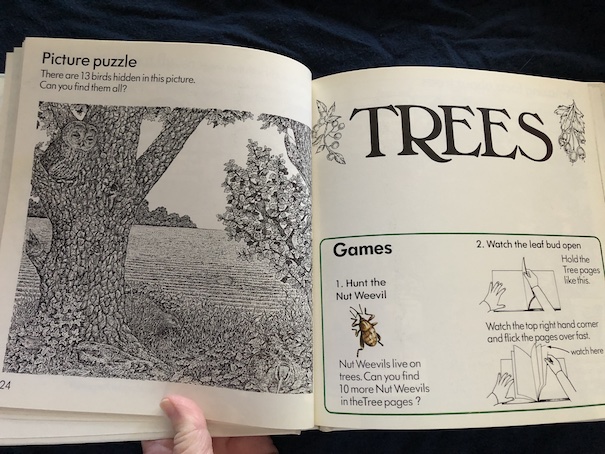
The Wendigo – A man on a hunting trip hears the wind calling to his companion. What does it mean?

The Dead Man’s Brains – This story is actually played as a game, and it’s especially popular on Halloween. Many of us have played some version of the game, where someone describes the body of a dead person, giving people weird and creepy things to feel that are supposed to be body parts. In reality, the “body parts” are common things, usually food, like peeled grapes to represent eyes, etc.

“May I Carry Your Basket?” – A man walking home late at night helps a strange woman to carry her basket, but what’s inside the basket is truly terrifying!

Other Dangers

These are more modern horror stories and urban legends than the earlier ones in the book, and they focus less on old ghosts and more on the dangers of modern society.

The Hook – This is a popular story at camps and sleepovers! A young couple is listening the radio in their car when they hear about an escaped murderer. The girl gets frightened and wants to go home, and it’s only when they get there that they realize how close they came to being his next victims.

The White Satin Evening Gown – A girl wants to go to a dance but doesn’t have much money for a dress to wear. When she finds a dress that she can rent cheaply, it turns out that there is something very wrong with it.

High Beams – A girl realizes that she’s being followed as she drives home alone at night, but her pursuer isn’t the one she should be afraid of.

The Babysitter – A young babysitter keeps getting strange calls … and they’re coming from inside the house.
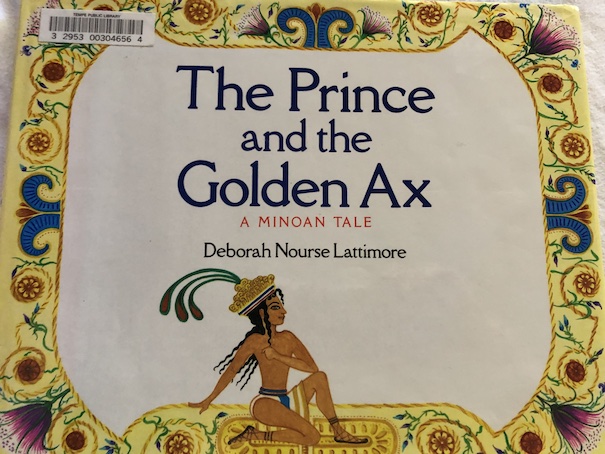
Aaaaaaaaaaah!

Even though this section has the same name as the first section, the stories in the final section of the book have humorous twists.
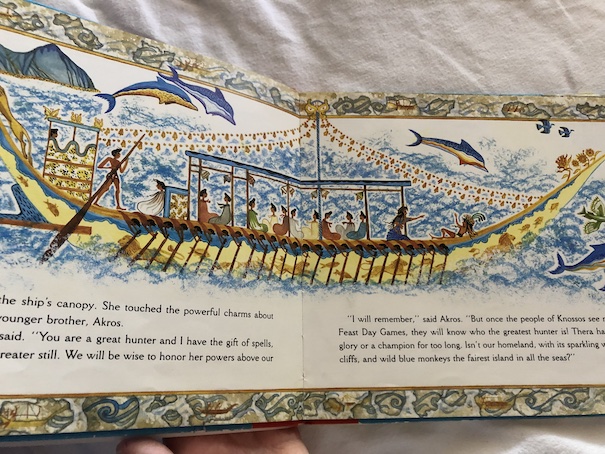
The Viper – One of my old favorites! The characters in The Haunting of Grade Three tell this story to each other. A woman keeps getting calls from a man calling himself “the viper.” Who is he, and what does he want?

The Attic – Rupert is looking for his dog when something happens to him on the way to check the attic that makes him scream.

The Slithery-Dee – A short rhyme.

Aaron Kelly’s Bones – Aaron Kelly is dead, but he doesn’t feel dead enough to stay in his coffin and won’t go back there until he does.

Wait Till Martin Comes – What will the cats do when Martin finally comes?

The Ghost with the Bloody Fingers – When dealing with a ghost, sometimes the practical approach is best.