The House on Hackman’s Hill

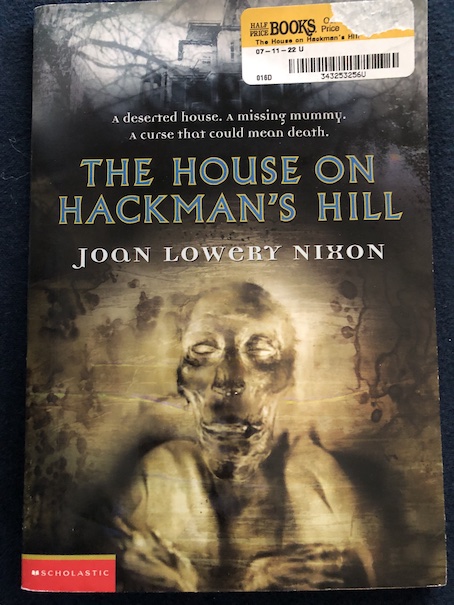
House on Hackman's Hill cover

The House on Hackman’s Hill by Joan Lowery Nixon, 1985.

This creepy book is interesting partly because it is told in two parts. About half the story is a flashback that explains the history of the house and the mummy inside it, and the rest continues in the present day.

The very beginning of the story is in the present, starting with a pair of cousins. While they are visiting their grandparents, Jeff tells his cousin Debbie that he’s found out about an old, abandoned house nearby that supposedly contains a hidden mummy and that there’s a reward for anybody who finds it. Debbie doesn’t believe him at first, but he says that he heard all about it from their grandparents’ neighbor, Mr. Karsten. Jeff persuades Debbie to come with him to check out the old house. Debbie comes and takes pictures of it because she’s interested in entering a photo contest.

The place looks really creepy, and they have the odd feeling like somebody is watching them, even though the house is supposed to be empty. Debbie says that they should ask their grandparents what they know about the old house. At first, the grandparents don’t want to talk about it. They just say that it’s an old house and not very interesting. Debbie asks them directly about the mummy, and they say that there are a lot of rumors about the old place, but they don’t really believe them. The kids decide to talk to old Mr. Karsten again. Mr. Karsten says that he knows all about the old house on Hackman’s Hill because he lived there for awhile when he was young, back in 1911.

Paul Karsten’s Story

Paul Karsten’s mother was a secretary, and she went to work for Dr. Hackman, the former owner of the house, after the death of her husband. Dr. Hackman was a strange man with changeable moods. He was pleasant enough to Mrs. Karsten, but he hated children and didn’t really like having her son Paul in his house. Dr. Hackman was a history professor, specializing in Egyptology. He was approaching retirement, and he wanted to devote himself to his papers and his collection of Egyptian artifacts. Mrs. Karsten’s job was to help him catalog his collection, and Dr. Hackman offered such a good salary, Mrs. Karsten couldn’t refuse. The mummy was delivered the same day that Paul and his mother moved into the house.

Paul was given a room in the tower of the house, and while he thought that it had a great view at first, he got nervous when he noticed how the tower room was situated on the edge of a cliff. One of Dr. Hackman’s servants, Jules, makes a comment about how Paul should be careful because they don’t want “another accident”, refusing to say more about whatever “accident” occurred there before. Paul was uncomfortable with the house and with Dr. Hackman. He tells his mother that the house frightens him and that he wants to leave, but his mother reassures him that the place only looks strange because of the Egyptian artifacts. Paul found the artifacts he once saw at a museum exhibit frightening and he’s particularly disturbed by a statue that Dr. Hackman has of a man with an animal head, but his mother says that’s just a statue of an Egyptian god.

Paul had notice earlier that a long box had been delivered to the house, and he gives into temptation and tries to look inside. However, he is stopped by Jules. Jules and his wife Anna warn Paul that this house isn’t very good for children and that Dr. Hackman doesn’t like people nosing around or messing with any of part his collection. At dinner, Paul admits to Dr. Hackman that he tried to look in the box and apologizes for his curiosity. Dr. Hackman accepts the apology, and before Paul goes to bed that evening, Dr. Hackman shows him the mummy case that was in the box. Paul asks him if it’s real, and Dr. Hackman says it is. Paul says that he heard that it’s illegal to take real mummies out of Egypt, but Dr. Hackman says that there are ways, if you’re willing to pay for it, and he was. Dr. Hackman says that his eventual goal is to turn his house into a museum of Egyptian artifacts so that scholars will come there to study them and read his papers, and he will be famous. He also says that he knows how to protect himself from the mummy’s curse. The talk of curses scares Paul, but Dr. Hackman says that nothing has ever happened to him personally because of any tomb curses … implying that something might have happened to someone else.

When Paul tells his mother that Dr. Hackman has a real mummy, she is worried and upset. She doesn’t like the idea of people obtaining artifacts through unethical or illegal means, although she knows that the laws are poorly enforced. Mrs. Karsten doesn’t believe in superstitious curses, but soon, strange things begin to happen. While putting away his things in his room, Paul discovers a strange, triangular piece of gold metal with some kind of design on it. When he goes up to bed, he feels like someone is there in the room, although he can’t find anyone. During the night, he wakes up, sees that one of his windows is open, and feels an odd urge to walk toward it, but fortunately, his mother comes to check on him and stops him. Paul and his mother both realize that they were woken by the sound of a cry in the night. His mother supposes that it was some kind of night bird, but Paul knows that it was probably something to do with the curse.

Paul insists that Jules and Anna tell him about the accident that took place in his room. They say that they weren’t working for Dr. Hackman when it happened, but they know that the person who fell from the tower room was a guest of Dr. Hackman’s, he was from Egypt, he died when he fell, and his body was shipped back home. At first, Paul thinks that the gold piece he found probably belonged to the Egyptian guest, but that’s not quite it.

Dr. Hackman gives Paul the job of polishing some of his statues, knowing that they bother him. It amuses Dr. Hackman as a mean joke. However, Paul’s fear of them fades while working with them because he begins to appreciate their artistry. Dr. Hackman is surprised that Paul is able to see that and not just be afraid of the statues. Paul asks him about the statue of the man with the animal head, and he explains that it’s a statue of Anubis, the god of the dead, and scares Paul again by saying that Anubis is the one responsible for the curses on tombs. He says that Anubis’s head is a jackal head and that jackals hunt at night and have a bark like a cry. This confirms to Paul that the curse was responsible for the cry he and his mother heard.

Paul eventually comes to realize that the strange gold piece attracts the mummy and the mummy’s curse, which is why Dr. Hackman knows that he’s in no danger. Dr. Hackman put it in the tower room to make sure that the mummy’s wrath would only come to whoever was in that room … and that’s why he made sure that Paul was given that room, too. To protect himself and his mother, Paul knows that he has to get rid of that gold piece.

Mr. Karsten finishes his story by explaining to Jeff and Debbie where he hid the gold piece and how Dr. Hackman disappeared, apparently a victim of the curse. Nobody ever discovered what happened to Dr. Hackman, and the mummy disappeared that same night, but a museum has offered a reward for anybody who finds the mummy. Mr. Karsten says that various people have tried to stay in the house and find the mummy, but nobody has succeeded. Everyone has been frightened off after just a single night in the house.

Jeff doesn’t believe in curses, and Debbie agrees to accompany him into the old house to find the mummy and claim the reward.

Return to the Present

The rest of the story is about Jeff and Debbie’s adventures with the house on Hackman’s Hill. Jeff says that he thinks all the spooky curse stuff was just put on by Dr. Hackman, who was a mean old man having a joke by scaring a kid with all that talk of curses. Dr. Hackman was definitely a mean old man who enjoyed scaring young Paul Karsten, but questions still remain. How much of what Paul experienced was really real, and what happened to Dr. Hackman? If the curse was just something he made up, why did he scream the night he disappeared, and where did he go?

Jeff’s idea is that all the creepy stuff happened at night, so the best time to go look for the mummy would be during the day. (That’s actually pretty sensible. Why go to a supposedly haunted house during the night if you don’t have to?) The kids make a plan and put together a collection of useful supplies and food for their mummy hunt. They decide to go while their grandmother is busy watching her favorite soap opera and their grandfather is in town, arranging some sort of surprise for them.

When they enter the house, they discover that everything is still inside. All of the furniture and Egyptian artifacts are like Mr. Karsten described them. Debbie has an instant camera that with takes pictures that develop themselves. (No brand name mentioned, but basically, a Polaroid instant camera or something very similar. Those were popular when I was a kid in the 1980s and into the early 1990s, especially for families and amateur photographers. They’re not as popular now with the popularity of smart phones and digital photography, but they’re still around. Although police photographers now use digital cameras, instant cameras have been used in accident and crime scene photography because they produce quick results, the photos last for a long time, and because they develop immediately after being taken, they can’t be digitally altered. What I’m saying is that Debbie has made a good choice for recording their adventures and any evidence that they uncover, and it pays off almost immediately.) When Debbie takes a picture of the statues that Mr. Karsten told them about, she notices something frightening right away: the Anubis statue doesn’t show up in photographs.

Jeff discounts the photographic evidence because Debbie’s hand shook, and the picture is somewhat blurred. However, the kids start hearing noises in the house. Then, Debbie notices that a bad snow storm is approaching. She wants to leave the house immediately, but Jeff realizes that they can’t because they’d never make it back to their grandparents’ house by the time the storm hit. Night approaches, and the kids are about to see just how true Mr. Karsten’s story was. The kids are trapped in the house by the snow storm, but they’re not there alone.

The book is available to borrow and read for free online through Internet Archive (multiple copies).

My Reaction and Spoilers

I thought that this was a fun, creepy story. The creepiness is tempered somewhat in the first half of this story because it’s told in the form of a flashback. We know during the first part of the story that Paul survives his ordeals and lives to old age because he’s telling the story of what happened when he was young to Jeff and Debbie as an old man. When Jeff and Debbie go into the house themselves, it’s less certain what’s going to happen.

There are points in the story after Jeff and Debbie enter the house where it seems uncertain how much of what Paul Karsten experienced was supernatural and how much might have been due to the machinations of Dr. Hackman, who seems to have been a very disturbed man by himself. They soon discover that the house has secret passages that could allow Dr. Hackman to move around the house unseen and create some strange phenomena himself to scare or harm people in the house. There was a point where I thought perhaps everything would turn out to be part of some elaborate plot by Dr. Hackman or someone else, but (spoiler) there is real supernatural phenomena happening.

Before the end of the book, Jeff and Debbie discover both where the mummy is hidden and where Dr. Hackman hid the mummy’s golden eyes, which Anubis has been searching for all this time. They also learn what really happened to Dr. Hackman all those years ago. He apparently did become the victim of the curse that he had tried to evade by inflicting it on others. When the story ends, it seems that the curse is ended permanently, although Jeff and Debbie do manage to get some things out of the experience.

I liked how, even though the story does turn out to be supernatural, the author introduced the idea that it might not be because that element of uncertainty kept the suspense going for longer and introduced some interesting possibilities for readers to consider. It also made it a little more plausible that the kids would be willing to enter the house because they could believe that the house itself was harmless without Dr. Hackman there to continue his plots.

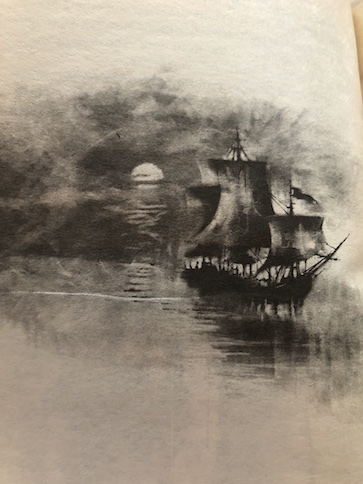
Susannah and the Poison Green Halloween

Susannah and the Poison Green Halloween by Patricia Elmore, 1982.

This is the second book the Susannah Higgins mystery series.

Halloween doesn’t start out well for Susannah’s best friend, Lucy. Her father accidentally threw out her costume, thinking that it was trash because it was mostly made out of tin foil. (She was planning to be the Death Queen character from a comic book.) As she desperately tries to put together a last-minute costume for Susannah’s Halloween party, her father tries to buy her a costume at the discount store. Unfortunately, all the discount store left was a Little Bo Peep costume. Lucy thinks that she’s going to be mortified, showing up in something so childish when she told everyone her costume would be really cool. When another girl from school, Carla, comes by and teases her about her costume, Lucy gets the idea to make it a kind of double costume, painting her face an evil green so she can rip off her sweet Little Bo Peep mask and be the sinister Death Queen underneath.

Carla says that the secret identity costume idea is pretty good, but before she can go to the party, she has to buy a costume of her own. She had to wait for her stepfather’s pay day because her parents bought a new dress for her older sister, Nadine, for a high school dance earlier. As Carla explains about her delay in getting her costume, she mentions her sister’s social worker coming to dinner. Susannah asks why Nadine has a social worker, and Carla says that her sister got into trouble with drugs a couple of years before, but she’s not really supposed to talk about it. Lucy and Susannah want to do some trick-or-treating before the party, and Carla asks if they’ll wait for her to get her costume first. The other girls aren’t willing to wait, but they say that they’ll get some extra candy for her when they start out, and they’ll meet her at her family’s apartment at the Eucalyptus Arms apartment house. In her recounting of that Halloween night, Lucy says right out that it was at the Eucalyptus Arms that someone gave them poisoned candy.

When they reach the Eucalyptus Arms, Carla isn’t home yet, but they meet up with Knieval Jones (Lucy’s nemesis and Susannah’s occasional helper from the previous book), who is dressed like a vampire, and get some stale granola bars from Carla’s sister, Nadine. A nice lady name Mrs. Sweet gives them homemade cupcakes, and Mr. O’Hare, who is a vegetarian and thinks that sugar is poisonous, gives them organic treats from the natural food store. However, the strangest experience they have is in Mr. Mordecai’s apartment. Mr. Mordecai is a strange man with whitish eyes. He insists that they come in and pay their respects to the deceased “Jeremiah.” There is a coffin in the room with a wreath on it. The kids are spooked, but Susannah notices something odd about the wreath, which gives her an idea of who/what “Jeremiah” is. Mr. Mordecai gives them popcorn balls, and they leave.

They meet up with Carla, and Susannah’s grandfather, Judge Higgins, drives all four children to the party. However, Knievel and Lucy get into a fight over their treat bags, spilling both of them into the gutter and ruining their candy. Lucy is mad at Knievel, but then Knievel suddenly gets sick. At first, Lucy thinks that he’s just eaten too much because he’s been sampling his treats and stealing some of hers. Knievel misses the party because he’s sick, but it turns out to be much worse than that. The next day, the police come to the school to tell them that Knievel was poisoned and to interview the children about everything that happened the night before.

Because Lucy and Knievel spilled and ruined their bags of candy, it’s hard to say exactly what Knievel ate before he got sick, and Lucy never ate any of it. Carla had the same treats as the others, and she is also ill and being examined by a doctor, just in case she was also poisoned. Susannah turns her treat bag over the police for analysis. She never touched her candy because she had more than enough to eat at the Halloween party.

By process of elimination, they determine that the poisoned treats had to come from one of the apartments at the Eucalyptus Arms, and that it must have been in something homemade or unwrapped, not wrapped, commercially-made candy. Lucy says that they really know better than to eat unwrapped treats from a stranger, but Susannah points out that Knievel was hungry and ate treats almost as fast as he got them, regardless of whether they were wrapped or not. There are only a handful of suspects who could have handed out the poison in homemade or unwrapped treats, but which of them did it and why?

The title of the book is based on the fact that the apartment house is painted an ugly shade of green and all of the questionable treats the kids received were colored green.

The book is available to borrow and read for free online through Internet Archive (multiple copies).

My Reaction

One of the best things about this book for me is that it was originally published in the year I was born, and it’s a Halloween story, and I happened to be born only a few days before Halloween. Even if I hadn’t already read and liked the first book in this series, that would have endeared me to this book right away. I originally read the first book in the Susannah Higgins series as a child in elementary school, but I think that’s the only book in the series that I read at the time. It might have been that the library didn’t have the full series and the first book was the only one I could find or that book was one of the many that I found at a used book sale and the others weren’t there. It’s been so long that I can’t remember. I just remembered one scene from the first book for years, and it took me a long time to figure out what I was remembering.

Because I was very young during the early 1980s, it was a long time before I understood that this was a period when people were especially worried about the possibility of poison and razor blades in Halloween candy. Like other kids of the 1980s and 1990s, I had to watch those Halloween safety videos that warn you to be careful and to inspect candy for signs of tampering before eating it. (Specifically, I saw this video, which I found one day on YouTube. I watched this 1970s film on reel-to-reel when I was in elementary school because they hadn’t yet installed TVs and VCRs in the classrooms yet and they had a library of old films that I’m pretty sure they bought when they originally built the school in the 1970s. The sound quality wasn’t any better when I saw it for the first time, but it still cracks me up that the ultimate solution to the girl’s unsafe Halloween costume turns out to be gradually changing it to be a different costume.) In 1974, a father murdered his own son for the insurance money, hoping that some random sadist would be blamed for the crime because there were already urban legends about such things. Even though it wasn’t long before the truth of the father’s crime came out, this incident added to the urban legends, seeming to confirm the stories of Halloween poisonings. Because of this, my early Halloweens were very different from the ones my parents had in the 1950s. I was allowed to go trick-or-treating, but I never received any homemade treats, like the popcorn balls and candy apples my parents sometimes got. By the time I was trick-or-treating, only fully-wrapped, commercially made candy was considered safe and acceptable.

At first, I thought that the solution to this mystery would be that Nadine had made marijuana granola bars because we were told right away that she was involved with drugs in the past. There have been real-life cases of children accidentally getting into drugs owned by family members, including cases that have become part of the Halloween urban legends. However, that’s not the case in this story. Susannah’s Aunt Louise, who is a nurse at the children’s hospital, tells Susannah that marijuana was one of the first things they ruled out when they were testing to see what had poisoned the children. The children were vomiting and hallucinating, so Aunt Louise says that it appears to be an overdose of some kind of medicine.

Aunt Louise wasn’t mentioned in the previous book in the series, but she comes to stay with Susannah because her grandparents have to go out of town. Again, Susannah’s parents are simply not mentioned in the story. It’s never clarified whether Susannah is an orphan or living with her grandparents for another reason, although I think it’s implied that she’s an orphan by the parents’ absence and the lack of any mention of why.

Carla is a new character who didn’t appear in the previous book, but again, children in these books do not live in conventional two-parent households. Nadine is actually Carla’s stepsister, and the two of them haven’t known each other very long and are having problems adjusting to their parents’ remarriage and living together. Books with divorced parents or blended families were becoming increasingly common in children’s literature during the 1980s and 1990s, and they were a regular staple of books that I read when I was young. It was pretty common for there to be at least one character with divorced parents in the books I read, but this series stands out to me because it seems like every kid in it so far is either from a divorced family or lives with relatives other than their parents, for some reason. A mixture of different family situations is to be expected, but an overwhelming number of kids in almost the same situation just seems a little odd.

The author does a good job of making everyone at the apartment house look equally suspicious. A number of people at the apartment house have secrets, and some of them are truly dangerous. One of the characters in the story, a man Nadine and Carla call “Uncle Bob” because he’s a friend of Nadine’s father, seems to be showing inappropriate attention to the girls. Carla is afraid to be alone with him, hinting that things that he does when she’s alone with him make her uneasy or even frightened. Uncle Bob isn’t the poisoner, but he does seem to have inappropriate sexual interest in the girls. There isn’t anything explicit described in the story, but the way that the characters refer to Uncle Bob and the dirty magazine that Lucy says she found in his trash can along with a bunch of empty liquor bottles imply what Uncle Bob is like when other adults aren’t watching. Carla says that she’s tried to tell her parents about it before, but nobody believed her because Uncle Bob has been such a good old friend of her stepfather, and he can’t picture him doing anything wrong. When she finally confides the problem to Nadine, Nadine confirms that she’s had the same experience with him and that her father didn’t believe her either, but she’s going to make sure that he listens this time. Susannah also says that they are going to tell the police about it and her Aunt Louise, and while Uncle Bob may not have actually done anything that would cause him to be arrested, he’s going to get some severe warnings and maybe some professional help.

More Scary Stories to Tell in the Dark

More Scary Stories to Tell in the Dark collected from folklore and retold by Alvin Schwartz, drawings by Stephen Gammell, 1984.

This is the second book in a series of popular ghost stories and American urban legends. Many of us who were children in the 1980s and 1990s heard these stories on school playgrounds, at summer camps, or at sleepovers, even if we didn’t read them in this book first. I found the stories in the first book in the series to be more familiar to me from my childhood than the ones in the second book, but there are still many popular and familiar ghost stories here. There is a section at the beginning of the book where the author/compiler discusses why stories like these have been popular for generations. In the back of the book, there is another section with more detailed information about the origins of the stories and their variants.
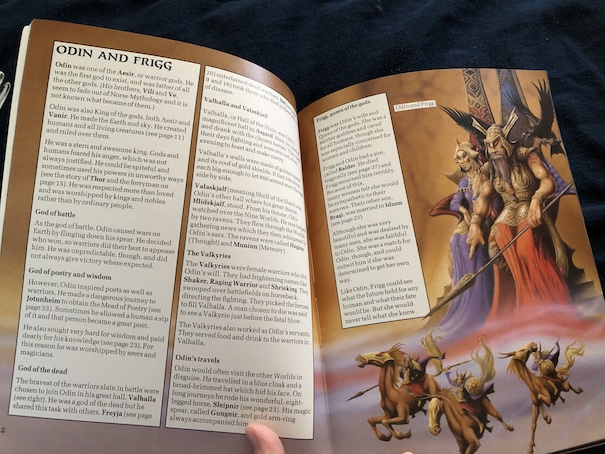
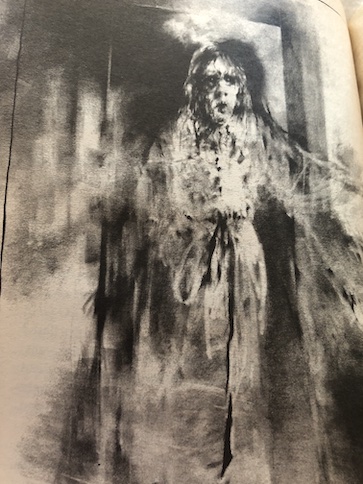
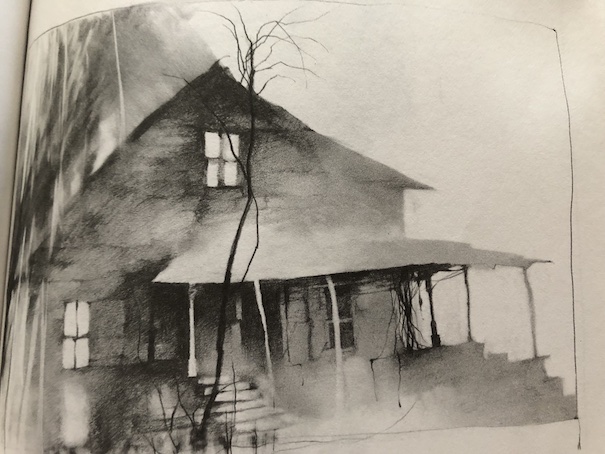
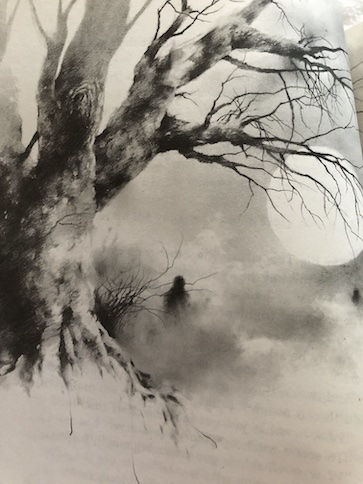
The drawings in the book also complement the stories well. They’re all in black-and-white and have an ethereal look, as those they were composed of spirits or smoke.

The book is available to borrow and read for free online through Internet Archive (multiple copies).

Stories Included in the Book:

The stories are divided into sections by theme or by the effect that the stories are supposed to have.

When She Saw Him, She Screamed and Ran

This section has stories about ghosts.

Something Was Wrong – A man is walking down the street, but for some reason, everybody is afraid of him. What’s wrong?

The Wreck – A guy meets a girl at a dance … only to learn that she was killed before she got there.

One Sunday Morning – A woman goes to church on Sunday but discovers that this isn’t a normal church service.

Sounds – Some fishermen take shelter in an empty house during a storm and hear the sounds of a past murder.

A Weird Blue Light – The crew of a ship during the Civil War witness something very strange, possibly the ghost of a pirate ship.

Somebody Fell From Aloft – The ghost of a murdered sailor gets his revenge.

The Little Black Dog – A murderer is followed by the ghost of a dog.

Clinkity-Clink – A grave digger steals the silver dollars laid on the eyes of a corpse, but the dead woman wants them back. (This story is supposed to end with a jump scare, like ghost stories told aloud around a camp fire.)

She Was Spittin’ and Yowlin’ Just Like a Cat

This is a selection of strange stories about different topics.

The Bride – The famous story about a bride who plays hide-and-seek and accidentally gets locked in a trunk.

Rings on Her Fingers – A thief tries to steal the rings from a dead woman, only she may not be quite as dead as everyone thinks.

The Drum – Two young girls meet a gypsy girl with a special drum that controls dancing figures. The girls want the drum, but the gypsy girl says that she’ll only give it to them if they do bad things.

The Window – One dark night, Margaret sees something with glowing eyes outside her window. What is it?

Wonderful Sausage – A butcher murders his wife and turns her into sausage.

The Cat’s Paw – A woman turns herself into a cat.

The Voice – A girl hears a voice in her room at night, but nobody is there.

When I Wake Up, Everything Will Be All Right

This section has stories about dangerous and scary places.

“Oh, Susannah!” – A university student thinks her roommate is humming at night, but her roommate is already dead.

The Man in the Middle – A girl sees three men on the subway late at night, but something’s wrong with the one in the middle.

The Cat in a Shopping Bag – A woman accidentally runs over a cat, and she puts the body in a bag to dispose of, causing a thief to get a terrible shock.

The Bed by the Window – A room at a nursing home has only one bed by the window. When one man kills another to get the view, he gets a shock.

The Dead Man’s Hand – A group of nursing students resent a fellow student who seems too perfect and decide to play a prank on her.

A Ghost in the Mirror – This story explains the spooky sleepover game Bloody Mary. Kids (typically girls) go into a dark or diml-lit room and look in a mirror to see a scary face appear. (This is actually a psychological trick, sometimes referred to as the “strange-face illusion“. Humans instinctively look for faces and facial emotions, and when someone can’t see their own face in the mirror very well because the room is too dim, their mind will try to reconstruct the missing details and interpret them, creating some strange illusions, like it’s someone else’s face when it’s just their own. The book doesn’t explain that, but that’s basically what “Bloody Mary” really is.) In the game, the identity of “Bloody Mary” and what she’ll supposedly do if you see her varies. This story explains different versions of the ghost story associated with the game.

The Curse – A fraternity initiation results in the deaths of two pledges and a curse on the remaining members.

The Last Laugh

This section has spooky stories with a humorous twist.

The Church – A man takes shelter in an abandoned church during a storm and thinks that he sees ghosts inside, but they aren’t what they appear to be.

The Bad News – Two old friends who love baseball and wonder if there’s baseball in heaven. There’s good news, and bad news.

Cemetery Soup – A woman makes soup with a bone she finds in the cemetery.

The Brown Suit – A woman thinks that her dead husband would look better in a brown suit for his funeral, and the funeral parlor comes up with a bizarre solution.

BA-ROOOM! – A spooky song.

Thumpity-Thump – People move into a spooky house and hear a mysterious thumping noise.

Scary Stories to Tell in the Dark

Scary Stories to Tell in the Dark collected from folklore and retold by Alvin Schwartz, drawings by Stephen Gammell, 1981.

This collection of creepy stories was a popular staple of my childhood! The stories included in the book are not original stories but popular ghost stories and American urban legends that were spread around by word of mouth before being collected and written down. Many of us who were children in the 1980s and 1990s heard these stories on school playgrounds, at summer camps, or at sleepovers, even if we didn’t read them in this book first. The very popularity of these stories was part of the popularity of this particular book and others in its series. The stories were frightening yet familiar, and reading them as an adult brings a sense of creepy nostalgia and Halloweens past. There is a section at the beginning of the book where the author/compiler discusses why stories like these have been popular for generations. In the back of the book, there is another section with more detailed information about the origins of the stories and their variants. The back of the book recommends these stories for ages 9 and up.

The drawings in the book also complement the stories well. They’re all in black-and-white and have an ethereal look, as those they were composed of spirits or smoke.

The book is available to borrow and read for free online through Internet Archive (multiple copies). There is also an audiobook copy.

Stories Included in the Book:

The stories are divided into sections by theme or by the effect that the stories are supposed to have.

Aaaaaaaaaaah!

This section has stories that are meant to make listeners jump at the end, like the kind people like to tell around camp fires, and there are tips for how to deliver the jump scares at the end.

The Big Toe – A boy finds a toe that seems to be growing in his garden, and his family decides to eat it (God only knows why), but that’s just the tip of something bigger …

The Walk – Two men walking down a road are each frightened by each other.

“What Do You Come For?” – A ghostly man comes down the chimney, part by part … and he comes for YOU!

Me Tie Dough-ty Walker! – A boy and his dog wait for a ghostly head that falls down a chimney.

A Man Who Lived in Leeds – A spooky rhyme.

Old Woman All Skin and Bone – A popular spooky song.

He Heard Footsteps Coming Up the Cellar Stairs

These are all stories about ghosts.

The Thing – Two friends see a frightening thing crawl out of a field, and it turns out to be prophetic.

Cold as Clay – A farmer separates his daughter from the man she loves, but when the man dies, his ghost makes sure that she gets safely home.

The White Wolf – When wolves are killing farmers’ livestock, a man becomes wealthy by hunting them. Then, a ghostly wolf takes its revenge.

The Haunted House – A preacher rids a haunted house of its ghost and brings her murderer to justice.

The Guests – A pair of travelers are looking for a room for the night. An elderly couple offers to let them stay in their house, but the travlers get a shock the next morning.

They Eat Your Eyes, They Eat Your Nose

These are an assortment of stories, and some are kind of gross-out stories. I never liked the gross-out scary stories when I was a kid, but I know some kids were really into them.

The Hearse Song – An old, traditional scary song that has several variations. “Don’t you ever laugh as the hearse goes by, For you may be the next to die.”

The Girl Who Stood on a Grave – Some kids at a party say that the graveyard down the street is scary, and one of them claims that if you stand on a grave, the person inside will reach up to grab you. A girl at the party doesn’t believe it and accepts a bet to go stand on a grave with frightening results.

A New Horse – A farmhand tells his friend that a witch turns him into a horse and rides him at night, and his friend finds a way to put a stop to it.

Alligators – A woman claims that her husband turns into an alligator at night and is turning their two sons into alligators as well. People don’t believe her, but there’s more truth to her story than they know.

Room for One More – A man has a prophetic dream that saves his life.

The Wendigo – A man on a hunting trip hears the wind calling to his companion. What does it mean?

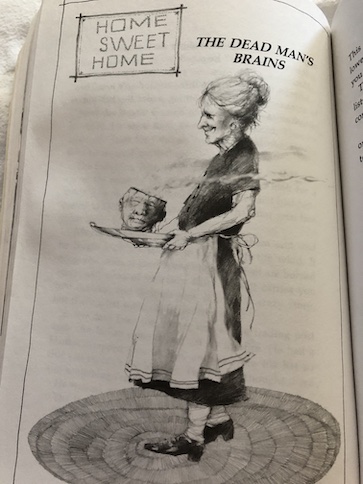
The Dead Man’s Brains – This story is actually played as a game, and it’s especially popular on Halloween. Many of us have played some version of the game, where someone describes the body of a dead person, giving people weird and creepy things to feel that are supposed to be body parts. In reality, the “body parts” are common things, usually food, like peeled grapes to represent eyes, etc.

“May I Carry Your Basket?” – A man walking home late at night helps a strange woman to carry her basket, but what’s inside the basket is truly terrifying!

Other Dangers

These are more modern horror stories and urban legends than the earlier ones in the book, and they focus less on old ghosts and more on the dangers of modern society.

The Hook – This is a popular story at camps and sleepovers! A young couple is listening the radio in their car when they hear about an escaped murderer. The girl gets frightened and wants to go home, and it’s only when they get there that they realize how close they came to being his next victims.

The White Satin Evening Gown – A girl wants to go to a dance but doesn’t have much money for a dress to wear. When she finds a dress that she can rent cheaply, it turns out that there is something very wrong with it.

High Beams – A girl realizes that she’s being followed as she drives home alone at night, but her pursuer isn’t the one she should be afraid of.

The Babysitter – A young babysitter keeps getting strange calls … and they’re coming from inside the house.

Aaaaaaaaaaah!

Even though this section has the same name as the first section, the stories in the final section of the book have humorous twists.

The Viper – One of my old favorites! The characters in The Haunting of Grade Three tell this story to each other. A woman keeps getting calls from a man calling himself “the viper.” Who is he, and what does he want?

The Attic – Rupert is looking for his dog when something happens to him on the way to check the attic that makes him scream.

The Slithery-Dee – A short rhyme.

Aaron Kelly’s Bones – Aaron Kelly is dead, but he doesn’t feel dead enough to stay in his coffin and won’t go back there until he does.

Wait Till Martin Comes – What will the cats do when Martin finally comes?

The Ghost with the Bloody Fingers – When dealing with a ghost, sometimes the practical approach is best.

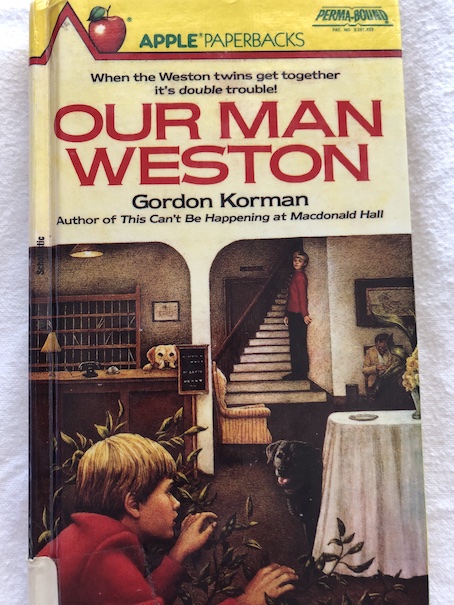
Our Man Weston

Our Man Weston by Gordon Korman, 1982.

Tom and Sidney Weston, a pair of identical twins, are excited about their first big summer jobs as service boys at a fancy resort hotel. Tom is thinking that the work is going to be easy and that they’ll have plenty of time to have fun, but then, he starts worrying about what kind of fun Sidney is going to try to have. Sidney mentions that they might see some interesting people at the hotel, and Tom remembers that Sidney thinks of himself as a detective and is always on the lookout for spies and criminals. It’s a real problem because Sidney is perpetually wrong in his suspicions about everything and everyone he tries to investigate. He’s gotten into trouble before for making false accusations, and because the two boys look alike, Tom sometimes gets blamed for things that Sidney does. Tom is really looking forward to this summer, and he’s determined that Sidney isn’t going to ruin their summer jobs.

Right from the first, Sidney is in detective mode. As the boys are picking up room service dishes, Sidney tries to study the dishes to make deductions about the people in each room. Tom tries to get Sidney to stop because their manager, Walter Parson, is a serious man with little patience, and he’s already annoyed that he has trouble telling the two boys apart. Sidney is excited when a hotel guest complains that her purse is missing, thinking that he’s found a case to investigate, but while he interviews her for details and pressing for details about a primary suspect, Tom just notices that the lady’s purse is still in her room. It wasn’t stolen, just misplaced. Tom uses this incident to emphasize to Sidney that he needs to give up this detective game because it only causes problems.

However, unbeknownst to the boys, there are real spies at the hotel, and they’re interested in the nearby air base, just like Sidney speculated might happen. The readers learn who the spies are right in the beginning, before the boys even know that there are spies. It’s a little like a Columbo mystery, where the identities of the villains aren’t a secret, and part of the suspense of the story is how the heroes will figure it out and prove it. Even though we know right away who the main villains are, Sidney is clueless.

Sidney continues investigating various guests as though they’re all spies or criminals, although he doesn’t seem at all suspicious of our real villains. He becomes convinced that Lawrence Waghorn is a spy when he’s actually a television writer who’s working on a script for a show about spies. He convinces the guest who temporarily lost her purse, Miss Fuller, that another guest, Mr. Kitzel, is a suspicious character, and she starts following him around and spying on him. In turn, Mr. Kitzel gets the idea that Miss Fuller either has an awkward crush on him or that she’s investigating him because he cheated on his taxes. He’s very nervous because she keeps following him around and tries his best to avoid her. Sidney steals his boss’s dog because he’s under the false impression that the dog is being trained to help the spies carry out their mission, and he seriously wants to inform the Prime Minister of Canada (where they live) and the President of the United States. Tom keeps trying to thwart his brothers’ various schemes and confiscate the spy equipment that he’s hidden around their hotel room. Confusion abounds, although some of its helps to inspire Waghorn, who has been suffering from a case of writer’s block.

Meanwhile, the real spy, Richard Knight (a pseudonym, county of origin unspecified), is trying to get his hands on a new airplane being tested at the nearby air base. He’s brought along a pilot named Bert Cobber. Cobber actually has military training and trained alongside the pilot testing the plane, “Wings” Weinberg. Weinberg has nerves of steel … except about anything related to his cadet days, having been partnered with Cobber, who is a skilled but reckless flier and nearly got him killed on many occasions while flying drunk, forgetting to put sufficient fuel in the plane, and repeatedly crashing. Weinberg hasn’t seen Cobber for years, but he practically has a nervous breakdown every time he relives those memories. A friend of Weinberg’s assures him that, if Cobber is really as reckless as Weinberg remembers, he probably got himself killed long ago, but Weinberg has the uneasy feeling that Cobber is still around somewhere.

Although many characters have the overall situation wrong, I appreciated those moments when some people got certain things exactly right. When Miss Fuller overhears Mr. Parson yet again mistaking Tom for Sidney and also quizzing him about why he’s getting mail from different government agencies, she steps up to tell him to stop his bullying, reminding him that mail is private and that the boy doesn’t owe him any explanation about his personal mail just because he works for him. She also tells him that he’s talking to Tom, not Sidney, and that he’s a fool for getting that wrong.

I also love it that the different government agencies that Sidney has been writing to already know who he is because Sidney has submitted many other inquiries to these various agencies. They’re all familiar with Sidney’s false accusations, and in their response letters to Sidney, they express both amusement for Sidney’s wild escapades and sympathy for whatever poor sap Sidney is suspicious of today. Sidney is never discouraged by their criticism of his wild theories or their requests for him to stop writing. It’s getting to the point where some law enforcement agencies are so fed up with Sidney that they wish they could find something to arrest him for.

Meanwhile, Richard Knight has noticed Sidney’s investigations, although he is unimpressed because he knows that Sidney is way off base. However, he hasn’t fully reckoned with the lengths Sidney is prepared to go to “save the western world”, and Sidney’s schemes interfere with Knight’s in completely unexpected ways.

My Reaction

I remember reading this book when I was in middle school, and I loved it. I remember thinking that it was really funny, although I’d forgotten a lot of the details since then. As an adult, I find Sidney more frustrating than I remember, and I feel sorry for poor, long-suffering Tom. As with the MacDonald Hall books by the same author but with different characters, Sidney’s crazy schemes end up working out for the best, and he ultimately saves the day, even though it’s largely by accident.

There are a couple of changes that I wish I could make to the story. First, I liked it that, while Mr. Kitzel isn’t a spy or a major criminal, he does have one guilty secret: he cheated on his taxes by claiming his dog as a dependent daughter. He becomes convinced that Miss Fuller is onto him for that. However, I’d like to create even more semi-guilty secrets for various guests at the hotel so that Sidney can be almost correct about some things while still missing the most suspicious person of all. As it is, Sidney is seriously way off base because he’s paranoid and delusional, although in a comedic sort of way. I don’t like characters that are intentionally stupid, so I’d like more secrets and petty crimes among the more innocent guests so Sidney can be almost right about them.

I’d also like to see Sidney develop some self-awareness during the course of the story. He is completely oblivious to his own failings and false conclusions and also to the way other people react to him, even when they tell him, in writing, that they don’t want to be bothered with his wild goose chases anymore. That’s part of the comedy of the story, but I find it a bit frustrating. Sidney does almost come to realize how other people look at him when he tries to persuade Miss Fuller that he was wrong about Mr. Kitzel being a spy, but she’s as impervious to correction as he is, so he ends up just letting her continue barking up the wrong tree. I think it would have shown more character development and maybe even have been more funny if Sidney comes to realize how Tom feels, trying to reign him in, if he had to try to control someone even more overly paranoid and determined than he is. The book ends well, but I think it would have been even better if, at the end, Sidney apologizes to Tom for everything he’s put him through, saying that, while everything worked out for the best, he realizes that he’s done a lot of things wrong and that he still has a lot to learn. Then, just when Tom thinks that things are going to calm down, he can see Sidney seriously reading a book about espionage or interrogation techniques and making notes or signing up for a summer correspondence course in criminal investigation, hinting that Sidney’s adventures aren’t over yet and leaving it open about whether he’s going to really learn something practical or just graduate to the next level of crazy.

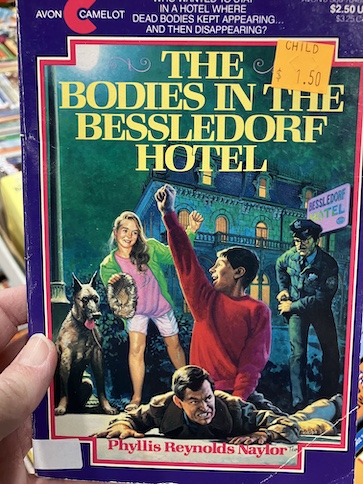
The Bodies in the Bessledorf Hotel

Officer Feeney is the first person who suggests that, someday, there might be a dead body at the Bessledorf Hotel. The hotel is coincidentally located next to the local funeral parlor, which is why the subject of dead bodies comes up, and Officer Feeney has a way of suggesting frightening things that scare Bernie Magruder, son of the hotel’s manager. Officer Feeney’s reasoning is that most people die in bed, so it only makes sense that some of them would be hotel beds. The hotel has 30 rooms, and with people coming and going, it’s surely just a matter of time before a guest dies there. It’s a morbid thought, although Bernie reasons that Officer Feeney is overestimating the number of people who pass through the hotel because it isn’t always full and some of the guests are long-term residents.

Still, Bernie gets a shock after he returns to the hotel, and the cleaning lady, Hildegarde bursts in on him and his parents, hysterical about finding a body in a bathtub of Room 107 with all his clothes on. Bernie’s father tells his wife to call Officer Feeney to write a report of the death and considers whether they can remove the body secretly, perhaps in a laundry cart, to avoid bad publicity for the hotel. Unfortunately, some of their guests already heard Hildegarde screaming about a dead body, so word is out. They want to know if it’s a case of murder or suicide and how it’s being investigated, and one of the long-term guests, who is a poet, has already written a short poem for the occasion.

However, by the time they all get to the room where Hildegarde saw the body, it’s gone. There is nothing in the bathtub, not even water. Officer Feeney shows up and demands to know what’s going on, and Hildegarde insists that she really saw something. The Magruders believe her, but they have no explanation for where the body could have gone. The guests speculate about body-snatchers and ghosts.

All they know about the man who occupied that room is that he gave his name as Phillip A. Gusset, he checked in the evening before, and he said that he would be leaving the next morning. Officer Feeney asks them if there was anything odd about him, like if he seemed nervous or unwell. Nobody remembers anything like that. They remember that he had a mustache and a hat with a red feather and just a single bag with him. He did kind of make Bernie’s parents uneasy, and he seemed to have a strange scent about him, although they find it difficult to describe what it actually smelled like. Officer Feeney says that, without a body or any evidence that something has happened, there doesn’t seem like anything to investigate. Bernie’s father is relieved that there won’t be any report of a murder or death occurring at the hotel because, otherwise, the owner might fire him. Bernie remembers that the man’s slippers were still in the room and goes to get them in case they’re evidence. When he gets there, he discovers that the slippers have mysteriously disappeared.

Bernie’s friends, Weasel and Georgene, think that people will probably never want to rent that hotel room ever again, and Bernie’s father renumbers the rooms so there will be no Room 107. Weasel convinces Bernie and Georgene to help him search the area for the body, thinking that whoever took it would most likely want to dispose of it quickly. They search down by the river, but they only find a bag of garbage that Bernie’s younger brother, Lester, left there to trick them.

Even though there’s no evidence that anything happened and the police aren’t investigating the situation, the incident of the disappearing guest appears in a newspaper in Indianapolis, where the hotel owner, Mr. Fairchild, lives. Mr. Fairchild calls the hotel to demand to know what’s going on. Mr. Fairchild says that he want the hotel to put on live entertainment in the evening on weekends to draw attention away from the incident and bring people in. However, he expects Bernie’s father to hire the entertainment out of his own money since Mr. Fairchild thinks this situation is his fault, and most entertainment is out of the Magruders’ price range. Fortunately, Bernie’s father has joined a barbershop quartet, so his group can do their singing at the hotel.

The singing goes well, but a strange woman with orange hair checks into the hotel and keeps making comments about dead bodies there. Then, one of the waiters finds this woman dead in her room, Room 321. Just like the first body, this body also vanishes. By this time, Bernie’s father suspects that the woman faked her “death” just to scare the waiter and ran away as soon as he was gone. As Bernie’s parents investigate the room, they notice an odd smell that reminds them of the first guest who disappeared. The smell really unnerves his father, but strangely, not his mother. It’s a faint smell that’s difficult to identify, but it conjures different images for both of them. Bernie’s father says it reminds him of sweaty clothes, cigars, and pastrami, while his mother says it makes her think of flowers and a porch swing in the evening.

The Magruders aren’t sure why someone wants to fake deaths at the hotel, but this latest faker didn’t pay for either her room or dinner, and somehow, the newspaper has heard about it and reported it again. Mr. Fairchild is angry, and Bernie knows that they need to figure out who the prankster is before they do it again!

The book is part of the Bessledorf mystery series, also known as the Bernie Magruder series. It is available to borrow and read for free online through Internet Archive (multiple copies).

Attempts to investigate the mystery alternate with the Magruders’ attempts at cheap hotel entertainment. The barbershop quartet works until one of the members gets laryngitis. Some of the guests start a food fight when the entertainment is bad. Then, Joseph gets some of his friends from the veterinary college who play instruments to come. Personally, I like the part where Lester suggests that they hold a haunted house at the hotel and take people on tours of the rooms where “dead” bodies have been found. They reject that idea, but there are hotels and bed-and-breakfasts that give haunted tours, and people come to investigate ghosts. That actually can be a successful gimmick. I once intentionally stayed in a supposedly haunted hospital that had been turned into a hotel in an old western mining town. A possible murder once occurred there, but I enjoyed the visit.

When a new guest shows up at the hotel with that same, strange scent, Bernie knows that it’s their culprit, back again in another disguise. Now that he knows who to watch, he starts planning how they’re going to trap the person.

I had a couple of ideas in beginning about who was doing all of this and why, but there are some surprising twists in the story. Bernie’s first attempt to catch the villain is weirdly thwarted by the discovery of a dead body that is actually a real, dead person. It’s not a guest; it’s a body stolen from the funeral parlor next door. The bad guy decided to change his tactics.

One of the clues to the person’s identity is that mysterious smell and the way it has an opposite effect on Bernie’s parents. It irritates Bernie’s father but makes his mother feel strangely nostalgic. The truth is that they’re both remembering the same thing or the same person, but although they can’t remember right away exactly what they’re remembering, they have very different feelings about it.

Surprisingly, although Mr. Fairchild threatens to replace Mr. Magruder with another manager, he actually shows up at the hotel himself and discovers that he likes playing detective and figuring out what’s going on. He’s also impressed with the way Mr. Magruder stayed to finish managing things even after he told him that he was planning to hire someone to replace him, and that secures the family’s position.

Eyewitness Medieval Life

Eyewitness

Medieval Life by Andrew Langley, photographed by Geoff Brightling and Geoff Dann, 1988, 2004.

I love books that explain the details of daily life in the past, and I especially like Eyewitness books because they include such great photographs to show objects that people would have used in the past.

This book begins by explaining the time period of the “Middle Ages”, which was the period between Ancient Greece and Rome and the Renaissance, when culture and knowledge from Ancient Greece and Rome came back into vogue. The Middle Ages lasted about 1000 years, roughly from 400 to about 1540 AD. (Estimates of the start and end dates vary because this was a period defined by cultural changes, which are gradual and don’t have precise start and end dates.) This long period of time can also be divided into smaller periods and contained many important events that helped to shape society and culture, including The Crusades and The Great Plague.

Medieval society was hierarchical and was based on land ownership. The king and the highest nobles controlled the land and allowed people in lower levels of society to use it or grant farming rights to peasants in exchange for rent in the form of their services and a share of what they produced. The peasants or serfs were tied to the land they farmed, and the land was owned by the lords they served. They were not regarded as “free” people, and they couldn’t leave their lord or the land except by raising enough money to buy some land for themselves or by marrying a free person from a higher level of society.

A lord’s manor included not only his manor house or castle but the nearby village, church, and the farmland where his serfs worked. Often, villages and manors had little contact with the outside world, so the people who lived there had to make most of what they needed themselves. Most people never left their land or were only able to travel a short distance from it, so the only new people they might meet would be traveling peddlers, soldiers, or pilgrims.

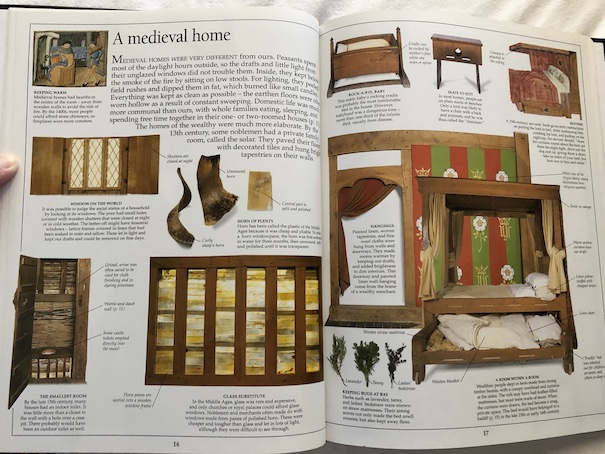
The book explains what would be found in a typical Medieval home. Poor people lived in houses that had only one or two rooms for the entire family. Few people could afford to buy glass windows. Poor people only had wooden shutters to cover their windows. Others might have tallow-coated linen over a lattice frame, which would let in light, and some wealthier people had pieces of polished horn in their windows, which also let in light, although you couldn’t really see through them well. What people ate varied depending on their social status. Wealthier people could afford a wider variety of foods, and poor people mostly ate what they produced themselves.

Women’s lives also varied depending on their social status. Pleasant women farmed and provided for their families alongside their husbands. Women in families of craftsmen and tradesmen often worked alongside the men in the family business. Wealthy women managed their husbands’ households or could rise to rank of influential abbess if they joined religious orders. However, the highest ranks in society were occupied by men.

While peasants served their lords, lords also owed services to higher nobles and, ultimately, to the king, although sometimes the king struggled to control powerful nobles and assert his authority over them. The king generally had to keep his nobles satisfied with his rule if he wanted to retain their loyalty because, while he was the source of their land and authority, they were effectively ruling over their own smaller lands with their own troops. While nobles owed their king military service and support, if they were dissatisfied with the state of their lands or were just unoccupied with other battles to fight and saw an opportunity, they would sometimes use their troops to raid the lands of neighboring nobles. Part of the king’s job involved preventing his nobles from being dangers to him and to each other. The king also made and enforced laws, settled disputes, and oversaw the collection of taxes.

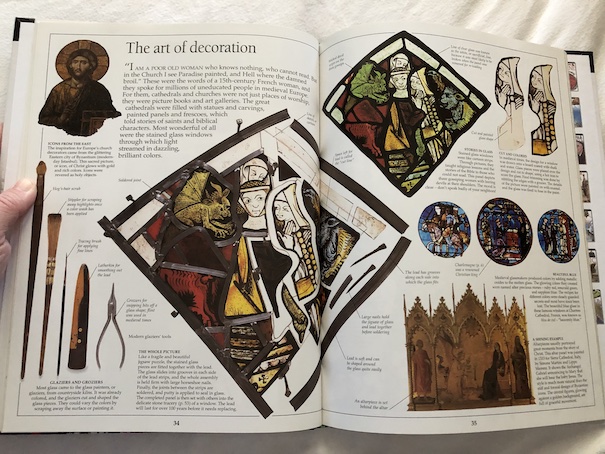
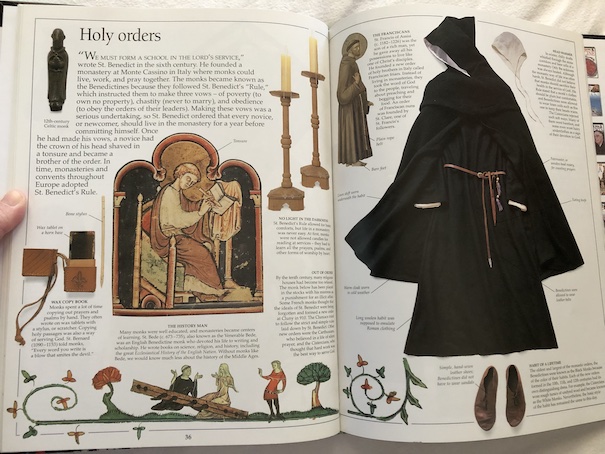
Christianity, specifically in the form of Catholicism, was central to the lives of people in the Middle Ages. During this time, stonemasons and craftsmen developed new techniques for building impressive cathedrals that still stand today. These cathedrals were lavishly decorated with statues, frescoes, and stained glass windows that depicted Biblical stories and the lives of saints. These works of art were important for helping to teach people who did not have the ability to read the Bible themselves about their religion.

Religious orders of monks and nuns performed important functions for society, such as caring for people who were poor or sick, providing safe places for travelers to stay, and copying written texts by hand. In the centuries before the printing press was invented, there were only handwritten books, and they took time and skill to produce. It could take an entire year for someone to copy an entire Bible. Few people were able to own personal books, and much of the schooling in this period was provided by religious orders.

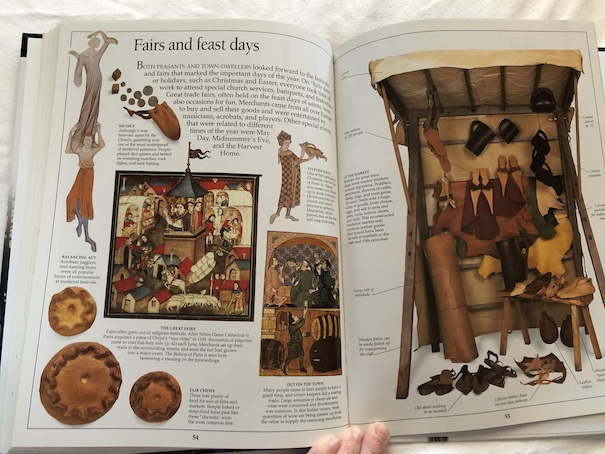
The book describes the rise of Islam during the early Middle Ages, increases in trade and commerce, the growth of towns, and guilds that controlled different professions. It also describes Medieval music and entertainment, such as plays and parades. One of my favorite parts of the book is about fairs and feast days.

The book ends by describing the beginning of the Renaissance and the rediscovery of classical Greek and Roman culture as well as the beginning of the Reformation and the development of new scientific discoveries and artistic styles.

The book is available to borrow and read for free online through Internet Archive (multiple copies).

The Olympians

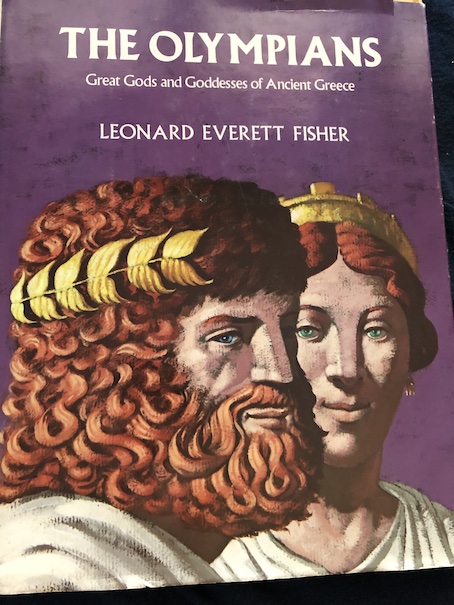
The Olympians by Leonard Everett Fisher, 1984.

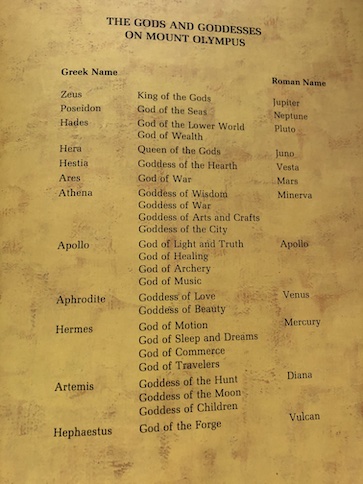
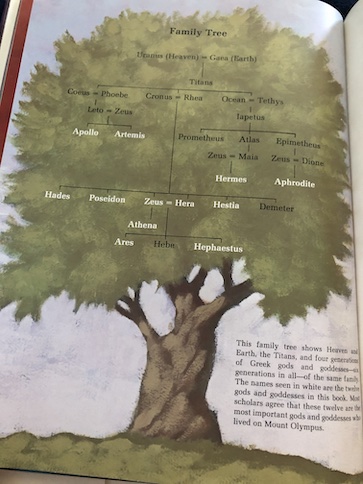
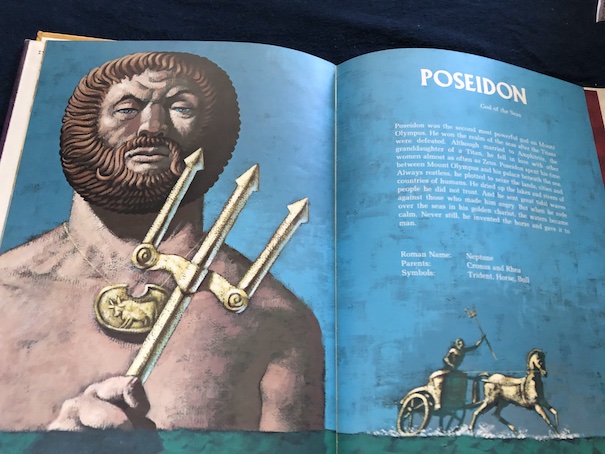
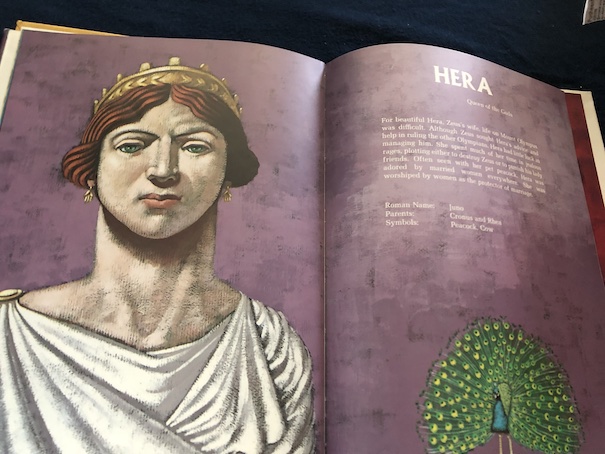
This picture book was my very first introduction to mythology when I was a kid! The book presents profiles of twelve Greek/Roman gods and goddesses. The Ancient Greeks and Romans worshiped the same gods and goddesses, but they used different names for them. At the beginning of the book, there is a list of gods and goddesses that gives both their Greek and Roman names. However, the rest of the book mainly uses the Greek names because the emphasis is on Greece. The gods and goddesses were called the Olympians because their legends state that they lived on Mount Olympus in Greece. It’s useful to know the Roman names, though, because the planets in our solar system were given the Roman names of gods.

The back of the book has a family tree because all of the gods and goddesses were canonically related to each other. As a kid, I just accepted that. I don’t remember questioning it. The names of the gods and goddesses in the book are written in white.

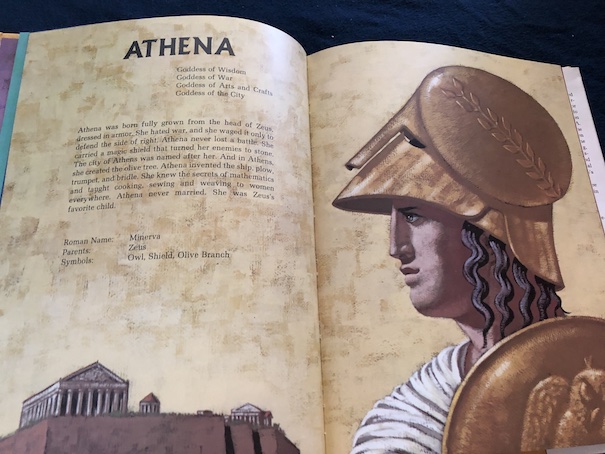
Each god and goddess in the book has a page of information and a full-page, full-color picture. Their profiles explain their personalities, their roles among the gods, and symbols that are commonly associated with them.

The pictures in the book are colorful. Although the faces of the gods and goddesses have a somewhat chiseled appearance, I like them.

When I was a kid, I think I had a fascination for Artemis and Apollo because they were twins, and I found twins fascinating. Because I was a girl, I generally liked the female goddesses better than the male ones. I think I sometimes tried to imagine which one I would be if I could pick one. I think, for a time, I liked Athena because she was the goddess of wisdom and was represented by owls, and I also happen to like owls.

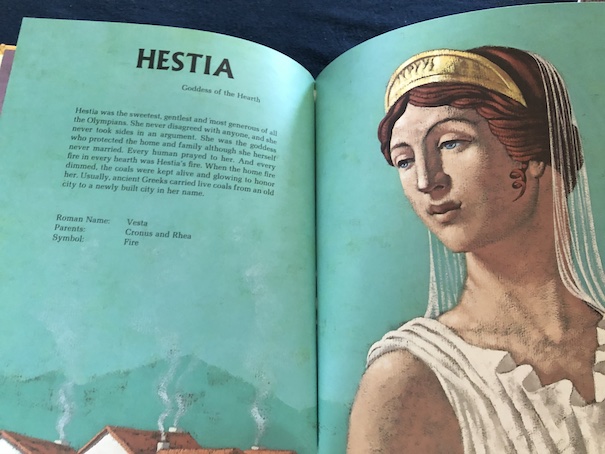
As I was rereading the book this time, I became more interested in the page about the goddess Hestia. As the goddess of the hearth and home, she might not seem as exciting and well-known as the others, but I like her picture, and her profile has some interesting facts. It mentions that Ancient Greeks would carry live coals from an old city to a new one that had been recently built in her honor.

The book is available to borrow and read for free online through Internet Archive (multiple copies).

Norse Myths and Legends

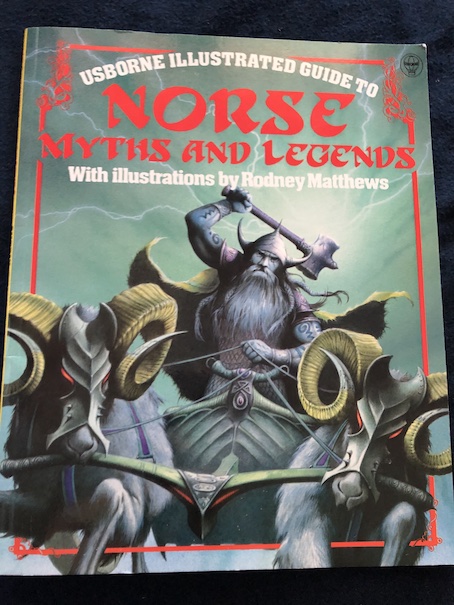
Usborne Illustrated Guide to Norse Myths and Legends by Cheryl Evans and Anne Millard, illustrated by Rodney Matthews, 1986.

I like this book because, before it begins telling the myths and legends, it first gives an introduction to the history, territory, and religion of the Norsemen. By “Norsemen“, the book means not only people living in Norway but Scandinavians and people of Scandinavian descent speaking related languages and living in various areas across Europe. The Norsemen include, but are not limited to, the Vikings, who were specifically seafaring traders, mercenaries, and pirates/looters as opposed to farmers and fishermen.

There is still much about the history of the ancient Norsemen that we don’t know because, for much of their history, they did not have their own system of writing and relied on oral stories for passing down historical and cultural knowledge. The Norse myths were originally oral stories before they were written down. The introduction also explains that there is one myth in the book, the story of Sigurd and the Nibelungs, that was originally a German legend but was later adopted by Scandinavians.

Norse mythology is somewhat unusual because, while Norsemen were polytheistic, like other ancient groups, and their gods and goddesses had human emotions and relationships, like the gods and goddesses in Greek and Roman mythology, Norse gods were not immortal. Norse gods could be killed, like human beings, which meant that any risks they took had genuinely serious stakes for them. In fact, the legends predict that, at a future, world-ending event known as Ragnarok, most of the gods will be killed.

Although this particular book doesn’t mention it, the qualities of Norse gods being able to perform incredible deeds while still being mortal makes them rather like our modern concept of a superhero. Thor and Loki were both made into comic book characters by the time this book was written, and characters and events in Norse mythology have helped to form the 21st century Marvel Cinematic Universe.

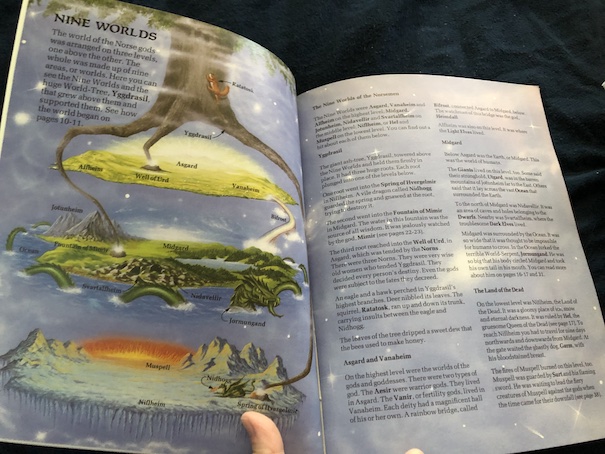
In Norse mythology, the gods and goddesses lived in a multilevel universe made up of nine lands or “worlds.” The highest level of their universe contained Asgard (home of the warrior gods), Vanaheim (home of the fertility gods), and Alfheim (home of the light elves). The middle level contained Midgard (our world, where humans live, connected to Asgard by a rainbow bridge), Jotunheim (home of the giants), Nidavellir (home of the dwarves), and Svartalfheim (home of the dark elves). The lowest level held Niflheim (land of the dead, dark and icy, ruled by a fearsome queen named Hel) and Muspell (where the creatures who will attack the gods at Ragnarok live). All three levels of this universe were kept in place by the roots of a giant ash tree called Yggdrasil.

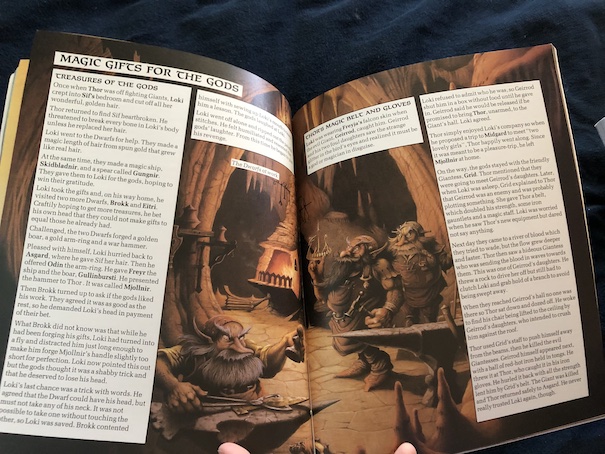
The book has pages dedicated to specific gods and goddess, explaining their histories and roles in Norse mythology. Odin, for example, was the king of the gods, who created the world and humans and was the father of the other gods. His wife’s name was Frigg, and she was a mother goddess figure. Thor was the thunder god and the god of law and order. Unlike other gods, he mostly relied on his strength instead of magic or tricks, but he did have magic weapons, including his hammer, Mjollnir, which would always strike its intended target and return to Thor after. Freyja was one of the fertility gods, and she was the goddess of love and beauty. She later also became a goddess of death and was responsible for starting wars among humans. Loki technically wasn’t a god because his parents were fire-giants, not gods, but he was a close friend and sworn brother to Odin, so he was able to live in Asgard, too. Loki is known for being a trickster figure.

After the book profiles some of the gods and goddesses and other notable figures in Norse mythology, it tells some of the myths and legends associated with theses figures. One story that particularly interests me is “The Curse of the Ring” because this story and other aspects of Norse mythology provided some of the inspiration for Tolkien’s Lord of the Rings. Before it inspired Tolkien, this same story was also made into an opera by Wagner.

In “The Curse of the Ring”, Odin, Loki, and Honir kill an otter who turns out to be the son of a magician who sometimes turns one of his sons into an otter to go fishing for the family. (Maybe not the safest choice of fishing methods.) The gods offer to compensate the magician with enough gold to fill the otter skin. Loki goes to get the gold from a dwarf named Andvari, who has a famous hoard. Andvari has no choice but to give Loki the gold he wants, but Loki notices that Andvari also has a gold ring on his finger, and Loki demands that Andvari give him the ring, too. Angry at having his ring stolen, Andvari curses the ring so that it will bring misery and destruction to anyone who wears it. When Loki brings the promised gold to the magician, the magician also sees the ring and wants it. Loki warns him about the curse on the ring, but the magician insists that he wants it anyway.

The curse on the ring comes true when one of the magician’s other sons, Fafnir, kills his father for his gold. Fafnir takes all of the gold instead of giving his other brother, Regin, a share of the inheritance and turns himself into a dragon so he can protect his hoard of gold from anyone who tries to take it. Regin raises their nephew, Sigurd, to kill Fafnir and avenge his grandfather. However, the curse of the ring and the gold doesn’t end there. Regin tries to kill Sigurd so he won’t have to share the gold with him, and Sigurd has to kill him in self defense. After Sigurd rescues a Valkyrie named Brynhild, and they fall in love, they both fall victim to treachery from Queen Grimhild of the Nibelungs. Wanting Sigurd’s gold, she gives him a love potion that makes him fall in love with her daughter, forgetting about Brynhild. Queen Grimhild’s son also wants to marry Brynhild. Abandoned by her lover, Brynhild marries him, but driven mad with by Sigurd’s abandonment of her, Brynhild arranges for Sigurd to be murdered and then kills herself, setting off a continuing chain of murder and revenge after her own death that destroys the royal family of the Nibelungs.

The book ends with a “Who’s Who” section with information about various characters and creatures in the Norse myths.

The book is available to borrow and read for free online through Internet Archive.

Da Vinci

Da Vinci by Mike Venezia, 1989.

This book is part of a series of biographies of famous people from history. I’ve been familiar with the part of this series about famous artists since around the time the first ones were published. I was in elementary school school at the time, and we had the books because my mother used to teach the Art Masterpiece program at the school. She would come to class and talk about famous artists and show their paintings, and there would be an art project for the kids to do based on the style or subject matter of the artists. So, when I was young, we had books from this series (among other art books) around the house that she used for the art classes and a lot of arts and crafts materials (a tradition which exists to this day). At the moment, this is the only book from the series that I have because the book about Leonardo da Vinci was my favorite.

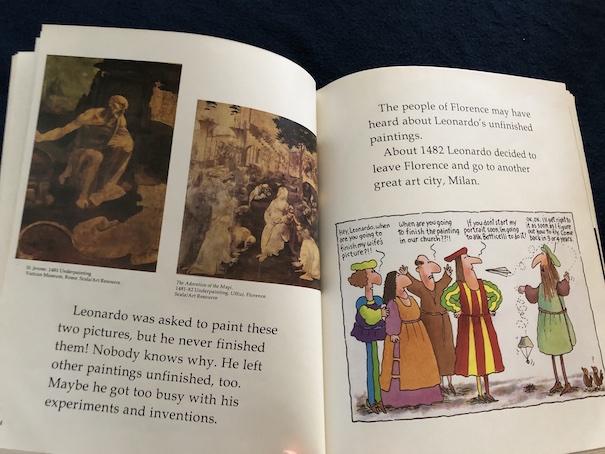
Leonardo da Vinci was one of the most famous artists of the Italian Renaissance, particularly known for his paintings The Last Supper and the Mona Lisa, but he was more than just a painter. The book is full of interesting facts about his life as well as his work. Aside from showing photographs of da Vinci’s work, the book also has humorous cartoons about da Vinci’s life, which is one of the things that makes this series of books fun.

Leonardo began showing an interest and talent for drawing while he was still a child. Throughout his life, he also developed and practiced many other skills, including architecture and mathematics, music, and sculpture. He was a scientist and inventor, experimenting in many different areas, from the mixing of different types of paints to weapons design. Along the way, he found creative ways to combine his various interests. He used his drawing skills to develop his scientific ideas, and he used his knowledge of science to make his art appear more realistic.

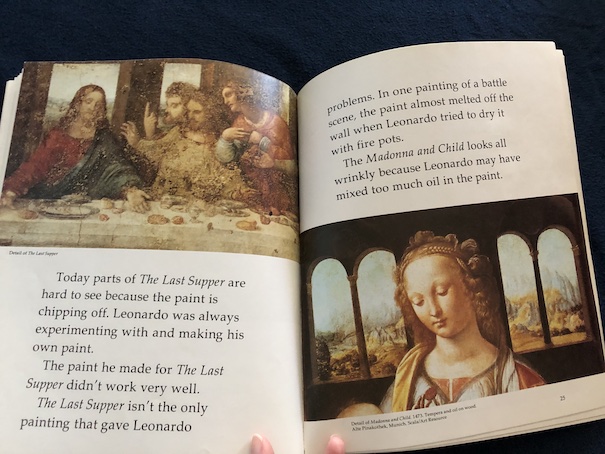
You might wonder how one person could find so much time to do so much, but part of the answer is that he didn’t finish everything he did. He is known to have left some of his work unfinished, possibly because he got distracted by other, more interesting projects and pursuits or because he just couldn’t finish them to his satisfaction. Not all of his designs for inventions really came to anything, and not all of his experiments worked out, either. Some of his paintings are now deteriorating because the experimental paints that he mixed didn’t quite work out.

However, Leonardo da Vinci was a perfectionist, and the paintings that he did complete show excellent techniques and a high degree of realism that have been an inspiration to later artists for centuries.

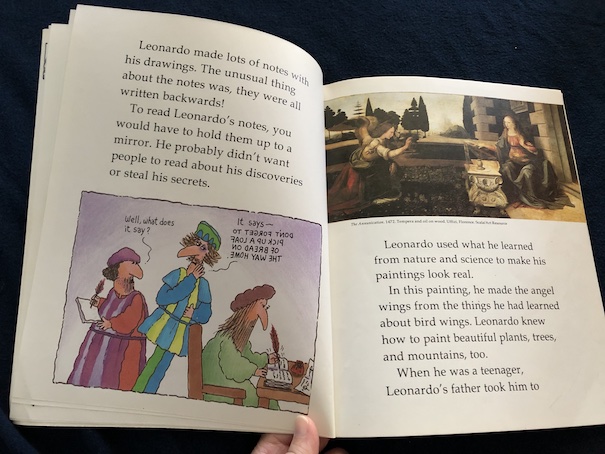
One final thing I’d like to add is that this book is part of the reason I thought The Da Vinci Code by Dan Brown was a dumb book. As I said, I grew up with art lessons. I read and loved this book about Leonardo da Vinci when I was a kid, and it has some very basic information about the life and work of Leonardo da Vinci that anybody who was seriously interested in him really should know. One of the cringiest parts of The Da Vinci Code for me was the part where our heroes are stupidly trying to figure out a message that is simply written backward. As this picture book about Leonard da Vinci points out, it’s common knowledge these days that da Vinci wrote notes using mirror writing. Some people, like the book suggests, think that he did that to make his notes harder for other people to read, although there’s also a theory that he did it because he was left-handed and that he decided that it was easier for a left-handed person to write that way. Left-handed people often complain about getting ink on their hands when they write left-to-right, but they don’t have that problem if they write right-to-left, so this might have been his attempt to get around the problem of ink-stained hands. Either way, if the people in The Da Vinci Code were such experts, they should have know this about da Vinci, and it should have been one of the first things they should have checked for. That’s not the only problem in The Da Vinci Code, but it’s one of the ones that rankled me the most because of how long I’ve known about this. (Also, The Da Vinci Code totally ripped off the albino assassin from Foul Play with Chevy Chase and Goldie Hawn, but that’s another issue.)

The book is available to borrow and read for free online through Internet Archive.