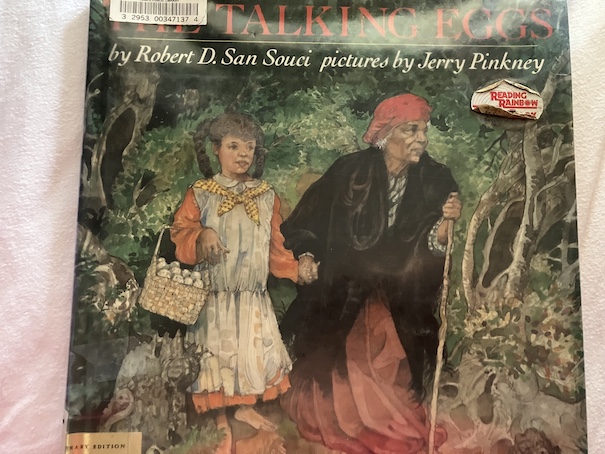
The Talking Eggs by Robert D. San Souci, pictures by Jerry Pinkney, 1989.
There was a poor widow who lived on a small farm with her two daughters, Rose and Blanche. Rose was the widow’s favorite daughter because she was so much like her mother. They were both mean and bad-tempered, and they had grand dreams of becoming rich someday, although neither of them had the slightest idea how to accomplish that. Blanche, on the other hand, was a sweet girl, and her mother made her do all the work while she and Rose just sat on the porch, talking about all of their grand dreams.
One day, when Blanche goes to fetch water from the well, an old woman approaches her and begs her for a drink. Blanche gives her some water, and the old woman thanks her, telling her that she will be blessed for her kindness.
However, when Blanche gets home, her mother and sister yell at her for taking so long. They hit her, and Blanche runs away into the woods. Then, she meets the old woman again. She explains to the old woman what happened, and the old woman invites her to come to her house. However, she cautions Blanche not to laugh at what she sees there. Blanche promises that she won’t laugh.
The old woman is no ordinary woman, and everything at her house is strange. Some of these strange things are amusing, some are amazing, and some are just plain weird and a little alarming. The animals are all strange, with chickens of different colors and cows with curly horns. Then, inside the house, the old woman removes her head and puts it in her lap to brush her hair. Then, the woman produces a fancy stew from just one old bone. After supper, they go outside and watch rabbits in fancy clothing dance.
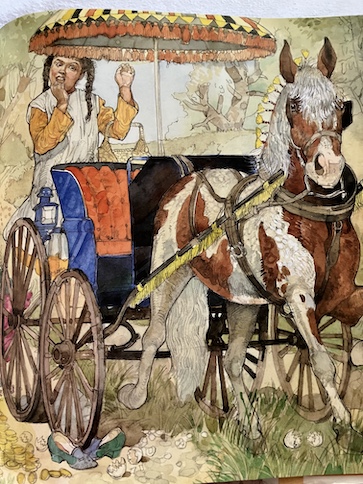
In the morning, the old woman tells Blanche to go out and gather some eggs before she goes home. Blanche is allowed to take any that tell her to take them and to leave ones that say not to take them. Blanche does as she is told, although the ones that tell her to take them are the plain-looking eggs, and the others are covered in jewels. The old woman tells Blanche to throw the eggs over her shoulder, one at a time, and when she does so, the eggs break and wonderful things burst out of them – fancy clothes, coins and jewels, and even a horse and carriage.
By the time Blanche gets home, she has many beautiful clothes, money, and luxurious things. Blanche’s mother pretends to be nice to her when she returns, but it’s only so Blanche will tell her where she got all the rich things. That night, when Blanche is asleep, her mother talks to Rose, telling her that she should also befriend the old woman and get the same rich rewards as Blanche. Then, they will steal all of Blanche’s things and head to the city to live the rich life that they’ve always dreamed of.
Of course, lazy and bad-tempered Rose isn’t as kind or hard-working as her sister. She ignores the old woman’s instructions and does everything she shouldn’t do. When she tries to force the old woman to give her riches, the old woman’s magic gives her and her mother their just desserts.
There is a note at the beginning of the book that this story comes from a Creole folktale that appeared in a 19th century collection of folktales from Louisiana by Alcee Fortier. It resembles folktales from Europe was probably adapted from fairy tales brought to Louisiana by French immigrants. It reminds me of the Mother Holle story, where a kind, well-behaved, hard-working girl is rewarded for following Mother Holle’s instructions, while her spoiled sister is punished for laziness and disobedience.
The old woman in this story is a similar figure to Mother Holle, with strange powers and magical objects, but there is no explanation of who she might be. The fact that she can remove her head just to brush her hair shows that she’s supernatural, but we don’t know if she’s supposed to be a witch or some other supernatural creature.
Personally, I don’t think I would laugh at any of the things in the old woman’s house. I think the strange animals sound more amazing than comical. I think I’d really be impressed by the different-colored chickens and the cows with the weird horns. I have to admit, though, that if someone takes off their head, my first reaction would probably be to run for it.
Mirandy and Brother Wind By Patricia C. McKissack, illustrated by Jerry Pinkney, 1988.
It’s springtime, and “Brother Wind” (the wind personified) is striding through the valley. Young Mirandy is getting ready for the junior cakewalk, and she imagines that, if Brother Wind was her partner, she would be sure to win the cakewalk. Her mother says that anyone who can catch the Wind can make him do whatever they want, so Mirandy decides that she’s going to catch Brother Wind before the cakewalk and make him dance with her!
That’s easier said than done. Mirandy doesn’t know how to catch the Wind, and her grandmother doesn’t think such a thing is possible. She asks different people what to do, and she tries different ways of catching him. She tries catching him in a quilt, but he gets away.
Then, Mirandy tries visiting Mis Poinsettia, the conjure woman (a sort of witch or woman with magical knowledge), and she asks her if she has a potion that would help. Mis Poinsettia’s advice is to trap the Wind in a bottle of cider, but that doesn’t work, either.
Eventually, Mirandy manages to trap Brother Wind in the chicken coop. Once she has Brother Wind, he has to give her a wish. However, on the night of the cakewalk, Mirandy realizes that there is someone else she wants for a partner besides Brother Wind, and she asks Brother Wind for help in a different way from the one she had planned.
My Reaction and Spoilers
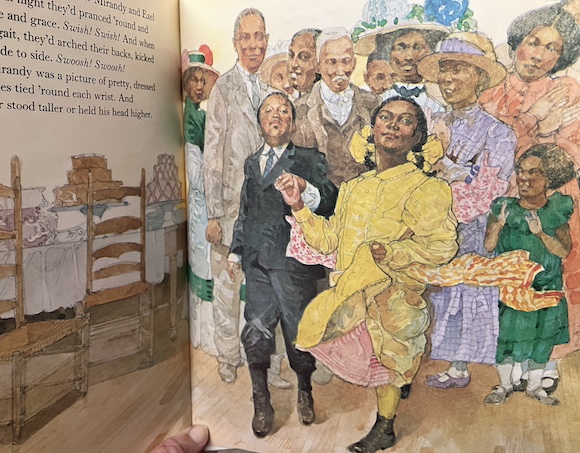
I thought this was a charming picture book, with bright, colorful illustrations that really conveyed that sense of lightness and air in the presence of Brother Wind! The old-fashioned clothing of the characters is part of the charm, and I like this sweet introduction to the concept of a traditional cakewalk. Cakewalks were a kind of traditional African American dance contest with a cake as a prize for winning. The people participating are dancing as they parade around the room, which is a little different from the cakewalks or candywalks that some modern people do at school or church carnivals as a kind of raffle game. In the game version, the players are just walking, not dancing, and they stop on numbered spots whenever the music stops, winning prizes if the number of their spot is drawn. For Mirandy, winning the cakewalk isn’t a matter of stopping in the right place but actually dancing well.
All through the book, there is a boy who likes Mirandy, but Mirandy doesn’t think of him as a dance partner because she has her heart set on Brother Wind as the perfect dance partner, and the boy is kind of clumsy. Mirandy really wants to win the contest, so it’s important to her to have the best partner she can. However, when one of the other girls at the cakewalk talks badly about the boy and his clumsiness, Mirandy can’t stand to hear him being insulted. She boldly declares that the boy will be her partner, and they will win in the contest together … with a little help from Brother Wind.
The Mysterious Giant of Barletta by Tomie dePaola, 1984.
This story is adapted from an Italian folktale. There is a note in the beginning about the town of Barletta and the statue that stands in front of the San Sepolcro Church. According to the note, nobody knows who the statue is supposed to represent, which is why there are stories about it. This one takes place during the Middle Ages, the 11th century.
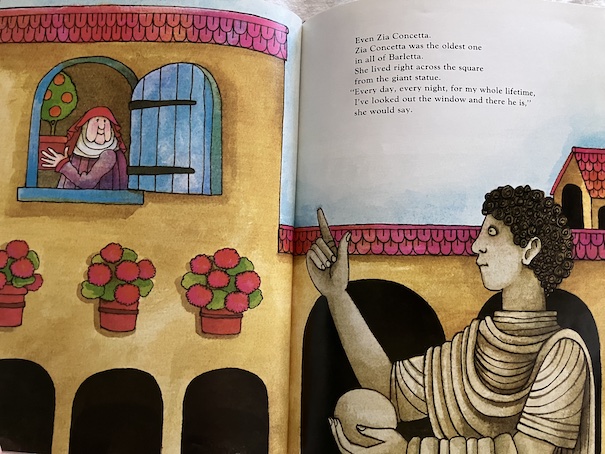
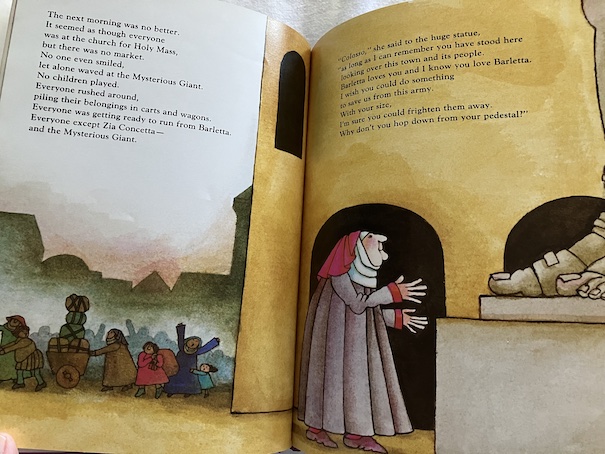
Because no one knows who the statue is supposed to be, the people of Barletta call it, “The Mysterious Giant.” No one even knows for sure how long it has been there. It has been there for as long as anyone can remember, including Zia Concetta, the oldest person in Barletta. People are accustomed to gathering around the statue to meet each other, and many of them will give the statue a friendly greeting or wish it good night.
However, one day, the town is threatened by an invading army. The people of Barletta are unprepared for invaders, and many of them prepare to flee, not knowing what else to do. Zia Concetta appeals to the statue to save their town.
The statue hears Zia Concetta’s request, and it comes to life, climbing down from its pedestal. Together, he and Zia Concetta come up with a plan to discourage the invaders.
When the invaders arrive, they see the statue, sitting by itself outside the city, crying. When they ask the giant statue why it’s crying, it says that the other boys at school are mean to him because he’s smaller than everyone else. When the invaders hear that everyone else in Barletta is bigger than the giant statue, they decide that they don’t want to meet the rest of the townspeople and leave!
The book is available to borrow and read for free online through Internet Archive.
My Reaction
I always like books that reference folklore! The theme of someone who is large pretending like they’re much smaller than other people to scare off an attacker is one found in other folktales. For example, in Fin M’Coul (a version of which was also written and illustrated by Tomie dePaola), Fin M’Coul, who is a giant, pretends to be his own baby to make an enemy think that his father must be larger and more fierce than he actually is.
I particularly liked this story because, unlike other folktales, it has a real setting and a definite landmark, the statue that is sometimes called the Colossus of Barletta. The way it is drawn in the book isn’t exactly as it appears in real life. In real life, it holds a cross in the hand that is raised, although the cross was not part of the statue originally. It probably originally held a spear or a flag standard. It is about three times the size of an adult human, which isn’t as large as it is shown the book. As in the book, it isn’t certain exactly who the statue is supposed to be, although it appears to be the statue of an emperor. He appears to be a middle-aged man wearing a jeweled diadem. The reason why nobody knows exactly who it was supposed to be is that it wasn’t originally made or displayed in Barletta. It was probably originally looted from Constantinople by the Venetians. There is a story from Barletta that it was once lost in a shipwreck on the way from Constantinople and washed up on the shores of Barletta in 1309, where some of its bronze was used for casting bells for a monastery. Then, in the 15th century, the statue was restored and displayed in front of the church. That, by itself is a fascinating story, although it isn’t explained in the book.
The Reluctant Dragon by Kenneth Grahame, illustrated by Michael Hague, 1983.
This picture book, with its illustrations, is from the 1980s, but the story by Kenneth Grahame is much older, from 1898. It was always a short story, originally published in a collection called Dream Days. In the original version, there’s an opening part that isn’t included in this picture book, where a girl name Charlotte finds large footprints from a reptile, and a man tells her the story of the dragon.
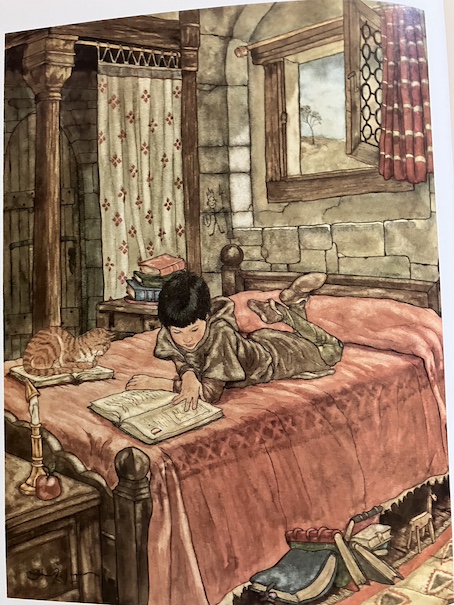
There is a shepherd whose son loves to read, borrowing books from a friendly member of the gentry who lives nearby. Not all parents from their class value book learning, but the boy’s parents appreciate it and support their son for spending time reading. One day, the shepherd comes home and tells his wife and son that he’s had a terrifying experience. While he was out with his flock, he heard a strange snoring nose, and when he went to investigate, he found a frightening-looking creature with scales, with its head sticking out from the cave.
The shepherd’s son isn’t as alarmed as the shepherd. He merely identifies the creature his father saw as a dragon. He knows about dragons because he’s read about them, and he’s thought for some time that the cave was probably a dragon’s cave. Rather than being surprised or alarmed about the dragon, his father’s discovery merely confirms what the boy already suspected, that a dragon might have lived in the cave once and that it would be a suitable dragon’s home. Furthermore, the boy says that dragons are quite sensitive creatures, so he might look in on this one at some point.
When the boy goes to visit the dragon, the dragon tells him he won’t put up with any rough stuff, like hitting or throwing stones. The boy says he wasn’t going to do any of that, and the two of them start to talk. The dragon hasn’t been staying in the cave for very long, and he’s not sure if he’s going to stay or not. It’s a nice place, but he’s not sure if he’s ready to settle down or not. He admits that he’s lazy, compared to other dragons. Other dragons do things like rampaging, chasing knights, and eating damsels, but this dragon would just prefer a quiet life with regular meals and time to snooze and make up poetry. The boy and the dragon talk about poetry and how it seems like nobody else around them appreciates it the way they do or understands why they like it.
However, the boy can see that there would be problems with the dragon settling in this area. Dragons and humans just don’t mix, even though this dragon isn’t interested in rampaging or doing the other things that would be likely to make enemies of the local population. Once word has gotten around that there’s dragon here, there are bound to be people who will try to hunt it with spears and swords because they’ll only see the dragon as a monster. The dragon has trouble grasping the idea that he could even potentially pose a risk to the human population or that anybody might see him as a danger.
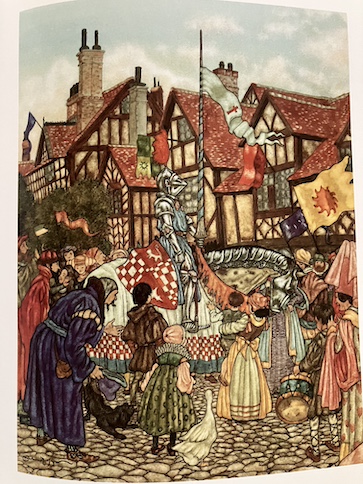
Eventually, word does get around that there’s a dragon living in the cave. The people in the village are both thrilled at this exciting thing happening to their village and plotting to rid their land from this supposed scourge, although the dragon has spent the entire time with his poetry and hasn’t been scourging anything. The village attracts the attention of St. George, the famous dragon slayer, and he comes to deal with the apparent problem.
The boy goes to the dragon and warns him that St. George is in town and that he’s got to prepare to face him and fight. Everyone in town is expecting him to, and they’re all excited about it because it’s the most exciting thing that’s ever happened there. However, the dragon says that he doesn’t like violence, and he doesn’t want anything to do with St. George. The boy worries that, if the dragon won’t take the threat seriously and fight, St. George will simply kill him, but he can’t seem to impress on the dragon just how much danger he’s in.
The boy tries to go to St. George and explain the truth about the dragon, but St. George doesn’t take him seriously at first. Everyone else in the village has been telling him tales of horror about the terrible things the dragon has been supposedly doing. The boy explains that the people in the village aren’t telling the truth because the truth is that they only want a fight. This is a quiet, boring little village, the villagers want excitement, and fights are a primary source of excitement for them. They don’t care at all that the dragon doesn’t like fighting and doesn’t want to be involved; they just want to stir things up with their stories and give St. George a reason to go over the dragon so they can watch the entertainment. When the boy explains that, right now, the villagers are taking bets on the upcoming fight, and so far, they’re favoring the dragon to win, St. George begins to think that maybe he’s been too quick to believe the villagers. He agrees to go with the boy to meet the dragon and talk things over.
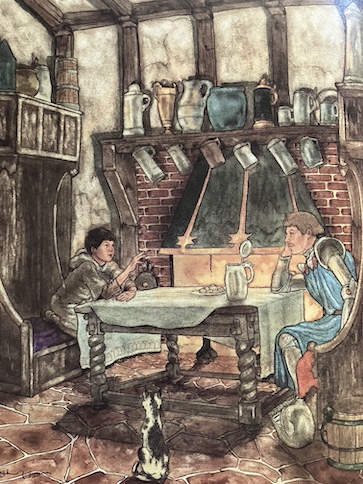
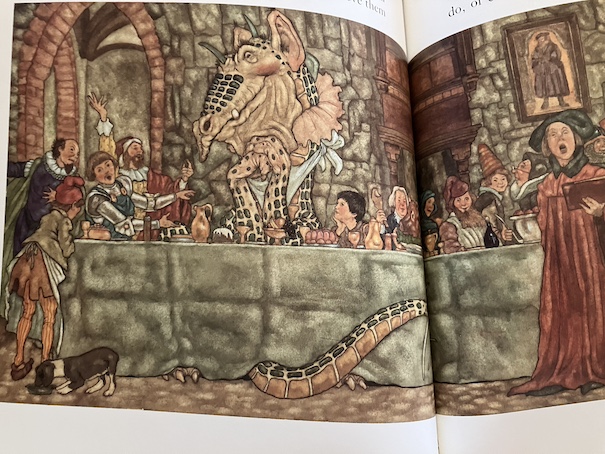
Both St. George and the boy think the best thing might be to have a fight and get it over with because that’s how things typically go with dragons, and it’s what everyone is expecting. St. George even says that he wouldn’t have to hurt the dragon much in the course of the fight, as long as it looks good to the spectators. The dragon isn’t thrilled with the plan because he still doesn’t like violence, and he doesn’t want to be hurt or even kind of hurt. The boy realizes that the dragon won’t be getting out of the experience, either. St. George would get the glory for the fight, but what’s in it for dragon? Fortunately, the dragon knows what he wants – to be the guest of honor at the victory banquet!
The book is available to borrow and read for free online through Internet Archive. The original story of The Reluctant Dragon was made into a cartoon film (with some slight changes to the story) by Walt Disney in 1941, and it was used as a vehicle for a film tour of the new Walt Disney Studios in Burbank, California.
My Reaction and Spoilers
This story is fun because it’s sort of a parody on folktales, especially St. George and the Dragon, subverting everyone’s expectations. The dragon in this story isn’t particularly fearsome and just likes poetry and a peaceful life, and the villagers, who are supposedly being terrorized, are actually the bloodthirsty ones. St. George is rather disappointed when he realizes that the villagers have been duping him with their stories, but he also realizes that they have to find a way to give the people what they want while sparing the dragon and making it so the dragon won’t be victimized later. Although the boy feels like they have to have a fight of some kind to appease the villagers, he also doesn’t want his dragon friend hurt, and he realizes that they have to consider what the dragon really wants.
The three of them work out a way to give the villagers a good show during their “fight” without the dragon getting really hurt. Then, St. George declares that the dragon has been defeated, and there is no need to cut off his head as the villagers have asked because the dragon has seen the error of its ways and repented, so there is no further need for vengeance. St. George’s victory speech also makes it clear to the villagers that he won’t put up with any more stories about the dragon’s terror because he knows that they can’t be true, that they should drop their prejudices because it’s pretty clear that they don’t know everything even if they act like they do, and that it’s wrong to make up stories about things that haven’t actually happened just for the excitement of doing so. I particularly like that last part of his speech/lecture: “And he warned them against the sin of romancing [in the sense of dramatizing and romanticizing things], and making up stories and fancying other people would believe them just because they were plausible and highly coloured.”
I feel like this is a lesson that more people could stand to remember this modern era of conspiracy theories, social media, and Internet rumors. Yeah, I’m particularly thinking of the stories about immigrants eating animals in Ohio. I’m never going to let that one go because everyone who fell for that and helped spread it was acting like the villagers in this story. They were irresponsible and attention-seeking, causing trouble and danger for people who did nothing to deserve it just for their own excitement and hysteria. It doesn’t help if people based some of their belief on old stories about other groups of immigrants eating pets. That actually makes it much worse because I know those stories were debunked decades ago, so they have even less of an excuse to fall for that now.
If you’re thinking at this point that the matter of rumors of pet-eating immigrants is unrelated to the story, I would argue that it fits in very well because, in both the story and in the real-life rumors, social acceptance is a major issue. The dragon wants to be socially accepted so he and stay in the cave that he now considers his home. He wants to be left in peace to compose his poetry but at the same time have the ability to have company and join in local festivities so he won’t feel too lonely. The problem is that the village people have their own expectations and plans to use the dragon as their personal source of excitement, uncaring about whether that costs the dragon his life or if it costs the knight his life while attempting to kill the dragon. They honestly don’t care who gets hurt or even killed as long as they get to see it, knowing that the stories they invent to tell St. George are necessary to make it all happen. Immigrants also want social acceptance and to be allowed to live their lives peacefully and go about their business in their new homes. People sometimes tell wild stories about them, things they made up themselves, knowing that they’re untrue and uncaring about the consequences for other people, for their own purposes.
The very first time I heard of the Springfield pet-eating hoax, I immediately thought of Janie’s Private Eyes, which I reviewed here years ago and contained references to similar accusations about immigrants. I read Janie’s Private Eyes when I was a kid, and since it dealt with the dangers of rumors and prejudice, specifically rumors about immigrants eating pets, I grew up figuring that these were things that adults should just understand and that only had to be explained to kids, who hadn’t heard about them yet. I don’t suppose everyone has read Janie’s Private Eyes, but I always thought, surely, by adulthood, they would have read something or had somebody clue them in at some point.
There was just no chance of me ever being impressed about humors of Haitian immigrants supposedly eating pets as an adult after hearing about long-debunked rumors about Chinese immigrants supposedly eating pets and Vietnamese immigrants supposedly eating pets and Mexican immigrants supposedly eating pets (I live in a border state, so other parts of the US may or may not have gotten around to that one). After all, how many sets of immigrants can you hear this about before it just becomes eye-rolling routine, like those dumb chain emails that used to be popular in the early 2000s or those supposedly shocking but highly improbable kidnapping stories you’re supposed to warn every young woman in your life about but which are almost direct rip-offs of badly-misspelled fan fiction from Wattpad that was written by teens around that same time period? In all those cases, they’re the some wild stories, just retold with a few minor details and the names of the characters changed.
Stories do matter. The ones we hear when we’re young live in our heads and influence the way we look at things when we’re older and how we respond to some of the questionable things that other people are bound to tell us later in life. In a way, I think it really helps to hear some of this bunk when you’re young, under circumstances where you can tell it’s bunk or with someone cluing you in, so you can get some of these ideas out of your head earlier in life and be better able to tell what’s old-fashioned, sensationalist bunk from someone playing up for attention when you’re an adult. I think that The Reluctant Dragon, although it can be taken in a lighter fashion as parody or satire by people who know the type of stories that are being parodied, also offers the opportunity to talk about the power of stories, how they change people’s views and motivate people to action, and the serious consequences of rumors.
Maybe some of the people spreading the Internet rumors really were ignorant and gullible, easily alarmed and manipulated by a wild story, and maybe some of them just wanted in on the excitement to get attention for themselves and never cared whether it was true or not as long as they could latch on to the attention the story was getting and make themselves part of it. I’m pretty sure that the people starting them and passed them on wanted excitement and attention. There is a certain thrill to passing on rumors, feeling special because you “know” something other people don’t know yet and maybe even wanting praise as well as attention for passing the story along. Maybe some of those people also wanted to get some kind of petty revenge on the immigrant population by saying something bad about them, they expected that people would believe them if they made the stories seem dramatic and plausible (like St. George said in the story), and like the villagers in the story, they did not think or care about what would happen to the people who were the subjects of their libel.
It’s the same sort of thing with most social media rumors, which often contain little truth and can do a lot of harm by people believing them and continuing to spread them, which is why I’m against them all in principle. I urge everybody, when you hear any sensational story through Facebook or any form of social media, to pause and do a little fact-checking before you send that story to anyone else. If you can’t verify it or if you find evidence against it, make no other comment on it other than a link to the evidence against the story (if possible) and a message saying that you don’t want to see any more rumors or conspiracy theories. (At least, I sincerely hope you don’t. I’m telling you, they’re only trouble, and real people get hurt because of fake news.)
In real life, I doubt most people, being told off, even in a nice way, for making up stories and getting caught in lies, would behave with as much grace as the villagers in the story. In real life, people get defensive when they know they’ve been caught and “fight back”, but the villagers just accept it as part of the excitement they wanted and focus on getting to the party they know they’re going to have. During his speech, along with his other admonishments, St. George lets the villagers know, subtly, that he’s discovered that they’ve also been staging animal fights and that this practice is going to have to end, and the villagers all know that he’ll personally be checking on that. At the end of St. George’s speech, there is “much repentant cheering”, and they all go to enjoy the banquet. If people are feeling a little awkward about their behavior or the situation, they’re still determined to enjoy themselves and this remarkable event as much as possible. Everyone relaxes at the banquet because the major event is over, everybody has had a taste of excitement and the spectacle they were craving, and St. George’s speech is over, so there’s nothing left for anybody to plan or worry about. Everybody has a good time at the party, and the dragon is pleased that he’s been accepted into society, so he will be allowed to stay in this peaceful place and even have some company, which was what he really wanted.
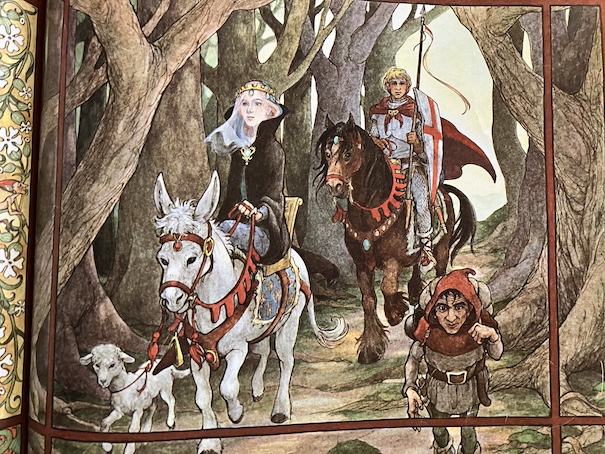
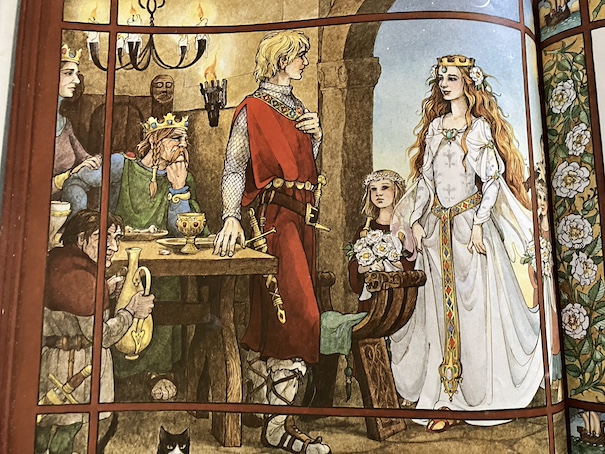
The Red Cross Knight, who carries a shield decorated with a red cross, does not know his own name or even where he came from. He only knows that the Queen of the Fairies has sent him to face a terrible dragon. He is accompanied on his journey by a princess with a little white lamb and a dwarf. The Princess’s name is Una, and her kingdom is being attacked by the dragon.
On their journey, they meet a hermit, who shows the knight a distant palace on a mountaintop, where angels travel between the palace and heaven. It’s so beautiful that the knight wants to go there immediately, but the hermit says that this palace is in another world and that he cannot go there until he faces the dragon. The hermit also reveals the knight’s past to him. He is not one of the fairy folk, although the fairy folk are the ones who sent him. The hermit knows that he was kidnapped by the fairies as a baby and hidden in a farm field, where he was discovered by a plowman who named him George. His true destiny is to become Saint George, the patron saint of England.
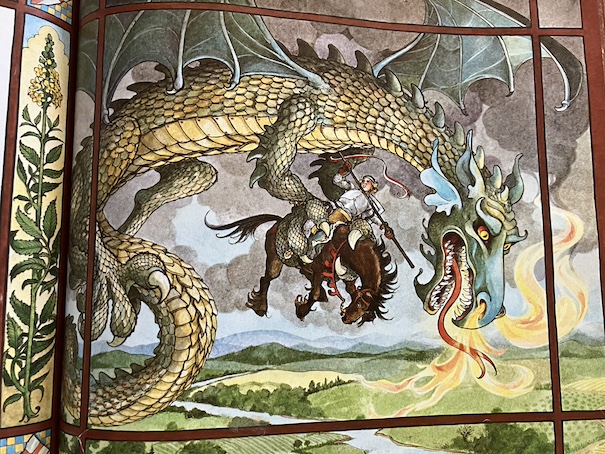
Una takes George to her parents’ fortress. As they approach, they see the dragon for the first time. George sends Una away from danger, and he and the dragon battle for the first time. The dragon picks up George, horse and all, and throws them to the ground. George manages to drive the dragon away, but he is also injured. At first, he and his friends think he is going to die, but he lies down in an ancient spring that cools and heals him. By morning, he is able to rise and fight again.
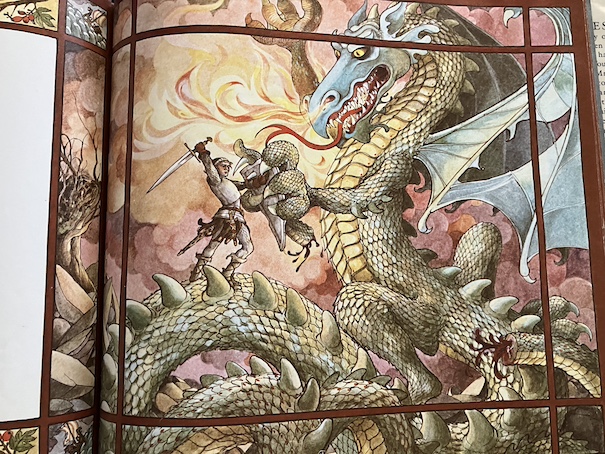
The second time George fights the dragon, he is able to cut off part of the dragon’s tail and one of its paws. The dragon’s fire finally drives George away, and once again, George seems too wounded to survive. However, he rests under an apple tree that drops healing dew, and George survives.
The third time George and the dragon fight, George manages to kill the dragon. Everyone celebrates, and Una’s parents thank George. The king gives George rich rewards, but George passes them on to the poor people. George is bound to the service of the Fairy Queen for six years, but the king allows George to marry Una and promises him that he will become the next king when his service is finished.
The book is available to borrow and read for free online through Internet Archive.
My Reaction
I love the colorful illustrations in this story, although some of them seemed a bit brutal for an audience of young children, showing George badly injured and the dragon spurting blood. Because I love folklore, I know that the legend of St. George and the Dragon is a Christian allegory, although it has some basis in earlier folktales and historical figures. I’ve heard different interpretations of what the dragon is supposed to represent. It can be a symbol of evil, the devil, or sin, and I think I’ve heard that it could represent paganism, which was replaced by Christianity (represented by St. George in the story), although I can’t remember where. In a way, I think this is one of those picture book that might mean more to adults because they would understand more of the symbolism, history, and folklore references in the story. On the other hand, who doesn’t love a story that ends with a gallant knight marrying a beautiful princess?
As another odd piece of literary trivia, the legend of St. George has a connection to another story that I’ve on this blog, Phoebe the Spy. The connection isn’t an obvious one because Phoebe the Spy was set in New York during the American Revolution, which seems far removed from Medieval England. However, on April 23, 1770 (St. George’s Day), the St. George Society (originally called the Sons of St. George) was founded at the Fraunces Tavern in New York, just six years before the story of Phoebe the Spy begins at the same tavern. The St. George Society was and still is a charitable organization that helps immigrants from Britain, using the patron saint of England as its namesake.
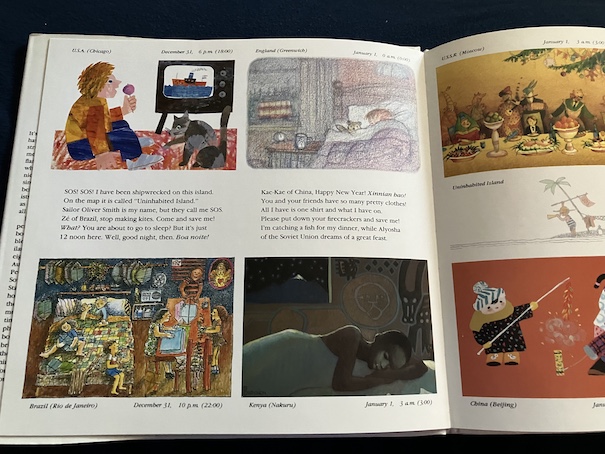
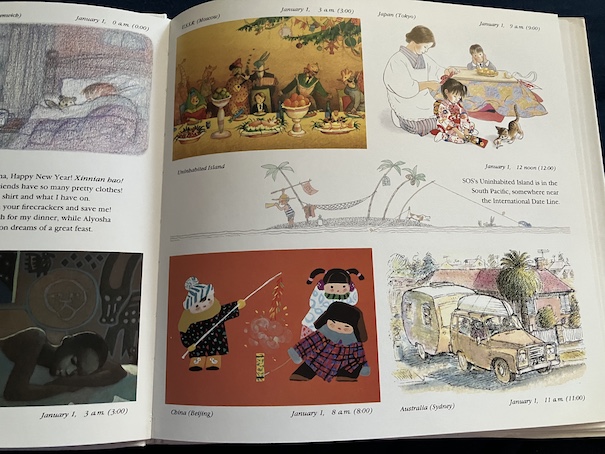
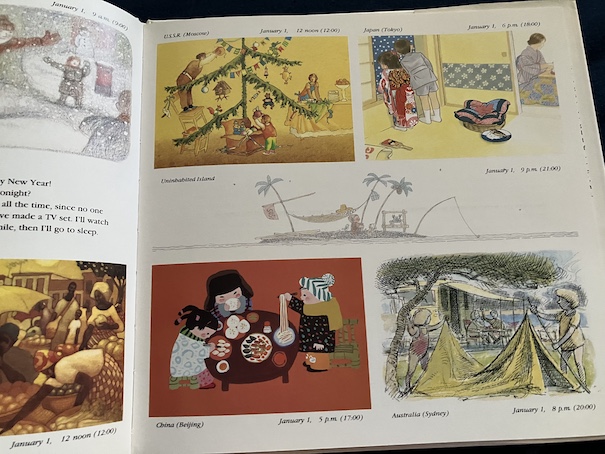
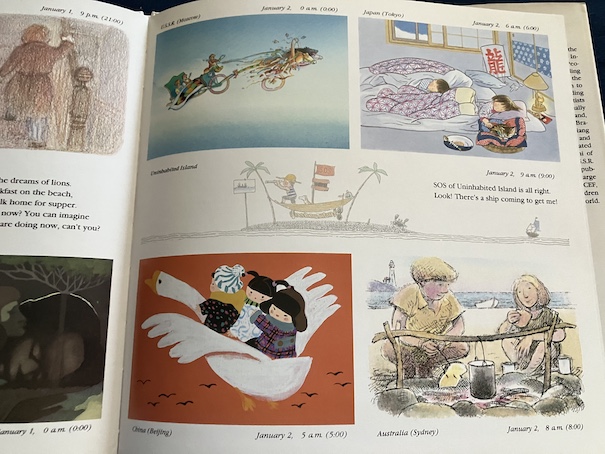
The format of this book is a little unusual. The book was a cooperative project among authors and illustrators from different countries to show children what is happening around the world at the same moment in different time zones.
Mitsumasa Anno, the primary author of the book, is from Japan, but he writes as a boy called Sailor Oliver Smith, or “SOS”, who has been shipwrecked with his dog on an uninhabited island near the International Date Line in the Pacific Ocean at noon on January 1 (which is also midnight on New Year’s Eve, Greenwich Mean Time). He is on the island for a full day before he is rescued, sending out appeals for help and thinking about what other children around the world are doing at every hour of the day as they celebrate the New Year.
As you read through the book, the small pictures of the children in different countries tell a complete story for each child in each country. The little mini-stories within the main story are presented almost comic book style. They contain no text themselves, but the boy on the island offers commentary on what’s happening with the children in other countries. During the time when SOS is asleep on his island, his dog, Matey, takes over the narration.
Children in Brazil are making and flying kites with their family and going swimming at the beach. People in Australia also go to the beach because it’s summer there in January, and they camp out overnight. A boy in the US sneaks out of bed to get a look at the party his parents are having at midnight, and is woken by his cat the next morning. The boy in England wakes up his too parents early in the morning by playing his trumpet. People in Kenya go a busy market and have dinner as a family. Children in China set off firecrackers, watch fireworks, and eat special foods. The story in Japan is about a little girl whose toy is stolen by a dog, and her cat chases after the dog to get it back. At first, they worry because the cat doesn’t return home for dinner, but the cat eventually comes in late with the toy, eats its fish, and goes to bed. Because this book was written in the 1980s, the book refers to Russia as the Soviet Union. The boy in the Soviet Union goes sledding with his friends and tries to ride his bike in the snow, which doesn’t work well. Children in various countries watch tv and read books during the day, and readers get to see their dreams when they sleep. At the end of the book, SOS sees a ship coming to pick him up at 9 am on January 2.
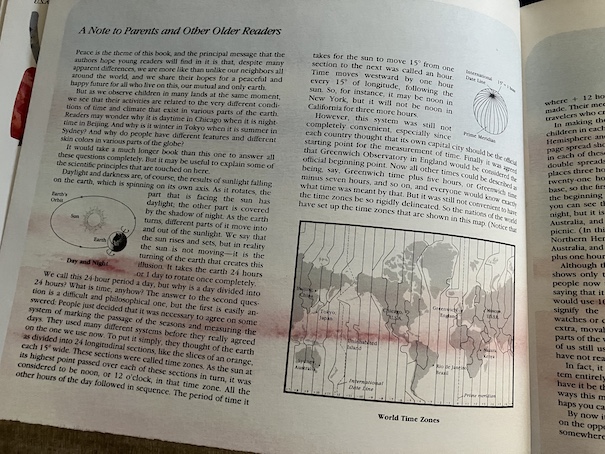
There is a message at the beginning of the book from all of the authors and illustrators who participated about children around the world, encouraging children to think about children in other places and what they might be doing throughout their day. Because it’s a different time of day in different places, some children are asleep in bed while others are awake and playing. However, it reminds readers that, no matter who we are, where we live on Earth, or what we look like, we’re all human beings on the same planet with the same sun and moon looking down on our days and nights. It’s a call for empathy and unity among nations and the people who live everywhere on Earth. In the back of the book, there is more scientific information about the movement of the Earth around the sun and the rotation of the planet and what makes different time zones. There is also information about the different authors and illustrators around the world who contributed to the project.
The book is available to borrow and read for free online through Internet Archive (multiple copies).
My Reaction
I have a vague memory of reading this book when I was young, but I can’t remember exactly when I read it. I think I was an older child because I already understood the concept of different time zones. I do think that kids who are a little older would get more out of the story and the concept of different time zones than very young children.
Older children would also probably find it easier to follow the different story lines of the children in each country. The format of the story may be a little difficult for very young children to follow because it does feel a little disjointed, getting just a snippet of each child’s day and night per page. However, the book is interesting to reread multiple times, following each child’s day, and I remember being fascinated by the notion of what everyone around the world was doing at different times.
The call for people to think about other people in other places and the call for international understanding is a nice, peaceful message for the New Year. As an adult, I was interested in seeing which authors and illustrators contributed to the book. Each set of illustrations for different countries has a different style. The illustrator for the boy in the US is Eric Carle, known for The Very Hungry Caterpillar. Not all of the illustrators are actually from the countries they illustrated, but more are. The two exceptions were for Brazil and Kenya, but the illustrator who did the pictures for Brazil did live there for a time, and the the couple who did the pictures for Kenya wrote and illustrated other books about Africa.
Somewhere in the World Right Now is a picture book on a similar theme, but instead of following children around the world through an entire day, it just shows what’s happening around the world at one particular moment. I think that makes Somewhere in the World Right Now a little easier to follow for younger children.
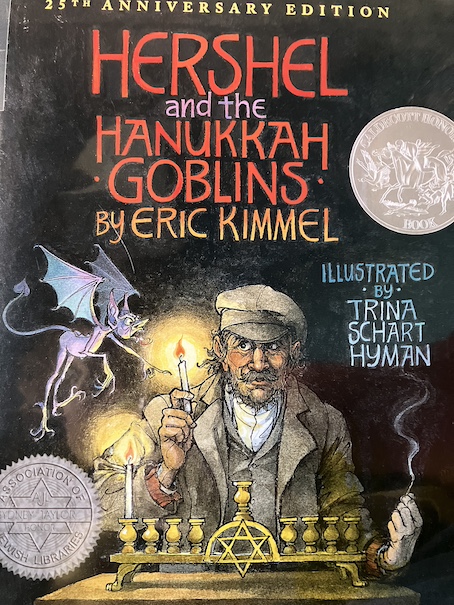
Hershel and the Hanukkah Goblins by Eric Kimmel, illustrated by Trina Schart Hyman, 1985, 1989.
On the first night of Hanukkah, a tired travel, Hershel, trudges through the snow on his way to the next village. There, he hopes to get something to eat and celebrate the holiday with the local villagers. However, when he reaches the village, nobody is celebrating.
When he asks the villagers why they’re not celebrating, they tell him that they can’t because there are goblins haunting the old synagogue on the hill. Every time they try to celebrate Hanukkah, the goblins come after them, blow out the candles on their menorahs, breaks their dreidels, and throw all the potato latkes on the floor.
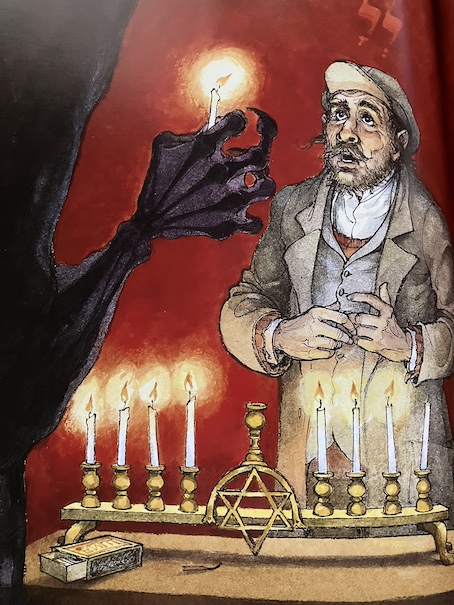
Hershel decides that he isn’t scared of the goblins, and he’s going to put an end to their mischief. The village rabbi says that the only way to get rid of the goblins is to spend all eight nights of Hanukkah in the synagogue, lighting Hanukkah candles every night. Then, on the final night of Hanukkah, the goblin king must light the candles himself. Although this sounds difficult, Hershel is confident that he can do it. Although the villagers aren’t really expecting Hershel to succeed, they support Hershel in his mission, and they give him some food, a menorah, candles, and matches.
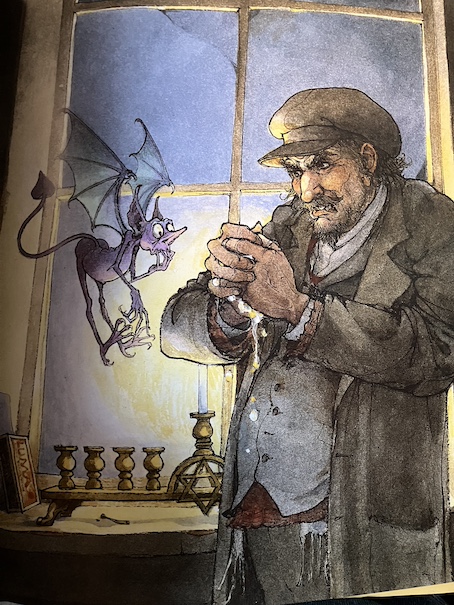
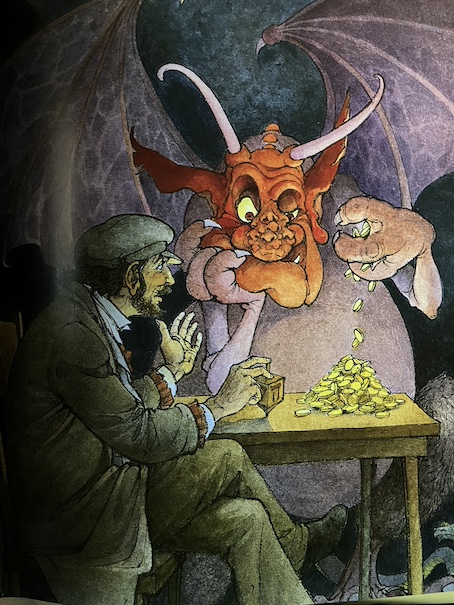
The old synagogue is creepy, and when Hershel lights his first candle, a small goblin appears to ask him what he’s doing. Herself isn’t intimidated by the little goblin, and he tricks the goblin into thinking that he’s strong enough to crush rocks in his hands by squeezing a hard-boiled egg in his hands until it breaks. The little goblins is scared away but warns him that bigger goblins than him will come later. The next night, a bigger goblin comes, but he isn’t very bright and gets his hand stuck in a jar of picks when he tries to take too many. The night after that, tricks the third goblin into playing dreidel with him and giving him all his gold.
It continues like this, night after night, with Hershel tricking the goblins in various ways so that they’ll let him light the candles on his menorah. Finally, Hershel comes face-to-face with the most sinister goblin of all – the king of the goblins. Can Hershel find a way to trick him and get him to light the candles of the menorah himself?
The book is a Caldecott Honor Book and named a Sydney Taylor Honor Book by the Association of Jewish Libraries. It is available to borrow and read for free online through Internet Archive (multiple copies). It was originally published as a short story in Cricket magazine and later as a book, which is why the story has two copyright dates.
My Reaction
I’m not Jewish, and I admit that this isn’t a book I read as a kid, although I do remember that it was one that was often recommended when I was young. As an adult, I decided to try it, since I just never got around to it before. I really do like this story. I enjoyed the folklore elements, and I also appreciated that the main character saves Hanukkah, in much the same way that various characters had to “save” Christmas when I was a kid.
It makes me laugh to think about it now, but Christmas always seemed to be an extremely endangered holiday in Christmas television specials from my childhood. Some evil person or being was always out to destroy Christmas, for various reasons, with varying degrees of logic, and popular television characters always had to “save” it from being destroyed or canceled or whatever. It was fun and entertaining, but when you consider the entire canon of endangered Christmas holiday specials all together, it does seem like there isn’t a single year when Christmas isn’t in danger from somebody or something, making it weirdly routine for Christmas to almost not happen. At some point, I think my brother pointed out that Christmas was always in danger, but it seemed like Hanukkah was relatively safe. (At least, in the land of holiday-themed winter television specials starring well-known cartoon characters.) I figured that Christmas was likely a bigger target for the forces of evil due to its wide mass appeal because there were just more people who celebrated Christmas where I lived than Hanukkah (and also because of the all the related Christmas toy tie-in commercials and advertising sponsors for those shows).
So, I was delighted to see Hanukkah get saved from a band of comically nefarious goblins in this book. The goblin king is a sinister figure in the pictures, but fortunately, he’s not too much brighter than his cohorts. The book has been adapted as a stage play (you can sometimes find clips or trailers from performances on YouTube), and there is also an animated short film of the story. I think it would be fun to see a longer version, though, in video or movie form. The book skims over the details of what Hershel does to trick some of the other goblins after the third one, so there’s room to elaborate and make the story longer. I think I would have been a little scared by the final goblin when I was a little kid, but the goblins not being particularly bright and easy to trick does help remove some of the scare factor.
At first, I though that the story of Hershel might have been a folktale because it reads like one. In the back of the book, the author explains that he wanted to write a story that was somewhat like A Christmas Carol by Charles Dickens but about Hanukkah, and he took his inspiration from the folktale Invanko, the Bear’s Son (also known as Jean de l’Ours or John the Bear), which is includes the hero tricking a goblin, and he added in a Jewish folk hero, Hershel of Ostropol. The resulting story is sort of like a new folktale, remixed from old ones, which is fitting because that’s what happens with folk stories Overall, I thought it was a fun story.
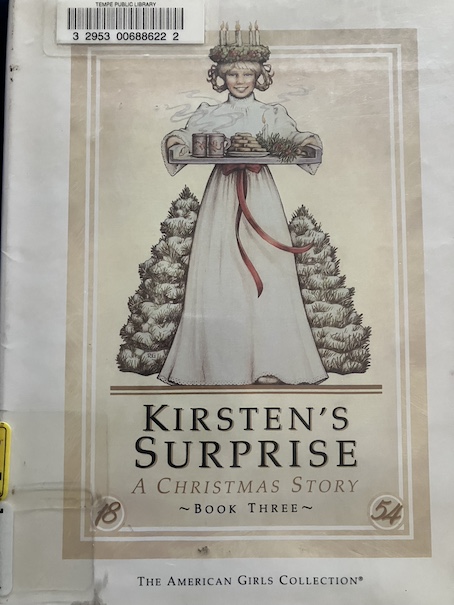
It’s winter, and Kirsten’s brother, Lars, is going to set animal traps in the woods with his friend, John Stewart, who lives nearby. Kirsten is friends with John’s sister, Mary. Trapping animals for their pelts is one of the ways that the boys make some extra money. The local men are all away, working at a logging camp for the winter. Kirsten isn’t really interested in trapping animals so much as she just wants to get out of her family’s little cabin because she’s been cooped up due to the winter weather, so she persuades the boys to let her come along on their trapping expedition.
As they go through the woods, Kirsten spots an animal snare that someone else set out, and John explains that there’s an old trapper called Old Jack who lives by himself in the woods. He has no family and often prefers to be by himself and avoids meeting many people, although he sometimes helps locals with their own traps. The snare is probably one of his traps. When they find a trap that has a baby raccoon caught by the tail, the boys say that it’s too small for them to kill it for its pelt, and Kirsten feels sorry for it. She persuades them to let her take it home and nurse it back to health, like she did with an injured bird, before releasing it into the wild again.
Kirsten is supposed to leave the little raccoon in the barn because, as her family tries to explain to her, wild animals are wild and uncontrollable. However, Kirsten feels sorry for the little thing because the barn is cold, so she brings it into the cabin. It turns out to be a terrible idea. The raccoon gets loose and knocks over an oil lamp that sets the cabin on fire! Kirsten makes her her little brother and sister get out safely, and when she realizes that the fire is spreading too fast for her to stop it, she manages to save the painted trunk with some of her family’s most important belongings. Unfortunately, the cabin is completely destroyed.
Kirsten’s aunt takes in Kirsten, her mother, and her siblings. It’s a little crowded in her house, but at least, they have a place to go. Everyone is understandably upset, although they are not too hard on Kirsten for causing the disaster. However, her mother says that they had been hoping that maybe they could buy a little land with the money Kirsten’s father is making at the logging camp, but she doesn’t see how they can now. They’re going to have to build a new cabin and replace some of essentials that they lost in the fire.
Then, John and Mary Stewart tell the Larsons that their family will be moving to Oregon because their father has found a new job managing a logging camp there. Kirsten is sorry to see the Stewarts leave because they’ve been good friends, but Aunt Inger points out that the Larsons’ problems will be solved if they can manage to buy the Stewarts’ house. The Stewarts’ house is much bigger than the little cabin where the Larsons lived, and the Stewarts will have to sell their home before they can move anyway. The problem is that the Larsons just don’t have the money to afford the Stewarts’ house.
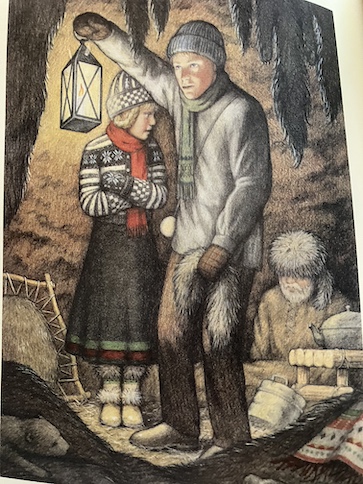
All Lars can think to do is try to make more money through trapping. Kirsten goes along to help him, and one evening, they stay out much later than they mean to and get lost in the dark woods. When the spot some human tracks in the snow, they think that they are probably the tracks of Old Jack, the trapper hermit. Kirsten thinks that Old Jack sounds frightening, but with no one else to turn to for help and shelter, they decide to follow the tracks to where Old Jack lives. When they find Old Jack’s home in a cave that he has turned into a rough house, they make an important discovery that changes everything for the Larsons.
The book ends with a section of historical information that explains how new settlers moving westward turned frontier areas like the area where Kirsten’s family lived into more settled towns. The farms where people lived became less isolated, and railroads connected cities and rural areas across the country. The first transcontinental railroad in the United States was completed by the time Kirsten would have turned 24 years old, changing the ways that people and goods traveled.
The book is available to borrow and read for free online through Internet Archive (multiple copies).
My Reaction and Spoilers
This was one of the books that I remember I didn’t like in the Kirsten series when I was a kid because it’s just so painful when the family’s cabin burns. Reading the book again, I appreciated how the family wasn’t overly hard on Kirsten about bringing the raccoon into the cabin that caused the fire. I couldn’t really blame the others if they were upset with Kirsten because it’s a major disaster that destroys their home and leaves them in a very precarious position. However, even though they’re understandably upset at the situation, it is nice that they don’t lay a guilt trip on Kirsten about it because that would have made it a much sadder story.
It also helps that the situation works out for the best in the end. When they hear that the Stewarts are moving, they do want the Stewarts’ house, but they just don’t think they will be able to afford it. What changes for the Larsons is that they receive an unusual sort of inheritance from Old Jack. When Kirsten and Lars are lost in the woods and seek shelter from Old Jack, they discover that Old Jack has died. There doesn’t appear to be any foul play. Old Jack was an elderly man, and he seems to have died from natural causes in his house. It’s a grim discovery, but while Kirsten and Lars shelter in his house with the body overnight, they also realize that Old Jack has a hoard of fine animal pelts. Since Old Jack has no family and no one to inherit his property, there is no dispute that the Larsons can claim his pelts because they found his body and plan to arrange for his burial. With the money that Old Jack’s pelts bring, they are able to afford the Stewarts’ house, which is much better than their old cabin. The Stewarts also leave them some furniture and household supplies.
I do like it that the story worked out for the best, although I wasn’t fond of the theme of trapping animals for pelts. I remember that this was an aspect of other books that I read as a kid, like Where the Red Fern Grows, but I never liked hearing or reading about it. I understand hunting for food, and I know the family in the story traps animals for fur because they badly need money, but it’s not a subject that I enjoy hearing about. The metal traps the boys use for trapping animals are considered inhumane in modern times, and their use is now banned or restricted in many countries and states.
It’s winter, and Kirsten’s family is just starting to prepare for Christmas. Kirsten’s mother has her help make their Christmas bread. So many things have changed for their family since they came to America and moved to the frontier in Minnesota, Kirsten asks her mother if they will be celebrating Christmas just like they used to when they lived in Sweden. The family doesn’t have much money and can’t afford extra treats, but her mother says they will do the best they can.
When they arrived last summer, the family didn’t even have enough money to pay for a wagon to carry their belongings to their new house, so they had to leave them in storage in Riverton, including Kirsten’s doll, Sari. Since then, Kirsten has been using a stuffed sock as a doll. Kirsten’s mother tells her that her father has arranged for their trunks to be sent to Maryville, which is closer, but still 10 miles away. Kirsten is eager to retrieve them, but her mother says that will have to wait because there are too many other things they need to do now to get ready for winter. Kirsten worries that they won’t be able to get their trunks before the snows come. If the roads are blocked by snow, they won’t have their trunks until spring! The more Kirsten thinks about the trunks, the more she wishes that they had the things in them, the things that would remind her of her home in Sweden and make their cabin feel more like home.
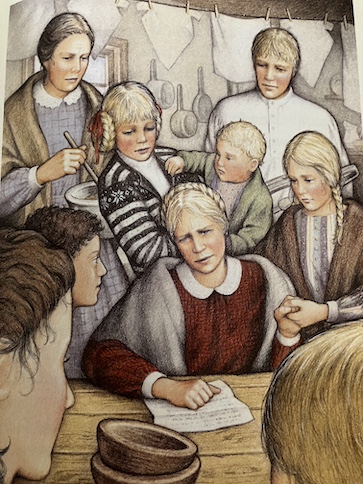
One day, while she is playing with her cousins, Lisbeth and Anna, Kirsten mentions St. Lucia, and she is surprised when her cousins don’t know what she is talking about. In Sweden, families traditionally celebrate St. Lucia’s Day before Christmas. However, Lisbeth and Anna were too young when they left Sweden, years before Kirsten left with her family, so they don’t remember that tradition, and since they came to America, they only remember celebrating Christmas in December. They ask Kirsten what happens on St. Lucia’s Day. Kirsten explains that it’s the shortest and darkest day of the year. One girl in the family dresses up as the Lucia queen, wearing a white dress and a wreath of candles on her head, and she wakes her family, bringing them a special breakfast with coffee and Lucia buns. Anna is enchanted by this description, and the girl talk about surprising their families with their own St. Lucia’s Day celebration.
Then, Kirsten remembers that the long, white nightgown she used for her St. Lucia’s Day dress last year is in one of her family’s trunks, and St. Lucia’s Day (December 13th) is only five days away. The other girls are about to give up on the idea of celebrating St. Lucia’s Day, but Kirsten thinks maybe they should ask Miss Winston if she knows what to do. Miss Winston is their schoolteacher, and she’s still living with Lisbeth and Anna’s families. Miss Winston has mentioned that she misses the Christmas parties her family and friends had back East, so the girls think that she might enjoy helping them plan a special surprise.
Miss Winston is happy to give the girls some candles and help them make St. Lucia crowns, but Kirsten’s father is still too busy to get the family’s trunks. He gets so annoyed with Kirsten asking about them that he tells her not to ask about them again. Lisbeth says that, if their plan won’t work out for this year, they can do it next year, but Kirsten feels badly for getting their hopes up. Her own hopes are also set on having a St. Lucia Day, but she doesn’t know what to do without the dress in the trunk.
Then, one day, she finally hears her father say that he will have time to go for the trunks, and he thinks he had better do it soon because there will be more snow coming. Kirsten is excited and asks if she can go along with him to get them. At first, he doesn’t want to take Kirsten because there won’t be much room in the sleigh for her, and he thinks it would be better for her to go to school with the other children, but she persuades him to let her come.
The journey to Maryville is fun, riding through the snow and singing a Christmas carol. Kirsten even gets a piece of candy at the general store. When they retrieve the trunks, Kirsten wants to open them right away, but her father says they need to leave because it’s already snowing harder, and they need to get home.
The weather gets worse on their way home, and Kirsten wonders if they should turn back, but her father thinks they can make it home. As it gets worse yet, Kirsten’s father gets out of the sleigh to lead the horse through the snow, and he accidentally twists his knee. With her father injured, Kirsten gets out the sleigh to lead the horse. The situation is dangerous, but fortunately, Kirsten realizes where they are, and she knows that there is a cave nearby where they can take shelter.
When Kirsten and her father arrive home, they are greeted by their worried family, and it’s St. Lucia Day. With some help from Miss Winston and her cousins, Kirsten is able to give her whole family their St. Lucia Day surprise, but it has even greater meaning because of everything they’ve been through.
There is a section of historical information in the back of the book about how Christmas was celebrated on the American frontier in the mid-19th century and how it was different from the Christmases families like Kirsten would have experienced in Sweden.
The book is available to borrow and read for free online through Internet Archive.
My Reaction
This was my favorite of the Kirsten books! Although there is some danger to Kirsten and her father when they get caught in the snowstorm after retrieving the trunks, everything turns out fine, and Kirsten saves her father because she insisted on going with him on the trip. This book is also fun because it introduces readers to the concept of St. Lucia’s Day. I think the first book I read as a kid that explained about St. Lucia’s Day was the nonfiction book Christmas Around the World, but I liked seeing this frontier family celebrate their St. Lucia tradition.
thought that Kirsten’s parents impatience with her “pestering” them about retrieving the family’s belongings was realistic, just like parents in real life might act when a child repeatedly asks for something they can’t give them right away. However, at the same time, Kirsten’s mother seems to understand that Kirsten is asking for the trunks for deeper emotional reasons. Not only does Kirsten badly miss her doll, which has been stored in one of the family’s trunks since the beginning of the series, but the other things in the trunk are both useful for the winter season and have connections to the people the family left behind in Sweden. With Christmas coming, Kirsten and other members in the family are missing those connections and the feeling of home. Kirsten’s mother points out that people are more important than belongings, but she also agrees with Kirsten that some belongings represent ties to other people.
Kirsten also misses the tradition of St. Lucia’s Day because that tradition usually marks the beginning of the Christmas season for the family. When Kirsten surprises her family by dressing in her St. Lucia costume, it’s a happy surprise for everyone and really makes everyone feel like Christmas. However, Kirsten also feels the significance of the holiday more than she ever did before because, having been welcomed home by the lights of their house and her waiting and worried family, she better appreciates the tradition of St. Lucia welcoming others with light and food.
As with other historical American Girls books, I also enjoyed the detailed colored pencil drawings of the characters and scenes!
Willie Bea and the Time the Martians Landed by Virginia Hamilton, 1983.
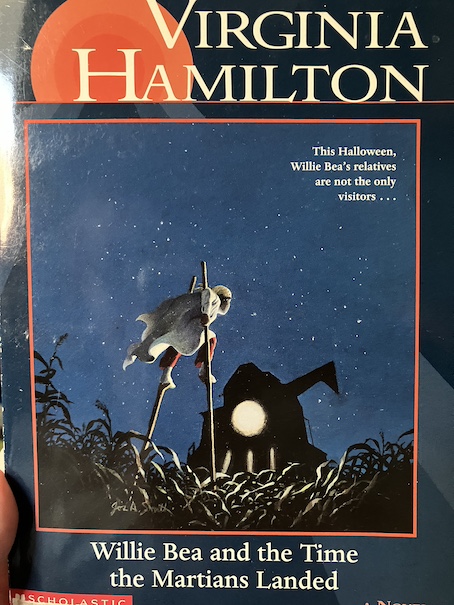
It’s Halloween 1938, and Willie Bea’s relatives have gathered at the old family farm, near where she lives. Money is tight because of the Great Depression, but one of her aunts lives and works in the city, making more money than the others, and is willing to help fund family dinners and provide a little extra for her nieces and nephews when they need something, like new clothes. The aunt is a little scandalous in their family for her multiple marriages, but the others appreciate her generosity, and the nieces and nephews like getting some extra attention and a few treats from her.
The family gathering is a bit chaotic with children running around and getting into trouble. One of Willie Bea’s cousins gets into particular trouble with her mother for using his bow and arrow set to shoot a pumpkin off of Willie Bea’s younger brother’s head. Their mother panics when she catches them doing it because he could have missed and killed the little boy, but Willie Bea tries to calm her mother. Willie Bea was less worried because she knows her cousin’s archery skill and that he wasn’t going to miss, but she understands that adults think of the risks and aren’t fully aware of what the kids are capable of doing. (I’m siding with the mother on this one. Even people who are very good at something can miss now and then, and it’s a big risk to take with someone’s life.) Willie Bea also realizes that the decision to use her little brother for the William Tell act actually came from another cousin because the cousin doing the archery wouldn’t have thought of it himself, and it’s not fair that her mother doesn’t know to blame this other cousin.
Willie Bea talks to her father about the incident, hoping that he’ll understand how unfair it is. However, her father tells her that what her cousin did was dangerous, no matter why he did it. Even though he has a reputation for being good with archery, even people who are good can still miss, and accidents can happen. (See?) Her father lets Willie Bea know that he’s aware that she and her cousins do risky things sometimes when they’re playing with each other, but as an adult, he and the other adults have a responsibility to tell them when something they’re doing is too risky and to put a stop to it. No matter how many times they’ve done some of these things without having an accident, some things are just accidents waiting to happen. They should never assume that an arrow can’t go wrong just because it hasn’t yet or that they can’t fall from a high place just because they haven’t fallen yet.
Willie Bea is a little embarrassed by the talk and feels like her father still doesn’t understand. However, Willie Bea herself has been starting to understand a few things about her relatives this Halloween, things that she either hasn’t noticed before or only half noticed. She can see that one of her cousins is too manipulative, noting the little tricks she uses to get her way and the things she says and does when she wants to be spiteful. She can see that her other cousin has trouble asking up for himself and is particularly vulnerable to manipulation.
Willie Bea also begins to notice things about the adults in the family and their relationships with each other. Aunt Leah, the aunt who has more money than the others and has been married multiple times seems glamorous and fascinating to Willie Bea. Aunt Leah is into horoscopes and fortune telling, and when she reads Willie Bea’s palm, she predicts something special for her. Although Willie Bea loves her own mother, she is intrigued by the family gossip that her father was seeing Aunt Leah before falling in love with her mother, and Willie Bea fantasizes about what it would be like to live with Aunt Leah in the city. She imagines that it would be exciting, and she asks her father why he chose her mother instead of Aunt Leah. Her father knows that Willie Bea doesn’t entirely understand what it’s like to make that kind of choice and what living with a woman like Aunt Leah would really mean. (It occurred to me that the multiple divorces Leah has had might be a clue.) He just explains to Willie Bea that his choice became clear after he got to know her mother as well as her sister, Leah. He knew her mother was the right choice because she was the kind of steady woman who would always be there for him.
That evening, while Willie Bea is putting together her hobo costume and the ghost costumes for her younger siblings and her parents are listening to the radio, Aunt Leah suddenly bursts in and starts having hysterics about it being the end of the world! It takes Willie Bea’s parents a while to get a clear answer from Aunt Leah about why she’s so upset. When she recovers enough to explain things, she says that she was listening to the radio, and she heard that Martians have invaded New Jersey! She describes the horrible, terrifying reports that the radio announcer made about the Martians destroying army troops with their deadly heat ray. Aunt Leah was so terrified by what she heard that she not only turned off the radio but unplugged it, and she says that she’ll never plug it in again, which might be a moot point, if aliens really are here to destroy the world. (If you know what was infamously broadcast on Halloween 1938, you know what Leah heard and that it’s not what she thinks it is.)
While Willie Bea’s parents are trying to decide what to make of Aunt Leah’s story, Willie Bea’s Uncle Jimmy arrives. He says that the rest of the family has also heard what Aunt Leah heard and that they’re all gathering at the old family farm. Rumor has it that people have seen the terrible invaders over at the Kelly farm. Willie Bea’s mother gathers the children and heads to the family farm that Willie Bea’s grandparents own to be with the rest of the family, while Willie Bea’s father tries to see if he can find the station that Leah was listening to and hear the reports for himself. It occurs to him that it might not be an invasion of the Martians but could actually be Germans and German war machines because they’ve all heard about the Nazi takeover of Germany, and he remembers the horrible Hindenburg disaster. If Germans could make a blimp that explodes into a fiery terror like that, then he thinks maybe they could make something that resembles an alien invasion.
At her grandparents’ farm, Willie Bea watches as various relatives panic, cluster around the radio, trade rumors, and try to figure what’s going on. Rumor has it that there are Martians on the Kelly farm, so Willie Bea convinces young Toughy Clay to go over there and try to see them for themselves. At Willie Bea’s insistence, they use the stilts that the children like to walk on to give themselves longer legs, so they can get there faster. Nothing is as it seems this Halloween, and Willie Bea’s expedition to see the Martians definitely doesn’t go as planned.
The book is available to borrow and read for free online through Internet Archive (multiple copies, including a short picture book version).
My Reaction
Almost of the characters in this book are African American. I don’t think it’s ever stated directly because there’s no need in the story to describe them, compared to anyone else, but I think it’s subtly implied. There is only one point in the story where race is mentioned at all, and that’s when Willie Bea is hurt, and the doctor comes to see her. Willie Bea describes the doctor as an old man who delivered most of the babies in her family and knows everybody in the community, and she says that he visits everyone, black or white, rich or poor. Willie Bea’s family is at the poorer end of the community because the doctor knows that people like them don’t normally call the doctor unless it’s something that they really can’t handle by themselves.
I found the family relationships in the story confusing at first. The kids are all referred to by nicknames, and when they are first introduced, it’s difficult to keep it straight who is whose sibling and who is a cousin, and who is older and who is younger. At least, that’s how it seemed to me. Relationships are explained gradually as the story continues, along with characters’ real names as well as nicknames, but it takes some time to get to the explanations.
The story has a slow start, and the real adventure doesn’t begin until about halfway through the book. In some ways, it’s a coming of age story for Willie Bea because she finds herself seeing her family in ways that she never has before, becoming more aware of different sides of their personalities and gaining more insights into their relationships with each other. She also comes to see firsthand what her father means about the stunts that she and her cousins pull and how she should never assume that they can’t get hurt just because they haven’t before. Much of this book is what I would call “slice of life”, a sort of glimpse into Halloweens of the past in a rural community, especially one particular Halloween that would have been memorable for anyone who was alive at the time in the United States.
The radio broadcast that has Willie Bea’s family and others in the community panicking over an alien invasion is The War of the Worlds, a play based on the novel of the same name by H. G. Wells. This type of panic over this particular radio performance was a real, historical incident because the radio play was presented in the format of news broadcasts at the time, and some people who tuned into the program late misunderstood what they were hearing and thought that it was a real news broadcast about an actual emergency. It wasn’t a widespread panic because, first, people who started listening to the broadcast from its beginning knew what they were listening to, and second, not everyone was listening to the broadcast at all. Still, there was enough panic over the radio performance that it became newsworthy and has become a piece of American history and lore.
I enjoyed the historical details in the story, particularly all the radio play references throughout the story. Willie Bea’s family likes to listen to radio shows, and I’m familiar with some of them because I also enjoy old radio plays. Her family likes to listen to The Shadow and Little Orphan Annie. Willie Bea likes to amuse her siblings by imitating people from the radio, singing theme songs and reciting jokes from Jack Benny, like the famous “your money or your life” joke.























 Jestress's Forgotten Books and Stories