Howl’s Moving Castle

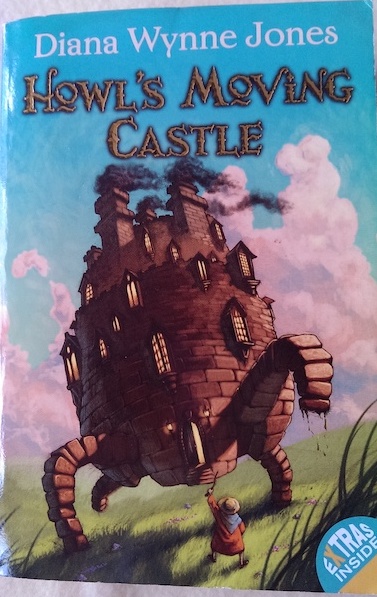
Howl’s Moving Castle by Diana Wynne Jones, 1986.

The kingdom of Ingary is the land of fairy tales. There is magic, and in a family of three children, it’s always expected that the youngest of the three will be most successful. Sophie Hatter, as the oldest of three, is disappointed when she first realizes that, but she reconciles herself to her rather dull fate. She is devoted to her younger sister and half-sister, and she does her best to look after them and help prepare them for their futures.

When Sophie Hatter’s father dies, her stepmother Fanny has to decide what arrangements to make for the family’s hat shop and the three girls in the family: Sophie, her younger sister Lettie, and her half-sister Martha.  Because Martha is very bright and expected to one day seek her fortune in the world, as third children generally do, Fanny arranges for her to become an apprentice to a respected witch.  Lettie becomes an apprentice in a pastry shop, where she will learn a good trade and possibly meet a nice young man to marry.  Sophie, as she had always expected, continues to work in the hat shop.  None of the three girls are particularly excited about the arrangements, but they make the most of it.  Sophie does have a talent for hat-making.  In fact, she has a very unusual talent because, as she talks to the hats while she makes them, the things she predicts for the buyers come true. People become increasingly attracted to the hat shop because it seems like good things happen to people who buy hats there.

Sophie is good at working in the hat shop, but she has to admit that her life there is dull. She doesn’t really know what else she would want instead, but she feels isolated, hearing gossip from other people but not really talking to anybody herself. A visit to her sister Lettie on May Day puts Sophie’s life in perspective and calls the things that are expected of older and younger siblings into question. Sophie learns that her sisters, dissatisfied with the arrangements Fanny made for them and having ambitions other than the ones that are expected of them, have secretly switched places with each other. Lettie craves learning and adventure, so she has taken Martha’s place as the witch’s apprentice to learn magic. Martha doesn’t actually care about going out to seek her fortune at all. She doesn’t want adventure or riches. What she really wants, although she’s never admitted it before, is to marry, settle down, and have ten children. Working in the pastry shop, she has already attracted quite a following of young men, and she’s sure that she’ll find one who will love her and make her happy. Neither of them cares about fitting the tradition mold of three siblings, and they’re both concerned about Sophie’s future. Sophie has never had any particular ambitions of her own, but her sisters know that being shut up in the hat shop all the time isn’t good for her. They think Fanny is taking advantage of her because it’s Sophie’s work that’s attracting all the customers these days, and Fanny isn’t even paying her an apprentice’s wage! Apprentices like Lettie and Martha get wages at other businesses, but Sophie’s been working for free while Fanny takes all the profits. It gives Sophie a lot to think about, and she becomes convinced that she’s being exploited when she asks Fanny about wages, and Fanny puts her off. Sophie is so angry that she thinks maybe she should run away to seek her fortune, but she can’t shake the idea that eldest children can’t do that. Soon, circumstances intervene to force Sophie to be the one to go out and seek her fortune anyway.

Dangerous and mysterious things are happening in the kingdom. Rumor has it that the evil Witch of the Waste has threatened the king’s daughter and that the king’s personal wizard, Suliman, has vanished after going to deal with her. People think that the Witch of the Waste probably killed him. The king’ brother, Prince Justin, also went in search of Suliman and disappeared.

One day, the Witch of the Waste pays a visit to Sophie’s hat shop.  Mistaking Sophie for one of her sisters, the witch curses Sophie, turning her into an old woman.  Unable to explain to anyone what has happened (which is part of the curse), Sophie makes the decision to leave the hat shop, finding a new job as housekeeper to the mysterious wizard Howl, a sinister figure himself.  Little is known about Howl, although he is known to live in a strange castle that moves from place to place, apparently of its own accord, and he has a reputation for breaking women’s hearts.

Howl is even stranger although somewhat less sinister when Sophie gets to know him.  He allows Sophie to stay in his castle, not so much by requesting her to stay but by not telling her to leave, much like he did with his apprentice Michael, an orphan who came to live with him and gradually became his apprentice when Howl decided not to send him away.  Howl is vain (using makeup and hair dye to make himself more handsome), immature, and somewhat cowardly, but he is still a powerful wizard and can accomplish great things when he makes up his mind that he wants to (or finds himself unable to refuse).  He doesn’t real steal girl’s souls, as some of the rumors about him say, but he is definitely a flirt and a womanizer, who drops girls as soon as they fall in love with him because he likes pursuing them but is afraid of commitment. In fact, he even has Michael spread scandalous rumors about him in the towns where they do business so people will be more reluctant to try to get him to commit to anything or anybody.

Howl has other problems aside from his immaturity and fear of commitment.  Calcifer, the mysterious fire demon that powers the moving castle, hints as much to Sophie.  He hopes that Sophie will be able to help, although he, too, is unable to explain the reason why for magical reasons.  Howl is not an ordinary person, but a traveler from another dimension, from a strange country called Wales, the same place where the king’s wizard, Suliman, was from. In Suliman’s absence and against Howl’s will, the king recruits Howl to be the new royal wizard, to find the missing Suliman and Prince Justin, and to deal with the Witch of the Waste.

Sophie struggles to convince/cajole/force/help Howl to save the kingdom and to learn the secret curse that Howl himself is living under even while suffering from her own curse.  Surprisingly, it seems that Sophie is the key to breaking not only Howl’s curse but her own.

The book is available to borrow and read for free online through Internet Archive (multiple copies). It’s the first book in a loose series. Many people these days are familiar with the story because it was made into a Miyazaki movie, although the movie was very different from the book in a number of ways.

My Reaction and Spoilers

I first read this book when I was in high school, years before the movie version was made. In a way, the book is party mystery or puzzle as well as fantasy. Calcifer and Howl have a problem that they can’t talk about because of the magic around it. Only one rumor about Howl is true: Howl is literally heartless. But, Calcifer has a heart. It takes a long time for Sophie to make the connection and to realize what Calcifer actually is and what Howl did. Howl made a sacrifice years before that has left both Howl and Calcifer in a precarious position. The clues to Howl’s past and the arrangement between him and Calcifer are in a poem by John Donne that turns out to be part of Howl’s nephew’s school assignment. The Witch of the Waste, who turns out to be one of Howl’s former, discarded conquests, knows Howl’s secret and is trying to use it to get revenge on Howl.

Although the movie version is very good, and I enjoyed watching it, it is very different from the original book. The beginning part of the movie, where Sophie is working in the hat shop and cursed by the Witch of the Waste before going to work for Howl is very similar to the original book. However, the major problem of the war in the movie never happened in the book. War is a common theme in Miyazaki movies, but there’s nothing in the book about wizards making themselves into weapons of war. Instead, the main problems of the book are about lifting Sophie’s curse, figuring out what the secret contract between Howl and Calcifer is, evading the wrath of the Witch of the Waste, and finding the missing Suliman and Price Justin. The movie addresses the arrangement between Howl and Calicifer, but it doesn’t fully cover any of the rest of it. There are some characters and plot lines from the book which were combined or reduced in the movie in favor of the war plot, which I found less interesting because it has less intrigue. In the movie, the Witch of the Waste is tamed and redeemed as a character, but in the book, she really is evil and is never redeemed.

There’s also nothing in the movie about Howl being from Wales in our world and the land where he lives being a different dimension, but that’s a major part of Howl’s character in the book. In the book, Sophie even visits Wales with Howl and meets his family. His sister thinks that Howl, known as Howell Jenkins in his native Wales, is a wastrel, who hasn’t made anything of himself in spite of his college education. She’s only partly right. What she doesn’t know is that Howl started learning about magic at university, which is how he found out how to travel to other dimensions and make himself into a wizard. In spite of his immaturity and attempts to avoid certain types of service, he is actually very skilled and powerful. Howl can’t tell his sister the truth, so he just lets her think that he’s a wastrel.

Sophie finds Wales strange and mysterious. She is terrified when Howl takes her and Michael for a ride in his car. One of my favorite parts is when Howl needs to talk to his nephew about the poem he was assigned at school, but he doesn’t want to talk to Howl because he’s playing a computer game with a friend. Sophie and Michael don’t understand computers or that the boys are playing a game, so when the friend says that he can’t stop to talk or he’ll lose his life, they think that the boy’s life is really in danger. They almost panic when Howl pulls the plug on the computer to get his nephew’s attention, totally unworried about his nephew possibly dying. That’s one of the reasons why I prefer the book to the movie. Many of the humorous little moments like this are lost in the movie, although the movie did keep the episode where Howl has a temper tantrum and fills the house with green slime.

There are also intricacies of the plot that aren’t explained in the movie. The one I mind the most is that the movie doesn’t fully explain how the curse on Sophie works or how it gets broken, either. The book provided more information, which helps Sophie fully appreciate who she really is. As Calcifer realized soon after meeting Sophie, removing the curse on Sophie is complicated because it has two layers. Howl even admits later that he’s been quietly trying to remove Sophie’s curse himself, but he was never successful because Sophie was actually maintaining the curse herself. The first layer was what the Witch of the Waste did to her, but Sophie herself has magical powers that she has been unconsciously using throughout the book. The reason why good things kept happening to the people who bought her hats was that she was unconsciously casting spells on the hats when she talked to them while making them. The second layer of the spell on Sophie herself was her unconsciously reinforcing her sense of being old through all of the negative things she’d been telling herself about being the eldest child in her family. Sophie’s power typically manifests in the things she tells to people and things, and she’s been telling herself all the wrong things.

Because of all of the tales about how the youngest children are the ones who successfully go out to seek their fortune, Sophie has felt relegated to just being the eldest, helping other people, and not really thinking about what she wants for herself. Even as a young woman, she acted and felt old before her time because she didn’t have any confidence in herself or anything to look forward to in her future. Her sisters even worried about her for not having enough self-respect, no ambitions or dreams of her own, or ability to stand up for herself. Because she never expected to do much of anything with her life or any belief that she might have talents of her own, she and everyone else completely overlooked all of the magic that she’s been instinctively doing. When Sophie discovers that her sisters have switched places and learns about their real life ambitions, she is stunned to realize that she has badly misunderstood both of them for most of their lives, also making assumptions about them based on their birth order. She has also misjudged or underestimated other people, but the person she’s misjudged and underestimated is herself. Howl is the one who tells her that there’s nothing wrong with her being the eldest sister; the times when she gets things wrong have been when she acts without fully thinking things through. Part of the key to breaking her curse is to get rid of the negative feelings she’s had about herself and her ability and to see herself for who she really is: a person with powerful talents and a right to want things and achieve things for herself and her future. Once she sheds her doubts about herself and her abilities and stops thinking of herself as just the eldest and doomed to fail, she realizes how she can use her powers to save Calcifer and Howl, and Calcifer lifts the rest of her curse.

The Poky Little Puppy’s Wonderful Winter Day

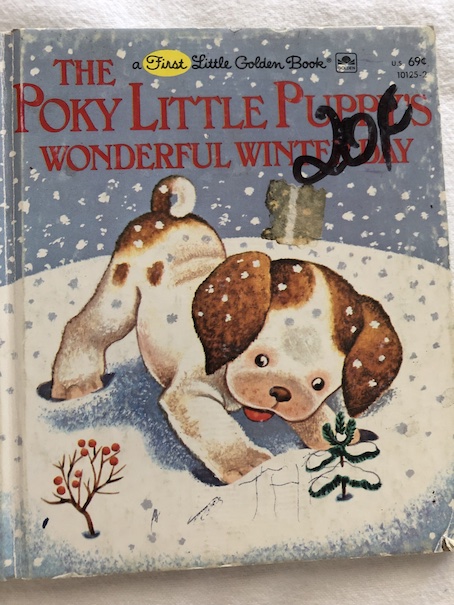
The Poky Little Puppy’s Wonderful Winter Day by Jean Chandler, 1982.

This book is part of the Poky Little Puppy series of picture books from Little Golden Books.

The Poky Little Puppy is the last to wake up on this snowy day, seeing his brothers and sisters rushing outside to play as he starts his breakfast. When he finishes his breakfast and goes outside, he doesn’t see the other puppies, but there are children playing in the snow.

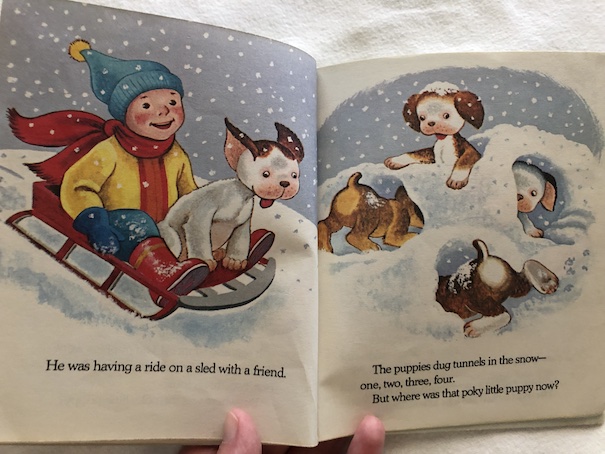
The Poky Little Puppy follows the puppy paws through the snow and finds his siblings. The other puppies go sliding now a hill together, but the Poky Little Puppy gets a ride on a child’s sled.

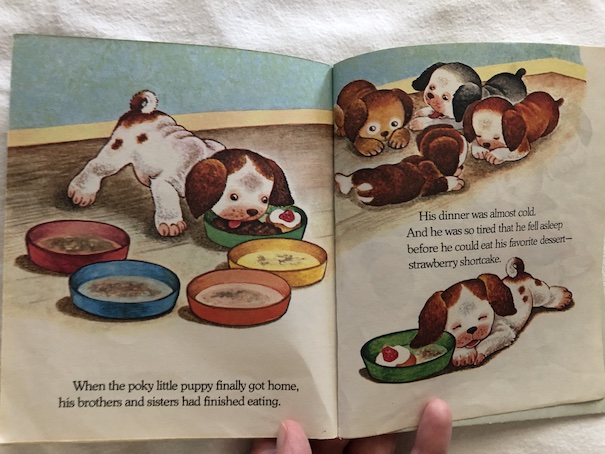
The Poky Little Puppy also tries to make a snow angel with a child and chases snowballs the children throw. He was the last puppy to start playing and the last to make it home to dinner because he is “poky” and arrives late to everything, but in the process, he had the most fun of everyone! (Although, he does fall asleep before eating his dessert.)

The book is available to borrow and read for free online through Internet Archive.

My Reaction

This is just a cute little story about the fun that a puppy has on a snowy day. I liked the message that the Poky Little Puppy has fun going through the day at his own pace and doing his own thing. Even though he isn’t always doing what his brothers and sisters are doing and sometimes trails behind them, he makes the most out of this fun, snowy day!

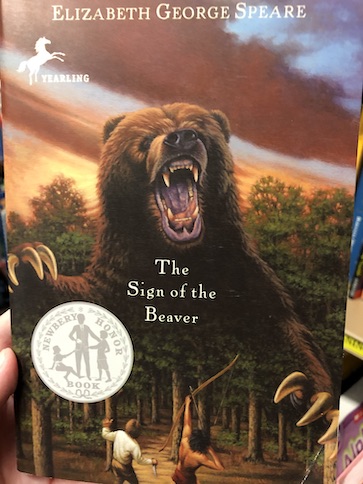
Sign of the Beaver

Sign of the Beaver by Elizabeth George Speare, 1983.

The story begins in the late 1760s with twelve-year-old Matt’s father leaving him alone in the log cabin that he and his father built for their family in the Maine territory. The rest of their family is still in Massachusetts, and Matt’s father is going to get them and bring them to their new home. Their family will be the very first to settle in what will soon be a new township. However, for now, Matt is alone at their cabin, surrounded by miles of wilderness, while he waits for his father to return and the rest of his family to arrive. Matt will be looking after the cabin and the field of corn that he and his father planted, but he finds the silence and solitude unnerving.

Before he left, Matt’s father left his watch and rifle with Matt. After his father leaves, Matt tries the rifle. He doesn’t hit anything, and he decides that it will take getting used to. He learns to hunt with it, and Matt finds that he is very busy with hunting, fishing, and chores, which helps pass the time. Every day, he makes a notch on a stick to mark the days that pass.

Gradually, Matt becomes aware that someone is watching him. Someone seems to be hiding and following him. Since there are no other white families living for miles around, he can only assume that it must be an “Indian” (Native American). They know that there have been some in the area, although they haven’t really met any yet. Matt finds the prospect a little worrying because he isn’t sure what to expect from them, but his father always told him that, if he met an Indian, he should just be polite and respectful. Matt is nervous that whoever is watching him is also hiding from him, though.

One day, Matt hears someone wearing heavy boots tramping in the woods, and Matt thinks that maybe his father has returned early for some reason. However, it turns out to be a stranger in a blue army uniform. Although Matt has missed having company, he finds himself reluctant to talk much to this stranger, and he doesn’t want the man to know that he is there completely alone. Still, the stranger is hungry, so Matt agrees to let him share a meal with him. The stranger, who calls himself Ben, stays the night with Matt, uninvited. Matt can’t bring himself to turn away someone who needs hospitality in the wilderness, and Ben tells him stories of his past adventures. Matt still has misgivings about Ben, and he’s sure his stories are tall tales. When Ben mentions leaving a town because there was trouble there, Matt thinks maybe Ben ran away because he’s a criminal. Matt plans to stay awake that night to keep an eye on Ben, but he eventually falls asleep. When he wakes up, Ben is gone, and so is his father’s rifle. Ben is a thief! Matt realizes that he was right to be suspicious of Ben and is angry that he let him get away with stealing the rifle.

Without that rifle, Matt can’t hunt. He can still feed himself through fishing, but he loses more of his supplies when he forgets to properly bar the door while he’s out fishing, and a bear eats most of the food in the cabin. Reduced to eating only fish, Matt gives in to temptation and tries to get some honey from some bees he finds in a nearby tree. It’s a bad idea, but this decision changes everything for Matt.

Matt is badly stung by the bees, and when he tries to escape them in the water, he nearly drowns. Fortunately, Matt is saved from drowning by the Indians who have been watching him. It turns out to be a grandfather and his grandson. The grandfather, Saknis, takes Matt back to his cabin, brings him food, and treats his wounds. When he realizes that Matt hurt his ankle and lost his boot in the water, he gives Matt a crutch to use for walking and a new pair of moccasins to wear.

Matt is both grateful for this much-needed help but also very self-conscious about it. He can tell that the grandson, Attean, doesn’t like him and thinks that he’s a fool for getting hurt like this, which is embarrassing. Matt also thinks that he should repay them for what they’ve given him, but he doesn’t have much to offer. The only thing he can think of to give them is the only book he owns, a copy of Robinson Crusoe. Matt is embarrassed when he realizes that the Saknis can’t read, and he thinks maybe he will be offended at this type of gift, but the older man realizes that Matt’s knowledge of reading is a gift that they badly need.

In broken English, the old man explains that his people have made treaties with white people before, but because they can’t read English, they never really know what’s written in the treaties. When white people break the treaties or tell them that they’re no longer allowed in certain areas of land, there isn’t much they can do, since they don’t even know for certain what was in the original agreements. He realizes that his people can’t afford to be ignorant. There are more white people moving into their territory all the time, and his people will have to know how to deal with them. Therefore, Saknis proposes a kind of treaty with Matt: they will continue to bring Matt food if Matt teaches Attean to read.

Attean immediately protests this plan. He really doesn’t like Matt, or any white people in general, and he doesn’t want these reading lessons. However, his grandfather is firm that this is something he needs to do. Matt also isn’t sure about this plan. He does owe them for their help, but he’s never taught anybody to read before. His own early lessons didn’t go particularly well, although he likes reading Robinson Crusoe now. Also, Matt thinks of Attean as being a “savage” and a “heathen” who doesn’t even really want to learn, so he’s not confident that the reading lessons are going to go well. Still, Matt does owe them for saving him and could use their continued help while he recovers from his injuries, so all he can do is try.

When Attean gets frustrated during the first reading lesson and storms out of Matt’s cabin, Matt thinks that the lessons are already over. Yet, Attean does return for more lessons. Gradually, Matt thinks of ways to make the lessons more interesting to Attean, reading the most exciting parts of Robinson Crusoe out loud to Attean to get him interested in reading the story himself and finding out what will happen to the main character. It isn’t easy to get Attean interested in learning because Attean is initially determined not to be interested or impressed by anything Matt has to say.

When Matt becomes curious about some of the things Attean and his tribe do, like how Attean hunts rabbits without a gun, Attean opens up a little and shows Matt some of the things he knows. Matt begins to admire some of the unique skills Attean shows him and learns to use them for himself. Matt is aware that his first efforts must look clumsy and childish to Attean as he tries to learn skills that Attean has known for years, but it puts the boys on a more equal footing with each other. Each of them has something to learn from the other, and it’s all right for each of them to look a little awkward to the other while learning. Matt gets embarrassed sometimes when he does something clumsy in front of Attean, but he learns that he must also persevere. Attean teaches him some good, practical skills for making things without using some of the manufactured goods that he and his father brought with them from Massachusetts. When Matt loses his only fish hook, Attean shows him how to make a new one. Attean teaches Matt to be self-reliant and to use new methods to accomplish his goals.

During the part where Matt reads the part of Robinson Crusoe where Robinson Crusoe rescues the man he calls Friday, and Friday, out of gratitude, becomes his slave, Attean protests that would never happen in real life. Attean says that he would rather die than become a slave. Matt is surprised because he never really thought that much about how someone like Friday would feel in real life. Matt learns to look at the story as Attean would, reading the best pieces to him, the ones that emphasize the friendship between the two characters rather than servitude.

Gradually, Matt and Attean become friends. Matt doesn’t think he’s very good at teaching Attean to read, but Attean does slowly learn. Although Attean resists learning to read because he’s trying to prove that he doesn’t need this skill that he associates only with white people, his spoken English becomes better as he and Matt talk. Attean admits that he tells parts of Robinson Crusoe to his people, and they enjoy hearing them, so Matt moves on to stories from his father’s Bible. Attean finds the Bible stories interesting and compares them to stories that his people already tell. (It is interesting, for example, how many civilizations around the world tell stories about great floods.) The boys are fascinated by the common themes in their stories.

The boys also enjoy doing things together, and Matt feels less lonely when Attean comes to visit. Matt doesn’t always like Attean because he has a disdainful attitude toward him, but they learn to trust each other, and they find interesting things to do together. Matt comes to realize that his irritation at Attean’s attitude is because it’s so difficult to earn Attean’s respect, and he really wants Attean’s respect. Although Matt doesn’t like Attean’s attitude toward white people, he does agree with Attean about some things, and he has to admit that he cares about what Attean thinks. Matt does get some respect from Attean later when the boys have a hair-raising encounter with a bear. Attean is the one who actually kills it, but Matt proves his usefulness during the struggle. Matt also comes to understand Attean’s resentment against white people when Attean eventually tells him that he’s an orphan and that his parents were killed by white people. That’s why he lives with his grandparents.

As time goes by, Matt becomes increasingly worried about whether or not his family will ever arrive. He worries that maybe something happened to his father and that the rest of the family won’t know where the cabin is and won’t be able to find him. When it passes the time when his family should have arrived, Matt fears that maybe they will never come at all. What if he is left alone? He has survived so far, with some help from Attean and his people, but can he live alone forever? Or could there be a place for him among Attean’s people?

Saknis has also been thinking about this, and he has noticed that Matt’s family has not yet come. He knows that it would be dangerous for the boy to remain alone in the cabin when winter comes. As the seasons change, the Native Americans are preparing to move to their winter hunting grounds. Saknis invites Matt to come with them, and Matt has to decide whether to accept the offer or stay and wait for his family.

This book is a Newbery Honor Book. It’s available to borrow and read for free online through Internet Archive (multiple copies).

My Reaction and Spoilers

This story reminds me a little of The Courage of Sarah Noble, where an 18th century white child who is afraid of Native Americans comes to learn more about them by living with them and interacting with them. I actually read The Sign of the Beaver when I was a child, and I only read The Courage of Sarah Noble as an adult. I’m not sure now if I prefer one of these books over the other. For a long time, I forgot the title of The Sign of the Beaver, although I did like this book the first time I read it. I remembered the concept of the boy living alone while he waited for the rest of the family to join him. One part that stuck in my mind the most was the part near the end of the story where Matt makes a cradle because he knows that his mother was expecting a baby when he last saw her and thinks that it would be nice to have a cradle ready for his new younger sibling, but when his family arrives, he is told that the baby died. That tragic image just stayed with me for years.

Some of the prejudiced language in the story, like “savage” and “heathen” and some anti-Catholic talk from Ben early on, is a little uncomfortable, but this is one of those stories about changing attitudes and overcoming prejudice. The main character has to show some fearful and/or prejudiced thoughts toward Native American initially for readers to appreciate how far he comes and how much his thinking changes after he makes friends with them and learns more about them.

Ben, of course, is a villain character, so his prejudiced talk is a reflection of that. He’s selfish and a thief, so his views of other people are based on what puts him in the best light or justifies things that he’s done. When he talks about the people of the last town he was in being against him and making trouble so he had to leave, both the readers and Matt realize that Ben was the one who started the trouble. Ben blames other people for problems he creates himself. The stories he tells Matt about his earlier, supposedly brave adventures are based around the French and Indian War, which is where the Catholics enter the discussion.

Several times during the story, Attean uses the word “squaw” to refer to women. I didn’t think too much about that sort of thing when I was a child because I assumed that both the author and characters in books that used that term knew what it meant and were using it correctly. Since then, I’ve heard that it actually has a rather vulgar meaning, although I’ve also heard conflicting information that it’s not always vulgar. The contradictory accounts make it a little confusing, but according to the best explanations I’ve read, the contradictions about the meaning of this word have to do with similar-sounding words in different Native American languages. Not all Native American tribes have the same traditional language, and some have words that sound like “squaw” and refer to females in a general way, while others have words with a similar sound that refer to female anatomy in a more vulgar way. For that reason, something that might seem innocuous to one native speaker might sound crude to another, and non-native speakers of any of the languages involved may not fully understand all the connotations of the word. In the end, I’m not sure how much of this the author of this book understood, but my conclusion is that it’s best not to use certain words unless you’re sure of their meaning, not only to you but to your audience. I only use the word here to make it clear which word appears in the book. Other than that, I don’t think this word is a necessary one, at least not for me. I understand what Attean is referring to in the context of the story, and I think that’s what really matters in this particular case. Whether that’s the right word for Attean’s tribe to use at this point in history would be more a matter for a linguist. I’m willing to accept it in the book as long as readers understand the context of the situation and are content to leave the word in the book and not use it themselves outside the context of the story.

When Attean talks about women in the story, it’s typically to point out certain types of work that he considers women’s work instead of men’s work. Matt is a little offended sometimes when Attean tells him that some chore he’s doing is for women instead of men. Matt’s family doesn’t have the same standards for dividing up chores as Attean’s tribe does, and the fact is that Matt is living alone at the moment. There are no women in Matt’s cabin, only Matt. Any chore that needs to be done right now is Matt’s to do because there simply is no one else to do any of it for him. I think when Attean tells him that he’s doing women’s work, he’s trying to needle Matt because, otherwise, he comes off as sounding a little dense. Sure, Attean. We’ll just have the women who aren’t here do this stuff that needs doing right now. During the course of the story, Matt comes to appreciate how the Native Americans live differently because it makes sense for the place where they live and their circumstances, but this is one instance where Attean could be a little more understanding about Matt’s circumstances.

One thing that I had completely forgotten about in this story was the part where Matt thinks about how Attean smells bad. Earlier, when I did a post about Mystery of the Pirate’s Ghost by Elizabeth Honness, I was irritated at the author for having one of the characters imagining smelly Native Americans because I had never heard of that as a stereotype before (I thought at the time), and I didn’t know where that idea came from. A site reader suggested that the trope came from the Little House on the Prairie series because there is talk like that in those books, but The Sign of the Beaver actually offers an immediate explanation as soon as Matt thinks about the cause of the smell. Matt realizes that Attean has smeared a kind of smelly grease on his body that is meant to repel mosquitoes. Matt has heard of people doing this before, and he understands that there is a useful purpose behind it, but he just hates the smell so much that he thinks he’d rather just put up with the mosquitoes. That explanation really helps to put everything into context. When there’s no explanation about things like this in stories, it makes it sound like Native Americans are just smelly because they’re “savages” who don’t bathe or something, but when you hear the explanation, it’s just that the smell is an inconvenient side effect from something that has a real, practical purpose. It might be unappealing to Matt, but there is a point to it. So, on the one hand, I feel a little bad about getting down on Elizabeth Honness for throwing that idea into her story without an apparent basis, but still irritated because, if she knew that was the explanation, she could have said something about it instead of just throwing that out there, like everyone reading the story would already know. I have similar feelings about some of the things Laura Ingalls Wilder put in her books, too. Context is important, and some authors are better at providing it than others. I also think that context is something that books from the late 20th century and early 21st century often provide better than books from earlier decades, although there are some exceptions.

At the end of the story, we don’t know for sure whether Matt and Attean will meet again. When Matt’s family arrives, they tell him that other white families will be arriving soon. Matt knows that the tribe he befriended will likely lose their hunting grounds to the town that will be built there. Matt is concerned for their future, but he is glad to be reunited with his family and still considers Attean his friend.
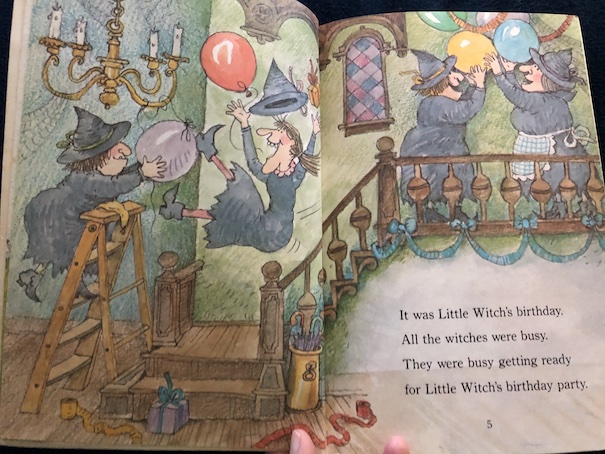
Happy Birthday, Little Witch

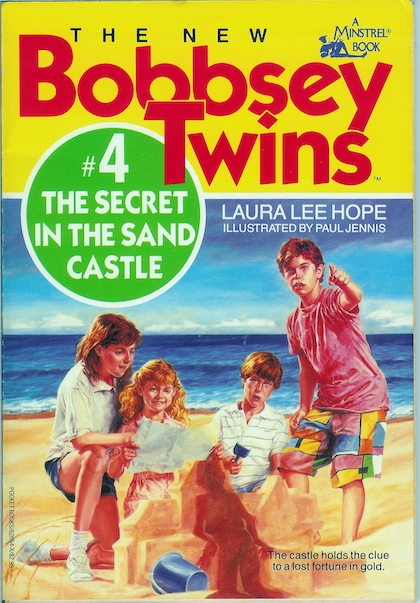
Happy Birthday, Little Witch by Deborah Hautzig, illustrated by Marc Brown, 1985.

This was one of my favorite Halloween books when I was a child, and so is the first book in the series, Little Witch’s Big Night. The first time I read these books, I read them out of order, but you really have to read the first book in order to understand Happy Birthday, Little Witch because it turns out that Little Witch still doesn’t understand the idea of trick-or-treating or that human children wear costumes on Halloween after meeting some children trick-or-treating on the previous Halloween. She really thinks that she met a small astronaut, pirate, and devil on Halloween, and that makes it difficult for her to find them when she wants to invite them to her birthday party.

The witches in Little Witch’s family are decorating and preparing for Little Witch’s birthday party, but Little Witch is sad. Witches are generally bad and nasty, and Little Witch knows all the tricks her family will pull at her birthday party. Little Witch is nicer than the other witches, and she wishes that her party could be nicer, too. Then, she gets the idea of inviting the new friends she met on Halloween, who she only knows as Pirate, Astronaut, and Devil.

She doesn’t know her friends’ real names, so she tries to search for them in place where she thinks that a pirate, an astronaut, and a devil might hang out, taking her cat Bow-Wow and her pet bat Scrubby with her. She hitches a ride on a rocket ship, but her astronaut friend isn’t inside.

She checks out a pirate ship, but her pirate friend isn’t there, and the captain makes her walk the plank.

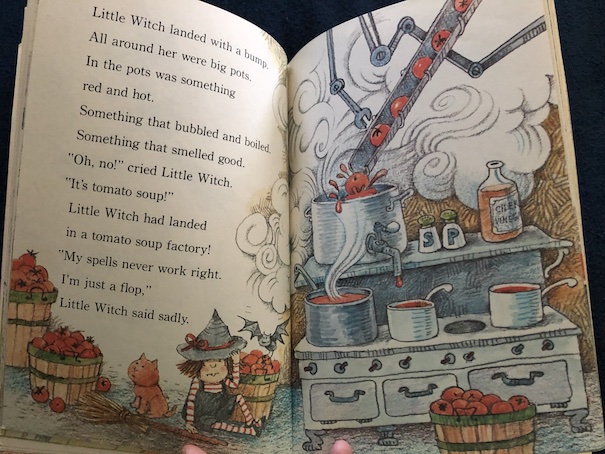
As for the devil, she thinks that she should try someplace that’s red and hot and ends up in a tomato soup factory (which I think is the funniest part if you’re reading this as an adult and you realize what kind of red, hot place she was really thinking of going to look for a devil).

However, the cook in the factory suggests to her that if she’s looking for her friends, they’re probably in school. At the school, Bow-Wow the cat gets frightened and runs away.

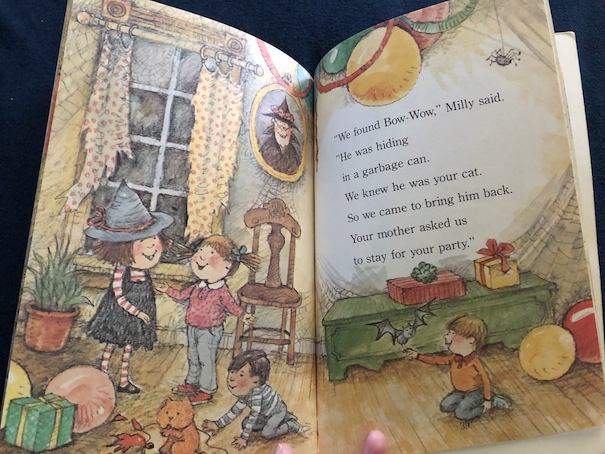
When Little Witch gets home, she finds out that her friends are ordinary children. They found her pet cat and brought it to her house, so her mother invited them to join the party. Her friends introduce themselves by name for the first time.

Little Witch’s party is nicer than it usually is, and she gets to play different games with her new friends. Little Witch’s mother says that she loves her, even though she is more good that most little witches.

Something that I didn’t mention in the review of the previous book is that both of these books were illustrated by Marc Brown, who created Arthur. The book is available to borrow for free online through Internet Archive.

Little Witch's Big Night

Little Witch’s Big Night by Deborah Hautzig, illustrated by Marc Brown, 1984.

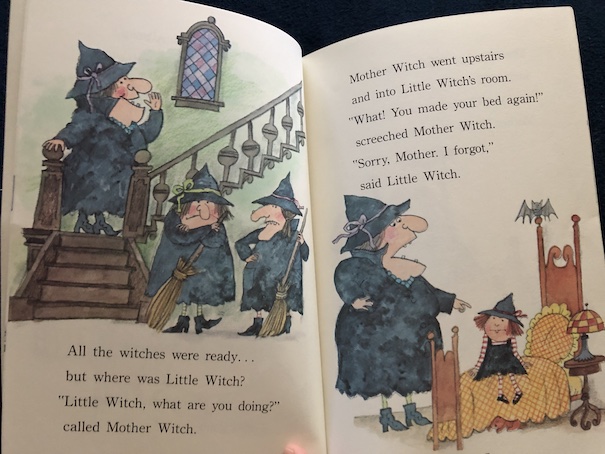
On Halloween night, all the witches in Little Witch’s family are busy getting ready for their big broomstick ride. However, when Mother Witch sees that Little Witch has cleaned her room and made her bed, something too nice for a witch to do, she punishes her by telling her that she will have to stay home.

Because Little Witch is left at home, she is there to answer the door for three trick-or-treaters dressed as an astronaut, a devil, and a pirate. Since she doesn’t have any treats to offer them, she offers to give them rides on her broomstick.

The trick-or-treaters have a great time as Little Witch has her broom do tricks and she shows the pirate a real pirate ship.

The trick-or-treaters have so much fun that they promise to come back next year. Little Witch resolves to be good all year so that her mother will punish her again and make her stay home from the Halloween flight, so she will be there to meet her new friends when they come back.

However, when the other witches come back, Mother Witch says that she missed Little Witch on the flight and that she will get to come on the flight next year. Little Witch asks if she can bring some friends with her, and Mother Witch says that will be fine, as long as Little Witch isn’t too good.

This was one of my favorite Halloween books when I was a child, and so is one of the other books in the series, Happy Birthday, Little Witch. The first time I read these books, I read them out of order, but you really have to read the books in order to understand Happy Birthday, Little Witch because it turns out that Little Witch still doesn’t understand the idea of trick-or-treating or that human children wear costumes on Halloween. She really thinks that she met a small astronaut, pirate, and devil on Halloween, and that makes it difficult for her to find them when she wants to invite them to her birthday party. The Little Witch in this series isn’t the same as the Little Witch in the Little Witch Craft Books.

The book is available to borrow for free online through Internet Archive.

The Mystery of the Creep-Show Crooks

The Three Investigators

The Mystery of the Creep-Show Crooks by M. V. Carey, 1985.

The Three Investigators are at the beach when Bob finds a plastic tote bag that appears to belong to a girl. Trying to figure out who the bag belongs to, the boys look through it to see if there’s some kind of identification. They find a teddy bear, a copy of People magazine, a self-help book about achieving success, some makeup, and a pair of earrings, but nothing with the owner’s name on it. When Jupiter takes a closer look at the book, he realizes that it’s a library book from the Fresno Public Library. The boys decide to contact the library, tell them that they found the book, and ask how to contact the person who checked it out. However, this simple attempt to return lost property turns into a much bigger mystery.

The librarian in Fresno gives the boys’ phone number to a frantic woman looking for her missing daughter, Lucille Anderson. Sixteen-year-old Lucille apparently ran away to Hollywood to try being an actress. Her parents are worried, the police haven’t been much help, and the boys’ inquiry about the tote bag and library book is the first lead they’ve had to Lucille’s location. Since the Three Investigators are all about solving mysteries, they immediately decide to search for Lucille themselves.

The self-help book immediately offers a few clues. The premise of the book is that anyone can become successful at whatever they want to achieve by imagining that they’re already successful. This is actually a real theory that I’ve heard of before, after a fashion. In real life, the theory is that you will also adopt the positive habits of the successful person you envision yourself to be, therefore promoting positive change in your life. (“If your habits don’t line up with your dream, then you need to either change your habits or change your dream.”) The self-help book in this story doesn’t seem to go into those details, though. Judging by the pawn tickets that Lucille has used as bookmarks, it’s not going very well for her.

Mr. and Mrs. Anderson come to Jupiter’s uncle’s salvage yard to meet the boys and collect Lucille’s bag. The Andersons bring along pictures of Lucille, and they talk to the local chief of police. There isn’t much the police can do, and runaways of Lucille’s type are unfortunately all too common. However, the police chief vouches for the boys’ reputations as amateur investigators, so the Andersons agree to let the boys try to find Lucille.

The boys’ first move is to check out all of the pawn tickets. They discover that, at each place where Lucille pawned something, she used a different name, the name of an actress who is already famous. Lucille has also been using makeup to change her appearance. The boys spot her at a pizza place, but because of her disguise, she gets away from them before they fully recognize her. They talk to some other people at the pizza place who know her under the name Arianne Ardis. At first, Lucille’s new friends are reluctant to say much about her to strangers, but the boys explain that her parents are frantic and need to know where she is. Lucille’s friends tell them where Lucille has been living.

It turns out that Lucille is being helped by a kind woman named Mrs. Fowler. Mrs. Fowler owns a large house, and she sometimes takes in teenagers like Lucille and gives them a place to stay and some work to do while they’re getting themselves established in life. Mrs. Fowler met Lucille at the hair salon where Lucille works part time. Now, Lucille is doing some house-sitting and helping Mrs. Fowler’s housekeeper while Mrs. Fowler is on a trip to Europe. Lucille says that it gives her some security and time to take acting classes and look for acting work. It’s a pretty cushy position for a teenage runaway. When the boys convince her to call her parents and bring her parents to see her, Lucille is angry and says that she doesn’t want to go back home with them because she is actually getting somewhere with her life and acting career.

Lucille tells them that she’s been offered a leading role in a new horror movie called Dracula, Mon Amour. It’s supposed to be a sequel to the classic Dracula. It sounds cheesy, and her parents are understandably skeptical. Lucille’s father doubts whether this movie offer is legitimate, and he recruits the Three Investigators again to research this film company and the movie producer to find out whether they’re even real filmmakers.

It doesn’t take the boys long to determine that the supposed producer isn’t who he claims to be. He’s assumed someone else’s identity, and when the Three Investigators meet with the real producer, he says that the phony is probably out to take advantage of this girl in some way. He says that there are some real weirdos out there and tells the boys to warn the young actress to back away from this supposed movie offer. However, when they go to tell Lucille what they’ve learned, they discover that she’s missing and may have been kidnapped! Why would phony movie producers kidnap a teenage runaway/wannabe actress? To make matters worse, the Three Investigators start to suspect that this horror movie crew might have something to do with a series of robberies committed around town by people dressed as horror movie creatures.

The book is available to borrow and read for free online through Internet Archive.

My Reaction

For part of the mystery, while the characters are pondering the real identity of the movie producers and Lucille’s whereabouts, I found myself wondering why Lucille left her tote bag of stuff on the beach. I wouldn’t have expected a teenage runaway, who has few personal possessions and probably can’t afford to replace any she loses, to be so careless with her things. At first, I wondered if this was an oversight or plot hole in the story, but it’s not. Lucille’s tote bag and its contents are key to the mystery. They’re the reason why the criminals are interested in Lucille. In a way, this story reminds me of the movie Charade with Cary Grant and Audrey Hepburn. In both stories, there is a bag full of seemingly innocent contents, but someone wants something in the bag very badly. The challenge is to figure out what they want and what its significance is.

There are also a couple of twists about the crimes being committed. The main criminals aren’t doing all of the things everyone suspects them of doing, and there is another criminal involved because there is another crime that isn’t discovered until the end.

TACK into Danger

TACK into Danger by Marvin Miller and Nancy K. Robinson, 1983.

This book is part of the TACK mystery series, which is very much like the Encyclopedia Brown series, although it’s not as well known and doesn’t have as many books. In fact, my copy references Encyclopedia Brown on the back: “Move over Encyclopedia Brown … make way for the TACK Team!”

The books in the series are collections of short mysteries that readers are invited to solve along with the characters before looking at the answers. TACK is an acronym for the names of the main characters. They’re kind of a mystery-solving club of neighborhood kids, although they say that they don’t really have a clubhouse or regular meetings. They just help out members of their community by solving problems whenever they can.

T = Toria – Her full name is Victoria Gardner, but she doesn’t like being called Vicky. She is the one who narrates the stories. She wants to be a newspaper reporter when she grows up, and she considers the journals she keeps of the group’s cases to be good writing practice.

A = Abby – Her full name is Abby Pinkwater. Abby and Toria were best friends before she moved away. Now, Abby is considered their “Agent-on-Remote” because the others still consider her part of the group, and she still comes back to visit and becomes involved with their mysteries, even though she no longer lives close.

C = Chuck – Chuck is the best speller at school, and his participation in a spelling bee is part of one of the stories.

K = Will – His full name is Will Roberts, and he’s the leader of the group, although he leads in a very informal way. Will’s initial is the odd one out. They use ‘K’ in place of his initial both because it makes their acronym easier to pronounce and because ‘K’ stands for “SWITCH” in telegraph language, and they think that’s an appropriate code name for him “because of the way his mind can switch all over the place.”

Overall, I like the characters in the stories, and I think they’re well-written. They would be of interest to people who like Encyclopedia Brown and similar types of Solve-It-Yourself style mysteries.

Stories in the Book:

The Comic Book Caper

Toria and Will are on their way to Will’s father’s hardware story, where they’re supposed to be helping out, when Toria’s sister Holly says that she wants a comic book. Toria takes Holly to buy one so she’ll be entertained while the older kids are helping at the store. While Holly is looking for a comic to buy, Toria overhears a couple of rough sailors talking about someone they’re waiting to meet. They don’t know what the man they’re waiting for looks like, but there’s a code word that he’s supposed to use. Unfortunately, the code word turns out to be the name of the comic Holly wants to buy, and the men start following Holly, thinking that she might be some kind of courier. Toria is afraid of what the men might do to Holly because her comic contains a secret message relating to a boat that’s recently been stolen.

Spelldown!

Chuck is taking part in the county spelling bee, but the bad news is that so is a kid from Monrose, and the Monrose kids are known to be cheaters. The meanest kid at Monrose (and that’s saying something) is Red Jamieson, and he’s made it known that he’s going to do something terrible to Chuck if he doesn’t let the Monrose student win the spelling bee. Will tells Chuck not to worry about that because he’ll come up with a plan to distract Red so he won’t have time to come after him. One thing that Red can never refuse is a chance to bet on something. After the spelling bee, Will offers Red the chance to hit him while the two of them are standing very close together, but only on the condition that he pick the spot where they’ll stand.

The Great Blueberry Pie Robbery

Will and Cyrus are spending the day with Toria’s family. They were going to have a cookout, but they have to change their plans because it rains. Instead, they decide to spend their time inside, reading. However, Cyrus brings Toria’s mother some blueberries, which she makes into a pie. Everyone is looking forward to having the pie after dinner, but when dinner ends, they discover that someone has eaten all of the filling out of the pie. Toria’s mother demands to know who the guilty party is, and this time, Toria is the one who comes up with the solution.

TACK into Danger

Abby comes to visit her friends for the summer, and they tell her about the cases they’ve recently solved, especially the one about the boat theft. As their reward for catching the thieves, they’ve been getting free sailing lessons from the boat owner, Johnny, and Abby gets to join them. However, while they’re out sailing, someone else driving their motorboat recklessly breaks a sign and rocks their boat. The boom swings over and hits Johnny in the face, breaking his nose. The kids need to get Johnny to the Coast Guard station, but how will they figure out which way to go with the sign broken?

Zoo TACT-tics

Will’s aunt takes the kids to the zoo along with her young son, Nicholas. While they’re at the zoo, they spot a dog who has somehow found his way into the polar bear enclosure. Fortunately, the polar bear is asleep, but can they get the dog out without waking the bear?

E-Z Parties, Inc.

Holly’s birthday is coming up, and Toria’s mother is overwhelmed with playing for it. Every year, it seems like Holly’s birthday part is difficult: kids fighting and crying, Holly not wanting to invite certain girls to the party, Holly wanting to buy a wedding cake she saw in a store window, etc. Toria’s mother wishes someone else could handle all the fuss, so she hires Toria and Will to do it. They manage to pull off the party without the kids getting into any fights, although it gets tricky when trying to divide a piece of cake between a set of twins in a way that satisfies each of them.

Halloween Shadows

Toria isn’t happy that her mother made her a haystack costume for Halloween because it feels clumsy and it’s difficult to see out of. As soon as she and Will are finished taking their younger siblings trick-or-treating, she makes herself a ghost costume for when she and Will are going to meet Chuck for more trick-or-treating by themselves. However, while she’s waiting for the boys, she sees someone in a skeleton costume like Will’s with someone dressed like a ghost and follows them into the graveyard, where they climb a tree and just look down at her creepily. At first, Toria thinks the boys are playing a trick on her, but then Will shows up, proving that the kid in the tree wearing a skeleton costume isn’t him. It’s just a coincidence that there are two sets of kids wearing similar costumes. However, some angry adults come along because a kid in a skeleton costume and a kid in a ghost costume just played some nasty tricks at their houses. When the adults see that there are two sets of kids who look alike, can Toria and Will prove to them that the pranksters are the other kids?

TACK Secret Service

TACK Secret Service by Marvin Miller and Nancy K. Robinson, 1982.

This book is part of the TACK mystery series, which is very much like the Encyclopedia Brown series, although it’s not as well known and doesn’t have as many books. In fact, my copy references Encyclopedia Brown on the back: “Move over Encyclopedia Brown … make way for the TACK Team!”

The books in the series are collections of short mysteries that readers are invited to solve along with the characters before looking at the answers. TACK is an acronym for the names of the main characters. They’re kind of a mystery-solving club of neighborhood kids, although they say that they don’t really have a clubhouse or regular meetings. They just help out members of their community by solving problems whenever they can.

T = Toria – Her full name is Victoria Gardner, but she doesn’t like being called Vicky. She is the one who narrates the stories. She wants to be a newspaper reporter when she grows up, and she considers the journals she keeps of the group’s cases to be good writing practice.

A = Abby – Her full name is Abby Pinkwater. Abby and Toria were best friends before she moved away. Now, Abby is considered their “Agent-on-Remote” because the others still consider her part of the group, and she still becomes involved with their mysteries, even though she no longer lives close.

C = Chuck – The stories in this book don’t explain very much about Chuck and his background compared to the other characters, although he has a dog named Duchess who is the subject of one of the stories.

K = Will – His full name is Will Roberts, and he’s the leader of the group, although he leads in a very informal way. Will’s initial is the odd one out. They use ‘K’ in place of his initial both because it makes their acronym easier to pronounce and because ‘K’ stands for “SWITCH” in telegraph language, and they think that’s an appropriate code name for him “because of the way his mind can switch all over the place.”

Overall, I like the characters in the stories, and I think they’re well-written. They would be of interest to people who like Encyclopedia Brown and similar types of Solve-It-Yourself style mysteries.

The book is available to borrow and read for free online through Internet Archive.

Stories in the Book:

TACK Secret Service: Operation Goldfish

The kids are getting ready for the science fair at school. They are not looking forward to the arrival of kids from a rival school because they don’t play fair, and a boy called Red Jamieson sometimes deliberately wrecks other kids’ projects. Will is helping a boy named Hugo to protect his project because someone stole the plans for the project the day before. The kids suspect Red and his friend, Lester. As the kids try to maintain surveillance on the exhibits, someone steals one of their walkie talkies and threatens to ruin it if they don’t turn over Hugo’s invention for remotely feeding goldfish.

The Locked House Mystery

Will and his brother Cyrus are staying with Toria’s family for a few days while their parents are on a skiing trip. The only problem is that Toria’s family has a cat, and Cyrus is allergic to cats. At first, they think it will be okay because Cyrus has his allergy pills, but it turns out that he forgot them at home, and he also forgot the house key. How can they get his allergy medicine from a locked house when they can’t reach the spare key?

The Pirates of Sandy Harbor

Toria is writing a report about the founder of their town, Simon Hawk, but she needs more information. She goes to the local historical society, but there, she discovers that an old note has been found that indicates that Simon Hawk may not have been the hero that everyone believes he is. Rather than chasing off the pirates that plagued the area, he may have been in league with them! Toria can’t finish her report until she knows the truth, but fortunately, Will spots something about the message that clarifies everything.

The Dance of the Trees

Toria’s sister, Holly, is in a dance recital with her ballet class where the best dancer in class gets to be a fairy, and the other girls get to be living trees. (Holly isn’t thrilled about that until she see the tree costumes, which are pretty cool.) Unfortunately, the girl playing the part of the fairy gets sick, and there isn’t enough time for someone else to learn her part. What can they do?

A Slipper for Ripper

Chuck worries that his mother will give away his dog, Duchess, if she doesn’t stop chewing things. They’ve tried giving her all kinds of chew toys, but she doesn’t like any of them. She just wants to chew things that belong to people. Will’s younger brother, Cyrus, thinks he’s found a solution, figuring out how to make what he calls “dognip.” However, when they arrive at Chuck’s house, Duchess has a slipper belonging to Chuck’s mother. Cyrus hurriedly gets the slipper away from Duchess and throws it into the next yard, but that’s where the violent dog Ripper lives. At first, the kids’ attempts to distract the dog and get the slipper only make the situation worse, but Will figures out how they can retrieve everything from Ripper’s yard safely.

The Case of the Haunted Dollhouse

Toria’s best friend, Abby, who moved away before the beginning of the book, calls Toria to tell her that her family is coming back to town to visit her grandmother, and she can see Toria when they come. However, this isn’t just an ordinary visit. Abby’s family is concerned because her grandmother is acting strangely, and her parents are worried that she might be getting senile. She’s talking about selling the fantastic dollhouse that she’s had since she was little, which is now a family heirloom. She’s become afraid of it because she thinks it might be haunted.
The Haunted Dollhouse – Part II

The kids figure out what’s created the haunting phenomena in the doll house, but when they go to tell Abby’s grandmother about it, they learn that she’s moved out of the old family home where she also runs her antique shop because other strange things have been happening. The temperature in the house inexplicably drops, and she’s been hearing music that seems to come from the dollhouse with no apparent cause. The adults are still concerned about her mental state, but the kids realize that there’s someone who’s behind all the strange things that have been happening. Who is playing ghost?
TACK to the Rescue

TACK to the Rescue by Marvin Miller and Nancy K. Robinson, 1982.

This is the first book in the TACK mystery series, which is very much like the Encyclopedia Brown series, although it’s not as well known and doesn’t have as many books.

The books in the series are collections of short mysteries that readers are invited to solve along with the characters before looking at the answers. TACK is an acronym for the names of the main characters. They’re kind of a mystery-solving club of neighborhood kids, although they say that they don’t really have a clubhouse or regular meetings. They just help out members of their community by solving problems whenever they can.

T = Toria – Her full name is Victoria Gardner, but she doesn’t like being called Vicky. She is the one who narrates the stories. She wants to be a newspaper reporter when she grows up, and she considers the journals she keeps of the group’s cases to be good writing practice.

A = Abby – Her full name is Abby Pinkwater. Abby and Toria were best friends before she moved away, which happened before the series even begins. Now, Abby is considered their “Agent-on-Remote” because the others still consider her part of the group, and she still becomes involved with their mysteries, even though she no longer lives close. She sometimes comes to visit or writes letters to the others about problems at her new school.

C = Chuck – His older sister Kate gets married in the first story in this this book, and during the field day story, the other kids say that he’s the best cyclist at school. Toward the end of this book, they mention that Chuck has just gotten a puppy named Duchess, which would actually make this book the first book in the series, before the one that’s often listed first.

K = Will – His full name is Will Roberts, and he’s the leader of the group, although he leads in a very informal way. Will’s initial is the odd one out. They use ‘K’ in place of his initial both because it makes their acronym easier to pronounce and because ‘K’ stands for “SWITCH” in telegraph language, and they think that’s an appropriate code name for him “because of the way his mind can switch all over the place.”

Overall, I like the characters in the stories, and I think they’re well-written. They would be of interest to people who like Encyclopedia Brown and similar types of Solve-It-Yourself style mysteries. Many of the problems and solutions to the mysteries in this book are popular logic puzzle concepts.

The book is available to borrow and read for free online through Internet Archive.

Stories in the Book:

The Case of the Invisible Skunk

Chuck’s older sister, Kate, is getting married. There’s a big tent in the backyard, and his mother is busy making arrangements for the wedding. Then, something unexpected happens that his mother is afraid will ruin everything: a skunk has somehow found its way into their garage. Chuck’s mom doesn’t know how to get the skunk out of the garage without frightening it, and if it gets scared, it will spray and make the whole yard smell terrible. However, Will has another suggestion for solving the problem.

TACK to the Rescue

Will calls Toria and tells her that the light at the Corkhill lighthouse is out. It’s important because the lighthouse helps boats navigate around a dangerous area, and if the light is out, boats might crash on the rocks. Ordinarily, they could just take the ferry out to the light and fix it, but the ferry is also broken down. The man who normally runs the ferry is trying to repair it. The local fishing boats are also out, so they can’t even borrow a boat. The only boat the repairmen have is a little dinghy that will only hold one adult, but both of them are needed to repair the light. How can they use the dinghy to get both men out to the lighthouse before dark?

The Jungle Adventure Adventure

The kids’ class at school is going on a field trip to an amusement park called Jungle Adventure. However, they run into trouble when they encounter a tunnel that the bus is just slightly too high to go through. What are they going to do?

The Disappearing Penny

The town of Sandy Harbor is raising money for a new library. Various people are giving shows and holding sales to raise the funds. The kids are helping with a bake sale when Will’s little brother realizes that he accidentally charged three boys the wrong price for a brownie. He goes after them to give them the correct change, but he runs into a problem. He’s supposed to give them five cents, but since there are boys and the money can’t be divided evenly, he gives them three cents and spends the other two on bubble gum. However, he feels guilty about it and can’t figure out how to make the math of the situation come out right. Toria gives him a suggestion to straight it all out.

TACK Tactics

The fund raising for the new library was a success, so everyone is celebrating. However, they quickly realize that there’s a new problem: they forgot about the cost of moving the books from the old library to the new one. They don’t have enough money to cover the costs and buy the new furniture for the children’s room. Fortunately, Will comes up with a straightforward suggestion to solve the problem.

Holly and Her Pet Pingo

Abby returns to town for a visit, and they all take a trip to the nearby state park. Toria’s little sister Holly insists on bringing her pet ping-pong ball Pingo with her. When Pingo gets trapped in a hole, the kids have to figure out how to get it back.

The Day of the Monsters

The Sandy Harbor kids aren’t enthusiastic about the Fall Field Day because they’re competing against kids from a rival school called Monrose. The Monrose Monsters are known for cheating, so the Sandy Harbor kids know that the contests won’t be fair and that they’re going to lose. Will temporary distracts Red Jamieson, the meanest kid at Monrose, with a bet that he can kick a soccer ball so that it will move away from him and then come back to him on its own.

The Day of the Monsters – Part II

As the Fall Field Day continues, the Monrose Monsters are up to their usual tricks. The Monrose players kick the Sandy Harbor players during the soccer game, and Red Jamieson uses a mirror to blind the Sandy Harbor goalie so Monrose can score more goals. When the kids try to tell their gym teacher about it, she doesn’t really listen to them and tells them not to be sore losers. The kids realize that they’re on their own to deal with Monrose. The last race of the day is a bike race, and Chuck has to compete against Monrose mean girl Gretchen. However, there’s a twist to this contest: the gym teacher says that the winner of the contest is the one whose bicycle finishes last. How is that going to work?

The Case of the Telltale Tattletale

At the end of the tortuous field day, Red Jamieson jumped off the bleachers on top of Will, who was sitting nearby, breaking Will’s leg. The adults are convinced that Red must have fallen, but the kids who witnessed the incident know better. Will has to stay home and rest while his leg heals. His friends bring him his schoolwork and letters from the other kids at school. Soon, Will is bored and restless. He’s tired of the puzzle books his friends have given him because he wants a real puzzle to work on. Fortunately, a letter from Abby brings him the mystery he’s looking for. Someone at her new school is writing nasty notes to her teacher about all the bad things people say about her behind her back. Some of the criticism of their teacher is true, but the other kids in class never meant to make her feel bad because they don’t like her jokes or think she looks funny. They’re also offended that one of the other students is spying on them and revealing things that they said in confidence. Some of the students are being punished by their parents for rude things they’ve said about the teacher, so they have reason to resent the class tattletale. All of the notes are signed with an odd ink blot. Can Will figure out who the poison pen tattletale is from his bed, 300 miles away?

Grover Goes to School

Grover Goes to School by Dan Elliott, illustrated by Normand Chartier, 1982.

This nostalgic picture book about a child’s first day of school features Grover, one of the characters from the Sesame Street tv show.

Grover is very exited about his first day at school. He’s ready and has everything he needs, but then, he starts to worry about whether the other kids at school will like him or not. His mother tells him that all he needs to do is be himself, but Grover decides he’s going to try hard to get everyone to like him.

Grover’s attempts to get the other kids to like him cause him to agree to do things that he doesn’t really want to do. When a boy named Truman likes Grover’s nice, new crayons and offers to trade him his old toy truck for the crayons, Grover doesn’t really want to make the trade, but he agrees because he wants Truman to like him.

Then, Grover offers to clean up while the other kids have snack time. Grover does a good job cleaning, but the others forget to save a cookie for him.

The day gets worse with Grover helping the others play jump rope when he doesn’t want to and feeling obligated to trade his lunch for food that he doesn’t want. Finally, Grover bursts into tears

Seeing Grover sad and upset, a girl named Molly asks him what’s wrong. Grover explains everything that’s been happening to her, and she says that she’ll play with him and cheer him up. Molly doesn’t know how to play jacks, which is Grover’s favorite game, but she says that she’d like to learn, and Grover enjoys teaching her.

When a boy named Bill offers to trade his old pencil box for Grover’s nice, new one, Grover decides to say no and keep the pencil box he loves. Grover worries that Bill might be mad at him, but he’s not. Instead, it turns out that Bill also likes jacks.

Making friends with Molly and Bill turns Grover’s day around, and by the time he comes home, he’s feeling much better about school.

The book is available to borrow and read for free online through Internet Archive.

My Reaction

I loved this picture book when I was a kid! I used to watch Sesame Street as a young child, and I liked Grover, who is a shy monster kid who just wants to be friends with other people. In this book, he not only shows little kids how to get used to school on their first day but also teaches a lesson about trying too hard to get people to like you and what it means to be a real friend with someone. Grover realizes that he doesn’t have to do things he doesn’t want to do or give people things to buy their friendship. People still like him even if he sometimes tells them “no.” Like his mother says, he just needs to be himself, and he learns to make friends in ways that are comfortable to him, finding kids who genuinely care about others’ feelings and share common interests.