The Chocolate-Covered Clue

The Bobbsey Twins

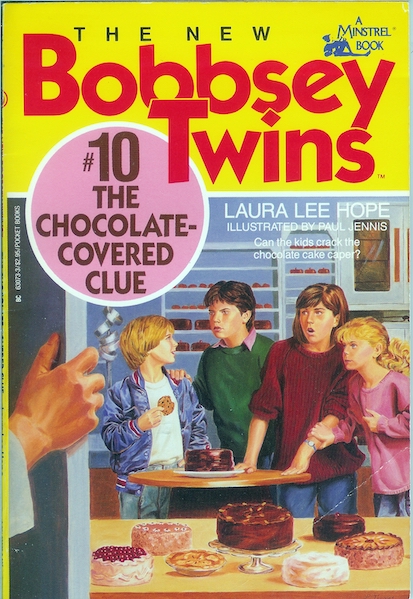
#10 The Chocolate-Covered Clue by Laura Lee Hope (Stratemeyer Syndicate), 1989.

Before I begin, I’d like to acknowledge Sean Hagins, for supplying me with photos of this book! Usually, I take pictures of books myself, but I just couldn’t find a physical copy of this one. Sean is a big fan of the Bobbsey Twins, particularly the New Bobbsey Twins mysteries, and you can see some of his video reviews as well as videos about his photography work on his YouTube channel, SJHFoto. Thanks, Sean!

Flossie has made a new friend, Casey Baker, whose parents own Baker’s Bakery. They invite her to come for a tour of the bakery to see how they make everything. It means getting up very early on a school morning because the baking has to start very early. They need to have everything freshly baked by the time the bakery opens for customers. Although it’s difficult to get up that early, Flossie enjoys the tour, seeing the large electric mixers where they make the cake batter and the enormous oven where they can bake over 100 cookies at once.

While the Bakers are showing her everything, they all realize that they feel cold. Someone has left the door to the alley open. Nobody is around, so they assume that it must have just been left open by a deliveryman making an early delivery.

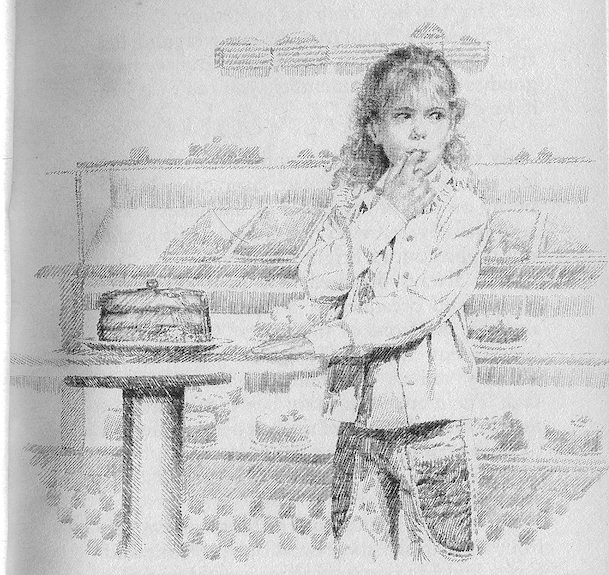
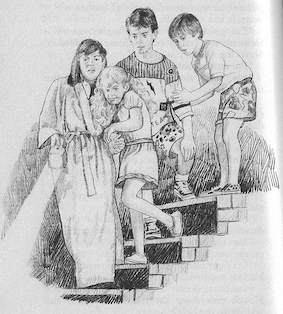
Later, while Flossie and Cassie are admiring a beautiful chocolate cake, something really strange happens. A masked man suddenly runs into the shop, grabs the cake, and runs away with it! Who could be so desperate for chocolate cake that they have to resort to theft? The Bobbsey Twins’ mother is covering a series of recent burglaries for the local newspaper, but this is the weirdest theft the kids have ever heard of.

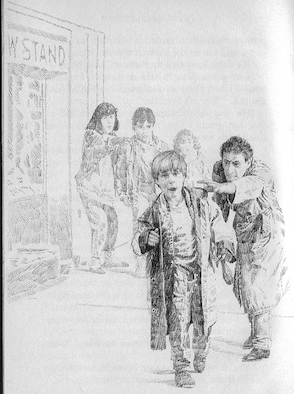
It gets weirder as the day goes on. While Freddie and his mother are running errands, they stop at a diner, and the same masked man runs in and smashes the chocolate cake on the counter with his bare hands! Freddie tries to chase him, and the man throws cake at him. The cake that was smashed was also from Baker’s Bakery.

The Bobbsey Twins talk to Casey, and she tells them that someone stole their delivery list. From then on, this crazy cakenapper starts tracking down and stealing and smashing every chocolate cake Baker’s Bakery made that day – including the one that the Bobbseys had delivered to their house.

What’s behind all of this cake carnage and chocolate destruction? Does someone have a grudge against the Bakers or against chocolate-based desserts?

The book is available to borrow and read for free online through Internet Archive.

My Reaction and Spoilers

I really liked the premise of this mystery! It’s such a fun, crazy concept of someone going all over town, smashing cakes, apparently for no reason. It’s the sort of mystery that I sometimes call a “Bizarre Happenings” mystery. That’s a mystery where strange things happen that encourage the characters to investigate, but it’s not obvious what’s behind it all or what sort of crime is really being committed. An example from adult literature would be the Sherlock Holmes story, The Red-Headed League, where the characters know that someone has been deceived into joining a special club for red-headed men that doesn’t actually exist and paid to copy entries from the encyclopedia, but they’re not sure why at first. In the case of the Bobbsey Twins mystery, the characters know that someone is stealing and destroying chocolate cakes, which is a very bizarre form of theft, but they’re not sure why. Readers can guess from the beginning that this rash of cake thefts is related to a different crime.

Actually, the solution to the story is very similar to that of another Sherlock Holmes story, The Adventure of the Six Napoleons, where someone is stealing and smashing busts of Napoleon. It has nothing to do with Napoleon or the busts themselves. There is something hidden inside one of the busts that someone is desperate to find, but because the busts all look alike, they have to track down and smash them all to find the one they really want. It’s like that with the cakes. The destruction of the cakes has nothing to do with the Baker family, their business, or the cakes themselves. Someone came into the bakery, looking for a place to hide, and dropped something in the cake batter while it was being mixed. Because the batter in the massive mixer was made into multiple cakes, they can’t be sure which cake now contains what they want. They need to track down the right cake in a hurry, before someone else finds what they hid. What seems to be an oddball crime puts the Bobbsey Twins up against a dangerous criminal!

Encyclopedia Brown Takes the Cake

Encyclopedia Brown

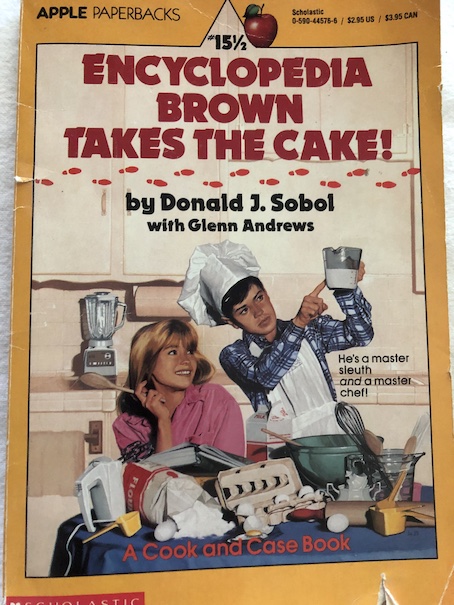
Encyclopedia Brown Takes the Cake by Donald J. Sobol with Glenn Andrews, 1982, 1983.

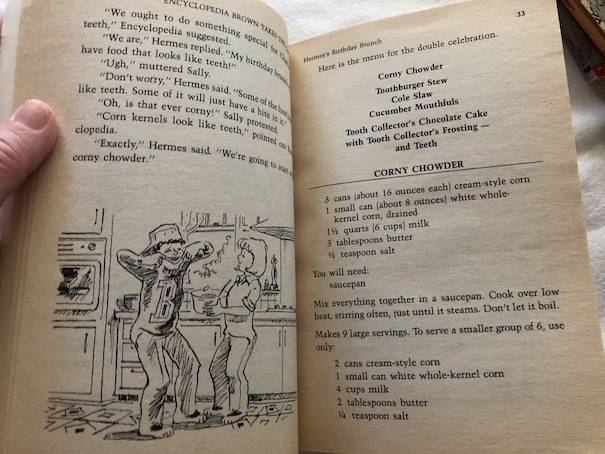
This book is a little different from other books in the Encyclopedia Brown mystery series. Like other books, it’s a collection of short solve-it-yourself mystery stories with the answers to the mysteries in the back. However, this book also has special sections with recipes and cooking tips after each story. The recipe sections are based on things that happen in each of the stories. It’s best to read the stories first to avoid some of the spoilers in the recipe sections.

The book is available to borrow and read for free online through Internet Archive (multiple copies).

Stories and Recipe Sections:

The Case of the Missing Garlic Bread

Encyclopedia Brown’s neighborhood nemesis, Bugs Meany, and his friends stole some garlic bread and a chocolate cake meant for a birthday party. They deny it, but Encyclopedia Brown knows how to prove that they’re the thieves.

Kitchen Basics

The birthday boy’s mother gives the kids kitchen tips, like how to peel and cut vegetables.

The Case of the Fourth of July Artist

On the Fourth of July, a local boy known for trying to cheat people attempts to sell a picture of the Liberty Bell supposedly painted by one of his ancestors on July 4, 1776. Encyclopedia explains why the painting is a fake. (It was a good enough painting that the guy should have just tried to sell it as an ordinary painting instead.)

The Fourth of July Party

Encyclopedia and his friends make oven-fried chicken, some side dishes, and a red, white, and blue shortcake for their Fourth of July party. All the recipes are provided.

The Case of the Oven Mitt

A friend of theirs has started working in her father’s kitchenware store. On her first day, while she’s helping their friend, Hermes, to decide on a present for his mother, someone sneaks in the back and steals a couple of mixers. She feels badly about it, and at Hermes’s birthday party, Encyclopedia realizes that the thief is one of the party guests.

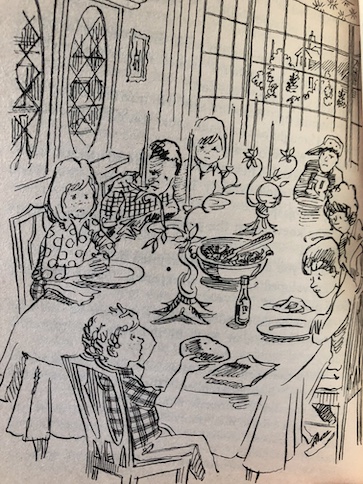
Hermes’s Birthday Brunch

In honor of a friend’s tooth collection, all of the food at the birthday party has something to do with teeth or foods that resemble teeth, like corny chowder and tooth-collector’s chocolate cake with frosting and teeth in the form of bits of marzipan and slivered almonds.

The Case of the Overstuffed Pinata

Bugs Meany steals a pinata from another boy. He insists that it’s his, but Encyclopedia proves it’s not.

A Mexican Fiesta

Encyclopedia and his friends make Mexican food, including cookies called polvorones, which are also known as Mexican Wedding cookies.

The Case of the Missing Watchgoose

A girl’s pet watchgoose goes missing. I didn’t like the solution to this one.

An Italian Dinner

The goose’s name was Christopher Columbus Day, so the kids cook an Italian-themed dinner.

The Case of the Secret Recipe

A friend of Encyclopedia’s, Beauford Twitty, invites his friends to his private potato museum to see his exhibits and sample a new recipe he’s created with a new variety of potato that his grandfather developed on his farm. While they’re there, someone steals a potato autographed by Yankees pitchers.

Dinner at the Twittys’

As a reward for helping to recover the potato, the Twittys give a dinner with no potato dishes at all: cream of chicken soup, meat loaf, corn pudding, baked tomatoes, lemon-buttered green beans, and apple pie.

The Case of the Chinese Restaurant

Oliver, who is a fan of Chinese food and the treasurer of the Service Club, is suspected of stealing from the Letterman’s Club treasury that was entrusted to him. Encyclopedia proves that he’s innocent.

A Chinese Banquet

Encyclopedia and his friends make Chinese food, including egg drop soup, Chinese riblets, egg rolls, and sweet and sour meatballs.

Snacks and Lunches

This section isn’t a story, just a collection of additional recipes for things like pizza made with pita bread, a variety of sandwiches, Twitty’s recipe for French fries from the potato story, French toast, cookies, and brownies.

Pointers from Pablo

Pablo, a young artist, offers advice on how to present and serve food while helping himself to cookies that Encyclopedia and Sally made.

Hilda’s Restful Chair

Hilda’s Restful Chair by Iris Schweitzer, 1981.

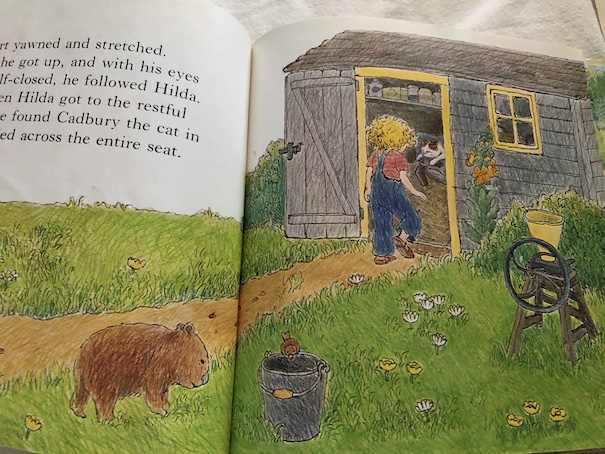
One hot morning, Hilda finishes watering her garden and decides that she needs to rest for a while.

When Hilda needs to rest, she has a special place she likes to go – an old armchair that she keeps in a shed. She calls the chair her “restful chair.”

Hilda is joined in her restful chair by Osbert the wombat and Cadbury the cat. However, Osbert and Cadbury aren’t the only animals who enjoy the restful chair. Soon, a pair of rabbits ask to join the others in the chair.

As Hilda and her animal friends sit in the restful chair, other animals come to join them. As the chair becomes more loaded with animals, it starts to creak and groan.

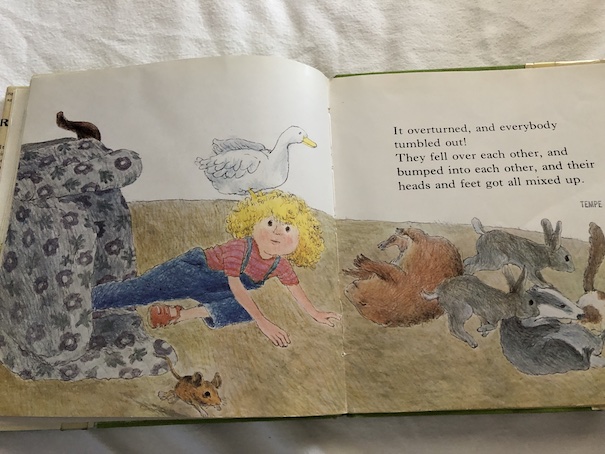
Eventually, the chair just can’t take it anymore, and it falls over, dumping everyone onto the floor.

Still, all the animals decide that they had a good rest. As the animals leave, Hilda sets the chair up again, and she and her animal friends go inside to have some watermelon.

The book is available to borrow and read for free online through Internet Archive.

My Reaction

This is a cute, fun story about animals who enjoy a comfortable chair as much as a little girl. Kids like stories with repetition, and they would probably enjoy seeing the parade of animals who come to join Hilda in her chair. They would probably also see the ending coming, that the chair won’t be able to hold everyone. It’s just a question of which animal is going to be the last straw for the chair. Fortunately, no animals were harmed by this experience, and even the chair seems okay, even though it fell over.

Because there is a wombat in the story, I assumed that the story takes place in Australia. It probably does, but from the publication information, it looks like it was first printed in Great Britain. The author was originally from Israel, but she was living in London at the time the book was published.

The Secret of the Sunken Treasure

The Bobbsey Twins

Bobbsey Twins The Secret of the Sunken Treasure cover

The Secret of the Sunken Treasure by Laura Lee Hope (Stratemeyer Syndicate), 1989.

Before I begin, I’d like to acknowledge Sean Hagins, for supplying me with photos of this book! Usually, I take pictures of books myself, but I just couldn’t find a physical copy of this one. Sean is a big fan of the Bobbsey Twins, particularly the New Bobbsey Twins mysteries, and you can see some of his video reviews as well as videos about his photography work on his YouTube channel, SJHFoto. Thanks, Sean!

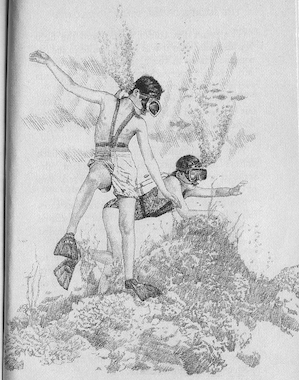
The two sets of Bobbsey Twins and their parents are on vacation in Florida for a week. It’s just a fun family vacation, although Mrs. Bobbsey is hoping to write an article about a sunken treasure ship called the Granada. The Bobbsey Twins are intrigued at the idea of searching for sunken treasure, although nobody has detected a sign of the treasure since the ship sank in 1801. Dan Chester, he brother of a family friend, lives in the town where the Bobbseys are staying along with his 15-year-old daughter, Meg. Dan and Meg are divers, and they have been searching for the wreckage of the Granada, and they think they have a lead. The Bobbsey Twins are excited to think that they might be able to participate in the search for the treasure or be there when the Chesters find it!

However, when Dan and Meg pick them up at the airport, they have bad news. Although they were able to locate the wreckage of the Granada, they were delayed reaching shore to claim their find because their boat propeller broke, and someone else claimed the Granada before they could. Joe Lenox, the man who claimed the wreckage, runs an underwater salvaging company, and he’s tough competition for the Chesters because he can afford all the latest sonar equipment. It’s a heavy blow to Dan and Meg, losing such an important find when they were so close to claiming it. The only consolation is that everyone will be able to watch the old safe from the wreckage being hauled to the surface. The safe is supposed to contain the treasure the ship was carrying.

When Joe Lenox learns that Mrs. Bobbsey is an out-of-town reporter, he invites the entire Bobbsey family to come with him on his boat to see the treasure being recovered. They accept the invitation, although the kids feel a little funny about it because Joe is Dan and Meg’s competitor.

On the boat, Joe shows the Bobbseys his equipment and explains how everything works. (I grew up in Arizona and have never been diving, so I have very little context for understanding diving equipment. This part looks informative, but since this book was published decades ago, there may have been some changes in equipment since then. I wouldn’t know.) Flossie is hoping that, when the treasure is brought up, she will get the chance to try on the famous tiara that is supposed to be in the safe. However, everyone is in for a shock. When the divers go to recover the safe, they discover that someone has already managed to open it and remove the strongbox containing the treasure!

Now, Joe feels cheated out of a treasure he thought he had safely claimed, and he wants to know who’s responsible. The logical suspects would be Dan and Meg, who felt cheated out of their opportunity to claim the treasure first and who have the diving skills needed to reach the safe. A charm belonging to Meg is found in the safe, making Joe and the police believe that the Chesters are guilty. Although, there are also the other members of Joe’s crew to consider. They were the only other people who knew where the wreck was. Could any of them gone out to raid the wreck before the official salvage operation? Can the Bobbsey Twins find the real thieves?

The book is available to borrow and read for free online through Internet Archive.

My Reaction

I had a couple of favorite suspects early on in the story. The book establishes that it would have taken at least two people to deal with the safe, so I was looking for a pair of people. I was only partly right, though, because there’s another suspect who isn’t introduced until later in the book. The first person I suspected is guilty, but there were more people involved than I thought.

The book explains a little about how a person can lay claim to a sunken ship. The characters say that they have to fill out paperwork at the courthouse. There are laws regarding claiming a sunken ship and official procedures to follow. It’s not as simple as finders keepers. It does matter who found it, where they found it, and who the ship belonged to originally. There were also some changes to the laws around the time this book was written and published with the Abandoned Shipwreck Act of 1987. I’m not completely sure whether each Joe or Dan and Meg could have legally claimed the ship. It partly depends on whether or not it was within US territorial waters or outside the official three-mile limit, and it also depends on whether or not the ship was property of a foreign government which could lay claim to it. For the purposes of the story, we have to assume that Joe Lenox was able to successfully lay a claim to the ship and that Dan and Meg could have done so if they had reached the authorities first. What makes me doubt this is how it would have worked in real life is that the treasure on the ship belonged to a Spanish countess, which makes me think that it could be regarded as property of the Spanish government, but it would be difficult to determine that without additional information.

The Secret in the Sand Castle

The Bobbsey Twins

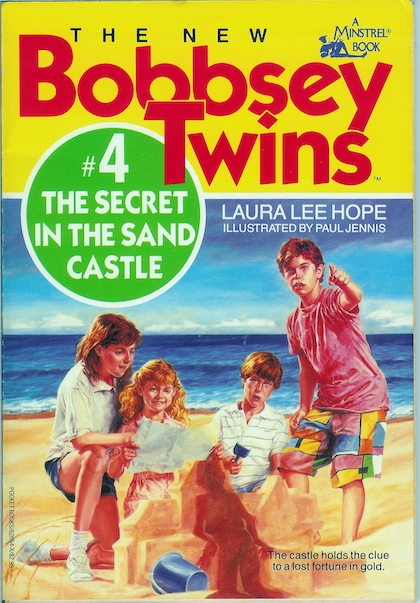
#4 The Secret in the Sand Castle by Laura Lee Hope (Stratemeyer Syndicate), 1988.

Before I begin, I’d like to acknowledge Sean Hagins, for supplying me with photos of this book! Usually, I take pictures of books myself, but I just couldn’t find a physical copy of this one. Sean is a big fan of the Bobbsey Twins, particularly the New Bobbsey Twins mysteries, and you can see some of his video reviews as well as videos about his photography work on his YouTube channel, SJHFoto. Thanks, Sean!

The two sets of Bobbsey Twins and their parents are spending a few weeks in an old house at Beachcliff Bay. It’s sort of a working vacation for their parents. Mr. Bobbsey owns a lumber yard, and he’s helping a local builder, Jim Reade, to either find some antique Victorian wooden gingerbread house trim or make new ones to match a home restoration project. Meanwhile, Mrs. Bobbsey is planning to write a travel article about the area for their local newspaper.

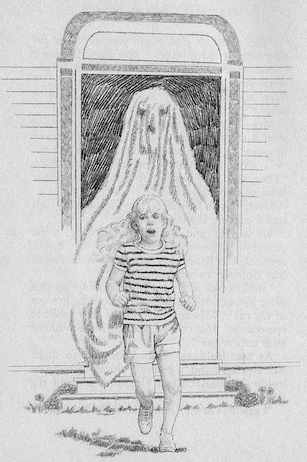
The house where the family will be staying is called the Wilson house, and it’s one of Mr Reade’s recent renovation projects. Flossie is the first in the family to go inside, and she is startled by what she thinks is a ghost. It turns out that it’s only the caretaker, Pete Smedley, taking the old dust sheets off the furniture. It’s not entirely reassuring because Pete says that there are stories about the old Wilson house being haunted by the ghosts of its former owners, who drowned in the nearby bay. He says that he knows when the ghosts have been there because they move things around and leave trails of water, seaweed, and seashells. Mr. Reade thinks that Pete’s stories are nonsense and that the strange things he’s observed are due to windows in the house being left open or something like that.

The inside of the Wilson house is as elaborate as the outside. The Bobbsey twins unpack their things and claim rooms for themselves upstairs. Flossie is quick to claim the biggest room with the best view for herself, and she asks Bert to help her move a mirror she likes into her room. They don’t have anything to hang the mirror, so they set it on Flossie’s bed. Strangely, they later find the mirror still on the bed but broken, and they don’t know how that happened.

Nan is curious about the Wilson family and the history of the house, so she and Freddie take a trip to the local library. There, Nan learns that the last two members of the Wilson family were a brother and sister, called Clay and Jennie. They were both artists, but they never made much money. Badly in need of money, they apparently robbed an armored car and stole gold bars. They tried to escape in a boat, but it was lost in a storm. The Wilsons apparently drowned, although their bodies were never found. The police thought they might have hidden the gold somewhere before getting on the boat, but nobody ever found the gold they stole.

Mr. Reade tells the children that his son, Jimmy, is entering a local sand castle contest, and the Bobbsey twins decide that they would like to enter the contest, too. Nan thinks they should try to build a replica of the Wilson house in sand. Unfortunately, Jimmy turns out to be a troublemaker, and it doesn’t look like he wants to be friends with the Bobbsey twins.

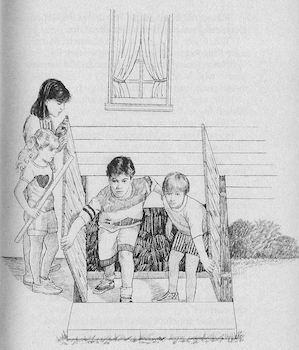
While the girls go to the store, Bert and Freddie decide to check out the old root cellar at the house, and someone traps them inside. The girls let them out when they get back. Then Flossie finds a secret passage and hidden stairs. Mr. Bobbsey says that it was once a servants’ entrance that had been sealed off. Later that night, a ghostly figure tries to enter Nan’s room! Could it have been Jimmy. playing a nasty prank, or is it someone looking for the lost gold? Could it even be a real ghost?

The book is available to borrow and read for free online through Internet Archive.

My Reaction

From the beginning of the book, I had a favorite suspect. However, this is one of those mysteries where there is more than one person involved, and they’re not working together. In the end, I was right about my main suspect, but having a second person doing suspicious things made the mystery more interesting. The title is a little misleading because the story is really about the search for the hidden gold from the robbery, not about the sand castle contest. The sand castle contest is more of a side issue, although studying the design of the house to build the sand castle version leads the kids to the solution of the mystery.

Because this book is from the late 1980s, there are things in the story that were more a part of my childhood than the lives of 21st century children, like renting videotapes. I was about the age of Freddie and Flossie when this book was first published, so it’s a bit of a fun nostalgia trip for me, both because I read books in this series when I was young and because some of the things the kids do in these stories are similar to things I did at their age.

The Secret of Jungle Park

The Bobbsey Twins

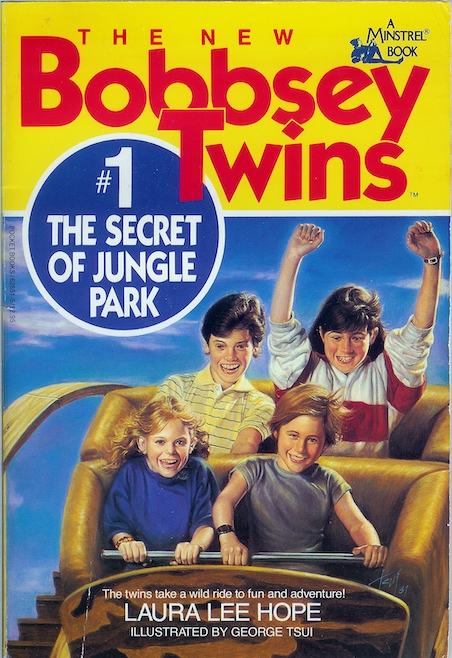
#1 The Secret of Jungle Park by Laura Lee Hope (Stratemeyer Syndicate), 1987.

Before I begin, I’d like to acknowledge Sean Hagins, for supplying me with photos of this book! Usually, I take pictures of books myself, but I just couldn’t find a physical copy of this one. Sean is a big fan of the Bobbsey Twins, particularly the New Bobbsey Twins mysteries, and you can see some of his video reviews as well as videos about his photography work on his YouTube channel, SJHFoto. Thanks, Sean!

Twelve-year-old twins Nan and Bert Bobbsey are part of a rock band with some of their friends. They call themselves The Aliens, and they’re participating in a Battle of the Bands at the amusement park Jungle Park. Nan plays the keyboard, Bert plays the drums, and their friends, Jimmy and Brian, play guitars. Flossie, their younger sister, wishes that she could join the band, too, but she’s still too young. Flossie and her twin brother, Freddie, are there to help their older siblings get ready and watch them perform. (And, the case of the boys, use some fake blood to play a trick on the girls.)

While they watch the first bands perform, they see some smoke. At first, they think that it’s just a stage effect, but it becomes thicker, and they realize that something is really wrong! Most of the audience flees, but Bert stays behind to save his band’s equipment. Nan tells him it was a dangerous thing to do, but Bert says that he doesn’t think it was a real fire. Fire fighters come, and so does their police officer friend, Lieutenant Pike. Lieutenant Pike also tells Bert that he took a foolish risk, but he agrees with Bert’s impression that the smoke was actually caused by a smoke bomb. Even though a smoke bomb isn’t real fire, setting one off in a crowded auditorium can still be very dangerous because someone could have been hurt in the panic when everybody rushed out.

Lieutenant Pike confides in the children that the police have been called to the park three other times recently for other apparent accidents and problems. He says that if things like this keep happening, they might have to shut down Jungle Park due to safety concerns. The four Bobbsey Twins don’t think that’s fair. They love Jungle Park, and they want to catch the person who set the smoke bomb!

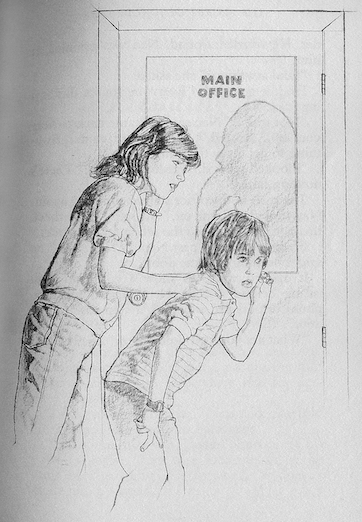
Lieutenant Pike lets the kids look around after the police and fire fighters are finished with the auditorium. There are two clues that they find: a black eye patch and a swizzle stick. Bert doesn’t think that the swizzle stick is much of a clue, but Freddie thinks it might mean something. The eye patch points to two possible suspects that the kids know about: a member of a rival band in the contest and a man the girls saw who was lurking around the dressing room area. Bert thinks that the rival band was trying to disrupt the contest so they would win, but the others aren’t so sure. It turns out that the guy with the eyepatch was hired by one of the owners of the park to make some repairs, but could he have been hired to do more than that? Could one of the owners have a reason to make sure the park closes? What about the woman who takes care of the animals at the park? She doesn’t seem happy about the conditions they’re kept in.

As the kids investigate their suspects, they get chased by elephants, hunt for a suspect in a fun house, tackle someone in a gorilla suit, and win the band contest!

The book is available to borrow and read for free online through Internet Archive.

My Reaction

Like Sean, this particular Bobbsey Twins series was the one that I read as a kid. I didn’t even know the difference between the New Bobbsey Twins series and the earlier series until I was older. The Bobbsey Twins series, like other Stratemeyer Syndicate series, is typically set contemporary to when the stories were written, so the New Bobbsey Twins series is set in the late 1980s and early 1990s, when they were originally written and published.

That time period was when I was a kid myself, so things that the kids did in the New Bobbsey Twins series were very like things kids my age were doing when I was a kid. A lot of kids wished that they could be part of a band. At one point, Flossie talks about something she saw in a teen fashion magazine. Flossie isn’t a teenage herself, but as I recall, teen magazines were largely popular with pre-teens (or “tweens”), who wanted to look like teenagers. Later, she pretends to be collecting signatures for Save the Whales, which was a popular and well-known cause at that time.

The mystery in this book was pretty good. I was sure from the beginning that the kid from the rival rock band wasn’t the park saboteur, but I wasn’t completely sure which of the adults was responsible for much of the book.

The Invitation

The Invitation by Nicola Smee, 1989.

This fun picture book is written in comic book form. Almost all of the text is in speech bubbles in the pictures.

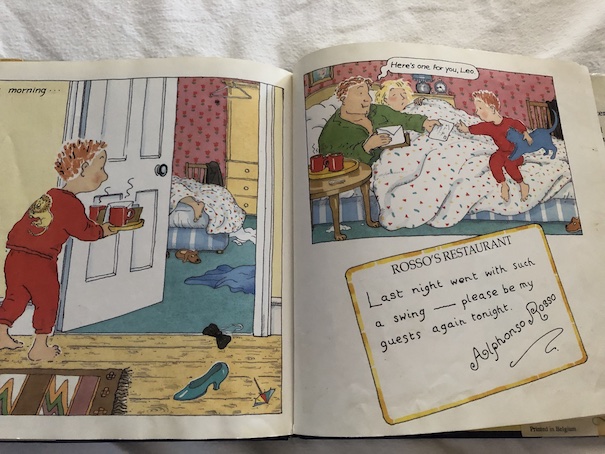
One morning, Leo finds an unexpected prize in his cereal box: an invitation to dinner at a fancy restaurant! He and his parents decide to accept the invitation, getting dressed up for the occasion.

The food is great, and Leo notices that there is a band playing. He asks his mother if she’s going to dance, and on a whim, she decides to dance with the waiter with the dessert cart.

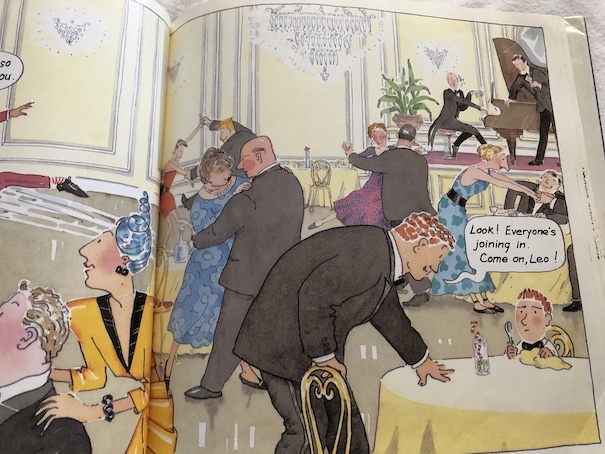
From there, the evening goes from good to great for everyone! The restaurant turns into a party with everyone dancing, Leo’s mother swinging from the chandelier, and the musicians having the time of their lives!

Then, a lady who is a dancing with Leo loses one of her diamond earrings. Leo volunteers to find it for her, and it turns up in an unexpected place.

The evening is such a success that the owner of the restaurant invites them to dinner the next night, too!

The book is available to borrow and read for free online through Internet Archive. It was first published in Great Britain.

My Reaction

In real life, fancy adult restaurants tend to serve foods that kids don’t like and require a level of etiquette that kids often find stifling, but in this fun, comic book style story, Leo and his parents have the time of their lives on this fun evening out! All of the adults in the story are open to some zany fun, and even the owner of the restaurant enjoys himself so much that he’d love to have them back the next day.

Like all picture books, it’s the details in the pictures that really make the story. The story doesn’t tell you that the reason why the cereal box prize was an invitation to this restaurant is that the restaurant owner also owns that brand of cereal, but it’s shown in the pictures, with his name on the box. When Leo and his parents arrive at the restaurant, the owner meets them and compliments them on their taste in cereal. Later, he’s shown eating a bowl of his cereal himself. I also loved the picture that includes Leo’s mother letting loose and swinging on the chandelier. The other people in the restaurant are also eccentrics. One of the dancing women is wearing a dress with a banana print and a matching hat with a banana on it, and while Leo is searching for the lost earring, he finds a lady in an elephant print dress and fuzzy slippers. There’s nothing dull about this elegant dinner or the people enjoying it!

Fin M’Coul

Fin M’Coul retold and illustrated by Tomie de Paola, 1981.

This is a retelling of a classic Irish folktale. The story is fun and silly, but one of the parts of this story I like the best is the introduction of the Giant’s Causeway – a real place with a magical look. There’s a geological explanation of this rock formation, but this story introduces the folkloric explanation.

In ancient times, when Ireland was inhabited by giants and magical creatures, a giant named Fin M’Coul lived on Knockmany Hill with his wife, Oonagh. One day, as he is building a causeway between Ireland and Scotland, Fin M’Coul hears that another giant, Cucullin, is coming.

Cucullin has a fearsome reputation, and he has beaten up many other giants, just to prove how strong he is. So far, Fin M’Coul has been able to keep out of his way, but Cucullin is now looking for Fin M’Coul to beat him. In fact, he’s so close that there’s no time for Fin M’Coul to get away.

Fin M’Coul goes home to his wife and asks her what he should do. Oonagh says that he won’t have any peace until he gets this confrontation with Cucullin over with, but Fin M’Coul doubts that he could be a match for Cucullin in a fight. Oonagh decides that they’re going to have to defeat Cucullin with cunning rather than strength.

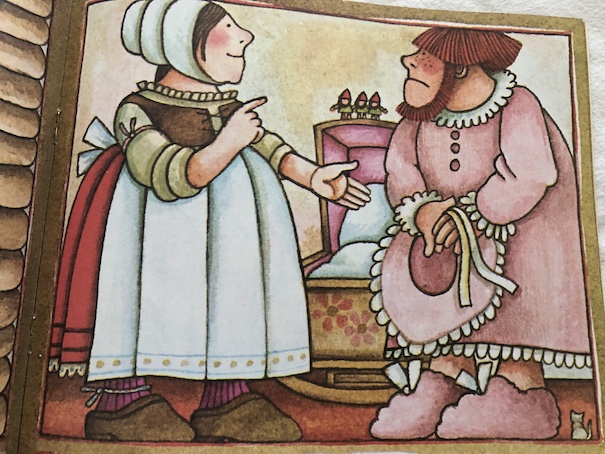
She quickly does a special charm to bring them success, and then, she begins setting the scene for the trick they’re going to play on Cucullin. She makes up a giant cradle and makes her husband dress in baby clothes and sit in the cradle. It’s ridiculous, but Oonagh has a plan.

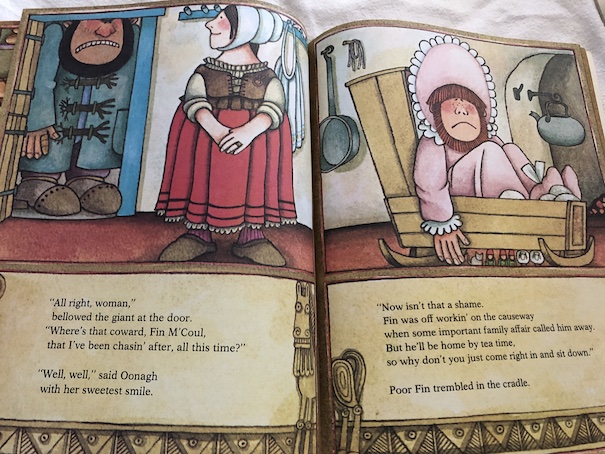
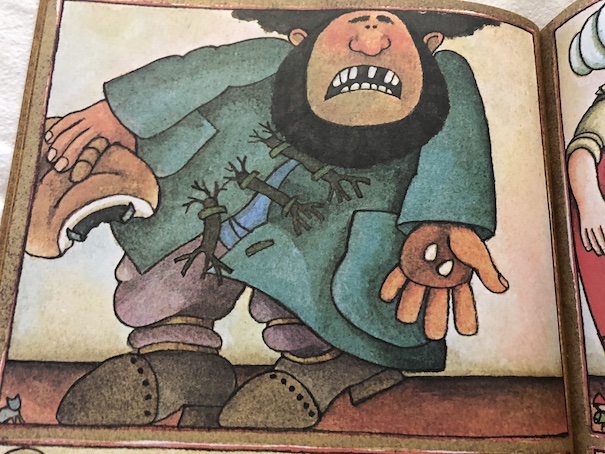
When Cucullin comes, Oonagh tells him that her husband isn’t home, but she invites him to come in and wait with her and her “baby.” Not only is the “baby” astonishingly large, even by giant standards, but Oonagh carefully convinces Cucullin of the baby’s unusual strength. She tricks him into thinking that the “baby” can eat bread and cheese that’s rock hard while giving Cucullin bread with a frying pan in the center and a real stone instead of cheese. Not only does Cucullin break his teeth on these things, but if Fin M’Coul’s “baby” can eat these things, how much stronger could Fin M’Coul be?

Oonagh’s tricks allow Fin M’Coul to get the upper hand against Cucullin and defeat him once and for all!

There is a brief section in the back of the book that explains a little about the background of the legend. I love the pictures in this version of the story. Tomie de Paola books always have fun illustrations, but if it weren’t for the little people and animals in the pictures with the giant characters, you might almost forget that the main characters in the story are all giants.

The book is available to borrow and read for free online through Internet Archive.

Pecos Bill

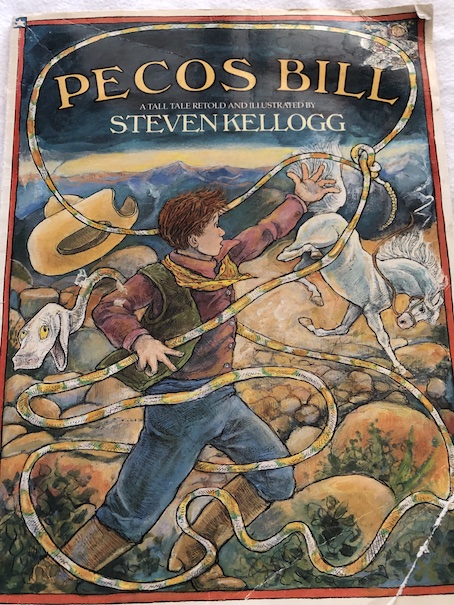
Pecos Bill retold and illustrated by Steven Kellogg, 1986.

I remember this book from when I was in elementary school! This was the book that my teacher or librarian (I forget which one now) used to introduce us to the concept of tall tales. Tall tales, like the story of Pecos Bill, are a major feature of American folklore, particularly Western American folklore.

When the story begins, young Bill is traveling west from New England with his family as part of a wagon train. As they cross the Pecos River, Bill tries to fish, but an enormous trout pulls him out of his family’s wagon. Bill is rescued by a coyote, and he spends some time living and growing up with the coyotes and other animals in Texas.

Eventually Bill meets up with a cowboy named Chuck, who explains to him that he’s a human and a Texan, not a coyote. Chuck gives him some extra clothes to wear (because he’s long outgrown his childhood clothes). Chuck tells Bill that many Texans are outlaws, but they would be better if they started herding cattle and became ranchers. Bill decides to try life as a Texas rancher.

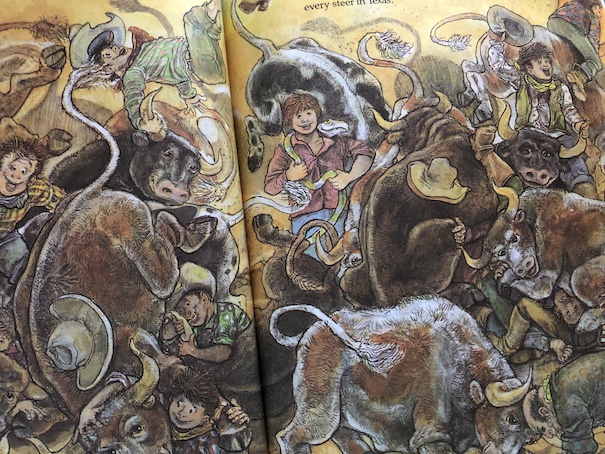
Because of his wild upbringing, Pecos Bill is able to perform amazing feats of strength, like subduing a giant rattlesnake to the point where it becomes tame and allows Pecos Bill to use him as a lasso. He also gets the hide of a monster to make other lassos to give to the worst gang of outlaws around. The outlaws are so impressed with Bill’s ability to subdue wild creatures that they agree to make him the boss of their gang, and they all become cowboys.

Bill subdues a wild horse called Lightning and uses the language of wild animals to befriend him. He leads the other cowboys on a massive cattle drive, and he creates the impossible Perpetual Motion Ranch on Pinnacle Peak.

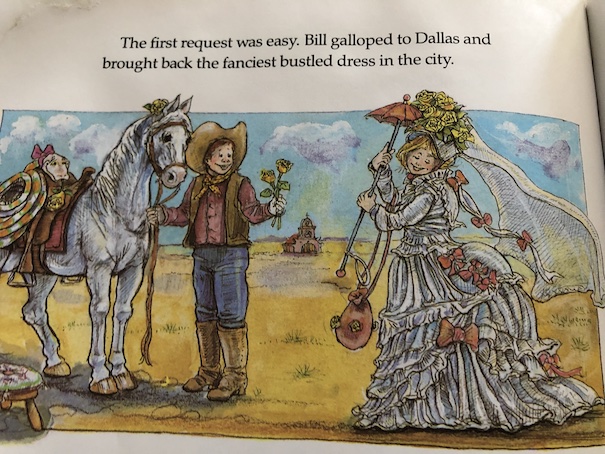
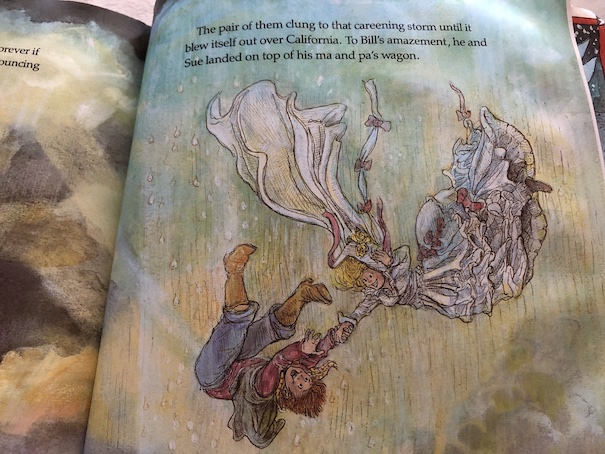
Then, Pecos Bill meets a pretty girl named Sue and decides to get married. However, Sue’s bustle is so tight that when she tries to sit on Bill’s horse, Sue bounces in the air so high that she reaches the moon. Every time she hit the ground, she bounces into the sky again, so Pecos Bill has to lasso a tornado to catch up with her.

When they finally land, they land on top of Bill’s family’s wagon in California. Apparently, they’re still wandering after all these years, trying to find a place to settle. Pecos Bill convinces his family to settle with him and his bride in Texas.

I’m not very big on tall tales, in spite of having grown in the American Southwest, where many of these types of stories evolved, but I have some sentimental attachment to this one because it was my first as a kid. The pictures in the book are wild and chaotic, just like the action in the story.

The book is available to borrow and read for free online through Internet Archive (multiple copies).

Howl’s Moving Castle

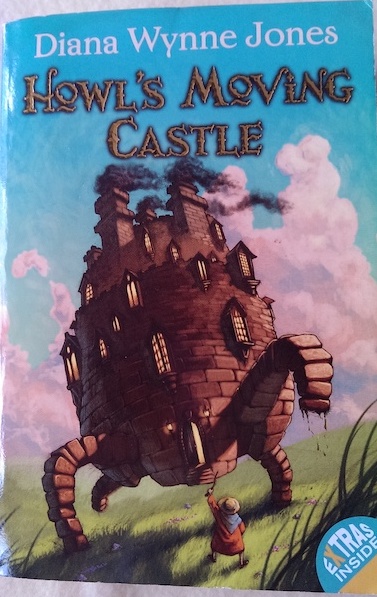
Howl’s Moving Castle by Diana Wynne Jones, 1986.

The kingdom of Ingary is the land of fairy tales. There is magic, and in a family of three children, it’s always expected that the youngest of the three will be most successful. Sophie Hatter, as the oldest of three, is disappointed when she first realizes that, but she reconciles herself to her rather dull fate. She is devoted to her younger sister and half-sister, and she does her best to look after them and help prepare them for their futures.

When Sophie Hatter’s father dies, her stepmother Fanny has to decide what arrangements to make for the family’s hat shop and the three girls in the family: Sophie, her younger sister Lettie, and her half-sister Martha.  Because Martha is very bright and expected to one day seek her fortune in the world, as third children generally do, Fanny arranges for her to become an apprentice to a respected witch.  Lettie becomes an apprentice in a pastry shop, where she will learn a good trade and possibly meet a nice young man to marry.  Sophie, as she had always expected, continues to work in the hat shop.  None of the three girls are particularly excited about the arrangements, but they make the most of it.  Sophie does have a talent for hat-making.  In fact, she has a very unusual talent because, as she talks to the hats while she makes them, the things she predicts for the buyers come true. People become increasingly attracted to the hat shop because it seems like good things happen to people who buy hats there.

Sophie is good at working in the hat shop, but she has to admit that her life there is dull. She doesn’t really know what else she would want instead, but she feels isolated, hearing gossip from other people but not really talking to anybody herself. A visit to her sister Lettie on May Day puts Sophie’s life in perspective and calls the things that are expected of older and younger siblings into question. Sophie learns that her sisters, dissatisfied with the arrangements Fanny made for them and having ambitions other than the ones that are expected of them, have secretly switched places with each other. Lettie craves learning and adventure, so she has taken Martha’s place as the witch’s apprentice to learn magic. Martha doesn’t actually care about going out to seek her fortune at all. She doesn’t want adventure or riches. What she really wants, although she’s never admitted it before, is to marry, settle down, and have ten children. Working in the pastry shop, she has already attracted quite a following of young men, and she’s sure that she’ll find one who will love her and make her happy. Neither of them cares about fitting the tradition mold of three siblings, and they’re both concerned about Sophie’s future. Sophie has never had any particular ambitions of her own, but her sisters know that being shut up in the hat shop all the time isn’t good for her. They think Fanny is taking advantage of her because it’s Sophie’s work that’s attracting all the customers these days, and Fanny isn’t even paying her an apprentice’s wage! Apprentices like Lettie and Martha get wages at other businesses, but Sophie’s been working for free while Fanny takes all the profits. It gives Sophie a lot to think about, and she becomes convinced that she’s being exploited when she asks Fanny about wages, and Fanny puts her off. Sophie is so angry that she thinks maybe she should run away to seek her fortune, but she can’t shake the idea that eldest children can’t do that. Soon, circumstances intervene to force Sophie to be the one to go out and seek her fortune anyway.

Dangerous and mysterious things are happening in the kingdom. Rumor has it that the evil Witch of the Waste has threatened the king’s daughter and that the king’s personal wizard, Suliman, has vanished after going to deal with her. People think that the Witch of the Waste probably killed him. The king’ brother, Prince Justin, also went in search of Suliman and disappeared.

One day, the Witch of the Waste pays a visit to Sophie’s hat shop.  Mistaking Sophie for one of her sisters, the witch curses Sophie, turning her into an old woman.  Unable to explain to anyone what has happened (which is part of the curse), Sophie makes the decision to leave the hat shop, finding a new job as housekeeper to the mysterious wizard Howl, a sinister figure himself.  Little is known about Howl, although he is known to live in a strange castle that moves from place to place, apparently of its own accord, and he has a reputation for breaking women’s hearts.

Howl is even stranger although somewhat less sinister when Sophie gets to know him.  He allows Sophie to stay in his castle, not so much by requesting her to stay but by not telling her to leave, much like he did with his apprentice Michael, an orphan who came to live with him and gradually became his apprentice when Howl decided not to send him away.  Howl is vain (using makeup and hair dye to make himself more handsome), immature, and somewhat cowardly, but he is still a powerful wizard and can accomplish great things when he makes up his mind that he wants to (or finds himself unable to refuse).  He doesn’t real steal girl’s souls, as some of the rumors about him say, but he is definitely a flirt and a womanizer, who drops girls as soon as they fall in love with him because he likes pursuing them but is afraid of commitment. In fact, he even has Michael spread scandalous rumors about him in the towns where they do business so people will be more reluctant to try to get him to commit to anything or anybody.

Howl has other problems aside from his immaturity and fear of commitment.  Calcifer, the mysterious fire demon that powers the moving castle, hints as much to Sophie.  He hopes that Sophie will be able to help, although he, too, is unable to explain the reason why for magical reasons.  Howl is not an ordinary person, but a traveler from another dimension, from a strange country called Wales, the same place where the king’s wizard, Suliman, was from. In Suliman’s absence and against Howl’s will, the king recruits Howl to be the new royal wizard, to find the missing Suliman and Prince Justin, and to deal with the Witch of the Waste.

Sophie struggles to convince/cajole/force/help Howl to save the kingdom and to learn the secret curse that Howl himself is living under even while suffering from her own curse.  Surprisingly, it seems that Sophie is the key to breaking not only Howl’s curse but her own.

The book is available to borrow and read for free online through Internet Archive (multiple copies). It’s the first book in a loose series. Many people these days are familiar with the story because it was made into a Miyazaki movie, although the movie was very different from the book in a number of ways.

My Reaction and Spoilers

I first read this book when I was in high school, years before the movie version was made. In a way, the book is party mystery or puzzle as well as fantasy. Calcifer and Howl have a problem that they can’t talk about because of the magic around it. Only one rumor about Howl is true: Howl is literally heartless. But, Calcifer has a heart. It takes a long time for Sophie to make the connection and to realize what Calcifer actually is and what Howl did. Howl made a sacrifice years before that has left both Howl and Calcifer in a precarious position. The clues to Howl’s past and the arrangement between him and Calcifer are in a poem by John Donne that turns out to be part of Howl’s nephew’s school assignment. The Witch of the Waste, who turns out to be one of Howl’s former, discarded conquests, knows Howl’s secret and is trying to use it to get revenge on Howl.
Although the movie version is very good, and I enjoyed watching it, it is very different from the original book. The beginning part of the movie, where Sophie is working in the hat shop and cursed by the Witch of the Waste before going to work for Howl is very similar to the original book. However, the major problem of the war in the movie never happened in the book. War is a common theme in Miyazaki movies, but there’s nothing in the book about wizards making themselves into weapons of war. Instead, the main problems of the book are about lifting Sophie’s curse, figuring out what the secret contract between Howl and Calcifer is, evading the wrath of the Witch of the Waste, and finding the missing Suliman and Price Justin. The movie addresses the arrangement between Howl and Calicifer, but it doesn’t fully cover any of the rest of it. There are some characters and plot lines from the book which were combined or reduced in the movie in favor of the war plot, which I found less interesting because it has less intrigue. In the movie, the Witch of the Waste is tamed and redeemed as a character, but in the book, she really is evil and is never redeemed.

There’s also nothing in the movie about Howl being from Wales in our world and the land where he lives being a different dimension, but that’s a major part of Howl’s character in the book. In the book, Sophie even visits Wales with Howl and meets his family. His sister thinks that Howl, known as Howell Jenkins in his native Wales, is a wastrel, who hasn’t made anything of himself in spite of his college education. She’s only partly right. What she doesn’t know is that Howl started learning about magic at university, which is how he found out how to travel to other dimensions and make himself into a wizard. In spite of his immaturity and attempts to avoid certain types of service, he is actually very skilled and powerful. Howl can’t tell his sister the truth, so he just lets her think that he’s a wastrel.

Sophie finds Wales strange and mysterious. She is terrified when Howl takes her and Michael for a ride in his car. One of my favorite parts is when Howl needs to talk to his nephew about the poem he was assigned at school, but he doesn’t want to talk to Howl because he’s playing a computer game with a friend. Sophie and Michael don’t understand computers or that the boys are playing a game, so when the friend says that he can’t stop to talk or he’ll lose his life, they think that the boy’s life is really in danger. They almost panic when Howl pulls the plug on the computer to get his nephew’s attention, totally unworried about his nephew possibly dying. That’s one of the reasons why I prefer the book to the movie. Many of the humorous little moments like this are lost in the movie, although the movie did keep the episode where Howl has a temper tantrum and fills the house with green slime.

There are also intricacies of the plot that aren’t explained in the movie. The one I mind the most is that the movie doesn’t fully explain how the curse on Sophie works or how it gets broken, either. The book provided more information, which helps Sophie fully appreciate who she really is. As Calcifer realized soon after meeting Sophie, removing the curse on Sophie is complicated because it has two layers. Howl even admits later that he’s been quietly trying to remove Sophie’s curse himself, but he was never successful because Sophie was actually maintaining the curse herself. The first layer was what the Witch of the Waste did to her, but Sophie herself has magical powers that she has been unconsciously using throughout the book. The reason why good things kept happening to the people who bought her hats was that she was unconsciously casting spells on the hats when she talked to them while making them. The second layer of the spell on Sophie herself was her unconsciously reinforcing her sense of being old through all of the negative things she’d been telling herself about being the eldest child in her family. Sophie’s power typically manifests in the things she tells to people and things, and she’s been telling herself all the wrong things.

Because of all of the tales about how the youngest children are the ones who successfully go out to seek their fortune, Sophie has felt relegated to just being the eldest, helping other people, and not really thinking about what she wants for herself. Even as a young woman, she acted and felt old before her time because she didn’t have any confidence in herself or anything to look forward to in her future. Her sisters even worried about her for not having enough self-respect, no ambitions or dreams of her own, or ability to stand up for herself. Because she never expected to do much of anything with her life or any belief that she might have talents of her own, she and everyone else completely overlooked all of the magic that she’s been instinctively doing. When Sophie discovers that her sisters have switched places and learns about their real life ambitions, she is stunned to realize that she has badly misunderstood both of them for most of their lives, also making assumptions about them based on their birth order. She has also misjudged or underestimated other people, but the person she’s misjudged and underestimated is herself. Howl is the one who tells her that there’s nothing wrong with her being the eldest sister; the times when she gets things wrong have been when she acts without fully thinking things through. Part of the key to breaking her curse is to get rid of the negative feelings she’s had about herself and her ability and to see herself for who she really is: a person with powerful talents and a right to want things and achieve things for herself and her future. Once she sheds her doubts about herself and her abilities and stops thinking of herself as just the eldest and doomed to fail, she realizes how she can use her powers to save Calcifer and Howl, and Calcifer lifts the rest of her curse.