Out of Their Minds

Out of Their Minds by Carol Matas and Perry Nodelman, 1998.

When the book begins, Princess Lenora and Prince Coren are going to Andilla, where their wedding will finally be held. (That seems to go against earlier books in the series, where they were planning to hold their wedding in Gepeth, but whatever. It turns out the Balance that governs this world has decided that it demands it, and so do the authors and story plot.) However, Lenora has been having strange, disturbing dreams about her vanquished alter ego, Hevak.

Lenora is still preoccupied by the concept of the Balance that governs their world and keeps it from descending into chaos because of the powerful mental abilities that the people in their world have. She still feels like the rules that help maintain the Balance are too restrictive, particularly in her home country of Gepeth, and it bothers her that there doesn’t seem to be a system that makes everyone perfectly happy. Somehow, no matter what system people in different countries have, someone is always unhappy or doesn’t fit in with the way the country lives. Lenora dreams of developing a perfect system of life and Balance, providing every individual person with perfect happiness and justice. Fortunately, since the last book in the series, she has come to realize that before she attempts to create a perfect world, she needs to think it over more and decide what a perfect world really looks like and how it should work.

It’s noble goal, and I don’t consider myself a cranky old cynic who hates youthful enthusiasm, but anyone who’s ever tried to get a roomful of people to agree on pizza toppings only to learn that at least one person in that room is also gluten intolerant and can’t eat the pizza at all unless you specifically take that into account at the beginning of the process knows that finding any system that makes absolutely everyone happy is not an easy process. Even putting together a system in which the majority of people are pretty happy most of the time is a major undertaking and involves taking into account various real world conditions and different peoples’ needs, things which Lenora has previously found boring and completely ignored in her lessons. She usually likes to play with ideas and consider possibilities more than getting into the nitty gritty details of how things actually work. I’m saying that she’s got a long way to go.

However, Lenora and Coren soon encounter other problems which are even more pressing than the preparations for their upcoming wedding. Something is very wrong in Andilla. Usually, the people there prefer using their imaginations to change their perceptions of reality rather than doing anything to actually change reality itself. They let their buildings turn to ruins as they live in the mansions of their imaginations, which is why Prince Coren prefers the way people in Gepeth live, actually creating and maintaining real things. (When Lenora sees what Andilla is like, she decides that she’ll never think of Coren as a coward again, as she has in previous books. He is usually more cautious than she is, but Lenora comes to recognize that it has taken courage for him to acknowledge the way his people really live outside of their imaginations instead of trying to hide from it and live in his own mind. It’s a step forward for Lenora.) People in Andilla also use telepathy to communicate directly with each other, mind to mind, rather than speaking out loud, something even Coren finds invasive at times although he uses that power, too. However, the people of Andilla are suddenly losing their ability to communicate telepathically, and their ability to maintain their imagined realities is fading. They’re having to resort to speaking aloud and seeing things as they really are, and Coren’s mother is beside herself. Coren’s father, the King of Andilla, hardly even seems aware of the problem because he has become deeply absorbed in his new hobby, baking things. People in Andilla usually do very little cooking, just turning very basic foods into whatever they want to imagine that they’re eating, but the King Arno has discovered the joy of baking in the new kitchen that Lenora’s parents actually created for his castle out of sheer desperation.

Kaylor, the Thoughtwatcher, who is the person responsible for maintaining Andilla’s version of the Balance, suspects that the king’s recent cooking might be responsible for shattering Andilla’s illusions, but most people don’t think that’s it. Everyone in the country seems to be affected, although King Arno can’t recall his two closest advisers complaining. Actually, he can’t recall seeing them around at all since the trouble began. Actually, nobody else has ever heard either of their names before. Actually, it looks like King Arno probably invented them as imaginary friends when he was a boy, forgot he invented them, and has been following their imaginary advice ever since because it generally seems to work out.

Lenora suggests that, since there don’t seem to be any answers to the immediate problem in the castle, she and Coren should go out to the countryside, meet the people of Andilla directly, and see if there are any answers there. (Plus they can get away from their annoying doubles, Leni and Cori, who were created in the last book, and the argument they’re having over who really owns Coren’s old room and the stuff in it.) Queen Milda and King Arno admit that, although they’ve spoken to many of their subjects with their minds, they’ve never actually met them face-to-face.

As Lenora questions Coren about the people in the castle and life in Andilla, she is also surprised to learn that, although everyone in the kingdom eats an odd kind of blue mush at every meal (while imagining it to be something far better), even Coren isn’t quite sure what the mush is made of and where it comes from. Of all of the people in his kingdom, Coren is the one who was always more interested in living in reality than fantasy and finding out how things really work, and it seems odd to Lenora that he’s never questioned the food that he’s eaten at every meal for his entire life in Andilla. According to Coren, it just appears in vats every day, and people help themselves to it or have a servant bring them some. No matter how empty the vats are at the end of the day, they’re always full the following day, and he has no idea who fills them, how, or why. To his surprise, Coren realizes that he’s never even thought to question it before, although he’s questioned nearly everything else. Lenora starts to wonder if that could be a key to the puzzle and if Coren actually has some kind of mental block against questioning the food, perhaps something his own people intentionally put there in order to keep their country’s version of the “Balance” in place, reinforcing the version of reality they’ve chosen to live in.

Investigation of the countryside reveals a previously unknown side to Andilla that everyone there has been ignoring, along with the dilapidated condition of their own homes and society. In a place where no community is supposed to be is an entire town of strangely neat, well-kept houses (the only well-kept houses in Andilla) and people all dressed alike whose only goal in life is constant work. The people there, who call themselves Skwoes, seem surprised that Lenora and Coren can even see them. They are the source of the blue mush that the other Andillans eat, although everyone else is unaware of it. The Skwoes are a forgotten part of Andilla’s Balance because everyone is too busy living in their imagination to notice them. Although they feed the rest of the population in exchange for payment from Andilla’s supply of gold, according to an ancient arrangement, they are disdainful of the lazy population they support, who spend their entire time living in their imaginations. (This is when we learn that none of our main characters have any idea what the word “economy” means, not to mention being completely unaware of the fact that Andilla actually has one.)

That explains part of the mystery, but there is still the question of why the Andillans have now lost their powers of imagination or why Lenora’s bad dreams about Hevak are getting increasingly worse.

The book is available to borrow and read for free online through Internet Archive.

My Reaction and Spoilers

Hevak is back … sort of. In the first book of the series, Lenora made her evil alter ego, Hevak disappear. But, we’ve also previously established that everything Lenora creates actually does exist somewhere. Exactly where Hevak went is somewhat nebulous, but he manages to communicate to Lenora that, when she made him disappear before, she accidentally sent him to another world where everything is the opposite of what it is in their world. Hevak says that this world really is the perfect world that Lenora has always dreamed of creating, where everything is happy. He also claims that he has now turned “good” himself and wants to help Lenora make everything in her world “good.” Hevak’s influence has been what has been causing all of this disruption to everyone’s powers, and he begins taking over Lenora.

Lenora does have a genuine desire to make the world a better place. She really always has wanted the world to be better, but what that means changes over the course of the series. At first, Lenora thought that making a better world involved more excitement, more freedom, and fewer rules. In this book, it’s about people loving each other and having all of their needs fulfilled. In the end, the characters aren’t completely sure whether that part was Hevak’s idea or whether Lenora’s desire for a better world was what called Hevak back from wherever he is now, but it does call into question what “good” really is and whether it really is possible to have too much of a “good” thing.

When Lenora, under Hevak’s control, tries to be “good” and help everyone with even their tiniest problems, she does create some fantastic and helpful machines that last even beyond the latest adventure. However, this form of “good” and trying to help everyone goes way too far because it is an extreme form. There is no “Balance” to it. In her “good” form, Lenora unconsciously drains other people of their powers, apparently so she can use them herself to make everyone “happy” and build the perfect world. She uses the Andillan ability to read minds in order to plant the suggestion of love in everyone’s mind, drawing them to her because she is suddenly ultra-appealing to everyone, and to find out what everyone wants and needs. Then, she uses the Gepethian of creation to make everything as everyone wants. Because this is an out-of-balance approach to making people happy, Lenora ends up being ultra-controlling (something she normally hates herself, when she’s in her right mind) of other people, and also because she has this desperate, uncontrollable need to make everyone happy, she struggles to grant their tiniest wishes, whether or not they would actually be good for anyone involved. Some of the wishes people have might make them happy in the moment but would be terrible for them in the long run, like young Sayley’s wish to never stop eating because she’s enjoying the food so much, and Lenora, in her current state, is unable to think beyond this desperate need to just give everyone whatever they want the moment that they want it. Coren, recognizing the problem, tries to free Lenora from the influence of Hevak but ends up under Lenora’s control himself because he loves even without the telepathic influence and the efforts to please everyone and cannot help being drawn to her.

Fortunately, Lenora, being a human girl even with her extended powers, soon begins to find everyone’s constant demands on her overwhelming. Even in the midst of this unbalanced effort to make everyone happy, no one is ever completely happy. Just like in the last book, where Lenora visited the distant past and witnessed a completely out-of-control world where everyone could do absolutely anything they wanted with their minds, it quickly becomes apparent that getting everything a person can think of instantly doesn’t make them happy. No sooner does someone thing of something they want and get it, they think of something else that they also want. Sometimes, people change their minds about what they want because what they got didn’t make them as happy as they expected it would. Human wants and needs and the imagination to think of new possibilities are never-ending. These are the basic reasons why humans never achieve perfect happiness. Eventually, Lenora snaps under the pressure of trying to keep up this impossible system when Coren, who at first only wanted to love Lenora and seemed like he was the only one truly happy with her, suddenly decides that he needs a glass of water and that it must have a straw. Yep, that’s the last straw that finally annoys Lenora enough to break Hevak’s hold on her.

I already mentioned above that creating a perfect system of anything is difficult, especially when you have many people with competing needs and some with needs that are completely unknown. Throughout the series, both Lenora and Coren have been learning more about the way their world and their powers function, which I think is good because it shows character growth. Usually, it’s Lenora who needs to learn something, but in this book, Coren also learns about sides of his own home country that he never knew existed before. There is an entire group of people in Andilla he knew nothing about, and they’re the only reason why there is “Balance” in Andilla and why the system there keeps working (not to mention their “economy”). The Skwoes and the other Andillans are total opposites in the way they live their lives. While most Andillans live in their imaginations to the point where they have completely lost touch with reality and the state they actually live in, the Skwoes have shunned all imagination and creativity in the name of practical work. Both groups are extreme, and up to this point, they have needed to be extreme in order to maintain a Balance with each other. But, maybe they don’t actually have to be that way because Balance can also mean reaching a happy medium. Lenora comes to realize that the difference between the Gepethian Balance and the Andillan Balance is that the Andillan Balance is more communal (although about half of the community was completely unaware of it up to this point), with one group of extremists balancing another group of extremists. In Gepeth, society focuses more on making individual people behave in a more balanced way. In the past, Lenora has found the enforced individual responsibility in Gepeth repressive, but she actually comes to appreciate it as a more balanced approach than the Andillan extremes.

In the end, the different groups in Andilla (now that they really know about each other), begin building a new form of Balance where some of each of their qualities being rubbing off on each other. The formerly purely imaginative Andillans come to see that they do need to face some parts of reality in order to rebuild their crumbling buildings and society, and they work out new contracts with the Skwoes to help them take care of these practical projects. Meanwhile, the Skwoes, freed from the monotony of just producing blue mush (made from some kind of plant material that’s never fully explained), begin enjoying these new work projects and actually not feeling bad about enjoying something for once. This new variety of work has a creative side that reawakens some of the Skwoes’ latent imaginations, and the book leaves the impression that the different Andillan groups will develop and new Balance of creativity and practicality. Also, Coren, who was troubled before about the way his people lived and even resisted using his powers too much because it felt too out-of-balance to him, comes to realize that using his powers sometimes is also part of the Balance and comes to appreciate his own abilities more.

Even though part of this story really reiterated some of the themes of the last book, I thought that it also did a good job of exploring Andillan, delving into how such a world could actually work, and considering new possibilities for it to change. Lenora also becomes more thoughtful as a person in this book. Some of that was partly from her unnaturally increasing need to be “good” and help people, but the characters also consider that it was partly Lenora’s real desire to make the world better that may have accidentally summoned Hevak back. Lenora and Hevak are two sides of the same person (with Hevak being the more unbalanced one in everything he does), so this desire to be helpful is still a part of Lenora’s personality. Lenora also continues to use the lesson that she learned in the last book about the need to think before she acts (although her thoughts are disrupted due to Hevak’s influence), which I also thought was a nice touch of character development. One of Lenora’s before traits was that she was slow to learn and actually resisted learning when it was offered because she was too absorbed in wanting to do whatever she wanted in the moment, so it’s nice to see her growing out of that.

More Minds

More Minds by Carol Matas and Perry Nodelman, 1996.

Since the last book in the series, Princess Lenora and Prince Coren have become engaged. Prince Coren has been living at Princess Lenora’s family’s castle in Gepeth while they get to know each other better and begin planning their future lives. Prince Coren appreciates the real and solid style of life in Gepeth, which is very different from his own country, where people use their special mental abilities to live in their imaginations, never creating anything real. Princess Lenora has calmed down somewhat since their last adventure, brought on by the alternate version of herself that she accidentally created because of her over-indulgence in using her special abilities to bring things that she imagines to life. All of the people in Gepeth have that ability, but Lenora’s abilities are especially strong. Also, everyone else in Gepeth controls their abilities more in order to maintain the common reality that they all share and prevent the state of reality from collapsing into chaos – what the people of Gepeth call “maintaining the Balance.” After seeing what the dark side of her own mind can do if not managed properly, Lenora has been limiting herself only to creating small things with her imagination, like special desserts for her and Coren to enjoy.

However, news comes that a giant has been attacking the land, and even though the people of Gepeth have tried to use their special mental abilities to make it go away, it seems immune to them. It sounds frightening, but Princess Lenora always craves excitement and insists that she be allowed to try to solve the problem. After her past escapades, her parents and others don’t fully trust Lenora, and they tell her that there’s no way that they’re going to let her try to deal with the giant. They even suspect that perhaps the giant is a figment of Lenora’s powerful imagination, run amuck again. Only, that isn’t the case, this time. Lenora is just as surprised as everyone else by the news, and she’s determined not to be left out of the excitement. While everyone else tries to think of some boring, sensible solution, impatient Lenora tries to work out a plan of her own that will allow her to have the adventure she craves.

The plan Lenora chooses is to create an alternate version of herself with her imagination. This double of her will stay with her parents and Coren, doing what she’s supposed to do and being bored, while the real Lenora sneaks out to go on a wonderful, exciting giant hunt. What could possibly go wrong? Seriously, Lenora, what could possibly go wrong after you discovered an evil alternate version of yourself in the last book, created by indulging the dark side of your imagination and your selfish, immature tendencies?

To be fair, Lenora quickly realizes her mistake when she creates an exact duplicate of herself and starts to worry that her duplicate might want to get rid of her and take over. She makes her duplicate disappear just in time, right before her duplicate tries it. (Nice going, Lenora. You’ve proven once again that you can’t really trust yourself.) Instead, Lenora decides to create a duplicate of herself who looks like her but has a very different personality, the sort of girl who enjoys the boring tasks her parents want her to take an interest in and all the minutia of the wedding planning. When Coren meets her double while talking to the man in charge of handling the wedding arrangements, he notices an immediate difference in her. For the first time, Lenora suddenly seems to care about things like pew ribbons and italics on wedding invitations. At first, he thinks that Lenora is being sarcastic about how exciting wedding planning is compared to chasing a giant, but a peek into her mind doesn’t reveal any sarcasm or duplicity from “Lenora”, something that really puzzles Coren. He becomes increasingly suspicious as Lenora’s out-of-character behavior increases, and she starts calling him by the pet name “Cori” and insists that he call her “Leni.” Lenora’s friend, the healer Lufa, has also noticed “Leni’s” odd behavior, but they are soon distracted when a tornado strikes the city.

All over the kingdom of Gepeth, strange things are happening that shouldn’t be happening. The Gepethians work hard all the time to keep their kingdom orderly and predictable, to “maintain the Balance.” Normally, they even control the weather. Mostly, the weather is wonderful, and because plants need watering, it rains every Sunday between two and six o’clock. They never have tornados, and few people have even read enough old books to know that word.

As Lenora journeys to find the giant, she also encounters unpredictable weather in the form of a snow storm. She is forced to seek shelter with a family of farmers, and none of them has any idea what the snow even is. Although the farmer’s wife has reservations about using their special gifts, both her husband and Lenora try to imagine the snow away and are unable to do it. Like the giant, it seems unaffected by their powers. After awhile, the snow suddenly disappears, but it’s one more sign that something is terribly wrong in Gepeth.

In fact, it’s not just Gepeth that’s in danger. In Coren’s home country, Andilla, where people live mostly in their imaginations instead of in the world as it really is, people are increasingly finding their thoughts and imaginings are getting scrambled. People fantasies are intruding on each other’s, and when Coren’s father attempts to communicate with Coren mentally, his thoughts get jumbled with someone thinking about cooking.

It seems that the Balance is out of balance everywhere, and the usual mental gifts that people use to keep the Balance are no longer effective.

The book is available to borrow and read for free online through Internet Archive.

My Reaction and Spoilers

I have to admit that I don’t have nearly as much patience with Lenora as I did when I read these books back in middle school. In the beginning, Lenora is impatient with everyone else for wanting to think before acting, like that’s a bad thing, but she also worries that, after their thinking, they’ll actually come up with a solution to the giant problem before she has an opportunity to get involved herself. Oh, noes! First, she thinks that thinking is bad, which is a sure sign of stupidity and that she has learned nothing from her previous misadventures, but also, she seems aware that this thinking that she hates is actually pretty likely to produce a solution. Lenora doesn’t really want to solve problems; she wants to enjoy them, and that’s a large part of her problem. For a young teenager, this attitude can be accepted as just part of Lenora’s character and taken to be just the catalyst for the rest of the adventure, but for an adult, it’s just a sign that Lenora never learns. She’s in her late teens, contemplating marriage and the future ruling of her kingdom, and she never learns. Deep down, she kind of seems to know better, but she doesn’t want to think. It’s maddening. Of course, part of that is because I can tell that the stories in this series kind of magnify “typical” teen traits of impulsiveness, rebelliousness, and lack of full understanding of the world and then put them into this fantasy setting. When I was young, I was more fascinated by the dynamics of Lenora’s world and figuring out how it worked than noticing the teen tropes, and now the teen tropes are annoying me. I’m actually more annoyed by the tropes and this sense I have that the authors probably expect adults to nod their heads and think, “typical teen” than I am by Lenora herself because I think that some of her behavior is that the authors set her up to be this cardboard cutout of a “typical teen” who sometimes goes wild with her powers than a fully developed character. I feel like her personality needs more depth and nuance.

Before the book is over, however, Lenora becomes a little more interesting as she has to deal with certain situations on her own, and she begins to see the sense in using her brain to solve problems, by thinking, not just impulsively pulling things out of her imagination. It’s partly when she accidentally creates a duplicate of Coren who is more physically brave and impulsive than the real Coren that she realizes the benefits of thinking things through before acting. She also comes to realize that some of what she thinks of as Coren’s “annoying habits” are actually positive traits. She occasionally wishes that Coren would worry less and be quicker to act, but after seeing what this opposite Coren is like, she comes to value the real Coren that much more. Fortunately, the second Coren, who likes to be called “Cori”, turns out to be a perfect match for “Leni.”

I thought that the relationship development between Coren and Lenora was good, although Lenora admits, even to herself, that she is deceiving him with her double, they are separated for part of the book. The two of them still love each other, even when they sometimes disagree or drive each other crazy. Coren understands Lenora, although he doesn’t agree with her, which is commendable. He knows that she craves adventure, excitement, and travel, all things that he could happily do without, preferring a more comfortable, settled life. He tries to explain to Lenora that, once the two of them are married, they will have the power to organize their lives together as they see fit. If Lenora wants to travel through the kingdom, dealing with problems and settling disputes, while Coren stays home and manages the life of the palace, he would be perfectly happy with that arrangement. It’s the opposite of what Lenora’s parents expect, wanting Lenora to tend to domestic matters and raising her future children, but as Coren points out, it’s more important that they arrange their lives and relationship in a way that suits the two of them and how they want to live. Lenora also comes to realize that she loves Coren being the person that he is, especially after meeting the incarnation of her fantasy about what Coren could be.

Overall, I often have the feeling that Coren is a more developed, nuanced character than Lenora. I think it’s partly because he is a more thoughtful person, and than gives him depth. He has now lived in two lands which are very different from each other, and it’s given him more perspective on the nature of reality and how people interact with it. He has not only seen different ways of living and experienced different ways of thinking, but he’s processed it and come to conclusions about it. That’s growth and character development. Lenora, on the other hand, has to be practically hit over the head by any situation in order to take it in and learn anything from it, and a large part of that is, unfortunately, plot device and the authors’ need to keep her in this impulsive, rebellious teen way of thinking.

That being said, this book does make it clear that Lenora is not the only person in their land who is dissatisfied with things being the way they are. People are unhappy and somewhat stressed because life in general has become entirely too predictable. People don’t travel to other places because they’re expected to be settled and enjoy the “perfect” conditions exactly where they are. They don’t see or experience new things during the general course of their lives. People don’t even control the names of their own children, which also seem to be granted to them as part of the “Balance.” It never even rains unexpectedly in Gepeth. Maintaining the “Balance”, the stable life that people in Gepeth know and value, involves strict control, but it seems that their control has gotten entirely too strict. Their efforts to avoid chaos have pulled things too much in the other direct, over-control, and over-control isn’t really “balanced.” Lenora thinks of her parents and the other leaders of their community as “bullies” for forcing people to live in a system where nobody is really happy. They try to explain to her why it’s necessary, but Lenora doesn’t want to listen until she sees for herself what the world is like with no Balance at all.

Too much chaos is the entire reason why Lenora’s people created the Balance in the first place. As Lenora and her friends try to unravel the mystery of why the Balance itself is falling apart, Lenora discovers that she herself is accidentally the cause of it. When she left the world that her alter ego had created in Grag leaderless in the last book, the people living there decided to try living in anarchy. It was fun for them for awhile, doing anything and everything they wanted with no rules, but then they discovered that they also had the power to make things they imagined become real. They used their powers, experimenting with them freely, and things got out of control. The chaos from Grag has since been spilling over to other worlds, disrupting their Balance. But, just as Lenora discovers that she is accidentally the cause of the problem, she also turns out to be the accidental solution to it.

Lenora gets to see what the world was like before the Balance was created. This is the book that implies that Lenora’s world is actually our world, but in the far distant future, after people evolved to have special mental abilities. When she goes to the past, a boy tells her that it’s the 21st century. Her past is our current time, which is also chaotic, but for very different reasons than in the book. The people in the 21st century have no control over their abilities, and the fabric of reality changes almost constantly because no one focuses on any one version of reality for any length of time and there is no agreement from anyone on what reality is or should be. In an odd way, I do find that appropriate for today’s conspiracy theory atmosphere. (For the umpteenth time, no, coronavirus is not man-made as a biological weapon in order to control people and make them “live in fear” like something an evil overlord from an ’80s cartoon would do, and it would be the world’s stupidest biological weapon if it was. Only an idiot would both create and release a biological weapon they didn’t already have a cure or vaccine for so they could make sure that they themselves didn’t get sick, and you’ll notice that no country or group of people has been spared. Releasing the disease first and vaccinating after would be like burning the village first and then looting it. Some things just have to be done in order, or they don’t work. I’m not impressed by this theory in any way, and I’m not going to be. I think people who make real biological weapons put more thought into it than people who make conspiracy theories. A person who really wanted to control others wouldn’t care so much whether or not they stayed in their homes but about what they were thinking and whether or not they had access to outside information, so it would be smarter for them to try to bring down the Internet or restrict access to it. Or maybe just use it to spread wild conspiracy theories to confuse people about the nature of reality or, better yet, help them to confuse themselves while avoiding responsibility for it. That’s also a form of control, manipulating people mentally and emotionally. Think about it.)

However, the past of Lenora’s world is like that if people had the actual ability to change reality for not only themselves but everyone else around them just by thinking something. Buildings constantly change shape there or turn into trees, and people become animals or wheels so they can just roll down the street. Sometimes, it rains candy, and sometimes, a giant worm destroys buildings. It’s pure chaos, and in the time that it takes for Lenora to notice each change, it suddenly changes again with someone’s next thought, leaving everyone unable to understand anything that’s going on or get any kind of grip on reality. (Personally, I would picture a world like this as being something like a physical version of absolutely everything that has ever appeared on the Internet without any moderator interference, but because this is a middle school level book, no one is naked or having sex in this world, at least not where Lenora can see it, thank goodness. There is a hint that people are definitively thinking about it, though, when everyone gets a peek into everyone else’s mind, and Lenora’s mother is appalled at some of the filthy things that people think.) In order to solve the problems with the world, Lenora has to reconcile her own feelings about the Balance and decide what sort of reality she would really prefer to live in. The fact is that people in this past world, where they could do and be absolutely anything they want whenever they want hasn’t made them happy. Part of the reason why things change so rapidly is that people discover that they’re not really happy with anything they create. No matter what it is, it’s never as good as what they originally imagined, it doesn’t change their emotions, and because the human imagination is limitless, they can always think of other possibilities to try that never turn out any better than what they did before and still leave them feeling unfulfilled … much like Lenora’s alter ego, Hevak, previously kept changing his/her perfect world because he/she never felt like she reached perfection in anything or like how Lenora’s creation of herself as the perfect princess she thought other people wanted is annoying and too absorbed with frivolous things or her fantasy of the perfect Coren turned out to be a dangerously rash bonehead because he never stops to think before he does anything. Maybe happiness isn’t really about getting everything you want (or think you might want) in the moment you want it but learning to stop and genuinely appreciate what you actually have. One 21st century person, reading Lenora’s mind, sees that she’s thinking exactly that and confirms that this is a problem. As exhilarating as Lenora finds this chaotic past, she begins to see the problems with it. It’s a very free place, but the truth is that it’s not perfect, either, by any stretch of the imagination.

In an ironic twist of fate and time loops (spoiler), it turns out that Lenora herself is the one who created the original Balance, producing the very world that she finds dull and stifling. When she was feeling overwhelmed by the chaos around her and even in her own mind, she conjured up a vision of home, and to her surprise, everyone liked it. It was the one world everyone could agree upon. It’s not perfect, and that still worries Lenora. At times, it’s overly controlled, and there is still room for improvement, but faced with that crazy, random chaos, it was a vast improvement. There was also some room in the Balance for people to gather in groups that wanted to do things in somewhat different ways, which is why people in different countries live in different ways or seems to have different mental abilities. The Balance feels rather controlling (especially to people who think like Lenora), but it does have some built-in flexibility. What Balance or Equilibrium or control feels like or requires is a little different everywhere, as each community interprets it, and there are some people who feel like misfits in their own land because they prefer the way other places do things, like how Coren really prefers the lifestyle in Gepeth to Andilla, where he was born. So, Lenora’s problems with the Balance might not be so much because Balance itself is a bad idea but that the way it’s implemented in Gepeth is a little too restrictive, and she would really prefer a slightly different type of Balance.

Because Lenora is kind of painted as this typical rebellious teen character, it seems that her acceptance of the concept of Balance stands for growing up and accepting adult responsibility and the rules and limits that come with it. When Lenora gets the chance to see inside her father’s head during the chaos, it turns out that he actually does feel the same way that she does about some things. He finds some of the processes involved in ruling boring and annoying, and he sometimes gets impulsive thoughts, like sending someone he doesn’t like to the bottom of the ocean. It’s just that, under normal circumstances, he doesn’t act on any of these thoughts or try to make them reality because he understands the heavy consequences that come with his actions and why it’s better to control his impulses. He understands the chaos that Lenora needs to experience for herself in order to understand the need for Balance. Lenora comes to realize that she does need some measure of control and stability after being confronted with a reality that is utter chaos. Like someone on an old episode of MASH said, “It’s easy to play the clown when you don’t have to run the circus.” Lenora likes excitement and a dash of chaos until everything is chaos, and she has to be the one to stop it and put things in order. But, I think that the book does pose questions and ideas that go far deeper than a teen learning to settle for some for the duller aspects of the adult world and responsibility. What is the real nature of reality? What level of control do we all really have in life, and how much do we really want? What do we really want our world to be?

Now, it’s possible that Lenora could still make some adjustments to the Balance. In the end, she still wants to do that. It’s possible that life in Gepeth could be a little less controlled. Maybe it doesn’t always need to rain on Sunday, or it could rain twice a week sometimes instead of once. Maybe a surprise rain storm could be fun, even if it does spoil your planned picnic because you end up staying inside and telling ghost stories with your friends and have more fun in an unexpected way. Maybe people could have some different names from the ones that they usually use and even come up with some better ones as well as a few that turn out hilariously bad. Maybe a dash of imperfection and unpredictability would make life a little close to feeling perfect … but maybe accepting that no version of life is ever completely perfect or makes everyone completely happy all the time might be the best way to start.
Everyone reading this lives in a world that is partially controlled by rules and limitations and is partially chaos, where things happen that nobody predicted and predictions are sometimes wrong. Is everyone here happy? Not everyone, and certainly, not all the time. In fact, much of the time, a lot of people aren’t particularly happy or entirely satisfied, even by our own personal decisions, which don’t always turn out the way we imagined they would when we made them. But, there are things, even in the middle of chaos or while dealing with the little rules and hassles of daily life, that are still good and make us feel happier. Life isn’t all great, but it’s not all bad, either. Sometimes, we get sudden shocks that lead us to rude awakenings, and sometimes, we’re pleasantly surprised. Everyone strives for balance in their own way, but whether or not we ever achieve perfect balance (we probably won’t), we could still appreciate some of the better things we do have and out own potential to improve. We can develop a kind of mental balance, even in an imperfect world.

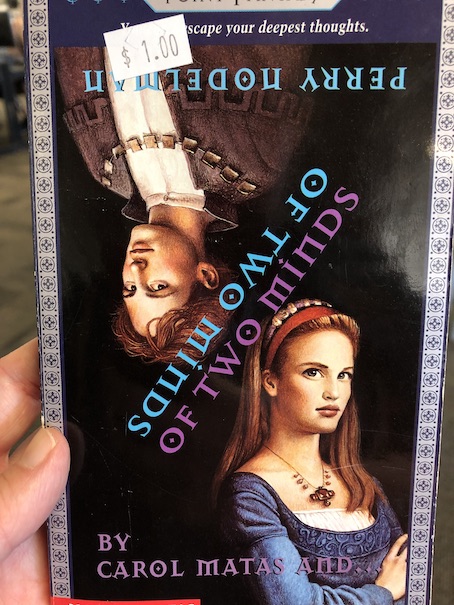
Of Two Minds

Of Two Minds by Carol Matas and Perry Nodelman, 1995.

Princess Lenora lives in a world where people can make things from their imaginations real just by thinking about them. This is a common “gift” that everyone in her country has, but the thing that really upsets Lenora is that people aren’t allowed to use their “gift” whenever they want to. Lenora’s parents are frequently upset with her for disrupting their calm, orderly world with her wild fantasies. They remind her that the reason why they have these rules was that their world was in chaos before people learned how to use their “gift”, and the chaos was only resolved when everyone agreed to maintain the same reality so they could all live in a safe, stable world that makes sense. They call this maintaining “the balance.” However, Lenora thinks that this stable world is boring and laments that there are never any technological developments or anything really interesting or exciting, like in the fantasy books she reads.

At this point, I pause to reflect that, in real life, we don’t have a world where people can change the nature of reality just by picturing something, and in spite of living every day in a common reality, our world still doesn’t completely make sense, people can have very different interpretations of things that are happening as if they lived in completely different realities of their own making, the idea that everyone could agree on one shared reality to create for any length of time sounds unbelievable, and when “exciting” things happen in world events, they are often not “interesting” or pleasant. Lenora is a teenage girl who doesn’t have a lot of experience yet in worlds that her people maintain in order to stay safe and sane or that she has not created herself and had control over. That’s about to change.

While everyone in Princess Lenora’s world has mental “gifts” that allow them to make imaginary things real, Lenora’s abilities are stronger than most, and her parents worry that her powers are getting much stronger. Lenora has trouble resisting the urge to imagine things and make them real, and although she loves doing it for the excitement and sense of power it gives her, it’s starting to scare her because it feels like her fantasies are starting to control her instead of her controlling them. Her fantasies have started to take darker turns, and frightening things are starting to become real, and she’s not even sure if they’re really coming from her mind or not. Because Lenora is turning seventeen years old, her parents are in the process of arranging a marriage for her to a prince from a neighboring kingdom, and they hope that marriage will help settle her down. However, Lenora isn’t so sure about the marriage or her increasingly difficult to control powers. When she talks to the healer, Lufa, about it, Lufa says that it’s not unusual for young people to experiment with their mental powers and that Lenora’s disturbing fantasies are coming from a dark part of her own mind that she will have to learn to control. She offers to spend some time working with Lenora and helping to develop her control.

Meanwhile, Prince Coren, Lenora’s betrothed, is having his own doubts about the impending wedding. In the first place, he thinks that he isn’t very handsome and isn’t sure that Lenora is going to like him. In the second place, he doesn’t really like change. Change makes him very nervous, although he doesn’t like the way things are in his kingdom and has felt for some time that things really need to change. People in his kingdom, like in Lenora’s, have special mental gifts, but they work in somewhat different ways. The people in Lenora’s kingdom, Gepeth, have the ability to change the nature of reality with their imaginations but often restrain their abilities in order to live in a common reality. In Coren’s kingdom, people have the ability to make things they imagine look and seem real, but they cannot actually change the nature of reality itself. They don’t bother to restrain their abilities at all, preferring to live in their imaginations. They don’t bother to keep their homes and buildings in good repair, just imagining that they live in opulent mansions and sleep in soft beds when their buildings are actually crumbling and they sleep on the ground. More than anything, Coren wants to build and enjoy something real instead of living in this imaginary world that he knows is not real at all. Also, Coren’s people have the ability to read each other’s minds, and they do it all time. The mostly talk to each other directly in their minds, not out loud or face to face, and they’re also in the habit of snooping and eavesdropping on each other’s thoughts. Coren tries not to be so obtrusive, and while his parents have some concerns about him marrying a girl who can’t speak mentally, Coren finds the idea a relief. Still, he’s not quite sure what to expect of Lenora or sure that she’s going to approve of him.

As Coren and his family approach Lenora’s kingdom, and he thinks and worries about meeting Lenora, he begins accidentally joining Lenora’s thoughts and fantasies. He begins getting a taste of what goes on in Lenora’s thoughts and imagination, and for a person who craves stability as much as he does, it’s unsettling.

It turns out that, although Lenora’s parents have mentioned marriage to her before, she has not been informed that her intended husband is on his way until he actually arrives. She is shocked and angry when her father suddenly springs Coren on her without warning, and Coren’s parents are dubious about this marriage when they discover that Lenora was not even informed that it was going to take place. They read the Lenora’s father’s mind and learn about Lenora’s previous antics with her powers. Coren begins having serious doubts about this marriage, and so do his parents, although they kind of admire Lenora’s imagination since they live in their imaginations much of the time.

Lenora, in a desperate panic to escape this unwanted marriage, tries to figure out what to do. She thinks about imagining a change in the world so that she won’t have to get married, but she knows that her father is still powerful enough to stop her. Then, she thinks about creating a world of her own with her imagination that she can jump into, but strangely, Coren ends up playing a role in everything she imagines. Even though she doesn’t want to like Coren, she feels strangely drawn to him. Since she can’t seem to escape thinking about Coren, she decides to physically run away and visit other countries, but she’s caught before she gets out of the palace.

Lenora’s father informs her that, because of her reckless behavior and increasing powers, they’ve arranged for her to marry Coren the very next day, and after their marriage, they will go to live on an island their kingdom controls with guards to prevent her from leaving or using her powers to escape. Lenora and Coren are to live on the island until after the birth of their second child, in the hopes that Lenora will settled down and get control of herself through her family responsibilities.

It seems like Lenora is trapped, but during the wedding ceremony, a portal to another world opens up. Lenora feels like someone, although she doesn’t know who, is offering her a chance at escape and decides to take it. However, as she goes through his portal, Coren tries to stop her, sensing that it’s dangerous, and he’s pulled in with her. The two of them find themselves in a world with an unknown creator, and for the first time in her life, Lenora’s powers don’t seem to work, so she can’t get them home. At first, Lenora is charmed by this seemingly perfect world full of interesting people and with the promise of newfound freedom. However, Coren is dubious and, although his powers are also gone, has the troubling feeling that they are in danger. What is this world, and who wants them there? If they’re ever going to return to their own world, they will have to face a dangerous enemy … and the darkest corners of Lenora’s own mind.

The book is available to borrow and read for free online through Internet Archive. It’s the first book in a series.

My Reaction

I first read this book when I was in my early teens, back in middle school, and I think that’s the right age group for this book. Princess Lenora is a daydreamer, like many teenage girls, but unlike most teenage girls, she has the ability to make the things she daydreams about become reality with just a thought. It’s pretty normal for people to imagine all kinds of things, just as passing thoughts, even dark things. If Lenora lived in our world with fanfiction.net, FictionPress, and Wattpad and similar sites for amateur writers, my guess is that she’d be spending much of her time writing stories to post online, like fan fiction and creepypasta, and few people would think anything of it because she would have friends doing the same thing. In a few years, they would probably either graduate to newer sites, like Inkitt, start their own blogs, work on getting books published, or just get busy with their lives, college, and career and let the hobby go for awhile. Instead, because Lenora lives in a world where people’s imaginations change the shape of reality itself, Lenora’s unchecked imagination poses a real threat to people around her and the fabric of reality itself.

Lenora’s parents try to rush her into marriage and family life in the hope that it will curb her dangerous tendencies and teach her some self-control (like people getting married too young never backfires horribly) and get her over this self-insertion fantasy stage she’s in, but in a way, that’s exactly the problem. Many of Lenora’s fantasies, especially the dark ones are about control. I didn’t think of that much when I first read the book as a young teenager. Mostly, I just liked the concept of a world where people could change reality just by thinking about things and the exploring the concept of what that ability could lead to. Much of the story is about that, but also, many of Lenora’s darkest fantasies are about power and control, things that she both resists in her daily life and craves for herself. A lot of teenage rebellion is about control – who has power over whom and where the boundaries lie.

Teenagers are at that phase of life where they’re almost legal adults. Physically, they can do most of the things that full adults can do, like drive cars and get themselves around town to go places they want to go, but yet, they can’t legally consent to certain things, and they’re still required to ask their parents’ permission before making even basic decisions about their weekend plans, and their parents are often telling them what they think they should do for their futures in the way of jobs and education. It can be a frustrating experience, knowing that you have the ability to go out, have adventures, and explore what life has to offer but yet not really being allowed to get out there and do things. There are practical reasons why teenagers can’t act on every whim that enters their heads. For one thing, life requires money. There are few things that don’t cost anything, and you need some time to build resources. For another, people won’t hire you for just any job because you showed up and said you wanted to try it. Most jobs require a certain level of education and/or experience, and teenagers just haven’t had time to acquire it yet. They have to find lesser jobs first and continue their education or get some professional training. Also, when it comes to marriage and other deeply personal decisions, there are serious life consequences to the choices you make. Adults hope by making young people wait for things and build their lives gradually, they’ll get a better sense of who they are, the lives they want to lead, and the consequences of the decisions they’ll make. It doesn’t always work because I’ve seen even older adults make some pretty weird decisions, but that’s largely the goal.

People have a tendency to try to control those who don’t seem to have the ability or desire to control themselves, and that’s really the phase that Lenora is in. Lenora’s young powers are growing, and she wants to test them and see what she can do with them, to explore her deepest thoughts and express herself and make her mark on the world, but her parents and the society she lives in actually can’t let her do that as much as she wants because of what it would do to everyone around her and the very world they live in. Most people, teenagers or not, have some private thoughts or fantasies that they would never want to share with the world, but Leonora’s fantasies become the world around her. They don’t stay private because they don’t stay only in her mind. When Lenora’s fantasies come to life, she pulls real people into them, giving them a genuine stake in having some say over them and trying to limit or stop them. It’s not just that she disrupts people’s lives and inconveniences them, but she can put them in very real danger and actually poses a threat to their very existence. Lenora doesn’t fully consider what her flights of fantasy do to other people, such as when she temporarily sends her mother into a gray void at the beginning of the book so she can pretend that she has the family’s castle to herself or when she briefly considers a fantasy where her parents would be living in poverty at her mercy and charity so she could control them instead of the other way around, until she finds herself at the mercy of someone she can’t control. Sometimes, people don’t understand what they put others through until they have to live it themselves. You’d think, with as much of an imagination as Lenora has, she could put herself in someone else’s place, but she doesn’t develop that kind of empathy until she sees what it’s like to deal with a person who completely lacks it.

If Lenora could have a creative outlet for her energies, getting her ideas out on paper, writing stories to share, or exploring her visions through art, her life would be different, and she probably would feel less frustration. The purpose of imagination and daydreaming are to let people explore concepts and consider different things that might happen, both good and bad, without acting anything out in the real world. It gives people a chance to think things through and consider what could happen without risking bad consequences from actually doing anything. I’m not a very adventurous person in real life. I don’t like camping or hiking, I’m afraid of heights, and there are things that I actually can’t do physically. But, I don’t mind vicariously experiencing things through stories, where I can have a safe kind of adventure. However, Lenora has that problem where, if she imagines things too hard, they become real. Her people call it a “gift”, and she doesn’t always see it as a problem, but it really is because it removes that important safety net between thinking and acting, and when Lenora’s darker thoughts take over, it poses a danger to everyone. Since Lenora has fantasy books that she likes to read, it does seem like her people have a sense of creative writing and the arts, and there are times when Lenora considers things that she could make real but doesn’t, so her people can apparently control their thoughts enough to pick and choose what to make real and what to leave as fiction. It seems that Lenora does have the option of writing stories as a creative outlet, but this craving for a sense of power and control and the ability to make some real change in the world are what keep Lenora from just writing fan fiction and tempt her to play with the nature of reality itself.

Spoiler:

The spoiler for this story is that Lenora’s greatest enemy is another version of herself, the dark version from the back of her mind who can’t be controlled, who doesn’t care about other people, and insists on getting everything his way. (Lenora’s dark version is a man, the idea being that this Lenora turned herself into something completely opposite to what she used to be in order to have a more powerful image.) What Lenora and Coren both need to find is the Balance that Lenora’s society tries so hard to maintain. She comes to have more respect for the people and worlds that she has created, seeing them as real beings with feelings instead of playthings to be cast aside when she becomes bored of them.

Coren also turns out to be a nice counterpart to Lenora. In the beginning, all he wants is a safe, stable, comfortable life in the real world instead of the world of imagination, where his parents live. In the end, he realizes that he needs to find a balance between the two himself. Although Lenora’s imagination is what gets them into trouble, he comes to realize that not all of what she created is bad. Lenora (and even her dark side) comes up with genuinely good ideas. Coren’s praticality and Lenora’s flair for adding a dash of excitement and color to life complement each other well, and in the end, they decide that they love each other. They would make good life partners because of their ability to bring out positive traits in each other and provide some balance to each other’s lives, but the book ends with them deciding that they want to get to know each other better before actually getting married, which is a practical thought.

Children’s Quick and Easy Cook Book

Children’s Quick and Easy Cook Book by Angela Wilkes, 1997.

When I was expanding my cooking skills as an adult, I started doing it using children’s cookbooks instead of cookbooks for adults because of the simplified instructions. When I bought this one, I hadn’t realized that it was originally a British book. I have the American edition, but the reason why I discovered that it was a British book is that the types of recipes the book offers includes some that are more common in the UK than in the US. A friend of my family, who was originally from England, spotted it and was happy to hear that I’d be learning to make some of these recipes. The recipes provide both metric and imperial measurements for the ingredients (another clue that this is an international book). There is a section in the beginning of the book that explains how to use the book and some general cooking safety tips. In the back of the book, there is a helpful Picture Glossary that demonstrates various cooking techniques and concepts used in the book, like how to use a marinade, how to core an apple, how to separate eggs, and how to roll out pastry. It’s all useful information for beginning-level cooks.

The recipes are divided into helpful sections, including snacks, meals, desserts, and sweets. The book is heavy on desserts, candy, and sweets, but many of the recipes under the snacks section are what Americans (and possibly British people, too, although I’m less sure there) might consider as breakfasts, lunches, and general light meals. In particular, the snack section includes sandwiches of various kinds. Some of the ingredients for the sandwiches sound uncommon for the US, although that might also vary by region. I can’t recall seeing salami and cream cheese together before, but I wouldn’t mind trying it sometime. Some sandwiches also call for ingredients like cherry compote and mango chutney. I think that serving grated chocolate on croissants or other bread items is also a European thing. I’ve seen it packaged just for that purpose at international grocery stores and import stores. Some of the snacks are more like snack items in American cook books, like flavored popcorn and smoothies.

The section of Speedy Meals include omelets, two kinds of soup, tacos, and pasta. Some recipes are common ones in the US, too, like chicken nuggets, chicken burgers, and fish sticks. The Turkish Meatballs with lamb, Falafel, Tabbouleh, and Chicken Curry and Rice are less common, but are still eaten here, especially if you live in areas with international restaurants and grocery stores.

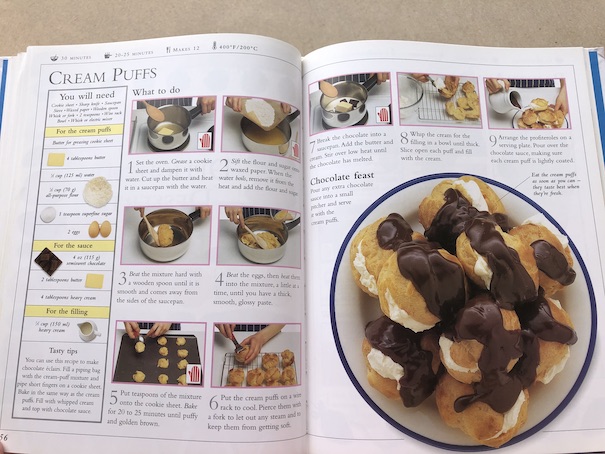
Of course, the desserts and sweets are particularly fun recipes. I particularly enjoyed making the cream puffs! There are different types of cookies included and candies like chocolate truffles and peppermint creams.

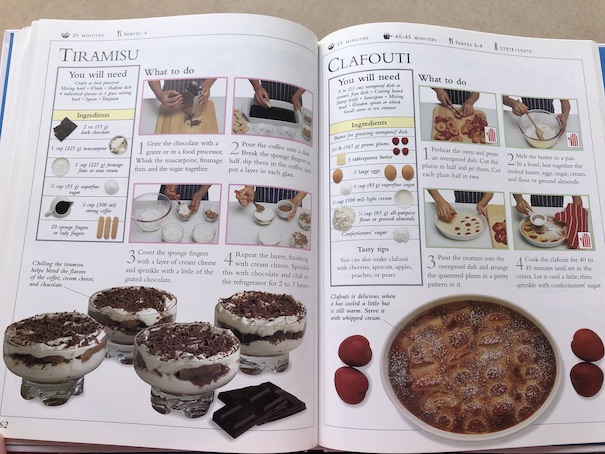
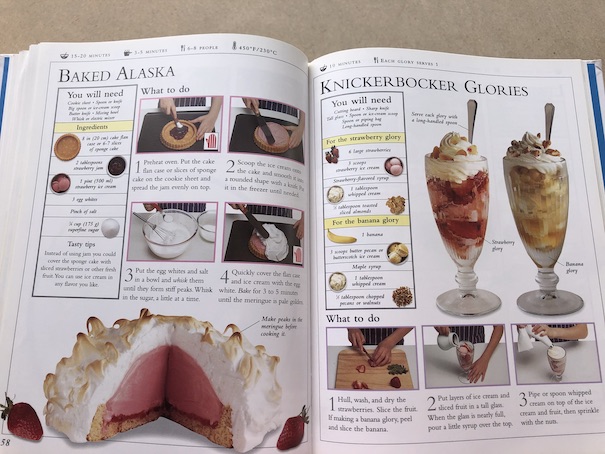
Many of the desserts would be familiar to Americans, like the chocolate cake, carrot cake, lemon cheesecake, and Baked Alaska. However, there were also a few desserts that were new to me. I had never heard of Clafouti before, and this was the first place I had heard of Knickerbocker Glories, a kind of parfait or sundae with layers of ice cream and fruit. (If you remember Harry Potter referring to a Knickerbocker Glory in one of the books, here is what it is!)

The book is available to borrow and read for free online through Internet Archive.

Hester Bidgood

Hester Bidgood, Investigatrix of Evill Deedes by E.W. Hildick, 1994.

Hester Bidgood was a character in one of the McGurk fantasy mysteries, which involved time travel, and in this book, she investigates a mystery of her own in her own time, the late 1600s, Colonial America.

Goody Willson’s cat has been found, badly injured, with the shape of a cross burned into it. Some people are spreading the rumor that this is a sign that Goody Willson is a witch and that the injuries to the cat were a sign of God’s disapproval for Goody Willson’s “witchy ways.” Of course, Hester and her friend, Rob, don’t believe that. Old Mistress Brown worries that if the witch rumors go too far, everyone will soon be a potential witch suspect, like in Salem. Rob takes care of nursing the cat back to health, while he and Hester try to determine how the cat came to be injured in such a strange manner.

Rob knows what it’s like to be an outcast. Although he’s a white boy, he lived for a time among the Native Americans as a young captive and adopted many of their habits. He doesn’t know how to read, and Hester has been helping him. However, there are people in the community who don’t trust Rob because of his connections to the American Indians, and they call him derogatory names.

Hester and Rob consider that the mark on the cat could have been made by a branding iron. They go to the blacksmith and ask him if he has an x-shaped branding iron or if anyone has asked him to make one, but he says no. But, then Hester begins to consider that maybe the cross isn’t really a cross. A cross sign could also be made by putting two capital ‘T’s together at an angle.

Their investigations also take them to the old Morton homestead, where the entire Morton family was killed by American Indians some years before. Someone has been staying there in secret, and there are signs of blood, possibly from the injured cat. Gradually, Hester and Rob begin to put the pieces together, realizing who the person responsible must be and how this evil deed is actually connected to an earlier crime.

I didn’t really like this book because of the cruelty to animals. It wasn’t just what was done to the cat but also when Hester remembers Rob finding a dragonfly and considering taking off its wings. Hester stops him from doing it, but it’s still a disgusting thought. I thought that the villain was pretty obvious from the beginning, too, although I didn’t know the motive. When there’s a witch hunt, the person who is the most guilty is the first one to bring up the subject of witches.

The Case of the Weeping Witch

The Case of the Weeping Witch by E. W. Hildick, 1992.

This is one of the McGurk fantasy mystery books.

The kids are studying the history of their New England town in school. McGurk studies witchcraft trials, and he is outraged at how innocent people could be charged with witchcraft on little evidence and sentenced to death. When their teacher tells them that she has learned that a young girl was once put on trial for witchcraft in their town 300 years ago, McGurk convinces the others to try to use their “little black boxes” from the previous book in the series to go back in time and try to save the girl.

The girl, Hester Bidgood, is thirteen years old and turns out to be the goddaughter of Gwyneth, one of their friends from their last fantasy adventure. Gwyneth is now very old, but she remembers them and welcomes them into her home. A man in their community, Jacob Peabody, is trying to pressure Gwyneth into selling him her property. He is the one who brings charges of witchcraft against Hester. Hester calls herself an “investigatrix,” meaning that she is a detective, like the kids in the McGurk organization. She knows some disreputable things that Peabody has done, and Peabody wants to keep her quiet as well as force Gwyneth to give up her property. The McGurk organization is determined to save Hester, but they must be careful not to make anyone think that they might also be witches.

Of course, that turns out to be difficult because all of the modern-day members of the McGurk Organization have magical black boxes.

The book is currently available online through Internet Archive.

Spoiler:

Hester has a friend called Rob McGregor who was captured and raised by Indians when he was young. Although he now lives with his grandparents, he still has habits and skills that he learned from the Indians, and Hester likes to call him by his Indian name, Blazing Scalp (because of his red hair). I expected that Rob would turn out to be some ancestor of McGurk’s, just like the last book had a definite McGurk ancestor, because he has that distinctive red hair, but if there’s a connection, it isn’t definite.

Rob knows that Hester has learned that Peabody earned his fortune by cheating at cards and that he is hiding a mysterious guest in his house. Rob saves Hester when the people in the town try to conduct the water trial, seeing whether she will float or sink in water to determine whether or not she is a witch. Then, Rob and Hester hide in Rob’s secret lodge in the swamp while the McGurk organization tricks the man hiding in Peabody’s house into revealing himself.

The man, who has been going by the name Mica Holroyd, is really Matthew Hopkins, a former witch hunter who has been charged with witchcraft himself and is now a fugitive from the law. Once everyone in town realizes that Peabody is dishonest and harboring a fugitive, they know that the charges against Hester were false. Peabody and Hopkins are both sent back to England, never to return. When the McGurk organization returns to its own time, they learn that Rob and Hester eventually married and that the town gave Hester property that used to belong to Peabody as compensation for accusing her of witchcraft. Hester started a home for orphans and elderly people, which is now a retirement community in the kids’ town.

There is another book in the series which focuses on Rob and Hester alone, without the members of the McGurk Organization.

The Case of the Dragon in Distress

The Case of the Dragon in Distress by E. W. Hildick, 1991.

The McGurk organization start getting interested in the Middle Ages when they acquire a round table, which reminds them of King Arthur’s Round Table, and they begin studying the Middle Ages in school. Shortly after that, Brains buys a set of walkie-talkies at a fire sale. At first, they don’t work, but Brains tinkers with them until he can get them to send and receive. The strange thing is that they only seem to work well at night.

One night, the organization decides to test them, and somehow, they are transported into the Middle Ages. A strange voice speaks to them through their “little black boxes” and sends them on a quest that takes them to the castle of Princess Melisande the Bad. The castle is supposedly guarded by a dragon, but it is really a couple of servants in a dragon costume. Like many others in the castle, they are prisoners of Princess Melisande, who appears young and sweet, but is actually evil. She uses the dragon story to lure brave men to the castle so that she can imprison them and drink their blood. She has leeches put on them, and then she eats the leeches. That is how she maintains her youth, even though she is ancient. Among her prisoners are the king’s son, Prince Geoffrey, and the young chief of the McGurk clan from Ireland, who may be a distant ancestor of Jack P. McGurk.

When the members of the McGurk Organization arrive at the castle, everyone is amazed by their strange appearance, modern clothes, and the little black boxes that talk. Even Princess Melisande is in awe of them, but the McGurk in her prison is weakening, and she may be planning to replace him with the McGurk from modern times.

The book is currently available online through Internet Archive.

My Reaction and Spoiler:

The two servants who were pretending to be the dragon, Gareth and his sister Gwyneth, are also time travelers, but they are from the 17th century. They were brought to the Middle Ages after drinking a potion that was supposed to cure them of a fever. In their own era, they live close to the castle where they are now imprisoned, and they know that there is a secret passage that leads out of the castle from the dungeon. The kids develop a plan to sneak out of the castle under the dragon costume, but they are caught and thrown in the dungeon. They try the secret passage, not knowing if the path goes all the way through. It does, and they make it to the king’s camp. When they tell the king that Princess Melisande has his son, the king plans to storm the castle and free the prisoners. McGurk says that their mission is accomplished, and the voice from their little black boxes says that it’s time for them to go home. Everyone wakes up in their own beds, as if nothing had happened. They believe that the walkie-talkies are responsible for what happened, but they aren’t quite sure if they actually went back in time or merely dreamed that they did. There is some evidence that they really went back in time, but it isn’t answered definitely.

I liked this book as a kid, although it’s a little bizarre because most of the books in this series are just mysteries involving a group of neighborhood friends that take place contemporary to when the books were written. There is usually nothing magical or supernatural about the books in this series, and it’s kind of a weird departure from the usual format. There is another book after this one that continues their time traveling adventures.

Colonial American Holidays and Entertainment

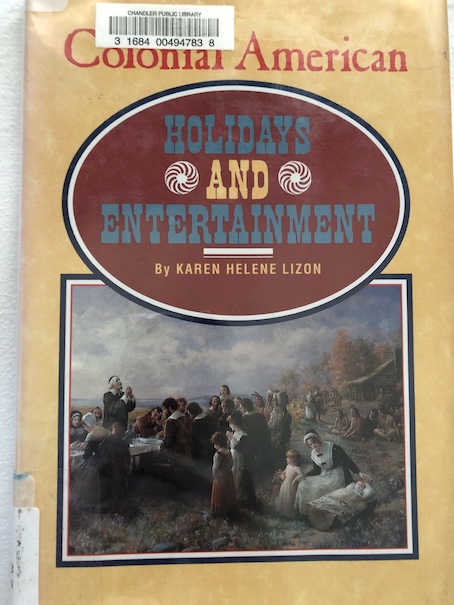
Colonial  American Holidays and Entertainment cover

Colonial American Holidays and Entertainment by Karen Helene Lizon, 1993.

Colonial American Holidays colonists arrive

This book explains how people living in Colonial America would entertain themselves and celebrate holidays. Both entertainment and holidays varied between time periods and geographical areas.

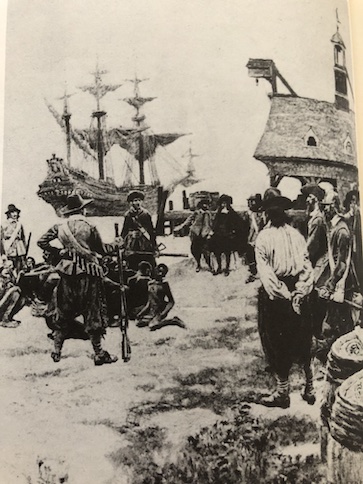
In the early days of European colonies in North America, life was hard. People were occupied with daily survival and the establishment of their communities. As their communities expanded and became more settled, they were gradually able to have more leisure time. The book begins with a general history of the American colonies, briefly explaining the range of countries the early colonists came from, the effect their arrival had on Native Americans, and the role that indentured servants played in society and the adoption of slavery as a means of obtaining workers.

Colonial American Holidays slaves

I was glad that they brought up the point about indentured servitude and slavery because I remember discussing it in my college history courses. Indentured servants were people who would agree to work for someone for a period of time in return for having that person pay for their passage to the colonies. There was a benefit for both sides in indentured servitude. For the indentured servants, they used their labor as a means to pay for transportation to the colonies that they could not have afforded by themselves, and once they had worked for the required period, they would be free to establish themselves independently in the colonies. For those who paid for the indentured servants, they would have guaranteed workers for the period of the indenture. However, plantation owners and other employers soon realized that they were not finding as many indentured servants as they wanted, and they didn’t like losing their labor force when their terms of indenture ended the workers left their employ. Therefore, they began to turn to slavery as a means of gaining a steady stream of workers who could not say no to them, no matter what the working conditions were like, and could never leave. Slavery wasn’t so much about race in the beginning as economics and employers who wanted cheap, permanent labor and didn’t care how they got it or what it would mean to the people they bought. But, I have other books that say more about what that led to. This book is mostly about lighter subjects, but it does acknowledge the serious aspects of American history and also makes the point that these completely unwilling immigrants also became a part of American society and, like other groups who came to America willingly, also brought traditions and folklore of their own that would gradually become part of American society, entertainment, and celebrations.

During the Colonial period, celebrations and entertainment varied throughout the regions of the American colonies, depending on the mixture of colonists living there and the holidays and traditions they brought with them from their homelands. Some of their holidays were ones that we still celebrate today, while others have fallen out of favor.

The book is divided into chapters based on different aspects of entertainment, and I’ve given a brief description of each, although all of these sections have more detail than I’ve provided. I particularly recommend reading the book if you would like more information about Native American entertainment or the lives of slaves because there is more information about these topics than I’ve described.

The chapters are:

Winter and Spring Holidays

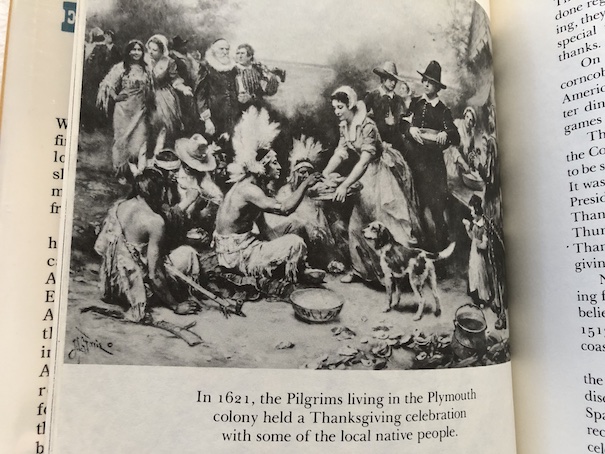
Christmas seems like one of the most obvious holidays for colonists to celebrate, but it wasn’t so straight-forward. First, not all of the colonists were Christian (there were some Jewish people in parts of the colonies, and they celebrated Hanukkah in the winter), and even among those who were Christian, not all actually celebrated Christmas. The Puritans, who wanted to separate themselves as much as possible from traditions which they thought were not part of pure Christianity, did not celebrate Christmas. In fact, they didn’t celebrate many holidays or special days at all. Apart from the Sabbath, they only had a Day of Humiliation and Fasting and a Day of Thanksgiving and Praise, and those were not regularly scheduled events to be held on any specific date; they were only declared when it seemed that circumstances called for them. A Day of Humiliation and Fasting would happen at a time when things were going badly and the community was suffering, and the Puritans would use that day for prayer, reflection on their sins, and repentance. A Day of Thanksgiving and Praise would happen when the community was prosperous and felt blessed, and it was a time of prayer and feasting.

Colonial American Holidays Thanksgiving

Also, among the Christians who did celebrate Christmas, not all of them celebrated it on the same day, and different groups had different customs for Christmas, depending on where they were originally from. People from Sweden celebrated St. Lucia Day on December 13th, and people from the Netherlands celebrated Sinterklaas Eve and Day on December 5th and 6th. It was also common for Christmas celebrations to continue through the Twelfth Night from Christmas itself, January 6th, also call Epiphany (the day that the Wise Men visited Jesus).

Colonial American Holidays New Year in New York in 1640

Easter is a common Spring holiday in modern times, but in Colonial times, it wasn’t so widely or elaborately celebrated. Colonial children were not told stories about an “Easter Bunny” delivering eggs or candy, although colonists from the Netherlands did decorate eggs with natural dyes and scratched designs into the shells.

A spring holiday that many of the colonists celebrated (but not the Puritans) but few people celebrate in modern America was May Day. On May 1st, people would gather flowers and dance around a Maypole.

Summer and Fall Holidays

The Fourth of July is the essential summer holiday of modern America, but it didn’t exist until the signing of the Declaration of Independence in 1776.

Colonial American Holidays harvest in New England

Many people’s lives centered around agriculture in colonial times, so fall was harvest time for them. Some colonists (although, not all, and definitely not the Puritans) also celebrated Halloween. The holiday was particularly celebrated in communities where there were people of Irish descent. (This book doesn’t say so, but at this time, it was particularly a Catholic holiday, the eve before All Saints’ Day on November 1st, although some other Christians celebrated it, too. Some Protestant groups, especially the Puritans, shunned the holiday as being too Catholic. I covered the general history of Halloween in more detail on my site of Halloween Ideas, including how Halloween became a secular American holiday.)

In some areas, colonists celebrated an anti-Catholic holiday called Pope’s Day on the 5th of November, where they would burn effigies of the pope. This was an older holiday than the English Guy Fawkes Day, celebrated on the same day, and that holiday was also celebrated in the parts of the colonies with English influence.

Of course, both colonists and Native Americans had harvest celebrations in the fall, including the periodic Thanksgiving feasts that led to our modern Thanksgiving holiday.

Sports and Recreation
Colonial  American Holidays bowling

Much of the lives of the early colonists focused on basic survival and the establishment of their new communities. (The book explains some of the ways Native Americans helped the early colonists to survive and adapt to their new environment and to unfamiliar foods.) There was always work to be done, and even young children had to help with daily chores. Still, they found ways to enjoy themselves. Hunting expeditions were a kind of adventure, and children were often assigned the fun chore of picking berries.

Then they had leisure time, they would enjoy games like shovelboard (like shuffleboard but played on long tables), ninepins or bowling (done at first outside on the village green), and billiards (some of the more prosperous families had their own billiard tables). In the 17th century, ninepins was the primary form of bowling with pins instead of our modern ten-pin games. Ninepins, also called Skittle, was the game that Rip Van Winkle played in the story set during this time by Washington Irving. When they talked about just “bowling”, they didn’t use pins at all, instead rolling a ball toward a designated mark on the ground. Boys played stick-and-ball types of games, like stool ball. Even Colonial women enjoyed a game of stool ball. Other games and sports Colonial people enjoyed include quoits (a ring toss game), tennis, battledores, swimming, canoe races, foot races, wrestling, and horse races. Wealthy families even engaged in fencing and (believe it or not) jousting.

During the winter, children built snow forts and had snowball fights and went sledding. Both adults and children went ice skating.

Games and Toys
Colonial American Holidays children with marbles

Many Colonial children’s toys were homemade. It was common for boys to whittle wooden toys for themselves such as whistles and windmills. Boys also had toy guns and bows and arrows. Colonial children liked to roll hoops, either homemade wooden ones or metal hoops from an old barrel. They rolled the hoops upright along the ground using a stick to keep them going, and the object was to go as fast as possible without loosing control of the hoop or having it fall. (They did not use hoops as hula hoops.) Native Americans also played with hoops, and they liked to make it a challenge to throw a spear through a moving hoop. In modern times, jump rope is often considered a girl’s game, but in Colonial times, it was more popular with boys, and they had their own jump rope rhymes. Colonial children also played with spinning tops, marbles (Native Americans had their own traditional marble games as well), jackstones (a precursor to modern Jacks), kites, toy boats, balls, and swings. Girls had dolls (usually homemade and sometimes corn husk dolls at harvest time and paper dolls they made themselves), and some of the more fortunate girls had doll cradles and dollhouses with furniture. Many homemade toys were actually very durable and were passed on through families for generations.

Children also played many games that are still popular on modern playgrounds, including various forms of tag, counting-out rhymes (like the kind modern children use to choose who is going to be “it” in a game), hide and seek, blindman’s buff, leapfrog, cat’s cradle, and hopscotch (which they called “scotch hoppers”). Sometimes, they played board games, like Checkers, Chess, Backgammon, and Nine Men’s Morris.

People throughout the colonies played various types of dice, domino, and card games, some of which were gambling games. Gambling rules and taboos differed throughout the colonies, but in some areas, even children were allowed to gamble.

Social Amusements
Colonial American Holidays tea party

A primary form of entertainment in Colonial times was visiting friends and neighbors, and they developed a form of social etiquette around visiting. Some people had specific days when they were expected at friends’ homes, and people often left calling cards to show that they had visited. (Since people couldn’t phone someone to say that they were coming to visit, they either had to prearrange the visit ahead of time to ensure that they were expected or leave a calling card if the person they were visiting happened to not be home, so they would know that a friend stopped by and wanted to talk to them.) Women who lived in towns held tea parties, and pioneer families had picnics that included fishing and berry-picking.

There were seasonal fairs in spring and fall with entertainment like juggling, puppet shows, tightrope walking, fortune-telling, music, exotic animal shows, and various types of contests. The fairs were also part business and involved trading and selling various types of products.

Colonists’ social lives also included political and religious community meetings. Towns would hold meetings to discuss town business and issues of local concern. Election days for public offices often had an air of public celebration as people watched public speeches and debates and booths sold good things to eat to the spectators. Citizens were welcome to attend criminal court trials and witness public punishments designed to humiliate offenders. Communities held market days when farmers, businessmen, and even Native Americans could gather to buy, sell, and trade products.

Colonial American Holidays tavern

Church attendance and activities varied by denomination and geographical location. In some areas, church attendance was mandatory, and people would not engage in any other business or activity on Sunday. In areas where neighbors didn’t live close to each other, church was one of their main opportunities to see each other, and it was common for families to meet and share meals after church or for young men to visit with girls they liked.

Taverns, inns, and coffee houses also became important community meeting places. They could be uses as places for community meetings, political discussions, arranging business deals, distributing news and mail, and (as a later chapter explains) sometimes theatrical performances.

Entertainment and Pastimes
Colonial American Holidays children at chores

Because Colonial life was often hard and full of work, learning how to entertain yourself at home and keep yourself amused while performing chores were important. Work and entertainment often went hand-in-hand, and social occasions were often accompanied by chores and activities to keep the hands busy. Children started learning useful skills early in life. By the age of five years old, girls were able to sew. They also learned knitting, weaving, and embroidery, showing off the range and variety of stitches they knew in hand-sewn samplers. (Originally, samplers were meant to be exactly that – samples of the variety of sewing stitches a girl knew how to do. They were meant to be a demonstration of learning and accomplishment. They were very different from modern samplers that only contain one stitch – cross stitch.) Girls as well as boys knew how to whittle wood, and it was common for children to trade things they had made themselves for other things they wanted. Families had gardens where they grew vegetables, herbs, and flowers that the family could enjoy, and some women developed side businesses selling vegetable and flower seeds from the family garden.

Colonial American Holidays entertainment at home

While not everyone knew how to read, many people did, and they would read books like the Bible, works by Shakespeare, and books of poetry. Some people even wrote poetry for fun. Benjamin Franklin opened the first lending library in Philadelphia in 1731. Families often provided their own entertainment in the evening, telling stories and folktales around the fire.

Communities also had musical performances and public dances. Different colonies had different customs regarding dancing, with some communities making it taboo for men and women to dance together. Wealthy plantation owners held fancy formal balls. Music was a common part of children’s education because people who knew how to sing or play an instrument could help entertain their families at home. Some people simply used improvised instruments made out of various objects that they happened to have on hand, like a comb covered in paper, spoons, or tin kettles.

Early American Observances

Aside from the holidays described earlier, there were other special occasions that communities celebrated. Families gathered to celebrate births, baptisms, and weddings. Even funerals, while being a time of mourning, were also social gatherings. Sometimes, wealthy families would give little gifts to those who attended family funerals.

Some children had birthday parties. In the early days of the colonies, people were too occupied with the business of survival to bother much with remembering birthdays, but as communities became more settled and stable, birthdays were increasingly celebrated, especially among the more prosperous families. Sometimes, children were excused from chores on their birthday, and they were often given practical gifts.

Native American groups also had their own seasonal festivals and ceremonies of thanksgiving that varied among tribes. These seasonal festivals marked times for planting or harvesting crops or moving to seasonal quarters. They would also have ceremonies to mark special life events, like testing boys to see if they were ready to be men in their communities.

Working Bees
Colonial  American Holidays quilting bee

As I said, work and fun often went hand-in-hand in Colonial America, and sometimes, the colonists would hold special working parties called “bees.” When people got together in big groups to take care of major chores, the work got done faster, and they could have fun talking and visiting with each other while they did it. When they finished with whatever task they set out to do, they would finish the event with food, games, and other fun activities.

At harvest time, they would hold harvest parties to harvest food and prepare it for storage. At apple bees (the parties, not the restaurant), people would peel and core apples and make apple-based foods, like cider and applesauce. At husking bees, they would husk corn. There was also an element of flirting to husking bees because, if a man found an ear of red corn, he was allowed to kiss a woman sitting near him.

At other times of the year, they would hold different types of bees for specific tasks or crafts. “Raising days” were when people got together to build a new building, like a house, barn, or public building, like a schoolhouse. Women held quilting bees and knitting bees. Children today still compete in spelling bees, just like colonial children did. “Sparking bees” were kind of like colonial singles meetups. Single young people in the community would come to the bee to meet each other, and if they found someone who “sparked” their interest, they could begin a formal courtship with that person.

Games, Goodies, Gifts

The final chapter of the book has words for the counting-out rhyme “Intry, Mintry” and the rules for the tag game Fox and Geese and the spinning top game Chipstones. There are recipes for Maple Sugar-on-Snow, Furmenty, Speculaas (a Dutch Christmas cookie), and Raspberry Flummery (a sweet drink). There are also instructions for making a pomander ball.

The book is available to borrow and read for free online through Internet Archive.

Brother Eagle, Sister Sky

Brother Eagle, Sister Sky: A Message from Chief Seattle with paintings by Susan Jeffers, 1991.

This is a picture book, but not one for very young children because of the serious subject matter. It’s a profound book with beautiful pictures, but before presenting it to children, adults should be sure that the children are old enough to understand the background of the book.

The book begins with some information about its background. It describes the variety of “Indian” (Native American) tribes that have lived in the Americas for thousands of years and how, after white settlers arrived from Europe, they were killed and pushed off their ancestral lands by the new arrivals. It’s historically true, but also dark subject matter, which is why it’s important for the children reading the book to be old enough to understand it. Most of the book is the text of a speech made by Chief Seattle (who lived c. 1786 to 1866) to the Commission of Indian Affairs for the Territory and other government employees when the US government wanted to buy land from his tribe. The historical details concerning this speech from the mid-1850s are complicated, and accounts of it might not be completely accurate, and there is a note in the back of the book that addresses that. I consider the spirit of this speech something worth preserving, so I won’t get too hung up on that right now. I just mention it for the sake of people interested in going deeper into the history.
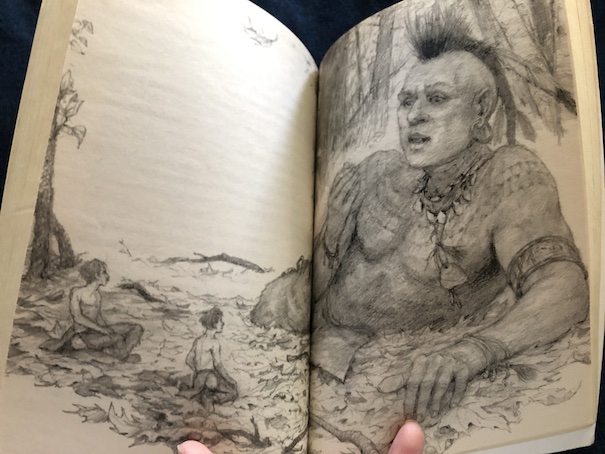
Susan Jeffers particularly wants readers to consider the environmental message of the speech and how relevant the message is today for a society that has endangered itself by placing a higher priority on the acquisition of land, resources, and wealth than on preserving the land and environment that makes life itself possible. This book was written in the early 1990s, and having been a child at that time myself, I know that these themes were increasingly becoming topics in schools and in children’s entertainment during that time. I’d like to point out that I, and others who are younger than me, have heard similar messages about environmental concerns from an early age. This has given us different priorities from earlier generations who did not, although it’s also worth pointing out that many of us came to care more about the environment as children because of the influence of adults who already did.

Chief Seattle questioned the concept of buying land because of the absurdity of buying aspects of nature, like the sky or rain. Land and nature had sacred spiritual meaning for Chief Seattle’s people.

Chief Seattle’s speech was full of poetic imagery, as he explained how his people felt like they were part of the land and it was part of them. He said that they looked on animals like they were brothers.

The land also connected them to their ancestors and the memories of their people.

Chief Seattle questioned what would happen in the future, when the land was filled with people and all of the animals either killed or tamed, painting a bleak picture of a land deprived of life.

The speech ended with the thought that people didn’t “weave the web of life, we are merely a strand in it.” Chief Seattle called on the people wanting to buy the land to love it, care for it, and preserve it because “Whatever we do to the web, we do to ourselves.”

The environmental themes of the message are poignant for modern times because people have become increasingly aware of the consequences of environment pollution and careless use of natural resources.

The book is available to borrow and read for free online through Internet Archive (multiple copies, including English and Hindi).

The Key to the Indian

The Key to the Indian by Lynne Reid Banks, 1998.

This is the final book in the Indian in the Cupboard series. At the end of the previous book, Omri’s father learned the secret of Omri’s special cupboard and key, that it brings small plastic figures to life.

At the beginning of this book, Omri’s father suddenly announces to his family that he wants to take them on a camping trip. It seems like an impulsive decision because this isn’t something that the family usually does, and Omri figures that it must have something to do with the secret that the father and son now share concerning their small friends from the past.

After Omri’s father discovered his secret, the two of them had a serious talk, and Omri explained to him all about his past adventures and the very real consequences that they’ve had, both in the present and in the past. They need to consider carefully what they’re going to do because Little Bear has asked them for help with some trouble that his tribe in the past is having with the British. Knowing the history of the interactions between Europeans and Native Americans, both Omri and his father know that something serious is about to happen to Little Bear and his people, but how can they help? Omri explains to his father that they have the ability to go back into the past themselves, but in order to do that, they need to find something big enough to hold both of them, and someone else would have to turn the key for them to send them and bring them back.

Omri’s father later admits to him privately that he thought up the camping trip as a way for the two of them to disappear for a couple of days without anyone asking questions. Although he proposed the camping trip, he plans to arrange for him and Omri to have a private trip by themselves, discouraging the others from going along. Omri’s father also thinks that he’s figured out what they can use to send themselves back in time – the family car. It’s big enough to hold both of them, it locks with a key, and there’s even an LB in the license plate number, which they take as a hopeful sign. But then, Omri realizes that there’s a problem with that scheme. Even though the car locks with a key, it’s not the kind of lock that an old-fashioned skeleton key could open. They need a key with a different shape, something flatter. They decide that they need the help of Jessica Charlotte, who made the last key. Fortunately, Omri has a way to talk to her because he has the plastic figure of Jessica Charlotte.

When Omri brings Jessica Charlotte back, he finds that she has attempted to drown herself in a river (an event hinted at in the last book) because of her guilt at accidentally causing her sister’s husband’s death. Omri brings back a WWII Matron who has helped them before to treat Jessica Charlotte. When Jessica Charlotte recovers, she thinks at first that she must have died and that Omri is part of her afterlife. Omri assures her that it’s not the case, that she’s still alive. She is still lamenting over having caused Matt’s death and ruined her sister and niece’s lives, but Omri explains to her that he’s Lottie’s grandson. Jessica Charlotte feels better, hearing that Lottie grew up, married, and had children, so her life wasn’t completely ruined. Omri can’t bring himself to explain how Lottie was killed in a bombing during WWII, but he asks for her help to create a new key. Aunt Jessie, as she asks to be called, agrees to help Omri, and he and his father give her their car key to duplicate.

However, when Aunt Jessie returns with the key, they realize that they’ve miscalculated. When a person comes from the past with anything they make or bring with them, it’s always small, like the miniature people themselves. Aunt Jessie’s key is a duplicate of the key they gave her, but it’s small, too small to use in the car. Omri and his father aren’t sure how to get around this problem, so they decide to go on the camping trip with Omri’s brother Gillon, just camping like normal, while they think it over.

It turns out that something magic happened to the car key while it was in the past with Aunt Jessie. When Omri’s father turns the key in the car, Omri suddenly finds himself in the past, but not the past he was hoping to visit. Because they brought some things that belonged to his Great-Grandfather Matt with them on the camping trip, Omri suddenly finds himself in India, during the time that Matt was living there. Omri is inside a puppet in a marketplace, and his great-grandfather buys him. Also, to Omri’s shock, Gillon is also inside a puppet that his grandfather has.

Their mother eventually rescues them by opening the car and turning the key. She was alarmed because it seemed like her husband and sons all passed out in the car. Omri and his father don’t have a real explanation for her, not wanting to explain that the car key is now magic. (She decides that there must have been an exhaust leak, and they were all overcome by fumes.) Gillon was knocked unconscious when his puppet was dropped on its head, and his mother takes him to the hospital, using her spare car key. (When Gillon recovers, he thinks it was just a weird dream he had because of the car fumes.) Meanwhile, Omri and his father talk about the situation, and Omri’s father reveals that, while the boys were taken to India, he ended up in Little Bear’s time because he was carrying some wampum belonging to Little Bear.

So, know they know that it’s possible for them to use their car key to go back in time, but if they try it a second time, who will turn the key for them to bring them back at the appropriate time? The only other person who can come with them on their “camping trip” who knows their secret and can be trusted to help them is Omri’s friend, Patrick. However, Patrick isn’t happy that he’s only there to help Omri and his father go back in time and that he won’t be going himself. He does agree to help them, but unfortunately, he has plans of his own while Omri and his father are occupied elsewhere.

The book is available to borrow and read for free online through Internet Archive (multiple copies).

My Reaction:

Although Omri’s father wonders at first whether it’s a good idea to try to help Little Bear because of the risk of changing the past and affecting the future, Omri has learned that it’s not quite as simple as that. During his previous adventures, he has felt an irresistible pull to use the cupboard and the key, even when he wasn’t always sure it was a good idea, and there are indications that Omri’s interactions with people in other time periods seem fated to happen. He did save Jessica Charlotte’s life when she tried to drown herself, and other things Omri has done seem to fit with wider events.

When Omri and his father are figuring out how to help Little Bear with his problems with the British in his time, they do some research about Little Bear’s time and talk about the ways that 18th century British people treated Native Americans. Knowing what Little Bear is likely to face, they feel like they have a responsibility to help him as best they can. When Little Bear explains in more detail what his people have been suffering at the hands of the British and other settlers, Omri feels guilty, knowing that he’s also British, while at the same time knowing that he was not responsible for things that happened before he was born. This is something that people still struggle with today, hearing about difficult periods of history and knowing that their ancestors (or at least other members of their society, if not literally their direct ancestors) played a role in making life difficult for others, setting up situations where real people suffered or were killed. The best Omri can do is to help Little Bear make the best possible decisions to ensure the survival of his people. Of course, being able to help with that much is part of the time traveling fantasy of this story. Real people can’t actually go back in time and intervene to influence others and change the course of history.

The books in this series aren’t for young children, and as the series progresses, they get more serious in subject matter. There is discussion of suicide, not just with Jessica Charlotte’s attempt to drown herself but when Little Bear explains that his first wife killed herself after being raped by white men. There is violence in the story when the Native American village is attacked and people are shot. Overall, the story is pretty straight-forward in the way in confronts the dark sides of history. Omri and his father advise Little Bear to take his clan to a place where they know that they will be relatively safe and among other Iroquois, but they know and admit to Little Bear that even that won’t solve all of their problems and that there will be other hardships in the future. It’s an imperfect solution to a massive problem, but Omri senses that it is best choice that they could make and that Little Bear and his family will live the safest possible life because of the decision they made, and their descendants will survive.
Omri and his father struggle with knowing that things are going to be hard for Little Bear’s people no matter what choices they make. There is no magical solution to everyone’s problems in the story, and the book doesn’t offer a firm moral or solution to Omri’s guilty feelings when he sees firsthand how badly Native Americans were treated (a form of “white guilt“, although the book doesn’t use that term). Overall, I would say that the book confronts the dark parts of history and human guilt on a very individual level. Omri and his father can’t solve the large issues completely because they can’t control them. They can’t control the past, and they can’t control other people, not even the people who come through the cupboard as miniature ones, like living toys. Everyone is an individual with their own choices to make, and every choice, even the wrong ones, changes the course of history.

After Omri saves Jessica Charlotte’s life, she realizes that what she thought was a dream before she stole her sister’s earrings was real, that she saw and spoke to Omri, and that he could have warned her about what would happen if she went through with her theft, how Matt would have died and how everyone’s lives would be changed for the worse. However, Omri did choose not to warn her because not everything was changed for the worse. After Lottie’s father died and her family lost their money, Lottie still grew up, fell in love, got married, and had a daughter. It’s true that she did die young in World War II, while her daughter was still an infant, and changing the theft of the earrings might have changed that in some way, but not without changing other things. Omri has discovered that changing things about the past, even seemingly small things, can change larger parts of history, and his psychic gift seems to guide him toward making only choices that help the flow of history instead of working against it. If he had prevented the theft of the earrings, his great-grandfather might have lived longer and so might Lottie, but if that happened, would Lottie have ever met the man she eventually married and had Omri’s mother? Omri’s father wouldn’t be happy without his wife and sons, and if Omri never existed, would some of the other things he did that impacted history have happened? Also, if Lottie hadn’t died in the bombing during WWII, would someone else have been where she happened to be and died in her place? The bomb that killed her would have fallen anyway because that was part of someone else’s choices, a person who never enters this story and whose decisions can’t be controlled. Time and history and the ripple effects caused by individual choices are complex. Omri has his psychic gift to guide him, and even his father, who admits that he never used to believe anything he couldn’t see for himself, comes to trust it.

People without this sort of magical gift have only themselves to rely on to make the best choices they can to make the world as good as possible, even in the face of others’ bad decisions. I think that a large part of the choices that Omri makes in the story and dealing with “white guilt” in real life come down to the combination of frustration and the acceptance of choices made by other people who can’t be controlled. Modern people might hate what happened in the past and feel badly if people related to them were part of it, but we don’t have the option to change things that have already happened. There comes a point where you have to accept the knowledge that you can’t control others, no matter how much you might want to make better choices on their behalf. The only person you can control is yourself.

I’m a white person, descended from colonial settlers in America, and I don’t actually see “white guilt” as a negative thing. I see it as a human thing. If you can feel real emotion at someone else’s plight, a wish that bad things didn’t really happen, or a feeling that what happened shouldn’t have happened and an honest desire to change even the unchangeable past for the better, it means that you’re a real, thinking, feeling human being with a sense of right and wrong, and there’s nothing bad about that at all. Feelings are just tools, to give us hints of what we need to do or how we need to behave in our lives. Feelings aren’t always completely accurate, but sometimes, they give us hints of things that need to be fixed or clues that whatever we did before didn’t really work, that we made the wrong choice or did the wrong thing. I think what upsets and confuses other white people about “white guilt” is the conflict between loving ancestors and wanting to be proud of them and admitting that some of them had a real dark side and did some pretty awful things. Some people have trouble dealing with that, thinking that it’s impossible to feel two things at once, loving someone and being angry with them for things that they’ve done, but it really is possible. Two things can be true at once, and you can have mixed feelings about many things.

Feelings are complex, as complex as people are, and I think it’s as possible for a person to both like and hate another person for the things they’ve done as it is to both like a sweater for the way it looks but not want to wear it because it’s itchy and uncomfortable. I think that’s about the best advice that I can actually offer to other white people trying to make sense of that feeling. Sure, that sweater looks pretty impressive. It has a nice color and a cheerful pattern, and you might think it would look impressive on you if you wore it, but honestly, it’s better if you just leave it on the mannequin. It’s overpriced, out of style, and won’t look at all impressive when it makes you constantly want to scratch all of the places where it itches. Let it go.

“God, grant me the serenity to accept the things I cannot change,
courage to change the things I can,
and wisdom to know the difference.”

The Serenity Prayer

The frustrating thing about feelings about the past and about other people’s lives is that we can’t fix those particular things. In real life, we can’t go back in time, and we can’t even “fix” other people in our own time because that’s something they have to do themselves, if they’re going to do it. You can suggest things to other people, but there’s always a point where they have to make the decisions themselves. But, the good news is that, if you can’t control other people, nobody can completely control you! The way I see it, the most useful thing about this “white guilt” is remembering that this is something we don’t want. Maybe there’s something charming about the rosy, nostalgic view of the past, but honestly, you wouldn’t be happy living there, and if you actually had to live with your ancestors, you’d probably discover that you wouldn’t see eye-to-eye on a lot of things and maybe wouldn’t even get along at all. So, why would you want to try to carry their old baggage with you into your life and spend your life and your precious time constantly trying to explain or excuse their bad choices? You’ve got your own to life.

Give credit where credit is due for both the good and the bad things, and let our ancestors’ records speak for themselves. You won’t accomplish anything for twisting your feelings into knots for trying to protect the feelings of the dead and justify their actions. They don’t even feel anything anymore. They are dead. Let them rest. We don’t want to add to bad things that have been done in the past and to keep having things in our lives to feel guilty about, and that’s okay because there are new choices to be made every single day. Put your focus there. You have a present to live and a future to plan. Knowing about the past is interesting and informative, but the past isn’t where we really live. Admire it like a nice sweater on a mannequin, take note of the price tag, and move on. We don’t have to make the same old choices that have made people, including ourselves, unhappy just because that’s the way things have been before or because we feel like we have something to prove about our ancestors. They had their chance to make the choices in their time, for good or bad (and frequently, some of each, but you can’t help that), and now, it’s our turn to make the choices because this is our time.

Speaking of bad decisions, Patrick almost gets Boone and Ruby killed because of his recklessness when he brings them back while Omri and his father were with Little Bear, which he did just because he was bored and felt left out of their magical adventure, which wasn’t really pleasant and fun for them anyway. Boone and Ruby both make it clear how they feel about that, and Omri also makes it clear that this is the end of the magic for him and Patrick. Boone and Little Bear have their own lives to live, and Omri’s gift tells him that it’s time to let them get on with living their lives without interference. Omri still has the cupboard and the key, but he no longer feels the pull he felt before to use them because he has played his part in history and in the lives of his little friends, and there is nothing more he needs to do. He doesn’t feel the need to lock these things away as he did before because he already knows that he will never feel the urge to use them again. When something’s over and the moment has passed, you just know.

Before the end of the story, Omri’s mother admits to him that she knows all about the little figures and that the cupboard brought them to life, although she never actually saw any of them herself. She has also inherited the family gift and is aware of what the cupboard does, even though she has not used it herself. All along, she’s been pretending that she didn’t know what was going on, although she really did. She’s a little sorry that she didn’t see the little people herself, but she knew that not interfering was the right thing to do. She thinks that letting the magic go and not using the cupboard again are the right decisions, and she doesn’t want Omri or his father to tell Omri’s bothers about the magic because, if they do, it will never end, and it’s really time for it to all end. This really is the final book in the series.