#3 Santa Claus Doesn’t Mop Floors by Debbie Dadey and Marcia Thornton Jones, 1991.
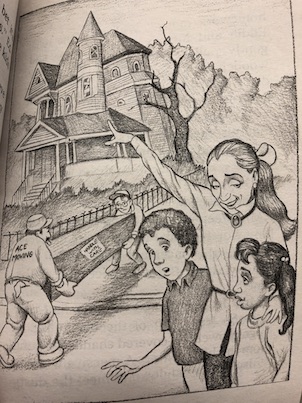
The school’s janitor, Mr. Dobson, quits one day after some kid spreads peanut butter from the food drive box all over the staircase banister. He’s had enough of their pranks! The third grade class’s substitute teacher, Mrs. Ewing, who is teaching the class while Mrs. Jeepers is visiting her family in Romania for Christmas, says that she’d hate to think that someone in their class actually stole food meant for some poor person and used it for an awful prank. The principal confirms that it was someone in their class when he pulls a couple of empty peanut butter jars from their trash can. The culprits turn out to be Eddie and Howie. So, the principal declares that, until they can get a replacement janitor, the third grade class will clean the entire building.
The other kids are angry with Eddie that they now have to give up their recesses to empty trashes and mop floors all over the school, and Melody says that it’s Eddie’s fault that Mr. Dobson is unemployed at Christmas. Eddie complains that “it was only peanut butter” and that it was Mr. Dobson’s choice to quit his job. The other kids know that part of Eddie’s problem is that he has an issue with Christmas, and that’s why he’s trying to spoil things. Eddie’s mother is dead, and ever since her death, his father hasn’t wanted to celebrate Christmas.
Fortunately, the principal soon tells the children that he has hired a new janitor, Mr. Jolly. Mr. Jolly is a cheerful older man with a thick white beard, and he likes to smoke a pipe. Mr. Jolly seems very nice, and he works very fast, but he has an odd way of watching the children and writing things down in a notebook.
Then, one day, the kids see Mr. Jolly talking to an odd little man, and they hear the man call him “S.C.” The little man seems very worried about something and wants Mr. Jolly to come and straighten out some kind of mess before Christmas. However, Mr. Jolly says that the work he is doing at the school is very important. They notice the kids watching them, so they don’t say any more, but the kids soon begin noticing other peculiar things about Mr. Jolly. He keeps the school’s temperature rather cold, but yet he likes to wear shorts. He doesn’t like it when Eddie turns up the thermostat because he likes the cold.
The temperature issue becomes serious because the kids have trouble working when it’s so cold. They have to wear their coats and sweaters all the time, and it gets to the point where it’s actually warmer outside than it is inside the building. Rather than freeze, Eddie decides that he’d rather get rid of Mr. Jolly. However, the other kids don’t want to help him after what happened with Mr. Dobson. Eddie takes it on himself to decorate the teachers’ lounge with toilet paper and turn up the heat again. However, Mr. Jolly solves both problems impossibly fast, and suddenly, the food drive box is overflowing with jars of peanut butter.
Liza is the one who suggests that Mr. Jolly could be Santa Claus. He looks like Santa Claus, and his short friend, who called him “S.C.” looks kind of like an elf. It would also explain why he likes cold so much and how he seems to do things magically fast. The others don’t believe her, and after Eddie pulls another trick that goes wrong, Mr. Jolly actually talks to him about Christmas and Santa Claus. Eddie says that those things are for little kids and even if there was a Santa Claus, he wouldn’t bring him what he really wants for Christmas.
Although Eddie doesn’t actually say it, what he really wants is attention from his dad. His dad is away a lot, working, and Eddie’s grandmother, who takes care of him, is often busy. However, Eddie becomes convinced that miracles can happen when his dad finally comes home for Christmas and actually wants to celebrate the holiday.
The book is available to borrow for free online through Internet Archive.
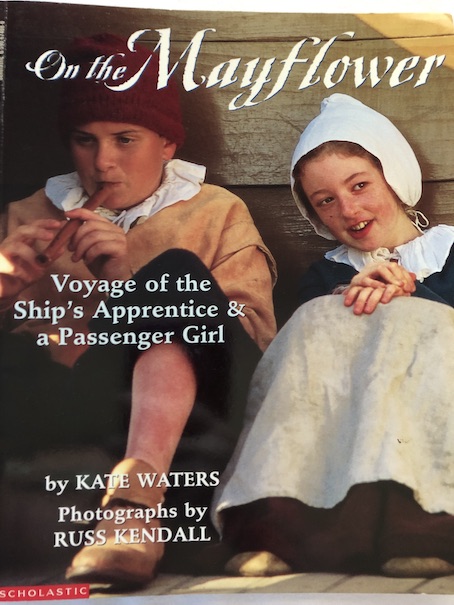
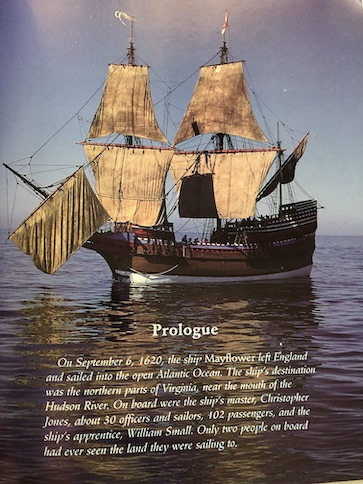
This book is part of a series by same author about children growing up in Colonial America. Each of the books is the series has photographs of historical reenactors portraying real people from Colonial history. This book focuses on two children who are traveling on the Mayflower in 1620, heading to what would become the Plymouth colony. One of the children is a girl who is a passenger on the ship, and the other is a boy who is part of the crew, a ship’s apprentice. In the section of historical information in the back of the book, the author explains that the girl was based on a real girl who was a passenger on the Mayflower, although the boy was not based on a specific apprentice; he is just meant to show what a ship’s apprentice would have been like at that time and to help explain the duties of the various crew members as he assists them.
The ship’s apprentice is called William Small. He is specifically apprenticed to the ship’s master, Christopher Jones (historical character). As an apprentice, he is learning basic navigation skills and assists the regular crew members with various tasks, including serving food.
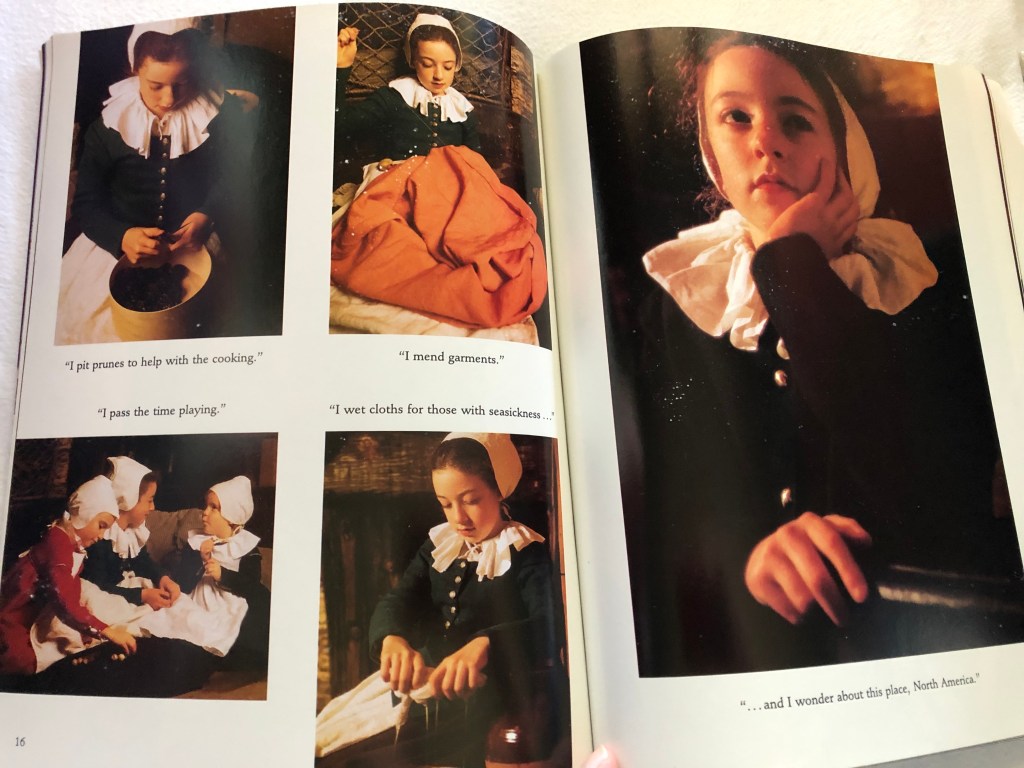
The girl is named Ellen Moore. She and the other passengers are traveling in cramped quarters, and people are often seasick or trying to find ways to keep themselves occupied during the long journey. Ellen is traveling with younger siblings, and she plays with them in between performing routine chores, like sewing and preparing food.
During the voyage, there is a terrible storm, and the passengers are all confined below deck without light because lanterns and candles would pose too much risk of fire while the ship is rocked during the storm. William has to help the ship’s carpenter to repair leaks. Before the storm is fully over, Mrs. Hopkins, one of the passengers, gives birth to a baby she names Oceanus (historical person, the real Oceanus made it through the voyage although he sadly died young, possibly about age six, but the date of his death is uncertain).
The book ends with their arrival in the Americas. Because the storm blew them off course, the Mayflower did not arrive at its intended destination in Virginia but further north at Cape Cod in what is now Massachusetts. Because winter was setting in, the passengers decided not to risk further travel and established their colony there, 65 days after their ship first left England.
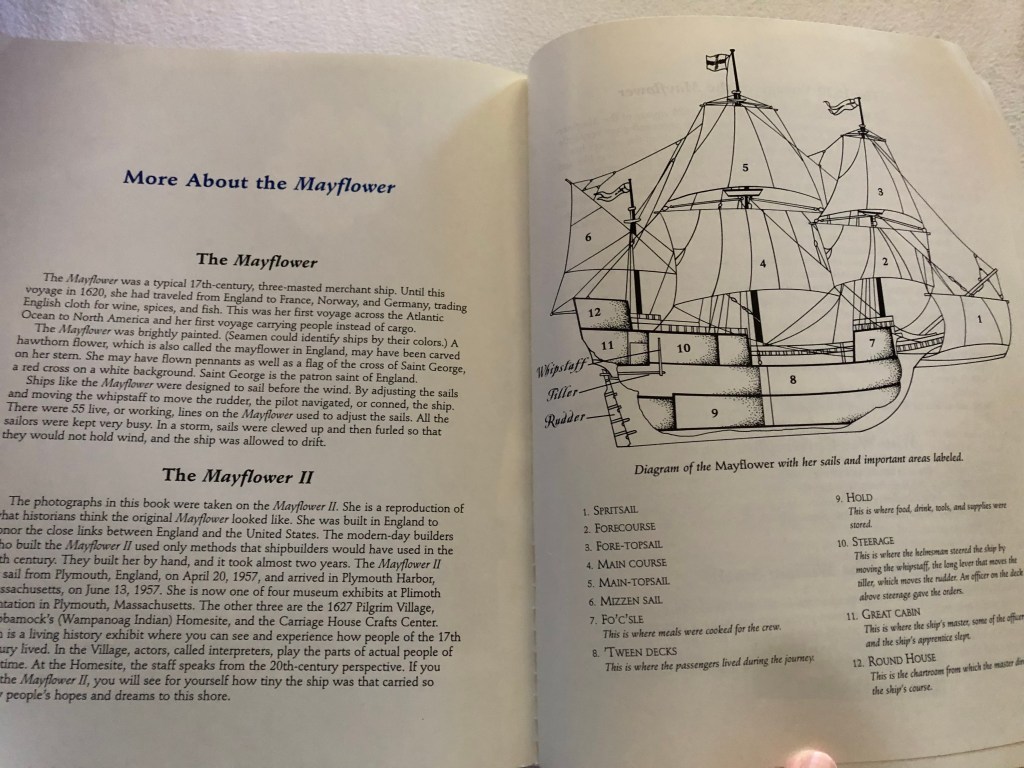
In the back of the book, the section with historical information explains more about both the characters in the story and the reenactors. The historical Ellen Moore and her siblings were traveling to the colony without their parents, under the guardianship of the other families, acting as young servants in their employment. The book mentions that the Moore children were without their parents because of a family tragedy but is not specific about what it was. I looked it up, and the story is both sad and bizarre. I can see why the author didn’t want to explain it in a children’s book. Apparently, the children’s parents had an arranged marriage and were not happy being married to each other. The children’s mother had a long love affair with another man, and also apparently, all of the children were the biological children of her lover. The mother’s husband began to notice that the children physically resembled his wife’s lover. The couple bitterly divorced, and after the husband was granted custody of the children (which, apparently, weren’t his anyway), he decided to send them away to the Americas with the departing pilgrims, paying for them to be taken on the voyage, never seeing them again. Sadly, Ellen probably did not survive the first winter at the Plymouth colony because she disappears from the historical record during that time. Out of the four Moore children traveling on the Mayflower, only one survived to adulthood, Ellen’s young brother Richard. Richard married twice in his life and had seven children of his own. He became a sailor and ship’s captain and eventually died an elderly man in Salem, Massachusetts, during the 1690s, not long after the Salem witch trials. None of this information about Richard is mentioned in the book, but I thought it was interesting background information. In the book, there is also additional information about the ship, The Mayflower, and the reproduction ship used in the pictures, The Mayflower II.
The book is available to borrow for free online through Internet Archive.
The Day of the Ogre Kachinas by Peggy D. Spence, 1994.
My Dog, Betty
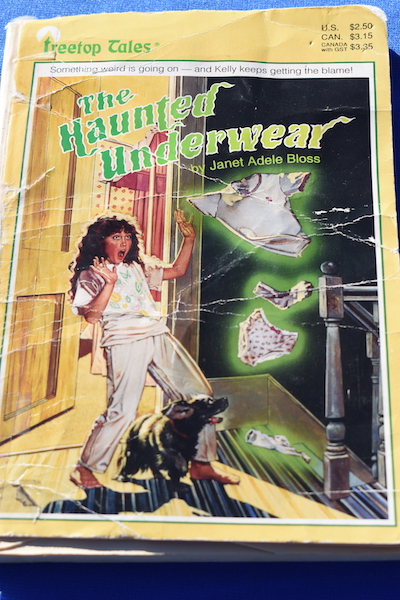
First, I would like to apologize for the cover picture above. This book was in better condition when I first got it. Then, I accidentally left it where my dog could play with it. Oops. She greatly enjoyed this book, which was printed on high-quality and apparently tasty paper, and thought it was a lot of fun, although she found it very difficult to get through. In fact, she did not get past the cover. (Thank goodness.) I enjoyed it much more.
The story is set in a Hopi town in Arizona (my home state!) and features Hopi traditions about kachinas. The introduction to the book explains a little about kachinas, which are spirits that represent concepts in the natural world. In Hopi ceremonies, men dress up as these spirits and dance or act out certain rituals. The ritual in this book is that of the Ogre Kachinas, which is meant to influence children’s behavior, teaching them what their community views as right and wrong and letting them know when they have overstepped the boundaries of their community. (I don’t know if eating the cover of a book counts as overstepping, but I promise that no doggies were harmed or even frightened as part of this book or the reading of it.)
Judson Honyouti, a young Hopi boy, is not a bad kid, but sometimes, like many other kids, he does things that he shouldn’t do. Sometimes, he forgets things or loses his temper and fights with people. His parents and the other adults in his village try to teach him the right things to do, but sometimes, he needs a little extra help to remember.
Judson is nine years old, and he knows that when he sees kachinas in a ceremony, it is only some of the men in his village, wearing costumes. He hopes that when he is old enough, he may become one of the kachina dancers himself, but for that to happen, he must follow his people’s ways and be a good member of his community. To be a good member of his family, Judson helps his father to take care of their cornfield and helps to look after his little sisters, but he still sometimes gets into trouble.
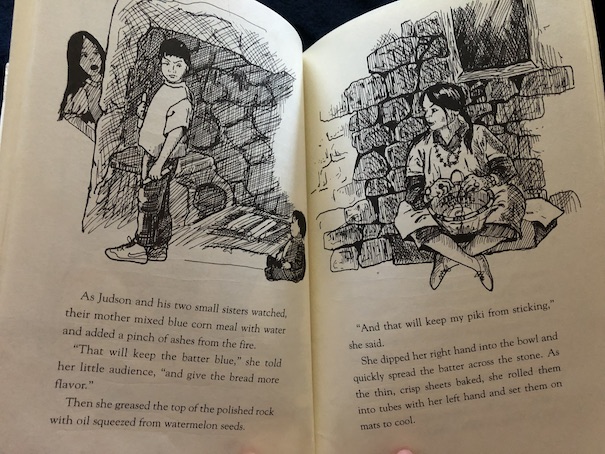
One day, Judson falls asleep while tending his family’s sheep, and most of them wander off. His father has to help him find the sheep again. Then, when his mother asks him to take some stew to his grandfather, Judson drops the bowl because he is playing and not paying attention. To make up for losing the stew, Judson gives his portion to his grandfather. Then, when Judson is supposed to be helping his mother to make piki (or paper bread) so that she can use it to trade in the market, Judson gives into temptation and eats too much. He has to help her make more.
In the market in the plaza, the Ogre Kachinas (really, men dressed up in costume), frighten the children and warn them that they must obey their parents. The Ogre Kachinas like to eat naughty children (but not really), and they say that they will return again soon to see if the children have been good. If they have been bad, the Ogre Kachinas might carry them away!
Even though Judson knows that the Ogre Kachinas are just human beings, their warnings worry him because he knows that he has been doing things wrong and has been getting into trouble. In spite of Judson’s attempts to do better, he still keeps getting into trouble. He fights with his sisters and even hits two other boys when he gets into fights at school. His father warns him that the ogres might come for him if he doesn’t behave, and sure enough, the Ogre Kachinas come one night.
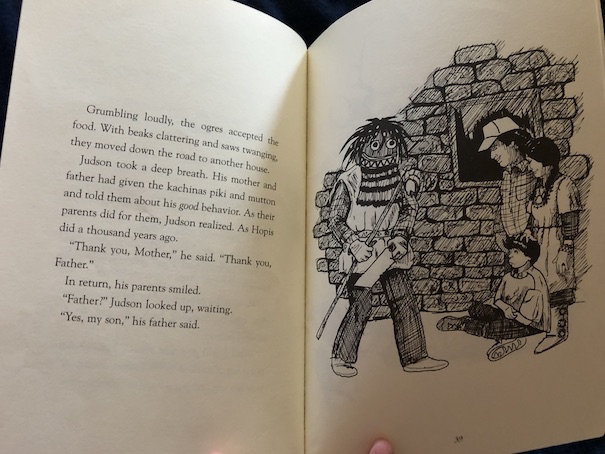
The Ogre Kachinas dance around Judson and his parents and confront Judson with their knowledge of all of the things that Judson has been doing lately. They threaten to take Judson away and eat him because they like to eat bad boys! Even though Judson knows that the kachinas are just ordinary humans in disguise, it’s an alarming performance! However, as part of this tradition, Judson’s parents speak up for him and tell the Ogre Kachinas to leave Judson alone.
It’s true that Judson has done things that he shouldn’t have done, but in many cases, he also did something to try to make up for what he had done wrong, like when he gave his portion of the stew to his grandfather to make up for the portion that he had ruined. He gets into trouble, but he is also polite and helpful in many ways. His parents say that he is actually a good boy and would make the ogres sick if they tried to eat him. Judson is relieved to hear that his parents love him and value the good things he does, even when he isn’t perfect. The Ogre Kachinas not only remind children of what they are not supposed to do but provide an opportunity for the parents to explain that they value their children and what the children do right. As Judson’s parents give the kachinas gifts of food and send them away, Judson realizes that their parents must have done the same for them when they were children and that the same thing has also happened for all Hopi children for generations.
I like books that include a little history and interesting information about cultural practices, but I also like this book for its understanding of human nature. First, I grew up in Arizona (in the American Southwest, for those who live outside of the United States), where this story is set. Although I am not Native American and didn’t grow up on an Indian Reservation, like Judson, I knew about Kachinas and was fascinated by them when I was growing up. I read books about Kachinas, and I loved the display of Barry Goldwater’s Kachina doll collection at the Heard Museum when I was a kid. I used to remember more of the individual names of different kinds of Kachinas and could point out the different ones in the Goldwater collection, but I’ve forgotten some of them as an adult. These things slip away if you don’t reinforce them. The book describes how Kachinas function in Hopi culture. There are different kinds that perform different ceremonial functions, but the main ones in the story are the Ogre Kachinas, which are meant to help frighten children into good behavior.
The need for both positive reinforcement and negative reinforcement is a real part of the human condition. Negative reinforcement has a bad reputation in modern times for making people feel scared or ashamed, and I think that it isn’t enough to have just negative reinforcement (punishment or criticism for things that a person has done wrong) or just positive reinforcement (praise for doing things right) by itself; I think they function best as a pair, the way they do in this story. It isn’t enough to just tell people what not to do (negative reinforcement) because it often leaves them wondering what they should have done instead, and it’s not enough to just give them praise with no criticism because it leaves them with the feeling that they do nothing wrong, and they’re often surprised later when they find out that things they’ve been doing have been seriously getting on everyone’s nerves all along. I think an over-reliance on positive reinforcement alone is part of the modern phenomenon where people don’t realize that they’ve been acting like bullies or saying really inappropriate things for years because, somehow, no one clued them in earlier in life. I’m pretty sure that I know why that is: it’s difficult to be the bearer of bad news or criticism that someone has gone too far with their behavior, to play the role of the disciplinarian, the “rules police” who has to stop the game to tell someone they’re not playing right. In an odd sort of way, the Ogre Kachina costumes probably make it easier for the elders of the community to dish out the criticism and discipline because they’re not quite doing it as themselves; they’re doing it in disguise as the horrible “ogres.”
To help people understand how they’re really supposed to behave in society, they need to know both what they’re not supposed to do and what people really want them to do instead. Judson gets both kinds of feedback in the story during the Ogre Kachina ceremony. First, he is confronted by what he has done wrong, and then he gets to hear his parents explain what he has done right in order to emphasize both what they love about him while helping him to realize what he needs to fix in order to be a better person in their society. Having a child confronted by scary ogres that threaten to eat him for doing things wrong sounds pretty scary, but the book does note that Judson is old enough to know that the Kachinas are just people in costume. Even though he’s kind of scared at being confronted by them, and for a moment, he does feel like they’re really threatening to eat him, he is aware that they are not what they appear to be and realizes that it’s all part of the ceremony. It also means that he is old enough to accept the rebukes as the consequences of their behavior, and he finds his parents’ praise of his good deeds as a motivator to do even better next time, not as an excuse for the things he did wrong.
By the way, Betty the dog was not punished for eating the book cover. I just took the book away from her and gave her a toy she could chew on instead. She is a good doggy, and I should not have left the book where she could get it. Bad Tracy!
The book is available to borrow for free online through Internet Archive.
Herculeah’s friend, Meat, decides to take a comedy class at a local comedy club called Funny Bonz. While he’s at the club for his class, he finds a dead body in the men’s restroom. He quickly runs to get help, but when the club’s owner (who is also the teacher of the class), Mike Howard, goes to check, the body is gone. It happens to be April 1st, so everyone assumes that it was just an April Fool’s Day prank. However, Meat is sure that what he saw was a real dead body.
He
tells Herculeah what happened, and he also remembers that he has proof of what
he saw: a blue wallet that he picked from the floor near the body. The ID in the wallet says is for a woman
named Marcie Mullet. Meat never got a
clear look at the identity of the body because it was lying face down, but he
remembers that it had a ponytail, so they assume that it was Marcie. Marcie was supposed to be a student in the
class, too, but she never showed up.
Meat and Herculeah assume that the body must have been Marcie.
However,
Herculeah is somewhat preoccupied by something else. She’s been getting strange vibes from a
camera that she bought at a secondhand shop.
The camera was cheap, only a dollar, and there’s still a
partially-exposed roll of film inside.
The camera was a great deal, but Herculeah’s hair is frizzling, and she
senses danger approaching.
When
she develops the film left in the camera, she realizes that the camera had once
belonged to Meat’s mother, and the pictures show Meat’s father. Meat has very little memory of his father
because his parents separated when he was very young, and his mother has
refused to talk about him for years.
Herculeah knows that Meat badly wants more information about his father,
but she hesitates to show him the pictures because she doesn’t think that he’ll
like what he sees. He’s imagined that
his father could have all kinds of cool professions, and she doesn’t know how
he’ll react to his real one.
Self-perception
is also very important to the solution to the murder. Meat is the first to learn the killer’s true
identity and is able to get the killer to confess and confide in him. The killer was tired of the victim’s mean-spirited
jokes, all of which were about the killer, who is fat. The murder was unintended; the person just
snapped when the victim gloated about using the mean-spirited comedy routine to
become famous. Meat understands how the
killer feels because he hasn’t had a very good perception of himself and knows
what it’s like to be fat. There is a
series of fat jokes in this part of the book, the meanest of which (the killer
quoting the victim) are about a fat woman’s bra size.
When his father’s true identity is revealed, Meat is actually glad, which surprises Herculeah. Meat’s father is very different from what he had imagined, but oddly, finding out that his father is a professional wrestler gives Meat something new to aim for. Meat is sometimes self-conscious of his large size, but seeing his father makes him realize that he can change his fat to muscle and be really impressive. The two of them meet, and Meat’s father apologizes for leaving so suddenly when Meat was young. He explains that, much like his own father, he has trouble living anywhere for very long. His own father had similarly abandoned his family when he was young. Both of them just reached a point when they had an irresistible urge to pick up and move on. However, Meat’s father makes it clear that he really does love him and is proud of him and says that he will continue to see him. It’s a strange explanation, but Meat accepts it and forgives his father.
This book is available to borrow for free online through Internet Archive.
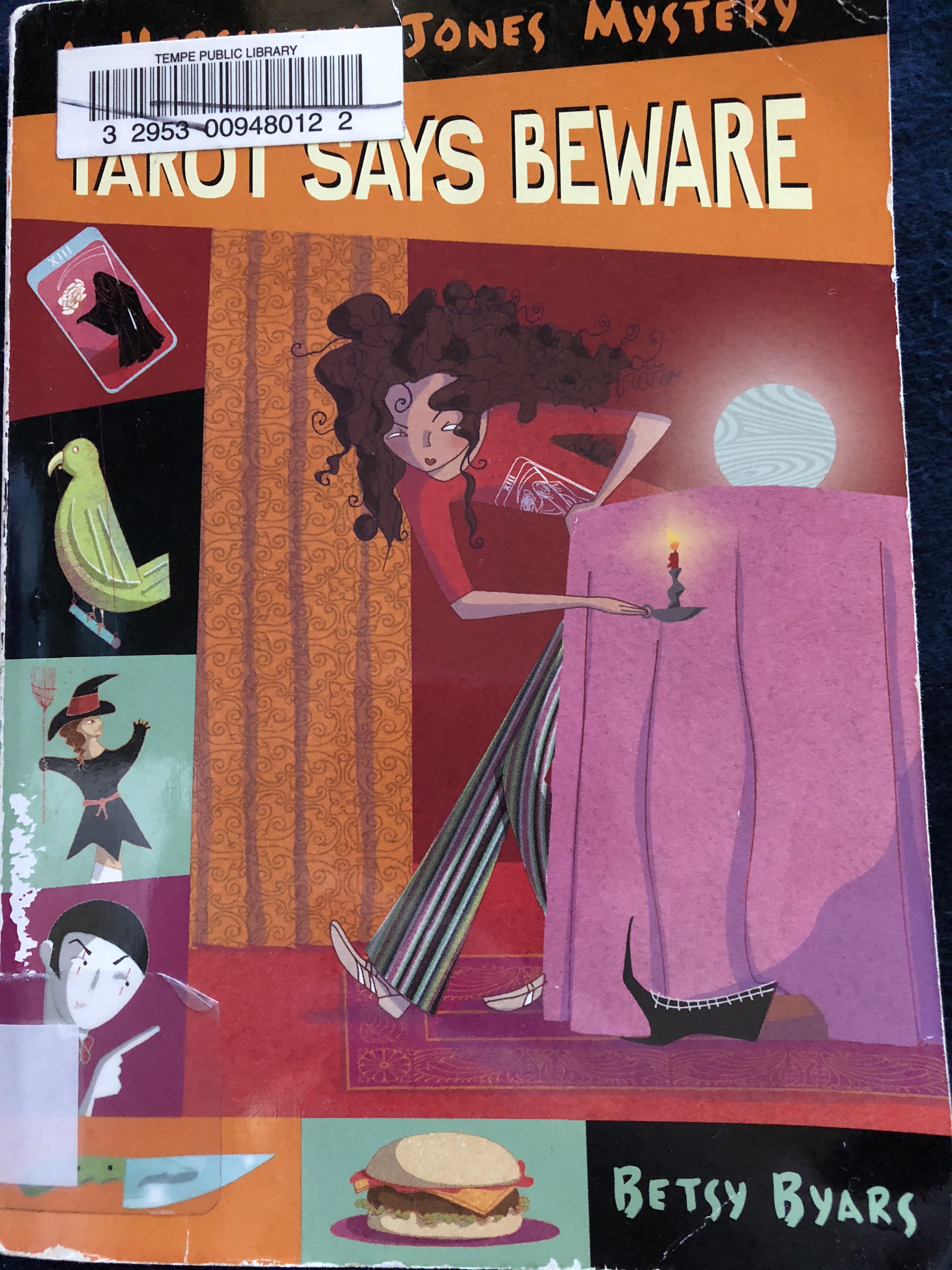
Madame Rosa is a fortune teller and one of Herculeah’s neighbors. Herculeah has been taking care of Madame Rosa’s pet parrot, Tarot, when she goes out of town. One day, Herculeah notices that Tarot has gotten loose and is sitting on the porch, so she goes to retrieve him. When she takes the parrot back into the house, she doesn’t see Madame Rosa. After investigating further, she finds Madame Rosa dead and calls her father, a police officer.
Herculeah is very upset about Madame Rosa’s death. She had considered her a friend. Even Meat said that he once consulted her for information about his father. She told Meat that his father danced, and Meat’s mother was very angry when she found out because she never wanted Meat to know anything about her ex-husband. She even said that she “could kill that woman.” But, who would really want Madame Rosa dead, badly enough to murder her? Was there someone else who didn’t like their fortune? Did Madame Rosa know something that someone was afraid that she would tell?
It turns out that Herculeah’s mother holds an important clue. Madame Rosa came to see her about a troubling client. A woman visited Madame Rosa to ask if her son could kill someone. The woman’s son had threatened her, and she wanted to know if he was capable of acting on his threats. Madame Rosa had asked her to bring something that belonged to her son, and the woman brought her the knife that the son had used to threaten her. That was when Madame Rosa had a vision of her own death. It frightened her so much that she fainted, and when she woke up, the woman was gone. Herculeah’s mother asked Madame Rosa what she’d like her to do, and Madame Rosa told her that she didn’t think anything could be done. Later, Madame Rosa was murdered with a knife.
So, now Herculeah suspects that the woman’s son came and murdered Madame Rosa, but she has no idea who the woman or the son are. Then, when Herculeah and Meat go to snoop around Madame Rosa’s house, Herculeah thinks that she sees Madame Rosa. Is she a ghost, or could Madame Rosa really be alive?
The title of the book comes from the fact that Tarot the parrot always says “Beware” to strangers, but not to Madame Rosa herself.
The book is available to borrow for free online through Internet Archive (multiple copies).
#1 Vampires Don’t Wear Polka Dots by Debbie Dadey and Marcia Thornton Jones, 1990.
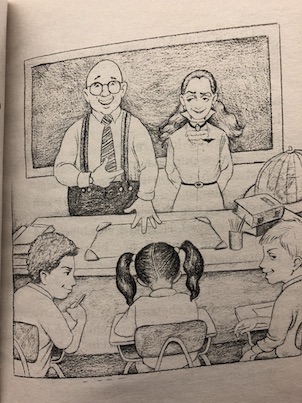
The kids in the third grade class at Bailey Elementary School have been pretty hard on their teachers. Their last teacher resigned when she suffered a nervous breakdown due to their misbehavior and pranks. Now, the kids have a new teacher, Mrs. Jeepers.
Mrs. Jeepers has just moved to their city from Transylvania, and everyone in class agrees that she’s not a normal teacher. She seems to have a hypnotic power over people, and her mysterious green brooch seems to glow and have magic powers. Not only that, but she has moved into a creepy old house in the neighborhood with a long box that could contain a coffin. Could Mrs. Jeepers be a vampire? No one knows, but none of the kids want to risk making her angry, except maybe Eddie, the class trouble-maker.
Mrs. Jeepers lays down the class rules on the first day. The rules are basically that the students should treat her and each other nicely, talk only when appropriate, and walk instead of run. Eddie asks her what happens if they break the rules, and Mrs. Jeepers only replies, “I hope you never have to find out.” Most of the other students are nervous about creepy Mrs. Jeepers and do their best not to make her angry, but Eddie is annoyed by how good the others are being and tries to various antics to get Mrs. Jeepers angry and make the other kids goof off, like normal. Sometimes, Mrs. Jeepers stops these antics, apparently with the power of her mysterious brooch.
Mrs. Jeepers is strangely evasive about her past, although she mentions that her husband is dead. He is the one who gave her the bat charm bracelet that she wears. Eddie and Melody try sneaking into Mrs. Jeepers’ house one night to see if they can get a look at the long box that might be a coffin, but they are unable to actually open the box, which seems to be locked from the inside.
The question of whether Mrs. Jeepers is really a vampire is never settled. Unlike most mythological vampires, she seems to have no problem going outside during the daytime. When the kids test garlic on her, it makes her sneeze. She does seem to have a strange power to make the children behave themselves, but that is partly because they are afraid of making her angry. At the end, Eddie finally causes Mrs. Jeepers to lose her temper. She takes him out of the classroom for a moment to talk to him, and when they return, Eddie seems to have been badly frightened by something. He never tells the others exactly what Mrs. Jeepers said or did, but he says that she is not normal and that he’ll never do anything to make her angry again.
When the book ends, it says that the children got through the rest of the school year with Mrs. Jeepers without getting her angry or seeing her brooch glow again, making me think that the book wasn’t always intended to be part of a series. However, for the rest of the series, the kids are still in the third grade with Mrs. Jeepers as their teacher.
The fact that the kids can never really prove that Mrs. Jeepers is a vampire, although they continue to believe it throughout the series, sets up the pattern for the books that follow it. Throughout the series, the kids encounter other people (including some relatives of Mrs. Jeepers) who seem strange and may be creatures from mythology or folklore or other supernatural beings, but the books always leave some room for debate. Mrs. Jeepers is the only one of these strange people to remain with the kids throughout the entire series. Other characters come and go, although there are a few recurring characters.
I always like it when children’s books reference other children’s books. In the beginning of the book, after their first teacher leaves, the kids worry about who their new teacher will be, and they make a reference to Miss Viola Swamp from the Miss Nelson books.
The book is available to borrow for free online through Internet Archive.
Things have been rough for ten-year-old Kelly Towser since her parents decided to adopt a four-year-old boy named Stevie. For the first part of her life, Kelly was an only child, and now she misses that peaceful period of her life. Now, her parents don’t have as much time to spend with her. Everyone showers little Stevie with attention and presents. Although she doesn’t say so, Kelly worries that maybe her parents adopted Stevie because they were disappointed in her or secretly really wanted a boy instead.
To make
things worse, Stevie’s little-kid antics get on Kelly’s nerves. Stevie keeps making messes, throwing his toys
all over the place. Kelly’s parents tell
her that she used to make a lot of messes when she was little, too. Kelly doesn’t remember doing it, but her
parents say that she used to like to throw her clothes all over the place, even
hiding her underwear in random locations in the house. They used to joke about her “haunted
underwear,” mysteriously showing up in strange places.
Because Kelly complains that Stevie is getting all kinds of presents, and she isn’t, her parents agree to give her a special present to celebrate her getting a new brother. After thinking about it a little, Kelly decides that she wants a new puppy. The family already has a dog named Star, but Kelly thinks that the new puppy could be a friend for Star while she’s at school.
At the
pound, Kelly selects a cute brown puppy.
One of the workers tells her that the puppy was found abandoned at the side
of the road, dirty and hungry. Stevie is
excited about the new puppy and wants to play with him, but Kelly is determined
to keep the puppy for herself, something that she doesn’t have to share with
Stevie. When Stevie insists that the dog’s
name is Boscoe because he used to have a dog named Boscoe, Kelly insists that
the dog’s name is Jingle. Stevie gets
upset that she isn’t sharing the dog, but Kelly doesn’t think that Stevie would
be careful with the puppy because he has already pulled Star’s tail.
As older readers might guess, Kelly soon finds herself in a similar position with Jingle as her parents are with Stevie. Star gets jealous of the new puppy in the same way that Kelly is jealous of Stevie, feeling like she’s been replaced in her own house.
Kelly
does try to get her parents’ attention with some silly stunts, but when her clothes
and underwear mysteriously start appearing around the house, she has no
explanation. Her parents punish her,
thinking that this is just another attention-getting stunt, but Kelly knows it’s
not her. She starts thinking that the
real culprit is Stevie, trying to steal her parents’ attention and affection
more than he already has. However, there
is another explanation for the mysterious underwear ghost, and as Kelly
investigates, trying to catch Stevie with her underwear, she learns a number of
important things.
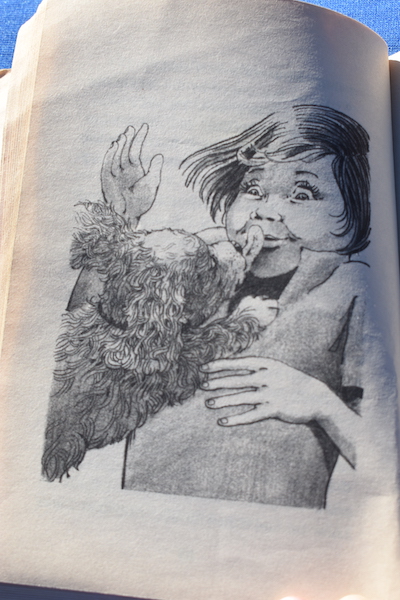
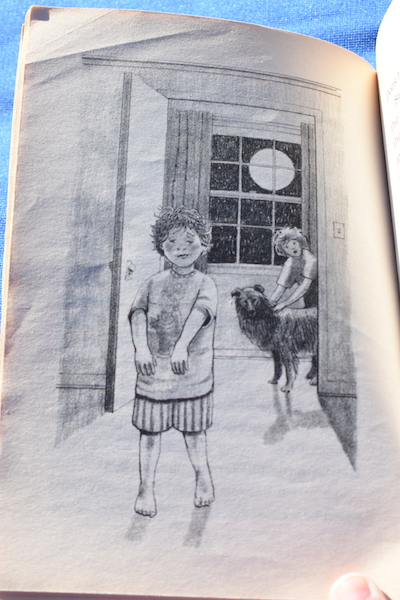
I figured out pretty early who was responsible for the underwear around the house, although it helped that I’ve had experience with dogs. Star, feeling neglected because of the new puppy, was trying to get Kelly’s attention in the same way that Kelly was trying to get her parents’ attention. Stevie does look guilty for a while because Kelly discovers that he is a sleepwalker and has been having nightmares. However, when she gets up in the night to catch Stevie sleepwalking with her underwear, she finds Star taking it instead. Understanding Star’s feelings help Kelly to better understand her own feelings, and she resolves to spend more time with Star so she’ll feel less neglected. When her parents discover the truth, they apologize to Kelly and reassure her that they didn’t adopt Stevie as a replacement for her and that they don’t love her any less.
Kelly’s mother also talks to Kelly about what she knows about Stevie’s history. Although they don’t know the names of Stevie’s birth parents, Kelly’s parents know that Stevie’s mother wasn’t married and had no money and gave up him for adoption in the hopes that he would be raised in a more stable home. Stevie has not seen her since he was two years old, two years ago. Stevie is troubled by nightmares because his young life has been very chaotic, and he has been moved from foster home to foster home, with people always giving him up. He deeply fears that his new family will also give him up and is terrified when they seem like they’re going to go somewhere, afraid of that they’ll never come back. That is what his nightmares are really about. Kelly comes to realize that his situation is very much like Jingle’s, that the fact that someone gave him up doesn’t mean that he’s bad and that all he needs is time, attention, and love to grow out of his problems.
Even though things work out okay, this is one of those books where I found myself getting impatient with the parents. I think that some of Kelly’s bad feelings might have been resolved much sooner or avoided altogether if Kelly’s parents had spoken more honestly with her in the beginning, preparing her to be patient with Stevie and to understand when he has problems. Apparently, they did tell her at least some of what they knew about Stevie’s past in the beginning, but they don’t seem to have spoken to her much about how that might influence his behavior and how he will need a lot of time and reassurance to get over his fears.
When I used to volunteer at an animal shelter, we used to tell people who were adopting dogs that they would have to expect that their new dog would destroy something that they owned, especially if it was an energetic young puppy. When you bring a new dog into your house, it doesn’t know the area, it doesn’t know you very well, and it doesn’t know the rules that go with you and your house. It’s almost certain that, soon after arriving, it will relieve itself in the wrong place or pick the wrong thing to use as a chew toy. Something is likely to get ruined or some mess will be made. The best you can do is to take some preemptive measures, like securing valuables, closing the doors to rooms with things that the dog shouldn’t get into, and taking the dog to the place where it should relieve itself immediately on arriving at the new home. These steps can help head off problems, but at the same time, something is still likely to go wrong because the dog needs time to learn what you find acceptable and unacceptable and will probably do something wrong while learning. We didn’t tell the new owners this to scare them off from adopting but to help manage their expectations so that they wouldn’t panic and try to return the new pet at the first sign of trouble. I think that Kelly needed a similar warning about her new brother to help manage her expectations.
Early in the story, Kelly says that when her parents first started talking about adoption, she thought that it would be great because she’s always wanted a little brother that she could teach to do fun things like roller-skating or flying a kite. Her attitude toward her new brother only soured when he seemed to be taking all of her parents’ attention and crying all the time and making messes. She thinks at one point that it’s hard to love someone who seems determined to get you in trouble, which is what she thought Stevie was doing with the underwear. My thought is that, if Kelly’s parents had explained more to her that Stevie might misbehave or be nervous in his new home and would need time to be taught how to live in their family, perhaps Kelly wouldn’t have been so upset and the parents would have been less quick to blame Kelly for the underwear issues. Knowing that there might be some problems that would be temporary would have been reassuring to Kelly that there were better things ahead for her and her new brother.
Also, even though the parents seemed to understand that Kelly was seeking their attention, they didn’t really do anything positive about it at first, just punishing her for leaving the underwear around. If they had told her, straight out, in plain English, that even though they’ve been very busy with Stevie that doesn’t mean that their feelings for her have changed and that she doesn’t need to pull stunts to get their attention because they would be spending some quality time with her soon, it might have helped to head off Kelly’s bad feelings. The closest they get to that at first is when they tell her that she’s old enough to know that there are better ways to get their attention than silly stunts. They don’t mention what the better ways are, and they don’t follow it up with much of an attempt to give her a little attention. What annoyed me most was that Kelly’s mother waited for Kelly to approach her to talk, but in her place, I think I would have taken the initiative, especially after Kelly’s stunts included some potentially dangerous bike stunts. I’m a great believer in direct communication. I tell people if there’s something I want them to know, and if I want to know what they’re thinking, I ask. Over the years, I’ve discovered that if you leave people guessing what you’re thinking or what you want, you discover that most people aren’t good at guessing. I won’t say that Kelly’s parents are the most clueless ones I’ve seen in children’s books because they made more of an attempt to tell Kelly things and talk to her than some other parents in books do. All the same, it always gets to me when problems in books could be avoided with just an extra conversation or two. There were a couple of times in the book when I wished that I could step into the scene, call “Time!”, and make the characters just stop and really talk to each other and take a real look at the situation.
The book is available to borrow for free online through Internet Archive.
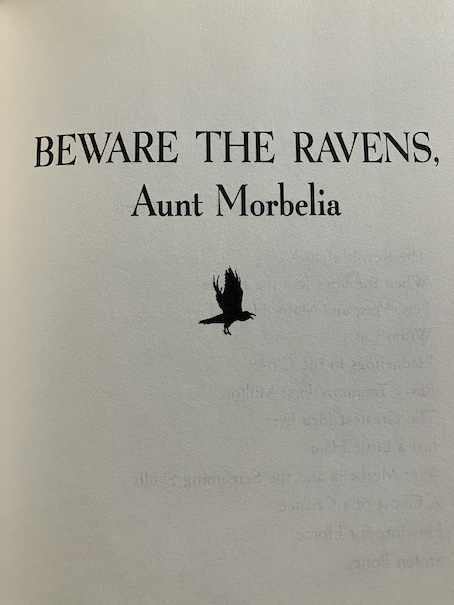
Years ago, Aunt Morbelia inherited the Fearing family estate, Harrowwood, after her cousin died. Aunt Morbelia goes to England to inspect the estate and make some decisions about its future. The estate is in disrepair, and taxes have been eating up the funds intended for its upkeep. Todd and his friend, Jeff, also go to England with Aunt Morbelia to see the family estate and famous places in London.
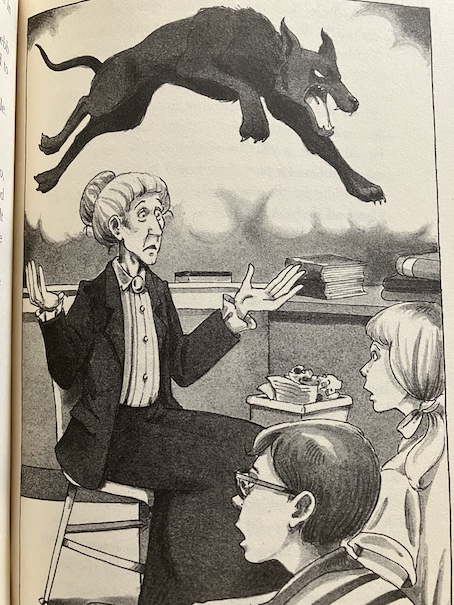
Some of Aunt Morbelia’s fascination with creepy stories becomes apparent as she recounts the dark history of the estate and the mysterious death of her wicked, possibly murderous, uncle. He was apparently killed by animals after his cruelty to the animals on his estate was discovered. When they spend the night at the estate, Todd and Jeff hear a frightening howl. They are only too happy to move on to London and go sightseeing.
At Harrowwood, Todd finds an old journal belonging to his aunt’s cousin, Albert, and he thinks it would be interesting to see the places that he visited when he went to London years ago. Albert was an eccentric man who died in an insane asylum because people thought he was crazy for going around town making bird sounds all the time. Still, Todd is fascinated by the strange drawings and cryptic notes in the journal. Before Todd can figure out what they mean, he and Jeff spot mysterious characters following them around, and someone leaves a threatening note at the bed and breakfast where they are staying. Todd is determined to find out who their mysterious stalkers are and put and stop to it!
The book is currently available online through Internet Archive.
My Reaction and Spoilers
The first book in this two-book series wasn’t a mystery, but this one is. (The first book in the series focused more on Todd and Aunt Morbelia getting used to each other when she moved in with Todd and his parents, and it had more discussion of Todd’s dyslexia in it than this one did.) There are things that Aunt Morbelia doesn’t know about her family and the family estate. The estate has meaning for her, but it has greater meaning for someone else, and so does the journal that Todd found. The Fearings have always been an eccentric bunch, and when they learn who has been following them around, Todd and Aunt Morbelia have some suggestions that change things for the better.
Aunt Morbelia didn’t know it, but her cousin had a son before he died, and he is bitter that Morbelia inherited the estate instead of him. He and his family have been secretly living on the estate for years, and they are afraid that Morbelia will have them thrown off. They admit that they were trying to scare Aunt Morbelia and Todd away so they could have the estate to themselves. They also want the journal that Todd found and has been carrying around the whole time. The journal contains Albert’s notes of his research on birds and bird calls. Albert believed that he had discovered the language of birds and could communicate with him. His son wants to carry on his strange work and maybe learn to communicate with other animals, too. Todd gives the journal back to them, and Aunt Morbelia assures them that she will not throw them off the estate. In fact, she suggests that they give nature lessons to tourists in order to support the upkeep of the estate. Because they demonstrated their skill with disguises and acting while following them around London, she also suggests that they put on mystery plays and host mystery weekends on the estate. They enthusiastically agree to the plan, and Aunt Morbelia and Todd talk about visiting next year to see how things are going.
Aunt Morbelia and the Screaming Skulls by Joan Carris, 1990.
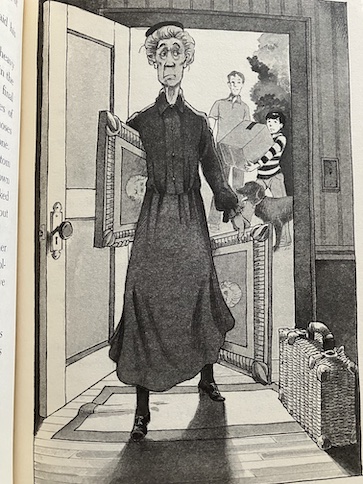
Todd Fearing is worried because his Great-Aunt Morbelia is coming to live with his family. He has never met her before, but he has heard that she is rather strange, and he knows that his life will never be the same again. Aunt Morbelia is very superstitious, and she sees bad omens everywhere. When she first arrives at Todd’s house and sees that the family owns both a black dog and a black cat, she takes it as a sign that she should leave right away. It takes a lot persuading to get her to stay on a trial basis. By Joan Carris.
Having Aunt Morbelia at his house is sort of a mixed blessing. On one hand, Aunt Morbelia likes baking good things for him to eat and helps him with his homework. Todd is dyslexic and has extra assignments to help him improve his reading. Aunt Morbelia used to be a teacher, and Todd really appreciates the help she gives him. On the other hand, Todd doesn’t like scary stories, and Aunt Morbelia’s talk of ghosts and bad omens gives him nightmares. His friends like to hear her stories, particularly Rocky, a girl who typically doesn’t like feminine things. Rocky, whose real name is RosaLynn, constantly pesters him about when Aunt Morbelia will tell more stories.
Eventually, Todd gets tired of Rocky’s obsession with ghost stories and the way she encourages Aunt Morbelia to keep telling them, and he and his best friend, Jeff, decide to play a trick on her to cure her appetite for scary stuff. However, their trick backfires, and in their attempt to make it up to everyone, especially Aunt Morbelia, they end up making things worse.
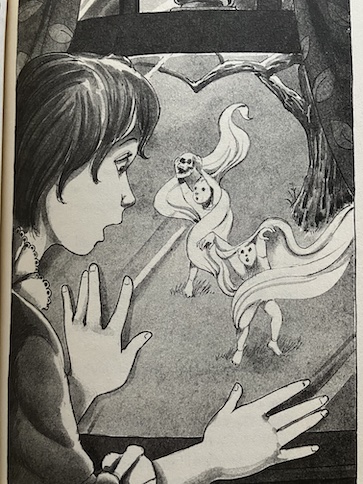
Todd and Jeff succeed in scaring Rocky by dressing up as ghosts and showing up at her house in the middle of the night. They have so much fun with their trick that they decide to go to their friend Alan’s house to try it on him. Alan lives in the house right behind Todd’s, and that’s where they run into trouble. When they start their ghost act, they can’t get Alan to wake up and come to the window to see them. Jeff decides to throw a rock at Alan’s window to wake him up, but the rock breaks the window. To make matters worse, they startle Todd’s black cat, causing the cat to yowl. The boys run back to Jeff’s house, but Jeff’s father catches them. Todd has to go home and apologize to Aunt Morbelia, who was frightened very badly when the cat started howling.
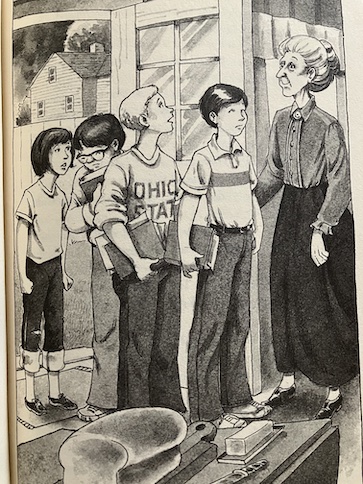
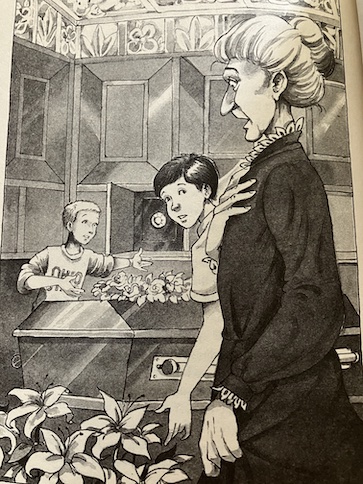
The boys decide to take Aunt Morbelia on a tour of the historic places in town to make up for scaring her. Unfortunately, Jeff includes the funeral home that his father runs on the tour because it is in one of the oldest buildings in town. Although Todd tells her that she doesn’t have to go in if she doesn’t want to, Aunt Morbelia thinks that it would be rude to refuse. Unfortunately, Jeff’s father arrives with a dead body before their tour ends, and Aunt Morbelia faints when she sees it. Aunt Morbelia tells the boys that it isn’t their fault, but she says that she’s not sure she really belongs in their town. Even with all of Aunt Morbelia’s superstition craziness and spooky stories, Todd still doesn’t want her to leave. Is there still something he can do to convince her to stay?
When I first read this book, I was expecting a spooky mystery, but it’s really more about a boy adjusting to a relative coming to live with his family and dealing with his dyslexia. Although Todd initially has some reservations about Aunt Morbelia living with him and his parents and her spooky stories scare him, Todd and Aunt Morbelia gradually come to understand each other better, and Todd genuinely wants her to stay. To help Aunt Morbelia change her mind about leaving, Todd has all the people who have met Aunt Morbelia since she arrived come by the house and tell her how much they all want her to stay. After everyone has visited her, Todd himself tells her that he doesn’t want her to go. They talk about the scary stories and how Todd feels about them, and Aunt Morbelia tells Todd that if he doesn’t want to hear a scary story, he can be honest with her and tell her so. Now that the two of them understand each other better, Aunt Morbelia agrees to stay, and she accepts the invitation that one of Todd’s teachers makes to help tutor children at the learning center.
I didn’t like the part where the boys played the trick on Rocky and how awkward things were with her afterward. Jeff’s father says that part of that, with Rocky drifting away from her friendship with the boys, is because the kids are growing up. He says that, as they grow up, girls start changing before boys do and have different interests from boys and different ways of looking at things, including more tomboy girls, like Rocky. Toward the end of the story, Rocky does appear to need more friendships with other girls, and Todd decides that Jeff’s dad is probably right, that Rocky thinks and acts differently from his guy friends because she’s a girl, even if she’s usually not a particularly “girly” girl. Part of that may be true, but the boys’ trick was pretty mean. I think that the real issue is that real friends shouldn’t do that to each other, and Rocky might really be questioning what she’s looking for in a real friend. Although, to hear some of my male friends talk about their youths, boys (at least certain ones) might be more accepting and forgiving of that kind of rough humor from friends than girls would be, so perhaps boys vs. girls issues are partly at the heart of it.
I thought that the parts where Aunt Morbelia was helping Todd with his dyslexia were interesting. I don’t really have any experience with the condition myself, and I’m not quite sure what techniques teachers really use to help dyslexics. One of the tricks that Aunt Morbelia uses is to break down tasks into smaller pieces to make them more manageable. For example, Todd feels badly that he can’t keep the orders of months straight. When he tries to recite the months of the year in order, he mixes them up, which makes him feel bad because most kids his age should be able to do this easily. When I first read this, I wasn’t sure if this is a common issue among dyslexics, although I thought that I remembered reading something about dyslexics having trouble remembering the orders of certain things, like lists of instructions. I looked it up, and apparently, it is a common issue, along with memorizing things like days of the week. There are different techniques for handling it, some of which involve associating the things to be remembered with something else that sticks in the mind more easily, such as a rhyme or song. Aunt Morbelia does some association with Todd but she also breaks the months down into groups of three, representing the four seasons of the year, and giving him small bits of information to memorize. She calls the spring months, “the flower months” and the fall months “the leaf months” and so on. Todd finds that technique helpful, and Aunt Morbelia says that once Todd has mastered the seasons of the year, they will put the season of the year together so that he can recite the entire year. Todd also describes other ways that he is affected by his dyslexia and techniques that his teacher uses to help him.
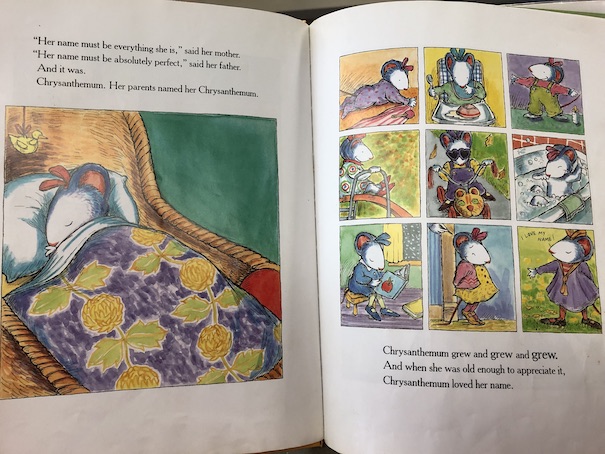
When little Chrysanthemum was born, her parents chose Chrysanthemum as her name because it just seemed perfect, as perfect as their little girl. As Chrysanthemum grew up, she loved her name, and she thought that it was perfect, too.
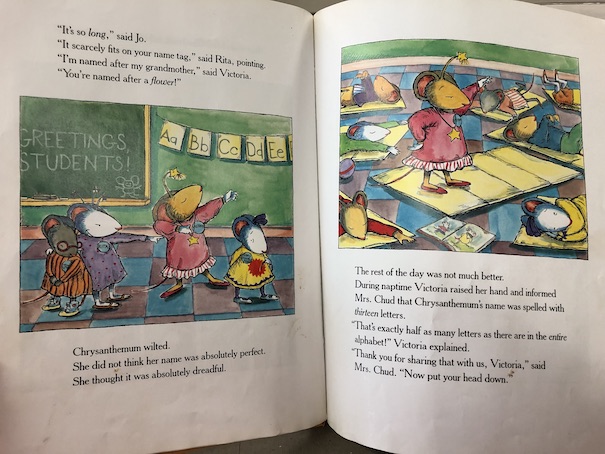
However, when Chrysanthemum starts school, the other kids point out how unusual her name is. Most of them have much shorter names. Chrysanthemum’s name is so long that it doesn’t really fit on her name tag. One girl, Victoria, is particularly mean about Chrysanthemum’s name, making fun of her whenever she can and encouraging other children to make fun of her.
For the first time in her life, Chrysanthemum starts hating her name. She wishes that she had a much shorter name, like Jane. Her parents comfort her and tell her that the other kids are probably just jealous, but their repeated teasing really bothers her.
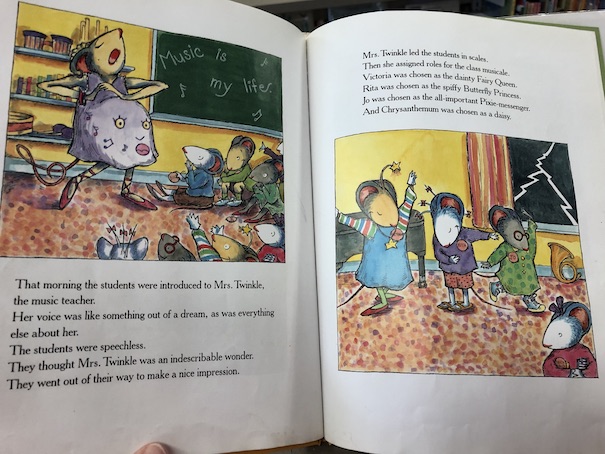
Then, the children have music lessons at school with Mrs. Twinkle. Mrs. Twinkle is a fun teacher, and the kids are excited about her class. She gives the children roles to play in a class musicale, and Chrysanthemum is cast as a daisy. When the other kids laugh about her playing a different type of flower, Mrs. Twinkle asks them what’s so funny.
The other kids explain about Chrysanthemum’s name and that they think it’s funny because it’s so long and weird. That’s when Mrs. Twinkle tells them that her first name is Delphinium – another long, unusual flower name! She says that she really likes the name Chrysanthemum, and since she’s expecting a baby, she might name the baby Chrysanthemum if it turns out to be a girl. Suddenly, the other girls in class envy Chrysanthemum and wish they had flower names, too!
In the short epilogue at the back of the book, the baby does turn out to be a girl, and Mrs. Twinkle names her Chrysanthemum. Chrysanthemum also gets a laugh at Victoria’s expense when the class puts on their musicale, and Victoria completely forgets her lines.
It’s a nice book, and I appreciate some of the messages now even more than when I first read it when I was a kid. Now that I’m an adult, I know that Chrysanthemum’s name isn’t the real reason why Victoria picks on Chrysanthemum. Victoria is mean basically because Victoria is a mean person. Kids who want to bully others make the decision to bully first and then pick something to bully about second. From what I’ve seen, they’re usually out to make fun of someone or make someone mad just to do it, and they don’t really care how or why. Chrysanthemum’s unusual name was just a convenient thing for Victoria to single out and use for her bullying. If she hadn’t had that name, Victoria would have picked on her (or maybe some other, more convenient target) for something else. Maybe it would have been someone’s clothes. Maybe it would have been the way someone walks or the way someone talks or their hair or their eyes or the fact that they have fingernails or breathe air or take up physical space … you get the idea. Victoria is the way she is because that’s what she is and what she wants to be, and she doesn’t see any need to change until the end of the story. (Even then, she may be back to bully again over something different because she hasn’t yet learned not to bully in general, just not over that particular thing.)
My point is that the way Victoria is has nothing to do with Chrysanthemum and her name. I’ve heard parents who are considering names for their children working hard to pick names that can’t be used for teasing, and sometimes, it can help. However, at the same time, bullies are basically going to bully because that’s who they are and what they do, and most importantly, it’s what they want to do. They’ll find something to bully about anyway because they’re always intentionally looking for something to bully about.
For a time, because of Victoria’s meanness and bullying, Chrysanthemum’s enjoyment of her name is ruined. She even feels like Victoria is destroying her sense of identity. At one point, she has a nightmare that she is actually a Chrysanthemum flower and that Victoria plucks her petals, picking at her and picking at her and picking at her until there’s nothing left. That’s the kind of effect that bullies have on people, which is why I have such contempt for them. They ruin things, even really fun and cool things like a colorful name, and make people unhappy just by being the kind of people they are. (If you’ve read my other reviews of books with bullies, you’ve already heard that I have very strong feelings about this subject and absolutely no patience or sympathy for bullies.)
But, fortunately, the book takes a very positive tone and points out that Chrysanthemum’s name is not really ruined by Victoria’s meanness. Chrysanthemum’s music teacher also has a really unusual flower name, and naming her baby Chrysanthemum as well gives Chrysanthemum new status among the kids at school, to the point where some of them, including Victoria, wish that they also had flower names of the kind that might inspire someone to name their baby after them. Mrs. Twinkle is a fun and different kind of teacher, and her fun and different name fits her personality. Although it hasn’t occurred to the other kids yet, the world would be a pretty drab place without colorful and unusual people. The Victorias and Janes of the world may have very proper names and are reassuringly ordinary, but the Delphiniums and Chrysanthemums are the ones who bring color and excitement to life. So, although I wouldn’t deliberately give a child a name that might leave them open to teasing, I don’t see a need to go overboard and reject some of the fun names that are just a bit unusual. Different is good, and it should be appreciated for what it is, not for what a bully may or may not be able to say about it when they’re trying to be mean. (They’ll find something else to bully and complain about two seconds later anyway, so why bother considering them for longer than that?)

















 Jestress's Forgotten Books and Stories