Lilly’s Purple Plastic Purse

Lilly’s Purple Plastic Purse by Kevin Henkes, 1996.

Lilly loves going to school, and she especially loves her teacher, Mr. Slinger. Everyone in class thinks that he’s great, and he inspires a lot of them, including Lilly, to want to be teachers themselves.

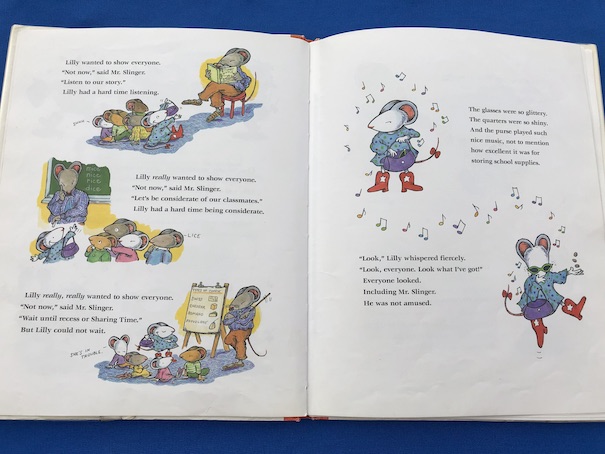
One day, after a special shopping trip with her grandmother, Lilly gains a some special new treasures: movie star sunglasses, some quarters, and a purple plastic purse that plays a tune when she opens it. Eager to show off her new things to her friends, Lilly brings them to school. However, she just can’t wait until recess or Sharing Time to show everyone. She keeps trying to draw attention to these things while the teacher is talking and opening the purse so it keeps playing its tune.

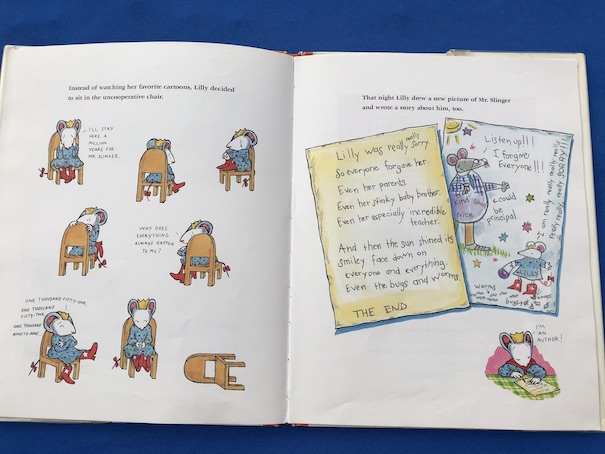
Finally, after repeated warnings, Mr. Slinger is forced to confiscate Lilly’s purse with its other treasures. Lilly is hurt and feels betrayed by her favorite teacher. Sad and angry at having her treasures taken from her, she draws a mean picture of her teacher as a purse thief, leaving the picture where she knows he will find it.

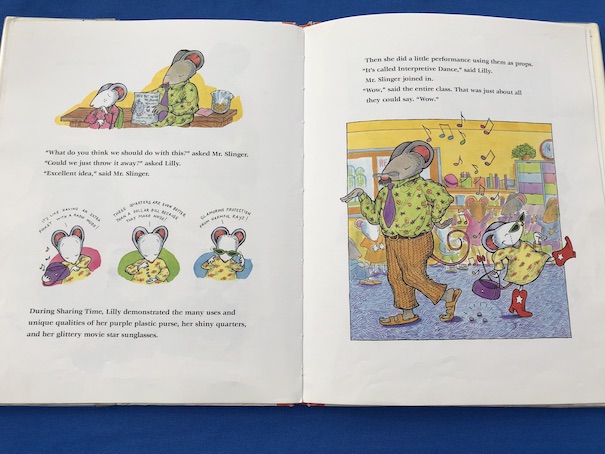
However, Mr. Slinger isn’t as mean as Lilly thinks that he is when he takes her purse. After he gives the purse back to her, she discovers a nice note from him inside, telling her that tomorrow will be a better day, and there’s even a little bag of snacks. Now, Lilly feels guilty about her mean picture. It’s too late to get it back, and she worries that her teacher will never forgive her.

The story is really good at showing how Lilly’s emotions change through the course of the day and how her sadness and anger grow more urgent the more she thinks and worries about them. It’s a good story to use when talking about feelings with young children (through the course of the story, Lilly is happy, excited, sad, betrayed, angry, guilty, worried, and embarrassed – some of these are stated explicitly and some are more implied) and how to deal with emotions. Adults can talk to children how one kind of emotion can lead to another (like how Lilly’s sadness turns to anger at her teacher for making her feel sad by confiscating her purse) and how some ways of dealing with emotions are better than others. It is both creative and appropriate that Lilly used her drawing ability to both insult her teacher and, later, apologize to him.

Fortunately, both Lilly’s parents and her teacher are very understanding. Her parents reassure her that her teacher will forgive her. Lilly draws a new, nicer picture of her teacher to go with her apology to him, and her parents give her some snacks to give to him as well. He does forgive her, and she finally gets to show everyone her amazing purple plastic purse at Sharing Time (being careful not to disturb anyone with them at other times.

The book is currently available online through Internet Archive. It is part of Mouse Books series.

Skylark

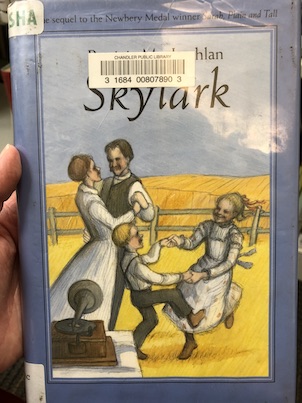
Skylark by Patricia MacLachlan, 1994.

The second book in the Sarah, Plain and Tall Series picks up about two years after the first book, shortly after Sarah marries Jacob, the father of Anna and Caleb.  That summer is very dry, and people worry about when it will rain next.  If there is no rain, their farms will be in danger.  Some people have been known to simply abandon their farms and move on during especially long dry spells.  Jacob says that their family won’t leave, no matter what, because “Our names are written in this land,” meaning that they have a commitment to it because they were born there and make their lives from the land.  However, Sarah was born in Maine, and Caleb worries that, if the dry spell goes on too long, Sarah will want to return to Maine.

The year goes on, and Sarah settles in to life on the farm.  Her cat, Seal, has kittens.  Sarah reflects on the baby animals and seems thoughtful about babies.  However, people are becoming ever more concerned that the water in the wells is lower than usual.  As people keep hoping for rain, Sarah gets a letter from Maine, saying how lovely and green everything there is.  The land around the farm is dry and brown, and the family has had to ration their water carefully, their supplies running increasingly low. 

Eventually, a family from the area has to pack up and leave because their well is dry.  Sarah is upset, trying to think of some way around the problem, but there is nothing to be done.  Everyone’s supplies are running low, and they’re already doing everything that can be done.  Sarah hates feeling helpless against the problem.  When Sarah’s best friend, Maggie, talks about leaving with her family, Sarah says that she hates the land because it takes so much and gives nothing back.  Maggie tells her that she’s like a lark that hasn’t come to land yet and that, if she is hoping to survive in this land and make a home there with Jacob, she will have to write her name in the land, just as he has.

Although the characters become increasingly distressed, in a way, I like the story for that.  Sarah is a strong, capable woman, but even she doesn’t have all the answers to every problem.  It’s upsetting for her to realize that, but it’s very human.  After the family’s barn catches fire and burns down, Jacob persuades Sarah to take the children and visit her family in Maine.  While they are gone, he will take care of the animals and try to keep the farm going, waiting for rain.

In Maine, Sarah and the children stay with Sarah’s aunts.  Aunt Mattie, Aunt Harriet, and Aunt Lou, who have never married, are called “The Unclaimed Treasures.”  They shower the children with affection.  Still, the children miss their father and worry about what is happening on the farm.  Sometimes, the children have bad dreams in which their father is unable to find them.

In the end, the rain comes on the prairie, and Jacob comes to Maine to collect his family.  Then, the family learns that Sarah is expecting a baby.  Anna worries a little because her mother died giving birth to Caleb, but Jacob and Sarah reassure her that everything will be fine.  When they return home, Sarah writes her name in the dirt, signaling her commitment to her new life on the prairie.

There is a movie based on the book that follows the story very well. In fact, some of the dialog is almost word-for-word from the original. The book is available to borrow and read for free online through Internet Archive (multiple copies – including one in Spanish).

Wizard’s Hall

Wizard’s Hall by Jane Yolen, 1991.

Henry hadn’t seriously considered becoming a wizard.  It was just one of a number of things he considered being when he was young.  However, when he suggests the possibility when he is eleven years old, his mother unexpectedly jumps on the idea and immediately packs him off to Wizard’s Hall, the school for young wizards.  Although Henry expresses doubts, his mother tells him that it’s only that he try that counts.  Being a dutiful son, he immediately sets out for Wizard’s Hall to enroll.  He has a moment when he gets worried and tries to turn back, but he discovers that he can’t because his destiny is at Wizard’s Hall, the road there won’t let him turn back.

At Wizard’s Hall, the Registrar (after consulting with a strange bird or animal in a cage called called Dr. Mo) changes Henry’s name to Thornmallow, saying that he’s prickly on the outside but squishy on the inside.  Henry isn’t happy about being given a new name, but he accepts it as part of what he has to try at the school.  The Registrar and the teachers also refer to Thornmallow oddly as what they “desperately need.”  Something is deeply wrong at Wizard’s Hall, and the teachers are hopeful that Thornmallow will be the one to save them, although he doesn’t appear to have much aptitude for wizardry.

On his first day, his teachers discover that he is tone-deaf, which is unheard of for wizards.  Wizards have to recite their spells in the proper tones, and Thornmallow can’t do it.  When one of his teachers tries to help him by covering his years while he attempts to recite, Thornmallow accidentally recites a spell that produces an avalanche of snow and roses.  It’s more powerful than anyone expects of a beginning student, especially one like Thornmallow, who has no prior knowledge of spells and doesn’t show much aptitude in other ways.  Thornmallow wonders briefly if he might have some special, hidden talent for wizardry, but he is unable to produce the same results when he is alone.

Although Thornmallow feels lonely and out-of-place at his new school, he persists because he promised his mother that he would try, and the teachers at the school also say that trying is important.  He also makes his first real friends his own age at the school.  A couple of other first-year students, Tansy and Willoweed (called Will for short) are assigned to be his Guardians, helping him to become acquainted with the school and its rules, and another girl, Gorse, also becomes his friend.  Thornmallow realizes that he would miss his new friends if he were to leave, although he briefly considers it, having the feeling that his first spell was just a fluke and that he doesn’t have any real talent for magic.

However, just when Thornmallow goes to tell his teachers that he thinks that his admittance to the school was a mistake, he overhears them talking about the serious threat to the school: the school is in danger from an evil sorcerer and his Quilted Beast (a “quilted beast” doesn’t sound particularly threatening because quilts are soft and comfy, but it’s way worse than that).  The teachers don’t know how to defeat the Master and his Beast, but they know that it’s vitally important for the school to have its full quantity of students, 113.  They were almost full when they sent out a call for the final student and got Henry/Thornmallow.  Although they aren’t sure why Thornmallow is the proper final student, it seems that he has some important role to play in the situation. When he learns the danger that they’re in, Thornmallow realizes that he has to stay and try to help them as best he can.

The book is available to borrow and read for free online through Internet Archive.

My Reaction and Spoilers:

Master Hickory, one of the teachers, explains to Thornmallow and his friends that the Master was one of the original founders of the school years ago.  The main founder had been Doctor Morning Glory, and she sent out a call for others to help her, bringing 13 sorcerers to found the school.  However, one of the others, Nettle, was prickly in every sense of the word.  He enjoyed using his words (and words are very important in magic and in the story) to sting and hurt others.  Eventually, the other 13 founders pushed him out of the school, and he turned to dark magic to get revenge. 

The Quilted Beast is made out of the dark pieces of the souls of each of the other founders, all “quilted” together.  Master Hickory explains that everyone has a little darkness in them in the form of very deep emotions, the kind that can tempt people to do bad things, if they let them get out of control.  I particularly liked the explanations of how people have their dark sides and how mature people deal with them.  At first, Thornmallow struggles to understand why the teachers are so upset that their dark sides have been removed because he thinks that would make them better.  However, Master Hickory explains that by “dark side,” he doesn’t mean the parts that are necessarily evil; he means the parts that could become evil, some of which are actually good.  Master Hickory says that some of the strongest human emotions can turn to evil if they aren’t kept under control.  For example, ambition out of control can become greed, or admiration out of control can become envy.  Having these feelings isn’t evil by itself; it’s the way people respond to their feelings that determines that.  Even love, which is considered good, is a deep emotion that can turn to something evil if used improperly, and so can count as part of a person’s dark side.  Mature people learn to deal with their feelings and control them, using them in the best ways.  People who aren’t mature, don’t.  Thornmallow, who often quotes his mother’s words of wisdom throughout the story, says, “Good folk think bad thoughts; bad folk act on ‘em.” 

I find those words of wisdom familiar because that’s something that my own parents impressed on me, “You can feel anything, but you don’t have to act on it.  You never have to act on it.” It was okay to have feelings and to say how we felt, but just “feeling like it” wasn’t an excuse for misbehavior. Everything has limits. You can’t hit your sibling just because you feel like it, and you can’t call people names just because you’re mad.  You can feel any way you want, but no matter what you’re feeling, you still have to behave, within the rules. If you don’t, there will be problems, and those problems won’t go away because of how you “feel.”  This probably explains a lot of my impatience toward people who don’t control themselves and don’t have limits for their behavior.  It’s not that I think it’s always easy or that people are always completely successful; it’s more that I have no respect for those who think it’s impossible and don’t even want to try, which brings us back to the story …

Master Hickory says that the teachers who had the smallest dark sides have still been basically functional since having them taken away, but those of particularly strong feelings have been damaged by the attack, including Morning Glory, who was both the most loving and the most ambitious of all the teachers.  What happened to Morning Glory isn’t fully explained until almost the end of the story, but the loss of her has been devastating to the school. When Thornmallow tells his friends about the problem, the kids are scared, but if there’s one thing that Thornmallow believes in, it’s trying. He and his friends are determined to try and save the school from the Master and the Quilted Beast, but time is running out.

The importance of trying is the theme of the story. Thornmallow/Henry doesn’t know his real talents or abilities, but just by showing up and trying to help, he learns that he possesses a special ability that makes him the right person to stop the evil wizard. Although he is not good at magic, not an enchanter, he has the ability to act as an enhancer for the abilities of others. The times when Thornmallow succeeds in his spells are when he’s working with, especially touching, one of the other wizards. He is able to use the talents of others and magnify them to be greater than anything either of them would do by themselves. By himself, Henry isn’t particularly special, but he can unite his friends and combine the talents of others, just by trying.

Another interesting aspect of the story is that the magic at Wizard’s Hall is largely based on word play. The characters play off words, using special names to point to the true natures of people and to change situations to be what they need them to be, which turns out to be part of the solution to their problem. Words spoken aloud at Wizard’s Hall have power and can change reality. For example, the names that everyone is given when they arrive at Wizard’s Hall are clues to the kind of people they are and what their abilities are. Thornmallow’s name is already explained, and at first, he puzzles a little over Tansy’s name when he meets her. Tansy is a black girl, and Thornmallow knows that tansy is a bright yellow flower. Gorse later explains to him that Tansy got her name because of her sunny personality. It’s not about what she looks like but what she is. Gorse describes herself as being small and prickly, and she seems proud of it because she’s comfortable with herself as she is. Before they can defeat the Master, who is really Nettle, they realize that they need to learn more about what Nettles are, which gives Thornmallow a clue as to what he needs to do and the words he needs to use.

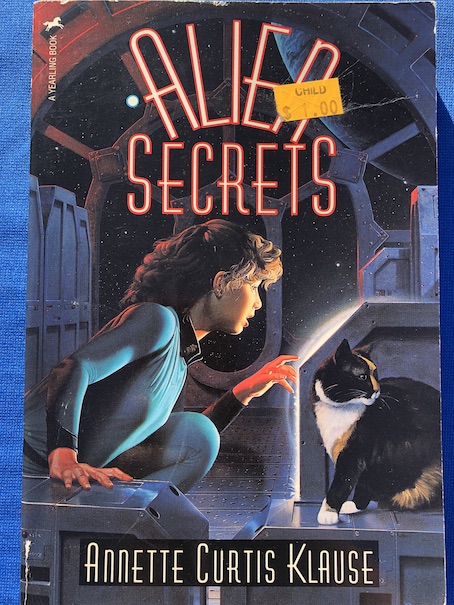
Alien Secrets

Alien Secrets by Annette Klause, 1993.

Robin Goodfellow, nicknamed Puck (her parents were fond of Shakespeare), is a human girl from Earth in the future.  When the story begins, she has been kicked out of boarding school on Earth and is traveling by space ship to join her parents, who are scientists who have been working on another planet.  They left Robin with her grandmother on Earth, who enrolled her in an English boarding school in order to give her some discipline and some friends her own age, but she was expelled for failing her classes (not to mention throwing a fit and burning her books when she discovered that she had failed).  Puck dreads what her parents will say when she arrives on the planet where they are now living because they had always hoped that Puck would also become a scientist and work with them, but this journey will change Puck’s life.

Before the ship she will be traveling on leaves Earth, Robin witnesses a man attacking someone else, possibly killing him.  Robin does not report the attack because she doesn’t know whether or not the other person was killed, and she doesn’t think that anyone will believe her anyway.  She witnessed this attack while sneaking around a place where she wasn’t supposed to be, and she is being sent to her parents in disgrace after being expelled, so she doesn’t sound like a very credible witness.  However, the man in the fight, Mizzer Cubuk (“Mizzer” is how they say “Mister” in the book), turns out to be traveling on the same ship as Puck.  All Puck can think of to do is to try to avoid him on the ship and hope that he didn’t get a very good look at her after she ran away from his fight.

To Puck’s surprise, the captain of the ship she is traveling on, Captain Cat Biko, asks her if she could make friends with an alien who is also traveling on the ship.  The alien is one of the Shoowa, who were enslaved by another group of aliens called the Grakk.  Now, he is free and finally traveling home to Aurora, the same planet where Puck is going.  The captain feels sorry for him and thinks that he might appreciate a friend and that he might find a human child less intimidating than an adult.

Later, Puck and other passengers are woken out of their sleep by the sounds of wailing and moaning.  One of the women on board, Leesa, says that she saw something that looked like a ghost that walked straight through her. Other people, who didn’t see or hear it, assume that it was nightmares or imagination, but Puck knows that it wasn’t.  One of the crew members, Michael, tells Puck that there have been rumors that the ship is haunted and that other people have seen and heard strange things.

Strange things are happening on the ship, and some of the passengers seem to be hiding something. Who can Puck trust, and who isn’t who they seem to be?

The alien who is traveling on board the ship understands Puck’s feeling of failure.  The alien, called Hush, says that he carries shame because he lost something important, something that his people were counting on him to take home to their planet.  Puck and Hush discuss how people from Earth had fought the Grakk and sought to learn about Grakk technology from Shoowa slaves who were freed after the war.  Even the ship they are now traveling on was once a Grakk ship.  The Earth people kept delaying sending the slaves home because they wanted to pump them for more information and because they were trying to decide if they could really trust them more than the Grakk.  After negotiating with the Earth people about returning home, the Earth people agreed, with some provisions.  They arranged for some of the Shoowa to stay on the Grakk home planet, still working with humans.  Some of them would travel on ships with Earth people, and some others could go home to their own planet.  Hush is the first one to head home, and he was entrusted carrying home an important symbol of his people that his family had protected for generations: a statue that represents a child because children are the future and a source of freedom, according to an ancient Shoowa prophecy. Unfortunately, the statue was stolen from Hush before he could return it to its rightful home. He reported the theft to the Earth security personnel at the station, but they didn’t take him seriously. They thought that he probably just lost it by accident.

The haunting is real in this book.  On a tour of the ship, Puck learns that the ship’s navigator has also seen the ghost aliens.  One of the characteristics of a ship’s navigator is the ability to see hyperspace, something that not everyone has the ability to do, although even scientists in Puck’s future time don’t seem to know why some people can do that and others can’t.  Slowly, it becomes evident that people who are able to see hyperspace are also able to see the ghosts.

On the journey to Aurora, Puck also learns that she is one of the rare people who are able to see hyperspace, giving her a possible future in navigating a space ship, something that she would really enjoy learning.  When she arrives at Aurora and is greeted by her parents, who have missed her while they were apart, Puck also comes to realize that her parents will always love her, even in spite of failing her classes. Even Hush’s people tell him that, although they are happy to have the statue back, his safe arrival was always the most important thing, and they wanted him to come home, whether he successfully brought the statue or not. Both Hush and Puck come to realize that their families will always love and value them even with their imperfections and failings.  With parents who love her and a new vision of the future ahead of her, Puck is ready to make a new life on Aurora.

The book is available to borrow and read for free online through Internet Archive.

Jeffrey Strangeways

Jeffrey Strangeways by Jill Murphy, 1990.

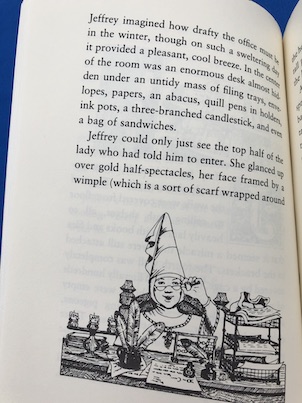
Jeffrey lives with his widowed mother in a Medieval village (not a realistic one, this is a fairy tale type story), where his mother supports the both of them by selling her knitting.  However, when his mother breaks both of her arms after falling off of a cart, eleven-year-old Jeffrey must find a job and earn some money.  As a young boy from a poor family, there aren’t many options for him at first, and he doesn’t try very hard for the ones that are available because what he really wants to do is to be a knight.  As a boy from a non-noble family, it isn’t likely that he’d ever actually become a knight, but it’s all that Jeffrey has ever dreamed of.

One day, after Jeffrey has failed to get the jobs that were available in a nearby town of Axington, he is walking home, sad and worried about what his mother will say, he meets a knight.  In fact, it’s not just any knight but a famous one, Sir Walter!  Jeffrey is thrilled to meet him.  Sir Walter asks Jeffrey for directions and invites him to join him for supper. 

The two of them discuss what it’s like to be a knight.  Sir Walter tells Jeffrey that it’s not all as glamorous as people think it is.  Some parts are very difficult, and he has to travel a lot on his various assignments, keeping him away from his family for extended periods.  Unlike real, historical knights, who would work for a lord, Sir Walter works for an agency in Axington called Free Lance Rescue Services Limited, which gives him his assignments.  They send knights like Sir Walter to rescue damsels in distress or deal with dragons or ogres.  Although it’s not easy work, Jeffrey likes the sound of it!

When Jeffrey returns home and his mother finds out that he didn’t get a job, she is upset.  Jeffrey tells her about his meeting with Sir Walter, and she points out that, even though it’s exciting, he really needs to focus on finding work because they’re running out of money.  Seeing his mother so upset, Jeffrey lies to make her feel better, telling her that Sir Walter has recommended him for a job with his rescue agency.  His mother is doubtful at first, knowing that knights are usually from noble families and that her small son hasn’t had any training or shown any fighting ability.  Jeffrey reassures her that he’ll probably just be helping in the office until he gets more training.  To Jeffrey’s shame, his mother believes him and is proud of the job that he doesn’t have.

The next day, after his mother sends him off to his first day on his new “job,” Jeffrey decides that the only thing to do is to go to the agency in Axington and try to find out if he can get a job there, or failing that, anywhere he can in order to make things right with his mother.  When he gets to Axington, he is hungry, so he asks at a food stand in the marketplace if he can help out for a while in exchange for some food.  He spends the morning peeling potatoes in exchange for lunch.  However, although it’s boring work, Jeffrey does get a good meal out of it, and he catches the eye of a leatherworker, who compliments him for working hard.  Jeffrey confides in the leatherworker that he’s really hoping to get a job at the rescue agency, and the leatherworker tells him that his fiancé is the secretary there.  He gives Jeffrey a message to take to the secretary, and Jeffrey sees it as his opportunity to ask for a job.

When Jeffrey delivers the message to the secretary (which is an invitation to join her fiancé for lunch), the secretary tells him that the rescue agency has no job openings at the moment, but that she’ll pay him a penny to watch the office and her mother’s rambunctious dog, Lancelot, while she’s at lunch.  It’s not much, but a penny is enough to buy his mother a nice dinner, so Jeffrey takes the job.  The secretary tells him a little about how the office works, but she doesn’t expect anything to happen while she’s at lunch because nothing ever does.

However, while the secretary is away, a message comes in that Sir Walter is in trouble!  Sir Walter is in the cave of an evil ogre and needs help at once!  Jeffrey tries to find the secretary to tell her and ask what to do.  When he can’t figure out where she went to lunch, Jeffrey decides that there’s no time to waste and that he must rescue Sir Walter himself!

Although Jeffrey is eager to help Sir Walter, he does worry about the lies that he has told his mother about his new “job”, the fact that he isn’t really qualified for what he’s doing and doesn’t even have permission to be doing it, that the ogre might well end up eating him as well as Sir Walter, and that he left a mess in the office when he ran off on his rescue mission and is currently in possession of a dog that doesn’t belong to him.  The book is a fun adventure story, but it makes some good points about truthfulness and responsibility as well.

Although Jeffrey really only brought the dog along because he had nowhere else to leave him, it is really Lancelot who defeats the ogre, partly by accident.  At first, Jeffrey is tempted to claim the victory for himself, but he decides to be honest and admits the truth about the ogre’s defeat to Sir Walter.  Still, Sir Walter is grateful and offers to sponsor Jeffrey for knight school and give him a part-time job polishing his armor.  Jeffrey accepts, and he also gets to keep Lancelot, who needed a new home anyway, although his mother says that he will have to be responsible for the dog and its training.

The book is available to borrow and read for free online through Internet Archive.

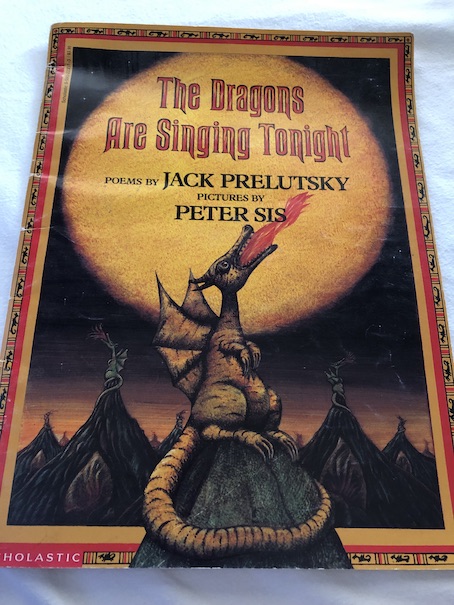
The Dragons Are Singing Tonight

The Dragons Are Singing Tonight by Jack Prelutsky, illustrated by Peter Sis, 1993.

This is a picture book of poems about dragons, but that description doesn’t quite do the book justice.

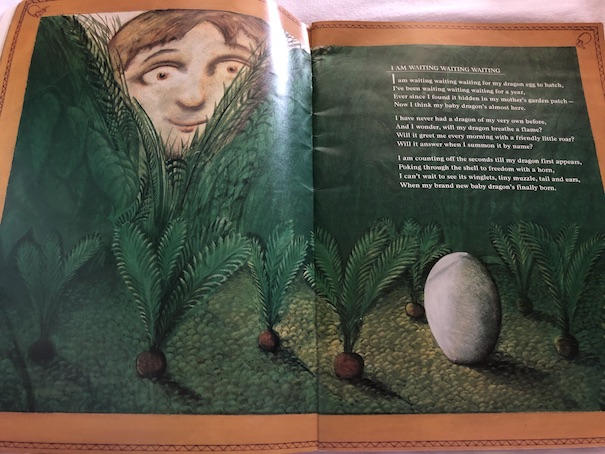
Jack Prelutsky is best known for his books of humorous poems for children, but not all of the poems in this book are funny. Some of them are humorous or have humorous twists, but others are just about the magic and wonder of the idea of dragons, some of which only exist in the imagination. Sometimes, just believing in magic or imagining it can be magical by itself!

The pictures are all excellent, colorful, and fanciful, and they really bring the poems to life. The book is larger than average, and the pictures span full pages.

The book is currently available online through Internet Archive.

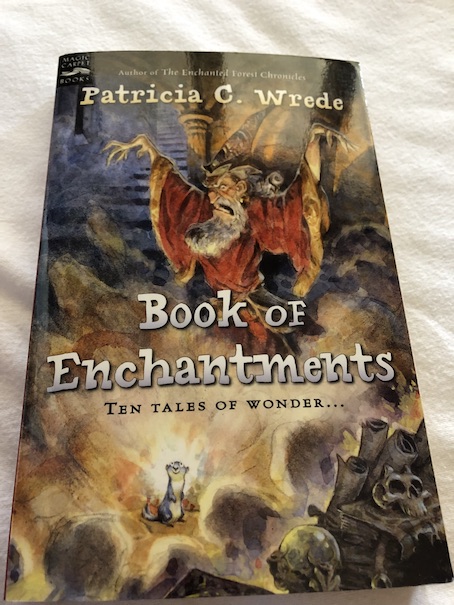
Book of Enchantments

Book of Enchantments by Patricia C. Wrede, 1996.

This is a collection of short fantasy stories, some of them based on other writings and series by the same author.  Many of them are also humorous. There is a section in the back of the book that explains the stories behind the stories and how they relate to her other works.

The stories included in this book:

Rikiki and the Wizard – A greedy wizard, unsatisfied with his success in life, attempts to summon a god to make him even more wealthy and famous so that he will never be forgotten. In exchange, he offers his daughter in marriage to the god who will help him.  Most of the gods recognize the wizard’s greedy and selfish purposes and refuse to cooperate, but Rikiki, the blue chipmunk god, is rather absent-minded and shows up to answer the summons. However, Rikiki, although having the powers of a god, is mostly obsessed with finding nuts, and how he interprets the wizard’s wishes (in exchange for the nuts the daughter feeds him, not for marrying the daughter) technically fulfill the requests but not in the way that the wizard had hoped.

The Princess, the Cat, and the Unicorn – This story takes place in The Enchanted Forest from one of the author’s series.  Things don’t go as expected for fairy tales in the fairy tale kingdom of Oslett, and it often bothers the king’s councilors.  Even though the princesses of the kingdom have a stepmother, she is a very kind and motherly person instead of the wicked stepmother usually found in folktales, and the princesses love her.  The princesses even get along well with each other instead of having the usual rivalries and jealousies between the oldest princesses and their pretty younger sister.  The middle princess, Elyssa, gets tired of being nagged about what the councilors think she should do and says that she’d like to go out and seek her fortune.  It’s not usually a thing for the middle princess to do, but well in keeping with what goes on in their kingdom.  She is accompanied on her journey by a talking cat who directs her to The Enchanted Forest, where the stuff of fairy tales happens.  There, the princess must escape the clutches of a vain unicorn, who is looking for a princess to adore it, and help the cat, who is not quite what he seems.

Roses by Moonlight – A modern retelling of The Prodigal Son story in a modern setting and with sisters instead of brothers and a fantasy twist.  Adrian is jealous of the party that her family is giving for her sister Samantha, the prodigal daughter returned.  As she sulks outside, her mother talks to her about her sister and the choices people make in life and enigmatically says that, while she is satisfied with her own choices and life, it occurs to her now that there may have been other choices that she had never considered before.  Instead of asking Adrian to come back inside and try to enjoy Samantha’s party, she asks her to stay outside for a while and see if someone shows up, mysteriously adding that if she is offered a choice, she should be careful and not choose too quickly.  Adrian does indeed meet a strange woman who offers her the choice of her destiny.  In a magical rose garden, Adrian may pick a rose which will represent the course that her life will take.  She is allowed to smell each one first and see what they have to offer.  Given the choice of any possible future, what will she choose?

The Sixty-Two Curses of Caliph Arenschadd – Also in A Wizard’s Dozen.

Earthwitch – A king whose kingdom is besieged appeals to the Earthwitch for help. He learns that the current Earthwitch is his former lover, and while the magic of the earth can help solve his problem, it will cost him to use it.

The Sword-Seller – A strange merchant gives a swordsman a free sword at a fair and recommends a woman to him who needs to hire a swordsman to accompany her on a journey to see her aunt, apparently fleeing problems with her other relatives. Her other relatives seem to behave oddly about the journey, and the swordsman isn’t sure why. He agrees to take the job and discovers the real reason why the merchant was willing to give him the sword.

The Lorelei – On a class trip, a girl has to save her classmate from the call of the Lorelei.

Stronger Than Time – This story is about what would have happened if the prince had been killed before rescuing Sleeping Beauty.

Cruel Sisters – A retelling of an old folk tale about jealous sisters, one of which evidently killed the other.  The story is told from the point of view of their other sister.

Utensile Strength – The last story in the Enchanted Forest Chronicles. When an enchanter makes a mistake while trying to make a magical weapon and accidentally casts the spell on a frying pan, the king and queen of the Enchanted Forest hold an unusual tournament of warriors to find the person who is destined to wield this very strange but powerful weapon.  The story is followed by the winning recipe from the cooking portion of the tournament, Quick After-Battle Triple Chocolate Cake.

The book is currently available online through Internet Archive.

Calling on Dragons

Calling on Dragons by Patricia C. Wrede, 1993.

This is the third book in the Enchanted Forest Chronicles. Cimorene is now married to Mendanbar and expecting their first child.

Morwen, a witch living in the Enchanted Forest, realizes that something strange is going on when she encounters a rabbit that is more than six feet tall. The rabbit, called Killer, has no idea how he managed to grow so big. It just happened suddenly that morning while he was eating some clover. Morwen goes to investigate the clover patch in the hopes of finding what might be responsible for the change. She discovers a wizard’s staff nearby, which is never a good sign.

She contacts King Mendanbar, Queen Cimorene, and her friend Telemain, a magical theoretician. Part of what they discover is that one of the wizards has shrunk himself in size. Mendanbar also discovers that someone has stolen the sword that he uses to control the threads of magic in the Enchanted Forest. The sword helps to maintain the protective spell around the Enchanted Forest that keeps wizards out. If the wizards have it, they may be able to enter the forest and soak up its magic. Mendanbar wants to go with the others to get it back, but Telemain points out that he can’t because he’s the other main focus of the protective spell; if he leaves the forest, it will be completely vulnerable. Even worse, they don’t have much time to retrieve the sword because whenever it’s outside of the Enchanted Forest, it leaks magic. Although Mendanbar doesn’t want to let Cimorene go on the mission to retrieve the sword while she’s pregnant, he has to let her go with the others. Before the book is over, Killer, who accompanies them on their mission, changes from a giant rabbit in to a flying blue donkey.

Among the fairy tale parodies that the characters encounter on their journey are a farmer named MacDonald (E-I-E-I-O) and a sorceress named Rachel who lives in a tower that can only be entered via a chair which Rachel lowers to bring people up (“Rachel! Rachel, send down the chair”). They keep in touch with Mendanbar in the castle using a magic mirror (“Mirror, mirror on the wall, I would like to make a call.”), until, for some reason, they are unable to reach him.

They are able to retrieve the magic sword, but the wizards capture Mendanbar and seal him inside his castle, trapped in a transportation spell to keep him safe yet contained. They don’t want to kill him because the Enchanted Forest would be plunged into chaos by his death, and they can’t keep him prisoner in a normal way because his friends would rescue him. Cimorene and the others know that the sword has the power to break through the shield spell on the castle, but the problem is that only a member of the royal family can wield it to do so. The sword allows Cimorene to carry it because she is Mendanbar’s wife, but only a blood relative can use the sword to break the spell . . . which mean that they have to wait for Cimorene’s baby to be born and become old enough to do it.

Although I like this series and think it’s a lot of fun, I’m not really fond of the last two books because of Mendanbar’s years of imprisonment. He’s okay when they finally get to him, but I still don’t like it. The ending of this book leaves things hanging until the fourth book.

This book is currently available online through Internet Archive.


Searching for Dragons

Searching for Dragons by Patricia C. Wrede, 1990.

This is the second book in The Enchanted Forest Chronicles, continuing the adventures of Princess Cimorene, although the story is told from the point of view of Mendanbar, King of the Enchanted Forest.  The Enchanted Forest is no ordinary kingdom, and Mendanbar is no ordinary king.  To be King of the Enchanted Forest means being a skilled enchanter.  Mendanbar can use the forest’s magic directly, making him more powerful than wizards.  Most of the creatures in the forest obey him, and unlike ordinary people, he can find his way around the forest almost automatically, even though things in the forest tend to move around.

At the beginning of the story, Mendanbar’s steward, Willin, pesters him about the subject of getting married.  Mendanbar hasn’t given the matter much thought since his father died three years earlier, but then, there’s been a lot to do.  Queen Alexandra has several daughters, any of which would be considered “suitable,” but Mendanbar doesn’t like any of them.  Mendanbar is annoyed because he’d just gotten the elf clans’ feud settled and was looking forward to a period of relative calm, so he decides that he’s going to give himself the day off, for a change.

He decides to take a stroll by the Green Glass Pool to relax, but on the way, he encounters a princess.  That’s not too unusual for the Enchanted Forest (home to many fairy-tale creatures and the events that make up fairy tales), but this princess strikes Mendanbar as a particularly scheming and ambitious one.  She tells him a great tale of woe in which her wicked stepmother cast her out that Mendanbar can tell is carefully rehearsed and might have even been the idea of the stepmother in question, with the idea of hooking an adventurous prince.  (Royal families do things like that, see the previous book in the series.)  However, Mendanbar is puzzled because the forest usually keeps out people who are obviously selfish.  Then, the princess mentions crossing an area of waste to get into the forest, and Mendanbar is alarmed because there shouldn’t be a wasteland there.  Forgetting about the princess, he hurries off to investigate.

Sure enough, Mendanbar discovers that a section of the forest is actually missing, destroyed to the point where there are just dead stumps.  Even the magic is gone.  Upon further investigation, Mendanbar finds dragons scales.  He isn’t sure why the dragons would want to attack the Enchanted Forest because they haven’t had any quarrels and mostly leave each other alone.  On the advice of a nearby talking squirrel, Mendanbar goes to see the witch Morwen.

After examining the dragon scales, Morwen demonstrates that, although they appear to be different colors and look like they’re from different dragons, they have actually been disguised.  They are actually from one dragon only.  Morwen also doubts that a dragon was really responsible for the damage to the forest.  After all, why would a dragon waste time disguising his scales when he could just pick them up?  Also, healthy dragons don’t shed that many scales.  Morwen is a friend of Kazul, who is the current King of the Dragons, and she advises Mendanbar to go see Kazul. 

Morwen also chides Mendanbar for not visiting Kazul when she became the king the year before.  Mendanbar feels a little guilty, saying that he’s just been very busy, which is true.  However, Morwen points out that what he could use is more effective help to organize things in the kingdom, not just making lists of things for him to do, like his steward does.  It’s part of the reason why people are saying that Mendanbar should get married.

Before Mendanbar can visit Kazul, he gets an unexpected visit from Zemenar, the Head Wizard.  Zemenar says that the wizards have been having problems with the dragons (again, see previous book) and that the dragons will not let them enter the Caves of Fire and Night.  He hopes that Mendanbar will allow them access from the Enchanted Forest.  Mendanbar doesn’t really trust the wizards, and he refuses the request on the grounds that he has something important to discuss with the King of the Dragons himself.  Zemenar tells Mendanbar about Kazul’s princess, Cimorene, blaming her for the the “misunderstanding” between the wizards and dragons.  Mendanbar at first imagines that Cimorene is much like the scheming princess he met that morning, but soon discovers that she’s anything but.  Taking the enchanted sword that only the kings of the Enchanted Forest can use with him, Mendanbar goes to visit the dragons.

At Kazul’s cave, Mendanbar meets Cimorene, who informs him that her official title is now Chief Cook and Librarian.  She tells him that part of the point of advertising this title is that it cuts down on the number of princes who come around.  Lots of princes want to rescue a princess, but few people want to rescue a Chief Cook and Librarian.  Mendanbar finds Cimorene a surprising change from the other princesses he’s met.  Mendanbar also makes a positive impression on Cimorene by using his sword to fix a broken sink, even if she describes the magic as being a bit “flashy.”

However, all is not well among the dragons.  Although Cimorene is reluctant to admit it at first, Kazul has mysteriously vanished.  She was planning to go out and search before Mendanbar showed up.  Kazul had been visiting her grandchildren when she decided to go by the Enchanted Forest to investigate someone growing dragonsbane.  Mendanbar shows Cimorene the dragon scales he found, and she indentifies them as belonging to Woraug, a dragon who was changed into a frog in the previous book.

It doesn’t take the two of them long to realize that the wizards are back to their old tricks and scheming.  However, what would they really have to gain by setting the Enchanted Forest and the dragons against each other?  And where is Kazul?

Like the other books in this series, this book is full of humor and a touch of mystery.  There are many parodies on fairy tale tropes, including an Wicked Uncle who’s not very wicked and does both a favor and an evil deed for his nephew by sending him to boarding school instead of abandoning him in the forest to have an adventure, as he’d hoped.  There is also romance between Cimorene and Mendanbar.  As you might have guessed, Cimorene is just the kind of practical princess Mendanbar needs to help him manage the magical chaos that is the Enchanted Forest and Mendanbar is the kind of king who is happy to find an intelligent princess who can do magic and rescue dragons.

The book is currently available online through Internet Archive.

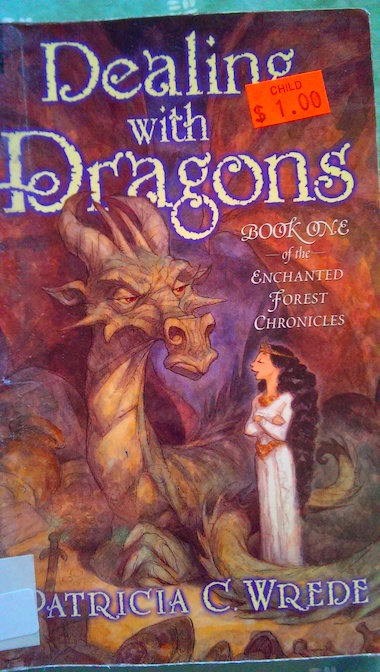
Dealing with Dragons

Dealing with Dragons by Patricia C. Wrede, 1990.

This is the first book in the Enchanted Forest Chronicles.  The fun thing about this series is that it parodies many popular fairy tales and their tropes.  Some of the books in the series also take the form of fantasy mysteries with some puzzle or nefarious happenings that the characters have to figure out.

From when she was a young child, Princess Cimorene of Linderwall has been bored with the kind of life that is expected from ordinary princesses.  Unlike her six older sisters, Cimorene doesn’t have golden curls.  She has black hair, and she’s way too tall for a cute little princess.  She’s also very stubborn.  When Cimorene gets bored of the usual princess lessons involving dancing, embroidery, and etiquette, she pushes other people in the castle into giving her different types of lessons.  First, she convinces the armsmaster to give her fencing lessons.  Then, she gets the court magician to give her magic lessons.  She also arranges Latin lessons, cooking lessons, economics lessons, juggling lessons, and so forth.  Each time her parents find out about her unusual lessons, they put a stop to them because none of the subjects that Cimorene finds interesting are “proper” for a princess to study. 

When Cimorene’s parents try to arrange for her to marry a prince that she doesn’t like, she finally decides that enough is enough.  Cimorene meets a talking frog in the castle pond, and after talking over her problem with him and saying that she’d rather be eaten by a dragon than marry the prince, the frog recommends that she run away.  He even gives her directions on where to go after she leaves the castle.  Not having any other plan, Cimorene takes his advice . . . and ends up at a dragon’s lair.

It works out for the best, though.  Rather than being eaten, Cimorene asks the dragons in the lair if they are in need of a princess.  She isn’t quite sure what princesses who are taken captive by dragons do, but she can cook (as part of her earlier cooking lessons) and do other chores.  Although one of the dragons, Woraug, wants to just eat her, the dragon called Kazul takes her on as her princess.

Cimorene finds it interesting being a dragon’s princess.  She cooks for Kazul and also helps to organize her treasure hoard and library.  As is expected when word gets out that Cimorene is a dragon’s princess, knights come to try to rescue her.  They are shocked when Cimorene turns them away, and it takes awhile before Cimorene is able to convince them that she’s really happy with the dragons and doesn’t want to be rescued.

Cimorene even makes new friends.  Morwen, a witch friend of Kazul’s, comes to visit and teaches Cimorene more about magic.  Morwen is also very practical and suggests putting up a sign (something like “Road Washed Out”) to discourage knights from approaching Kazul’s lair.  It is while Cimorene is putting out the sign that she means the wizard Zemenar.  His presence in the area is suspicious because wizards and dragons do not get along.  Wizards do not use their own magic but use their staffs to soak up magic from magical places or magical beings – like dragons.  When wizards take magic from dragons, they actually take part of their essence, and give them a reaction that’s similar to allergies.  Zemenar is also head of the Society of Wizards, so it’s doubly suspicious if he’s been hanging around a dragon’s cave.  When Cimorene tells Kazul and her friends about seeing him, they become concerned, wondering what he’s after.

Cimorene also meets other princesses who are the captives of other dragons: Keredwel, Hallanna, and Alianora.  At first, they also have trouble believing that Cimorene actually volunteered to be a dragon’s princess and that she likes it.  Cimorene doesn’t like the arrogant attitudes of Keredwel and Hallanna, but Alianora is pleasant, and the two of them become friends.  Alianora tells Cimorene that, although she was taken captive by Woraug, her family basically set her up for it.  Like Cimorene, she was under a lot of pressure to do the things that everyone expects of fairy tale princesses, but she wasn’t much good at them, and things never turned out as one might expect.  The wicked fairy who came to Alianora’s christening when she was a baby didn’t curse her; she just enjoyed the party and had a wonderful time.  Alianora also didn’t prick her finger on the spinning wheel that her busy-body aunt gave her, and when she tried to spin straw into gold, she got linen thread instead.  When various fairy tale schemes failed to work for Alianora, her interfering aunt arranged for her to visit a village, knowing that Woraug was going to ravage it.  As Morwen noted, princesses who are taken captive by dragons and then rescued can expect to make good marriages.  Although being abducted by a dragon was a shock, Alianora says it’s not so bad; Woraug mostly ignores her since she doesn’t know how to cook, and it’s a relief for her to get away from her nagging aunt.  The only downside is that the other, more conventional princesses are really annoying.  Alianora and Cimorene bond over their unconventional lives as fairy tale princesses.  Cimorene gets the idea to send some of her knights and princes to go rescue Keredwel, thus taking care of two problems at once.  Alianora also helps Cimorene with her efforts to find a fire-proofing spell to protect the princesses from accidental burning from the dragons, and later becomes her ally when things get more serious.

Zemenar returns to Kazul’s cave and, while Cimorene tries to subtly pump him for information, he sneaks a look at a book about the history of dragons.  He seems to be interested in the section about how they settled in the Mountains of Morning, how they chose their king, and the Caves of Fire and Night, where they found the special stone that they use to choose their king.

Then, the king of the dragons is murdered, poisoned by dragonsbane.  The wizards have a confederate among the dragons themselves, and they want something that only the king of the dragons can give them.

By the time the murder is committed, Cimorene and Kazul have a pretty good idea of who the conspirator among the dragons is.  The wizards think that they’ve found a way to rig the ceremony for choosing a new king so that the dragon who supports them will win, giving them what they really want.  However, Cimorene foils their plan with the help of her friends.  The mystery/conspiracy elements of the story are great and help add weight to balance out the lighter, fairy tale parody elements.

The book is currently available online through Internet Archive.