The King’s Equal

The King’s Equal by Katherine Paterson, 1992.
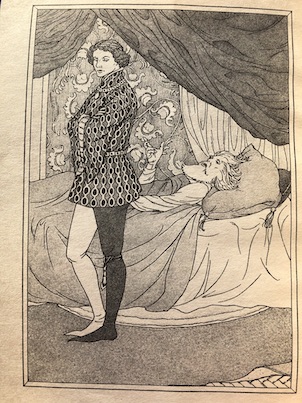
Everyone dreads the day that Prince Raphael will rule the kingdom instead of his father.  Prince Raphael is good-looking and highly educated, but he’s also selfish and greedy.  His one outstanding characteristic is that he’s arrogant.  He assumes that no one knows as much as he does about anything and no one is as deserving as he is . . . of anything.  Knowing that, as the old king lies dying, he makes his final decree that the prince will not wear his crown until he is married to a woman who is his equal.

When the prince hears that, he immediately becomes angry, saying (as his father guessed he would) that there could not possibly be any woman in the world who is his equal, who is as rich, intelligent, or beautiful as he is.  After his father dies, the prince immediately begins looting the kingdom for his own gain and generally abusing his subjects (as they had also guessed he would).  Still, he doesn’t have the one thing he really wants: his father’s crown.

The prince orders his councilors to find him an appropriate bride but (as the councilors feared), the task proves impossible.  No matter what options they place before the prince, the prince finds something about them to nit-pick.  Princesses of fabulous wealth are not beautiful or intelligent enough for him.  Princesses who have amazing beauty either aren’t beautiful enough or don’t know enough.  Princesses with amazing knowledge are still lacking in some area of knowledge or are just plain ugly in the prince’s eyes.  One by one, he dismisses them all.

Meanwhile, a farmer in the prince’s kingdom, has sent his daughter, Rosamund, to live in the mountains with their goats to avoid having the prince confiscate their only livestock, which he has done with everyone else.  During the winter, Rosamund and the goats almost starve, but they are saved by a magical Wolf.

The Wolf assures Rosamund that her father is alive and well, and Rosamund says that she is worried about what is happening in the kingdom.  The Wolf tells Rosamund that the kingdom would be saved if the prince finds the princess that he is looking for and that she should go to the capital and present herself as that princess.  Rosamund doesn’t see how she can do that because she is definitely not as wealthy as the prince, and she doesn’t think of herself as particularly beautiful or clever.  However, the Wolf tells her that her mother, who died when she was born, had blessed her, that she would be a king’s equal.  To fulfill her dead mother’s wish, Rosamund does as the Wolf tells her.
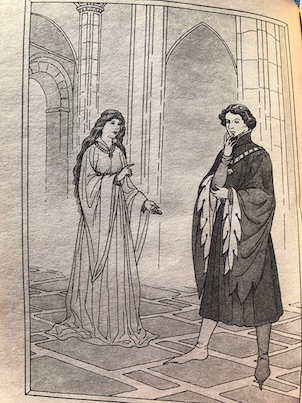
To Rosamund’s surprise, the prince falls in love with her beauty at first sight.  She also impresses him with her intelligence when she tells him that she knows what no one else does, that he is actually very lonely.  (Which is natural, since he thinks that no one can be his equal or true companion.)  Although she cannot demonstrate that she possesses great wealth, she can demonstrate that there is nothing in particular that she wants while the prince still feels like he is lacking things he needs (like his father’s crown).  The prince is satisfied that Rosamund has passed all the necessary tests to be his equal, but Rosamund turns the tables on the prince by pointing out that his description of her has made her more than his equal, challenging him to prove to her that he is worthy of marrying her.

It is in meeting Rosamund’s challenge, taking care of her goats in the mountains for a year, Raphael learns humility from the Wolf.  While he’s away from the palace, Rosamund tends to the kingdom, ruling more compassionately than Raphael had.  When Raphael returns, he is humble enough that he doesn’t think that he is worthy of marrying Rosamund, but his humility is precisely what makes him worthy, and they do marry.

My Reaction

Overall, I liked the story, although I wish that we could see a little more of the conversation between Rosamund and Raphael when she explains to him who she really is. They still get married, so whatever Rosamund told Raphael must have persuaded him, but it’s left to the imagination how she explains it. How I picture it is partly based on the fact that, during the last year, Rosamund has lived as a princess, even though she was originally a goatherd, and Raphael has lived as a goatherd, even though he is really a prince. By the time the year is over, they have each lived in the other’s place, and that is what really makes them each other’s equal. Raphael was callous and arrogant because he never thought about how other people lived until he tried it himself.

I don’t know if Rosamund really learned anything from her experiences as a princess, which bothers me a little because I think that she really should have because it was so far outside of her experience. We don’t really hear about that because the focus is on Raphael’s changing character. Personally, I’d like to think that part of what Rosamund may have learned is that running a country is a big, difficult job, and that, while her rule was better than Raphael’s for being more compassionate, it’s not a job that she would like to do alone, emphasizing that she and Raphael would be better ruling as a team than either of them would be by themselves. If Rosamund and Raphael really both need each other, it would be fitting for a story about equals.

Magician’s Ward

Magician’s Ward by Patricia C. Wrede, 1998.

This is the sequel to Mairelon the Magician.  When the book begins, it has been about a year since Kim and Mairelon’s previous adventures.  Kim has been living with Mairelon as his apprentice, and he has been teaching her both reading and magic.  (In the previous book, Kim was living on the streets of early 19th century London.  She did not know how to read, and at the end of the previous book, she learned that she had the ability to become a wizard, prompting Mairelon to take her on for training.)  Although Kim enjoys spending time with Mairelon and appreciates what he’s teaching her, other aspects of life with Mairelon’s wealthy family are less appealing.  Kim gets bored reading by herself while Mairelon continues his work with the Royal College of Wizards, and Mairelon’s aunt, Mrs. Lowe, is trying to turn Kim into a proper young lady.  The pressures of the social niceties and obligations wear on Kim, and even more worryingly, Mrs. Lowe has been considering Kim’s marriage prospects.

In order to be socially-acceptable, Mrs. Lowe thinks that Kim should be considering a socially-acceptable marriage for her future.  For most of her life, marriage was about the last thing on Kim’s mind.  She spent most of her youth pretending to be a boy in order to be safer on the streets.  Since she became Mairelon’s apprentice, the challenges of reading and magic have occupied most of her time.  When Mrs. Lowe brings up the subject of marriage, the idea seems ridiculous to Kim.  With her poor background, she can’t imagine what kind of “respectable” man would want to marry her, and she can’t imagine anyone among the upper-class people of London she would want to marry.  However, she sees Mrs. Lowe’s point that she won’t be able to stay Mairelon’s apprentice and ward forever.  At some point, she will need to decide what to do once her training with Mairelon is complete.  It’s a little worrying to her that Mairelon (known to most people by his real name, Richard Merrill) hasn’t discussed the future with her and doesn’t seem to be making any plans.

Then, one night, Kim overhears someone breaking into the library in their house.  At first, Kim can’t imagine what someone would want in the library.  She interrupts the thief, and he manages to escape.  After colliding with her in the hallway, the thief leaves behind one of his buttons and a small piece of wood that seems to be magic.  When Mairelon examines the wood, he says that it appears that someone stored a spell inside it temporarily, to be used by someone else.  Also, whoever put the spell together didn’t do a very good job and probably didn’t really know what they were doing.

As for what the thief was looking for in the library, Mairelon discovers that he was particularly looking through a collection of books that his father purchased years ago from a French wizard who had come to England after fleeing the French Revolution.  In particular, the thief seems to be trying to obtain the memory book that belonged to the wizard’s wife.  A memory book is exactly what it sounds like – a book that that keeper would carry around with him or her and use to record certain things that he or she would particular want to remember, a little like a journal but often containing bits of important instructions, like notes about favorite recipes or cold remedies (not necessarily the entire recipe, just general reminder notes) or, in the case of a wizard, notes about important spells.

As they investigate further, they learn that the wizard and his wife were part of a larger society of wizards in France before the Revolution and that someone has been trying acquire all of their old books and notes to learn the secret of one of their spells, specifically a spell for sharing magical power.  The person who wants this knowledge has a nefarious purpose for it, and when Mairelon tries to interfere with his plans, he uses the knowledge he has acquired to block Mairelon’s own magic!  This spell and its power-hungry master has already harmed other magicians, and now, Mairelon is in danger, too.

Meanwhile, Mairelon and his family have decided that, in order for Kim to truly be accepted in society, she must have a coming out party.  The mystery and intrigue of the story mix with Kim’s new lesson in dancing, fashion, and social etiquette and the unexpected attention that she receives from young men as she begins truly mingling with the upper classes of society.  Part of the mystery actually does involve the tensions between social classes, social mobility, and the extent to which birth and natural ability influence both.  As Kim discovers that she is more acceptable in society and desirable to at least some of the upper-class young men, she also finds herself becoming jealous of the attention that Mairelon receives from young women in search of a good husband.

Like the first Mairelon book, this one is a nice mixture of mystery, fantasy, history, and comedy of manners.  Both of the Mairelon books are a fun mixture of intrigue and humor, and this one also has a nice romantic element as Kim realizes that the only man she could ever see herself marrying is Mairelon.  He’s eccentric and sometimes aggravating, but she loves him, and he has loved her all along, from the time when she was just a thief in the marketplace to her beginnings as a wizard and her transformation into a young lady. The book ends with Kim and Mairelon engaged to be married, and I’m sorry to say that there are no more books in the series after that. I really wish that there were because I think that there’s a lot more room for character development.

The villain’s plot in this book hinges on the earlier established principle that wizards are born, not made.  Only certain people have the ability to use magic.  For some people, like Kim, the ability to use magic can lift them to higher positions in life, and it can be a source of real power.  For a person who is unable to use magic, there aren’t as many options.  The villain in this book thinks that he’s found a way around the problem, but as Mairelon guessed from the first, he doesn’t really know what he’s doing.

Even though this book has been a favorite of mine for years, I noticed something this time that hadn’t really occurred to me before.  Mairelon’s aunt and mother in the book look at fashion and social obligations in a similar manner to people in high society and the business and legal professions (categories that overlap) in modern society, whereas Mairelon, who is considered pretty eccentric for a man of his family’s social standing, and other wizards seem to look at fashion and social obligations more like modern day academics, engineers, computer programmers, and other tech experts (at least, the ones I know because those are the kind of circles I tend to move in).  Within each of these categories, some of these characters are more knowledgeable about fashion or more socially adroit or intuitive, but I noticed that there are two basic schools of thought going on here.  For the high society types, fashion is essential and social activities are their main focus in life because that is how they build their connections, make the best possible marriage matches, gain support from others, and generally move up the social scale, always aiming to do a little better that they did before or set the stage for their children to move up.  For the wizards and academic types, fashion and social obligations are of secondary importance because what makes the biggest difference in their lives is knowledge and skill.  They even say that wizards are always considered socially acceptable because of their abilities and professional standing.  Because of that, they’re socially allowed some eccentricities in personal habits and dress, and many of them take those liberties as much as possible because most of them are kind of socially introverted and prefer either the privacy of their own studies or the company of others who share their professions and interests. 

At first, Mairelon doesn’t do much about Kim’s social education because it is not a subject that’s important to him and he knows that she can go pretty far in the field of magic by putting most of her efforts into building her magical skills.  However, what Mairelon’s mother and aunt try to impress upon both Mairelon and Kim is that they both need some social skills in order to function in wider society.  This is kind of like how tech experts may have some great ideas for creating new software or a new form of online business, but in order to get their ideas off the ground, they have to have some business knowledge or connections.  Wizards may be allowed to be a little less social or more eccentric than other people, and it’s generally understood and expected, but they do much better if they learn to balance their preferences with society’s expectations.  Because the people who normally occupy high society love the latest fashions and attending prestigious social events, they can’t understand why other people don’t. As the story says, they would leap to the assumption that a wizard, who is always acceptable in society, would naturally want to participate in society, and if the wizard didn’t, it must be that they are either not really a wizard or at least not a good one.  In other words, they would assume that something was wrong with the person or their skills, not recognizing that their choices are simply a matter of personal taste.  In order for Kim and Mairelon to truly rise in their professions, they also have to learn to manage their social obligations.

In the book, Renee is an example of a character who has learned this type of social, professional, and personal balance.  She is a wizard, and as a single female, is regarded as something of an eccentric, but she understands that social skills are important.  She is a longtime friend of Mairelon’s, and she lectures him somewhat on his social obligations and acts as something of a big sister/fashion mentor to Kim, along with Mairelon’s female relatives.

The book is currently available online through Internet Archive.

Mairelon the Magician

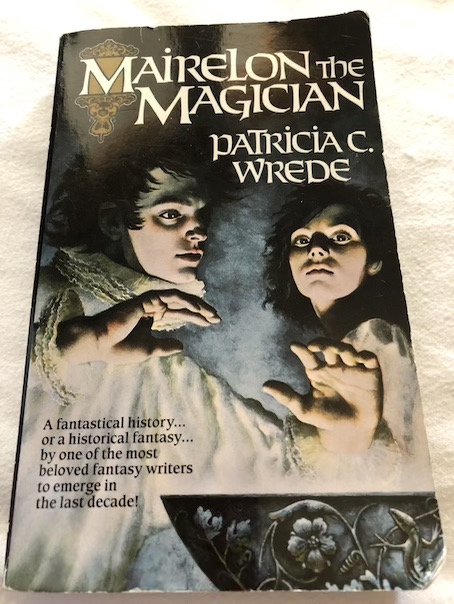
Mairelon the Magician by Patricia C. Wrede, 1991.

This young adult book takes place in an alternate history version of Regency England.  In this world, magic is a normal and accepted part of society.  “Wizard” is an accepted profession, and there is even a Royal College of Wizards dedicated to magic.  Not everyone can be a wizard because not everyone has the ability to use magic.  It is a skill that people are either born with or born without, similar to people who have an innate talent for art or music, compared to people who are born tone-deaf or color-blind.

In this early 19th century world, there is a teenage girl, Kim, who lives on the streets and survives by her own wits, taking whatever jobs she can and committing a little petty thievery whenever she needs to.  She has spent most of her life dressing like a boy and pretending that she is one because life on the streets is even more precarious for a girl.  For a time, she was part of a gang of child thieves run by a woman call Mother Tibb.  As far back as Kim can remember, Mother Tibb was the only one who took care of her as a child.  Kim has no memory of her parents or any knowledge about what happened to them.  She doesn’t even have a last name.  However, before the story begins, Mother Tibb was caught and hanged for her crimes.  Some of the other child thieves were apprehended and put in prison or exiled to Australia, but Kim managed to escape.  Since then, she has been on her own.  So far, she has managed to avoid being pressured in to joining up with other gangs or turning to prostitution to survive, but the fear of that haunts her. Her future is uncertain.

At the beginning of the book, Kim is hired to sneak into the wagon of a traveling magician who is performing in the market and to see what he keeps among his belongings.  The man who hired her doesn’t want her to take anything, but he is particularly eager to see if the magician has a particular silver bowl in possession.  It’s a strange request, but the money that the man offers Kim is too good to pass up.

However, the magician, who calls himself Mairelon, isn’t quite what he seems.  He is not just an ordinary traveling entertainer using some sleight of hand to amuse people in the market.  Kim discovers that he can do real magic as she searches his wagon and is knocked unconscious by a real magical spell that Mairelon uses to protect his belongings.

When Kim wakes up, Mairelon and his servant, called Hunch, have tied her up.  Unlike Hunch, Mairelon has also realized that Kim is actually a girl, not a boy.  The two of them question Kim about why she sneaked into the wagon, and she tells them the truth about being hired to do it.  When she describes the man who hired her, it seems that Mairelon recognizes the description.  The part about the silver bowl also unnerves him.

Surprisingly, Mairelon makes Kim an offer to come with him and Hunch when they leave London.  He is fascinated by Kim’s skills in picking locks, even the lock on the booby-trapped trunk that knocked her unconscious, and he thinks that Kim might be useful to him and Hunch, perhaps helping with the magic act.  In return, he offers to teach Kim some of his magic tricks.  Hunch is dubious about Kim because she has obviously been a thief, and Kim also isn’t sure what to make of Mairelon.  She knows that he’s hiding something, but she isn’t sure what.  No one with real magical abilities like him would ordinarily be making a living with simple magic tricks in the market. 

However, Kim does accept the offer because she’s been worried about one of the major criminals in the area, Dan Laverham, who has been showing too much interest in recruiting her. He is heavily involved with a number of criminal activities, and he knows that Kim is a skilled lock pick.  If he found out that she was a girl, he would probably also press her into prostitution. Dan Laverham would be a good reason to get out of London for a while.  Also, Kim realizes that if she learns a few magic tricks from Mairelon, she might be able to set herself up as an entertainer and make an honest living, safe no matter who finds out that she’s female.  Besides, Kim realizes that if she’s not satisfied with the situation, she could always run away later.

Before leaving London with Mairelon, she returns to the man who hired her, at Mairelon’s suggestion, and tells him that she didn’t see a silver bowl in Mairelon’s wagon (which is true because she was knocked unconscious and didn’t see anything in the trunk).  The man is angry, but Mairelon, who followed her in disguise, helps to create a distraction so that she can get away from the man.  They leave London in the middle of the night because Mairelon says that he was spotted by someone who recognized him when he went out to get magic ingredients.

On the journey, Kim gradually gets to know Mairelon and his situation.  The silver bowl, which Mairelon does have, is actually part of a set of magical objects which, when used together, can compel people to tell the truth without interfering with their ability to answer questions intelligently.  Mairelon’s real name is Richard Merrill, and he is, or was, part of the Royal College of Wizards.  Years earlier, the Royal College of Wizards was analyzing this particular set of magical objects and the unique spell that they control, when they were suddenly stolen, and Merrill was framed for the theft.  At the time, Merrill was unable to prove his innocence (at least not without sounding as if he had done something inappropriate with a lady, which he also did not do – they were just together at the time of the theft because she was helping him and another friend with a magical experiment), but he was also recruited by his friend in the government to be a spy against the French, so the story of his supposed theft gave him a plausible reason for wanting to leave the country.  In the time since then, he and his friend have continued to look into the matter of the theft, and they have made some progress in tracking down the other pieces of the magical set.  At the time that Kim met him, he was on his way to the next piece of the set, a silver platter.

To their surprise, however, they soon discover that someone has been making copies of the platter.  The copies are not magical, but they do confuse the issue.  Who is making the copies and why would they want copies, since they do not have the powers that the original has?  As Kim and Mairelon investigate, they crash a house party at a lavish country estate and spy on a meeting of a rather inept society of druids.  All the while, they are getting closer and closer to finding the original thief.

I loved the combination of mystery, fantasy, history, and humor in this book!  It’s one of my all-time favorites.  It has a happy ending with Mairelon’s name cleared and the thief caught.  They also discover that Kim has the ability to use magic, and Mairelon offers to take her on as his apprentice, saving her from the streets forever.  There is a sequel to this book called Magician’s Ward, about Kim’s life and adventures as Mairelon’s student.  The hints of romance in this book are also much stronger in the next one.  There are only two books in this series, which is disappointing because the characters are so much fun, and I think that there is a lot more room for their development.  By the end of the next book, Kim’s future is looking more certain, but her past is still murky.  Originally, I had expected that there would be secrets revealed about Kim’s past because of her ability to use magic, possibly something that was passed on to her by her parents.  However, by the end of the second book, Kim still doesn’t know who her parents were/are, and it doesn’t look like there’s any chance that she will ever know.  Perhaps it doesn’t really matter. Sometimes, secrets are more tantalizing when you imagine the answers than when you actually find out.

The book is currently available online through Internet Archive.

Felicity’s Craft Book

American Girls

Felicity’s Craft Book by Rebecca Sample Bernstein and Jodi Evert, 1994.

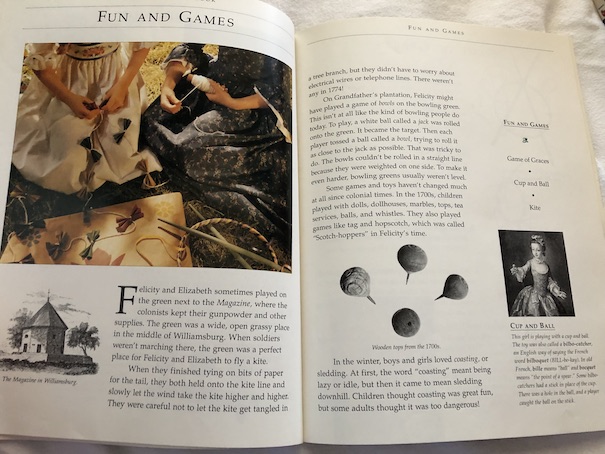
This is a companion book to the Felicity, An American Girl series.  It explains about the types of crafts that people would do in Colonial America and gives instructions for projects that readers can make at home.

In the beginning of the book, there is a brief history of crafting in America.  It explains that, in the earliest days of the American colonies, people had to get most of their goods from Europe because they had to spend their time and energy on building homes and establishing farms in order to survive.  However, as the colonies became more established, people were more able to make goods for themselves, both in their own homes and as professional craftspeople.  By the time that Felicity lived, during the late 1700s, there were many skilled craftspeople, and those craftspeople also trained new people in their professions in apprenticeships.

Before presenting craft projects that readers can make, the book also offers a few tips for safety and neatness while making things. The crafts are also divided into sections relating to topics like writing, sewing, games and toys, and scented objects that you can make with plants.

The projects explained in this book include:

A quill pen and two types of ink – The book gives instructions for making ink from different types of berries (such as raspberries, strawberries, and blackberries, which make red or purple ink) and walnut shells (which makes a brown ink).

A wax seal – To be used with sealing wax or wax from a candle. These were used to seal letters before the invention of envelopes with glue. (I know that there are people and companies that still make these because I have one myself and the sealing wax to use with it.)

Game of Graces – A hoop with a pair of sticks that were used for a tossing game.

Cup and Ball Game – A common toy in which a cup is attached to the end of a short stick and a ball is tied to it.  Players have to move the toy around and make the ball swing into the cup.

Kites – Made with lightweight paper.

Folding Fan – Made with poster board and ribbon.

Fancy Straw Hat – Explains how to decorate a hat with flowers and ribbon.

Fruit Pyramid – Used as a table centerpiece.

Cross-Stitch Sampler – A basic sampler using only the cross-stitch. (Colonial girls would create more elaborate samplers to show off the range of stitches they could make.)

Sachet – A small bag of potpourri (sweet-smelling dried plants).  Colonists would put sachets into trunks and wardrobes where they were storing their clothes to make them smell nice.  (Some people still do this in modern times.)  In a later part of the book, they also give instructions for making potpourri with herbs and flower petals.

Friendship Pincushion – An embroidered pincushion.

Tussie-Mussie – A small bouquet, like the kind that bridesmaids and flower girls might carry.  (The book says that people in Colonial times might carry one or maybe a pomander ball if they went to visit a sick person because they had an idea that breathing bad air would spread sickness and they were trying to freshen the air with fresh scents.  That’s not quite how sickness is spread, but they were partly correct about sicknesses being airborn.)

Pomander Ball – An orange scented and decorated with spices and cloves.  Besides freshening the air, they can also make nice decorations.

In the sections about different types of projects, there is additional historical information about life and crafts in Colonial America. Because, in the books, Felicity’s grandfather owns a plantation and one of the books takes place there, the craft book also has a section about plantations that includes a brief description of plantation life and slavery, noting that the lifestyle and pastimes that plantation owners enjoyed would not have been possible without their slaves to take care of the plantation chores for them.

The book is currently available online through Internet Archive.

Molly’s Cook Book

American Girls

Molly’s Cook Book by Polly Athan, Rebecca Sample Bernstein, Terri Braun, Jodi Evert, and Jeanne Thieme, 1994.

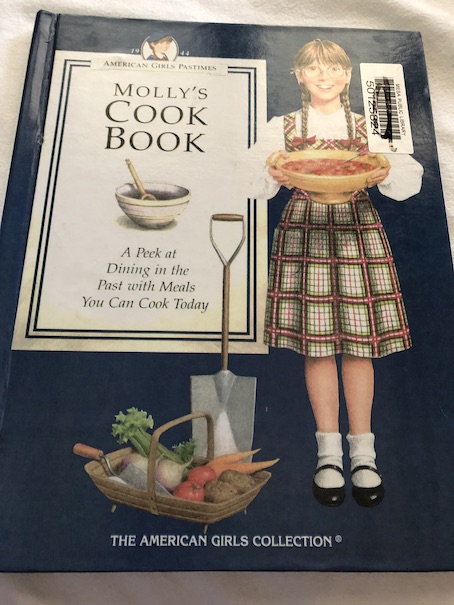
This is a companion book to the Molly, An American Girl series.  It has recipes from the 1940s that people would have made during World War II.  A section at the beginning of the book explains how shortages and rationing during the war changed the way that people shopped for food and cooked.  For example, people on the homefront didn’t have many canned foods because many canned foods were shipped overseas to soldiers and much of the metal that would have been used to make more cans for food was being used to make other war supplies.  Because certain types of food were in short supply, individuals and families would receive ration books, which contained stamps that represented which types of foods they would be able to buy and how much.  Cookbooks printed during the war focused on creating meals that used little or no rationed products.  People also planted Victory gardens and grew their own vegetables to fill out their meals.

The cookbook is divided into sections for different meals:

Breakfast – Fried Potatoes, Toad-in-a-Hole (not the British dish – this is eggs cooked in a frame of bread, what I first learned to make as Eggs-in-a-Frame), Fried Bacon, Quick Coffee Cake, and Frozen Fruit Cups.

Dinner – Vitamin A Salad (made with carrots and lemon gelatin), Deviled Eggs, Carrot Curls and Celery Fans, Vitality Meat Loaf, Parsley Biscuits, Volcano Potatoes, and Applesauce Cupcakes.

Favorite Foods – French toast, Waldorf salad, PBJ Roll-ups, Jelly Flags, Victory Garden Soup, Nut-and-Raisin Bread, and Fruit Bars.

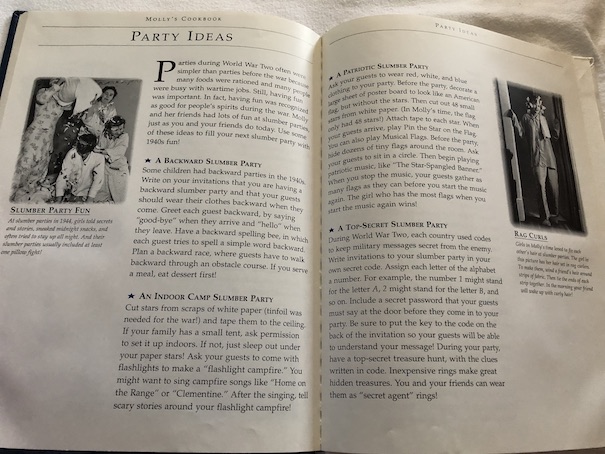
In each section of recipes, there is more historical information about food in World War II.  There is also a section in the back with party ideas from the 1940s.

For more World War II recipes, I recommend The 1940’s Experiment, which is a blog with recipes from World War II and an explanation of how they can be used to both save money and lose weight because they were intentionally designed to make maximum use of limited resources, both economically and nutritionally. In Molly’s Cook Book, there is a chart that government experts during World War II used to give people guidance on how to budget their food money among seven food groups. The diet that they recommended, both nutritionally and to limit certain rationed foods, was heavy on vegetables and fruits and lighter on meats, grains, and dairy products. This type of diet is basically in keeping with modern nutritional advice, which also emphasizes the importance of vegetables and fruit.

The book is currently available online through Internet Archive.

Pirates Past Noon

Magic Tree House

#4 Pirates Past Noon by Mary Pope Osborne, 1994.

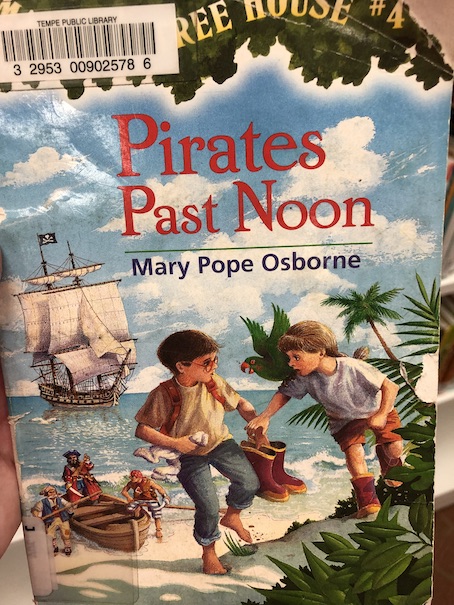
One rainy afternoon, Annie urges Jack to go to the tree house with her because she has a feeling that they will soon meet its mysterious owner.  When they arrive, no one is there, so the kids start looking at the books.  The day is cold and wet, and Annie shows Jack a picture of a sunny beach, saying that she wishes they were there.  Soon, they find themselves on the beach. 

They have fun at first, but then some pirates come to the beach, looking for a treasure buried by Captain Kidd.  The evil pirate, Cap’n Bones, makes the kids prisoners aboard his ship until they figure out where the treasure is hidden from the clue written on the captain’s map.

The clue says that the treasure is hidden underneath the whale’s eye, and from the ship, Jack and Annie realize that the island is shaped like a whale with a big boulder for its eye.  The kids make the pirate captain take them back to the island in exchange for telling him where the treasure is.  While the pirates are digging for the treasure, a parrot flies over, saying, “Go back!”  The pirates take that as a sign of an approaching storm and flee, leaving the kids behind. 

A storm does come, but Jack still has difficultly tearing himself away from the treasure that they’ve uncovered.  Finally, the parrot convinces him to leave, and he and Annie use the tree house to go home again. 

Once they’re back in Pennsylvania, the parrot appears and turns into a woman and says that she’s Morgan le Fay.  She is the owner of the tree house and the amulet.  Besides being King Arthur’s sister and an enchantress, she is also the librarian of Camelot.  She has been using the tree house to travel to other times to collect books that the scribes in Camelot can copy for their library.  She put the spell on the tree house so that she can travel to some of the places in the books herself.  The kids can use the spell only because Annie truly believes in magic and Jack really loves books.  She and the tree house disappear as the kids head home, but Jack discovers that she left her amulet with him as a sign that she will come back.

I was surprised that the owner of the tree house turned out to be Morgan le Fay, both because an Arthurian character didn’t seem to quite fit with a magical children’s tree house and because Morgan le Fay wasn’t one of the good characters in the Arthurian legends. The exact nature of the character of Morgan le Fay changed through different retellings of the Arthurian legends, and she wasn’t always an adversary or villain, but she does do things in some of the stories that wouldn’t make her a good heroine for children’s literature. However, none of that matters in this series because, here, she’s just an enchantress from Camelot who is interested in books.

The book is currently available online through Internet Archive.

Dinosaurs Before Dark

Magic Tree House

#1 Dinosaurs Before Dark by Mary Pope Osborne, 1992.

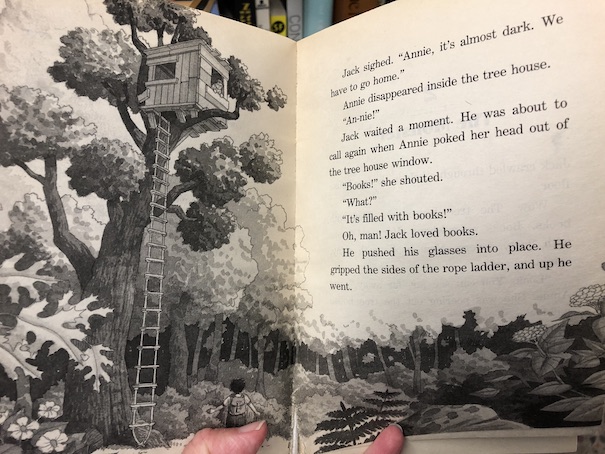
Eight-year-old Jack is walking home with his seven-year-old sister, Annie, when Annie spots a tree house in the woods that they’ve never seen before.  In spite of Jack’s warnings, Annie climbs up into the tree house and yells down that there are a bunch of books in there.  Jack loves books, so he also climbs up into the tree house to see what she’s found. 

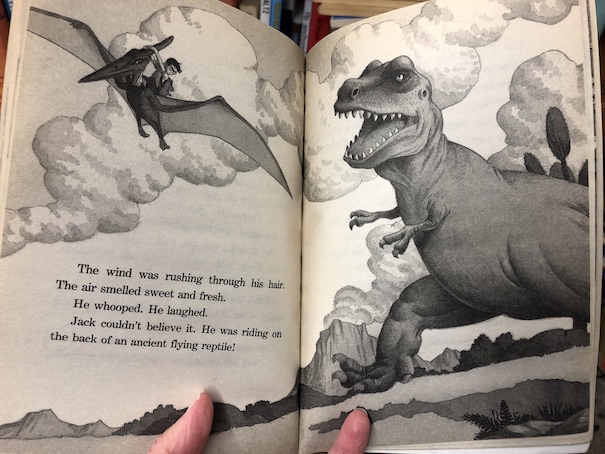
There are books in the tree house about all sorts of interesting times and places.  When Jack starts looking at a book about dinosaurs, he wishes that he could see one himself.  Suddenly, the tree house takes the kids back in time to a land filled with dinosaurs.  The two of them have some hair-raising adventures as they try to figure out how to get back home, getting some help from a friendly Pteranodon when they need to escape from a Tyrannosaurus Rex. 

The kids figure out that the tree house will take them anywhere they want as long as they look at a picture of the place in one of the books and wish to go there.  There is a book about Pennsylvania in the tree house with a picture of their home town in it, so all they need to do is to look at it and wish they were there in order to go home. 

While they are still in the land of the dinosaurs, Jack finds a gold amulet with the letter M on it.  He thinks it belongs to whoever owns the tree house, so he picks it up and brings it back with them, although by the end of the book, the kids still don’t know who it really belongs to. The ownership of the tree house is something that they eventually figure out through their adventures with it. (See book #4 in the series for the answer.)

The Rag Coat

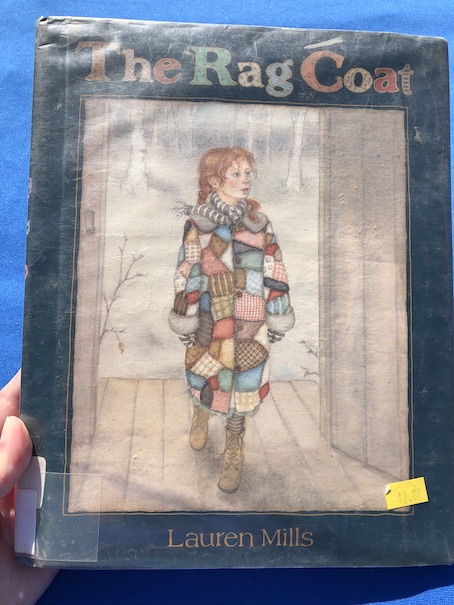
Minna is a poor girl, the daughter of a coal miner.  Her father has been ill with the miner’s cough, so Minna has to help her mother to make quilts that the family can sell for money.  She wants to attend school, but she can’t because she is needed at home and her family can’t afford a warm coat for her when winter starts.  It’s too bad because Minna really wants to make some friends her own age, and she would meet other children at school.  Her father says that he will find a solution to the problem, but he dies before he can.

After Minna’s father’s death, some of the other women in the community come to the house to work on making quilts with Minna’s mother.  When the women say that the quilt pattern they are using is named after Joseph’s Coat of Many Colors, Minna wishes again for a coat.  When the other women, who are mothers themselves, realize that Minna cannot go to school until she has a coat, they decide to make one for her.  They don’t have much money, but they do have plenty of quilting scraps.  They decide to make a new, quilted coat for Minna out of their old scraps.

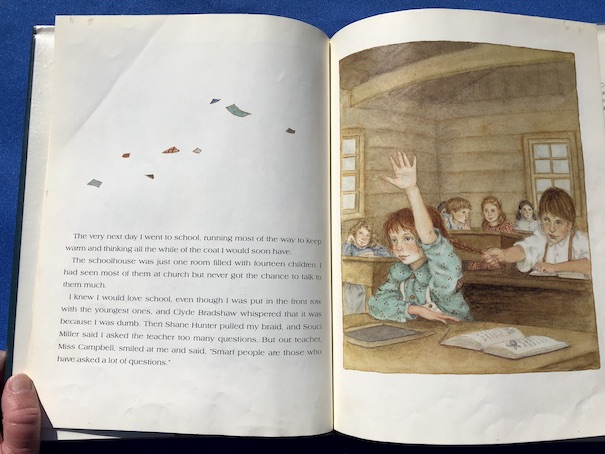
Minna starts going to school and does well, although she gets some teasing because, as a new student who has never been to school before, she has to sit with the youngest children, and Shane pulls her braid.  Something that Minna particularly likes at school is Sharing Day (what my school always called “Show and Tell”), where students are given the chance to show special things to the class and talk about them.  Minna decides that when her coat is ready, she will show it to the class during Sharing Day.

As the coat is being made, Minna admires all of the beautiful colors of the cloth scraps in the coat and adds a piece of her father’s old jacket as well.  Each of the other scraps in the coat also has a story that goes with it.  The cloth pieces come from old clothes and blankets that people in the families of the quilting mothers have used, and they memories attached to them.  The mothers tell Minna all of the stories as they work on the coat, and Minna loves it.

However, when Minna wears the coat to school for the first time, the other kids make fun of her for wearing rags.  Minna is really upset and runs away into the woods.  After thinking about it, Minna remembers what her father said about how people really need other people, and she decides to go back to school.  There, she tells the other students that the rags in her coat are actually their rags, and she begins reciting the stories that go with them.

One of the scraps is from Shane’s old blanket from when he was a baby.  He was born so small that everyone was afraid that he’d die, but the blanket kept him warm, and he later carried it around with him until it fell apart.  Shane is happy, seeing the scrap of his favorite blanket again in Minna’s coat.  Everyone else gathers around Minna, looking for their scraps in the coat and listening to the stories behind them.  Each of the scraps in Minna’s coat is like an old friend that none of them ever thought they’d see again.  The other children apologize to Minna for their teasing and Minna says that friends share and that it took all of them to make her coat warm.

The book doesn’t say when this story is supposed to take place, but based on the children’s clothing, I think it’s about 100 years ago or more. It doesn’t say exactly where this story takes place, either, but a note on the dust jacket says that it takes place in Appalachia. The author said that she was inspired by Appalachian crafts that she learned from the women in her family and a patchwork coat that she wore as a child. However, years later, the author revisited this story and rewrote it in a longer version, and some of the explanations that accompany the new version of the story elaborate more on the background.

The author rewrote this story in a longer, novel form called Minna’s Patchwork Coat (2015). In the back of that book, the explanation behind the story mentions that the year of the story is 1908. It also discusses some cultural references and songs included in the expanded version of the story that were not part of the original. It states that the inspiration for this story came not only from the author’s experiences but from a song written by Dolly Parton, Coat of Many Colors, which was made into a picture book itself after the publication of this book.

There is also an expanded retelling of the story called Minna’s Patchwork Coat, and I’d like to talk about some of the differences. For example, the ending message of the story is slightly changed in the longer version, or at least the emphasis of the moral is different. The original book emphasized how much “people need people” and how the goodwill of many people (in the form of the quilting mothers and their hard work and scraps, cast-off from all of their children) changed Minna’s life. They emphasize it at the end, talking about how Minna’s coat is the warmest of all of them and that it took a lot of people to make it that way. However, in the expanded version, Minna also explains that when she started school, she liked her classmates better than they liked her because, thanks to their mothers’ stories as they made her coat, she already knew who the other children were, but none of them really knew anything about her. The message of the expanded version is that it is important to learn others’ stories to learn who they really are and to become friends with them.

Actually, I don’t like the second version of the story as well as the original. I thought that the moral and the story were stronger when the focus was on how people benefit from having relationships with other people because people can do great things when a lot of people contribute a little. Remember, it took a lot of people to make Minna’s coat warm because each of them contributed at least one scrap to it and others took the time to put them all together. It was their stories that made the coat special, more than just an ordinary coat. The expanded story has that element, too, but more emphasis is placed on Minna needing to share her story with the other children to win their respect and approval. I didn’t like the notion that Minna needed to win their approval by telling her story. Also, this story takes place in a small mining community. I find it difficult to believe that the other kids wouldn’t basically know her story already. Her mother knows their mothers. Their families see each other at church before Minna goes to school. The disease that took her father’s life isn’t terribly unusual for coal miners, and probably, a number of the other children are the children of coal miners as well. It seems to be the major industry in the area. Minna’s family might be more poor than the others’ since her father’s illness and death, but I don’t see why their circumstances would be so different and incomprehensible to people who must have seen her and her family around and who knew them from church or through their parents’ associations. One thing that small towns and communities are known for is everyone knowing everyone else and their business, so why didn’t they all know Minna’s story already? Even if the quilting mothers didn’t talk about helping to make the coat for Minna, the other kids should have known about the family’s money circumstances and the tragic death of Minna’s father. I don’t see why the other kids would have known so little about her or thought that she was so unusual.

The expanded version of the story also features a Cherokee midwife and a biracial friend for Minna who did not appear in the original story. This friend, Lester, is also something of an outcast among the other children, and Minna and the stories from her coat help the other children to be more accepting of him as well. It’s a nice thing, I guess, but it felt a little artificial to me because I knew that it wasn’t part of the original story. I hesitate to criticize it too much because the basic message of the story isn’t bad, but I guess that the way the second version came out just doesn’t have the same feel to me. The author put things into it that weren’t in the original, and with that change in emphasis on the ending, it makes the story and characters feel a little less natural to me now. I often feel the same way when I see a movie version of a story that adds things that weren’t in the original book.

The Camp-Out Mystery

The Boxcar Children

#27 The Camp-Out Mystery by Gertrude Chandler Warner, 1992.

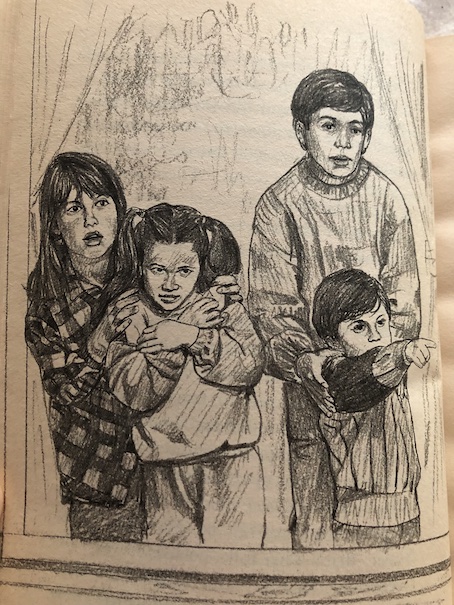
The Alden family has decided to go on a camping trip to a campground at a state park.  From the moment that they arrive, though, strange things seem to be happening.  When they stop for supplies, a woman Mr. Alden knows, Doris, seems oddly evasive when he tries to ask her about her sister, Hildy, and she makes the odd comment that she hopes nothing will spoil their trip.  As they pull into the state park, they discover that the arrow on the sign pointing to the rangers’ station has been reversed to point the wrong way.  Mr. Alden shrugs the incident off as a prank, but it’s only the beginning of the strange happenings.

The Aldens get to their camp site and notice that the place is a mess.  Either the previous campers were pretty messy, or they left in a hurry.  The Aldens clean up the site and set up their tents.  (The description of how they set up camp is actually somewhat educational because they talk about things to look for when choosing a campsite, how they have to check the ground for rocks and tree roots before setting up their tents and why they should avoid places where it looks like rain water might pool and why it can be dangerous to set up a tent under a tree if there is a lightning storm.)  Later that night, Violet is woken by the sound of music.  At first, she thinks that it must be some nearby campers, but it sounds too loud and too close.  When she and Jessie get up to investigate, the sound stops.

Later, the kids see strange lights in the woods, and things disappear or are moved around at their campsite.  When Mr. Alden realizes that someone has been sneaking into their camp and taking things, he suggests that they might want to leave the park, but the kids say that they’d rather stay because they’re still enjoying themselves.  Then, Mr. Alden injures his ankle when he’s startled by another blast of loud music and part of the path he’s on gives way because the dirt was loosened by rain.  The children are prepared to leave when their grandfather is injured, but to their surprise, Mr. Alden says that he’d rather stay, too.

Who is doing all of these things and why?  Is it the unfriendly Hildy, who lives alone in a cabin and wants everyone to leave her alone?  Or maybe her seemingly-helpful neighbor, Andy, for reasons of his own?  Could Doris be responsible?  What about the Changs, a family camping nearby who seemed disappointed that they didn’t have the campground to themselves?

There are some environmental themes and lessons in the story.  The Aldens frequently pick up litter that other campers and hikers leave behind.  There is also an explanation that the reason why part of the path Mr. Alden was on collapsed due to erosion because there are no trees along that section of path; tree roots help secure the soil so that it doesn’t wash away.  After the mystery is solved, Mr. Alden decides to donate some trees to the park, and the kids talk about adding more trash cans and a recycling center to help solve the litter problem.

The book is available to borrow and read for free online through Internet Archive.