The Mystery of King Karfu

The Mystery of King Karfu by Doug Cushman, 1996.

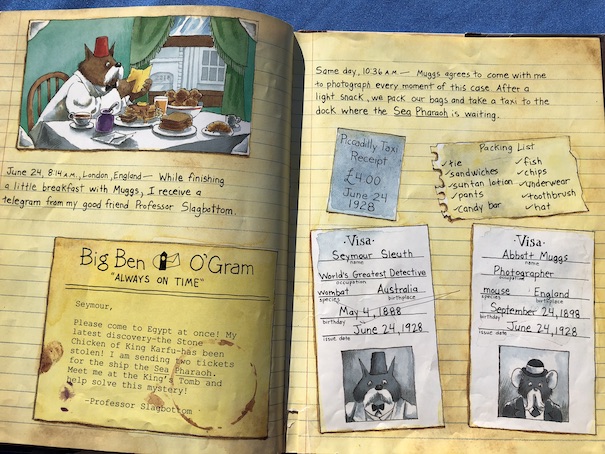
Seymour Sleuth, an Australian wombat living in London, introduces himself as “the greatest detective in the world.”  His friend, Abbott Muggs, a mouse, is a photographer who assists him in his cases and documents them.  When the story begins, Seymour receives a telegram from his friend Professor Slagbottom, who is working on an archaeological site in Egypt.  Someone has stolen one of their finds, the Stone Chicken of King Karfu, and he needs Seymour’s help to find it!  Seymour and Muggs head for Egypt!

King Karfu was a wealthy pharaoh and a wonderful cook, and the Stone Chicken may provide clues about the Lost Treasure of King Karfu, the nature of which is unknown.  When they reach the dig in Egypt, Professor Slagbottom explains that he was researching a message in code on the outside of the Chicken when it was stolen.  The suspects are the other people on the dig, who may be trying to steal King Karfu’s Treasure.

Seymour interviews the suspects one at a time and considers their connection to clues found at the scene of the crime.  As an adult, I figured out who the culprit was pretty quickly, but for the benefit of child readers, Seymour provides notes about the clues and suspects to help them understand the connections. The pictures in the story also provide important clues.  After Professor Slagbottom’s decoder is stolen, Seymour realizes who the thief is.

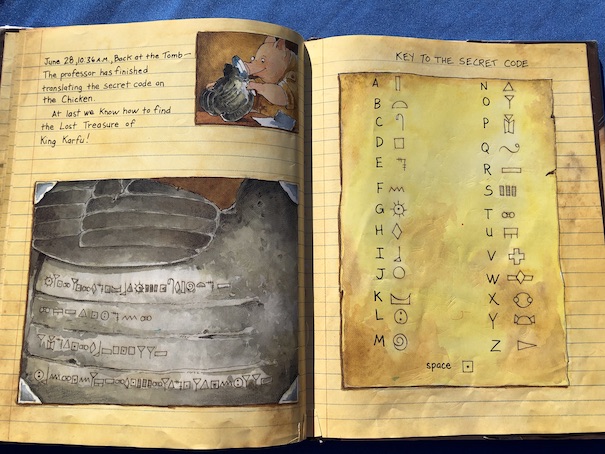
After they get the Stone Chicken back, readers can use the decoder provided to solve the code and learn where the Treasure is.  It turns out that the Treasure is actually a recipe, written in the same substitution code – for peanut butter and jelly sandwiches!

I always like mysteries that involve codes and puzzles, and this cute animal mystery would be fun and challenging for young kids.  With the key provided, it would be a good introduction to substitution codes for kids who have never seen them.  There is one other book with Seymour Sleuth, The Mystery of the Monkey’s Maze.  The author, Doug Cushman, is also the author of the Aunt Eater Mysteries.

The book is currently available online through Internet Archive.

Annie’s Promise

AnniesPromise

Annie’s Promise by Sonia Levitin, 1993.

This is the final book in the Journey to America Saga.  Annie, the youngest of the Platt girls, is more of a tomboy than her older sisters.  Her father thinks that she’s been growing up too wild in America, running around and climbing like a boy.  This summer, in 1945, while her best friend goes to visit their family’s farm in Wisconsin, Annie’s father wants her to stay home and help him with sewing for his coat business, and Annie’s mother has a list of chores for her to do.  It all sounds so boring and dreary.  Twelve-year-old Annie longs for excitement, but because of her recent appendix operation and her migraine headaches, her parents worry about her health.

Then, Annie gets the opportunity to attend summer camp.  She wants to go and do all the fun summer camp activities that other girls do, but her parents worry at first.  They worry about Annie’s health, and they don’t know who is running the camp or what they do there.  Annie’s older sisters, Ruth and Lisa, tell their parents that it’s normal for girls in America to go to summer camp and that the experience might do Annie some good.  When the family doctor says that Annie is healthy enough to go, her parents finally agree.

At first, camp is hard.  Annie faints soon after her arrival, and she worries that maybe her parents were right about her being delicate.  However, one of the counselors tells her that these things happen and that she was probably just overtired, overheated, and still suffering from the rough bus ride to the camp and that she will be fine after she rests.  Annie is physically fine, although one of the other campers, Nancy Rae, makes a big deal about the incident, calling Annie a “sickie” and other names.  Nancy Rae is a terrible bully, and Annie nearly drowns in the lake after accepting a dare from Nancy Rae to swim across it, in spite of not being a good swimmer.  Annie overhears the counselors saying that Nancy Rae should probably be sent home for goading Annie into a dangerous stunt, but they know that Nancy Rae comes from a bad home and that her father abuses her.  For her own sake, they decide to give her another chance.

However, even knowing Nancy Rae’s troubled history doesn’t help Annie when Nancy Rae keeps picking on her and a black girl named Tallahassee (Tally, for short).  Nancy Rae calls Tally and her younger brother (who is also at the camp) “nigger” and says that Annie is a “nigger-lover” when she tries to protect the younger brother from one of Nancy Rae’s tricks that could have really hurt him.  (Note: I’m not using the n-word here because I like it. I’m just quoting because I want you to see exactly how bad this gets.  Nancy Rae uses this word multiple times, and so do others when quoting her. This book is not for young children.  Readers should be old enough to understand this word and beyond the “monkey see, monkey do” kind of imitation some kids do when they learn about bad words.  The management assumes no responsibility if they aren’t.)  Nancy Rae is a thrill-seeker, who frequently does wild stunts to get attention and tries to make other girls hate Annie as much as she does.  At one point, she snoops through Annie’s things and tries to take her diary.  Eventually, she figures out that Annie is Jewish and makes fun of her for that, painfully reminding Annie of what it was like living in Nazi Germany and of her relatives, who died in the concentration camps.

Finally, Annie reaches the breaking point with Nancy Rae.  At a camp talent show, she arranges with other kids to dump horse manure on Nancy Rae’s head after she finishes singing a song.  Nancy Rae is so humiliated by the experience that she ends up leaving camp.  Annie is relieved that she is gone, but one of the camp counselors, Mary, makes her feel guilty about her revenge because she sees Annie as being stronger and more talented than Nancy Rae and wishes that she could have made Nancy Rae her friend instead, giving the bully a chance to improve herself.  (I disagree with what the counselor says, but I’ll explain more later why.)  Annie feels badly about how things turned out, but the incident blows over, and the rest of camp is a great adventure for her.

At camp, Annie mixes with different kinds of children from the ones she usually sees in her neighborhood and at school, and everything is a learning experience.  She becomes friends with Tally and gets a crush on a boy named John.  There is an ugly incident in which an assistant in the camp kitchen tries to molest Annie when he finds her alone (this really isn’t a book for kids), but the camp counselors dismiss him for what he did.  Annie and Tally talk about many things together, and Tally is very understanding.  The incidents with Nancy Rae and the kitchen assistant bring up the subjects of people who try to victimize others and how to deal with them.  Annie resents that people like that force others to be on their guard, limiting them in ways that they can behave in order to avoid being victimized, but Tally says that there’s no help for that.  As long as people like that exist, she says, protecting yourself is a necessity.  They also compare the way Annie feels when John gives her a little kiss to the repulsed and frightened way that she felt when the kitchen assistant tried to force himself on her.  Both incidents involved a kiss, but the way it was delivered and the person delivering it made each experience feel very different.  In the end, Annie’s crush on John turns into friendship rather than love as she realizes that the kiss was just a friendly gesture.  It is a little disappointing to her at first, but it is still a learning experience for her.

Annie learns that everyone at this camp has been through something bad in their lives.  Annie’s family are war refugees, but Tally’s father has been married three times, and she’s often the one to take care of the house and her younger brother, while her current stepmother cleans other people’s houses for money.  Other kids are poor or orphans or have fathers in jail.  The camp gives them a chance to get away from their problems for awhile, to make new friends, and to develop talents that they can be proud of.  Annie really blossoms at camp, learning to ride horses and work on the camp newspaper.  As Annie’s session at camp comes to an end, Mary offers Annie a position as a junior counselor for the final session of camp, helping the young children.  Annie is enthusiastic about the prospect, but family dramas at home threaten to derail her plans.  Ruth’s fiancé is shell-shocked from the war and has broken off their engagement.  Lisa is tired of arguing with their parents about every small piece of independence in her own life and has decided to move to a place of her own.  With all of this going on, and their parents upset about everything, what chance is there that they will sign the permission slip that Annie needs to become a junior counselor?

This book shows how much the lives of the girls in the Platt family have changed since they first left Germany for America.  It’s partly because they are living in a different country, partly because times and habits are changing everywhere, and partly because all of the girls are growing up and making decisions about what they really want to do with their lives.  The older girls in the family, Ruth and Lisa, are women now and thinking about careers and marriage.  As the girls suffer disappointments and changes of heart, their parents suffer along with them, and Annie realizes that she has to make up her own mind about what she really wants.  As Annie tries to decide what she really does want, her parents struggle to cope with all of the changes in their daughters’ lives and in the changing world around them.  They fight against it in a number of ways, and when things go wrong, whether it’s Annie’s illnesses or the older girls’ romantic problems, they tend to get angry or panic.  As the book goes on, it becomes more clear that what the parents really feel is helplessness.  More than anything, they’ve wanted life to be better for their daughters in their new country, and it upsets them when things don’t work out.  They want to help guide their daughters and make their futures work out for the best, but in the process, they often come across as too controlling or making the wrong decisions because they don’t fully understand the girls’ feelings or situations.

Ruth and Lisa each suffer romantic disappointment before they settle down.  Ruth had a fiancé, Peter, who went away to fight in World War II, but having seen the prisoners in the concentration camps, he has returned disillusioned and dispirited.  He was Jewish, but now comes to associate his religion and heritage with pain and suffering and wants to give it up, breaking off his engagement to Ruth in the process.  At first, Ruth is angry with him, saving that it’s like he wants to give up on his whole life, on the whole world.  The girls’ father says that he wants to kill Peter for leading his daughter on, but part of his feelings turn out to be his own feelings for somehow failing his daughter, that he is somehow to blame for allowing this disappointment.  When Lisa is upset because the young man that she’s been seeing says that he doesn’t want to get married, she argues with her parents about the course of her life and leaves home to live on her own.  Her parents see that as turning her back on their love and protection, but Lisa says that she just wants the independence that other girls have.  Even Annie feels abandoned by Lisa because Lisa was always there to comfort her as a sister and help her persuade their parents to listen to her, but Lisa says that she has to deal with problems on her own and that Annie will understand someday, when she’s in the same position.  Annie realizes that, in a way, she already is in the same position.

The one time that Tally comes to visit Annie at her house and the girls go to the beach together, Annie’s parents make a scene when she gets home because she’s left sewing all over the house and eaten more food than she should have.  Tally was going to apply for a sewing job with Annie’s father, which would have helped both of them, but Annie’s parents send her away, thinking that she’s a bad influence who encouraged Annie to goof off.  Then, Annie hears her own parents use the n-word.  It’s the final straw for Annie, and she runs away to camp.

The people at camp are glad to have her because they need her help, but being there, helping them, and thinking about her own life and future help Annie to realize what’s really important to her.  She’s been feeling bad about the hate she got from Nancy Rae and the hate that she felt from her parents with their insults to her friend.  However, her parents don’t really hate her, and in spite of what they’ve done, she doesn’t really hate them.  She realizes that, before she does anything more with the camp, she needs to go back and see them.

Annie rethinks what Nancy Rae was really about, how she was filled with hate for everyone, dealing out hatred because of all that she’d received from everyone else.  The counselors realized that she needed love more than anything, but Nancy Rae’s own hateful behavior pushed away the people who would have given her more positive attention and Annie’s revenge (although provoked) ended her camp experience.  Annie realizes that she doesn’t want to go down the same path and that she must mend her relationship with her family.

I said before that I disagreed with the counselor’s approach to the problem of Nancy Rae and what she said to Annie about her revenge.  I see what they were trying to do with giving Nancy Rae another chance, but what bothers me about it is that they act like Annie was in a much less vulnerable position to Nancy Rae and that she should have been strong enough to take what Nancy Rae dished out without hitting back, and I don’t think that’s true.  All of the kids at the camp were there because they had something troubling in their lives, some vulnerability, including Annie.  To say that Annie was more fortunate and more talented and that it should have been enough was to discount the harm that Nancy Rae was doing.  I know that the counselors were trying to make the camp experience positive for Nancy Rae, but she was making the camp experience more negative for everyone else around her and needed to be stopped.  Everyone suffers from something in life (as this book also demonstrates), but not everyone chooses to become a bully because of it.  Nancy Rae made that decision herself, within herself, and for herself alone.

Part of the problem, I think, was that there were no obvious consequences for Nancy Rae’s bad behavior, and therefore, she had no reason to stop doing what she was doing.  The lack of punishment and the inequity of the situation was what finally sent Annie over the edge with her.  Since the counselors didn’t make it obvious that Nancy Rae was in the wrong, Annie felt that she had to, and that says to me that there was a lack of responsibility and accountability.  I think that life is a balance and that both positive reinforcement (giving rewards to people who do good) and negative reinforcement (punishment for bad behavior) are necessary.  I believe in plain speaking, and if I were in the counselors’ position, I would make it plainly and specifically clear that no campers were to use the n-word, to mess with others’ belongings, or to do the other things that Nancy Rae was doing and that there would be consequences for doing so, telling them exactly what those consequences were so that no one could say that they were surprised.  I would also make it clear to Nancy Rae that I knew exactly what she was doing and why she was doing it and that it was unacceptable.  When we choose what we do and say in life, we all consider (or should consider) what we want to happen in life, and I would put it plainly to Nancy Rae how she really expects others to react to her and how their reactions would change if she did things differently.  Clearly, no one has ever told her that in her life before, and it was about time that she heard it from someone.  I suppose we could guess that the counselors may have said something of the sort to her out of hearing of the others, but I would also say the same thing to Nancy Rae’s victims.  Letting them know that I’d dealt with her adequately might head off their attempts to deal with her themselves and talking about what our behavior might lead others to do might also discourage revenge.

Also, the counselors were counting too much on the idea of friendship with Annie to get Nancy Rae to stop treating her badly, but that’s not at all the way that bullies work.  One of the primary reasons why people bully is that they know that there are a lot of people who like mean humor, and they use their bullying to bond with those people, not their victims.  Their friendships are formed on mutual contempt for the victim and the fun of humiliating that person.  They’re getting everything they want through their bullying, so there’s no reason for them to stop until someone else gives them consequences and puts an end to their bully support network.  I think that the counselors should have also talked to the people Nancy Rae was trying to bond with, explaining that they know what Nancy Rae is attempting to do and telling them that they would also be punished if they tried to help her, further cutting off one of Nancy Rae’s incentives to keep doing what she’s doing.

I’m not saying that it’s a perfect solution or that it would be guaranteed to work, just that I believe in being direct rather than letting things slide and just hoping that people will someday see the light.  Sometimes, people just need to have things spelled out for them in no uncertain terms.  If they chose to ignore what you say, then it’s on their own head, and they can’t say otherwise because you were clear and backed up your words exactly how you said you would.  I do think that the counselors were right that, in the long term, revenge never turns out well.  It often turns into a vicious cycle, as Annie later considers.  However, in this case, some proper handling in the first place, with consequences as well as words, might have headed off the situation before it got that far.

We don’t know what eventually happened to Nancy Rae by the end of the story, but I’m not sure that Annie is right to think that she wronged her.  In fact, she might have actually done her some good.  Sometimes, seeing others react badly to bad treatment can make a difference to someone’s future.  In my experience, people sometimes don’t realize that they’ve pushed another person too far until that other person finally reacts and says or does something.  Realizing that they’ve pushed someone too far can give them a reason to change because they realize that people won’t put up with their behavior forever.  Part of me thinks that maybe, at some point in the future, Nancy Rae might look back on this experience and quietly admit to herself that she had provoked it, being more careful the next time not to pick fights because she can be humiliated or excluded when people get fed up.  It might even help Nancy Rae to realize that she doesn’t have to put up with her father’s ill treatment forever because she also has the right to lose patience with bad treatment, too.  At least, I hope that this was a learning experience for her.

Annie realizes that both her parents and Nancy Rae are angry and hateful because of what they’ve suffered in their lives, but the problem is that both of them are taking it out on the wrong people.  Annie’s parents, at least, seem to realize that what they did was going too far and taking out their feelings on someone who didn’t deserve it.  By the time that Annie arrives home, they are also ready to make their peace with her and even support her return to the camp as a junior counselor, if that’s what she really wants to do.

The final days of World War II frame this story, beginning with the reports of Hitler’s death in the late spring of 1945 and ending with the bombings of Hiroshima and Nagasaki and the Japanese surrender in August.  With the end of the war comes a new chapter in the lives of the Platt family.  They’ve been through a lot together, but in spite of the girls growing up, moving out, and arguing with their parents, they still are a family.  There are no more books in the series, but Annie explains that Lisa gives up the dream she once had of being a dancer because she doesn’t think that she’s star material and because she decides that what she really wants is to get married and have children of her own.  In the end, she and her boyfriend get married, and she is happy with her life.  Similarly, Ruth, who is now a nurse, meets a new love when she visits Annie at camp and later marries him.  Annie realizes that she has found what she loves most in teaching young children, taking care of animals, and writing, and these things will form the basis of what she does with her future life.

Make a Wish, Molly

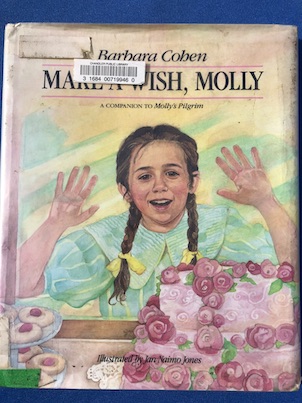
Make a Wish, Molly by Barbara Cohen, 1994.

This book is the sequel to Molly’s Pilgrim.

Things have improved for Molly in Winter Hill since she and Emma became friends.  Now, Molly doesn’t feel quite so alone as she once did.  However, Emma is still friends with the nasty Elizabeth (resident mean girl from the first book).  Molly has learned that a major part of Elizabeth’s resentment toward her is that Elizabeth is used to being the teacher’s pet and the center of attention at school.  In both first and second grade, she always seemed to be the favorite student.  Now, in the third grade, Elizabeth thinks that their teacher prefers Molly, and she can’t stand it.  So, she tries to make trouble for Molly whenever she can and make others not like her, too.

Emma tries to ignore Elizabeth’s nastiness and invites both girls to her birthday party.  Molly is excited because she’s never been to a birthday party in America before, and birthdays are celebrated very differently in America from the way they were in Russia.  Emma and Elizabeth (in her condescending way) explain how birthday parties are, that the birthday girl receives presents from her friends and gives them small party favors in return, and that there is cake and ice cream for everyone.  Molly has never had a cake like the ones that the girls look at in the bakery window and is eager to try it.  But, there’s a problem.

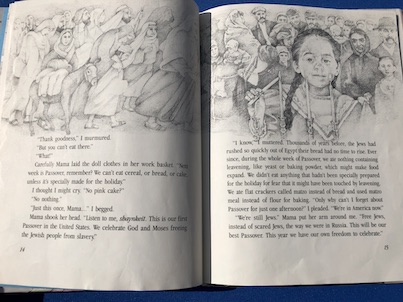
Molly’s mother says that it’s fine for her to go to the party and is willing to make some doll clothes for Emma’s birthday present, but she says that Molly cannot try the cake because the party will take place during Passover, and Jewish families like theirs cannot eat leavened foods during that time. Leavened foods are those that include rising agents, like yeast, baking powder, and baking soda, which includes cakes and breads. For Passover, Molly and her family are limited to things which don’t have these ingredients.

Instead, Molly’s mother packs a snack for Molly to take and eat while the others have the cake.  At first, Molly thinks maybe she could disobey her mother just this once and try the cake anyway without her noticing and without feeling different among the other girls, but when a piece of cake is placed in front of her at the party, she can’t bring herself to eat it.

Of course, Elizabeth takes advantage of Molly’s inability to eat the cake to make her feel bad and look bad in front of the others.  Elizabeth says that Jewish people don’t like to eat in Christian homes.  Molly tries to explain that isn’t the problem and to tell them about Passover, but Elizabeth ignores her explanation and just says that Molly’s reluctance to eat proves that what her mother told her about Jews was true.  (Let me just say that when a kid is as awful as Elizabeth is routinely, I always assume that the parents are exactly the same way.  I decided that Elizabeth’s mother was probably a bully and a snob back in the first book, so hearing that she’s been spewing anti-Semitic comments is no more than what I would have expected.  I view this type of behavior as an off-shoot of a bullying mindset, so I would completely expect that a person who is prone to one type of bullying would also engage in another. The apples never fall far from the tree.)  Molly knows that she can’t make the other kids understand the situation, so she just leaves in embarrassment.

When she gets home, Molly tells her mother about what happened.  Her mother says that everyone is a little different from other people, and there’s no use in pretending that they don’t live different types of lives from some of their neighbors.  However, Molly also has a birthday coming soon, and Molly’s mother thinks that if they invite some of the girls from Emma’s party to their house for a celebration, they will see that Molly’s family isn’t quite as different as they might think.

At first, Molly isn’t sure that it will be such a good idea, but it turns out better than she expects.  Her birthday is full of wonderful surprises.  There’s no cake, but Molly’s mother bakes other wonderful goodies, like rugelach (pastries with apples, raisins, and nuts).  Emma and another girl, Fay, try them and like them, but Elizabeth still refuses.  She also just looks defiant when Molly’s mother proves to her that Jews will wash and reuse plates that Christians have eaten from, not throw them away, like Elizabeth’s mother said before.  Once again, the issue with Elizabeth isn’t how correct or incorrect she (or her mother) was in whatever she said but whether or not she happens to look better than someone else at the current moment.  All Molly’s mother’s demonstration means to her is that she just lost another opportunity to look better than someone, and that annoys her.  But, Molly doesn’t care so much about Elizabeth’s lingering nastiness at that point because she knows that Emma is still her friend and Fay has just become a new friend.

There is also a movie version of this book, although the story was altered slightly so that the girl who insults Molly at the party says that it was her aunt who told her all the bad stuff about Jews, not her mother.  Also, the movie takes place in a time contemporary with when it was made.  The original book takes place in the past, judging by why the reasons why Molly’s family had to leave Russia and the clothes that the girls wear in the pictures.

Coconut Kind of Day

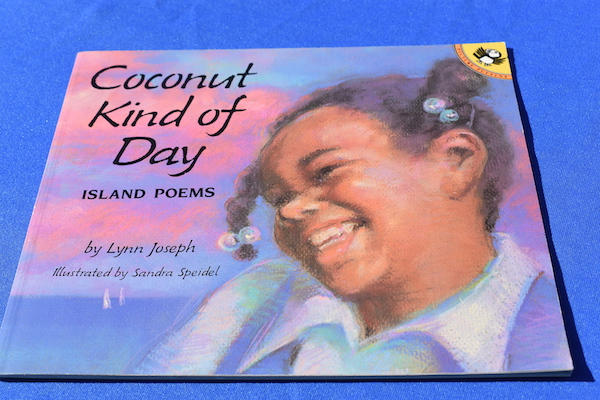
Coconut Kind of Day: Island Poems by Lynn Joseph, illustrated by Sandra Speidel, 1990.

The author’s note in the back of the book explains that the author was originally from Trinidad and that she wrote this book of poems about some of the things that remembers from growing up there.  She also explains some of the terms used in the poems that people who aren’t familiar with Trinidad might not know:

Palet man – Ice-cream man who sells ice cream on sticks, like popsicles (I knew this one because I’m used to the Spanish word “paletero” from growing up in Arizona.)

Soursop – A type of fruit often used as an ice cream flavor

Pullin’ seine – When the fishermen start pulling in their nets, and other people help.

Jumbi man – A bogey man.  It’s popular for people to dress in a Jumbi costume at Carnival time.

Sorrel – A plant used in making a drink around Christmas

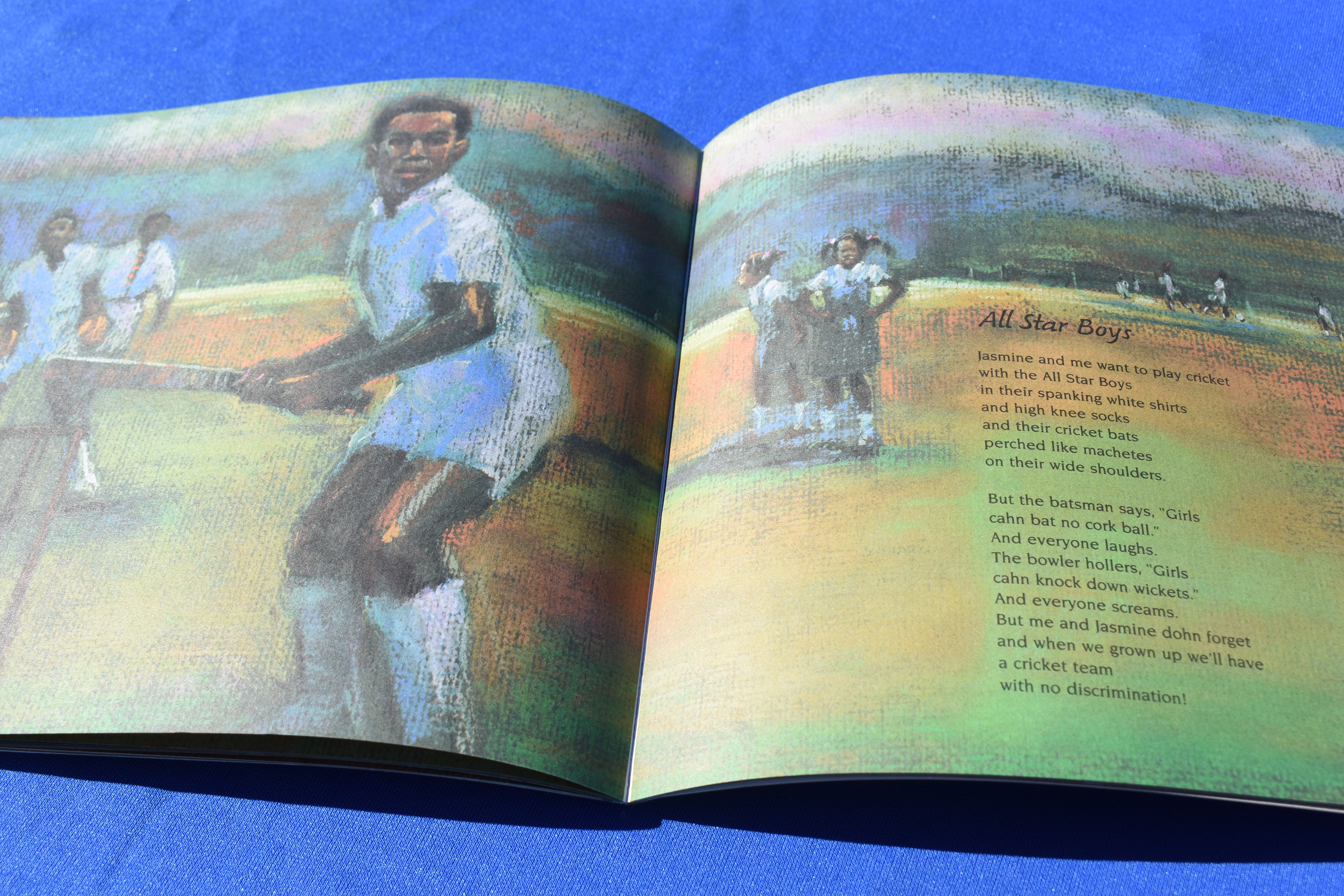
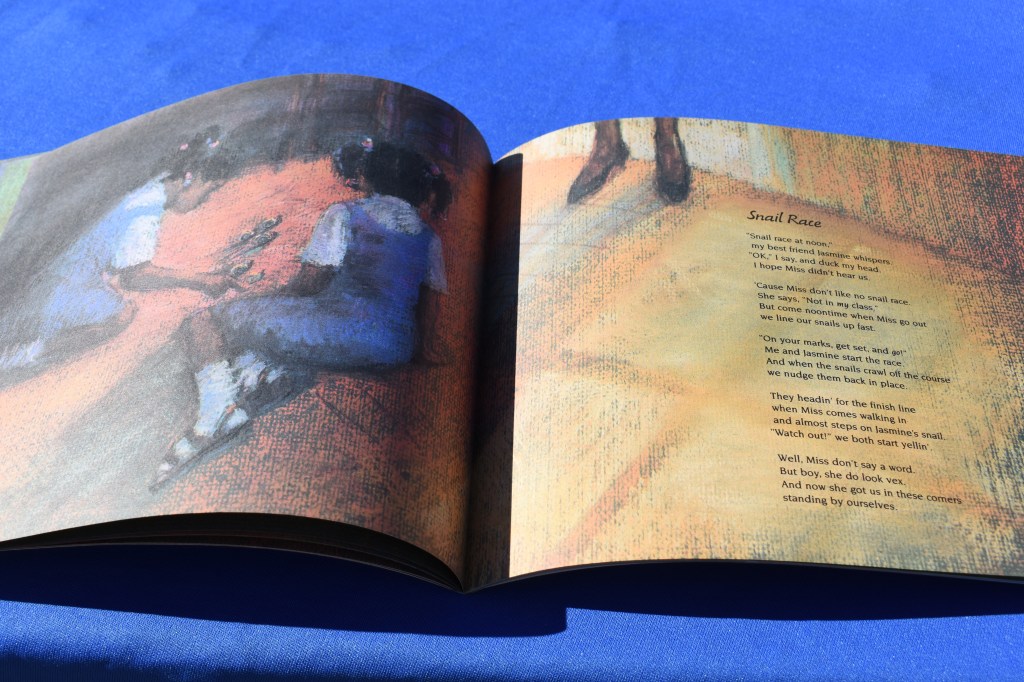
The poems are mostly about small, everyday things, like going to school or to the market or how the children play together or get ice cream from the palet man.

There is one poem where the girls want to play cricket with the boys, but the boys won’t let them, and they decide that when they’re older, they’ll have a cricket team of their own.

The pictures are beautiful, done in an impressionistic style.

The Gullywasher

The Gullywasher written and illustrated by Joyce Rossi, 1995.

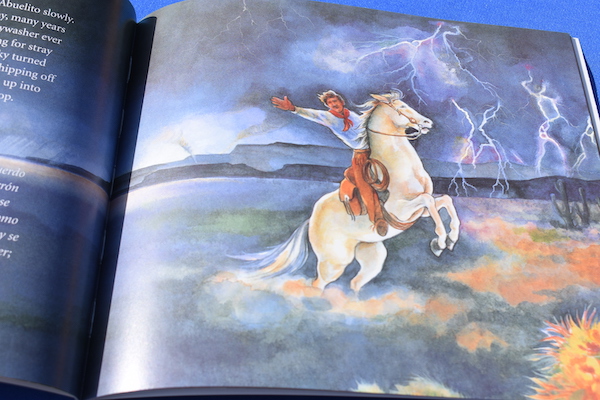
This is a tall-tale story, told by a grandfather to his young granddaughter about how he came to be an old man.  The grandfather was a vaquero (Spanish for cowboy, the origin of the work “buckaroo”) in his younger days.  The book is written in both English and Spanish.

When the story begins, Leticia and her grandfather are watching a passing storm.  The grandfather calls it a “gullywasher” and says that they should wait before going on a walk.

Leticia asks her grandfather to tell her about when he used to be a vaquero.  After some coaxing, he begins to tell her about a big gullywasher that he was caught in when he was younger.

By the time the storm was over, the water had wrinkled his skin.  Then, when he was napping under a palo verde tree, a hummingbird took some of the hairs on his head to make a nest.  It took all of the dark ones, leaving only the white ones.

After that, he came to a village, where he looked for food.  An old woman gave him some corn kernels, but he made the mistake of eating some chili peppers immediately afterward, so the corn popped in his stomach, giving him the pot belly he has today.  Also, his horse was so tired that he had to carry the horse all the way home on his back, making him bent over.  That is how he got to be the old man that he is.

When the tall tale is over, Leticia asks her grandfather if it makes him sad to be bent over.  Her grandfather tells her that it doesn’t because he’s closer to her this way.

The note from the author in the beginning explains a little about the tall tales that cowboys liked to tell.  One of the keys to telling a story like this is to try to keep a straight face during the telling.  Keeping a straight face can make the outrageous story seem more convincing, but it can also make it seem funnier.  There is also a glossary in the back of the book with the definitions of some of the key Spanish words.  It also reminds readers that Leticia’s name is pronounced differently by Spanish speakers than English speakers (“leh-TEE-seeya”).

Something Good

SomethingGood

Something Good by Robert Munsch, 1990.

Tyya begs her father to buy “something good” at the grocery store. Tyya would much rather have him get something like ice cream and cookies instead of boring things like bread and eggs, which is what he usually gets.

However, when she tries to get whole cartloads of ice cream and candy bars, her father makes her put it all back. Tired of her messing around, Tyya’s frazzled father tells her to just stand in one place and not move. Unfortunately, he tells her that near a display of large dolls. Because she doesn’t move, a store employee mistakes Tyya for a doll and puts her on the shelf with the others, giving her a price tag of $29.95.

Some people try to buy Tyya, but she yells at them, scaring them away. Tyya’s father comes to get her, but he has trouble taking her out of the store because she still has a price tag on her, and the man at the register insists that her father has to pay for her.

In real life, no grocery store would try to sell a child, and it would be a crime if they did. However, because this is a Robert Munsch story (where all kinds of crazy things happen), Tyya’s father finally pays the $29.95 because she’s worth it, and Tyya says that her father finally bought something good at the grocery store.  Sort of touching, in an odd kind of way, I guess.

One of the benefits of this story is that it has a lot of potential for reading aloud because the reader can really play up the parts where the characters yell.

The book is currently available online through Internet Archive.

This House is Made of Mud

HouseMud

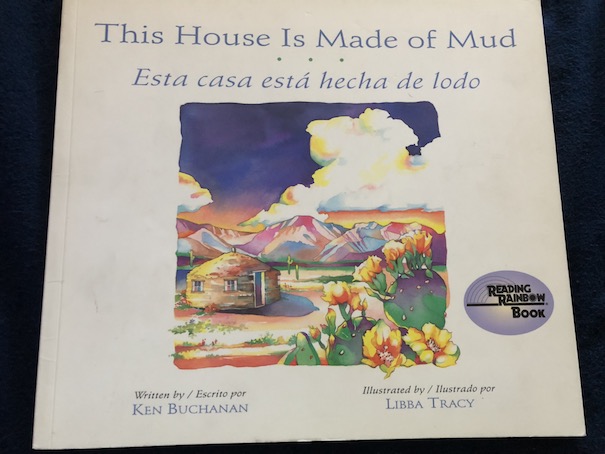
This House is Made of Mud by Ken Buchanan, illustrated by Libba Tracy, 1991, 1994.

The edition of this book that I have is the bilingual edition with English and Spanish.  Originally, the book was written in just English. I like to use kids’ books for Spanish practice, which is why I like this one.  It’s a Reading Rainbow Book.

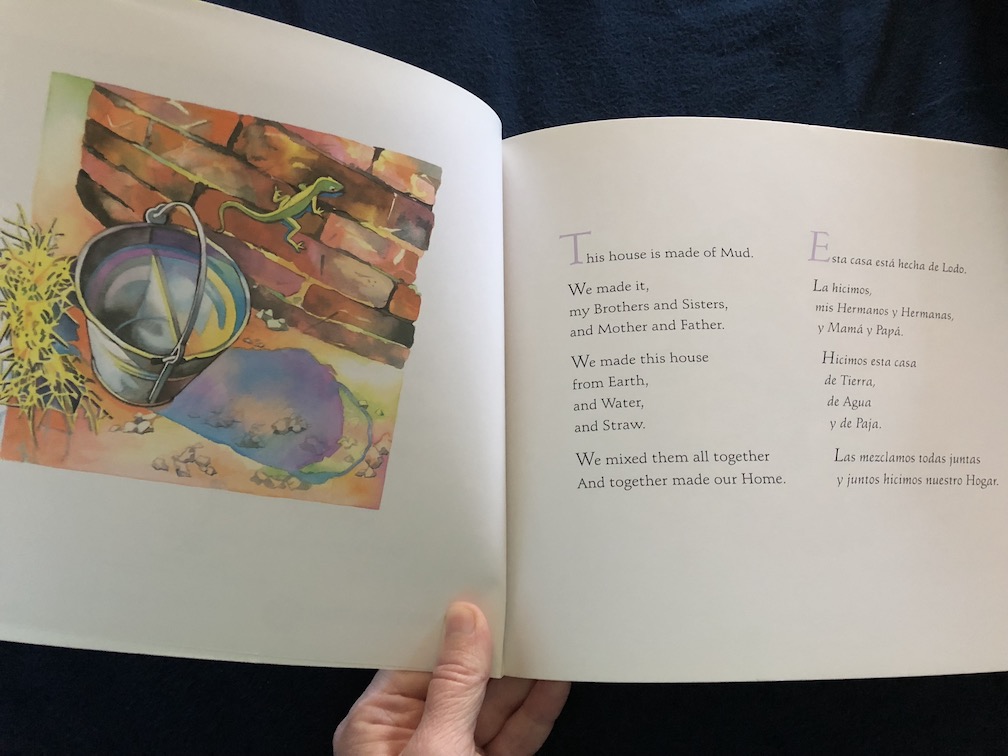
The story is written in a poetical form (non-rhyming), describing an adobe house, which is why it’s made of “mud.”  It’s a traditional way of building houses in the American Southwest, where I’m from.

HouseMudBeginning

As the book describes the house, it compares it to the land around it and the world in general.  Like the Earth, the house is round, which is how some Native Americans build their houses.

HouseMudRound

Aside from the people who live there, animals also share the house, from the family pets to bugs and mice who live in the walls and under the floor.

HouseMudAnimals

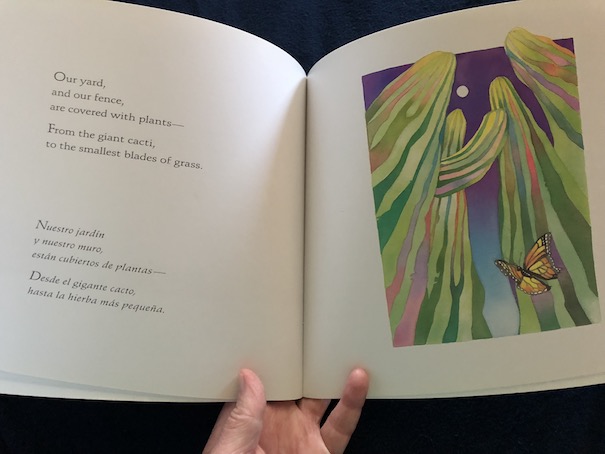
Their yard is the desert, surrounded by mountains and full of cactus.

HouseMudYardCactus

The people who live there have many friends who come to visit, and it is a house full of love.

The book is currently available through Internet Archive.

HouseMudLove

The Unbreakable Code

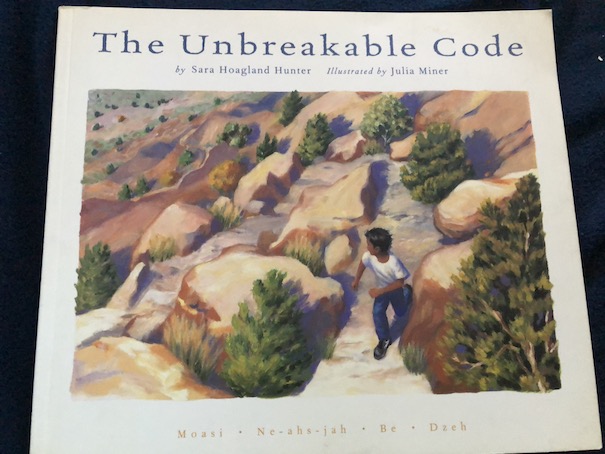
UnbreakableCode

The Unbreakable Code by Sara Hoagland Hunter, illustrated by Julia Miner, 1996.

A young boy, John, is upset because his mother has recently remarried, to a man from Minnesota.  Now, John is faced with the prospect of moving to Minnesota, and he doesn’t want to go.  He would much rather stay with his grandfather on his farm on the Navajo Reservation.  His grandfather points out that he’ll return in the summer, but that hardly seems good enough.  Then, his grandfather tells him that he’ll be okay because “You have an unbreakable code.”

UnbreakableCodeJohnGrandfather

John asks what his grandfather means by that, and he says that the Navajo language is the unbreakable code.  John worries that he’ll forget how to speak Navajo, but his grandfather says that he never did even though he had to attend a government boarding school at a young age and that the language saved his life during World War II.  John’s grandfather was a code talker.

John’s grandfather tells John the story of how he became a Code Talker, starting with when he was at boarding school.  The purpose of the government “Indian Schools” was to assimilate Native Americans into white American culture.  They were known for forcing their students to abandon traditional clothing, cut their hair, take English names, and speak only English.  John’s grandfather describes having to chew on soap whenever he was caught speaking Navajo.  He was only allowed to return home during the summer to help his family with their sheep and crops.

UnbreakableCodeBoardingSchool

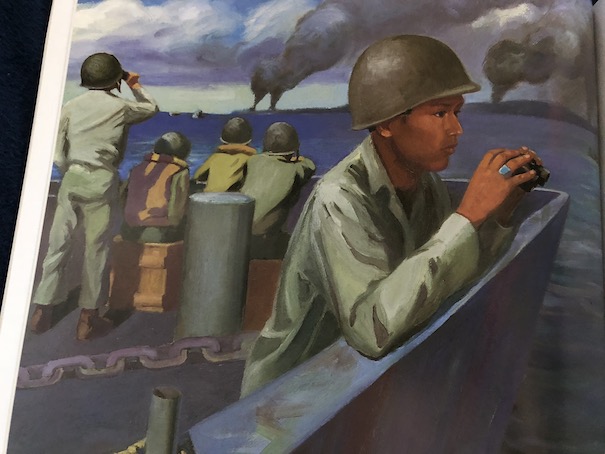
Then, when he was in his teens, during World War II, he heard an announcement on the radio that the Marines were looking for young Navajo men who could speak both English and Navajo.  Seeing it has a chance to escape, he ran away from school and enlisted.  After life at a harsh boarding school, the military marches and drills were no problem, and all of the Navajos already had wilderness survival skills.

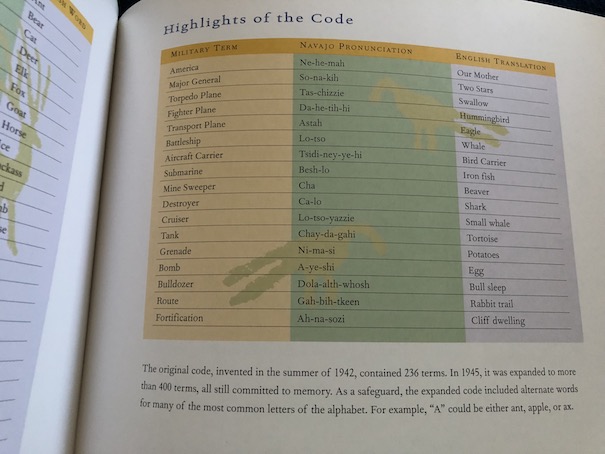
After they had completed basic training, they were told that they were needed for a secret mission in the Pacific.  The Japanese had intercepted American radio transmissions and broken the codes they were using.   The Marines wanted Navajo speakers because the language was almost unknown outside of the United States, not many non-Navajos had ever learned it, and at that point in its history, the language had not been recorded in writing, so there was no way that the Japanese could research it and learn it.  The Marines and code talkers developed a system of code words in Navajo and military terms to use, so it wasn’t as simple as just speaking the language plainly.  The system was highly effective.

UnbreakableCodeTalker

John’s grandfather goes on to tell John about how bloody the war was and how his life was constantly at risk.  Once, another American soldier even mistook him for a Japanese spy because he didn’t know what language he was speaking.  Fortunately, one of his friends intervened and saved his life.

UnbreakableCodeWar

The code was never broken during the war, and John’s grandfather eventually made it home safely.  However, the code talkers were not hailed as heroes because, for many years, the government wanted to keep the code a secret.  No one was allowed to talk about it.  John’s grandfather was glad to return to a peaceful life on his farm.

UnbreakableCodeReturnHome

His grandfather’s story gives John the courage that he needs to face moving to a new place.  After all, his grandfather had been to far more frightening places and faced them with courage.  Knowing his family’s history gives John a new sense of his own identity and the knowledge that his identity and language will remain with him wherever he goes.
This book is available to borrow and read for free online through Internet Archive.

My Reaction and Additional Information

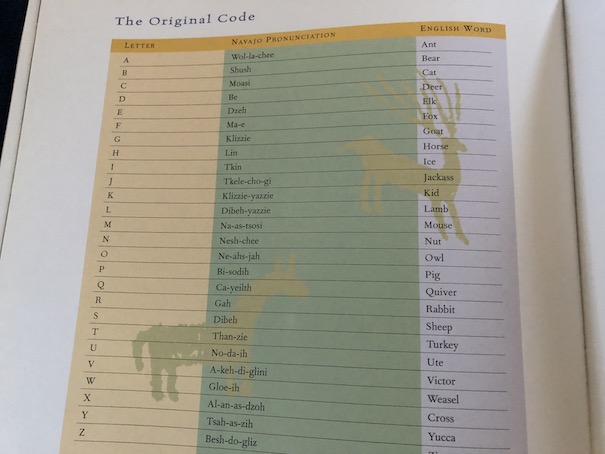
Even though this is a picture book, it isn’t really a book for very young children.  There are descriptions of the blood and violence of the war that would be more appropriate for older children.  There is a brief note from the author at the beginning of the book that explains a little about World War II and code talkers, and at the end of the book, there are charts that demonstrate how the code worked.  This book is an a good way to introduce students to the topic of code talkers if they have never heard of them before.

UnbreakableCodeTable1
UnbreakableCodeTable2

In modern times, there is a written form for the Navajo language, and since I grew up in Arizona, the colleges I attended had classes in Navajo for those who wanted to study the language.  I used to see the books for the classes in the school book stores, although I never studied Navajo myself.  I met one of the code talkers once when he came to speak at our college.  I believe that there are a few who are still alive at the time of this writing.

Monster Slayer

MonsterSlayer

Monster Slayer retold by Vee Browne, illustrated by Baje Whitethorne, 1991.

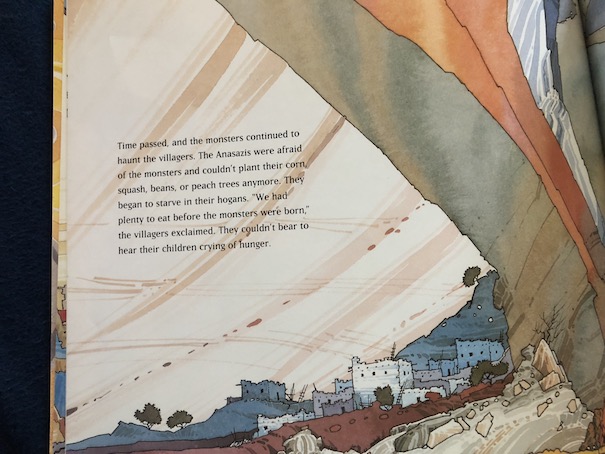
This is a retelling of a Navajo folktale.  An Editor’s Note at the beginning of the book explains a little about the original legend.  It is actually part of a much longer story.  The book only focuses on the Walking Giant part.  The Walking Giant threatened the villages of the Anasazi.  The author and illustrator of this book are both Navajo.

Changing Woman, who created both humans and monsters, had twin sons, but they did not know who their father was until they were twelve years old, when their mother told them that their father was the Sun.

MonsterSlayerAnasaziVillage

The twins went to see their father, but they were returned to Earth to help their people to fight the monsters which plagued the land.  The monsters prevented the Anasazi from planting their crops, and people were starving.  The people appealed to Changing Woman and her sons for help.  The twins’ father gave them his lightning arrows to use in the fight.

MonsterSlayerVillagers

Hearing the sound of thundering footsteps, Changing Woman told her sons that it was the sound of the Walking Giant.  The twins took their armor, sacred magic feathers, and lightning arrows and set out to find the giant.  Eventually, they found him by a lake.  The twins hid behind a rock, but the giant could smell them.

MonsterSlayerMagicFeathers

As the fight began, the twins let the giant shoot the first arrow at them because their father told them to, since Walking Giant was older that they were.  However, their magic feathers helped them to evade the giant’s boomerang.  Then, one of the twins used a lightning arrow to finish off the Walking Giant.  To commemorate their victory, Changing Woman named this twin Monster Slayer.  (The other boy was already named Child Born of Water.)

MonsterSlayerGiant

This story is interesting but felt a little disjointed to me. That may be because it is a shortened version of the legend.  I wish that the beginning note explained a little more about the context of the story.  This book won the Best Juvenile Book Western Heritage Award from the National Cowboy Hall of Fame.

The book is available to borrow and read for free online through Internet Archive.

Cam Jansen and the Ghostly Mystery

Cam Jansen

CJGhostlyMystery

Cam Jansen and the Ghostly Mystery by David A. Adler, 1996.

CJGhostlyMysteryGhostCam Jansen’s Aunt Molly takes her and her friend Eric to buy tickets for a Triceratops Pops concert.  Triceratops Pops is a singing group that dresses up like dinosaurs, and many of the fans buying tickets also wear dinosaur costumes.  While they’re standing in line, someone dressed as a ghost starts sneaking up behind people and scaring them by yelling, “Boo!”  At first, it seems like a mildly annoying prank, but then one old man standing nearby seems to have a heart attack when he is startled.

The guards standing near the ticket booth rush to help the man and call for an ambulance for him.  However, while they are distracted, the person in the ghost costume robs the woman selling tickets, taking all the ticket money and her own money from her purse.

Cam is convinced that the old man who collapsed was part of the thief’s plan and that his “heart attack” was just an act to distract the guards.  She noticed that he seemed to be wearing a wig to make himself look older.  But, there are two other clues that are important: the magazines that the man dropped when he fainted, and the fact that the ghost costume was found in the ladies’ restroom.  Once again, Cam helps the police with her amazing memory!

The book is currently available online through Internet Archive.