Aunt Eater’s Mystery Halloween by Doug Cushman, 1998.
This is a cute Halloween book for kids. There are actually four short mystery stories in the book as Aunt Eater, dressed as Sherlock Holmes, goes to a Halloween party and encounters various spooky happenings.
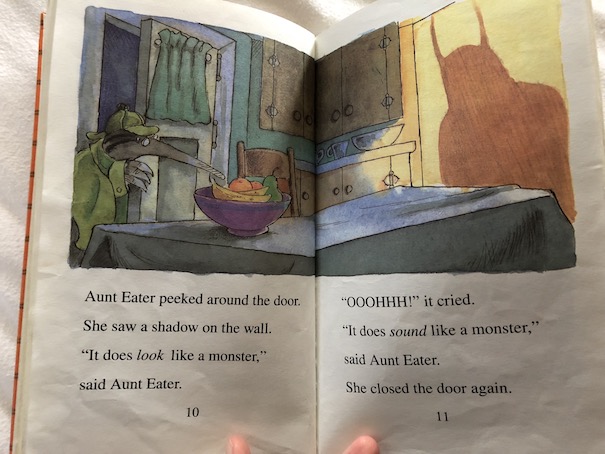
Aunt Eater Sees a Monster
While she’s on her way to the Halloween party, Wally stops Aunt Eater and says that there’s a monster in his kitchen and that it ate his father. When Aunt Eater takes a look, she sees a scary shadow in the kitchen and hears a terrible groan. Is it really a monster?
Aunt Eater Sees a Ghost
Aunt Eater continues walking to the party with Mr. Chumly, who is dressed as a turnip. Mr. Chumly points out a hollow tree that they pass and tells her that it’s supposed to be haunted by a headless ghost. Aunt Eater doesn’t believe in ghost, but then a scary jack o’lantern appears, moving by itself, and it’s followed by a ghost with no head! Fortunately, there is a logical explanation.
Aunt Eater Hears Some Music
Aunt Eater is glad to see all of her friends at the party. Miss Underbelly has brought her pet snake with her. Later, the piano suddenly starts playing strange music without anyone sitting at it, and the snake has disappeared! What do you suppose is happening?
Aunt Eater Dances a Jig
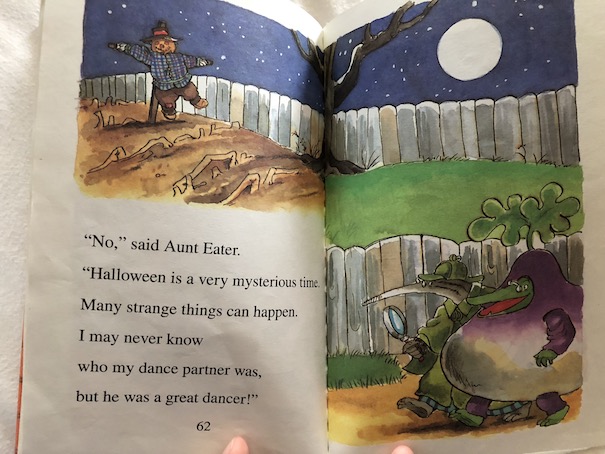
Mr. Fragg, a friend of Aunt Eater’s, is wearing a scarecrow costume, and he tells Aunt Eater that he’d like to dance with her later in the evening. She does dance with a scarecrow, but then learns that it wasn’t Mr. Fragg because Mr. Fragg hurt his foot. Who was that mysterious scarecrow? Aunt Eater never figures it out, but readers do.
The book is currently available online through Internet Archive.
If Your Name Was Changed at Ellis Island by Ellen Levine, 1993.
Like other books in this series, this book explains about a part of American history using a series of questions and answers. Each section of the book starts with a different question about what it was like to come to America as an immigrant in the past and what happened when they reached Ellis Island, one of the main ports of entry into the United States around the turn of the 20th century, just off the coast of New York City, such as, “Would everyone in your family come together?”, “What did people bring with them?”, and “What did the legal inspectors do?” Then, the book answers each of the questions.
The questions and answers start by describing what the journey to America was like from the late 1800s through the early 1900s. Typically, families would come to the United States in stages: the father of a family (or perhaps one of the older children) would make the trip first, find a job in the United States and start saving money to prepare for rest of the family to come. Depending on the family’s individual circumstances, it might be years before all the members completed the immigration process and reunited in America.
People traveled by ship in those days, and an often-forgotten part of their journey was even reaching the port the ship to America would be leaving from. Depending on the starting point of the journey and the travel arrangements each family was able to make, getting to the port might involve crossing borders between other countries, adding another layer of legal difficulties to the journey.
There was also the knowledge that they might be turned away once they arrived at Ellis Island. One of the chief concerns at the time was illness. The inspectors at Ellis Island checked immigrants for signs of infectious diseases, and the ship companies knew that if their passengers were turned away because of the fear of disease, they would be required to pay for the return voyage themselves. To help ensure that their passengers would not arrive with a disease, they would conduct their own health checks before the ship ever left port, looking for signs of illness, giving the passengers vaccines, and disinfecting things. They were particularly afraid of passengers with lice because lice can spread typhus, which is deadly. They would often cut the passengers’ hair or comb it very carefully.
The treatment passengers on ships received depended largely on their class of passage. First and second-class passengers received the best rooms and the best food, and when they arrived in New York (assuming that was their destination), they didn’t even have to go to Ellis Island at all; the immigration inspectors would inspect first and second-class passengers on board the ship. Only steerage passengers (“third class”, the cheapest possible method of travel, used by the poorest people, the largest group) would have to get off the ship for processing at Ellis Island.
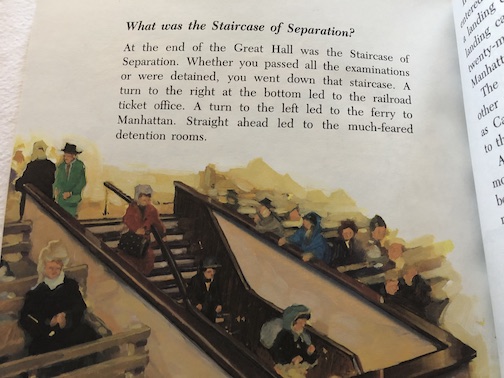
The processing center at Ellis Island wasn’t just a building; it was an entire complex. The Great Hall alone was large enough to contain hundreds of people at a time, and when it was full of immigrants there were so many languages being spoken at once (sometimes as many as 30 different languages) that some people described it as sounding like the Tower of Babel. There were also dormitories that could house more than a thousand people, a hospital for the sick, a post office, banks where people could change their cash for American money, a restaurant to feed everyone (with two kitchens, one kosher and one regular), a railroad ticket office where immigrants who would be moving on from New York could make their travel arrangements, and much more. Some people called Ellis Island the “Island of Tears” because the arrival there after a long journey was an emotional experience and many immigrants were worried that they might be sent back if they couldn’t answer the inspectors’ questions to their satisfaction. At the end of the Great Hall, there was a large staircase that came to be known as the Staircase of Separation. Everyone had to go down this staircase after their examination by the inspectors. At the bottom, they would go their separate ways, depending on their travel plans or whether they had passed inspection. People who turned to the right were heading to the railroad ticket office. People turning to the left were heading to the Manhattan ferry. People who went straight were heading to the detention rooms because they hadn’t passed the inspection.
As I mentioned before, the inspectors were very concerned about people who showed signs of serious diseases. One of the first things that would happen during inspection was a brief examination by the Ellis Island doctors. Because of the massive amount of people who had to be processed, this examination lasted only a few minutes, during which the doctor would quickly check for very specific symptoms and signs of possible illness. If they didn’t see anything obviously wrong, such as red eyes (possible sign of eye infection, although for some, it was just because they’d been crying), difficulty in breathing, or lice, they would let the people pass. If the doctors thought that they saw something that might be sign of illness, they would write a letter in chalk on the person’s clothes and send them on to be examined more thoroughly by another doctor. Getting one of these letters didn’t always mean rejection. If the other doctor decided that the first doctor was mistaken or that the person’s symptoms weren’t serious, they would still be allowed into the country. Sometimes, if a person was ill but had a curable disease, they would be kept in the hospital on Ellis Island until they were better. If the doctors weren’t quite sure if a person was ill or not, they might keep the person in the dormitories for a few days and then check them again after they had a chance to rest. The people who were sent back on the ship were ones who had diseases that were incurable or seriously contagious. (It sounds heartless, but they were trying to head off deadly epidemics. During the 1800s, large cities like New York sometimes suffered serious epidemics of deadly diseases because of the sudden influx of new people who were living in overly-crowded conditions with relatively poor sanitation. By preventing people with signs of serious diseases from joining the rest of the population, they were hoping to head off new epidemics and save lives.)
One of the more controversial parts of the examination was when they tested people for possible mental problems. They wanted to make sure that they were mentally fit enough to find work, but the problem was that the tests designed by people who didn’t take cultural differences into account when they designed them. The parts where they asked people to do simple arithmetic problems or to demonstrate that they could read, count backwards, or match up sets of similar drawings were pretty straight-forward. However, sometimes they were shown a picture and asked to describe what was happening in the picture, and the immigrants gave the inspectors some surprising interpretations because it turns out that some experiences aren’t quite as universal as some people think. For example, one picture was of some children digging a hole with a dead rabbit lying nearby. It was supposed to depict children burying a dead pet. But, some people view rabbits more as food than pets, and some immigrants said that the children were doing their chores because why shouldn’t the children work in the garden (the digging) after hunting a rabbit for dinner? Fiorello La Guardia, himself from an immigrant family, an interpreter on Ellis Island and later, mayor of New York, particularly despised tests like these because the people who designed them and administered them were trying to test the minds of others without any real idea about what their lives had been like or how their minds actually worked.
The inspectors’ examinations in general weren’t always reliable because they were often hurried (dealing with so many people in a limited amount of time) and because the interpreters weren’t always accurate, which brings us to the question of why people’s names were sometimes changed at Ellis Island. Sometimes, it was intentional. Some immigrants thought that they would be more likely to be accepted by the inspectors if they had short, easy-to-pronounce names, so they would purposely give them shorter versions of their names. There was some basis for this belief because, if an inspector didn’t understand a long, unfamiliar name, they wouldn’t have much time to figure it out and so would either take their best guess at the what the name should be, shorten it when they wrote it down, or give up altogether and write a much shorter name instead. For example, when they processed Jewish people from Russia, the inspectors often ran into difficulties in understanding their last names and would sometimes just write down “Cohen” or “Levine”, no matter what the original name really was. Sometimes, name changes were just an honest mistake because the inspector didn’t know how a name was really spelled (I can speak from personal experience because my family’s last name wasn’t always spelled like it is now, and when they found out that it had been changed, it was just too much trouble to fix it) or because they had misinterpreted something that the immigrant said. One of my favorite examples of this was a young man who tried to explain to the inspector that he was an orphan (“yosem” in Yiddish). The inspector dutifully wrote his last name as Josem.
The pictures in the book are paintings based on original photographs of immigrants and Ellis Island. (See Immigrant Kids to compare some of the pictures.)
The book also contains some further information about the lives of immigrants once they arrived in America (Immigrant Kids goes into a lot more detail), the attitudes of Americans toward immigrants at the time (varied but with strong strains of anti-Catholic, anti-Irish, and general anti-immigrant attitudes during the 1800s), and the contributions of immigrants to American society. I actually bought this book as a souvenir on a visit to Ellis Island years ago.
The book is currently available online through Internet Archive.
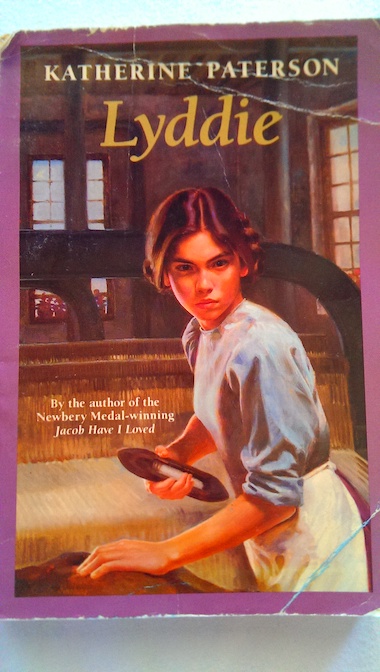
The year is 1843. Thirteen-year-old Lyddie’s father left home to go West and seek his fortune, and he hasn’t been heard of since. Lyddie helps her mother to take care of their farm in Vermont and the younger children, but they are very poor, and her mother has given up hope of their father returning home. The children’s aunt and uncle, Clarissa and Judah live nearby, but they are of little help, full of fire-and-brimstone talk. Lyddie and her brother Charlie, who is ten, more often turn to their Quaker neighbors, the Stevenses, for help. They are kinder than their aunt and uncle, although their mother disapproves of them for being abolitionists and, in her mind, heathens. Lyddie and Charlie are just grateful for their help. Because of their mother’s depression at the loss of their father, she pays little attention to the things that her children do to keep the farm going and the family together.
However, when a bear enters their house and eats the oatmeal that Lyddie was preparing, their mother, primed by Clarissa’s and Judah’s talk of signs of the end times and such, goes into a panic and sure that the world is going to end. Lyddie and Charlie let her go with their younger sisters to stay with Aunt Clarissa and Uncle Judah while they continue managing the farm as best they can. However, even though their mother sees that the world doesn’t end, she decides that she’s going to hire Lyddie out as a maid at the Cutlers’ tavern and Charlie to work at the mill because the family has too many debts and they will have to rent out their fields and animals.
Luke Stevens, the youngest of the Stevens sons, although much older than Lyddie and Charlie, gives them a ride to their new homes and employment at the mill and the tavern and promises to keep an eye on their house while they’re away. Lyddie is lonely and unhappy working at the tavern, badly missing the family farm and her siblings, especially Charlie. Then, one day, a woman visiting the tavern mentions that she’s one of the factory girls from Lowell, Massachusetts. The woman tells Lyddie that she seems like a good worker and that she could earn a good wage in the factories herself. At first, Lyddie doesn’t believe what the woman says that girls can earn there.
When Lyddie is allowed a brief visit home to her family’s farm, she discovers that Luke Stevens has been allowing a runaway slave to hide there. Lyddie isn’t sure what she thinks of it at first. Ezekial, the fugitive, frightens her because she has never met a black man before, and she knows that if she were to turn him in, there would be a handsome reward that could solve her family’s money problems. However, Ezekial seems to understand the situation that her family is in without her father. Although Lyddie and Charlie are not technically slaves, they have become a kind of indentured servant because of their family’s debts. Ezekial is a father himself, hoping to send for his family when he has found a safe place for them. Lyddie still wonders if her own father is alive, perhaps hoping to send for his family when he can. Having come to a better understanding of Ezekial, she knows that she can’t turn him in, even for the reward money.
Her talks with Ezekial make Lyddie understand that working in the tavern won’t solve her problems, though. As a maid there, she basically works all day for her room and board and has nothing else to show for it. Mrs. Cutler just sends a little money to her mother now and then and even then, she doesn’t always bother, and her mother is in little position to insist on proper wages, making Lyddie little better than a slave. Mrs. Cutler cares nothing about Lyddie or her family’s welfare, just trying to get as much labor out of her for as little as she can. Lyddie finally makes up her mind to seek factory employment in Lowell, Massachusetts, seeing it as her only chance to earn some real wages.
Life in Lowell turns out not to be as glamorous as the woman she met at the tavern made it sound, although the wages are definitely better. The company that owns the fiber mill where Lyddie gets a job has all sorts of rules and regulations for the girls who work there, even ones that intrude on their personal lives outside of work. Anxious to give the impression that all of their workers are of good moral disposition, they insist that the girls attend church on Sundays. Lyddie never had the money to pay pew fees back home, so she is unaccustomed to going to church, but finds that other girls in her position tend to go to Methodist churches, where there are no pew fees, saving their precious wages. Lyddie, who never had much time for schooling when she and her brother were trying to keep the farm going, has trouble understanding all of the terms of the employment contract that she signs but signs it anyway. Her employment turns out to be an education that changes Lyddie’s life, although not in all the ways that she had hoped.
Like Mrs. Cutler, the bosses at the factory have little real care for their workers, trying to get as much work out of them as they can for the least amount of pay they have to give them. The work is hard and the hours are long, but Lyddie keeps at it because the pay is the best she’s ever had and she is starting to save up for her family’s future. The poor working conditions contribute to health problems among the girls, and some of them petition for better working hours, but Lyddie is reluctant to do so because girls who are dismissed “dishonorably” from the factory are blacklisted all over town, and she fears not only risking the loss of her job but the potential to find a new one.
Through her interactions with the other girls and young women at the factory, Lyddie also develops into a young woman. She had previously wished that she’d been born a boy instead because a boy would have a better chance of running her family’s farm, but she comes to realize that there are opportunities out in the world for young women who are willing and able to go out and seek them. In Lowell, Lyddie gets a taste for literature through the books that her friend Betsy reads to her and acquires more lady-like behavior by watching the lady-like Amelia. Neither of them plan on working at the factory forever, and their ambitions, to get married or continue their education, cause Lyddie to consider what she really wants for her own future. Through the difficulties she encounters and everything she learns while facing them, Lyddie really becomes her own woman.
In the end, Lyddie is unable to save her family’s farm and reunite their family there. Her mother dies, and her father’s whereabouts are still unknown, so her uncle sells the farm to pay the debts. However, Charlie and her younger sister Rachel are provided for, the Stevenses decide that they will purchase the farm themselves, and Lyddie becomes reconciled to the loss of the farm through her new vision of the future. She is unfairly discharged from the factory after she catches an overseer molesting another girl and stops him because he blackens her name in retaliation. But, by then, Lyddie has acquired some money and new confidence in herself, and she begins making other plans for her future, which may include both further education and the possibility of marriage. One thing that she knows for certain is that, whatever she does with her life, she wants to move forward as her own, independent person.
The book is currently available online through Internet Archive (multiple copies).
Daily Life in a Victorian House by Laura Wilson, 1993.
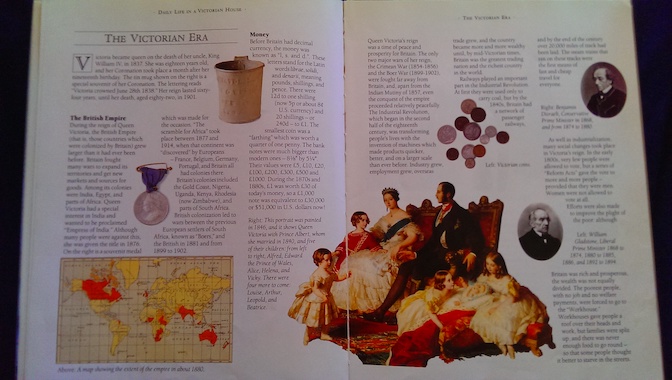
The book begins by giving some background on the Victorian era, which lasted from 1838, when Victoria became Queen of England, to Queen Victoria’s death in 1901. It was a time of expansion and colonization for the British Empire. Society was becoming increasingly industrialized and urban, although there was still great inequality about who had voting rights, and there were great gaps between rich and poor people.
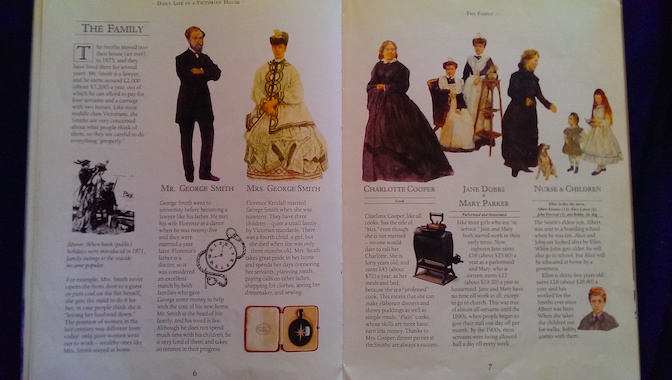
To explain what a typical day might be like for people living in the Victorian era, the book introduces a fictional upper middle class family, the Smiths. It explains some of the background of the Smith family and the members of the Smith household. Mr. George Smith, the head of the household, is a lawyer. His wife, Florence, does not need to work, so she spends her time overseeing the household servants, managing the household accounts (how much money is needed for household expenses such as food, clothes, and supplies), visiting friends, and shopping. Mr. Smith’s income is good enough to afford for the family to have a cook, two maids, and a nurse to look after the youngest children in the family.
The Smiths have three living children. One of their daughters died in infancy, which was sadly common for that era. The eldest boy in the family, Albert, spends most of his time away at boarding school. The two youngest children, Alice and John, are cared for by their nurse. When John is old enough, he will go away to boarding school, like Albert, but Alice will probably be tutored at home. Their parents spend surprisingly little time with them, even in the general course of a day.
There is a map of the Smiths’ house, and then the book begins explaining what each of the members of the house do at different times of the day. Each day, the servants are the first to get up because they need to light the fires to heat the house and start cleaning and making breakfast, which would be a large meal.
Something that I thought was interesting was that the cook typically purchased food from tradesmen who sold their goods door-to-door. This was also important to the maids, who are in their teens, because they worked such long hours that they really wouldn’t have had time to get away and met young men in any other way. Their suitors would likely be the young tradesmen. Of course, the young tradesmen would have met many young female servants at all of the households they visited during their daily rounds.
The maids would have spent their days cleaning, tasks that would have been more time-consuming without more modern inventions. Vacuum cleaners were invented toward the end of the era, in 1899. Cooking was also a time-consuming job, although the book does explain some innovations for the Victorian kitchen. Because Mrs. Smith had servants to do all of her cooking and cleaning for her, she never even went into her own kitchen at all. It was considered improper for a lady with servants to handle menial tasks herself, and the servants wouldn’t have welcomed her interference in their work.
I liked the sections of the book that explained about the lives of children in the Victorian era the best, although I was surprised at how little time children from well-off families would have spent with their parents. Generally, young children would see their parents in the morning for prayers and spend about an hour with their mother in the late afternoon. Other than that, they would spend most of their time in the nursery with their nurse, who would take care of them and didn’t welcome much parental interference any more than the cook would welcome the lady of the house supervising her work.
I also liked the sections about toys and games and entertainment as well as the description of what young Albert’s life would have been like at boarding school. The book also explains what life and childhood were like for less fortunate people during the Victorian era.
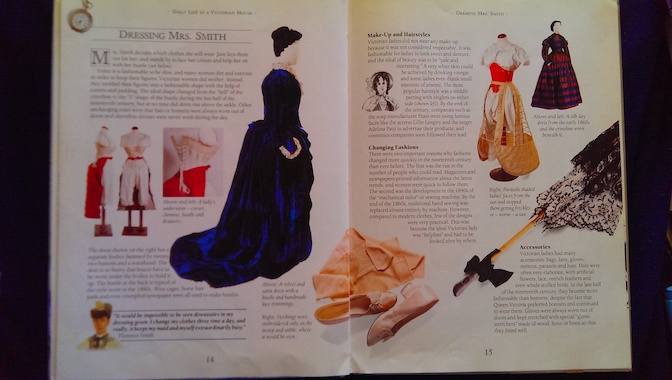
Overall, I really liked this book. It’s a good introduction to Victorian history and life, and it does one of the things that I really wish adult books would do more often: have pictures. Pictures really are worth a thousand words, and actually showing the objects that people of this time would have used in their daily lives is far more effective than pages of lengthy descriptions of them in words only.
The book is currently available online through Internet Archive.
Mirette on the High Wire by Emily Arnold McCully, 1992.
About 100 years ago (the book says, so it’s around the 1890s), a young girl named Mirette and her widowed mother run a boardinghouse in Paris. Most of the people who live there are actors and performers of various kinds.
One day, a strange, quiet man named Bellini comes to stay at the boardinghouse. Most of the time, Bellini prefers to keep to himself, but then Mirette catches him walking on the rope they are using for clothesline in the courtyard of the house. It turns out that Bellini is a tightrope walker. Mirette begs him to teach her how to do it, but he refuses.
Not to be daunted, Mirette begins experimenting with tightrope walking herself. After repeated falls, Mirette eventually learns to balance on the rope. When she shows Bellini that she can walk the length of the rope, he is impressed with her perseverance and teaches her more things to develop her skills. However, he becomes very upset when she boasts that she will never fall again.
Mirette learns that Bellini was a world-famous tightrope walker until a friend of his was killed in a fall, and he lost his nerve. She talks to Bellini about it, and he says that he doesn’t know how to get over being afraid. Seeing Mirette’s disappointment and worry, however, gives Bellini the courage to try once again.
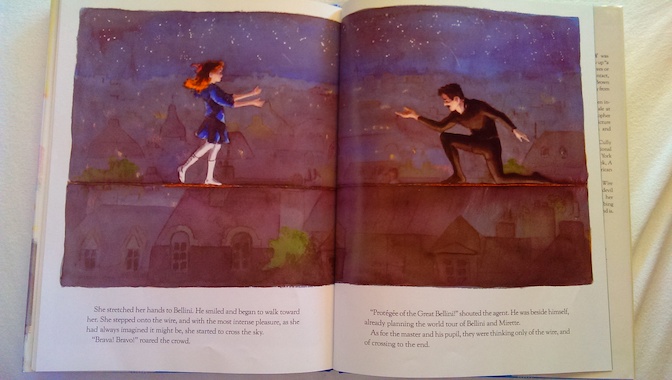
After talking with a performing agent staying at the boardinghouse, Bellini arranges a performance where he will walk a tightrope over a Paris street. When Mirette sees him hesitating at the beginning of the performance, she joins him on the wire, bolstering his courage and realizing her own dreams of becoming a real tightrope walker.
There are other books in a series about Mirette and Bellini, where they perform tightrope acts and have adventures around the world, but I think that the first book is really the best. The pictures are beautiful, done in an impressionistic style.
This book is a Caldecott Award winner. It is currently available online through Internet Archive.
The True Tale of Johnny Appleseed by Margaret Hodges, 1997.
This American folktale was based on the life of a real person, John Chapman.
Johnny Appleseed was born as Johnny Chapman in 1774. His family lived in Massachusetts. There were plenty of apple trees there, and Johnny loved them. When he was grown, he started traveling west with the idea of spreading apple trees.
He carried very little with him, and some people said that he wore the pot that he used to cook his meals on his head as he walked. Everywhere he went, he planted apple seeds.
His reputation spread, and although people thought that traveling around just to plant apple seeds sounded crazy, they sometimes let him stay with them on his travels. Even Native Americans seemed to like him because he was friendly and helpful and interested in learning their languages. His legacy continued long after his death with trees that were enjoyed by generations of families across the Midwest.
There is a section in the back of the book that explains more about the history behind Johnny Appleseed’s story, including the end of the Revolutionary War and the beginning of westward migration in America. One of the things they mention is the effect that the War of 1812 had on relations between pioneers and Native Americans. Because pioneers were already pushing into the territory of Native Americans in the area that later became Ohio, the tribes there sided with the British in the war, hoping to push out the invading pioneers. After the war was over, though, the pioneers continued to come west, and when they did, they retaliated against the tribes that had been on the side of the British. The pioneers could be brutal, and part of the reason that Native Americans liked Johnny Appleseed was that he was different. He wasn’t trying to hurt anyone or take land for himself; he just wanted to plant trees. After he planted trees, he would build fences around them to keep animals from eating them while they were growing.
John Chapman’s life was unconventional. He never married, and he acted as a Christian missionary in his travels as well as a planter. Although he could be regarded as something of an oddball in the itinerant way he lived his life, he became a legend.
The book is currently available online through Internet Archive.
The Stinky Cheese Man and Other Fairly Stupid Tales by Jon Scieszka and Lane Smith, 1992.
This book is a spoof on a number of classic fairy tales. As it explains in the introduction, the short stories included in the book are more Fairly Stupid Tales than Fairy Tales, giving the example of Goldilocks and the Three Elephants: A girl smells peanut porridge and wants to enter the elephants’ house to eat some and try out their furniture, but elephant furniture is too big for her to climb up on, so she just leaves, The End. That incredibly short story isn’t found anywhere else in the book, but it’s a good example of what the other stories are like.
Even the set up of the book is a joke, with the Little Red Hen showing up to demand help with her wheat only for Jack the Narrator to tell her that it’s too soon because they haven’t even had the title page yet. The title page has the words “Title Page” larger than the title itself, and the dedication is upside down because who would actually read it anyway? Then, Chicken Licken thinks that the sky is falling and that everyone should run and tell the President, but it turns out that what’s falling is actually the Table of Contents, which squashes everyone before Foxy Loxy can eat them.
Then, the rest of the stories begin:
Chicken Licken – As described above
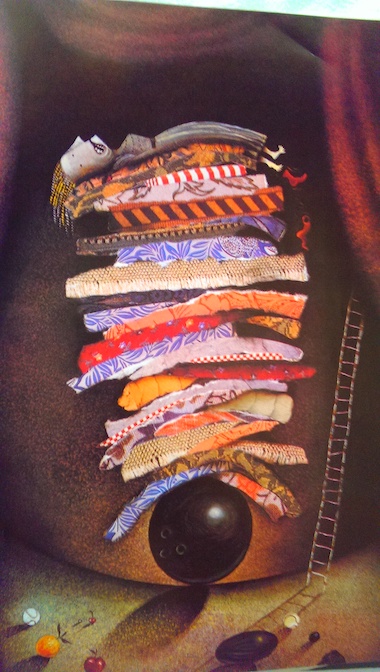
The Princess and the Bowling Ball – parody of the Princess and the Pea – Starts off like the original story with the prince’s parents testing princesses to see if they can feel a pea through a whole bunch of mattresses, but none of them ever do, so the prince takes matters into his own hands to rig the test in favor of the girl he really wants to marry.
The Really Ugly Duckling – parody of The Ugly Duckling – When the really ugly duckling grows up, he’s basically just an ugly duck. The End.
The Other Frog Prince – parody of The Frog Prince – The frog isn’t really a prince. He just said that because he wanted a kiss.
Little Red Running Shorts – parody of Little Red Riding Hood – Jack the Narrator accidentally spoils the story by revealing too much in his introduction to it, so the characters feel like there’s no need to act it out, and the Little Red Hen fills up the extra space, demanding to know why they haven’t gotten to her story yet.
Jack’s Bean Problem – parody of Jack and the Beanstalk – Jack the Narrator starts to tell his own story about defeating the Giant, but the Giant protests because he doesn’t like always being tricked and takes control and reads a story that he “wrote” himself, cut out of pieces of other random stories from different books. When the Giant threatens to eat Jack if he can’t tell a better story, Jack tells a story that constantly repeats until it transitions into the next one.
Cinderumpelstiltskin – parody of Cinderella and Rumpelstiltskin – Starts out like the usual Cinderella story, but Rumpelstiltskin shows up and offers to teach her how to spin straw into gold. Cinderella doesn’t see how that can possibly help her since he doesn’t have a gown for her to wear to the ball, so she ends up without either a gown or any gold.
The Tortoise and the Hair – parody of The Tortoise and the Hare – A rabbit tells the tortoise that he’s so slow that he can grow hair faster than the tortoise can run. By the end of the story, the tortoise is still running, and the rabbit is still growing hair.
The Stinky Cheese Man – parody of The Gingerbread Man – An old couple make a “child” for themselves out of stinky cheese. When he takes on a life of his own and run away, they don’t bother to chase him because they can’t stand the smell. Nobody else wants to chase him, either.
So, why isn’t there a Little Red Hen story listed? At the end of the book, she shows up to complain about how she had to do everything herself to make the bread and nobody even saved space for her story (because Jack had to sneak away from the Giant after he fell asleep). The Giant wakes up and decides to make a chicken sandwich with the bread.
Understanding the jokes in the book requires a knowledge of the stories they’re spoofing, so this isn’t a book for very young children. Any kid who reads this should already know the classic fairy tales and be old enough to appreciate the humorous twists. I think kids feel clever when they realize that they can recognize the references in the stories and know where and how the parodies are different from the originals. Some of the humor has to do with the abrupt endings, simplifying issues that are more drawn-out in the original stories. I remember liking this book when I was in elementary school!
The art style is very distinctive, with a number of cutout elements with different textures. It’s fascinating to see the way that the pictures were put together.
The book is currently available online through Internet Archive.
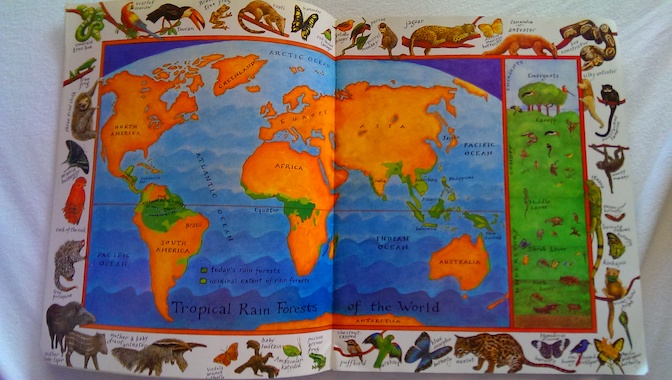
The book begins with a letter from the author, saying that she wrote the book in order to explain to people the importance of rain forests and why they should be preserved.
Two men are walking through a rain forest. They are there to cut down the trees (probably for farming). The animals watch as one of the men begins chopping at a great Kapok tree with his axe. It’s hard work, and before the man gets very far with his chopping, he has to stop and rest.
As the man sleeps, the animals come to him and whisper to him not to chop the tree down. The boa constrictor tells him that his ancestors have lived there for generations. The monkeys tell him that if he chops all the trees down, there will be no tree roots to hold the soil in place, and it will wash away, eventually changing the land into a desert. The birds are worried because people use fire to help clear the forest, and it destroys everything. All of the animals are worried about where they will live and what they will eat if the forest disappears.
The animals also point out to the man that destroying this forest would also be destroying his own future and that of his children. The forest produces oxygen for humans to breathe.
Finally, a human child from the Yanomamo tribe that lives in the forest asks the man to wake up and look at him and all the animals. The man is startled and amazed by what he sees. He thinks about continuing his work, but seeing the child and all of the animals staring at him silently, hoping that he won’t, he decides that he can’t bring himself to do it and leaves.
I don’t remember reading this book when I was a kid, but I remember other stories very much like it. Environmental issues like this were common topics of discussion when I was in elementary school during the early 1990s. One of the movies of my childhood, FernGully, came out in 1992, a couple of years after this book was first published. That movie is also based on a book, although it has even more fantasy elements than this story, which has talking animals. Both of these stories demonstrate how many children during the 1990s were raised to be environmentally aware.
The Sly Spy by Marjorie Weinman Sharmat and Mitchell Sharmat, 1990.
Someone has been trying to steal Olivia’s business by covering up her flyers with ones that say E.J.’s Spy Service. At the same time, Olivia’s friends are trying to keep Desiree’s birthday present a secret even though she has been snooping at their houses to find out what it is.
Olivia’s friends bought her a pet canary because she said that she likes feathers, and they ask Olivia to hide it at her penthouse until the party. However, it looks like Desiree has hired E.J. to spy on her friends and discover what they’re giving her for her birthday. Olivia has to outwit the spy and prove to him that some cases aren’t worth taking.
In a way, this story is kind of like business ethics for kids. First, covering up Olivia’s ads to prevent her from getting business was a form of unfair competition. Then, when Olivia points out to E.J. that he also has a surprise present to give to Desiree, she helps him to understand why the other kids want to keep their present a secret. It wasn’t really ethical for E.J. to take Desiree’s case in the first place since it would be better for her to be surprised on her birthday. Olivia makes sure that E.J. only has a vague notion about what Desiree’s present actually is, and he figures out what to tell Desiree so that he can fulfill his duty to her without giving away the surprise.
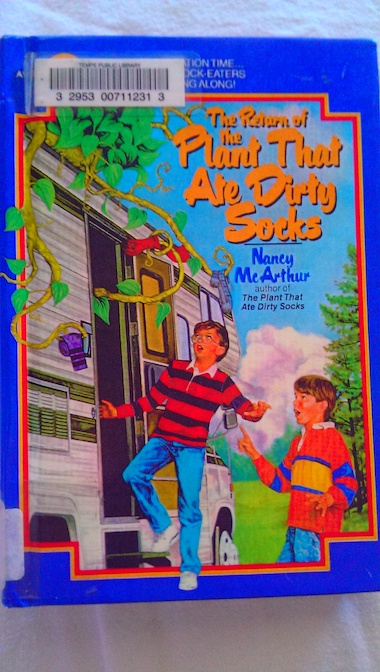
The Return of the Plant That Ate Dirty Socks by Nancy McArthur, 1990.
Michael and Norman’s father has finally gotten the chance to take a vacation, but his sons’ weird, sock-eating plants complicate things. You can board pets or ask someone to come in and feed them, but how can you ask someone to leave out socks for your houseplants? The boys’ parents still kind of think that the plants are more trouble than they’re worth, but the boys love them like pets and can’t bear to get rid of them. Instead, they persuade their parents to rent an RV for the family’s vacation. That way, they can take the plants along.
It seems like a good idea, although before they leave home, the boys notice that the plants are starting to produce seed pods, something that they decide not to tell their parents. Instead, they simply remove the seed pods from the plants when they find them. So, the family sets off for Florida and Disney World in their RV with the sock-eating plants sticking out through the sun roof.
At first, it seems like things might be okay on the trip, but one night, when the boys are visiting their grandmother and sleeping in the house instead of the RV, they forget to set out socks for their plants to eat. When they wake up in the morning, the RV is gone. The boys worry that the plants somehow got control of the RV and drove it off to find more socks, but it turns out that it was stolen by car thieves. The police recover the RV but are puzzled when witnesses describe the thieves as abandoning the vehicle, screaming and running away without their shoes on, one of them only wearing one sock. The family is relieved to get their RV back, not to mention their plants, however their adventures are just beginning.
The family has a good time when they get to Disney World, but the plants start drooping because they feel neglected, all alone in the RV all day. To get the plants out in the sunshine and supervised more, the boys ask the people at the daycare center at the RV park if they can leave their plants there during the day. The plants perk up a little more, getting attention from the staff and children, especially when they sing.
But, it turns out that the mother of one of the girls who has seen the plants, Dr. Sparks, is a botanist, and she’s very curious about the origin of these unusual plants. The boys’ parents think that it might not hurt to get an expert opinion about their strange plants, but the boys worry that if the plants turn out to be very rare, scientists will want to take them away or their parents might decide to sell them. Their parents still think that the plants are too weird and too troublesome to keep, but Michael and Norman think of them as their friends and pets. They’ve been trying hard to keep their plants’ sock-eating abilities quiet. Is it finally time to tell someone? Can Dr. Sparks be trusted?
They end up asking for Dr. Sparks’ help when Fluffy accidentally eats something he shouldn’t. Dr. Sparks knows that the plants are unusual, but by the end of the book, she’s still not sure that she believes that they really eat socks. The boys give her some seeds so that she can experiment without taking their plants, knowing that she’ll eventually discover just how unusual the plants are. By the end of the book, other people are also growing more plants like Fluffy and Stanley, partly because Michael’s friend Jason stole some of the seeds they were saving and sold them to other kids while Michael and Norman were out of town. The boys can’t get back the seeds, but they force Jason to at least confess to the other kids that the plants will eventually eat socks. Jason doesn’t think that they’ll believe him, but the boys know that it’s only right that the buyers be warned because they’ll discover the truth eventually. Fluffy and Stanley are also starting to acquire the ability to move around on their own.












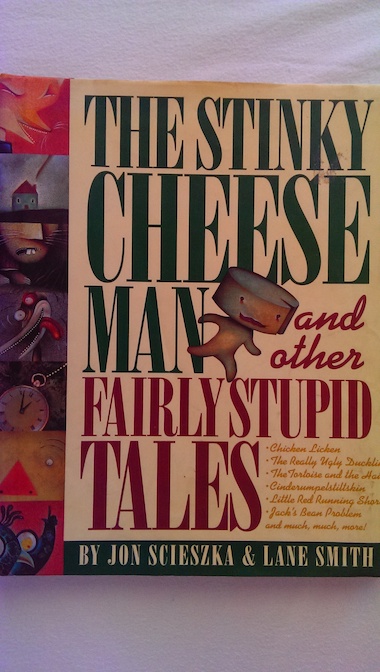
 This book is a spoof on a number of classic fairy tales. As it explains in the introduction, the short stories included in the book are more Fairly Stupid Tales than Fairy Tales, giving the example of Goldilocks and the Three Elephants: A girl smells peanut porridge and wants to enter the elephants’ house to eat some and try out their furniture, but elephant furniture is too big for her to climb up on, so she just leaves, The End. That incredibly short story isn’t found anywhere else in the book, but it’s a good example of what the other stories are like.
 Chicken Licken – As described above
 So, why isn’t there a Little Red Hen story listed? At the end of the book, she shows up to complain about how she had to do everything herself to make the bread and nobody even saved space for her story (because Jack had to sneak away from the Giant after he fell asleep). The Giant wakes up and decides to make a chicken sandwich with the bread.


 The Return of the Plant That Ate Dirty Socks by Nancy McArthur, 1990.
 Jestress's Forgotten Books and Stories