In the Kaiser’s Clutch

KaisersClutchIn the Kaiser’s Clutch by Kathleen Karr, 1995.

After their father’s death during World War I  (then called The Great War), the Dalton twins’ mother started supporting their family by writing.  It’s the summer of 1918, and Dorothy Dalton is now writing the scripts for a silent movie serial starring the fifteen-year-old twins, Nelly and Fitzhugh.  Times have been tough for them without their father’s support, but the serial means steady work and salaries for all three of them for the entire summer, enough to support them and buy school supplies for the fall, and maybe even enough to buy back some of the things that their mother pawned to keep their family going when they had to move out of New York to a less expensive town in New Jersey.

The movie serial, called In the Kaiser’s Clutch, is about a pair of wealthy American twins (played by Nelly and Fitz) who find themselves battling German spies.  The serial is part adventure story, part American war propaganda.  It’s also a subject that hits close to home.  The Dalton twins’ father wasn’t killed while fighting overseas.  He was in charge of the security force for the piers of Black Tom Island, just off the coast of New York, the port where most of the weaponry destined for the war in Europe was being shipped.  However, a massive explosion destroyed the port at Black Tom and killed Mr. Dalton.  Fitz wishes that he were old enough to fight directly in the war, but failing that, he wants to find the people who killed his father because he is sure that his father’s death was due to deliberate sabotage, not an accident.  However, it’s possible that the saboteur himself is looking for the Dalton family.

Strange things start to happen which the twins realize may have some bearing on their father’s death.  Someone has been spying on the family, listening by the window of their apartment.  Then, the director of their movie serial hires a new, part-time actor to play one of the villains, and this man is oddly similar to the fleeing figure of the man who was spying on them.  This new actor is German, and he seems to have some weird grudge against the twins, muttering insults in German and taking advantage of the stunts they have to perform in the movies to hurt and frighten them.  There are plenty of opportunities for the twins to get hurt on the movie set because each episode of the series has to end with a cliff-hanger scene, and there are no stunt doubles.  (Early silent movies in real life typically didn’t have stunt doubles, and the stunts were difficult and dangerous for the actors themselves.  This YouTube video explain how Buster Keaton, a famous silent film actor, performed his own stunts.)  From fist fights to car chases to quicksand to a cave-in to a giant pendulum with a mysteriously sharpened edge to sudden explosions, the Dalton twins are constantly teetering on the edge of disaster, not all of it planned by their writer mother.

Mrs. Dalton admits to the twins that, shortly before their father died, he told her that he was close to uncovering something that would be a much better story than anything she could make up.  Unfortunately, he never told her what it was.  He did tell her that he was making notes about it, but those notes were never found and may have also been destroyed in the explosion.  The only odd thing that Mrs. Dalton found after her husband’s death seemed like an ordinary shopping list: “cigars, eggs, dumplings, coal, pencils.”  However, Mrs. Dalton realized later that it has to mean something else because her husband didn’t smoke.

Could this somehow be the clue to what her husband was investigating before his death?  Are there real spies operating in the area?  Is there some other clue to their identity that they are now searching for, something that the Daltons still have in their possession?  Will the Dalton twins manage to find the spies before the spies eliminate them?  Will the family finish the serial and collect their salaries?  Find out in this exciting installment!  (There’s only one installment here because this is just a single book, not part of a series, but you get the idea.)

My Reaction

World War I books aren’t quite as common in children’s literature as World War II stories, so I found this interesting, and movie serials are also a fascinating thing of the past.  The movies that the kids are acting in are black-and-white silent films, so there are interesting discussions of the techniques they use to make things show up properly on black-and-white film (makeup, dyeing the water black for Nelly’s near-drowning scene, etc.) and conveying emotion when the actors’ voices will not actually be heard.  It’s a fun and fascinating story with spies, government agents, and the kind of movie stunts that I’m sure a lot of kids wish they could do for their summer jobs!
The General Store

Historic Communities

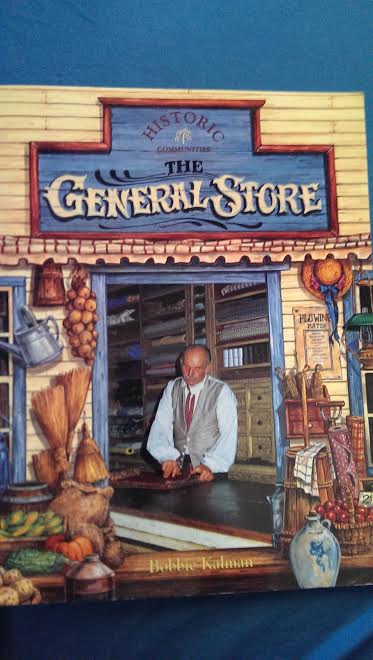
GeneralStoreThe General Store by Bobbie Kalman, 1997.

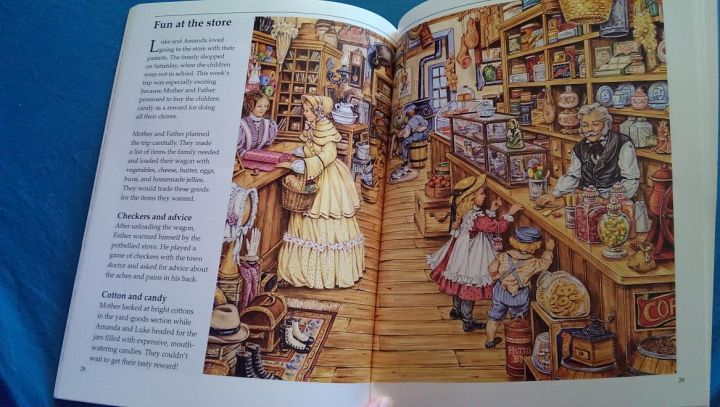
Besides providing 19th century communities with needed goods, general stores were often centers for community life.  Everyone would need to come and purchase or barter for supplies they couldn’t make for themselves, and it was also where mail for the area was delivered and sorted.  People gathered there to pick up what they needed and to exchange news and gossip with other members of the community.  The book explains how general stores functioned, what kinds of goods they carried, and how they helped to build growing communities.

Basically, they were like small department stores, carrying a little of everything that people in the area needed, including food items, dishes and silverware, tools, plant seeds, ready-made clothes and shoes, bolts of cloth, books, newspapers, and medicine.  Store owners had to decide what they would carry in their stores and how much of it to stock.  If they stocked too little of an item everyone wanted, they would run out, and if they had too much of an item hardly anyone wanted, they would either have to sell it at a discount or keep it themselves.  If someone wanted something that the storekeeper didn’t have on hand, they would have to ask the storekeeper to order it for them from a catalog or get it themselves by making a trip to a larger town where they could find what they were looking for.

GeneralStoreDrawersStore owners also had to decide how much they should charge for each item or how much they would be willing to take in trade.  Farmers often bartered for goods with the produce from their farms, and it was common for store owners to use a form of credit to keep track of what their customers owed and what they owed to their customers.  Farmers would typically sell their goods at harvest time, and the store owners would give them a certain amount of credit at their store, based on what they thought the farmers’ produce was worth.  Then, the farmers could use the credit on their account at the store until the next harvest and selling time.  If a farmer ran out of credit before the next harvest, the store owner would usually extend credit at the store to the farmer to allow him and his family to buy some necessities, knowing that the farmer could make up for it when he came to sell his next batch of produce.

To keep their customers from disputing the prices they charged at the store, store owners often used a kind of code to keep track of the amounts they spent to buy each item and the price they wanted the customer to pay in order to make a decent profit.  The codes were usually something like a substitution code, using letters to represent numbers so customers would need the store owner to interpret the price tags and manage their credit account.  This code system became less common after the 1870s because more people were simply using cash instead of bartering for goods, but I thought that it was a fascinating piece of history.

GeneralStoreMailAnother odd kind of code that the book mentions was the kind that people would use on mailed letters.  Instead of the sender paying the postage, as they do now, people receiving letters were supposed to pay for them when they picked them up from the general store.  If a receiver returned a letter unopened, they wouldn’t need to pay anything, so some people would try to cheat the system by writing a message in code on the outside of the envelope so the receiver would know the most important part of what the writer wanted to tell them for free.
People who practiced special trades, such as blacksmiths or printers, would often set up shop near the general store, and that would be the basis for the main street of growing towns.  Later, when railroads connected more towns, more people began ordering what they wanted themselves through catalogs (not unlike the way people have begun ordering more goods through the Internet). Mail started being delivered to individuals’ homes, and general stores were replaced by more modern department stores and specialty shops.

I loved the pictures in the book, a combination of photographs from living history museums and drawings.

The book is currently available online through Internet Archive.

GeneralStoreFun

Colonial Crafts

Historic Communities

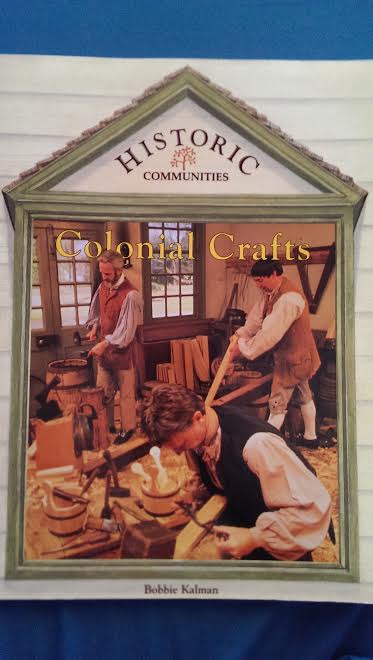
ColonialCraftsColonial Crafts by Bobbie Kalman, 1992.

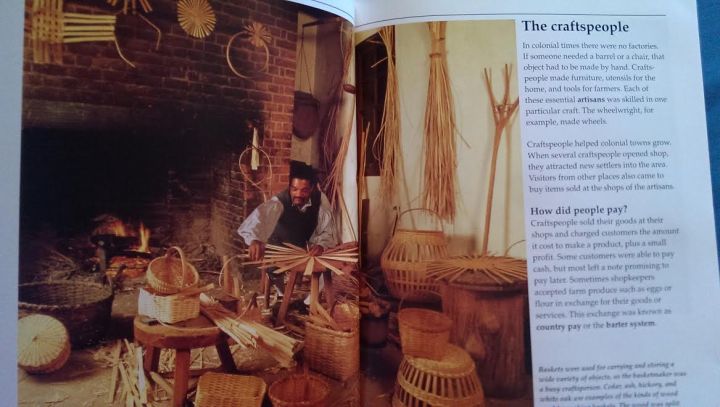
In Colonial America, everything had to be made by hand.  There were people whose entire profession was to make certain types of things, and this book describes common types of craftspeople, how they learned their skills, the goods they made, and how they practiced their trades.

People who worked with their hands learned their trades directly from others in their profession by serving apprenticeships.  Schools as we know them were less common in Colonial times and were mainly for upper class families, especially the sons of wealthy men.  Girls typically learned domestic crafts such as sewing, weaving, and candle-making.  Girls were mainly expected to marry and be housewives, and boys often learned their father’s trade.  How long an apprenticeship would last depended on the trade, but apprentices usually started performing very basic chores for their masters and gradually worked their way up to more difficult tasks as they learned the trade.  At the end of an apprenticeship, the apprentice would produce a work called the “masterpiece” to show off their new skills.  Then, the apprentice would become a journeyman, traveling around and looking for work in their trade until they earned the money they needed to open a shop of their own.

ColonialCraftsBaskets

Some of the trades covered in the book are cabinetmaker, leatherworker (including related trades like shoemaker and harnessmaker), cooper (someone who makes barrels), wheelwright, blacksmith, silversmith, gunsmith, printer, and milliner (someone who could make and alter clothing and sell fashion accessories).  The descriptions for each profession include not only details about the trade and tools of the trade but interesting facts such as the fact that, in Colonial times, shoemakers did not make shoes different shoes for left and right feet.  Both shoes in a pair were shaped exactly the same because it was easier for the shoemaker and because people thought that the tracks of identical shoes looked neat.  Aside from the professional crafts, the book also explains a little about domestic crafts, the kinds of things that people made in their own homes.

The book is full of pictures of historical reenactors demonstrating different crafts and trades.  It is currently available online through Internet Archive.

The Keeping Room

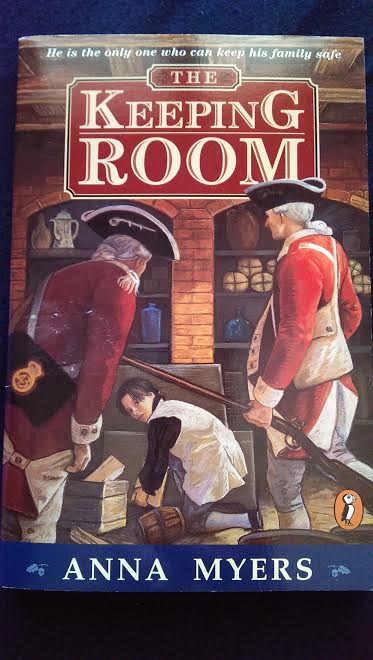
KeepingRoomThe Keeping Room by Anna Myers, 1997.

Joey was named after his father, Colonel Joseph Kershaw, a wealthy businessman in Camden, South Carolina during the Revolutionary War.  Joey is like his father in many ways.  He idolizes him and does everything as his father wishes.  When his father marches off to fight on the side of the revolutionaries, he tells twelve-year-old Joey that he must be the man of the house while he is away and look after his mother and the younger children.  Joey takes pride in his new position as man of the house, but he is soon to undergo hardships that will turn him into an older and wiser person.

Joey’s father and his troops lose their battle and are captured by the British.  Soon, the whole town is taken by the British troops, and they commandeer the Kershaw house, the biggest house in town, as their headquarters, keeping Joey and his family as prisoners.  Joey can only watch in helpless anger as the British set up gallows in his family’s garden and hang rebels, his father’s surviving troops.

Joey’s mother was a Quaker before her marriage, and so is Joey’s tutor, Euvan.  They do not believe in the violence of war or harboring hate.  Although Joey seethes with anger at his father’s imprisonment, his family’s captivity in their own home, and the death and destruction he sees around him, they make efforts to remind him that British soldiers are human too, some good, some bad, and not all monsters.  However, how can Joey see the British as anything but monsters when he has seen their cruelty, when he and his family have suffered at their hands, and when he has watched them put many good men to death?

Before the British captured the house, Joey managed to hide away his father’s pistol.  It isn’t enough to fight an army, but Joey knows that he will use it to fight if he gets the chance.

Throughout the story, Joey undergoes a transformation, not just from a boy to a man, but from his father’s little copy into his own person.  From the beginning, Joey identifies himself mainly as his “father’s son.”  He loves his father and truly idolizes him.  He wants to be just like him, and his father is grooming him to take over his businesses one day, to do everything the way he does.  Joey loves how respectful everyone is toward his father, a wealthy and successful man, and how respectfully they treat him when he is with his father.  He hangs on his father’s words and adopts all of his beliefs.  But when his father is gone, things are different.  People who were respectful of him because of his father now regard him as just a boy, a little spoiled and not really knowing or understanding much.

Joey struggles to grow into his new role as man of the house, to really be a man as his father would have wanted.  But along the way, he comes to realize that there are many things that his father didn’t really understand himself and that he was wrong about many things.

Joey’s father didn’t believe in educating women beyond basic reading and writing.  His sister Mary has defied their father’s wishes before by borrowing Joey’s books, and although he didn’t want to tattle on his sister, Joey could never bring himself to support her studies openly because he didn’t want to go against what his father wanted.  However, during their captivity, Joey comes to appreciate his sister Mary’s courage and intelligence.  She gives him great support through their harrowing circumstances. He is proud of her and realizes that she is worthy of the studies she craves.

Similarly, Joey comes to question his father’s beliefs about slavery. Although his father railed against British tyranny, claiming that he would never be a slave to them, he kept slaves of his own.  When Joey had previously questioned him about that, his father told him not to worry about it because it was part of “the order of things.”  But, Joey’s own experiences in captivity make him think differently.  He also comes to appreciate the two slaves who stood by the family to help them through their captivity, learning more about their lives and history.  Because of his experiences, he decides that he will never be a slave owner himself.

Most of all, Joey finally sees the truth of what his mother, Euvan, and even Biddy and Cato (the two slaves who remained with them) tried to tell him about hate and killing when one of the British soldiers gets killed while saving Joey’s life.

As Joey reacts to the frightening circumstances around him, doing what he can to protect his mother and younger siblings, he realizes that he must rely on himself and his own judgement, not his absent father’s, to handle the situation.  In the end, he decides that, although his still loves his father and eagerly waits his return home, he does not really want to be like his father anymore.  He has truly become his own man and is ready to stand up for the man he has become, even though his father may no longer want him to run his businesses.

This book is currently available online through Internet Archive.

Mary Geddy’s Day

MaryGeddyMary Geddy’s Day: A Colonial Girl in Williamsburg by Kate Waters, 1999.

This book is part of a series of historical picture books about Colonial America.

Mary Geddy was a real girl living in Williamsburg in 1776. In this book, she is reenacted by Emily Smith, a young interpreter at the Colonial Williamsburg living history museum. The story follows her through a single day in her life as it would have been typically experienced by girls around the beginning of the American Revolution (lessons, chores, shopping, and visiting with her friend) up until the moment when the vote for independence at the Fifth Virginia Convention was announced.

Mary Geddy’s father was a silversmith, which put them in the middle class for the times.  They had a comfortable house with a shop next door where Mr. Geddy sold his silver work.  The Geddy family also had slaves to take care of household chores.

At the beginning of the story, Mary knows that the Fifth Virginia Convention is voting on the subject of independence from Great Britain.  Mary is concerned about the prospect of war, and she knows that if the vote is for independence, she will probably lose her best friend, Anne.  Anne’s family are loyalists, and her family plans to return to England if the colonies decide to break away.

All through the day, people are speculating and worrying about what is going to happen as they go through the typical routines of their day.  Mary explains the clothing that colonial girls would wear as she gets dressed in the morning.  Then, her mother sends her out to buy eggs at the market.  Although she can see Anne there and hear some of the talk about what’s happening, Mary is kept at home for most of the rest of the day, practicing her sewing, learning to bake a pie with her mother, helping in the garden, and having her music lessons. She is learning to play the spinet.  She envies her brothers, who are allowed to help their father in his shop and therefore able to hear more of the talk than she is.

I particularly liked how they showed the coins that Mary uses when she goes shopping.  Even though Mary’s family lives in an English colony, she’s using pieces of eight, which is Spanish money.  The book doesn’t explain what currency she’s using or why, but that’s why the coins are those little triangular shapes, like little pieces of pie. Let me explain.

First, the American colonies had a currency problem.  They actually had a shortage of English currency because England didn’t want wealth to leave the English economy and go out to the colonies.  One of the measures they took to prevent wealth from leaving England was to make it illegal to export higher-value pieces of currency to the colonies.  People in the colonies needed something to replace the pieces of currency that they didn’t have or had in too short supply, so they resorted to other methods of exchange such as barter, IOUs recorded in ledgers, and currency from other countries.  They had some standard units of exchange for converting different currencies into British money because that was the way people in British colonies thought about money.  One of the most popular coins in use was the old Spanish dollar or piece of eight, which was worth eight reales (unit of Spanish currency).  However, sometimes, people wanted to use a smaller piece of currency for small purchases and transactions (like buying eggs), so they physically cut one coin into eight pie-shaped pieces (hence, “pieces of eight”), each worth only one real.  They had to do the coin cutting very carefully because the value of this type of money was based on the amount of silver in the coins themselves, and if they cut a coin unevenly, it would impact the value of the sections.  Each section of a piece of eight was called a “bit“, and two bits would be worth one-quarter of the value of the original coin, which is why some people in the US refer to a US quarter as “two bits.”  That’s what Mary is holding in her hand in the picture.  For more information, see the YouTube video from Townsends about The History of Money in America.

When they discover that the Convention voted for independence, there is celebrating in the streets, and Mary goes with her parents and brothers to see everything.  Her little sister is afraid of the noise and stays at home with the slaves.  Everyone is excited, but Mary is worried because she knows that her friend will leave and nothing will be the same again.

Throughout the book, you can see that the slaves are always a part of the family’s activities.  They do chores together, and when the family is not doing housework, the slaves are still working in the background.  Having slaves didn’t mean that the family never had to do any chores themselves, but they had to do less of them, giving them more time for other things, like music lessons and visiting with friends.  When the celebrating starts, the boy slave, Christopher, who is about the age of the Geddy children, wants to go and see what is happening himself, but he has to stay and help look after the younger girl in the family.  Although the slaves live as part of the household and seem to be on friendly terms with the Geddys (Mary speaks of them fondly, wishing that Christopher could join in the celebration and is happy that Grace, the slave who mainly works in the kitchen as the cook, seems proud of her for learning to make a pie), they have no say in making decisions and are expected to follow the orders they are given, even when they don’t want to or larger events are taking place.

In the back, there is more historical information about the period and the Geddy family.  There are also instructions for making a lavender sachet like the kind Mary and her friend Anne make and a recipe for apple pie that was used in Colonial Williamsburg, like the one that Mary learns to make in the story.

The book is currently available online through Internet Archive.

Black and White

BlackWhite

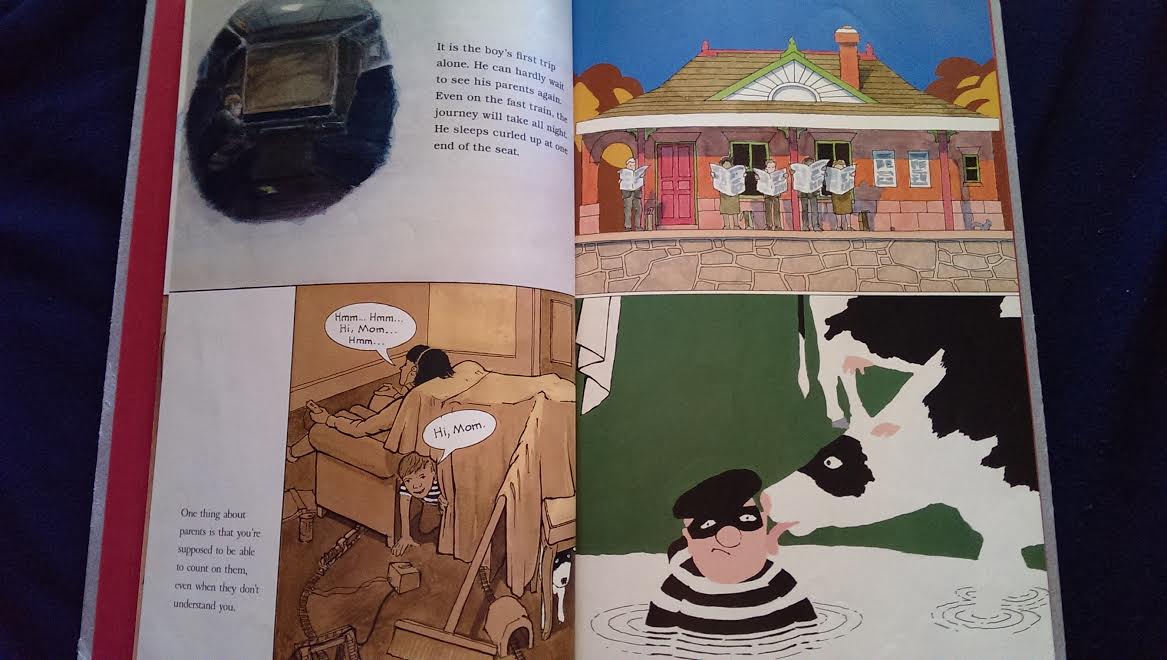
This book is unusual because there are four stories inside, being told at once, but there is one continuous storyline that joins all four of them together.  Two of the stories don’t have many words, but if you pay close attention to the pictures, the connection to the other stories becomes obvious.  The title of the book is also kind of a hint, although those colors apply to more than one aspect of the overall story.

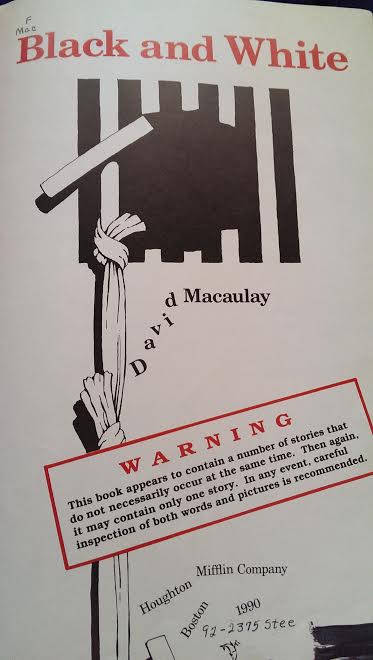
The picture at the right is from the title page, and the title page has the message that explains the concepts behind the stories. One of the fun things about this book is reading it multiple times. You can read the stories and look at the pictures of all four stories as you go through the book the first time, but if you look at each story in isolation, you can experience the continuity of each thread of the bigger stories and notice additional details.

BlackWhiteStories.jpeg

Seeing Things — A young boy takes a train trip by himself, going home to his parents.  He sleeps through most of his long journey, but during the night, he wakes up to some strange happenings.

A Waiting Game — A group of commuters waiting for their train, which has been unexpectedly delayed, find amusing ways to entertain themselves.

Problem Parents — A girl and her brother are convinced that their parents are crazy when they arrive home from their offices in the city wearing weird outfits made of newspapers and singing.

Udder Chaos — An escaped convict hides among a herd of cows.

You might be able to get some of the connections between these stories from what I’ve said and the pictures I’ve shown, but it gets funnier if you keep going through the stories, seeing where each of them lines up with the others.

The book is currently available online through Internet Archive.

BlackWhitePic1
BlackWhitePic2
BlackWhitePic3

The Mystery of the Haunted Trail

MysteryHauntedTrailThe Mystery of the Haunted Trail by Janet Lorimer, 1989.
Brian Kelly wasn’t too excited at first when his teacher assigned his class to write letters to students at a school in Hawaii.  He doesn’t really like to write, and the whole thing sounded boring, but it turned out to be pretty fun when his new pen pal, Alani, wrote back.  Brian discovered that he and Alani had a lot in common, and he even got to meet Alani when his family came to California on a trip.  Then, best of all, Alani’s family invited Brian to spend part of the summer with them in Hawaii!

Brian loves Hawaii from the moment he arrives.  Alani’s family lives in a rural area near Kalawa.  All of the families in the area raise their own vegetables and keep animals.  They depend on what they earn from selling food although some of them, like Alani’s mother, who is a nurse, have other jobs as well.  Alani’s father, like Alani’s grandfather, is primarily a farmer.  Alani’s grandfather lives with him on land that the family has owned for generations.

Alani and his family enjoy showing Brian around their island and talking about the history of the place.  Brian particularly likes the stories that Alani’s grandfather, who they call Kupuna, tells them, although some of them are frightening.  At the luau that the family and their friends have to welcome Brian to Hawaii, Brian overhears people talking about the Night Marchers.  They say that the Night Marchers have been seen recently and that bad things have been happening in the area, like crops dying and the nearby stream starting to dry up.  Some people seem to think that it’s a sign of bad luck and that maybe they should move away from the area.

According to Kupuna, the Night Marchers are a ghostly parade of the ancestors of the people who have lived there for generations.  Sometimes, it’s just ordinary people and sometimes it’s the souls of warriors.  Sometimes, Hawaiian gods may even walk among them.  But, when they march, any living person must either flee from them or, if that is impossible, they must lie down and hide their eyes.  At the head of the Marchers is a ghostly spearman who will strike down any living person who sees them, unless that person is related to one of the Marchers themselves.  They spare members of their own families.  People who are struck by the spear of the Marchers appear to have died of a heart attack.

The place where the Marchers supposedly walk is an old trail that leads to a sacred place where Alani’s ancestors are buried.  Brian is curious to see the place, but Alani warns him away, saying that they are not allowed to go there because it’s too dangerous.  However, Brian soon sees the Marchers himself one night in Alani’s family’s fields, and the next day, their crops are dead.  When Brian notices strange footprints in the fields as well, he realizes that some living people may be responsible for the awful things that have been happening in the area, but the only way he can prove it would be to explore the haunted trail himself and track the “ghosts” to their lair.

Janet Lorimer’s books are interesting because they are often a combination of mystery and ghost story.  There are logical explanations and living villains who are responsible for the things that are happening to Alani’s family and their neighbors, but there is also a definite supernatural element to the story as well.  Telling you where one ends and the other begins may be saying too much.  It may be more fun to let you find out yourself.

The book is currently available online through Internet Archive.

Castle Diary

CastleDiary

Castle Diary: The Journal of Tobias Burgess, Page by Richard Platt, 1999.

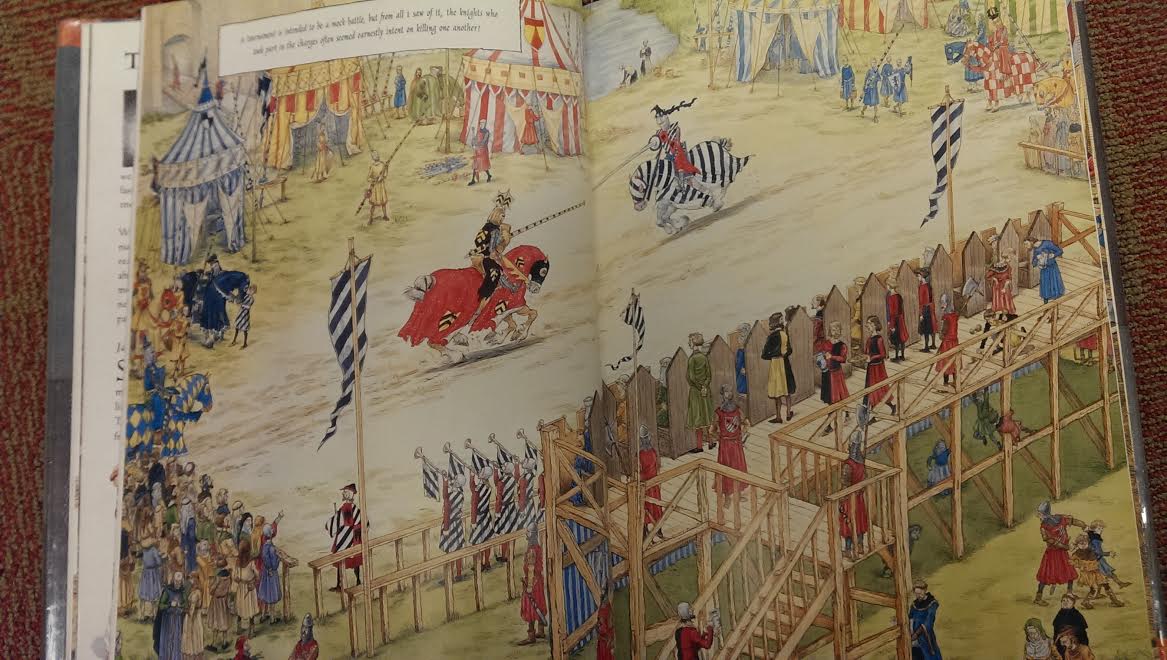
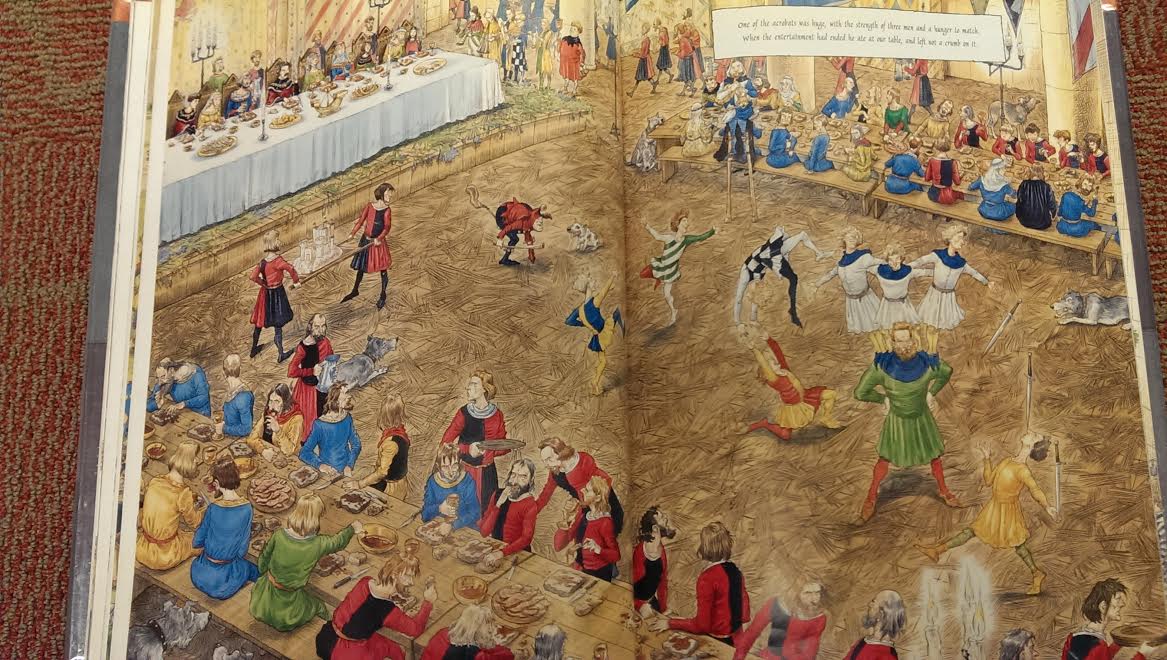
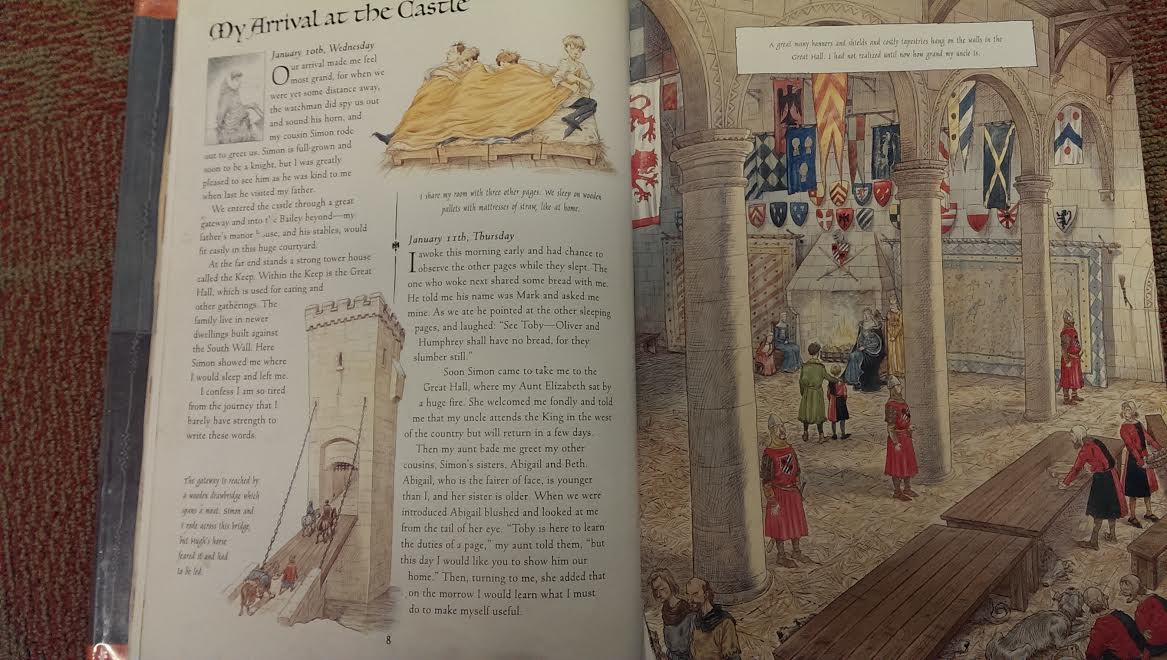
Tobias is an eleven-year-old boy living in England in 1285.  He is from a noble family, and his father is sending him to his uncle to become a page.  As a page, Tobias will learn manners and skills that he will need as he eventually becomes a squire and then a knight.  During the first year of his training that he spends with his uncle, he keeps a diary of everything that happens to him and everything he learns.  Toby is a fictional boy, but his life and family are meant to illustrate what life was like for a young boy from his social level during the Middle Ages.

CastleDiaryPic1

The castle were Toby’s uncle lives is much bigger than his parents’ manor house.  Toby has to learn the roles of all the servants who live there: who is in charge of what and who reports to who.  Not all servants are equal, and some command more respect than others.  Some of them are even from noble families like his, including his aunt’s companion, Isbel.  Toby himself is assigned to do chores for his aunt like running errands, delivering messages, serving food at meals, and holding up the hem of her cloak when she walks outside.

Toby shares a room with the other pages at the castle, all boys of noble families and destined to become knights, just like him.  They have lessons in reading, writing, mathematics, Latin, and scripture from the castle’s chaplain, and he is a harsh disciplinarian.  They practice their lessons on wax tables that can be smoothed out and used again.  The boys also learn manners and start learning archery and about all the weapons and armor that knights use.  When they have time to play, they try walking on stilts and play at being jousting knights by carrying each other on their backs and trying to knock each other off.

CastleDiaryPic2

During the course of the year, Toby gets to witness a hunt, a joust, and a banquet with important guests.  At one point, he gets sick and receives treatment from a physician.  He also encounters a poacher on his uncle’s land.  This man is eventually caught (although Toby decides not to turn him in) and put on trial, but in the end, he is not punished because the jurors were sympathetic.  The book ends with a Christmas celebration, after which Toby goes home to visit his parents.

CastleDiaryPic3

In the back of the book, there is a section with more information about Medieval society, castles, sieges, weapons, armor, and the changes that eventually brought an end to feudal system that Toby knew.

The book is part of a series of historical picture books.  It is currently available online through Internet Archive.

CastleDiaryPic4

Something Queer in the Wild West

SQWest

Something Queer in the Wild West by Elizabeth Levy, illustrated by Mordicai Gerstein, 1997.

Gwen and Jill go to visit Gwen’s Uncle Dale, who owns a ranch in New Mexico. The girls enjoy learning to ride horses, but Fletcher seems to be interested in an old barn.  C. J., who works on the ranch, tells the girls that the barn is supposed to be haunted by the spirit of a wild horse and that they should stay away from it.  Uncle Dale confirms the old legend, but the girls think there’s more to the story.

They have hear strange sounds coming from the old barn.  Then, the girls notice that Fletcher seems to be sneaking out during the night.  One night, they see a white horse roaming around when Uncle Dale doesn’t own a white horse. Could it be the spirit of the wild horse, or could it have something to do with a recent horse theft?

Fletcher’s odd behavior is a clue, and there is more to the old barn than the ghost story, as the girls suspected.  The “theft” isn’t quite theft, and the thief is actually trying to do something noble.  In the end, the girls decide to help, but they need Fletcher’s help to do it.

This book is part of the Something Queer Mysteries.  It is currently available online through Internet Archive.

SQWestPic2

Something Queer in the Cafeteria

SQCafeteria

Something Queer in the Cafeteria by Elizabeth Levy, illustrated by Mordicai Gerstein, 1994.

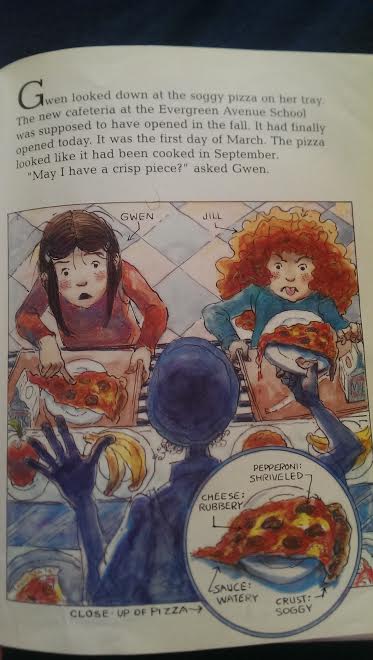
SQCafeteriaPic1Ms. Lensky, the cafeteria lady at Gwen and Jill’s school, is just plain mean. All of the food that the cafeteria serves is yucky, even though the cafeteria is new. There will be a party to celebrate the opening of the new cafeteria, and even the kids’ parents and the mayor are invited. Gwen and Jill are happy because their class will get to help decorate the cake. However, Ms. Lensky, the M.C.L. (Mean Cafeteria Lady), doesn’t like the girls, and she blames them for a number of accidents that happen in the cafeteria.

The first accident was caused by the M.C.L. herself when she was chewing out the girls for being messy (really, the food was messy), and she bumped into other students, causing a food fight to break out.  The M.C.L. blames Jill and Gwen, of course, for starting the fight.  As punishment, the girls are assigned to clean in the cafeteria.  While they’re cleaning up, the M.C.L. blames them when a faucet breaks.

SQCafeteriaFoodFight

Later, when their class visits the cafeteria to prepare for decorating the cake, a counter collapses, throwing frosting all over Gwen.  Then, the girls get in trouble again for criticizing the food.  When the cake burns at the party, and it looks like Fletcher the dog’s bandana is in the burned mess, the girls are blamed once more.

SQCafeteriaFrame

Is the cafeteria jinxed, or is the M.C.L. just out to get the girls?  Or is there another explanation?

This book is part of the Something Queer Mysteries.  It is currently available online through Internet Archive.