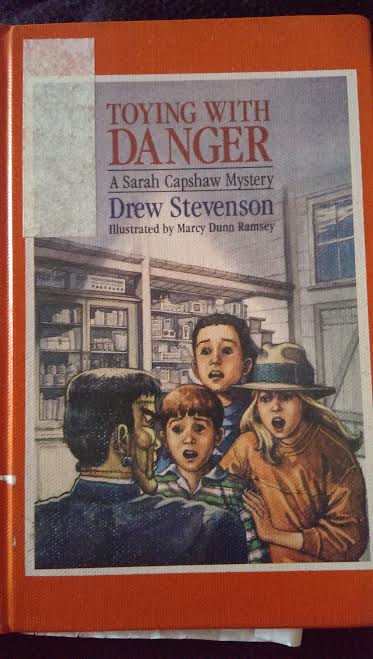
Toying With Danger

toyingwithdangerToying With Danger by Drew Stevenson, 1993.

Sarah Capshaw is lamenting to her friend Clark that she hasn’t had an interesting case to solve since she and her parents moved to Wilsonburg when their friend Frog tells them that the local bully saw a monster at the old Harley farm outside of town.  Rumor has it that a mad scientist bought the place.  Naturally, Sarah wants to investigate.

It turns out that the “mad scientist,” Dr. Becker, is actually an eccentric toy inventor.  The “monster” is an electronic Frankenstein monster.  Dr. Becker is actually pretty nice and is even interested in seeing the detective board game that Frog is trying to invent.

Even though the monster wasn’t a real monster, there are still strange things happening in the woods surrounding the old farm where Dr. Becker’s workshop is.  The local bully is hanging around in the woods and trying to scare everyone away.  The kids also see a mysterious man hanging around, and Sarah wonders if he could be spying on Dr. Becker in order to steal his designs.
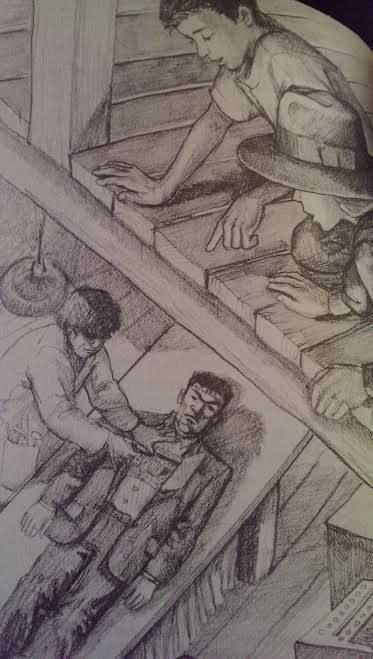
toyingwithdangerpic2It seems that Sarah is right that someone is trying to spy on Dr. Becker.  The kids learn more about the money involved in buying and selling toy designs when they visit the Too Wonderful toy company for a tour with Sarah’s grandfather.  Making toys is serious business, and companies guard their designs very carefully.  The Too Wonderful toy company wants to purchase some of Dr. Becker’s designs, but one of the members of the company says some strange things about Dr. Becker.  Can the kids trust him?  Can they trust the strange Dr. Becker?  Can Sarah catch the spy before it’s too late?

This is part of the Sarah Capshaw Mysteries series.
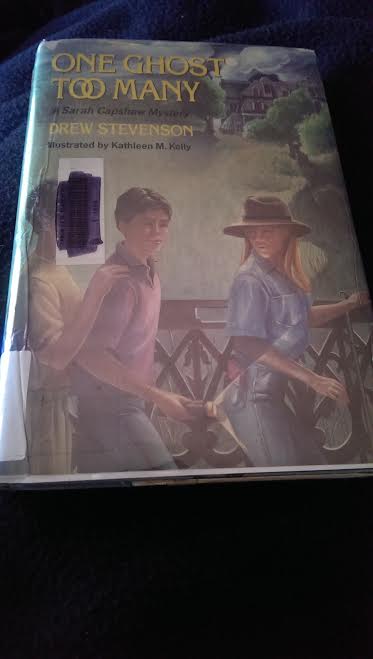
One Ghost Too Many

oneghostOne Ghost Too Many by Drew Stevenson, 1991.
Clark Lannigan meets Sarah Capshaw by accident when she comes to spend the summer with her grandparents in Wilsonburg. Sarah’s grandfather, Conrad Capshaw, is a lawyer, and he is handling the estate of Rodney Maplewood. Rodney Maplewood used to be a museum curator and had an impressive collection of antiques which he kept in his large house, Maplewood Manor.

Maplewood Manor is the oldest and the spookiest house in town. It was once owned by the eccentric Antonia Whitemarsh, who was a spiritualist and believed that her father’s spirit still inhabited the house. Now, people in town think that Rodney Maplewood’s ghost is also haunting the house because lights have been seen in the house at night. Conrad Chapshaw also says that, although nothing is missing, some objects in the house have been moved around.

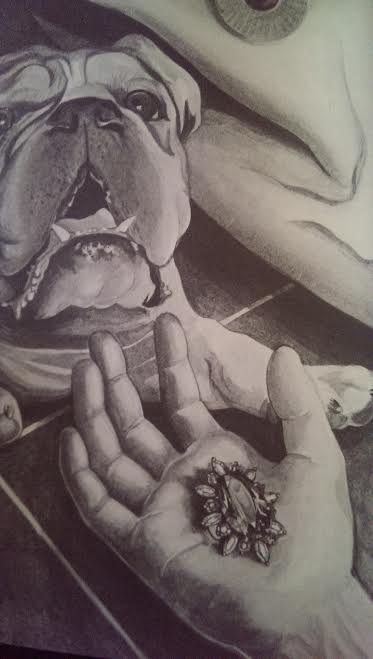
oneghostpic1Sarah persuades Clark and his friend “Frog” Fenniman to join her investigation of the house, but besides the resident ghost, they will also have to deal with a local group interested in psychic phenomena and a mysterious stranger who is paying the local bully to spy on the house.
This is the first book in the Sarah Capshaw Mysteries series.  Sarah and her parents move to Wilsonburg, and she has other adventures with Clark and Frog, all narrated by Clark.

The book is currently available online through Internet Archive.

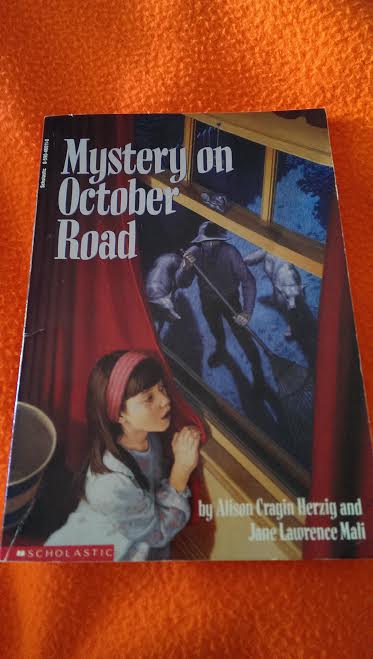
The Mystery on October Road

OctoberRoadThe Mystery on October Road by Alison Cragin Herzig and Jane Lawrence Mali, 1991.
A strange man has moved next door to Casey.  He always wears a bandana tied across the lower part of his face, like a bandit.  His pets are the strangest dogs Casey has ever seen, huge Irish Wolfhounds.  He’s started fixing up his new house, but for some reason, he only likes to work at night.

One day Casey and her friend Cats (really, they’re both named Catherine, but they each have nicknames) go to take the man some bread that Casey’s mother baked, and they’re frightened away by one of the dogs.  Casey goes back to get the bread they left behind, and the man tells her to go away and leave him alone.

Casey and her friends (Cats and Benny, a boy Cats likes) are curious about this strange man.  They even wonder if he could be some kind of gangster, hiding out.  At her friends’ urging, they sneak into his house one day to look around.  When the man comes back unexpectedly, her friends get away in time, but Casey falls and hurts her ankle.  The man finds her in his house, and she learns the truth about him.

The man isn’t a bad guy, and Casey even becomes a friend for him.  The story ends on Halloween, when the man creates a special Halloween display for Casey of beautifully carved pumpkins.  The part that always fascinated me was the way he carved them, by peeling the skin off the pumpkin and only leaving it in places where he wanted dark lines.

Part of the story is about how appearances can be deceptive.  The stranger is actually a good person, but he is physically disfigured, which is why he doesn’t like people to see him.  For part of the story, Cats isn’t really a very good friend for Casey, neglecting her feelings and the feelings of the mysterious stranger in order to impress Benny.  But later, when she realizes that Casey was right about the stranger and that she was really hurt in their little escapade, she shows that she can be a better friend, too.

The book is currently available online through Internet Archive.

The Ghost on the Hill

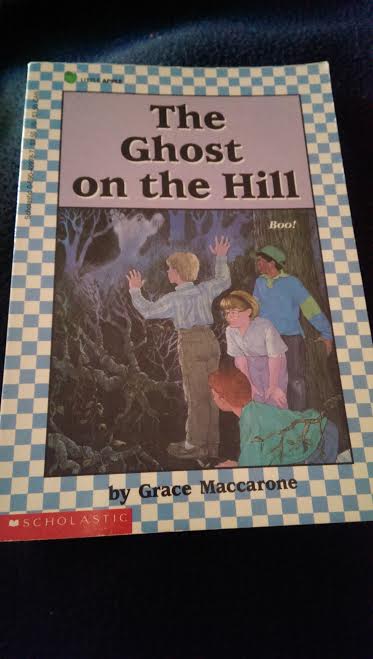
ghosthillThe Ghost on the Hill by Grace Maccarone, 1990.
This is the last book in the Third Grade Ghosthunters series.

The kids take another field trip, this time to a state park. Native Americans used to live on that land, but most of the tribe died from disease many years ago. There are stories about spirits that live in the hills and the forest. Young boys from the tribe used to perform a ritual where they would dance with the Great Spirit in order to become men.

The third graders have been studying Native American history and customs to prepare for the field trip.  Norma wrote a report about Native American names, which tended to describe some significant characteristic of the person.  Their teacher tells the students that they should think of names for themselves which describe something significant about themselves.  Most of the kids think it sounds like a fun idea, but Joey doesn’t.  He’s just one kid in a family with a dozen other kids, and he’s never felt like there was anything particularly special about him.  That’s why he makes up tall tales about himself that all the other kids find weird and annoying.

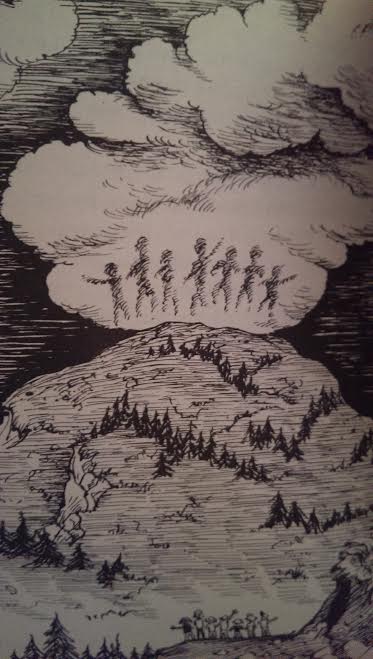
ghosthillpicWhen they reach the state park, Dennis Ten Foot Bridge, who is the last of his tribe, tells the students about his tribe, teaches them wilderness skills, and leads them in group activities.  One evening, Joey goes out to practice some rowing on the lake by himself, and he sees what looks like a large ghost at the top of a hill  However, everyone knows that Joey lies about a lot of things, so at first, no one believes him.  At least, no one except Adam.

Adam agrees to help Joey investigate the mysterious spirit. Eventually, all of the members of the ghosthunting group decide to go up on the hill together to see the ghost for themselves.  There, Joey finds the courage to face the spirit directly, and everyone sees the truth. Together, Joey and his friends end up repeating the ancient coming-of-age ritual that the tribe that used to live there would perform.

The solution to the mystery is a little strange, but the book is great for the characters alone. This final book in the Third Grade Ghosthunters series is a coming-of-age story. The other books in the series addressed personal issues and personality quirks in the characters as side-plots, such worrying about not being as smart others, worries about making and keeping friends, and the trouble with teasing. This one focuses on Joey and his sense of identity. He’s always felt that there is nothing special about him compared to his brothers and sisters. In this story, he develops his own character more and gains new confidence. In the process, he ends up becoming more comfortable with his role as a kid in a family with many children as well as appreciating his own uniqueness.  He also finds a name for himself that expresses his new sense of identity.

Wrapped in a Riddle

wrappedriddleWrapped in a Riddle by Sharon E. Heisel, 1993.
Miranda is living with her grandmother in Oregon while her scientist parents are away studying algae in Antarctica. Her grandmother owns a bed and breakfast called The Jumping Frog, which has a Mark Twain theme. At first, all Miranda is concerned about is finding some friends and fitting in at her new school, but soon strange things start to happen at the bed and breakfast.

First, someone attacks their housekeeper, hitting her over the head with a bust of Mark Twain. Then, some letters that were written to an ancestor of Miranda’s by Mark Twain himself are stolen.

Although Miranda’s grandmother likes to think the best of everyone, Miranda is convinced that the villain is someone living in the bed and breakfast. With her new friends (the main characters from A Little Magic, another book by the same author) Miranda begins her investigation, determined to find the letters for her grandmother, although it may mean solving a double mystery.  There is more that one person in the bed and breakfast with something to hide.

One of the fun things about this story is the riddles that Miranda and her grandmother like to tell each other.  Even her friends enjoy riddles, and they help provide Miranda with the inspiration to solve the mystery.

This book is currently available online through Internet Archive.

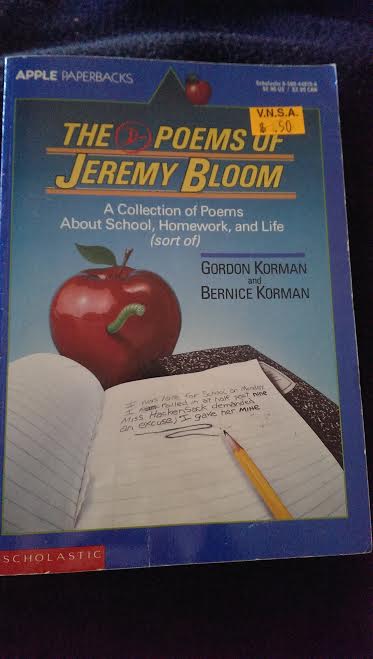
The D- Poems of Jeremy Bloom

jeremybloomThe D- Poems of Jeremy Bloom by Gordon Korman and Bernice Korman, 1992.

This book is mostly a collection of funny poems, but there is an overarching story to them.  Jeremy Bloom, a typical middle school slacker, wanted to sign up for the easiest elective course he possibly could.  But, by accident, he overslept on the first day of school, and by the time he got there, sign-ups had already started and the easiest and most popular electives were full.  Desperately trying to find something easy and with as little work possible under the remaining electives, Jeremy decided to sign up for Pottery. (“It was no Snooze Patrol, but how hard could it be to make ashtrays?”)  Only, he made another mistake and accidentally signed up for Poetry, and once he was enrolled, there was no way out of it.  He was committed to spending a year writing poetry.

jeremybloompoemJeremy tries to make the best of things, but somehow (partly through his own fault and partly by accident), he continually manages to do things to annoy his poetry teacher, Ms. Terranova (or, as the kids call her, Ms. Pterodactyl, thanks to a mistake Jeremy made when he said her name on the first day of class).  Every single poem Jeremy writes during the year receives the same grade: D-.  The book is divided into different periods of Jeremy’s work, along with an explanation about what Jeremy did during each period to tick off his teacher.  At the end, the reader can be the judge: Are Jeremy’s D- grades because he’s a terrible poet or because his teacher is mad at Jeremy for everything else he does during the year?  (The answer is pretty obvious.)

My favorite poems are the longer ones like “Why I Was Late,” “The Wheeler-Dealer,” and “No Boring Parts Allowed.”  Just to give you an idea of what the poems are like (although they are written in a variety of styles), here’s another one of my favorites, “Honesty Is Not Always the Best Policy.”

The book is currently available online through Internet Archive.

My Crazy Cousin Courtney Returns Again

CousinCourtneyReturnsMy Crazy Cousin Courtney Returns Again by Judi Miller, 1995.
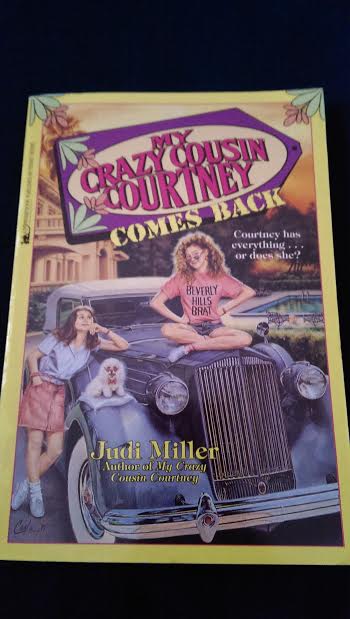
Courtney is back in New York with her cousin Cathy and living her dream of becoming an actress!  Courtney has landed a part in a movie called The Laundry Bag Murder (see the first book in the series for that explanation).  With Courtney’s new professional responsibilities, Cathy hopes that this visit will be quieter than their last ones, but no such luck.  Excitement follows Courtney wherever she goes, and if things aren’t exciting enough to suit her, she knows how to stir them up!

When Cathy and Courtney go to the Central Park Zoo to try out Courtney’s new video camera, Courtney ends up turning the expedition into a vampire hunt that ends up catching a criminal.  When they go to see a friend’s rock band perform at a bar, Courtney turns a barroom brawl into a hug-in.

Courtney is also giving Cathy relationship advice.  Cathy and Frank are boyfriend and girlfriend now, but both of them are pretty shy.  Too shy to even go on a real date.  Courtney says that maybe Cathy should act a little helpless to bring out Frank’s protective instincts and to get his attention.  She says that Cathy should tell Frank that she thinks someone might be following her around (it’s not a lie if Cathy isn’t sure).  That way, Frank will want to spend more time with her to look after her.

With some reservations, Cathy does tell Frank someone may be following her, which does get Frank’s attention.  Then, to Cathy’s surprise, she actually does notice someone following her around.  At first, she suspects that Courtney got another actress to follow her for awhile to make her story to Frank true, but it turns out, that’s not the case at all.  Who is that mysterious woman in the sunglasses and what does she want?

There is another book in the series which I don’t have and haven’t read called My Crazy Cousin Courtney Gets Crazier.  Courtney ends up going to school in New York with Cathy because she lands a role in another movie which will be shooting there during the fall.

My Crazy Cousin Courtney Comes Back

CousinCourtneyBackMy Crazy Cousin Courtney Comes Back by Judi Miller, 1994.

The title is a little deceptive because Courtney hasn’t come back to New York to visit Cathy.  This time, Cathy has flown to Beverly Hills to spend Christmas with Courtney.  Courtney’s parents are now divorced, and Courtney’s adjusting to it, but she’s still as wild and unpredictable as she ever was.

Almost as soon as Cathy arrives, Courtney wakes her in the middle of the night to tell her that she needs her help to rescue an old man who’s being held against his will and maybe bring him cans of soup and sauerkraut.  Courtney’s heart is always in the right place, but as usual, she has the wrong idea.  In the best Courtney tradition, things work out amazingly well in the end.

In between spotting movie stars and getting into trouble, the girls manage to find time to get their nails done and visit with their friend Frank, who they met last summer in New York.  Cathy had fallen in love with Frank until she realized that he was more interested in being Courtney’s boyfriend.  Seeing him again over Christmas has brought back Cathy’s awkward feelings.  She still likes Frank, but the last thing she wants to do is to take a guy away from her lovable, if crazy, cousin.  But, if there’s one thing that Courtney specializes in, it’s happy endings.

This book isn’t as introspective as the first one in the series was, although Courtney and Cathy still help each other with their opposite personalities.  Cathy’s common sense and restraint can’t stop Courtney in her wild escapades, but she does inspire Courtney to be more thoughtful.  Courtney also helps Cathy to get out of shell, speak up for herself, have a little excitement, and see the possibilities that life has to offer.

My Crazy Cousin Courtney

CousinCourtneyMy Crazy Cousin Courtney by Judi Miller, 1993.
Cathy Bushwick usually spends the summer at camp, but this summer, her mother is having her stay in the city because her cousin Courtney is coming to visit them in New York.  Cathy and Courtney are actually second cousins because their mothers are first cousins.  They’re the same age (thirteen) and met once when they were five, but neither of them remembers it.  All that Cathy really knows about Courtney before she arrives is that she’s somewhat neurotic (Courtney is troubled by anxiety and panic attacks) and that the reason she’s coming to visit is that her parents are thinking of getting a divorce and need time alone to discuss it.

Cathy understands what it’s like to live with a single parent.  Her parents are divorced, and her father went to California years ago to become an actor.  She hasn’t heard from him since.  Her mother used to be an actress, but with Cathy to take care of, she became a theatrical agent for animals instead (she finds animals for people to use in commercials).  So, when Cathy hears that Courtney will be visiting from Beverly Hills, she’s very excited.  At first, she hopes that she and Courtney will be like sisters and that Courtney might have even heard of her father in California.

Cathy’s illusions are shattered almost immediately.  Courtney not only hasn’t heard of her father but she’s nothing like Cathy imagined.  When she and her mother go to meet her at the airport, she’s wearing heart-shaped sunglasses and a hot pink shirt that says, “KISS ME QUICK,” and she has a pile of luggage.  She’s used to having money and getting the best of everything, and she’s immediately disappointed with the modest apartment where Cathy and her mother live.  When she learns that they don’t even have a pool, she gets upset and wants to go home.  But, it’s no use.  She’s stuck there for the summer.  And, they’re stuck with her.

But, things don’t turn out to be as bad as Cathy fears they’re going to be.  In some ways, they’re worse.  Once Courtney reconciles herself to spending the summer in New York, she has some very specific ideas about things that she’d like to do, and a lot of them end up getting the girls in trouble.  Shy, sensible Cathy finds herself getting locked in Tiffany’s after closing time because Courtney thought she saw a spy stealing their designs, rescuing Courtney from the dolphin pool at the aquarium, and lots of other things that she never thought she’d find herself doing.  Then, one day, the girls think they’ve witnessed a murder.  What are they going to do?  Is Cathy going to survive the summer with her crazy cousin Courtney?

This book is the first in a series about Cathy and Courtney.  Courtney may be a bit wild, but she’s not as crazy as Cathy thinks.  Over the course of the summer, the two become friends, and they learn quite a few things about each other and about themselves.  By the time Courtney has to go home, a little of each of them has rubbed off on the other, and neither will be quite the same again.

The book is available online through Internet Archive.

The Night Crossing

NightCrossingThe Night Crossing by Karen Ackerman, 1994.
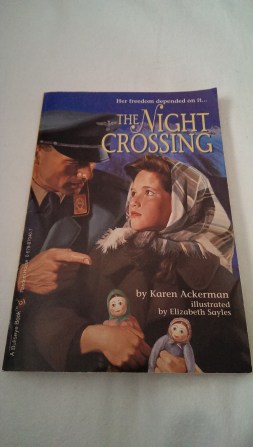
It’s 1938 in Austria, and Clara’s parents have decided that their family needs to leave before things get worse.  Already, Jewish families like theirs are being rounded up by the Nazis, and Clara and her sister Marta were chased through the streets by other children, shouting insults.

Their family has been through things like this before.  Clara’s grandmother tells her about when she had to flee Russia as a little girl to escape the pogroms.  She brought her dolls Gittel and Lotte with her as her family hiked through the Carpathian Mountains.  Now, Clara will carry them with her as their family leaves Austria for Switzerland.

It’s a hard journey with lots of walking and little food.  The family can carry very little with them, and some of what they have they are forced to trade for food, a place to rest, and for not being turned over to the Nazis.  Finally, at the border crossing, Clara’s parents are afraid that they will have to get rid of the candlesticks that have been in their family for generations because they might be discovered by the border guards.  Then, Clara comes up with a plan to hide them in her dolls.  Will it work?

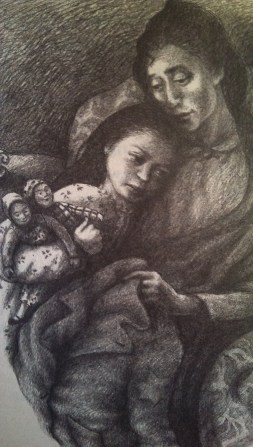
NightCrossingPicThis is a pretty short chapter book.  Although the subject matter is serious, and parts might be frightening to young children (the part where Clara and Marta are chased and perhaps some of the parts where the family is hiding), there are only vague references to more dark subjects like concentration camps (people who already know what they are and what happened there would understand, but children who haven’t heard about them wouldn’t get the full picture from the brief mentions).  The book would be a good, short introduction to the topic of the Holocaust by putting it in terms of the way it changed the lives of ordinary people who had to flee from it.  Actually, it wouldn’t be a bad way to start a discussion of the Syrian refugees in Europe by putting it into the context of ordinary people fleeing the violence of war.

This book is currently available online through Internet Archive.