#9 The Mystery of the Eagle Feather by Elspeth Campbell Murphy, 1995.
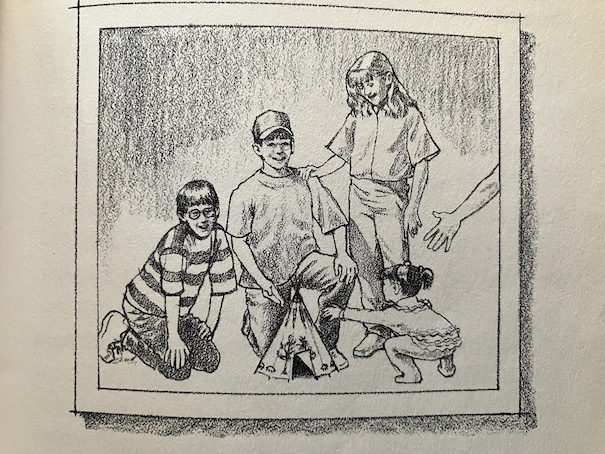
Timothy is excited because he has a chance to meet his pen pal, Anthony Two Trees, for the first time. Anthony is a Native American, and he will be dancing at a powwow. Timothy’s cousins get to come along on the trip, too.
Soon after they arrive, though, they learn that someone has been taking pieces of the dancers’ costumes, like fans or headdresses made of eagle feathers. Who could be taking the costume pieces and why?
The costume pieces and the eagle feathers they contain are very expensive, and the kids realize that the thief might be thinking of selling them. It is illegal to deal in eagle feathers because eagles are an endangered species. Even the Native American dancers have to write to the government in order to get eagle feathers for their costumes from eagles that died in zoos. Therefore, the costumes are expensive and require a lot of effort to put together, and losing them is a real blow. The rarity and cost of the feathers might prove to be a temptation to a thief.
The theme of the story is self-control.
The book is available to borrow and read for free online through Internet Archive.
My Reaction
I wasn’t sure if I was going to like this story. I understand the fascination kids have with Native Americans and their costumes and dances. I felt like that when I was a kid, too, but there’s also an element of cringe to it. The cringiness comes from kids (and even adults) who get wrapped up in the fascination of the appearance of other people’s traditions and treat them more like playing dress-up than traditions with deeper, underlying meaning and significance or depicting Native Americans as being stereotypes from old movies and books rather than real, living people.
Fortunately, I was pleased at how this story shows that Timothy’s friend, Anthony, is a regular boy who shares his interest in baseball. They emphasize that Native Americans don’t live in tepees any more, and they don’t treat the Native American characters like stereotypes. I enjoyed some of the facts the story provided about Native American dances and costumes, like the regulations regarding the use of eagle feathers.
#10 The Mystery of the Silly Goose by Elspeth Campbell Murphy, 1996.
As soon as they arrive home from their trip to the powwow in the previous book, the cousins are approached by Timothy’s neighbor, the snobby 13-year-old Lyddie, with another mystery. While they were out of town, someone went around the neighborhood, stealing lawn ornaments. Lyddie is concerned because her grandmother has come to live with her and her parents, and her lawn geese were stolen. One of the geese was the mother goose with a silly-looking bonnet on her head, and the others were her goslings. Lyddie’s grandmother is rather attached to the geese because they were a present from someone.
The three cousins don’t really like Lyddie because she and her friends are usually unfriendly and too concerned with being “cool” all the time. However, they feel sorry for her grandmother and agree to take the case. To their surprise, most of the lawn ornaments are actually pretty easy to find. They were hidden in some obvious places around the neighborhood. The only ones that are difficult to find are the geese. Who hid the lawn ornaments and why?
The theme of this story is Proverbs 24:3-4, “It takes wisdom to have a good family. It takes understanding to make it strong. It takes knowledge to fill a home with rare and beautiful treasures.”
The book is available to borrow and read for free online through Internet Archive (multiple copies).
My Reaction
Part of the mystery has to do with image, but it also has to do with sentimental attachment. Lyddie is very obsessed with image because she and her friends try so hard to maintain their cool image. Although she calls in the cousins to find the missing lawn ornaments, she only does it because her grandmother takes the loss of the mother goose so hard. Lyddie doesn’t see why the goose is so important, although she knows that her grandmother is attached to it because it was a present from someone.
The situation changes when Lyddie’s grandmother reveals the full story behind the lawn geese and her own understanding of the situation. Lyddie cares for her grandmother, and she comes to see the geese in a new light once she understands why they matter to her grandmother. It’s not the value of the geese, and it’s not about how the geese look. It’s all about the person her grandmother associates with them. Fortunately, Lyddie’s grandmother is a very understanding woman, and when the lawn ornament thief explains the issue, they work things out to everyone’s satisfaction.
#7 The Mystery of the Haunted Lighthouse by Elspeth Campbell Murphy, 1995.
Sarah-Jane’s parents have been planning a trip, and her cousins, Titus and Timothy are coming, too. At the request of an old family friend, Ned, they are going to visit him and take a look at an old lighthouse that he is thinking of buying. He wants to turn the lighthouse into a bed and breakfast.
However, strange things have started happening at the lighthouse. Someone has vandalized the outside, and Sarah-Jane sees a frightening face up in the tower. Could the old lighthouse be haunted?
The theme of the story is faithfulness.
The book is available to borrow and read for free online through Internet Archive.
My Reaction and Themes
Since this is a Christian-themed mystery, readers can guess that there won’t be any real ghosts. This is more of a light, pseudo-ghost story, like Scooby-Doo mysteries, with another explanation for what’s happening.
There’s more than one kind of haunting. People can be haunted by memories, and living humans are also attached to the places associated with their happy memories. There is someone who has an attachment to the lighthouse and is unhappy that it’s being sold. This person needs to reconcile their feelings to the situation.
Some Christians don’t like the concept of ghost stories at all. In the book, Sarah-Jane likes hearing ghost stories, although she admits that she doesn’t like remembering them later, when she’s alone at night. She enjoys a little spooky excitement, as long as she knows it’s just a story, and she’s hearing it in a safe setting.
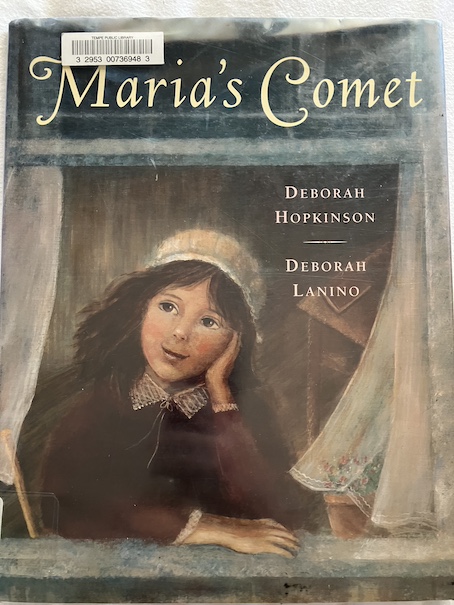
Maria’s Comet by Deborah Hopkinson, illustrated by Deborah Lanino, 1999.
This picture book is a fictional story about a real person, Maria Mitchell. (She pronounced her first name “ma-RYE-ah”, not “ma-REE-ah”.) Maria Mitchell was born into a Quaker family on Nantucket Island, Massachusetts in 1818, and she became the first female astronomer in the United States. She is known for discovering a comet only viewable through a telescope in 1847, and she also became the first astronomy professor at Vassar College. She is the namesake of the Maria Mitchell Association, a science center on Nantucket. She was also an abolitionist, although this topic is not touched on in the book. Maria’s father taught her about astronomy when she was young and encouraged her interests and career at a time when not many women were encouraged to pursue careers or higher education.
Maria’s papa is an astronomer. At night, he goes up on the roof their house to use his telescope, and he explains how the telescope works, gathering and focusing light to make distant objects look larger and closer than they would with just a person’s eyes. He especially likes to look for comets. In their time, they’re not entirely sure what comets are made of, and that’s part of what makes studying them interesting. Maria imagines what it would be like to travel across the sky with a comet, encountering the different planets.
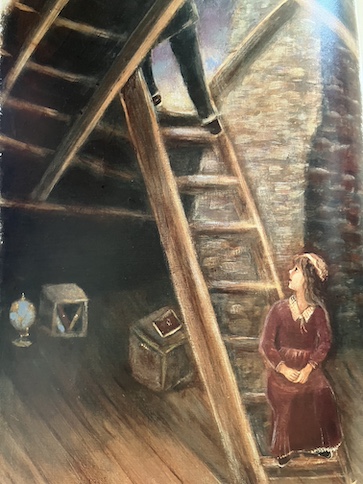
Most of Maria’s life centers around their house and family in Nantucket. There are nine children in the family, so Maria helps with chores and tells her siblings bedtime stories. Sometimes, she and her brother Andrew go into the attic and use an old atlas to pretend that they’re explorers. When they read books, Maria likes books about astronomers, but Andrew likes books about sailors. He wants to be a sailor himself.
When Andrew gets older, he runs away from his family to go to sea on a whaling boat. The entire family is sad that he is gone, and Maria soothes her siblings by telling them stories about all of the amazing places their brother will go. That night, after supper, Maria asks her father if she can come with him to look through his telescope or “sweep the sky” as she thinks of it. For a moment, Maria thinks they will say no, but they agree. Maria wants to be an explorer of the sky, like her brother wanted to explore the seas.
Maria’s father points out Polaris, the North Star, to Maria and says that sailors use it to navigate. Maria wonders if Andrew might be looking at the same star right now. Then, she sees a comet streak across the sky.
There’s an Author’s Note in the back of the book that explains about the real life of Maria Mitchell. It has some comments about what people of her time knew and didn’t now about the planets. When she was young, people only knew about seven planets in the solar system. Neptune was discovered during her lifetime (although not by her), and Pluto wasn’t discovered until 1930, after she had died. There is also a section about the astronomy terms used in the story and famous astronomers.
My Reaction
I enjoy books about historical people, although the author admits in the Author’s Note that this particular story about Maria Mitchell is fiction. I have mixed feelings about that. I don’t like to fictionalize real people, and I’m not entirely sure whether there’s any truth to the story about Maria’s relationship with her brother and how she felt when he left to become a sailor. On the other hand, I did appreciate how the book showed Maria becoming interested in astronomy by watching her father and joining him in his studies of the sky, which is apparently true. Overall, I did enjoy the story.
The pictures in the book are wonderful. They capture the coziness of an old-fashioned 19th-century home and also the wonderment of looking to the skies and imagining exploring the big, wide world and the stars beyond it.
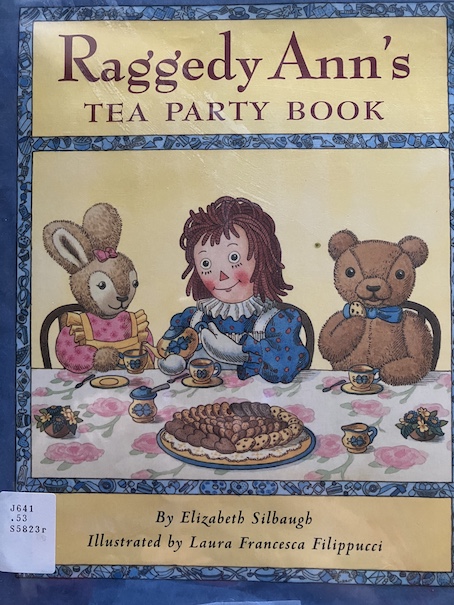
Raggedy Ann’s Tea Party Book by Elizabeth Silbaugh, illustrated by Laura Francesca Filippucci, 1999.
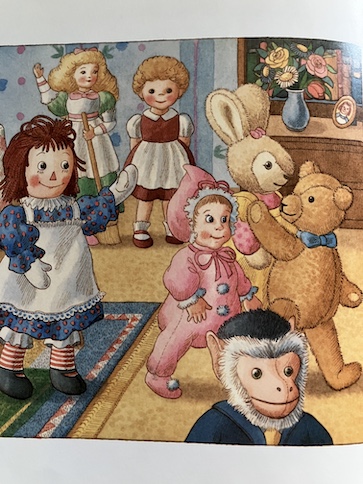
This book is a children’s guide to planning a tea party with Raggedy Ann. As in the original books, Raggedy Ann is a doll who lives with a girl named Marcella, and she likes to have tea parties with Marcella’s other dolls and stuffed animals.
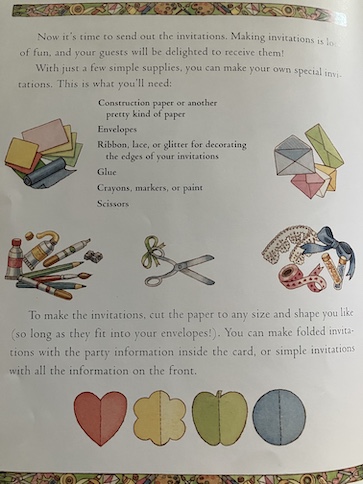
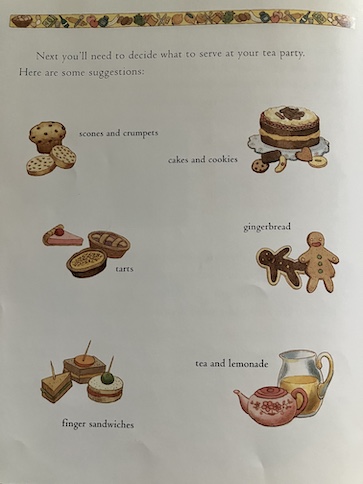
The book explains how to plan and prepare for a tea party, from figuring out how many guests there will be and making sure there are enough seats for everyone to choosing a menu and games to play. There are tips for making party invitations and a section of recipes in the back of the book.
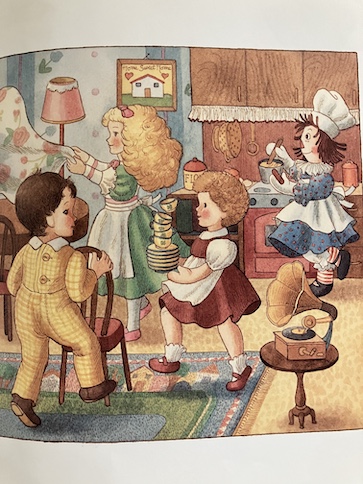
The food ideas aren’t too complicated. The book recommends keeping preparations simple because a party is about having fun. Setting the table is an activity by itself. Raggedy Ann gets her guests to help her, and they put on music while they do it. They want to make the table setting pretty, and they make sure that everyone knows each other and is included in the conversation. Tea parties are a time to practice good manners and make sure everyone is enjoying the party. At the end of the party, guests can also help clean up while they play music.
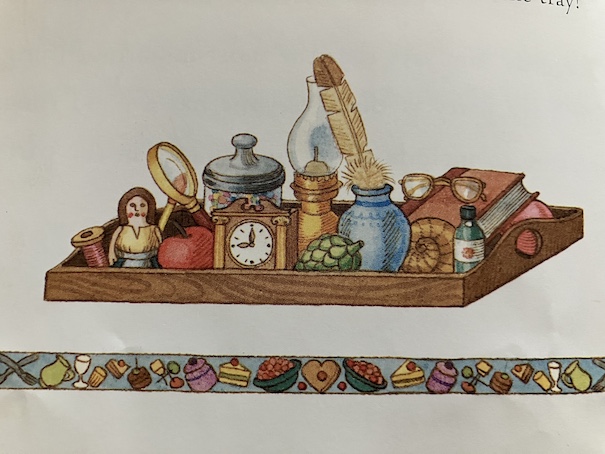
For games to play, they recommend the classic game of Telephone, Fiddly Diddly (a guessing game), and Memory Tray, where guests look at a tray of objects for a limited amount of time and then try to remember everything they’ve seen.
The recipes included in the book are:
Easy Chocolate Cakes
Creamy Pink and White Icing
Tiny Sandwiches – They suggest a variety of possible fillings, including tuna, ham, tomato, hard-boiled egg, cucumbers, cheese, fruit, or jam.
Raggedy Ann’s Candy-Heart Cookies – These are heart-shaped cutout cookies because Raggedy Ann has a candy heart.
Uncle Clem’s Super-Simple Scotch Shortbread
Marcella’s Lemonade
The book is available to borrow and read for free online through Internet Archive (multiple copies). There is another book by the same author called Raggedy Ann’s Birthday Party Book, about planning a birthday party.
My Reaction
I found it charming and nostalgic, and I loved the colorful pictures! I didn’t read this book as a child, but it is the kind of book I would have liked. The party-planning tips are useful, taking child readers step-by-step through planning the party, inviting the guests, and preparing food and entertainment. I liked the advice to keep things simple, so even the host/hostess can enjoy the party instead of getting stressed over complicating preparations. The recipes in the book fit the tea party theme, and they are simple enough for children to make or at least help in their preparation without being overly simplistic.
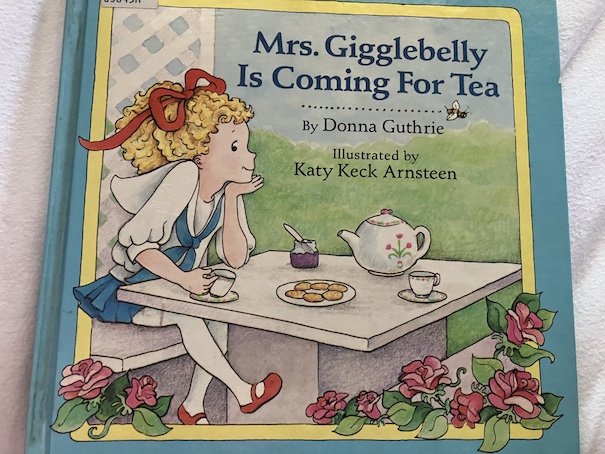
Mrs. Gigglebelly is Coming for Tea by Donna Guthrie, illustrated by Katy Keck Arnsteen, 1990.
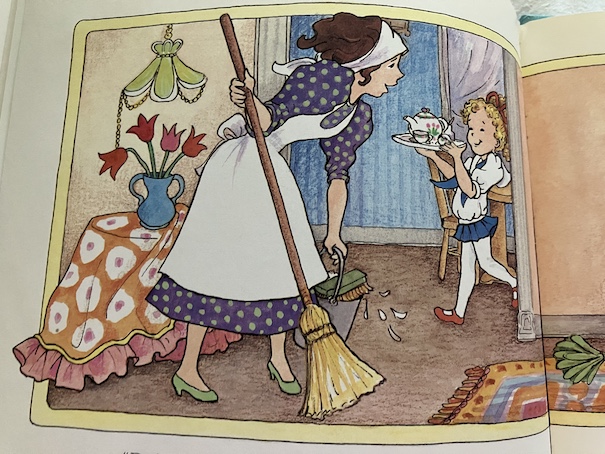
Elizabeth Ann tells her mother that Mrs. Gigglebelly is coming for tea today, but her mother says that she’s in the middle of her spring cleaning and doesn’t have time to prepare for Mrs. Gigglebelly today. In fact, she suggests that Mrs. Gigglebelly might be busy today, but Elizabeth Ann says that Mrs. Gigglebelly always has time for tea with her.
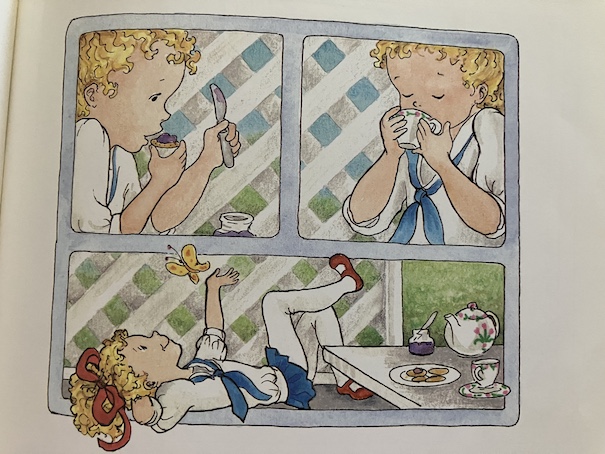
Since her mother is busy with chores and can’t prepare tea or a cake for Mrs. Gigglebelly, Elizabeth Ann fixes some lemonade and crackers with grape jelly for their “tea.” While Elizabeth Ann waits in the garden for Mrs. Gigglebelly, her mother dashes about, doing her chores.
At first, it seems like Mrs. Gigglebelly isn’t going to come, but she eventually arrives because she always has time for Elizabeth Ann … so does her mother.
My Reaction
This is a cute story about a mother who makes time for her child, even when she’s busy. “Mrs. Gigglebelly” seems to be a game of pretend the mother and daughter play together when they have their tea parties. On this particular day, the mother is very busy, but she still throws together a costume for their game. The book doesn’t say that “Mrs. Gigglebelly” is Elizabeth Ann’s mother, but it’s implied in the story, and in the last picture, readers can see pieces of “Mrs. Gigglebelly’s” improvised costume around the room.
I thought it was sweet that the mother in the story took time for a little fun and silliness and a special moment with her daughter, even though she had work to do. Some mothers might just lecture their child about how they’re busy and the child just has to accept that, but this mother understands that her attention is important to her child. Sometimes, it’s the little moments that mean a lot, even if it’s just pausing to share a snack. She does make her daughter wait because there are things she has to do, but the wait is worth it because the mother follows through and makes the effort to make time for her daughter.
Elizabeth Ann also doesn’t nag her mother about hurrying up or try to convince her mother to drop everything she’s doing and play with her instead of doing her cleaning. Instead, she waits patiently, confident that her mother will have time for her eventually because her mother has already established that her daughter is a priority and that she will make time for her. It looks like this mother-daughter pair understands each other well and that they have a good relationship with each other, and I like that.
Aunt Flossie’s Hats (and Crab Cakes Later) by Elizabeth Fitzgerald Howard, paintings by James Ransome, 1991.
On Sunday afternoons, a pair of sisters, Susan and Sarah, go to visit their Great-Great-Aunt Flossie. They love her house because it is full of interesting things, especially Aunt Flossie’s hat collection.
When their aunt welcomes them in, she offers them tea and cookies and promises that they will get some crab cakes later. After they have their tea and cookies, Aunt Flossie lets the girls try on her hats and tells them stories about them.
The girls are fascinated by the different colors and styles of the hats, but to Aunt Flossie, they represent memories. As the girls pick hats to try, Aunt Flossie tells them what the hats remind her of.
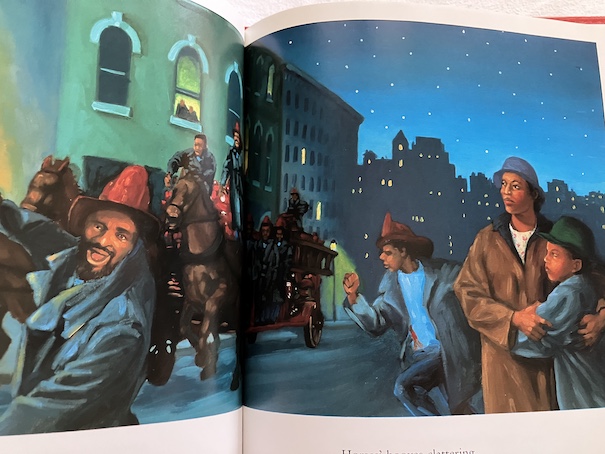
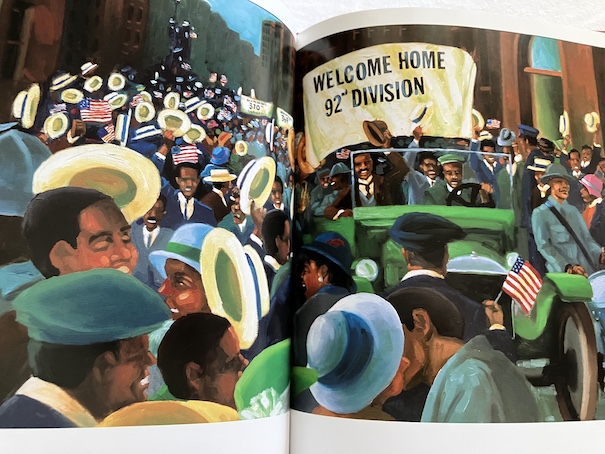
One hat that still has a slight smokey smell reminds Aunt Flossie of a big fire she witnessed in Baltimore. Another hat, one with a red feather, reminds Aunt Flossie of the parade she saw at the end of the Great War (what WWI was called before WWII).
Aunt Flossie’s favorite hat has pink and yellow flowers, and it reminds her of the time when she almost lost it, but it was rescued by a friendly dog. The girls love Aunt Flossie’s stories about her hats, and they love the crab cakes they get later with their family!
The book is available to borrow and read for free online through Internet Archive (multiple copies).
My Reaction
This is a sweet, slice-of-life story about an elderly aunt sharing her memories with her young nieces. The girls enjoy their time with their aunt, trying on the hats in her collection and getting glimpses of the past through her stories. By spending time together, getting together for tea (and crab cakes later) and trying on the hats, the girls are also building new memories. Years later, they will be able to tell stories about the afternoons they spent with Aunt Flossie and the stories she would tell them about her hats. A note in the book’s dedication indicates that the story is based on memories of the author’s own elderly Aunt Flossie.
The pictures in the book are colorful, like the colors of the aunt’s hats, and they’re also a little soft. I think the soft quality of the images is a good match for the memories the aunt shares with the girls and the new memories they’re creating by sharing stories and spending time together as a family.
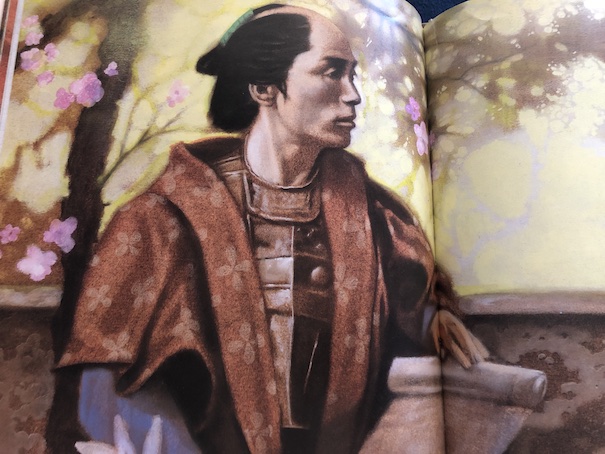
The Girl Who Loved Caterpillars adapted by Jean Merrill, illustrated by Floyd Cooper, 1992.
This story is a rendition of a 12th century folktale from Japan.
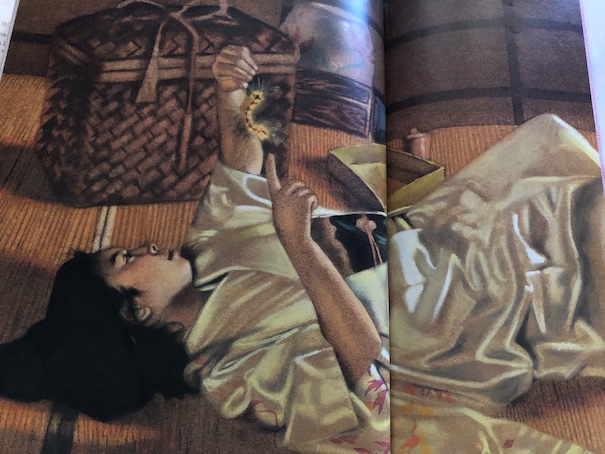
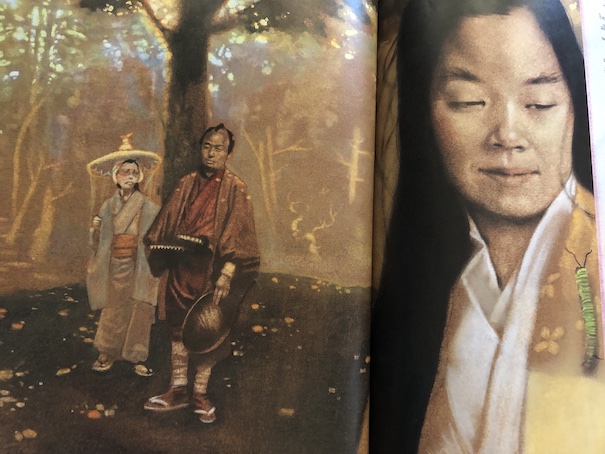
Izumi is the daughter of an important man, a provincial inspector who serves the emperor in Kyoto. Court life is full of elegance, and Izumi is a pretty and clever girl. Her parents have high hopes that she might become a lady-in-waiting or marry a nobleman, but she is mainly known for one thing: her peculiar love of caterpillars.
A beautiful and elegant woman who lives nearby is known for her love of butterflies, and she is considered to be The Perfect Lady. She has all of the skills that a noblewoman could aspire to, and Izumi’s parents think of her as a great role model for their daughter.
However, Izumi doesn’t see the appeal of beautiful butterflies. After all, they come from caterpillars, and caterpillars are much more interesting. Izumi also loves worms, toads, insects, and other things that most people would find unappealing. She likes to keep them as pets and observe how they live and grow. Izumi’s parents don’t approve of the lower-class boys who bring Izumi new creatures for her collection, and nobody else understands her fascination with these creatures.
Izumi just loves the natural world. To her, court life and the beauty standards for women there are too artificial. She also believes in reincarnation and the idea that any person might have been one of these unusual creatures in a past life or could be one in the next. Her parents love her, and they understand how she feels when she explains her reasoning to them, but they also worry about her future. If she doesn’t conform more to the standards of the court and develop more “normal” interests, will she ever make a desirable marriage? People at court gossip about Izumi and her odd tastes.
However, the rumors about Izumi reach a young nobleman who is as clever as Izumi, and he is fascinated at the idea of a pretty girl who isn’t afraid of the creeping creatures of the Earth.
The book is available to borrow and read for free online through Internet Archive.
My Reaction
I remember this story from when I was a kid! When I was a kid, I didn’t bother to read the Afterword of the book, which explains more about the origins of the story. Izumi’s story actually seems to be part of a much longer story about court life in Medieval Japan. The original author of the story is unknown, and Izumi’s part of the story is incomplete. It ends with the promise that what happens next will be revealed in the next chapter, but the rest of the story is unknown. We don’t know if she ends up marrying the nobleman who has developed a fascination with her or not.
I have a theory, based on a comment that Izumi made, comparing caterpillars to their adult forms and asking why people are only interested in the adult forms, that Izumi’s love of caterpillars is based both on her young age and perhaps a hidden affinity for children. Perhaps Izumi will grow to love butterflies as well as she grows up and be viewed as more of a butterfly herself, or maybe the nearby lady who loves butterflies will admit to a secret love of caterpillars as well. None of us stay young, and we all evolve as we grow, but part of us always remembers being in those early, awkward stages. Maybe everyone has a secret soft spot for the young, even when they’re fuzzy or grubby crawling things, and a desire to see them become the best form of themselves.
Whatever her future brings, readers get the impression that Izumi is happy and at peace with herself as she is, whether anyone else agrees or not. We can hope that the young nobleman will also love her for the person she is, but Izumi seems to believe that being true to her own nature is the way to achieve inner peace.
In other times and places, as the Afterward observes, Izumi might have been a scientist, naturalist, or philosopher. The traits that make her seem odd for her time and place are actually desirable ones that could make her more successful in other circumstances. In the early 21st century, Izumi’s sense of individualism and her value of the natural world would probably win her many friends. People who enjoy the aesthetic of Goblincore would probably relate to her feelings about caterpillars and other crawly creatures.
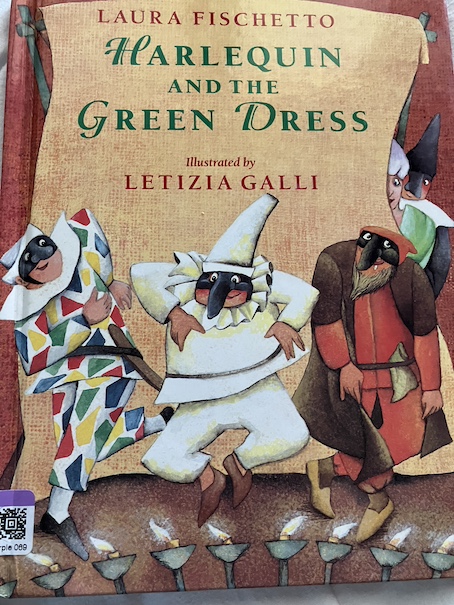
Harlequin and the Green Dress by Laura Fischetto, illustrated by Letizia Galli, 1994.
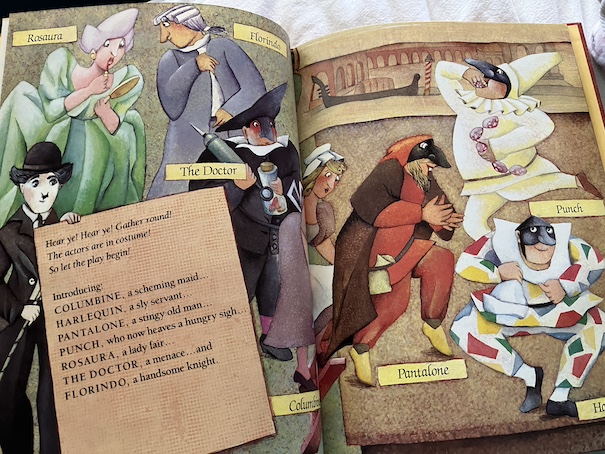
What I love about this book is that it’s a fun introduction to commedia del arte and its stock characters! A figure that looks like Charlie Chaplin holds a card that summons readers like guests to a play and introduces our characters like this:
Columbine – “a scheming maid …”
Harlequin – “a sly servant …”
Pantalone – “a stingy old man …”
Punch – “who now heaves a hungry sigh …”
Rosaura – “a lady fair …”
The Doctor – “a menace … and”
Florindo – “a handsome knight.”
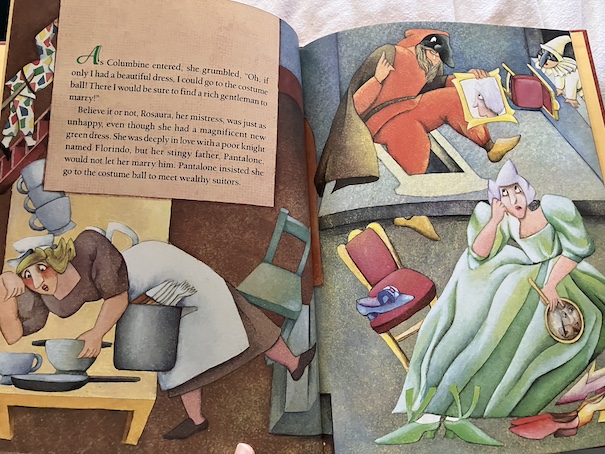
There is going to be a costume ball. Rosaura, a wealthy young lady, has a beautiful green dress to wear, but she is unhappy because her father, Pantalone, refuses to let her marry the man she loves, Florindo. Florindo is a poor knight, and Pantalone hopes that Rosaura will meet a wealthier suitor at the costume ball.
Meanwhile, Rosaura’s maid, Columbine, wishes that she had a beautiful dress so that she could go to the costume ball herself. She thinks that, if she went to the ball, she might also meet a rich man.
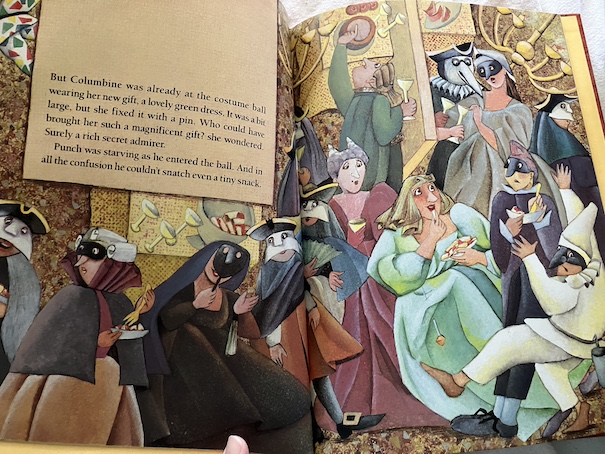
Harlequin is in love with Columbine, and he wants to do something that would impress her. He decides to borrow Rosaura’s dress and give it to Columbine as an anonymous gift so that Columbine can to go to the ball, but unbeknowst to him, Florindo is coming up with a scheme that will allow Rosaura to run away with him and get married. Florindo enlists his servant, Punch, to pretend to kidnap Rosaura, to provide a reason for her sudden disappearance. He tells Punch that he will know Rosaura at the ball because of her magnificent green dress, not knowing that Columbine has already received the dress from Harlequin and is wearing it at the ball.
Chaos ensues when Punch abducts Columbine, thinking that it’s Rosaura and that she’s just playing along with Florindo’s plan. When Punch says that he’s taking her to her suitor, Columbine assumes that he’s taking her to the secret admirer who gave her the dress.
In the meantime, poor Rosaura is having hysterics because she can’t find her dress and can’t go to meet her suitor. When Harlequin discovers what a mess all the scheming has caused, he comes up with another scheme to straighten out everything. Can he reunite Rosaura with Florindo, convince Pantalone to allow their marriage to take place, make her that Punch gets all the snacks he wants, and make things right with Columbine?
My Reaction
I love books that introduce lesser-known topics, and I imagine that few young readers would know anything about commedia del arte. For kids who are old enough to appreciate a little theatrical history and expand their cultural horizons, this is a fun introduction to an art form that they may have never seen before!
My first introduction to the stock characters was in Agatha Christie movies because Agatha Christie was fond of commedia del arte and put references to it into some of her stories, like The Affair of the Victory Ball. There is a section at the back of this book that explains the historical background of this type of theater and more about the characteristics of the stock characters.
I did think that the story in the book jumped around oddly in some places, and the role of The Doctor wasn’t very well explained. I think part of the reason was that the action would be easier to understand if we were watching it on stage rather than reading it in a book. The pictures are also chaotic and a little difficult to follow. I think they’re meant to convey the shifting scenes and the fast and chaotic movements of the characters as they go about their various schemes. The story itself is meant to be chaotic and action-filled because of all the characters’ schemes and counter-schemes. The action and visual jokes would probably make more sense seeing them performed rather than hearing them described.
I did like the part at the end, where we see the actors taking their bows and some of them removing their masks because the story was a play the entire time. The story isn’t meant for readers to see the characters as real people and events that are actually taking place. It’s all been a stage play the entire time. The pictures also indicate that it was always a play, with its flat scenery, objects at strange angles, and characters that seem to be separated from each other by thin walls. It’s all a bit unreal because it is unreal.
To get around some of the chaotic nature of the story and make it more fun for kids, I think this is a good book to read aloud with a lot of enthusiasm and maybe even act out rather than just telling it, encouraging young listeners to get involved in the story and the imaginary world of the theater.
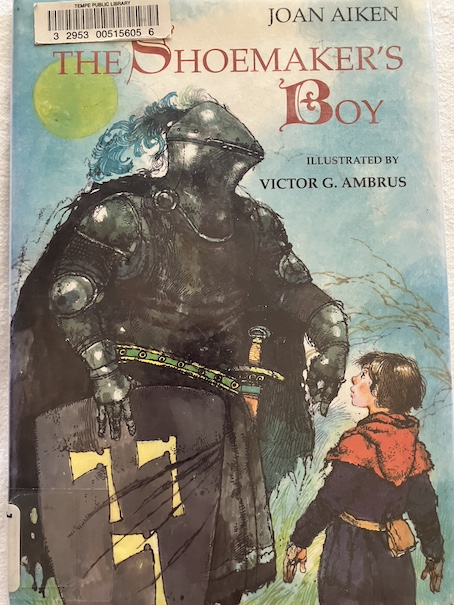
The Shoemaker’s Boy by Joan Aiken, illustrated by Victor G. Ambrus, 1991, 1994.
Jem’s father is a shoemaker, and Jem is learning his trade. However, things take a bad turn when his mother suddenly becomes ill. It’s a strange kind of illness. She sleeps all the time, can’t eat, and is hardly breathing. The doctors can’t seem to help her, so Jem’s father decides to go on a pilgrimmage to St. James in Spain and pray for his wife to get better.
While he’s gone, Jem has to mind the family business and look after his mother. Jem’s father has a reputation as a incredible shoemaker, with people coming to see him even from other kingdoms, and Jem is worried that he won’t be able to maintain the business on his own because he’s still learning the trade. However, since nothing else seems to help his mother, it seems like his father’s holy pilgrimage is their last hope.
While his father is away, Jem tries his best, but he finds it difficult to keep up with the orders that come in for shoes. He falls behind on his work, and money is running short. Then, one day, he has a strange encounter with three little men, who are only the size of young children. They are all dressed in green, and they ask Jem for the three silver keys. Jem doesn’t know what they’re talking about, but the men say that they were sent to ask him for them because someone was supposed to leave the keys with him. Jem says that nobody has left any keys with him, and suddenly, the little men vanish! At first, Jem thinks that maybe he imagined the whole thing, but this is just the beginning of a series of strange happenings.
Late that night, there is a knock on the door, and when Jem answers it, he is confronted by a knight wearing black. The knight says that he wants Jem to make him a pair of boots because he’s heard that the boots from this shop are the best. Jem doesn’t want the knight to be disappointed, so he explains to him about his father being away and that he is not as good as his father at making boots. The knight appreciates his honesty and says that he will try Jem’s work anyway. He promises Jem an excellent fee for his services if the boots are ready by morning, and to Jem’s surprise, he also asks Jem if someone has left three silver keys for him. Jem tells him that nobody has left any keys with him, and the knight says that someone may leave them by the time the boots are ready, and he asks Jem to take good care of them.
Jem works on the boots through the night, and he’s making good progress when, in the middle of the night, a second knight arrives. The second knight is dressed in white. This knight doesn’t want any boots or shoes. Instead, he asks Jem to take care of a little packet for him while he runs an errand. He says that he has heard that Jem is very trustworthy, and he says that if he doesn’t return by morning, Jem can keep the packet. Jem agrees that he will take care of the packet and make sure no one else touches it.
The rest of the night is very strange. While Jem works hard on finishing the last boot, he hears strange sounds outside, and he thinks that he can hear the little men and the black knight calling out for the mysterious keys. What does it all mean? Are the keys in the packet left by the white knight, and if so, what are they for?
The book is available to borrow and read for free online through Internet Archive (multiple copies).
My Reaction
This is a short, easy beginning chapter book, and it’s a nice story with a Medieval setting, written in the style of an old fairy tale. The story leaves a few questions unanswered at the end. We never really find out who the two knights are or who the little men are, although there are implications that they are supernatural. I think that they also have religious significance, tying them to Jem’s father’s pilgrimage. The contents of the white knight’s packet are not obvious, but it is the solution to Jem’s main problem. When Jem’s father returns home, he also has some information about Jem’s mysterious visitors, although he doesn’t have all the answers, either. Readers know enough at the end to appreciate that Jem made the right decision when he handled the packet and that his experiences were partly a test of his character.
The book mentions Jem’s father putting a scallop shell on his cap when he’s about to begin his pilgrimage. The scallop shell is a symbol of St. James, one of the original Twelve Apostles. The place where Jem’s father was going on his pilgrimage, the shrine of St. James at Santiago de Compostela in Spain is a real place that has been a popular site of religious pilgrimages for centuries. After Jesus was crucified, His disciples traveled to other places to spread the word about Jesus and gain new converts to the new religion of Christianity. St. James went to what is now Spain, and after teaching there, he eventually returned to Jerusalem. It isn’t entirely clear what happened to his body after he died, but one of the stories is that his followers brought his body back to Spain and buried it at the site now known as Santiago de Compostela. St. James is now the patron saint of Spain, and pilgrims who visit Santiago de Compostela often collect a scallop shell as a souvenir of their journey. Actually, that is the one complaint that I have about this book. In the story, Jem’s father puts on a scallop shell as he begins his journey, but in real life, Medieval pilgrims usually used the shell as a sign of completion of their journey.





















 Jestress's Forgotten Books and Stories