Stories of Rainbow and Lucky: Handie

Stories of Rainbow and Lucky

I’ve been wanting to cover this series for some time. It’s an unusual series from the mid-19th century, written on the eve of the American Civil War, by a white author with a young black hero. Rainbow is a teenage black boy who, in this first installment of the series, is hired by a young carpenter, who is only a few years older than he is, to help him with a job in another town. The entire series is really one long story, like a mini-series, and each book is an installment in the story. 

This first book focuses mostly on the young, white carpenter Handie Level, why he needs to take this job in another town, and why he decides to hire Rainbow to come with him. The rest of the series follows the two young men, particularly Rainbow, through their adventures, learning life lessons, even dealing with difficult topics like racism. (Lucky is a horse, and Lucky enters the story later.) It’s unusual for this time period for black people to be the heroes of books and for topics like racism to be discussed directly. It’s also important to point out that our black hero is not a slave, he is not enslaved at any point in the series, and the series has a happy ending for him. People don’t always treat him right, but he does have friends and allies, and he manages to deal with the adversity he faces and builds a future for himself.

I want to explain a little more about the background of this book, but it helps to know a couple of things before you begin. First, the author was a minister who had written other books and series for children, Jacob Abbott. He had a strong interest in human nature and the details of everyday life, so his books are interesting for students of history. He explains some of the details of 19th century life that other people of his time might have taken for granted, and he also liked to explain the reasons why his characters behave as they do in the stories, exploring their personalities and motivations. Second, as part of the author’s character studies and also just for the fun of it, he made many of his character names puns that offer hints to the characters’ roles or personalities, so keep an eye out for that when new characters are introduced. Some of these pun name or nicknames are obvious, but others require a little explanation. Rainbow’s employer, Handie Level, is a level-headed carpenter who’s good with his hands, so the meaning of his name is pretty straight-forward. “Rainbow” is the nickname of our black hero, not his real name. We are never told what his real name is. He apparently has one, but even the author/narrator of the story admits that he’s not sure what it is. He is nicknamed “Rainbow” because he is “colored”, and that may require a little explanation.

During the course of the books, the author explains that “colored” was one of the more polite words used for African Americans during the mid-19th century. The author wanted to make his stories educational for children of his time, so there are points when characters discuss how to address African Americans politely, explaining which terms are acceptable and which are not acceptable. The basic rule that the author establishes of not referring to anybody by a name you think they wouldn’t want to be called still holds true today, no matter who you’re talking about. It’s important to consider other people’s feelings in how you describe them, and it’s good to teach children to notice and care about other people’s feelings. However, some of the polite racial terms the author recommends in the books sound out-of-date to people today and might leave modern readers wondering if they really are polite. The answer to the question is that they were considered polite at the time the book was written, but since then, some of the conventions regarding polite racial terms have changed.

A major shift in the terms used took place during the Civil Rights Movement, around 100 years after this series was written. People were intentionally trying to distance themselves from the emotional baggage associated with the racial terms that had been used previously, so instead of using “Negro” and “colored”, they began using “African American” as the formal term and “black” as the generic, informal term. This change in terms was meant to help create a sense of a fresh start at a time when cultural attitudes were changing. Because this book was written in the 19th century, the terms they use as the polite terms are the ones that were formerly used as the polite terms before that cultural shift. Even though most people wouldn’t speak like that anymore, you can still see the use of these terms occasionally, particularly in the names of organizations that were created prior to the shift in racial terms, like the United Negro College Fund (UNCF, founded 1944) and the National Association for the Advancement of Colored People (NAACP, founded 1909). So, yes, “Rainbow” is a pun nickname because he is “colored” in the sense of the racial term. Apparently, the author was amused that the term made it sound like he was colorful, like a rainbow, although I think he is also a colorful personality.

The way a person speaks does offer hints to their background and character. Jacob Abbott had a fascination for analyzing the details of human behavior and the ways other people react to the other people around them them. He was aware of what was considered polite in his time and how the words people use affect other people. In these stories, he deliberately offers teachable moments to show child readers the differences between people who behave politely and considerately and the people who do not. As you go through the stories, feel free to study the characters and their behavior. The author meant for people to notice who these people are and why they do the things they do.

This book is easily available to read online in your browser through NINETEENTH-CENTURY AMERICAN CHILDREN & WHAT THEY READ, I’m going to do a detailed summary below. If you’d rather read it yourself before you read my review, you can go ahead, but some people might want to know in detail what they’d be getting into. There’s nothing here that I think would be racially offensive because it’s quite a gentle, sympathetic story. However, I can immediately see a couple of reasons why this book and its series hasn’t become a better-known children’s classic. 

I wasn’t kidding when I said that the author goes into detail about some aspects of daily life and society in the 19th century. This story and its series, like others by the author, was meant to be education, so there’s a lot of teaching going on, both in the form of moral advice and general life lessons and in the specifics about how to handle money and negotiate business arrangements. It could still be interesting for someone studying daily life and social attitudes in the 19th century, but 21st century children might find it a bit dull. There’s more explanation than there is action and adventure, although I wasn’t bored while reading it, and there are a few interludes with character backstories, stories that the characters tell each other, and a strange dream Handie has. In the middle of the book, there’s kind of a touching story about a little boy and his widowed mother that I enjoyed, and it explains some of the reasons why the characters are in the situation they’re in.

Handie and Rainbow are the two main characters of the series, although most of this book focuses on Handie and his family. Their money troubles, an inheritance that Handie receives, and the arrangements that he makes on behalf of his family create the situation that causes Handie to hire Rainbow to help him with some work, which requires traveling to another town to manage his inheritance. The entire series tells the story of why they’re doing this, what happens to them on the journey to this new town, what they find there, and what it means for their futures, but it’s told in five installments. There are some spoilers at the end of this story to future stories in the series, which ruins some of the suspense, but this isn’t really meant as a suspense story. It’s a story about a couple of promising boys in the teenage years and what they do that sets them up for their future. One of them just happens to be black, and that’s something that figures more in the later stories in the series. This particular book has a few moments when the characters discuss race and the difficulties and discrimination that black people encounter in life, but it’s not a major focus. There is going to be outright racism in the stories, but this book mostly sets up the backstory of the characters and their situation.

Handie Level (his first name is short for Handerson, we are later told) is a poor boy who is reluctant to go to school because his clothes are so poor, but yet, he is eager to learn. Our narrator, an unnamed neighbor of the Level family, describes how Mr. Level has difficulty earning much money because he is not very strong and is physically deformed. He manages to earn sufficient money to keep himself, his wife, and their son in a basic way as a kind of repair man. He is very good at fixing things in his little workshop. However, he isn’t very good at managing the little money he has, and his wife isn’t very attentive about maintaining the house or the family’s clothes, making them look more poor than they actually are. It’s true that they don’t have much, but they could do better if they managed their resources better. It’s partly because they feel sorry for their poor state and not very hopeful about it improving that keeps them from striving to do better. In reality, they’re not that much worse off than their neighbors, but this feeling that they are is what keeps Handie from going to school and letting others see his poor state. Since he has not been to school so far and can’t read, Handie worries that he would be embarrassingly behind the other children if he tried to go.

One day, the kind neighbor/narrator sees Handie trying to teach himself to read. Wanting to help the boy, the kind neighbor gives him a book that will help him learn to read better than what he was trying to use. (The author of the story is probably inserting himself here as the friendly neighbor, especially because he also wrote other books about children’s education, children’s readers, and series of simple stories aimed at teaching children to read.) Handie is grateful and begins making more progress in his learning.

Handie also becomes more helpful to his parents as he grows older and takes an interest in learning to mend his own clothes. When his mother helps him to mend his clothes, he looks much better, and Handie praises his sewing ability. His mother is pleased at the praise, and we learn that her husband has been more in the habit of criticizing her efforts at everything rather than praising her. This constant criticism and lack of encouragement is another reason why she has not been trying harder to maintain the household and the appearances of her family. Handie’s praise encourages his mother, and with Handie’s help, she begins making more effort around the house and doing more mending. With his clothes looking nicer and his new ability to read, Handie feels more comfortable going to school, and he begins progressing in life.

As Handie grows up, he becomes more and more helpful to his parents, both around the house and in his father’s repair business. He begins taking jobs of his own and bringing in a little money. He helps his family improve their circumstances. Then, a new opportunity comes along. The man at the mill says that if Handie or his father can buy a horse and wagon, he would pay them good money to haul lumber for him. It’s a tempting offer, and it could be a job that Handie’s father could do that would pay him more than what he’s doing now, but Handie doesn’t know where they would get the money for the horse and wagon for either of them to use. Handie has been good about saving money from what he earns, but the amount they would need is a large sum.

When Handie finally talks to his father about the job offer, Mr. Level is upset. He has been very worried lately, and he reveals to Handie the reason why. Even though they own their house, there is a mortgage on it, and the mortgage holder (a lawyer in the village) is now insisting that the Levels pay him the full sum or the family will be turned out. Mr. Level doesn’t know where he will get the money to pay the full amount, and he doesn’t know where they can possibly live if they have to leave. Handie and his mother had no idea that Mr. Level had taken out a mortgage on the house, and they are distressed about the looming threat of eviction. The amount of money they would need to save their house is about the same as what it would take to buy a horse and wagon.

While the Levels are debating about what they can do, the story flashes back a few years to a little boy named Solomon Roundly and the reason why Mr. Level is in such financial trouble. Solomon belongs to an industrious but poor family on the other side of the village from the Level family. The family is saving up to buy their own farm when Solomon’s father suddenly dies of an illness. The neighbors do their best to comfort Mrs. Roundly and young Solomon. Among the neighbors, there is a black lady and her 12-year-old son, who sometimes looks after young Solomon and plays with him or takes him fishing. (The book uses the term “colored” to describe the black boy and his mother because that was one of the more polite terms at the time. There is a point later in the series where the narrator specifically explains this.) The narrator says that he doesn’t remember the black boy’s real name because everyone has called him Rainbow for as long as anyone can remember, and they’re not even very certain whether he ever had another name.

One day, another local boy, called Josey Cameron, is accidentally injured when he tries to throw a stone into an apple tree to knock down an apple, and the stone comes back at him and hits him just above his eye. The boy cries with fright and pain, and Mrs. Roundly takes him inside and tends to the wound. Mrs. Roundly asks young Solomon to fetch Rainbow and see if Rainbow can take the injured boy home in his cart. Rainbow agrees to take Josey home, and Mrs. Roundly tells him to be sure to drop the boy off close to his house but not right in front of it and to let him walk the rest of the way so that his mother will see that he is not hurt too badly. If Mrs. Cameron sees them drop off her son right at the door, she might panic, thinking that he couldn’t walk at all. The reason why this little incident matters is that it happens shortly before Mr. Roundly dies, and it starts off a chain of events which explains Mr. Level’s mortgage.

Mr. Cameron is so grateful for Mrs. Roundly tending to his son’s wound and arranging for his ride home that he arranges a little present for the Roundly family. He is a daguerreotypist, meaning that he makes daguerreotypes, which is an early form of photography. Basically, he has a photography studio. He has Mr. Roundly pose for a daguerreotype as a reward to his family for their help. Mrs. Roundly is happy to see the picture of her husband when they receive it, but later, after her husband’s death, she finds it a painful reminder of the loss. Young Solomon, seeing his mother crying over the daguerreotype of his father, decides that if it makes her so unhappy to see it, maybe he should get rid of it.

Solomon takes the daguerreotype and goes to see Rainbow and asks him for a ride into the village. Rainbow is happy to give him a ride, but he asks him why he wants to go there. Solomon says he’s going there “on business”, which makes Rainbow laugh because Solomon is so little. Yet, Solomon insists that’s the case and tells Rainbow he’ll see it’s true when they get there. 

On the way, Solomon insists that Rainbow tell him a story. Rainbow tells him the only one that he knows, a story about a man who killed a bear. (I find hunting stories rather gruesome, although I suppose 19th century children might have found this interlude thrilling.) Rainbow knows this story because his mother read it in an almanac once. Solomon asks Rainbow if he can read. Rainbow says he can’t read very well. His mother is too busy working to teach him, and it’s hard to learn on his own. He wishes he could go to school, but he says that the local people don’t like him to go. The other boys don’t want to sit near him, and people make trouble for him. Solomon wishes he could do something that would help, but he can’t think of anything.

In the village, Solomon asks Rainbow to take him to Mr. Cameron’s. When they get there, Solomon asks Mr. Cameron to make a daguerreotype of him, just like he did with his father and to replace his father’s daguerreotype in its case with his instead. Mr. Cameron is surprised at the request, especially since Solomon admits that his mother didn’t send him and he wants the picture for free, but he agrees to do it as a favor to the little boy. When Mr. Cameron makes the daguerreotype, Rainbow is standing behind Solomon, and he ends up in the picture as well. When Solomon sees it, he says that he didn’t mean Rainbow to be in the picture with him, but Mr. Cameron says that he doesn’t see a problem with it. In fact, he thinks that Rainbow’s presence really improves the picture and makes it “prettier.” Rainbow is surprised and flattered that Mr. Cameron, as a man of artistic sensibilities, thinks his face could make a picture more beautiful, and Solomon decides that the picture will serve his purpose as well with Rainbow in it. 

When he gets home, Solomon puts his new daguerreotype in the place where his mother kept his father’s picture, and he puts his father’s picture away for safe-keeping. In the morning, his mother asks him about the new daguerreotype, and Solomon explains what he did. He says that he did it so that his mother would think of him now, and not his father, so she would be less sad. His mother agrees that’s a good thing to do, and she says that she doesn’t mind having Rainbow in the picture, either, because Rainbow has been so kind to Solomon.

Taking her son’s words to heart, Mrs. Roundly decides that she needs to start thinking of her son more and planning for the future again. She has some money that her husband left her, so she decides to see the lawyer in the village, Mr. James, about investing it on her son’s behalf, so her son will be able to buy a farm when he is grown. Mr. James is the same lawyer who holds the mortgage on the Levels’ property, and the money that Mr. Level borrowed from Mr. James is the money that Mrs. Roundly invested with him. Mr. Level was in debt at the time, and he promised to repay the loan with interest, using his house as collateral for the loan. The money that Mr. Level must repay is being managed by Mr. James, but it’s actually for young Solomon Roundly and his mother. 

Mr. Level is not good at managing his money, he has been careless about making his payments on time, and because he didn’t tell Handie or his mother about it, there was no one else to remind him or make sure that he repaid the money he borrowed. Mr. James has already extended the loan and given Mr. Level chances to make payments, and Mr. Level hasn’t done it. Mr. James can’t in good conscience allow Mr. Level to not repay a widow and a fatherless boy the money he owes them because he knows they really need it. That’s why he’s insisting on payment now or he’ll take the house.

When we return to the present after the flashback that explains the nature of the problem, Handie decides that the only thing to do is to see Mr. James himself and try to negotiate with him on behalf of his father and family. On his way, he meets Captain Early, who offers him a ride. Handie accepts and decides to ask Captain Early for advice about debts and mortgages. Because his father doesn’t understand much about money matters, Handie also doesn’t really understand mortgages or what the family’s options are. 

Captain Early says that if the property that’s mortgaged is worth more than the current mortgage, it could be possible to take out a second mortgage from a different person and use it to pay off the first one, thus buying some time to fully repay the debt. Handie has some misgivings about this approach. Captain Early doesn’t think it would be hard to find another investor who would be willing to lend money in the hopes of earning interest on it, but Handie now knows that his father isn’t good at paying his debts or even the interest on them. Still, it’s the only sensible solution that anyone has proposed so far, so he decides to discuss the possibility with Mr. James.

When Handie goes to see Mr. James, they discuss the situation. Handie explains that he didn’t understand the state of his father’s finances before or he would have helped his father pay the debt, and Mr. James explains why he’s reluctant to allow them more time to pay. The reason why the matter is so pressing is that Mrs. Roundly and her son are living in a rented house, and the man who owns it is in need of money and wants to sell the property. If Mrs. Roundly gets her money back, she could buy the home herself, and she and her son could continue to live there. If she doesn’t, she will have to worry about where she and her son will live. To let the Levels continue living in their home while not repaying the debt would result in the Roundlys being evicted, and that would hardly be fair, since it was really their money in the beginning.

Handie agrees that it would be unjust to not repay the debt to the Roundlys and put their situation in danger, and he promises to try to work things out so he and his father can repay the money. Mr. James appreciates Handie’s practicality and understanding, and he says that it’s too bad that Handie is only 19 years old. If he was 21, he would be a legal adult, and he would be willing to invest in Handie himself to repay Handie’s father’s debt. The only reason why he can’t do it now is that, until Handie is a legal adult, his signature on any agreement wouldn’t be legally binding. Also, technically, under the law, Handie’s time and money don’t belong to him but to his father. Even if his father would allow him to have time and money to himself, everything that belongs to Handie, and even Handie himself, legally belongs to his father until he’s a legal adult. 

As for what Captain Early said about taking out another mortgage or loan, even if Handie tried to arrange such a thing, any loan made to him would really, legally, be another loan to his father. Even if Handie gave his father the money to settle his debt or any other loan, there would be no guarantee that his father would actually use the money for that purpose. Legally, he can do what he wants with any money Handie gives him, even if Handie is the one who earned it, and even if he just wastes it instead of settling his debts. The truth is that Mr. James has already approached potential investors about making another loan to Mr. Level, but nobody wants to loan him money. Mr. Level has been complaining openly to people in the village about how unfair it is that he’s going to lose his house because he hasn’t repaid his loan. By doing all that complaining, he’s publicly outed himself as a bad debtor, and while people feel sorry for him, nobody wants to trust him with their money.

The situation looks hopeless to Handie. All he can think of is that his family will have to sell their house and move somewhere else. Because they can get more money from the sale of the house than they need to cover the debt, they could use that money to move somewhere else. Mr. James says that whoever buys the house might lease it back to them so they can continue to live there. They would just be paying rent to continue living in the house rather than paying the mortgage. It’s not a great solution, but it’s the only one open to them, and they will be left with some money from it. Handie explains the plan to his parents and to Mrs. Roundly, and they all agree to it.

It will take a couple of months to settle the sale of the house, so Handie tells his father that they must try to earn as much money as they can during that time. Mr. Level says that there’s no way they can earn enough to stop the sale of the house in that time, but Handie says that it doesn’t matter. Whatever money they can earn will help in setting them up with a place to live and improving their financial situation. Thinking again about the offer of a job delivering lumber, Handie decides that, rather than trying to buy a horse and wagon, maybe he could rent one. He does so, his father begins delivering lumber, and he and his father begin saving up money and paying down the debt.

Then, Mr. James sends Handie a message to come see him. Mr. James has received word that Handie’s uncle has died and left him a small farm called Three Pines. Because his uncle left the farm to Handie and not to his father, Mr. James is to hold it in trust for him until he is 22. (This is one year past the age of adulthood, but this is what his uncle specified.) There is money to go with the property, and as the executor of the estate, Mr. James is directed to use the money to fix up the property and rent it out to a tenant on Handie’s behalf until Handie is old enough to have it. The bequest would be helpful to Handie if he could use it immediately to pay his father’s debt, but there is still the issue that Handie is underage. While Mr. James can rent out the property and use the money on Handie’s behalf, it would be against the terms of the will to use the money to pay Handie’s father’s debts. While helping his father would indirectly help Handie, that’s not quite good enough to satisfy the terms of the uncle’s will.

What Mr. James suggests is that they follow the terms of the will that require him to use the money from the estate to hire someone to fix up the property, and to that end, he will hire Handie to do the work and pay him for it. It seems odd to be hired and paid to work on a house that’s technically his, but it’s a logical solution to the problem. Because of the lawyer’s strict interpretation of the will and his role in executing it, he doesn’t think it would be appropriate to give Handie an advance on his work so he can settle the debt right away, insisting that Handie must do the work before getting any money. Handie thinks he’s being too strict, which is not really in his best interests at the moment, but he doesn’t see how he can argue. The proposition that Mr. James makes for him would still allow him to earn more money than he is currently earning.

When he tells his parents about the bequest and Mr. James’s proposition, they are happy that Handie’s uncle left him something but disappointed that Mr. James is unwilling to use the situation to help them more immediately. Handie himself thinks that Mr. James should have made a little exception to the rules to give him an advance on the money, although he has a dream that night that gives him a different perspective. In his dream, a fairy argues with a clock, telling it that it would do some good for it to go a little faster sometimes and a little slower at others, according to people’s needs. The clock says that the trouble is that, if he speeds up for one person, he might go too fast for another person’s needs, and if he slows down too much, it might cause trouble for someone who needs time to go faster. Because changing the flow of time can hurt one person at the same time as it helps another, it’s better for him to just keep the correct time. 

When he wakes up, Handie thinks about his weird dream and realizes that Mr. James is like the clock because he has to go strictly according to the rules, stable and predictable, to keep the situation steady for everyone. Sometimes, he might be tempted to do someone a favor by tilting the balance for them, but that can throw off other people who are also depending on him to follow the rules. Handie also considers the purpose behind his uncle’s will. His uncle and his father didn’t get along well, and his uncle was aware that his father was terrible at handling money. Handie himself has now become acquainted with his father’s lack of money sense and how it affects the rest of the family. He realizes that his uncle left his farm to Handie because he had heard that Handie was a practical boy and a good worker and would be more likely to take care of it. Therefore, he skipped over Handie’s father and left the farm directly to Handie, to be held in trust for him until he was a full adult to make sure that Handie’s father couldn’t use it for his own purposes or that Handie wouldn’t sacrifice something that would make a real difference to his future in his efforts to help his father. His uncle was planning for the long term, not the short term, something which Handie’s father never does but which Handie will have to learn to do if he wants a better future. Mr. James understands this thinking as well as Handie does, and that’s why he’s so adamant that they follow the terms of the will exactly.

When Handie speaks to Mr. James again, Mr. James reminds him that his father has a legal right to Handie’s time and anything that he earns through the use of his time. Time is a valuable resource, and Handie’s father owns his as a piece of property until Handie turns 21 years old. (In the book, Mr. James says, “You see the law requires that children should do something to reimburse to their parents the expense which they have caused them in bringing them up. … . They are required to remain a certain number of years to assist their fathers and mothers by working for them or with them. The time when they are finally free is when they are twenty-one years old.” This isn’t how society or the law would look at it in modern times, but I’ll have more to say about that later.) What Mr. James proposes to Handie is that he literally buy Handie’s time from his father, the remaining 2 years until Handie is 21 years old, for enough money to pay off the mortgage and give him plenty of extra money. If he does that, Handie will be working for Mr. James instead of his father for the next two years, and whatever he does or whatever he earns in that time would be for Mr. James. Handie agrees to this proposal because it would take care of his father’s money troubles. 

However, Mr. James improves the offer by saying that Handie has the ability to buy his own time, in which case he will be working for himself, owning his own time and his own earnings. He has spoken to a gentleman in the village who is willing to establish a loan for Handie, which he can use to buy his time from his father. As long as Handie stays healthy and continues working during the next two years, he will have more than enough money to repay that loan. Handie asks what happens if he gets sick or dies. Mr. James says this arrangement will require him to take out life insurance as security, to repay the loan in case something happens to him. The farm Handie has waiting for him can also be security for the loan in case Handie is sick or injured, and Mr. James will also endorse the note, meaning that he will pay the debt if Handie is unable to do it. It’s suitable for Mr. James to do that as the trustee for Handie’s inheritance and more legally-binding because Handie is still a minor.

Handie explains this new proposal to his parents, and they all agree to it. Handie’s mother is worried that this arrangement will involve Handie leaving home, and she doesn’t know what they’ll do with out him, but Handie says it’s necessary for him to go to the farm he’s inherited and begin fixing it up. It will bring in more money in the long run, and he will come home to his parents when everything is order and the farm is ready to lease to a tenant until Handie is 21. When they accept the proposal, Mr. Level is able to pay off his mortgage and save his ownership of his house, and he has enough money left over to buy his own horse and wagon to use in his new delivery job. With the family’s fortunes looking much better, Handie prepares to go to farm and begin his work there.

Hiring Rainbow

So far, the story has mostly focused on Handie and his family, and we haven’t seen much of Rainbow since he was helping young Solomon, but this is a small village, and Handie does know who Rainbow is. This is the part of the story that establishes the relationship between Handie and Rainbow and how Handie decides to hire Rainbow to help him with the work on his new farm.

As Handie prepares to go to the farm, which is near another town, Mr. James talks to him about the arrangements he’s made to provide Handie with money to pay him the wages for working for his own estate and also to allow him to buy whatever supplies and hardware he will need for repairs around the farm. Because Mr. James won’t be there to oversee things directly, he’s made arrangements to send money to Handie through another lawyer who lives near the farm. 

Handie is young, but he’s had experience as a carpenter. He can handle most of the work himself, but carpenters frequently need assistants to act as an extra pair of hands, helping them by holding boards in place or handing them tools as needed. Mr. James says that it would be appropriate for him to hire an assistant to help him, and he will provide money from the estate for that purpose. Since Handie doesn’t know anyone in this new town and wouldn’t know who to hire there, he decides that it would be better to bring an assistant with him from his village. He chooses Rainbow because, even though Rainbow is only 14 years old at this point, he’s big and strong for his age and is a good worker. He hasn’t had any training in carpentry at this point, but he doesn’t really need any experience to be an assistant. Rainbow is good at following instructions and is eager to do a good job and please people, and that’s more important.

Before he asks Rainbow if he wants the job, Handie tells Mr. James what he’s thinking to see if he thinks it’s a good idea. Mr. James says that, before he talks to Rainbow, he needs to decide how much money he would be willing to pay Rainbow out of the estate and what his accommodations would be while they’re in the other town. Handie proposes what he thinks would be a decent wage for an assistant and says that he will pay for Rainbow’s room and board. They will have to board somewhere in town until the farm is suitable for them to live in. Mr. James says that may be difficult because not every boarding house would be willing to have a “colored” tenant. Tenants in boarding houses all eat together at the same dining table, and not everyone will want to see at the same table as a black person. (This is just like Rainbow said that the other boys at school wouldn’t want to sit with him and would make trouble.) Handie is confident that he can find a place for them to board anyway, so Mr. James says that the plan sounds fine to him, as along as Rainbow agrees to it and Rainbow’s mother approves.

Handie goes to Rainbow’s house, but Rainbow’s mother says that he isn’t home because he’s working in Mrs. Roundly’s garden. Deciding that he should offer the job directly to Rainbow first before talking to his mother, Handie goes to find Rainbow.

Rainbow is working with young Solomon in the garden, and when they stop to rest, Rainbow says that he has a new story to tell, besides his usual bear one. A man read it to him recently out of a newspaper. It’s about a thief who was caught trying to steal money from a miser, and there’s an interlude in the main story where Rainbow tells this story. (Actually, it’s more like the thief was trying to get the miser’s money through extortion because he writes the miser a threatening note, demanding that he leave a sack of money in a particular place.) The miser’s sons set a trap for the thief and catch him.

As Rainbow finishes the story, Handie comes along and explains his job offer to Rainbow. It would require the two of them living in another town about 30 or 40 miles away for about 2 or 3 months. Feeling like he should tell Rainbow the hardest parts of the job, he says that the work will be physically rough, and he’s not sure exactly where they will be staying or what the “fare” (food) will be like, but he promises that, if Rainbow comes with him, he will pay him and that Rainbow will eat as well as he does himself. The physically hard parts of the job don’t sound appealing, but like most boys his age, Rainbow is adventurous, and the idea of going to another town, exact destination unknown, sounds exciting. Young Solomon thinks it sounds exciting, too, and he says he wants to go along. Solomon tries to prove to Handie how much he can lift, and Handie says that’s pretty impressive, and he would take him, if he could.

Turning serious, Handie asks Rainbow what he really thinks of the job offer. Rainbow says that he likes the idea, but he’s not sure what his mother will think and if she will be all right at home without him. Handie says that Rainbow can talk it over with his mother, and Rainbow persuades him to come along to see her and explain the job himself. At first, Handie is worried about the objections that Rainbow’s mother, Rose, might make, but actually, Rose is a sensible woman and sees that this is a good job offer for her son. She will miss him while he’s gone, but she doesn’t want him to miss out on this opportunity because of that. Since they’ve all agreed that Rainbow will have the job as Handie’s assistant, Handie and Rainbow begin their packing and preparations for the journey to Handie’s farm.

Even though Rainbow’s latest new story was one told to him by someone else, we are told at this point that Rainbow has made progress in learning to read and is now doing well enough at it to find it enjoyable rather than a chore. He is now able to read from the New Testament. His mother laments that he can’t write as well as he can read. She hasn’t been able to teach him more because she’s not that good at writing herself. Because Rainbow can’t write very well, he won’t be able to write letters to her while he’s away. Rainbow says that Handie could help him with that, and his mother tells him that, while Handie is his employer, Rainbow should call him Mr. Level. Handie is almost a grown man, and he is acting as grown man, doing professional work and being Rainbow’s employer and supervisor. (The book uses the term “master”, but they don’t mean it in the slave sense. This story was written and published before the Civil War, and slavery is legal during this period, but Rainbow is a free person, who is being employed at his own consent and paid a salary. The term “master in this case is more in the sense of a supervisor, someone who will be directing Rainbow’s work and overseeing the results.) Rose tells Rainbow that, if he has any problems on this job or if he does anything that causes a problem, he needs to be honest and tell Mr. Level (Handie) about it. If Handie knows what the problems are, he can help fix them, and hiding them would only make them worse. She has a little rhyme about it:

“Wrong declared
is half repaired;
while wrong concealed
is never healed.”

She also tells him that if anyone in this new town tries to give him a hard time or tease him because he is “colored”, he shouldn’t mind them. Rainbow says that’s very hard sometimes. Rose says that she understands but that fighting people wouldn’t do any good. He is likely to be outnumbered (that’s literally what it means to be a “minority”), so it’s better to use patience and show as little reaction as possible. They’re more likely to stop their teasing if he doesn’t give them the reaction they’re trying to provoke. Rose uses some local dogs as an example, pointing out how each of them responds to teasing. The one that just responds to teasing with a look of contempt doesn’t get teased as much. Rainbow points out that the dog who doesn’t react could probably head off further teasing if he put a scare into the teaser, but Rose says that only works if someone is big enough to put a scare to a teaser without actually hurting him and if the bully doesn’t have a bunch of confederates backing him up.

She further reminds Rainbow that the Gospel says, “that we must study to show kindness to those that do not show kindness to us.” She says that, while he’s away, she wants him to continue reading the New Testament and saying his prayers. She also makes a point that she wants him to think about the meaning of what he’s reading and have it in his mind that he will follow it in his life. She hopes that perhaps, during his time with Handie, Rainbow will improve his reading and writing ability and that Handie will help him. Before Rainbow leaves the village, he goes around to say goodbye to some friends and neighbors, and one of them gives him an inkstand and pens so he can write.

This installment of the series ends with Handie and Rainbow leaving on their journey to the new town, Southerton. We are told that, “Handie and Rainbow had a very pleasant ride, but they met with an accident on the road which led to a singular series of adventures. They, however, at last arrived at Southerton in safety, and spent two months there in a very agreeable and profitable manner.” This is kind of a spoiler for the next book in the series, which is all about their adventures on their journey. We know that they eventually arrive safely and proceed about their business, but the narrator promises to tell everything in more detail in the next volume. Actually, there are also spoilers for the rest of the series because we are also told that everything goes well with Handie’s farm, Mr. James is able to find a good tenant to rent it, and when Handie eventually returns home, he finds that his parents have been doing well and that Handie is able to repay the loan that bought his time from his father. There’s no suspense about any of that, whatever else happens in the following stories. In fact, the book says that the loan worked out so well for Handie that Rainbow thinks that he’d like to try a similar arrangement when he’s older. Handie says that, by that time, he might have the money to make him a loan himself.

I covered some of this above, but there are a few more things I’d like to talk about. Although the plot is a little slow and must of it focuses on how business deals work and the importance of hard work and prudent living, I actually thought it was an interesting book. What I found most interesting about it was the look at the daily lives and concerns of people in the mid-19th century.

I was a little surprised at the way the lawyer explained the laws concerning the ownership of Handie’s time and the laws about the obligations between children and parents. The relationships between children and parents and how they should behave toward each other, specifically what children owe to their parents are central to the story. 

The parents in the story aren’t perfect people. Handie’s parents have some obvious flaws, particularly Handie’s father. Handie and his mother would have some justification for being upset with Mr. Level for getting their family into this financial hole and then depending on Handie to work out a solution, but they’re not really angry with him. Mr. Level is within his legal rights to use his money and theirs in whatever way he wants as the head of the household and Handie’s father, even though it’s obvious that he doesn’t really know what he’s doing. Nobody questions Mr. Level’s legal authority over his family’s financial affairs, although everyone knows he isn’t good at handling money, and they haven’t been able to get him to improve before. However, Mr. James and Handie recognize that whatever solution they work out together can’t violate Mr. Level’s rights to make decisions about his family’s affairs and must respect his authority over his son. What Mr. James suggests to Handie is a way of emancipating Handie’s financial affairs from his father’s while providing Mr. Level with generous compensation, which improves the circumstances of the entire family.
The part about children legally owing their parents some form of compensation for the costs of raising them surprised me. I’ve heard of that as a social convention, but I didn’t think there were actual laws about that. I’m not completely sure whether the author was right about that part or not because I had some trouble finding a source to verify that, but if anyone else knows the answer, feel free to comment below and tell us. 

In modern times, there are laws about the care of children, and parents can be charged with neglect if they fail to provide certain necessities for their children, but I don’t think I’ve ever heard of a modern law about children giving compensation to their parents. After all, children can’t choose their parents like they can choose from among possible employers and negotiate their terms, so it’s not quite like entering into a business arrangement. I can see the logic of children helping the parents who raised them as part of family loyalty and affection, but the amount of care that family members show each other is difficult to codify because it’s hard to measure and put a price tag on human feelings. Emotional support is a natural and important part of family life, and it occurs to me that might be difficult to prove how much family members might have shown to each other. People value it, and it’s hard to say how much of that might be a service that they render to each other in a family. 

It also occurs to me that individual families in the past may not have looked at their family through a legal lens, even if they had the legal means to do so. When Handie speaks to his parents about reorganizing their family’s financial affairs and about his new position, repairing the farm he inherited on behalf of his own estate, Handie tells his parents that, when he returns home from this job, he will live with them again but that he will pay them for his room and board. His mother tells him that paying to live with them won’t be necessary because he’s their son, but Handie insists because he will be working and earning money as an independent person, no longer a dependent of his father. 

What that exchange tells me is that Handie’s mother doesn’t view him as an economic resource for their family. He’s just their son, and she loves him and would care for him, even if he couldn’t pay her for it. Their family isn’t overly concerned about money, they hardly even know how to manage the money they have, but they do understand family and human feeling. There are upsides to that because they are prepared to support each other just out of love and family loyalty, even when that would hurt their financial situation. The downside is that Handie has realized that, for their family’s future security, they’re going to have to be a little more strict about the financial aspects of the life they share together. While he is grateful for his parents’ feelings for him, he thinks that insisting on upholding his financial obligations to his parents will be more beneficial to them in the long run. 

Maybe people in real life looked at it in a similar fashion, depending on their own family’s circumstances. Maybe there were times when they didn’t care that much about keeping track of each family member’s financial contributions and insisting on exact repayment from each other because their feelings for each other were in the balance and/or because some family members might not be in a position to compensate each other financially to the same degree because of health reasons or other issues. If the law is really as Mr. James says it is, the rules about children compensating their parents might have only been invoked in situations where there was some serious dysfunction in the family, like if a child resisted working or helping out at home at all, and the parents were desperate. If the parents were satisfied with their relationships with their children, they probably wouldn’t bother to keep strict accounting of their children’s monetary value or get petty about the laws with them. At least, that’s my theory. In the case of the story, the characters are in a pretty serious financial problem, with the threat of losing their home, so they seriously need to straighten out their finances according to the law.

So far, because most of the focus of the story is on the Levels’ financial woes and how they straighten out their affairs, the story hasn’t gone into detail about race relations. However, I already know that this becomes more of a central theme in later installments of the story. At this point, we know that Rainbow couldn’t go to school like Handie did because he wasn’t welcome there. Nobody uses the term “segregation”, but that’s basically what it is. Nobody explains the laws regarding this kind of segregation, so I’m not sure if there’s an official law about that for this village or not, but there seems to be at least a social convention about that. 

Rainbow says that people have teased and taunted him about his race, although when he’s about to leave home with Handie, many of the local boys say goodbye to him in a friendly way. The book says that many of the local boys like Rainbow because he is kind, which made me wonder how many of those boys were the ones who didn’t want Rainbow in school with them. The story isn’t clear on that point, although I have heard of that concept of some white people liking black people as long as those black people “know their place.” I suspect that the situation in this town may be something like that. Maybe most of the townspeople accept Rainbow in a general way, as a neighbor and a worker and someone they might wave to or chat with, but they can get offended or even nasty if he starts getting above the station that they think he should occupy in life. We don’t have any specific names of people who have harassed Rainbow, so we don’t know if any of them are also sometimes friendly, as long as they think they have the social upper hand. It just strikes me that many of Rainbow’s relationships with the people in this village are probably conditional ones, the condition being that he doesn’t seem like he’s trying to be as good as or better than they are.

Handie and Rainbow haven’t been far from home at this point in their lives, and going to this new town will be a major adventure for them. Mr. James knows that Rainbow may have some problems from the people they meet along the way and that Handie may have trouble finding places for them to eat and sleep on their journey because Rainbow is black. However, Handie decides that he really wants Rainbow and that he’s willing to take responsibility for the both of them and deal with whatever problems they encounter. When Handie promises Rainbow that Rainbow will eat as well as he does, he’s promising that either he will make sure that people give Rainbow the services that they both need or that he will forgo those services himself. He will only stay and eat in places that accept Rainbow as well, whatever that means for them both along the way. Handie is becoming a young man, and as befits a real man, he’s taking responsibility for someone younger and is determined to look after him as both an employer and friend. There will be more to say about this as we continue through the story.

Little House in the Big Woods

Little House on the Prairie Series

Little House in the Big Woods by Laura Ingalls Wilder, 1932.

The story begins “60 years ago”, in a little house in the woods in Wisconsin, where a little girl named Laura lives with her parents and her two sisters, Mary and Carrie. Mary is older than Laura, and Carrie is younger. Their father hunts for meat for the family in the woods, and although Laura worries about the wolves in the woods, she and her family are safe in their little house.

Much of the family’s time is occupied with getting and preserving food. Food preservation is important because not every hunting trip is successful, and they need to make sure that they make the best use of every animal they get, as well as dairy products and produce. Laura and Carrie like to play among the food being stored in the attic. One of their favorite chores is helping their mother mold butter into shape with their butter mold, and often, the highlight of their day is getting something special to eat.

The story begins in winter, and Christmas is coming. The girls help their mother to prepare some special foods and treats, like apple pie and vinegar pie. They make candy by pouring a molasses syrup over snow to freeze it. The girls’ aunt, uncle, and cousins come to visit, staying overnight. The children have fun playing in the snow, making what they call “pictures” by throwing themselves down in the snow and seeing what type of shapes they can make with their bodies. The family has a feast, during which the children are not allowed to talk because “children should be seen and not heard”, but they don’t really mind because the food is really good, and they can have as much as they like. The children believe in Santa, and they are happy with the simple presents they receive: a pair of red mittens and a peppermint stick each.

Laura also receives a very special present: her first real rag doll. Her older sister already has a rag doll, but up to this point, Laura didn’t. Her only doll was made from a corn cob. Children of their time don’t get many presents, and the youngest children don’t get any at all or only have improvised toys. The other children aren’t angry or jealous because Laura has received this extra present because she is younger than they are. Only the babies in the family are younger than Laura, and the older chidren know that Laura didn’t already have a doll, like they do. Laura isn’t being favored; it’s just that she is now old enough to get this kind of present.

Although the family is safe when they’re in their log cabin, there is a genuine risk of attack from wild animals when they’re outside. Members of the family talk about close encounters they or other people had with panthers or bears. Laura’s Pa has a humorous encounter with a tree stump that he mistakes for a bear in the snow, while Ma actually slaps a bear because she mistook it for the family cow.

As the seasons change, the family activities change. They help relatives make maple syrup, and they have a dance. The girls have their first trip to town with their parents. Pa gathers honey, and Ma makes straw hats. Pa helps a relative with his harvest, and a cousin who plays mean tricks instead of helping gets his comeuppance.

I couldn’t find a copy of this book to read online, probably because of the racial language in the story, but there are shorter books on Internet Archive based on individual incidents in this story, like the winter and Christmas scenes. I thought those were the best parts of the story anyway. I would recommend those shorter books and picture books over the original for young children.

My Reaction

Things I Liked and Didn’t Like

It’s been a long time since I first read this book, and honestly, I didn’t like it as much as I did the first time. I remembered kind of liking it when I was a teen. I can’t remember exactly how old I was the first time I read it, I might have been a young teen or tween, but I know I didn’t read Little House on the Prairie books as a young child. My mother wasn’t really into the series herself, so she didn’t read them to me or recommend them much. (She preferred Nancy Drew, and really, so did I.) I know I lost interest in the series after reading only one or two more books because it seemed like that poor family was always getting sick everywhere they moved, and I found that depressing. This book series is one of the reasons why I don’t believe that exercise and organic food by themselves keep a person from being sick. This family had both, and it never helped them. During the course of the series, they catch everything from malaria to scarlet fever or meningoencephalitis, whichever it was that eventually made Mary go blind. It’s like all of the diseases my characters died from in the Oregon Trail computer game but in book form. Come to think of it, people on the Oregon Trail were also exercising and eating organic, and I’ve seen the real tombstones of pioneer children. I believe in sanitation and vaccinations.

As an adult, I found much of the first half this particular book boring or frustrating. That’s surprising because I usually like books with details about life in the past, and many of the details in this particular book echo stories passed down in my own family. (I also had ancestors with strict traditions about not working on Sundays, and they also ate cold meals on Sundays because they had to do all the Sunday cooking the day before.) I found some of the early parts of this story grating. The main reason is that this book is not actually a single story. There is no real, over-arching plot. It’s basically a collection of episodic reminiscences and family stories. I found some of them interesting, but not the early parts.

The book isn’t bad because the writing quality is pretty good, but in the first part of the book, there are long descriptions of hunting and food. I hated the descriptions of how they processed animals they hunted and butchered. I’m sure they’re true-to-life, but I’m the squeamish type. The parts where they talk about foods they like are better. They have kind of a cozy feel, with homemade meals and goodies that have kind of a nostalgic feel. However, I’m not that much of a foodie, and I’m not into “food porn” or long detailed descriptions of things other people are eating. There are limits to how much of that I can take before I start wanting more plot to happen. I think food descriptions are good when used to add color and atmosphere to a story, but it’s too much when they start turning into the story itself. Ideally, a good food description in the book will make me think of a story I liked the next time I eat that particular food. When it’s too overwhelming, there isn’t much of a story to be transported to. Part of the reason why Laura dwells on the subject of food is that this family has to struggle and work hard to get it. It’s not always guaranteed, and when there is something extra, there’s reason for celebration. They are poor, and treats are rare. I think that part of the reason why this book was so popular during the 1930s, when it was first published, was that many other children were growing up in a similar situation during the Great Depression.

When there is more action in the first part story, it’s typically that someone has a close encounter with a dangerous wild animal, like a panther or a bear. Most of this isn’t something that little Laura witnesses directly, but people will tell her stories about family members who had this happen to them. It happens repeatedly throughout the book. One really exciting encounter with a wild animal who wants to eat someone makes for a good adventure story, but when it happens repeatedly, the novelty goes out of it. It starts to become more like, “Oh, another animal attack incident story. Everybody’s got one.” Ma slapping the bear was something special, though. After the other descriptions of animal attacks, Pa’s mistaking a stump for a bear and Ma actually slapping a real bear felt like the punchline of a joke.

People in Laura’s family carry guns with them whenever they go out both for hunting purposes and because they are living in a real wilderness full of dangerous animals, and there is always a real possibility that they might have to defend themselves from a bear, panther, or wolf. They also eat bear when they can get one, and Laura likes the way it tastes. One of the chores that the kids find fun is when they help their father make his own bullets using molten lead in a bullet mold. I actually know someone who does this in modern times. Some modern gun hobbyists do, but I’m not into guns myself, so I didn’t find that as interesting as other types of home crafts. As the book continued and the seasons changed, there was more variety in activities for the family, and I started getting more interested.

The books in this series are semi-autobiographical, based on the real life and childhood of the author, Laura Ingalls Wilder. Laura Ingalls Wilder is actually the Laura from the book. That’s partly why the book isn’t structured liked a story so much as a collection of reminiscences, because this is just about what she remembers from her early life and family. I appreciated some of the small details of daily life, like the log cabin where the family lives, the butter mold with the strawberry shape, the trundle bed where the girls sleep, the lanterns they use for lighting, the family’s Sunday traditions, how the ladies prepared for their dance, and how they made maple syrup and straw hats. The parts of the story that I didn’t like so well were the parts where she goes on about the parts of life in the past that interest me the least. I don’t like hunting, I have no interest in guns, I don’t like hearing about butchering animals, and I’m not the kind of person who gets excited about animal attacks. (I never liked watching them on National Geographic, and I refuse to watch Shark Week or anything like it.) The parts I liked better were about using items that people just don’t use anymore and often don’t even have in their homes and the things the family did for fun and entertainment or celebrating holidays.

One of best scenes in the book, which is probably many people’s favorite, is the Christmas episode. It’s charming how Laura and her family make candy by pouring molasses syrup over snow. People can still do this today if they want to try an old-fashioned treat. It’s also heart-warming that they spend Christmas with visiting relatives, playing outside in the snow and enjoying a few simple presents, mostly handmade. They take great pleasure in simple activities and small presents because much of the rest of their lives were about chores and basic survival, and special treats and presents of any kind were rare. I thought about this book during the covid pandemic, when many people couldn’t safely visit with family or friends for Christmas. This is just one household of people, with just a few relatives visiting for a day, enjoying a few simple pleasures and homemade food and fun. It can be possible to enjoy very simple, homemade activities if you take the time to fully appreciate them and really throw yourself into making the most of them. The Christmas scene was the one that really stayed with me from my first reading when I was young, and it was the main reason why I wanted to read it again. I forgot most of the rest of the book.

Racial Language Issues

One thing that many people find distasteful about the Little House on the Prairie books these days is that books in the series have inappropriate racial language. This sort of thing went completely over my head when I was a kid because I didn’t know what some of these words meant, but it really jumps out at me now. At one point in the story, Laura’s father plays his fiddle and sings a folk song called Uncle Ned (that link is to a page from Missouri State University with words and music), which is about a black man who dies and uses the word “darkey” repeatedly. To be completely honest, I listened to the entire recording of this song, and I have no idea why anybody would like it. It’s not the only song Pa sings in the story about someone dying, and I can’t figure out why he thinks any songs like that are fun. They just sound depressing to me. But, Uncle Ned stands out from the other songs because of the racial slur.

I want to stress that it definitely is a slur. “Darkey” was not a polite term even during the time the story was set. People said it, but it was rude and insulting slang, not a word for polite conversation. Black people did have feelings about racial terms, and there were terms that were preferred and polite and terms that were considered demeaning and insulted and were known to be deliberately condescending. This particular term belongs to the second category. Black people weren’t always able to openly express their real feelings about the rude terms because of threatened violence for anything they might say, but their inability to speak openly about the issue doesn’t change the reality of the issue. There were 19th century white people who were well aware of what terms were polite and which were impolite, and they made active efforts to teach children to speak politely, such as the editors of this 19th century children’s magazine and Rev. Jacob Abbott, author of the Stories of Rainbow and Lucky (1859-1860), among other children’s books. Both of those sources are older than Laura Ingalls Wilder, pre-Civil War. Abbott made it a point to include a conversation between a grandfather and grandson in one of his Rainbow and Lucky stories to teach children the polite way to address black people of their time (“black” was one of the less preferred terms until the Civil Rights era, when people wanted to distance themselves from older racial terms and their accompanying emotional baggage, but the advice to care about others’ feelings and what they want to be called still holds true):

“I don’t know who they are, grandfather,” said he, after gazing at Handie and Rainbow a moment intently. “One of them is a black fellow.”
“Call him a colored fellow, Jerry,” said the old man. “They all like to be called colored people, and not black people. Every man a right to be called by whatever name he likes best himself.”
“But this is a boy,” replied Jerry.
“The same rule holds good in respect to boys,” added the old man. “Never call a boy by any name you think he don’t like; it only makes ill blood.”

True politeness requires consideration for others’ feelings, not denial of them, which would be the exact opposite of politeness by literal definition. Politeness is about avoiding what would offend others and emphasizing behaviors others find pleasant, not about doing only what pleases oneself or choosing to take personal offense at the idea of considering another’s feelings.

So, what’s the deal with Pa Ingalls? If other white adults of this era cared and tried to teach their children to care, why doesn’t he? Some people might point out that he’s just singing a song and that he didn’t write the song, which is true. In this particular instance, he’s effectively quoting someone else. That being said, this is just the first instance of questionable racial terms and attitudes in this series, and some of the later ones are worse. After thinking it over, I think what it comes down to is that the Ingalls family has little need to consider how people of other races feel specifically because of the way they live. Most of the time, there are simply no “others” in their lives to consider.

Nobody thinks anything of this type of language in the story or comments on it because, remember, this family lives in a log cabin in the woods with no close neighbors. They rarely go to town, and when they visit with other people, it’s usually other relatives, like the children’s aunt and uncle or grandparents. What I’m saying is that, when you live alone much of the time or surrounded only by people like you, especially close relatives, you don’t have to put much energy or thought into how to live with other people. The Ingalls family doesn’t have to think about any of this, so they just don’t think about any of this. But, when it comes right down to it, that’s certainly not the kind of life I’ve lived or the kind of life modern 21st century children live.

Since my first encounter with this book, I grew up in a city, in multicultural society full of people to interact with every day, and I got a higher education with a heavy focus on cultural issues. Some of the words in this book went over my head the first time, but I grew up. This book did not grow with me, and the racial language is one of the parts that not only doesn’t hold up but feels worse when you’re older and know better. This is not a book that has greater depth and provides more insight when you go back and read it as an adult with more life experience, as some children’s books do. Instead, it brings out some uncomfortable realizations about characters you liked before and the lives they live.

I’ve read that some newer printings of these books have changed the problematic parts, which is actually very common with older classic children’s books that are still in print. The same thing was done to old Stratemeyer Syndicate books like the Bobbsey Twins, Mary Poppins books, and various books by Enid Blyton. I was surprised when I found out what some of the original editions of those books were like. However, I haven’t seen a new copy of any of the Little House on the Prairie books to know how much has changed. There are parts of this series that I remembered from reading them the first time, mostly the Christmas scenes, but I’m just not really into this series. There are others I like better. Overall, I really prefer the Grandma’s Attic series to the Little House on the Prairie series because it also has details of daily life in the past, but I feel like it has more variety and warm humor to the stories in those books, and there are no inappropriate racial terms. My own grandmother grew up on a farm in Indiana, and she specifically recommended the Grandma’s Attic series to me, saying that it reminded her of her youth. She never mentioned or recommended Little House on the Prairie books, so I suppose she wasn’t as into those, either.

Sing Down the Moon

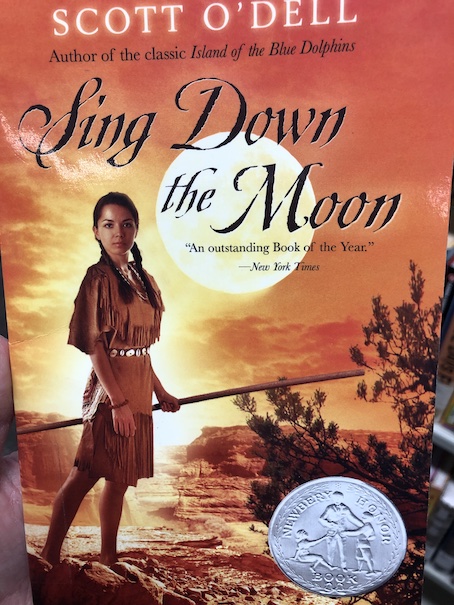
Sing Down the Moon cover

Sing Down the Moon by Scott O’Dell, 1970.

The story begins with a young Navajo girl, Bright Morning, admiring the beginning of spring, but she is caught in a storm and hurries home without the sheep she was supposed to be tending. When the girl’s mother realizes that she abandoned the sheep, she takes the girl back to the sheep, and they watch them all night. The sheep are very important to the family, and the girl’s mother refuses to allow her to take the sheep out by herself again for the rest of that spring.

When Bright Morning finally proves that she can be responsible and not leave the sheep to tend themselves, she is allowed to take them out again. Bright Morning likes to talk to the other girls, Running Bird and White Deer, as they watch all of their sheep together. The girls like to talk about their futures, who they will marry and what kind of children they have. They like to tease each other. Bright Morning’s friends know that she is likely to marry a young man called Tall Boy. The rumor is that Tall Boy’s parents want him to marry her because her mother owns so many fine sheep. Bright Morning knows that her friends tease because they are curious about Tall Boy and want her to talk about him, but she refuses. The girls know that he is supposed to be riding out with the warriors soon, and they tease that maybe he will bring back some other girl from the Ute tribe, but Bright Morning ignores them.

After the warriors have left for their raid on the Utes, the girls see some white men on horses approaching the village. The girls recognize them as oldiers and are worried that their village could be vulnerable to attack without the warriors. Later, the girls encounter more white men, but these men are not dressed as soldiers. They stop to talk to Bright Morning and Running Bird, asking them for directions, but the girls realize that they are slavers. They kidnap both girls and ride away with them!

They take the girls to a town of Spanish people and separate them from each other. They sell Bright Morning to a woman who uses her as a servant. The woman has other Native American girls as slaves, including a younger girl called Rosita. Rosita doesn’t mind her captivity or her life as a servant much. She came from a tribe that was very poor, and since she was brought to this woman’s household to work for her, she has had better food and clothing than she did at home. Rosita tells Bright Morning that the family they work for isn’t bad, and Bright Morning is allowed to keep her dog, who followed her when she was abducted. However, Bright Morning can’t stand her captivity. The woman who owns the house gives her new clothes, but Bright Morning doesn’t care. All she wants to do is find a way to go home.

Bright Morning is reunited with Running Bird when another captive girl comes up with a plan for the three of them to escape. They manage to steal horses and ride away from the town. Along the way, they meet up with Tall Boy and one of his friends, and the boys help fight off the Spaniards who are pursuing the girls. Unfortunately, Tall Boy is badly injured in the fight. He loses the use of one of his arms, and the other Navajos know that he can no longer be a warrior. Bright Morning still cares about Tall Boy, but her mother and sister tell her that she should no longer consider marrying him.

However, the Navajos’ troubles are just beginning. They haven’t heard the last of the soldiers. The American soldiers return and drive the Navajos off their land. They destroy all of their homes and eventually round them up and start them on a long march with little food, where many of them die. The Navajos fear that all of them will die. How will Bright Morning and her family survive, and will they ever see their homeland again?

The book is a Newbery Honor book. It’s available to borrow and read for free online through Internet Archive (multiple copies).

My Reaction

I remember reading this book when I was about 13 years old, in middle school! It takes place in my home state, the northern part, where the Navajo reservation is now, in the Four Corners region. I’ve been to Canyon de Chelly (“Chelly” is pronounced like “shay”, like in French) before, although I hadn’t been there at the time when I first read this book. Since I read this book as a kid, I’ve been to places and seen things that helped me understand the setting of the story better. As an adult, I appreciate the historical aspects of the story even more because I know more about the background. The book doesn’t give a date for the story until the postscript at the very end of the book, but the death march described in the story is Long Walk of 1863 to 1865.

The second half of the book is very depressing because there are horrible conditions and many deaths, including the deaths of children. I wasn’t sure that I really wanted to revisit this book at first because I remembered that it was depressing, but the book is well-written. The narrator describes events in an exciting, compelling way.

I had forgotten many details of the story, but there were some things that jumped out at me as an adult that I hadn’t noticed the first time. The postscript at the end of the story explains how life and Navajo culture changed after this traumatic event. If you see photographs of Navajo in “traditional” costumes now, they often include velveteen clothing, but that’s actually a relatively new tradition. The velveteen was adopted from white people during their captivity because they didn’t have access to wool to make their older style of traditional clothing. When Bright Morning was held captive in the Spanish town, she was given velveteen clothing there.

Another odd topic that is touched on only very briefly but that I know more about from other sources concerns the subject of flour. The book mentions that the Navajo were unused to eating wheat flour until it was their only form of rations during the Long Walk. Until then, their staple grain was corn, and when they started eating wheat flour, it made them feel sick. Their bodies just weren’t used to it. The book doesn’t explicitly explain this, but I know from other sources that the Long Walk and those flour rations were the origins of Navajo fry bread. Fry bread was not part of Navajo diet until that point. I grew up eating it on special occasions as a treat because it is greasy but good with powdered sugar, and it’s often served at carnivals and fairs here. However, as an adult, I came to realize that its origins as a food come from a very dark source. It was starvation food. It can keep you alive if there’s nothing else, but it’s not going to keep you healthy if you eat nothing else. It’s greasy and fatty, and it has little nutritional quality. Even now, I don’t have as much tolerance for it as I did when I was a kid. I can’t stomach it well these days if it’s too greasy or I eat too much.

That’s actually not a bad metaphor for the events described in this book. They’re heavy, and the more of it you understand and absorb, the sicker you feel. I absorb much more now than when I was a kid and only half understood the full significance of the events, and it makes me feel much worse than I did the first time.

So, do I recommend this book for kids? Actually, yes. I’m not a fan of depressing books with a lot of death, and I struggled through some depressing books when I was in school. If you had asked my 13-year-old self whether books with this much death and suffering were worth it, she might have had trouble answering that question, but time and further understanding have changed the way my adult self feels. There are some depressing topics that are worth the struggle to absorb them, but if I were the one teaching the lessons, I think I would do it a little differently than my teachers did for me back then.

I think this book is still a good introduction to topics that can be difficult to discuss. It’s worth reading once to understand the historical background of these events and what they really meant to the people who experienced them directly. It’s painful to read the bad parts, but it’s the kind of pain that leads to something better: real understanding. I recommend the book for kids in their early teens because I think that’s the best level for understanding it and accepting the bad parts. I think it should also be accompanied by nonfiction history lessons about the time period and events and discussion about their feelings about the story and historical events. I remember being told some of the history the first time I read this book, but I think that maybe there should have been more discussion about feelings.

I think it’s important to discuss feelings because they’re the hardest part of this book and they’re also the reason why it’s difficult to study some of the darker parts of history. I had a hard time with this when I was younger, and I still do in some respects, but I think understanding what causes those feelings is key to handling them. Reading books like this while discussing tools to handle difficult feelings could help students to better handle their emotions in other areas of life as well.

One of the first points that I think is important to understand and which my teachers didn’t really explain to me is that it’s natural to feel bad when you hear about bad things happening to other people, even when the bad things happened generations before you were born or even when those individual characters are fictional. (Bright Morning and her friends and family are fictional characters even though the events around them are historical. Real Navajos did experience what they experienced.) Empathy is a natural human emotion, and it’s an important tool for living with other people. Humans are social creatures. We live as part of larger groups, and we need at least some empathy to understand other people’s emotions and circumstances, how our actions affect them, and how to treat other people as we ourselves would truly like to be treated. The ability to experience empathy is a sign that you are mentally and emotionally healthy. It’s really only worrying when someone can’t feel it.

One of the most disturbing feelings about this story comes from realizing that the soldiers who are inflicting all of this death and pain either don’t feel empathy for the people they are harming or have actively chosen to ignore it to further their own purposes. That’s not a sign of being mentally or emotionally healthy or behaving in a moral way. When the readers feel repulsed by the soldiers and what they’re doing, it’s because they recognize that these people are a serious danger to others, and they are not functioning in a normal way. Your brain is warning you of a threat. It’s a past threat rather than an immediate one, but if you find the soldiers and their actions upsetting, it’s a sign that your brain has accurately assessed the risk associated with these people and the harm they do. You have accurately connected the suffering of other people for whom you feel empathy with the people who are the direct cause. I’m not saying that the soldiers were necessarily psychopaths, but lack of empathy and remorse and calculated manipulation are all symptoms of psychopathy and should raise alarms for anyone confronted with those signs. So, feeling bad about this situation and the people causing it is a sign that you yourself are mentally and emotionally healthy and have correctly recognized the seriousness of the situation and the harm being done to other people. What I’m saying is that, even when you’re feeling bad, it’s for good reasons, and that deserves recognition.

When I was young, I felt angry and frustrated by stories where people were doing terrible things to others. I still do because that’s part of empathy, but I also came to realize that part of my frustration when it came to historical situations came from my inability to change the situation. When harm has been done, it’s impossible to undo it. What was done was done. I can’t help the people who died, and I can’t even punish the wrong-doers because they’re dead now, too. It’s frustrating to find yourself confronted by a situation where nothing can change. But, I think it’s important to realize that change has happened and is currently happening. History is being written all the time, not even just through writing but through the ways that people live their lives every day. Even when a particular event is over, events and people keep moving. Bad events can cast long shadows, causing harm long after the initial event. That’s part of what makes them so bad. However, as time moves on, new people enter the scene, and new things happen, including things that people in the past would never have foreseen. It eventually reaches a point where the things that continue to happen rely on what we, the living, continue to do or allow to be done. History takes the long view, and I think people need to be reminded of that.

Do you suppose that the people in this story who act as villains thought of themselves like that? Further point, how much does it matter how they thought of themselves? Maybe they thought of themselves as winners at the time because they were getting their way and the people they were hurting were unable to stop them from hurting and killing them, but is that really “winning”? Lazy historians frequently brush things off by saying that “history is written by the victors“, but if that were really true, would we even be hearing or reading stories like this? Would we ever hear about slaves or care about the victims of war and atrocity? Would we ever consider the perspectives of people who died at all? Or does it change your mind about what “winning” really is and who’s really a “winner”? Maybe, in life and history, there aren’t any “winners” because neither of those was ever really a contest to begin with. (Or, as some put it, life is a collection of contests that people can simultaneously be both winning and losing. Personally, I think life is just for living, not for winning against someone else who is also trying to just live and probably couldn’t care less about you “winning” or not.) Apparent victories aren’t always real accomplishments, and people who see that reality are the ones who write the most accurate histories. Individual human lives only last so long, so any apparent “win” by an individual or group is never more than temporary. Our sense of what history includes and what people in the past were really like changes as we increase our knowledge of it and reconsider the context, not unlike the way my 40-year-old self has a deeper understanding of this book than my 13-year-old self did.

Remember that, at the beginning of this particular story, the Navajo warriors were going to raid the Utes. We never really find out in the book why they were going to do this, but does it matter anymore when the Navajos themselves get raided and subjected to something that might be even worse than what they were originally planning to do to their enemies? The story drops this subplot when the march begins. Life is like that, constantly moving, ever changing. History goes on and on. Sometimes, a young warrior who was praised for his prowess gets shot in the arm and can’t pull a bow anymore. Sometimes, a 40-year-old woman from the 21st century looks back on 19th century soldiers who may have thought of themselves as heroes and wants to tell them, to their faces, that they couldn’t be more wrong about that. If they’re not evil psychopaths, they’re doing a dang good job of pretending, and I never once thought of them as being “heroes” in my entire life. That’s life for you. Each of the people who have read this book or ever will read it are among the new people entering the story and its sequels, and we all have the ability to decide what role we want to play in the on-going story of history.

What happens after the book ends, is important, too. If I were teaching this, I would follow up this particular chapter of Native American and Navajo history by talking about some of the developments that continued to happen in their history, including some of the better moments, like the development of the written form of the Navajo language (for much of it’s history, Navajo was only a written language – that’s why the soldiers in the story couldn’t leave a written message in Navajo) and how code talkers used the Navajo language during WWII. The people who realized that these things were possible and something worth working toward were creative individuals. Rather than seeking to destroy something or repress it, they found creative ways to make use of what was there and put people’s talents to good use, helping others. The worst moments of history have been when people without empathy use others or seek to destroy them for personal gain, but the triumphant moments are when people take what they have and find a way to make it better. Noting these positive moments doesn’t make the bad parts of history any better than they actually were, but what we want is more of these positive moments of creativity and development and the type of people who are willing to work to make them happen.

It helps to balance out the explanations of what went wrong and people who did wrong with examples of what was better. Some teachers stress how we teach the bad moments so people learn from the past and don’t repeat it, and that’s true. However, I think we also need to add on what has worked and what we want people to do instead. A “don’t do this” needs to be followed up by “do this instead” to be an effective instruction. As a society, we don’t want more destroyers and takers. We want innovators and makers. We want creative people who find new uses for resources, including human resources and talents, and who are dedicated to truly helping others and human society as a whole instead of merely helping themselves to what others have that they want. This book demonstrates the dark side of humanity, but as I said, history is still being written every day with new players.

On the lighter side of this story, I enjoyed the descriptions of the coming-of-age ceremony for young women that Bright Morning has and the marriage ceremony later. During her time in captivity in the Spanish town, Bright Morning also attends Easter celebrations. She doesn’t understand Christianity and has never heard of Jesus before, and she doesn’t understand what the holiday is about or what’s going on. Rosita tries to explain to her who Jesus is in terms of Navajo religion. I found the explanation fascinating, but Bright Morning is still confused.

The Rover Boys in the Jungle

The Rover Boys

The Rover Boys in the Jungle by Arthur M. Winfield (aka Edward Stratemeyer), 1899.

My Foreword

I wasn’t particularly eager for this book after the first one in the series. I didn’t think the Rover Boys was as much fun as later Stratemeyer Syndicate books and there are some instances of racial language that are uncomfortable to explain. However, this is the book where the boys actually go to Africa in search of their missing father, and it resolves one of the major problems that the first book in the series set up, and I wanted to see it end.

As the book says at the beginning, the boys’ father went to Africa before the beginning of the series to look for gold mines and hasn’t been heard from since. The boys don’t know if their father is alive or dead, and meanwhile, the boys’ enemies from the first book in the series are still hanging around. The Baxters were put in prison for attempting to kidnap Dora at the direction of Josiah Crabtree in the book immediately before this one, but Dan Baxter escapes early in this book, and Crabtree is still around somewhere. The introduction and first chapter to the book brings readers up to date on developments from the previous books, sort of like the introductions to episodes of movie serials that didn’t exist at the time these books were written. Books in this series really need to be read in order, and if you skip any, like I did, you really need the introduction to bring you up-to-date.

The Story

There is a new boy at school, Hans Mueller, who is from Germany. This book was written before World War I, so there is nothing critical or derogatory about Germans, but the boys decide to tease Hans a little by playing up myths of the Wild West to scare him. They tell him that the school will be teaching them how to fight Indians (Native Americans) and that he’ll have to learn how to scalp people. Hans doesn’t know what they’re talking about at first, and when they explain it to him, he’s alarmed. (Good, Hans. That’s a sign of sanity.) Hans says that the only time he’s seen American Indians was at a traveling Wild West show that came to Germany, and he thought they looked scary. The other boys have a laugh about spooking poor Hans and drop the matter.

I mentioned in my last Rover Boys review that early Stratemeyer Syndicate books had archaic racial language and sometimes questionable racial attitudes that was later rewritten when various series were reissued. This early series hasn’t been revised. This first scene with Hans isn’t really so much a slur against Native Americans as prank with the boys playing up Wild West stories, but the book is just starting out.

Hans becomes the boys’ friend, but they prank Hans again later, scaring him with Tom wearing a Native American costume as he threatens to scalp him to continue their earlier joke, and they use the term “red man.” (We haven’t even gotten to Africa yet, so I was cringing at this point at what might be in store.) When Hans realizes that it was all just a prank, he tries to get the better of Tom by taking away the gun that Tom was using as a prop to scare him, and Tom tells him that the gun is too old to fire and isn’t dangerous. He just found it in the barn, and it’s all rusty. Tom tells Hans to pull the trigger and see that it won’t fire, which is the dumbest thing that anybody can do with a random old gun they just found somewhere. The gun explodes in Hans’s hands, knocking both Hans and Tom unconscious and scraping them with shrapnel. The other boys are scared, but they finally manage to bring them both around. Tom is horrified when he realizes what happened, saying that he’s been playing with that gun for awhile and pulled the trigger a dozen times himself, which is why he thought that the gun was unloaded and harmless (meaning he did the dumbest thing that anybody can do with a random old gun they just found somewhere repeatedly because, up to this point, dumb luck was on his side). He is shocked to realize that he’s lucky that he hasn’t shot somebody before and that he and Hans weren’t killed by the exploding gun. He apologizes to Hans and promises that this is the end of the pranks. Tom was always the lead prankster in earlier books, but he grows up a little here, realizing that reckless pranks have consequences.

At school, the boys participate in a kite flying contest, and Sam is almost pulled over the edge of a cliff by his kite. (Seriously.) Dora tells Dick that her mother had a dream that Crabtree tried to shoot him in a forest. (Prophetic?) The boys also have a run-in with Dan Baxter, who is still lurking around and swearing revenge.

Then, the boys turn their attention to a thief at school. Sam witnesses someone, who is probably the thief, sneaking around at night. Unfortunately, he didn’t see the person’s face, only describing this person as tall. Captain Putnam comes to believe that Alexander “Aleck” Pop, a black man who works for the school, is the thief because he receives an anonymous note that says he’s guilty. Sam doesn’t trust the anonymous note and tells the Captain so, saying that he can’t believe anyone as good-hearted as Aleck is would be a thief. However, the Captain insists that Aleck’s belongings be searched, and some of the objects that have been stolen turn up among his stuff. It’s a pretty obvious frame, and Alexander protests that he’s innocent, but Captain Putnam doesn’t believe him. There’s some ugly racial language used during this part. The word “coon” is used twice, and when the students at the school discuss the situation, one says the n-word. Fortunately, our Rover boy heroes aren’t the ones using that language, and Tom even tells the boy who used the n-word that he’s just resentful against Aleck for catching him doing something he shouldn’t have done earlier. The boy who used the n-word, Jim Caven, is portrayed as mean and unreasonable, and he gets into a fight with Tom in which he almost hurts him very badly. I was uncomfortable with the language in this scene, although I was somewhat reassured to see that it was used to characterize the ones using the worst of it as being the bad characters. My reassurance wasn’t complete because that’s not the only questionable racial language in the book.

Captain Putnam sends someone to escort Aleck to the authorities. He says that he supposes that the boys think he’s being too harsh with him, but he’s also suspicious of Aleck because he knows that members of his family have been in trouble with the law, too. The boys say it isn’t fair to blame him for things his relatives did and that they still don’t think he’s guilty. However, Aleck escapes before they reach the authorities, and they hear rumors that he went to New York City and boarded a ship to go overseas somewhere. The boys are sad, thinking that maybe they’ll never see him again. (You know they will.)

It’s not much of a surprise when the Rover boys later learn that Jim Caven has sold some things that match the description of other objects that have been stolen. Apparently, he’s been the thief all along and deliberately framed Aleck to get revenge on him. (I partly expected that the thief might be Dan Baxter, considering that he’s escaped from jail and is hanging around somewhere, probably needing money.) When the other boys confront Jim Caven, he flees into the woods. The other boys explain the situation to Captain Putnam, and he searches Jim Caven’s belongings, finding the rest of the stolen items. (You know, they could have just conducted a general search of the school and everyone’s belongings before this. This is a military academy, so a surprise dorm inspection wouldn’t be out of character, and it would have settled the matter much earlier.) Aleck’s name is cleared, but since he’s fled, they don’t know how to find him and tell him. Captain Putnam is sorry that he didn’t believe Aleck before.

However, they don’t have much time to consider it because the boys are soon summoned home by their uncle because he’s had news of their father. A ship captain has written Uncle Randolph a letter saying that his crew rescued a man who was floating on a raft off the Congo River. The man died soon after they brought him aboard their ship. They don’t know who the man was, but he was carrying a letter from the Rover boys’ father saying that he found a gold mine in Africa but was taken captive by King Susko of the Bumwo tribe (not a real African tribe, I can’t find anything about it) in order to prevent him from telling the secret of the mine to outsiders. Specifically, the tribe is afraid that the English and French colonizers will come to loot the mine and kill them. (Actually, a depressingly reasonable fear.) Anderson Rover explains in the letter that they don’t understand Americans. (That wouldn’t help, Anderson. Your boys attend a school run by a man who served with General Custer, and if this tribe knew what happened to Native Americans when gold was discovered on their land, they wouldn’t be reassured at all.) Anderson Rover is in fear of his life and asks his brother Randolph to come and rescue him if he can, but the letter is dated a year ago, so his family still doesn’t know if he’s alive now or not.

Uncle Randolph tells the boys that he wants to go to Africa to find his brother and asks Dick to come with him, as the oldest of his nephews. Dick, of course, agrees to go, but Tom and Sam refuse to be left behind. They decide that all of them will go.

On the ship to Africa, they meet an English adventurer named Mortimer Blaze, who is going to Africa for big game hunting. Tom asks him what will happen if the big game decides to hunt him instead, and he just says that it will be a “pitched battle.” (Doesn’t sound appealing to me.) When they talk about the people in Africa, they use the word “native” a lot and not in a flattering way. The general attitude seems to be that the “native” Africans are not very civilized (I was expecting they would say that because of the time period of this book), and Mortimer Blaze tells stories about tribes of people who are either very tall or very short. (I think he’s really referring to people from folktales, which I covered in the Encyclopedia of Legendary Creatures.) At one point, the characters say that the warm climate is the reason why Africa hasn’t made more progress toward civilization, that the warmth makes people want to be lazy. The adults in the story shock the boys by saying that not only is there no Christianity but that people there don’t really believe anything in particular, putting them even behind people Christians would consider heathens. They also make a shocking comment at one point about unwanted children being fed to crocodiles. They conclude that “civilization” can’t come soon enough to Africa, even if it has to be forced in with weapons. (Wow. I knew there was bound to be a lot of generic “native” and “savage” talk when I started this book because of the time period, but these matter-of-fact slights and accusations sound like they came straight out of Mrs. Mortimer’s books about Countries of the World Described, which heaps criticism and accusations of violence and immorality on pretty much all of the people of the world. Mrs. Mortimer’s books are much older than any Stratemeyer Syndicate books, and I wonder if Edward Stratemeyer read them in his youth. It wouldn’t surprise me because the attitudes match, and here he is, passing it all on to the next generation of kids in the form of an exciting adventure story.)

In a stroke of good luck, they end up rescuing Aleck, who was stranded at sea from the ship he boarded during his earlier escape. Aleck is glad to see the boys again, and they tell him that his name has been cleared and the real thief was caught. Aleck is glad to hear that, but he’s worried when he finds out that the ship that picked him up is headed for Africa. Aleck reflects that he always heard that his ancestors came from the Congo region of Africa, but he doesn’t really want to go there because he’s used to life in America and wouldn’t know what to do in Africa. (The Rover boys and Aleck go on for awhile about how great the United States is, and I know they were trying to sound patriotic, but the way they said it felt oddly like a sales pitch to me. I felt like saying, “You don’t need to sell me on the place. I already live here.”) The boys explain how they’re going there in search of their father. Aleck decides that he’d rather join their expedition than stay on the ship, and he offers his services as a valet. Uncle Randolph and the boys are glad to accept his help, and Uncle Randolph says it might be useful to have a black man with them who they know and trust in case they need someone to blend in with the native population and spy for them.

In a surprising twist, the boys also run into Dan Baxter on their arrival in Africa. When they ask him what he’s doing there, he says that he got drunk and was Shanghaied onto a ship, forced to work as a sailor. He was treated cruelly on the ship and ran away as soon as he had the chance. Now, he’s alone and has no money and no way home. The Rover boys feel sorry for him and give him money for him to buy his passage back to the United States. Dan Baxter asks to join their expedition, too, and they consider it as a sign that Dan is starting to reform because of his expedition. However, Dan is still a bully and an opportunist, and when he gets a counter-offer from someone else who is willing to hire him to make trouble for the Rovers, he accepts that instead, still holding a grudge against the Rovers because his father always told him that Anderson Rover stole a mine from him years ago that would have made them rich.

When I reviewed the first book in this series, I complained about the various unresolved story lines and miscellaneous villains still running around at the end of the story, still left to work on their individual plots against the Rover boys and their friends. In this book, every unresolved story line and villain from the first book collides with each other in Africa. Not only is Dan Baxter in Africa coincidentally at the same time as the Rovers, but Josiah Crabtree is also in Africa, for completely unrelated reasons from either the Rovers or Dan Baxter. He does attempt to kill Dick, but Dick survives. He is even rescued from a lion by one of his brothers.

So, is there true resolution with the main villains of the story, Dan Baxter and Josiah Crabtree? Not really. I looked up summaries of other books in the series, and even after they get some comeuppance, they continue to come back in sequels.

What is resolved by the end of the story is that the Rovers find their father alive. They rescue him from the village where he was being held captive, taking some of the women and children from the village with them as hostages to keep the village warriors from attacking them. They say privately that they wouldn’t have really hurt the women and children, but they tell the men that they’ll kill them if they don’t let the rescue party go. (This was another shocking part for me because I wouldn’t have thought of any of the usual Stratemeyer Syndicate heroes doing this. Somehow, I can’t picture the Hardy boys going this far, taking women and children hostage and threatening to kill them.) Once the rescue party is sure that they’re safe, they release their hostages and head for home. Anderson Rover says that he did find a gold mine, and someday, he’ll come back and loot it, er, mine it, but right now, all he wants to do is go home with his boys. It would be heartwarming if I didn’t know that he’s going to come back someday for gold on land that belongs to someone else who would never willingly sell it to him, and his boys are talking revenge on the king of the tribe that held their father captive.

This book is in the public domain and is easily available online in various formats through Project Gutenberg and Internet Archive (which has an audiobook).

My Reaction

I already gave much of my reaction to this book during the description of the plot because much of my reaction had to do with the racial language of the book. I knew there were going to be problematic portions before I even started, but frankly, there were too many of them for me to go into detail on all of them. What I described gives the broad strokes. I won’t say the book is deliberately trying to be insulting to black people. Aleck is portrayed as a good character who was wronged by a white boy by being framed for theft. However, there is a kind of casual racism in the story, like the casual references to how “uncivilized” Africa is and the characters’ off-hand supposition that it’s probably due to the climate there. I wouldn’t say that the characters or author hate black people (except maybe the non-Christian ones who feed children to crocodiles, which sounds like things Mrs. Mortimer accused various people of doing in the worst parts of Countries of the World Described), but I would say that there is a kind of condescension and dismissiveness that everyone, characters and author, seems to take for granted.

I can’t recall any of the characters using the phrase, “you know how they are”, but that’s the vibe I was getting. I got the feeling like the characters were saying things to each other and the author was saying things to his child readers with that sort of knowing tone, like “we all know these things.” No. “We” don’t. I know that Stratemeyer probably got a lot of this from a combination of old minstrel shows and Mrs. Mortimer or something very similar because I’ve seen Mrs. Mortimer‘s books, and I know how she talks. I also know why she says the things she does, and I’m not putting up with her attitude, even when it’s coming from someone else. Maybe the Rovers boys as characters and their child audiences would have read her books or similar ones before and nodded along with what Stratemeyer says because it confirms “information” they’ve seen before, but I’ve had more than my fill of wild accusations and crazy conspiracy theories, and I have no more patience left for any of it.

Mrs. Mortimer portrayed her book series as a factual introduction to world geography and the habits of people in different countries, but the truth behind her criticism, condescension, outspoken rudeness, and many of the wild accusations she makes about badly-brought-up children, dead bodies floating in rivers or just left in the street (depending on nationality), or the “antics” of “savages” around the world is her religious agenda (and, I think, probably some personal emotional and self-esteem issues, but that’s just a guess). She used missionaries with their own agendas as references for anecdotes in her books and tried to make people of various religions around the world sound evil and crazy on purpose to emphasize why “the Protestant” is the best religion (her words – she was specifically Evangelical and downright pushy about it). I would say that she also never hated black people … except maybe non-Christian ones, who as I recall, she claimed didn’t know what religion they were and were given to “antics”, dancing around and yelling or something. She wasn’t too clear on that point, probably because she didn’t know what she was talking about herself. On the other hand, she seemed inclined to be sympathetic to black people in the US who were victims of ill treatment, probably because they were Christian and most likely Protestant, which would have made all the difference in the world to her. She probably would have been okay with Aleck because he’s a Christian who was born in the US and has definitely never fed a baby to a crocodile in his life. She did not approve of the the concept of slavery at all and wouldn’t have tolerated physical cruelty of anyone due to race, which is to her credit, but none of that stopped her from spreading stories and rumors of violent savagery and teaching children that anyone who believed anything other than Protestant Christianity was “ignorant”, “savage”, and “wicked”, all words she actually used in describing people from various countries around the world because that’s what she wanted young children to “know” about other people. Mrs. Mortimer’s religious prejudices probably would have gone over the heads of the children who were these books’ original readers, especially if it echoed the talk of the children’s parents, but that’s how we end up with generations of children who grow into adults with casually racist ideas, thinking nothing of it, throwing around racist language without a clue or a care for the consequences. It’s in the book because it’s what “we” all “know”, dear Mrs. Mortimer said as much before, and Stratemeyer is just saying what “we” were all thinking, right? I think that’s about how that goes.

Let me bring you into the real world. If readers want to know what was really happening in Africa during the 19th century, there are far better sources. Africa is an entire continent, and there were many complex events happening all over, particularly related to European colonization. Outside forces were claiming territory in Africa, not so much for benefiting the people there and bringing them “civilization” as accomplishing their own personal aggrandizement and enrichment. (You know, rather like a man who is already rich in his own country coming to find and claim a gold mine that’s on someone else’s land because he’s addicted to the thrill of the hunt and acquisition and uses that thrill to hide from his own personal problems that he doesn’t want to face at home, like dealing with the loss of his wife and the raising of his boisterous sons. Just saying.) There were wars, famine, and disease in various parts of Africa during this period, partly due to internal power struggles among different African groups and leaders. I don’t know if anybody ever fed anyone to a crocodile on purpose, but infanticide is part of the dark side of humanity that comes out when times are desperate and hopes of survival in general are low. It’s a symptom of a society that’s suffering, and societies have suffered in that way many times around the world. If someone is likely to die soon after birth anyway, the hopeless parents might say, why even try? I suppose some might be tempted to say that having a religion that forbids killing children would help, but it hasn’t always, and having food also helps. I don’t blame 19th century missionaries for attempting to help people, but those who came in with a sense of self-importance, deciding ahead of time what would help without understanding the situation they were walking into, often didn’t help. Missionaries sometimes ended up getting killed in the middle of the unrest and power struggles. Some were even actively deceptive, using trickery and their position to gain advantages for themselves or the governments they represented at the expense of the people they were supposedly trying to help. But, the 19th century wasn’t all war, famine, and exploitation in Africa. The missionaries who were serious about doing some good and set up practical schools did provide useful centers of learning that helped educate future leaders and professional people and gave them tools they could use to build the lives they wanted. African societies did continue to build their own nations and identities. Overall, the colonization of Africa was more of an intrusive, disruptive force, providing additional hardships and obstacles to success more than solutions to any problems that Africa had before, not the glorious “civilizing” force that prevents people from feeding children to crocodiles that the book described.

So, now that I’ve talked about the historical and cultural influences behind the more uncomfortable parts of this book, I think it’s pretty obvious why early Stratemeyer Syndicate books had to be rewritten and revised in the mid-20th century. I knew this book was going to be cringe-worthy in places, but I have to admit that I was surprised at just how bad certain parts got. I hadn’t even considered that the word “coon” might appear. I never heard that word growing up and didn’t even know what it meant until I was in college, so I was pretty taken aback that a just-for-fun book for kids would use it, even one from the late 19th century. I suppose having grown up with the tamer, revised versions of books from the Stratemeyer Syndicate, I underestimated what the older series were like. I can only hope that I’ve made it pretty clear for people reading this review what the problems with this series were.

I debated about whether or not to even post this review, but I’ve talked about some uncomfortable books before (and said many highly critical things in my earlier rant about Mrs. Mortimer, my favorite example of a very popular bad influence in children’s literature – if you only know about her from The Peep of Day, you haven’t seen anything yet, even though the first chapter of that book is one of the most disturbing things I’ve ever read that was intended for small children). I’ve been planning a page discussing Stratemeyer Syndicate series books because they have been an important force in American children’s literature for so long, and it seemed only right to talk about their first series. So, now I’ve talked about it, and nobody else has to suffer through this book if they don’t want to. I found the characters, language, and situation aggravating, and the rewards for perseverance were inconsequential. This is certainly not something to spring on suspecting people, especially modern children, who might try using certain words for the attention-getting shock value without really understanding what they mean. I would say that this series should be primarily for adults interested in the history of children’s literature and others who know what they’re reading, understand what’s behind it, and can draw the line between fictional book and real life.

I’m not sure if I want to read any further books in this series because the unresolved problems of the stories get on my nerves, and there will probably be further issues with racial language, and I’d just have to repeat all the same explanations I’ve already given. I’m not saying a firm “no” to the rest of this series because there are indications that some people would like to see more coverage of them, but if I do any more, it’s probably going to be awhile and will only be delivered in small doses.

I wasn’t quite expecting to have these Mrs. Mortimer flashbacks from this book, but in honor of that experience, I might as well say that even though I’m leaving the Rover boys behind for now, I’m planning to go read many other useless novels “about people who have never lived”, which Mrs. Mortimer despised, and because I have access to some of them in audio book format, I can listen to them while knitting something completely unnecessary just because I want to. (If you read my rant/review about Countries of the World Described, you know what I’m talking about.) I’m not going to do it just because it would annoy Mrs. Mortimer. It’s something that I enjoy and do routinely anyway. I would do it even if it was something I thought Mrs. Mortimer would actually like. It’s more that knowing that she would have disapproved and can’t do anything about it makes me feel like we’re even because that’s the way I feel about her books and others like them.

Hand Shadows

When I first read and started playing with this book as a kid, I didn’t stop to read the preface in the book or look at the publishing date, so I completely missed the fact that this is a reprint of a book from the late 1850s. The author, Henry Bursill (link repaired 9-11-24), was a professional artist

In the preface, Bursill refers to a well-known print from the early 19th century called The Rabbit on the Wall, which shows a father making shadow figures on the wall with his hands to amuse his children. Bursill says that there have been other books about hand shadows before his, but he emphasizes that his book is not the same as theirs because he has worked out his own hand shadows through experimentation. He says that it will take some practice for people making hand shadows to get them perfectly, but he encourages people to practice and not be afraid to work out new hand shadows of their own through experimentation. Bursill did the illustrations for the book himself, and he says that he began sketching some of the designs during his time as an art student and that he would amuse some fellow students by making hand shadows on the wall of his studio.

Other than the preface, the only words in the book are the captions on each of the pictures. I’ve tried some of the hand shadows in the book, and I had a more difficult time than the preface makes it sound. The only ones I’ve really been able to do well were the bird and the greyhound. I haven’t given up on mastering some of the more difficult ones someday, though!

The book is available to read for free online through Project Gutenberg and Internet Archive (multiple copies).

Addy’s Cook Book

Addy, An American Girl

Addy’s Cook Book by Rebecca Sample Bernstein, Terri Braun, Tamara England, and Jodi Evert, 1994.

This cook book is one of the activity books that was written to accompany the Addy series that is part of the American Girls franchise. The American Girls books were written to help teach American history (as well as sell the accompanying dolls and accessories), so this book has recipes of the type that people would have eaten during the American Civil War, when the character of Addy lived, and some historical information.

The book begins with sections of historical information about African Americans, kitchens, and table settings in the 1860s. It describes the lives of slaves and explains how they were given basic rations of food which they could supplement and extend by producing or gathering some food of their own, such as vegetables they grew or fish they caught themselves. When they managed to escape from slavery, they had to depend on help from others, such as churches or abolitionists, until they became established in their new lives. When they were able, many of them provided help to others who were in the same position. (This was a topic covered in the Addy books.)

The types of kitchens they used depended on where they were living. As slaves, Civil War era African Americans would do their cooking in small fireplaces attached to the small cabins where they lived. Because they needed the fire for cooking, they kept it burning all the time, even in hot weather. Free African Americans had more options. Depending on their living arrangements, they might have a stove for their cooking, or if they lived in a boarding house, they might be provided with meals as part of their boarding, paid for along with the rent on their rooms.

The recipes in the book are divided into three sections: breakfast, dinner, and favorite foods. There is a section with some general cooking tips, but there are other cooking tips and pieces of historical information included along with the recipes. Some information that I found particularly useful explains why some historical recipes can be confusing to read. Because some people were using cooking fires and some were using stoves, 19th century recipes can have vague-sounding instructions like “fry until golden brown” instead of specific cooking times and temperatures. It was also common for people to cook favorite dishes from memory instead of following written recipes. People learned to cook from their elders, and they just continued doing what parents and grandparents always did when they cooked. The book doesn’t mention it, but this style of cooking also continued into the 20th century, so even when people wrote down recipes, they might seem vague or incomplete to modern readers. It was like that with recipes that my grandmother and great-grandmother wrote down, too. They were accustomed to making certain recipes mostly from memory, and they didn’t feel obligated to write down every little step, assuming that anyone who read it would already know how to make that kind of dish and would just need a few reminders about amounts. Fortunately, the recipes in this book are all written with detailed, modern instructions and include cooking times and oven temperatures.

The book explains that poor people during the Civil War didn’t usually have much for breakfast because they had to rise early and get to work. Most mornings, they might have some leftovers from the previous night or some simple hot foods, like buttermilk biscuits and hominy grits, a traditional Southern breakfast food made from corn (my grandmother said that she had it when she was growing up on a farm in Indiana, too). As a special treat, they might have scrambled eggs or sausage and gravy.

The dinner section includes main dishes, like fried fish, and side dishes, like hush puppies. A particular recipe that gets extra attention is Hoppin’ John, a rice dish with black-eyed peas and bacon. Hoppin’ John is special because it’s a dish traditionally served at New Year’s Day.

The section of favorite foods include chicken shortcake, a few other side dishes, and a few special treats, including peach cobbler and shortbread. I’ve tried the shortbread recipe, and I like it. It’s easy to make and includes only a few ingredients, and it’s really good. It does contain a lot of butter, so it’s just an occasional treat.

The book ends with a section of advice for planning an Emancipation party. It explains how people celebrated when the Emancipation Proclamation was read publicly on December 31, 1862, having been transmitted to communities by telegraph. Children played games like Novel Writers (which is a story-writing game similar to Consequences) and Blindman’s Buff. The book also describes the origins of Juneteenth – slaves in Texas were freed on June 19th, 1865, about two and half years after the Emancipation Proclamation.

The book is available to borrow and read for free online through Internet Archive.

Through the Looking Glass

Through the Looking Glass by Lewis Carroll, 1871.

The story of Alice in Wonderland is over 150 years old, and the sequel, Through the Looking Glass, is now 150 years old, as of 2021. These books have been reprinted in many different languages and editions. The edition that I’m using for this review is actually a combined edition of the two from 1960 with added notes by Martin Gardner. (Although I used a cover image from a different edition above.) I like editions with added notes because there is quite a lot to explain about both Lewis Carroll and his stories.

I explained a lot of Lewis Carroll’s background and some of the controversies surrounding his life in my review of Alice in Wonderland. One important point about the Alice stories is that they are full of puzzles, riddles, word games, in-jokes, and parodies of poems that were popular in the author’s time. Lewis Carroll (real name Charles Dodgson) was a mathematician and scholar at Oxford, and he liked to play with logic puzzles and word games. Sometimes he would hide people’s names within poems or parts of the story by rearranging the letters of their names or using them as the beginning of lines in a poem, as an acrostic. There is an acrostic poem which is dedicated to Alice Liddell, the real girl who inspired Alice in Wonderland. This poem is printed as part of some editions of Through the Looking Glass, including the one that I’m using. The acrostic poem also references Row, Row, Row Your Boat, which is apparently older although its origins aren’t completely certain. If you read down the beginning letters of the poem, you find out that Alice’s middle name was Pleasance.

The chess game in Through the Looking Glass is meant to be part of an actual chess game with real moves that can be mapped out on a board. The game and the moves in the story are explained in the preface of my copy of the book. Alice begins as a white pawn in the game, but when she reaches the other side of the board, she becomes a queen, which is part of the rules of chess – pawns that successfully reach the opponent’s side may be exchanged for other pieces. The colors of the chess pieces in Alice’s game are red and white instead of black and white because red and white are old traditional colors. Although black and white are common today, many different color combinations have been used, and the red and white combination dates back to the Middle Ages.

The story begins on the day before Guy Fawkes’ Night. (Alice has been watching the bonfire preparations out the window.) Alice is trying to wind some yarn, and her pet cat Dinah’s little black kitten keeps playing with it. Alice chastises the kitten, and then begins talking to the kitten about the way it was watching her play chess earlier in the day. Alice likes to play games of pretend, and she starts to pretend that the kitten is the red queen from the chess game. The kitten doesn’t cooperate in posing like the chess queen, so Alice holds it up to a looking-glass.

As they look in the mirror, Alice gets the idea of a “Looking-glass House” – a house on the other side of the mirror that can be reached by stepping through it. Alice starts to imagine what it would be like to enter the world on the other side of the mirror. She gets up on the mantle over the fireplace and steps through the mirror into the looking-glass house to see what is there.

Things in the looking-glass house are very strange. The clock and the pictures seem to be alive, and so are the chess pieces. Alice helps the pieces back onto their table after they’ve been knocked off, but they don’t seem to understand what has happened and are alarmed. Alice then picks up a book on the table near the chess board and reads the poem Jabberwocky, which is about the defeat of a horrible monster. The poem is written in backwards writing, and Alice has to hold it up to a mirror to read it. The poem is a nonsense poem that contains many made-up words, which are explained later on in the story.

Alice decides to see what is outside the house. She discovers that the flowers can talk to her, but they are rude and insulting. Then, Alice encounters the Red Queen, who has grown taller than she was in the house. (The flowers say that it’s because of all the fresh air outside.) The Red Queen is both commanding and contradictory, but she gives Alice directions to other “squares”, addressing her as a chess pawn.

Pawns get to move two squares on their first turn, so Alice gets to go by train. In the train carriage, Alice meets many strange characters, including a gentleman dressed in white, a Goat, a Beetle, and a Gnat, who keeps whispering in her ear and suggesting that she make jokes based on puns. Through the Gnat, Alice meets other strange insects, like the snap-dragon-fly, the rocking-horse-fly, and the bread-and-butterfly. The Gnat tells Alice that the creatures in the woods don’t have names, and when Alice goes through the woods, she temporarily forgets her name, getting it back again on the other side.

Soon after, Alice meets Tweedledum and Tweedledee. (Lewis Carroll didn’t invent these characters. They are nursery rhyme characters.) They ask Alice if she likes poetry, and they tell her the tale of The Walrus and the Carpenter. (This is one of the most-quoted poems in the Alice stories – many people remember the part where they “talk of many things” – “Shoes and ships and sealing wax and cabbages and kings.”) At the end, Alice can’t decide which of the two characters she likes the best because both are sneaky and eat the oysters that trusted them, so she decides that she doesn’t like either of them. (Yeah, I can think of others stories where I’ve felt the same way.) Alice hears a strange sound, and they tell her that it’s the Red King snoring and that the Red King is actually dreaming about her right now. Tweedledum and Tweedledee insist that Alice isn’t a real person, only part of the Red King’s dream, and that she’d disappear if he were to wake up, which upsets Alice. Alice starts to cry, which she thinks is proof that she’s real, but they claim that those aren’t real tears. Finally, Alice decides that they’re just talking nonsense and that there’s no point in crying over it. Tweedledum and Tweedledee want to have a battle (as in their poem), but a large crow interrupts them and frightens them away by producing a great wind.

Alice catches hold of a shawl that was being blown away by the wind and returns it to its owner, the White Queen. The White Queen speaks very strangely, and she says that it’s an effect of living backwards. Because she lives backwards, her memory works both ways, and she can remember things that haven’t happened yet. The White Queen screams with pain before she pricks her finger, so she doesn’t have to do it again after her finger is hurt. Alice cries when she talks about how lonely she is in the woods, and the White Queen distracts her by telling her to consider things because no one can think of two things at once (which is true). The White Queen talks about considering and believing impossible things (sometimes she believes “six impossible things before breakfast” – one of the most famous lines that is often quoted from this story).

As Alice asks the White Queen if her finger is better, she suddenly and inexplicably finds herself in a shop and talking to a sheep, who asks her what she wants to buy. Alice tries to look around, and the Sheep asks her if she’s a child or a teetotum (a kind of spinning top used in old games, sometimes by itself and sometimes as a replacement for dice or a spinner – dreidels are a kind of teetotum) because of the way she’s turning around. The Sheep is knitting and keeps picking up more needles to knit with. For awhile, the shop disappears, and Alice finds herself in a boat with the Sheep, but then the shop returns, and the Sheep asks her again what she wants to buy.

Alice decides to buy an egg, and the egg that she buys turns into Humpty Dumpty when she approaches it. Humpty Dumpty is a bit rude and insults Alice’s name because he doesn’t think it means anything. Alice mistakes Humpty Dumpty’s cravat for a belt because he’s egg-shaped and doesn’t have a true neck for wearing a tie. Humpty Dumpty reveals that the cravat was an un-birthday (a concept that Lewis Carroll invented) present from the White King and Queen. All through the conversation, Humpty Dumpty uses words in unusual yet strangely nit-picky ways, making words mean only what he wants them to mean in the moment. Because he’s so particular about the meanings of words, Alice asks Humpty Dumpty about all the strange words in the Jabberwocky poem, and he explains what the made-up words mean. Humpty Dumpty recites another poem for Alice that doesn’t seem to have a true ending and then abruptly dismisses her.

As Alice leaves, she meets the king with all of his horses and men (from the Humpty Dumpty nursery rhyme) and is introduced to one of his messengers. Alice is amused by the name and description of the messenger and starts playing a game of “I Love My Love” out loud with the messenger’s name. (The two messengers are called Haigha and Hatta and are shown looking like the March Hare and Mad Hatter from Alice in Wonderland in the illustrations.) The messenger informs the king that the lion and the unicorn are fighting for the crown again (another nursery rhyme reference). The king says that it’s all a joke because the crown is his and neither one of them is going to get it no matter which of them wins the fight.

The unicorn is amazed to meet Alice because he never knew that children were real before. As at the end of the rhyme, they are given plum cake, and they hand the dish to Alice for her to cut the cake. However, Alice finds that she can’t cut it, so they ask her to hand the cake around first and then cut it afterward, which surprisingly works.

After the others are drummed out of town, also as part of the rhyme, the Red Knight attempts to capture Alice, but the White Knight shows up to save her. The White Knight tells Alice all about his inventions, none of which make any sense, and sings her a song which apparently has several names and is set to the tune of a song Alice recognizes as “I give thee all, I can no more” (which is another name and the first line of the song which is really titled My Heart and Lute, which is part of the on-going joke about the song’s real name).

Then, Alice reaches the final square of the board and becomes a queen, finding a crown suddenly on her head. The Red Queen and the White Queen appear suddenly, and the Red Queen tells her that she must pass an examination before she can truly become a queen. The queens ask her a series of questions that are supposed to be math questions but are actually a combination of riddles and nonsense. Their general knowledge questions are a combination of nonsense and puns. Eventually, the Red Queen and White Queen both fall asleep to a parody of “Rock-a-bye Baby.”

Alice finds herself in front of a door labelled “Queen Alice,” but the old frog who comes to the door doesn’t seem to want to let her in. Alice enters anyway and sits next to the Red Queen and White Queen. They introduce her to the food being served at the feast, but they don’t actually allow her to have any because it isn’t polite to cut and serve something you’ve been introduced to, and the plum cake verbally protests when Alice tries to serve it anyway.

The White Queen tells Alice a riddle in poem form about fish. The riddle is never answered, but everyone drinks to Alice’s health. The Red Queen tells Alice that she should make a speech, and as she gets up, many strange things begin happening in the room. Alice thinks that the Red Queen is responsible and grabs hold of her, threatening to “shake her into a kitten.” Alice suddenly wakes up, holding her little black kitten.

Like in Alice in Wonderland, everything that Alice experienced was a dream. However, the end of the book poses the question of whether the dream was Alice’s or the Red King’s. The question is never answered; it’s just something to make the readers think. That’s actually what I like most about the Alice stories, that they are partly meant to make the reader think. The stories are somewhat disjointed and constantly changing, kind of like dreams do, but I appreciate all the references and parodies in the stories.

The book is now public domain and is easily available online through Internet Archive and Project Gutenberg.

Shadow in Hawthorn Bay

Shadow in Hawthorn Bay by Janet Lunn, 1986.

Mary (or “Mairi,” they spell it both ways) Urquhart and her cousin Duncan had always loved each other.  They were always close as children, feeling more like two parts of one person than separate people, and they always imagined that they would spend the rest of their lives together.  Then, Duncan’s parents, Mary’s Uncle Davie and Aunt Jean, decided that they wanted to travel to Canada, while Mary and her parents stayed at home in the Scottish Highlands.  Duncan hadn’t really wanted to go.  He was only eleven, and he promised Mary that when he was older, he would work hard to earn enough money to come back.  However, Duncan never came.  He only sent Mary a brief letter about the dark forest where he now lives.  Mary feels like the Duncan she knew is gone forever.

Four years later, in 1815, when Mary is fifteen, she has a strange feeling, like Duncan is calling to her from across the ocean.  All of her life, Mary has had a strange gift for seeing into the future or reading others’ minds.  The “gift of two sights,” people call it, but Mary doesn’t feel like it’s a gift.  It makes her uneasy, and she can’t control it.  She hears Duncan’s calls to her through her “gift,” but she is afraid because she doesn’t want to leave Scotland.  She wants Duncan to come to her.

However, she is unable to resist Duncan’s calls.  She asks her parents for help with money for her passage to Canada, but they tell her that she is wasting her time and that, even if they sold their family’s most precious heirloom to give her the money, there would not be enough for the return journey.  A family friend gives her the money instead, and although Mary doesn’t really want to accept it and doesn’t really want to go, she can’t help herself.

The journey to Canada is miserable, and when she finally arrives at the place where her aunt and uncle live, alone and without money, she learns something which she thought she had sensed during the journey: Duncan is dead.  Duncan committed suicide while Mary was still on the ship to Canada.  Mary has arrived too late.  To make matters worse, one of the family’s neighbors, Luke Anderson, tells her that her aunt and uncle gave up the idea of farming in Canada and have already begun the journey back to Scotland.  Mary has no money to follow them, and they have no idea that she’s now in Canada, alone.

Luke takes Mary to Mrs. Colliver, who tells Mary a little about her family and their life in Canada and why they decided to leave.  Mary is devastated by the loss of Duncan and tries to tell Mrs. Colliver about how she felt that Duncan had been calling out to her, but Mrs. Colliver tells her that she doesn’t believe in ghosts or things like that.  Although Mary knows that her “gift” is real and so are spirits, she learns that others in the community share Mrs. Colliver’s no-nonsense, disbelieving attitude toward such things.  Mary, in her despair, wants to rush straight back to Scotland, but Mrs. Colliver, with her practicality, points out that Mary can’t possibly get there without money.  She tells Mary that she can stay with her family, that she will give her room and board in exchange for help with chores and that she can earn extra money for weaving and spinning.  Mary is clumsy at household chores because she was always better with animals at home, but when Mrs. Colliver sees Mary’s skills with animals, she is appreciative.

Life is hard in the small farming community.  Mrs. Anderson, Luke’s mother, explains to Mary that most of the people who live there are refugees.  When they were young, their families moved there from the Thirteen Colonies that now make up the United States because they were Loyalists.  When the Revolution came, they couldn’t stay, and so had gone north to Canada, where they struggled to establish a new community for themselves with their small homesteads. During her time there, Mary witnesses the death of a baby and the hardships of this strange place, seeing why Duncan didn’t like it there.  They tell her that Duncan was a strange boy who would seem bright and happy one day, but black with depression the next, something Mary remembers in him even before he went to Canada. 

The people are kind and welcoming to Mary, although they find her a bit strange.  As Mary struggles to make a life for herself, hoping to earn enough money to return home, she slowly comes to appreciate Luke’s kindness and help.  She learns healing arts and the use of herbs from another woman in the community, developing new skills.  In helping others, she earns their appreciation and a place in their community.  Luke Anderson becomes very fond of Mary, but she still mourns for her lost Duncan.  In spite of his kindness, she doesn’t see how she can make this strange, hard, dark forest of Canada her home, where it doesn’t even seem like the spirits she believed in and that seemed to protect her when she lived in Scotland exist.

Mary is melancholy and feels like she doesn’t belong in Canada.  It distresses her that she can no longer feel Duncan’s presence . . . although she can oddly hear him calling to her sometimes.  Mary also unnerves people when she makes predictions that come true and speaks about ghosts and spirits.  When she almost gives in to her homesickness and depression and kills herself, lured to the spot where Duncan drowned himself by his ghostly calls to her, she finally sees Duncan’s death for what it really was and finds the courage to refuse to follow him down the dark path that he chose for himself and to fight for the life she has been building, the one she really wants to live.

The book is available to borrow and read for free online through Internet Archive.

My Reaction

This book is part of a loose trilogy, involving ancestors and descendants of the Anderson and Morrisay families.  All of the books take place in or near Hawthorn Bay in Canada, but at different time periods.  Some of the characters are psychic, like Mary, or have the ability to travel through time, like Susan in The Root Cellar, who is apparently Mary’s granddaughter.  The connection between Mary and Susan is never stated explicitly, but it’s implied by their last name, shared psychic abilities, and comments that a friend makes about Susan’s grandmother in The Root Cellar.  In this series, the characters from each of the books generally don’t appear in any of the others (except, perhaps, for Phoebe, who appears briefly in this book and is the main character in the third story).  Most of the time, you only know about the family connections by reading the books and taking note of the last names.  The books go backward in time as the series progresses, and the connection between the Anderson and Morrisay families is only obvious in The Root Cellar.

With the deaths that occur in the book, discussions of suicide, and the influence of Duncan’s selfish, malevolent spirit, this is not a book for young kids. I’d say that readers should be middle school level or older. There is also some implied sex and pregnancy out of wedlock when one of Luke’s brothers gets one of Mary’s friends pregnant. Her friend doesn’t give the details of what happened, but from what she says, it’s implied that Luke’s disreputable brother forced himself on the girl and that she went along with it because she didn’t know what else to do. The description of that incident is minimal, but older readers will understand what happened. There is a scandal in the community because of it, and the disreputable brother leaves rather than face the consequences of his actions.

Themes and Spoilers

I enjoyed the book for its references to Scottish folklore, which Mary believes in and seems to be in touch with through her “gift” and for Mary’s growing confidence in her abilities and more mature understanding of what her cousin was really like and what her relationship with him really was.  In some ways, I do feel sorry for Duncan because he seems to have been suffering from some kind of mental illness, possibly bipolar disorder or manic depression, which would explain how his moods could shift so abruptly and dramatically.  However, Duncan was also a selfish and controlling person.  Although Duncan’s death was sad, Mary realizes that his end was of his own making, and it’s not the future she wants for herself.  There are some disturbing scenes in the story.  Mary witnesses the deaths of others, including a baby, because it is a harsh environment, where people sometimes succumb to sickness or bad weather, although these deaths are not described in too much detail. 

There are also some frightening moments, like when Duncan’s ghost almost convinces Mary to kill herself and when he similarly lures a young boy, Luke’s younger brother, to the spot where he drowned and almost kills the boy because Mary finds the little boy comforting and Duncan doesn’t want her to be comfortable and happy.  In the beginning, readers see Duncan through Mary’s fondness for him, so the true darkness of his personality isn’t immediately apparent, although I had some misgivings about him from Mary’s first description of how they played together as children.  I didn’t like the way she described how he would tease her until she became angry or hurt and then he would sulk until she comforted him.  She says that wasn’t really fair, but to me, it was disturbing because I have seen that kind of selfish personality before, and it’s never a good sign.  It shows right from the first that Duncan doesn’t really care about Mary’s feelings.  He cares only about his own feelings, and he has no interest in changing his behavior out of consideration for her.  In fact, the very idea that he should consider her feelings seems somehow insulting to him, even though he supposedly loves her.  He just thinks that she needs to reassure him that everything he does is fine whether it is or not.  In his view, Mary is obviously wrong to feel hurt even when he tries to hurt her because he has more right to his feelings than she has to hers and he should be able to behave any way he wants with no consequences.  That’s what Mary’s first description of Duncan said to me.  As soon as I saw that, even though some might consider it just the actions of an immature child, I had some suspicions about him.

My suspicions were somewhat confirmed before Mary left home. Her mother told her that she didn’t think Duncan was worth chasing after, calling him sulky and thoughtless, but the full truth of that doesn’t strike Mary until she confronts his spirit where he died. Because people in Canada don’t like to talk about Duncan much, when Mary first hears about his death, it isn’t immediately clear that he killed himself or how.  At first, it’s just somewhat implied, but when Mary is almost lured to her death, she sees the full truth about Duncan. 

Mary comes to realize that, although everyone, including Duncan and herself, felt like the two of them were two parts of the same person, they really weren’t.  Mary sees that not only can she live without Duncan, she has been living without him for years.  She lived without him for a time in Scotland, and she’s been living without him in Canada, and she can continue to live without him wherever she chooses to live the rest of her life.  When she was younger, she had thought of Duncan as being the stronger of the two of them because he was not plagued by the same “gift” she was, but she realizes that she is actually the stronger of the two of them.  Duncan’s “love” for her had also always been a selfish one.  He couldn’t bring himself to work hard and return to Scotland for her sake, but he expected her to give up everything, even her own life, to join him in Canada and in death.

When Mary realizes all of this, Duncan’s spirit loses its hold over her, and she comes to see that the darkness in him was darker than the forests that had seemed so frightening to her before.  Free from the shadow of Duncan’s death and his selfish spirit, Mary is able to see the beauty of Canada and to be more open to the good people around her, forging a new future with a better man.

Twin Spell

This book was originally called Twin Spell but was renamed Double Spell in reprintings.

Elizabeth and Jane Hubbard, a set of twelve-year-old twins, can’t really explain what made them stop to look at the little wooden doll in the window of the antiques shop.  Ordinarily, they probably wouldn’t have noticed it at all, but something seemed to draw them to it while they were supposed to be going home to look after their little brother.  The woman in the shop wasn’t going to sell the doll to them, either, but for some reason, she said that she felt that she ought to do it because it seemed like the doll belonged with them.

Buying the old doll starts off a chain of mysterious events in the twins’ lives.  On impulse, still forgetting that they’re supposed to go home and baby-sit, the girls decide to visit their Aunt Alice and show her the doll.  Aunt Alice had been living in England, but she had recently moved back to Toronto to live in the girls’ grandmother’s old house.  Aunt Alice doesn’t know what to think of the doll, except that it might be worth something as an antique.  She shows the girls around their grandmother’s old house, but Elizabeth has a sudden fall down the stairs, breaking her leg.  Strangely, a week later, Aunt Alice suffers a similar accident, breaking her hip.

Because of her accident, Aunt Alice decides that the big old house is a bit much for her to handle, and she tells the twins’ parents that they can have it to live in instead.  With five children in the family, including the twins, they could really use the larger house, and the children are excited about going to live there.

The twins find themselves thinking of odd things, as if they were old memories.  They suggest taking a “sick basket” of goodies to their aunt, thinking that maybe their mother had done something like that for someone before or maybe they had dreamed something like it.  Their brothers can’t remember any such thing happening, and it would be pretty weird for both of the girls to have the same dream.

However, the children think that a basket of goodies for their aunt would be a good idea.  They put together some stuff from their kitchen and what they can buy with their money, and they decide to include a book that she can read while she’s recovering.  Unfortunately, the book they choose from their shelves turns out to be a rare copy of a book about the history of Toronto that their father was using for a research project, so they have to get it back.  They do, and Aunt Alice tells them that she enjoyed it and that she had forgotten that an uncle had written it.

As the family moves into Aunt Alice’s old house, the twins keep thinking that there is something strange about their doll, that it seems to be influencing them, giving them visions of the past.  Besides the “sick basket” dream they both had, they have visions of a house and a blonde girl in old-fashioned clothes.  They start to think that the doll, which they both have the impulse to call “Amelia,” might be magic or something.  Jane is the more sensible of the two, and she insists that there must be some other explanation, like imagination or coincidence.  Elizabeth, the dreamier twin, insists that it’s the influence of Amelia, that they’re somehow seeing Amelia’s memories of the past.

After the girls argue about the doll and the source of their odd visions, Jane starts ignoring Elizabeth.  Elizabeth continues thinking about what they’ve seen, and the blonde girl, who she is sure is called Hester and was the former owner of Amelia.  Eventually, Jane starts agreeing with Elizabeth about Hester being the doll’s former owner, but she is dubious when Elizabeth says that Amelia wants to find the house where she once lived with Hester.  Jane doesn’t know how the two of them can do that.

They ask their father for his advice, and he suggests that they start at the museum.  There, they learn by studying the styles of old clothes that Amelia is from the 1840s.  They find an area of town with houses similar to the one they’ve seen in their minds, where Amelia once lived, but they have trouble finding the exact house they’re looking for.

Jane becomes increasingly afraid, though.  More and more, she begins to feel like something is trying to take the doll away from them.  Something that is mean and doesn’t like her is in their attic.  Something like a ghost.  Jane has an awful feeling that something horrible is about to happen.

When the Jane looks at the history book her father has been reading, the one written by her great-great-uncle, Jane suddenly has a startling revelation. The house they have been seeking in actually their house, changed over the years by new additions. Amelia came from their house, and that is where she really belongs. Through the visions, they see an old tragedy in their family reenacted, a tragedy that puts Jane’s life in danger.

The book is available to read for free online through Internet Archive. There is no need to borrow this copy and no time limit; you can just read it in your browser.

The girls had made a mistake when they first started receiving their visions.  They had assumed that Hester was Amelia’s original owner, but she wasn’t.  The glimpses they got of Hester weren’t through the doll’s eyes, but those of the doll’s real former owner.  The doll was one of a set of two that originally belonged to another set of twins in the girls’ family, Anne and Melissa.  Hester was their cousin, and she was not a nice girl.  Both Jane and Elizabeth sensed it pretty early.  During an argument with Anne years before, Hester accidentally lit Anne’s dress on fire with a candle she was holding, causing Anne to die.  Hester hadn’t actually meant to harm Anne.  The whole thing was just an accident, but Hester’s guilt and Melissa’s anger and grief at her twin’s death had caused Hester’s spirit to linger in the house.  By learning the circumstances of Anne’s death and assuring Hester that they understand that she had not meant to kill her cousin, that it was all an accident, and that she couldn’t save Anne because she was just too frightened and didn’t know what to do, they help Hester’s spirit to finally rest and to reunite Amelia with her doll twin, which Hester had hidden years before.

The scene where the girls see Anne’s death is a little scary, but mostly sad.  Hester lived on after the incident, but it was not a happy life.  She ended up having to live in Anne and Melissa’s old room, where Anne died, because she never married and had to live with family.  Aunt Alice remembers knowing her as a young child, when Hester was a bitter old woman.  Perhaps if Hester hadn’t been carrying that guilt around for so many years, her life would have been much happier, although being a nice person had never particularly been her nature.  However, the twins’ acceptance of Hester’s tragedy and assurance that they understand and forgive her for what happened set her spirit at peace.

The genealogy in the story is a little confusing, partly because certain family names repeat through the generations, but there is a chart in the back of the book to help.  There are some other loose ends in the story which are also never completely clarified.  The girls admit that they will probably never know how the doll Amelia came to be in the antiques store, but it doesn’t particularly matter because Hester, Anne, Melissa, and Amelia all seem to be at peace now.

Mazemaker

Mazemaker by Catherine Dexter, 1989.

Twelve-year-old Winnie Brown loves mazes, and she is very surprised when one shows up among all the other graffiti on the schoolyard.  The maze is painted on the ground in silver and is big enough for a person to walk through.  Winnie and her friend, Harry, try to walk the maze, but it makes them dizzy at first.  Then, a cat they’ve befriended finds its way to the center of the maze and disappears right before their eyes!

When Winnie tries to tell her mother about it, her mother doesn’t really pay attention.  Although Winnie and Harry try to explain it away as an optical illusion of some kind, Winnie is still convinced that there is something strange about the maze.  She feels drawn to it, and she tries to walk it one more time, even though Harry is afraid. 

The next thing Winnie knows is that she’s in a hedge maze.  She faints, and when she wakes up, she finds that she is being cared for by members of the Taylor family, who owned a large house in the area about a hundred years ago.

Somehow, Winnie must find the path through the maze again in order to go back home.  According to the Taylors’ creepy housekeeper, Violet Minot, the only person who really knows the maze is the mazemaker, a distant cousin of hers who disappeared many years ago.  Winnie wants very badly to return to her own time, but she fears that Mrs. Minot may have diabolical plans of her own for the mazemaker.

The book is available to borrow for free online through Internet Archive.

Themes and Spoilers

Winnie learns that a couple hundred years before the time of the Taylors and Mrs. Minot, a cousin of Mrs. Minot’s family came to live with them.  He was an orphan, and the father of the family liked him better than his sons because he was a good worker, and they were trouble-makers.  The cousin, William Sparrow, was afraid of his cousins because he knew they were jealous of him.  His grandmother was a witch, and she had taught him a little magic about mazes, like the one that was made near the village in England where he grew up.  William built the maze and used its magic to escape from his cousins, who were about to kill him.  He came to the Taylors’ time, when the maze had been built into a hedge maze and found work as the Taylors’ groundskeeper. 

However, even though William was not murdered by his cousins, they were blamed for his disappearance and looked at with suspicion for the rest of their lives. The locals, having noted their hostility toward their cousin, believed that they probably murdered William and hid his body somewhere. In the end, they were silently judged for the crime that they wanted to commit but didn’t actually commit because they never had the chance to do it. In a way, it’s a kind of justice, although Violet Minot doesn’t see it that way.

Violet Minot, one of their descendants, has been searching for years for the secret to the maze.  She believed that if her ancestors hadn’t been blamed for William’s disappearance, her family might have owned the big house and the estate around it.  She recognized William when he appeared in her time and threatened to tell everyone in the village who he was if he didn’t share the secrets of the maze with her.  To escape her, William went through the maze again and ended up in Winnie’s time.  He painted the maze on the ground where it was supposed to be, although it had been covered up by concrete for the schoolyard.  Then, William was picked up by the police for defacing public property.  His cat roamed the area and made friends with Winnie and Harry.

When Winnie goes back in time through the maze, Violet tries to use her to learn the secrets of the maze.  Winnie eventually figures out how to get home because Violet’s great-aunt tells her that there should be an extra turn in the maze, one that isn’t marked, which she made by accident before. Can Winnie and William both outwit Violet and get back to the times where they both belong? Where does William even belong? If he can’t go back to where he came from, where should he go?

The story ends happily and something that Winnie knows from her time settles the matter of where William should live the rest of his life. There is one person in time who loves him and never stopped looking for him when he disappeared from her time. William’s time quandary and the existence of his magic maze have accidentally trapped other people in time, and when he resolves his problem and decides where he really belongs, he is able to free the others who were trapped and put an end to the magic.