The Ghost of Windy Hill

GhostWindyHill.jpg

The Ghost of Windy Hill by Clyde Robert Bulla, 1968.
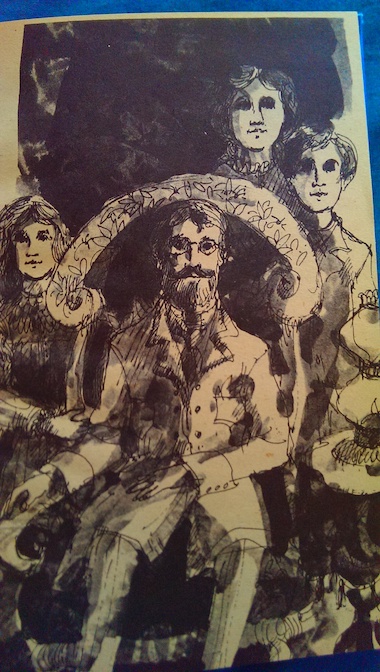
GhostWindyHillFamilyIt’s 1851, and Professor Carver of Boston is living in an apartment above a candle shop with his wife and two children, his son Jamie and daughter Lorna.  One day, a man named Mr. Giddings comes to see Professor Carver to request his help.  For years, he has wanted to buy a particular farm with a beautiful house called Windy Hill.  However, when he finally succeeded in buying the house and he and his wife went to live there, his wife became very upset.  She said that she felt strange in the house and that she had seen a ghost.  Now, she is too upset to return to Windy Hill.  Mr. Giddings has heard that Professor Carver once helped a friend get rid of a ghost haunting his house, and he asks the professor if he would be willing to do the same for him.

At first, Professor Carver is reluctant to agree to help.  He doesn’t believe in ghosts, and when he helped his other friend, he didn’t get rid of any ghosts.  His friend had only believed that his house was haunted, and after the professor and his family had stayed there for awhile without experiencing anything unusual, his friend relaxed and was reassured that the house was alright.  Mr. Giddings asks if the professor and his family would be willing to stay at Windy Hill for the rest of summer and see if they see anything unusual.  If they don’t, perhaps Mrs. Giddings will feel better about the house and be willing to return there.  Although the professor is still not that interested in the house, his family is, so he agrees to spend the rest of the summer there, about a month.  His family can escape the summer heat in the city, and he can work on his painting while someone else teaches his class.
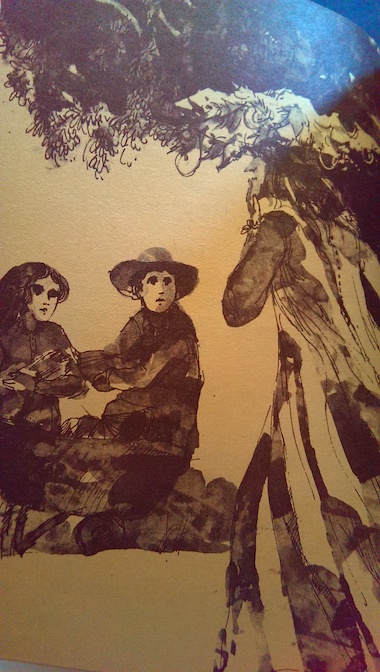
GhostWindyHillLadyJamie and Lorna are thrilled by the house, which is much bigger than their apartment in town.  They can each have their own room, and there is an old tower in the house that was built by a former owner, who was always paranoid about Indian (Native American) attacks (something which had never actually happened).  However, their new neighbors are kind of strange.  Stover, the handyman, warns them that the house is haunted and also tells them about another neighbor, Miss Miggie.  Miss Miggie is an old woman who wanders around, all dressed in white, and likes to spy on people.  There is also a boy named Bruno, who apparently can’t walk and often begs at the side of the road with his pet goat, and his father, Tench, who is often drunk and doesn’t want people to make friends with Bruno.

The kids make friends with both Bruno and Miss Miggie.  Bruno is unfriendly at first, but Lorna brings him cookies, and she and her brother tell him about life in the city.  Miss Miggie brings Lorna a bag of scrap cloth so that she can make a quilt.  Nothing strange has been happening in the house, so the family knows that they will be returning to the city soon, reassuring Mr. Giddings that the house isn’t haunted.

GhostWindyHillBoyThen, strange things do start happening in the house.  The quilt that Lorna has been making disappears and reappears in another room in the middle of the night.  At first, the family thinks maybe she was walking in her sleep because she had done it before, when she was younger.  However, there is someone who has been entering the house without the Carvers’ knowledge, and Jamie and Lorna set a trap that catches the mysterious “ghost.”

As Professor Carver suspected, there is no real ghost at Windy Hill, but this story has a double mystery.  First, there is the matter of the mysterious ghost, who is not there to scare the Carvers away but actually to make them stay.  Then, there is the question of what Mrs. Giddings saw that upset her so much, if anything.

The book is easy to read for younger readers and accompanied by black-and-white pictures.  My only complaint is that some of the pictures are a little dark, and the artistic style makes them a little difficult to interpret.

The book is available to borrow and read for free online through Internet Archive.
The General Store

Historic Communities

GeneralStoreThe General Store by Bobbie Kalman, 1997.

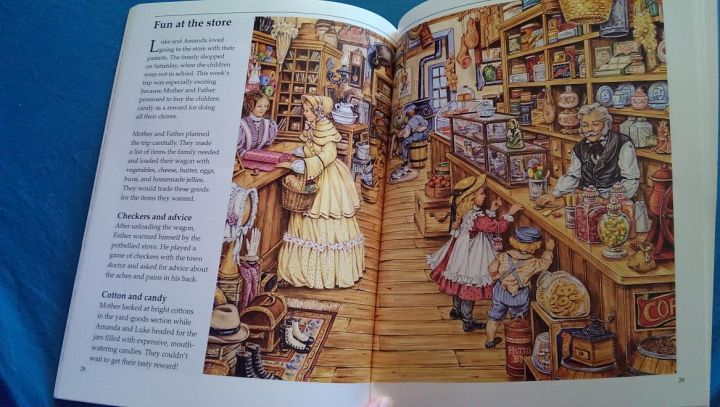
Besides providing 19th century communities with needed goods, general stores were often centers for community life.  Everyone would need to come and purchase or barter for supplies they couldn’t make for themselves, and it was also where mail for the area was delivered and sorted.  People gathered there to pick up what they needed and to exchange news and gossip with other members of the community.  The book explains how general stores functioned, what kinds of goods they carried, and how they helped to build growing communities.

Basically, they were like small department stores, carrying a little of everything that people in the area needed, including food items, dishes and silverware, tools, plant seeds, ready-made clothes and shoes, bolts of cloth, books, newspapers, and medicine.  Store owners had to decide what they would carry in their stores and how much of it to stock.  If they stocked too little of an item everyone wanted, they would run out, and if they had too much of an item hardly anyone wanted, they would either have to sell it at a discount or keep it themselves.  If someone wanted something that the storekeeper didn’t have on hand, they would have to ask the storekeeper to order it for them from a catalog or get it themselves by making a trip to a larger town where they could find what they were looking for.

GeneralStoreDrawersStore owners also had to decide how much they should charge for each item or how much they would be willing to take in trade.  Farmers often bartered for goods with the produce from their farms, and it was common for store owners to use a form of credit to keep track of what their customers owed and what they owed to their customers.  Farmers would typically sell their goods at harvest time, and the store owners would give them a certain amount of credit at their store, based on what they thought the farmers’ produce was worth.  Then, the farmers could use the credit on their account at the store until the next harvest and selling time.  If a farmer ran out of credit before the next harvest, the store owner would usually extend credit at the store to the farmer to allow him and his family to buy some necessities, knowing that the farmer could make up for it when he came to sell his next batch of produce.

To keep their customers from disputing the prices they charged at the store, store owners often used a kind of code to keep track of the amounts they spent to buy each item and the price they wanted the customer to pay in order to make a decent profit.  The codes were usually something like a substitution code, using letters to represent numbers so customers would need the store owner to interpret the price tags and manage their credit account.  This code system became less common after the 1870s because more people were simply using cash instead of bartering for goods, but I thought that it was a fascinating piece of history.

GeneralStoreMailAnother odd kind of code that the book mentions was the kind that people would use on mailed letters.  Instead of the sender paying the postage, as they do now, people receiving letters were supposed to pay for them when they picked them up from the general store.  If a receiver returned a letter unopened, they wouldn’t need to pay anything, so some people would try to cheat the system by writing a message in code on the outside of the envelope so the receiver would know the most important part of what the writer wanted to tell them for free.
People who practiced special trades, such as blacksmiths or printers, would often set up shop near the general store, and that would be the basis for the main street of growing towns.  Later, when railroads connected more towns, more people began ordering what they wanted themselves through catalogs (not unlike the way people have begun ordering more goods through the Internet). Mail started being delivered to individuals’ homes, and general stores were replaced by more modern department stores and specialty shops.

I loved the pictures in the book, a combination of photographs from living history museums and drawings.

The book is currently available online through Internet Archive.

GeneralStoreFun

More Stories from Grandma’s Attic

This is the second book in the Grandma’s Attic Series (I’ve only read two of them, although there are more in the series than that).  Like the first one, grown-up Mabel shares stories from her childhood with her granddaughter: short, humorous stories about life on a farm during the 1800s, often with a moral to them (the stories typically have Christian themes).  The stories are entertaining, thoughtful, and mention interesting details about life in the past.  Watch what happens when Mabel and her friend try to play “mother” to a piglet!  Also, is it possible that the doll Mabel found in the mud is actually . . . alive?

This book is available to borrow and read for free online through Internet Archive.

The Nuisance in Ma’s Kitchen

Mabel helps to nurse an ailing baby goat, but when the goat is better, she has trouble accepting that it’s time for it to return to the barn with the other goats.

Grandma’s Sampler

Mabel learns that it’s better to be careful and to fix mistakes early when her over-confidence jeopardizes her chances of winning a contest with her sampler.

Mrs. Carter’s Fright

Mabel and Sarah Jane love babies!  They admire Mrs. Carter’s new baby so much when she comes to visit that they’re inspired to pick a “baby” of their own from a litter of piglets.  But, when they borrow Mrs. Carter’s baby carriage for their “baby,” they accidentally give everyone a fright!

When Grandma Needed Prayer

Young Mabel questions the need to pray on a busy morning, but when she and her friend get lost later, they come to understand the importance of being able to stop and pray.

The Stranger

A stranger comes to the farm and visits with them one day.  He seems to know them, and doesn’t introduce himself.  While he helps them with chores and spends a pleasant evening with them, no one is willing to admit that they don’t know who the man is.  Who is the mysterious stranger?

The Big Snow Storm

When Mabel’s Ma is sick during a big snow storm, the family doesn’t know how they’ll manage to get help for her.  But, ironically, the storm actually brings help to them.

Grandma and the Slate

Mabel’s brother, Roy, gets a new slate to write on for school.  Mabel admires it and wants to try writing on it herself, but Roy teases her that she’s just too young.  Then, when Roy makes a bargain with Mabel to give her the slate if she does something for him, he ends up getting more than he bargained for.

A Pig in a Poke

Grandma Mabel explains to her granddaughter that the word “poke” used to mean a bag or sack.  If someone bought a pig in a poke, it meant that they bought something sight unseen, not knowing exactly what they were going to get or what quality it would be. Young Mabel once saw her brothers do that the day they bought a trunk that had been locked for years because the key was lost.  Will their trunk contain a fabulous treasure or just a disappointment?

Grandma’s Day Off

Young Mabel persuades her mother to let her have a day with no chores and finds out that a life of leisure isn’t all it’s cracked up to be.

How News Spreads

When Mabel’s family hears that the girl Sarah Jane’s brother wants to marry is buying cloth for a wedding dress, Mabel and Sarah Jane get the wrong idea.

Charlotte

Mabel finds a doll lying in a mud puddle and brings it home to play with.  But, Charlotte turns out to be an unusual doll.  Wait, did she just move?!

The Slate Pencil

Mabel finds a lost slate pencil at school. Even though she knows who lost it, it’s a nice pencil, and she’s tempted to keep it for herself.

What Shall We Write About?

Mabel and Sarah Jane want to write exciting stories like the ones in the magazines, but they don’t have anything interesting to write about.  Then, Sarah Jane finds a diary that her cousin Laura left behind when she visited.  Could it be a source of story material?

The Cover-Up

Roy is punished for teasing Mabel by having to wash the dishes (since he told her that she was such a baby and couldn’t do it right).  He tries to hurry through the chore and ends up breaking one of the plates.  Is there any way he can keep everyone from finding out?

The Haircut

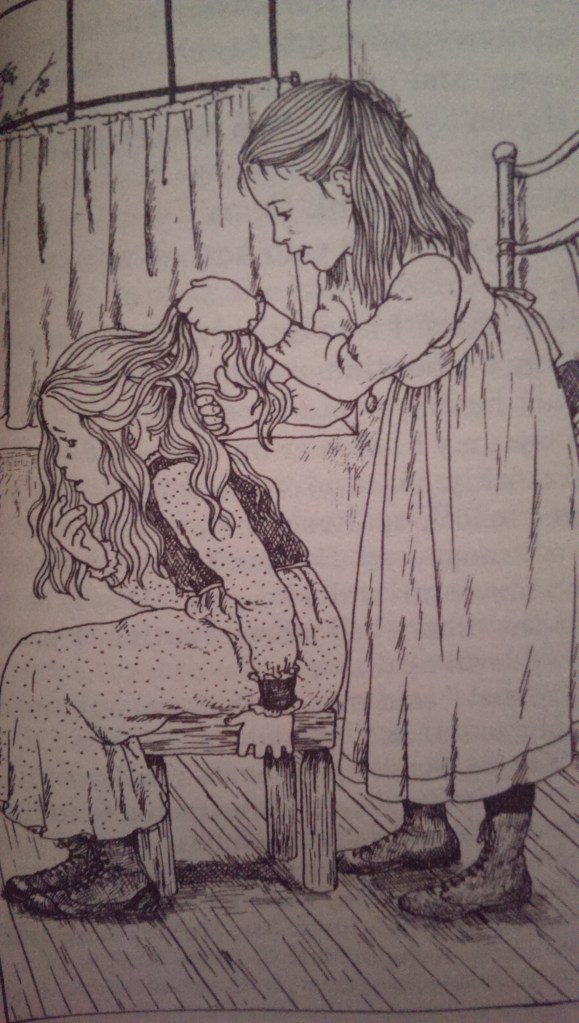
Mabel is honored when her friend, Sarah Jane, decides that she’d like to carry a lock of her hair in her new locket.  Unfortunately, Sarah Jane accidentally cuts off more of Mabel’s hair than she means to.  What will Mabel’s mother say when she sees it?  Or is there some way that they can cover it up?

Grandma Makes a Friend

Mabel resents the new girl in class, Alice, because the teacher gives Alice Mabel’s seat next to her best friend and Alice always seems to have nicer clothes to wear and everything.  But, hating people isn’t a healthy way to live your life, and Mabel’s mother convinces her to give Alice a second chance to be her friend.

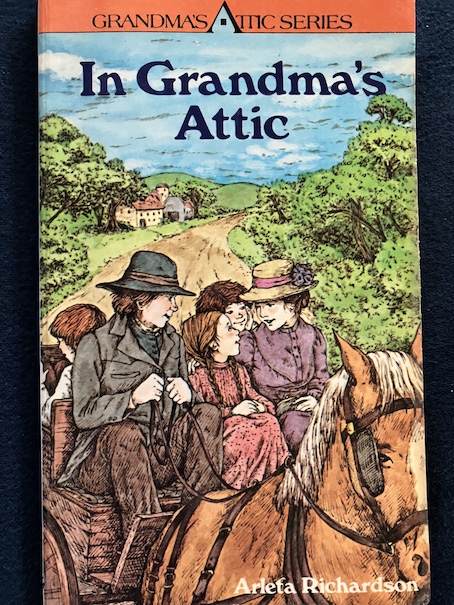
In Grandma’s Attic

The books in the Grandma’s Attic Series are collections of short stories (although I think later books in the series are novel-length stories) told by a grandmother to her granddaughter about life when she was young.  They typically begin with the young granddaughter (unnamed in the stories) asking her grandmother, Mabel, about an object in her house, and Mabel then tells the story about it.  These are usually short, slice-of-life family stories with a humorous twist, often with a moral (the stories generally have Christian/Biblical themes).  The inspiration for the stories was the author’s own grandmother, who grew up on a farm in Michigan in the 1800s.  I’m kind of sentimental about them because the books I have were presents from my own grandmother, who also grew up on a farm.

This series is good for discussing aspects of life in the 1800s. They include little details about daily life like the types of chores children did, how they got to school and what lessons were like, and other little household details like warming clothes on a wood-burning stove and throwing water from washing dishes outside because they didn’t have a modern sink.  They’re also good for talking about morals or making ethical decisions (it’s not just Christian themes, Mabel also talks about more general issues of growing up, like honesty, responsibility, and the awkward mistakes children make when they try to act more grown-up than they really are) or just for a good laugh because some of the stories are really funny (learn the perils of attempting to sit down in a hoop skirt without really knowing how)!

In Grandma’s Attic is the first book in the series and it is available to read for free online through Internet Archive.

Pride Goes Before a Fall

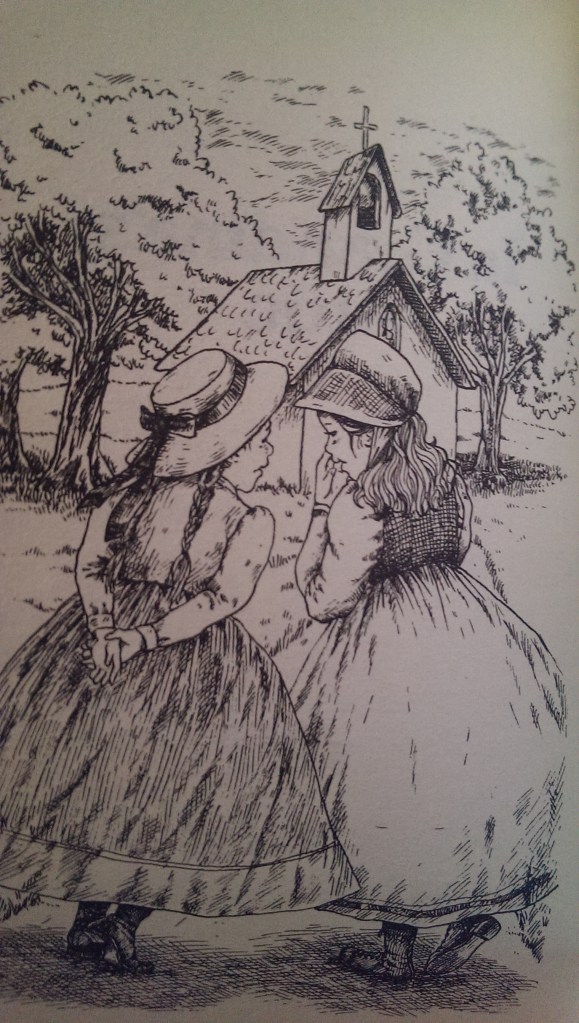
Mabel and her best friend, Sarah Jane, badly want to wear hoop skirts like the fashionable young ladies and have everyone admire them, even though their mothers say they are really too young. When they get the chance to wear them in front of everyone, they make a mistake and learn the lesson in the title of the story.

When God Knew Best

Mabel talks about a childhood disappointment that turned out well in the end because she was saved from disaster.  Sometimes disappointments are blessings in disguise.

The Red Bonnet

A lost bonnet gives everyone the wrong impression, and a search begins for a not-so-missing child.

Grandpa’s Apron

The other guys teased him when he asked Mabel to make him a work apron with pockets because aprons were supposed to be women’s clothing, but his comes in handy in some unusual ways.

Ma’s Busy Day

Being a mother is hard work, and when a hectic day leaves Mabel’s Ma no time to change her aprons when one after the other gets dirty, the layers of aprons she has on at the end of the day become a record of the day’s events.

Grandma’s Mistake

Mabel misunderstands something her mother says, and it causes her problems at school.

The Button Basket

A strange Indian (Native American) comes to the farm and trades a beautiful basket for food.  Unfortunately, they can’t speak the same language, so they never learn the reason why, and they marvel over the mystery of the basket’s origins.

The Little Gray Shoes

Mabel learns that vanity comes at a price when she insists that she wants a beautiful pair of gray shoes that don’t fit her properly.

Nellie and the Buttons

Why does their horse, Nellie, keep trying to bite the buttons on Mabel’s new coat? Nellie might be smarter than they think.

The Pearl Buttons

When Mabel has trouble fastening the buttons on her new dress, she finds a creative solution that causes her some embarrassment.

Nellie’s Trips to Town

When Mabel’s family makes a trip to town, their horse and buggy suddenly disappear.  Then, as soon as they get a ride from a friend, they are suddenly returned.  Why?

The New Pump

Young Mabel learns the hard way why it’s a bad idea to lick cold metal in the winter.

You Can’t Always Believe

When strange things start happening around the farm, Pa blames one of Mabel’s brothers but learns that it isn’t a good idea to be too quick to blame.

The Old Door

Mabel’s brother plays a trick that causes some embarrassment for their mother.

Pa and the Dishwater

Mabel’s fear of the dark makes it difficult for her to throw the dishwater outside after they wash the supper dishes.  When she thinks she’s found a shortcut for getting rid of the dishwater, it gets her into trouble.

The Dishes

Mabel tries to put off her chores so that she can play with her friend, but the guilt she feels takes the fun out of it.

Ma’s Birthday Cake

Mabel is so pleased to be making a cake for her mother on her birthday, but has she gotten the recipe right?

Grandma’s Warm Clothes

Mabel and her brothers used to warm their clothes by the stove on cold winter mornings, but Mabel’s attempt to make it easier on herself and her forgetfulness have unintended consequences.

Grandma’s Prayer

Mabel thinks that a selfish prayer she made may have brought bad luck to her family.

Molly Blue

Molly Blue the cow always gives Mabel trouble.  Her family thinks it’s funny until they see how much Mabel needs their help.

Grandma and the Gun

Gun safety is a big issue in modern times, and it was back then, too.  Mabel is a curious child and makes a mistake that almost has very serious consequences, but she learns an important lesson.

What Grandma Lost

When Mabel’s brothers are sick and she gets to take the family’s horse and buggy to school by herself (a special privilege for a child of her time), she decides to show off a little.  But, in her attempt to look more grown-up and responsible, she ends up proving that she’s not as grown-up and responsible as she thought.

What Did You Expect?

Not exactly a full story, but Mabel shows her granddaughter what a miracle looks like because she believes it can happen.