Mystery at Kittiwake Bay

Mystery at Kittiwake Bay by Joyce A. Stengel, 2001.

Cassie Hartt has only recently moved to Kittiwake Bay, Maine with her mother and brother following her parents’ divorce. Her mother is a nurse, and she has found a job at the local hospital, which is actually 30 miles away from the little town where they were able to find a house. Because of her mother’s long commute, Cassie will need to look after her 7-year-old brother, Danny. Soon after arriving, she meets a nice boy named Marc Nolan, who is a little older than she is and loves boats, and a girl name Liz Painter, who likes photography and walks her cat on a leash. Liz is the one who introduces Cassie and Danny to the Beachcombers Club, which is a group for kids Danny’s age who like to go swimming and camping and the kids who hang out at the Sand Shack coffee shop. Marc is one of the Sand Shack kids, and so is a boy named Ryan Jerrick, who is Liz’s crush. Cassie is glad to be making friends and starting to get settled into her new home, but soon, there are complications.

One evening, on her way home from the grocery store with her dog, Sam (short for Samson), Cassie sees some mysterious figures sneaking around in the dark. She doesn’t know who they are, but the way they’re sneaking around worries her. She later learns that there have been robberies in the area.

Cassie develops a fascination for the large house that she saw on a cliff near the ocean, and Marc and Ryan tell her that’s a senior citizens’ residence called Waterview Manor. Both of them work there part time. Liz says that the house wasn’t always a senior citizens’ residence and that there are a lot of weird stories about the place. It was built by a rich man before the Civil War, but it became property of the town in the 1950s. One of the stories about the place is that it was once part of the Underground Railroad helping escaped slaves. The boys say that a woman named Mrs. Wentworth says that her grandfather was one of the people helping escaped slaves. There’s also a story about Captain Kidd hiding his treasure somewhere around the old house, although Ryan doesn’t believe any of these stories. He thinks Mrs. Wentworth just tells tall tales. Cassie thinks that she might like to volunteer at the house, like the boys did before they started working there as employees. If her little brother joins the Beachcombers Club, she’ll have some free time for volunteer work.

When Cassie goes to Waterview Manor to sign up, she witnesses an argument between Ryan and Mrs. Wentworth, who is confined to a wheelchair. Ryan was being disrespectful because Mrs. Wentworth was telling one of her stories about the history of the town that Ryan thinks is outlandish, and Mrs. Wentworth was telling him off. Ryan doesn’t actually like working at Waterview, but he has to keep his job because he needs the money. Cassie thinks he’s arrogant. Ryan has no patience for the fetching and carrying he has to do for the older people, and he thinks that Mrs. Wentworth’s mind is going. Cassie thinks that Mrs. Wentworth sounds like she still has her faculties and is sympathetic when Mrs. Wentworth laments about not being able to do things she used to do because her hands and feet won’t obey her anymore. Mrs. Wentworth is physically feeble these days, but she knows what she’s talking about when it comes to local history.

After she signs up to volunteer, Cassie can’t resist a peek into the forbidden East Wing of the house, and she meets Marc there. They both admit that they’re curious about the stories of treasure in the house. Unlike Ryan, Marc believes Mrs. Wentworth’s stories, and Cassie can’t wait to hear more!

Mrs. Wentworth used to be a history teacher, and she does know more about local history than Ryan gives her credit. She tells Cassie how her grandfather used to be a conductor on the Underground Railroad and how his friend, Mr. Palmer, who was the original owner of Waterview Manor, was a stationmaster, which meant that he hosted and hid the escaping slaves that Mrs. Wentworth’s grandfather conducted to him. Mrs. Wentworth’s grandfather told her about a secret room where they used to hide people and a secret tunnel that would take them to the landing site for the boat that would smuggle the runaways to Canada. When Cassie asks her about the story about Captain Kidd hiding his treasure somewhere in the area, Mrs. Wentworth said that her grandfather always believed he did, although Captain Kidd was much older than both her grandfather and the Manor. She explains a little about the life story of Captain Kidd and how it seems that most of his treasure was never found.

However, they soon have a more modern mystery on their hands. Whoever has been stealing things in the area recently seems to have started taking things from Waterview Manor. First, an expensive chess set belonging to one of residents disappears. Then, some jewelry and a coin collection disappear. Then, someone steals Mrs. Wentworth’s beloved lavaliere necklace, a special present from her late husband. For someone to both know about the residents’ valuables and to have access to them, the thief must be somebody working at the Manor! Who, could it be? Is it grumpy Ryan, who needs money? Is it John, another employee, who often acts a little strange? Could it even be helpful Marc, who seems nice but is often lurking around areas where both he and Cassie aren’t supposed to be? Or is it someone else Cassie wouldn’t even think to suspect?

The mysteries of the past start mingling with the mysteries of the present. Cassie sees signal lights from the tower of the old house that remind her of of the signals Mrs. Wentworth said the Underground Railroad used. Is someone now using them for a different purpose?

The book is available to borrow and read for free online through Internet Archive.

My Reaction

The Underground Railroad is a popular subject in US children’s books. There is something compelling about people sneaking around on clandestine missions and hiding in secret rooms and secrets passages, and since these things were used in the real life Underground Railroad, they make convenient devices for US children’s books with some historical flavor. The former Underground Railroad secret passage in Waterview Manor does play a role in this story. Someone is using it for a new purpose, just like they’re using signals from the tower.

The purpose of the Underground Railroad secret tunnel in the story is also to show that Mrs. Wentworth knows what she’s taking about when she tells her stories about local history. Ryan tries to discount her stories because some of them sound a little far-fetched and dramatic and because he thinks scornfully of the old people he serves in his job. Ryan has a negative attitude and looks at the elderly as being senile and demanding. Cassie feels differently because she has more empathy and, perhaps, because her mother is a nurse, which may make her more aware of the human condition and more comfortable helping other people. She seems to understand what Mrs. Wentworth means when she talks about finding it frustrating that she can’t do things she used to do, and she says that she agrees with Mrs. Wentworth when she says that she likes keeping her hair long even though a nurse at the Manor says it would be easier to care for if she cut it shorter. The nurse is probably thinking that short hair would be easier on those who might have to help Mrs. Wentworth wash and brush it, but Cassie understands when Mrs. Wentworth explains why she likes her hair long. Cassie thinks the people who live at Waterview Manor are interesting, and she admits to her mother that she likes to pretend that they’re her grandparents. She is fascinated by Mrs. Wentworth’s stories, and because she and Marc believe what she says, they are able to get to the bottom of the mysteries surrounding the Manor.

I was pretty sure I knew who at least one of the thieves was, and I was also pretty sure I knew why. I was correct in my first guess, but there were enough red herrings along the way to give me some doubts, so there was plenty of suspense in the story. One of them wasn’t fully aware of what he was getting involved with at first, but he does bear responsibility for what he did even after he knew.

This book also deals with the subject of divorce and how it affects families and children. Books like this were once rare, but they have been very common staples of children’s literature since the late 20th century, reflecting changes in American society and a growing willingness to discuss difficult topics with children. Moving to a new state and starting over after the divorce wasn’t easy for Cassie, her mother, and her brother. Cassie quickly becomes interested in the history of her new town, and it doesn’t take her long to find some new friends and a volunteer activity to keep her occupied. However, other aspects of the changes in her life and family will take longer to get used to. Her mother has to work long hours with a long commute, so Cassie frequently has to be responsible for her younger brother when he’s not at activities of his own, and her mother often isn’t home for Cassie to discuss things with her.

There is also some tension between Cassie and her brother because the divorce has changed their relationship with each other. Because Cassie has become more of a caregiver to Danny because her mother has to work, she has to make arrangements for Danny before she can do anything on her own, which sometimes makes things awkward for her. Danny also becomes jealous because Cassie does have more ability to do things on her own than he does and because she makes friends and settles into their new town more easily than he does.

One part of this book that I hated was when Danny intentionally left Sam outside alone to spite Cassie, and Sam is poisoned by one of the villains and nearly dies. Cassie is very upset with Danny because of this incident, understandably so, but I didn’t like it that the other characters were pressuring her to be okay with Danny and forgive him too quickly. They do this because Danny is young, they think that he left the dog out by accident, and Danny feels really badly about almost getting the dog killed. Cassie knows, although Danny doesn’t initially admit it, that Danny left the dog outside on purpose. That purposefulness maliciousness is not a thing that I think should be too easily forgiven, especially not because someone just “feels bad.” Let’s insist on a little empathy here, Danny. Cassie feels bad because you almost got her dog killed. Sam really feels bad because he’s the one who almost died! Maybe your feelings shouldn’t be given first priority here, since you were the one who caused the harm. Sam is a dependent animal. Under no circumstances should animal abuse be excused, and leaving a dependent animal outside alone to be lost, hit by a car, or yes, harmed by some other malicious person is abusive. Danny should not be given a pass for malicious behavior or animal abuse just because he “feels bad.”

Giving people that type of excuse for malice and abuse just encourages more of it in real life because the person finds that there are no consequences for their actions and it gets them the forgiveness and attention they want, so they keep doing it. It’s a dangerous thing to allow. The story makes it clear that Danny was acting out on bad feelings that he already had about the divorce and feeling neglected by both his mother and Cassie, but I think it’s important to make it clear to him that, even if he’s “feeling bad”, that does not give him the right to hurt other people or animals. Nobody has the right to hurt others just because they’ve got mixed-up feelings. I hate it that the other characters don’t seem to feel that way.

The story ends happily when Danny tries to make it up to Cassie by investigating the situation and Cassie rescues him from the bad guys. They have a heart-to-heart talk that makes Cassie realize how important Danny is to her and that she has to make time for paying attention to him and supporting him more during this difficult time. Still, I feel very strongly that the story and the other characters should emphasize to Danny that causing hurt because you feel hurt is wrong and damaging to relationships. The way the other characters tried to make Cassie feel bad about the situation also really felt like gaslighting. She had a real and serious reason for being angry with her brother, and it just made me really angry when they acted like she was the bad one because Danny was “feeling bad” and she wanted him to be accountable for his actions. He knew what he was doing, and he should have known it was dangerous to Sam, even if he didn’t know that someone was going to deliberately try to kill the dog.

I know that Danny has some emotional issues that need to be addressed, but I’m saying that he also has some behavior issues that also need to be addressed. There are helpful ways to deal with emotions and destructive ways to deal with emotions. Danny is not too young to understand the consequences of his actions and to accept them. I don’t think that learning that it can take awhile to regain trust after betraying someone’s trust is also an unbearable lesson. In fact, I’d call it a life skill. If it helps him to develop more empathy and consider other people and the consequences of his actions before he lashes out, it is worth it.

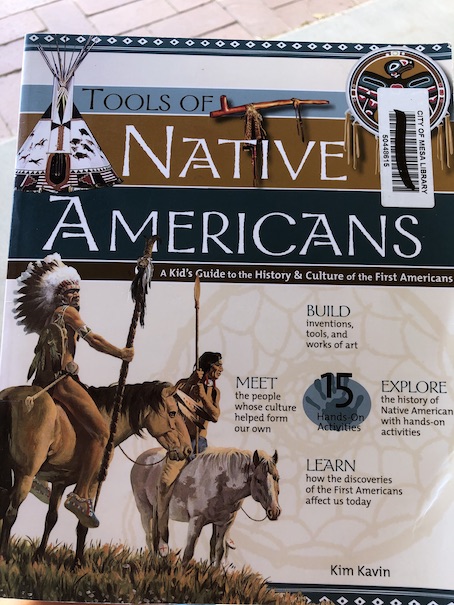
Tools of Native Americans

Tools of Native Americans by Kim Kavin, 2006.

This nonfiction book is part of a series recommended for kids ages 9 to 12. It provides insights into the daily lives of Native Americans of the past by explaining their tools and inventions. I was intrigued by the idea immediately because I love books that give insights into history through the lives of ordinary people.

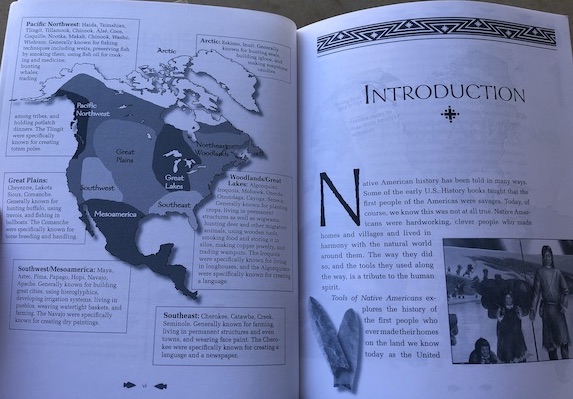
The book is divided into time periods and geographic areas of North America. At the beginning of the book, there is a timeline of important events in the history of North America and Native American culture, beginning c. 20,000 to 8000 BCE, when the ancestors of Native Americans are believed to have migrated to the continent and ending in 2006, the year the book was published. There is also a map showing major geographic regions of North America and the Native American tribes that live there. The chapters of the book are mostly grouped by region, except for the first two, which are about the First Americans and Archaic and Formative Periods.

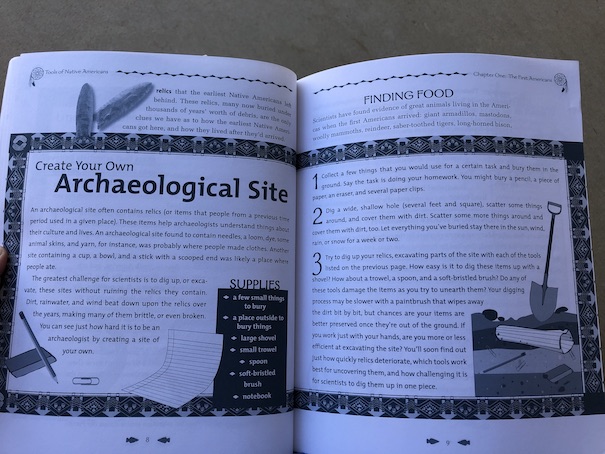
The first chapter, called The First Americans, discusses theories about how the ancestors of Native Americans first arrived on the continent from Asia. The exact circumstances of their arrival are unknown, but there are some possible migration paths that they could have taken. The chapter discusses the Ice Age that existed when this migration took place, how people found food, and Clovis culture, one of the earliest known civilizations in the Americas. One of the activities from this section is about archaeology, which is what we use to learn more about ancient civilizations that did not leave written records, and how to create an archaeological site of your own.

The next chapter is about the Archaic and Formative Periods, which were characterized by climate change as the Ice Age came to an end and many plants and animals that had thrived in the colder climate died off. The changes in the environment cause Native American groups to make changes in their own lifestyles. Rather than relying on herds of large animals for food, they began cultivating crops. They made pottery and developed new cooking techniques. They still hunted, using a device called an atlatl to throw their spears further and with more power. Civilizations like the Maya flourished.

After the second chapter, the other chapters discuss tribes by region:

The Northeast Woodland and Great Lakes Tribes – The Algonquian and Iroquois

This chapter discusses Native American tribes from the East Coast to the Midwest, around the Great Lakes, who primarily lived in woodland areas. The Iroquois and the Algonquian were both collections confederated tribes. There is information about the Algonquian language, which contributed some words to English, including moccasin, succotash, hominy, hickory, and moose. There is also an activity about creating Algonquian style pictographs and petroglyphs.

The Southeast Tribes – The Cherokee, Catawba, Creeks, and Seminoles

The tribes in this chapter lived in and around the Appalachian Mountains. It explains about Sequoyah, who developed a system of writing for the Cherokee language.

The Great Plains Tribes – The Cheyenne, Lakota Sioux, and Comanche

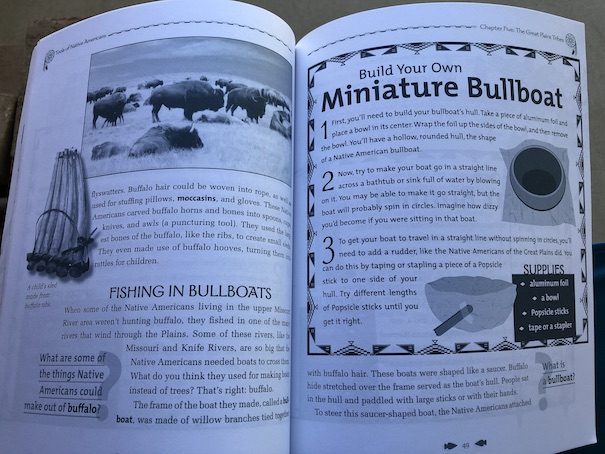
The tribes of the Great Plains were migratory, following herds of buffalo, which were a primary source of food. Because they moved often, everything they owned, from the tepees where they lived to the tools and other objects they used, had to be easily portable. The Comanche were particularly known for being expert horsemen. This chapter also discusses the Lewis and Clark Expedition and Sacagawea, who was part of the Shoshone tribe from the Rocky Mountains. She had been abducted when she was young, and when she joined the Expedition, she was able to guide Lewis and Clark and their men back to the territory she had known when she was a child and to the Pacific Ocean. Activities for this chapter include making a rattle of the kind children used as toys, making a miniature bullboat, and making a war bonnet (using pieces of poster board instead of feathers).

The Southwest and Mesoamerican Tribes – The Hohokam, Mogollon, Anasazi, Maya, Aztec, Hopi, Apache, and Navajo

I know this area because this is where I grew up. Much of it is desert, and the book is correct that there can be sharp differences in temperature between day and night. In modern Southwestern cities, buildings and pavement can hold in heat even at night, but there isn’t much to hold in heat in the open countryside, not even much humidity in the air to hold heat once the sun goes down. There is an abundance of clay in the soil in this region which local tribes used to make pottery and adobe homes.

Among the civilizations discussed in this section are the Hohokam, whose name means “Vanished Ones” (I’ve seen different versions of the translation of that name, but they’re all words to that effect – that they are gone, vanished, disappeared, etc.) because, for unknown reasons, they seem to have suddenly abandoned the area where they had previously lived and farmed for generations. They don’t seem to have died off, at least not all of them. It’s believed that they were the ancestors of the Pima and Tohono O’odham tribes, and the book discusses that a little further on in the chapter. There is a Pima story about a fierce rainstorm and a massive flood that killed many people, but The Hohokam were the ones who built the original irrigation canals for watering their crops. Later, when settlers came from the Eastern United States, they found these abandoned canals, dug them out, and started using them again. The canals are still in use today, and one of the activities in this chapter of the book is about irrigation.

This section of the book also covers the Maya and the Aztecs, who lived in what is now Mexico and Guatemala. There is an activity about creating hieroglyphs, like the kind that the Maya once used.

In the part that describes the Navajo, there are activities for sand painting and Navajo-style jewelry.

The Pacific Northwest Tribes – The Nootkas, Makahs, and Tlingits

Much of this chapter discusses hunting and fishing and the preservation of food. Because food-related work mostly took place during a single season due to the severity of the winters, there were periods of time when the members of the Pacific Northwest Tribes had time for social and artistic pursuits. The book explains the meaning of totem poles, and there is an activity for readers to create their own.

The Arctic Tribes – The Inuit

The lives of the Inuit were shaped by learning to live in a very cold environment. The book explains how they built igloos out of packed snow and ice, but really, igloos were temporary shelters. The houses they lived in long term where made of sod and were partially built underground for insulation. There are activities for building a snow cave called a quinzy (this requires that you live in a place with snow) and for playing a game called Nugluktaq.

The last chapter in the book is called New Immigrants, Manifest Destiny, and the Trail of Tears. It’s about how European settlers arrived in the Americas, the westward expansion of the United States, and the confinement of Native American tribes to reservations.

The book ends with an Appendix with further information about Native American Sites and Museums State by State. There is also a glossary, index, and bibliography.

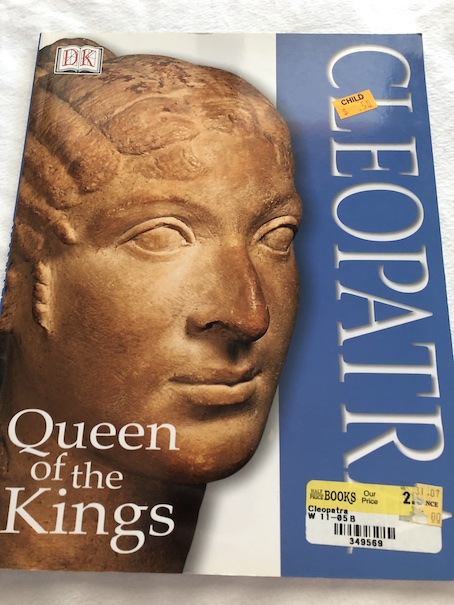
Cleopatra: Queen of the Kings

Cleopatra: Queen of the Kings by Fiona MacDonald, illustrated by Chris Molan, 1998, 2003.

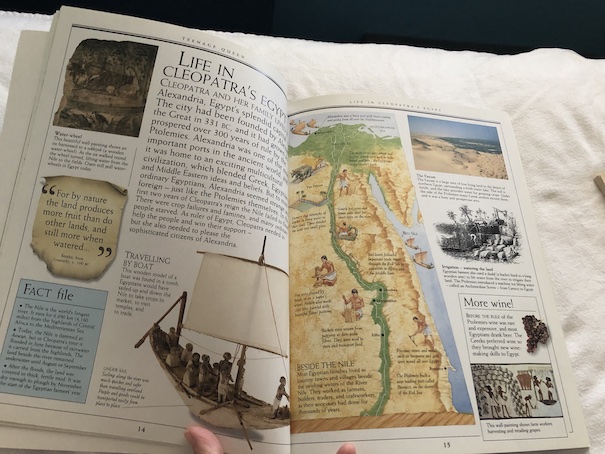
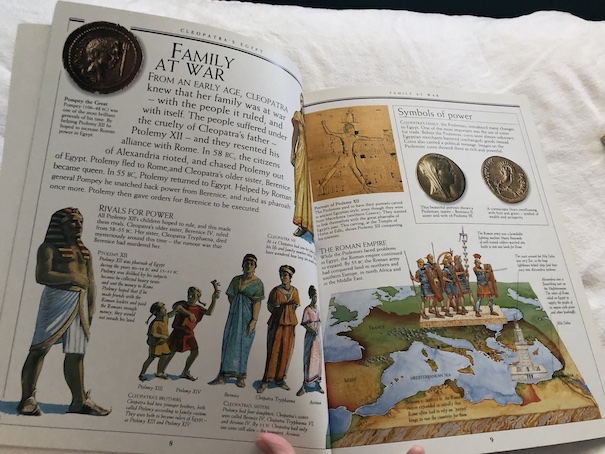
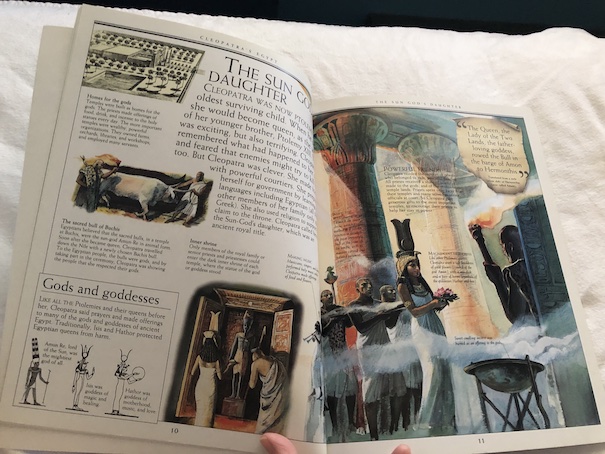
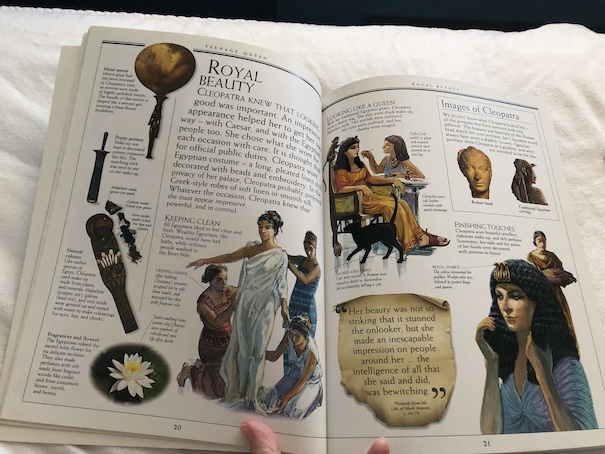
I always like books from DK Publishing because they have great illustrations, and they do a good job of helping to explain nonfiction topics, including different periods of history. However, one thing that’s important to realize is that you really have to read all of the small text that accompanies even the small pictures in order to get the full story. If you don’t, you may miss important details. Although this is a picture book, the detailed nature of the information and some of the dark subject matter make it inappropriate for young children.

This particular book is about the life of Cleopatra, the famous Egyptian queen. The queen we know as simply Cleopatra was actually Cleopatra VII. She was part of a dynasty of Egyptian rulers who were originally from Macedonia, a region of Greece. This dynasty was known as the Ptolemaic Dynasty because all of the kings in the dynasty were named Ptolemy, including Cleopatra’s father, Ptolemy XII. There were certain names that were repeated in every generation of the family and even within generations, like Ptolemy (Cleopatra’s two brothers both had this name), Cleopatra (Cleopatra also had a sister who was also named Cleopatra), and Arsinoe (Cleopatra’s younger sister). The book doesn’t fully explain why they came from Macedonia, but one of Cleopatra’s ancestors, Ptolemy I, was a Macedonian nobleman and a friend of Alexander the Great. Ptolemy I went with Alexander the Great on his military campaigns. Through his service to Alexander the Great, Ptolemy I was made the Greek governor of Egypt, ruling from the city Alexandria, which had been established by Alexander the Great. Alexandria was an important port city as well as the seat of the royal family. It was a gathering place of traders, scholars, and people from different cultures in Egypt, although average Egyptian citizens viewed it more as city of foreigners, just as the royal family itself was also foreign. That’s an abbreviated explanation of the family’s history, but it helps to understand that, while the family ruled Egypt for generations, they remained culturally Greek. The book mentions that most of the members of Cleopatra’s family only spoke Greek and that Cleopatra departed from the norm by learning to speak Egyptian.

Cleopatra was born into tumultuous times in the history of Egypt and her family. Her father was known as a cruel ruler who taxes his people heavily and sent large amounts of money to Rome, attempting to befriend Roman leaders and bribe them not to invade Egypt. In 58 BC, Alexandrian citizens had enough of Ptolemy XII and the way he catered to Rome, and they revolted, forcing Ptolemy XII to flee the city for Rome. Cleopatra was only fourteen years old at the time. Members of the family were left behind in Alexandria when Ptolemy XII fled, and Cleopatra’s oldest sister, Berenice claimed the throne in her father’s absence. The Ptolemies were always focused on maintaining their power, even in the face of competition or opposition from family members, and they were not afraid to fight or even kill each other to maintain control. Berenice may have murdered another of her sisters during her time as queen because she died under mysterious circumstances. However, when Ptolemy XII returned to Egypt a few years later, he had Berenice executed as a rival for the throne. By then, Cleopatra was the oldest surviving child of the family, with only her youngest sister and her brothers still alive.

A few years later, Ptolemy XII died, and Cleopatra acted quickly and prudently to secure both her life and her power. Her younger brother, Ptolemy XIII, had a claim to the throne, but he was still only twelve years old, and Cleopatra was eighteen. Asserting her authority over her child brother, Cleopatra took the throne as the oldest remaining offspring of Ptolemy XII and married her brother in order to turn her brother from a rival for power into a further source of her own authority. She could then rule on her brother’s behalf as his wife as well as his older sister. (Other Egyptian rulers had married close relatives for reasons like that. Tutankhamen was similarly the result of an incestuous royal relationship.) As queen, Cleopatra called herself the Sun God’s Daughter, an old royal title that tied her image to rulers of the past and the gods of Ancient Egypt.

From the beginning, being queen was a difficult task for Cleopatra. There were famines in Egypt during the beginning of her reign, and Cleopatra had to manage a response that would satisfy the citizens that she was doing her job as ruler. Family rivalries were also an ever-present danger. Cleopatra knew that she had enemies in her court, including people who favored her brother over her. As her brother got older, he became dissatisfied with the way his sister was ruling without sharing power and authority with him. For a time, Ptolemy XIII forced Cleopatra to flee Egypt and go to Syria. Cleopatra took her sister Arsinoe with her, both to protect her from their brother and to prevent her from trying to seize power herself. (In the Ptolemy dynasty, either could be a possibility. When family members weren’t in danger from each other, they could be a danger to each other.)

In the meantime, Julius Caesar came to Egypt to collect a debt that he claimed that Cleopatra’s father had owed him. He arrived during the power struggle between Cleopatra and Ptolemy XIII, and he decided that it would be for the best to try to mediate peace treaty with the two of them. He wanted to meet with both Cleopatra and Ptolemy XIII together, but Cleopatra knew that there was a risk that she might be killed if she showed up for a meeting. Yet, she did want to meet with Caesar because she recognized that he could be an important friend and source of protection for her. She ended up visiting Caesar in secret. According to legend, she had herself delivered to Caesar’s room in a rolled-up carpet. Caesar was charmed by Cleopatra and became her ally. When the news of their alliance spread, it tipped the balance of power in the royal family. Caesar learned that Ptolemy XIII’s adviser was plotting against him and had him executed. Ptolemy XIII fled with Arsinoe to join the Egyptian army and was later killed and found dead in Alexandria’s harbor. Getting rid of her brother/husband and his advisers secured Cleopatra’s position. She had one remaining brother, Ptolemy XIV, who was only eleven years old at the time, so she married him, too, further solidifying her power. As her ally (and possible lover), Caesar provided her with guards for her safety.

Cleopatra had a son named Caesarion, who was rumored to be Caesar’s son as well. However, Romans feared that Julius Caesar would proclaim Caesarion as his heir. They didn’t want him as the future ruler of Rome, citizens were appalled at the way Arsinoe was paraded through the streets as a war prize, and people generally began to fear that Caesar was becoming too powerful. In 44 BC, Caesar was assassinated by a group of senators. Cleopatra was in Rome when Caesar was killed, and she fled back to Egypt with her son. Around this time, Ptolemy XIV disappeared, and he may have been murdered by Cleopatra. With a son to inherit her throne, Cleopatra no longer needed Ptolemy XIV. However, her Roman protector was now gone, and Cleopatra still had enemies at court. Cleopatra’s remaining sibling, Arsinoe, sided with Caesar’s enemies and plotted against her sister and Caesarion.

Nobody knows exactly what Cleopatra looked like (statues and carvings of her don’t always look alike, and they may have been idealized images of her), but she took care of her appearance as part of her image as queen. Apparently, Cleopatra was more striking than beautiful, and what struck people about her the most was her intelligence and personality. Her charm was one of her most important tools in winning allies, and she used it again to win over a new ally to replace Caesar. She found a new ally in Marcus Antonius (also known as Mark Antony), one of the candidates to replace Caesar in Rome.

Mark Antony needed the control of Egypt and its resources and the support of Cleopatra for his own political purposes. To win his support for her purposes, Cleopatra began a romantic relationship with Mark Antony that eventually became a major part of the legends around Cleopatra. Although Mark Antony already had a wife in Rome, he became devoted to Cleopatra and fathered a set of twins with her and, later, a third child.

When Caesar’s nephew, Octavian, learned that Antony had divorced his wife and was conspiring against him, he declared war on Egypt to take down both Antony and Cleopatra. Cleopatra and Antony’s forces were defeated at the Battle of Actium although the two of the escaped. Feeling that the end was probably near, Cleopatra had stoneworkers hurry to complete her tomb. She began experimenting with poisons, and she and Antony swore to each other that they would die together. When Antony’s soldiers turned against him and refused to fight, Antony was disgraced and forced to flee. He ended up taking his own life by stabbing himself. Cleopatra had retreated into her own mausoleum, planning to die, but Octavian allowed her to remain there as a prisoner while she arranged Antony’s funeral. The exact cause of Cleopatra’s death has never been confirmed, but according to legend, she arranged her own death by the bite of an asp and sent a note to Octavian, asking that she be buried with Antony.

It’s a tragic end to a story that was full of treachery and family rivalries from the very beginning. Octavian refused to allow any of Cleopatra’s children to assume the throne of Egypt, ending the reign of pharaohs forever. Rome took control of Egypt, and Cleopatra’s children were sent to be raised by Antony’s first wife in Rome, Octavia (who was also Octavian’s younger sister). Caesarion tried to flee to Syria, but he was caught and executed by Octavian’s orders. No one knows what happened to Cleopatra’s other two sons because they disappear from historical records after this point, so they may have died young (or were murdered, given how things went in the powerful circles in which they lived). However, Cleopatra’s daughter survived, grew up, and eventually married the King of Mauretania, a region in North Africa. The book mentions that she had a son that she also named Ptolemy, but it doesn’t mention that this Ptolemy was the last king of Mauretania and was assassinated by Caligula. Caligula and Ptolemy were distant relatives of each other because Ptolemy of Mauretania was a grandson of Antony, and Caligula was descended from both Antony and Octavian. In many ways, it seems like this family’s greatest misfortunes were themselves and each other. Fortunately, the death of death of Ptolemy of Mauretania didn’t end the family line. It’s unknown whether or not Cleopatra has living descendants today, but Ptolemy of Mauretania did have a sister (the details of her life are unknown) and a daughter named Drusilla, who apparently grew up, married, and continued the family line. Further down the family tree, relationships and offspring become harder to trace.

Something I particularly liked about this book was the separation between the legends of Cleopatra and the her known history. As with other ancient historical figures, the history and legends go hand-in-hand, and it can become difficult to separate the two. The book is pretty open about which parts of her life are known, what can’t be firmly established, and which parts of her story come to us from legend and may or may not be reality. The final section in the book discusses the known facts and fiction about Cleopatra and possible confusions between her and other Cleopatras in her family (which may be another reason why not all of the images of Cleopatra look alike). It also explains the information about Cleopatra in Plutarch‘s biography of Mark Antony and how his stories inspired Shakespeare’s play and modern movies about Cleopatra.

The book is available to borrow and read for free online through Internet Archive.

The Lost City of Faar

Pendragon

The Lost City of Faar by D.J. MacHale, 2003.

Press and Bobby have followed Saint Dane to the territory of Cloral, a world completely covered by water and occupied by peaceful people who live in floating cities.  Of course, with Saint Dane on the loose, things aren’t going to stay peaceful for long.  An entire city of people are killed when they eat poisoned food, and it looks like Cloral’s entire food supply may be in danger. 

Saint Dane is commanding a group of pirates raiding cities for their food supplies.  Among the dead is Cloral’s last Traveler, and his successor is his son, Spader, who has no idea what the Travelers are or what kind of dangerous mission awaits him.  Spader takes his father’s dead very hard and vows revenge upon Saint Dane.  As Bobby, Press, and Loor, who Bobby introduces to Spader in order to help explain who Travelers are, acquaint Spader with his new duties as the Traveler of Cloral, they try to convince him that preserving the peace of Cloral is more important than seeking revenge.  Spader is hot tempered, and they try to teach him to use peaceful means to combat Saint Dane, who has superior strength, anyway. 

Before he died, Spader’s father left behind one clue to the solution of their problems: a reference to the lost city of Faar, apparently the last city on dry land on Cloral. According to legend, it sank many years ago, but its advanced civilization may not have been completely destroyed. Centuries ago, the water level of Cloral rose, and the people of Faar realized that their city would soon be underwater.  They built a dome to protect their city, and they have been secretly helping the people in the floating cities by tending to their underwater farms and sharing technology with them.  However, they have been afraid to openly reveal themselves to the rest of Cloral because they were worried about their culture becoming contaminated. 

When Press, Bobby, and Spader tell them that Saint Dane knows where they are and is on his way to destroy them, most of the people flee the city.  The dome is broken, and it looks as though they will be unable to retrieve the equipment that the people of Faar were going to give them to save Cloral’s food supply.  However, the one person who remained in Faar and was killed was talking about making Faar “transpire.” Bobby, wanting to fulfill the dead man’s mission, activates the machinery to make it happen.  It turns out that the people of Faar have made it possible for their city to detach from the ground and float to the surface, like the other cities of Cloral.  Faar and its people have now rejoined the rest of Cloral, and they are able to retrieve the machinery they need.  Sadly, Spader tries to chase down Saint Dane as he escapes through the flume, and Press is killed saving him.  Spader volunteers to accompany Bobby on his mission to stop Saint Dane.

Throughout the books, Bobby, like Spader, has to come to terms with the fact that his life and his entire identity are not what he has always thought they were. Other Travelers also go through the same process as they learn about what it means to be a Traveler and to accept the mission of the Travelers. All through the series, there are other revelations about the nature of the Travelers themselves and how they came to be.

The book is available to borrow for free online through Internet Archive.

The Merchant of Death

Pendragon

The Merchant of Death by D.J. MacHale, 2002.

Bobby Pendragon is a normal fourteen-year-old boy, or at least he thought he was.  One day, his mysterious Uncle Press shows up at his house right before he’s supposed to leave for an important basketball game at school and tells him that he needs his help and that Bobby must come with him right away. 

Although Bobby doesn’t know what is going on, he goes with his uncle and begins a terrifying journey to another world.  His uncle reveals to him that they are both Travelers, members of a select group of people who can use gateways called flumes to travel across time and space to other worlds.  Worlds everywhere are in chaos, and an evil Traveler called Saint Dane is manipulating events to cause more chaos and destruction.  On the world of Denduron, the decadent Bedoowan society is oppressing the Milago miners, and thanks to Saint Dane, their world is about to erupt in warfare unless Bobby and his uncle can stop it.

Bobby and his uncle are separated for a while when some Bedoowans capture Uncle Press, and Bobby meets up with fellow travelers Osa, Loor, and Alder.  Osa, the most experienced Traveler, is killed trying to protect Bobby, and Bobby makes some mistakes that make the situation worse, including having his friends back home send him some items that are advanced technology to the people of Denduron. 

The Milago have discovered an explosive mineral called Tak, and they are using it to build a super weapon to wipe out the Bedoowan.  Saint Dane is trying to increase tensions between the two groups of people so that they will use this weapon, which will lead to the destruction of their world … unless Bobby and his friends can stop it.

This series reminds me a little of old movie serials, like Flash Gordon, where the good guys must defeat an evil overlord, free people from oppression, and bring peace to warring groups.  However, like with Flash Gordon’s evil nemesis, Ming the Merciless, Saint Dane has a way of escaping even when our heroes have put a stop to his plans. By the time matters are straightened out with the Bedoowans and the Milago, Saint Dane has escaped to another world, and Bobby and his companions must find him and stop him from causing further destruction.

The book is available to borrow for free online through Internet Archive.

The Sleepover Cookbook

The Sleepover Cookbook by Hallie Warshaw, 2000.

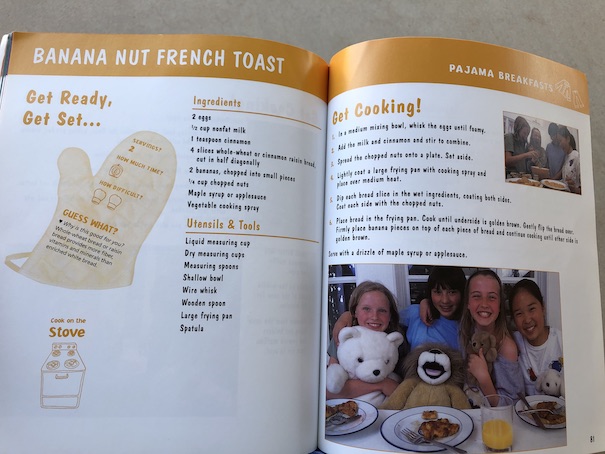
This cookbook has easy recipes that kids can make with their friends at sleepovers, parties, or anytime they want to eat together and include cooking as an activity. Some of the recipes are made from scratch, and some include shortcuts, like using pre-packaged pie dough and crescent roll dough.

The recipes are divided into sections with two sections devoted to snacks, Starter Snacks and Sacktime Snacks (bedtime snacks). There are other sections for meals – dinners, breakfasts, and brunch or lunch. There is also one extra section for birthday treats. The introduction to the book says that it isn’t really important when readers use the recipes – if you want to use a starter snack as a bedtime snack or eat a dinner recipe for breakfast, it’s all up to you. The sections are just to make it easier to find certain types of recipes.

As expected in a book of sleepover recipes, there are plenty of sugary treats, but there is one specifically “healthy” recipe for each section in the book, marked by a heart in the table of contents. The snacks include traditional kid favorites like cookies, popcorn balls, and s’mores. However, even some of the recipes that aren’t specifically labeled “healthy” are still non-sugary, like guacamole and hot taco dip.

The meal recipes also include many popular favorites. Dinner recipes include chicken pot pie, taco salad, spaghetti and meatballs, and homemade pizza. Breakfast recipes include cream cheese and ham omelettes, chocolate chip muffins, and banana nut French toast. Lunch recipes include tuna melts (called Tuna Meltdowns), bow-tie pasta salad, chicken veggie sticks (kebabs), and turkey burgers.

The section of birthday treats has recipes for different types of cakes and a few non-cake treats like brownie sundaes and Fundue (chocolate dessert fondue).

Each of the recipes in the book comes with ratings, indicating the difficulty of the recipes, although none of them were are really very difficult in general, and the amount of time it takes to make them. One of the things that I liked about this book, besides the ease of the recipes is that the book, is that the pictures show boys cooking as well as girls. I think it’s good that the book portrays cooking as something that both boys and girls can do because it’s a useful life skill for everyone and something that anybody can do for fun.

The book is available to borrow and read for free online through Internet Archive (multiple copies).

We’re Going on a Ghost Hunt

We’re Going on a Ghost Hunt by Marcia Vaughan, illustrated by Ann Schweninger, 2001.

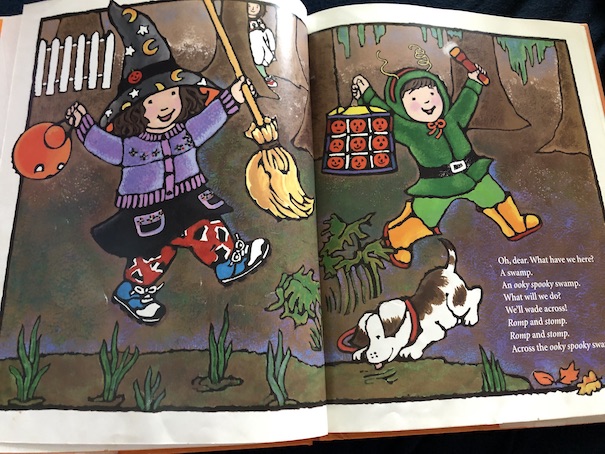
On Halloween night, two kids go out on a ghost hunt. This is a cute picture book, told as a poem, with a lot of repetition of phrases and sound words, like “thump” and “stomp.” The book also encourages children to notice details. The “ghost” appears in the scene where the children pass through the “swamp” and the ghost costume appears again at the end of the book.

As the kids go on their ghost hunt, passing through a swamp and past a haunted house and other scary things, they repeat that they’re not afraid.

The kids are brave, right up to the point where they finally find a ghost.

The kids run home to their mother, who gives them cupcakes and reads them a story.

Three guesses who the red-sneakered ghost was. Happy Halloween!

The book is available to borrow and read for free online through Internet Archive.

The Vanishing Passenger

The Boxcar Children

#106 The Vanishing Passenger by Gertrude Chandler Warner, 2006.

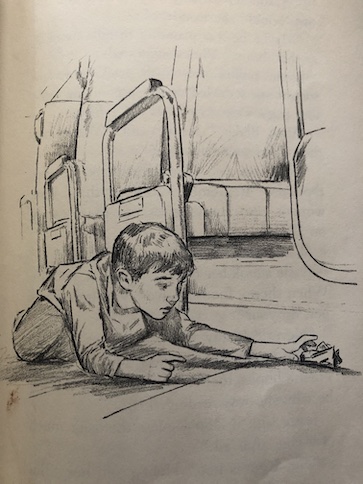
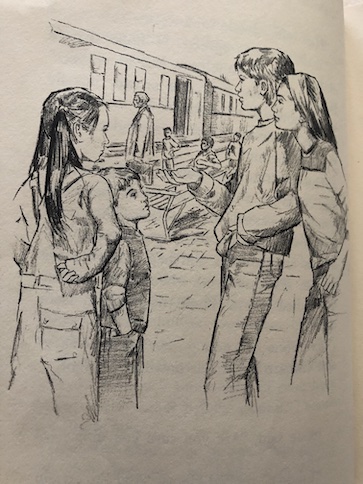
The Alden children have been working on a project at their public library to invite the author of one of their favorite book series to visit as a guest speaker.  However, when they go to meet his train, the author isn’t there.  He’s completely disappeared!

The Aldens know that he got on the train because they spoke to him on the phone earlier.  When they interview some of the passengers, they discover that the train trip was somewhat chaotic.  The train passed through a harsh storm.  A small dog disappeared, and his heart-broken family is searching for him as well.  The evidence seems to point to the author jumping off the train, but why would he do that?  Where is he now, and why hasn’t he tried to get in touch with them?

Carefully, the Aldens have to work backward through the train journey, piecing together the author’s movements to put together the whole story.

The book is available to borrow and read for free online through Internet Archive.

My Reaction

I really appreciated the premise of this story. A mysterious disappearance makes a more unusual kind of mystery than the more typical crimes that appear in mystery stories, like theft. This is a story of a trip in which quite a lot of things went wrong.  The kids do manage to track down their missing author with some surprising help from the author’s rival, who is also apparently his friend, showing the children that not all competition has to be unfriendly.

The Mystery at Skeleton Point

The Boxcar Children

Boxcar Children Mystery at Skeleton Point cover

#91 The Mystery at Skeleton Point by Gertrude Chandler Warner, 2002.

Boxcar Children Mystery at Skeleton Point bone collection

Mr. Alden’s cousin Charlotte has recently bought a house and some land at Skeleton Point that is a local landmark.  The doctor who owned the old house collected skeletons.  He was a bone expert and taught aspiring doctors and veterinarians.  It’s a creepy place with a lot of local legends about a skeleton called the Walking Skeleton that came back to life and is trying to turn itself back into a person by stealing pieces from the statuary around the house.  The statues are damaged and missing pieces, although no one really knows why.

Boxcar Children Mystery at Skeleton Point neighbors

The locals have mixed feelings about Charlotte’s desire to donate all the skeletons to a medical school and to clean up the house and renovate it.  Some people don’t like the idea of a local landmark changing.  Greenie, a man who lives nearby, is also an expert on bones who studied with the doctor, and he is upset that the doctor didn’t leave Skeleton Point to him when he died, as he had promised that he would. 

The people Charlotte had hired to carry out the renovations argue with each other about how things should be done and are not happy that Charlotte has asked the Alden children to help out with the cleaning and documenting the statuary around house.  It seems like they’re trying to distract the Aldens and keep them away from the house.

Then, some of the statues around the house disappear.  Who is taking them and why?

The book is available to borrow and read for free online through Internet Archive.

My Reaction

The best part of the story for me was the setting. A house filled with skeletons is a bizarre and creepy idea. But, much of the mystery concerns the statues around the house instead of the skeletons, and honestly, although I had a strong feeling about who was taking the statues, there were times when I suspected other people and different motives for the thefts. The story did a good job of making multiple people look guilty.

The Mystery in the Computer Game

The Boxcar Children

Boxcar Children The Mystery in the Computer Game cover

#78 The Mystery in the Computer Game by Gertrude Chandler Warner, 2000.

Boxcar Children The Mystery in the Computer Game playing

The Alden children love the computer game that they’ve been playing with their cousin, Soo Lee.  The game is called Ring Master, and they have to help the characters in the game to solve puzzles in order to find the magical ring.  Solving puzzles is a specialty of the Aldens.

Then, they get the chance to be play testers for the sequel to Ring Master.  Their grandfather knows the owner of the company that makes the games.  The owner of the company invites the children to come to the company for a tour and even gives them a computer to use to play the test version of the new computer game.

Boxcar Children The Mystery in the Computer Game QuestMaster company

Strangely, some of the people at the company seem upset at the Aldens getting the computer.  Andy, the one of one of the founding members of the company, insists on coming over to the Aldens’ house and working on the computer, giving it some updates.  However, after he leaves, the Aldens realize that some things about the game have suddenly changed.  A new character called Naje suddenly pops up, and she seems to be hanging around places in the game that remind them of places that remind them of real places around town.

Boxcar Children The Mystery in the Computer Game car

The Aldens feel like they’re being given a message through the game, especially when they visit some of the places represented in the game and notice Jane, a member of the computer game company, hanging around these places.  What is Jane up to, and what is the game trying to tell them?

The book is available to borrow and read for free online through Internet Archive.

My Reaction

Boxcar Children The Mystery in the Computer Game posing for a picture

This story deals with corporate spies and the theft of intellectual property, but what makes it really interesting is the sort of treasure hunt-style way the puzzles in the computer game lead them to the culprit. The identity of the mysterious person who is feeding the clues to them is part of the mystery. The fact that the person who is feeding them clues feels like they can’t speak up about their suspicious openly is also a clue to their identity.