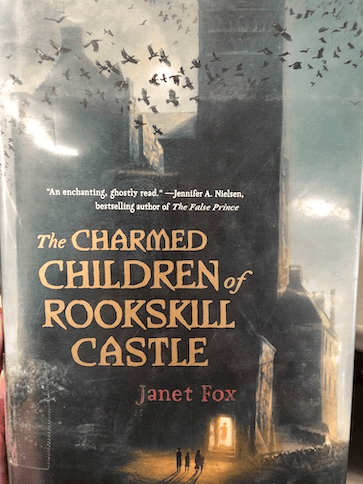
The Charmed Children of Rookskill Castle

The Charmed Children of Rookskill Castle by Janet Fox, 2016.

In 1940, in London, the coming of the Blitz during World War II means that children must be sent away to escape the bombings. Kat Bateson and her siblings are told that they will be sent to Rookskill Castle.

Rob is excited about going to a castle because it might be haunted and they might learn all kinds of Medieval fighting skills, like fencing and archery. Kat says that the castle is now called Rookskill Castle Children’s Academy, so they’ll probably just be having standard lessons. Rob thinks that she’s being stodgy and boring. Their little sister, Amelie, thinks that ghosts sound exciting, but 12-year-old Kat is sure that there won’t be ghosts. The castle is owned by the children’s distant relatives, and Kat is more worried about practical things, like their father’s war work with MI-6 (he is a spy, although they are not supposed to talk about it), how she will fit in with other children at school, and packing warm clothes for Scotland.

Before the children leave for Scotland, Great Aunt Margaret gives her something for protection – her chatelaine. The chatelaine is a family heirloom that holds a pen, scissors, and thimble attached by chains to a ring. Great Aunt Margaret says that it’s magical, and she warns Kat to be careful with magic because magic always comes at a price. Kat doesn’t really believe in magic, like her younger siblings do. She is practical and enjoys numbers, puzzles, and the clockwork skills that her father has been teaching her. Still, she accepts the chatelaine from her aunt. Her aunt tells her that the pen will write by itself, the scissors will cut anything, and the thimble has the power to capture souls.

Kat and her siblings make the trip to Scotland along with Peter, the American son of people their mother works with. The Bateson children like Peter, and they become friends. However, when they reach Scotland, the station master warns them away from Rookskill Castle, talking about strange stories about the place and other children who have gone there and haven’t been seen since. The children are spooked by what he says, but they have no choice but to go with the man from the castle who comes to pick them up.

When they arrive at Rookskill Castle, they all find the place creepy. The boys find the lady who runs the castle school, Eleanor, to be pretty and charming, but the girls find her creepy. Kat thinks that there is something wrong with her, although she’s not sure what. Eleanor also wears a chatelaine, although Kat doesn’t think hers is as good as the one Aunt Margaret gave her. Aunt Margaret’s chatelaine holds practical items, but Eleanor’s chatelaine holds strange-looking charms with no practical use. Kat doesn’t know what the point of them is, but she prefers Aunt Margaret’s chatelaine.

The children are told that they will share rooms – Peter and Robby together and Kat and Amelie together – and that they must wear school uniforms, which is typical of a boarding school. However, they are also told that they will be locked in their rooms at night, which sounds alarming, and that if they hear any strange noises, they should ignore them because old castles make odd sounds. They are not allowed to wander the grounds and explore.

The children and the other students at the school soon begin to see and hear strange things around the castle. They see other, mysterious children, who are not students but who may be ghosts. The boys hear strange noises coming from a secret room that Kat thinks sound like a radio. Kat thinks that the radio sounds might indicate that there is a German spy at the school, someone who is communicating with someone outside in secret. That would make sense for wartime Britain, but it can’t explain the other, frightening things that are happening at the castle.

There is something wrong with the teachers and the cook at the school. Their memories are sometimes muddled, and they seem to be easily confused about certain things. One of their teachers keeps talking about special artifacts with magical powers that could decide the course of the war, including a magical chatelaine once owned by Vlad the Impaler.

The longer they’re at the school, the more everyone seems to be affected by the place. Kat becomes certain that the students’ cocoa is drugged every night, and Lady Eleanor isn’t what she appears to be. Really none of the adults in the castle is quite what they appear to be, but Lady Eleanor is particularly sinister. In a series of flashbacks, it is revealed that she has led an unnaturally long life because of a magical pact she made centuries ago. In order to gain the power she craves, she needs the souls of children. Logical Kat needs to grasp the idea that there is magic and take possession of her own magical potential to save herself and the others in a terrifying showdown on Halloween night.

My Reaction

I really enjoyed the combination of magic and historical fiction in this story! I’ve read other books that combine the real-life experiences of WWII child evacuees with magic and fantasy. Many people would remember that the children in The Lion, the Witch, and the Wardrobe were child evacuees, but there are other books with similar themes, like Stonestruck by Helen Cresswell. There are several things that make this book different from others of its type, and I love that this book fits well with the Dark Academia aesthetic that’s been popular during the last few years.

One thing that appears in this story that I haven’t seen in similar ones is the use of mathematics and engineering skills alongside magic. Kat’s talent for mathematics and puzzles have practical uses during their adventure, and so does her budding talent for clockwork and machinery. There is both real machinery in the form of code machines and magical machinery in the story, and Amelie comments on the similarity between magic and the incredible results produced by Kat’s mathematics and by machines. I like the juxtaposition of real skills needed for invention and creation alongside the magic.

There is also a double threat in the book – the magical one and the more standard wartime threat of spies. The book’s premise of Nazis being interested in supernatural artifacts also has some basis in history. Movies like Indiana Jones and the Raiders of the Lost Ark are actually correct that there was an element of superstition in Nazism, and Nazis did attempt to use folklore and antiquities to create or build a connection to the past and to powerful figures. (There are many videos and documentaries on YouTube that offer more details about this. I recommend the ones from National Geographic, the Smithsonian Channel, and various universities as being the most authoritative and reliable.) The Nazi concept of history was really more of a fan fiction about their imagined past glories rather than sound and real history, and it was meant to serve as an inspiration for the empire they wanted to create. The book was correct that the darkness of war brings out magic, after a fashion. Even Allied countries, like Britain, saw a rise in spiritualism because of the war as people tried to connect to the spirits of lost loved ones, and this was also the time when Wicca began evolving into a religious movement. In fact, the founders of Wicca in Britain attempted their own magical ritual in the New Forest to ward off the Nazis. (The incident is recounted in this documentary about the life of the founder of Wicca by Professor Ronald Hutton of the University of Bristol.) In times of chaos, people are prepared to try anything and everything they can to protect what’s important, and that can include magic. The real life Wiccan rituals were not like the magic in this book, but I found it interesting that the fantasy of this story built on some real-life wartime attitudes about the supernatural.

I like books that include interesting and unusual historical details. Although this is a fantasy story, the experiences of the child evacuees do resemble the experiences of real-life evacuees. I enjoyed reading about their train journey from London to Scotland and the black-out curtains that even the trains have. Many books about child evacuees have them sent to live in private homes with people they don’t know, but in real life, there were some evacuees who were sent to boarding schools instead.

The use of a magical chatelaine is a charming touch that also shapes the nature of the story. A chaletaine is an unusual piece of jewelry that isn’t commonly worn anymore, which makes it different from stories that make use of charmed necklaces and rings. A chatelaine is a belt hook with items joined to it by chains. The items can be practical items, like the ones on Kat’s chatelaine, or charms, like the ones on Eleanor’s. Each of the items on the chatelaines in the story has a purpose.

There are also themes about power in the story. Eleanor craves power. When she was younger, before she began living this unnatural life, she craved love, but she was abused and neglected. She was powerless and fearful of the people who abused her, and her quest for power is to make herself invulnerable to that type of abuse again. However, in the process, she has sacrificed her humanity and placed herself in the position of being used by someone much more powerful. Readers and the characters can feel sorry for her because of her past life experiences, but she is beyond the point where they could save her from herself, the choices she’s made, the things she’s done to other people, and the evil force that has used her. The book is a little open-ended, with the villain behind the villain still lurking around at the end with a mission of his own to accomplish, and this story has a sequel, The Artifact Hunters.
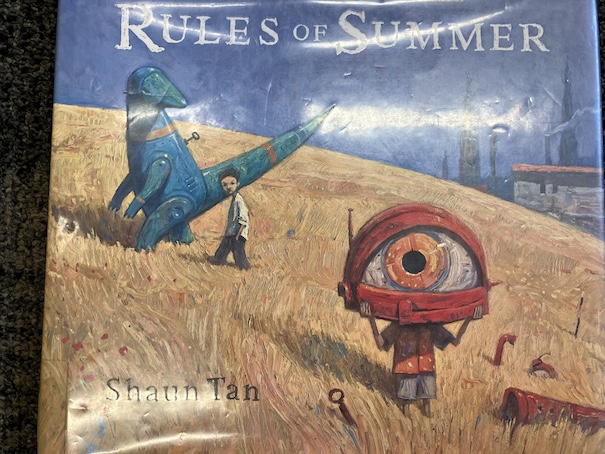
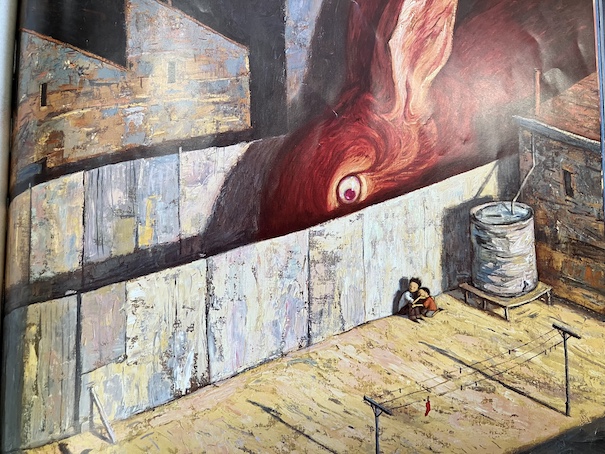
Rules of Summer

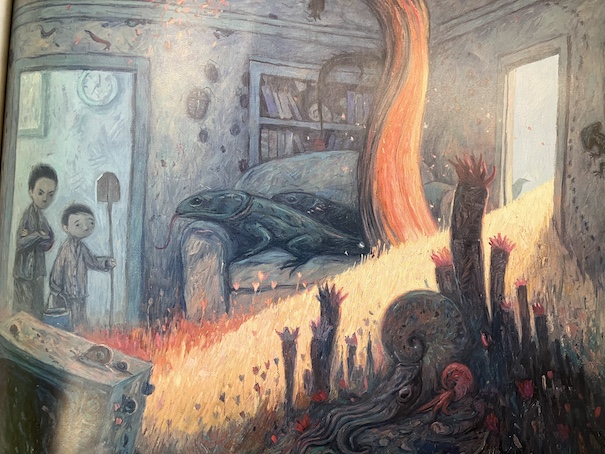
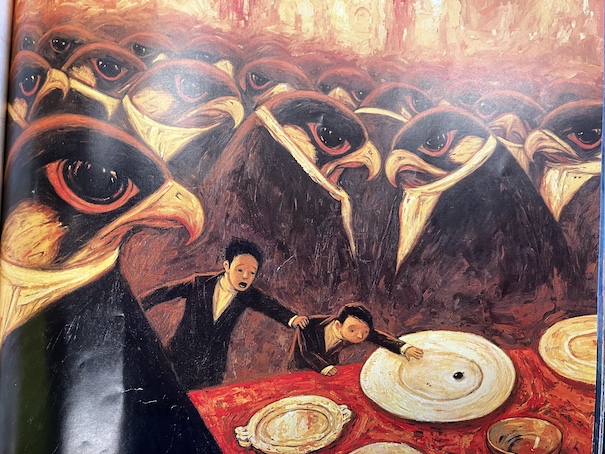
The book starts with the phrase, “This is what I learned last summer:” On every page, there’s a different “rule of summer”, something that the kid and his brother learned from their summer adventures.

However, they’re not having the ordinary kind of summer adventures. He apparently learned not to leave a red sock on the clothesline when a giant red rabbit appeared, and he learned not to drop his jar when he and his brother were catching falling stars.

The pictures show all kinds of strange things happening, like a giant lizard and weird plants spilling into the living room, which apparently taught the boy not to leave the back door open overnight and a tornado that came after the boy stepped on a snail.

At the end of the book, the two boys sit in front of their tv with pictures of all the strange creatures they’ve seen pinned to the wall. Are they pictures from the boys’ imagination or memories of a fantastic summer?

The book is available to borrow and read for free online through Internet Archive.

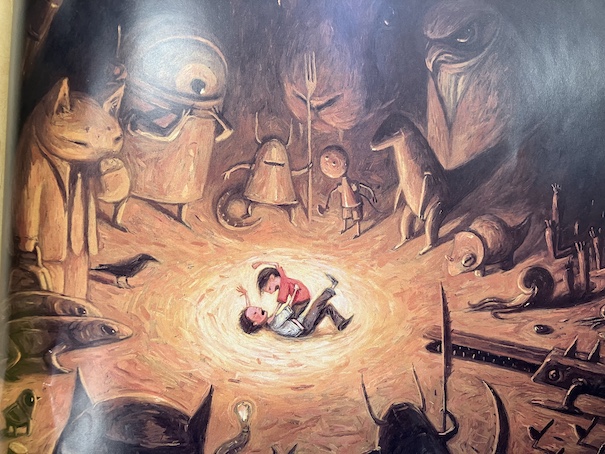
The book is set in a gritty, urban environment where some surreal things happen. Either that, or the surreal adventures all take place in the boys’ imaginations. They could be turning regular adventures in the city where they live into sci-fi, dystopian epics. There is no backstory to anything in the book, so it’s all up to the readers’ imaginations whether anything in the book actually happened or not.

Their world may be post-apocalyptic (at least in their imaginations), peopled by all kinds of strange creatures and robots. There are no other humans in the book other than the boys. I don’t really like gritty or dystopian style books or art, but this book appealed to me because it leaves so much up to the imagination, including whether or not the boys just imagined everything. To me, the last picture, where the boys are just sitting in front of their tv with pictures they’ve drawn all over the walls suggest that they imagined their fantastic summer adventures, but that’s never clarified. In fact, there are a couple of additional pictures after the story ends that suggest maybe it wasn’t all imagination, but you can make up your own mind.

In the Garden with Dr. Carver

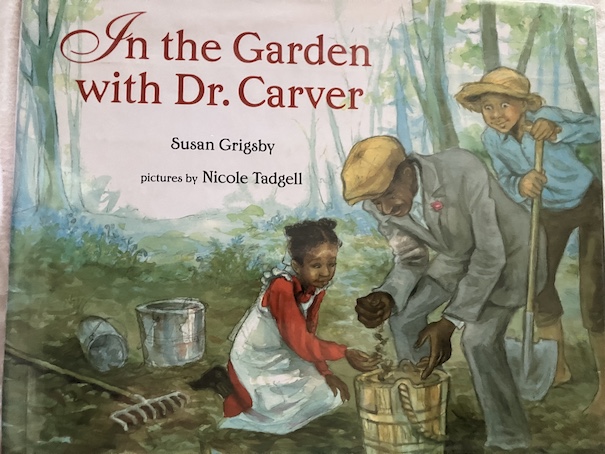
This picture book is about George Washington Carver, as told by a young girl named Sally.

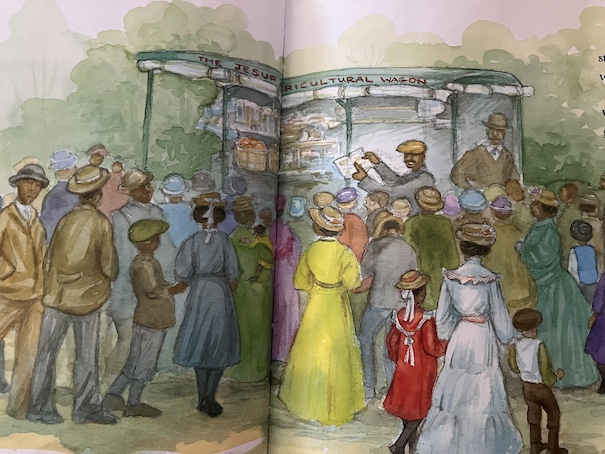
The first time Sally sees him is when he’s traveling with his wagon, pulled by a mule. Sally knows that Dr. Carver is a famous plant scientist from Tuskagee and that he uses his wagon as a kind of mobile school. It contains seeds, plants, and gardening tools, and people come to Dr. Carver for advice about growing plants. The nutrients in the soil of this area have been depleted by growing cotton, and Dr. Carver has been advising them about how to restore the soil. He also advises them about new ways to use common crops.

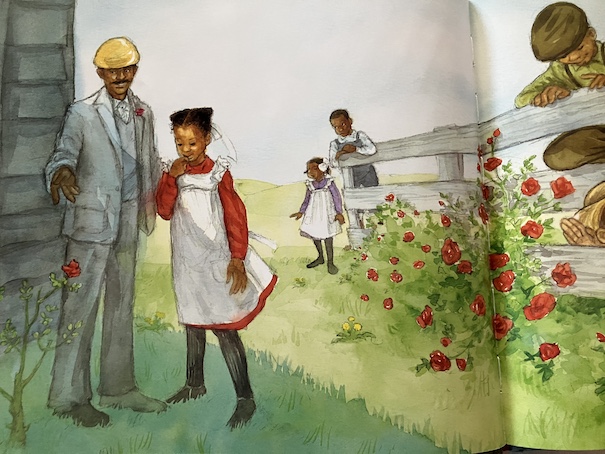
Dr. Carver visits Sally’s school to help the children with their garden. He teaches them how to use observation to notice the conditions that benefits plants and figure out how to help plants that aren’t doing well. When a boy is about to kill a spider, Dr. Carver stops him, pointing out that the spider helps their garden by eating bugs that are pests for the plants. He teaches the children that everything is part of an ecosystem (although he doesn’t use that word) and that they need to observe and understand the roles each plant and creature has in the ecosystem before deciding to eliminate or change anything. The reason why they remove weeds like dandelions is that their presence doesn’t help the other plants, and they take resources the other plants need. Although, he also shows them that dandelions are edible, so they are not wasted.

Dr. Carver teaches the children about restoring the nutrients in depleted soil using fertilizer and compost made from decaying plant matter and organic materials that most people simply throw away. Dr. Carver teaches them not to waste anything, helping them to make a scarecrow and markers for their plants from scraps of wood and other things people have thrown away.

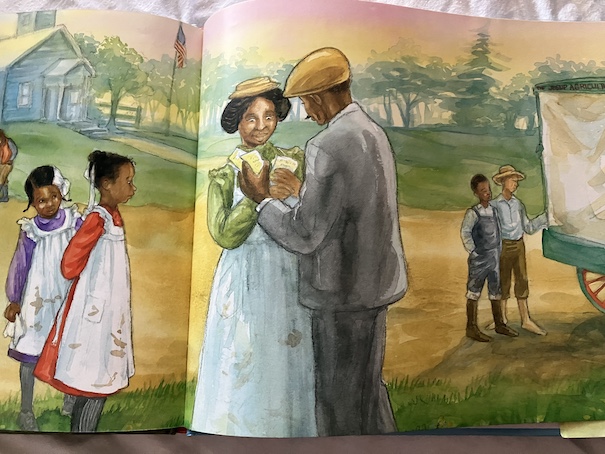
Eventually, Dr. Carver has to return to Tuskagee, but the lessons he teaches the children stay with them.

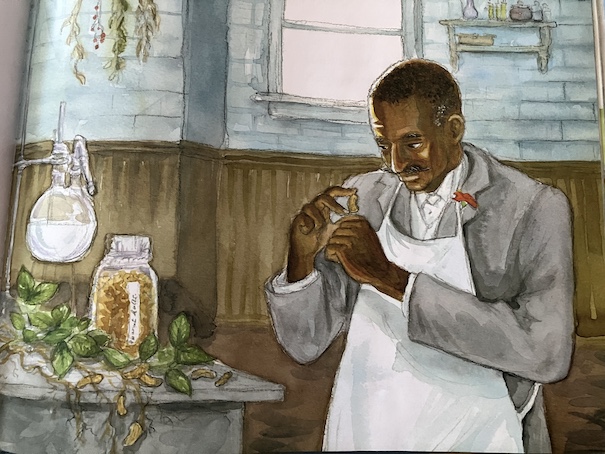
There is a section at the back of the book that explains that Sally and her school are fictional, but George Washington Carver was a real person and the story is based around his life and writings. He was born as a slave in Missouri about a year before the abolition of slavery, so he grew up as a free person. He began learning about agriculture and botany from an early age, and as he grew older, he sought out schools that would help him further his knowledge and share it with others. He taught at Iowa State College before Booker T. Washington (see More Than Anything Else for a picture book about his youth) recruited him to be the head of Tuskagee‘s Department of Agriculture in 1896. He also believed in bringing education to people who couldn’t come to a college to learn by sending out bulletins about farming techniques and booklets for teachers in lower grades to use in their classrooms. His mobile school in a wagon was another form of outreach that has been imitated in other places.

I enjoy books about historical figures, and I found this story about George Washington Carver gentle and fascinating. There are some parts that I think I appreciate more as an adult than I would have as a child, making this a book that I think would appeal to readers across different ages and something that parents and teachers would enjoy sharing with children.

Although Sally wasn’t a real person, the lessons she and her classmates receive from George Washington Carver help to illustrate Carver’s real-life work and the lessons that he shared with people of his own time. I appreciated the level of detail the story provided about how people can use observational skills to diagnose and fix possible issues with ailing plants, the importance of understanding that plants exist as part of an ecosystem and that gardeners and farmers need to understand how all parts of the ecosystem interact, and how nutrients can be restored to depleted soil. I can’t remember whether I had heard before about how cotton farming depleted soil nutrients, but I appreciated how that explanation helped explain a real problem facing farmers of Carver’s time and how Carver was helping them to solve it.

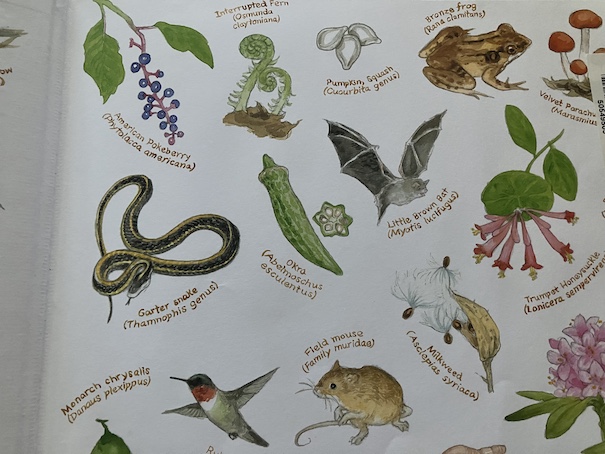
I think this book would appeal to fans of cottagecore as well as people interested in American history. The illustrations are beautiful, and even the inner covers are lovely, with small, labeled pictures of plants and creatures. As the book explains, George Washington Carver himself used drawings of plants and creatures in his work, and in the story, he teaches the children to make their own drawings to help themselves study details of the natural world.

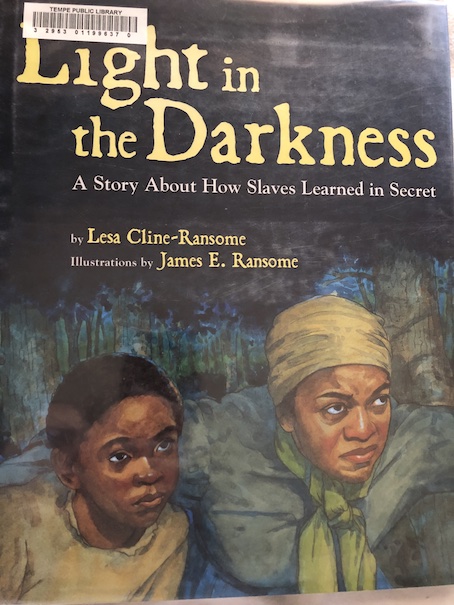
Light in the Darkness

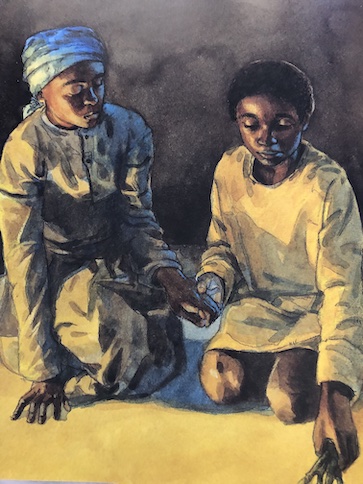
As the subtitle of the book says, this is “A Story About How Slaves Learned in Secret.” During the history of slavery in the United States, slaves were often forbidden to learn to read, and there were punishments for people who taught slaves to read. These anti-literacy laws were the norm for most people prior to the Civil War. However, there were some slaves who managed to acquire some basic reading and writing skills in secret, in spite of the anti-literacy laws, and that is what this story is about.

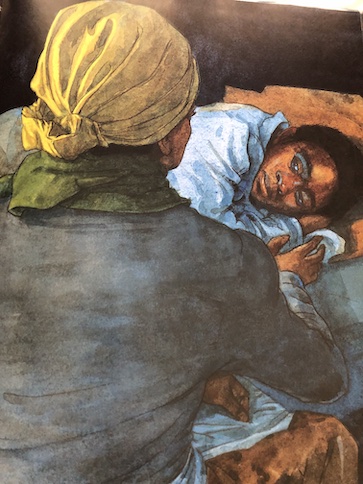
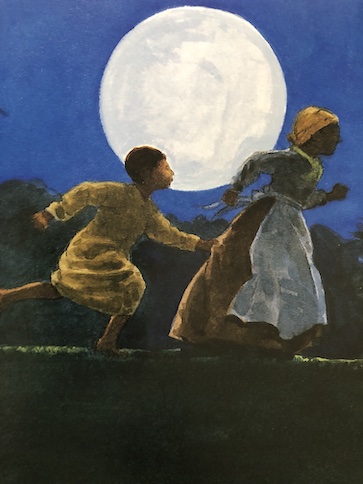
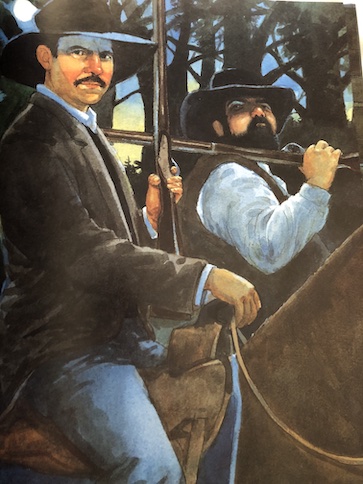
The story is told from the point of view of a young slave, Rosa. Rosa’s mother wakes her in the middle of the night, and they sneak out to go to the secret reading and writing lessons. They have to be careful because there are patrollers out, looking for runaways and slaves who are doing what they’re doing.

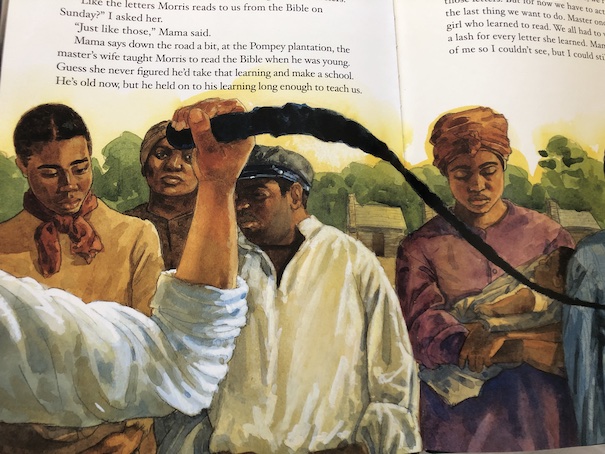
The risks are serious because slaves are whipped for learning how to read. Rosa and the other slaves were once forced to watch a girl being given a lash for each letter she learned. The slaves who go to this secret school know that the same thing will happen to them if the patrollers catch them and turn them in to their master.

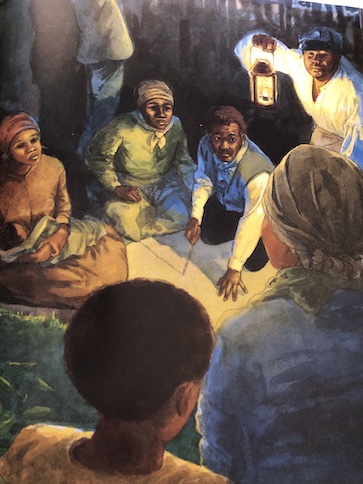
The man teaching the secret school, Morris, was taught to read Bible stories by his master’s wife when he was young, although nobody expected him to teach other slaves. Morris’s “school” is an improvised pit hut, a pit dug in the ground and covered over with branches. He uses sticks to show his students the shapes of the letters by the light of a lantern.

During the day, the slaves who go to this secret school have to proceed with their usual chores and pretend like they don’t know anything about reading and writing at all. By night, they help each other learn their letters. It’s a slow process, and sometimes, they can’t hold the school because they know that patrollers are traveling the area, and it’s too dangerous. However, they keep coming back when they can because this is important to them. They are doing something that their masters don’t think they’re bright enough to do, and they know that this secret knowledge will be an important tool in their eventual quest for freedom.
I thought that this was a good book, focusing on a particular area of history that isn’t always explored in detail in other sources. I’ve read other books that refer to slaves, both real and fictional, as having found ways to read in secret, but this book focuses solely on that process, how they managed it, how they organized others to participate, what the risks were, and what it meant to them. There is an Author’s Note in the back of the book, which explains that the author was doing research for a book about Frederick Douglass when she found a reference to “pit schools”, like the one in the story, where slaves would meet in secret for lessons from each other. I had never heard about pit schools before, and I found the concept fascinating.

The subject of education and literature is a particular sore point for me when it comes to the Confederacy, and I’m sure I’ve mentioned it before. Slavery apologists sometimes talked about how slave owners treated slaves like “family” and taught them to read and gave them Bible lessons, etc. These claims have been made since the 19th century, and you can see it in plantation or “anti-Tom” literature, including some 19th century and early 20th century books for children. (I discussed this earlier in my list of Books from the 1850s, the decade when Uncle Tom’s Cabin was published. “Anti-Tom” literature was a direct response to that book.) However, such lessons were actually forbidden by law in most slave-owning areas. There were exceptions to this rule, like Phillis Wheatley in the 18th century and Frederick Douglass in the 19th century, but the reason why these people became famous was because they were the relatively rare exceptions. Only a small percentage of slaves ever achieved any level of literacy, and of those who did, few received any help from their masters or their masters’ family because the practice was discouraged more than encouraged, with laws and punishments in place against it. In real life, Frederick Douglass received some basic lessons in reading and letter recognition from the wife of one of his masters, but that ended when his master found out about it and made his wife stop.

I never believe those stories about slaves and masters being just one big, happy family or the assertion that it was common for masters to benevolently educate their slaves to better their lives because I already know that was not at all the case for the vast majority, by design, with intention, and enforced by law. The “history” books produced by the United Daughters of the Confederacy particularly try to create this impression of slavery as a benevolent institution, but actual benevolent institutions do not have laws that specifically restrict both the personal development and freedom of movement of the people they serve with harsh physical punishments for violations. I resent the mere existence of these history books and the organization that produced them because I resent anyone who lies to me (whether directly or indirectly or even by omission or implication) about anything important, and it is personally insulting to me that they would think I would ever be dumb enough buy that bunk. I’m sure they didn’t mean it as a personal insult to me because they’ve been doing it since long before I was born. I’m sure they have no idea who I am and couldn’t care less about me as a person, but at the same time, the fact that they did it at all carries an implied insult to anyone who may potentially believe them or is pressured to read and believe them. They must either think very little of other people’s intelligence or simply never think about other people outside of their own family lineage at all except as resources to be used or manipulated for social aggrandizement. I don’t blame people for merely having ancestors who owned slaves, but when someone works hard to make me believe that slavery wasn’t bad, that their ancestors weren’t bad for doing things they admittedly did, that I don’t really know the things I actually do know about that, and that I should not only be respectful but reverent toward these people and their institutions, I blame them a lot, specifically for that. When I was young and found out about censorship, propaganda, and book burnings, I daydreamed about writing something that would personally offend this type of person as much as they offended me, and it seems like the best way to do that is just by telling the truth about history.

Although some people like to think of people in the past, especially their own ancestors and family, as being above average, most people are average, by definition. It’s not that it never happened, because I know that it did in rare cases, but most people are simply not rare exceptions. If they were, the average would have looked very different indeed, and those anti-literacy laws would not have existed in the first place, but that’s just not the reality. The reality is that those laws did exist, and most people both followed and enforced them because they both agreed with them and feared the consequences of disobedience. Most people, by definition, are basically average, and this is just what the basic average was. The average slave-holder was harsh, punitive, anti-education, and far more interested in what they could get out of their slaves than in the slaves themselves because that was the entire reason for having them in the first place.

Plantations were not non-profit organizations, and they were not run like non-profits as tools for the welfare and social betterment of clients. Non-profits serve others. Slave owners forced other people to serve them, and that’s seriously all there is to it. Slave owners were takers, not givers, although I’m sure that they engaged in occasional public philanthropy for the social cred because one of their primary goals was climbing that all-important social ladder and maintaining their place on it. Plantations were family businesses for the wealth and social betterment of the families who owned them, designed to maximize profits, and the profits were meant entirely for the owners and no one else.
In the story, Morris becomes a teacher for the other slaves because he is the rare exception among them, having had lessons from his master’s wife when he was young. Most were not given any lessons at all, and both the slaves and their potential teachers could face serious consequences if they were caught. Everyone knows that, if Morris is caught teaching the others, he will be punished much worse than the rest of them. They’re all taking a serious risk, but Morris is in the most danger if they are discovered.

Mooncakes

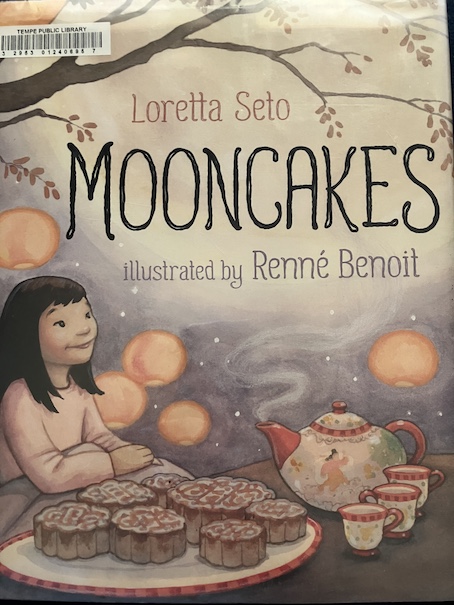
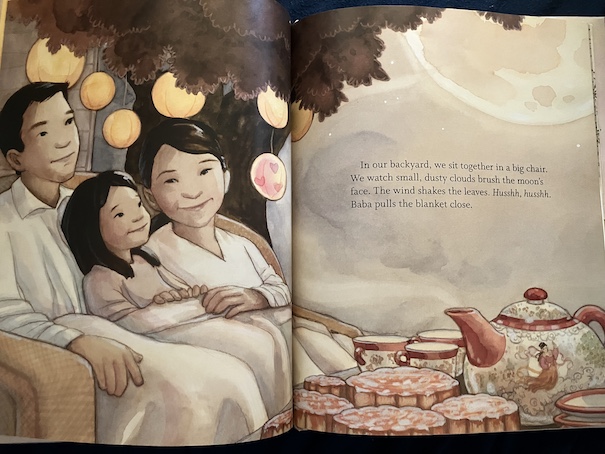
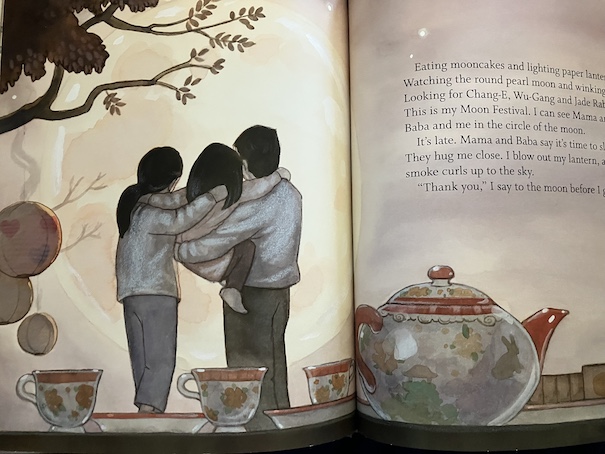
A young girl is excited because tonight is special, and she will be allowed to stay up late and eat mooncakes with her parents for the Chinese Moon Festival. They decorate with paper lanterns, and they spend the evening looking at the night sky from their backyard.

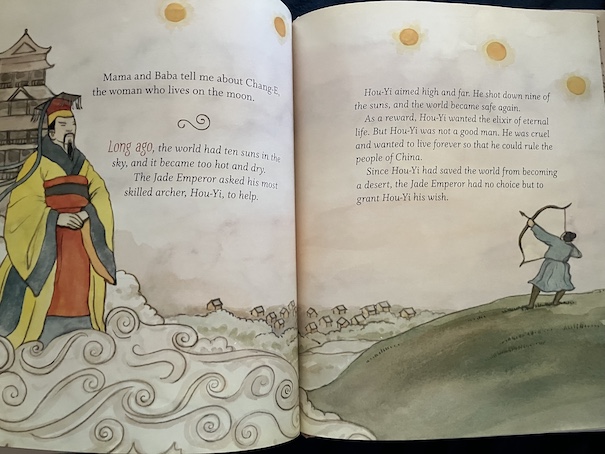
Her parents, called Mama and Baba, tell her stories from Chinese legends. The book includes the stories they tell, like the story of Chang-E (who was a woman who escaped from her cruel husband with the elixir of life and now lives in the Jade Palace on the moon), the story of the woodcutter Wu-Gang (who chops wood forever on the moon in his quest for eternal life), and the story of the Jade Rabbit (who lives on the moon with three magicians and brings food to people who need it).

As they tell stories, the girl and her parents drink tea and eat mooncakes. The girl tries to look for the characters that they talk about on the moon until it’s time for bed.

There’s an Author’s Note in the back of the book that explains a little more about the Chinese Moon Festival. It’s a harvest festival that takes place in the eighth month of the lunar calendar. It also honors family, and even family members who can’t be together will remember that the rest of their family is looking at the same moon, no matter where they are.

I know that I’m presenting this story out of season because the Chinese Moon Festival is in autumn. Because it’s based on the lunar calendar, it sometimes happens in September and sometimes in October. I did my review at this time of year because it fit best with my blog’s schedule.

I enjoyed experiencing this lovely festival through the eyes of a young girl, having a gentle celebration with her parents. It’s an idyllic evening of cozy story-telling, and I really enjoyed the three folktales introduced in the book! I enjoy folk tales from different countries, and I liked these brief stories. I think this book would make a good beginning introduction to Chinese folklore for young children.

The focus of the story and the pictures in the book alternate between the stories the parents tell and the girl and her parents as they enjoy their evening together. I think this would make a great bedtime story.

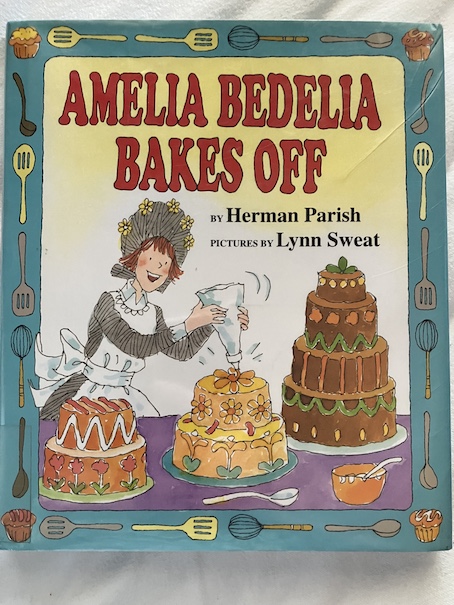
Amelia Bedelia Bakes Off

Amelia Bedelia Bakes Off cover

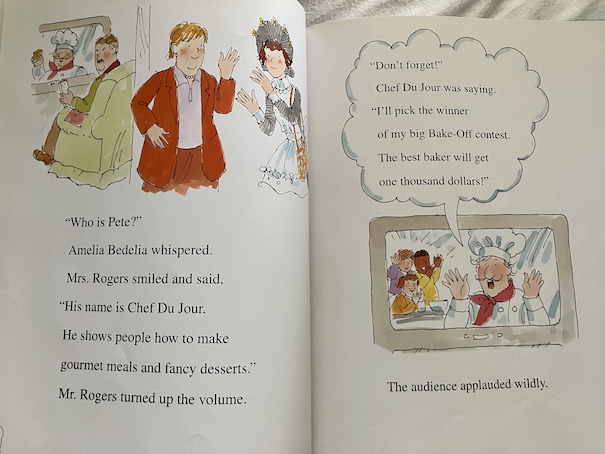
Mr. Rogers has been watching a tv show called What’s Cooking? with Chef Du Jour, and there’s going to be a Bake-Off contest in town! Because Amelia Bedelia is so good at baking, Mr. and Mrs. Rogers think she should try to enter the contest.
Amelia Bedelia Bakes Off contest announced on the tv show

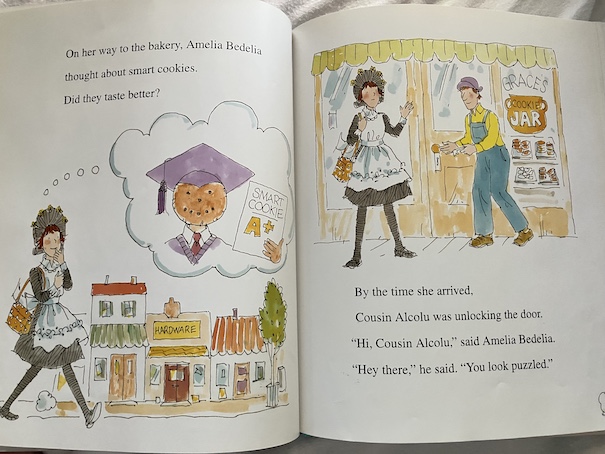
She is a good baker, but Amelia Bedelia has already agreed to spend the day taking care of the bakery called Grace’s Cookie Jar with her Cousin Alcolu while Grace is out of town. Even though Amelia Bedelia is good at baking, it turns out that she isn’t any better at following someone else’s baking and recipe instructions than she is at following any other to do list written by someone else.

Amelia Bedelia Bakes Off - Amelia meets her cousin at the bakery

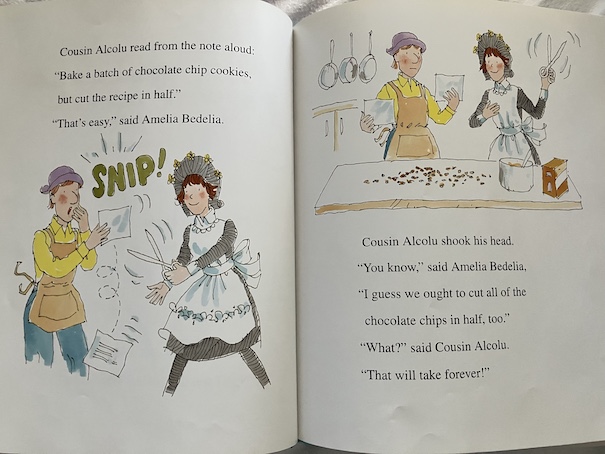
When Amelia Bedelia meets Cousin Alcolu at the bakery, they read the notes that Grace left for them. The first note tells them to “start every recipe from scratch”, so of course, they have to scratch each other’s backs before they begin cooking. From there, Amelia Bedelia thinks that cutting a recipe for chocolate chip cookies in half means that they have to literally cut the recipe paper in half. Then, for good measure, Amelia Bedelia thinks they should cut all the chocolate chips in half, too.

Amelia Bedelia Bakes Off - Amelia literally cuts a recipe in half

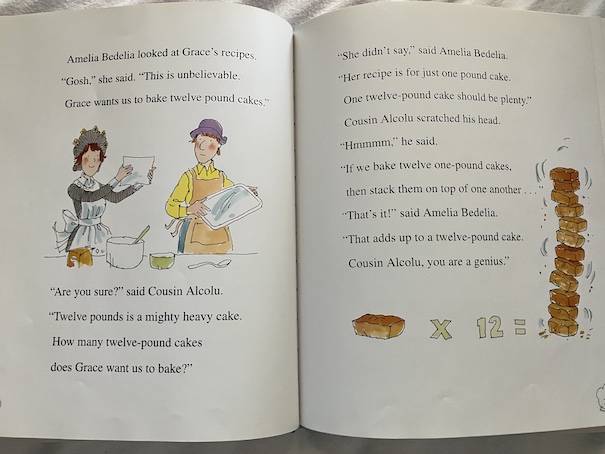
When Grace’s instructions ask them to bake “twelve pound cakes”, she assumes that she wants a cake that weighs 12 pounds instead of baking 12 small pound cakes. Fortunately, because that seems like such a big task, Cousin Alcolu suggests that they bake twelve one-pound cakes and just stack them, which is closer to what they’re actually supposed to do.

Amelia Bedelia Bakes Off - Amelia and her cousin stack pound cakes

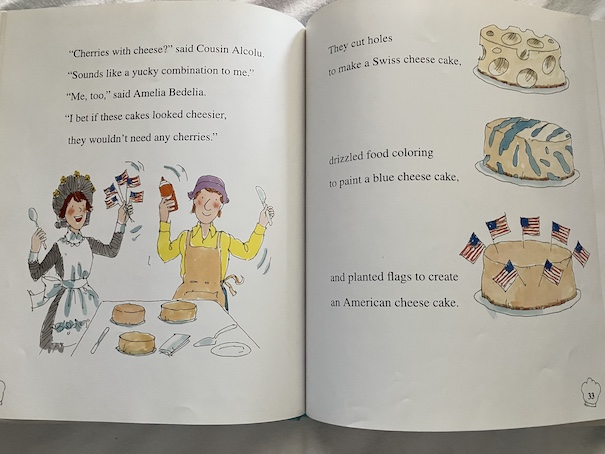
Amelia Bedelia and Cousin Alcolu get creative with decorating the cheesecakes because Amelia Bedelia doesn’t want to top them with cherries, like Grace asked. She just doesn’t think that cherries and cheese go together. Instead, they decorate them on the theme of cheese. Even though they don’t go about their baking in quite the way they’re supposed to, the things they make are still good.

Amelia Bedelia Bakes Off - Amelia and her cousin decorate cheesecakes

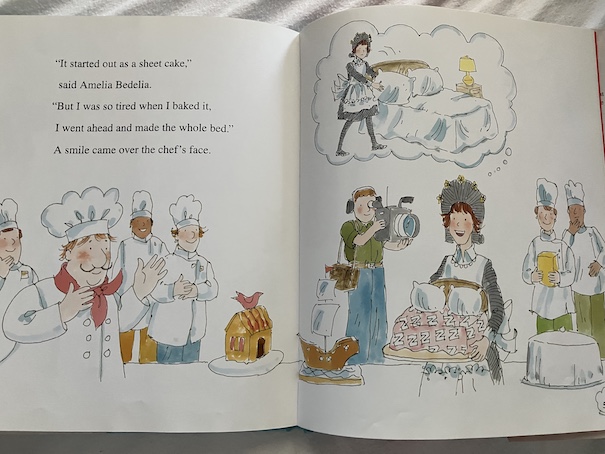
At the end of the day, Amelia Bedelia is tired, but she bakes one last cake for the Bake-Off. Since she’s so tired, she uses that a creative theme for her “sheet” cake! The book includes the recipe for Amelia Bedelia’s Sheet Cake.

The book is available to borrow and read for free online through Internet Archive.

Amelia Bedelia Bakes Off - Amelia decorates a cake to look like a bed

Amelia Bedelia books are supposed to be ridiculous, playing off of expressions and words with multiple meanings. They aren’t really supposed to make sense so much as poke fun at Amelia Bedelia’s literal interpretations or confusion over instructions that other people give her.

I found this one a little out of character for Amelia Bedelia because one of her signature traits is that she’s good at baking. In other books, her baking skills often save her job or diffuse people’s anger at other instructions that she’s misinterpreted. Of all the things that Amelia Bedelia might understand, you would think she would know how to read a recipe. Although, admittedly, this isn’t the first time that she’s misunderstood something that someone else asked her to bake because she once cut up a calendar when she was asked to bake a “date cake”, apparently not understanding that dates are fruit. Now that I think about it, Amelia Bedelia also seems to bake her best dishes from memory, not usually consulting a recipe. Above all, though, there are a lot of baking and cooking expressions that would be fun to see Amelia Bedelia misinterpret (like when Amelia Bedelia pinches Cousin Alcolu when a recipe calls for a pinch of salt), and that’s what’s really the point of the story.

I did enjoy that, even though Amelia Bedelia and her cousin misinterpret Grace’s instructions, the things they make still taste good, and most of them are more or less what they’re supposed to be, like the cookies and the pound cakes.

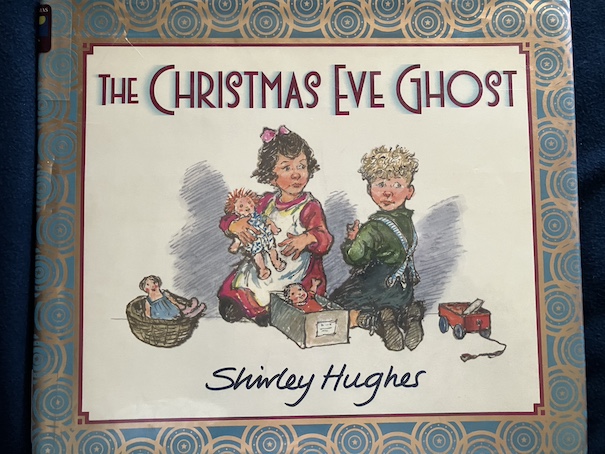
The Christmas Eve Ghost

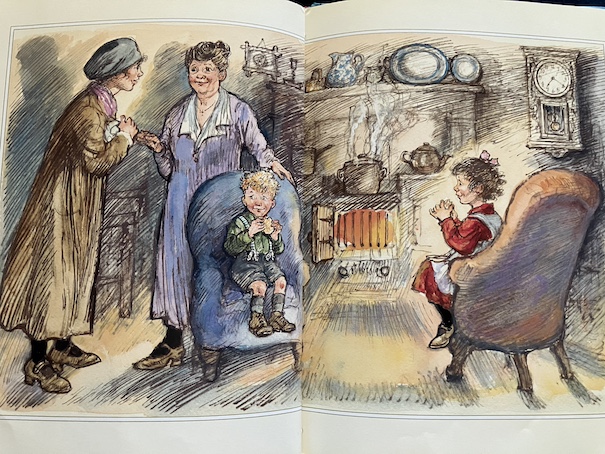
Bronwen and Dylan are two young children who live in Liverpool. They moved there from Wales with their mother after their father died in a mining accident. The family is poor, and their mother works out of her home as a laundress. When she has some free time, she tells the children exciting stories about dragons and ghosts.

The family living next to them, the O’Rileys, are also poor, but the children’s mother discourages the children from being too friendly with them. The children don’t fully understand why, but it has something to do with the fact that the O’Rileys go to a different church. Bronwen’s mother tells her that the O’Rileys are not their kind of people and that she doesn’t want her to go near their church.

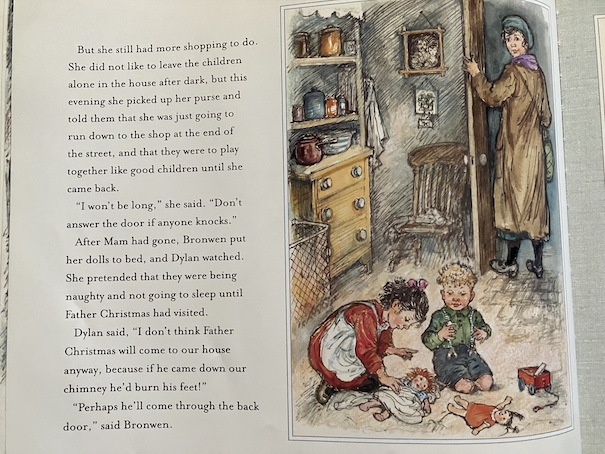
As Christmas approaches, “times are hard”, and the children’s mother doesn’t have much money. She saves what she can to give the children a bit of a treat, but she can’t spare much. Although their mother doesn’t like leaving her young children home alone, on Christmas Eve, the children are tired, and she needs to do a little more shopping. She tells the children to be good, play nicely, and not open the door for anyone and that she will be back soon.

Things are fine at first, but then, the children begin hearing a strange sound. They can’t figure out what it is, but it seems to be coming from their mother’s wash house. Based on their mother’s stories, they think maybe it’s a ghost! In a panic, Bronwen and Dylan run out of their house and straight into Mrs. O’Riley. Fortunately, Mrs. O’Riley knows what the sound is, and as a mother herself, knows what to do.

The book is available to borrow and read for free through Internet Archive.

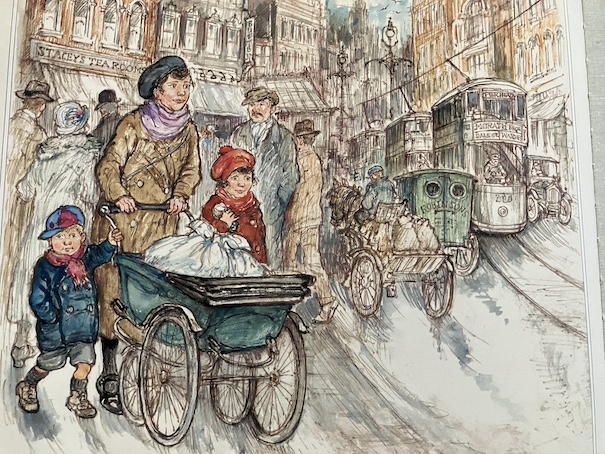
Although this story never explains what year it takes place, it appears to be set during the Great Depression. (Although the Great Depression started in the United States, and this story is set in England, economies all over the world are and have been connected to each other. When one country’s economy experiences something catastrophic, it affects everyone else. The Great Depression was a worldwide event.) The setting is partly in the way people are dressed but also in their circumstances. The way the mother does the laundry is an old-fashioned, labor-intensive process. More tellingly, not only is the children’s widowed mother poor and struggling to get by as a laundress, but the O’Rileys are struggling, too. The children in the story know that Mr. O’Riley and his grown sons often work at the docks, and when there’s no work for them there, they hang out on the street with other men looking for work, and they don’t always find it. This is a time when everyone is poor and suffering. In the back of the book, the author explains that the story was based on her own memories of growing up in Liverpool in the 1930s.

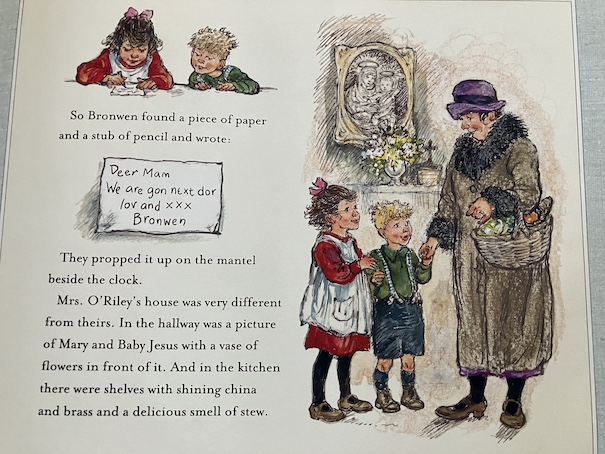
The book doesn’t explicitly identify what the O’Rileys’ religion is because the story mainly focuses on young Bronwen and her perspective. The Irish name is a clue, but Bronwen also says that she once looked inside the church that the O’Rileys attend, out of curiosity, and she saw stained glass, candles, and statues, far more decoration than she normally sees in the comparatively plain church she attends with her mother. These are features of Catholic churches that aren’t always found in Protestant churches, at least not to the same degree, especially in more strict Protestant churches. The religious symbols in the O’Rileys’ house also confirm that this is a Catholic family. The issue between Bronwen’s mother and the O’Rileys is the conflict between Catholics and Protestants, and Bronwen’s mother fearing that the O’Rileys and their different ways might have a negative effect on her children.

In real life, in the modern world, I wouldn’t recommend small children going into a neighbor’s house without their mother’s knowledge and approval, but in the story, it works out for the best. When Bronwen and Dylan’s mother finds out how Mrs. O’Riley helped look after the children when they were alone and scared, she realizes that she can trust the O’Rileys. Mrs. O’Riley even offers to look after the children sometimes when their mother needs to go somewhere, and the children’s mother is grateful. It’s difficult for her, being on her own and not living near other relatives, who could help look after the children. She needs someone to rely on for help sometimes, and the key to finding someone is being open to getting help from people around her, regardless of their religion.

I thought was also telling that the neighbors’ last name is O’Riley. That’s an Irish name. Bronwen and Dylan’s family moved to Liverpool, England from Wales, but it seems like the O’Rileys have probably moved there from Ireland. We don’t know the history of the O’Riley family and how long they’ve lived in Liverpool, but it seems likely that both of these families are from somewhere else, living in an area that probably has a lot of immigrants who are struggling to get established and look for new opportunities in a new place during economically rough times. Aside from the religious differences, their positions are probably pretty similar.

I enjoyed the old-fashioned charm of the pictures in the story. The family lives in a small, old-fashioned house, and they are obviously poor, but at the same time, it’s charming and cozy.

Sharing the Bread

This is a charming picture about a family preparing for an old-fashioned Thanksgiving. The story is told in rhymes as the family begins preparing and cooking their feast.

Every member of the family gathers in their kitchen, which appears to be a late 19th century or early 20th century kitchen, with a wood-burning stove.

Everyone, including the children and grandparents, has something to do, from preparing the turkey to making bread, cranberries, and pumpkin pie and washing dishes. The children also make place mats in the form of pilgrim hats.

As they set the table, everyone is a little tired but pleased with their feast. Then, they all say grace and enjoy the feast that they have prepared, thankful for what they have and the family who made it all with love!

The book is available to borrow and read for free online through Internet Archive.

I thought that this story was sweet, and it had fun and simple rhymes for kids. Everyone in the family has something to do to get ready for Thanksgiving, and adults reading the book with kids can point out how each of the family members relate to each other – grandfather, grandmother, father, mother, son, daughter, brother, sister, aunt, uncle, etc.

The pictures are charming, and I love the look of the old-fashioned kitchen where this story mainly takes place! Adults can also point out to kids how this old-fashioned kitchen is different from the kitchens in modern homes, with its pump at the sink, the wood-burning stove, and the herbs hanging on the wall.

The Pumpkin Head Mystery

The Boxcar Children

The Aldens are getting ready for Halloween, and they go to the Beckett farm to get some pumpkins. Mr. Beckett has been having trouble this year because he broke his leg. He’s been letting a hired assistant, Bessie, handle the pumpkin patch, but she is short-tempered and not very good with customers. Mr. Beckett fired her once before, but he had to take her back this year because he was desperate for help.

Mr. and Mrs. Beckett’s daughter, Sally, has been trying to persuade them to sell their farm and come live near her and her children in Florida. She thinks they’re getting too old to manage the farm by themselves and that this recent injury of Mr. Beckett’s proves it. The Becketts say that they don’t want to give up their farm and that they’re not ready to retire. Then, one of the farm hands, Jason, says that Mr. Beckett broke his leg while chasing a pumpkin-headed ghost, but Mr. Beckett denies that it exists.

Later, someone trashes the pumpkin patch and smashes a lot of pumpkins, and for some reason, Bessie faints. The real estate developer who is pressuring the Becketts to sell their farm, Dave Bolger, shows up again and tries to persuade the Becketts to sell. Sally thinks her parents should take the offer, but they still refuse. The Aldens help clean up the pumpkin patch in time for the next hayride, so the Becketts won’t have to cancel it, and Sally tells them that the farm is haunted and that the stories Jason has been telling about the pumpkin-headed ghost are true.

A glowing pumpkin has been seen floating through the fields at night, seemingly with no body underneath it. When it appears, they hear scary voices, telling them to leave the farm and leave the spirits in peace. Mr. Beckett did injure his leg while trying to chase after it on his horse. The Aldens think this sounds scary, and they ask Sally if the farm was always haunted. Sally admits it wasn’t, but she is serious that she thinks her parents should sell the place and move closer to her and her family.

The Aldens want to help the Becketts, and they start doing some seasonal work at the farm, making flyers for their hayrides and dressing up in costumes as part of the spooky attractions. Then, someone steals the scarecrow that Benny made from the Aldens’ house, and a new pumpkin-headed ghost appears on the farm!

Are there actually any ghosts, or is someone pulling a trick on the Becketts? Is it one of the people trying to pressure the Becketts to sell the farm or someone else, for a different reason?

I enjoyed this spooky mystery! The author did a good job of making multiple characters look like good suspects for playing ghost on the farm. Mr. Bolger and Sally both want the Becketts to sell the farm, and scaring farm workers and visitors away from the farm would add pressure to the Becketts. Bessie isn’t very good at her job, but the Aldens discover that she needs money because her husband is sick. Could she have been paid to commit some sabotage on the farm or could she be trying to get back at the Becketts for firing her last season? Jason has worked on the Becketts’ farm for years and seems to love the place, but he’s been arguing with Mr. Beckett about the way he runs the farm. Maybe Jason wants the farm for himself! There are some good possibilities for suspects.

There were some clues that I thought were obvious, like the connection between the disappearance of Benny’s pumpkin-headed scarecrow and the sudden appearance of a new pumpkin-headed ghost on the farm, but child readers may find the mystery more challenging. Even though I thought some parts were obvious, because there were several suspects, each of which seems to be doing something sneaky that they want to cover up, I wasn’t sure whether some of them might be working together or not.

The book has the right amount of spookiness for a Halloween story without being too scary for kids. In some ways, like with all Scooby-Doo style pseudo-ghost stories, I thought that it was a little silly for the plot to frighten people away from the farm to succeed. My reasoning is that, since this story is set in the Halloween season and some parts of the farm are deliberately set up as haunted attractions with people running around in costumes, I would think most farm workers and visitors would just attribute the pumpkin-headed ghost to either a Halloween prank or just part of the act at a spooky attraction.

One of the possible motives that they never discuss in the story is that the ghost act could be a publicity stunt to draw more visitors to the park. While the premise of the story is that people are being scared away, in reality, there are a lot of curiosity-seekers who would want to go to a supposedly haunted attraction to see what all the fuss is about. Publicity isn’t the real motive of the fake ghost, but I’m just saying that it could have been a real possibility that was overlooked. There are a lot of places, like hotels and restaurants in historic buildings, that capitalize on any potential ghost stories to attract curious thrill-seekers.

Something I appreciated is that the real estate developer is Dave Bolger, which is a homage to Ray Bolger, who played the role of The Scarecrow in the 1939 movie of The Wizard of Oz. Is that a hint? I’ve decided not to spoil the solution of the mystery!

The Zombie Project

Boxcar Children

The Alden children are staying in a cabin at Winding River Lodge because their grandfather is friends with Maude Hansen, who owns the lodge. They’re enjoying the fall weather in the woods, and Violet is taking pictures and videos of their trip with their new camera.

There are other people staying at the lodge, too. A newspaper reporter named Madison can’t help but stay on top of the news while she’s there. She tells everyone about a wealthy businessman, Matthew Donovan, who vanished after apparently stealing millions of dollars from his company’s investors. Surprisingly, the charity golf tournament he sponsors is still taking place in his absence. Madison also has a blog about haunted places, and she tells Maude that she’d like to include the Winding River Zombie on her blog. Maud says that the zombie is only a story that her great grandfather made up and that it doesn’t really exist. Benny asks what a zombie is, and his older siblings reluctantly tell him that it’s an undead monster from the movies that eats people. They hope that the idea of the zombie won’t give Benny nightmares.

That evening, when people are telling stories around the campfire, Maude’s teenage grandson, Jake, tells everyone the zombie story. He says that there used to be an old hermit who lived in the woods, and one day, his great grandfather found the old hermit dead. He reported the death to the local sheriff, and they tried to locate the hermit’s family, but they never found out who he really was or where he came from. With no one else to make funeral arrangements, the Hansens arranged for the old hermit to be buried in a nearby cemetery. Then, not long after, a camper had a frightening encounter with a strange man who tried to grab him and bite his arm with bloody teeth! The Hansens found out that someone had dug up the old hermit’s grave and that the body was gone. People believed that the old hermit had turned into a zombie and still lurked in the woods. Jake’s teenage friends love the zombie story, and Jake claims that he’s seen the zombie before.

When Benny thinks he sees a zombie in the woods and lights in the woods at night, the Aldens wonder if the zombie story could be true or if something else is going on. Do the Hansens fake the appearance of the story to keep the legend alive? Could Madison be faking the zombie or getting someone to play zombie so she’ll have a more exciting story for her blog? Or is there something or someone scarier lurking in the woods?

I was a little surprised at the zombie theme of the story because, although The Boxcar Children series has other spooky stories, the lumbering, cannibalistic undead seems more gruesome than this series normally gets. The unusual darkness of the subject shows in Benny’s siblings’ initial reluctance to explain to Benny what zombies are, for fear that he’ll have nightmares. However, the story doesn’t get overly scary, considering the theme. They don’t explain, for example, that zombies in movies typically want to eat human “braaaaiiiiiiinnnnns!” It’s scary enough that they might just generally want to eat people. Maude is also careful to say from the very beginning that there was never any truth to the story. It was always just something her family made up for the benefit of the tourists.

As some readers might guess, the missing businessman has something to do with the appearance of the “zombie”, but that’s not the entire explanation. There are multiple people involved in the so-called zombie sightings, which confuses the issue for the Aldens. I thought the other people involved were obvious because of some of the things the characters said, but younger readers will probably still find the story thrilling. It’s very much a Scooby-Doo style pseudo-ghost story mystery, not too gory or gruesome, but exciting for kids who like things a little spooky.