The Most Beautiful Place in the World

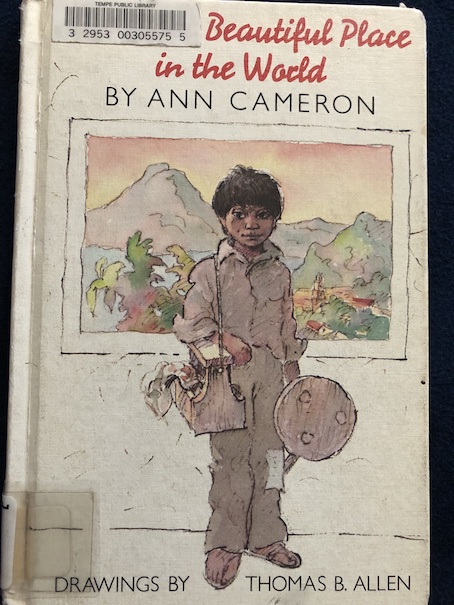
The Most Beautiful Place in the World by Ann Cameron, drawings by Thomas B. Allen, 1988.

Juan is a little boy living in the town of San Pablo in Guatemala. It’s not a very big town, but it is very busy. The town is on a lake with several other towns around it, but Juan has spent his whole life in San Pablo.

Juan is from a poor family, although he doesn’t consider his grandmother poor because she owns her own house and is able to take in other relatives whenever they fall on hard times. He knows that his father was the caretaker of a big house in the town, but he abandoned him and his mother when Juan was still a baby. His mother says that his father wanted to continue partying with his friends like he did when he was a single man, spending more than they could afford. After they argued about it, he left his family and went to a bigger city and never tried to see them again. Juan’s mother moved back in with her mother, so Juan grew up in a crowded little house filled with other relatives who needed help because they had gotten sick, lost their jobs, had marital problems, or various other things going wrong in their lives.

Juan’s grandmother supports herself by making arroz con leche and selling it in the marketplace. When Juan is still a small boy, his mother remarries to a man who doesn’t want anything to do with Juan, so his mother abandons him, leaving him with his grandmother. Juan is distressed by his mother’s abandonment, but his grandmother continues to look after him and begins preparing him to live an independent life from a young age. She has him help her sell arroz con leche in the marketplace, and later, she teaches him how to shine shoes so he can earn his own money. Juan is still very young, but his grandmother knows that life will tough for him without his parents.

Juan knows that his mother has had another child, and he feels jealous of his younger half-brother because he gets to live with his mother, and he doesn’t. (I question whether the younger half-brother is really going to be better off in the long run, but I’ll explain why below.) However, he is really jealous of the other children in town who get to go to school. Not all children in town go to school because many are from poor families, who need them to work and earn money, but Juan wishes that he could go to school, too.

He quietly teaches himself to read the signs in town and a newspaper, but he’s afraid to ask his grandmother about letting him to go school at first. He’s worried that, if he asks for that, his grandmother may tell him that she only cares for him because of the money he earns. If his grandmother abandoned him or withdrew her affection for him because he asked for too much, Juan doesn’t know what he would do. However, when he finally brings up the subject of school with his grandmother, he learns how much she really does care for him, how much she plans for his future, and how proud she is of him.

The book is available to borrow and read for free online through Internet Archive (multiple copies).

My Reaction

Juan’s family is poor, and at first, Juan doesn’t understand fully how poor they are. His grandmother’s life is more secure than others because she owns her own house, while others don’t, but even she has limited resources. The house has running water, but it doesn’t have electricity because she can’t afford it. She takes in other relatives when they are in trouble because she cares about her family, but she also has to make sure that everyone does whatever they can to support themselves because she can’t do it alone.

At first, Juan thinks that maybe she just keeps him because he earns money shining shoes, and she keeps most of his wages. However, when he talks to her about school, he learns that she has not spent any of his wages on herself or on other relatives. Instead, she has secretly saved them up because she knew that he would need money for his education, and she uses it to buy school supplies for him. At first, his teacher doesn’t want to accept him in class because the school year has already started, but when he demonstrates that he has already learned math from working in the marketplace and has taught himself to read, she accepts him. He exceeds everyone’s expectations for him, and his teachers even say that they will contribute to his education, if necessary, to keep him in school.

Juan’s grandmother cannot read, and she reveals that her parents wouldn’t let her go to school when she was young, even though she wanted to go. Her parents were afraid that she wouldn’t learn to do any practical work in school, so they didn’t want her to get an education, but she’s always felt disadvantaged because of it. She’s managed to get by in life, but she realizes that she could have done better with an education. She says that if Juan continues to work after school and does well in school, she’ll support his education, as far as he wants to go, even to the university. She says maybe he’ll even be able to figure out some of the big questions in life, like “why some people were rich, and some were poor, and some countries were rich, and some were poor, because she had thought about it a lot, but she could never figure it out.” Juan worries that he won’t be able to live up to his grandmother’s expectations for him, but she tells him not to worry about that. She just hopes for the best for him and wants to see him do the best he can because she loves him, and that’s what Juan really needs to hear.

The title of the story comes from a tourist poster that Juan reads to his grandmother, calling their town, “The Most Beautiful Place in the World.” Juan’s grandmother thinks that the most beautiful place in the can be anywhere where a person can be proud of who they are, but Juan privately thinks that the most beautiful place in the world is somewhere with someone you love and who loves you back. Juan has been deprived of love because of his parents’ abandonment of him, but he has found the love and support he needs from his grandmother, who wants him to succeed in life because she loves him and not just for what he can do for her.

Parts of the story are sad because Juan’s parents callously abandon him, and even his mother tries to act like it’s nothing because she knows his grandmother is taking care of him. I tried to decide how selfish Juan’s mother is in the story. On the one hand, I can see that she is poor and desperate and may have felt compelled to accept the first marriage proposal she was offered just to get out of her mother’s house, but she is very callous to her little son and his feelings and needs.

At first, he doesn’t even quite understand why his mother has left him, not even leaving him the bed they shared, so he has to sleep on some empty rice bags. He goes to his mother’s new house and tries to spend the night there. His mother lets him stay the night but hides him because she says his stepfather will beat him if he catches him in the house, which is why Juan never goes there again. I don’t know whether the stepfather ever beats Juan’s mother or the child they later have together, but the mother’s comment makes me think that it’s likely. Yes, Juan’s mother succeeded in getting remarried and out of her mother’s house, but I don’t think she’s really headed for a better life, and I have doubts about the future her younger child will have. It looks like the stepfather is selfish and temperamental, probably every bit as immature as Juan’s father was, and the children’s mother will always place her own needs first. As hurtful as it was for Juan to be abandoned by his mother, his mother is not going to nurture him and his future in the way his grandmother does. His grandmother has to be tough sometimes because of the family’s poverty, but she still does her best to look after everyone, even at her own expense, because she does love her family and wants the best for them and their futures, not just to get what she wants from other people and get ahead by herself. I would say that’s the quality that makes her different from Juan’s mother. At one point, she even marches Juan to her daughter’s new house and demands that she and her new husband at least provide a real bed for her son, reminding them of their responsibilities.

The book doesn’t go into the details of Guatemalan society and events in the 1980s, when this book was written, which was something I wanted to see. It’s pretty simple story for elementary school level children, but there is more going on behind the scenes that Juan would be aware of as a young boy living in a small town. The time period when this story was taking place was during the Guatemalan Civil War, which lasted from 1960 to 1996. The war and sharp differences in social class are partly responsible for the economic and societal inequities that Juan’s grandmother describes, although the economic and social disparities in Guatemalan society were part of the reason for the war in the first place. There was also general dissatisfaction with government incompetence and interference in Guatemalan affairs on the part of the United States, which sought to use Guatemala as part of its Cold War strategy, including using it as a training ground for Bay of Pigs Invasion against Cuba. These are complicated and long-term situations that would require more explanation than a children’s book of this level can provide, and because the characters in the story live in a small town, they may not be seeing many of these events directly. As he gets older, Juan will probably become more aware of the wider world and the circumstances that have shaped his family’s lives, as his grandmother hopes and expects, especially if he does end up going to the university in the capital city.
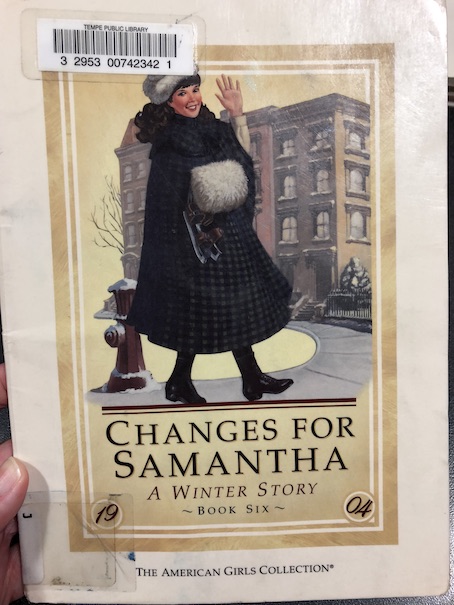
Changes for Samantha

American Girls

Changes for Samantha by Valerie Tripp, 1988.

This book is part of the Samantha, An American Girl series. This is the last book in the original series of Samantha’s stories and explains the changes in the lives of Samantha and her friends, especially Nellie. When Samantha met Nellie in the first book in the series, Nellie was a poor girl working as a servant girl in a neighboring house. Later, Nellie and her family moved to Samantha’s town, Mount Bedford, and Nellie and her sisters were able to attend school for the first time.

Now, Samantha has moved to New York City to live with her Uncle Gard and his new wife, Aunt Cornelia. Samantha likes living with them, although their housekeeper, Gertrude, is strict and often makes her feel like she’s doing things wrong. Samantha’s grandmother, a widow, has remarried to her long-time friend, the Admiral. Samantha’s life has changed considerably since the first book. Since her move to New York City, Samantha hasn’t seen Nellie or her sisters, but their lives have also changed, and not for the better.

When the book begins, Samantha and Aunt Cornelia are making Valentines to give to friends and family. Samantha receives a letter from Nellie that says that her parents have died of the flu and their employer, Mrs. Van Sicklen, is sending her and her sisters to New York City to live with her Uncle Mike. Nellie says that she’ll try to visit Samantha in New York City soon. Samantha is upset to hear that Nellie’s parents are dead, but Uncle Gard and Aunt Cornelia reassure her that Nellie’s uncle will take care of her and that she’ll soon be living much closer to Samantha.

After some time goes by and Samantha doesn’t hear any more from Nellie, she begins to worry about her. Uncle Gard decides to call Mrs. Van Sicklen and find out Nellie’s new address, but she doesn’t know where Nellie’s uncle, Mike O’Malley, lives. All Mrs. Van Sicklen knows is that he lives on 17th or 18th Street, but New York City is so big, that doesn’t help much. Uncle Gard and Aunt Cornelia say that maybe Nellie has had to get a job or look after her sisters and that she’s just been too busy to visit, but Samantha is still worried that something is very wrong.

Samantha decides to start asking around 17th and 18th Streets to see if she can locate Mike O’Malley, and she finds a chestnut seller who knows Mike O’Malley. However, he warns Samatha not to get involved with him because Mike O’Malley is a “hooligan.” Samantha worries about that, but it’s just another reason for her to want to check on Nellie. When she reaches the apartment where Mike O’Malley last lived, he isn’t there anymore. His neighbor explains that Mike O’Malley was a drunk who simply abandoned his nieces in his old apartment. The neighbor took the girls in for a while, but she is a poor woman with children of her own to raise, so she had to turn Nellie and her sisters over to an orphanage, the Coldrock House for Homeless Girls.

Samantha tells her aunt and uncle what she’s learned, and they’re upset that she went to such a dangerous part of the city alone. However, Aunt Cornelia agrees to take Samantha to the orphanage to see Nellie. The directoress, Miss Frouchy, is a stern and sneaky woman, but she agrees to let Samantha see Nellie, even though it isn’t a visitors’ day. It is difficult for the girls to speak candidly with Miss Frouchy watching them and monitoring everything that Nellie says. When Aunt Cornelia asks if Nellie and her sisters need anything, Miss Frouchy interrupts and says that they don’t. However, Samantha notes how thin Nellie looks and suspects that there is more going on than Nellie is being allowed to say, and Miss Frouchy even confiscates the cookies meant for Nellie and her sisters right in front of Aunt Cornelia and Samantha.

Aunt Cornelia asks Miss Frouchy for a tour of the orphanage so that Nellie and Samantha can be alone, and so the girls are able to speak openly. Nellie confirms that things are hard at the orphanage and her sister, Bridget, isn’t strong. Miss Frouchy thinks that Bridget is lazy and doesn’t want to work, so Nellie tries to cover Bridget’s chores as best she can. Samantha says that Nellie could come and stay with her and her aunt and uncle, but Nellie says that they probably don’t need any more maids. Samantha offers to hide Nellie and her sisters, but Nellie thinks that plan is too risky. More than anything, Nellie wants to keep her sisters together. She says with a little more training, she could find a job as a maid and support them.

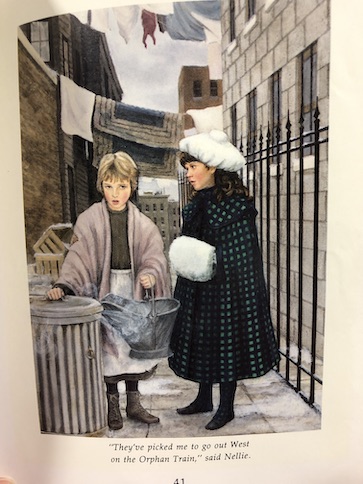
Samantha returns to the orphanage again with her aunt and uncle to visit all three girls, and she and Nellie arrange to meet secretly at the time when Nellie is supposed to take the fireplace ashes out to the alley for disposal. At their next meeting, Samantha finds out that Miss Frouchy took the gloves that they had given Nellie and even punished her for having them because she said that she must have stolen the gloves. However, there is worse to come. Soon, Nellie tells Samantha that she has been chosen to be sent out west on the Orphan Train, but because her sisters are too young to go, they’ll be left in New York alone. With the sisters about to be split up, Samantha’s plan to help the girls run away and hide is looking better.

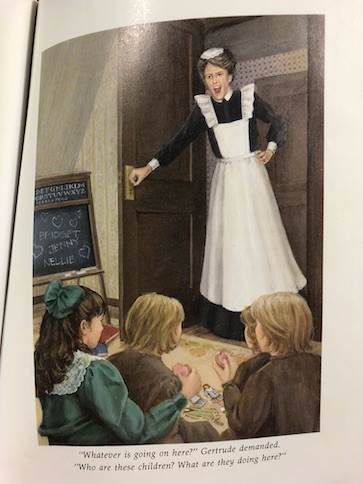
Together, Nellie and Samantha help to sneak the younger girls out of the orphanage, and Samantha hides the three of them in an upstairs room in the aunt and uncle’s house that isn’t being used. She sneaks food and toys upstairs to them, and Nellie sneaks out during the day to go looking for work. However, Gertrude soon gets suspicious about how much food Samantha seems to be eating and how she seems to be sneaking around with it. When the girls are finally caught, Samantha owes her aunt and uncle some explanations, but admitting the truth of what has happened changes things for the better for all of the girls.

In the movie version of the Samantha series, which combined all the stories from the Samantha books into one, the story ends at Christmas, but in the book, it’s Valentine’s Day. The Christmas ending is nice, but Valentine’s Day does make for a nice difference, and love is appropriate to the theme of the story. Uncle Gard and Aunt Cornelia end up adopting Nellie and her sisters, so they officially become part of Samantha’s family. Unlike other characters in the story, who see the orphans as either an inconvenience or a source of cheap labor, Uncle Gard and Aunt Cornelia genuinely love them and want to raise them.

Something that struck me about the book was that both Nellie and Samantha are orphans, but their lives were very different at the beginning of the story because Samantha is from a wealthy family with an uncle who loves her and Nellie is a poor girl with an irresponsible uncle. If Samantha had been poor, she might have been destined for an orphanage or the orphan train herself. Because she wasn’t and because her family looks after children well and is willing to share what they have with others, Samantha has a secure future, and Nellie and her sisters become part of their family.

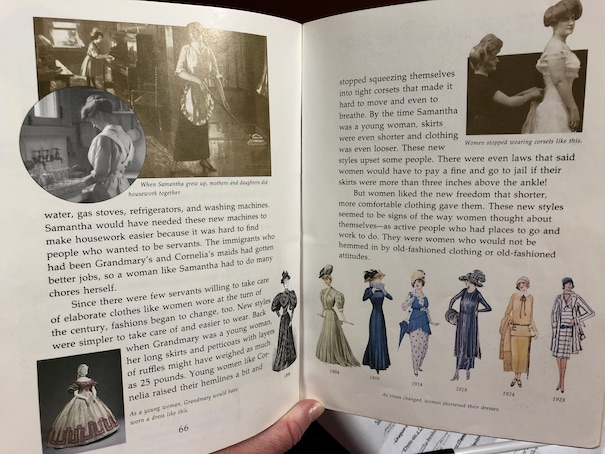
The book ends with a section of historical information about all the changes taking place in Samantha’s time, from technological changes, such as the first airplanes and new cars, to the increasing sizes of cities and new immigrants arriving in the United States.

As girls like Samantha grew up, society continued to change. In earlier books, Samantha’s grandmother talked about how young ladies aren’t supposed to work but learn how to be ladies and take care of a household. By the time Samantha was an adult, in the 1910s and 1920s, it was becoming more common for women to hold others jobs, although they would often stop working when they got married so they could focus on raising their children. The profession of social work evolved to help care for children like Nellie and her sisters. Some social workers also helped immigrants to learn English and train for new jobs when the came to the United States. The book specifically mentions Jane Addams, who founded the settlement house, Hull House.

Change is a major theme of all of the American Girl books, and a girl like Samantha would have seen some drastic changes in the ways that people lived as she got older. Over time, fewer immigrants looked for jobs as domestic servants, and newer forms of household technology, like washing machines, made it easier for housewives to do more of their domestic chores themselves. The section of historical information ends with examples of the changes in styles of women’s clothing through the 1920s, explaining how the changes in clothing styles were part of the changes in the types of lives the women wearing them were leading.

Although the book doesn’t go into these details, I would just like to point out how old Samantha would have been at various points in the 20th century. She was born in 1894, and ten years old in 1904, so that means that she would have been:

  • 23 years old when the US entered World War I in 1917
  • 26 years old when the 19th Amendment granted women’s suffrage in the United States in 1920
  • 30 years old in 1924 (Jazz age and Prohibition)
  • 35 years old when the stock market crashed in 1929, the beginning of the Great Depression
  • 47 years old in 1941, when the attack on Pearl Harbor occurred, and the US entered World War II, and 50 years old in 1944, when the Molly, An American Girl series takes place.
  • In her 50s during the early days of the Cold War. She would have to live to be 95 to see the end of it.
  • In her 60s through her early 70s during the Civil Rights Movement.

I like to think about these things because it puts history in perspective, and it gives us some sense of what Samantha’s future life might have been like. When she was a young woman, she may have joined the women’s suffrage movement with her Aunt Cornelia. She probably knew young men her age who went to fight in World War I. (Eddie, the annoying boy who lived next door to Samantha’s grandmother, would have been old enough to fight and may have been a WWI soldier himself.) Perhaps, Samantha’s future husband was a soldier. When she was older, Samantha could have either joined the temperance movement behind Prohibition or visited a speakeasy or at least knew people who did. It’s difficult to say what happened to Samantha’s family during the Great Depression. Depending on their professions and what they may have invested their money in, they may have lost their fortunes in the stock market crash, or they may have ridden out the whole thing in relative comfort. By World War II, Samantha may have had a son who was old enough to fight. One of the things I find interesting about historical novels with children is imagining what their future lives may have been like, and Samantha was born at a time when she would have witnessed many major events throughout her future life. The book shows how women’s fashions changed as Samantha grew up, but I’m fascinated by the events in Samantha’s life that I know must be coming, just because of when she was born. By the end of her life, the world would be a very different place from what she knew when she was young.

The book is available to borrow for free online through Internet Archive.

The Puppeteer’s Apprentice

The Puppeteer’s Apprentice by D. Anne Love, 2003.

Poor Mouse works as a scullery maid in a castle in Medieval England.  She has lived there all her life, since someone abandoned her at the castle as a baby.  She has no idea who her parents are, when her real birthday is, or exactly how old she is (the cook once said she was about eleven, but he wasn’t sure).  She doesn’t even have a real name; Mouse was simply the name given to her by the cook, who makes her work hard and beats her if she makes a mistake.  Mouse’s life is hard, but then one day, she makes a big mistake, and the cook gets in a rage and attacks her with a meat hook.  Mouse escapes from him and flees the castle.  She knows that she cannot go back, but she doesn’t know where to go. 

For the first time in her life, Mouse’s fate is in her own inexperienced hands.  For a time, she joins up with a group of travelers, who take her to the city of York.  However, none of them can adopt Mouse, and she must struggle to make a life for herself.  In York, Mouse sees a puppeteer performing, and she is inspired to learn to be a puppeteer herself.  Through a mixture of trickery and pleading, Mouse convinces the puppeteer to take her on as an apprentice. 

Although Mouse makes many mistakes at first, and the puppeteer gets angry and threatens to leave her behind, the two eventually learn to get along with each other.  Mouse gains skill at making and manipulating the puppets, and her confidence grows.  However, danger still lurks in the future, for the puppeteer also has a dark past and dark secrets which pursue the two of them in their travels.

The book is currently available online through Internet Archive.

My Reaction and Spoilers

Stories with abused and neglected children are always sad. Mouse is failed by various adults who are mainly focused on their own lives and securing their own positions in life before she finally becomes independent. We don’t know why Mouse was abandoned as a baby, although it was probably because her parents were poor and maybe unmarried, which would have been a stigma at the time. We can be pretty sure that, whatever happened, Mouse’s parents’ position in life was too precarious to take care of her themselves. The castle cook she lives with is mainly worried about his own job and is more of an unwilling employer to Mouse than a parent. In fact, employment is more of a theme in Mouse’s precarious life than family. Even the puppeteer is more of an employer to Mouse than a parent. Mouse learns from the puppeteer, but it’s as an employee, and Mouse is well aware that she can be abandoned at any time if she fails to please her employer. In the end, Mouse gains an independence that pleases her, but I still found it a little sad because it seems like the one and only person who can’t abandon Mouse is Mouse herself and that there is little or no security in trusting or relying on others. The eventual goal turns out to be employing herself so she doesn’t haven’t to rely on someone who can dump her. I suppose that can be true in real life, too, but it’s one of hard, dark sides of life.

Although, the adult characters’ focus on securing their own lives and positions first is also a testament to the nature of the time when the story is set. Opportunities are limited by social level, and there are few sources of support for those who suffer unfortunate circumstances. Although it seems like the adults in the story are cruel and neglectful, there’s also a desperation to their own situations. The one person in the story who is willing and able to offer more generosity to Mouse than other characters is able to do so because of his privileged position in life. Even the puppeteer, while seeming more free than other characters, is living under danger and threat, and there is genuine risk to sharing in her life that Mouse doesn’t come to understand until later.

The puppeteer always dresses in loose-fitting clothes to cover up the fact that she is a woman.  Although there is no reason why women cannot be puppeteers, she finds it necessary to disguise herself because she is pursued by an enemy from years ago.  Once, her father, who was a master puppeteer, saved the life of a young Duke who was attacked by a man named Ordin.  Ordin was trying to steal some of the duke’s lands.  The old puppeteer and his daughter stood witness against him, and he was thrown into prison.  Later, when he got out of prison, he attacked the party on the road, killing the old puppeteer and his companions.  Only the daughter escaped alive, and she became a puppeteer to support herself.  Ordin escaped, and she was forced to disguise herself to protect herself.  She even refuses to tell Mouse or anyone else what her real name is through most of the book. 

However, Ordin recognizes her one day while she and Mouse are giving a performance.  He and another highwayman follow them on the road and attack them.  The puppeteer kills the other highwayman but is gravely wounded herself.  Mouse fights back against Ordin, knocking him into the fire, and he burns to death.  They are not far from the duke’s castle, so the puppeteer sends Mouse there to get help.  Mouse tells the duke what happened to the puppeteer, and he has her brought to his castle.  The puppeteer, realizing that she will not recover from her wounds, finally tells Mouse her story and offers her name if Mouse wants it for herself.  The duke offers to let Mouse stay at his castle.  Mouse stays the winter, but in the spring, she decides to leave.  She has come to love life on the road, and she promised the puppeteer that she would take care of the puppets.  Mouse decides to take the puppeteer’s name, Sabine, as her own and sets off on a journey to find a place to perform her new puppet play, one telling the puppeteer’s story.