The Secret of Stonehouse

Stonehouse

The Secret of Stonehouse by Lynn Hall, 1968.

Heather has lived her entire life (as far as she can remember) in Scotland with her grandmother and her uncle, Donald.  Donald has raised her since she was small.  He’s been like a father to her, and she loves him like a daughter.  However, he recently decided to move the two of them to the United States, taking them to a small town in Wisconsin.  Heather can’t understand the reason for the move, and for the first time in her life, it seems like Donald is keeping secrets from her.

Donald seems oddly concerned that Heather shouldn’t tell people that she is adopted, something that he’s never seemed concerned about before.  Heather has asked him about her parents before, but all he can tell her is that his wayward brother Ewen brought her to the family farm in Scotland, saying that she was his daughter and that her mother was dead.  Ewen simply left her with Donald, never trying to see her or talk to her again and never sending her any money. Heather also knows that, although says that he’s going out to search for a new job, he’s been hanging out in other places, spending time with the mysterious Mr. Worley.

Heather makes friends with a boy named Gus who lives nearby.  Gus lets her ride one of the horses that his family owns, Cloud, and invites her to go riding with him sometimes and participate in local riding events called “shodeos.”  Heather loves horses and enjoys their rides together.

On one of these rides, the two of them go near a large, old, stone mansion that gives Heather a strange feeling.  Gus’s family tells her the tragic story of the family who used to live there, the Selkirks.  They were wealthy, but young John Selkirk was killed in an accident the day that his beautiful young wife, Molly, gave birth to their only child, a little girl named Hebron.  John’s parents never recovered from the loss of their son and passed away soon after, leaving just Molly and the baby.  However, when Hebron was only three years old, she was apparently abducted for ransom and later murdered, and her mother died soon after.  The story makes Heather uneasy, and the house gives her a strange feeling, like she’s drawn to it.

However, other sinister things start happening.  Someone in a car that looks disturbingly like Donald’s tries to run her and Cloud off a bridge.  When Donald spends the night away from home “on business”, someone sneaks into the house.  Heather begins to realize that someone is out to get her, some mysterious person means her harm.  Memories, dangerous ones, are beginning to surface in Heather’s mind, and someone is determined to try to keep her from remembering.

Part of the mystery is pretty obvious (at least, I thought it was, and you might guess it from my plot description), but the part that I didn’t guess was who was behind it all.

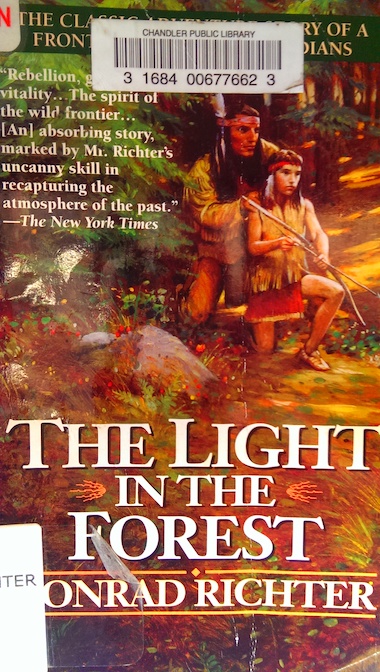
The Light in the Forest

LightInTheForestThe Light in the Forest by Conrad Richter, 1953.

Although this book was adapted into a live-action Disney movie in 1958, this is not a story that I would recommend for young children because of the level of violence.  I think I was in elementary school, about 10 or 11 years old, when I read it as a kid, but I wouldn’t recommend it for anyone that young anymore.  This book is bound to be controversial, but read to the end, where I discuss my reaction to it.

This story takes place in 18th century Colonial America, specifically in Pennsylvania.  Eleven years before the story begins, four-year-old John Butler was abducted by Lenape Indians and adopted by a member of the tribe as a replacement for a Lenape boy who had died.  His new “father” names him True Son and treats him as his son.  John/True Son comes to feel that his Lenape father is his true father, although he is aware that he had another father before.  Years later, in 1764, fifteen-year-old John/True Son remembers very little about his life among white people and now considers himself Lenape.  The Lenape recognize him as a full member of the tribe as well, but a recent treaty requires them to return all white people they have taken captive, including True Son.

The tribe reluctantly hands True Son over to white soldiers to be returned to his birth family, although True Son resists, even attempting to kill himself at one point to prevent it.  However, the suicide attempt is thwarted, and True Son is brought to Fort Pitt, where he is reunited with his birth father, Harry Butler.

Harry Butler takes John/True Son home to the rest of the family, but True Son refuses to acknowledge them as his family.  He pretends like he can’t understand English anymore and continues dressing like a Lenape.  The one member of the family he bonds with is his younger brother, Gordie, whom he had never met before.  Gordie is young and has no particular prejudice against Native Americans.  He finds the things that True Son does fascinating.  (The Disney film cut out the character of Gordie in favor of giving John/True Son a love interest, but I think that is a mistake because I think that the relationship between John and Gordie and how John/True Son views young children is central to the true theme of the story.  Read on.)

The family member that True Son really hates is his Uncle Wilse, who is known to have participated in a massacre against Native Americans.  Wilse thinks that John/True Son has been brain-washed by the Lenape and doesn’t really trust him.  When Wilse tells True Son that the Lenape have taken the scalps of children as well as adults, True Son denies it. The two of them argue, and Wilse slaps him.

True Son pines for his Lenape family, and when he learns that a couple of Lenape have been asking about him in the area, he manages to meet with them in secret.  One of them turns out to be Half Arrow, True Son’s cousin among the Lenape.  When Half Arrow tells him that friends of Wilse have killed a friend of theirs named Little Crane, the boys attack Wilse and scalp him in revenge.  (Not killing him, just scalping him.  It’s disgusting, but possible.  In the Disney movie, this scene is changed to a fist fight.)

True Son returns to the Lenape tribe with Half Arrow, and the tribe furthers their revenge for Little Crane’s death with a raid on a white village.  However, John/True Son is horrified when he sees the scalps of children as well as adults after the raid, proving that members of his tribe have killed innocent children and that Wilse was correct about that much.

When his tribe attempts to get True Son, posing as an ordinary white boy, to lure an unsuspecting group of white settlers into another attack, John/True Son must decide who he really is and what he really stands for.

The book is available to borrow and read for free online through Internet Archive (multiple copies).

My Reaction and Spoilers

In the end, John/True Son decides to alert the settlers to the imminent attack and warn them away because he sees children among them (in particular, a little boy who reminds him of Gordie, which is why that character is so important to the story) and can’t stand to see them killed.  His decision results in his banishment from the Lenape tribe.  At first, they were going to kill him for his disloyalty, but his adoptive father convinces them to spare his life, although he warns True Son that if members of the tribe see him again, they will consider him an enemy, so he can never become a part of their society again.  From this point on, John/True Son is on his own, and his fate lies in his hands alone.

Modern readers may be repulsed at the discussion of scalping (I know I was), and I’ve also heard arguments about whether the practice was more a Native American thing or one more often practiced by white people against Native Americans. Both sides do this in the story, but there are debates about where exactly the practice started.  My thought is that some things are just so disgusting that I can resent anyone who does them, regardless of who started it, but that’s neither here nor there.  Before anyone goes too far in that direction, I’d like to point out that we shouldn’t make the same mistake that most of the characters in the book do: overlooking the more immediate issue, which is True Son himself.

Throughout the story, John/True Son is a victim in more ways than one.  Because of his abduction at a young age, he is not only stuck in a personal identity crisis and a clash of cultures but has become a pawn in a power struggle between two societies that have each committed atrocities against the other.  In the beginning, he understands the most that the Lenape have been victimized by white people.  He comes to despise the white culture into which he was born and empathizes with the Lenapes’ attempts to strike back at the white people. Some of this might be a kind of Stockholm Syndrome (a term I didn’t know when I first read this book), but he is correct that men like his Uncle Wilse have committed great atrocities, and he wants no part of them.  However, against his wishes, he is thrust back into the culture he came from and into the middle of the conflict as a bargaining chip in a treaty.

After his time among his white family, he begins to see the conflict from both sides and to realize that not all white people are guilty of atrocities and deserve to be punished.  At the same time, True Son is forced to acknowledge that people close to him on both sides of the conflict have each done terrible things.  In the end, his sympathy is particularly for the innocent children who, like he was as a young child, have been brought into this cycle of hate, revenge, and killing without even their knowledge, having done nothing to deserve it.

We’re not quite sure what John/True Son’s life is going to be after the end of the story.  He has been rejected by the society he knows best, where he once thought he belonged, but whether his birth family and society will accept him back after what he’s done (the scalping of his uncle) is uncertain.  There is one thing that we do know: True Son has become his own man.  In a moment where he could simply have done what others asked, what they expected him to do, he made a difficult decision to stand up for what he really believed in, the protection of the innocent, regardless of their race, knowing even as he did so that there would be dire consequences for him personally.

We hope that John Butler/True Son manages to find some acceptance somewhere (probably among white society, which is hinted at the end of the book, but also probably on the fringe of it) and settle down to a more peaceful life, but we know that because of his troubled past, it isn’t going to be easy.  I would say that the overall message of the story is for people to consider the children and the generations to come and the impact that their decisions and their quarrels will have on their future and the kind of world the young people will grow up in.  John/True Son understands more about the horrors of fighting than either of the two sides involved, and he wants better for the younger children he finds at his mercy.

When you read other reviews of this book, you’ll see that there is some lingering resentment from people who were forced to read it in school.  It is a popular book for teachers to assign students to read around the middle school level (around age 12 to 14, roughly), and I have to admit that I often resented being forced to read depressing books in school myself.  This isn’t a happy story, but it is memorable and thought-provoking, and now that I’m an adult, what I remember best about the story is how John/True son feels about younger children and how he accepts the role of protecting them.

This story is based somewhat on real-life stories of abducted children from the same time period who also found themselves pawns in the struggles around them and felt conflicted when they once again came into contact with their birth families.  There are other books written on this topic, and the author of this one also wrote a book about a girl captive called A Country of Strangers.

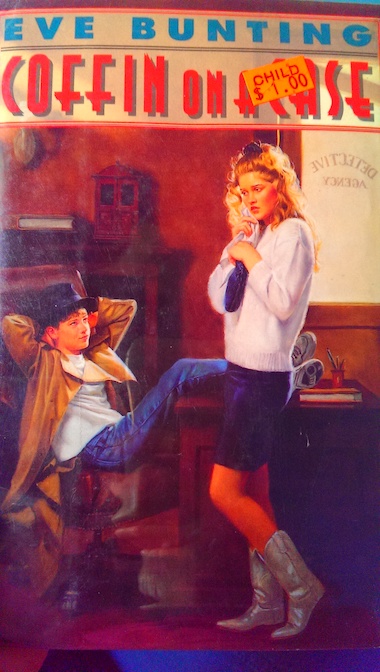
Coffin on a Case

CoffinCaseCoffin on a Case by Eve Bunting, 1992.

Twelve-year-old Henry Coffin’s father is a private investigator, and Henry hopes to be one himself someday.  He’s learned a lot by watching his father in action.  One day, a sixteen-year-old girl, Lily, comes to the office and asks for help in finding her missing mother.  Lily found her mother’s car in their driveway with groceries still in it, and her mother is nowhere to be found.  She doesn’t want to go to the police because she once called the police about her mother being missing only to discover that there was a mix-up and that her mother had tried to leave her a note that she hadn’t seen.  Lily has double-checked this time to make sure that there was definitely no note from her mother and none of her mother’s friends have heard from her, but she worries that the police would think that she’s being paranoid, so she decided to consult a private investigator instead.

Henry’s father is concerned about the disappearance of Lily’s mother, but he’s unable to take the case because he has to go out of town.  He tries to refer Lily to another investigator or a friend of his who is with the police, but Lily just storms out of the office.  Henry wishes that he could take the case for his father.  His own mother abandoned him and his father when Henry was just a baby, so disappearing mothers are of great concern to him.  Later, when Lily gets in touch with him, Henry agrees to help her without telling either his father or Mrs. Sypes, the housekeeper who has looked after him since his mother left.

At first, there doesn’t seem to be much to go on.  Lily’s mother makes wooden storks that she sells as lawn decorations to people who have recently had a baby.  She was going to sell a couple before going to pick up the groceries, but Lily says that there is an extra one missing.  Somewhere between the grocery store and home, Lily’s mother made an unexpected stop . . . and there are signs that someone other than Lily’s mother drove the car to Lily’s house.  But, who was it, and what happened to Lily’s mother?

The answers to these puzzles put Henry on the trail of some dangerous thieves who would do just about anything to cover up their crime.

The book is available to borrow and read for free online through Internet Archive (multiple copies).

My Reaction

Henry shows excellent deductive reasoning as he analyzes the clues and reconstructs Lily’s mother’s trail to learn what happened to her. Both Henry and his father are inspired by the fictional character, Sam Spade, and Henry makes frequent references to him in the story, thinking what Sam Spade would say or do in certain situations.

Throughout the book, Henry also considers his own mother’s disappearance years ago.  Her abandonment of her family was her own choice, not an abduction, which makes her situation different from what happened to Lily’s mother.  Henry has no real memory of his mother, which pains him somewhat.  He sometimes dreams that she’ll return home one day for a happy ending, like in the movies, but he also realizes that’s really just a daydream.  When Lily’s mother is finally rescued, Henry and Lily continue being friends, and Henry also considers whether a relationship would be possible between his father and Lily’s mother.  It’s a nice idea, but Henry also thinks that isn’t likely, and he’s okay with that.

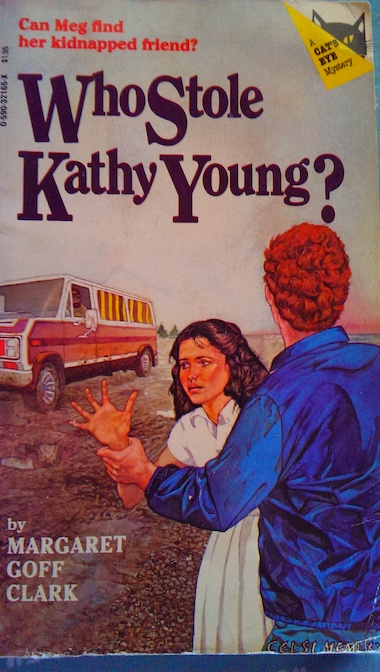
Who Stole Kathy Young?

KathyYoungWho Stole Kathy Young? by Margaret Goff Clark, 1980.

Kathy Young has had her share of problems.  Her mother died a year and a half ago, and now, her father has a housekeeper with a sour personality.  A couple of months after her mother’s death, Kathy was seriously ill, and her illness caused her to lose most of her hearing.  She now depends on a hearing aid and her improving lip-reading and sign language abilities.

This summer, Kathy’s best friend, Meg, is staying with her while her parents are on a trip to Switzerland.  Meg was of great help to Kathy when she was trying to adjust to her hearing loss, practicing sign language with her during her special lessons.  Kathy’s dream is to become an artist, but Meg now wants to be a teacher for the deaf, like the teacher who taught Kathy.  Kathy is still very unsure of her abilities to cope with her deafness.  She had the opportunity to attend a special art workshop over the summer but passed it up because she was worried about whether she would be able to communicate with and understand her teacher and the other students, and she knew Meg couldn’t attend to help her.

Kathy has been enjoying Meg’s summer visit, but the girls have noticed something odd.  It seems like a couple of strangers, a man and a woman, have been hanging around everywhere they go.  Meg is worried about it, but Kathy doesn’t want to worry her father.  She thinks that they’re probably tourists, like the housekeeper said.  They nickname the strangers Heron and Toad because of their appearances.

One day, Kathy is kidnapped!  Some men in a van stop to ask her directions and when she tries to explain where they have to go, they pull her inside and drug her!  Meg witnesses the kidnapping, but is standing too far away to help Kathy.

When Kathy wakes up from being drugged, she finds herself on a boat.  Her abductors have cut her hair and changed her shirt to disguise her from anyone who might spot her.  They’ve also taken her hearing aid, hoping to render her helpless and keep her from finding out their plans because she can’t hear them.  However, Kathy isn’t as helpless as they think.  She can still read lips, and she can still think.

Kathy learns to rely on herself and her own wits as she tries to gather as much information as she can about her kidnappers and to figure out how she can save herself.  Through this experience, she develops more self-confidence, realizing that she can do more and handle more than she had thought was possible.

While Kathy is struggling in captivity and her father is dealing with the police and the ransom demand, her friend Meg is trying desperately to find her.  The story alternates viewpoints between the two girls as Meg aids the investigation into Kathy’s disappearance and puts together clues that Kathy leaves for her as her abductors move her from place to place.  The mastermind behind the kidnapping plot is closer to home than they think.

The book is available to borrow and read for free online through Internet Archive.

Baby-Sitting Is a Dangerous Job

Baby-Sitting Is a Dangerous Job by Willo Davis Roberts, 1987.

Thirteen-year-old Darcy knows that babysitting the Foster kids isn’t going to be easy. Jeremy, Melissa, and Shana Foster are young children and rather spoiled. Their parents are wealthy, but they don’t spend much time with their children. When Darcy babysits them, the children go off in different directions and do things they know they aren’t supposed to do.

On top of that, Darcy is worried that someone will figure out that she and her friend Irene have been helping to hide their friend Diana, who ran away from home because her father was beating her. Diana is afraid to go to the police because her sister tried to tell them about their father’s abusive behavior, and no one believed her. She thinks that the police will just take her home and her father will beat her again.

One day, while Darcy is babysitting the Foster kids, some men break into the house and kidnap them all for ransom. Darcy feels guilty for not preventing the kidnapping, but she’s determined to make sure that she and the kids make it home safely to their parents.  When the kidnappers make a slip that allows Darcy to discover their true identity, she must come up with a daring plan to save herself and the children, who turn out to be surprisingly resourceful themselves.

The book is available to borrow and read for free online through Internet Archive.

My Reaction

I enjoyed this book! The Foster kids start out being nightmares to babysit because they’re badly behaved, but Darcy can tell that their bad behavior is because they’re neglected. They act out for attention and because their parents haven’t paid enough attention to them to teach them about boundaries and how to behave. On the outside, it might seem like the Foster kids are fortunate because their family has money, but when Darcy starts babysitting for them, she can see that their lives aren’t really as great as they seem. However, the kids do turn out to be clever and resourceful, and they really help Darcy when they’re all in danger.

There is an element of mystery to the story about who has kidnapped the children. Part of what makes their situation dangerous is that Darcy actually knows their kidnappers, and when they realize that she has recognized them, Darcy fears that they will try to eliminate her and possibly the young children, to avoid being identified to the police.