Santa Claus Doesn’t Mop Floors

The Adventures of the Bailey School Kids

#3 Santa Claus Doesn’t Mop Floors by Debbie Dadey and Marcia Thornton Jones, 1991.

The school’s janitor, Mr. Dobson, quits one day after some kid spreads peanut butter from the food drive box all over the staircase banister. He’s had enough of their pranks! The third grade class’s substitute teacher, Mrs. Ewing, who is teaching the class while Mrs. Jeepers is visiting her family in Romania for Christmas, says that she’d hate to think that someone in their class actually stole food meant for some poor person and used it for an awful prank. The principal confirms that it was someone in their class when he pulls a couple of empty peanut butter jars from their trash can. The culprits turn out to be Eddie and Howie. So, the principal declares that, until they can get a replacement janitor, the third grade class will clean the entire building.

The other kids are angry with Eddie that they now have to give up their recesses to empty trashes and mop floors all over the school, and Melody says that it’s Eddie’s fault that Mr. Dobson is unemployed at Christmas. Eddie complains that “it was only peanut butter” and that it was Mr. Dobson’s choice to quit his job. The other kids know that part of Eddie’s problem is that he has an issue with Christmas, and that’s why he’s trying to spoil things. Eddie’s mother is dead, and ever since her death, his father hasn’t wanted to celebrate Christmas.

Fortunately, the principal soon tells the children that he has hired a new janitor, Mr. Jolly. Mr. Jolly is a cheerful older man with a thick white beard, and he likes to smoke a pipe. Mr. Jolly seems very nice, and he works very fast, but he has an odd way of watching the children and writing things down in a notebook.

Then, one day, the kids see Mr. Jolly talking to an odd little man, and they hear the man call him “S.C.” The little man seems very worried about something and wants Mr. Jolly to come and straighten out some kind of mess before Christmas. However, Mr. Jolly says that the work he is doing at the school is very important. They notice the kids watching them, so they don’t say any more, but the kids soon begin noticing other peculiar things about Mr. Jolly. He keeps the school’s temperature rather cold, but yet he likes to wear shorts. He doesn’t like it when Eddie turns up the thermostat because he likes the cold.

The temperature issue becomes serious because the kids have trouble working when it’s so cold. They have to wear their coats and sweaters all the time, and it gets to the point where it’s actually warmer outside than it is inside the building. Rather than freeze, Eddie decides that he’d rather get rid of Mr. Jolly. However, the other kids don’t want to help him after what happened with Mr. Dobson. Eddie takes it on himself to decorate the teachers’ lounge with toilet paper and turn up the heat again. However, Mr. Jolly solves both problems impossibly fast, and suddenly, the food drive box is overflowing with jars of peanut butter.

Liza is the one who suggests that Mr. Jolly could be Santa Claus. He looks like Santa Claus, and his short friend, who called him “S.C.” looks kind of like an elf. It would also explain why he likes cold so much and how he seems to do things magically fast. The others don’t believe her, and after Eddie pulls another trick that goes wrong, Mr. Jolly actually talks to him about Christmas and Santa Claus. Eddie says that those things are for little kids and even if there was a Santa Claus, he wouldn’t bring him what he really wants for Christmas.

Although Eddie doesn’t actually say it, what he really wants is attention from his dad. His dad is away a lot, working, and Eddie’s grandmother, who takes care of him, is often busy. However, Eddie becomes convinced that miracles can happen when his dad finally comes home for Christmas and actually wants to celebrate the holiday.

The book is available to borrow for free online through Internet Archive.
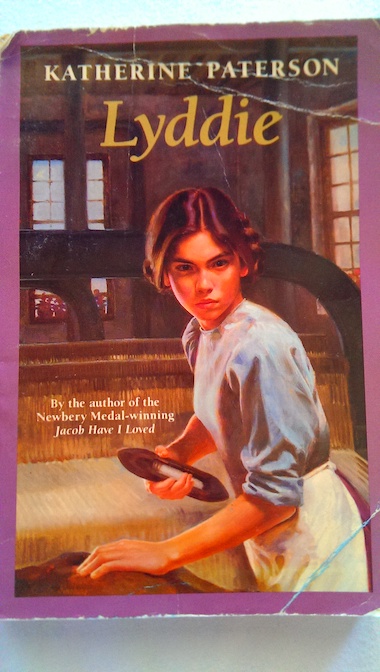
Lyddie

Lyddie

Lyddie by Katherine Paterson, 1991.

The year is 1843. Thirteen-year-old Lyddie’s father left home to go West and seek his fortune, and he hasn’t been heard of since. Lyddie helps her mother to take care of their farm in Vermont and the younger children, but they are very poor, and her mother has given up hope of their father returning home. The children’s aunt and uncle, Clarissa and Judah live nearby, but they are of little help, full of fire-and-brimstone talk. Lyddie and her brother Charlie, who is ten, more often turn to their Quaker neighbors, the Stevenses, for help. They are kinder than their aunt and uncle, although their mother disapproves of them for being abolitionists and, in her mind, heathens. Lyddie and Charlie are just grateful for their help. Because of their mother’s depression at the loss of their father, she pays little attention to the things that her children do to keep the farm going and the family together.

However, when a bear enters their house and eats the oatmeal that Lyddie was preparing, their mother, primed by Clarissa’s and Judah’s talk of signs of the end times and such, goes into a panic and sure that the world is going to end. Lyddie and Charlie let her go with their younger sisters to stay with Aunt Clarissa and Uncle Judah while they continue managing the farm as best they can. However, even though their mother sees that the world doesn’t end, she decides that she’s going to hire Lyddie out as a maid at the Cutlers’ tavern and Charlie to work at the mill because the family has too many debts and they will have to rent out their fields and animals.

Luke Stevens, the youngest of the Stevens sons, although much older than Lyddie and Charlie, gives them a ride to their new homes and employment at the mill and the tavern and promises to keep an eye on their house while they’re away. Lyddie is lonely and unhappy working at the tavern, badly missing the family farm and her siblings, especially Charlie. Then, one day, a woman visiting the tavern mentions that she’s one of the factory girls from Lowell, Massachusetts. The woman tells Lyddie that she seems like a good worker and that she could earn a good wage in the factories herself. At first, Lyddie doesn’t believe what the woman says that girls can earn there.

When Lyddie is allowed a brief visit home to her family’s farm, she discovers that Luke Stevens has been allowing a runaway slave to hide there. Lyddie isn’t sure what she thinks of it at first. Ezekial, the fugitive, frightens her because she has never met a black man before, and she knows that if she were to turn him in, there would be a handsome reward that could solve her family’s money problems. However, Ezekial seems to understand the situation that her family is in without her father. Although Lyddie and Charlie are not technically slaves, they have become a kind of indentured servant because of their family’s debts. Ezekial is a father himself, hoping to send for his family when he has found a safe place for them. Lyddie still wonders if her own father is alive, perhaps hoping to send for his family when he can. Having come to a better understanding of Ezekial, she knows that she can’t turn him in, even for the reward money.

Her talks with Ezekial make Lyddie understand that working in the tavern won’t solve her problems, though. As a maid there, she basically works all day for her room and board and has nothing else to show for it. Mrs. Cutler just sends a little money to her mother now and then and even then, she doesn’t always bother, and her mother is in little position to insist on proper wages, making Lyddie little better than a slave. Mrs. Cutler cares nothing about Lyddie or her family’s welfare, just trying to get as much labor out of her for as little as she can. Lyddie finally makes up her mind to seek factory employment in Lowell, Massachusetts, seeing it as her only chance to earn some real wages.

Life in Lowell turns out not to be as glamorous as the woman she met at the tavern made it sound, although the wages are definitely better. The company that owns the fiber mill where Lyddie gets a job has all sorts of rules and regulations for the girls who work there, even ones that intrude on their personal lives outside of work. Anxious to give the impression that all of their workers are of good moral disposition, they insist that the girls attend church on Sundays. Lyddie never had the money to pay pew fees back home, so she is unaccustomed to going to church, but finds that other girls in her position tend to go to Methodist churches, where there are no pew fees, saving their precious wages. Lyddie, who never had much time for schooling when she and her brother were trying to keep the farm going, has trouble understanding all of the terms of the employment contract that she signs but signs it anyway. Her employment turns out to be an education that changes Lyddie’s life, although not in all the ways that she had hoped.

Like Mrs. Cutler, the bosses at the factory have little real care for their workers, trying to get as much work out of them as they can for the least amount of pay they have to give them. The work is hard and the hours are long, but Lyddie keeps at it because the pay is the best she’s ever had and she is starting to save up for her family’s future. The poor working conditions contribute to health problems among the girls, and some of them petition for better working hours, but Lyddie is reluctant to do so because girls who are dismissed “dishonorably” from the factory are blacklisted all over town, and she fears not only risking the loss of her job but the potential to find a new one.

Through her interactions with the other girls and young women at the factory, Lyddie also develops into a young woman. She had previously wished that she’d been born a boy instead because a boy would have a better chance of running her family’s farm, but she comes to realize that there are opportunities out in the world for young women who are willing and able to go out and seek them. In Lowell, Lyddie gets a taste for literature through the books that her friend Betsy reads to her and acquires more lady-like behavior by watching the lady-like Amelia. Neither of them plan on working at the factory forever, and their ambitions, to get married or continue their education, cause Lyddie to consider what she really wants for her own future. Through the difficulties she encounters and everything she learns while facing them, Lyddie really becomes her own woman.

In the end, Lyddie is unable to save her family’s farm and reunite their family there. Her mother dies, and her father’s whereabouts are still unknown, so her uncle sells the farm to pay the debts. However, Charlie and her younger sister Rachel are provided for, the Stevenses decide that they will purchase the farm themselves, and Lyddie becomes reconciled to the loss of the farm through her new vision of the future. She is unfairly discharged from the factory after she catches an overseer molesting another girl and stops him because he blackens her name in retaliation. But, by then, Lyddie has acquired some money and new confidence in herself, and she begins making other plans for her future, which may include both further education and the possibility of marriage. One thing that she knows for certain is that, whatever she does with her life, she wants to move forward as her own, independent person.

The book is currently available online through Internet Archive (multiple copies).