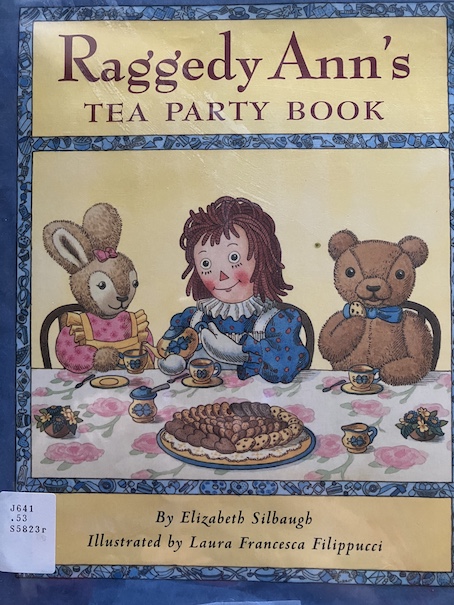
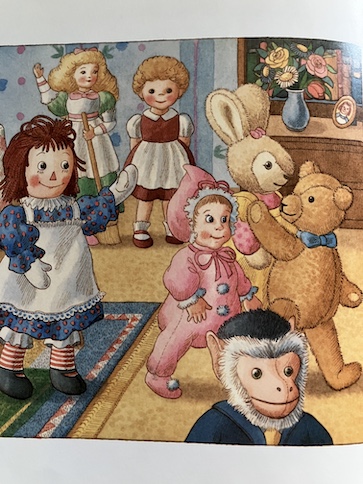
Raggedy Ann’s Tea Party Book by Elizabeth Silbaugh, illustrated by Laura Francesca Filippucci, 1999.
This book is a children’s guide to planning a tea party with Raggedy Ann. As in the original books, Raggedy Ann is a doll who lives with a girl named Marcella, and she likes to have tea parties with Marcella’s other dolls and stuffed animals.
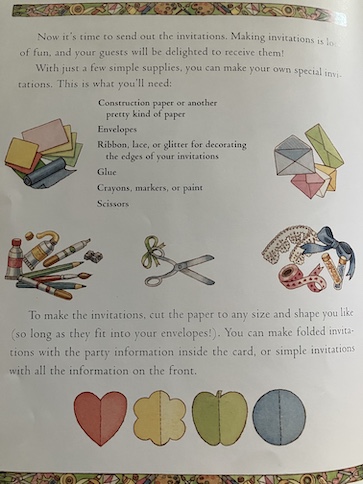
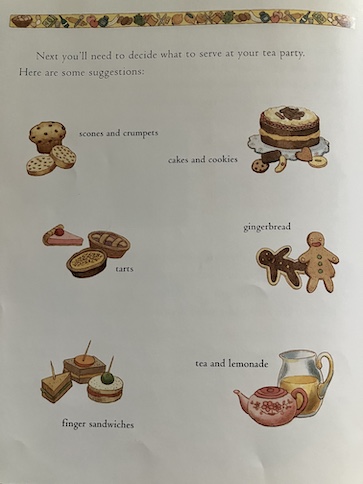
The book explains how to plan and prepare for a tea party, from figuring out how many guests there will be and making sure there are enough seats for everyone to choosing a menu and games to play. There are tips for making party invitations and a section of recipes in the back of the book.
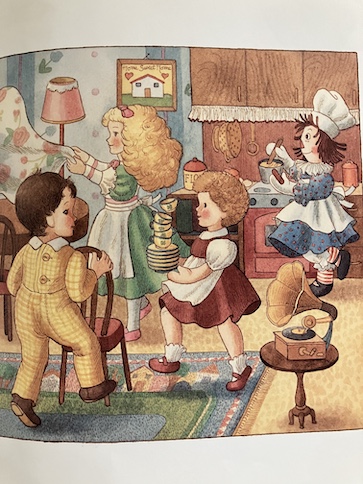
The food ideas aren’t too complicated. The book recommends keeping preparations simple because a party is about having fun. Setting the table is an activity by itself. Raggedy Ann gets her guests to help her, and they put on music while they do it. They want to make the table setting pretty, and they make sure that everyone knows each other and is included in the conversation. Tea parties are a time to practice good manners and make sure everyone is enjoying the party. At the end of the party, guests can also help clean up while they play music.
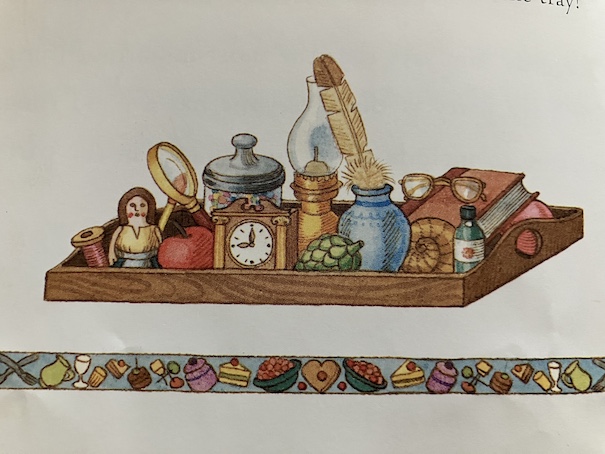
For games to play, they recommend the classic game of Telephone, Fiddly Diddly (a guessing game), and Memory Tray, where guests look at a tray of objects for a limited amount of time and then try to remember everything they’ve seen.
The recipes included in the book are:
Easy Chocolate Cakes
Creamy Pink and White Icing
Tiny Sandwiches – They suggest a variety of possible fillings, including tuna, ham, tomato, hard-boiled egg, cucumbers, cheese, fruit, or jam.
Raggedy Ann’s Candy-Heart Cookies – These are heart-shaped cutout cookies because Raggedy Ann has a candy heart.
Uncle Clem’s Super-Simple Scotch Shortbread
Marcella’s Lemonade
The book is available to borrow and read for free online through Internet Archive (multiple copies). There is another book by the same author called Raggedy Ann’s Birthday Party Book, about planning a birthday party.
My Reaction
I found it charming and nostalgic, and I loved the colorful pictures! I didn’t read this book as a child, but it is the kind of book I would have liked. The party-planning tips are useful, taking child readers step-by-step through planning the party, inviting the guests, and preparing food and entertainment. I liked the advice to keep things simple, so even the host/hostess can enjoy the party instead of getting stressed over complicating preparations. The recipes in the book fit the tea party theme, and they are simple enough for children to make or at least help in their preparation without being overly simplistic.
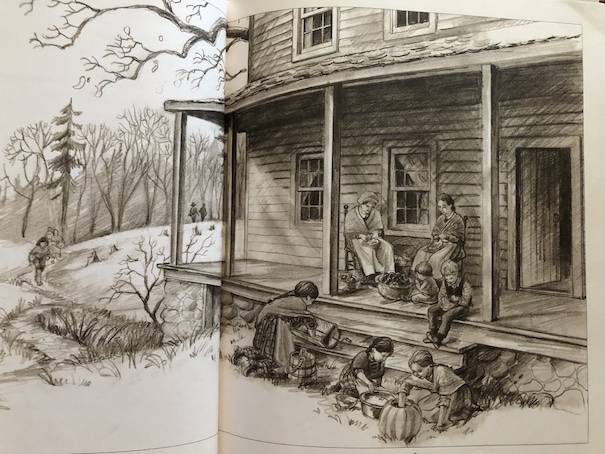
A Pioneer Thanksgiving by Barbara Greenwood, illustrated by Heather Collins, 1999.
This book is part story, part history, and part craft and activity book. It tells the story of a particular pioneer family’s Thanksgiving celebration in 1841 to explain the sort of Thanksgiving celebrations that pioneer families would have at the time, and there are related activities and recipes to accompany the story.
Everyone in the Robertson family helps with preparing the food for the Thanksgiving feast, including the family’s neighbors, who will be joining them. The story is episodic, focusing on different family members and their adventures and activities through the Thanksgiving preparations.
As they begin their preparations, they are worried about Granny, who is unwell. Mrs. Robertson is afraid that she might die because she doesn’t seem to be improving. As Sarah reads to her, Granny expresses a wish to taste her mother’s cranberry sauce one more time.
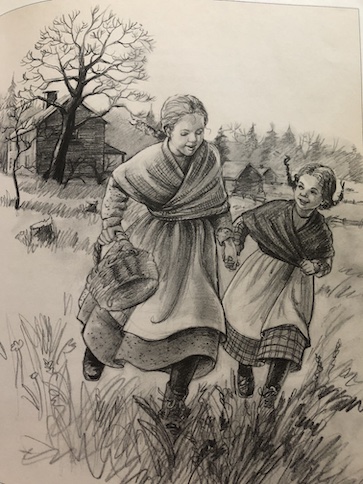
Sarah decides to go out and gather some cranberries for the sauce herself, but her little sister, Lizzie, tags along with her. The cranberry bog isn’t safe. Lizzie falls in and nearly drowns. Sarah manages to save her, but she’s very upset at almost losing Lizzie. However, her brother George finds Sarah’s basket of cranberries and brings it back to the house. The first activity in the book is a recipe for cranberry sauce.
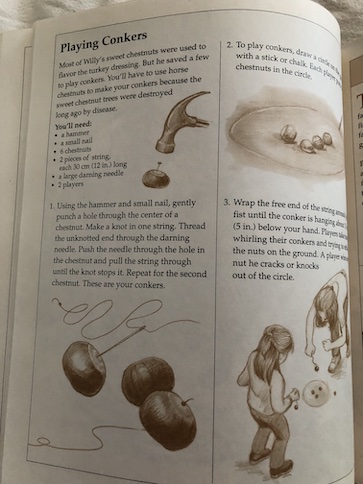
Willie, one of the boys in the family, almost gets lost while looking for chestnuts for his mother’s chestnut stuffing, and he plays a game of Conkers with a Native American (First Peoples) friend, whose family trades foods with the Robertson family. Part of the story explains about Ojibwa and Iroquois thanksgiving ceremonies, and there are instructions in the book for playing Conkers with chestnuts and a Native American game with peach stones.
The younger children go into the woods to gather nuts, and there are instructions for weaving a nutting basket. Meg, the oldest girl in the family, makes bread with interesting designs, and there’s a recipe for bread. Sarah makes a Corn Dolly, and Granny explains the superstition of making a Corn Dolly and then plowing the Corn Dolly back into the soil at the beginning of the next planting season to ensure a good harvest.
Mr. Burkholder, their neighbor, tells them a story about when his family had newly arrived in North America and they had little food. Then, there is a section about weather and now to make a weather vane. Finally, everyone gathers at the table to say grace and enjoy the feast!
In the back of the book, there is a section about the history of Thanksgiving as a holiday in North America, both in the US and Canada. This book is actually set in Canada, and it explains that the date of Canandian Thanksgiving celebrations wasn’t initially fixed. Sometimes, they could be in October and sometimes in November. Canadian Thanksgiving was finally established as the second Monday in October in 1957.
I couldn’t find a copy of this book online, but I did find a copy on Internet Archive of a related book by the same author about the same pioneer family in Canada.
My Reaction
Although the book doesn’t say exactly where this family is other than North America, the other book about the family establishes that they are in Canada, and the references to Native Americans as “First Peoples” confirms it. When I first started reading the book, I thought that the pioneer family was somewhere in the United States or its territories. The lifestyle that the Canadian pioneers lived seems very similar to the way pioneers in the United States lived around that time, so I think the recounting of this family’s holiday would still be of interest to fans of the Little House on the Prairie series and similar books.
Hearing about Canadian Thanksgiving was interesting, and I liked the inclusion of information about the Thanksgiving traditions of the First Peoples and immigrants to Canada. The family in the story was originally from Scotland, and the grandmother in the story talks about how Thanksgiving celebrations remind her of the Harvest Home celebrations back in Scotland.
The book has a good selection of different types of activities for readers to try, from recipes to games to crafts. It seems like there is something here that could appeal to many people with different interests. Each of the activities appears next to a part of the story that references it, so readers can feel like they’re taking part in the activities along with the people in the story. I also really love the realistic art style in the illustrations!
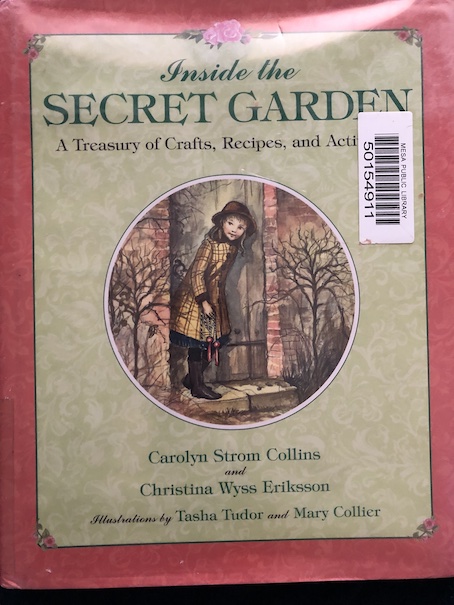
Inside the Secret Garden by Carolyn Strom Collins and Christina Wyss Eriksson with illustrations by Tasha Tudor and Mary Collier, 2001.
This is a how-to book with activities, crafts, and recipes that fit the themes in the classic children’s book The Secret Garden by Frances Hodgson Burnett. The book has some of the classic illustrations from The Secret Garden by Tasha Tudor, and there are also illustrations by Mary Collier.
The book begins with an explanation of the story of The Secret Garden and the life of Frances Hodgson Burnett. In the description of the author’s life, the book discusses some of the places where she lived and people she knew who provided inspiration for aspects of the story of The Secret Garden. There is also a timeline of world events during the author’s lifetime.
The second chapter describes the setting of the story with descriptions of Misselthwaite Manor and its gardens. It explains how a large manor house like Misselthwaite would function and the types of staff and servants it would have. It also explains the types of gardens and plants that would have been grown in the kitchen gardens of English manors and cottages.
The third chapter in the book has recipes and menus based on the foods the characters eat during the story. Food is important in The Secret Garden because Mary and Colin didn’t have appetites when they were unhealthy, but after their time working in the garden and getting fresh air and exercise, their appetites improved. The recipes in the book are based on things the characters eat during the story.
The recipes in the book include:
A pot of tea
Porridge (oatmeal)
Treacle (They use molasses with corn syrup and honey to make it.)
Orange marmalade
Homemade bread
Snow-white eggs (soft boiled)
Raspberry jam
Clotted cream
Muffins
Ham
Oatcakes
Doughcakes
Apple Crumble
Crumpets
Robin cake
Roasted eggs (The instructions call for cooking them in an outdoor stone oven, like they did in the book, but it also discusses how to make an indoor version.)
Roasted potatoes (The instructions call for cooking them in an outdoor stone oven, but it also discusses how to make an indoor version in a standard oven.)
Currant buns
A book of activities based on The Secret Garden wouldn’t be complete without gardening activities! The fourth chapter has suggestions for creating your own garden. The gardening tips and suggestions are based on the plants the characters used in The Secret Garden. I’m not sure all of them would grow well in every climate, and planting seasons can vary by region.
The gardening activities include:
Planting a spring bulb garden
Planting a rose in a flowerpot
Making an indoor “secret garden” with potted plants in a tray or pa
The fifth chapter has a selection of crafts and activities related gardening. They include things you can make to use in your garden and things you can make our of plants from the garden, including:
A twig tool holder
Plant labels (little signs for labeling plants in your garden)
Moss-covered flower urns
Key wind chimes
A planter in a watering can
A twig trellis
Pressed flowers and a pressed flower scrapbook
A bouquet of roses
A topiary flower arrangement
A miniature arrangement
A bird feeder
A bird bath
Nest-building station
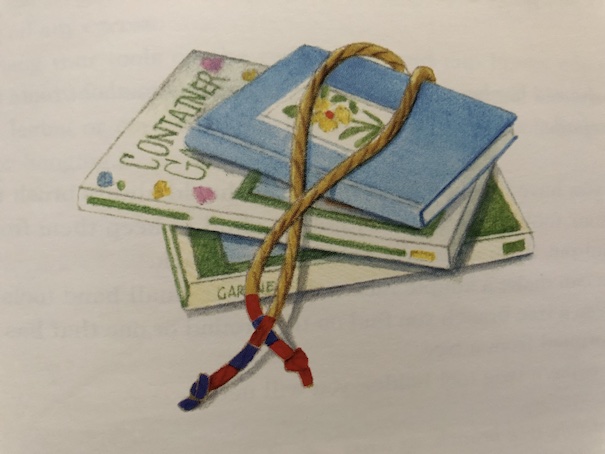
It also explains how to make your own skipping rope, like the one Mary had in the book, and there is a section of traditional jump rope rhymes.
The book is available to borrow and read for free online through Internet Archive.
My Reaction
I liked the chapters about the history of The Secret Garden and the life of Frances Hodgson Burnett. I thought it was interesting to see some of what inspired her to write the story. I particularly like the chapter that describes how a manor like Misselthwaite would be run because I like seeing the historical background to stories.
I don’t think that the gardening tips are really universal. I grew up in Arizona, and I know from personal experience that plants and gardening techniques that would work well in cooler and wetter climates don’t work as well in a hot, dry desert climate. However, some of the garden-related crafts looked intriguing. I particularly like the idea of the wind chime that uses old keys as the chimes. I’ve seen antique stores and places that sell crafting supplies that also sell old keys, so know it’s possible to get them.
I like the selection of recipes the book provides, and I think most of them would be pretty easy to make. The most difficult ones are probably roasted eggs and roasted potatoes because they require an outdoor oven, like the kind the characters in The Secret Garden used. The book briefly describes how to make the kind of outdoor stone oven they mean, but I don’t think that kind of oven can be built just anywhere. It’s more for camping and the countryside, where you can safely have fire pits away from buildings. Fortunately, the book also includes instructions for making those dishes inside, in a standard kitchen.
Kids Travel: A Backseat Survival Kit from Klutz Press, 1994.
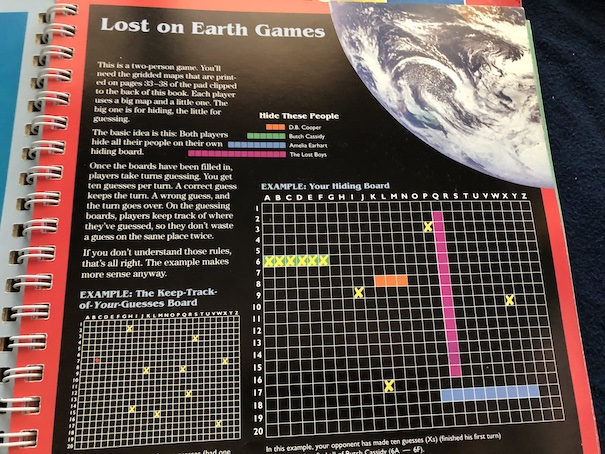
This was one of the Klutz Press activity books that I had as a kid! I used to take it on the long road trips we would take across the country during the summer. The reason why this book is called a “kit” is that it came with a pouch with some extra equipment that could be used for the activities in the book and a special activity pad on a clipboard in the back. I don’t have my activity pad anymore, but it had pencil and paper games and puzzles, like mazes, connect-the-dots pictures, and grids for a Battleship style game that they called Lost on Earth, where you would attempt to find famous missing people or things instead of finding your opponent’s battleships.
The Lost on Earth games are especially funny when you know the references for who the missing people or what the missing things are, like who Amelia Earhart or D.B. Cooper is/was. When I was a kid, I didn’t know about D.B. Cooper (this YouTube video from Buzzfeed Unsolved explains), but I think one of the missing people on the activity pad grids was Jimmy Hoffa, and I knew that name (Buzzfeed Unsolved also covered that). The great thing about these references is that, if you’re playing this game with a kid who hasn’t heard of some of these people or things, just explaining who or what they are is activity by itself.
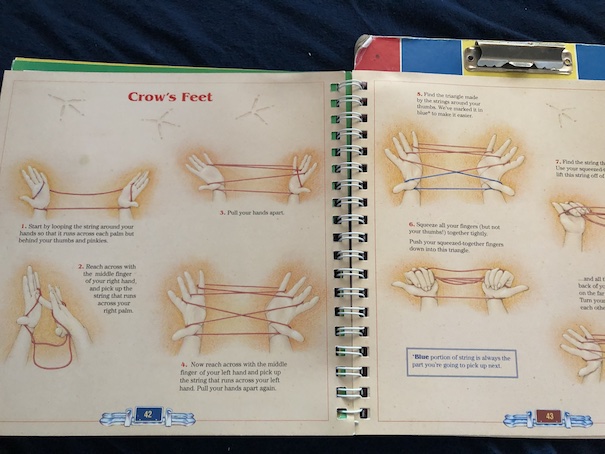
The pouch contained a set of markers for drawing and doing the activities on the activity pad, embroidery thread in different colors for making friendship bracelets and hair wraps, a loop of colorful string for making string figures, a small sheet for the Grown Up Pop Quiz, and some gummy playing pieces and dice for playing Parchesi (a board was included on one of the pages in the book). The gummy pieces would stick to the page, but not so tight that you couldn’t get them off. I think I saw a later edition of this book that used a different style of playing pieces, but I’m not sure now. The gummy pieces do gradually lose their ability to stick over time.
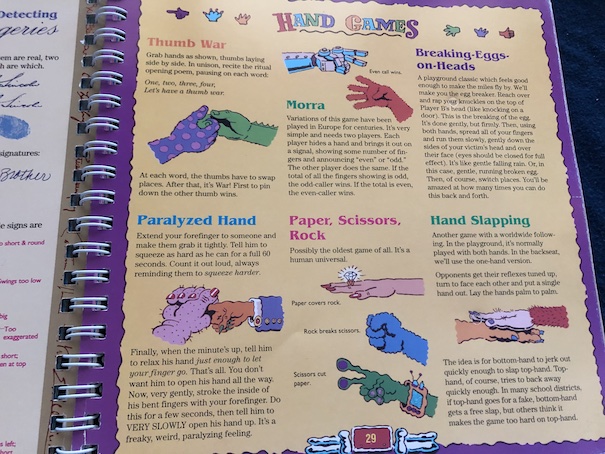
The activities in the book are meant to be done in a car. In the front of the book, there’s a section where you can record which license plates you’ve seen from different states in the US. (A common car activity on US road trips because there are 50 states, and they all have different styles of license plates. In theory, you could see examples of plates from all 50 states in a single, long car trip, but I never did. I’ve seen most of the states during a single trip, but I’ve never been table to check off all of them during a single trip.) There are also rules for playing many classic car games, mostly games that involve talking or hand motions or can be played on paper, like Twenty Questions, Paper, Rock, Scissors, and Hangman. It also describes popular car trip rituals, like holding your breath while passing a graveyard, lifting your feet while going over a bridge, or ducking your head while going under a bridge.
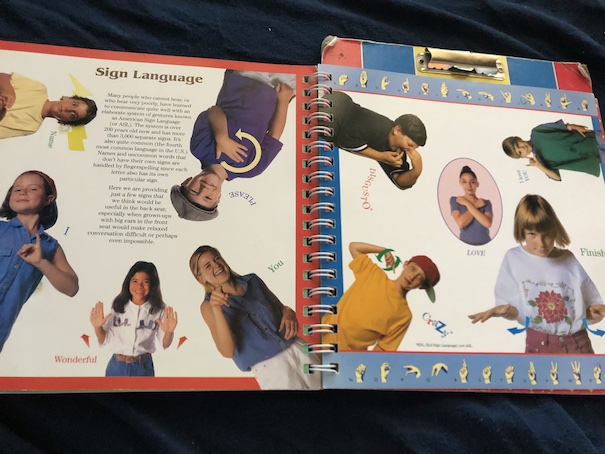
However, even though most of the activities are meant for car trips, many of them would be good for airplane trips as well. When I was a kid, airplanes were quieter, and it was much easier to talk to the person in the seat next to yours than it is now, so the talking games are still better for car trips. However, making friendship bracelets are ok for planes and trains as well as in a car. There are also activities for folding a dollar bill and making a paper fortune teller, making string figures, drawing superheroes, writing things in secret codes, reading palms, and learning some basic sign language.
What I’ve always liked best about this book is the variety of activities. There’s something for everyone in this book, and I’m still amused by some of the games and activities. If there’s an activity that the reader doesn’t like or that won’t work for the current location, there are plenty of others to move on to. Many of the activities in the book are either mentioned in other Klutz books or have entire Klutz books dedicated to them. Also, every part of this book is meant to be used for something. There is a finger maze around the title and copyright page, and when you remove the activity pad in the back, there is a board behind it to use for a game called Penny Hoops, which involves flicking pennies onto target areas on the board to earn points.
Sadly, I don’t think this book and activity kit are being sold new anymore, although there are some copies being sold used (I think most of the used books don’t come with the extra items in the original kit), and the book is available to borrow and read for free online through Internet Archive.
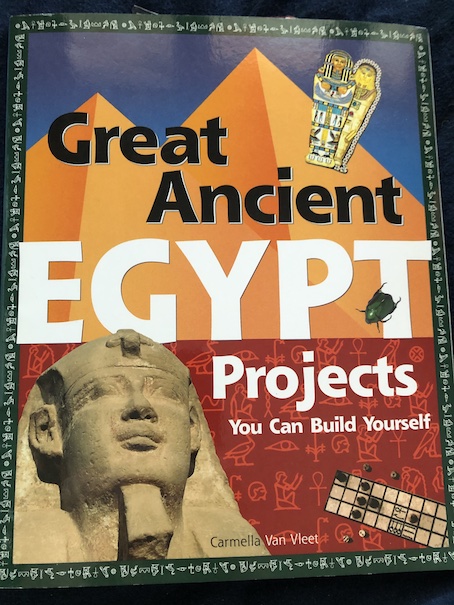
Great Ancient Egypt Projects You Can Build Yourself by Carmella Van Vleet, 2006.
I love this book because it combines lessons about history with hands-on projects and craft activities!
The book starts with a general timeline of Egyptian history, a brief introduction, and then a chapter about The Foundations of Ancient Egypt, which explains about the climate of Egypt, the role of the Nile in Egyptian civilization and farming, jewelry and other products produced by Egyptian artisans, pyramids and mummies, and forms of entertainment that the Ancient Egyptians enjoyed, like games and music. After this first chapter provides a general overview of Egyptian civilization, the other chapters go into more detail on different subjects related to Egyptian civilization with accompanying activities and projects. Each of the activities or projects comes with a list of materials needed and an estimate of the amount of time needed to finish.
Below is a list of the chapters in this book and descriptions of the types of projects that you will find in each section:
Boats
Boats were an important form of transportation of people and goods up and down the Nile. This chapter explains how the Ancient Egyptians made boats and has instructions for making your own miniature boat out of drinking straws in a similar manner as the Egyptians made papyrus boats.
Farming
This chapter describes the Egyptian flooding, growing, and harvesting seasons and the types of crops the Ancient Egyptians planted. The project for this chapter is how to build a shaduf, which is a device the Ancient Egyptians used for irrigating their crops.
Papyrus
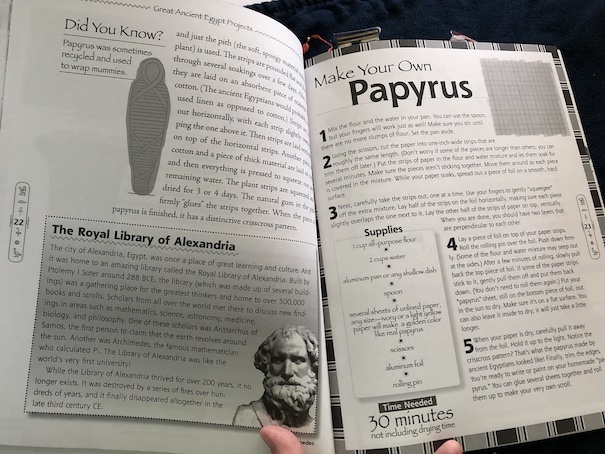
The Ancient Egyptians found many different uses for papyrus plants, including boats, baskets, mats, ropes, sandals, food, medicine, perfume, and paper. This chapter discusses how the Ancient Egyptians made papyrus paper and formed it into scrolls. The activity is to make your own papyrus-style paper using strips of regular paper instead of papyrus. It also has a recipe for a berry-based ink. It mentions that the Egyptians would have used different colored minerals, but the berry ink is easy for a beginner.
Homes
I always like books that discuss the lives of ordinary people and their homes. This chapter explains how Ancient Egyptian homes were made, how the homes of common people and wealthy people differed from each other, how homes were decorated, and the arrangement of rooms for sleeping, storing goods, and cooking. There are three activities for this chapter: making your own mud bricks, making a cat statue, and making a “soul house” – a miniature house or layout of rooms out of plaster of Paris.
Bread
This chapter is about what people ate in Ancient Egypt, and it particularly describes how the Ancient Egyptians made bread. An interesting fact in this chapter is that people in Ancient Egypt typically bartered for food instead of using money. This chapter includes two recipes, one for bread and one for date (fruit) candy.
Games
This is one of my favorite chapters! It’s about toys and games played by children in Ancient Egypt. It also describes board games that could be played by people of all ages, like Mancala, Hounds and Jackals, and Senet. The book provides instructions for making your own Senet board game and rules for playing.
Tunics and Fashion
This chapter is about what people wore in Ancient Egypt. Clothes at the time weren’t as much about modesty as in modern society. Clothing in Ancient Egypt could be pretty minimal, and it was common for Egyptian children to simply go naked. This chapter also discusses clothing accessories and wigs. The activities for this chapter are to make your own simple tunic, sandals (basically decorating a pair of flip-flops), and nemes (head covering).
Jewelry
This chapter explains the decorative and religious aspects of jewelry and the types of gems and minerals included in Egyptian jewelry. The projects are making paper beads and a wesekh collar (type of necklace).
Amulets
This chapter is about how Ancient Egyptians used amulets that they believed had the power to protect them from illness and other dangers. It describes different types of amulets and what they were supposed to do for people who had them. Part of this chapter covers The Book of the Dead, which was a collection of texts that provided a guide to funeral rituals and the afterlife. (You can actually get copies of this book today, translated into English.) The activity for the chapter is to make your own amulet out of a dough made from water, flour, and sawdust.
Kohl and Perfume
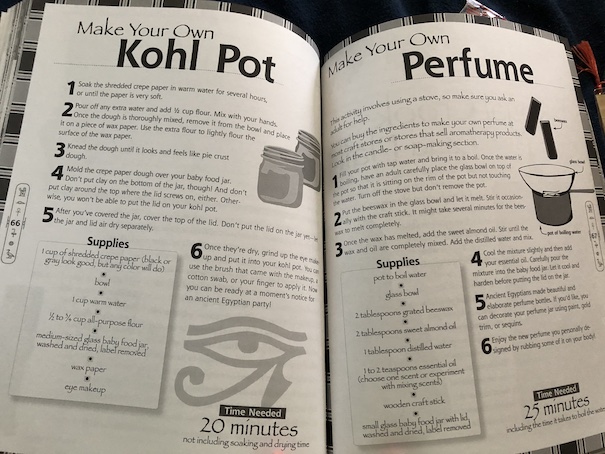
This chapter is about the makeup that people used in Ancient Egypt. Kohl is the substance that Egyptians used around their eyes. It was made from the mineral galena, and it may have helped the Ancient Egyptians protect their eyes from eye infections or provided some shielding from the sun’s glare. This chapter includes instructions for making a simplified version of kohl using black crepe paper, water, and flour and for making perfume out of beeswax, almond oil, and different essential oils. (The perfume activity looks the best of the two. Health food stores that also carry cosmetics, like Sprouts, probably have all or most of the ingredients, and if they don’t, you could probably get whatever’s missing from Amazon.)
Royal Crook and Flail
Pharaohs are often depicted holding a symbolic crook and flail. This chapter explains the meaning behind these symbols (the crook resembles a shepherd’s staff and was meant to represent the ruler of the king because he was supposed to look after his people like a shepherd looks after his sheep, and the flail is the same design as one that was used in harvesting and may have represented the pharaoh overseeing the fertility and prosperity of the land) and also discusses the duties of an Egyptian king or queen and what their subjects expected of them. The chapter also gives information about famous kings and queens and the crowns they wore. The activities for the chapter are making your own crook and flail and your own throne (by decorating an old chair, like one you might find at a garage sale).
Pyramids
This chapter covers Ancient Egyptian tombs and pyramids, how they were built, and how they were decorated. The activities for the chapter are building your own pyramid out of poster board and building a sledge of the type that the Ancient Egyptians used to transport stone blocks.
Temples
This chapter discusses Ancient Egyptian gods and their temples. It explains how the Ancient Egyptians would worship their gods. The activities are making your own foam obelisk and a miniature temple sanctuary scene in a box.
Mummies
This chapter explains how Ancient Egyptians made mummies and what they believed about the afterlife. The activities are making your own shabti (little figurines that were supposed to perform tasks on behalf of the deceased) out of a bar of soap and making your own funeral mask (like Tutankhamen’s famous mask).
Hieroglyphs
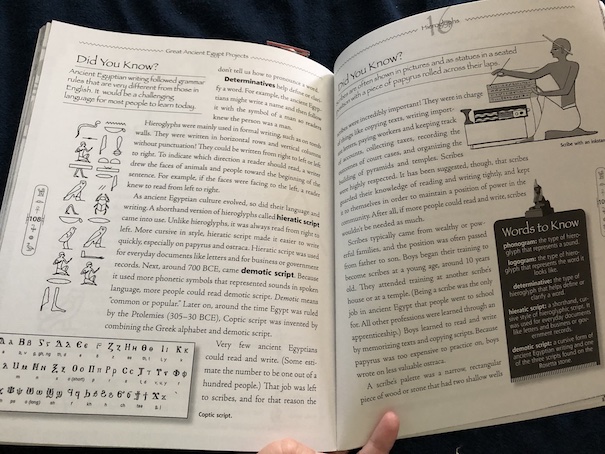
This chapter explains how the Ancient Egyptian systems of writing worked and how modern people learned to read hieroglyphs by studying the Rosetta Stone. Th activities are making your own ostraca (piece of pottery used as a writing surface), mural, and cartouche.
I haven’t seen this particular book available to read online, but there’s a very similar by the same author on Internet Archive.
The FunCraft Book of Print & Paint by Heather Amery and Anne Civardi, 1976.
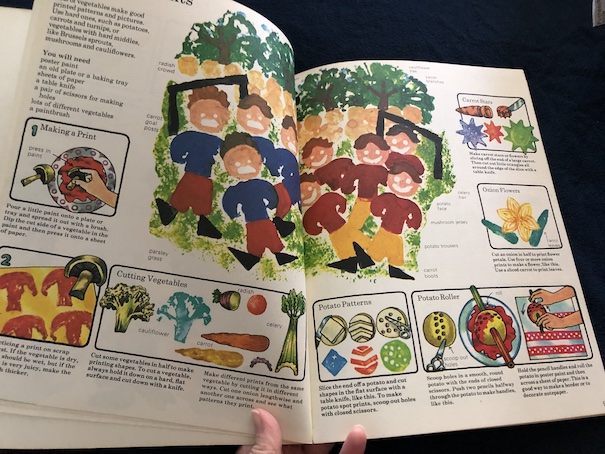
This is the American edition of a British book, and it’s part of a series of craft and activity books. When I was a kid, I was really into crafts, but I didn’t do even half of the crafts in the craft books we had. This particular book is interesting because I first thought that it was going to be about painting pictures, and it is, but it’s specifically about making “prints” with paint. Basically, the crafts involve using various objects, from leaves and veggies to your own hands and fingers as stamps to make pictures and designs.
I remember once taking part in an activity at our local library that involved making pictures with stamps make from cut potatoes, like the book shows in the section about vegetable prints. Our potato stamps weren’t as elaborate as the ones shown here, and it’s interesting that they thought of using other veggies to get some different shapes as well.
The range of objects and techniques that the book uses in making prints is also interesting. It points out that you can make some interesting patterns by painting on a page and folding it over or using string coated in paint to make swirls. There are tips for making using tools like stencils and rollers to make designs.
The book also includes some painting techniques, like how to mix colors, and some tips for how to enhance pictures you’ve made, like painting over parts of a picture with glue and then shaking on some powdered colors. It gives suggestions for different powdered colors, like colored sand, salt, or sugar or using powdered spices or cocoa from your kitchen (more expensive, but it will give your artwork a scent).
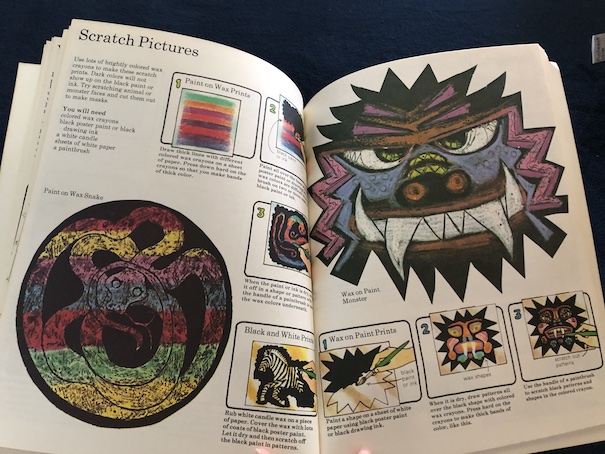
One of my favorite suggestions was a technique that I did like a lot when I was a kid, making scratch pictures with a simple form of sgraffito. You can buy kits and specially prepared paper for doing this today, which didn’t exist when I was a kid (at least, not anywhere where I could buy it). Instead, I had to do it the old-fashioned way, using the technique in this book – drawing a rainbow of colors on paper, covering of it with black, and then scratching the black off to make rainbow pictures and patterns.
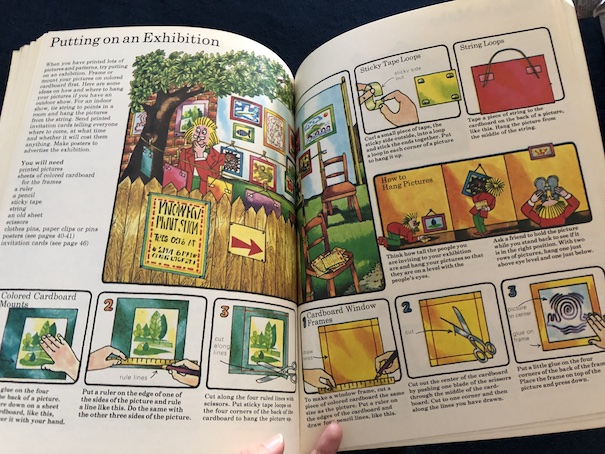
There are too many tips and techniques for me to cover everything in detail. The last few pages cover uses of the techniques for specific projects, how to make prints on cloth, and how to have an exhibition of the pictures you’ve made.
The book is available to borrow and read for free online through Internet Archive.
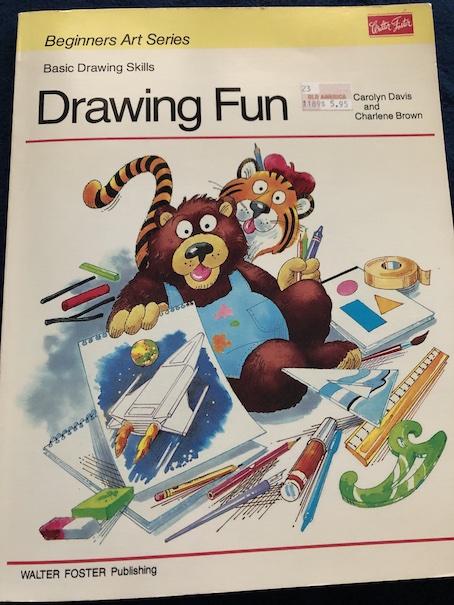
Drawing Fun by Carolyn Davis and Charlene Brown, 1988.
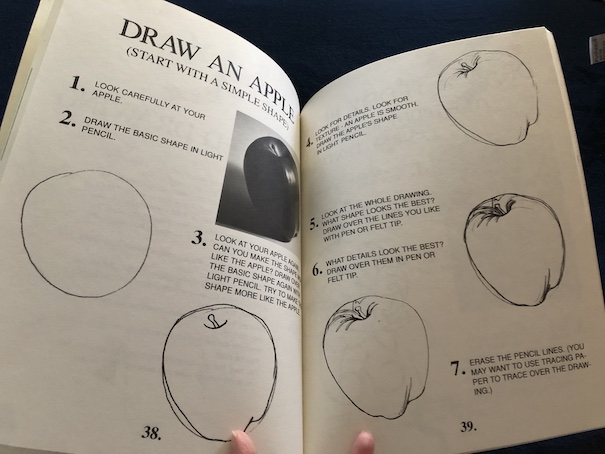
This book is part of the Beginners Art Series, and it teaches children basic drawing skills. The book is designed for readers to try out drawing techniques on their own as they read along and starts with a page that explains the materials they will need.
Because this is a beginning guide, the book begins by explaining that all objects and, therefore, all drawings, are made up of basic shapes. One of the keys to learning how to draw is studying the basic shapes and how they can be combined to create more complex shapes and drawings.
When beginning to draw, the reader should begin by sketching out the general shapes that make up what they’re drawing and then fill in the details.
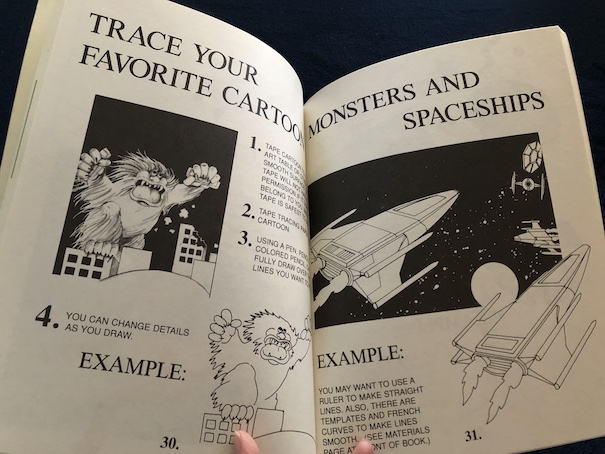
Many of the drawing activities in the book focus on tracing shapes, drawings, and photos to learn how they are formed and practice drawing skills.
As the book continues, the techniques become more advanced and the drawings become more detailed. It gradually teaches readers how to use shadows and shading to make their drawings appear more realistic and three-dimensional. The subject matter of the drawing exercises ranges from basic apples to more interesting subjects, like teddy bears and people.
The book also explains how to use perspective in drawing to further add a three-dimensional quality.
I like this book because I think it’s a good introduction to a fun, artistic hobby, giving readers good beginning techniques.
The book is available to borrow and read for free online through Internet Archive.
Bird Wise by Pamela M. Hickman, illustrations by Judie Shore, 1988.
This is a beginning guide to birds and bird watching for kids. I thought that the guide was very helpful with nice, detailed illustrations. The book explains the appearance, biology, and lives of birds and offers activities to help readers understand and interact with birds.
The first section in the book is about the appearance and body parts of birds. It explains how different birds have differently-shaped beaks and feet and different types of feathers and how the differences help each type of bird eat the foods they like and live in the places where they live. One of the activities for this section is about how to start a feather collection. The book also explains that different birds have different styles of flying.
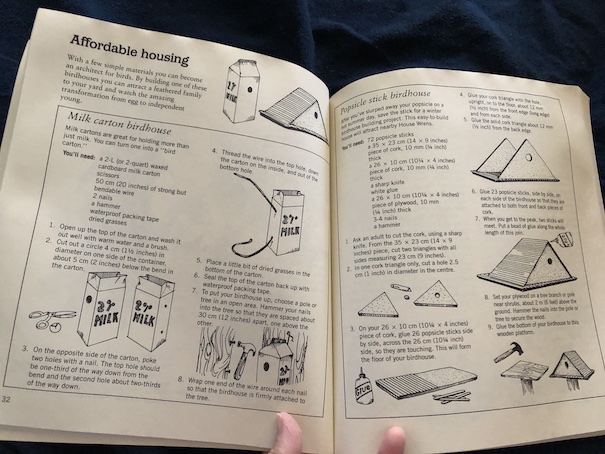
The section about how birds live explain about different types of bird nests and how they migrate and raise their young. The book explains different methods for making bird feeders and bird houses.
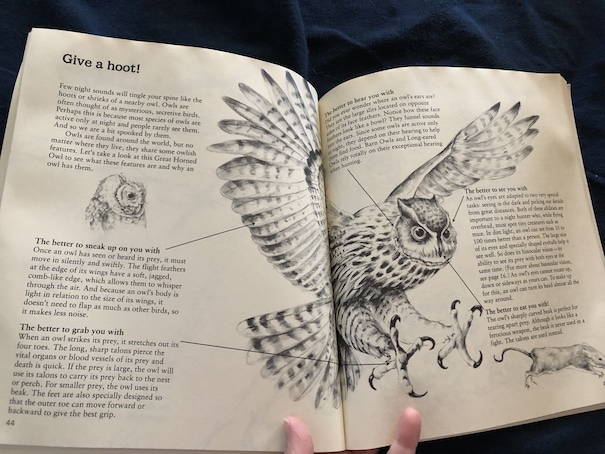
The book profiles certain specific types of birds, including owls (there is an activity about dissecting owl pellets, which I had to do when I was in elementary school), gulls, hummingbirds, and woodpeckers.
In the section about bird watching, the book offers tips for what to look for to identify a bird’s type. It also explains how to make bird blinds to avoid being seen and how to recognize types of bird songs.
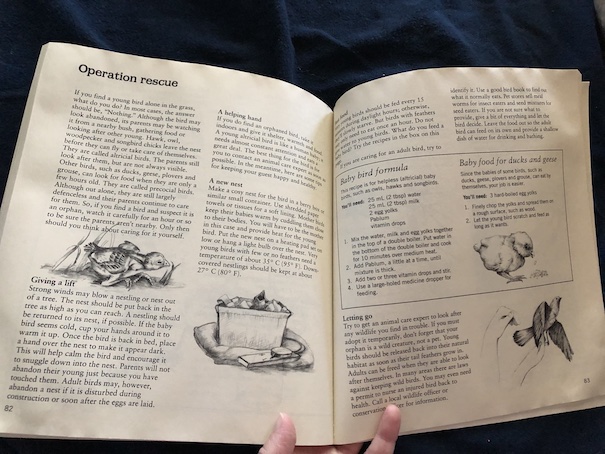
The book also contains other helpful information, like how to care for injured birds and how to plant a garden that will attract birds. It also includes a board game that emphasizes some of the lessons about birds in the book.
Overall, I was pleased with the range of information in the book. It was interesting and well-presented.
The book is available to borrow and read for free online through Internet Archive.
Once in awhile, I feel like circumstances require me to make some comment about current events. Christmas this year is weird. There’s no denying that. This year has been dominated by the Coronavirus Pandemic, an event unforeseen at this time last year. In fact, the very first book post I made when this year began focused on the Influenza Pandemic of 1918, and I didn’t do it on purpose. I just happened to be reading Charlotte Sometimes around Christmas last year because it was a book many people said was good, and I’d been meaning to get around to reading it. I didn’t know on New Year’s Day 2020 that it was going to turn out to be weirdly appropriate.
So, everyone’s lives this year have been affected by the current pandemic. Many people aren’t going to spending Christmas like they did last year. Not everyone can travel to visit relatives, and some people, sadly, will be missing people who were with them last year. It’s okay to be sad about it. Circumstances aren’t good, and it’s okay to have feelings about it. It’s okay to be sad or angry and get those feelings out. Christmas tends to bring out strong feelings even in ordinary years because it’s the last major holiday before the New Year. It’s an event that not only marks a major Christian event, but also kind of caps off the year. It’s a time when people take a pause, and when people pause, they also tend to think. They think about what’s happened during the last year, where they are in their lives, where they expected to be, and what they expect or hope for during the next year. When I was in high school, a teacher warned us that it’s normal for some people to get depressed around this time of year, even though it’s usually considered a happy time. There are different reasons for that. Sometimes, it’s partly the weather, if you live in a place that gets dark and snowy around this time of year, but quite often, it’s about personal expectations. We all have expectations about our lives and how we think events are going to go, and it’s disappointing and sometimes frightening when things don’t go according to plan. Some people feel like they’ve failed when things in life don’t work out the way they wanted them to, and that’s depressing. They feel like they should have been able to control things better in the year leading up to Christmas and have the expectation that Christmas should be this perfect day where everything goes smoothly and everybody is perfectly happy. But, that’s not really how life goes, and not everything in life can be helped. Everyone encounters circumstances beyond their control that occasionally derail their plans, and that’s okay because it’s human, and that’s something that’s at the heart of the Christmas story, too.
For those who believe in the Christmas story, Jesus was born in a stable because there was no room at the inn for his parents to sleep in. There was literally nowhere else to go for them but the street, and the stable was a step up from that because it at least had some straw to lie on instead of the hard ground. It looks cute in nativity scenes with all the animals around, but anybody who’s been in a real stable or barn knows that they are smelly. Stables are for animals to live in, and animals poop. That’s one of the reasons why barns and stables have straw on the floor, to make it easier to clean up the animal poop and pee as well as providing animal bedding. In nativity scenes, Mary typically looks unusually clean in white and blue robes for someone who just gave birth while lying in a pile of straw. In real life, straw probably would have gotten all over her clothes and into her hair. This wasn’t a hygienic maternity ward with clean white sheets and soft pillows. It was a glorious event, but far from “perfect”, and even calling it “ideal” would be stretching it a little. It was what it needed to be for the people involved and the circumstances they were in. This is a story about people making something wonderful happen because they were doing the best they could with what they had in difficult circumstances. In a way, that’s part of what’s compelling about this story. If it had been a normal birth where everything went as one would expect, with no complications or unusual circumstances, it wouldn’t be special, would it? Everything about this story centers on the fact that this birth was unusual, not anything anybody would have expected. It was all surprising, from a prophetic star overhead to angels telling shepherds about the birth to wise men showing up with gifts to a homicidal king who starts looking for the baby, forcing the family to flee, to who this baby turned out to be. Nothing about this situation was normal. If it had been, we probably wouldn’t have a major holiday to celebrate it, and it wouldn’t be a story worth telling.
By the way, that’s my grandmother’s old Nativity set in the picture, and if you look at it closely, it’s also far from perfect. That picture isn’t the greatest, but also the figures are a mixture of pieces from different sets that my grandmother probably bought on sale or at a garage sale because she did things like that. You can kind of tell that it’s not just one set from the different styles of the figures and the bases that don’t match each other. Some are stamped “Made in Japan” and some are labeled “Made in West Germany.” Yep, West Germany. Some of the figures are broken. The guy in the back on the left is missing a hand, and some of the animals have to lean on something to keep from falling over. The angels aren’t in the picture, but they’re on top of the box that contains the scene, and one of them is missing a wing. We still use this set every year because we’ve had it for years and are attached to the pieces, even the broken ones. It’s possible to love something that isn’t perfect.
There are all kinds of expectations, and the type that really makes Christmas special is the expectation not that things will be perfect but that we will be pleasantly surprised by what happens. Pleasant surprises come when circumstances aren’t perfect, but good things still happen, and we have something to celebrate anyway. This is true even in the middle of a pandemic. So, forget what this year and this holiday were “supposed” to be! A lot of things have happened this year that nobody wanted (no matter what the conspiracy theorists say). It’s been hard for everyone, but there is some comfort in realizing that, no matter what you’ve been through this year, there are people around the entire world who have been going through the same thing with you every step of the way. You’re far from alone, and during this last week of the weirdest year of our lives, there are still some things to be glad about and some time to arrange a few last-minute treats for yourself and some nice surprises for other people.
Remember the Little Things
Life is in the details, and even in the midst of every insane thing that’s happened this year, there are still some little things that have gone right. Did you learn something new this year? Revive an old hobby during quarantine? Reconnected with an old friend online? Take care of some things you’ve been meaning to do but just never got around to doing until you just couldn’t get out to doing anything else? If you did, celebrate it! If you didn’t, you’ve still got about a week to do whatever it is you want to do before the year ends and then celebrate it!
Since my family started quarantining, I’ve gotten used to Zoom (which I’d been meaning to learn how to use and this year, I really had to). I managed to complete an internship remotely, and I’ve finished my final class to get the degrees I wanted. My dog has finally let my brother pet her because he’s been around more, and she’s finally started to trust him more. These are things that make a difference to me, and if you think about it, there may be things that you did that have changed your life for the better while you were worrying about larger events. Even just managing your life through a major pandemic is an accomplishment by itself. Think about the positive things you’ve done, big and small. Maybe write them down so you can see them and remind yourself of the good you’ve done.
I can’t say that I accomplished everything I wanted to do this year … or, even half of it. But, that happens every year. I just roll over all my uncompleted projects to the next one and add some more as the year goes on. It’s routine. It doesn’t matter how long I live, I’m the kind of person who thinks of more to do than I’m ever going to find time to do, and I’m used to that. As the year comes to a close, take a little time to appreciate the things you have done instead of brooding about what you didn’t or couldn’t. There is satisfaction in knowing that you’ve done things and taken care of what you needed to do. If, like me, your to do list is never-ending, then take a moment to appreciate being an ideas person with a constant supply of interesting projects and that you’ll never lack for direction in your life.
Celebrate an Old Tradition or Start a New One
Traditions can be a source of comfort, even if you’re not sharing them with the people you normally would. Traditions connect people with the past and the people who have shared those traditions before. They also remind us that there have been other Christmases before, and there will be more to come. This is just one year out of many. Whatever your situation is/was this year, it will probably be different by this time next year. Take comfort in that, and take some time do the things that you’ve enjoyed doing on Christmases before.
Watch some of the movies that you’ve liked on Christmases past, or if you’re just not feeling it this year, try something different. A simple Google search will show you just how many Christmas-themed movies there are to choose from. You don’t even have to watch something Christmas-specific, if you don’t feel like it. If it would make you happier to watch Star Wars tomorrow, do that instead. (I’d rather watch that than It’s a Wonderful Life any Christmas. Even though it has a happy ending, I find it wrenching to go through to get there.)
Most of my blog is about books, specifically nostalgic ones. Revisit some childhood favorites, or check out some of the ones I’ve reviewed! Most of the ones I’ve reviewed are also available online through Internet Archive, so if you don’t have them, you can get them with a couple of mouse clicks. (Internet Archive requires you to sign up to borrow books online and read them in your browser, but it doesn’t cost any money, and you might also find some old favorites there that I don’t know about yet.) Read them with your kids or just by yourself to relive the nostalgia!
Favorite books from Christmases past (plus more on my list of Christmas books):
The adventures of a group of neighborhood children, leading up to Christmas. This are just calm, slice-of-life adventures that make nice bedtime reading, like the one about Eddie’s cookie mix-up and the time he played Santa for his family and how a toy horse became a zebra in the school’s toy drive. One of the Betsy and Eddie books by Haywood.
The Herdmans, the worst kids in town, unexpectedly show up at Sunday school (mostly to raid the snacks) and become interested in the Christmas pageant. What will happen when the Herdmans decide that they want the starring roles? Part of The Herdmans Series. This humorous book brings up what I mentioned earlier about the situation in the First Christmas not being perfect, and there’s also a movie version.
Amelia helps Mr. and Mrs. Rogers get ready for Christmas while they go to pick up Aunt Myra, who will be spending the holiday with them. As in all of her books, Amelia goes through her to do list taking absolutely everything literally, from “trimming the tree” by clipping its branches to “stuffing the stockings” with the same kind of stuffing that she would use to stuff a turkey. Part of the Amelia Bedelia Series.
The chipmunk children are disappointed because Santa has trouble finding their house among the other trees in the forest, so the animals decide to turn their home into a big, decorated Christmas tree. A Little Golden Book.
A young girl receives a magical nutcracker for Christmas and learns how to break the spell that has changed him from a human prince. By E.T.A. Hoffmann, retold by Anthea Bell.
This book explains Christmas customs in various countries around the world. I’ve read it and reread it around Christmas since I was a kid! If you like this book, I also recommend the Anglophenia YouTube video about Christmas in Britain.
Some other books that I haven’t reviewed yet on my blog are:
This is a collection of the Christmas scenes from different books in the Little House on the Prairie series. There are some good Christmas stories in those books, where people often had trouble getting together, and the family had their own, homemade fun and enjoyed simple pleasures.
Many people feel nostalgic about special foods and treats around Christmas. Even if you can’t get together and eat with as many people this year, you can still enjoy old favorites, and baking special Christmas cookies and making candy and other treats can be a good activity and something you can enjoy with children.
Of course, a classic Christmas activity is making a gingerbread house. Or, if you’re like me, using the shortcut of making one out of graham crackers or pop tarts. (Remember, it doesn’t have to be perfect, it just has to be fun. It’s always a little messy, and you’ll notice mine has old Valentine candy on it because it’s more fun to read candy hearts than eat them.) If you don’t have proper piping bags for the icing, you can always do what I do and put the icing in a sandwich bag or freezer bag and snip off one corner.
If none of these activities sound like your traditional activities, or if you don’t feel like doing what you ordinarily would do, consider starting a new tradition! Make a new kind of craft or try a new recipe you’ve never tried before. All traditions were new once, and if you like it, it might just catch on.
Be Good to Yourself
Whatever you decide to do this year, do things that make you happy. Christmas is a day to celebrate, to enjoy what you have and give yourself a special treat. Ask yourself what would make you the happiest and make it a point to do things that you enjoy. Read a favorite book (whether it’s about Christmas or not), eat your favorite snacks, have a bubble bath, make a pillow fort with the kids (or, heck, just make one for yourself – who’s gonna know?), run around in the park, drink hot chocolate, play games, whatever you like. Give yourself permission to relax for one day.
Even if you’re spending Christmas alone this year, there are still things you can do to be happy. Take advantage of the freedom of being alone to watch movies, listen to music, or eat foods you like but nobody else really does. Call people and wish them Merry Christmas. If you haven’t sent everyone a card yet, this is a good time to do that.
Surprise Someone
Hopefully, you’ve done all of your Christmas shopping, but there’s still time to surprise someone with something special. If it’s not a gift, it can be just something nice that you do for someone. Call or write to someone you haven’t talked to in awhile and let them know you’re thinking of them. Call into a local radio station and request a song you can dedicate to someone else. Arrange to do yard work for someone to help them even if you can’t have close personal contact with them. Seeing that you can do little things to help people and make them smile may make you smile, too.
If you want a sense of accomplishment, do something to help someone else or make plans to do it for the New Year. There are many groups to donate to, from pet shelters to organizations that help foster children. Do a little research and find out what’s happening in your community and look for a cause you’d like to support. You could donate money to help the homeless or make toys out of no-sew fleece for the local pet shelter. If you’re feeling lonely, there are even some organizations (like this one) that will match you up with a pen pal, like a home-bound senior, who could also use some companionship and emotional support. To find these groups, Google “write to the elderly” and add in your location to find a senior pen pal near you. Consider ways to connect with your community and the people in it, even if you can’t exactly gather yet. Nothing lasts forever, and by the time the pandemic eases, you may have made some new friends by connecting with a good cause.
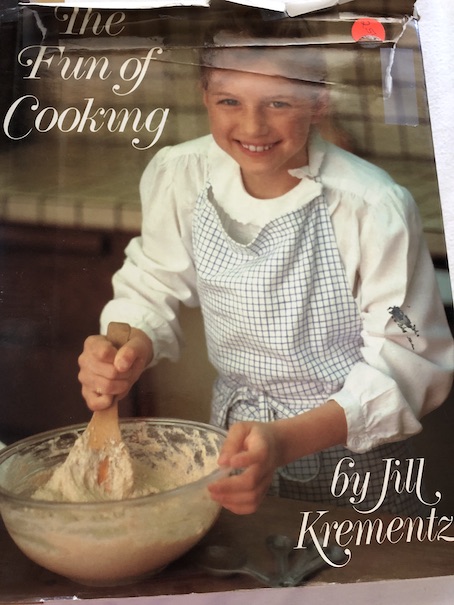
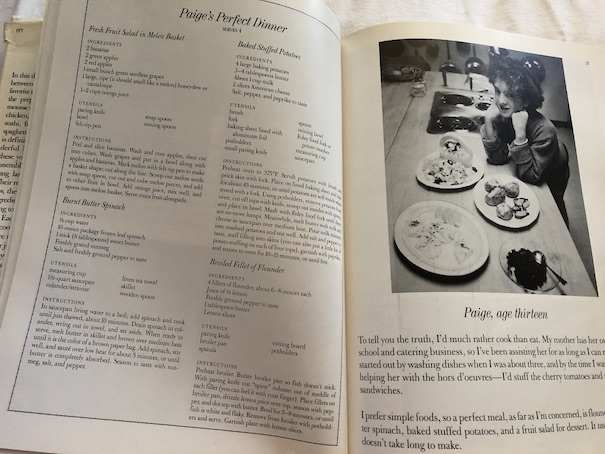
This cookbook was designed not only for children but includes real children making their favorite recipes, sometimes by themselves and sometimes with the help of their parents. The author, Jill Krementz, was also a photographer, and she photographed the children as they cooked. (Another interesting fact is that Jill Krementz was also married to Kurt Vonnegut, until his death. It’s not directly related to this book at all, just a fun fact.)
The recipes in the book aren’t arranged in any particular order, going back and forth between main dishes and desserts of various kinds. Some of the children included recipes for entire meals that included both main dishes and a dessert.
The children themselves are a range of ages from six to sixteen. The older children tend to make more complex dishes or meals, and the younger ones tend to make simpler ones, although even the younger children can make complex dishes with the help of their parents or grandparents. One girl, Michele, has a father who is a professional chef, and she says that it’s her ambition to be a chef, too. She and her father are shown making spaghetti together in the kitchen of his restaurant.
The children all seem to live in or around New York City, where the author lived, and they are from a variety of backgrounds. There are two girls who mention that they are Jewish, including the girl who makes matzo ball soup with her grandmother. There are also two black girls, and one boy with Greek ancestry. Not all of the children have obvious backgrounds like this, but I thought it was interesting where it was noticeable. I think that having a variety of children with different ages and backgrounds was a good idea because it could help many young readers to identify with different types of children.
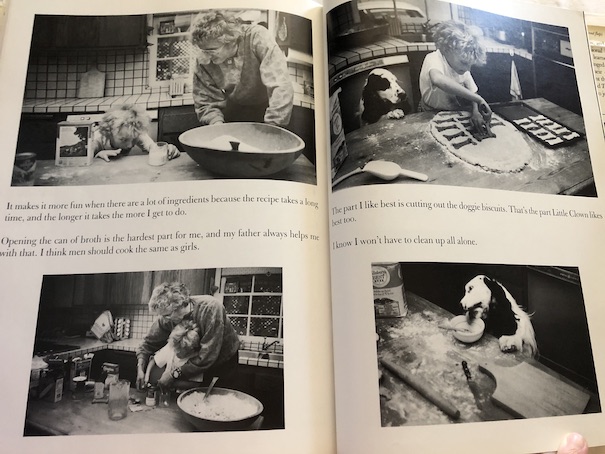
I also liked the fact that there were both boys and girls cooking their favorite recipes. Not only did Michele cook a recipe with her father, but there are other fathers in the book, helping with the cooking, too. One of the boys makes dog biscuits for his dog with his father, and he comments, “I think men should cook the same as girls.” It’s nice to see cooking characterized as something that anyone can enjoy doing, both men and women, as well as children of different ages.
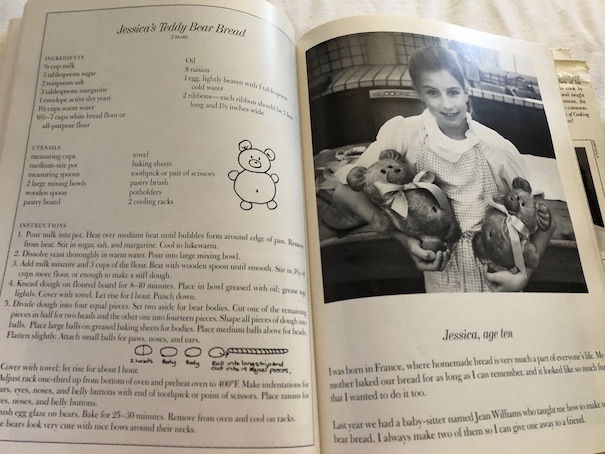
One of the cutest recipes is one for making loaves of bread shaped like teddy bears.
One of my favorite recipes was the one for pumpkin pie. I’ve made pumpkin pie from a whole pumpkin like this before, and it’s a lot of work, but it’s fun! The girl making the pie also roasts the pumpkin seeds.
The book is available to borrow and read for free online through Internet Archive.

































 Jestress's Forgotten Books and Stories
