The Mystery of the Vanishing Treasure

The Three Investigators
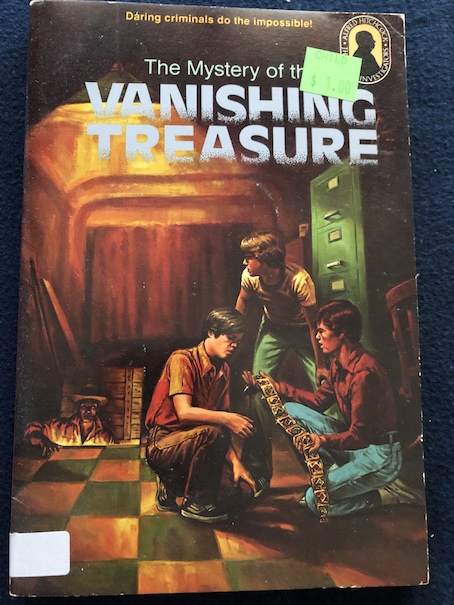
The Three Investigators don’t have a case at the moment, so Jupiter entertains himself and his friends with an intellectual exercise – figuring out how someone could steal the Rainbow Jewels from an exhibit at the Petersen Museum, an exhibit that has been promoted in the local papers. Pete and Bob object that they solve thefts, not commit them, but Jupiter says that figuring out how a theft could occur would be useful in helping them understand thefts that actually occur. The boys go to the museum to see the exhibit and study it for security weaknesses.

While they are at the museum, a theft actually occurs, but not in any of the ways that Jupiter predicted that a theft could occur. It happens in broad daylight, with a room full of people and security, and the object that was take, a golden belt, was actually the heaviest and least portable object in the exhibit. Jupiter and his friends witness the start of the crime when Jupiter runs into an old acquaintance from his childhood acting days. This actor gleefully tells Jupiter to watch the stunt that he’s going to pull. He pretends to feel faint and then drops a fake jewel that looks like one of the real ones. This is a distraction for the guards, who are all focused on him when the real theft happens. The actor is in trouble for providing the thieves with a distraction, but he tells the police that he was hired to do it both to prove himself for a role in a movie and as kind of a publicity stunt. Of course, the movie wasn’t real, and he was just duped into helping the thieves.

Jupiter is intrigued by the theft and offers the Three Investigators’ services to the man in charge of the exhibit, but he turns them away because they’re kids. However, they soon have another mystery to consider. An elderly children’s author thinks that she is being stalked by gnomes. She lives in the same old house where she grew up, and she is known for writing books about gnomes, inspired by stories that her old Bavarian nanny told her. Years ago, she used to invite neighborhood children to her house for parties, playfully calling them her “gnomes”, and she would read to them from her books. However, the old families have grown up and moved away, and many of the old houses around her have been torn down and replaced with shops and businesses. The author doesn’t want to sell her house, even though she’s been pressured to sell by a developer, but lately, strange things have been happening at the house. She keeps seeing little men dressed like gnomes, and they play mean tricks on her. She swears that she’s not dreaming or crazy, which is what her nephew seems to think. She does genuinely believe in gnomes, but what’s been happening could also be someone playing a trick on her.

The Three Investigators might think that she was imagining things, except that Bob sees one of these gnomes out the window while they’re talking to the author. The boys try to chase after it, but it disappears before Jupiter and Pete can even get a look at it. They consider the idea that Bob could have imagined the gnome, based on his reading about them and the author’s stories, but he swears he didn’t. They decide to approach the situation from the assumption that someone is playing tricks on the author, and Jupiter and Pete decide to spend the night at the author’s house to see what happens.

While the boys are exploring the area, they decide to check out the defunct movie studio next to the author’s house. There, they overhear the developer who wants to buy the author’s house talking to the security guard at the old studio. What they say makes Jupiter wonder if they could have something to do with the theft of the gold belt, but when they discover the boys listening, they insist that Jupiter misheard them.

The son of the man in charge of the exhibit at the museum comes to consult the Three Investigators about theft of the belt, having overheard them offering their services to his father. Jupiter gives him a suggestion to check on while the Three Investigators look into the matter of the gnomes. Jupiter’s first guess about the theft of the belt isn’t quite right, but it turns out that there is a connection between the gnomes and the theft. The gnome incidents could be part of an effort to pressure the author into selling her house to the developer, but the digging sounds that accompany the gnomes make Jupiter realize that the gnomes have other motives.

The book is available to borrow and read for free online through Internet Archive (multiple copies).

Many of the Three Investigators mysteries are a little like Scooby-Doo mysteries, with ghosts, monsters, or other supernatural phenomena that have logical or human explanations. I like this mystery because gnomes are an unusual mythological creature to find in that kind of story. There are plenty of mystery stories with faked ghosts but few with staged gnome appearances. It’s a little bit of a spoiler to say that the gnomes are fake, but not much of one because that is really the assumption from the beginning. The children’s author believes in gnomes, but nobody else does, and even the author isn’t convinced enough to stop her from hiring the investigators to look into the situation.

The introduction of the theft of the golden belt from the museum at the beginning of the story introduces the idea that the theft is somehow related to the gnome appearances, and that is the case. What complicates the situation is that there are different people involved with both the gnome appearances and the thefts, and not everyone who’s involved in one plot is necessarily involved in the other. One of the complications of the story is figuring out who is involved in what and who is the ultimate mastermind behind the main mystery.

The gnome appearances also put this mystery into the category of mysteries that I call Mysterious Happenings – where something strange is happening with no obvious explanation, and much of the mystery involves figuring out the motive behind the mysterious happenings, which is usually related to an actual crime that is initially unknown to the investigators. A classic example of a Mysterious Happenings mystery is the Sherlock Holmes story, The Red-Headed League, which involves a man who is invited to join a club that requires him to do some meaningless busy work for money but which he suddenly discovers is fake. In that case, the mystery is figuring out the purpose of the club and why someone would play such an elaborate prank on this particular man. This Three Investigators story has a similar premise to the Sherlock Holmes story in the sense that someone is playing an elaborate prank on the author with the gnome appearances, and the question is why anyone would do that. Part of the reason that I mention the Sherlock Holmes story is that the motive behind the prank in the Sherlock Holmes story is the same as the motive for playing the prank with the gnomes, making me think that the author was inspired by The Red-Headed League.

As for who/what the gnomes are, the presence of the old movie studio and the use of a hired actor to create a distraction in the museum are clues. It’s also important to the story that it was children’s day at the museum, so there were a lot of kids on the scene when the theft happened. I suspected who was playing the part of the gnomes from the beginning, but I didn’t guess the full motive for the crime, even though The Red-Headed League is one of my favorite Sherlock Holmes stories. There’s a dramatic scene at the end of the book where the “gnomes” storm the kids’ headquarters at the salvage yard to retrieve the golden belt from Jupiter after Jupiter figures out where they hid it.

The Mystery of the Creep-Show Crooks

The Three Investigators

The Mystery of the Creep-Show Crooks by M. V. Carey, 1985.

The Three Investigators are at the beach when Bob finds a plastic tote bag that appears to belong to a girl. Trying to figure out who the bag belongs to, the boys look through it to see if there’s some kind of identification. They find a teddy bear, a copy of People magazine, a self-help book about achieving success, some makeup, and a pair of earrings, but nothing with the owner’s name on it. When Jupiter takes a closer look at the book, he realizes that it’s a library book from the Fresno Public Library. The boys decide to contact the library, tell them that they found the book, and ask how to contact the person who checked it out. However, this simple attempt to return lost property turns into a much bigger mystery.

The librarian in Fresno gives the boys’ phone number to a frantic woman looking for her missing daughter, Lucille Anderson. Sixteen-year-old Lucille apparently ran away to Hollywood to try being an actress. Her parents are worried, the police haven’t been much help, and the boys’ inquiry about the tote bag and library book is the first lead they’ve had to Lucille’s location. Since the Three Investigators are all about solving mysteries, they immediately decide to search for Lucille themselves.

The self-help book immediately offers a few clues. The premise of the book is that anyone can become successful at whatever they want to achieve by imagining that they’re already successful. This is actually a real theory that I’ve heard of before, after a fashion. In real life, the theory is that you will also adopt the positive habits of the successful person you envision yourself to be, therefore promoting positive change in your life. (“If your habits don’t line up with your dream, then you need to either change your habits or change your dream.”) The self-help book in this story doesn’t seem to go into those details, though. Judging by the pawn tickets that Lucille has used as bookmarks, it’s not going very well for her.

Mr. and Mrs. Anderson come to Jupiter’s uncle’s salvage yard to meet the boys and collect Lucille’s bag. The Andersons bring along pictures of Lucille, and they talk to the local chief of police. There isn’t much the police can do, and runaways of Lucille’s type are unfortunately all too common. However, the police chief vouches for the boys’ reputations as amateur investigators, so the Andersons agree to let the boys try to find Lucille.

The boys’ first move is to check out all of the pawn tickets. They discover that, at each place where Lucille pawned something, she used a different name, the name of an actress who is already famous. Lucille has also been using makeup to change her appearance. The boys spot her at a pizza place, but because of her disguise, she gets away from them before they fully recognize her. They talk to some other people at the pizza place who know her under the name Arianne Ardis. At first, Lucille’s new friends are reluctant to say much about her to strangers, but the boys explain that her parents are frantic and need to know where she is. Lucille’s friends tell them where Lucille has been living.

It turns out that Lucille is being helped by a kind woman named Mrs. Fowler. Mrs. Fowler owns a large house, and she sometimes takes in teenagers like Lucille and gives them a place to stay and some work to do while they’re getting themselves established in life. Mrs. Fowler met Lucille at the hair salon where Lucille works part time. Now, Lucille is doing some house-sitting and helping Mrs. Fowler’s housekeeper while Mrs. Fowler is on a trip to Europe. Lucille says that it gives her some security and time to take acting classes and look for acting work. It’s a pretty cushy position for a teenage runaway. When the boys convince her to call her parents and bring her parents to see her, Lucille is angry and says that she doesn’t want to go back home with them because she is actually getting somewhere with her life and acting career.

Lucille tells them that she’s been offered a leading role in a new horror movie called Dracula, Mon Amour. It’s supposed to be a sequel to the classic Dracula. It sounds cheesy, and her parents are understandably skeptical. Lucille’s father doubts whether this movie offer is legitimate, and he recruits the Three Investigators again to research this film company and the movie producer to find out whether they’re even real filmmakers.

It doesn’t take the boys long to determine that the supposed producer isn’t who he claims to be. He’s assumed someone else’s identity, and when the Three Investigators meet with the real producer, he says that the phony is probably out to take advantage of this girl in some way. He says that there are some real weirdos out there and tells the boys to warn the young actress to back away from this supposed movie offer. However, when they go to tell Lucille what they’ve learned, they discover that she’s missing and may have been kidnapped! Why would phony movie producers kidnap a teenage runaway/wannabe actress? To make matters worse, the Three Investigators start to suspect that this horror movie crew might have something to do with a series of robberies committed around town by people dressed as horror movie creatures.

The book is available to borrow and read for free online through Internet Archive.

My Reaction

For part of the mystery, while the characters are pondering the real identity of the movie producers and Lucille’s whereabouts, I found myself wondering why Lucille left her tote bag of stuff on the beach. I wouldn’t have expected a teenage runaway, who has few personal possessions and probably can’t afford to replace any she loses, to be so careless with her things. At first, I wondered if this was an oversight or plot hole in the story, but it’s not. Lucille’s tote bag and its contents are key to the mystery. They’re the reason why the criminals are interested in Lucille. In a way, this story reminds me of the movie Charade with Cary Grant and Audrey Hepburn. In both stories, there is a bag full of seemingly innocent contents, but someone wants something in the bag very badly. The challenge is to figure out what they want and what its significance is.

There are also a couple of twists about the crimes being committed. The main criminals aren’t doing all of the things everyone suspects them of doing, and there is another criminal involved because there is another crime that isn’t discovered until the end.

My Sister the Witch

My Sister the Witch by Ellen Conford, 1995.

Norman Newman is convinced that his sister, Elaine, is a witch. When he goes to her room one evening to call her to dinner, he catches her all dressed in black and chanting strange words.

Norman likes to read horror and mystery books, and he uses some of the techniques that he has learned from reading his favorite mystery stories to investigate his sister. Some of these techniques don’t work as well for Norman as they do for the characters in his books, partly because he doesn’t really know how they work (like which end of a glass you’re supposed to put against a door when you’re trying to listen in on someone) and partly because the characters and situations in books are fictional and some of the things they do don’t work that well in real life.

Early in the story, Norman uses one of his scary stories for a book report for school, and his teacher tells him that she wants him to start to read other types of books. She makes him write an extra book report, telling him that he has a week to read something outside of his usual genre and report on it. That incident and some other pieces of bad luck cause Norman to think that maybe Elaine really is a witch and that she put a curse on him, just like a witch in the book he just read.

Norman’s friend, Milo, thinks that Norman’s imagination is just running away with him. It’s happened before because of the scary stories he reads. Once, he thought that their teacher might be an alien.

When Norman has a brief streak of good luck, he starts to think that whatever curse Elaine put on him may be over, but then, he gets sick to his stomach. He goes to the library to get a book for his new book report, and he also gets a non-fiction book about witches. Then, he overhears Elaine talking to her friend, Deirdre, about something being powerful and scaring Deirdre’s sister. The two of them begin chanting together. Norman decides that he was right about Elaine being a witch and that Deirdre must be a witch, too.

After some research, Norman and Milo learn that, to get rid of the effects of a magic spell, they need to learn the words to the spell and say it backwards. Norman doesn’t remember the whole spell from when he heard Elaine say it, so Milo says that he’ll just have to look for a copy of the spell in her room. The book they consult also says that a spell can be neutralized if the person it was cast on duplicates it, which means gathering all the materials used in the spell, but Norman doesn’t know where he would find things like newts’ eyes and frogs’ toes. Either way, it looks like Norman’s going to need a copy of Elaine’s spell. However, even when he gets it and tries to break the curse, things still go wrong. What can Norman do to get rid of this bad luck spell?

I particularly liked the character of Milo in the story. Milo uses a wheelchair because he was hit by a car when he was young and can’t walk. Norman notes that, although Milo can’t use his legs, he gets around very well in his wheelchair and that he has very strong arms. Milo is also more level-headed than Norman, pointing out to him how he has allowed his imagination to run away with him in the past.

The book is available to borrow and read for free online through Internet Archive.

Spoilers and Other Thoughts

I thought that the secret behind Elaine’s spell was pretty obvious from the beginning because the book repeatedly says that Elaine wants to be an actress. It reminded me of other stories I’ve seen where someone’s playacting was mistaken for some real life danger. Overall, I enjoyed the book, even though I figured out what was going on pretty quickly. Kids might be in suspense for longer.

By the end, Norman still hasn’t learned his lesson because the next scary story he reads leaves him looking at his dog suspiciously. There is at least one sequel to this story called Norman Newman and the Werewolf of Walnut Street.

Mystery Madness

Mystery Madness by Otto Coontz, 1982.

While Murray’s parents are on vacation, his older sister, Blanche, is in charge of the house. One day, he calls Blanche to get a ride home from the dentist and hears what he thinks is Blanche shooting their housekeeper.

Earlier that morning, he had heard Blanche talking on the phone to someone about a gun. Then, when he calls home, a friend of Blanche’s, Harold, answers, and Murray hears a gun going off in the background and Blanche apologizing to the housekeeper and talking about blood on the carpet. When Murray gets home, his mother’s Persian rug is missing and sees what appears to be a head in a bucket under the sink in the kitchen, further proof that the housekeeper is dead and that her blood stained the carpet.

Murray doesn’t know what to do because he is sure that his sister would never shoot anyone on purpose, and he doesn’t want to see her go to jail. He consults a private detective, Mat Cloak, who he met in a doughnut shop, for help.

The detective agrees to look into the case, and along the way, he realizes that it has connections to a case that he is already investigating. What really happened to the housekeeper? Is Blanche really guilty of murder? Moreover, who is the strange man who is following Murray around?

It’s a very funny story with some twists that readers won’t be able to guess right away. Part of the mystery is pretty obvious because Blanche is a theater student, but the real mystery is one that Murray isn’t even trying to solve and the real villain is someone who Murray thinks is a victim.

The book is available to borrow and read for free online through Internet Archive.

The Secret of Terror Castle

The Three Investigators

TITerrorCastle#1 The Secret of Terror Castle by Robert Arthur, 1964, 1992.

In the first book in the series, Jupiter, Pete, and Bob form the Three Investigators, an organization dedicated to solving all kinds of mysteries.  It was particularly Jupiter’s idea. They have been friends for a long time, and they used to have a club dedicated to solving puzzles. Now, they’ve decided that they want to solve more complicated problems and mysteries. Jupiter has won the use of a Rolls Royce and chauffeur for a month by entering a contest at an auto rental agency, so he thinks that it would be a good time to get started because they will have transportation to anywhere in the city.

Jupiter also has an idea for their first case, something that will help them get publicity for their new investigative organization. There is a rumor that a director, Reginald Clarke, is looking for a genuine haunted house to be the setting of his next movie. Jupiter manages, through some clever trickery, to get an interview with Reginald Clarke and persuades him to introduce this account of their first case if he and the other investigators can find a genuine haunted house right in town. Clarke takes them up on it, not because he thinks they will succeed, but because he sees it as the only way to get Jupiter to stop doing an unflattering impersonation of him.

Jupiter, however, is confident that they will be successful because he already knows the perfect place to investigate. Terror Castle is a large mansion that was built years ago by an old actor who was in silent films. All of his movies were scary ones, and since his death under mysterious circumstances, no one has succeeded in staying in the castle very long. Strange apparitions have been seen there, and anyone who tries to spend the night there is overcome by inexplicable terror. As far as Jupiter is concerned, all they have to do is prove that the castle is really haunted, and that means that the Three Investigators must visit it themselves.

In the original books, the director that Jupiter tries to find a real haunted location for was Alfred Hitchcock.  Alfred Hitchcock introduced the early books in the series and played minor roles in some of them, and The Three Investigators capitalized on his reputation.  When the series was re-released, however, Alfred Hitchcock was replaced by a fictional director, and his role in later books was taken by a fictional mystery author named Hector Sebastian.  In the re-released version of the first book, Reginald Clarke refers the boys to Hector Sebastian at the end of the story so they can help a friend of his to find his missing parrot, which leads directly into the subject of the next book.

The haunting in this story (as with others in the series) has a reasonable explanation, not a supernatural one.  In fact, one of the things that I always found memorable about this book was the explanation of how the inexplicable feelings of terror people experienced were created using sound waves which could be felt but which were beyond the normal range of human hearing.  I’m not sure whether the book was completely correct about the science behind this technique, but I have heard about sounds being used to create odd or even harmful effects on human beings in real life.  As for the reasons behind the haunting, they concern the original owner of the castle and the life he lived.

This is one of the books in the series which was made into a movie, The Three Investigators and the Secret of Terror Castle, but the movie was very different from the original book.  In the movie, the owner of the castle was an inventor, not an actor.  Part of the plot also concerned Jupiter’s deceased parents and a mystery that they had been investigating.  Jupiter’s parents were not part of the original book at all.  A villain who appears in some of the other books in the series also makes an appearance in the movie, although he had nothing to do with this particular story in the original series.  Overall, I don’t recommend the movie for fans of the original series.  The changes don’t seem to be for the better, and I think people who remember how the original story was and liked it would be disappointed in the movie.

There are multiple copies of this book available to borrow for free online through Internet Archive, both the original version with Alfred Hitchcock and the updated one.

Stage Fright

SBStageFright

Stage Fright by James Howe, 1990.

A well-known actress, Michaele, who is also an old friend of Sebastian Barth’s mother, has come to town to be in a play. She’s staying with Sebastian’s family, and Sebastian has a role in the play as Michaele’s son. His friends will be working on the sets for the play, and everyone is really excited. However, Michaele herself is nervous because she hasn’t done live theater for some time. She is also struggling to get to know her nine-year-old son, who has recently come to live with her.

Then, someone begins sending her strange notes. At first, they come in the form of secret admirer notes and are accompanied by little presents. Later, the notes take a nasty turn, and Michaele becomes the victim of suspicious accidents. Someone even calls her son pretending to be his father, who lives in another state, to get him to go off on his own to meet him somewhere. Although nothing bad happens to the boy and no one comes to meet him, his sudden disappearances cause Michaele to worry that he has been kidnapped. Someone seems to be trying to frighten Michaele out of doing the play, but who is it and why?

The theme of the story is the difference between what people imagine is true and what is really true. A lot of the people in the story have unrealistic expectations of others. For instance, Michaele is impatient with her young son, who has had a troubled history of being torn between his divorced parents, who are both busy with their careers. By the end of the story, she has come to understand him better and plans to spend much more time with him.

Michaele, as a well-known actress, also attracts many admirers, most of whom have different illusions about what she is really like and what she really wants. In the end, after Sebastian reveals the culprit, Michaele decides not to let what happened stop her from going for what she knows she really wants, whether her efforts succeed or not. Michaele’s confidence is restored, and she’s looking forward to a brighter future with her son.

The book is currently available online through Internet Archive.

In the Kaiser’s Clutch

KaisersClutchIn the Kaiser’s Clutch by Kathleen Karr, 1995.

After their father’s death during World War I  (then called The Great War), the Dalton twins’ mother started supporting their family by writing.  It’s the summer of 1918, and Dorothy Dalton is now writing the scripts for a silent movie serial starring the fifteen-year-old twins, Nelly and Fitzhugh.  Times have been tough for them without their father’s support, but the serial means steady work and salaries for all three of them for the entire summer, enough to support them and buy school supplies for the fall, and maybe even enough to buy back some of the things that their mother pawned to keep their family going when they had to move out of New York to a less expensive town in New Jersey.

The movie serial, called In the Kaiser’s Clutch, is about a pair of wealthy American twins (played by Nelly and Fitz) who find themselves battling German spies.  The serial is part adventure story, part American war propaganda.  It’s also a subject that hits close to home.  The Dalton twins’ father wasn’t killed while fighting overseas.  He was in charge of the security force for the piers of Black Tom Island, just off the coast of New York, the port where most of the weaponry destined for the war in Europe was being shipped.  However, a massive explosion destroyed the port at Black Tom and killed Mr. Dalton.  Fitz wishes that he were old enough to fight directly in the war, but failing that, he wants to find the people who killed his father because he is sure that his father’s death was due to deliberate sabotage, not an accident.  However, it’s possible that the saboteur himself is looking for the Dalton family.

Strange things start to happen which the twins realize may have some bearing on their father’s death.  Someone has been spying on the family, listening by the window of their apartment.  Then, the director of their movie serial hires a new, part-time actor to play one of the villains, and this man is oddly similar to the fleeing figure of the man who was spying on them.  This new actor is German, and he seems to have some weird grudge against the twins, muttering insults in German and taking advantage of the stunts they have to perform in the movies to hurt and frighten them.  There are plenty of opportunities for the twins to get hurt on the movie set because each episode of the series has to end with a cliff-hanger scene, and there are no stunt doubles.  (Early silent movies in real life typically didn’t have stunt doubles, and the stunts were difficult and dangerous for the actors themselves.  This YouTube video explain how Buster Keaton, a famous silent film actor, performed his own stunts.)  From fist fights to car chases to quicksand to a cave-in to a giant pendulum with a mysteriously sharpened edge to sudden explosions, the Dalton twins are constantly teetering on the edge of disaster, not all of it planned by their writer mother.

Mrs. Dalton admits to the twins that, shortly before their father died, he told her that he was close to uncovering something that would be a much better story than anything she could make up.  Unfortunately, he never told her what it was.  He did tell her that he was making notes about it, but those notes were never found and may have also been destroyed in the explosion.  The only odd thing that Mrs. Dalton found after her husband’s death seemed like an ordinary shopping list: “cigars, eggs, dumplings, coal, pencils.”  However, Mrs. Dalton realized later that it has to mean something else because her husband didn’t smoke.

Could this somehow be the clue to what her husband was investigating before his death?  Are there real spies operating in the area?  Is there some other clue to their identity that they are now searching for, something that the Daltons still have in their possession?  Will the Dalton twins manage to find the spies before the spies eliminate them?  Will the family finish the serial and collect their salaries?  Find out in this exciting installment!  (There’s only one installment here because this is just a single book, not part of a series, but you get the idea.)

My Reaction

World War I books aren’t quite as common in children’s literature as World War II stories, so I found this interesting, and movie serials are also a fascinating thing of the past.  The movies that the kids are acting in are black-and-white silent films, so there are interesting discussions of the techniques they use to make things show up properly on black-and-white film (makeup, dyeing the water black for Nelly’s near-drowning scene, etc.) and conveying emotion when the actors’ voices will not actually be heard.  It’s a fun and fascinating story with spies, government agents, and the kind of movie stunts that I’m sure a lot of kids wish they could do for their summer jobs!

MacDonald Hall Goes Hollywood

macdonaldhallhollywoodMacDonald Hall Goes Hollywood by Gordon Korman, 1991.
MacDonald Hall has been picked as a location for filming a movie about a boarding school, and people are going crazy (or crazier than normal)!  Bruno hopes that he’ll be discovered and become a movie star. His attempts to insinuate himself (not very subtly) into various scenes keep getting him into trouble.

The girls at Miss Scrimmage’s Finishing School for Young Ladies all have a crush on the teen star of the movie, Jordie Jones, further annoying Bruno.  Cathy and Diane, Bruno and Boots’s friends at Scrimmage’s, are especially getting on his nerves with their wild schemes to meet Jordie in person.

Meanwhile, poor Jordie wishes that he could live life out of the limelight for awhile.  His manager worries about him excessively and never lets him do anything fun.  In spite of his many admirers, Jordie is lonely because he spends all of his time with the movie people and doesn’t have many friends his own age.  Nobody has even remembered his birthday!

Bruno and Boots discover Jordie’s woes when Bruno tries to play a mean trick on Jordie, due to his jealousy of all the attention Jordie gets.  After Jordie opens up to the guys about his problems, Bruno feels more sympathetic toward him and decides to help.  The boys invite Jordie to play poker with them (after lights out and against school rules), take him to a dance at Miss Scrimmage’s (in disguise as a prince from a made-up country), and even get him to help with a hockey game as goalie (which earns Jordie a black eye).

Jordie has been having the time of his life, but the boys still have to conceal his activities as much as possible and deal with his over-protective manager, his rabid fans at Miss Scrimmage’s, and as always, The Fish.  Mr. Sturgeon (aka The Fish), is sympathetic to Jordie because he knows that activities like these are important to his growth as a person, but the movie people crack down on Jordie’s activities because the black eye interferes with his filming.

Although Jordie is supposed to keep quiet and let his eye heal, he runs away to join Bruno and Boots and several other boys on the school’s traditional wilderness survival trip (known to the students as “Die-in-the-Woods”).  It isn’t long before Jordie is discovered among them, but before the trip is over, the others are going to be glad that he’s there.

This book is part of the MacDonald Hall Series (or Bruno and Boots series).  It is currently available online through Internet Archive.

My Crazy Cousin Courtney Returns Again

CousinCourtneyReturnsMy Crazy Cousin Courtney Returns Again by Judi Miller, 1995.

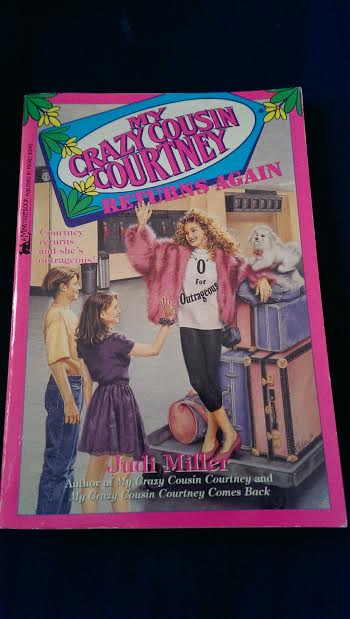
Courtney is back in New York with her cousin Cathy and living her dream of becoming an actress!  Courtney has landed a part in a movie called The Laundry Bag Murder (see the first book in the series for that explanation).  With Courtney’s new professional responsibilities, Cathy hopes that this visit will be quieter than their last ones, but no such luck.  Excitement follows Courtney wherever she goes, and if things aren’t exciting enough to suit her, she knows how to stir them up!

When Cathy and Courtney go to the Central Park Zoo to try out Courtney’s new video camera, Courtney ends up turning the expedition into a vampire hunt that ends up catching a criminal.  When they go to see a friend’s rock band perform at a bar, Courtney turns a barroom brawl into a hug-in.

Courtney is also giving Cathy relationship advice.  Cathy and Frank are boyfriend and girlfriend now, but both of them are pretty shy.  Too shy to even go on a real date.  Courtney says that maybe Cathy should act a little helpless to bring out Frank’s protective instincts and to get his attention.  She says that Cathy should tell Frank that she thinks someone might be following her around (it’s not a lie if Cathy isn’t sure).  That way, Frank will want to spend more time with her to look after her.

With some reservations, Cathy does tell Frank someone may be following her, which does get Frank’s attention.  Then, to Cathy’s surprise, she actually does notice someone following her around.  At first, she suspects that Courtney got another actress to follow her for awhile to make her story to Frank true, but it turns out, that’s not the case at all.  Who is that mysterious woman in the sunglasses and what does she want?

There is another book in the series which I don’t have and haven’t read called My Crazy Cousin Courtney Gets Crazier.  Courtney ends up going to school in New York with Cathy because she lands a role in another movie which will be shooting there during the fall.

My Crazy Cousin Courtney

CousinCourtneyMy Crazy Cousin Courtney by Judi Miller, 1993.

Cathy Bushwick usually spends the summer at camp, but this summer, her mother is having her stay in the city because her cousin Courtney is coming to visit them in New York.  Cathy and Courtney are actually second cousins because their mothers are first cousins.  They’re the same age (thirteen) and met once when they were five, but neither of them remembers it.  All that Cathy really knows about Courtney before she arrives is that she’s somewhat neurotic (Courtney is troubled by anxiety and panic attacks) and that the reason she’s coming to visit is that her parents are thinking of getting a divorce and need time alone to discuss it.

Cathy understands what it’s like to live with a single parent.  Her parents are divorced, and her father went to California years ago to become an actor.  She hasn’t heard from him since.  Her mother used to be an actress, but with Cathy to take care of, she became a theatrical agent for animals instead (she finds animals for people to use in commercials).  So, when Cathy hears that Courtney will be visiting from Beverly Hills, she’s very excited.  At first, she hopes that she and Courtney will be like sisters and that Courtney might have even heard of her father in California.

Cathy’s illusions are shattered almost immediately.  Courtney not only hasn’t heard of her father but she’s nothing like Cathy imagined.  When she and her mother go to meet her at the airport, she’s wearing heart-shaped sunglasses and a hot pink shirt that says, “KISS ME QUICK,” and she has a pile of luggage.  She’s used to having money and getting the best of everything, and she’s immediately disappointed with the modest apartment where Cathy and her mother live.  When she learns that they don’t even have a pool, she gets upset and wants to go home.  But, it’s no use.  She’s stuck there for the summer.  And, they’re stuck with her.

But, things don’t turn out to be as bad as Cathy fears they’re going to be.  In some ways, they’re worse.  Once Courtney reconciles herself to spending the summer in New York, she has some very specific ideas about things that she’d like to do, and a lot of them end up getting the girls in trouble.  Shy, sensible Cathy finds herself getting locked in Tiffany’s after closing time because Courtney thought she saw a spy stealing their designs, rescuing Courtney from the dolphin pool at the aquarium, and lots of other things that she never thought she’d find herself doing.  Then, one day, the girls think they’ve witnessed a murder.  What are they going to do?  Is Cathy going to survive the summer with her crazy cousin Courtney?

This book is the first in a series about Cathy and Courtney.  Courtney may be a bit wild, but she’s not as crazy as Cathy thinks.  Over the course of the summer, the two become friends, and they learn quite a few things about each other and about themselves.  By the time Courtney has to go home, a little of each of them has rubbed off on the other, and neither will be quite the same again.

The book is available online through Internet Archive.