This is the second book in the Our Secret Gang series. Members of the detective gang in the story take turns narrating different books, and this one is narrated by Nancy. After having solved their first mystery in the previous book, the kids are organizing their detective club and discussing how to advertise their services. Then, Jason’s younger brothers and their friend, Kenny, bring them their next case.
Kenny tells them that he saw a ghost near the old, abandoned train yard. He says that he saw something white dart into the swamp near the train yard. He was riding the school bus at the time, and other kids on the bus saw it, too. Jason thinks that the kids probably just saw some swamp gas, but the rest of the gang decides to check it out anyway.
When they explore the area around the train yard, Nancy and Jason find someone’s camp site. Their first thought is that the “ghost” is just someone who’s been camping out in the area. However, when they bring their friends back to the camp site the next day, there is weirdly no sign of the camp fire they saw and no sign that anyone has been camping there recently. It seems weird that an entire camp site could vanish so completely in just a day. However, there is definitely someone hanging around the old train yard because someone lets the air out of the kids’ bike tires, and Nancy later realizes that the shades in the old station house where down, when they weren’t before.
Then, there an announcement at school that an elderly local man suffering from Alzheimer’s has disappeared, apparently wandered off. The fifth and sixth graders are recruited to help with the search for him. He is eventually found near the train yard, leading the kids to think that maybe the “ghost” was the old man, wandering around.
They soon realize that it wasn’t the old man when some of the kids see the ghost again after the old man is found and returned home. Is there someone else hiding out around the old train yard, or could it really be a ghost?
Meanwhile, Nancy has noticed that her parents are behaving oddly. They invite a woman Nancy has never met before to dinner, and they seem to be keeping secrets. Secrets are no stranger to Our Secret Gang because everyone in the club has a secret. Nancy’s is that she was adopted and very few people know. Could this mysterious stranger and her parents’ secrets have something to do with her adoption?
The book is available to borrow and read for free online through Internet Archive. In the back of the book, there are instructions for making plaster casts of footprints and how to analyze footprints, which the characters didn’t do themselves in the book. It’s more that books in this series include instructions for detective skill activities.
My Reaction
This mystery is the kind that I like to call Pseudo-Ghost Stories, mysteries of the Scooby-Doo variety, where there seem to be ghosts, but there are actually logical explanations for everything.
I first read this book when I was a kid, and I remember being intrigued by the secrets of the club members and Nancy’s sudden discovery that she was adopted. I think it’s common for kids to imagine what would happen if they suddenly made a discovery like that. Nancy’s discovery of her adoption happened when she and her parents first moved to the town of Millerton from Boston, so she’s know about it for a little while but not very long. When Nancy’s parents begin acting oddly and have a guest to their house who identifies herself as a nun and also seems to be a social worker, Nancy worries about what they’re keeping from her. I thought the answer was pretty obvious, and I don’t think that it stumped me for very long when I was kid, either, because Nancy even says at the beginning of the story that she’s always wanted a younger sibling.
I don’t think that her parents should have been so mysterious with her because their secret-keeping before about her adoption caused her some hard feelings, and I don’t think that there’s a good reason to keep her in the dark when they’re thinking of making a major change in their family. They say that it’s because they didn’t want her to get her hopes up because adoptions take a long time to arrange. It sounds like a realistic explanation; I just don’t think it’s the best idea. Nancy’s parents could have used the long process of the adoption of a younger sibling for Nancy to show Nancy what they went through when they adopted her and how much they wanted her because they were willing to go through the long process to get her, which could help her better understand her own past and what she means to her parents. In the end, Nancy does come to those realizations, and she also realizes that is a large part of the reason that her parents have been overprotective of her. She also realizes that the adoption of a new child will mean that her secret about her adoption will probably be revealed, but she decides that it’s okay. Her mother admits that her reluctance to reveal Nancy’s adoption had to do with her own unresolved feelings about her own adoption as a child, but she has been working through them.
As another small point that I found interesting in the story, when Nancy makes the flyers for their detective club, she uses press-type letters. I used to have some myself that I used for labeling things with my name. They’re also called dry transfers or rub-ons. They’re decals with pressure-sensitive adhesive on a piece of backing material. To apply them, you lay them face down on the object where you want them to be and rub the backing with something. The pressure activates the adhesive, and they stick.
The Mystery of the Other Girl by Wylly Folk St. John, 1971.
It’s a rainy Saturday in Florida for the Barron family when Stevie (short for Stephanie) gets a strange phone call from Mobile, Alabama that’s meant for her ex-boyfriend, John Henderson. Stevie just broke up with John, who likes to call himself “Ian” because he thinks it sounds classy, the day before, and she has no idea who the strange girl on the phone is or why she’s trying to reach John/Ian at her number. Stevie asks the girl for her name, and she says that she’s Morna Ross, but suddenly, the girl screams and is cut off, like someone put a hand over her mouth, and then someone hangs up the phone at her end. Stevie is disturbed by the call, fearing that something bad happened to the other girl, but she doesn’t know what to do about it because she doesn’t know Morna Ross and doesn’t know exactly where she was calling from or why she wanted to talk to Ian.
Since Stevie already has a date to go dancing with friends at a place where Ian and his band are performing that night, she tells her friends about the weird phone call and asks them what she should do. They say that they’ve never heard of Morna Ross and tell her that she should talk to Ian about it. However, Stevie feels too awkward about the breakup to talk to Ian and asks a couple of her friends to do it for her.
That evening, Stevie and her friends run into Stevie’s old friend, Hope. She and Hope haven’t seen too much of each other lately because she’s not interested in dancing and dating and other things that Stevie wants to do. This evening, though, Hope is out with a visiting cousin from Mobile, Alabama named Phil Walters. Stevie is glad that Phil is getting Hope to come out of her shell a bit. Stevie and Phil say that the style of dancing popular with teenagers today is better than older styles of dancing because they don’t have to take any lessons to learn it – it’s just moving to the music, like everyone else. On impulse, she asks Phil if he’s heard of Morna Ross, but he says he hasn’t. Stevie’s friends say that when they asked Ian, he claimed not to know Morna Ross at first, but then he said something about her being a girl who’s “crazy about him.” Apparently, he dated her before he dated Stevie, and since he and Stevie broke up, he decided to invite her to the Old Seville Festival that’s happening next week, a local celebration of the history of their town. Stevie thinks it’s strange that Ian didn’t mention that Morna lives in Mobile, since that’s the place she was calling from. Stevie’s friends think maybe Ian was lying about Morna being crazy about him and that he probably doesn’t really know her because Ian is always bragging about things, like how great his family is. Hope thinks Ian makes up things to brag about because he wishes they were true even though he knows they really aren’t. After she thinks it over, Stevie thinks that’s true, that Ian likes to keep up appearances and a superior attitude because, underneath it all, he’s actually a very insecure person. But if he made up his relationship with Morna, and he doesn’t really know her, why was Morna trying to call him?
Before the evening is over, Ian confronts Stevie and reminds her that their first date was almost a year ago, at the last Old Seville Festival and that he’s planning to see her there again this year because they promised each other that they would see each other during the festival every year. In return, Stevie confronts Ian about Morna. Ian says that she’s just another of the girls who have come to see his band perform and likes him. When Stevie asks why nobody’s met Morna at any of the teenage hangouts in town, he says that they like to hang out at the more adult spots. He begins spinning a story that Stevie is sure is at least half fiction about how he and Morna order non-alcoholic drinks at adult nightclubs but they sneak in some gin to mix in with it and how they’ve tried marijuana. (Keep in mind that marijuana was illegal everywhere in the US at this time.) Ian says that he and Morna don’t really want to become potheads, but they see trying these things as part of growing up, “to experience everything and then make a choice.” Stevie pauses to wonder about the word “everything.” (That is always a good thing to wonder about when someone talks about wanting to try “everything.” Define “everything.”) Stevie asks him where Morna lives, and he says that she lives across town, but her family has moved around a lot because her father deals in real estate and sometimes even sells their own house and moves his family to a different one. (Ian sounds like he thinks that’s clever. I thought it sounded really suspicious, like maybe Morna’s family is actually involved with the mafia or something and has to keep on the move.) Stevie doesn’t really believe any of this, but she pries a few more details out of Ian about what Morna looks like. Although she thinks that Ian made up most of the things he said about Morna, there is still the girl who called her earlier and screamed like she was in trouble. She was a real person, even if what Ian said about her wasn’t all true.
When Stevie gets home, she tells her mother what Ian said about Morna and how Ian likes to make up things. Stevie is still concerned about the girl who called and wants to find out who and where she is and if she’s okay. Her mother says that her father will be coming home from a business trip the next day, and they can ask him what to do about it. Stevie’s father is a fingerprint expert at the police department, so he knows about police procedures and can make inquiries. Stevie wishes that she had Morna’s fingerprints so her father can analyze them himself, and in another weird development, she gets that opportunity.
The next day, Stevie gets a letter from Morna. The letter is addressed to her and not Ian. Morna didn’t know her home address, so she addressed it to the high school she attends, and the letter was forwarded to her from there. Stevie handles it carefully so she won’t disturb any fingerprints. The letter even has Morna’s return address, so she knows where she lives in Mobile. The contents of the letter are strange. Morna talks about her school band and how they’re always short of instruments. She says that she’s liked Stevie since she saw her playing with her school band in a competition (Stevie really is in her school’s band) and wonders if her school would be willing to sell spare instruments. The letter is oddly worded, the word “see” is underlined twice, and there are doodles all over page. Also, the specific instrument Morna says that she wants is written in French and doesn’t sound at all familiar to Stevie. Stevie looks up the term Morna uses, and it turns out to be a French horn. But, if Morna meant “French horn”, why didn’t she just say that? Also, the price she mentions for the French horn is far less than what an actual French horn would cost. It seems like Morna is either crazy or trying to say something else in her letter.
Stevie has a younger brother named Lyle who is really smart, and he suggests that the letter might be in some kind of code. As they talk it over, Stevie realizes that the French horn refers to Ian because he plays the French horn in her school band. Lyle wants to study the letter more to see if he can figure out other parts of the code, and Stevie decides to invite her friends over to see it, too, because most of them are also in the band and might notice something else in the message that’s music-related. Little by little, the kids begin working out the real meaning of Morna’s message. First, the amount of money that didn’t make sense is meant as a clue the reader that there’s more to this message than just an inquiry about musical instruments. Second, Morna phrases sentences oddly in order to work certain words into the message and put them in the right order for her hidden message. Third, the doodles around the message are the beginnings of pieces of music. Stevie and her friends providing their musical knowledge and Lyle coaches them through code-breaking techniques. After awhile, Lyle goes to his room to work on the code alone because he finds it easier to think by himself and likes surprising people with his discoveries. When he returns, she has the final solution.
Morna’s message says that she has to get in touch with Ian. She says that she is being watched and her mail is being read, which is why she has to communicate in this way. Morna asks Stevie to write to her in the same way, promising to explain the situation later. Stevie remembers that Ian wanted to see her at the Old Seville Festival, so she decides to tell Morna when and where to come if she wants to see Ian. Shortly after Stevie mails the letter, Morna calls again, saying that she needs to warn Ian because someone might try to kill him. Then, she screams and someone hangs up the phone again.
At first, Stevie’s father thinks that Morna is some kind of prankster or maybe having some kind of paranoid fantasy because she’s into drugs or something, but Stevie is sure that Morna really is scared. The danger is real, and Stevie’s family realizes it when Lyle is kidnapped at the Old Seville Festival.
The book is available to borrow and read for free online through Internet Archive.
My Reaction
I was pretty sure, for much of the early part of the book, that the whole thing with Morna’s mysterious phone calls and messages was just an act that Ian dreamed up and got someone to do for him as one of his dramatic bids for attention. It seemed weird to me that Morna second phone call ended exactly the same way as her first, like it was part of a rehearsed routine. Also, someone who wanted to interrupt Morna’s phone calls and keep her from talking could do it in easier ways that wouldn’t involve dramatic screams that would get attention. They could have just unplugged the phone or held down the hang up button. (Remember, this is the early 1970s. Morna’s using an older style of telephone that has to plug into the wall, and there are buttons where the handset rests that hang up the phone. That was the first type of phone I ever used as a kid, and I know that you can push those buttons down with your hand to end a call even if someone is still holding the handset.) I would think that if a sinister person was watching Morna, they would cut her off that way rather than try to put a hand over her mouth while she screams. Also, if they really didn’t want her to communicate with anyone, I don’t think they’d let her write any kind of letter, not even one that just seems to be about band instruments. Even if they couldn’t figure out the code, I doubt that they’d want to take the chance that she might communicate something to the wrong person. It all just seemed too theatrical and not realistic. So, I couldn’t really blame Stevie’s father for initially thinking that the whole thing might just be some kind of prank. However, I did wonder why he didn’t just phone the Mobile police department and ask a colleague to do a welfare check on the girl at the address on the envelope to find out if it was a prank or not. Better safe than sorry, and if it turned out to be just a prank, knowing that the police knew about it would probably be enough to get the girl to stop.
As it turns out, it’s not just a prank. There is something genuinely sinister going on, although I wasn’t sure what it was for quite awhile. I thought it might have something to do with drugs because there were repeated references to drugs in the story, but that’s not what’s going on. It turns out that Ian/John has been having trouble with his self-image and even self-identity because he’s adopted. He’s aware that he’s adopted, which is why he secretly worries that he doesn’t really fit in with his family or friends and makes up fantasies about himself to impress people while being inwardly insecure. However, there’s quite a lot that Ian/John doesn’t know about his past, not even his birth name, and the truth of Ian’s past is even stranger than anything that he’s ever imagined. His blood relatives love him and didn’t forget about him, even though they couldn’t take care of him when he was a baby, and now, they’re trying to protect him from a very real threat. Finding out the truth comes as a shock to Ian, but it’s an important step in making peace with himself and realizing just how important he is just for being himself, not only to his adoptive family but to the family who gave him up for adoption and to the friends who cared about him even when he was a bit of poser and who took great risks to protect him and help him find the truth.
Lyle is fun as an eccentric genius character who has a pet walking catfish. I hadn’t actually heard of a walking catfish before reading this book, but that’s part of the fun. I enjoy stories that bring up interesting facts that I didn’t know before. Walking catfish can actually survive out of water for long periods of time and move across land. The walking catfish ends up playing a role in catching the bad guys in a way that actually makes sense, which is nice. I also like that, although Lyle is pivotal in solving the mystery, he didn’t get all the answers too easily, like some geniuses in stories, and he needed some specialized knowledge from other people. That makes him a more realistic character.
I would like to discuss the costumes that the characters wear to the Old Seville Festival, though. They explain that it’s common for people attending the festival to dress in historical costumes from different time periods in the town’s history to get into the spirit of the event. Ordinarily, I would think that’s fun and be completely supportive, but there’s one exception that I think crosses the line a little. Some people, including Lyle, dress in Native American costumes. I’m not Native American myself, but I know that real Native Americans are usually not too happy to see traditional forms of dress being used as costumes. I would cut the characters more slack for it if they confined themselves only to wearing clothes like traditional Native Americans, but what pushes it over the line for me is that Lyle is described as darkening his hair and his skin as part of his costume. He also does some kind of warpaint on his face, but it’s the skin coloring that he does that I think is unacceptable. I think that’s going too far, and that’s what pushes this costume into the realm of the tasteless and offensive. A little more restraint, just sticking to the clothes might have been okay, but looking like one of those white actors trying too hard with makeup to pass for a minority in an old black-and-white movie is just too much. It’s one of the things that really dates this book because fewer people today would be willing to take it that far, at least not without some embarrassment or criticism from other people. It was published in the early 1970s, and may possible take place a little earlier, in the 1960s, because no exact year is given. I’ve heard some people claim that it was normal for them to wear racial face makeup as part of costumes when they were kids, and never having seen that even once when I was a kid in Arizona during the 1980s and 1990s, I’ve wondered just when and where kids did that of their own free will when they were given the opportunity to wear literally anything else, and I think I have at least a partial answer here. Lyle carries a tomahawk as an accessory to his costume and gives war cries. He also comments about how hippies are bringing Native American style headbands back into style, which further dates the story.
I should also explain that Lyle is not just dressing as any random Native American; he is trying to be a real historical figure. He is specifically trying to be William Weatherford, a mixed-race plantation owner known for his involvement in the Creek War in the 1810s. I like the part where Stevie wonders about the authenticity of Lyle’s costume. Apparently, Lyle got some help from someone at the local museum, but Stevie realizes that nobody else at the festival is going to know (or care) whether Lyle’s war paint designs are accurate or not, and even if he’s dressed accurately as a Native American of the area, the real William Weatherford probably typically dressed in the British style favored by other plantation owners of the era because he was living in the same manner as fully white plantation owners and going by his English name rather than his Native American name. I’m not actually sure how the real William Weatherford dressed because this isn’t a part of history that I know much about, but Stevie’s logic makes sense. My guess is that he probably wore a variety of different clothes in his life, depending on his circumstances at the time. (After all, various other historical figures did. Emperor Hirohito was photographed at various times wearing traditional Japanese ceremonial clothing, Western-style suits, and military uniforms, depending on the event.) One thing I could state with confidence is that William Weatherford probably didn’t have a pet walking catfish on a leash, which Lyle does because he insists on bringing his pet to the festival with him.
It’s part of the plot that Lyle is wearing an outlandish costume and has his walking catfish with him when he’s kidnapped, but I still think that there are equally outlandish historical costumes that he could have chosen that could have chosen that would have worked. It’s important that Lyle dyed his hair for the costume, so he had the same hair color as Ian on the day he was kidnapped when his ordinary hair color is much lighter, but I think there could be other ways around that or maybe he could have worn a hat so his hair wasn’t visible at first. I wouldn’t mind if he just dyed his hair, but the skin coloring is just too much.
Personally, I prefer the costumes that Stevie and her friends wear to the festival. They decide to dress as Gibson girls from the late 1800s and early 1900s. They basically wear old-fashioned-looking skirts and blouses and put their hair in the typical Gibson Girl hairstyles. Historical costumes that are based on wearing different clothes and hairstyles are the type of costumes I favor.
Aside from the costume issue, I really liked the story. I honestly wasn’t sure what the real problem was until the very end of the book. I had several theories, but Morna really surprised me when she explained who she really was and why Ian was in danger. I thought that she might turn out to be a relative, but the situation wasn’t what I expected.
This story is fascinating and magical, partly because of other the stories that it reminds me of and partly because, at various points in the story, I was pretty sure that I knew what kind of book it was going to be, but I was never more than partly correct.
When young Cory Winterslow arrives at the airport in California, she expects to be met by her Uncle Dirk. Uncle Dirk has sent her letters before and a picture of himself, but they’ve never actually met in person. Cory is supposed to be spending Easter vacation with her relatives, the Van Heusens, a wealthy family living on an estate called Tarnhelm. Her mother, Stephanie, sent a telegram to the Van Heusens to tell them when Cory would arrive on the plane from New York, where they’ve been living, but no one shows up to meet Cory at the airport. This seems almost like the beginning of a gothic novel, with a young heroine on her way to meet people she’s never met who turn out to not really be expecting her and aren’t what they appear to be, but that’s not really the case here.
Fortunately, a sympathetic older woman who was also on the plane, Mrs. Smallwood, talks to Cory, who explains the situation. Mrs. Smallwood knows the Van Heusens, and she calls both the house at Tarnhelm and Uncle Dirk’s office. Apparently, Uncle Dirk never mentioned to his secretary that he needed to meet anyone that day, and he’s away on business until late. Nobody is home at Tarnhelm, but Mrs. Smallwood is optimistic that it’s all just an oversight. She says that she’ll give Cory a ride to the house. Cory is hesitant to accept a ride from a stranger because she and Mrs. Smallwood have only just met, but it’s raining and she doesn’t know what else to do, so she goes with her. This part seems a bit worrying, but you don’t have to worry because it’s not a kidnapping story.
On the way to Tarnhelm, Mrs. Smallwood points out local sights, and Cory asks her a bit about her relatives. Cory’s mother has always been reluctant to talk about her relatives in California. Mrs. Smallwood describes Uncle Dirk as a young man who never smiles. She says that his mother, Cory’s grandmother, as a high society woman who sometimes acknowledges acquaintances in public and sometimes doesn’t, depending on her mood, something that often offends Mrs. Smallwood, as one of those acquaintances. They also pick up a boy called Peter Hawthorne, who was out walking in the rain and needed a ride. He introduces himself to Cory as the president of the Explorers Club. His description of Cory’s Uncle Dirk doesn’t sound very favorable, either. However, he mentions that the sign for the mansion at Tarnhelm has a unicorn on it, just like the unicorn on the pendant that Cory wears, which she thinks of as her “amulet”, and Cory takes that as a hopeful sign.
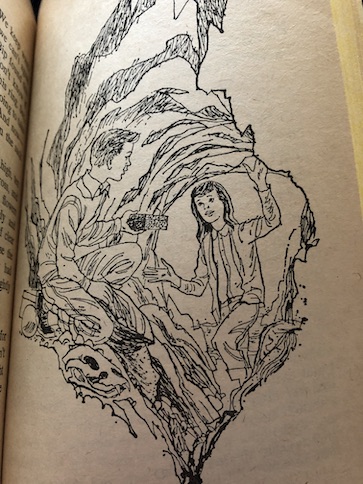
Unfortunately, the Smallwoods’ car runs out of gas. Since it’s not raining anymore, Peter offers to walk Cory the rest of the way to Tarnhelm. Then, it starts to rain again, so they take shelter in a cave that Peter knows. While they wait out the storm, Peter asks Cory more about herself. Cory explains that she usually refers to her mother as “Stephanie” because she’s actually adopted. She later reveals that she doesn’t know anything about her birth parents because Stephanie doesn’t like to talk about them, saying that it makes her sad. Stephanie is an actress, and they’ve had to move around sometimes. Because she’s had to switch schools several times, Cory hasn’t made many friends her own age. Cory doesn’t always go with Stephanie when she travels for work, often staying at home with housekeepers (which she calls “lady-helps”) so she can continue going to school. Stephanie isn’t married, so Cory doesn’t have a father to take care of her. The reason why she has come to stay with her relatives during this school break is that Stephanie needs to travel again for her work and couldn’t manage to find new help to stay with Cory. This is the first mention that Cory’s “mother” isn’t really her mother and these relatives that she’s going to visit aren’t blood relatives. This is central to the plot of the book, but there’s a twist coming, and it’s not the twist that I expected. I had theories about the identities of Cory’s biological parents at this point that turned out to be completely wrong.
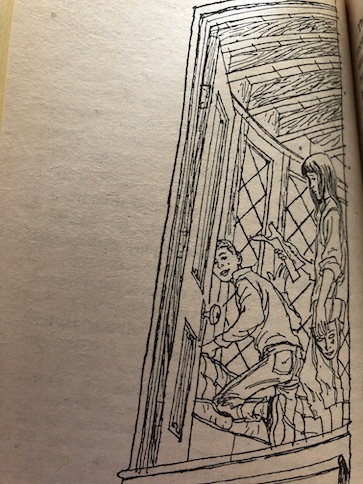
When the rain lets up a bit, Peter takes Cory the rest of the way to the house, although they leave her luggage in the cave because it’s too hard to carry it over the muddy ground. When they arrive at the house, the housekeeper, Fergie, welcomes Cory. She says that everyone has been in a tizzy about her because Stephanie actually sent multiple telegrams with different sets of instructions for picking up Cory, so nobody knew when she was really arriving. (This is the first indication that Stephanie is unreliable.) Fergie and her husband, Andrew Ferguson, both work for the Van Heusens, and they make Cory feel welcome at Tarnhelm, fussing over her and giving her and Peter a hot dinner. However, they tell Cory not to mention the cave to her grandmother because she wouldn’t understand, and she might be unhappy about Cory showing up at the house wet and muddy. Peter promises to bring Cory’s luggage up to the house later. If this were a gothic novel style of story, the servants would be strict, unhappy, uncaring, or putting on a facade of caring while being just plain sinister, but the Fergusons are exactly as caring and friendly as they seem to be. This isn’t that kind of book.
The Fergusons are Scottish and a bit superstitious. At dinner, they notice that Cory is left-handed, “cawry-fisted”, as they call it. Peter is intrigued that “cawry” sounds like “Cory”, and the Fergusons say that there’s a superstition that left-handed people are enchanted or bewitched. However, the Fergusons don’t think it’s a bad thing that Cory is left-handed and possibly bewitched; it’s just more of an interesting idea to them. This story isn’t as supernatural as I originally expected.
The Fergusons tell Cory that her grandmother and uncle are good, kind people, but they aren’t used to children and are fussy about some things. Uncle Dirk is known to be moody, and Cory’s grandmother likes things quiet and orderly. Cory starts to think that she might be happier with just the Fergusons, although she is still curious about her relatives. She hopes that they will like her, and maybe if they like her enough, they’ll let her stay longer so she can go to Peter’s school and join his Explorers Club because she badly wants friends. Issues about how to make friends add an element of teen drama to the story, but there’s more going on here than that.
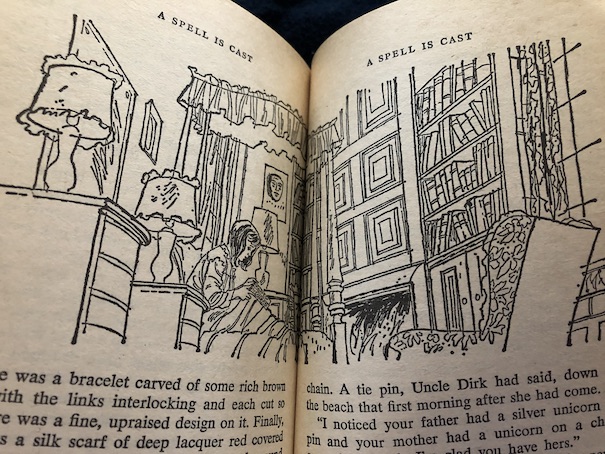
The house is beautiful and charming, and Fergie gives Cory Stephanie’s old room, which Cory loves. It has beautiful, old-fashioned furniture and its own fireplace! She also shows Cory a collection of carved wooden masks hanging on the walls of the hallways that her Uncle Dirk made. Uncle Dirk is an architect, but he’s also been a wood carver. In Stephanie’s room, there is even a mask of Stephanie’s face, which Cory recognizes. During the night, she half wakes up and is aware of her grandmother and Uncle Dirk in her room, whispering about her, saying that she looks rather plain and something about somebody “getting used to” something. They don’t deny this conversion later when Cory asks them about it, and there is less sinister significance to it than it seems at first.
The next morning, Cory meets her grandmother and Uncle Dirk at breakfast. They greet her politely, but her grandmother says that she wants to have a word with Peter about how he should have taken her to his house until the rain stopped, not made her walk through the mud to Tarnhelm, ruining her shoes. Cory asks her not to say anything to Peter because she really wants to join the Explorers, and they wouldn’t let her in if they thought that she was afraid of a little mud. However, her grandmother reminds her that she’s only there for a short visit, and she doesn’t want her getting hurt or doing anything dangerous. Uncle Dirk is more sympathetic and offers to teach her to swim.
Mrs. Van Heusen brings up the subject of Stephanie, and during the conversion, she lets slip that Stephanie has never legally adopted Cory. Now, we’re getting to a major plot point of the story! Stephanie is consumed by her acting work and not good with paperwork, and Mrs. Van Heusen thinks it’s about time that she took care of the issue of Cory’s legal adoption. The news comes as a shock to Cory, who thinks that, not being legally adopted, she doesn’t really belong to the family at Tarnhelm. Both her grandmother and Uncle Dirk hurriedly reassure her that she is family to them and belongs at Tarnhelm and that the official paperwork doesn’t really make a difference to them. There is no danger in the story of Cory being rejected by this family, and they don’t have any objection to her visit or Stephanie’s guardianship of her. However, this is another of the early indications that Stephanie is not as attentive as she should be as Cory’s guardian and that there are aspects of Cory’s life and well-being that are being neglected. Cory is starting to develop a new awareness of these issues.
Cory asks her grandmother and Uncle Dirk about her birth parents because Stephanie has never explained who they were or what happened to them. Her grandmother says that it’s only right that she knows and that Stephanie really should have told her before. Uncle Dirk explains to Cory that her parents’ names were Lawrence and Coralie Winterslow and that they were friends of Stephanie’s when they were young, before they were even married. They all liked to go skiing together. Cory’s parents lived in England for awhile after they were married, and Cory was actually born in London. Then, her parents were killed in a skiing accident in Switzerland. Stephanie had been with them on that skiing trip, and before Cory’s mother died from her injuries, she asked Stephanie to take three-year-old Cory because she had no living relatives on her father’s side and she didn’t want to leave her child with her own relatives, for some reason. Cory is glad to know the story of her parents but sad at the same time and worried about not being legally adopted. Fergie suggests to her that she write to Stephanie about it and see what she says. (At first, I was expecting that there would be more intrigue about Cory’s parents’ deaths, but there’s nothing suspicious about their cause of death. The story that Uncle Dirk tells Cory is exactly what happened. The Winterslows were also definitely Cory’s biological parents. I thought that there might be some intrigue about that, but her birth parents were who Uncle Dirk says they were.)
Later, Cory also asks Uncle Dirk about the unicorn on the sign at Tarnhelm and about her own silver unicorn pendant. Uncle Dirk tells her that he has a fascination for British history and heraldry, which is why he carved the unicorn as the symbol of Tarnhelm. He also says that the pendant used to belong to Cory’s mother and that her father had a matching unicorn tie pin, although he doesn’t know what happened to it after his death. Cory wishes that she’d thought to ask Stephanie about it in her letter.
All of this explanation about Cory’s parents’ history sounds pretty straight-forward, although sad. However, the story doesn’t end there. Everyone has a history, and there are things about her Uncle Dirk that Cory doesn’t know yet as well as the reasons why Stephanie has never completed Cory’s adoption papers.
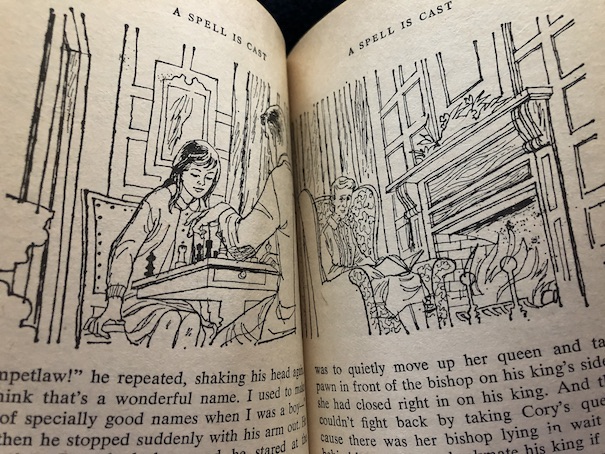
Cory becomes sick and feverish, spending a few days in bed. During this time, she has strange dreams, but not all of them are actually dreams. She remembers dreaming about a room with a chess set that has carved unicorns instead of horses as the knight pieces. Later, when Uncle Dirk plays chess with her, with a normal chess set, she mentions this dream, and both Uncle Dirk and her grandmother act strangely about it. Eventually, Cory comes to realize that her “dream” wasn’t just a dream, that she actually did get out of bed and wander around while she was feverish, but it takes some time before the full meaning of the chess set becomes clear to her.
Various people comment to Cory about Uncle Dirk’s moods and personality, hinting at past problems he’s had. Cory’s grandmother makes a comment to Cory about Uncle Dirk harming himself more than anyone else, except perhaps for one person, hinting at relationship troubles in Uncle Dirk’s past that contribute to his dark moods. Nosy Mrs. Smallwood also refers to the strange behavior of the Van Heusen family, often rude and unfriendly. While Mrs. Smallwood is a busy-body with issues of her own, she is correct in noticing the casual harm that various members of the Van Heusen family have done to people around them. It’s never intentional and they rarely notice the consequences of what they do, but that’s part of the problem. The Van Heusens are often selfish, thoughtless, and out-of-touch with other people’s feelings and the effects of their actions on others. Even Uncle Dirk acknowledges that members of the family are often hard on each other even when they care about one another.
However, the Van Heusens aren’t all bad, and some of them have changed somewhat over time. Mr. Smallwood, who is a more optimistic and level-headed person than his wife, tells Cory that his wife likes to live in the past, and while Uncle Dirk was a rather thoughtless young man who wouldn’t have made a good husband, he’s grown up since then. He says that Uncle Dirk has become friendlier and more thoughtful toward others, in spite of his occasional dark moods. But, since Uncle Dirk has never been married, what did Mr. Smallwood mean about him not making a good husband?
On the grounds of the Van Heusens’ estate, Cory spots what looks like the foundations of a house that was started to be built but never completed. Peter says that he and the other Explorers sometimes play around these foundations. Cory wonders who was planning to build a house there and why they never finished it. Uncle Dirk gets angry when he catches Cory and Peter snooping around the tower at Tarnhelm, where he keeps some of his old wood-carving things and where Peter finds some mysterious poetry.
Peter later takes Cory to visit Laurel Woodford, a young woman Cory met on the beach earlier, who helped Cory find her necklace when she lost it. Laurel is a weaver. Laurel lives by herself, but she says that she isn’t lonely because she has plenty of things to do that keep her busy. However, there is a kind of sadness about Laurel, and she has secrets of her own. She knows the Van Heusen family herself, and it wasn’t a happy experience for her.
Slowly, without Cory really doing any intentional investigating, the pieces of the past start coming together – Uncle Dirk, a marriage that didn’t take place, a house that wasn’t completed … and two identical unicorn pendants.
The story is haunting and magical, but not because of an real spells or magic. The only ghosts are the ghosts of the past. The book reminds me of a couple of other books that I’ve read, but explaining which ones involves some spoilers. I don’t mind giving spoilers for this story because I haven’t found a copy of this book that’s available to read online, and it’s something of a collector’s item now, with copies typically costing at least $20 and frequently more, although it’s sometimes possible to find one for less.
My Thoughts and A Few Spoilers
One of the interesting things about this book is that it reminds me of other books that I’ve read and liked. Some children’s books are mentioned in the course of the story because Cory likes to read, like The Five Little Peppers and How They Grewand The Story of the Amulet, but these aren’t the books that the story reminds me of.
Throughout the book, the Fergusons use various Scottish words and phrases, sometimes singing old songs or quoting from poems. Mrs. Van Heusen says that she particularly likes the Fergusons because her family was also from Scotland, and they remind her of her youth, which is a comfort to her. The Scottish element and the young orphan learning to make friends and become close to a new family remind me of Mystery on the Isle of Skye, although that book was actually set in Scotland. The books also have a similar feel in the way they approach the element of mystery in the story and the element of “magic” and “spells” that aren’t really magic spells. Both books have an enchanting quality to them, but it’s because of the atmosphere of the stories, not because there’s any actual magic.
During the course of the story, Cory learns more about what it takes to make friends. Peter realizes that Cory isn’t particularly good at making friends and confronts her about the reasons why. It’s partly because Cory has had to change school multiple times, but Peter has also noticed that Cory always waits for other people to approach her with offers of friendship and invitations to join in. If they don’t, she just feels hurt and left out instead of voicing her desire to join in. Even when she gets an invitation, her impulse is to reject it if she thinks it was only offered out of pity. Peter finds it annoying that Cory seems to need people to practically beg her to be their friend and join in activities. It reminds Cory of advice that Stephanie has tried to offer her before that she should just join in and not worry or assume that people don’t want her around. Even Fergie told her that if she wants to make friends, she’ll have to drop her pride, meaning that she’ll have to learn to make the first move and approach other people instead of waiting for them to come to her. This criticism is partly true, but Cory’s experience of life is that many of the things she wants also depend on the decisions of other people, and Peter comes to rethink some of what he said when some of his friends are less than accepting of Cory. It isn’t nice to be invited into a place where you aren’t really made to feel welcome and accepted. This is also a fitting description of Cory’s life with Stephanie, being largely raised by her hired help.
When Cory finally receives Stephanie’s reply to her letter, Stephanie’s selfishness and detachment from Cory’s life become increasingly apparent. Cory shares the letter with her grandmother and Fergie and outright asks her grandmother if she can stay in California. Her grandmother asks her if she won’t miss Stephanie because Stephanie is the only mother she’s known since she was little, but Cory says she won’t because Stephanie is gone so much and busy with her acting, leaving her with hired help. Fergie, while being hired help herself, is more maternal and says that situation is unacceptable, but Cory’s grandmother says that she’s not sure that she’s up to raising another child, that she’s old and wants her peace and quiet now. Even while Cory’s grandmother knows that her daughter is self-centered, she has a kind of self-centeredness of her own. When her grandmother gets dramatic about the worry Cory puts her through when she’s running around the caves with her friends, Cory realizes that Stephanie has been imitating her during her dramatic acts.
Cory begins to get the answers about her past and Uncle Dirk’s when Peter shares some treasure with her that he and other members of the Explorers have found and are hiding in a cave on the Van Heusens’ property. This treasure is part of the reason why some of the other Explorers have been less than welcoming to Cory, not wanting to share it and their secret hiding place with her. They’re worried that she’ll give their secrets away to the Van Heusens, and then, they’ll lose their treasure and their secret hiding place. However, among their treasures is a carved wooden box that Peter found, and it looks like Uncle Dirk’s carving work. Cory points out that the carved wooden box probably belongs to Uncle Dirk, and since it was on the Van Heusen land, he probably hid it in the cave himself. Peter, as the finder of the box, lets Cory have it to return to Uncle Dirk.
In the box, Cory finds four colorful feathers, four pretty seashells, a poem about an angry quarrel signed with the initials “L.W.”, a carved wooden bracelet, a woman’s scarf, and a small silver pendant that is identical to the one that Cory wears. However, the back of this particular unicorn has a rough spot where it used to be mounted on something else, and Cory realizes that this is the one from the tie pin that Uncle Dirk told her about, turned into a necklace. From these pieces, Cory begins to realize that the contents of the box are Laurel’s – her initials on the poem and a necklace made for her that Cory thinks must have come from her father. If that’s true, Cory thinks Laurel must be some kind of relation to her.
Cory also explores the room off the tower in Tarnhelm that contains the amazing chess set with the unicorn knights, and now that she’s no longer sick, she sees that the room also holds other furniture that Uncle Dirk made. Uncle Dirk was the person who started to have the house built, and he was making furniture to go in the house, but for some reason, he stopped and stored the furniture away because there was no new house to put it in. There are also carved masks of Laurel in the room.
Early in the morning, Cory decides to go see Laurel about what she’s found, knowing that if she waits, she’ll miss her because she’s about to leave on a trip. When Cory shows her the box that she’s found and asks her about the unicorn pendant and whether or not they’re related, Laurel tells her that they’re not related but that the unicorn did come from her father’s tie pin. Like my earlier theories, Cory’s theories about Laurel are partly right and partly wrong. After Cory’s parents died, Stephanie sorted through their belongings. She gave the little unicorn necklace to Cory, and she gave Cory’s father’s tie pin to her brother, Dirk. After Dirk got the unicorn tie pin, he had it made into a necklace for Laurel.
Laurel explains that, about seven years earlier, she and Dirk got engaged while they were still in college. However, Dirk was very spoiled by his mother after his sister left home and went to New York to do her acting. He was a very talented wood-carver and looked at himself as an artist who would never have to earn a living because his mother was very wealthy, and she encouraged him in his art. Dirk wanted to drop out of college and just spend his time doing wood carving, without caring much whether he ever made any money at it. Laurel argued with him about it because she didn’t like the idea of living on Mrs. Van Heusen’s money, and she broke off the engagement. Looking back on it, Laurel regrets doing that. She finished college and could have worked to support herself and Dirk independently, just as she’s been supporting herself these last several years, ironically with an art of her own, and with Dirk’s talent at carving, he might have ended up making money at his art anyway, doing something he really loved to do.
It was all about pride. Laurel was too proud to rely on Mrs. Van Heusen, who was happy to support her son’s art, and Dirk was both proud and spoiled and wanted everything his own way on his say-so without working things out with Laurel. Dirk was being a little selfish, but Laurel comes to realize that she was a bit selfish too because she refused to acknowledge how important Dirk’s art was to him and wanted him to be something else. At one point, Laurel wanted to make up with Dirk and talk things out, but he ignored her and refused to talk to her. She got so mad that she left the box of treasures in the cave where she and Dirk used to play as children and threw the engagement ring in the ocean. Since that time, she and Dirk haven’t been able to talk to each other, even though they both wanted to. Dirk gave up the woodcarving that he loved because it was a painful reminder of the reason why he and Laurel broke up. Instead, he went back to college and became an architect so he would have a profession of his own. However, he is given to dark moods because he misses both Laurel and his woodcarving and doesn’t know what to do about it.
The situation gets straightened out when Dirk, realizing that Cory is missing from the house and that fog is coming in, goes to Laurel’s house to make sure that Cory is safe with her. The three of them talk things over, and Dirk asks Cory to give him some time to talk to Laurel alone. Dirk and Laurel make up, and Laurel agrees to marry Dirk as they planned, on the condition that they both adopt Cory because she’s come to love Cory as a niece. Cory is overjoyed to hear the news, and Dirk plans to begin construction on the house that they’d started years before.
The story of the lovers parted by a prideful quarrel and the unicorns that bind them together reminded me of The Little White Horse by Elizabeth Goudge.
There is a scene when Stephanie shows up to claim Cory and take her back to New York, but the family talk it out with her. Stephanie admits that she took Cory partly because that was her promise to her old friend and partly out of guilt because the skiing trip where Cory’s parents were killed had been her idea. Mrs. Van Heusen tells her not to blame herself because she couldn’t have known what was going to happen and Cory’s parents chose to come on the trip with her. Stephanie further admits that she didn’t legally adopt Cory because she was aware that her lifestyle wasn’t particularly suited to bringing up a child, although she’s done her best, and because she knew that Cory did have other relatives. She doesn’t quite admit that she was hoping that one of these other relatives might take her someday, but she gives that impression. Cory’s relatives on her mother’s side haven’t tried to claim her because her grandmother on that side of the family was too old to look after her, and her aunt already had a large family and not much money. Stephanie loves Cory, even though she doesn’t really know how to raise a child and has found it difficult to care for her, and she feels betrayed at first when Cory says that she’d rather stay with Dirk and Laurel. However, Stephanie later apologizes to Cory for making a scene about it because it really would be better for everyone if Cory stayed in California, where she would have a stable life and Stephanie wouldn’t have to worry about her. Stephanie returns to New York on her own, and Cory tells Peter that she’s going to stay in California. Peter and the other Explorers welcome her into their club. Now that Cory knows that she’s going to be staying, everyone feels more like she truly belongs.
This book is a companion book to the Samantha, An American Girl series, focusing on Samantha’s best friend, Nellie. Personally, I don’t like the companion books to the main American Girls books as well as the original books, but this book does follow up on the events to the main series. At the end of Samantha’s series, Samantha’s aunt and uncle took in Nellie and her sisters, Bridget and Jenny, after their parents died. Nellie and her sisters were from a poor family and had to start working from a young age before their parents died. After their parents died, their disreputable uncle abandoned them, and they were sent to an orphanage before Samantha discovered where they were. Samantha’s aunt and uncle are wealthy, and the girls’ lives have improved considerably.
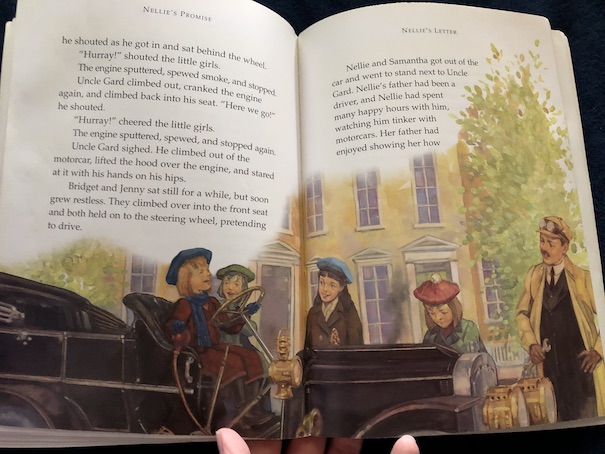
Nellie’s happiness is threatened by the sudden reappearance of her Uncle Mike. Uncle Mike sees Nellie walking down the street in her nice new clothes and wants to know what rich family the girls are living with. Nellie runs away from him, but he threatens to find out where she’s living and to take her and her sisters back, saying that it’s his right as her uncle. He says that he means to put the girls to work earning money for him. Nellie is afraid that he might be able to reclaim them from Uncle Gard and Aunt Cornelia because he is a blood relative.
At first, Nellie is afraid to tell anyone that she’s seen her uncle and that he threatened to take her and her sisters back. Before her parents died, her mother made her promise to look after her younger sisters, so Nellie makes up her mind that’s what she’s going to do.
Nellie worries about the future for her and her sisters. She feels like she doesn’t fit in with the wealthy girls at Samantha’s school, who have had very different lives from hers, and the lessons they learn are the type of lessons for fine young ladies who will marry rich men and spend most of their time raising families, overseeing a house with servants, and entertaining friends and their husbands’ business associates, not preparing for practical professions outside the home. Nellie thinks that it’s important that she have some kind of job skills because the future can be very uncertain, and she wants to know that she can provide for her sisters, no matter what happens.
Samantha senses that Nellie is unhappy, and she asks her if she likes living with Uncle Gard and Aunt Cornelia. Nellie tells her that she does, but she hesitates to explain what’s really worrying her. Instead, she lets Samantha think that she just wants to feel like she’s doing something useful for the family. Before her parents died, Nellie used to get sewing lessons at a settlement house (a place where immigrant families could go to learn English, new job skills, and other skills they would need in their new lives in the United States) run by Miss Brennan. Aunt Cornelia is involved with many good causes, and she wants to visit a settlement house and get an introduction to Miss Brennan. Because Nellie knows Miss Brennan, she can help arrange that. It’s in a rough part of town, but Nellie is more accustomed to navigating rough neighborhoods than Samantha or her aunt. It also occurs to Nellie that she could ask Miss Brennan what to do about Uncle Mike.
Miss Brennan is glad to see Nellie, and she lets her show Aunt Cornelia and Samantha around the settlement house. They have many different types of classes for children as well as adults. Nellie says that she likes the practical classes that she used to have there, and even the types of dances that they do seem more practical than the more purely artistic ones that they do at the school she now attends with Samantha. Aunt Cornelia is pleased with the classes that they offer for women, and because she is interested in women’s education, decides that she wants to help out at the settlement house. However, the visit to the settlement house leaves Samantha irritated for reasons that Nellie doesn’t fully understand.
As Nellie begins spending more time with Aunt Cornelia at the settlement house, Samantha begins spending more time with Bridget and Jenny, and Nellie becomes jealous of how Samantha seems more like their older sister than she is. However, the others still don’t know about Uncle Mike’s reappearance, and Nellie is still fearful of what he might do and what will happen to her and her sisters if Uncle Mike tries to take them away. She feels like her only option is to try to prepare herself for a better job than that of factory worker.
When Nellie finally gets the courage to tell Miss Brennan about her worries, Miss Brennan tells her that she needs to discuss the situation with Uncle Gard. Uncle Gard is a good man, but he’s also a lawyer, and he will know how to legally stop Uncle Mike from trying to take custody of the girls. However, Miss Brennan adds that, whatever else happens, Nellie will still need to make some decisions about her future and what she wants to do with her life and education. The more Nellie thinks about it, the more certain she is about what she wants to do. She wants to become a teacher, like Miss Brennan.
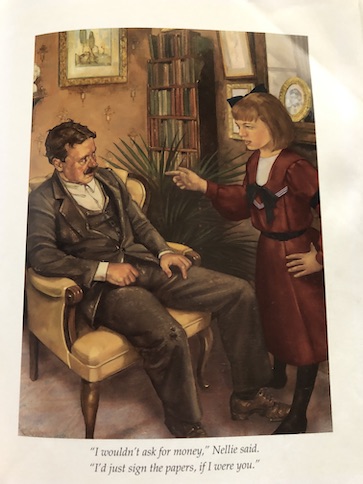
Nellie provokes more drama by applying to the boarding school in Boston where Miss Brennan said that she trained to be a teacher without talking to Aunt Cornelia, Uncle Gard, or Samantha about her decision or about her uncle. However, when the truth comes out about Uncle Mike, everyone understands that she was trying to hide and protect her sisters from him. It turns out that Uncle Gard has actually been looking for Uncle Mike because he already has the documents that he needs to legally adopt Nellie, Bridget, and Jenny, and he just needs Uncle Mike to legally release them into his custody. At first, Uncle Mike tries to extort money from Uncle Gard for the girls, but Nellie gets up the courage to tell him off, promising that if he doesn’t sign the papers and leave, she’ll tell everyone about how he stole all of their money and abandoned them to freeze the last time they were in his custody. The book ends happily, with Aunt Cornelia and Uncle Gard adopting the girls and understanding Nellie’s ambition to be a teacher. They enroll Nellie in a school in New York that teaches the skills she really wants so that she can continue living with them and not go to Boston. It also turns out that Samantha was mostly uncomfortable at the settlement house because she felt so sorry for the young children there and that spending time taking care of Bridget and Jenny was part of her way of trying to help Nellie by leaving her more free to do some of the things that she felt like she had to do. With everything out in the open, Nellie and her sisters are able to more fully become part of the family.
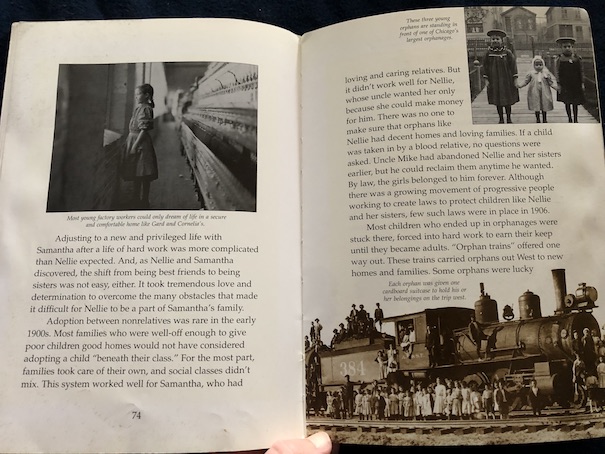
In the back of the book, there is a section with historical information about orphans and adoption in the early 1900s. There were not many laws and regulations governing care of orphans. Usually, orphans would be taken in by relatives, like Samantha was when her parents died. If a child didn’t have any relatives who were willing and able to take them, the child might be sent to an orphanage and possibly sent west on an orphan train as Nellie almost was at the end of the Samantha series. Families didn’t usually adopt children from different levels of society.
Settlement houses were important resources for poor immigrant families, and the education they received allowed immigrants to enter higher professions than servant or factory worker, which had been the primary source of income for many of them. It was common for settlement houses to help train young women to become teachers. There are still similar institutions and organizations in operation in 21st century America.
The book is available to borrow for free online through Internet Archive.
My Reaction and Further Historical Information
Part of the reason why I don’t like the companion books as much as the original American Girls series is that they tend to get more dramatic than the original books, and sometimes, I feel like the attitudes of the characters are less realistic for their time periods than they were in the original books. I think what made the original books more realistic was the restraint of the stories – they had their share of excitement and sometimes drama, but they never went overboard. The return of Nellie’s disreputable uncle struck me as both unlikely and unnecessary to Nellie’s and Samantha’s larger stories.
The historical details in this book are good. What they say about orphans of the time is basically true, although they note in the historical information section in the back of the book that Nellie’s experience of being adopted by a wealthier family was not typical of the time, and I think that’s part of what bothers me. Adoptions in general during the early 1900s were less formal than they are in modern times, and the idea of Uncle Gard hiring a private detective to find Uncle Mike and get him to sign legal documents doesn’t seem entirely realistic. I think it would have been more realistic to me the way that the last Samantha book ended, with Uncle Mike leaving and the assumption that none of the characters would see him again.
The reason why Nellie and her sisters were sent to the orphanage and why the orphanage was considering sending Nellie west on the orphan train was that no one expected that Uncle Mike would ever want to see the girls again. He’d already taken everything he could from them and left with them with no concern for what would happen to them. In the time that has passed since then, I would have expected that Uncle Mike would already have gotten into trouble that would keep him busy and out of their lives, maybe ended up in prison for being drunk and disorderly or hopping from job to job or begging for money as their little money ran out. Even if Uncle Mike had some thought of finding the girls, I don’t think it’s likely that he would have succeeded or even gotten close on his own because he is not that bright and he is not the kind of person who makes friends in places where he’s been before. I doubt that his former neighbor who took his nieces to the orphanage would have told him much if he had shown up again, looking for them. She knew that he was a drunk who abandoned the girls, and she made it clear that she didn’t like him. The people at the orphanage would have probably sent him away with no information because they would probably view the situation as closed since the girls are already placed out and Mike may not even have any proof of his identity and relationship to the girls. There is no such thing as a driver’s license during this period and many people did not even have birth certificates, so it’s possible that the people at the orphanage could simply choose to disbelieve this disreputable character and send him away. When I was watching a documentary about the orphan trains, former orphan train riders said that the orphanages that sent them west deliberately took notes from them that had their living parents’ addresses and otherwise cut off contact with living parents because they wanted the children to sever their ties to their difficult pasts and devote their attention to their new families, not maintain contact with the parents who were unable to care for them financially, so I wouldn’t expect that anyone at the orphanage in these books would go out of their way to reunite the orphaned girls with a rather shady uncle when they knew that the girls were already placed with a wealthy family and no longer their responsibility. Without help, which would be unlikely to be forthcoming, it doesn’t seem likely that Uncle Mike would be able to stumble on the girls by accident. As mentioned in Changes for Samantha, New York is a big city, people can be difficult to find if you don’t have a hint of where to look, and the wealthier part of the city where Nellie and her sisters live now is not a part of town where a guy like Uncle Mike would be likely to hang out. They could all easily live in New York City for years without meeting each other.
I feel like the situations in the story were a little contrived. By now, I would have thought that Nellie would know that Uncle Gard is a lawyer and would be the best person to ask about the laws. I don’t recall the earlier books saying what Uncle Gard did for a living, but Nellie lives with him now, and I would think that someone would have mentioned Uncle Gard’s profession by now. In the book, it oddly seems like as much of a surprise to Nellie as it is to the readers. I could believe that Nellie would go to the settlement house and do volunteer work there with Aunt Cornelia because it was already established in the previous books that Aunt Cornelia supports good causes, and although women of her level of society didn’t usually work for living, supporting good causes and charitable works would have been acceptable. Nellie’s level of knowledge seems a little odd, considering that she needed extra tutoring in basic subjects, like reading, in Samantha Learns a Lesson. In that book, Nellie never mentioned settlement house lessons, which she would have done if it hadn’t been a sudden decision to insert that this in book. Here, Nellie talks about classes that she had at the settlement house, where I would have expected to have more lessons to improve her reading, and it seems like she learned more there than she seemed to know before, even knowing a few words of foreign languages. In Samantha Learns a Lesson, one of Nellie’s skills was her ability to do math quickly handle money because she used to do the shopping for her mother, and in this book, she mentions that she helped to teach immigrants about American money, which she never mentioned before. These things are necessarily contradictory, but it all just seems a little off because they don’t quite fit into Nellie’s established character and history, and it implies that Nellie has had more education and training than she seemed to have before. It’s not necessarily impossible for a girl of Nellie’s time to know some of these things, but it’s the departure from what was already established about Nellie and her situation in life than kind of grates on me.
I think it could be reasonable for Nellie to develop the ambition to be a teacher. Even Samantha has previously some interest in that direction, having helped to tutor Nellie before. Not all women of this time went on to higher education, but those who did might attend a normal school, which is basically a college that focuses on training teachers. By contrast, the daughters of wealthy, high society families would be more likely attend a finishing school that emphasized social skills and entertaining more than academics. Both Samantha and Nellie are about twelve years old during this story and would be a little young for either of these options, but Samantha’s school seems to be more inclined toward preparing the girls for a finishing school. Given Aunt Cornelia’s interest in education and social causes and Uncle Gard’s support of it, I would expect that Samantha would be more likely to attend a women’s liberal arts college when she gets older, preparing her to marry a well-educated and culturally aware man as well as a wealthy one and probably engage in some form of social work and/or the arts in her spare time, but that’s just a guess. (I discussed some of this already in my review of Happy Birthday, Samantha. See also the book Daddy-Long-Legs for a description of what that might have been like for a girl of Samantha’s and Nellie’s time. The book was written a little later in than the time period of this book, but it’s set at about the right time for Samantha and Nellie to be old enough for college and includes characters of approximately their social backgrounds.) This book doesn’t really go into the subject, but if that’s the case, Samantha’s future might not be as different from Nellie’s as it first seems, and there might be a kind of middle path that both of them could choose. The Finch College in Manhattan, which was a fairly new preparatory school in Samantha’s and Nellie’s time, seems like it would have been a good option for both Samantha and Nellie, catering to upper-class girls while focusing on a more practical liberal arts education than the less academic finishing schools. Its founder, Jessica Finch, was a women’s rights activist and may have moved in similar circles to Aunt Cornelia. Her attempts to balance theoretical and practical knowledge sound like they would have appealed to the characters in the story. I’m not an expert on the Finch College, only having heard a little about it, but I think a school like that would present an intriguing possibility for the girls’ futures.









 Jestress's Forgotten Books and Stories