The four Melendy children live in a brownstone townhouse in New York City during the early 1940s. Their mother is dead, but they get along well with their father, and their housekeeper, Cuffy, is a motherly woman and helps look after the children. Each of the children has their own responsibilities in the house and distinctive talents and ambitions in life. Mona is the eldest at age 13, and she wants to be an actress. Rush, age 12, wants to be a mechanical engineer and a pianist. Miranda, who is 10 years old and usually goes by the nickname “Randy”, loves dancing and painting. Oliver, the youngest at 6 years old, wants to be a train engineer.
The children have a room at the top of the house which is a sort of playroom, although they call it the “office.” It has the children’s toys and books and plenty of things that they’ve gathered for their various hobbies, activities, and experiments. However, one rainy Saturday, the kids are bored. It isn’t that they don’t have anything to do. It’s more that the day is so wet and miserable that they have trouble getting interested in anything. While they debate different things they could do or wish they could do and complain about the weather and the size of their allowance, Randy comes up with an interesting idea.
Each of the four children has something that they wish they could do, but they’ve never been able to afford to do it because it costs more than the allowance they receive. Randy suggests that they form a kind of Saturday club. Every week, they will pool their allowances, and one of them will use the collected money to do something they’ve always wanted to do. To make it worth the investment from the others, they all have to agree that they won’t just blow the money on something they could do any time, like buy a bunch of candy. Each child’s special Saturday should be something really exciting and worthwhile. All of the kids are interested and have ideas about what they could do if they had a lump sum equal to four allowances and one free Saturday to do whatever they want by themselves.
When they explain the plan to their father and Cuffy, they agree that the children can do what they like with their allowance money, including taking turns pooling it and sharing it with each other. They also agree that the children can go off by themselves for their adventures as long as they agree to some basic safety rules. Over the next several Saturdays, the children take turns having their own special days with their pooled allowance money.
Randy is the first one to have her turn. As an art lover, she goes to an art gallery. To her surprise, Randy also sees an elderly woman she knows, Mrs. Oliphant, who is an old friend of the Melendy family. Mrs. Oliphant is a kind woman, but the Melendy children never thought of her as much fun. Randy loves the art and the ways the paintings make her feel, almost as though she could step into them and experience what the people in the paintings are experiencing. There is one particular picture that interests her, a picture of a girl who looks like she’s the same age as Randy is now. Randy finds herself wishing that she could meet the girl in the painting, like the girl might be someone she could have been friends with.
Then, Mrs. Oliphant approaches Randy and asks her about whether or not she likes the painting. Randy is surprised when Mrs. Oliphant tells her that it was painted 60 years ago and that she was the girl in the picture. Randy’s artistic afternoon takes an unexpected turn when Mrs. Oliphant invites Randy to have a snack with her, and she tells Randy about her youth in Paris, when she was a lonely only child being raised by a strict father, elderly aunts, and a governess. The artist who painted her was a friend of her father’s, who thought that she looked like a little princess. It was at the inspiration of the artist that young Mrs. Oliphant snuck out of her house to visit her first carnival when her overprotective family wouldn’t let her go, and she was kidnapped for ransom by a gypsy fortune teller. Fortunately, she was found again by the artist at another carnival where the fortune teller was performing. The artist persuaded her father to let him paint her after the rescue. Randy loves that exciting story and is surprised at how romantic and fascinating Mrs. Oliphant really is. Mrs. Oliphant invites her to visit her sometime and see some of the fascinating things that she’s collected over the years, and she buys a little box of petite fours (fancy little cakes that the children have never had before) for Randy to take home to her siblings.
When it’s Rush’s turn for a special Saturday, he decides that he wants to go see an opera because he loves music. He goes to see Wagner’s opera Siegfried (part of a series of operas based on the Nibelungenlied epic poem that helped inspire Tolkien‘s The Lord of the Rings), about a hero and a magic ring made by dwarves and a fearsome dragon. On the way home, Rush rescue’s a stray dog and brings him home. He tries to clean up the dog before showing him to his father and Cuffy, but the dog gets loose before he’s done washing him. Fortunately, the dog manages to charm the rest of the family, so the family gains a pet.
Mona’s turn is next. She really hates her long braids, so she decides to use her Saturday for her first trip to a beauty parlor and asks for a hair cut. She isn’t really sure that her father or Cuffy would approve of it, but nobody has told her not to (because she didn’t ask). At the beauty parlor, they ask her if she’s really sure that she wants a hair cut because her braids are almost down to her waist, but she insists. While she works on Mona’s hair, the stylist tells her a story about how she and her brother ran away to New York as children and how she got into the beauty business.
When she’s finished, Mona is impressed with how beautiful she looks, and she even lets the stylist paint her nails. However, the reception she gets at home is about as bad as Mona might have expected. Her father and Cuffy are pretty conservative on the subject of girls’ hair and makeup. They disapprove of her trying to be too grown up and not consulting them about her hair, and they want to get the nail polish off her fingers as soon as possible. Even her siblings think that she’s been too daring with her appearance.
When Cuffy sees how upset Mona is about their criticism and disapproval, she comforts her, and she admits that the hair cut is actually practical because it will be easier to wash and brush shorter hair than long hair. Mona’s father admits that he might also get used to the hairstyle and come to like it. He further admits that it can be hard for parents sometimes, when they see signs that their children are growing up. Randy also says that Mona really does look like a movie star.
The children continue taking turns with their special Saturdays. Oliver, being only 6 years old, can’t go out into the city alone, like the others can, so the others spend their Saturdays at home with him whenever it’s his turn. Then, on one of Oliver’s Saturdays, he disappears. Sneaking out of the house by himself, he takes the money that he’s saved and asks a policeman the way to the circus, which is at Madison Square Garden.
While his siblings panic when they realize that Oliver is missing, Oliver has a great time at the circus, watching all the animals perform and buying cotton candy and other treats. However, when it’s time to leave, Oliver gets lost on his way home, and he starts feeling sick from everything he’s eaten. He gets a ride home from a friendly policeman on a horse, and looking back on it, Oliver decides that was the best part of his day. He decides that maybe, instead of being a train engineer, he’ll become a policeman on a horse when he grows up.
After Oliver’s circus adventure, the siblings decide that they want to do a shared adventure, so they go on a picnic. Their new dog, Isaac, later saves them from a disaster caused by a careless mistake that could have killed them all at home. The children’s father decides on some home repairs, and the children realize that they won’t be able to go away for their usual summer trip and that they’ll have to economize on their Saturday adventures. Fortunately, Mrs. Oliphant has an idea for a summer adventure for the family. She owns a lighthouse, and she invites the Melendy family for a summer visit!
I like this series because it’s set contemporary to the time when it was written, in the early 1940s. This first book sets the time period with a comment about a mark on the floor left by one of the children trying out roller skates on Christmas 1939 and one of the children commenting that a stain on the wall looks a lot like Hitler because it looks like a man’s face with a mustache. (One of the other children comments that he’s going to turn the stain into a bearded man, like George Bernard Shaw, because he doesn’t want to see Hitler.) Toward the end of the book, the children talk about the war a little with Cuffy. The war has definitely been going on because they mention bombs and blackouts in London, and Randy asks Cuffy what it was like when the world was peaceful. Cuffy says that it seemed lovely, at least on the surface, but the peace didn’t last. There was another bad war before this one, and a peaceful time in between the two wars when people could travel freely. When Mona was a baby, their parents took a trip through Europe, and Cuffy was there to look after Mona. Because the children live in New York, they never see the war directly, but they’re aware that it’s happening, and they have feelings about it.
Apart from the historical war references, this book is just generally fun to read. It’s fun to see what each of the children does when they have a little money and the freedom to go where they want and do what they want in the city. The kids have minimal adult supervision on their adventures, and it’s the sort of thing that kids today might dream about doing. In general, kids love stories about other kids with the freedom to do what they want to do, although because this family likes the arts and culture, many of their chosen activities, like going to an art gallery or an opera, are things that many other children might not think to do. I was thinking that, probably, one adventure that many kids in my area could do or might do unsupervised might be to get their hair cut and/or nails done in some fancy way, like Mona did.
I was a little surprised that the father of the family reacted as strongly as he did to Mona having shorter hair because shorter hair for women and girls had become more acceptable by the 1940s. I think that regarding short hair as scandalous was more common when the style was new in the late 1910s and the 1920s (see the story Bernice Bobs Her Hair by F. Scott Fitzgerald from 1920). On the other hand, the real issue here seems to be that the father and Cuffy think that Mona is trying to act too old for her age (which is a way of saying too attractive or too sexy for a girl who is still too young to date). The father somewhat admits that it can be a shock to a parent to see how much his daughter is growing up. In that case, it’s not so much about short hair in general but now grown-up and attractive Mona looks in a more adult hairstyle.
Something else I’ve noticed about books in this series is that they frequently contain mini-stories told by other characters to the Melendy children. In this book, we get the story told by the hairdresser about how she and her brother ran away to the city when they were young and the story of Mrs. Oliphant’s adventures when she was kidnapped by a gypsy as a child. Children kidnapped by gypsies is a theme in vintage children’s books, although this is considered a stereotypical depiction in the 21st century. The stereotype of the child-stealing gypsy was probably based in prejudice, the use of community outsiders as scapegoats, and erroneous conclusions drawn from observing family members who do not physically resemble each other. (For example, I remember being told as a child that two blue-eyed parents would not produce a brown-eyed child because blues eyes are a recessive gene, yet it actually does happen, although it’s relatively rare. It’s just that human genetics are complex and produce more variations or throw-backs to earlier generations than some people might expect.) The main character in another book by a different author, The Girl in the Window, challenges the prejudices of adults in her community when they start to blame the disappearance of a local girl on a gypsy.
The four Guthrie children (Dit, Allen, David, and Winkie – short for Winifred) find it difficult to play in their family’s apartment, where they always have to be careful not to disturb the neighbors. One rainy day, while their mother is at a dentist appointment, the children act out a scene from The Swiss Family Robinson, where they’re throwing the animals overboard from the shipwreck to swim to the desert island when they accidentally break part of the floor, which is also the same as breaking part of the ceiling for the neighbors underneath. When they get a knock at their door, shortly after, they figure that the neighbors have come to complain.
However, it turns out that their visitor is the neighbors’ cousin, who is staying with them. The children explain about The Swiss Family Robinson, the shipwreck, and how they were throwing particularly heavy ducks overboard from their wrecked ship. The neighbors’ cousin is a good-natured man who enjoys talking to the children. When the children’s mother comes home, she apologizes for the damage and explains that she and her husband are currently looking for a new house with more room for the children to play, but they haven’t found a place yet. The cousin says that he comes from a smaller town himself, Anchorage, Connecticut, and he might be able to help them find a place to buy there.
The Guthries do rent a house in that town that has some land attached to it, and the children are excited about the move. They want to be able to camp out on their land, like castaways from their favorite book. When they stop in town to buy some supplies before heading to their new house, they are surprised that there don’t seem to be any children around. The shopkeeper explains that there’s a measles epidemic going around town, and most of the children have it right now. He asks the Guthries if their children have had measles before, and their mother says they have … except for the youngest, Winkie. She decides that, for safety’s sake, she should keep the children close to home until the epidemic is over, and the kids should wait to try to make some new friends in town.
The children are hoping to find some new friends, but there’s plenty to do at their new house in the countryside to keep them occupied for a while. On their first day there, they are delighted to find out that there’s a brook and a lake on their property. The children convince their father to come exploring with them, and he has them help him to make a map of the area, knowing that they will want to camp out later. After walking around a piece of land that’s bordered by the lake and the brook, they realize that it’s actually an island because it is bordered on every side by water. The lake is on one side, the brook on another, and there are two more brooks or streams on the other sides that separate it from the land around it and make it into a sort of oblong-shaped island. They call it “The Invisible Island” because it isn’t obvious that it is actually an island until someone walks all the way around it and realizes that it’s actually surrounded by water on all sides. As far as they know, nobody else besides them is even aware that it’s an island.
The children’s mother has some reservations about the children camping out on the island, but the children agree to some safety rules and bringing along some practical camping supplies. They make a raft to carry their supplies across the water to the island. The children begin calling their new house “The Wreck”, imagining that they are rescuing supplies from a shipwreck, like The Swiss Family Robinson. They create a hiding place for their tents, and they find a spring on the island, although their father won’t let them drink from it until he has the water tested to make sure that it’s safe.
The children have enough supplies to camp on the island for a week, and they begin having an idyllic summer, with little adult supervision. They swim and bathe in the lake, using colorful soap on a rope that Winkie found when the family bought supplies at the store in town. They feed the birds, explore, and pick wild strawberries. They get ideas for how castaways are supposed to act from The Swiss Family Robinson and The Mysterious Island.
Their parents do come to visit them and check on them, playing along with the shipwreck theme by calling themselves friendly “savages” when they visit the camp. Their father helps the children to bring stones from a quarry to build a hut. Their mother tells them that she has started to meet the neighbors, and they have some nice children who could make good friends for the Guthries, once they’re out of quarantine from the measles. Both the nice man who helped them find the house to rent and the local doctor have nieces and nephews. The children don’t care that their mother thinks the children are well-mannered. They’re more concerned about whether or not they’ll be adventurous types, who would have fun with them on their special island. They think that they would hate to share their island with “apron-string children” who would be too tied to their parents and home and wouldn’t appreciate the independence and adventure the island allows. The truth is that the children have been enjoying their freedom on the island so much that they’re not sure that they want to give it up yet to make friends with the local children, and in a way, they’re grateful to the quarantine for giving them this time to explore by themselves.
However, there are some strange things that the children have started to notice about the island. One day, Winkie’s soap on a rope disappears and reappears in a different place, strangely looking less used than when they last saw it. The children’s wishes also seem to be granted by a mysterious, unknown person. When they wish aloud for a book about castaways that they haven’t read before and book about birds so they know more about the birds they’ve been seeing, they soon find a wooden box that contains books matching that exact description. When they wish that they had more strawberries, they suddenly find more strawberries in their icebox that they can tell came from a store instead of the wild strawberry patch. Winkie has a bizarre encounter with a “dryad”, and the footprint of a 6-toed giant suddenly appears on the beach. Maybe they’re not as alone on the island as they thought, but who else is there with them?
The book is available to borrow and read for free online through Internet Archive (in audio form!)
My Reaction and Spoilers
Copies of this book are difficult to find now. It’s become a collector’s item, and copies go for hundreds of dollars on Amazon at the time of this writing. It’s a shame because it’s really a charming story, and I think it would really appeal to fans of Cottagecore. If I hadn’t found a copy on Internet Archive, I couldn’t even talk about this book at all.
There were many children’s book series published in the mid-20th century about children having adventures in the countryside and independent of their parents and guardians, like The Boxcar Children series or many of the books by Enid Blyton. Some of these books and series seem a little more realistic than others. Most require the children’s families to be at least middle-class or wealthy to be able to set the children up for their adventures. Some books, particularly the ones by Enid Blyton, feature parents who are preoccupied with their own problems or activities and seem less concerned with the children’s welfare than about getting the kids out of their hair. I thought The Invisible Island had a good balance of independence for the children and adult supervision.
The adults in this book know that the children have been camping before, so they have some basic camping skills, and they come to visit the children about every two days, to see how they’re doing and make sure they aren’t having any problems. The kids pride themselves on their independence (they brag that they’re “not apron-string children”), but at the same time, their parents do regularly check on them and are aware of developments on the island, sometimes more so than the children realize. The children confide to their parents some of the strange things they’ve noticed on the island, but not everything because they’re enjoying their adventure so much that “the castaways” don’t want to be “rescued.” Eventually, readers come to understand that the parents know who’s been hanging around the island and that the children are not in any danger.
Adults will probably realize pretty quickly that some of the neighbor children are also camping out in the area, and that these children are the ones moving things around, giving them things, and staging fantastical stunts, like the appearance of the “dryad” and the giant’s footprint. It’s just that they can’t introduce themselves to the Guthrie children yet because the quarantine is still on, and they have to stay mostly separate. As the quarantine ends, they’re able to let the Guthrie children see them and interact with them more, although the game doesn’t completely end until the official end of the quarantine and the surprise party they hold to celebrate. The book ends with the children and their new friends making plans for more adventures that summer.
One of the great things about this book is that it’s one of those children’s books that reference other children’s books. There are other vintage children’s books like this, where the child characters take their inspiration for their games of imagination from their favorite books. The books are named throughout the story, and presumably, child readers from the time when this book was originally printed, would also know these stories and identify with the children’s pretend play. The main favorite book of the Guthrie children is the classic The Swiss Family Robinson, which inspires them not just to camp out but to turn their camping trip into one big game of imagination in which they’re shipwrecked. Most of the things they do in the story are based around that concept, although some fantasy elements also creep in, like fairies and dryads and granted wishes, because the children also enjoy fantasy books and poems. The new friends they make in the area turn out to enjoy similar stories, so some of the mysterious incidents they stage are also based on those stories, further appealing to the children’s imaginations as well as their sense of adventure.
I wasn’t completely sure if the book that their new friends gave to the Guthrie children was meant to be a real book because there are many books with titles like The Smuggler’s Island, and I had trouble locating a book from before 1948 with that exact title. Since the other books and poems they reference are real, The Smuggler’s Island might be real, too. If anybody knows what it is and who wrote it, please let me know. On the other hand, that book, because the children say they’ve never read it before, might just be invented by the author to represent that general genre of children’s fiction.
Other real books, stories, and poems referenced by this story include The Mysterious Island by Jules Verne (which is a sequel to both his Twenty Thousand Leagues Under the Sea and In Search of the Castaways), The Hunting of the Snark by Lewis Carroll (at one point, David recites the lines from the poem, “His intimate friends called him “Candle-ends”, And his enemies “Toasted-cheese”), and the poem Overheard on a Saltmarsh by Harold Munro (which was the inspiration for the dryad scene because it contains a nymph and a goblin and a necklace of green glass beads).
The concept of a quarantine probably would have made this an excellent story for the coronavirus pandemic, but the setting is idyllic and enchanting for any time. The children are clever in the way they set up their camp, trying to keep it as secret as possible. Their island also includes a spring (which is safe to drink from) and a cave, and they start building a stone hut in this book.
There’s only one thing I can think of to complain about in this book, and that’s the concept of the “savages.” When the parents describe themselves as “savages” when they visit the children, they’re playing on themes from earlier vintage books with islands and shipwrecks. “Natives” and “savages” in those stories can either be helpful or, more commonly, threats to the castaways. I’ve complained about this before in previous book reviews with similar themes because there are stereotypes around these generic “natives” and “savages”, and modern children should be taught not to talk about people in those ways. However, there is no malice behind it in this story. The characters aren’t making fun of anyone or disparaging anybody for being “primitive.” It’s just that they’re playing a game of imagination built on these earlier stories, and they’re using this concept as a plot device to work themselves into the story as something other than visiting parents, preserving both the children’s sense of independence and the imaginary world of the children’s game. Anybody who can understand that should be fine with this book.
My only other complaint is that this book is so rare and so long out of print. I really do think it would appeal to modern audiences, especially fans of cottagecore.
The Witch’s Spoon by Mary Cunningham, illustrated by Marilyn Miller, 1975.
Tom and Lauren are spending a week with their grandmother at her beach cottage during the summer. They have visited the cottage many times before, and they love revisiting all their favorite places, the bunk beds on the cottage’s sleeping porch, like the tree where they always see baby owls (which they call the owl tree), and the place where they once found some lost coins (which they call the money spot). They know the cottage well, inside and out. This summer, though, there are a few things that are different.
The first thing that the kids notice that is different is that their Grandma has added a new item to her curio cabinet: a big silver spoon with a long handle. They ask their grandmother about the spoon, and she explains that it’s a witch’s spoon. She recently inherited it from the children’s Great-Aunt Hannah (that would be their grandmother’s sister), who used to live in Massachusetts. The spoon is a family heirloom from the time of the witchcraft trials in Salem (“when witches were thought to be as much of a problem to people as air pollution is now” – this is from the mid-1970s). Their grandmother says that there are good witches and bad witches, and good witches would use spoons like this one to stir love potions. Tom doesn’t believe in witches, but Lauren is fascinated by the spoon and the idea of love potions. She is sure that she senses magic from the spoon.
The next thing that will make the children’s visit here different from previous years is that their grandmother has decided that they’re old enough to have a June Day. June Days are a family tradition, and it’s not just because it’s June. During a June Day, the usual household rules are suspended for one day, and the children are allowed to go wherever they want and do anything they want, all on their own. Grandma says that she will prepare meals at the usual times, but for that day, it’s up to the children whether or not they show up for them, so they don’t need to interrupt their adventures. If the children aren’t there to eat their meals, Grandma will share the food with their nextdoor neighbor, Mr. Bunby. There are only a few safety rules that the children have to follow: they are expected to by careful when attempting any activity that might have an element of danger, and they have to leave their grandmother a note about the general area where they are going, like the beach or the nearby woods, so if they’re not back by dark, she’ll know where to look for them. The June Day ends when it gets dark, and the children must be home by then.
The grandmother understands that there is a certain element of risk in letting the children go off by themselves, and she reminds them that “every box has its pill.” That means that, while their children can choose what they’re going to do, they have to face the consequences of their choices, no matter what they might be, good or bad. “If you open the box and find a bitter pill, you have to swallow it.” Getting to make their own rules and decisions for a day doesn’t get them out of taking the consequences of whatever they do. If they get hurt or get into serious trouble, not only will they suffer the hurt or trouble they cause, but their parents may not let them come back next summer, so they need to keep that in mind when making their choices. Freedom still comes with responsibility, and that’s what the children need to be old enough to understand before they can have a June Day. Tom says that they understand, and that they won’t do anything too wild. Their grandmother tells them that they can have their June Day in two days, so they will have time to look forward to the treat and plan for it.
Tom and Lauren have different interests, so each of them decides to make up their own plans for a private adventure. Tom already knows what he wants to do for his June Day. There is a cave near the beach where the children usually aren’t allowed to go, but there are rumors that there is a giant cavern inside where pirates have hidden their treasure. Getting inside the cave will be difficult and involves an element of risk, but he is determined to spend his June Day hunting for pirate treasure. He doesn’t want to persuade Lauren to join him because he thinks she’ll be too scared to do it.
Meanwhile, Lauren thinks how she’s always wanted to hold a baby owl in her hands. She loves animals, and she decides that she’ll try to hold a baby owl on her June Day. She decides she won’t tell Tom about it, because he would probably think that was a silly thing to do. Lauren thinks that she even might try to make a baby owl a pet, just for the rest of the week.
There is one other thing that is different about this year, though. Their grandmother informs them that their cousin, Elizabeth, will be joining them at the cottage this year. Elizabeth’s father is the brother of Tom and Lauren’s father. Years ago, he moved to Italy and married a woman there, and they had only one daughter, Elizabeth. Unfortunately, Elizabeth’s parents died in a car accident, and Elizabeth has been living with her three aunts in Rome. She has never been the United States before and has never met either her grandmother or cousins, so the children’s grandmother has decided to invite her to visit this year.
Tom and Lauren aren’t thrilled at the idea of meeting their Italian cousin. It’s partly jealousy at sharing their grandmother with a girl they don’t really know. Elizabeth was named after their grandmother, and Lauren worries that Grandma will like her better because of that. Tom complains that she’ll probably be fat and smell like garlic because people in Italy eat a lot of spaghetti. It’s a mean thing to say, and even Lauren thinks it sounds ridiculous, but the children’s negative attitudes are also because they realize that Elizabeth’s presence will complicate their secret plans for their June Day. In order to have their secret adventures by themselves, they will also have to avoid their cousin trying to tag along.
In spite of their negativity and thoughts about playing pranks on Elizabeth so she won’t want to stay, Lauren realizes that she is also curious about this cousin and seeing what she’s like. When Elizabeth arrives the next day, she is a slim girl with dark hair, who doesn’t smell like garlic at all. Elizabeth speaks fluent English as well as Italian because she goes to an international school in Rome, so the children are able to talk to each other easily. Lauren feels jealous about the attention that their grandmother showers on Elizabeth, but Elizabeth is nice to Lauren. Elizabeth likes to knit, and she says that she would like to make a sweater for Lauren. Lauren asks her if she’ll have enough time because she’s only visiting for a week, and Elizabeth says that if it’s not finished by the time she has to leave, she will mail it to her. Lauren begins to feel a little sorry that she thought bad things about Elizabeth, but she also still feels jealous because of all the things Elizabeth knows how to do. Elizabeth can play the flute and wears pretty clothes as well as knitting and speaking multiple languages. Then, their grandmother announces that Elizabeth will be allowed to choose one item from her curio cabinet to take back to Italy with her. Tom and Lauren aren’t even allowed to open the curio cabinet without permission!
Their grandmother tells Tom and Lauren that they will each have a chance to choose something from the cabinet when they’re older. The only reason why Elizabeth is choosing now is that she lives far away and can’t come very often. Tom and Lauren each have favorite items in it that they tell Elizabeth to definitely not take before they get a chance to choose, and Lauren suggests that Elizabeth take the witch’s spoon. The witch’s spoon hasn’t been in the cabinet long enough for Tom or Lauren to have developed an attachment to it. Elizabeth is intrigued by the story that witches used it for making love potions, and their grandmother says that, in times of trouble, you can look into the bowl of the spoon and see answers. Elizabeth says that it’s an Italian tradition that a good witch gives children presents on January 6th (see The Legend of Old Benfana). She tries to see her deceased father in the spoon and is disappointed when she can’t. Their grandmother says that it might not be magical anymore or maybe people only saw in the spoon what they wanted to see.
Tom and Lauren continue making their secret plans for their June Day, each kind of wondering what the other is planning to do. When the day arrives, they each get up early and put their plans into action before anybody can ask them what they’re going to do. Of course, their plans don’t turn out the way they thought. Lauren’s attempt to hold a baby owl and maybe make one a pet don’t take into account how the mother owl would feel about that. In the cave, Tom accidentally falls and drops his flashlight, so he’s trapped and unable to find his way out. Neither one of them was specific enough in their notes for anybody to find them quickly when they get into trouble. Fortunately, Elizabeth turns out to be not only a tag-along but a helpful partner in their adventures. Through their various adventures and disasters on this special June Day, the three children come to feel like they really are cousins. At the end of the story, the grandmother makes a special tea blend, and Elizabeth stirs it with the witch’s spoon, turning it into a love potion, but for family love.
I bought my copy of this book through Amazon. I haven’t found a way to read it online.
My Reaction and Spoilers
The book doesn’t say exactly where the story takes place, but I think it’s supposed to be the California coast because that’s where the author lived. The descriptions of the pine forest near the cottage and beach fit the California coast, and the same author wrote another book called The Rescue that takes place at a cabin in California.
The story has some nice cottagecore vibes, with the children having fun and adventures in nature. There are times that they reminisce about past summers at the cottage as well as enjoying the current summer. They once kept a lost, wild baby ferret as a pet temporarily one summer before releasing it back into the woods, and they always have to look for baby owls in the owl tree when they arrive at the cottage. They spend time at the beach, swimming, wading, sunning themselves, and looking for seashells. Lauren has a favorite type of seashell, called angel’s toenails. When Tom explores the cave, he likes seeing the stalactites, and he sees bats and a type of blind fish in the stream of the cave.
Few children these days have the same level of freedom that these children have at their grandmother’s seaside cottage, although for somewhat obvious reasons. Their grandmother speaks to them honestly and sincerely about the nature of risk-taking and accepting the consequences of their actions, but adults will realize that there are obvious problems with each of their plans for June Day. Even as a kid, I would not have tried to pick up a baby owl or keep one as a pet. Wild animals do not want to be made into pets, and they don’t want their babies to be picked up and held by humans. Owls are cute, but they are also birds prey with sharp beaks and talons and will fight back if they feel like someone is intruding on their personal space. Even my child self would have thought of that long before Lauren tries her June Day experiment. Of course, that’s mostly because my elders impressed on me that nobody should mess with wild animals. The reason why we know that certain things are bad ideas is that people actually tried them and found out from personal experience. Maybe some people have to try things themselves before they understand or believe why they’re bad ideas. I have to admit that I once tried to pick up a dead cactus pad when I was about four years old because I had the idea that dead things couldn’t hurt me, so I figured out that it wouldn’t hurt to touch dead cactus. That’s the Arizona version of this type of experimenting with interacting with the natural world, and I was very, very wrong. One benefit of this kind of hands-on experimenting is that the lessons you learn stay with you forever, but as the grandmother of this story says, you have to accept the results of your experiments, whether it’s a clawed head or a handful of cactus spines.
Tom is the one who takes the greatest risk in this story. When he first considers using the June Day to explore the cave, he knows that they’re not usually allowed to go there. The question that immediately came to my mind was why, and the obvious answer is that the adults know that the cave is too dangerous. Tom considers the difficulties of getting into the cave but not the dangers he can encounter inside. Just because the rules have been suspended for the day doesn’t mean that the dangers have also been suspended for the day, which was what their grandmother was trying to get the children to understand. It’s not unlike learning that cactus spines are just as sharp when the cactus is dead as when it was alive. Fortunately, Lauren and Elizabeth manage to rescue Tom without anyone getting hurt.
The adventures that Tom and Lauren end up sharing with Elizabeth help them bond as cousins. They also learn that, while Lauren has some unique skills and lives a very different kind of life in Rome that is exciting in its own way, she isn’t perfect and neither is her life. Elizabeth is an orphan who still misses her parents. The skills that she has are ones that she’s learned from her aunts, who each have their own standards for what Elizabeth should learn and do. Elizabeth’s aunts love her and care for her, but she isn’t always allowed to do what she wants. This summer represents an unusual amount of freedom for her, too.
I think Tom and Lauren might have taken Elizabeth’s sudden arrival better if their grandmother had prepared them for it instead of springing it on them without warning or discussion of how it would affect their summer plans. The grandmother might have also prevented some hard feelings by talking to all of the children about the gift for Elizabeth from the curio cabinet. I understand why Tom and Lauren wanted to prevent Elizabeth from suddenly taking things that they were attached to. If she had, it would have caused some hard feelings among the cousin. If I were the grandmother in this situation, I think I would have sat all three children down and told them that I wanted to give each of them a special gift from the cabinet. Tom and Lauren would have to leave their gifts in the cabinet for the present, partly because the heirloom Tom values most is a pearl-handled gun, and I think he’s too young to have that unsupervised. However, it would be understood that each of the children would own a special heirloom, and they could discuss their choices among themselves so there wouldn’t be hard feelings or the impression that one child was given more choice than the others.
There aren’t really occult themes in the story. The witch’s spoon only does one thing that appears like magic at one point, and there is a logical explanation for that. The love potion tea really just caps off the children’s day of adventure, when they bond over helping each other. The children know that the spoon probably really isn’t magic. The real magic in their imaginations and the time they spend together as family.
Philip Mannering is spending part of his summer holidays at the home of one of his teachers, doing some extra studying, which is a bit depressing. He has fallen behind in school because he recently suffered from Scarlet Fever and Measles, and he is trying to catch up. He’s not the only boy studying at the teacher’s home, but he isn’t really friends with the others.
One day, he’s doing some studying on the hillside and hears a strange voice telling him to shut the door and not whistle. There is no door on the hillside, and he wasn’t whistling. Philip is very confused until he realizes that the voice is coming from a big, white parrot sitting in a tree. Then, he hears a child’s voice calling the parrot from the garden of the teacher’s house. Philip is happy, thinking that another boy has joined the study group, but it turns out that he’s only half right.
The voice in the garden belongs to Lucy-Ann Trent, who isn’t a student and isn’t there to study. Her brother, Jack, is the one who needs to catch up in school because he never focuses on his studies. Jack has only one interest in life, and that’s birds. Jack owns the parrot, Kiki, and wants to be an ornithologist when he grows up. He is bright but disinterested in anything that isn’t related to his chosen field. Lucy-Ann is only there to spend time with him and keep him company while he gets extra tutoring. The two of them are orphans. They don’t remember their parents because they died in a plane crash when the children were very small. Most of the time, they live at boarding school, which is why they don’t spend as much time together as they like. Usually, during their holidays, they live with a fussy uncle, which is why the parrot is always barking orders at the children.
Philip also usually lives with an aunt and uncle when he’s not at school. His father is dead. His mother is still alive, but she spends most of the time working at her art agency. He also has a sister named Dinah, but they don’t usually get along. Philip is surprised at how well Jack and Lucy-Ann get along with each other because he’s always fighting with his sister, who has a temper. (Although, admittedly, he does push Dinah to lose her temper.) Strangely, Philip finds himself wishing that Dinah were also there because, when he becomes friends with Jack and Lucy-Ann, it occurs to him that she would nicely round out the group.
Philip, Jack, and Lucy-Ann become friends by bonding over their shared love of animals. Philip likes the parrot and tells Jack and Lucy-Ann that they would probably like his aunt and uncle’s house because they live by the sea, and there are many sea birds in the area. Philip doesn’t know much about birds in general, but he likes collecting various small pets, including mice and caterpillars. The teacher isn’t too happy about these animals because they disrupt study sessions.
Then, Jack and Lucy-Ann get a letter saying that they’re going to have to continue staying with the teacher through the rest of the summer because their uncle has broken his leg and can’t take them back. The children aren’t happy about that and neither is the teacher because he had other plans after the summer tutoring session ended, even though the uncle has provided a generous check for the children’s care.
Then, Philip has a wonderful idea: maybe Jack and Lucy-Ann can come visit him and his sister at his aunt and uncle’s house. Dinah has written to him that she’s bored and lonely and misses him, even though they usually fight. She would like the company, and Philip knows that his aunt and uncle could use the money the children’s uncle is willing to offer for their boarding. Jack and Lucy-Ann like that idea, but they’re not sure that their uncle and teacher would agree to let them go because they don’t know Philip’s aunt and uncle, and they think maybe Philip’s aunt and uncle wouldn’t want two strange children staying with them. The children know their plan would be best for everyone, but since they’re not sure that they can persuade the adults, they take the attitude that it’s easier to ask for forgiveness than permission and plot for Jack and Lucy-Ann to run away and join Philip on the train home. Jack and Lucy-Ann secretly send their trunks to the train station along with Philip’s and tell the teacher that they’re just going down to the station to say goodbye to Philip when he goes. Then, they quietly buy their train tickets and leave.
When the children arrive at Philip’s home, Aunt Polly is irritated because she isn’t prepared for unexpected guests. There are no rooms or beds for them, and she says that they can’t stay. However, she is surprisingly won over by Kiki, who says, “Poor Polly!” over and over in a sad tone. Not knowing that Kiki is also sometimes called Polly, Aunt Polly thinks that the bird knows her name. She often feels overworked and rarely gets any sympathy, so she appreciates this gesture from Kiki, who repeats the phrase more often, seeing that it pleases Aunt Polly. Aunt Polly is also charmed that Polly tells people to get a handkerchief when they sniffle or sneeze because she’s always saying that to Dinah. When she telephones the children’s teacher to discuss the situation and learns about the fee the children’s uncle is willing to pay for caring for the children, she decides that maybe the children can stay after all. The relieved teacher promises to endorse the check over to her.
Aunt Polly is relieved to get the extra money, and she reveals to the children that she’s been very worried about expenses because Philip and Dinah’s mother has been ill and hasn’t been able to send the money she usually sends from her job. Her doctor says that she’s run-down and needs a rest, but her job is an important source of money to the whole family. Everyone is relying on her, but since she hasn’t been able to send her usual support money for the children, Aunt Polly is worried about how she will afford the children’s school fees. Philip bravely says that he’s willing to quit school and get a job instead to help out the family, but Aunt Polly says he’s still too young. Philip has wished before that he was old enough to be the man of the family and provide for his mother. His uncle isn’t much help with money and doesn’t pay attention to family expenses, too absorbed in his academic work. Aunt Polly says that the money she’ll get from boarding the Trent children will help out.
Philip says that part of the trouble is that the house where they live is really too large. About half the house is crumbling into ruins from neglect, and the other half is really too big for Aunt Polly to maintain. Aunt Polly agrees but says that moving would be difficult because few people would want a house like this one, crumbling and located in a rather lonely spot along the coast. Besides, the children’s uncle loves it because he knows all the history of the area, and he wouldn’t want to leave. Philip thinks the only thing that will really help is when he and Dinah are old enough to get jobs. Then, the two of them will be able to help their mother afford a place for three of them.
Philip’s aunt and uncle have a gloomy man named Joe working for them, and he tells the children that the tower room where the boys will sleep on an old mattress (a prospect that seems adventurous to them instead of an inconvenience) isn’t a good room because it’s the only room where they can see the Isle of Gloom. He says that bad things are associated with the Isle of Gloom because bad people who did terrible things lived there. Jack asks Philip about the Isle of Gloom. Philip says that it’s difficult to see, even from the tower room, and it’s always covered in mist. Nobody lives there now. Jack thinks it sounds great because the birds on the island have probably never seen people before and won’t be afraid of them, so he could get some amazing pictures. He thinks maybe he’ll even find some rare birds. Philip says that he and Dinah have never been there before themselves, and he’s not sure whether there are birds there or not.
Staying at the house by the sea isn’t easy. All of the children are expected to help with the chores. There is no electricity, and they use oil lamps that need to be cleaned. The water has to be pumped from a well. Still, Jack and Lucy-Ann think that it’s just part of the adventure. They enjoy going swimming and fishing with Philip and Dinah, and Jack has fun bird-watching, but Joe the handyman is always spying on them and acting creepy. He keeps telling the children spooky stories about things lurking in the dark. For some reason, Joe tries to discourage the children from exploring the area or going out in a boat, but they soon make an interesting discovery.
While the children are exploring a cave, Philip teases Dinah, and she hits him. He stumbles back and ends up in a hidden tunnel. Philip and Jack explore the tunnel and discover that it leads to some carved stone steps and trapdoor that leads up to a storeroom that’s part of the cellars at the house. Philip says that he never knew this part of the cellar existed. The boys discover that the door to the storeroom is usually hidden by boxes, but Joe has the key and comes in. Kiki, who is with Jack as usual, makes some sounds that terrify Joe, who thinks that there are strange and spooky things in the cellar. The boys think that it’s hilarious that Joe got scared when he’s always trying to scare them. They steal the key that Joe left in the door so they can come and go whenever they like, but they wonder why Joe even hides the door to the storeroom in the first place. Philip is sure that even his aunt doesn’t know about that storeroom, or she would have mentioned it before.
Joe is definitely doing something suspicious, going out at night in a boat, fearful that the children will find out what he’s doing. The children make friends with a nice man named Bill, who is staying in an old shack nearby. Bill says that he’s there for bird-watching, but he doesn’t seem to know that much about birds or talk about them as much as Jack does. Bill has a boat and takes the children out sailing, but he doesn’t want to take them to the island and warns them to be careful of Joe. Does Bill know something the children don’t, or does he have some dangerous secrets of his own?
The book is available to borrow and read for free online through Internet Archive (multiple copies). It was first published in Britain, and some US copies use the title Mystery Island instead. The book was made into a movie in the 1980s, and you can see it on YouTube. The movie has John Rhys-Davies as one of the villains.
My Reaction
First, I’d like to get it off my chest that I didn’t like many of the family relationships throughout the book. Aunt Polly’s marriage is a little disturbing because she doesn’t have enough money to run the household, but her husband not only says that he has none to give her and wouldn’t give her any even if he did have money. He doesn’t seem to care about the welfare of either Polly, who is eventually revealed to have a heart condition, or the children in his care. He buries himself in his study most of the time and has almost no idea of what’s going on in the rest of the house or even who’s there. He’s not just obsessed with his studies, but at times, it seems like he’s deliberately hostile toward everyone else, including his wife, like their existence in the house is a terrible inconvenience to him.
I didn’t like the way Philip and Dinah were portrayed as always fighting physically in the book. Admittedly, my brother and I got into physical fights when we were little, but Dinah is twelve years old, and Philip is older than she is. Both of them seem to be too old to be acting the way they do in the story. Dinah is very emotional and has a hair-trigger temper, and Philip, knowing this, intentionally baits her into losing his temper. He likes to put creepy-crawly creatures on her or act like he’s going to, knowing she doesn’t like it and that she’ll react, and then he’s not happy when she lashes out and hits him. While Dinah shouldn’t react by hurting people physically, I could sort of understand it if she constantly has to put up with this from Philip. Living with someone who is always baiting you and escalating his behavior until you break would probably leave anyone broken in the end, and I can’t help but think that Dinah’s emotions would stabilize more if she didn’t have to deal with someone always trying to throw her off balance. Maybe she’d still be an emotional person, but I notice that it’s particularly Philip who gets her to fight physically while nobody else does because they don’t bait her into it. I found that sibling relationship kind of disturbing because Philip seems to know exactly what he’s doing, and as I said, he’s too old to be doing this stuff innocently.
Jack and Lucy-Ann seem to have a more fond sibling relationship. Lucy-Ann sometimes seems a little clingy with Jack, but I think that might be because the children are orphans and are not fond of their stern uncle, so they don’t really have anybody else to be close to except each other.
My copy of the book is one of the later editions that had some of the names and language changed to remove racially-problematic aspects of the story. In the original version of the book, the sinister handyman was a black man called Jo-Jo, and his race was unduly emphasized. I prefer the version where he’s just a weird guy named Joe.
The mystery isn’t bad. I knew right away that Joe was suspicious because he kept acting suspiciously, but the mystery is one of those type where it’s not so much about “whodunnit” as about “What is this person doing?” Readers know that Joe is up to something, but it isn’t clear for much of the book what it is. I had a couple of ideas early in the story, but neither was right.
Bill is also an interesting addition to the story. For part of the book, he looks a little suspicious because readers can tell that he’s not the bird-watcher he pretends to be, but he doesn’t seem to be allied with Joe. Bill is actually a good character, although he’s not what he appears to be, and he becomes one of the important characters in other books in the series.
This is the first book in the Vesper Holly series. Vesper Holly is like a female Young Indiana Jones.
The story begins in 1872, when Professor Brinton Garrett and his wife, Mary, receive a letter saying that Professor Garrett’s colleague, Dr. Holly, has died overseas. Dr. Holly named Professor Garrett as executor of his will, gave him the rights to organize his person papers for publication, and made him the guardian of his 16-year-old daughter, Vesper. When Professor Garrett and his wife arrive at Dr. Holly’s country estate in Pennsylvania to meet Vesper and take charge, they at first expect that they will have to comfort a timid and grieving orphan. However, Vesper is anything but timid and seems to have gotten over whatever grief she was feeling and has quickly taken charge of the situation. She welcomes the professor and his wife, calling them Uncle Brinnie and Aunt Mary, and she quickly persuades them that, rather than her coming to live with them, it would be better for them to take up residence at the Holly estate, where there is plenty of room and Uncle Brinnie would have full access to her late father’s library and papers. At first, they’re reluctant to leave their own home, but Vesper Holly is practically a force of nature and very difficult to resist.
Vesper is intelligent and multi-talented, with interests in everything from science to women’s rights. (In some ways, she seems kind of like Mary Sue – impossibly talented and skilled at everything, with her main flaws seeming to be that she is difficult for everyone else to keep up with.) Uncle Brinnie quickly realizes that she is a daunting girl to have as his ward, and rather than he and his wife taking charge of her, Vesper has efficiently taken charge of them.
Soon after Professor Garrett and Mary settle in at the Holly estate, Vesper asks Uncle Brinnie if he’s read a piece of classic literature called the Illyriad and if he knows anything about Illyria. Professor Garrett has read this less-known classic piece, and while he’s never been to Illyria, he knows that it’s an incredibly unstable place. While the Illyriad is thought to be mostly legend, Vesper says that her father believed that there was more truth to it than most people know. He believed that the magical army described in the story may actually have been an army of clockwork automatons. Professor Garrett remembers Dr. Holly saying something like that before, but no one in the academic community took the theory seriously, and Professor Garrett says that he thought Dr. Holly had abandoned the idea. Vesper reveals that her father was still working on the theory and that, shortly before his death, he wrote to her, saying that he found something that seemed to support his ideas. Unfortunately, he died before revealing what he found. Vesper says that she wants Uncle Brinnie to take her on an expedition to Illyria so that she can finish her father’s work. Once again, Professor Garrett balks at the idea because of the dangerous political situation in the region, but also once again, Vesper’s powers of persuasion win.
Professor Garrett is sure that they won’t be granted permission to enter the country much less move around Illyria because of the unrest there, but to his astonishment, Vesper gets them permission to do both by writing to the king of Illyria himself. Although the king never met Vesper’s father, he has read Dr. Holly’s research and is fascinated by his theories, which is why he also grants Vesper a personal audience. Before their meeting with the king, Vesper and Professor Garrett are caught up in a riot while touring the city, and someone tries to stab Vesper! Although it could have been an accident during the riot, Vesper is sure that someone deliberately tried to kill her, and she tells the king about it at their meeting. The king is troubled by the news and admits that he had assigned someone to follow Vesper and Professor Garrett to protect them. It’s a failure on the part of his guard that they were attacked anyway.
The king’s vizier immediately says that they have to crack down harder on the native Illyrians, bringing up the cultural and political struggle that has made this country so dangerous. (Don’t worry too much about understanding it. This isn’t a real life historical situation with real groups of people.) Vesper boldly says that it doesn’t make sense to her that one half of the country crack down on the other half of the country, and she advocates for more respect for the native Illyrians and their wishes. The vizier is scandalized at a girl speaking up to the king like that, and the king tells Vesper that the situation isn’t that simple. The king has been trying to modernize and improve the infrastructure of the country with projects like building schools and railroads lines, but each of these projects has been ruthlessly sabotaged, apparently by the native Illyrians. The vizier has suggested hiring outside sources from other countries to complete the projects, but the king still thinks it’s important to keep the projects within the country. Hiring outsiders would be costly and would make Illyria dependent on outsiders. (Right about at this point, I was sure that I fully understood who the real villain of this story was and who was really responsible for the sabotage, and it wasn’t the native Illyrians. However, there is one more important character yet to be introduced.)
The king grants Vesper and Professor Garrett the ability to travel to the village Vesper wants to visit to pick up the trail of her father’s studies, but before they leave the palace, the king introduces them to anther visiting scholar, Dr. Desmond Helvitius. Dr. Helvitius is there to catalog the palace archives and conduct research for a book about the early history of Illyria. Dr. Helvitius says that, based on his studies, he believes that the army from the Illyriad Dr. Holly was researching never existed and was purely imaginary and says that the palace archives, which are thorough and complete, prove it. However, Vesper insists on seeing the archives herself, and she quickly notices that there is a gap in the records. Our heroes ponder what is missing and why Dr. Helvitius doesn’t want anyone to know that anything is missing.
As Vesper and Uncle Brinnie continue in pursuit of Dr. Holly’s theory, there are further attempts on their lives.
The book is available to borrow and read for free online through Internet Archive (multiple copies).
My Reaction and Spoilers
Although there are themes of history and archaeology in the Vesper Holly stories, I think it’s important to point out that all of the history and archaeology in the stories is fake. The locations they visit are fictional. The series takes place in the Victorian era, but this is not really a historical fiction series because they mostly focus on the history of places that don’t exist. The Indiana Jones and Young Indiana Jones franchise based their adventures on real places, people, artifacts, and legends that exist outside of the franchise, but that’s not the case with Vesper Holly. Really, the Vesper Holly series is just an adventure series. The locations and circumstances only exist to create the opportunities for adventure. That’s fine and fun, as long as readers understand that’s the case.
The name of Illyria comes from an ancient name for a region in the Balkans where people spoke a language that was called Illyrian, but Illyria didn’t exist as a country in the 1870s. People stopped referring to Illyria in the sense of a nation after the Ottomans invaded the region in the 15th century, and that was after it had already been under both Roman and Byzantine control. The term “Illyria” sometimes emerged after that in a cultural sense. The Illyriad doesn’t exist and seems to be based on the real piece of classical literature, the Iliad. I couldn’t find any references to a King Vartan, but there is a St. Vartan or Vardan, who was an Armenian military leader and martyr, who died in 451 AD. The political and social tensions in the story are between the ethnic Illyrians and the Zentans. The captial city of this fictional Illyria is Zenta, and I think it is based on the city now called Senta in modern day Serbia, which was the site of a battle in 1697, where the Ottomans were defeated and lost control of the region. So, my overall impression of the time period and location of the story is that it seems to take place in a sort of alternate reality of the Victorian world, semi-based on real places and historical concepts from Eastern Europe and the Mediterranean, especially the Balkans, but not adhering strictly to real history so the author could set up the adventure creatively.
The Illyrian characters in the book use words like “dragoman” (a term for a guide and interpreter, usually used in the Near East, particularly in areas with Arabic, Turkish, or Persian influence) and “effendi“, which is an honorific for a man of high status in eastern Mediterranean countries. It’s plausible that these terms would be used in the Balkans in the 19th century, but this isn’t really my area of expertise, so I can’t say how common that would have been.
The adventure in the story is good, and it has an element of mystery that adds an interesting twist to the ending. At the beginning of the story, Vesper and Professor Garrett explain that Dr. Holly had a theory about the historical events behind a legend described in a piece of classical literature. His theory was that this special army described in literature was actually some kind of mechanical or clockwork army, an army composed of something man-made rather than real humans. Professor Garrett and his colleagues never took Dr. Holly’s theory seriously because it does sound rather unbelievable, too technologically advanced for the time when the historical events took place. However, Vesper believes in her father and his theories, and now that he is dead, she wants to investigate and find the proof that her father wanted for the sake of his memory. If they had really found an amazing clockwork army, it would have been an incredible adventure, but I was pleased that what they actually found is a more plausible explanation that would have fit the time period. It turns out that Dr. Holly was half right; the legendary army was not composed of real people, but there is another kind of army that nobody considers until Vesper actually finds it. Legends tend to magnify things out of their original proportions. This particular legend not only exaggerated the army’s capabilities but also its size.
I liked the twists to the story, but Vesper herself got on my nerves a bit. Vesper only really makes sense if you look at her as being the kind of heroine of tall tales. She is overly perfect with no noticeable flaws. She rarely gets frightened or upset at anything, from the death of her own father to being threatened with death herself. She cheerfully pulls her new guardian into dangerous situations, and her guardian can’t even really get angry with her for doing it. Vesper is incredibly persuasive, whether it’s dealing with her guardian or a foreign king, and her guardian is adoring of her and constantly admires her intelligence and abilities. Like Sherlock Holmes with Watson, Uncle Brinnie is always one step behind both Vesper and the readers in figuring things out. Characters who are overly perfect can be a little grating, partly because there are times when they drag their friends into dangerous situations but, somehow, it’s never their fault because they’re perfect. In fiction, this kind of confidence and seeming perfection are strengths, but in real life, over-confidence is a sign of incompetence and lack of awareness. People who charge directly into dangerous situations in real life are just kind of clueless about the dangers they’re plunging into. The books in this series are just meant as fun adventure stories, not serious or true-to-life in either characterization or historical background, so Vesper’s amazing qualities, whether it’s her ability to eat all kinds of strange foods or learn new languages in barely any time at all or to compete intellectually with professional academics who are decades older than she is, fits with the story type. Vesper isn’t mean to be a real person so much as the ultimate teenage adventurer.
Kids can enjoy this teenage heroine who is on top of every situation, can rush into danger without any sense of fear, and gets her way with little argument from anyone. However, I think I would enjoy Vesper more if she did have a few more flaws and limitations. I would have liked it if Vesper had a definite fear of something, like Indiana Jones’s fear of snakes. It could be played for comedy, like in the Indiana Jones movies. I also would have liked it if Professor Garrett could have appeared more sharp than he did and provide more useful knowledge so that Vesper had to depend a little more on him professionally during their expedition. I felt like the story dumbed down the professor a bit so Vesper could appear more brilliant, and I don’t like it when characters are made to look stupid so another character can look more intelligent by comparison.
Vesper’s relationship with her deceased father is never really explained or developed, either. When we first meet her, she is well over being sad about his death and ready to embark on an adventure in his name. I would have liked it if she and her Uncle Brinnie had a heart-to-heart talk about her feelings during their travels. Dr. Holly seems to have spent a significant amount of time away from home or involved in his research work. Vesper is a motherless only child who does not seem to attend a regular school or have friends her own age. I would expect that this unconventional life would have an effect on her development and that she would have feelings about it. I would have liked her to explain more to Brinnie that her eclectic range of knowledge and expertise with languages comes from having been dragged around the world with her father from a young age, from spending time around her father’s professional colleagues and witnessing their discussions with each other, and from becoming an active research assistant to her father because their family consisted of only the two of them, and sharing his interests was a way for them to bond. I picture Dr. Holly reading pieces of classical literature to Vesper as bedtime stories because he would have little or no interest in the typical nursery rhymes or picture books.
If Vesper had more knowledge of ancient history and literature than things typical children know and like, that could also show character quirks and development. It might even be a flaw in the sense that Vesper knows more about how to speak to and relate to professional academics than girls her own age at a time when female academics were often not taken seriously. Vesper occupies an odd position in life but without the obvious awkwardness that would cause in real life. Her confidence and ability to stride forward in situations that would cause anyone else hesitation might actually come from the knowledge that, if she allowed anyone else time to think about what she’s barging into, she would never be able to accomplish what she wants to accomplish because other people wouldn’t accept it. She could be feeling more of the awkwardness of her position more than she lets on, and some discussion of her need to hide her own feelings, act more confident than she feels, or compensate for other people’s feelings about her would add depth to her character. It’s possible that later books in the series develop other sides of her personality and history more, but I would have liked more of that in this book.
This book is a classic piece of children’s literature! This is the first book in a series of about the adventures of the Banks children with their magical nanny, Mary Poppins.
Mr. and Mrs. Banks of Cherry-Tree Lane have four children: Jane, Michael, and the infant twins, John and Barbara. When the story begins, the children’s nanny has just suddenly left her job with no real explanation. Mrs. Banks is beside herself, wondering what to do about this household upheaval, and Mr. Banks offers the practical suggestion that she should advertise for a new nanny in the newspaper. Mrs. Banks decides that’s a good idea, but a strange wind from the East brings an unexpected answer to this domestic problem.
When Mary Poppins arrives at the Banks’ house to take the position of nanny, it seems like she was blown there by the wind. When the children ask her, she says that’s indeed what happened, but she offers no other explanation. Mrs. Banks discusses the position of nanny with her, but it turns out that it’s more like Mary Poppins is interviewing her and evaluating the children to see if they’ll do. Mary Poppins refuses to provide references when Mrs. Banks asks for them (I would find that worrying), saying that people don’t do that anymore because it’s too old-fashioned. Mrs. Banks actually buys that explanation and doesn’t want to seem old-fashioned, so she stops asking. Mary Poppins basically grants herself the position of nanny as if she were doing the Banks’ family a favor. Maybe she is.
Jane and Michael can tell right away that Mary Poppins is no ordinary nanny. When she begins unpacking her belongings, it seems at first that her carpet bag is empty, but she soon starts pulling many different things out of it, including some things that should be too big to be in the bag at all. Then, she gives the children some “medicine” (she doesn’t say what kind of medicine it is or what it’s supposed to do) that magically tastes like everyone’s favorite flavor.
From there, the story is episodic. Each chapter is like its own short story.
On her day off, Mary Poppins meets up with the Match Man called Bert, who also paints chalk pictures, and when he doesn’t have enough money to take her to tea, they jump into one of his chalk paintings and have a lovely tea there. The children aren’t present for that adventure, but they do go to tea at Mary’s uncle’s house.
Mary’s uncle, Mr. Wigg, is a jolly man … maybe a little too jolly. It’s his birthday, which has filled him full of high spirits, and he literally can’t keep his feet on the ground. When they arrive, he’s hovering in the air. He says that it’s because he’s filled up with Laughing Gas because he finds so many things funny. It’s happened to him before, and he can’t get down to earth again until he thinks of something very serious. The whole situation is so funny that Jane and Michael begin to laugh and find themselves floating in the air, too. Even though Mary isn’t amused and doesn’t laugh, she makes herself float in the air also and bring up the tea table so they can all have their tea in midair. The merriment only ends when Mary Poppins finally tells the children that it’s time to go home, which is very serious indeed.
Mary Poppins understands what animals are saying, helping to sort out matters for a pampered and over-protected little dog who desperately wants a friend to come live with him. Then, when the children see a cow walking down their street, Mary Poppins says that cow is a personal friend of her mother’s and is looking for a falling star. On Mary Poppins’s birthday, she and the children attend a bizarre party in the zoo where the animals are their hosts.
There is an episode in the book which has some uncomfortable racial portrayals. It takes place when Mary Poppins shows the children how a magical compass can take them to different places around the world, and they meet people who are basically caricatures of different racial groups. (This episode has resulted in the book being banned by some libraries. P. L. Travers received complaints about it in her lifetime, and she revised the scene in later printings of the book, which is why you’ll see books labeled as “Revised Edition.” I have more to say about this scene, but I’ll save it for my reaction.)
Mary Poppins and the children visit a bizarre shop where the owner’s fingers are candy and grow back after she breaks them off and gives them to the children. (That’s actually pretty freaky.) The children save the gold paper stars from the gingerbread they buy at the shop, and later, they see Mary Poppins and the shop owner and her daughters putting the stars up in the sky.
There is a story about the babies, John and Barbara, and how they understand things that the adults and older children don’t, like what animals, the wind, and sunshine are saying. They are sad to learn that they will forget these things as they grow up.
Toward the end of the book, Mary Poppins takes the children Christmas shopping, and they meet Maia, one of the Pleiades (here she is considered to be a star as well as a mythological figure, and she looks like a young, scantily-clad girl), who has come to Earth to do her Christmas shopping as well.
In the end, Mary Poppins leaves the Banks family suddenly when the wind changes directions, flying off into the sky on the wind with her umbrella. She does not say goodbye, and the children are very upset. Mrs. Banks is angry with Mary Poppins for her sudden departure on a night when she was counting on her to be there to take care of the children. The children try to defend her, though, and say that they really want her back, even though she’s often cross with them. However, she does leave behind presents for the children that hint that she may come back someday.
The book is available to borrow and read for free online through Internet Archive (multiple copies).
My Reaction
In some ways, the Mary Poppins in the original books isn’t quite as pleasant as Julie Andrews in the Disney movie version. The Mary Poppins in the book is vain and stuck up. She can be intimidating in her manner, refuses to answer questions, and even gets rude and snippy with the children. She was a little like that in the movie, but in the book, she’s even more so. After any strange or magical thing happens and the children want to talk about it, Mary Poppins gets angry at them and denies that any such thing happened at all. I found that rather annoying because it’s kind of like gaslighting, denying things happened when they really did happen. I think we’re meant to assume that’s because the adults aren’t allowed to find out that magical things have happened because they might put a stop to it or because Mary Poppins realizes that the children can only enjoy this kind of magic for a brief phase of their lives and that they’ll have to grow up in the more mundane world, just like the little twins can’t help but lose their ability to talk to animals. It’s a little sad, but I think it’s meant to provide some kind of rational explanation about how magic can exist in the world but yet go unnoticed by most people.
I’d like to talk more about the racially-problematic episodes with the magic compass. A compass that can take people to different areas of the world just for asking is a good idea, but the people they meet in the places they go are all uncomfortable caricatures of different races. The one part that I’m not really sure about is how seriously these were meant. When I was trying to decide what to say about this, I considered the idea that aspects of this part of the story may have been meant as a parody of things from other children’s books and popular culture at the time. I have seen even older vintage children’s books that poke fun at concepts from earlier stories, so it occurred to me that this book might be making fun of concepts about people from around the world that young children of the time might have from things they’ve read in other books. There is a kind of humor throughout the book that involves puns and plays on certain ideas, like the way her uncle insists that he floats when he’s in a humorous mood because he’s buoyed up by “Laughing Gas”, which is not what real “Laughing Gas” is. It’s like what a child might picture as “Laughing Gas”, if they didn’t already know what that term means. It’s possible that part of this scene might be parodying other children’s fantasy books about magical travel, but it’s still very uncomfortable to read the original version of this scene, if you don’t have one of the revised editions of the book.
On the other hand, I suspect that the author isn’t really that thoughtful or self-aware by the way the adult characters speak throughout the book series. At the end of the book, when Michael is upset at Mary Poppins suddenly leaving and he throws a fit and argues with her, his mother tells him not to act like a “Red Indian.” I’m not entirely clear on what that comment was supposed to mean in that context, but Mrs. Banks uses it as if she does, so it seems that there is some implied insult there, maybe equating Michael’s behavior to being “savage” or “uncivilized” or something of that nature. Even Mary Poppins herself uses racial language throughout the series, using words like “hottentot” or “blackamoor” to criticize the children when they misbehave. It makes me think that the author was accustomed to that kind of talk herself. If Mary Poppins can get snooty as a character, I think I have the right to express my disapproval of her behavior as well.
While I like the basic character of a magical nanny who takes children on magical adventures, I don’t like either those comments or the compass scenes because the obvious caricatures are uncomfortable, and I don’t think they make good story material for children. I would recommend saving that version for adults who are interested in reading or studying nostalgic literature and use the revised versions for children, who would probably just prefer to have a story they can enjoy for fun without needing a lesson on racial attitudes of the past to understand it. If they’re curious, they can always have a look at the original later, when they’re old enough to understand it better and put it perspective. In the revised compass scenes in later books, some printings still have people but some of the offensive words removed, and in later printings, the children meet different types of animals instead of people.
The Rover Boys in the Jungle by Arthur M. Winfield (aka Edward Stratemeyer), 1899.
My Foreword
I wasn’t particularly eager for this book after the first one in the series. I didn’t think the Rover Boys was as much fun as later Stratemeyer Syndicate books and there are some instances of racial language that are uncomfortable to explain. However, this is the book where the boys actually go to Africa in search of their missing father, and it resolves one of the major problems that the first book in the series set up, and I wanted to see it end.
As the book says at the beginning, the boys’ father went to Africa before the beginning of the series to look for gold mines and hasn’t been heard from since. The boys don’t know if their father is alive or dead, and meanwhile, the boys’ enemies from the first book in the series are still hanging around. The Baxters were put in prison for attempting to kidnap Dora at the direction of Josiah Crabtree in the book immediately before this one, but Dan Baxter escapes early in this book, and Crabtree is still around somewhere. The introduction and first chapter to the book brings readers up to date on developments from the previous books, sort of like the introductions to episodes of movie serials that didn’t exist at the time these books were written. Books in this series really need to be read in order, and if you skip any, like I did, you really need the introduction to bring you up-to-date.
The Story
There is a new boy at school, Hans Mueller, who is from Germany. This book was written before World War I, so there is nothing critical or derogatory about Germans, but the boys decide to tease Hans a little by playing up myths of the Wild West to scare him. They tell him that the school will be teaching them how to fight Indians (Native Americans) and that he’ll have to learn how to scalp people. Hans doesn’t know what they’re talking about at first, and when they explain it to him, he’s alarmed. (Good, Hans. That’s a sign of sanity.) Hans says that the only time he’s seen American Indians was at a traveling Wild West show that came to Germany, and he thought they looked scary. The other boys have a laugh about spooking poor Hans and drop the matter.
I mentioned in my last Rover Boys review that early Stratemeyer Syndicate books had archaic racial language and sometimes questionable racial attitudes that was later rewritten when various series were reissued. This early series hasn’t been revised. This first scene with Hans isn’t really so much a slur against Native Americans as prank with the boys playing up Wild West stories, but the book is just starting out.
Hans becomes the boys’ friend, but they prank Hans again later, scaring him with Tom wearing a Native American costume as he threatens to scalp him to continue their earlier joke, and they use the term “red man.” (We haven’t even gotten to Africa yet, so I was cringing at this point at what might be in store.) When Hans realizes that it was all just a prank, he tries to get the better of Tom by taking away the gun that Tom was using as a prop to scare him, and Tom tells him that the gun is too old to fire and isn’t dangerous. He just found it in the barn, and it’s all rusty. Tom tells Hans to pull the trigger and see that it won’t fire, which is the dumbest thing that anybody can do with a random old gun they just found somewhere. The gun explodes in Hans’s hands, knocking both Hans and Tom unconscious and scraping them with shrapnel. The other boys are scared, but they finally manage to bring them both around. Tom is horrified when he realizes what happened, saying that he’s been playing with that gun for awhile and pulled the trigger a dozen times himself, which is why he thought that the gun was unloaded and harmless (meaning he did the dumbest thing that anybody can do with a random old gun they just found somewhere repeatedly because, up to this point, dumb luck was on his side). He is shocked to realize that he’s lucky that he hasn’t shot somebody before and that he and Hans weren’t killed by the exploding gun. He apologizes to Hans and promises that this is the end of the pranks. Tom was always the lead prankster in earlier books, but he grows up a little here, realizing that reckless pranks have consequences.
At school, the boys participate in a kite flying contest, and Sam is almost pulled over the edge of a cliff by his kite. (Seriously.) Dora tells Dick that her mother had a dream that Crabtree tried to shoot him in a forest. (Prophetic?) The boys also have a run-in with Dan Baxter, who is still lurking around and swearing revenge.
Then, the boys turn their attention to a thief at school. Sam witnesses someone, who is probably the thief, sneaking around at night. Unfortunately, he didn’t see the person’s face, only describing this person as tall. Captain Putnam comes to believe that Alexander “Aleck” Pop, a black man who works for the school, is the thief because he receives an anonymous note that says he’s guilty. Sam doesn’t trust the anonymous note and tells the Captain so, saying that he can’t believe anyone as good-hearted as Aleck is would be a thief. However, the Captain insists that Aleck’s belongings be searched, and some of the objects that have been stolen turn up among his stuff. It’s a pretty obvious frame, and Alexander protests that he’s innocent, but Captain Putnam doesn’t believe him. There’s some ugly racial language used during this part. The word “coon” is used twice, and when the students at the school discuss the situation, one says the n-word. Fortunately, our Rover boy heroes aren’t the ones using that language, and Tom even tells the boy who used the n-word that he’s just resentful against Aleck for catching him doing something he shouldn’t have done earlier. The boy who used the n-word, Jim Caven, is portrayed as mean and unreasonable, and he gets into a fight with Tom in which he almost hurts him very badly. I was uncomfortable with the language in this scene, although I was somewhat reassured to see that it was used to characterize the ones using the worst of it as being the bad characters. My reassurance wasn’t complete because that’s not the only questionable racial language in the book.
Captain Putnam sends someone to escort Aleck to the authorities. He says that he supposes that the boys think he’s being too harsh with him, but he’s also suspicious of Aleck because he knows that members of his family have been in trouble with the law, too. The boys say it isn’t fair to blame him for things his relatives did and that they still don’t think he’s guilty. However, Aleck escapes before they reach the authorities, and they hear rumors that he went to New York City and boarded a ship to go overseas somewhere. The boys are sad, thinking that maybe they’ll never see him again. (You know they will.)
It’s not much of a surprise when the Rover boys later learn that Jim Caven has sold some things that match the description of other objects that have been stolen. Apparently, he’s been the thief all along and deliberately framed Aleck to get revenge on him. (I partly expected that the thief might be Dan Baxter, considering that he’s escaped from jail and is hanging around somewhere, probably needing money.) When the other boys confront Jim Caven, he flees into the woods. The other boys explain the situation to Captain Putnam, and he searches Jim Caven’s belongings, finding the rest of the stolen items. (You know, they could have just conducted a general search of the school and everyone’s belongings before this. This is a military academy, so a surprise dorm inspection wouldn’t be out of character, and it would have settled the matter much earlier.) Aleck’s name is cleared, but since he’s fled, they don’t know how to find him and tell him. Captain Putnam is sorry that he didn’t believe Aleck before.
However, they don’t have much time to consider it because the boys are soon summoned home by their uncle because he’s had news of their father. A ship captain has written Uncle Randolph a letter saying that his crew rescued a man who was floating on a raft off the Congo River. The man died soon after they brought him aboard their ship. They don’t know who the man was, but he was carrying a letter from the Rover boys’ father saying that he found a gold mine in Africa but was taken captive by King Susko of the Bumwo tribe (not a real African tribe, I can’t find anything about it) in order to prevent him from telling the secret of the mine to outsiders. Specifically, the tribe is afraid that the English and French colonizers will come to loot the mine and kill them. (Actually, a depressingly reasonable fear.) Anderson Rover explains in the letter that they don’t understand Americans. (That wouldn’t help, Anderson. Your boys attend a school run by a man who served with General Custer, and if this tribe knew what happened to Native Americans when gold was discovered on their land, they wouldn’t be reassured at all.) Anderson Rover is in fear of his life and asks his brother Randolph to come and rescue him if he can, but the letter is dated a year ago, so his family still doesn’t know if he’s alive now or not.
Uncle Randolph tells the boys that he wants to go to Africa to find his brother and asks Dick to come with him, as the oldest of his nephews. Dick, of course, agrees to go, but Tom and Sam refuse to be left behind. They decide that all of them will go.
On the ship to Africa, they meet an English adventurer named Mortimer Blaze, who is going to Africa for big game hunting. Tom asks him what will happen if the big game decides to hunt him instead, and he just says that it will be a “pitched battle.” (Doesn’t sound appealing to me.) When they talk about the people in Africa, they use the word “native” a lot and not in a flattering way. The general attitude seems to be that the “native” Africans are not very civilized (I was expecting they would say that because of the time period of this book), and Mortimer Blaze tells stories about tribes of people who are either very tall or very short. (I think he’s really referring to people from folktales, which I covered in the Encyclopedia of Legendary Creatures.) At one point, the characters say that the warm climate is the reason why Africa hasn’t made more progress toward civilization, that the warmth makes people want to be lazy. The adults in the story shock the boys by saying that not only is there no Christianity but that people there don’t really believe anything in particular, putting them even behind people Christians would consider heathens. They also make a shocking comment at one point about unwanted children being fed to crocodiles. They conclude that “civilization” can’t come soon enough to Africa, even if it has to be forced in with weapons. (Wow. I knew there was bound to be a lot of generic “native” and “savage” talk when I started this book because of the time period, but these matter-of-fact slights and accusations sound like they came straight out of Mrs. Mortimer’s books about Countries of the World Described, which heaps criticism and accusations of violence and immorality on pretty much all of the people of the world. Mrs. Mortimer’s books are much older than any Stratemeyer Syndicate books, and I wonder if Edward Stratemeyer read them in his youth. It wouldn’t surprise me because the attitudes match, and here he is, passing it all on to the next generation of kids in the form of an exciting adventure story.)
In a stroke of good luck, they end up rescuing Aleck, who was stranded at sea from the ship he boarded during his earlier escape. Aleck is glad to see the boys again, and they tell him that his name has been cleared and the real thief was caught. Aleck is glad to hear that, but he’s worried when he finds out that the ship that picked him up is headed for Africa. Aleck reflects that he always heard that his ancestors came from the Congo region of Africa, but he doesn’t really want to go there because he’s used to life in America and wouldn’t know what to do in Africa. (The Rover boys and Aleck go on for awhile about how great the United States is, and I know they were trying to sound patriotic, but the way they said it felt oddly like a sales pitch to me. I felt like saying, “You don’t need to sell me on the place. I already live here.”) The boys explain how they’re going there in search of their father. Aleck decides that he’d rather join their expedition than stay on the ship, and he offers his services as a valet. Uncle Randolph and the boys are glad to accept his help, and Uncle Randolph says it might be useful to have a black man with them who they know and trust in case they need someone to blend in with the native population and spy for them.
In a surprising twist, the boys also run into Dan Baxter on their arrival in Africa. When they ask him what he’s doing there, he says that he got drunk and was Shanghaied onto a ship, forced to work as a sailor. He was treated cruelly on the ship and ran away as soon as he had the chance. Now, he’s alone and has no money and no way home. The Rover boys feel sorry for him and give him money for him to buy his passage back to the United States. Dan Baxter asks to join their expedition, too, and they consider it as a sign that Dan is starting to reform because of his expedition. However, Dan is still a bully and an opportunist, and when he gets a counter-offer from someone else who is willing to hire him to make trouble for the Rovers, he accepts that instead, still holding a grudge against the Rovers because his father always told him that Anderson Rover stole a mine from him years ago that would have made them rich.
When I reviewed the first book in this series, I complained about the various unresolved story lines and miscellaneous villains still running around at the end of the story, still left to work on their individual plots against the Rover boys and their friends. In this book, every unresolved story line and villain from the first book collides with each other in Africa. Not only is Dan Baxter in Africa coincidentally at the same time as the Rovers, but Josiah Crabtree is also in Africa, for completely unrelated reasons from either the Rovers or Dan Baxter. He does attempt to kill Dick, but Dick survives. He is even rescued from a lion by one of his brothers.
So, is there true resolution with the main villains of the story, Dan Baxter and Josiah Crabtree? Not really. I looked up summaries of other books in the series, and even after they get some comeuppance, they continue to come back in sequels.
What is resolved by the end of the story is that the Rovers find their father alive. They rescue him from the village where he was being held captive, taking some of the women and children from the village with them as hostages to keep the village warriors from attacking them. They say privately that they wouldn’t have really hurt the women and children, but they tell the men that they’ll kill them if they don’t let the rescue party go. (This was another shocking part for me because I wouldn’t have thought of any of the usual Stratemeyer Syndicate heroes doing this. Somehow, I can’t picture the Hardy boys going this far, taking women and children hostage and threatening to kill them.) Once the rescue party is sure that they’re safe, they release their hostages and head for home. Anderson Rover says that he did find a gold mine, and someday, he’ll come back and loot it, er, mine it, but right now, all he wants to do is go home with his boys. It would be heartwarming if I didn’t know that he’s going to come back someday for gold on land that belongs to someone else who would never willingly sell it to him, and his boys are talking revenge on the king of the tribe that held their father captive.
This book is in the public domain and is easily available online in various formats through Project Gutenberg and Internet Archive (which has an audiobook).
My Reaction
I already gave much of my reaction to this book during the description of the plot because much of my reaction had to do with the racial language of the book. I knew there were going to be problematic portions before I even started, but frankly, there were too many of them for me to go into detail on all of them. What I described gives the broad strokes. I won’t say the book is deliberately trying to be insulting to black people. Aleck is portrayed as a good character who was wronged by a white boy by being framed for theft. However, there is a kind of casual racism in the story, like the casual references to how “uncivilized” Africa is and the characters’ off-hand supposition that it’s probably due to the climate there. I wouldn’t say that the characters or author hate black people (except maybe the non-Christian ones who feed children to crocodiles, which sounds like things Mrs. Mortimer accused various people of doing in the worst parts of Countries of the World Described), but I would say that there is a kind of condescension and dismissiveness that everyone, characters and author, seems to take for granted.
I can’t recall any of the characters using the phrase, “you know how they are”, but that’s the vibe I was getting. I got the feeling like the characters were saying things to each other and the author was saying things to his child readers with that sort of knowing tone, like “we all know these things.” No. “We” don’t. I know that Stratemeyer probably got a lot of this from a combination of old minstrel shows and Mrs. Mortimer or something very similar because I’ve seen Mrs. Mortimer‘s books, and I know how she talks. I also know why she says the things she does, and I’m not putting up with her attitude, even when it’s coming from someone else. Maybe the Rovers boys as characters and their child audiences would have read her books or similar ones before and nodded along with what Stratemeyer says because it confirms “information” they’ve seen before, but I’ve had more than my fill of wild accusations and crazy conspiracy theories, and I have no more patience left for any of it.
Mrs. Mortimer portrayed her book series as a factual introduction to world geography and the habits of people in different countries, but the truth behind her criticism, condescension, outspoken rudeness, and many of the wild accusations she makes about badly-brought-up children, dead bodies floating in rivers or just left in the street (depending on nationality), or the “antics” of “savages” around the world is her religious agenda (and, I think, probably some personal emotional and self-esteem issues, but that’s just a guess). She used missionaries with their own agendas as references for anecdotes in her books and tried to make people of various religions around the world sound evil and crazy on purpose to emphasize why “the Protestant” is the best religion (her words – she was specifically Evangelical and downright pushy about it). I would say that she also never hated black people … except maybe non-Christian ones, who as I recall, she claimed didn’t know what religion they were and were given to “antics”, dancing around and yelling or something. She wasn’t too clear on that point, probably because she didn’t know what she was talking about herself. On the other hand, she seemed inclined to be sympathetic to black people in the US who were victims of ill treatment, probably because they were Christian and most likely Protestant, which would have made all the difference in the world to her. She probably would have been okay with Aleck because he’s a Christian who was born in the US and has definitely never fed a baby to a crocodile in his life. She did not approve of the the concept of slavery at all and wouldn’t have tolerated physical cruelty of anyone due to race, which is to her credit, but none of that stopped her from spreading stories and rumors of violent savagery and teaching children that anyone who believed anything other than Protestant Christianity was “ignorant”, “savage”, and “wicked”, all words she actually used in describing people from various countries around the world because that’s what she wanted young children to “know” about other people. Mrs. Mortimer’s religious prejudices probably would have gone over the heads of the children who were these books’ original readers, especially if it echoed the talk of the children’s parents, but that’s how we end up with generations of children who grow into adults with casually racist ideas, thinking nothing of it, throwing around racist language without a clue or a care for the consequences. It’s in the book because it’s what “we” all “know”, dear Mrs. Mortimer said as much before, and Stratemeyer is just saying what “we” were all thinking, right? I think that’s about how that goes.
Let me bring you into the real world. If readers want to know what was really happening in Africa during the 19th century, there are far better sources. Africa is an entire continent, and there were many complex events happening all over, particularly related to European colonization. Outside forces were claiming territory in Africa, not so much for benefiting the people there and bringing them “civilization” as accomplishing their own personal aggrandizement and enrichment. (You know, rather like a man who is already rich in his own country coming to find and claim a gold mine that’s on someone else’s land because he’s addicted to the thrill of the hunt and acquisition and uses that thrill to hide from his own personal problems that he doesn’t want to face at home, like dealing with the loss of his wife and the raising of his boisterous sons. Just saying.) There were wars, famine, and disease in various parts of Africa during this period, partly due to internal power struggles among different African groups and leaders. I don’t know if anybody ever fed anyone to a crocodile on purpose, but infanticide is part of the dark side of humanity that comes out when times are desperate and hopes of survival in general are low. It’s a symptom of a society that’s suffering, and societies have suffered in that way many times around the world. If someone is likely to die soon after birth anyway, the hopeless parents might say, why even try? I suppose some might be tempted to say that having a religion that forbids killing children would help, but it hasn’t always, and having food also helps. I don’t blame 19th century missionaries for attempting to help people, but those who came in with a sense of self-importance, deciding ahead of time what would help without understanding the situation they were walking into, often didn’t help. Missionaries sometimes ended up getting killed in the middle of the unrest and power struggles. Some were even actively deceptive, using trickery and their position to gain advantages for themselves or the governments they represented at the expense of the people they were supposedly trying to help. But, the 19th century wasn’t all war, famine, and exploitation in Africa. The missionaries who were serious about doing some good and set up practical schools did provide useful centers of learning that helped educate future leaders and professional people and gave them tools they could use to build the lives they wanted. African societies did continue to build their own nations and identities. Overall, the colonization of Africa was more of an intrusive, disruptive force, providing additional hardships and obstacles to success more than solutions to any problems that Africa had before, not the glorious “civilizing” force that prevents people from feeding children to crocodiles that the book described.
So, now that I’ve talked about the historical and cultural influences behind the more uncomfortable parts of this book, I think it’s pretty obvious why early Stratemeyer Syndicate books had to be rewritten and revised in the mid-20th century. I knew this book was going to be cringe-worthy in places, but I have to admit that I was surprised at just how bad certain parts got. I hadn’t even considered that the word “coon” might appear. I never heard that word growing up and didn’t even know what it meant until I was in college, so I was pretty taken aback that a just-for-fun book for kids would use it, even one from the late 19th century. I suppose having grown up with the tamer, revised versions of books from the Stratemeyer Syndicate, I underestimated what the older series were like. I can only hope that I’ve made it pretty clear for people reading this review what the problems with this series were.
I debated about whether or not to even post this review, but I’ve talked about some uncomfortable books before (and said many highly critical things in my earlier rant about Mrs. Mortimer, my favorite example of a very popular bad influence in children’s literature – if you only know about her from The Peep of Day, you haven’t seen anything yet, even though the first chapter of that book is one of the most disturbing things I’ve ever read that was intended for small children). I’ve been planning a page discussing Stratemeyer Syndicate series books because they have been an important force in American children’s literature for so long, and it seemed only right to talk about their first series. So, now I’ve talked about it, and nobody else has to suffer through this book if they don’t want to. I found the characters, language, and situation aggravating, and the rewards for perseverance were inconsequential. This is certainly not something to spring on suspecting people, especially modern children, who might try using certain words for the attention-getting shock value without really understanding what they mean. I would say that this series should be primarily for adults interested in the history of children’s literature and others who know what they’re reading, understand what’s behind it, and can draw the line between fictional book and real life.
I’m not sure if I want to read any further books in this series because the unresolved problems of the stories get on my nerves, and there will probably be further issues with racial language, and I’d just have to repeat all the same explanations I’ve already given. I’m not saying a firm “no” to the rest of this series because there are indications that some people would like to see more coverage of them, but if I do any more, it’s probably going to be awhile and will only be delivered in small doses.
I wasn’t quite expecting to have these Mrs. Mortimer flashbacks from this book, but in honor of that experience, I might as well say that even though I’m leaving the Rover boys behind for now, I’m planning to go read many other useless novels “about people who have never lived”, which Mrs. Mortimer despised, and because I have access to some of them in audio book format, I can listen to them while knitting something completely unnecessary just because I want to. (If you read my rant/review about Countries of the World Described, you know what I’m talking about.) I’m not going to do it just because it would annoy Mrs. Mortimer. It’s something that I enjoy and do routinely anyway. I would do it even if it was something I thought Mrs. Mortimer would actually like. It’s more that knowing that she would have disapproved and can’t do anything about it makes me feel like we’re even because that’s the way I feel about her books and others like them.
My Father’s Dragon by Ruth Stiles Gannett, illustrated by Ruth Chrisman Gannett, 1948.
This is a fantasy book where the author tells a story about her father’s adventures rescuing a dragon when he was a boy.
It all starts when the boy, Elmer Elevator, brings home an alley cat that he found. However, his mother doesn’t like the cat and doesn’t want Elmer to keep her. When he tries to feed the cat secretly, she throws the cat out and punishes Elmer. The boy and the cat take a walk in the park together, and the boy confides his wish to learn how to fly airplanes when he grows up. The cat says that he doesn’t have to wait until he grows up to learn how to fly.
The cat explains that she has traveled a great deal, and not too long ago, she visited the Wild Island, which is inhabited by wild animals. The island is divided in half by a river inhabited by crocodiles. Normally, the animals have to take the long way to get around the river to avoid being eaten by the crocodiles, but a few months before the cat visited the island, a baby dragon fell of his cloud and landed next to the river with an injured wing. The other animals on the island captured the poor baby dragon, and when his wing healed well enough for him to fly, they started forcing him to carry passengers and cargo over the river. They work the poor baby dragon too hard and mistreat him. The cat made friends with the little dragon and wanted to help him but didn’t know how because she couldn’t untie the rope that holds the dragon prisoner. The cat suggests to Elmer that the dragon would probably be happy to give him a ride if he helps to free him, and Elmer decides to do just that. Besides, he’s angry with his mother for mistreating the cat and doesn’t mind leaving home for awhile.
The cat decides that she’s too old to travel, so she stays behind, but she helps Elmer to prepare for the trip. Elmer stows away on a ship to the nearby Island of Tangerina and gets to the Wild Island by climbing over the rocks between them. When he reaches the Wild Island, he decides to look for and follow the river, but he has to be careful of the animals on the island.
Elmer is found by some tigers who say that they’re hungry and curious to know what little boys taste like. However, remembering some of the cat’s advice, he offers the tigers some chewing gum because (apparently) tigers love it. He also tells them that it’s special chewing gum that will change colors when they chew it, and then, they’ll be able to plant it in the ground to grow more chewing gum. The tigers fall for it and forget about Elmer, who sneaks away.
Elmer also has a dangerous encounter with a rhinoceros after he drinks from his “weeping pool.” The rhino wants to toss Elmer into his pool to drown him, but Elmer asks him what he has to weep about. The rhino says that he’s upset that his tusk is no longer as white and pretty as it used to be, and Elmer gives the rhino his toothbrush and toothpaste. The rhino lets Elmer go and begins using the toothbrush to clean his tusk, but by now, the boars have realized that there is someone on the island who doesn’t belong.
Elmer continues onward, helping a lion with a messy mane and a gorilla with fleas and befriending the crocodiles by offering them all lollipops, until he finally finds the dragon and rescues him. They fly away from the island together, but it’s not the end of their adventures.
There’s a reason why the author and illustrator’s names are very similar but not identical. If you read their short biographies, they explain that the illustrator was the stepmother of the author.
This book is a Newbery Honor Book, and it’s also the first in a trilogy about Elmer and the dragon and their adventures together. It’s available to borrow and read for free online through Internet Archive (multiple copies).
From the Mixed-Up Files of Mrs. Basil E. Frankweiler by E.L. Konigsburg, 1967.
Twelve-year-old Claudia Kincaid is bored with her dull suburban life in Connecticut with her parents and her brothers. Her life also often seems unfair, like she has more responsibilities than her brothers do and she has more chores than her others friends. Basically, Claudia is bored and feeling unsatisfied with her life. She wants to get away from it all and have a little adventure … although not too much adventure because Claudia isn’t the overly-adventurous type.
Claudia is cautious and methodical. When she plans to run away from home, she carefully plans every step and invites her more adventurous nine-year-old brother Jamie to go with her, both for the companionship and because he is a tightwad and has the cash necessary to fund their adventure. Although Claudia and Jamie bicker as siblings, they’re closer to each other than to either of their other brothers. Jamie eagerly accepts Claudia’s proposition to run away, although at first, he’s a little disappointed when he finds out where they’re going.
Claudia plans for them to run away to New York City because, as she puts it, it’s “a good place to get lost.” The city is so big, Claudia is sure that two runaway children will be easily overlooked. She’s also found a great place for them to stay during their adventure: the Metropolitan Museum of Art. Claudia loves comfort, convenience, and beauty, and the museum can offer all of that without the fees of staying in a hotel. There are exhibits of furniture, which provide them with a bed to sleep in, and interesting exhibits to keep them entertained and educated, and all they have to do is evade the security guards. At first, Jamie thinks that sounds a little too tame, but their adventure soon proves to be exciting and challenging, with enough mystery to satisfy both of them.
Claudia and Jamie develop routines for sneaking around the museum, evading the guards, hiding the backpacks and instrument cases that hold their clothes, and raiding the coins in the fountain for extra money. One day, while they’re hiding in the restrooms and waiting for the museum staff to leave, the staff set up a new exhibit for an angel sculpture sold to the museum by the wealthy and mysterious widow Mrs. Basil E. Frankweiler, who is actually the person narrating Claudia and Jamie’s story in a letter to her lawyer.
Claudia develops a fascination for the angel and a desire to learn the truth about the theory that the statue was made by Michelangelo. Between the two children, Claudia is the more imaginative and romantic, but Jamie’s logical mind and zest for adventure serve them well as they delve deeper into the mystery. They do learn something important at the museum, but to get the full truth, they have to leave their planned hiding place in the museum and go see Mrs. Basil E. Frankweiler herself.
Mrs. Frankweiler is a delightfully eccentric student of human nature, who is fascinated by the young runaways who come to her for answers to a mystery hundreds of years old. In exchange for the details of their exploits, Mrs. Frankweiler gives the children a chance to locate the answers they’re seeking in her strange, mixed-up files. In the process, the children learn a secret that gives both of them the sense of being part of something secret and exciting and much bigger than their ordinary, hum-drum lives, which is what they were originally looking for when they ran away from home.
The book is a Newbery Award winner, and it is available to borrow for free online through Internet Archive (many copies).
My Reaction
During the course of the adventure, Claudia and Jamie become closer to each other than they were before they ran away from home. They learn a little more about each other and themselves, and neither of them is quite the same as they were before they started, which is at the heart of Claudia’s reasons for wanting to run away from home in the first place. The language and descriptions in the book are colorful, which is part of the reason why this book is popular to read in schools.
There were two movies made of this story. One is a made-for-tv movie version from 1995, although it changed some of the details from the original story. In the 1995 movie, there is a scene with Jamie getting sick and Claudia worrying about him and taking care of him that never happened in the original book. Also, in the movie, Claudia stops Jamie from taking the coins from the fountain when they had no qualms about raiding the fountain for money in the book. At the end of the book, the children don’t tell their parents where they were hiding when they return home, but in the movie, the parents do find out. There is also an older movie from 1973 which is sometimes called The Hideaways.
Harold and the Purple Crayon by Crockett Johnson, 1955.
Harold loves drawing things with his purple crayon. In fact, everything in the story is a creation of Harold’s, drawn with his purple crayon.
First, Harold decides that he wants to go for a walk in the moonlight. He draws a moon and a path that he can follow.
Along the way, he decides to draw a forest with an apple tree. However, he makes the mistake of drawing a dragon to guard the tree, and it frightens him.
Harold’s hand shakes, and he accidentally draws water and falls in. Fortunately, he also draws a boat and sails to a beach where he can have a picnic lunch.
After a series of adventures, Harold decides that he wants to go home, but he has trouble finding his home. He looks for his bedroom window, and then realizes that his window should look out on the moon, which is still in the sky.
After drawing his window and bed, Harold goes to sleep.
The story is rather surreal. We never see Harold’s real home or any other people who are not drawn by Harold. All we see in the story is Harold and the things he draws with his purple crayon. This is a story about the power of imagination, and at the end, we can only imagine Harold’s real life because we never see him return to it.
The book is available to borrow for free online through Internet Archive (multiple copies).
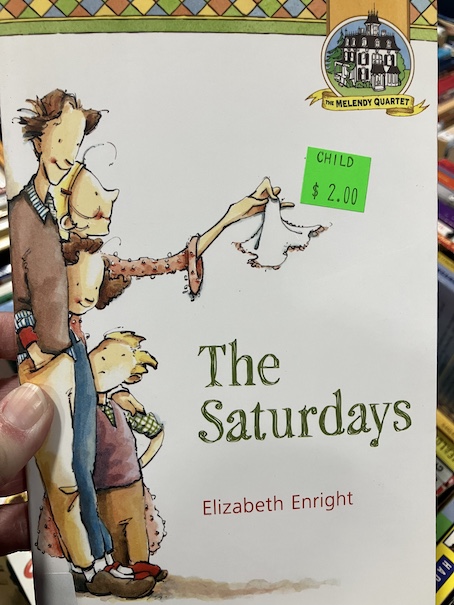
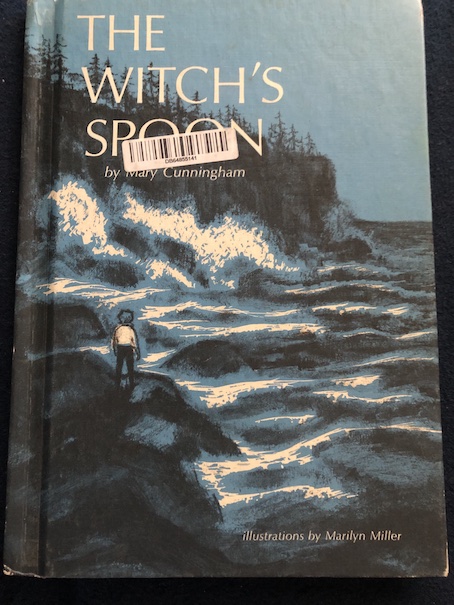


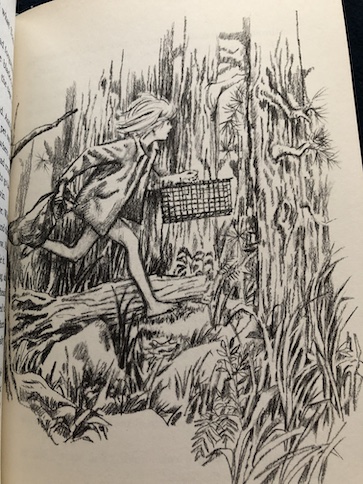


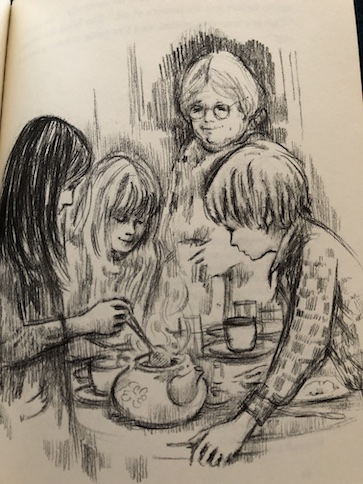
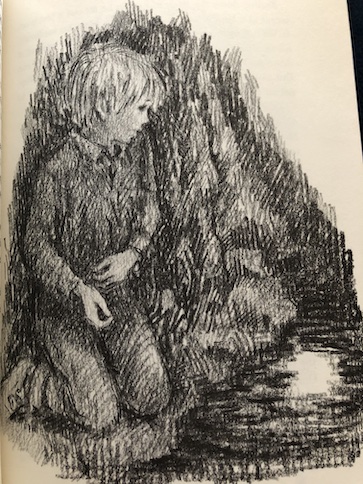
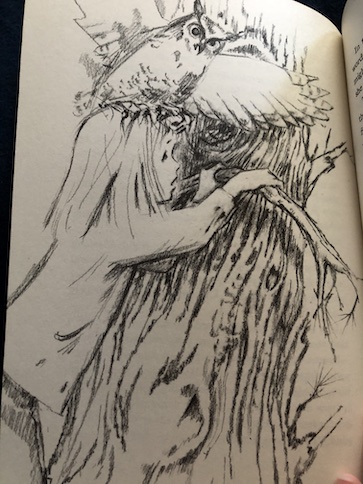


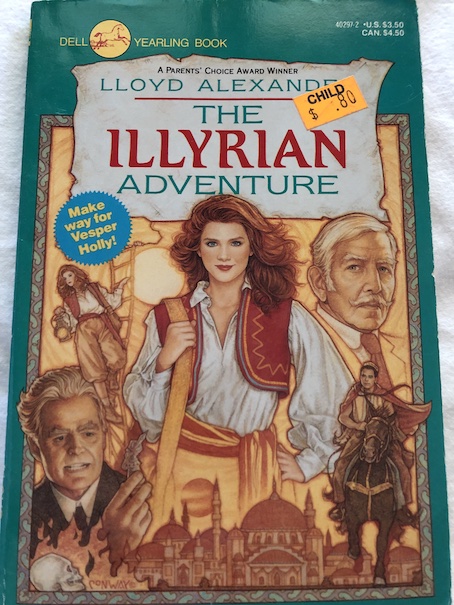
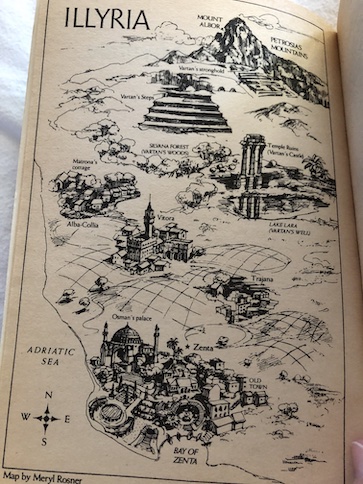

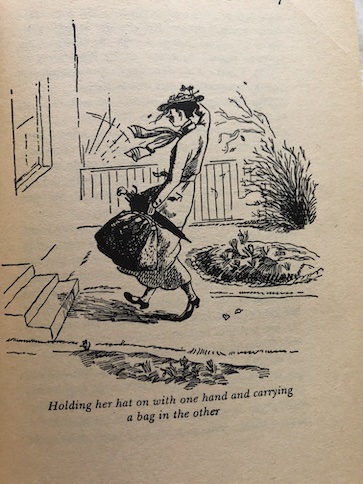
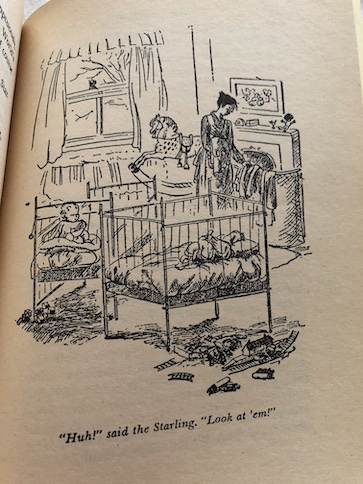

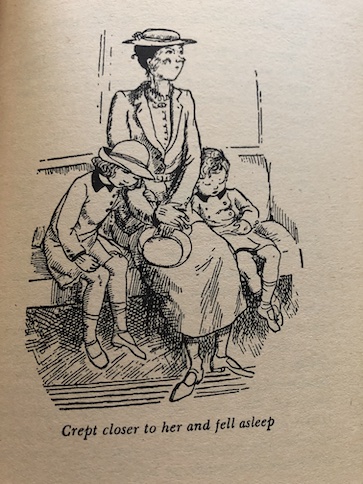

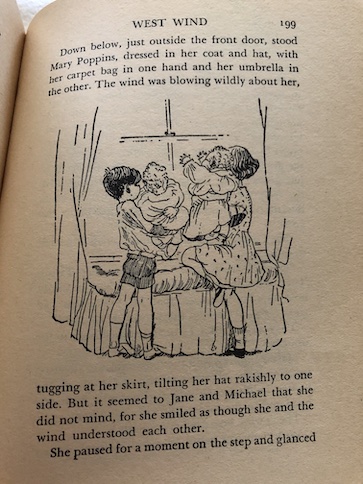
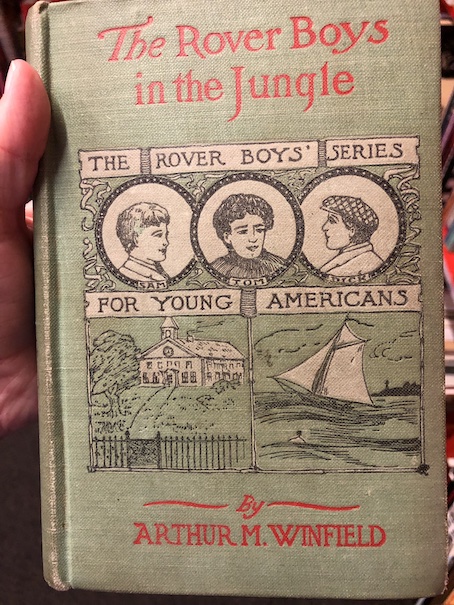

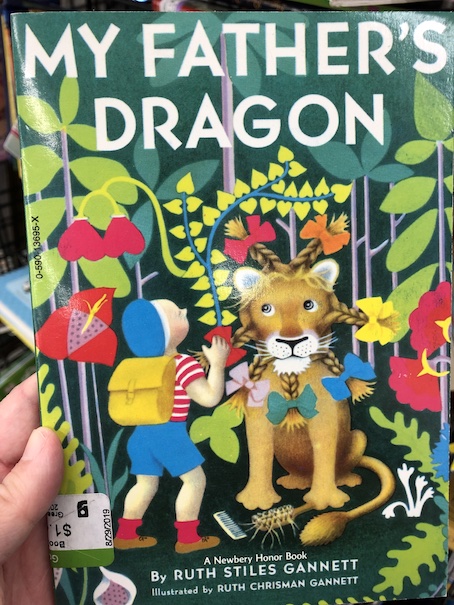



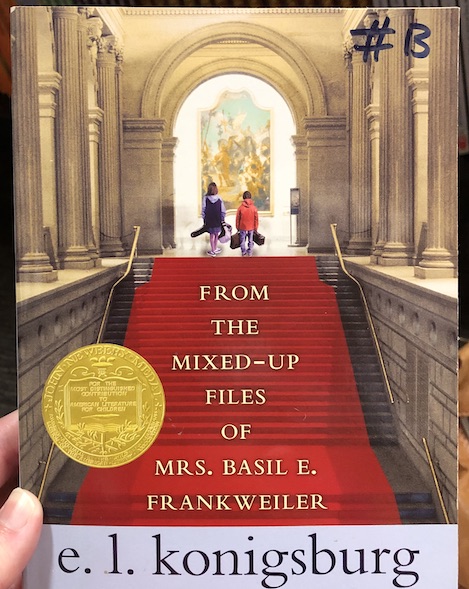


 Jestress's Forgotten Books and Stories