Alice in Wonderland

The beginning of the story is famous. Alice is sitting with her sister (unnamed in the book, but probably based on Lorina because Lorina was older than Alice) by the river, and she is bored by the book that her sister is reading because there are no pictures or conversations. As Alice is sitting there drowsily, she suddenly spots a white rabbit who seems like he’s running late for something. Curious to see where he is going, Alice follows him and falls down a rabbit hole which is like a deep well.
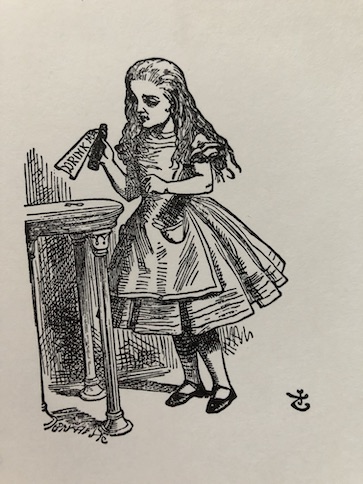
It takes her a long time to fall (causing Alice to wonder if she’ll pop out on the other side of the world eventually), and when she reaches the bottom, she finds herself in a dark hallway with a small door that is too small for her to go through. She manages to shrink herself by drinking from a mysterious bottle that says “Drink Me,” but she forgets the key to the door on the table above her, so she has to make herself bigger by eating cake from a box labeled “Eat Me.” When Alice is big, she cries so much, worrying that she is no longer herself but someone else she would rather not be because so many strange things are happening, that she makes a sea of tears, and when she is small again, she has to swim.

She meets a mouse, who swims to shore with her, where they meet a bunch of other animals (including the Dodo), who all seem somehow familiar to Alice (probably because they’re all parodies of people Dodgson and the Liddells knew – A Lory (type of parrot) argues with Alice and tells her that it’s older than she is and “must know better” than she does – possibly another reference to Alice’s older sister Lorina).

Alice and all of the animals are wet, so they try to dry themselves. The Mouse begins telling a very dry history of England (ha, ha), but that’s not good enough. The Dodo suggests that they have a Caucus-race (Alice’s childish misunderstanding of certain words and concepts leads to some of the jokes and puns in the story) to dry themselves out, and they all start running in a circle. After awhile, they all stop, and since there is no obvious winner, the Dodo decides that everyone has won and that everyone should receive a prize. Alice gives all the animals pieces of candy from her pocket. Alice’s prize is her own thimble, which is the only other thing she has in her pocket.

The Mouse starts to tell a story about why it hates dogs and cats, but it gives up when Alice doesn’t pay attention and becomes confused. Then, Alice makes the mistake of mentioning her pet cat and how it likes to chase mice and birds, and all of the other animals become offended and leave. However, the White Rabbit appears and, apparently mistaking Alice for his maid, asks her to bring him his gloves and fan. Alice goes into his house to look for them. Finding another bottle like the first one, she drinks it and becomes so big that she gets stuck in the house. The White Rabbit and his friend, Bill the Lizard, become alarmed at her large arm sticking out of the window and talk about burning the house down. They throw pebbles at Alice which turn into cakes, and Alice eats them to become smaller.

Alice makes her escape from the house, distracting a puppy much larger than she is by throwing a stick, and meets a caterpillar, who is sitting on a mushroom and smoking a hookah. The Caterpillar asks her to explain herself, but Alice says that she can’t because she isn’t really herself. Alice tells him that she keeps changes sizes and can’t remember things that she thinks she should remember. The Caterpillar asks her to recite the poem about Father William, and Alice recites Carroll’s parody version instead of the original poem. The Caterpillar agrees that Alice said the poem wrong. He asks Alice what size she would like to be and gets offended when Alice says that being only three inches tall is awful because that is the Caterpillar’s height. However, he does tell Alice that one side of the mushroom will make her taller and the other will make her shorter, not explaining which is which. Alice experiments with bits of mushroom until she finally becomes her normal size again. She keeps the mushroom pieces so that she can change size again, if she needs to. (Has anyone ever made a video game version of Alice in Wonderland where the player, as Alice, has to become bigger or smaller to get through different levels? If no one has, I think someone should.)

Alice soon makes herself small again so that she can go into a little house. Alice speaks to the footman of the house, who has just accepted an invitation for the Duchess to join the Queen for croquet. The footman rambles on about how there’s no use in Alice knocking because they’re both on the same side of the door and everyone inside is making too much noise to hear her. Not getting any straight answers about whether or not she’s allowed to go inside, Alice decides that the footman is an idiot and just lets herself in. The Duchess is sitting inside with a baby while her cook makes pepper soup. The Duchess’s cat, the Cheshire Cat, grins at Alice in a strange way. (The Cheshire cat comes from an expression that was popular in the 19th century – “grinning like a Cheshire cat” – although the origins of the phrase are uncertain. The Cheshire Cat wasn’t actually in the original version of the story.) Alice becomes alarmed when the cook begins throwing things at the Duchess and the baby, but the Duchess tells her to mind her own business. The Duchess is rough with the baby and throws it. Alice catches it and takes it away, worrying that the Duchess might kill it, but the baby turns into a pig, and Alice has to let it go. Alice thinks that it would have been a very ugly child and is better off as pig, which reminds her of other children she knows. (Ouch.)

Alice spots the Cheshire Cat and tries to ask it for directions. It directs her to the Mad Hatter and the March Hare, telling her that they’re both mad. (These also come from old expressions, “mad as a hatter” and “mad as a March hare.”) Alice says that she doesn’t want to “go among mad people”, but the Cheshire Cat says that can’t be helped because everyone is mad here, including Alice, because she wouldn’t be there if she wasn’t. He says that he will see her later when she plays croquet with the Queen. Before the Cat vanishes completely, he asks her what happened to the baby, and when Alice says that it turned into a pig, the Cat says, “I thought it would.”

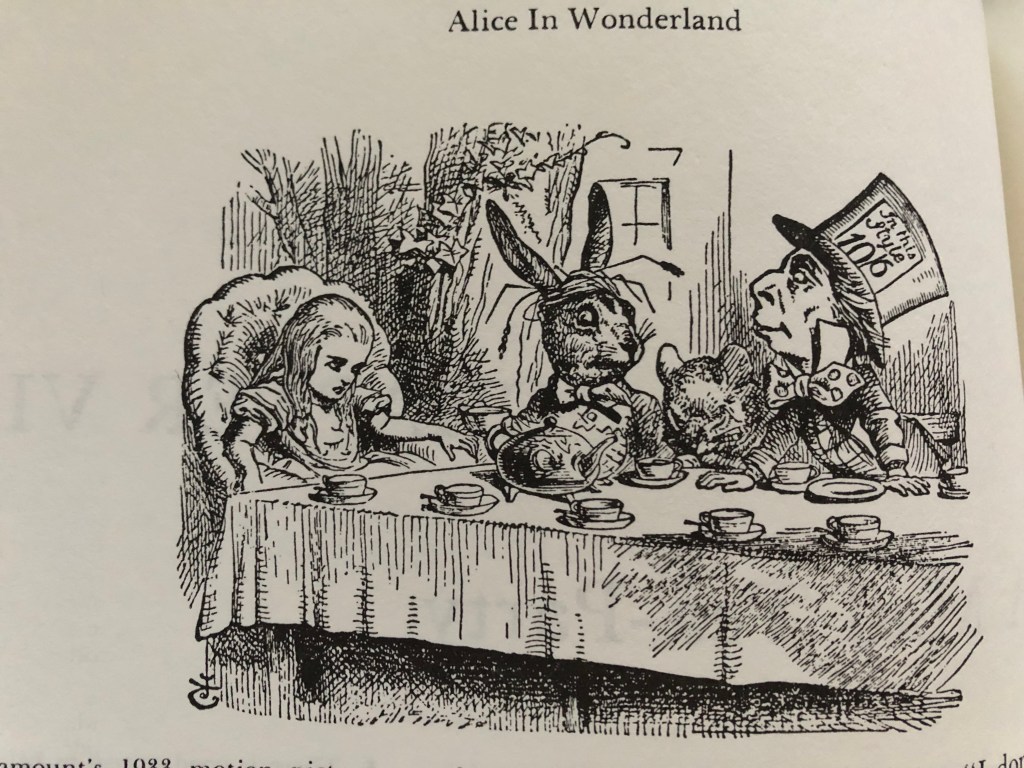
Alice ends up at the tea party that the March Hare and the Mad Hatter are having with the Dormouse. (This tea party also was not part of Carroll’s original version of the story.) Although they tell her there is no room at the table for her, Alice notes that it’s a big table with a lot of chairs, so she sits down, uninvited. The conversation is confused, and the Mad Hatter tells Alice a riddle without knowing the answer to it himself. Alice says that he’s wasting time, and the Mad Hatter says that Time won’t do anything he wants now because he was accused of “murdering the time” when he sang “Twinkle, twinkle, little bat!” before the Queen of Hearts (he messed up with the timing of the song), and now it’s always six o’clock and always tea time (that’s when people, including the Liddells, used to have tea time when the story was written). This gives them no time to clean up between tea times, so they just keep moving around the table. Alice tries to ask them what they do when they get back to their original positions at the table, but the March Hare changes the subject. The Dormouse begins telling the story of the three sisters who lived at the bottom of the Treacle Well and were learning to draw things that begin with the letter ‘M’. (As the March Hare says, “Why not?”) Alice tries to ask questions, and starts to say, “I don’t think-” The Mad Hatter says, “Then you shouldn’t talk.” Alice gets offended and decides to leave.
She finds a door that takes her back to the hallway where she was in the beginning, and she is able to open the door that she couldn’t before, which leads her into a beautiful garden. There, she finds some playing cards painting the roses. It turns out that they accidentally planted white roses, and the Queen wants red ones, so they’re just painting the roses so she won’t find out. The King and Queen of Hearts enter the garden, and the Queen begins demanding to know who Alice is and who the cards are. Alice gives a flippant remark, and the Queen screams, “Off with her head!” (Which, I think, is about the third time in the story that someone has said that. The Duchess was the first.) The King points out that Alice is only a child. The Queen invites Alice to play croquet. The White Rabbit explains that the Duchess isn’t coming because she’s supposed to be executed for boxing the Queen’s ears.

In this game of croquet, the mallets are flamingos (ostriches in the original version) and the balls are hedgehogs. The card soldiers have to bend themselves to be the arches. Alice can’t control her flamingo or hedgehog, nobody waits for their turn, and the Queen keeps ordering people’s heads to be taken off. Alice is very worried, and when the Cheshire Cat appears, Alice tells him that nobody is playing fairly. She notices that the Queen is listening, so she comments that the Queen is likely to win, which pleases her. The King says that he doesn’t like the Cat and wants him removed. The Queen orders its execution, but the Cheshire Cat makes its body disappear. The executioner doesn’t know what to do because he’s used to removing heads from bodies and can’t deal with a bodiless head. Alice suggests asking the Duchess because it’s her cat.

The Duchess seems glad to see Alice, and as Alice’s mind wanders, the two of them have a discussion about what the moral of the situation is. (Victorian children’s books often had a moral to the story. All of the Duchess’s and Alice’s suggested morals are proverbs that don’t fit the situation at all or are parodies on popular sayings. “Take care of the sense, and the sounds will take care of themselves” is a parody of “Take care of the pence, and the pounds will take care of themselves.”) The croquet game continues until everybody has been arrested except for the King, Queen, and Alice.

The Queen asks Alice if she’s met the Mock Turtle yet (which is supposedly what mock turtle soup is made from). Alice hears the King pardon everyone who was arrested. The Queen orders the Gryphon to take Alice to the Mock Turtle, and the Gryphon tells her that nobody ever really gets executed when the Queen orders an execution – it’s all just the Queen’s fancy.

When the Gryphon introduces Alice to the Mock Turtle, the Mock Turtle explains that he used to be a real turtle. He talks about his youth and the lessons he had when he was young. (The “extras” that he and Alice describe – French, music, and washing – are a parody of British boarding schools at the time and a play of the word “extra.” These things were not provided as free “extras”, and of course, washing isn’t a lesson – they would cost extra at boarding school and the additional costs would be added on to the fees.) The Gryphon and the Mock Turtle describe the Lobster-Quadrille dance to Alice, demonstrating it (while singing a song that is a parody of The Spider and the Fly). They ask Alice about her adventures, and she tells them everything that’s happened to her so far. When she mentions not being able to recite poems correctly, they have her try another, and she recites “‘Tis the voice of the Lobster” instead of “The Sluggard” by Isaac Watts. The Mock Turtle sings “Turtle Soup”, which is a parody of the song “Star of the Evening” by James M. Sayles.
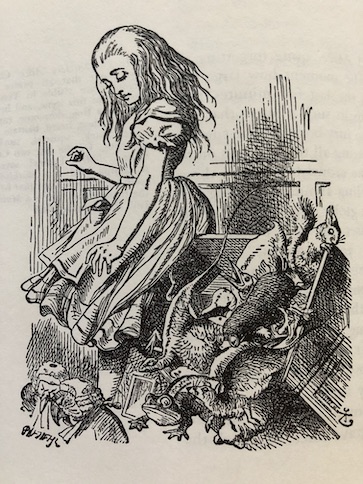
Then, they hear that a trial is beginning. It turns out that it’s a trial for the Knave of Hearts who stole the Queen’s tarts. During the trial, which is basically nonsense, Alice feels herself growing larger. She is called to give evidence, but because she is becoming too tall, she is told to leave the court. The King says that it’s Rule Forty-Two and is the oldest rule in the book, but Alice points out that the oldest rule should be Rule One. The White Rabbit presents a letter, supposedly written by the defendant, which is a nonsense poem. (This one is a shortened version of another nonsense poem by Carroll which loosely parodied the song “Alice Gray” and isn’t recognizably close to the original here.) The King and Queen try to figure out what the poem means, but Alice doesn’t think it means anything. The Queen wants to give the sentence first and the verdict afterward, and Alice says that’s nonsense and she doesn’t care what they think because they’re just a pack of cards. The cards come flying at her, and Alice wakes up.

Apparently, the entire adventure was a dream, and Alice feel asleep on the river bank with her sister. Alice tells her sister about the dream, and her sister is enchanted. Alice’s sister imagines Alice in years to come, telling other children the same story.

Alice in Wonderland has been made into movies many times, including the 1951 version by Disney (which didn’t contain the Duchess or the pig baby and had some elements from Through the Looking Glass, like the talking flowers and Tweedledum and Tweedledee). The story is considered public domain now and is easily available in multiple forms online, including versions on Project Gutenberg, Lit2Go, and Internet Archive.

The story of Alice in Wonderland is over 150 years old, as of this writing, and it has been reprinted in many different languages and editions. The edition that I’m using for this review is actually a combined edition with the sequel, Through the Looking Glass, from 1960 with added notes by Martin Gardner. I like editions with added notes because there is quite a lot to explain about both Lewis Carroll and his stories. This is going to be a very long review, and there are a number of things I want to explain before I even start summarizing the story.

Lewis Carroll, real name Charles Dodgson, was actually a mathematician at Oxford in England. His modern reputation is somewhat dubious because one of his hobbies was photography, and among the pictures he took were pictures of children, including many in various states of undress, some nude or partially nude and some in nightgowns. Charles Dodgson never married and never had any children of his own, and his sexuality (or relative lack thereof, as some have also speculated) is debatable. He was known for being friendly with the children of many of his friends and colleagues, and he enjoyed spending time with them, talking to them, telling them stories, and teaching them things … and taking pictures of them. The parents of the children knew about the photographs, including the nude ones, and gave permission for them to be taken, even keeping copies themselves.

Scholars debate about Dodgson’s photographs and the intention behind them. Not all of the pictures feature children who are undressed; some are just wearing ordinary clothes and others are dressed in fanciful costumes, like characters from stories. However, the nude or partially nude pictures are troubling because the children in those pictures were not babies, like the ones in modern Anne Geddes photographs. By modern standards, there would be no innocent reason for taking pictures of unclothed children like that. However, some scholars point out that photography was a relatively new hobby at that time, and people were taking pictures of things and other people in ways that people wouldn’t now because they were so eager to try out this new technology. People were realizing that they could use photography to immortalize loved ones in ways that they never could before. (Look up 19th century post-mortem photography only if you’re not easily startled or disgusted.)

There is some evidence that Victorian people were not scandalized by the idea of nude photographs of children, perhaps considering them a preservation of a state of innocence that would gradually disappear as the children grew up, almost like how some people today still photograph nude babies. Dodgson wasn’t the only one taking pictures of nude children at the time, and he apparently did so with the full knowledge and approval of the children’s parents, giving them photographs to keep. On the other hand, without knowing Dodgson’s real intentions, it’s difficult to say whether or not these pictures were really as innocent as they were once supposed, and some people consider that Dodgson may have taken advantage of the innocence of both the children and parents involved for his own purposes. After his death, some of his relatives removed some of the pages in his diaries, censoring them before they could be made public, so it’s difficult to say what they removed and why. This censorship could have had something to do with his photography hobby and how he felt about it, or it could be unrelated, maybe covering up his romantic feelings for someone else or maybe personal or professional quarrels that might have proved embarrassing to people still alive at the time he died. Without the missing diary pages, there isn’t really much to go on, and the speculation is really just speculation.
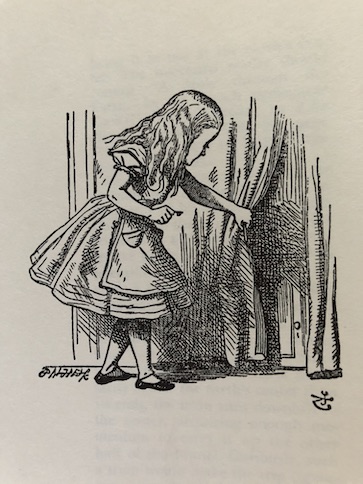
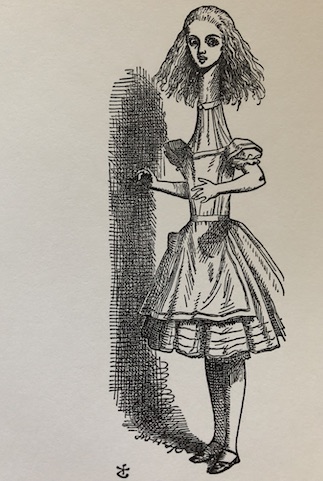
Not what Alice Liddell really looked like.

One of the favorite child friends of Dodgson’s was Alice Liddell, one of the daughters of the ecclesiastical dean of Christ Church, Oxford. Dodgson often visited the Liddell family and took Alice and her sisters on outings. On one of their outings together, when he and a friend took the Liddell girls on a boating trip on the Thames, Alice begged Dodgson to tell a story, and he began making up the story that became Alice in Wonderland, making Alice herself the heroine. Dodgson was still friends with the Liddell family at that point, although he later had a falling out with the family for reasons that are still unknown. The reasons for the falling out were apparently part of the pages removed from his diary, and some people have speculated that Dodgson may have behaved improperly toward one or more of the girls, although that’s not the only possibility; Dodgson may have had a different type of romantic indiscretion at that time, possibly involving the children’s governess or Alice’s older sister Lorina, and he may have also quarreled with the dean over college politics. Dodgson was a contemporary of another famous author of children’s fantasy books, George MacDonald. (I’ll be talking about him more when I get to The Light Princess and The Princess and the Goblin.) The two of them were friends, and MacDonald was the one who urged Dodgson to publish Alice in Wonderland after his own children read it and liked it. (MacDonald’s children were also among the ones photographed by Dodgson.)

This documentary has more details about the history Lewis Carroll, his photography, and his writing. Overall, I think that probably the most accurate answer in the documentary to the question of what was really going on in Oxford in the mid-1800s is “Who knows?” Some people gave much more definite-sounding responses to the question, but there are equally vehement opinions that take completely opposite views of the situation, and with the obvious gaps in the available information, I don’t think that level of certainty is warranted. The documentary covers various viewpoints and ends with a photograph that is potentially damaging to Lewis Carroll’s reputation, one that would have been scandalous even in the Victorian era if it was really taken by Carroll (it wasn’t proven definitely, but the experts’ conclusions were that seems likely or at least credible, and its time period and quality are in keeping with Carroll’s work) because the subject of the photograph (possibly Lorina Liddell) would have been too old for the photograph to be considered “innocent” even back then. The girl in that photograph would have been above the minimum age of consent for her time but still below the age of consent for ours, making that photograph suspicious by everyone’s standards.

This is not sexy, Martin Grotjahn.

My theory about the issue? I kind of doubt that Carroll was a pedophile. Kind of. Partly, my reasoning is based on listening to and reading the different arguments on each side, and it seems to me that those who express doubt about the accusation have more concrete evidence to support their points (they reference other photographers who took pictures similar to Carroll’s, they discuss the age of consent in the Victorian era, they note inconsistencies in the reported ages of Carroll’s female friends, they provide details about different sources of information, etc.) than the people who insist that he “obviously” and “without doubt” was sexually attracted to little girls, who seem to be largely reactionary and make I statements like “I can’t believe” that there was anything innocent going on and “it makes me angry.” (Some of the people interviewed the Timeline Documentary speak like that.)

Between the two choices, I’d be more inclined to go with reasoned arguments and cited sources more than gut reactions. My reviews here on this site are full of my personal feelings and gut reactions on a number of topics because that is the nature of opinion-based reviews, but I’ve had training in evaluating historical sources and writing research papers. Feelings change over time, and you can’t cite gut reactions as evidence in a thesis paper. The first essay that postulated that Alice in Wonderland may contain sexual symbolism, written by A.M.E. Goldschmidt in the 1930s, may have actually been written as a parody of contemporary psycho-analysis, and some of the “obvious” sexual symbols cited in later essays and analysis make no sense to me. In 1947, a psychoanalyst named Martin Grotjahn said that the scene where Alice’s neck suddenly grows longer is a symbol “almost too obvious for words.” No, it’s really not. I had to sit and think for awhile about why a person with a giraffe-like neck would be considered sexy, and then, it occurred to me that he’s probably really thinking of a piece of male anatomy instead of a girl’s neck, which doesn’t make any sense for the context of the story. Even now, I’m still not completely sure if that’s what he’s really getting at, and if I have to ponder it that much, it’s not that “obvious.” It’s about as bad as all the “that’s what she said” jokes I’ve heard. Quite a lot of unrelated things can be made to sound raunchy if you add “that’s what she said” after them, and the more times you hear that, the more annoying and less funny that kind of joke becomes. When a scholar does something like that in literary criticism, I’ve noticed that people are reluctant to question it because they assume that the scholar knows something they don’t, but I really don’t understand that comment and I don’t mind saying that I don’t think it makes much sense.

Also, I can’t help but notice in the descriptions of Carroll’s interactions with the Liddell girls that he visited them in different locations and took them on outings in different locations and that they were in the company of different people during these visits. The Timeline documentary mentions that the children’s governess would have been with them, even if the parents weren’t, and on the day that he took them on the boat trip where he began composing Alice in Wonderland, they were accompanied by his friend, Robinson Duckworth. I’m not a specialist in Carroll’s life, but it isn’t clear to me, from their descriptions, whether or not he was ever completely alone with the girls or with any child in particular, with no other witnesses. He may have been, but it seems to me from others’ descriptions that they were often chaperoned by different people. If some form of abuse or suspicious behavior were going on, it would be more difficult to evade or fool multiple witnesses. In 1932, when Alice was 80 years old, she went to New York to receive an honorary doctorate from Columbia University for her participation in the creation of a piece of iconic children’s literature and to take part in a centennial celebration of Dodgson’s birthday. I would think that if she had bad memories of Dodgson, she would have been less likely to take such a long journey at her advanced age in order to attend this celebration. On the other hand, that’s still just a guess of mine, and the suspicions about Dodgson, now raised, really can’t be proven either way. It still remains a possibility, and that’s why I only “kind of” think that Dodgson’s intentions might have been innocent.

In the end, I don’t have a firm theory so much as a conclusion: if you need to have definite answers, without debate, qualification, or reservation, in order to acquire knowledge, history probably isn’t your field. My first degree was in history, and I’ve noticed so many times that people discount historians and historical knowledge because the field doesn’t make firm, definite statements on many debatable aspects of history like this, and times when historians and private individuals have tried, they have often been proven wrong in some respect. However, that’s exactly the point: serious, professional historians don’t make definite statements unless and until they have definite proof because they know that there’s always a chance that they could be proven wrong at a later date when new information surfaces. It’s happened before, so true professionals are usually cautious. It’s not that they don’t know anything, it’s just that they’re aware of the limits of their knowledge, and they are careful in how they present what they really know in order to prevent people from drawing the wrong conclusions too quickly. It would be irresponsible to tell people that something is definitely true when the circumstances aren’t definite, so instead, they tell people about the information they know they have and the things are “possible,” “likely,” or “probable,” which irritates people who expect definite answers from experts. We know some things, and we also are aware of what we don’t know and what pieces we’re missing, which is also very important.

It doesn’t matter so much in modern times that we can’t completely prove Dodgson/Carroll’s intentions regarding his photography one way or the other as that we understand that the controversy exists. Without the diary pages, which would have been proof of his thoughts and intentions (and which were probably destroyed long ago), the most we could say is that the photographs suggest a possibility. Because, as scholars have pointed out, Dodgson wasn’t the only person who took photographs of children like that without apparently causing scandal, I wouldn’t say that it’s “definite” that his behavior or intentions were inappropriate. The final photograph in the documentary above is bad, but because they never proved definitely that he made it, I’d hesitate to call it “probable,” even though it seemed to me that the documentary makers were fishing for that so they could have a compelling revelation for their documentary. I don’t know for certain whether Charles Dodgson was or was not a pedophile, but I do know that it’s possible that he may have been one or at least had feelings or urges in that direction. There are enough indications that it remains possible, even though it’s unprovable. If you’re okay accepting as fact that an idea is “possible,” but probably not “probable” and certainly not “certain” … you could do well studying history, and just getting through my explanation (if you managed all that) means that you’re more than ready to tackle the logic puzzles of Alice in Wonderland. They’re kind of like that when you turn them around in your head.

There are a couple of things that are easier to prove about Alice in Wonderland than whether or not Lewis Carroll may have been attracted to the real Alice, and these more easily provable aspects of the story are what make it particularly interesting for me. First, parts of the Alice stories are actually parodies of popular stories and rhymes from the 19th century. Dodgson/Carroll particularly liked to poke fun at didactic stories and rhymes that were used to teach children useful lessons and morals. He liked to twist those more serious stories and rhymes into things that were basically nonsense. Modern readers are more likely to focus on the nonsense and less likely to notice the parodies in the Alice stories because they are not familiar with the original rhymes and stories being parodied, as the original readers of these books would have been. The original readers would have known immediately what he was making fun of. For example, “How Doth the Little Crocodile” is a parody on “Against Idleness and Mischief” by Isaac Watts, which is about the importance of using time well. “You are Old, Father William” or “Ballad of Father William” is a parody on “The Old Man’s Comforts and How He Gained Them” by Robert Southey, which gives advice to the young about how to behave so that they may enjoy a happier old age. These types of poems would have been given to Victorian children as something to read and memorize during their lessons, and so they would have noticed that Carroll was poking fun at them. That’s why I like editions of the Alice books that come with extra notes, pointing out the parodies and original references, so I can be in on the joke. On the other hand, modern readers will have no trouble recognizing the source of “Twinkle, Twinkle, Little Bat” as “Twinkle, Twinkle, Little Star” or “The Star” by Jane Taylor (first published in 1806, although modern readers think of it as the song instead of the poem, and not all of them know all the verses). It’s pretty common throughout history for bored students to make jokes about the things that they’re required to learn in their lessons, and many of these poems are old enough for Carroll himself to have learned them when he was a student. It’s possible that he may have started playing with parodies of his school lessons or popular songs long before he started writing Alice in Wonderland, although that’s just my personal guess, based on my own school years. I did things like that, and some of my friends did, too. (People older than me also remember On Top of Spaghetti and Joy to the World, the School Burned Down – not Carroll parodies and much cruder than his work, but examples of the way kids can twist things that are commonly known for the amusement of their friends.)

The second important point about the Alice stories is that they are full of puzzles, riddles, and word games. Remember that Lewis Carroll /Charles Dodgson was really a mathematician and scholar, and he liked to play with logic puzzles and word games. There are a lot of puns in Alice in Wonderland, some of which reference places in and around Oxford, like the Treacle Well where three sisters supposedly live – Lacie (anagram of Alice), Elsie (her older sister was Lorina Charlotte – L.C. Liddell), and Tillie (her younger sister Edith’s nickname). Alice in Wonderland is full of inside jokes, riddles, and puns like this. There are many in-jokes for people who are familiar with places in Oxford, and there are many in-jokes that Dodgson and the girls had with each other. Some of the strange characters in Wonderland are apparently parodies of people that Dodgson and the Liddells actually knew. Dodgson himself explained that he is the Dodo in the story. Dodgson spoke with a stutter, and when he would introduce himself to people, his name would often come out, “Do-Do-Dodgson.” “Dodo” Dodgson was an in-joke that the Liddells would have recognized.

Part of the trouble with analyzing Alice in Wonderland is that it’s possible to take it too far. Some of the parodies are obvious to people who are familiar with 19th century literature and poetry, and the references to places in Oxford are noticeable to people who are familiar with Oxford, but there are so many in-jokes in the story that might not be possible for modern readers to understand them all because we might not know all the in-jokes that Dodgson and the Liddells had with each other. So many strange and surreal things happen in the story that it’s possible to read too much into all of it. Some of it may have simply been meant to be silly references to other stories that Dodgson told the children before Alice’s story, long-standing in-jokes, or random silliness, and may not have any deeper meaning than that. When I read other reviews and analysis of the stories, I sometimes get the feeling like the critics are trying too hard, reaching and reading too much into everything. There’s a lot to enjoy about the story just as it is, without over-analyzing it to death, looking for hidden psychology that might not actually be there because a major part of it was based on parody and in-jokes in the beginning. If you want to spend some time appreciating the logic puzzles and word play and comparing the parody poems to their originals, that’s fine, but it’s also fine to just enjoy the book for the imaginative nonsense. It’s a long, strange trip, and I think it’s perfectly okay to just sit back and enjoy.

Something else I’d like to mention before starting on the story itself is that the Alice who is depicted in the classic illustrations is not actually the original Alice Liddell. The illustrated Alice is a blond girl, but Alice Liddell was a brunette with shorter hair. Lewis Carroll apparently suggested that the illustrator use a picture of Mary Hilton Badcock as the model for the book illustrations, and Mary Hilton Badcock did look similar to the finished illustrations, although it’s also possible that the illustrator used a different child with a similar appearance as his model.

Also, the story as Carroll originally wrote it was called Alice’s Adventures Underground. Carroll did his own illustrations in the original version, showing Alice more like the real Alice, and there were a number of differences in the story. For example, in the original version, the White Rabbit drops a nosegay of flowers, which Alice smells, and that causes her to shrink, something that didn’t happen in the later version. If you want to read the original, it’s available through Project Gutenberg.

The School at the Chalet

The School at the Chalet by Elinor M. Brent-Dyer, 1925.

This is the first book in the Chalet School Series.  This series is uncommon in the United States.  People from Britain or countries with heavy British influence would be more familiar with this series.  It’s considered classic!

When the story begins, Madge and Dick Bettany, who are brother and sister, a set of twins, are discussing their family’s situation.  Their parents are dead, and they have very little money and no family members they can rely on.  Madge and Dick are grown and are ready to begin making their own way in the world, but their younger sister, called Joey, is still a child, and her heath has been poor.  Dick has a job, but he really can’t afford to support his sisters.  However, Madge has had an idea: she wants to start a school.  Dick worries that they don’t have the capital necessary to start a school, but Madge says that she could start one in continental Europe instead of England, where they are from, because the costs would be lower.  She even has a specific place in mind, a chalet near a lake, close to a town called Innsbruck in the Tiernsee (Austria).  Joey could live with her at the school and continue her education in the company of the other students, and Madge thinks that the climate there might even be better for her than England.  She has already written a letter to find out if the chalet is available, and it is.  If they sell most of what they own in England, Madge thinks that they’ll have enough to buy what they need in Europe.  Madge says that she thinks she could handle about a dozen girls, between the ages of twelve and fourteen or fifteen.  She knows someone who could help her teach, Mademoiselle Lepattre, and between them, they are qualified to teach French, German, sewing, and music.  Dick is still a little concerned about whether or not Madge can pull off the school, but he agrees that she should go ahead with her plans (since she likely will anyway) and says that if she runs into trouble, she should contact him for help.

Madge even knows who her first pupil at the boarding school will be: Grizel Cochrane.  Madge has already had her as a student, and she is friends with her family.  She knows that Grizel has been unhappy at home since her father remarried because she and her stepmother do not get along.  Grizel’s stepmother has already been pressuring her father to send her away to boarding school, but he loves her and has been reluctant to part with her.  However, Grizel has been miserable, and her father decides would be more willing to send her away with someone he already knows.  Grizel is pleased at the idea of joining Madge and Joey at a school in Europe, and the Madge gains her first student.

Dick and Mademoiselle Lepattre go to the chalet first to take the larger trunks and belongings and begin getting settled, while Madge, Joey, and Grizel follow them.  Along the way, they see some of the sights of Paris.  By the time they arrive at the chalet, Mademoiselle Lepattre’s young cousin, Simone Lecoutier, has arrived at the school to be a pupil, and Madge has arranged to accept an American girl named Evadne Lannis, who will arrive later.  These four girls, Joey, Grizel, Simone, and Evadne, are the school’s first boarders.  The school soon acquires a few day pupils who live nearby: Gisela and Maria Marani (a pair of sisters), Gertrud Steinbrucke, Bette Rincini, Bernhilda and Frieda Mensch (also sisters).  Maria is much younger than the other girls, only nine, but her mother asked that she be admitted along with her older sister. There are public schools for children in Innsbruck, but the father of one of the new local pupils thinks that the Chalet School might be healthier for his daughter because, while he doesn’t think much of English educational standards (Grizel takes exception to that comment), they shorten the school day (compared to the average school day of Austria or Germany of the time) and encourage participation in sports and games. The local girls are curious to see what things are going to be like at an English style school, and if it will be like other English schools they’ve heard about.  The school also soon gains more students and boarders:

  • Margia and Amy Stevens – ages 8 and 11, their father is a foreign correspondent from London who needs to travel for his work, and the girls’ parents wanted to find a stable place for the girls to stay.
  • Bette Rincini’s cousins, who have come to stay with her family
  • A pair of sisters from another town across the lake
  • Two more children from a nearby hotel
  • Friends of Gisela from Vienna
  • Rosalie and Mary, two girls Joey and Grizel know from England

As the school grows and the girls settle into life at the school, they make friends with each other, although it’s awkward in some cases.  Madge notices that Simone is often by herself and she asks Joey if she and the other girls are being nice to her.  Joey says that they try, but Simone often sneaks off alone, and she doesn’t know where Simone goes.  Joey tries to ask Simone if she’s unhappy, and Simone tries to deny it.  The truth is that Simone is really homesick.  Joey finds her crying by herself later and comforts her, and Simone finally admits how much she misses her mother.  Simone also says that she feels left out because everyone else at the school has someone to be close to.  Other girls at the school share nationalities with at least some of the other students.  Simone is the only French girl at the school.  The Austrian girls are close to home, and Joey and Grizel already knew each other before they left England.  Seeing the other girls being such close friends makes her feel more left out.  Joey apologizes for making Simone feel left out and assures her that she will be her friend.  Simone asks her to be her best friend because she really needs someone to confide in, and Joey agrees, although she finds Simone rather needy and clingy. 

It turns out to be a difficult promise because Simone gets very jealous when Joey makes friends with other girls, and she tries to convince Joey to only be friends with her.  Simone is very dramatic, and she even ends up cutting off her long braid in an effort to impress Joey and get her attention when she learns about the other girls who will be coming from England.  Simone is so desperately lonely and finds it so difficult to make new friends that she is terrified that Joey will abandon her completely when she has other friends.  Joey gets fed up with her behavior and tells her that she’s being selfish. Joey knows that Simone would find it easier to make more friends herself if she would stop moping and being sad and gloomy.

After Juliet Carrick, another English girl, joins the school, Gisela is made head girl, and other girls are made prefects.  Bette is a sub-prefect, and one day, when she tells Grizel to put her shoes away, Grizel is rude to her, and Juliet laughs.  Gisela and the prefects discuss the situation and agree that Grizel, who wasn’t causing problems before, is now acting up because Juliet thinks that it’s funny.  When Gisela sends someone to bring Grizel to the prefects’ room to talk about it, Grizel refuses to come and see them, and she realizes that something needs to be done.  If the head girl and prefects let a girl get away with disrespecting them or not following the rules, the prefect system and student government would fall apart.  Grizel feels a kinship for Juliet because neither of them has a happy home life. Juliet has been raised to believe that the English are superior to everyone else, and she has no shame in showing it.  Juliet encourages Grizel to adopt her prejudices, but at a school in Austria with students of varying nationalities, that can’t be allowed.  Madge supports the prefects, and Grizel is punished for her behavior.

Juliet is still a bad influence, sometimes encouraging other girls to act up with her. When Madge refuses to allow the girls to pose by the lake for some film makers, Juliet convinces some of other girls to sneak away with her and volunteer to be filmed without Madge’s knowledge.  However, the father of one of the local girls catches them. He explains to the film makers that it would be inappropriate to film the girls because they don’t have permission from either the girls’ parents or teachers, and he takes the girls back to the school.  Grizel’s temper and excessive patriotism also get the girls into trouble when they encounter a German tourist who makes it plain that she is disgusted at the presence of the English girls. (This is after The Great War, World War I, so that may be the reason.)  While the German woman was being deliberately rude and insulting to the girls, Joey points out that Grizel’s hot-headed reply to her has now caused them more trouble.  Grizel does apologize for not using more restraint.

Juliet’s home life turns out to be even worse than the other girls know, but they learn the truth when Juliet’s father sends a letter to Madge saying that he and his wife relinquish their custody of Juliet to the school.  The letter says that Madge can do whatever she likes with Juliet.  If she wants to keep Juliet at the school and have her work for her future tuition, that will be fine, and she is also free to send Juliet to an orphanage.  The point is that her parents have left the country, they consider Juliet a burden that they would rather not bring with them, and while they might one day feel able to reclaim her, chances of that are not looking good.  When Juliet learns about the letter, she cries and says that she had been afraid that they would do something like this.  Her parents tried to abandon her at a different school once before, but the school had insisted that they take her back.  Madge now has no idea where Juliet’s parents are.  However, she can’t bear to turn Juliet over to an orphanage, so she promises Juliet that she will keep her and that she can help to pay for her tuition by working with the younger children at the school.  Although Juliet’s behavior hasn’t been very good up to this point, Juliet is grateful to Madge and does earnestly try to please her and to maintain her place at the school. Before the end of the book, Juliet’s parents die in an automobile accident, giving Madge and the school permanent custody of her. Most of the other students (except for Joey) do not know that Juliet’s parents tried to abandon her before they died.

Through the rest of the book, the girls have adventures together and forge the new traditions of their school.  They celebrate Madge’s birthday, get stranded in a storm and have to spend the night in a cowshed, start a magazine for the school, and play pranks on each other. When Grizel’s pranks and disobedience go too far and she is punished harshly for it, she gets angry and runs away from the school, becoming stranded on a nearby mountain. Joey goes after her to save her, and both girls are ill after their experience.

The book ends with Madge and a few of the girls caught in a train accident. Fortunately, they escape the accident without serious injury, and they also manage to help the German woman who had insulted the girls earlier. A man named James Russell helps them. The book ends at this point, and the story continues in the next book in the series. James Russell is a significant continuing character.

The book is currently available to borrow for free online through Internet Archive.

Toby Tyler

TobyTylerToby Tyler; Or, Ten Weeks with a Circus by James Otis, 1881.

Toby Tyler is an orphan who lives with a church deacon he calls “Uncle Daniel.” Uncle Daniel isn’t really his uncle, but he raised Toby after he was abandoned as a baby. Toby doesn’t know anything about his parents. Uncle Daniel is stern with him and says that Toby eats more than he earns, making it a hardship to care for him. Toby is cared for, but life with Uncle Daniel isn’t exactly happy.

Toby has a fascination for the circus, although Uncle Daniel says that the show isn’t any good, and it’s all a waste of time and money. The circus is certainly cheap, as Toby can see from the first. When he tries to buy some peanuts, he only gets six for the penny he gives, and all or most seem to be bad. The lemonade is basically water with lemon peel in it. But, to Toby’s surprise, the man who sells the snacks at the circus, Mr. Lord, offers him a job. He says that people who work for the circus get to see the show as often as they like, and he could use a boy to help him as an assistant.

TobyTylerPicToby think that it sounds like an exciting offer, and Mr. Lord persuades Toby that the best way would be for him to sneak away at night because his Uncle Daniel might disapprove and stop him from taking the job. Not taking that as a warning, Toby agrees. Toby feels a little guilty about running away and surprisingly homesick, but he decides to stand by the agreement he made with Mr. Lord and see what possibilities life with the circus might have for him.
Life with the circus turns out to be very different from what Toby is used to and what he expects. It’s noisy and dirty, and no one seems to particularly care about Toby or his welfare. Mr. Lord also turns out to be even sterner than Uncle Daniel, not even telling Toby what he expects him to do, just expecting him to do it. Toby works hard, and Mr. Lord acknowledges that he’s better than the other boys who have helped him, but he’s still a temperamental man and hard to please. Like Uncle Daniel, he fusses about how much Toby eats. Toby also has to sell snacks inside the big top under the watchful eyes of Mr. Jacobs, who threatens him with violence if he doesn’t make sales or if people try to cheat him.

However, Toby does succeed in making a few friends in the circus. The first friend he makes is a monkey that he calls Mr. Stubbs. Mr. Treat, who plays the part of the Living Skeleton in the circus sideshow, and his wife, who is the Fat Lady, have seen Mr. Lord mistreating other boys, and they intervene to make sure that Toby is all right, giving him food when Mr. Lord doesn’t. Unlike everyone else Toby has known, Mrs. Treat lets him eat as much as he wants without worrying, saying that some people just need more food than others. Like her husband, Toby seems to have the ability to eat a lot while still being small and skinny.  Mrs. Treat herself maintains an enormous size while hardly eating anything. She says that’s just how some people are.

When Mr. Castle teaches Toby to do trick riding, his status goes up in the circus, and he is no longer under Mr. Lord’s thumb. As far as the Treats are concerned, Toby could stay with them forever. However, life in the circus isn’t what Toby had once thought it was, and Toby can’t get rid of the thought that he’s made a terrible mistake by running away from Uncle Daniel. He wants to go home and make things right with him.

In the Disney movie, Toby stays with the circus, doing well with his trick riding act and having happy adventures with his monkey friend. Unfortunately, in the book, Mr. Stubbs is accidentally shot by a hunter and dies. The book was meant to teach moral lessons about responsibility, whereas the movie was just about fun and adventure.

In the end of the movie, Toby stays with the circus even while being reunited with the people who raised him and missed him when he ran away, giving an all-around happy ending. In the book, Toby feels terrible about the death of Mr. Stubbs (although it wasn’t really his fault), and the hunter who shot him is very sorry because he hadn’t realized that he had shot someone’s pet. To make up for it, he helps Toby to get back to Uncle Daniel. At first, Toby is unsure that Uncle Daniel will want him back, but he misses his old home so much that he says he doesn’t care if Uncle Daniel whips him for running away. However, Uncle Daniel has also missed Toby since he disappeared. As stern and harsh as he could be before, Uncle Daniel genuinely cares about Toby and welcomes him back with open arms.  The ending implies that Toby’s future with Uncle Daniel will be happier than the past because they have much greater appreciation for each other now.

The book is now in the public domain and is available on Project Gutenberg.

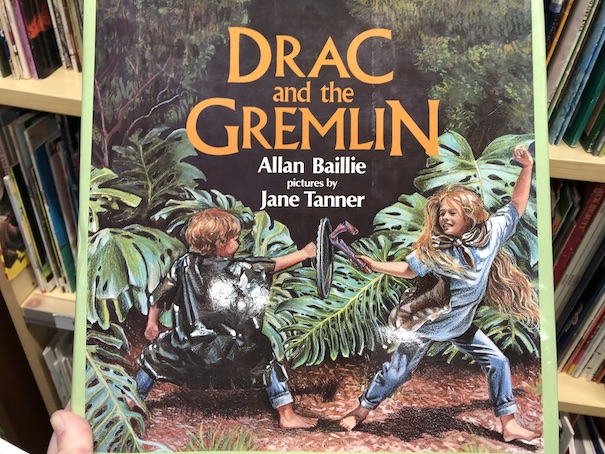
Drac and the Gremlin

Drac and the Gremlin by Allan Baillie, pictures by Jane Tanner, 1988.

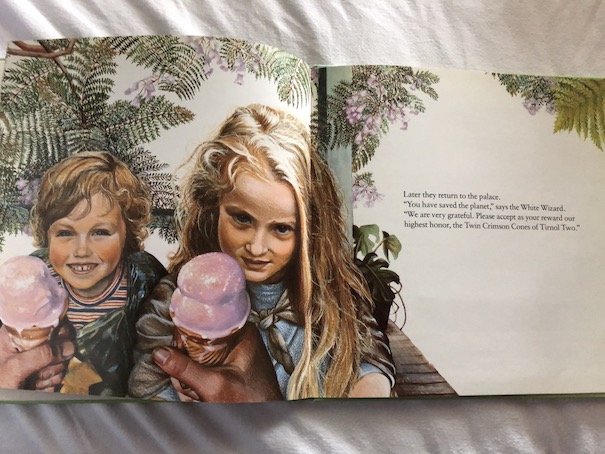
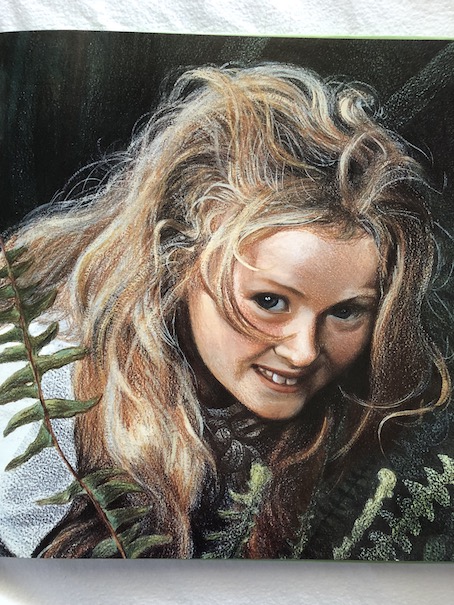
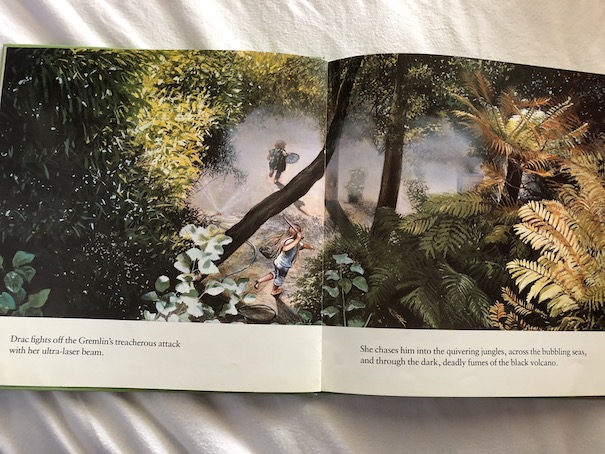
The great thing about this book is that you really need to look at the pictures in order to get the full story.  If you read the text alone, it sounds like a magical space adventure story, but when you see the pictures, you realize that it all takes place in a girl’s imagination as she and her younger brother play in their backyard.  The book never mentions the children’s names (or directly talks about reality at all).  The girl calls herself “Drac, the Warrior Queen of Tirnol Two”, and her younger brother “the Gremlin of the Groaning Grotto.”

DracGremlinChase

Drac begins by trying to capture the The Gremlin.  She pursues him across the jungles, but when she finally traps him, she receives a message from the White Wizard.  The White Wizard is being attacked by “General Min” (their cat, Minnie) and desperately needs her help!  Drac persuades the Gremlin to help her.

DracGremlinCapture

The two of them get into Drac’s “anti-gravity solar-powered planet hopper” and race to the rescue!  They arrive just in time to save the White Wizard in her current form (a moth).

DracGremlinPlanetHopper

But, they are soon facing another peril: “The Terrible Tongued Dragon” (their dog)!   Drac is almost overcome by the dragon, but the Gremlin saves her just in time!

DracGremlinRescue

Their adventure ends at the palace, where the “White Wizard” (their mother) rewards them with “the Twin Crimson Cones of Tirnol Two” (ice cream).

DracGremlinReward

I love the way that the adventure unfolds in the children’s minds and the pictures show what is actually happening to the children, as their mother and everyone else sees them.  The pictures are beautiful and realistic.  The book was originally published in Australia, and I recognize some of the plants from pictures that a friend of mine there has sent me!

The book is available to borrow and read for free online through Internet Archive.

Drac

Pippi Longstocking

PippiLongstocking

Pippi Longstocking by Astrid Lindgren, 1950.

Pippi Longstocking is an iconic figure in children’s literature, a little red-haired girl with amazing strength (she can lift a horse all by herself) and a quick wit, who can “always come out on top” in any situation and is frequently doing exciting and hilarious things without adult supervision. The books in her series were originally from Sweden, with the first one written in 1945, but I’m reading a later English translation.

In the first book, she comes to live by herself in a house, which she calls Villa Villekulla, in a small town in Sweden when her father, a ship’s captain, is washed overboard at sea.  Although others fear that he is dead, Pippi thinks it more likely that he was washed up on an island of cannibals, where he will soon be making himself their king.  (Of course, Pippi turns out to be right, but that’s getting ahead of the story.) Her mother died when she was a baby, so Pippi now lives all by herself, except for her pet monkey and horse. She pays for the things she needs with money from the suitcase of gold coins that her father left for her and spends her time doing just as she pleases.

Tommy and Annika, the children who live next door to Ville Villekulla, are perfectly ordinary, basically obedient children, who live normal lives with their parents. When Pippi moves in next door, their lives get a lot more exciting. The first time they meet her, she’s walking backward down the street. When they ask her why she’s doing that, she says that everyone walks that way in Egypt. Tommy and Annika quickly realize that she’s making that up, and Pippi admits it, but she’s such an interesting person that they accept her invitation to join her for breakfast. They’re amazed when they find out that Pippi has no parents, only a monkey and a horse living with her, and are entertained by the tall tales that she tells.

When they go back to see her the next day, Pippi tells them that she’s a “thing-finder” and invites them to come and look for things with her. Basically, Pippi is a kind of scavenger, looking for valuable things, things that might be useful, or (which is more likely) just any old random junk that she might happen across. Pippi does find some random junk, although she makes sure that Tommy and Annika find better things (probably by hiding them herself).

Then, the children see a group of bullies beating up another boy and decide to intervene. The meanest of the bullies, Bengt, starts picking on Pippi, but picking on a girl with super strength isn’t the wisest move. She picks him up easily and drapes him over a tree branch. Then, she takes care of his friends, too.

Word quickly spreads through town about this strange girl. Some of the adults become concerned that such a young girl seems to be living on her own. A couple of policemen come to the Ville Villekulla one day to take Pippi to a children’s home, but she saucily tells them that she already has a children’s home because she’s a child and she’s at home. Then, she tricks them into playing a bizarre game of tag that ends with them being stuck on the roof of the house. The policemen decide that perhaps Pippi can take care of herself after all and give up.

Tommy and Annika try to persuade Pippi to come to school with them, but that doesn’t work out, either. Pippi, completely unfamiliar with the routine of school, thinks that the teacher is weirdly obsessed with numbers because she keeps demanding that her students give her the answers to math problems that Pippi thinks she should be able to solve on her own. The teacher concludes that school may not be for Pippi, at least not at this point in her life.

Tommy and Annika delight in the wild things that Pippi does, like facing off with a bull while they’re on a picnic, accepting a challenge to fight a strongman at the circus, and throwing a party with a couple of burglars.  When they invite Pippi to their mother’s coffee party, and their mother’s friends begin talking about their servants and how hard it is to find good help, Pippi (having already devastated the buffet of desserts and made a mess in general) jumps in with a series of tall tales about a servant that her grandparents had, interrupting everyone else.  Tommy and Annika’s mother finally decides that she’s had enough and sends Pippi away.  Pippi does leave, but still continuing the story about the servant on the way out, yelling out the punchline from down the street.

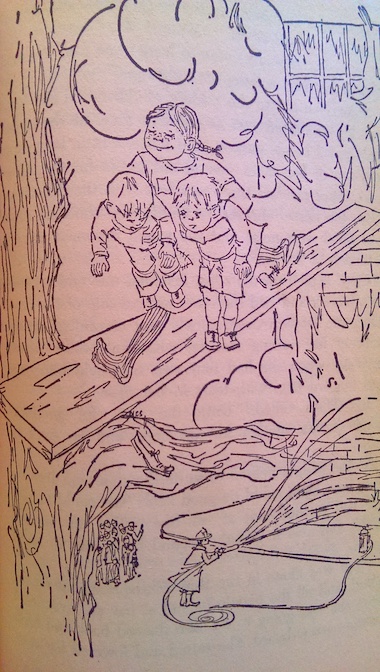
However, Pippi becomes a local hero when she saves some children from a fire after the fireman decide that they can’t reach them themselves.

The book is available to borrow and read for free online through Internet Archive.

My Reaction

I have to admit that, as a character, Pippi sometimes annoys me with her obvious lies and some of the stuff she does. She openly admits that she lies after telling some of her tall tales, but it’s the parts where she admonishes her listeners not to be so gullible that get to me. You can tell that her listeners aren’t really fooled at all; they’re just trying to be polite by not calling her a liar directly, and then she insults them for it. Maybe it’s Pippi who’s really the gullible one, thinking that she’s fooling people when she isn’t really. 

Admittedly, Pippi’s wild stories are sometimes amusing.  I liked the one where she claimed that the reason why other people don’t believe in ghosts is that all of the ghosts in the world live in her attic and play nine-pins with their heads.  When Tommy and Annika go up there to see them, there aren’t any, of course, and Pippi says that they must be away at a conference for ghosts and goblins.

I just don’t like it that Pippi seems to be deliberately trying to make people look dumb when she’s the one saying all the stupid stuff and it’s really obvious that people know it. I also don’t like the part where she makes such a mess at the coffee party because she seems to be trying to be a messy pain on purpose.  She insists that it’s just because she doesn’t know how to behave, but I get the sense that it’s just an excuse and that Pippi just likes to pretend to be more ignorant than she is, pushing limits just because she likes to and because she usually gets away with it.  I didn’t think it was very funny.  But, Tommy and Annika seem to just appreciate Pippi’s imagination, enjoying Pippi’s antics, which bring excitement and chaos to a world controlled by sensible adults, which can be boring to kids, and accepting Pippi’s stories for the tall tales they are, playing along with her.

Pippi herself is really a tall tale, with her super strength, her father the cannibal king, and her ability to turn pretty much any situation her to advantage.  Part of her ability to “come out on top” is due to her super strength and part of it is that Pippi approaches situations from the attitude that she’s already won and isn’t answerable to anyone but herself.  This approach doesn’t always work in real life (I can’t recommend trying it on any of your teachers, or worse still, your boss – not everyone is easily impressed, especially the people who pay your salary), and nobody in real life has Pippi’s super strength to back it up. The adults in the story frequently let Pippi win because they decide that fighting with her just isn’t worth it. (Admittedly, that does happen in real life, too. I’ve seen teachers and other people give in to people who are just too much of a pain to argue with because they’re too impatient or find the argument too exhausting.)  Kids delight in Pippi’s ability to get the better of the adults, who usually have all the control, and in Pippi’s freedom to do what she wants in all situations.

One thing that might surprise American children reading this story is that the children in the story drink coffee. Tommy and Annika say that they are usually only allowed to drink it at parties, although Pippi has it more often. It isn’t very common for American children to drink coffee in general because it’s usually considered more of an adult’s drink and because of concerns about the effects of too much caffeine on young children. Children in Scandinavia tend to drink coffee at a younger age than kids in the United States.

Hitty, Her First Hundred Years

Hitty

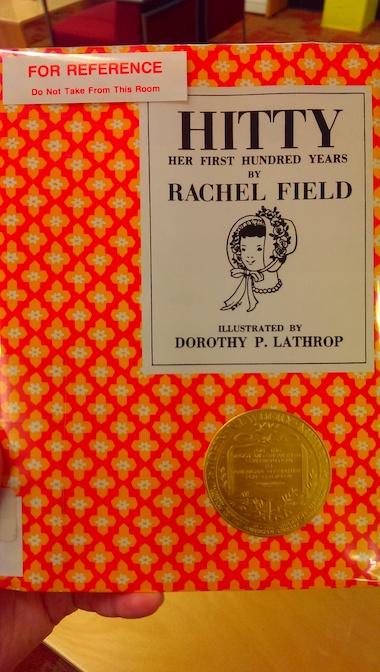
Hitty, Her First Hundred Years by Rachel Field, 1929.

Sometimes, I debate about how much detail I should use when describing the plots of books, but since this is such an old book and a more recently released version has altered the events in Hitty’s life significantly, I’ve decided to cover it in detail.  I do not have the updated version and haven’t read it, so what I describe below is the older version.  The book is episodic in nature, following the life and travels of a small doll named Hitty.  This book is a Newbery Award winner and is currently available online through Internet Archive (multiple copies).

These are the memoirs and adventures of a hundred-year-old wooden doll, which she writes as she lives in antique shop. She doesn’t recall exactly when she was made, but she knows that it was about a century earlier and that she was carved by a peddler in Maine for a little girl named Phoebe Preble.

HittyMemoirsThe peddler did some odd jobs for the Preble family on their farm that winter, while the weather was too bad for him to travel. They named the doll Mehitabel (a Biblical name from the Old Testament), and Phoebe nicknamed her Hitty. At her mother’s insistence, Phoebe made clothes for Hitty and embroidered Hitty’s name on the doll’s petticoat. Phoebe’s mother says that as long as she has her name on her clothes, she’ll always know what it is, whatever happens to her. Phoebe doesn’t see what could happen to Hitty because she wants to keep her forever, but Hitty is destined to live an adventurous life.

Phoebe misplaces Hitty more than once during their time together. The first time, she accidentally leaves her at church (when she wasn’t even supposed to bring her there in the first place). Then, Phoebe takes Hitty out to play one day, but she and her brother are frightened when they see some American Indians. (Phoebe lives in the early 1800s.) When they run away from the Indians, Phoebe accidentally leaves Hitty behind. Then, Hitty is picked up by a curious crow and carried to the tree next to the Preble house. She hangs from a tree branch for awhile before they realize that she is there and rescue her.

HittyShipwreckedThen, Phoebe’s father, who is the captain of a whaling ship, convinces his family to join him on a voyage. Life aboard ship turns out to be both exciting and perilous. One day, the ship catches fire, and the Preble family and all the crew abandon it. Hitty, once again, is unfortunately left behind. Although Hitty sees Phoebe gesture back at the ship and knows that Phoebe wants to return for her, it is too late for that.
However, luck is with Hitty, and instead of being burned, she is washed overboard as the ship goes down. Miraculously, she is washed ashore and found once again by the Preble family, who are now castaways on an island. They hope for rescue but fear the “natives” on the island. (Yep. “Savages”, “natives”, etc. These are sadly a common feature in vintage children’s literature. See Edward Eager’s Magic by the Lake for a funnier spoof version. The scene in this book is the sort of generic “savage natives” or “native savages” scenes he was making fun of, except that nobody tries any silly ooga-booga talk to communicate with them, and they don’t turn out to be cannibals. But, it does occur to me that if this book had been written in modern times, people would have insisted that the author give the proper name for the civilization on this island instead of just calling them “natives” and thoroughly research their actual habits and customs and present them in an informative, realistic way for the education of children reading this book, while writers and parents during this period didn’t seem to care about any of that.  Keep this in mind the next time someone tells you that younger generations are lazier and not as well-educated.)

One day, the natives come to have a look at the castaways, and their leader catches sight of Hitty and demands (through gestures) that she be handed over to him. Phoebe doesn’t want to give up her doll, but her father tells her that she has to. It turns out that the natives think that Hitty might be an idol that gives the castaways power, which is why they want it for themselves. Hitty is taken back to the natives’ village, and they use her as an idol themselves, making a little shrine to house her.

Hitty probably would have remained there if she had not been stolen from the temple by some curious monkeys and once again found by members of the Prebles’ party, who return the doll to Phoebe. Fortunately, the family sees a passing ship and manages to get rescued before the natives can come after Hitty again.

However, Hitty’s adventures are still not over. The ship that rescues them is going to India, and unfortunately, this is where Hitty and Phoebe are permanently separated when Phoebe loses her in a bazaar. Instead of being found by Phoebe or her family again, Hitty is found by a snake charmer, who uses her in his act, positioned near the snake. Even though Hitty is made of wood and not vulnerable to snake bites, she still finds the experience frightening.

From this point on (we’re about halfway through the story), Hitty changes hands repeatedly, gaining and losing owners every few years or so. Most of her new owners give Hitty a change of clothes, but they always keep her petticoat with her name still embroidered on it so, as Mrs. Preble once said, Hitty and her new owners always know her name.

An American missionary couple spot Hitty with the snake charmer and realize that her design looks like dolls in America. They have no idea how she got to India, but they buy her from the snake charmer and give her to their daughter, Thankful. Hitty lives with Thankful for a couple of years, and she enjoys her time with her, even though she really misses Phoebe.

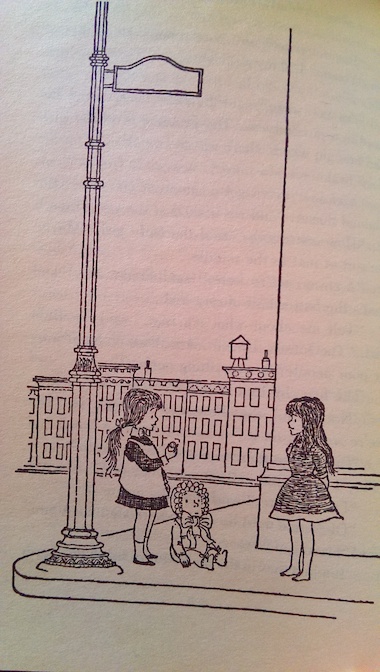
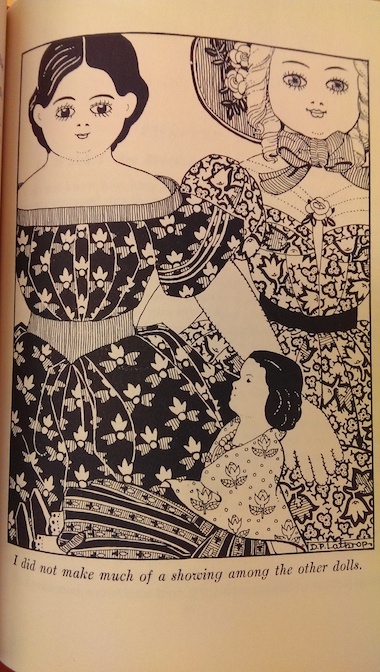
HittyOtherDollsThen, Thankful gets sick, and her parents decide that it might be time to send her home to the United States to stay with her grandparents. Thankful takes Hitty with her when she goes home to Philadelphia. Because Thankful’s early life was spent entirely in India, she has been unaccustomed to spending time with American girls her age, and she doesn’t know how to behave around the American children she meets when she first arrives in Philadelphia.  When the some of these (still 19th century) American girls first meet Thankful and Hitty, they think that Thankful is strange and make fun of her for her unusual habits and the way she dresses, telling her that her doll is ugly, too. Hitty has to admit that she isn’t as fancy as the other girls’ dolls. Thankful is so embarrassed by what the other girls say that she decides to hide Hitty in a sofa. After that, the sofa is taken up to an attic for storage, so Hitty remains hidden for a number of years.

HittyQuakerDuring her time in the attic, Hitty resents Thankful for abandoning her, in spite of all the charitable talk of her missionary parents. However, when Thankful is grown, Hitty is finally found by one of Thankful’s younger cousins, Clarissa Pryce, who really appreciates her. She doesn’t know how Hitty came to be in the attic, but thanks to the name still embroidered on Hitty’s petticoat, knows what to call her. Clarissa is a quiet, conscientious girl in a family of Quakers. She dresses Hitty as a Quaker girl, and Hitty lives with her for many happy years, learning to write as Clarissa goes through her schooling.

By now, the time of the Civil War is approaching, and Clarissa’s family are abolitionists. Hitty doesn’t really understand what the war was about, but she remembers being with Clarissa and watching soldiers march off to war. (This is where the updated version of the book differs greatly.  In the older version, Hitty doesn’t witness the war directly, but in the newer one, she does when she is sent to Charleston.)

Eventually, Clarissa gets older and is sent away to boarding school. Hitty is put into storage for awhile and then sent to the Pryces’ relatives in New York, along with some other things. However, Hitty’s package is misdirected and ends up being delivered to the wealthy Van Rensselaer family by accident. There, she is found by Milly Pinch, a seamstress doing some sewing for the Van Rensselaer family. Miss Pinch makes some stylish new clothes for Hitty, although she still lets her keep the petticoat with her name on it.

The Van Rensselaers’ young daughter, Isabella, sneaks into Miss Pinch’s room one day and finds Hitty, and a debate ensues about who really owns her. Mr. Van Rensselaer, on hearing where Miss Pinch found Hitty, says that rightfully, Hitty belongs to their family but that the clothes she is wearing are obviously Miss Pinch’s because she made them. Miss Pinch is gratified that he is being fair about it, but because Isabella really wants both the doll and clothes together, the family purchases them from Miss Pinch and gives her an excellent employment recommendation for her sewing.

Isabella is rather spoiled and has several dolls already, but she genuinely likes Hitty and takes care of her. Unlike Thankful, she even speaks up for Hitty when others say disparaging things about her plainness. While living with Isabella, Hitty even gets the chance to meet Charles Dickens. However, Hitty is stolen from Isabella by a gang of mean boys.

One of the boys in the youth gang takes the doll home with him and gives her to his younger cousin, Katie. The family is poor, but Katie loves her and gives her plenty of attention. When Katie gets sick and goes to live in the country for awhile, Hitty is accidentally lost in some hay and spends a long time in the barn, living with the mice.

When she is finally found, a pair of traveling artists are staying at the farm, and one of them keeps her to use as an artist’s model. He uses her to amuse children when he paints their portraits and even adds her into still life paintings. Hitty worries about how her painted features have faded, but the artist thinks that she’s much easier to paint than newer china dolls because the light doesn’t glare off of her. She stays with him for many years while he travels around the country, but he eventually leaves her with a pair of spinster ladies, Miss Hortense and Miss Annette, in New Orleans when he rents a room from them.

HittyBrideWhile living with these ladies, Hitty learns that Miss Annette’s fiancé died young, fighting for the Confederacy in the Civil War, and she still feels bitterly toward the North because of it. From her time with Clarissa, Hitty knows that many people in the North could say the same about the South, but of course, she can’t actually say so out loud. The ladies make new clothes for Hitty, dressing her as a bride, with her clothes made from an heirloom handkerchief, and put her on display at the Cotton Exposition (aka the 1884 World’s Fair). From there, Hitty is stolen by a little girl named Sally, whose father is the captain of a riverboat that carries cotton up and down the Mississippi River.
Hitty learns that Sally is a lonely child who travels with her father frequently because her mother is an invalid and cannot always take care of her. Sally knows that it was wrong for her to steal Hitty, but she so badly needs a companion that she is even willing to risk jail if it means that she can keep Hitty. However, after attending a revival meeting where there are warnings against the evils of theft and getting caught in a sudden thunderstorm, Sally panics, thinking that God may be about to strike her down for her sins, and throws Hitty into the river. (I found this scene a little disturbing because, when Sally fears that God will smite her with lightning for stealing, she not only makes a desperate apology but asks if anyone has to be struck, couldn’t it be one of the newly-baptized kids, who are sinless and would know that they were going to heaven? The fearful apology is understandable, but it’s a little disturbing to hear this little girl try to throw someone else under the bus like that.)

From the river, Hitty is rescued by a couple of black boys (the book says “Negro” because it was written in the 1920s) who are fishing. One of them gives Hitty to his sister, “Car’line.” (Her name is probably really Caroline, but Hitty just says the name as she hears it, and the boys have a Southern accent. This is one of those books where they try to give the impression of accents with odd spellings like, “How you come by dat doll?” It’s not the worst example I’ve seen of this, but I have to admit that I’ve never really liked the use of odd spellings like that.) Car’line’s family is the poorest one that Hitty has ever lived with, with a fairly sizable family living in a small cabin. However, Hitty likes the way Car’line treats her and how close her family is, and she loves the music that they sometimes play and the old spirituals that they sing.

At Christmas, Car’line’s family goes to a big party at a house that was apparently once an old plantation. The wealthier owners of the house give presents to the poor children of the area, like Car’line. While they are at the party, one of the women at the house, Miss Hope, recognizes Hitty from a newspaper report that a doll in heirloom clothing had disappeared from the Exposition in New Orleans. Car’line is upset when Miss Hope tells her that the doll really belongs to someone else and should be returned, but Miss Hope understands Car’line’s feelings toward Hitty and soothes her by giving her the doll she had played with as a child, a fancy French doll named Mignonette, as a replacement for Hitty.

As the end of the book draws closer, Hitty changes hands more often than before, and she doesn’t describe her time with new owners in as much detail, partly because her new owners tend to be adults and mostly display her, not play with her. Miss Hope attempts to return Hitty to the ladies in New Orleans, but since the heirloom handkerchief clothes are ruined, they decide that she should really be returned to the artist who had her before. When they try to mail Hitty to his address in New York, it turns out that he has moved without leaving an accurate forwarding address. Hitty spends some time as a package in the postal service, ending up in the dead letter office, where she is sold off, along with other undeliverable packages, to people who are willing to take a chance that there might be something interesting or valuable in them. She doesn’t spend much time with the man who bought her because her package is accidentally left behind at a tobacconist’s shop, where she is accidentally delivered to a house with an order of pipes. The lady of the house has been wanting to try a craft project for turning a doll into a pincushion, so she adds padding to Hitty and puts some pins in her (terrifying but not actually painful for Hitty). From there, Hitty is sold at a craft sale, where she is bought as a present for someone’s great aunt. The great aunt doesn’t think much of the pincushion, but her friend collects dolls and recognizes that Hitty is a collectable. For awhile, Hitty lives happily with the friend as part of her collection, until she is lost out of a car on her very first automobile ride. Then, she lays alone in the countryside, fearful that this is going to be the end for her, until she is found and rescued by some picnickers.

HittyCollectableIt is at this point that Hitty learns something astonishing: not only is she now about a hundred years old, but she has actually managed to make it back to her home state of Maine. To her further astonishment, she even returns to the Preble house where she originally lived, which is now the summer home of an elderly woman. Hitty knows that it’s far too late for her to have any hope of seeing Phoebe Preble again, and she never learns what exactly happened to Phoebe in her later life (which I thought was kind of a shame, bu it fits with the story of a doll, drifting from one owner to the next, unable to control her destiny or ask any questions of the people around her). The elderly lady collects antiques, and Hitty becomes a part of her collection, although the lady has no idea that this is Hitty’s original home.

Eventually, the elderly lady dies (it’s implied, but not stated – one summer, she simply never comes back), and her collection is auctioned off. Hitty is again surprised when she discovers that people view her as a valuable antique now. An Old Gentleman buys her at the auction, and when he takes her with him to New York, he comments that he supposes that it’s probably the first time she’s been outside of Maine and that her travels are about to begin. Hitty is amused.

At the end of the story, it is revealed that the Old Gentleman has purchased her for Miss Hunter’s antique shop, which is where she is now writing her memoirs. Miss Hunter and the Old Gentleman are delighted by Hitty and consider her a “museum piece.” Even though they could sell her, they don’t seem anxious to do so. She has become their shop’s mascot, and many people who visit the shop like to say hello to Hitty. Still, Hitty knows from her experiences that change is a part of life, and she is looking forward to seeing more changes in the world around her and the new adventures she may have with future owners!

My Reaction

In some ways, I was surprised by how much I enjoyed this story.  The length may seem a little daunting at first (262 pages about the adventures of a doll!), but the reading time is faster than you think, partly because of the episodic nature of Hitty’s life.  Books that are episodic can sometimes be a drag because, no sooner are the characters out of one situation, they plunge straight into another.  If it isn’t done right, it can leave the reader feeling like it’s all getting tiresome and repetitive and wondering where it’s all heading.  It’s a little different with Hitty, partly because the writing quality is good and partly because her owners and their lives are so varied.  I didn’t think much of the whole “natives” episode (because I never like “savage native” scenes in anything), but her other owners are a eclectic range of people, young and old, who have different interests and uses for Hitty.  Hitty ends up in some worrying situations, but you can feel reassured that she is going to be all right in the end because you know from the beginning that these are her memoirs that she is writing during the course of the story.

Hitty is unable to move around much on her own, which is part of the reason why she moves from place to place because of accidents or intentionally being carried or shipped by people.  However, she does seem to have the ability to move by herself in some small ways, such as writing her memoirs and when she tries to imitate Isabella’s dancing lessons, only to discover that she can’t quite do it because a doll’s legs aren’t jointed in the same way that human ones are.

Apart from the “savage native” scene, I don’t think the book was too bad, racially speaking.  I can’t recall any really objectionable terms being used.  Black people, when they appear, are called either “black” or “Negro”, and nothing insulting is said about them.  They are not treated cruelly in the course of the story.  Hitty enjoys her time as Car’line’s doll and doesn’t think badly of her or hold her in lesser esteem than other owners because she was poor.  The people in India aren’t described too badly, either, although Hitty thinks that the snake charmer was weird, and she seems to think well of the Indian nurse who took care of Thankful.  Thankful’s parents never discover that the Indian nurse gave her additional herbal remedies when she was ill, but Hitty appreciates the nurse’s devotion to the girl, doing everything she could to help her.  Hitty even says that she doesn’t know which medicines helped Thankful the most or if it was really the combination of all of them that saved her from her illness.

Some of Hitty’s owners are obviously nicer than others, with Thankful being arguably among the worst of them.  Even though Thankful’s upbringing is very religious, she and her new American friends are apparently rather shallow and thoughtless.  Even though her new “friends” in Philadelphia aren’t even nice to her, Thankful still worries about how she looks to them and is ready to chuck her beloved doll to please them.  Even spoiled little Isabella takes better care of Hitty and is more loyal to her, standing up to mean people as best she can instead of trying to appease them.

Mostly, Hitty prefers to be owned by young girls because she likes it when they play with her and carry her around, but she does enjoy being with adults who pay attention to her and treat her as a personality instead of as a mere object.  I was glad that none of the children Hitty lives with dies young, which could have been a risk in real life but would have been tragic.  Even with the elderly owner who presumably died, which was probably why her collection was being auctioned, Hitty never sees her die and doesn’t explicitly know that she is dead.  Whether Hitty will ever be owned as a child again now that she is considered an antique is unknown, but the author leaves the end of the story open, so just about anything could happen in Hitty’s future.

In a way, though, Hitty’s fate is already known.  Great Cranberry Island is the part of Maine where Hitty is supposed to have come from, and the Preble house is based on a real house. The story was based on a real doll that the author found in an antique store.  This doll is now at the Stockbridge Library Museum in Stockbridge, Massachusetts. There is also a cafe that is named after Hitty. There are fan sites dedicated to Hitty, some of which have tips for creating a doll very much like her.

Seven-Day Magic

SevenDayMagic

Seven-Day Magic by Edward Eager, 1962.

John and Susan are brother and sister, living in a perfectly ordinary town in Connecticut. They are tall, good-looking, and good in school and at sports, so they are generally popular and are often chosen for positions like class president. However, their home life is unusual because they are orphans who live with their grandmother, who sometimes requires them to look after her as much as she looks after them. Their grandmother isn’t very strong, but she is spirited and is sometimes tempted to do things that she probably shouldn’t do at her age, like climbing trees. Because John and Susan feel like they have to look after their grandmother, it’s sometimes difficult for them to get out and do some of the things that other children their age are doing, like going to parties. They’re glad when Barnaby and his sisters move to a house nearby because they make life more exciting.

SevenDayMagicChildren

Barnaby and his sisters, Abigail (called Abbie) and Fredericka, become friends with John and Susan. Their father is a singer in advertisements, and their mother is a realtor. Because their parents work a lot to make ends meet, the children are often left to their own devices.  Barnaby is opinionated, stubborn, and sometimes hot-tempered, which causes him to get into fights at school, but John likes him because he’s imaginative and full of interesting ideas.

Barnaby wants to be a writer. He’s secretly writing a story of his own, and he encourages the others to read more. Before meeting Barnaby, John hardly read anything at all, and Susan was mostly into the Sue Barton books, about a young woman who becomes a nurse (a real series that was popular in the mid-20th century, realistic fiction). Barnaby introduces them to a whole new world of fantasy stories, full of adventure. One day, while visiting the library together, the children talk about the kinds of stories that they like and wish that they could find a really good book full of magic and kids that are like themselves. Their wish comes true in a peculiar way.

On impulse, Susan checks out a rather worn-looking book with a red cover, not really knowing what it’s about but thinking that it just looked kind of interesting. The librarian seems a little uneasy when she takes it and warns her that she can only keep that particular book for seven days, which is surprising because that’s the limit usually imposed on new books, not old ones.

On the way home, the children show each other what they got and read parts of their books aloud to each other. When Susan opens the red book, they are all startled to find out that the book is about them. It starts out just like the real life book and tells about their lives and backgrounds and has their conversation about books they like, word-for-word. The children can tell that this is a magic book, but even while the idea is thrilling, it makes them uneasy. There is nothing written beyond their conversation about books, and the book won’t let them turn pages to see what might come next or how their story will end.

As much as the children like the idea of being the stars of their own magical book, it’s worrying. They don’t know what they’re in store for, and they even worry briefly that maybe their entire lives are fictional, that they might just exist in someone’s imagination, although they don’t really believe that because they can remember their lives before the story began. Barnaby points out that the book specifically mentions that he and his sisters recently moved to the area, but he remembers having lived elsewhere before that.

The children carefully consider everything they had originally wished for in a book: that children, just like themselves, would be walking home from somewhere and a magical adventure would start before they even realized that it was happening and that they would have to figure out the rules of the magic in order to use it for their own purposes. Since the first part of their wish has literally (very literally) come true, they decide that they’re going to have to figure out what the rules of this magic are before they decide what to do next. Since looking ahead in the book seems to be against the rules, they decide that they will have to be very careful about anything they wish for next because their wishes seem to be what writes the story, and they need to discuss it first and come to an agreement about it.

SevenDayMagicDragon

Unfortunately, little Fredericka (the youngest of the children) is too impatient for discussion and immediately wishes for an adventure with wizards, witches, and magic, and she wants it to start right away so that they’ll know that the magic is really working. A minute later, a dragon suddenly appears and scoops up Fredericka, flying away with her!

The others try to figure out where the dragon came from, and it turns out that a stage magician who lives nearby was practicing his act at the time that Fredericka made her wish. When she wished for a magical adventure, the rabbit that the magician was supposed to pull out of his hat turned out to be a dragon. The magician, The Great Oswaldo, is mystified, but he’s destined to play the part of Fredericka’s requested wizard. The children ask him to help them, and he says he’ll try, although he’s not sure how.

As Oswaldo tries various tricks in his magic supplies, they don’t work in the way they usually do. Finally, he is able to make his landlady’s house fly after the dragon, much to the landlady’s horror (she’s cast in the role of the witch in Fredericka’s story). In the magical land where the dragon lives, the peasants inform them that the dragon is always carrying off girls and young women to eat them, and they have to think of something fast before Fredericka becomes his next meal!

This is where the children discover that the contents of the magical book change depending on who reads it. When the magician reads it, it’s full of magic spells. When the landlady, Mrs. Funkhouser, takes it from him, it has household hints. For the dragon, it’s all about dragons. Surprisingly, it’s Mrs. Funkhouser’s household hints that save the day, although it’s Oswaldo who gets most of the credit because one of his pet cats eats the dragon after Mrs. Funkhouser shrinks it.

Oswaldo and Mrs. Funkhouser decide to stay in the magic land (which the children think might actually be Oz, in its early days), where they are hailed as heroes, sending the children home by themselves with the help of Mrs. Funkhouser’s vanishing cream. As expected, this adventure is now written in the magic book when the children have another look at it (although Fredericka argues that the illustrations don’t really do her justice).

SevenDayMagicCoin

Susan, as the borrower of the book, says that she wants their next adventure to be calmer, the kind of everyday magic that just creeps up on you. This is the part of the story where it crosses over with the events in Half Magic (another book in the same series as this one). In these children’s world, Half Magic is a fictional book that they’ve read and liked. Susan’s requested adventure picks up where Half Magic left off, explaining what happened after the other four children (Jane, Mark, Katharine, and Martha) left their magic coin to be discovered by a new owner. Susan and her friends delight in explaining to the young girl who found the coin what it does. The girl says that she had thought that the coin might be magic, but was confused because she didn’t get her wish to go into the future and meet some other children. Because the coin only grants wishes by halves (interpreting that pretty liberally), Susan and her friends (who live in the future), came to meet her instead.

Once again (as is common in this series), it leaves the matter of what is fiction and what is reality open to question. Was it the girl’s wish that brought the other children to her, or their wish that took them into her story? Or Both? Was that fantasy story secretly real, or are Susan and her friends more fictional than they like to think? The author likes posing questions like this, but of course, you never completely know the answers, and in some ways, it hardly matters because the adventure doesn’t require anyone’s understanding for them to take place, which is something that, ironically, it has in common with real life – things frequently happen regardless of whether or not you understand the reasons why. Sometimes, figuring out how things work and to deal with them is about all you can do, never getting the complete “why” behind everything.  That’s pretty much how all the stories in this series go.

After the children explain to the girl what the coin is and how it’s supposed to work, she makes a more careful, doubled wish to go to the future with the other children. Unfortunately, when they get there, she panics when she realizes that she forgot to bring her one-year-old baby brother with her and makes a hurried half-wish for him to be there, too.   Because she didn’t wish right, what she gets is her brother at the age he would be in the other children’s time (about age 37) but still mentally the baby he was back in 1924 (the girl’s time). The “baby” is amazed when he realizes that suddenly he can walk and talk much better than he could before and that he’s suddenly much bigger and stronger than he used to be. He gets hold of the coin and refuses to give it back, telling his little “big” sister that he can do what he wants now, not what she tells him to do. Noting that he can even pick her up and carry her around now, he does that, with the others chasing after him to get the charm and bring him under control. (A somewhat similar incident, where a baby grows up too fast and is dangerously immature, happens in E. Nesbit’s Five Children and It – another instance of Edward Eager playing off her books.)

It’s chaos for awhile because a 37-year-old man who acts like a 1-year-old can’t help but attract attention, especially when he gets it into his head that he wants to drive a train. Eventually, they get the “baby” back under control and to his proper age, allowing his sister to take him back to their own time and plan her future adventures with the coin.

Then, Susan and John’s grandmother gets hold of the book, and it takes her and her grandchildren back in time, to when the grandmother was a young woman working as a prairie schoolteacher. Susan makes a wish for the other children to join them, and they help their grandmother and her students to survive a sudden blizzard. They come to appreciate their grandmother’s youthful personality and formidable spirit even more from the experience. They even get to meet their grandfather, who died before they were born, seeing him rescue their grandmother and her students when he was a young man.

SevenDayMagicPlaywright

Then, Abbie decides that she wants to try to help her father’s singing career. He typically has to work long hours and never makes very much money, just being part of the chorus on advertisements. She thinks things will be so much better if they can help him to be discovered as a great talent. The others are kind of doubtful about her plan because the book seems to send them on rather “bookish” adventures, related to other stories they’ve read or people’s memories, like in their grandmother’s case because her early life actually did somewhat resemble things from the Little House on the Prairie series (a series which the grandmother enjoys reading for that reason). The other children just don’t know what would happen if Abbie tries to use the book for something more modern and everyday, like their father’s career. She tries it anyway, with some unpredictable results.

During a recording at a television studio (which the children are present to witness), the magic makes their father sing wonderfully but he also does his singing part out of sync with the other singers. He’s sure that he is singing his part at the right time, but for some reason, the other members of the chorus are silent when he sings. The director gets mad at him for singing out of sync and messing up the performance, and the singer who was supposed to be the star gets mad about being upstaged, but the reviewers end up loving the performance. So, while at first it looks like the father is going to be fired, he ends up with more singing parts because of the episode. The only problem is that all the singing parts are silly jingles, like the typical advertising jingles he gets. While he’d welcome more money, he always dreamed of being able to get better parts. However, the magic isn’t quite done, yet. When Abbie meets a playwright who is looking for a new talent to sing in his play, it turns out that he has seen Abbie’s father on tv and likes his voice.

SevenDayMagicWings

Abbie’s wish is so great and does so much for their family that the kids start thinking that it might be the end of the magic. The seven days are really up, and the book has to go back to the library the next day. However, John and Barnaby haven’t had their chance to wish yet, and each of them wants to have a turn before the book goes back. Barnaby even suggests that perhaps they can keep the book an extra day, turning it in late. Surely a little late fee isn’t too much to ask for an extra day of magic, is it? Abbie is afraid, though, that keeping the book overdue would be breaking the rules and that the magic might go all wrong. She’s right.

Even with the idea of keeping the book for extra time, John and Barnaby argue over which of them will get to go first. The book’s magic, angry about not being returned to the library, turns sour on them, causing them to fight. John angrily tells Barnaby that just because he’s usually the group’s idea man doesn’t mean that he’s the only one who’s allowed to have ideas. (Which, in a way, is something that Barnaby needs to hear because that’s part of the reason why he often gets into fights – he always thinks he knows best.) John and Barnaby fight over the book, and the book gets torn. John ends up with a few pages, and Barnaby gets most of the book, which he uses to make a wish that he refuses to tell to the others. Barnaby disappears, and the others realize that the pages that Barnaby is holding are the last few pages from the end of the book, still blank. Without them, the book can’t end, and Barnaby could end up stuck in the book forever! Can the others find him and get him (and the book) back before it’s too late?

Before the end of the book, John does prove that, although he might not be as quick to come up with ideas as Barnaby is, he does get good ones. After he and the others find Barnaby, John uses his wish to get them back home and to return the book to the library in a most unusual way.  (Actually two unusual ways because he couldn’t quite make up his mind about which was best.  Both of them are homages to incidents in E. Nesbit’s books.)

The book is currently available online through Internet Archive.

Knight’s Castle

Knight's Castle

Knight’s Castle by Edward Eager, 1956.

Roger and Ann are the children of Martha from the previous two books in the series. Like their mother’s family when they were growing up, they live in Toledo, Ohio. Their Aunt Katharine (one of Martha’s older sisters) used to live close to them in the Midwest but now lives in Baltimore, Maryland. Roger and Ann don’t particularly get along with Aunt Katharine’s children, Eliza and Jack, because Eliza is bossy and Jack is only interested in photography. However, the four children end up spending the summer together when Roger and Ann’s father needs to have an operation at a hospital in Baltimore.

Like their mother and her siblings when they were young, Roger and Ann also like fantasy stories, which their father likes to read to them. Roger starts to believe in real magic when it seems like one of his toy soldiers comes to life at night. Roger collects toy soldiers, and he has over 200 of them, but this one is special because his father says that its been handed down in their family for generations. Roger calls it the Old One. It’s rather worn, so it isn’t obvious at first, but the Old One is actually a knight. Worried about his father’s illness, Roger takes the Old One to bed with him (which he thinks is more manly than taking a teddy bear to bed), and then feels it wriggling in his hand.

Knight's Castle Roger

Realizing that the Old One is magic and is coming to life when he holds him, Roger asks him if it’s part of his magic to grant wishes. If it is, then he wishes for his father to get well, and if possible, for him and his sister to have an adventure in Baltimore over the summer. The Old One doesn’t answer him immediately, but over time, he makes it clear to Roger that wishes have to be earned, and that will be the source of his summer adventure.

When the children arrive in Baltimore to stay with wealthy Aunt Katharine while their father is in the hospital, Aunt Katharine gives them presents. Ann gets a new dollhouse, and there is a toy castle for Roger. Since Aunt Katharine has also just taken all the children to the movies to see Ivanhoe, all of them become immediately interested in playing with the castle.

That night, Roger has a strange dream that he finds himself within the story of Ivanhoe, which is being acted out in his toy castle. The Old One is there as well, although he is mainly watching the action as Roger begins to take part in the story. When Roger comes face-to-face with the villain, he accidentally lets Ivanhoe’s plans slip to him. Things are looking pretty bleak when Roger suddenly realizes that the castle is still a toy and everyone around him is just a lead soldier. This revelation ends the magical adventure and brings him back to reality. However, Roger is disappointed that he ended the adventure so early when perhaps he could have done something really heroic.

Seeing the toy soldiers scattered around instead of poised for the battle they were planning the night before, Eliza and Ann think that Roger was just playing with the castle without them, but he explains to them what happened. The girls were just reading The Magic City by E. Nesbit, and they start building their own “magic city” out of random things from around the house, surrounding the toy castle. Roger is upset about the city because he says that it doesn’t fit in with the Ivanhoe story, and he’s sure that it will ruin everything, maybe from preventing the magic from working again at all. The Old One tells Roger that magic works by threes, so the next opportunity for magic will be in three days.

Knight's Castle Magic City

As it turns out, the city does end up becoming part of the story when the magic brings it all to life on the third night. Roger, Ann, and Eliza find themselves in the middle of the city, surrounded by knights attempting to drive modern cars. Ivanhoe has become a fan of science fiction books, via the public library in the city that the girls built. Although Ivanhoe has turned into something of a geek, the children persuade him to come on a mission to rescue the captive Rebecca, and they end up traveling in a flying saucer (made from a real saucer) to the Dolorous Tower, where the adventure ends as soon as Eliza remembers that the villain threatening them is still just a lead soldier.

Knight's Castle Flying Saucer

It was an even weirder adventure than Roger’s first one, but by now, the children are starting to understand the rules that go along with the magic. Jack, who says he doesn’t really believe in magic, accompanies the other children on the next adventure, as they try to prove to him that it’s real. They end up having to rescue some of the others from the “giant’s lair”, which turns out to be Ann’s new dollhouse. The dolls are angry that Ann has been neglecting them, only paying attention to the dollhouse when she and Eliza needed to borrow things for their magic city. They manage to escape again by remembering that the dolls are just dolls.

However, Roger is still worried about their father, who is about to undergo his operation. The Old One had told him that wishes needed to be earned, and he doesn’t think that they’ve managed to accomplish much in their adventures. Roger thinks that they need to do something really heroic so that his wish for his father to get better will come true. The Old One gives Roger a rhyme, hinting at what the children need to do on their next adventure, but Roger doesn’t understand what it means, and he doesn’t know if he can figure it out in time.

Actually, it is Ann who eventually realizes what the rhyme means and provides Roger with the “wisdom” that he needs to earn his wish. All throughout the story, Roger was criticizing his little sister for things she did wrong, saying that she was too little and only a girl. Because Roger thinks of her as being just his little sister, he overlooks what she has to contribute to the adventure. Roger’s acquired wisdom is to value the contributions of others and not underestimate their ability to contribute. Ann, being young and shy, frequently doubts herself, but she also learns confidence when she realizes that she has the answer to the riddle. Jack and Eliza learn lessons as well. Doubting Jack learns to believe in magic, and Eliza learns that she can’t always be the boss, that sometimes it is better to let someone else take the lead when they’re the right person for the job. (Although, she does say at the end of story, “If that wouldn’t be just like that magic’s impudence! Trying to teach me moral lessons!”)

Like other books in this series, there are a lot of references to popular pieces of children’s literature and jokes about things that happen in children’s stories.

The book is currently available online through Internet Archive.

Knight's Castle Feast

Magic by the Lake

MagicByLake

Magic by the Lake by Edward Eager, 1957.

Jane, Mark, Katharine, and Martha are finally going to spend the summer at a lake with their mother and their new stepfather! The children were never able to do that before because their widowed mother always had to work during the summer. When they arrive at the cottage by the lake that their stepfather, Mr. Smith, has rented, there is a sign that says, “Magic by the Lake.” The children think that it could just be the name of the cottage because sometimes cottages are giving interesting or amusing names, but having had experience with magic before (this being the second book in the series), they consider the idea that they could be headed for more adventures. Of course, they are correct, but it turns out to be the lake that’s really magical, not the cottage.

MagicByLakeTurtle

The children are playing by the lake when they wish for more magic, and a talking turtle comes up to tell them that, because of their wish, the entire lake is magic. That sounds amazing, but too much magic all at once can be overwhelming. Fortunately, the turtle is also magical, and he has some ability to influence magic in the lake. The children make a deal with him that he can arrange for them to have adventures with magic in the lake, but only one at a time, because that’s what they feel that they can handle. Also, the adventures won’t happen every day, so they can have a chance to rest in between. The grown-ups around them won’t notice any of the magical happenings, and little Martha insists that nothing truly scary will happen to them. Jane protests at that request because she thinks that it will make their adventures as boring as overly-tame children’s books, but the turtle says not to worry because what he thinks of as “not scary” isn’t necessarily what Martha would think of as “not scary.” The turtle tells the children that when they’re ready for adventure, they should think about what they wish for and then touch the lake, and if the time is right for it to happen, it will.

That sounds simple enough, but what they consider the right time and what the lake considers the right time aren’t always the same thing, and just as before, their wishes and adventures don’t go quite as planned. In their first adventure, a mermaid takes them to an island of pirates, the stuff of high adventure. The children are delighted when they discover that the pirates, being adults, can’t really see them, as per their earlier wish for adults not to see their magical activities. It opens the potential for playing dirty tricks on rotten pirates, who seem to perceive them as some sort of ghosts. It’s all fun and games until the pirate captain decides to see if he can make ghosts walk the plank. Their turtle friend saves them by turning them into turtles, which, while magical, makes the rest of the day rather difficult for them because they have to go home and on errands with their mother. Walking on land can be difficult for turtles, and their mother has no idea that they’ve changed at all, still seeing them as children. Whatever magic the children get during the day seems to last until the sun sets, even when they wish it would end sooner.

MagicByLakeGrownUp

Then, while watching their mother and Mr. Smith at a dance, Jane and Katharine wish that they were old enough to join in, about age sixteen. Suddenly, the two of them are teenagers in evening dresses, getting attention from some teenage boys. The girls seem to enjoy the romance of it, but Mark and Martha follow them around, trying to convince the boys that the girls are really younger than they seem to be and dreading the moment when they will inevitably change back to themselves.

The children discover that they don’t even need to be at the lake in order to make the magic happen as long as they’re touching water from the lake. On a rainy date, when the roof of their cottage is leaking, the children realize that the rain water is also lake water. By making a wish on that, they end up at the South Pole in time to save a lost explorer and help him make an important discovery.

MagicByLakeDisappearance

The children enjoy their adventures, but they become worried about Mr. Smith, who has been making the commute back and forth from the lake to his bookshop, and it seems that business hasn’t been good at his bookshop this summer. They consider the idea of using the magic of the lake to solve Mr. Smith’s problems, perhaps by going back to the island where they saw the pirates bury a treasure chest. They figure that if they could bring Mr. Smith an entire chest of pirate treasure, he wouldn’t have to worry about money anymore.

But, of course, that idea doesn’t go as planned. When Martha argues with the others and goes to the island by herself to get the treasure, she breaks all the rules associated with the magic.   Because the rules that previous protected her and her siblings are gone, there is nothing to prevent her from being captured by the cannibals that live on the island. When her brother and sisters try to save her, they are also captured. It’s only the sudden appearance of Martha’s future children and Katharine’s future daughter (although they don’t know it yet), who are on a magical adventure of their own, in a cross-over from another book in the series, The Time Garden.

MagicByLakeTreasure

The children make one more attempt to get treasure for Mr. Smith in a kind of Arabian Knights adventure, but that doesn’t work, either. However, although the children seem to have used up their wishes on the lake, they have the feeling that the magic might allow them one last opportunity to get what Mr. Smith needs. It does in a way that may or might not be magical, although the buried treasure that they find and get Mr. Smith to dig up may be a representation of the pirates’ treasure and not of the old miser (now deceased) who was said to have lived at the old, abandoned cottage by the lake that the children decide to explore. It does seem like quite a coincidence that the old miser’s initials would match those of the pirate captain, and they are carved on the stone over the buried treasure, just like the marker the pirate captain left.

In the scene with the cannibals on the island, the cannibals are stereotypical “savage natives” (or “native savages”, or something generic of that sort, since the terms are used pretty interchangeably in the story). You find things like this pretty commonly in old children’s books, especially prior to the 1960s. But, what made this more palatable for me was that the entire scene is written as a joke on the usual stereotypical books that children of the era would have read. The cannibals speak kind of like American Indians in cheesy old Westerns, using words like “heap” for “very” and randomly adding “-um” to end of words. You know that it’s not really how anybody, even cannibals living on some remote island in an indeterminate ocean, would talk, but it might be how children raised on adventure stories and movies from the 1920s might imagine they would (adding to my earlier theory from the last book that at least some of the children’s adventures might actually take place in their own minds, not in their “real world”).  It may also be a reference to things in tv shows from the 1950s, the time period when the story was written. The best part for me is when the children try to remember what shipwrecked explorers do when confronted with cannibals in some of the stories they’ve read. They start throwing out random words that are meant to sound impressive combined with some gobbledy-gook in an effort to communicate/impress the cannibals. Then, Mark tries to convince them that he’s a powerful god with the ability to control fire. The cannibal chief is unimpressed, telling him that he recognizes what Mark has as an ordinary safety match, which he blows out. So much for the old adventure stories.

The book is currently available online through Internet Archive.

Half Magic

HalfMagicHalf Magic by Edward Eager, 1954, 1982.

Jane, Mark, Katharine, and Martha are siblings living in the 1920s. Their father is dead, and their mother works for a newspaper. While their mother is at work, Miss Bick takes care of the house and the children, although she isn’t really good with children. The children are often free to amuse themselves on their own during the summer, and they like to pick out books from the library for entertainment. They particularly enjoy the fantasy books by E. Nesbit (a real author, and they reference her real books during the story), and they wish that exciting, magical things like the ones that happen in her stories would happen to them.

They get their wish (and a great many others) when Jane finds a strange coin on the sidewalk that they mistake for a nickel at first. By accident, they discover that this coin grants wishes, but it has a peculiar habit of only granting half of what a person wishes for (and the coin seems to interpret the idea of “half” pretty liberally, depending on the type of wish, so results can be pretty unpredictable).

Jane is so bored after she finds the coin that she wishes that there would be a fire for some excitement. Suddenly, the children hear a fire engine and discover that a child’s playhouse had caught fire. It could have been coincidence, except that their mother borrows some change from Jane, getting the magical coin by accident. While she is visiting the children’s aunt and uncle and finds their conversation boring, she wishes that she were at home, but finds herself unexpectedly by the side of the road halfway home. She is confused but thinks that she must just be very tired or something and forgot that she was walking home. She ends up accepting a ride from a very nice man who happened to be passing her on the road and thought that she looked lost and confused.

HalfMagicChildrenThese early experiences and a series of odd wishes Mark makes when he doesn’t realize that he has the coin demonstrate to the children not only that the coin is magical but that they have to be extremely careful what they wish for when they have it. They have to word their requests very carefully, asking for twice as much of anything they want in order to counteract the half magic of the coin. Even so, they can’t help but make mistakes and get themselves into trouble.

When Katharine uses her turn with the coin to take them back to the days of King Arthur, she ends up causing trouble and disrupting history by defeating Lancelot in a tournament. Fortunately, Merlin realizes what the children have done and forces them to explain themselves and show him the magic coin. After inspecting it, Merlin gives the children a stern lecture about interfering with the natural course of history. He uses the coin’s magic to undo what the children have done and further uses it to restrict the children’s wishes to affecting only their own time period. He warns them to be more careful about what they wish for, keeping their wishes smaller and more personal, adding that the coin’s magic will eventually be exhausted, so they should save their wishes for what is important.

HalfMagicTheaterThere is one more disastrous experience when the children go to the movies (a silent film because this is 1920s), and Martha accidentally wishes that she wasn’t there while touching Jane’s purse, which holds the coin. Martha, of course, ends up being only halfway “not there,” almost like a living ghost, which terrifies onlookers. Straightening out that mess brings them into contact with Mr. Smith, the nice man who gave their mother a ride home. He owns a bookstore, and he enjoys fantasy stories as much as the children do. He becomes the only adult who knows that the children have been using magic, and he’s fascinated by it, enjoying witnessing their adventures.
When the children’s mother comes to pick them up, Mr. Smith is pleased to meet her again and invites the family to join him for dinner. Mr. Smith is obviously fond of the children’s mother, and most of the children like him, too. However, Jane is uneasy. It’s partly that she worries that Mr. Smith will interfere with their use of the magic coin and partly that she worries about his new relationship with their mother. Of the four children, only Jane, as the oldest, really remembers their father, and she can’t stand the thought that Mr. Smith might become their stepfather and take his place.

HalfMagicSmithWhen Jane argues with the other children about Mr. Smith and rashly wishes that she belonged to another family, the other children call upon Mr. Smith to help them rescue Jane from her foolish wish, her unsuitable new family, and from herself.

In the end, Mr. Smith does marry the children’s mother, and even Jane is happy with the arrangement, having come to appreciate Mr. Smith much better.  Once their mother and Mr. Smith each have what they wished for most — each other and a happy family with the children — they forget about the magic coin.  Although none of the children realize it, the coin also grants Jane one final half-wish in which her father comes to her in a dream-like form, letting her know that he approves of her mother’s remarriage and the children’s new stepfather because he wants them all to be happy.  This gives Jane the reassurance she needs to fully accept Mr. Smith.  The children, deciding that the coin has given them all the wishes it’s going to, leave it in a convenient place for a new owner to find.

You don’t find out what happens with the coin’s new owner apart from when the children see a young girl pick it up and realize that it’s magic when she makes her first wish. However, there is a cross-over scene in another book in the series, Seven-Day Magic, which explains a little more about what happens next.  Books in this series frequently reference and sometimes parody other children’s books that were popular at the time they written, and individual books in the series even sometimes reference each other, even when the main characters have changed.

Speaking of literary references and parodies in this series, sometimes it’s a little difficult to tell for certain which scenes are really meant as parodies and which aren’t.  Knowing a bit about vintage children’s fiction helps, but there may be some scenes in the stories which can make modern readers a little uneasy.  One scene in the book that bothered me was near the beginning, when Mark wishes to be on a desert island.  This was before the children fully realize that the coin only grants half of a wish, so the children just end up in a desert, but not on an island.  The part that bothers me is that they are briefly kidnapped by a kind of wandering Arab man who seems to be planning to ransom or sell them.  This scene is like an old stereotype out of the sort of silent movies that the children would have been watching, and because of that, it was a little painful to read.  The man’s name is Achmed (still in keeping with the stereotype), and they keep referring to him as “Achmed the Arab,” in case you need reminding that that’s what he is.  They get out of their predicament with him by wishing for something that would make him really happy so that he’ll forget about them.  By then, they realize that they need to double their request in order to make the coin work properly, so their wish works.  The coin ends up giving Achmed a beautiful wife and “six plump Arab children” (in case you forgot that Achmed’s children would be Arab as well) and generally improves what Achmed owns, so Achmed becomes a happy family man and gives up his earlier, shady ways.  It’s eye-rollingly stereotypical and cliche, so I think it’s worth telling potential readers that this scene is there.

The cliches and stereotypes (not to mention the constant, unnecessary repetition of the word “Arab” just to remind you that that’s what everyone is, in case you were confused) in that scene were annoying, but unfortunately, things like that crop up pretty regularly in children’s literature from the 1950s and earlier when there are scenes that take place just about anywhere outside of the United States, Canada, or Europe.  That being said, there are a couple of things that make this scene easier to bear.  One is that Mark, realizing that the magic coin can get them out of this situation and that they have the power to put Achmed at their mercy, decides not to do it because it occurs to him that Achmed is probably a desperate man because he is poor.  Mark decides that Achmed would be a better person if he had whatever would make him feel the most fulfilled in life, so he wishes for that for him.  It’s nice that Mark sees him as being a person whose well-being needs to be considered, not just an enemy to be defeated.  Also, it occurs to me that it’s not completely certain that the desert they’re in is a real-life one, even in the children’s fictional world.  I think the assumption is that it is, like we’re supposed to assume that the world of Camelot that they visit is a real part of history, but it may not be.  In fact, the children in different books in this series in general sometimes get philosophical about their magical adventures, wondering about how their magical adventures fit into the real world around them or if they really do, and they never fully get all the answers.   Perhaps the coin took the children to their idea of what a desert or what Camelot would be like, not to those real places.  In 1921, there was a famous silent movie called The Sheik in which Rudolph Valentino played an Arab sheik named Ahmed (Achmed’s name could be a joke on that).  It’s not a movie for children, but it was very popular in the 1920s, and it inspired other movies with Arabian themes, at least a couple of songs, and probably a number of the stereotypes about Arabs of the time.  So, if the kids in the story were imagining an Arabian desert, it would probably be something resembling what they’d seen in movies like that.  This little adventure may have only taken place in the imaginary world, even from the children’s perspective, and the author may be poking fun at the notions children get from popular culture.  Even in the end, the children admit that there are many things they don’t understand about the coin and how it works, like where the other half of Martha went when she was only half there.   In a world where magic works, pretty much anything is possible.  Then again, since the entire book is fictional, it may be best not to worry too much about it.  Still, I just plain didn’t like this scene.  The rest of the book wasn’t so bad.

Overall, it’s a fun story.  Part of the fun for book lovers is in spotting the various literary references in the story because the children talk about the books they like and read and compare their adventures to ones they’ve read about.  The concept of the half-wishes also makes you think.  It’s worth pointing out that, although the children enjoy the general adventure of the coin, most of the children’s wishes, no matter how carefully they word them, don’t turn out the way that they expected, even when they get exactly what they asked for.  Mr. Smith marrying their mother is actually the best wish that comes true in the whole book.

The book is currently available online through Internet Archive (multiple copies).