
The Door in the Wall by Marguerite de Angeli, 1949.
The story takes place in Medieval England. Robin is the son of a noble family. All his life, there has been the expectation that Robin would learn to be a knight, like his father. Soon after Robin turns ten years old, Robin’s father goes away to fight in Scotland, and Robin’s mother arranges for him to be sent away to begin his training as a knight while she takes a position as lady-in-waiting to the queen. However, soon after his parents’ departure, Robin becomes terribly ill and loses the use of his legs.

Now, Robin is miserable and wishing that his mother was still with him to help him get over his illness. Instead, he is looked after by servants. Then, after Robin throws a fit and refuses to eat, his servants disappear. The next person Robin sees is Brother Luke, a friar from St. Mark’s monastery. The friar tells him that his servants were ill and have fled from the plague, but one of them sent him to care for Robin. He feeds Robin and tells him that he will take him to St. Mark’s and continue to care for him there. Robin tells Brother Luke about how he was supposed to be taken away for training but that he was unable to go because he was ill, and he asks how they will get to St. Mark’s because he cannot walk. Brother Luke says that the man who was supposed to escort him to the castle where he would live and be trained as a knight may be unable to get back into London because travel is restricted due to the plague, so Robin’s training will have to wait. As for how they will travel, Brother Luke has a horse that they can ride.
Before they leave, Brother Luke asks Robin to remember the wall around his father’s garden and the wall around the Tower. He points out that all walls have a door in them somewhere and that if you follow a wall long enough, you will eventually find the door. At first, Robin doesn’t understand what Brother Luke is trying to tell him, but the metaphor is the theme of the book and it becomes clear through the adventures that follow. The wall stands for adversity, and the door stands for solutions to problems, other paths to take, and ways to move forward in life. What Brother Luke is trying to say is that there are many types of problems in life (the walls), but that problems have solutions (doors). There are ways around obstacles, and if you persevere, you will find them. He reminds Robin of this throughout the story.

At St. Mark’s, Robin stays in Brother Luke’s quarters, and Brother Luke takes care of him. When Robin is a little stronger, Brother Luke gives him wood to whittle. When he grows stronger yet, Brother Luke gives him writing lessons. As the plague begins to pass and there are fewer patients to tend to, Brother Luke begins to carry Robin around or push him in a cart, taking him to visit other parts of of the monastery.
Since Robin still cannot walk, Brother Luke thinks it’s important to keep his mind and hands busy, one of the first “doors” that he finds for Robin around his current limitations. Brother Matthew oversees Robin as he learns and practices carving wood, teaching him patience when he has a temper tantrum on ruining one of his first projects. Brother Luke helps Robin to write a letter to his father, in which Robin explains his current situation, and a traveling minstrel, John-go-in-the-Wynd, will carry it to Scotland when he goes there with some soldiers. Later, Brother Luke even takes Robin to go fishing and begins teaching him to swim. In spite of these improvements, Robin still worries about his inability to walk and how it will affect his future and his father’s hopes for him to be a knight.
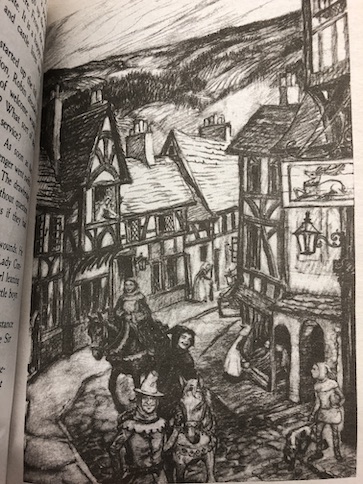
When John-go-in-the-Wynd returns with a reply from Robin’s father, Robin’s father says that he is distressed to hear that Robin has been ill, although he thankful that Robin did not get the plague and die with so many others. Robin’s illness was severe, but he is already showing signs of recovering. His father has made arrangements for him to travel to the castle of Sir Peter in Shropshire, who is Robin’s godfather and where he was meant to go for his training, accompanied by Brother Luke and John-go-in-the-Wynd, as soon as he is well enough to travel. Since Robin has already become well enough to make himself a pair a crutches with his new woodworking skills and has begun to use them, they decide to proceed with the journey.
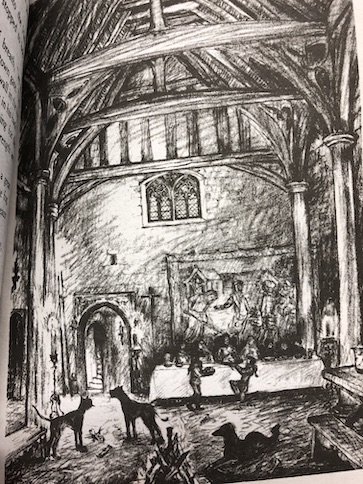
On the journey to Sir Peter’s castle, they have adventures, narrowly escaping from thieves and visiting a fair in Oxford. Robin encounters Welsh speakers for the first time. Although Robin is worried about what Sir Peter will think of him when he sees his condition, Sir Peter welcomes the travelers gladly. He has recently been injured in battle and still recovering himself. Robin says that he doesn’t think that he will make a very good page because of his difficulties in walking but that he can read, write, and sing to provide entertainment. Sir Peter says that there are many ways to serve others and that people must do what they can.

Brother Luke and John-go-in-the-Wynd stay at the castle to help Robin settle in, and Sir Peter gives Robin duties that he can perform. Robin asks Brother Luke if he thinks that he will ever be able to walk normally again, and Brother Luke admits that he doesn’t know but that he is sure that Robin will have a fine life ahead of him. People are not perfect, but everyone has to do the best they can with what they have. Robin soon learns to get around well enough to navigate the castle easily and play with the other boys, but he is still bent and unable to walk without crutches. Robin’s disability and the craftsman skills he learned from the monks have taught him patience and that he feels better after accomplishing difficult tasks.
Then, one foggy day, the Welsh surround and attack Sir Peter’s castle. The defenders hold out in the keep, but they begin to run low on food, and strangely, the well seems to be running dry. As they run low on water, hope seems to be lost. They begin to devise a plan for someone to slip out and go for help. Robin volunteers to go. He knows where John-go-in-the-Wynd is staying with his mother nearby, and he can tell him about the situation in the castle and where to go for help. Robin knows that if anyone catches sight of him, he will look like a poor, lame, shepherd boy, and no one will suspect him of coming from the castle.
Robin has felt badly about his new disability, but his youth and disability are actually what allow him to pass unchallenged through the enemy lines. Suddenly, his disability actually becomes an advantage, allowing him to do what others cannot. Robin’s future may not be the one that he first expected, but he has found ways to move forward in his life and ends up a hero!
The book is a Newbery Award Winner. It is available to borrow and read for free online through Internet Archive (multiple copies).


 Jestress's Forgotten Books and Stories