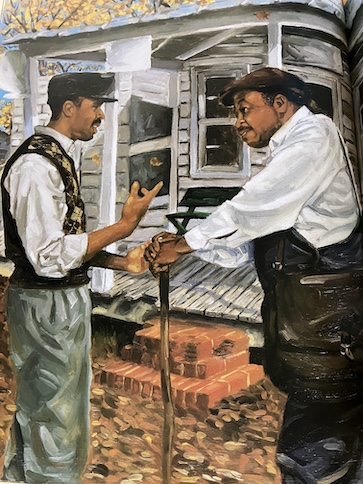
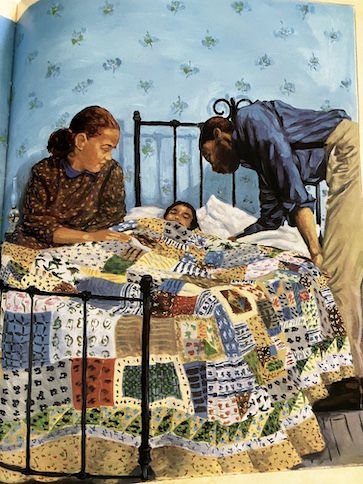
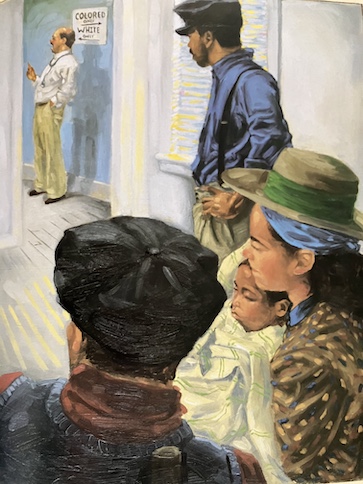
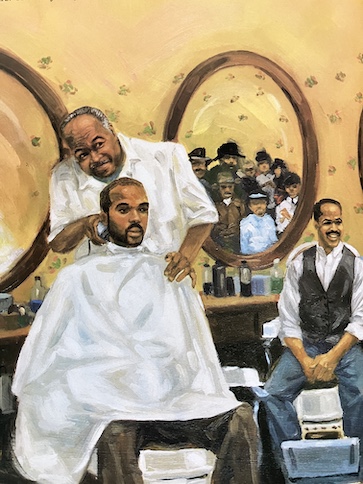
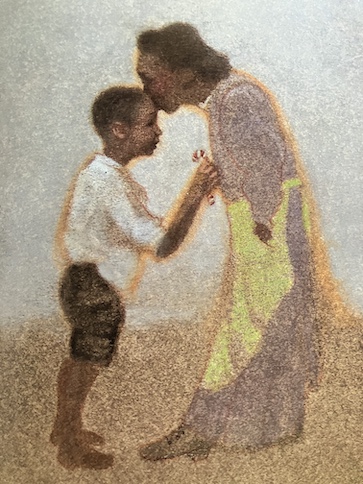
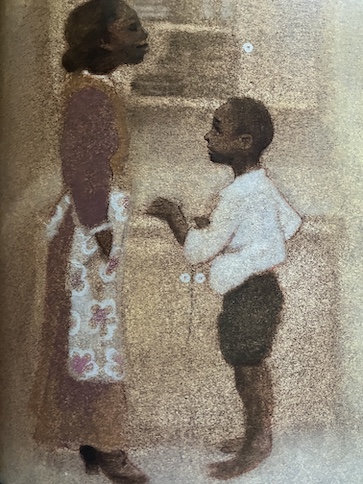
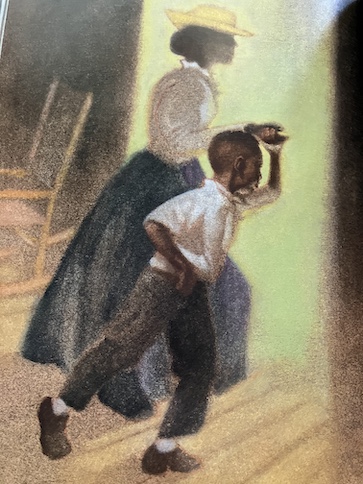
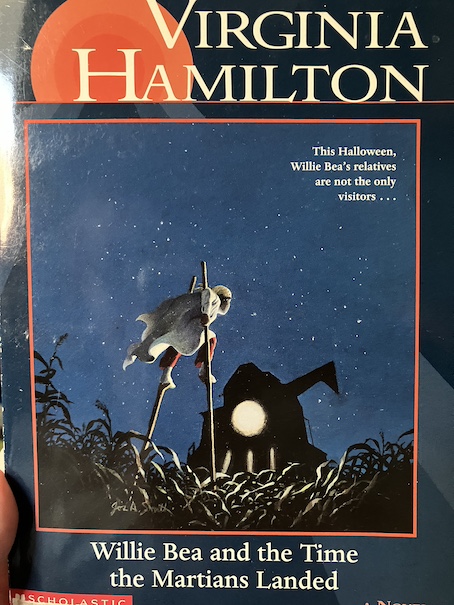
Willie Bea and the Time the Martians Landed

It’s Halloween 1938, and Willie Bea’s relatives have gathered at the old family farm, near where she lives. Money is tight because of the Great Depression, but one of her aunts lives and works in the city, making more money than the others, and is willing to help fund family dinners and provide a little extra for her nieces and nephews when they need something, like new clothes. The aunt is a little scandalous in their family for her multiple marriages, but the others appreciate her generosity, and the nieces and nephews like getting some extra attention and a few treats from her.

The family gathering is a bit chaotic with children running around and getting into trouble. One of Willie Bea’s cousins gets into particular trouble with her mother for using his bow and arrow set to shoot a pumpkin off of Willie Bea’s younger brother’s head. Their mother panics when she catches them doing it because he could have missed and killed the little boy, but Willie Bea tries to calm her mother. Willie Bea was less worried because she knows her cousin’s archery skill and that he wasn’t going to miss, but she understands that adults think of the risks and aren’t fully aware of what the kids are capable of doing. (I’m siding with the mother on this one. Even people who are very good at something can miss now and then, and it’s a big risk to take with someone’s life.) Willie Bea also realizes that the decision to use her little brother for the William Tell act actually came from another cousin because the cousin doing the archery wouldn’t have thought of it himself, and it’s not fair that her mother doesn’t know to blame this other cousin.

Willie Bea talks to her father about the incident, hoping that he’ll understand how unfair it is. However, her father tells her that what her cousin did was dangerous, no matter why he did it. Even though he has a reputation for being good with archery, even people who are good can still miss, and accidents can happen. (See?) Her father lets Willie Bea know that he’s aware that she and her cousins do risky things sometimes when they’re playing with each other, but as an adult, he and the other adults have a responsibility to tell them when something they’re doing is too risky and to put a stop to it. No matter how many times they’ve done some of these things without having an accident, some things are just accidents waiting to happen. They should never assume that an arrow can’t go wrong just because it hasn’t yet or that they can’t fall from a high place just because they haven’t fallen yet.

Willie Bea is a little embarrassed by the talk and feels like her father still doesn’t understand. However, Willie Bea herself has been starting to understand a few things about her relatives this Halloween, things that she either hasn’t noticed before or only half noticed. She can see that one of her cousins is too manipulative, noting the little tricks she uses to get her way and the things she says and does when she wants to be spiteful. She can see that her other cousin has trouble asking up for himself and is particularly vulnerable to manipulation.

Willie Bea also begins to notice things about the adults in the family and their relationships with each other. Aunt Leah, the aunt who has more money than the others and has been married multiple times seems glamorous and fascinating to Willie Bea. Aunt Leah is into horoscopes and fortune telling, and when she reads Willie Bea’s palm, she predicts something special for her. Although Willie Bea loves her own mother, she is intrigued by the family gossip that her father was seeing Aunt Leah before falling in love with her mother, and Willie Bea fantasizes about what it would be like to live with Aunt Leah in the city. She imagines that it would be exciting, and she asks her father why he chose her mother instead of Aunt Leah. Her father knows that Willie Bea doesn’t entirely understand what it’s like to make that kind of choice and what living with a woman like Aunt Leah would really mean. (It occurred to me that the multiple divorces Leah has had might be a clue.) He just explains to Willie Bea that his choice became clear after he got to know her mother as well as her sister, Leah. He knew her mother was the right choice because she was the kind of steady woman who would always be there for him.

That evening, while Willie Bea is putting together her hobo costume and the ghost costumes for her younger siblings and her parents are listening to the radio, Aunt Leah suddenly bursts in and starts having hysterics about it being the end of the world! It takes Willie Bea’s parents a while to get a clear answer from Aunt Leah about why she’s so upset. When she recovers enough to explain things, she says that she was listening to the radio, and she heard that Martians have invaded New Jersey! She describes the horrible, terrifying reports that the radio announcer made about the Martians destroying army troops with their deadly heat ray. Aunt Leah was so terrified by what she heard that she not only turned off the radio but unplugged it, and she says that she’ll never plug it in again, which might be a moot point, if aliens really are here to destroy the world. (If you know what was infamously broadcast on Halloween 1938, you know what Leah heard and that it’s not what she thinks it is.)

While Willie Bea’s parents are trying to decide what to make of Aunt Leah’s story, Willie Bea’s Uncle Jimmy arrives. He says that the rest of the family has also heard what Aunt Leah heard and that they’re all gathering at the old family farm. Rumor has it that people have seen the terrible invaders over at the Kelly farm. Willie Bea’s mother gathers the children and heads to the family farm that Willie Bea’s grandparents own to be with the rest of the family, while Willie Bea’s father tries to see if he can find the station that Leah was listening to and hear the reports for himself. It occurs to him that it might not be an invasion of the Martians but could actually be Germans and German war machines because they’ve all heard about the Nazi takeover of Germany, and he remembers the horrible Hindenburg disaster. If Germans could make a blimp that explodes into a fiery terror like that, then he thinks maybe they could make something that resembles an alien invasion.

At her grandparents’ farm, Willie Bea watches as various relatives panic, cluster around the radio, trade rumors, and try to figure what’s going on. Rumor has it that there are Martians on the Kelly farm, so Willie Bea convinces young Toughy Clay to go over there and try to see them for themselves. At Willie Bea’s insistence, they use the stilts that the children like to walk on to give themselves longer legs, so they can get there faster. Nothing is as it seems this Halloween, and Willie Bea’s expedition to see the Martians definitely doesn’t go as planned.

The book is available to borrow and read for free online through Internet Archive (multiple copies, including a short picture book version).

Almost of the characters in this book are African American. I don’t think it’s ever stated directly because there’s no need in the story to describe them, compared to anyone else, but I think it’s subtly implied. There is only one point in the story where race is mentioned at all, and that’s when Willie Bea is hurt, and the doctor comes to see her. Willie Bea describes the doctor as an old man who delivered most of the babies in her family and knows everybody in the community, and she says that he visits everyone, black or white, rich or poor. Willie Bea’s family is at the poorer end of the community because the doctor knows that people like them don’t normally call the doctor unless it’s something that they really can’t handle by themselves.

I found the family relationships in the story confusing at first. The kids are all referred to by nicknames, and when they are first introduced, it’s difficult to keep it straight who is whose sibling and who is a cousin, and who is older and who is younger. At least, that’s how it seemed to me. Relationships are explained gradually as the story continues, along with characters’ real names as well as nicknames, but it takes some time to get to the explanations.

The story has a slow start, and the real adventure doesn’t begin until about halfway through the book. In some ways, it’s a coming of age story for Willie Bea because she finds herself seeing her family in ways that she never has before, becoming more aware of different sides of their personalities and gaining more insights into their relationships with each other. She also comes to see firsthand what her father means about the stunts that she and her cousins pull and how she should never assume that they can’t get hurt just because they haven’t before. Much of this book is what I would call “slice of life”, a sort of glimpse into Halloweens of the past in a rural community, especially one particular Halloween that would have been memorable for anyone who was alive at the time in the United States.

The radio broadcast that has Willie Bea’s family and others in the community panicking over an alien invasion is The War of the Worlds, a play based on the novel of the same name by H. G. Wells. This type of panic over this particular radio performance was a real, historical incident because the radio play was presented in the format of news broadcasts at the time, and some people who tuned into the program late misunderstood what they were hearing and thought that it was a real news broadcast about an actual emergency. It wasn’t a widespread panic because, first, people who started listening to the broadcast from its beginning knew what they were listening to, and second, not everyone was listening to the broadcast at all. Still, there was enough panic over the radio performance that it became newsworthy and has become a piece of American history and lore.

I enjoyed the historical details in the story, particularly all the radio play references throughout the story. Willie Bea’s family likes to listen to radio shows, and I’m familiar with some of them because I also enjoy old radio plays. Her family likes to listen to The Shadow and Little Orphan Annie. Willie Bea likes to amuse her siblings by imitating people from the radio, singing theme songs and reciting jokes from Jack Benny, like the famous “your money or your life” joke.

Stories of Rainbow and Lucky: Up the River

This is the fifth and final book in the Stories of Rainbow and Lucky series. I’ve already covering the rest of the books this series, and I have to do all five books in a row because the series is set up like a mini-series. That is, none of the books in the series can stand alone; they are all installments of one, longer story. They only make sense together.

It’s an unusual series from the mid-19th century, written on the eve of the American Civil War, by a white author with a young black hero. Rainbow is a teenage black boy who, in the previous installments of the story, is hired by a young carpenter, Handie, who is just a few years older than he is, to help him with a job in another town, working on renovating a farm house that Handie has inherited. The rest of the series follows the two young men, particularly Rainbow, through their adventures leaving their small town for the first time, learning life lessons, getting new jobs, and even dealing with difficult topics like racism. Lucky is a horse who used to belong to a neighbor of Handie’s new farm. Rainbow befriended him, and in the previous book in the series, he managed to buy Lucky on credit. Because he now owns a horse, he is able to take a new job, delivering mail. This final story in the series follows Rainbow as he begins his new job.

The story is unusual for this time period because it was uncommon for black people to be the heroes of books and for topics like racism to be discussed directly. I wouldn’t say that racism is the main focus of the series. It’s mainly a slice of life and coming of age story for Rainbow as he and Handie both set out in life and begin building careers for themselves, and it’s meant to be educational for young readers. However, racism and racist comments are sprinkled throughout the story, with the author calling attention to the fact that these are not good ways to behave or polite ways of speaking, for the benefit of its original audience of 19th century children. It’s also important to point out that our black hero is not a slave, he is not enslaved at any point in the series, and the series has a happy ending for him. People don’t always treat him right, but he does have friends and allies, and he manages to deal with the adversity he faces and builds a future for himself. 

This particular installment in the series focuses on Rainbow’s new job. It has its hardships and adventures, but it sets up a bright future for Rainbow. Keep in mind along the way that there are a lot of pun names in this series and that people’s names are often clues to their characters.

This book is easily available to read online in your browser through NINETEENTH-CENTURY AMERICAN CHILDREN & WHAT THEY READ, I’m going to do a detailed summary below. If you’d rather read it yourself before you read my review, you can go ahead, but some people might want to know what it’s like in more detail.

This story picks up where the previous book in the series left off, with Rainbow back in his home town with his horse, Lucky. He has just accepted the job of delivering mail. The first characters we see are Thomas and Jerry, two teenage boys working in the stable that belongs to the local tavern. Jerry is younger than Thomas and has only just started working there. He is disgruntled because Thomas won’t let him handle some tasks without supervising him closely. Thomas says that he needs to see how Jerry works before he will trust him to work unsupervised. Jerry thinks that Thomas is implying that he’s incapable of doing the work, which is insulting. Thomas says that his own job depends on his ability to make sure that everything is done correctly in the stables, and as a new employee, Jerry is his responsibility, so Thomas needs to make sure that he knows what he’s doing and does a good job.

Rainbow is boarding Lucky at the stable, and the boys talk about the horse and about Rainbow’s new job. Thomas is a little envious of Rainbow for getting the job of delivering mail, but he couldn’t apply for it himself because he doesn’t have a horse of his own, like Rainbow does. Jerry asks how Rainbow was able to afford a horse, and Thomas explains that he bought it on credit. Making a major purchase on credit involves finding someone who is willing to supply the loan, and Thomas is also a little envious that Rainbow managed to do that because he can’t think of anyone who would trust him enough to loan him that amount of money. Jerry says that he’s surprised that a black boy got the job because the black boys he’s known are so “saucy” (meaning flippant or impudent). However, Thomas says that Rainbow isn’t like that and that he’s smart and a good worker. In spite of the fact that Thomas wishes he was in Rainbow’s position, he admits that Rainbow got to this position because he’s a good worker, and employers trust him because he has demonstrated that he is scrupulous in fulfilling his duties to them. That’s how Rainbow finds people willing to hire him and loan him money.

Rainbow comes to the stable to give Lucky a brushing and take him out for a run. He tells Lucky that he’s been able to have fun up to this point, but soon, they will have to seriously begin their work of carrying the mail. They will have to follow a 24-mile route up the river, traveling in all kinds of weather with a heavy mail sack, and there will be a fine to pay if they don’t stick to the route and arrive on time. However, the work will pay off, and Rainbow says that he will see to it that Lucky has a nice, warm stable and good food. Lucky, being a horse, is unconcerned and is mainly interested in neighing at another horse he sees nearby.

When Rainbow and Lucky return to the stable, Jerry tells Rainbow that Trigget is waiting in the tavern to talk to him. Rainbow goes to see Trigget, and Trigget says that he is there to draw up the contract for Rainbow’s new job. They discuss the job requirements and the pay, and Trigget offers Rainbow advice about how fast his horse can travel and how he can make his mail run on time. Because Lucky is still a young horse, Trigget cautions Rainbow not to run him too hard and risk injury. Traveling the full length of his route at a good pace will take about 8 or 9 hours, so Rainbow should plan accordingly. During periods when the weather is bad and traveling will be slower, Rainbow will have to leave earlier in the morning to make sure that he finishes the route at the proper time.

Trigget also tells him that, even though he’s sure that Rainbow will do his best to be on time with his deliveries, there will be times when he will be late despite his best efforts. Sometimes, the weather will be bad, and there’s always the risk of accidents. Because there are government fines for being late with the mail, Rainbow’s pay includes the option to accept extra money that he can use to pay up to four fines per year, if Rainbow chooses to pay his fines himself rather than having the company pay on his behalf. It’s a bit of a gamble to accept this option because, if Rainbow is late more than four times during the year, he will have to cover the additional late fines himself and will lose money. However, if Rainbow is late less than three times during the year, he can keep whatever is left over from that extra money. Rainbow decides to accept this option because he is confident that he won’t be late very often. With the terms settled, Rainbow signs his contract with Trigget and begins his job.

Rainbow and Lucky set off on their route on the morning of November 1. The book explains that the post office in their town is in a small building next to the tavern, and Rainbow enters from the tavern, using a special key kept on a hook. The postmaster prepared mail bag the night before, so it is ready to go. Rainbow just needs to pick it up.

Rainbow and Lucky ride about 5 miles before they reach the first post office on their route. The postmaster there takes the mail bag from Rainbow, removes the mail meant for his office, and returns the bag to Rainbow. Everything goes according to routine at the first stop, and Rainbow and Lucky continue on their way.

Rainbow begins to consider his new schedule as they travel. They will be traveling for most of the week with a stop at post office No. 5 for a couple of days. The stop at No. 5 would be a good time for Lucky to rest, but Rainbow wonders what he’s going to do there for a couple of days himself. He considers whether he could find any side jobs to do there, like carpenter work or hauling wood.

As they continue on their way, Rainbow talks to Lucky about the countryside, the river, and the bridges, noting how high the water under them can get. About every four or five miles, they stop at another post office. As they keep going up river, the post offices become more primitive. One of them is just in a log cabin with a sign written in chalk to designate it as the post office.

At a place called Mix’s Corner, a man named Mix has a farm and a saw mill. His house also serves as the post office and tavern for the few travelers who come that way. Mrs. Mix handles the mail and gives Rainbow some food while her young son, Ephraim, puts Lucky in the barn, where Rainbow can give him some oats. Rainbow offers to make a whistle for Ephraim, but then, he remembers that it’s better to make whistles in the spring, when the barn is easier to separate from a willow or poplar stem. (There is a detailed explanation here about how that works because the new layer of wood formed in the spring, the alburnum, is softer then. After it has matured, it becomes harder, and it’s more difficult to remove. The author/narrator says that Rainbow doesn’t fully understand the scientific principles behind this process, but he knows from hands-on experience that these wooden stems are easier to work with in the spring. “So much for the philosophy of whistle-making.”) Ephraim is disappointed, so Rainbow offers to make him a windmill toy instead and to bring him a whistle from the store the next time he passes. Stores sell whistles for a penny each, so it wouldn’t be too expensive for Rainbow to buy one for the boy. Ephraim accepts the offer, so Rainbow makes him a windmill out of a wooden shingle (we called this toy a pinwheel when I was a kid, and we made them out of paper), and Ephraim runs around in the yard outside with it to make it spin.

As Rainbow continues on his way, he makes it a point to get to know the people along his route and to make friends with them. At the next house he passes, a woman named Mrs. Captain Myers greets him. The narrator says that she even gives him a “courtesy” (what we would call a curtsy). Normally, she probably wouldn’t make such a formal, deferential gesture for an ordinary black boy, but she knows that he’s the new mail-carrier, and this is an important position in this area as mail is the main form of communication. She values the position Rainbow holds, so he gets special consideration.

She asks Rainbow if he is carrying any letters for her, but he says that he doesn’t know. There is a lock on the mail bag he carries, and he can’t open it because only the postmasters at the post offices along his route have copies of the key. This is how they keep the mail secure. Since he can’t open the bag himself, there’s no way that Rainbow can check for letters for specific people. Mrs. Captain Myers lives a couple of miles from the nearest post office, and she says that it’s often difficult for her to get there to pick up her letters. Rainbow says that, if she likes, he can pick up her mail for her and bring it to her on his return trip, and she say that would be very helpful.

As he rides on, Rainbow confides to Lucky that his desire to make friends and help people he meets along the way isn’t entirely out of kindness for its own sake but also cunning. Rainbow knows that this route will become more difficult to travel during the winter, and there will probably be some times when he will need help from people who live in the area. If he has made friends with them and done them a few good deeds, they will probably be more likely to help him later, when he needs a good deed himself. The narrator/author weighs in at this point with some thoughts about how Rainbow needn’t think this form of “cunning” isn’t also kindness:

Rainbow was very much mistaken in supposing that his disposition to be obliging to the people who lived along the road was to be attributed to cunning and not to kindness. If we really entertain feelings of good-will o those around us, and desire to promote their happiness by every means in our power, and take pleasure in doing it, then we are truly and sincerely kind. The fact that we are aware that, by so doing, we make other people ready to show kindness to us in return, and that we are even influenced in what we do by a desire to secure such requitals, is nothing in any sense derogatory. “Cast thy bread upon the waters: thou shalt find it after many days,” is an injunction of the Scriptures, and it implies that it is right for us to be influenced in our efforts to do good by the hope and expectation of receiving at some day or other a beneficial return.

(I can see the point, that a kind act isn’t diminished by the other person’s gratitude or willingness to return the favor. The author might have also considered that there are also less kind ways for people to try to get people’s cooperation than building up goodwill in advance. Some people might simply expect deferential treatment as their due without showing care or consideration to the other people involved, or worse, they might use the threat of bad behavior to make other people do things for them. Rainbow is taking a better path by showing others that he does care about them and is willing to help them when he can, even if they haven’t done anything for him yet.)

The final stop on Rainbow’s route is post office No. 5, which is in Squire Holden’s house. (The book sometimes calls Mr. Holden by the title “squire,” which can have several meanings. Besides the British gentry title, it can refer to the primary land owner in a village, which may be the meaning here, or to someone who holds a legal position, like the lawyer in the first book in the series, who was also called “Squire.” The legal title is still in use sometimes as a courtesy title for lawyers in the form of “esquire“, after a lawyer’s name, frequently abbreviated as Esq.) The village is very small, with only a blacksmith shop, a mill, and a general store. Squire Holden’s house is only one story with an addition built on that doesn’t look completely finished. Since Rainbow has had some carpentry training from Handie (in the earlier books in the series), he thinks that he might be able to get some work helping the Holden family finish it. Squire Holden isn’t at home when Rainbow arrives, but his wife greets him and tells him where to put the mail bag.

According to the arrangement of his route, Rainbow will be staying with the Holdens for a couple of days before beginning the journey back. Trigget discussed with the Holdens before Rainbow began his job, telling them that the new mail carrier would be a black boy. As mentioned in the first book in the series, some people in this time and area might object to having a black person stay with them, so Trigget wanted to make sure that Rainbow would be welcome with them and would have a place to stay. The Holdens have no objection to hosting Rainbow, with Mrs. Holden saying, “that she never cared at all what color a cow was so long as she gave plenty of good milk.” (Meaning that she isn’t concerned about Rainbow’s race as much as his behavior, and Trigget has given him a good character reference, so it’s all fine with her.) The narrator says that Trigget thought that would probably be the case with the Holdens, but he thought that they would appreciate him discussing the situation with them first anyway, since Rainbow would be staying in their home as a guest. The Holdens’ small daughter, Toolie, is very shy of Rainbow when he first arrives, but she warms up to him gradually during his stay. Rainbow helps to win her over by making a little doll for her.

Mr. Holden is out in the woods, cutting down some trees. Rainbow offers to go and help him, if there is an extra axe, but Mrs. Holden says that the only other axe they have is an old, dull one. Rainbow goes to the village store to see if he can buy an axe, but the store is closed. The nearby blacksmith tells him that the store doesn’t sell axes anyway. All they have is axe handles. Rainbow watches the blacksmith making horse-shoe nails for a while, and the narrator describes the process. The blacksmith comments about the horse Rainbow rode there and asks who owns it. Rainbow says that’s a difficult question to answer because he has bought the horse but hasn’t yet paid for him. Since Rainbow doesn’t explain further about buying the horse by obtaining a loan for the purchase and that it’s the loan that he hasn’t repaid, the blacksmith is surprised and doesn’t really believe him.

Rainbow spots an old axe in the blacksmith shop and studies it. He knows more about evaluating the condition of tools than the blacksmith thinks because of his time working with Handie. Rainbow realizes that the axe is old and has been worn down and resharpened many time before. To put it in good repair again, the axe head would have to be removed from the hand and reshaped through a process they call “setting” (which the author describes as one of his detailed explanations of 19th century life). Rainbow negotiates with the blacksmith to purchase the axe and have it set. (The blacksmith quotes him the price of a “shilling.” It surprised me that he called it a shilling because that’s usually a British monetary description, and this is the mid-19th century, well after the Revolutionary War. I didn’t realize that expression was used in the United States that late. The amount of money in the “shilling” the blacksmith expects is also different from the British shilling. The British shilling would be worth 12 pence or pennies or 1/20 of a pound, but the book explains that the blacksmith wants 26 cents.) The blacksmith asks when Rainbow can pay for it because he said that he didn’t pay for the horse he bought, and the blacksmith doesn’t think he really has any money. To his surprise, Rainbow produces the money and pays right away, which makes the blacksmith hold him in higher regard. The blacksmith says that he can have the axe ready for him that evening.

When Rainbow returns to the Holdens’ house, he uses their old axe to split some wood in the yard. When Mr. Holden returns home for supper, he says that Rainbow can help him to clear a piece of land. He offers Rainbow two shillings a day for his help, which Rainbow considers a good wage. Rainbow tells him about the axe he is buying from the blacksmith, which he can use for clearing some bushes while Mr. Holden cuts down trees. However, Rainbow says that he would also like to explore the neighborhood the next day because he has never been in this area before.

After supper, Rainbow returns to the blacksmith, whose name is Mr. Whackhammer. He helps by operating the bellows while the blacksmith works on the axe. Mr. Whackhammer comments that Rainbow seems to have some understanding of tools, and Rainbow explains a little about his work with Handie over the summer. The blacksmith thinks that he’s bright to have picked up some knowledge of tools in such a short time. After the blacksmith finishes setting the head, Rainbow buys a new handle for it and fits the head to the handle. (The author also describes the process for that.)

Rainbow spends the rest of evening talking and telling stories with the Holdens by the fire. When it’s time to go to bed, Mr. and Mrs. Holden talk to each other a little about Rainbow. Mr. Holden says that Rainbow seems like a smart boy, and Mrs. Holden says that he is also pleasant company, noting that, “I’m more and more confirmed in my opinion, that it is of no consequence what the color of a cow is, provided she is not cross, and gives plenty of good milk.”

The next morning, Rainbow goes out to the woods with Mr. Holden and helps him clear the underbrush on the land he is trying to clear. When he does a good job with that, Mr. Holden says that he can try his hand at cutting down trees, which is trickier. A person cutting down a tree needs to cut it in a particular way so that it will fall in the direction he wants it to fall. The narrator explains how this works, and Rainbow follows Mr. Holden’s example. They make good progress before they go home for dinner. (“Dinner” is frequently what they call lunch in the countryside, and that is the case here. They go home for lunch.)

After dinner, Rainbow says that he would like to take a walk and explore the area that afternoon. The Holdens tell him a little about the people who live nearby, including a man named Mr. Dyker, who is building a house. Rainbow says that he might go see him and offer his help. This, unfortunately, leads us to the second use of the n-word in this series. As Rainbow approaches the house, he hears Mr. Dyker say to the man who is with him, “Who is this (n-word) coming, Dan?” When Rainbow hears that, he almost turns around and leaves, wishing that he hadn’t bothered to come. What stops him is that Dan replies, “Don’t call him a (n-word), Joe, till you find out whether he deserves it.” Rainbow decides that he might take a chance on these men since at least one of the two seems willing to give him a chance. (Personally, I might not be so charitable. Rainbow considers Dan a “fair man” for his comment about reserving judgement to see “whether he deserves it”, but to my way of thinking, calling that comment “fair” would imply that there might be people who do deserve that kind of slur, and I’m not convinced. Granted, it’s not as bad as immediately calling a total stranger something bad for no reason, but it’s still not great.) Rainbow still feels indignant about the insult, but he decides to follow his mother’s advice about “overcoming evil with good.”

Rainbow explains that he heard they would be raising a house frame this afternoon, so he came to see if he could help. Mr. Dyker says that perhaps he can. Mr. Dyker doesn’t think too much of Rainbow’s abilities at first, and he also hesitates to let him do too much because he thinks Rainbow might expect payment. He asks Rainbow what kind of wages he expects, but Rainbow says that he doesn’t need any money. He’s just looking for things to do because he is the new mail carrier and will be staying here for a short time before following the route back down the river. Hearing that Rainbow is the new mail carrier catches Mr. Dyker’s attention. Rainbow explains what he can do to help them, and Mr. Dyker and Dan realize that Rainbow has some carpentry experience. Dan suggests that they let Rainbow show them what he can do. When they see that Rainbow knows what he’s doing, they’re happy to let him work with them. As they work, they chat pleasantly with each other, and they begin feeling better about each other.

When Mrs. Dyker begins to lay out supper, Rainbow gets ready to leave, thinking that they might not way to eat with a black person, considering the way Mr. Dyker talked before, but they insist that they would like him to stay and have supper with them, so he does. While they’re getting the supper ready, Rainbow even picks some flowers for Mrs. Dyker, as “the lady of the new house.” The author/narrator says that this gesture pleases Mrs. Dyker, even coming from a black boy (which seems a little back-handed to me). The author/narrator also says that Mr. Dyker adds a prayer of blessing for Rainbow to their prayer before the meal. He says, “Mr. Dyker was perfectly honest and sincere in these invocations, for he was really a good man, although he had been so heartless, or rather so thoughtless, as to call Rainbow at first by an opprobrious name.”

Mr. Dyker compliments Rainbow on his carpentry skills, and Rainbow thanks him, but he says that he doesn’t plan on becoming a real carpenter. Mr. Dyker asks him why, and Rainbow says that he has trouble with the mathematical skills that professional carpenters need to plan what they build. Handie tried to teach him a little geometry, but he found it difficult to understand. The author/narrator praises Rainbow for this honest and accurate assessment of his own skills and limits. Rainbow knows his tools and can carry out some basic carpentry tasks and assist others, but he knows that he can’t plan out the full construction of a building or more complicated projects by himself. Still, Mr. Dyker thinks enough of Rainbow’s skills that he says anytime he has free time, he will pay him to help further with his building project. Rainbow says that he will be free on Friday, and he can work for Mr. Dyker that day, but he can’t make promises beyond that point. He’s still getting a feel for his new job as mail carrier, and he can’t say what other jobs might come up for him on the side.

On Rainbow’s way back down the river from his first trip, he remembers to pick up Mrs. Myers’s letters for her, as he promised before. He also remember to buy a penny whistle for young Ephraim to take with him when he begins his next route up the river. He knows it’s important to keep his promises while building relationships with the people he meets.

As Rainbow continues making trips up and down the river, he starts to become better friends with little Toolie. In particular, Toolie likes the way he answers the questions she asks. The narrator explains that Rainbow is very good at answering the questions of young children because he knows a little more than they do, but not a lot more. Rainbow is still young himself, in his teenage years, and he is just starting to get out in the world and experience more of life, but he isn’t that much more experienced than a kid yet, which the author says is the ideal mindset for explaining things to kids. Often, adults with a lot of knowledge and experience will try to tell kids too much or make their explanations too detailed when talking to young kids, confusing them. Rainbow is one step ahead of them in his knowledge, and one step further is the most a young kid can take at once.

At this point, the author delivers a reprimand to adults who assume that, just because they cannot give a young child a complete, detailed answer to their questions that the child should not have asked the question in the first place. He says that asking questions and trying to understand the world is part of the natural business of childhood and is important for helping the child to prepare for later life, so a child should never be criticized or shut down for doing that. He says that it is unreasonable for an adult to try to stop children from asking questions or reprimand them for their growing young minds simply because the adult finds it difficult to handle and formulate answers. (I have some thoughts about this, but I’ll save them for my reactions section.)

One day, little Toolie asks Rainbow questions about his appearance, trying to figure out why he looks different from everyone else she knows. (Her questions sound awkward and would be insulting, if they didn’t come from a little child who is just struggling to understand something that she has noticed.) She starts by asking him why his face is black. Rainbow simply says that he’s always been like that. Toolie thinks about it a little and then asks if the black would wash off if he washes his face. Rainbow explains that it won’t because his color is something inside himself that just grows there, and it’s not something on the outside of his skin that would wash off. (Rainbow might not know the word melanin, but this basic description is accurate. The scientific explanation is that all humans have melanin in their bodies, but we have it to different degrees. People with a lot of melanin have darker skin, hair, and eyes, and people with less have lighter features. This is an example of how Rainbow, with little formal education, can’t supply some of the more complex, scientific explanations, but he can deliver simple explanations that are accurate and easy enough for a young child to understand.) Toolie further asks Rainbow about his curly hair, and Rainbow says his hair curls like that naturally, although some people use curling tongs to curl their hair. Toolie understands this because her mother also has curling tongs.

Satisfied with this basic explanation, Toolie tells Rainbow about the schoolhouse up the road. Toolie sometimes goes to school there, when her father has the time to take her there, and she asks Rainbow if he will take her there sometimes. Rainbow says that he could take her on Lucky when he carries the mail, making a pun on male/female: “Then Lucky would have a mail and a female on his back.” Toolie is confused because she doesn’t understand the terms male and female yet. Rainbow asks her what she learns at school, and Toolie says she is learning to count, but she can only count up to nine so far. Rainbow jokes about his own ability to count, saying that he counts, “One couple three several, many more enough, plenty, and ever so many.” Toolie doesn’t believe him that this is the right way to count, and they move on to talking about why the sun is so bright and warm before it’s time for dinner.

Toolie’s parents arrange with Rainbow for him to take her to school one day before he leaves with the mail. Rainbow takes Lucky for a brief run before picking up the mail and Toolie because Lucky is very energetic, and he doesn’t want Lucky to act up and scare little Toolie while she’s riding with him. Toolie is very nervous when she gets up on Lucky, and Rainbow tells her that’s fine and normal:

“Yes,” said Rainbow, “every body’s afraid the first time they ride upon a horse. I expected that you would be afraid. But that’s no matter. It does not hurt any body to be afraid, so don’t you mind it.”

(I like that advice better than “All we have to fear is fear itself.” Learning not to be afraid of your own fear sounds like a more positive move.)

The other children and their teacher are surprised to see Rainbow arrive at the school, carrying Toolie on horseback. He introduces himself and explains that he’s the one who carries the mail. Some of them say that they would love it if Rainbow would bring them letters, and Rainbow laughs before he rides off again.

There is a brief interlude at this point that explains that Toolie is one of the youngest children at the school and describes what the youngest children do. It’s a small, one-room schoolhouse, so the teacher divides her attention between the different levels of students. Mostly, the youngest children just practice reciting their letters for the teacher at various points throughout the day, and the rest of the time, they are allowed to play outside, as long as they stay within sight of the school and come inside when the teacher rings the bell.

As Rainbow continues to travel his route, he meets more people and becomes better acquainted with the terrain and how it changes with the weather and changing season. There is one point when he has to ask a strange for directions for an alternate route because he realizes that the water in a stream he crosses is rising too high and that his usual road may become impassable. Later, he befriends some children he meets while watering his house and makes toy boats for them. He calls the children he meets along his route “my children” because he has a soft spot for young children and likes looking after them and making them little toys.

There are times when the route is harsh due to bad weather, which Rainbow knew would happen before he began the job. He still has to get the mail through as best he can, no matter the weather. There is one time when he has to walk the mail across and then his horse across a flooded crossing. The only time when he misses one of his stops is when he gets lost in a snow storm because the roads are covered in snow, and he fails to reach No. 5. When Rainbow realizes that they’re lost, he and Lucky have to camp out in the woods. Rainbow makes them a couple of huts for shelter, and they are able to find their way in the morning.

Rainbow’s most serious problem comes when Lucky is stolen from Trigget’s stable one night by a couple of thieves. At first, Trigget assumes that Lucky simply got out of the stable himself somehow and is lost, so he loans Rainbow another horse that he can ride to make the mail run. Rainbow is very upset, but he has no choice but to start on his route with the borrowed horse. At every stop on his route, he asks if anyone has seen Lucky, but nobody has.

Meanwhile, the thieves are hiding in a house in the countryside, planning to wait until Rainbow has stopped looking for his horse. Eventually, they plan to take the horse to Boston to sell him. To make Lucky less recognizable, they paint white markings on him. However, Lucky doesn’t like the rough shed where the thieves are keeping him. He gnaws throught he rope securing him. Unable to get out of the shed, he lies down behind some barrels, so when the thieves come to feed him the next day, they don’t see him. When they find him behind the barrels, they lead him out of the shed and have a look at his rope. Seeing that he chewed through his rope, they decide that they need to put a sturdier harness on him. While they’re trying to harness him, Lucky breaks free and runs away.

Lucky wanders around and hides in the woods. Getting hungry, he looks for food and eats some hay from a traveler’s sled. He runs away from most of the people he sees. He really wants to find Rainbow, and Lucky recognizes that Rainbow is black, so he runs away from any white person he sees. When he finally sees a black man coming along the road, he follows him, thinking at first the it might be Rainbow. It isn’t, but Lucky continues to follow him anyway because he reminds him of Rainbow.

The black man, whose name is Augustus, lives in a log cabin. Lucky explores around the cabin and finds a supply of hay, so he starts eating it and then goes to sleep. The next morning, Augustus comes to get some hay for his cows and finds Lucky eating it. Augustus calls to his teenage daughter, Rosalinda, to come and see the horse. He asks Rosalinda if she knows who owns this horse, but Rosalinda says that she doesn’t recognize him and doesn’t think he belongs to anybody nearby.

Augustus puts Lucky in his shed and gives him more hay to eat while he decides what to do. Since they don’t know who really owns him, Augustus decides that they should make some advertisements about the horse they found. Rosalinda knows how to read and write, so Augustus tells her what to write on the advertisements, having her make four copies. Augustus’s plan is to take their advertisements to Mix’s Corner and give them to the mail carrier to post in the tavern. Of course, Rainbow is the mail carrier.

When Augustus meets Rainbow and tells him about the horse he found, Rainbow recognizes Lucky from his description, except for the white markings the thieves painted on him. Rainbow goes with Augustus to have a look at the horse, and he realizes that the white markings are only paint. He knows that someone must have taken Lucky and painted him deliberately, although he still doesn’t know the full story behind Lucky’s disappearance. He is grateful to Augustus for finding Lucky and taking care of him, and he takes Lucky home and cleans him up.

Rainbow runs into trouble as winter begins turning into spring. The snow is still high, but it is just starting to melt, which makes it too soft and too deep for Lucky to walk on. People who live along Rainbow’s route help by trying to clear the roads where they can, so Rainbow can get through, but there are still times and places where Lucky has trouble sinking into the snow.

One day in early April, it rains, and this makes the going even more difficult. Rainbow and Lucky make it to Mix’s Corner, but the people tell him there that he shouldn’t try going further because the conditions are bad. Rainbow feels obligated to try to get the mail through anyway, so he decides that he will walk the rest of the way while leading Lucky. However, when he comes to a bridge, a stranger who lives nearby warns him not to try to cross because the bridge is unsafe. Rainbow could try to cross the stream on the ice, but with the thawing, the ice isn’t safe, either. Since there is a saw mill nearby, Rainbow decides that he can get some boards that can help him cross the ice by himself with the mail bag, but he will have to leave Lucky behind.

Rainbow arranges for the stranger to board Lucky in his barn and to help him lay the boards over the ice so he can cross. (The book explains that laying boards over thin ice can reinforce it so it can support the weight of a person when it otherwise wouldn’t. The idea is that the board will distribute the person’s weight more over the surface of the ice. It states this as a fact that young readers may already know, probably from living in areas where people do this. I’ve never lived in a place where it snows, so I’ve never had a reason to try to cross ice, but I understand the principle of weight distribution.) Rainbow says that he could also use a hand-sled to carry the mail further. The stranger doesn’t have one, but Rainbow asks to borrow his tools and makes one for himself. The man watches while Rainbow crosses the ice, and fortunately, Rainbow reaches the other side safely. Rainbow is able to successfully get the mail through, barely on time, which causes Trigget to lose a bet he made with Jerry because he didn’t think Rainbow would succeed in that weather.

This is the end of the five-book series, and the final chapter explains how our characters are doing and what is likely in store for them in the future. We are told that, “Rainbow went on very prosperously after this in all his affairs.” There are difficulties and dangers in his job, but he is successful because he is prudent and plans ahead for the difficulties he may encounter. The people along his route also help him when he needs it because he’s been so kind to them and their children. Before the end of the year, he is able to repay the loan he used to buy Lucky, so Lucky now belongs to him outright.

Because the loan worked so well for buying Lucky, some people suggest to him that he could buy some farmland in the same way. Handie recommends that he wait until he’s a little older before he does that, and if he wants to buy some land, it would be better for him to do it an area with other black people. While Rainbow gets along well enough with white people because he is so helpful, good-natured, and hard-working, Handie knows that white people don’t always treat Rainbow as well as they should, and he thinks that Rainbow would be happier with people who are like him.

Rainbow says that what he would really like to do eventually is to move to Boston and work for Colonel Hammond, the man who loaned him money to buy Lucky. Rainbow thinks he would enjoy taking care of Colonel Hammond’s horses and driving his carriage, and maybe he could buy a little house for himself so he can go to his own home in the evening. He also thinks that he would like to marry Rosalinda some day, although he hesitates to say that part out loud.

Like the other books in this series, and the series itself in general, this story is mostly slice-of-life, giving readers a look at life in the past. Originally, the places and situations in the book would have been familiar parts of daily life for its intended audience of children in the mid-19th century. Its descriptions of daily things like how blacksmiths make nails or the finer points of making wooden whistles would have just added detail to what would have been familiar to 19th century children. To people reading it in the 21st century, it adds color and dimension to the lives of people in the past, allowing us to picture the ordinary things they would do every day and to get a sense of the things they would have known.

There are adventurous aspects of the story, where Rainbow almost meets with disaster, but no matter what the situation, things always turn out well for him in the end. Sometimes, it seemed to me like the author/narrator built up excitement over Rainbow’s predicament, only for the problems to be solved more easily than expected, which can feel a little deflating. However, it is also reassuring that nothing truly disastrous happens to Rainbow and Lucky in the end, making a gentler read.

Although most of the emphasis of these stories is on daily life, and they’re pretty gentle to read, racial issues are always in the background. Rainbow is always aware that white people look at him differently because of his race, and that this can be a source of potential problems. It’s one of the reasons why he goes out of his way to build up good will with other people, so people come to like him and treat him better. For the most part, this strategy works. The author intended the stories to be educational for children, and there is a lot in the series about how to understand and get along with other people.

Sometimes, people say rude things to Rainbow about his race and appearance. There are three instances where the n-word is used in the entire series, once in the third book, Three Pines, and two times in one scene in this final book, although there are also other, lesser derogatory comments. In vintage children’s books, the way people speak can be clues to their character, and the author of this series particularly likes to examine people’s character and motives. In the second book in the series, Rainbow’s Journey, we had the example of a disreputable man who turns out to be a thief. He is the first person who makes derogatory comments about Rainbow and insists that he doesn’t want to sit near him on the stage coach. Trigget, who is driving the stage coach, tells him off for doing that, and other people laugh at him because they know that he is a disreputable and ill-mannered person in general. I’ve seen other vintage children’s books that use derogatory racial language and attitudes as signs that a character is ill-bred or generally ignorant.

What interested me about this particular series is that the people who use the n-word, characterized as the worst possible language to use, are not the worst characters, just as people. I found that interesting because the characters’ badness wasn’t directly proportionate to the bad language they used. The first person to use the n-word, in the third book, does it during a tirade against Rainbow because he has come to deliver Handie’s refusal to loan her his saw. Basically, she throws a temper tantrum, and she uses the worst possible language she can against the messenger while she’s having her fit just because she’s angry and wants to make him feel as bad as she feels. It’s simply childishness. During their interactions with her and descriptions of how well she doesn’t get along with her other neighbors, the author makes it clear that she is a highly emotional person with little or no sense of self-control, what we might call “no filter” today. For whatever reason, she has little or no ability to regulate her emotions or control the way she expresses them, like she’s permanently stuck in her terrible twos as an adult. Other people besides Rainbow also find her difficult to deal with because of the way she acts, and even she sometimes feels embarrassed about the things she says and does. However, she gradually becomes a more helpful and sympathetic character because the kind, controlled way that Handie and Rainbow respond to her inspires her to improve herself and to put forth a better image.

The two men who use the n-word in this story are different from all of the above. The author characterizes them as being merely thoughtless, especially the first man to do it. I partly believe that because, even after getting to know Rainbow better and appreciating his help, they don’t seem to experience any regret or even realize just how aggravating and offensive Rainbow found their language. The first man in particular, who just casually calls Rainbow the n-word when he’s idly wondering who he is the first time he approaches, is totally clueless. The author characterizes him as being a good man who says his prayers and later even adds a prayer for Rainbow because he’s grateful for Rainbow’s help, never even seems to have an inkling of the bad impression he made on Rainbow with just that comment. In the end, he focuses on how pleased he himself is with Rainbow’s help and totally misses that he’s not completely satisfactory in his own behavior. Rainbow is reconciled to that and appreciates when the man behaves better, accepting him for what he is, but it rankles with me because this man is, in fact, a grown man, and grown people without a clue are just plain aggravating. It just never even dawns on him that he’s done anything that anybody even might object to, and that level of obliviousness drives me crazy. Now, some modern readers might just brush this off as “just the way people talked bad then” and that he didn’t put enough thought into it to really mean anything by it, but I’m not buying it in this instance, for two reasons. In the first place, not everybody is talking like this. Some people realize that this is an ill-mannered and inappropriate way to talk, and they say so. Second, the second man’s comment adds a qualifier on this word that implies that there was more thought behind this comment that even the author of the book isn’t going into.

After the first man makes that off-handed slur, the second man uses the n-word himself, but he does it in the context of telling the first man not to say that until he finds out “whether he deserves it,” meaning whether Rainbow deserves it. It’s this qualifying statement, which is never explained, that makes me uneasy about the assertion that these guys are just “thoughtless.” In order for there to be an evaluation of who “deserves” this language and who doesn’t, there has to be a certain amount of thought into what the term implies and some kind of standard to judge who fits this term and who doesn’t. Rainbow takes the second man’s comment as reassuring, that the man is giving him a chance to prove himself without judging him immediately, but it doesn’t reassure me because I can tell that there is some standard being applied here, it’s a standard that both of the men seem to understand and believe in, I think it’s a negative standard, and I don’t have confidence in their ability to accurately assess other people.

There are reasons why Rainbow and others feel especially insulted by this word and why it’s considered even worse than other words that are also considered rude. To put it mildly, the n-word implies highly unfavorable things about the person being described, and it implies them to a greater degree even that other insulting words. In general, it carries connotations of worthlessness and a sub-human, animal-like state. I know that the men in the story are definitely thinking about some of the unfavorable implications and evaluating them seriously because the second man says that they will see if Rainbow “deserves” the term in a way that says he realizes that the first man may be insulting Rainbow needlessly. I guess it’s nicer to give Rainbow a chance to show his true character before they render judgement, but it’s still troubling because this conversation reveals that these characters do believe that some of the implications of the n-word are accurate about some people and that they think themselves accurate judges of that. It bothers me because I don’t believe either of those things. While I don’t like some people, I don’t think that calling someone sub-human or worthless, particularly just based on race. Also, I have no confidence in the standards or abilities of these people to accurately assess the relative worth of their fellow human beings in general. To be blunt, I believe that self-awareness is a prerequisite for understanding other people, and I don’t think either of these men have much self-awareness. The fact that both men have totally missed the affect that their attitudes have on Rainbow and the effort he has to make to work with them for free just to help them that day makes me think that neither one of them has the capacity to be accurate in their general understanding of other people or to read any individual in particular, even though they have appointed themselves as the judges of the situation. Even after spending all afternoon with him and seeming to get along with him, even noting his initial hesitation to accept the offer to stay for dinner, they still don’t get it. They just never give it a second thought.

You might wonder why does that bothers me so much, if they all managed to get along well enough anyway. I’ll tell you why. How many other people do you suppose they’ve labeled n-words before because those people reacted negatively to them, specifically because they’re clueless and provoked them, and they’ve just never had the self-awareness to realize that they caused it all themselves? I don’t know the overall number, but I could guess that the percentage is likely 100%. Because they have no self-awareness or situational awareness, they casually create bad impressions with the first words out of their mouths. The casual nature of their behavior indicates that this is habitual with them. They are completely comfortable with doing something that makes everyone else uncomfortable because they do it often and think nothing of it.

The author somewhat implies that these men are likely to provoke negative reactions from black people they just casually meet by pointing out that Rainbow could have turned around and walked away at the first mention of the n-word. The only reason why he didn’t do that and leave them there, probably saying that he must have been an n-word, is that he decided to give them a second chance when they didn’t even know that they’d blown the first impression. Rainbow didn’t really have to give them that chance since he was planning to volunteer his services to them, and he didn’t owe them his time or work. Many other people, including me, probably would have walked away with maybe a dirty look and not a single word, and these guys wouldn’t have had a clue why. These guys would probably mutter “What’s their problem?” to that reaction, never realizing that the only problem is their behavior. It bothers me that, even after getting to know Rainbow better, they still don’t know that they almost drove him away or why, and they don’t seem to have any regrets about what they said or realize that Rainbow ever had a problem with it. Because they don’t realize that their behavior is a problem, they’re probably going to do it again with someone else because no real lessons have been learned here. While they have apparently labeled Rainbow as “not an n-word” kind of black person in their minds, nothing has changed the notion that they still have that other people are, so they will probably repeat this process with other black people they meet, cluelessly provoking others and probably blaming them for being provoked. Until someone lays it out for them, they’re just not going to get it, and even then, they might still not because they feel justified and don’t see themselves as others see them.

I’ve said it before that some of the world’s most judgemental people often forget that other people can also look back at them and make their own evaluations of their behavior and character. The author of the story may consider these men as basically good but thoughtless, but bringing up the subject of who “deserves” to be called certain things also raises the question of who really deserves the label of “good.” “Good” is a relative term that comes with levels and gradations. I’d like to to make it plain that, while these men may be good in some ways, I don’t see them as being as good as other characters who also do good things but without talking the way they do. While I’m sure that they’re more law-abiding than the thief from the second book in general character, they rank behind many other characters in my evaluation. Handie, Trigget, and the Holdens all come before them in my estimation, for several reasons. Not only are these characters demonstrably ethical in their dealings with other people, but they give Rainbow a chance to demonstrate his good side to them without making it clear that they were factoring his race/appearance into their assessment of his character. In fact, they explicitly make it clear that they will not do that. More than that, each of them also stands up for Rainbow and/or shows consideration for his well-being. The take his feelings and situation into account, where the men we’re discussing are mostly concerned with what Rainbow can do for them. Even though they later pray for him, the prayer is based around what Rainbow did for them. While I like the fact that they’re showing gratitude for what they’ve received, which is a positive trait, that sense that they’re approaching it from the angle that Rainbow turned out to be a pretty good guy for someone who might have been just an n-word takes the shine off the apple.

It occurs to me that, in pointing out that these men are “good” in spite of their bad/thoughtless behavior, in a way, the author is almost repeating the sentiment of the man who said that they shouldn’t use derogatory language against Rainbow until they see whether or not he deserves to be regarded in a derogatory way. The author seems to be trying to look on the positive side and to encourage readers to find the positive side of other people, even ones who behave badly, but at the same time, there does seem to be an acknowledgement that they did behave badly and that it would take extra effort to get past that bad behavior to their better sides and to see that they might not be totally bad. Yes, these men are acting like rude and clueless racists. However, there is apparently more to their personalities than that. The author would like us to reserve judgement on these men long enough for them to show their true natures and demonstrate that, in fact, they are thoughtlessly rude and clueless and also seem to have some racist attitudes, but they can make exceptions to their racist preconceptions to accept good deeds from particular individuals whom they might otherwise have disdained for their race and remember to be thankful for what they have received and say their prayers.

The second part of that is good, but the first part of that hasn’t gone away. Maybe that’s less bad than if the sum total of their personalities was to swagger around and dish out the slurs and crude language, but less bad isn’t quite the same as “good.” They show gratitude after receiving something but not graciousness on meeting. To me, their up sides just doesn’t make me feel that much better about them, especially since these guys don’t seem to have learned anything from the experience and seem likely to repeat it. At least, Mrs. Blooman learned something and improved. These guys just managed to get through an afternoon and make a business deal for continued services for their project. I can see that the author is trying to demonstrate how issues like this can be smoothed over with good behavior on the part of other people so that people can get along, but I just find it difficult to buy the assertion that these men are that much better than they first seem to be when their good sides don’t seem to have an affect on their bad ones, and they don’t demonstrate a change in thinking or behavior.

After all my analyzing and ranting, what do I think of this book’s potential to teach us more about racial attitudes and interactions during the mid-19th century?

First, I like the fact that the author examines different types of characters who have different motives for their behavior. Human beings have wide-ranging personality types, and I can believe that each of the characters in the story represents the behavior and personality type of people who really existed. I can believe that a genuinely shady person, like the thief, would also have crude manners or racist beliefs due to a bad upbringing or general anti-social attitudes. (I’m guessing that someone who makes their living by taking advantage of their fellow humans and their belongings generally doesn’t hold other people in high regard and might have disdain for particular groups of people.) I have seen people with temperamental natures and poor impulse control, like Mrs. Blooman, and I can believe that someone like her could say some pretty awful things without necessarily meaning them seriously just because she’s lashing out at others during a tantrum. I could believe that the author might have based her on someone he’d seen in real life. I do also believe that the descriptions of the men using the n-word in this book could be realistic, even though I’ve already explained (ranted) about how I don’t look at them quite the way the author does. I believe that they are thoughtless and that they don’t realize the real problems with their behavior or the effect they have on others because they don’t examine their own motives or look at their behavior from someone else’s perspective. They probably also think that they are basically okay because they’re religious, even while provoking people and testing their patience (including mine). All of these types of people seem realistic enough, and some even remind me of people I’ve seen.

However, the second point to keep in mind that the author’s main goal is to write educational stories for children. He’s always in the role of teacher, whether he’s explaining the fine details behind daily things, examining people’s characters, or offering advice on how to behave or deal with someone else’s behavior. Because he is trying to demonstrate the ways that people should act and how people can be influenced to improve their behavior, even the problem people Rainbow meets can generally be managed, and some of them really do improve, at least to some degree. The author is trying to encourage positive behavior and positive outlooks in his young readers.

While I think that his attempts to set good examples are excellent, part of me knows that, in real life, not everybody really does change for the better from the kind behavior of people they disdain. In fact, some people can become increasingly resentful when someone they don’t like seems to be behaving better than they are because they feel like the other person is just acting that way to show them up, so they act contrary to good behavior the other person is showing just to make it clear that the other person can’t influence them. (In modern terms, “vice-signalling” as a response to “virtue-signalling.” ex. “Oh, you don’t like the Confederate flag? Well, I’ve got it waving outside my house, and I’m gonna get it painted on my truck and wear a shirt with it every day! I’ll show you!”) Mrs. Blooman changes her behavior because she feels ashamed of her lack of control and inspired to improve by seeing how well Handie and Rainbow behave. However, in real life, other people might double down on their bad behavior because they feel like they’ve got something to prove, like they’re “strong” for not being influenced by anybody, not even for the better, or because they want to show that they’ve got contempt for other people, no matter what they do. The examples of people and behavior that the author shows throughout this series tend to lean toward the milder side, although there are small implications that Rainbow has seen worse before and that worse and less manageable people are out there.

There are some instances where the author references more difficult and more racist people without directly showing them in the story. For example, we know from the first book in the series that Rainbow wasn’t allowed to go to the small school in his small town because people made it clear that he wasn’t welcome there. Yet, we don’t really see the people in his town abusing him, and people generally seem to like him for being good-natured. Even though we don’t see the people in his town being bad to him or disliking him, we know that they don’t fully accept him and that some have particularly excluded him. When the lawyer managing Handie’s inheritance tells him that he might run into trouble while traveling with Rainbow because some people might not be willing to rent a room to a black person or have a black person dine with them, I expected that this would happen at some point in the story, but it never does. There’s never an instance where they have to try more than one inn, tavern, or boarding house because they are refused service at the first one they tried. There is just that acknowledgement that some people are like that and that it causes problems, but the author doesn’t provide examples of some of the people with the worst behavior.

Overall, my feeling is that the books demonstrate not how everyone behaved during the mid-19th century but how the author would like young readers to behave and how they should respond to examples of poor behavior from other people without becoming angry and overly negative. I think these are useful lessons, and I’d like to think that at least some of the author’s young readers benefited from them. Some pieces of advice that the author provides make sense to me, like maintaining your own good behavior and kindness even in the face of provocation and leaving other people with the echoes of their own bad words rather than returning a flippant comment that might turn negative attention on yourself. The author does provide some insight on how people thought and behaved during the 19th century and how they wanted to inspire the next generation to behave for the better. However, I do know that, in real life, there are even more variations of people that the author doesn’t delve into, particularly some of the more harmful kinds, who do more than just use a bad word, and the kinds that are less likely to change. I think that a modern version of the same story would probably feature some of these darker elements of human behavior, although I also think it would do a disservice to the nature of the story to go too far in the negative direction and forget the positive side that the author wanted to promote. In general, I prefer a balanced approach that includes both the more negative aspects of humanity and the positive ones because I think reality does combine both.

There is one final issue that I’d like to discuss, and that’s the author’s thoughts aobut adults who don’t want to answer children’s questions or try to prevent children from asking questions about difficult topics. The author points out that some adults feel like the children aren’t ready to hear the answers for the questions they’re asking, but the truth is that the questions themselves are the children’s attempts to gain knowledge and make themselves ready for growing up and living in the world. Often, the adults’ insecurity with their ability to handle difficult questions from children that are the problem. It does matter how you answer children’s questions at their level of understanding, and I think the author is correct that it’s best to take things in steps. My own thought is that if kids are ready to ask a question, they are ready to hear an answer, although as the author points out, it doesn’t have to be the most detailed or complete answer. Partial ones can do for a beginning with more details provided later. You can figure out the steps to take by talking to the children and figuring out where they are in their current understanding, but if you shut down their discussion and questions, you’ve closed off that insight into what the children know and really need to understand.

I think that this issue of what children are ready to ask or to learn relates to children’s literature in modern censorship issues. Some adults want more control over what their children read because they think that they aren’t ready for certain things or that certain things will never be appropriate for their kids. Yet, if the kids didn’t have enough understanding about particular topics to be curious about them and want more information or have the reading level necessary for books on these topics, maybe the case is more that the kids are more ready to tackle the tough issues of life than the parents are to see their kids starting to understand these things.

I really don’t have any personal experience of adults censoring my reading when I was a child. My own parents never restricted the books I read or told me that I couldn’t read certain things. They weren’t hanging over my shoulder all the time while I was looking up books at the library or looking through what I selected before I checked it out, although they did talk to me about what I was reading. That wasn’t just because they were playing the Knowledge Police; it was more because my parents just generally liked to talk to me and to know what I was thinking about and what was going on in my life. As an adult looking back, I think that my parents just being interested in my thoughts and approaching issues as part of a conversation instead of a lecture probably did more for me in terms of increasing my range of understanding and methods of expressing myself than if they had tried to be authoritarian and controlling.

My parents also liked to read, and they would tell me about books they were reading, so I would tell them about what I was reading. We could and did talk about things that bothered me or questions I had. The way I evaluate books on this blog or rant about issues and characters I don’t like are pretty much the way I’ve always talked about these things with my parents and friends and, really, anybody who would sit still long enough. Generally, my family is full of people with strong opinions, and we are not usually the type to keep things to ourselves when there are things that bother us. We also do not tend to let go of things we don’t understand, at least not easily. Because my parents and I talked to each other, they generally knew what was going on with me, when there was a complicated issue bothering me, and if I had questions about things. Because they liked to explain things as much as I do, I typically would get an answer to whatever I asked. If I brought up a topic that they didn’t approve of, they would just tell me why they didn’t like it, just like I now explain the parts of books I don’t like. The more I think about it, the more I think that my wide-ranging interesting and the way I express myself in writing are really reflections of what I was allowed to read and talk about when I was young. At this point, I could well imagine that people who don’t like some of the things that I have to say or how wordy I am when I say them taking this as evidence that shutting down children’s conversation and limiting their range of knowledge and self-expression may have some benefits, but that’s the risk we all take.

Stories of Rainbow and Lucky: Selling Lucky

This is the fourth book in the Stories of Rainbow and Lucky series. I’ve already started covering this series, and I have to do all five books in a row because the series is set up like a mini-series. That is, none of the books in the series can stand alone; they are all installments of one, longer story. They only make sense together.

It’s an unusual series from the mid-19th century, written on the eve of the American Civil War, by a white author with a young black hero. Rainbow is a teenage black boy who, in the previous installments of the story, is hired by a young carpenter, Handie, who is just a few years older than he is to help him with a job in another town, working on renovating a farm house that Handie has inherited. The rest of the series follows the two young men, particularly Rainbow, through their adventures leaving their small town for the first time, learning life lessons, and even dealing with difficult topics like racism. Lucky is a horse who belongs to a neighbor of Handie’s new farm, and Rainbow has befriended him.

The story is unusual for this time period because it was uncommon for black people to be the heroes of books and for topics like racism to be discussed directly. It’s also important to point out that our black hero is not a slave, he is not enslaved at any point in the series, and the series has a happy ending for him. People don’t always treat him right, but he does have friends and allies, and he manages to deal with the adversity he faces and builds a future for himself. Keep in mind along the way that there are a lot of pun names in this series and that people’s names are often clues to their characters.

This particular installment in the series focuses on the horse, Lucky. Lucky’s owner has decided to sell him, and she asks Handie and Rainbow to take Lucky from the town of Southerton to Boston to sell him. Along the way, they have encounters with thieves and further trouble with racism. However, the story ends happily for both Rainbow and Lucky.

This book is easily available to read online in your browser through NINETEENTH-CENTURY AMERICAN CHILDREN & WHAT THEY READ, I’m going to do a detailed summary below. If you’d rather read it yourself before you read my review, you can go ahead, but some people might want to know what it’s like in more detail.

The first three books in the series focused on Handie’s inheritance of the Three Pines farm, how he hired Rainbow to help him fix it up, their travels to the farm, and their adventures with their new neighbors there. Now, the summer is over, and they have returned to their own small town, but the adventures aren’t over yet.

It’s October, and since his time working for Handie over the summer as a carpenter’s apprentice, 14-year-old Rainbow’s own carpentry skills have improved, and he has bought himself a set of his own tools. Although Rainbow has faced his share of racism, even from people in his own small town, he is generally well-liked by most people because he is kind, friendly, and a good worker. He is still friends with a little white boy named Solomon, who lives nearby. Solomon looks up to Rainbow like an older brother because Rainbow spends time with him, especially since young Solomon’s father died. Solomon has started helping Rainbow with some of his work projects, as a kind of junior assistant. That’s what they are doing when Handie comes with a letter that he has just received from Southerton, the town where the Three Pines farm is.

During the course of the previous book, they befriended a difficult neighbor named Mrs. Blooman, who is the owner of the spirited colt called Lucky. Rainbow, who loves horses and has a talent for handling animals, made friends with Lucky, and he is still the person who is best able to handle him. Mrs. Blooman has had difficulty handling Lucky herself (which is partly her own fault, as the previous book explains), and she has now decided that she wants to sell Lucky. Since nobody handles Lucky as well as Rainbow does, she wants to hire Rainbow to take Lucky to Boston, find a buyer for him, and arrange the sale.

Rainbow is amazed at the job offer. The trip to Southerton was pretty momentous for him, and Boston is farther than he’s ever been, and he has never handled a horse sale before. Still, the money is good, and Rainbow really does like Lucky. Handie suggests that Rainbow think it over and talk to his mother about it. Rainbow is still a minor under the law, but his mother consents for him to take the job, and Handie accompanies Rainbow to Southerton again to pick up Lucky.

In the second book in the series, Handie and Rainbow traveled to Southerton by stage coach, and now, they’re making the same trip again with the same driver, Trigget. Since Trigget is a friend of theirs, they once again ride on top of the stage coach with him, so they can talk along the way, instead of riding inside. Trigget says that they have to stop to pick up another passenger, a young man who is bound for college. Trigget is disparaging of college-educated young men because he thinks that college makes them conceited. However, when college-boy William joins them, he turns out to be more friendly and personable than Trigget thought. Instead of sitting inside the coach, he decides that he would also like to ride on top and chat with them. The author/narrator uses this opportunity to point out that pre-conceived notions about what people are like are often wrong, and you can’t entirely depend on another person’s assessment of what someone else is like:

“Indeed, I think it may be laid down as a general rule, that if you hear a specially unfavorable account of any person whom you do not know, you will find, when you come to get acquainted with him, that he does not more than half deserve the ill account which was given of him. On the other hand, when you hear any one who is a stranger to you very extravagantly commended for certain excellent qualities which he is supposed to possess, you will find, if you come to know him intimately, that he is, after all, not so remarkable as you had been led to expect. People are very prone to exaggerate both the faults and the excellencies of those of whom they speak, by way of making what they say more striking and interesting to those who hear it.”

As they start their journey, Handie and Rainbow catch up with the changes in Trigget’s life since they last saw him. Trigget has gotten married and bought a house. He tells them about the house he bought, which used to belong to another person they also knew. The house needs some fixing up, but Trigget considers it a good deal that was beneficial to both himself and the selling. 

William protests that no deal can be beneficial to both the buyer and seller at the same time because, to his way of thinking, what defines a beneficial deal is the price of what is being sold. If the price is lower than the value of the product, the deal is beneficial to the buyer, and if the price is higher than the value of the product, the deal is beneficial to the seller. Since the price can’t be both higher and lower than the value of the product at the same time, William can’t see how the deal could benefit both the buyer and seller at the same time. (My first thought was, what if the price is neither higher nor lower but simply is the value of the product? However, there are other logical fallacies in William’s argument, as the narrator and the character point out.) The other characters debate the general idea of what makes a deal beneficial, putting forth the idea that the value of anything for sale can be difficult to pinpoint because value may be based on non-tangible aspects of the deal. For example, the same house may be worth more to one person than to another because, aside from the value of the physical aspects of the house, the house may be better suited to the circumstances of the buyer than to the seller, making the buyer view the house as being worth more than the seller might think of it. Rainbow listens to this discussion with interest because he will soon be arranging the sale of Lucky, and he wants the deal he makes to be beneficial to everyone involved.

After they get to Southerton, Rainbow receives instructions for how he can find a buyer and arrange a sale. It will take about four days of travel to reach Boston from Southerton, and Mrs. Blooman is providing money for his traveling expenses. Rainbow will go there on horseback, riding Lucky, and after he sells Lucky, he will return by train. (Unless he fails to sell Lucky, in which case, he is to ride Lucky back to Southerton.) When he gets to Boston, Rainbow is to present Lucky to the owner of a particular stable, Mr. Miles, and this stable-owner will help him to find a buyer for Lucky, if he doesn’t want Lucky himself. Rainbow also has the option to sell Lucky before reaching Boston, provided that he can find a suitable buyer who is willing to pay an acceptable price. 

Handie also gives Rainbow a letter of introduction to present to Mr. Miles, verifying his identity and that he is working for Mrs. Blooman and arranging the sale of Lucky on her behalf. Handie also presents Rainbow with a “certificate”, which he obtained on Rainbow’s behalf from the selectmen of their town before they left home. The “certificate”, as Handie describes it, is a “sort of universal letter of introduction.” This story is set long before drivers’ licenses and other, modern forms of identification, so from a modern standpoint, it performs the functions of an ID card with an added statement on the nature of the subject’s character. The certificate verifies Rainbow’s identity, the fact that is a citizen of his town, that he is known to his town’s leaders, and that he has a good character and can be considered trustworthy, for the benefit of everyone who needs to know any of that. It is signed by the selectmen (the town’s leaders) and says:

“This may certify that the bearer of this, commonly called Rainbow, colored boy, is well known to us, and to all the people of this town, and that he is a boy of excellent character. He is honest, truthful, and trustworthy. He speaks the truth and keeps his promises, and he needs no watching. He is accordingly hereby recommended, as a safe and reliable boy, to all who may have any dealings with him.”

Rainbow puts these important papers in his wallet. Then, he and Handie further discuss the arrangements with Mrs. Blooman. Rainbow wants to know if he needs to arrange a contract or memorandum in writing about their arrangements, but Handie says that this is unnecessary for this type of job. He says that women acting on their own don’t like to arrange contracts in writing like that, but he will act as a witness of the agreement between them, in case there is any dispute later. Handie is a good witness because, while he does care about Rainbow’s welfare and success as a friend, he has no legal or financial claims on the business between him and Mrs. Blooman. Neither of them thinks that there will be any difficult over the arrangement, but it’s important to consider these things, just in case.

Before they leave on the trip to Boston, Rainbow talks to Lucky about how he is going to be sold. Rainbow is sad about that because he likes Lucky and doesn’t expect to see him again after the sale. He thinks these few days that they’ll have together while they’re traveling will be their last time together.

Rainbow says that he wishes Handie would buy Lucky and let Rainbow train him and rent him. Trigget has told Rainbow that, if he can get a horse, he will hire Rainbow to carry mail, so if Handie bought Lucky, Rainbow could pay to rent him out of the wages he would earn as a mail carrier. Handie says that he wishes he could buy Lucky, so they could have that arrangement, but the problem is that Handie doesn’t have enough money to buy him and can’t borrow any more right now. He’s already working off a loan from the first book in the series, and he doesn’t think he can take on such a large expense right now. If Handie and Rainbow can’t buy Lucky themselves, they’re just going to have to let someone else buy him.

Rainbow sets out with Lucky the next day. Because he is riding Lucky to Boston, Handie is not going with him, and he is traveling completely alone for the first time. When they first start out, Lucky assumes that they are just going on one of the routine errands around the town, and as they keep going further and further, he starts getting more uneasy. He keeps wanting to turn back and looks for an opportunity to run away and go home. He almost gets away from Rainbow when they stop to eat, but Rainbow stops him and manages to calm him enough that he can get control of Lucky again.

As Rainbow continues his travels, he gets some questions about his horse from curious people he meets. A couple of them make offers to buy him or suggestions about where he might find a buyer, but none of them leads to anything. Some people make jokes or call him names, but Rainbow ignores them. At one point, he helps a boy with an injured foot, and the boy’s grateful mother gives him supper. She offers to let him spend the night, but he says that he wants to get further before the day ends.

Eventually, he stops at a cheap tavern and asks for a room. They say that he can stay the night, and he puts Lucky in their barn for the night. A black woman working in the kitchen gives Rainbow dinner and says that she will make up a bed for him, but Rainbow says that he would rather sleep in the barn to be near Lucky. It’s a good thing that he does because he overhears a couple of suspicious men he saw earlier talking about stealing his horse (and using some derogatory language about him while they do it). At first, they consider taking Lucky out of the barn that night, but then, they think about how people at the tavern have seen them and might identify them. Instead, they talk about waylaying Rainbow and Lucky further down the road, in the woods. After the men leave, Rainbow talks to Lucky, reassuring him. He also makes a pun about their use of the word “black” to describe him, saying to Lucky that these men seem like the real “black fellows.” (I think he’s referring to “black” in the old-fashioned, literary sense of “evil or sinister”, in this case. These sinister men are “black” in different way than Rainbow is, and it’s a much worse way.) Forewarned of their plans, Rainbow takes steps to make sure that the men can’t get into the barn again that night, and he foils their plans to steal Lucky the next day.

After this experience, Rainbow decides that traveling through smaller towns and country roads is too risky. He thinks that he might be safer from thieves if he sticks to better-traveled roads and bigger towns. When he comes to a larger town, he rents a room at a tavern for the night, and he is approached by a man who calls himself Mr. Truman. Mr. Truman is interested in buying Lucky, and he invites Rainbow to come to his room later to discuss it. The author/narrator informs readers immediately that Mr. Truman is a criminal, so there is no suspense about that, but there is some suspense about how or whether Rainbow will realize it in time to avoid being cheated by him or turning Lucky over to him.

When Rainbow meets with Mr. Truman later about Lucky, Mr. Truman agrees to the price that Mrs. Blooman wants for Lucky. Rainbow is pleased about finding a potential buyer who is willing to pay the right price, and he shows Mr. Truman the papers he has to prove that he is authorized to sell the horse. Mr. Truman asks Rainbow if he will return to Southerton immediately after selling Lucky, and Rainbow says that his plan is to take the train back. Mr. Truman suggests that they meet the next morning at the local train station, shortly before the train to Southerton will leave, to carry out the sale of Lucky, and Rainbow agrees.

However, after leaving Mr. Truman’s room, Rainbow begins to have some doubts about the deal and Mr. Truman himself. On the one hand, he was pleased to get an agreement to buy Lucky so easily, but on the other hand, he realizes that he doesn’t really know anything about Mr. Truman. Maybe Mr. Truman won’t show up to the train station at all to buy Lucky, or if he does, maybe he won’t bring the amount of money he agreed to pay or the money could be counterfeit. Because they agreed to meet shortly before the train will leave, Rainbow realizes that he won’t have much time to count the money or verify that money is real before the train leaves. Maybe that’s part of Mr. Truman’s plan.

Rainbow decides to ask the staff at the tavern what they know about Mr. Truman, but nobody there is able to tell them much. He’s just a man who arrived at the tavern recently and rented a room. Nobody there knows much about him, his background, or his business. Rainbow feels a little more uneasy, and he decides that, when they meet at the train station, he will ask the man who runs the ticket office to help him count the money and verify that the money is good because he figures that the person who sells the train tickets is accustomed to handling money and will know if there’s anything wrong with Mr. Truman’s payment.

When Rainbow arrives at the train station the next day, he finds the ticket seller, shows him his identification papers, and explains to him about the sale of Lucky and that he would like him to observe the sale and verify Mr. Truman’s payment to him. The ticket seller, Mr. Jones, seems intrigued by his request. He and some other men in the station’s freight office discuss Mr. Truman, and none of them know of anyone by that name in this town. Mr. Jones asks Rainbow some further questions about where he met Mr. Truman and what he knows about him. Although Rainbow doesn’t know it, there has been talk in this town about counterfeiters, and there has been some bad money found in the town. What Rainbow says about Mr. Truman awakens some suspicions that Mr. Jones and the other men have had about the origins of the bad money. Mr. Jones and the other men explain to Rainbow what they know about counterfeit money being spread in the town. They agree to witness the sale of Lucky, but they give Rainbow specific instructions about what to do and say so that Mr. Truman won’t sense their suspicions about him too soon and run away before they have evidence against him.

When Mr. Truman comes to buy Lucky, he seems unsettled when Rainbow calls Mr. Jones over to count and verify the money. Mr. Truman tries to make an excuse about wanting to talk to someone so he can leave, but the other men stop him, and he is arrested by an officer. Rainbow is astonished that his vague suspicions about Mr. Truman were correct and that Mr. Truman is an even worse criminal that he thought. He is also relieved that he didn’t go through with selling Lucky to this man. Rainbow offers to pay Mr. Jones for his help in observing the sale and stopping him from making a bad deal, but Mr. Jones says that isn’t necessary. After all, Rainbow has also provided a service by helping to expose the counterfeiter who has been spreading bad money all over town. As a reward for helping to catch the counterfeiter, Mr. Jones provides Rainbow with a pass for himself and a place for Lucky in the horse-box on the next train to Boston, saving them time and money on their journey. He even makes Rainbow’s ticket a round-trip ticket so that he can return to Southerton by train when his business in Boston is concluded.

Lucky, being a horse, finds the train ride upsetting and disorienting. At first, Rainbow isn’t sure which car he should enter or where he should sit on the train, but the brakeman tells him he can sit wherever he likes because “they don’t pay any attention to color on this road, except it be the color of their money.” In other words, this train isn’t racially segregated; all they care about is whether or not the passengers have bought tickets. The brakeman explains more about how hard his work is as a brakeman, which is very hard for the money is paid. Nobody pays him enough to care about passengers’ race as well. Rainbow asks him why he stays in the job, since it sounds pretty demanding, and the brakeman says that it was hard enough to just get this job; getting another, different job would be even harder.

Since the train is about to leave, Rainbow gets on and looks around for an open seat. There are some ladies on board who have filled up some vacant seats with their parcels. Rainbow doesn’t want to disturb them, but a well-dressed young man, looking for a seat himself and seeing Rainbow’s difficulty in finding a place to sit, says that he will find a place for them both. Because the young man is handsome and charming, he is able to convince a young lady to allow him to put her parcels in the upper rack so that he and Rainbow can have the seats she was using for them. When the young man tells a story about how it is wrong to take more than a person has paid for, such as taking up multiple seats when she has only paid for just one, he tells it so charmingly and not in a directly accusing way, that the lady isn’t offended by it. The young man indicates that he thinks that men do this less often on trains than ladies because they are more acquainted with the transactional nature of train travel.

When Rainbow says that this is his first time traveling by train, the man lets Rainbow have the window seat so he can enjoy the view. Rainbow finds the view whizzing past the window as disorienting as Lucky does, although he enjoys it much more. As he watches the scenery moving past, he wonders why it seems like objects that are closer to the train move by faster than ones that are further away. He is tempted to ask the young man about it, but before he can think how to ask the question, the young man gets up from his seat.

When the train reaches Boston, Rainbow reclaims Lucky from the horse-box, and they set out to find Mr. Miles’s stables. Rainbow tries to ask a newsboy for directions, but the newsboy makes fun of him instead, teasing him about his race, “Say, Pompey, how came you both to be so black, you and your horse? Did he catch it of you, or did you catch it of him?” Rainbow ignores him and finds someone else to ask.

Getting around in Boston is tricky, especially for a person who has never been to the city before. A butcher tells Rainbow that the full instructions would be too complicated for him to understand and remember all at once, so he advises Rainbow to take it in steps. He gives Rainbow a part of the directions to his destination, the first street he needs to go down and the first turn he needs to make, and then advises him to ask the next person he sees when he has gone that far. Rainbow continues to ask directions of people in this way, and through a series of questions and answers and getting lost a couple of times, he gradually makes progress and finds his destination.

When Rainbow finds Mr. Miles’s stable, he shows Mr. Miles his papers and explains why he has brought Lucky there. Mr. Miles has one of his workers put Lucky in the stables, and he talks to Rainbow about his journey. He is impressed by the story about how he helped catch the counterfeiter, and he shows Rainbow to a restaurant where he can buy some dinner before they take a look at Lucky and discuss finding a buyer for him. When Rainbow returns, Mr. Miles examines Lucky carefully, and he is pleased with Lucky’s condition. He thinks that he won’t have any trouble finding a buyer for Lucky who will be willing to pay the price that Mrs. Blooman requests.

Soon, a man and a young boy come to the stables, and the boy is immediately fascinated with Lucky. The boy, called Johnny, says that he would like to ride Lucky, and Rainbow offers to take him for a ride because he has taken other boys for rides on Lucky before. The man, who is called Colonel Hammond (often simply called “the colonel”), agrees that Johnny can have a ride with Rainbow. While they have their ride, the colonel talks to Mr. Miles about Rainbow and Lucky. 

The colonel agrees that Lucky seems like a fine young horse, and he would consider buying him, but he already owns many other horses and doesn’t need another one. He is impressed with how well Rainbow handles Lucky and how well he works with young Johnny and asks Mr. Miles what he knows about him. Mr. Miles shows the colonel the identification papers that Rainbow provided to him, and the colonel is pleased with the statement about Rainbow’s character. He asks Mr. Miles about Rainbow’s plans while he is in the city. Mr. Miles doesn’t quite know about Rainbow’s plans, although he knows that he will probably be there for another day or two while they’re looking for a buyer for Lucky. Mr. Miles is planning to offer Rainbow a place to stay among the hostlers in the stable. The colonel says that he would like to invite Rainbow to stay at his house.

The colonel asks Rainbow if he would be willing to drive young Johnny home in the chaise and tells him that, if he would be willing to stay at his house while he’s in Boston, he would be welcome. Rainbow is happy to take Johnny home, and the colonel says that he if goes to the side door of the house and asks for Phebe, she will take care of him. Rainbow takes Johnny home and then drives the chaise back to the stable. He asks Mr. Miles if he should accept the colonel’s offer to stay with him, and Mr. Miles says that would be a good idea. The colonel is a wealthy man with a good reputation.

Rainbow returns to the colonel’s house again and asks for Phebe. Phebe is a black woman who works for the colonel, and she is expecting him. The two of them talk about Rainbow’s journey to Boston, and Rainbow also tells her about his home town. Then, Phebe suggests that he visit the colonel’s stable to see his horses. The colonel’s private stable is relatively small, much smaller than Mr. Miles’s stable, and there are two horses there. The colonel owns more horses than these two, but he boards the others with Mr. Miles. Rainbow is pleased with the stable and horses, and he helps the man who works in the stable until it’s time for supper.

Rainbow has supper with Phebe, and Colonel Hammond has another servant deliver the message that he would like to see Phebe in the library after supper. Phebe goes to talk to Colonel Hammond, and then, she tells Rainbow that Colonel Hammond would like to talk to him about Lucky.

When Colonel Hammond speaks to Rainbow, he says that he has an idea about buying Lucky on speculation. He thinks that Lucky is worth the price Mrs. Blooman is currently asking but that he might worth more in the future. Earlier, Rainbow had confided in Phebe that, if he had the money, Rainbow would buy Lucky himself so he could get the job carrying mail. Phebe told Colonel Hammond about Rainbow’s wish, so Colonel Hammond proposes that he buy Lucky on Rainbow’s behalf, with the idea that Rainbow will pay him back later, with interest. That way, Rainbow can have the horse and get the job he wants right now, and the colonel will gain a profit on his investment later. Rainbow is concerned about his ability to repay the debt, and the colonel tells him that he can pay in installments after he has started earning money from his new job. Colonel Hammond believes that it’s a safe investment because he thinks that Rainbow is trustworthy and will repay the debt in time, and if he can’t, for some reason, Colonel Hammond would have the horse, which is a good horse. To further secure the deal, Colonel Hammond says that they should buy insurance for the horse, in case Lucky gets sick or killed in an accident.

Rainbow is thrilled with Colonel Hammond’s proposal, although he is so overwhelmed that he isn’t sure how to respond at first. Colonel Hammond says that he can take some time to think it over, and Rainbow decides to write a letter to Handie Level about the deal, to see if he thinks this is a good arrangement. Colonel Hammond says that’s fine, and since it will take a couple of days to get a reply to the letter, he would be willing to have Rainbow stay in his house until the reply comes. Colonel Hammond provides Rainbow with a written proposal of the agreement between them to study and to describe to Handie.

When Handie’s reply arrives, Handie advises Rainbow to accept the deal with Colonel Hammond. Handie has spoken to Trigget, and Trigget is still willing to offer Rainbow the job of carrying the mail. Rainbow tells Colonel Hammond that he has decided to accept his offer, and they complete the transaction. Since Rainbow still has a return pass to Southerton for the train, he decides to use it for himself and to use some of his remaining money to pay for Lucky to travel by train, which shortens their journey considerably and saves them money finding places to stay on the way.

The return trip to Southerton takes only hours by rail rather than days by the road. In Southerton, he gives Mrs. Blooman the money for Lucky, and the next day, he and Lucky leave for Rainbow’s home town. Once he gets there, he accepts the job from Trigget. The author/narrator tells us that Rainbow performs the job well, although there are difficulties along the way, which we get to hear about in the final installment of the series.

Overall, I liked the story. I was a little concerned for Lucky’s welfare along the way, even though I already knew that Rainbow was going to end up as his owner eventually because I already knew the general course of the series. I just wasn’t sure exactly how that would happen. I was relieved that nothing really bad happened to the horse along the way because I always get upset with stories where bad things happen to animals.

There is a theme in 19th century and early 20th century books that I call “Rich People to the Rescue.” Although themes of hard work and having a good character are prevalent during that period, and the Stories of Rainbow and Lucky have those themes as well, I’ve noticed that the reward that hard-working people often receive in these stories is that some rich person will recognize and reward their hard work and good character. This story follows that same pattern. I liked the part where Rainbow helps to expose the counterfeiter and the kind ticket seller at the train station rewards him with a free train ticket, but I did feel like Colonel Hammond arranging everything for Rainbow at the end was kind of sudden. Colonel Hammond is a wealthy man, and Mr. Miles says that he often makes speculative investments of that kind to promote people or causes he thinks might be worth it. Because Colonel Hammond has plenty of money, it’s a small risk for him to do this, although he is reasonably careful about securing his investment with well-defined terms and insurance. Framing Colonel Hammond’s generosity as a business arrangement rather than pure charity does make it seem a little more realistic to me than those stories where a rich person just automatically buys things for the deserving main characters unconditionally, and I think that’s what the author means when he has Mr. Miles say that what Colonel Hammond does to help people is better than simply giving people money. Colonel Hammond enables people to proceed with useful projects and ventures in a practical and realistic way.

Racism is a constant theme throughout this series because Rainbow is black. It’s a bold choice for a children’s series written on the eve of the American Civil War. However, I was somewhat surprised that there was less racism in this particular installment of the series than I expected. 

This is the first story in the series where Rainbow is traveling alone instead of under the protection of a white employer. I could see that would make him more vulnerable, and the story does say that young black men who leave home feel more uncertain and vulnerable because they don’t know what kind of reception they might receive from people they meet and they’re aware that it can be nasty. In the first book in the series, the lawyer from their home town even says that there are some places that won’t offer food or accommodation to a black person during their time, which is a difficulty when traveling. At first, I expected to see an example of this with Rainbow traveling alone. However, he is never turned away from taverns or inns where he rents rooms for the night, and he doesn’t seem to have any difficulty finding places to eat. He does meet with thieves and con men along the way, but they’re more general criminals, not targeting him specifically because of his race. There are some random people Rainbow meets on his journey who say rude or derogatory things to him, but that’s about it. Also, nobody has used the n-word since Mrs. Blooman did it in the previous book in the series. I’m just surprised that Rainbow didn’t encounter more problems of that kind or that he wasn’t refused service anywhere.

I’m trying to decide whether Rainbow’s difficulties with racism in the story are more low-key than I expected because that’s more in keeping with the usual daily experienced of the times or if it’s because the author decided to put more emphasis on Rainbow’s adventures with the criminals he encounters. I’m leaning toward the idea that the author wants to put the emphasis on the adventure part of the story and on how Rainbow’s hard work and good character are rewarded in the end. If nobody in his time and location refused service to a black person, the concept of that happening wouldn’t have been mentioned earlier in the series. 

The author, Jacob Abbott, likes showing the details of daily life in his time in his stories, and it’s interesting to read about Rainbow’s travels. In this story, we get to see Rainbow take his first train ride, during which we have an interesting observation about the way scenery appears to move thought the train window, and we also get a complaint about ladies with the habit of taking up extra train seats with their parcels and a lesson on why this is a form of theft. I get the feeling that the author has encountered this situation before, and it really annoys him, although he delivers his rebuke as diplomatically as he can.

We also get to see Rainbow eating in a city restaurant rather than the small town or countryside taverns where he has been before. I found the description of the restaurant interesting. It was one of the places where I though that Rainbow might be refused service at first, but he encounters no difficulties there. What particularly fascinated me about the restaurant is that all the food is pre-made and on display for people walking in to select what they want to eat. Foods that don’t need to be kept hot, like pies and sandwiches, are simply laid out on the counter, and hot dishes are kept behind the counter, warmed by “spirit lamps.” It seems almost like modern fast food, being kept warm under heating lamps. Rainbow just tells the restaurant staff what he wants from the foods he sees, and they give it to him. I see the benefits of this system because, especially in an era without microwaves to quickly warm up food, people can’t wait for dishes they just ordered to be cooked from scratch. Things need to be prepared when they come in. I just didn’t expect it to be so similar to the methods we use for modern fast food. I am a little concerned that the foods that are simply laid out on the counter, like sandwiches with cold meat in them are not being kept at a proper temperature, but it may not matter if they are not there for long because customers claim them pretty quickly.

Stories of Rainbow and Lucky: Three Pines

This is the third book in the Stories of Rainbow and Lucky series. I’ve already started covering this series, and I have to do all five books in a row because the series is set up like a mini-series. That is, none of the books in the series can stand alone; they are all installments of one, longer story. They only make sense together.

It’s an unusual series from the mid-19th century, written on the eve of the American Civil War, by a white author with a young black hero. Rainbow is a teenage black boy who, in the previous installments of the story, is hired by a young carpenter who is just a few years older than he is to help him with a job in another town. The rest of the series follows the two young men, particularly Rainbow, through their adventures leaving their small town for the first time, learning life lessons, and even dealing with difficult topics like racism. (Lucky is a horse, and Lucky enters the story in this installment!) The story is unusual for this time period because it was uncommon for black people to be the heroes of books and for topics like racism to be discussed directly. It’s also important to point out that our black hero is not a slave, he is not enslaved at any point in the series, and the series has a happy ending for him. People don’t always treat him right, but he does have friends and allies, and he manages to deal with the adversity he faces and builds a future for himself. Keep in mind along the way that there are a lot of pun names in this series and that people’s names are often clues to their characters.

This particular installment in the series focuses on their arrival at their new town and what their neighbors are like. There is a racial slur in the story. Although there are hints in the earlier books, this story does particularly contain a lesson about the polite words to use when talking about black people by mid-19th century standards. I’ve explained this before, but the terms that they considered polite in the mid-19th century aren’t quite the same as what we would consider polite by 21st century standards, and the main reason for that was a cultural shift that took place in the mid-20th century with the Civil Rights Movement. Up to that point, “black” was unconsidered impolite and unflattering, and the terms “Negro” or “colored” were preferred. You can see remnants of this is the name of organizations formed prior to the Civil Rights Movement, such the National Association for the Advancement of Colored People (NAACP) and the United Negro College Fund (NCF), although those terms sound outdated today. During the Civil Rights Movements, people wanted to distance themselves from the older racial terms because they came with a lot of emotional baggage attached to them, and they wanted a fresh start. Because of that, from the late 20th century to the 21st century, the term African American has been considered the polite, formal term (some call it “politically correct”, but I think “polite” covers it well enough) and “black” has been used as the informal, generic term. One point this particular story makes, which I think applies to all eras and circumstances, is that the best policy is to refer to people by whatever terms the prefer themselves and to never call anyone something you think they wouldn’t like. One of the characters says that to do otherwise makes for “ill blood.”

This book is easily available to read online in your browser through NINETEENTH-CENTURY AMERICAN CHILDREN & WHAT THEY READ, I’m going to do a detailed summary below. If you’d rather read it yourself before you read my review, you can go ahead, but some people might want to know what it’s like in more detail.

The story picks up where the previous installment left off, with Tolie taking Handie and Rainbow into Southerton by wagon. On the way, Handie asks Tolie questions about the farm that he’s inherited, which is called Three Pines. The farm used to be much finer, but it has become run down, and Handie will have plenty of work fixing it up with Rainbow’s help. Handie’s plan is to get a room at the local tavern for a day or two, where he and Rainbow can stay until they get a chance to see the farm and fix it up enough for them to live there for the next two or three months, while they’re working there. His backup plan, if they can’t get a room at the tavern, is to make up beds from straw for them to sleep on at the farm because he doesn’t expect to find any furniture there. Tolie confirms that there probably won’t be any beds, but there won’t be any straw there, either. The place has been empty for some time, and it was probably cleaned out by the neighbors. They stop at a farm that Tolie knows nearby, which belongs to Mr. Workworth, to buy some bundles of straw, just in case they need it, and Tolie tells them a little more about the Three Pines farm’s neighbors.

Tolie says that the woman who lives next door to the Three Pines farm is Mrs. Blooman (Tolie calls her “Ma’am Blooman”), and he describes her as “the crossest and ugliest old vixen in town.” They pass her farm on the way into town, and they see her looking out of the window at them.

When they come to the Three Pines farm, they decide to go up to the house to have a look at the place and drop off the straw. The house at Three Pines is painted red, and there’s a broad field between it and the Blooman farm. There’s also a little yard around the house, surrounded by a fence, and the yard is full of litter. Tolie doesn’t see how they can get in because it looks like the house is all locked up. (I don’t know why the lawyer didn’t provide Handie with a key to the house or tell him where to find one.) Handie looks over the situation and decides that their best bet is to try one of the windows on the upper floor because he thinks that they’re less likely to be locked. They look around the barn and the shed to see if they can find a ladder, and they find a jar of wheel-grease. When Handie sees the grease, he comments that this will be useful, and he comes up with an alternate plan. With Rainbow’s help, he removes one of the doors to the shed from its hinges. They prop this door against the house, and Handie uses it to climb up to an upper window and get inside and open a door for Rainbow.

Once they get into the house, Handie says that they should make a fire in the kitchen fireplace “to drive the spooks out of the house.” The story says that neither of them really believes in “spooks” as in ghosts, but the house has a lonesome atmosphere from being empty for so long, and they know that a cheery fire will make the place feel more cozy and lived-in. Handie sends Rainbow out into the yard to pickup some chips and kindling from the yard litter that they can use to start a fire.

Since they got into the house successfully and have straw to make beds for themselves, they decide to forgo renting a room at the local tavern and just camp out in the house instead. Handie has Rainbow fetch a few things that they found while exploring the shed and barn, including the jar of grease and an old tin mug, and he uses them to make a primitive oil lamp so they will have a light while they explore the rest of the house. He explains to Rainbow what he’s doing as he works on the lamp. It’s sort of a thrown-together lamp with a short wick, but it will do for one night, and Handie promises that they will get a better lamp later.

Handie says that they will explore the house together before they go to bed. Rainbow is relieved that they will have a look around, not because he thinks the house might be haunted, but because it occurs to him that there might be some trespasser hiding somewhere, like a drunk, a crazy person, or criminals hiding out. He knows he will feel better if they look in all the rooms and make sure that there’s nobody else there. Handie is less worried about trespassers and more generally curious to see what the house looks like, so he goes first in their exploring.

The house is generally a mess, with broken floor boards, a door with a half-broken hinge, signs of a leak in the roof, and litter everywhere. Handie can see that they have their work cut out for them, getting the house in shape. However, Handie is generally pleased with the layout of the house. There is a bedroom that connects to both the kitchen and parlor, and he thinks that, when he’s old enough to get married and come to live here with his wife, she will be pleased with that room and how easily it connects to the rest of the house.

They are startled by a cat, which dashes from the house out to the barn and shed. Handie asks Rainbow to try luring the cat back to the house with some cheese, which is the only food they have that might interest a cat. Rainbow is very good with animals, and he makes friends with the cat. Handie says that cats tend to belong to places rather than people, and they tend to stay in their territory, even if the people leave. He figures that the cat just belongs to the house, and he invites Rainbow to give the cat a name, something that would be appropriate to the Three Pines farm. Rainbow decides to call the cat Pineapple. The narrator reflects that pineapples don’t come from pine trees, which are the source of the farm’s name, but Handie and Rainbow are satisfied that the name has “pine” in it.

The next morning, Handie gets up early to meet the stage coach, which delivers their luggage and his tool box. Then, he and Rainbow begin setting up for the work that they’re going to do on the farm. They start cleaning up the yard and setting up Handie’s new workshop in a back room of the house. They haven’t even had breakfast yet, so they go into town to get some food at the tavern. After they eat, Handie sends Rainbow back to the farm while he goes to see the local lawyer. As explained in the first part of the series, the lawyer who is handling Handie’s inheritance until he is old enough to take full possession of the farm himself has made arrangements to send money from his uncle’s estate to him so that he can buy what he needs to fix up the farm and to support himself and Rainbow while they’re working on the project. 

When Handie returns to the farm, he tells Rainbow to start sweeping the house while he starts to prepare some wood to make a workbench for himself. They don’t have a broom, and they hate to bother the neighbors to borrow one, but Rainbow says that he knows how to make one himself from hemlock, and there is hemlock growing nearby. Handie sends Rainbow to collect the hemlock and says that he will make a handle for the new broom. When Rainbow returns with the hemlock, he says that he met Mrs. Blooman. She asked him who was at Three Pines and what they were doing there. Rainbow explained to her who they were, and Mrs. Blooman gave him a kind of wild look before saying that she hoped that Handie Level would have a good time working on the farm and went away. She behaves very oddly, and Handie says she is probably unhappy because people don’t like her. Handie thinks that they should do something nice for her when they have the chance so they can make friends with her and cheer her up.

They finish up their first day on the farm by walking around the grounds and taking note of all the things they will have to do. The garden has many good plants, but it will need weeding. There’s an old summerhouse that’s in such bad condition that Handie decides they will just have to pull it down. To their surprise, they see that someone has been mending the fence at the end of the lane, but they’re not sure who did it. 

As they approach the three pine trees that give the farm its name, they see a black colt that looks shaggy and wild. They wonder who owns the colt, and they notice an old man fishing nearby with a boy, so they decide to ask him. This leads to the part of the story I mentioned earlier, the conversation about the polite way to describe black people, by mid-19th century standards. The old man, called Old Uncle Giles by most people, is fishing with his grandson, Jerry. Old Uncle Giles is blind, and Jerry is helping him. When he hears someone approaching, Old Uncle Giles asks Jerry who is coming:

“I don’t know who they are, grandfather,” said he, after gazing at Handie and Rainbow a moment intently. “One of them is a black fellow.”

“Call him a colored fellow, Jerry,” said the old man. “They all like to be called colored people, and not black people. Every man a right to be called by whatever name he likes best himself.”

“But this is a boy,” replied Jerry.

“The same rule holds good in respect to boys,” added the old man. “Never call a boy by any name you think he don’t like; it only makes ill blood.”

Handie greets them and introduces himself, and Uncle Giles tells him more about the history of Three Pines farm. The story behind the three pine trees is that they were planted by the young daughter of a former owner of the farm. The man’s wife died, and he was so upset that he nearly gave up the farm and moved away. However, he had a young daughter to support, so he decided to keep the farm and tend it as best he could. As he was clearing trees from the land to plant fields, he brought his little daughter along with him because there was now nobody to take care of her at the house. His daughter asked him why he was cutting down all the pretty trees, and he explained how they had to make space for planting crops. However, his daughter saved three very small pine trees and planted them in a special little garden she made for herself. She made her father promise not to touch those three little trees, so he left them for her and protected them. That was over 70 years ago, and now, the three pine trees are tall and strong. The girl herself grew up and moved away, and how she’s 80 years old, about 5 years younger than Uncle Giles is.

A few days later, a little boy comes to the Three Pines farm and says that his “ma’am” asks to borrow a saw. When Rainbow and Handie try to question him about who is “ma’am” is and why she needs a saw, he doesn’t seem to know quite what to say. The little boy says that his name is Tom and points in the direction of Mrs. Blooman’s house when they ask him where he came from. Rainbow expects that Handie will lend Mrs. Blooman a saw because he said that he would like to do Mrs. Blooman a favor, but instead, Handie explains to the boy that he doesn’t have the kind of saw Mrs. Blooman needs. Handie’s saws are special carpenters’ saws, not the ordinary wood saws that someone might use for cutting up old lumber or firewood. They would be dulled if they were used for that purpose because that kind of wood probably contains old nails or sand and dirt. The boy seems a little confused, so they can only hope he understands well enough to repeat Handie’s message to his mother.

Rainbow knows that Handie could easily resharpen one of his saws if Mrs. Blooman dulls it, but Handie explains to him that’s not the point. He says that it wouldn’t really be doing someone a favor in the long term to humor an unreasonable request, and this particular request is unreasonable. She’s asking to use tools which are important to him and his work in a way that they are not intended to be used and which would damage them. Yes, he could repair the damage, but he doesn’t want her to get in the habit of thinking that it’s okay to use his tools in this way. There are limits to what another person can ask for and what favors Handie is willing to grant. ”We must help our neighbors all we can, but we must not let them loll upon us and make us carry them, instead of doing what they can for themselves.” He fully expects Mrs. Blooman to argue with him about his refusal to loan her a saw, but he also knows that’s because she doesn’t understand the nature of his trade and tools and doesn’t know how unreasonable her request is. He expects that she will come to understand and accept it eventually, and then, the neighborly relationship between them will improve.

A short time later, Tom returns and tells them that his mother says that Handie’s type of saw will do. Handie and Rainbow puzzle over what she means by “that’ll do.” Handie says maybe they’ve misunderstood what kind of task Mrs. Blooman is trying to do, since Tom isn’t able to describe it well. Since Handie is busy, he tells Rainbow to go over to Mrs. Blooman’s farm with Tom and see what the task is. If it’s a simple task that would be appropriate for a carpenter’s saw, like cutting a piece of clean lumber, they can can do that for Mrs. Blooman. If it isn’t the right kind of task for the saw, like cutting up old wood for firewood, he should explain to Mrs. Blooman herself why that type of saw isn’t appropriate for the job.

Rainbow goes over to Mrs. Blooman’s with Tom, who doesn’t really talk the entire way, even though Rainbow tries to talk to him. When they reach Mrs. Blooman, Rainbow explains the situation to her, and she reacts angrily, becoming the only person to use n-word that has appeared so far in the series:

She called Handie and Rainbow all manner of hard names, and wound up by telling Rainbow himself never to dare to show his sooty face upon her premises again. “For if there is any thing in the world that I absolutely hate,” she said, “it is a nigger.”

She is being deliberately insulting, and when she’s done with her tirade, she turns around and goes straight back inside her house. Rainbow returns to Three Pines farm and tells Handie what happened. Handie says that he is relieved that Rainbow didn’t give her any retort or that she didn’t allow him the chance to do so. Some people think that having a clever retort to crush someone who has said something rude or cruel is the best response, but Handie disagrees:

“The best thing to do when any body says any thing angry or cruel to us is not to make any reply, but to leave the sound of the words which they have spoken remaining their ears, without doing any thing to disturb it. If we say any thing ourselves we take the sound away, whereas, if we leave it there them to hear and think of, it makes them feel worse than any thing we can possibly say pay them back.”

Handie assumes that Mrs. Blooman, left alone with her own words echoing in her ears, will regret what’s she’s said and will be more civil the next time they meet her. Rainbow says that this might be likely, but he doesn’t care whether she is not. The truth is that he’s angry about the way Mrs. Blooman talked to him, although he doesn’t want to say so out loud. He is not eager to try to make friends with Mrs. Blooman.

While Handie and Rainbow are talking, the narrator says that Mrs. Blooman is feeling guilty about her behavior. It’s not because she thinks that she was unreasonable so much as she realizes that Rainbow was just the messenger for the person who refused her demands. It occurs to her that Handie is the one to blame for not lending her the saw, and it was just Rainbow’s bad luck to be the one who had to tell her. This doesn’t mean that she has any better feelings toward black people, just that Rainbow isn’t the person to blame for the immediate problem, and that she should make it up to Rainbow for that reason. Using another slur mentally, she thinks, “I need not have scolded poor blacky about it, after all … It was not his fault, I suppose, that the young curmudgeon would not lend me a saw.”

A few days after this nasty incident with Mrs. Blooman, Rainbow sees Mrs. Blooman running down the road, trying to stop the black colt that they saw earlier. She calls to Rainbow to help, but he is also unable to catch the colt. Mrs. Blooman doesn’t blame him for this. She says that the colt, whose name is Lucky, has a habit of escaping, and it’s always difficult to get him back. Eventually, he will be caught by someone and taken to the pound, and then, she’ll have to pay to get him out again. (The narrator adds the information that Lucky’s behavior is Mrs. Blooman’s fault. She has encouraged Lucky to jump fences into other people’s pastures to graze or to just to graze along the roadsides. She has not just allowed him to be free roaming but actually encouraging in this, so she has encouraged him to develop habits that are causing problems with her neighbors, creating situations that have caused her neighbors to be angry with her.)

Rainbow volunteers to go after Lucky anyway and either try to catch him or drive him in the direction of home, provided that Handie is willing to let him go. Mrs. Blooman doubts both whether Handie will let Rainbow off work and whether Rainbow will be able to accomplish the task, but Rainbow is determined to try. As established in the previous book in the series, Rainbow loves horses and knows how to handle them. Handie allows Rainbow to go in search of the colt and lets him take some bread with him to try to lure him.

Rainbow has some strong cord, and he uses it to make a kind of halter for Lucky. When he finally spots the colt, he approaches him very carefully. He’s just making some progress with the colt when a group of boys comes along. They recognize Lucky and think it would be fun to drive him toward the pound. Rainbow speaks up and says he already has charge of the horse. The boys argue a little about it, but they finally leave Rainbow alone with the colt. Gradually, Rainbow begins feeding some bread to Lucky. He talks to him, saying:

“Now, Lucky … why can’t you and I be good friends at once, without any more playing off and on? … I’m a colored boy, it is true, Lucky; but then you can’t complain of that, for you are blacker than I am, and nobody likes you the less on that account. I am not heavy to carry, and then I shall never whip you unless you really deserve it, and then, you know, it will be for your good.”

That last part didn’t sound very reassuring to me, the reader. However, Rainbow is able to get his harness on Lucky. When Rainbow gets up on Lucky’s back to ride him home, Lucky starts running in the opposite direction from home. Lucky tries to throw Rainbow off or scare him at first, but when he realizes that Rainbow isn’t scared and loves being on his back, Lucky begins to calm down and enjoy the ride himself.

Eventually, Rainbow is able to take Lucky back to the Blooman farm. Mrs. Blooman is glad to see that he has caught Lucky and offers to pay him for his help, but Rainbow refuses. Instead, he asks if he can lead the horse around while Tommy rides him. Mrs. Blooman isn’t sure that’s safe at first, but Rainbow says it will be fine and Tommy wants a ride, so she allows it. Then, she invites Rainbow into the kitchen and gives him a big piece of pie. Rainbow is a little surprised at how tidy the kitchen is and how good the pie is, and the narrator says:

“it was very natural that he should be so, for when we find that a person is marked with bad or disagreeable qualities of one kind, we are very apt to form an unfavorable opinion of him in all respects. But when we do this we usually make a great mistake, for good and bad qualities are mixed together in almost all human characters, and nothing is more common than for a woman who is rude and selfish, and makes herself hateful to all who know her by her ugly temper and her perpetual scolding, to be very neat in her housekeeping, and an excellent cook.”

Yes, Mrs. Blooman is a definite pain-in-the-butt, obviously rude and selfish, outwardly hateful and bad-tempered to her fellow human beings, but at least, she knows how to cook and keep her house clean. I guess that’s some consolation, although I can’t help but think that the ability to make a pie doesn’t matter much in situations where you don’t actually need a pie but just need to be able to communicate with someone without them flying off the handle and becoming verbally abusive.

Mrs. Blooman asks Rainbow where he got the halter for Lucky. When Rainbow says he made it, Mrs. Blooman asks him if she can keep it for Lucky. Rainbow says that the cord he used wouldn’t be strong enough to prevent Lucky from breaking it, but he could make another one, if she has some stronger rope. She says that all she has is the rope she uses for clothesline. Rainbow has a look at it and decides that it looks strong enough, so he makes her a new halter.

There is another house near the Three Pines farm, and that’s the house that belongs to Mrs. Fine. Mrs. Fine’s house is on the edge of Southerton, and unlike Mrs. Blooman, Mrs. Fine is a very polite woman. However, beneath her politeness, she is also cunning and scheming. It’s more that she has discovered that having pleasant manners can help her to get what she wants.

One day, Mrs. Fine wants to go somewhere in her wagon, but the man who works for her isn’t there, and she can’t harness the horse to the wagon by herself. She happens to see Rainbow passing the house on an errand for Handie, and she decides to get him to help her. Instead of just explaining the problem and asking him for help, she starts by chatting with him in a friendly way and offers him some flowers because she knows that Handie is replanting the garden at his house. Rainbow is reluctant to stop on his errand, but he feels that he has to because she’s being friendly and offering something for Handie. Then, while they’re looking at the flowers, Mrs. Fine comments that she knows Rainbow likes horses, and she invites him to come look at her horse. Rainbow says that he really needs to continue with his errand, but Mrs. Fine says that it won’t take long. Rainbow can tell immediately that the horse is difficult to handle, and then, Mrs. Fine brings up that she would like to go somewhere but can’t manage the horse herself. After all this maneuvering, Mrs. Fine could finally ask Rainbow if he can help her harness the horse, but she draws it out, step by step, first getting him to lead the horse out of the barn for her, and then, asking him if he would put on the horse’s collar. At this point, Rainbow cuts to the chase:

“If you wish to have the horse harnessed, ma’am, I can harness him for you just as well as not,” said Rainbow. “If you had told me so at the gate, I should have been perfectly willing to come and do it.”

Rainbow does harness the horse for Mrs. Fine, and later, he tells Handie about the incident. Handie thinks that it’s very funny, although Rainbow is impatient with Mrs. Fine’s roundabout way of asking for what she wants or needs. He says that, between the two of them, he thinks he likes Mrs. Blooman better than Mrs. Fine because at least she’s straight-forward. 

The narrator agrees with Rainbow on this point. Mrs. Fine is in the habit of pretending that things are better than they really are, and she pushes other people to agree with her in what she pretends. Her children are often the targets of this behavior. She will often offer them something great in exchange for them doing chores, but what she gives them isn’t as good as what she promised. Then, she just pretends that she gave them what she promised. She also often assigns difficult or distasteful chores in a way that, at first, makes it seem like she’s doing them a favor or letting them have a treat. She has a smooth manner, but she takes advantage of people, even her own children. The worst part is the deceptiveness. Nobody (again, not even her own children) can trust her when she’s being nice or promising something because there’s probably going to be a catch somewhere.

While they’re talking about the differences between Mrs. Fine and Mrs. Blooman, Handie asks Rainbow what he thinks about Mrs. Blooman’s cooking. Since Rainbow liked Mrs. Blooman’s pie, Handie is thinking about making arrangements with Mrs. Blooman for them to buy their meals from her instead of going to the tavern in town all the time. They can’t really cook at the Three Pines farm, and if they could get their meals next door, it would save them a lot of time going back and forth to town. Rainbow agrees that Mrs. Blooman’s cooking is good and the plan to buy meals from her would work for him.

Handie goes to see Mrs. Blooman about arranging to buy meals from her. When he gets there, Mrs. Blooman is immediately suspicious about his reasons for visiting, bracing herself for some complaint, because that’s usually why people come to see her. She invites Handie inside, and he compliments her about how neat her house is. His compliments soften her a little, but she’s still suspicious and raises the question with him about whether or not he’s come to complain about something. Handie asks her what he could complain about. Mrs. Blooman isn’t sure, but people do often complain to her, mostly about Lucky getting into their pastures. (As established earlier, this is her fault.) Handie says he’s not complaining about anything and that he thinks she’s a good neighbor. He says he’s looking forward to living next door to her when he’s old enough to take full control of his farm, although he speculates that she might have married and moved away by then. Mrs. Blooman is surprised by that comment, but Handie says he doesn’t see why she shouldn’t marry. To his mind, the only thing stopping her is her obvious capability and independence, that she seems to be managing things on her own and wouldn’t be interested in marriage. Handie is young yet, too young to get married himself, but he offers this thought about what men are looking for in a wife:

“You see, when a man looks out for a wife, he wants somebody to take care of, not somebody to take care of him. He likes to have his wife a little timid and gentle, so that she will lean upon him, and look to him for help and for protection. When a woman shows that she is perfectly able to go alone, and fight her own way through the world, he lets her go. He wants one who will lean upon him, and look to him, and let him fight for her.”

(I also think it’s important to point out that we don’t really know much about Mrs. Blooman’s backstory. We know that she must have been married at some point because she’s a “Mrs.” and she has a little boy, but we don’t know what happened to Mr. Blooman. Pressumably, Mr. Blooman is dead, and Mrs. Blooman is a widow. Since she was married once before, I wouldn’t think that the idea that she could marry again would be so surprising. She has a child, which might be a complication if she wants to remarry, but my idea is that her biggest barrier to remarriage is that she has a uncontrolled temper. I’ll have some further thoughts about Handie’s assessment of her marriage prospects in my reaction below. )

Since Mrs. Blooman brought up the subject of Lucky getting into the pasture, they discuss putting up fences, although Handie says that he will allow Lucky to graze in the pasture at regular intervals. Then, Handie brings up the topic which he really came to discuss, which is buying meals from Mrs. Blooman.

Mrs. Blooman is surprised about Handie’s request to buy meals from her, but she agrees to the arrangement. Handie will pay her regular amounts of money on top of allowing Lucky grazing time in his pasture, and Mrs. Blooman says that he and Rainbow can come to her house for their meals.

This arrangement works out well for all of them. Handie and Rainbow enjoy her cooking, and they notice that Mrs. Blooman starts dressing better and taking more care of her appearance when they come to her house. She doesn’t often receive visitors (as previously established), and Handie and Rainbow make it a point to dress as nicely as they can when they call at her house, making her feel like she should take more care to look nice as well. Handie also makes it a point to compliment Mrs. Blooman on her appearance when she looks nice, to encourage her to continue to take care of her appearance. (This is similar to how he encouraged his mother to take better care of their clothes and house in the first book by showing his appreciation every time she did something nice and complimenting the behavior he wanted to encourage. He’s using positive reinforcement.) The narrator points out:

“This is the true way to promote improvement in those who, though within the reach of our influence, are not in any sense under our control. It is not by pointing out their faults and exhorting them to amend, but by noticing what is right, and commending it, and thus encouraging them to love and to cultivate the virtue, whatever it is that you wish them to acquire.”

Handie and Rainbow also help Mrs. Blooman with some repairs to her house and yard while they’re there, and they encourage young Tommy by giving him some simple jobs to do to help and praise him when he does well. Rainbow also takes the opportunity to become better friends with Lucky. He gives him little crusts of bread as a treat, so Lucky always looks forward to Rainbow coming.

There is an upsetting incident where Rainbow comes to Handie and tells him that someone has shot a couple of robins he was caring for near the pine trees. Rainbow is so angry and upset about the deaths of the robins that he wishes he could shoot the shooter himself. Handie is alarmed, and Rainbow amends that to saying he would shoot the person in the legs with salt. It’s all talk because Rainbow doesn’t have a gun, and Handie is relieved about that. Handie says that he doesn’t think shooting someone would teach them to behave better, and Rainbow agrees, but he still feels like there should be some punishment for this.

When the shooter comes along, they see that it’s a boy who lives in the area named Alger. Handie and Rainbow confront him about what he did, Handie saying that it was a “good shot” in the sense of accuracy but not in the sense that it was a good thing to do. They explain that those two robins were parents, and they had a nest with babies in it. With the parents gone, the babies will starve if they don’t help them. Alger says that he didn’t know about the babies and wouldn’t have shot the robins if he had known. Handie and Rainbow say that Alger should get the nest and raise the babies since he made them orphans. Alger doesn’t think he can get to the nest when Rainbow points out where it is, but Rainbow helps get it down.

Alger is charmed by the babies when he sees them, and Rainbow makes him promise to take care of the baby birds and feed them properly. Alger agrees, and he plans to make pets of them. Unfortunately, he carelessly puts the nest where a cat can get at it when he gets home, and the cat eats the babies. Alger feels terrible about this, realizing that, with one shot, he destroyed an entire family of adorable birds. If he hadn’t shot the parents, they wouldn’t have taken the babies out of the tree, and if they were still in the tree, they wouldn’t have been eaten by the cat. Alger thinks to himself that he’ll never shoot another robin. “Thus, although Handie’s mode of managing the case proved unhappily unsuccessful, so far as saving the lives of the little birds was concerned, it had the effect of awakening the dormant sentiments of humanity in Alger’s bosom …” Alger’s sadness at seeing the full, awful consequences of his actions directly teaches him an important lesson about thinking before he does things and understanding that his actions affect other living creatures, something that the author reflects, he couldn’t have learned by getting shot in the legs.

The narrator tells us that other boys in Southerton didn’t like Rainbow when he first arrived in the area, presumably because he’s black. However, Rainbow is generally a friendly and helpful person, and he gradually won them over by helping them with problems that they had. Rainbow is physically strong and also clever, and the local boys discovered that he could help them do things that they couldn’t do themselves, causing them to turn to him when they need help with things and develop a friendlier relationship with him.

One day, some younger boys come to Three Pines farm and ask Rainbow for some wood shavings from Handie’s carpentry work because they want to make a bonfire. Rainbow asks them where they plan to make this fire, and they say that they want to make it out in the street. Rainbow says that’s too dangerous because a fire in the street would scare horses that might come along. Instead, he says that he will help them make a space in the garden for their bonfire. He takes them to a clear space in the middle of the garden and gives them some wood shavings and some matches. Then, he goes back to his work and lets them have their fire. (This sounds dangerous, too, leaving them unsupervised with matches and fire, but fortunately, nobody gets hurt or burns anything down.)

When Rainbow sees how much the younger boys enjoy the bonfire, he thinks that he should make a large one for them some evening. He plans a bonfire party and starts inviting other boys, but he only invites boys who are twelve years old or younger. The younger boys are relieved that the older boys aren’t invited because the older boys give them a hard time. Rainbow doesn’t tell them about the bonfire right away, either, because he wants that to be a surprise. He just tells them that he wants to have a party, and he says that they should bring some bread and butter for their supper because the kitchen at Three Pines still isn’t set up for cooking. When Rainbow discusses his plans with Handie, Handie approves of the party and buys some gingerbread in town for the boys’ dessert. Mrs. Blooman, whose son Tommy is also part of the party, lets the boys take some milk from her cow when they ask.

The story describes how the boys set up their bonfire, and the boys play hide-and-seek until it’s dark enough to light the fire. Everyone has a good time, and the bonfire is impressive. When the fire has burned out, Rainbow gives the boys rides on Lucky. Generally, the party goes well, nothing goes wrong, and it’s just a pleasant interlude in the story.

The narrator says that, all the time that Handie and Rainbow have been at Three Pines, they spend an hour in the evening helping Rainbow to improve his writing skills. Sometimes, Rainbow writes letters to his mother or works on accounts, but other times, he copies quotations with some moral lesson, which he often decorates with little drawings and hangs on the walls of the room where he’s staying. One day, Rainbow asks Handie about a poem by Pope, which says:

“Teach me to feel another’s woe,
To hide the fault I see:
That mercy I to others show,
That mercy show to me.”

Rainbow asks Handie if he thinks they should always hide other people’s faults. Handie, says, yes, unless there’s a good reason for calling attention to them. As an example, he reminds Rainbow of how he revealed when he saw a thief hiding a bag with the stolen goods in the last book in the series. In that case, he had to tell what he saw so that the stolen goods could be return to the owner. However, in lesser circumstances, there is no good reason to point out every little, petty fault in other people. The narrator agrees with the principle, although he notes that it can sometimes be difficult to tell when there might be a good reason to reveal someone else’s fault or wrong-doing.

“On the other hand, in respect to the ordinary faults and foibles of our friends and acquaintances, it is plain that we ought to do all in our power to conceal them. They who take pleasure in talking over these faults and in setting them out in a strong and ridiculous light among each other, merely for amusement, evince a very unchristian and a very hateful spirit, and do very wrong. But then there is a third class of cases, in which a conscientious person is sometimes quite at a loss to know whether a certain act of wrong-doing which has come to his knowledge ought to be divulged or concealed.”

This brings us to the incident with the “torpedos,” which tests that principle and presents a case where Rainbow wonders whether or not he should tell what he knows. The story explains that “torpedos” are small explosives that some of the local boys make for fun. They roll up fulminating powder (which is highly volatile) in some paper with sand and lead shot. Because the fulminating powder is so volatile, the torpedos explode with a loud bang when the boys just throw them on the ground.

One day, little Tommy Blooman sees some other boys setting off torpedos for the first time. He doesn’t know quite how they work, but he’s fascinated. He asks the boys to set off more for him, but the other boys need to go home, so they just give Tommy a couple of torpedos for himself. Tommy thinks at first that they need to be lit with a match, like “India crackers” (I think they’re referring to fire crackers), so he puts the torpedos in his pocket and plans to go ask Rainbow for a match to set them off. When he asks Rainbow for a match, Rainbow thinks that he’s going to make another little bonfire, like the local boys sometimes do, and gives him one. Tommy wraps the match up in his pocket with the torpedos, planning to light them later. (You can see the disaster impending, can’t you? See, this is why we, as a society, discourage children from playing with matches, especially unsupervised. You just can’t make assumptions about what kids are going to do with them.)

When Tommy gets home, Joseph, the man who works for his mother, is taking Lucky into the barn. Joseph asks Tommy to help him spread some straw for Lucky, and Tommy does, but somewhere, he loses the little paper bundle he made with the torpedos and the match. Tommy returns to the yard and the barn later, looking for it, but he doesn’t see it anywhere. Fortunately, he leaves the barn door unlatched when he leaves, so Lucky is able to get out later.

Lucky accidentally steps on the bundle with the torpedos in it because it’s in his stall, and he sets them off. The loud bang scares him, and he bolts, running for the Three Pines farm. Meanwhile, the explosion and Lucky treading on the match starts a fire in the Bloomans’ barn.

When Lucky runs to the Three Pines farm, he goes to the place along the porch where Rainbow usually gives him some food, and he begins pawing with his hooves to get Rainbow’s attention. Rainbow is asleep, but he wakes up when he hears the horse and wonders why Lucky is there in the middle of the night. He looks out the window and see the fire at the Blooman barn, and he wakes up Handie. The two them rush over to the Blooman farm to help.

When they get there, Mrs. Blooman is in a panic, and Joseph is starting to work on the fire. Handie clams Mrs. Blooman down, and they help Joseph fight the fire. Eventually, they manage to put it out. Mrs. Blooman and her son go back to bed because it’s still night, and Joseph sits up to keep watch, in case there are still sparks smoldering, which can start a new fire. Handie and Rainbow go back to their own farm. In the morning, they return to the Blooman farm to see how things are.

By this time, Rainbow has had time to think, and he remembers Tommy asking him for matches. Thinking that Tommy’s request might have something to do with the fire, Rainbow questions him about what he did with the matches. Tommy reluctantly admits that he lost them and tells Rainbow about misplacing the bundle with matches and torpedos. He thought he dropped them in the yard somewhere, but Rainbow correctly realizes that Tommy lost them in barn, and that’s how the fire started. 

However, Rainbow is reluctant to tell anybody what he knows. After all, Tommy didn’t start the fire on purpose, and Rainbow realizes that everyone might be really mad at Tommy for being careless with matches. On the other hand, though, Rainbow has to admit that Tommy was careless with the matches and should never have taken them into the barn. When Rainbow lets some of the boys have matches, he warns them to be careful. But, now that the fire is over, what good would it do to tell everyone about it? It’s not like the fire can be undone now. Rainbow has good intentions, although the narrator points out that there is a selfish motive in Rainbow’s concealment of what he knows because, as the person who let Tommy have matches, he is also partly to blame.

Handie later tells Rainbow that the damage done to Mrs. Blooman’s barn isn’t the problem. Mrs. Blooman had insurance, so she’s going to get some money to take care of rebuilding the barn. The real problem now is that the thinks Joseph is responsible for the fire. She thinks that he was smoking his pipe in the barn and got careless, since as far as she knows, Joseph was the last person in the barn before the fire. She is planning to send Joseph away because of his carelessness. Now, Rainbow is worried about Joseph losing his job and being falsely accused because he didn’t speak up about what he knows about Tommy and the matches.

To make sure that he really has the story straight, Rainbow talks to Tommy one more time, and Tommy admits that he went out to the barn to find the torpedos and matches after Joseph left, but he never found them. Tommy also admits that he’s the one who left the barn door unlocked because he was too short to latch it again, although he’s glad he did that now because that allowed Lucky to get out of the barn when it caught fire. Satisfied that he now understands the full situation Rainbow realizes that he needs to tell Handie what really happened so Joseph won’t take the blame. Rainbow is also willing to face whatever criticism he gets for supplying Tommy with the matches. First, Rainbow tells Handie what he knows, and then, Handie speaks to Mrs. Blooman about the situation.

Fortunately, neither Handie nor Mrs. Blooman are angry with Rainbow or Tommy. Handie believes that Rainbow has learned a lesson from this experience and doesn’t feel the need to lecture him. Mrs. Blooman no longer blames Joseph for the fire, and actually, she’s not really upset about the fire because it has allowed her the opportunity to rebuild her barn with some improvements, so she doesn’t lecture Tommy. (Personally, I thought she ought to talk to Tommy at least somewhat, pointing out that the fire shows him how dangerous fires can be and how she wants him to be careful with matches and explosives, regardless of whether or not the ones he had caused the fire. It’s not just about the fire in the barn but the future fires Tommy might cause, if he doesn’t understand that how he treated those matches and explosives was dangerous.)

With this incident behind them, Handie continues work on repairing his farm. In a few more weeks, it’s in pretty good shape, and he soon finds a suitable person to rent the farm. Before he and Rainbow return to their home town, Handie also works on the new barn for Mrs. Blooman. There are just a couple more matters to attend to. One of them is the cat, Pineapple. At first, Rainbow wants to take the cat home with him, but sadly, Pineapple is killed in an accident when a wood pile falls on her. The author describes how the accident was caused by the careless way a local girl removed wood from the bottom of the pile, probably a warning to child readers of the story. The other matter is the horse, Lucky. Rainbow has become extremely fond of Lucky, and now Lucky has a new barn to live in, but there’s more to the story between him and Rainbow, which the author promises to tell in the next installment in the series.

The story is episodic, like other installments in this series. Within the book, there are smaller stories and incidents. Overall, I liked it, and the author’s analysis of human nature and behavior are thought-provoking. I don’t agree with him on everything, but he does a good job of examining the feelings and motivations of his characters.

The criminal we met before, in the previous book, spoke contemptuously of black people and didn’t want to ride inside the coach with Rainbow, but Mrs. Blooman is even more over-the-top in her reaction to being told that she can’t borrow one of Handie’s tools. So far, she is the only character in the book to use the n-word. I’ve read other vintage and antique children’s books where characters’ language, including their choice of racial language is a clue to their personal character. Sometimes, as with the criminal in the previous book, it indicates a bad upbringing and a disreputable character. Mrs. Blooman’s language is also a clue to her character, but the author takes it in a somewhat different direction, and he also introduces another woman, whose behavior is opposite to Mrs. Blooman’s, to provide further insight into both of them.

Is Mrs. Blooman actually a racist? She certainly sounds like one, and she explicitly states that she doesn’t like black people, in very crude terms. On some level, she might be, but there’s more going on with her than that. Basically, Mrs. Blooman’s worst problem is that she’s bad-tempered and has little or no impulse control. In modern terms, she has no filter, and she lacks it pretty badly. Whenever something happens that gets her angry, even if it’s a situation that she created herself (maybe even especially when she’s caused the problem herself), she lets loose with the worst, most insulting language she knows. It might be debatable how much she means what she says literally, but she certainly means the emotion behind it, and that emotion is that she wants to hurt other people’s feelings whenever she feels bad.

Handie seems to see what’s behind Mrs. Blooman and her behavior, and he uses a kind of positive reinforcement with her to draw out her better nature. He finds parts of her behavior and her nature that he wants to encourage, and he makes it a point to praise her for them repeatedly, giving her an incentive to do more of what is pleasant and less of what is unpleasant. Through this technique, Mrs. Blooman’s behavior gradually improves, and she becomes helpful to both Handie and Rainbow.

One of the points that I find difficult to believe is the idea that Handie puts forth is that Mrs. Blooman probably regrets the nasty things she says to Rainbow soon after she says them and that, if she is left to consider them, she will probably change her behavior out of embarrassment over the way she acted. Personally, I have doubts about this. I don’t doubt that such a person might feel badly or embarrassed about saying something rude; I just don’t expect that their behavior will improve that quickly because of that embarrassment. I’ve seen similar people before just dig themselves in deeper, doubling down on their bad behavior, because they feel like they have something to prove. What they do indicates that they think that, if they make any attempt to change their behavior, they would be tacitly admitting that they were wrong to do what they did, and they can’t or won’t do that because it would compromise their egos. To avoid that, they often increase their bad behavior, trying to prove that there’s nothing wrong with what they’ve done, that nobody can stop them from acting any way they choose, and because nobody can stop them or give them any consequences for their behavior, they must have been right to do what they did all along. Even if nobody else buys it, they’ll do it if they can use that to convince themselves. I’ve seen this often enough that I would have expected Mrs. Blooman to behave the same way for the same reasons, doubling down on the bad behavior save face and/or prove that nobody can control her when she can’t control herself. Like other people I’ve seen, Mrs. Blooman has ingrained bad habits and a sense that she’s entitled to take out her own bad feelings on other people. So, if she’s feeling bad again, even if it’s because she’s feeling bad about her own behavior, I would expect her either to take it out on someone else or double down on her previous behavior to try to prove to herself and everyone else that she can do what she wants and not feel badly about it. Even if she does actually feel badly about it, she still might try to repeat the behavior to prove to herself that she doesn’t need to feel bad. Lather, rinse, repeat ad nauseum.

However, I did like the author’s suggestion that it’s best to make no reply to such people when they’re being rude and nasty. Handie’s idea is that it leaves their own rude words echoing in their ears with no one’s retort to distract them from what they said themselves. I do think there’s something to this idea. In modern times, a lot of people put their emphasis on having a good comeback to crush the offender, but those can be difficult to think of in the moment, and also, there are many offensive things a person can say which just don’t have any good response. The offender can also use any rude or harsh reply that someone might make to try to blame the other person for their own attitude problems or to try to prove that the other person is no better than they are. Handie is correct that this is likely to compound the problem and distract from the real issue, which is the original rudeness. I don’t take it as a guarantee that the person will come to their senses and realize that their behavior was inappropriate, but offering no reply would at least not add any potential distractions from the real issue or fuel for further arguments.

Mrs. Fine is the opposite of Mrs. Blooman in many ways. She is far more polite in her outward behavior than Mrs. Blooman, and she is far more controlled and calculating. Mrs. Blooman lashes out without a thought, while Mrs. Fine is a schemer. Mrs. Fine’s polite veneer is a tool to get people to do what she wants, and she’s not above lying to provoke people’s sympathy and get her way. When Rainbow realizes that’s what she’s doing, he says that he actually prefers Mrs. Blooman to Mrs. Fine. Yes, Mrs. Blooman is temperamental and offensive, but with her total lack of impulse control, she couldn’t scheme or manipulate to save her life. Rainbow appreciates that, as difficult as she is, at least he knows where he stands with her. Mrs. Fine uses politeness and promises to make people feel like they can’t refuse to do what she wants, but the worst part is that she is deceptive. She often misrepresents what she wants or doesn’t fulfill her promises to the people who help her, even her own children. I would argue that she’s not fooling people as much as she thinks because people who have dealt with her before are on to her tricks. It can still be difficult to refuse her because of the way she uses what seems like politeness to make people feel obligated to go along with her, but at the same time, people who are accustomed to her behavior can tell when she’s stringing them along, that she isn’t likely to follow through on promises, or that there’s going to be a catch somewhere in any offer or request she makes. Rainbow catches on after one encounter, and Mrs. Fine’s children don’t really believe anything she says to them anymore.

Handie and Rainbow interact more with Mrs. Blooman than with Mrs. Fine in the story, so Mrs. Blooman’s behavior is examined more, and Handie finds a solution to dealing with her. They don’t deal more with Mrs. Fine, Mrs. Fine’s behavior isn’t examined as much, and Mrs. Fine doesn’t change during the course of the story. I developed a few theories of my own regarding why Mrs. Fine acts the way she does. My main theory is that Mrs. Fine’s behavior is probably a reflection of the family that raised her. I suspect that her family probably insisted on good behavior in the sense of being polite and agreeable, or at least faking it, but also made it difficult for her to ask for things she wanted and needed openly. I think that she probably developed her behavior as a coping mechanism because she felt like it was the only way for her to get what she needed from other people when she couldn’t directly ask. She still uses it when she thinks that she can’t get her children to cooperate with her just by asking them or telling them what she wants them to do. Because she doesn’t expect people to accept her real requests or her real reasons, she invents them. It wouldn’t surprise me if her own mother did that or had the habit of pretending that bad circumstances are better than they actually are to cover up for some unpleasant realities. We don’t know for sure because the book doesn’t provide her background details, but I base that theory somewhat on times when I’ve been around people who were disrespectful to me and wouldn’t accept what I said when I was voicing real opinions or concerns. Those types of circumstances can lead a person to become a bit cagey to work around difficult people. It can be awkward and embarrassing, but as I said, there are some things and some people who simply have no good response. Maybe Mrs. Fine could learn to be a little more sincere if people made it clear that they want to know what her real needs are, that it’s safe for her to be honest with them, and that they refuse to play along with her when she pretends that things are other than they really are, but that’s just my theory.

So, do I agree with Rainbow’s assessment that blunt Mrs. Blooman with the faulty filter is easier to get along with than the slick Mrs. Fine? Actually, I didn’t like either of them. Mrs. Blooman improved her behavior, which made it easier to follow her the rest of the story, but I refuse to accept the premise that there’s a choice to be made between these two women just because they were both neighbors of Handie’s and their behavior was juxtaposed. Mrs. Blooman and Mrs. Fine are both examples of extreme behavior, just in opposite directs. Mrs. Fine is too controlled and too controlling where Mrs. Blooman represents a lack of control and self-awareness. Neither trait is really appealing. While the two are represented as a comparison with a choice between them, neither of them makes an easy neighbor when taking as individuals. Between Neighbor A and Neighbor B, my preference is for Neighbor C, someone different and more moderate in their behavior. In this case, Neighbor C is really represented by Handie himself.

Handie does use some flattery and politeness to smooth things over with Mrs. Blooman, but what makes his behavior less manipulative than Mrs. Fine’s is that it contains no deception. Being honest doesn’t have to mean being rude and nasty, which is a concept that Mrs. Blooman struggles with. Handie is just honest about the things he finds appealing, emphasizing the positive, but he didn’t lie about what he finds positive about Mrs. Blooman. Mrs. Blooman also hasn’t made the connection that her own negative behavior provokes the negative interactions she has with other people, while Handie understands that positivity brings out more positive reactions in other people. Mrs. Fine has a sense of that as well because she knows that politeness and a smooth manner bring cooperation, but she doesn’t use that technique in an honest way. Handie makes business arrangements with Mrs. Blooman that suit his needs, but he’s honest about what he wants and what he has to offer her in the arrangements, and he follows through on his promises, which Mrs. Fine never does. Of course, Handie is the most balanced character in the story because he’s the one who is meant to demonstrate to Rainbow and young readers of the stories how to behave and how to get along with other people. He’s not entirely perfect because the author has established that he sometimes tries too hard, but he is meant to set a good example.

I’m pointing out Handie’s role as the good example to follow because I’ve noticed that many people tend to like “no filter” people, seeing them as the alternative to people who are a bit too smooth and manipulative, like Mrs. Fine. I think it’s important to realize that the Mrs. Bloomans and Mrs. Fines of the world are the extremes they actually are, and most of life isn’t about choosing between them. They both have their problems, and Mrs. Blooman only becomes a helper when she changes her behavior in response to the opportunity that Handie gave her. Handie is more the ideal, balanced person, someone who has control of himself and his responses to other people but not in a deceptive way. He uses his abilities to promote positive outcomes and considers the benefits to everyone involved rather than merely using people for his own purposes or taking out his frustrations on them. Life isn’t about picking between Team A or Team B any more than everyone is neither Neighbor A or Neighbor B. It’s about trying to be something better than either of the extremes and maybe bringing out the best of everyone.

I was amused by Handie’s thoughts on the subject of marriage, especially because he is a nineteen-year-old who has never been married, and he was delivering them to a woman who had evidently been married before. I don’t fault him for having thoughts on what he’s looking for in a wife, and I think a nineteen-year-old can have a sense of what other young men are looking for in a wife, but Mrs. Blooman is a Mrs. with a young son, after all. It’s not like she hasn’t had a man in her life before. Handie uses his thoughts about marriage to flatter Mrs. Blooman, in a way, by pointing out that there are positive qualities that a man might see in her, but I just think that she probably knows that since at least one man has married her in the past.

One of the striking parts of what Handie says about marriage is that a man wants a woman he feels would need him to protect her and take care of her, whereas he might feel that a woman who is strong and independent wouldn’t need him in her life. I can see that a person likes to feel that their partner needs them and that they have a definite role to play in the other person’s life. However, it did strike me as odd that Handie would characterize Mrs. Blooman’s level of capability as the major barrier to her remarrying. 

As far as barriers to remarriage go in Mrs. Blooman’s life, there are far more obvious ones that Handie doesn’t mention. I considered whether or not Mrs. Blooman’s son might be a barrier to her remarriage. It’s debatable. Some men might be reluctant to commit to being an instant father, but on the other hand, there might be some men who would appreciate her son and also take it as a sign that they might have other children together. The biggest obstacles I can see for Mrs. Blooman come from herself and her own behavior. I think Handie doesn’t mention them because he’s trying to stick to promoting positives, but her temperament nature and lack of self-control are the first, most obvious aspects of her character that would make her difficult for another person to live with. Mrs. Blooman provokes other people with her bad behavior, lack of self-awareness, and lack of consideration for other people. She overcomes this by absorbing Handie’s emphasis on her positive qualities and changing her behavior to match his positivity and level of effort to put forth her best image, but she doesn’t change to become more dependent on him or any other man beyond her basic business arrangements. In fact, it’s her capability that gets Handie to make his business arrangement with her about meals for himself and Rainbow.

Farm wives have to be capable people because there are many jobs to be done on a farm, and everyone has a role to play. Like other farm wives, Mrs. Blooman has learned to cook and care for her house and her child. She has hired a man to work for her to help run the farm and manage the animals, but she’s still in charge as his employer. Even if Handie marries a woman to share his life on the farm and he sees himself as taking care of her by running the farm well, she will also have to do her part in taking care of the farm house, the cooking, any children they have, and possibly Handie himself during times when he might become sick or injured. Although the historical view would be that the man is the head of the household, providing for his family, the day-to-day reality is that everyone in the family is providing something for each other because everyone has a part to play. I know that, one day, Handie might well be grateful for a woman who will let him lean on her occasionally as well as her leaning on him because everyone needs someone to depend on for something. The image of a capable woman might sound like a modern one that evolved as more women started working outside the home or needing to work to provide an extra income, but women back then were workers as well, just not in a paid, official capacity, and their ability to do what they needed to do for their families was necessary. Handie might not be thinking about that right now because he is probably envisioning himself as the strong hero to the young woman of his dreams, but I think he might come to appreciate that aspect of a woman’s role in his life eventually.
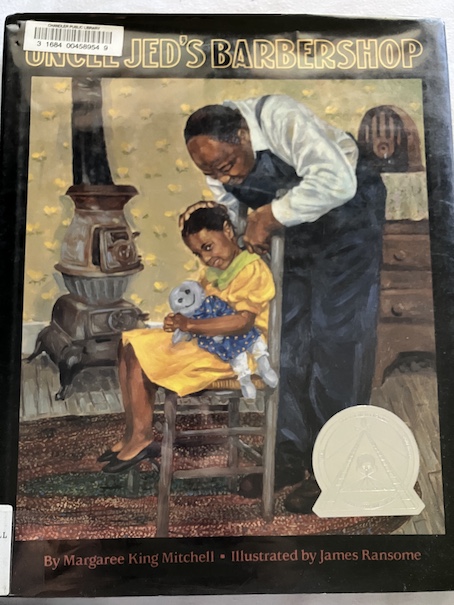
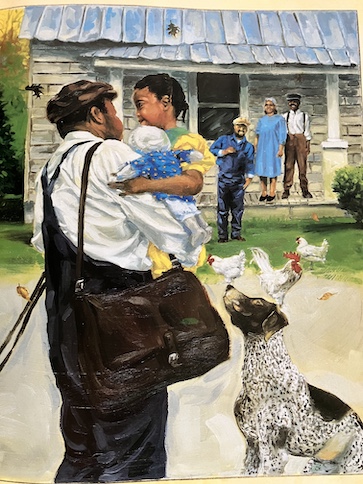
Maniac Magee

Maniac Magee by Jerry Spinelli, 1990.

When the character of Maniac Magee is introduced, he is described as a legend or a tall tale. Even though he is a young boy, his origins are unusual, and people have built up stories around him. The story even admits that his personal story is part fact and part legend.

The truth is that “Maniac” is an orphan. His real name is Jeffrey Lionel Magee, and he was born a normal boy with normal parents, but his parents were killed in a trolley accident when he was only three years old. After that, he went to live with his aunt and uncle in Pennsylvania. However, his aunt and uncle had an extremely dysfunctional marriage. They didn’t believe in divorce, so they stayed married, but they lived a strange, separated life in their house. They divided their home in half so they could effectively live apart, avoiding each other most of the time. They shared Jeffrey by taking turns eating meals with him, but they never ate together as a whole family. Eventually, Jeffrey couldn’t take this weird life anymore, where his aunt and uncle never talked to each other. One day, he blew up at them at a program at his school, and he ran away.

For the next year, Jeffrey seems to have wandered around by himself. Nobody is sure exactly where he was during that year, but he eventually turned up in another town about 200 miles from where he started. He wore ragged clothes and worn-out shoes, but he greeted people with a cheery, “Hi.” One of the first people he meets is a black girl named Amanda with a suitcase, and he asks her if she’s running away. Amanda tells him that she’s not running away, just going to school. Her suitcase is full of books. Jeffrey is fascinated by the books, and he offers to carry her suitcase. Amanda thinks it’s strange that a white boy like him is in an area of town that is almost entirely black, and she asks him who he is and where he lives. Jeffrey doesn’t quite know how to answer her at first because he doesn’t really live anywhere.

He asks her why she carries so many books to school, and she explains that she has younger siblings who color all over everything and a dog who chews everything, so she feels like she has to carry her whole personal library around with her to protect it. Jeffrey begs Amanda to loan him a book. At first, she refuses because she doesn’t know if he’ll give it back, but he swears he will. After they argue about it, Amanda tosses him a book because she has to hurry off to school and can’t take time to argue anymore.

Jeffrey continues to wander around the town for several days. People begin to notice him, how he runs everywhere goes, how he’s always carrying a book, and how he shows off his sports prowess by bunting a frog during a baseball game he joins. He lives in the deer shed at the zoo and eats some of the food for the animals, although he also joins a large family at dinner one night because they’re always taking in people or inviting people to dinner, so one extra person doesn’t attract too much attention. Nobody knows what to call him, so they start thinking of him as that “maniac” and start calling him Maniac.

The bully who threw the frog at him in the baseball game gets angry because Maniac’s bunt ruined his perfect record of strikeouts, so he decides to beat up Maniac in revenge. When he and his friends chase after Maniac, Maniac runs in the direction of the invisible line that divides the town in half, into the white portion and black portion of town. Maniac doesn’t understand the division between the parts of the town, but the other kids do, and they won’t follow him across the line between their part of town and the other part of town. Maniac’s disregard of the racial separations in this town is one of the things that sets him apart from other people and accentuates his oddness. He’s not afraid to share food with a black kid, even eating over the same place where the other kid bit.

When one of the black kids fights with Maniac, trying to get the book away from him, a page is torn. Fortunately, Amanda knows immediately which of them ripped the book. Jeffrey/Maniac reassures her that they can fix the torn page, so Amanda invites Jeffrey home with her. He spends the rest of the day with Amanda and her family. In the evening, Amanda’s father offers to take him home, but Jeffrey doesn’t know how to explain that he lives the deer shed at the zoo. In the car with Amanda’s father, Jeffrey tries to pretend that he lives in a house a few blocks down the street, but Amanda’s father knows immediately that it can’t be true. Jeffrey still doesn’t understand the division in the neighborhoods in town, and the house he picked for his pretend house is in the black area of town. When Amanda’s father presses Jeffrey for an explanation, Jeffrey admits that he doesn’t have a home and explains about his past. Amanda’s father immediately takes Jeffrey back to his family’s house, and Amanda’s mother insists that Jeffrey stay with them.

For the first time in about a year, Jeffrey has a home! Jeffrey gets along well with the family and is good with Amanda’s little brother and sister. He likes reading Lyle, Lyle Crocodile to them. He doesn’t even mind taking baths with the little kids or untying their knotted shoelaces.

Maniac starts feeling at home in the black neighborhood, although he’s still regarded as an oddity. His new family calls him Jeffrey, but everyone else calls him Maniac. He is a strange kid, who turns out to be allergic to pizza and breaks out in a pepperoni-shaped rash when he eats it. He’s a very fast runner and good at sports, and he seems to have a special talent for untying knots. Because of his time spent living in a dysfunctional house where people didn’t talk to each other and his time living alone on the streets, there are many things that Jeffrey doesn’t understand about other people. He doesn’t understand social dynamics and racial issues, and it takes him some time to understand how other people look at him as well as at each other.

One day, when he’s playing with the other kids in the street, an older black man calls him “whitey” and tells him to go home, back to his “own kind.” He doesn’t believe that Maniac lives in the neighborhood. His new siblings tell the old man to go away, and the old man keeps ranting about people belonging with their “own kind” until a woman leads him away. The incident disturbs Maniac. Amanda says that the old man is a “nutty old coot” and that Jeffrey should ignore him, but the incident makes Jeffrey realize that there are some people in the neighborhood who don’t want him there. Jeffrey wants to stay with his new family, and they want him to stay, but Maniac worries that his presence is creating a problem for them. Can he find a way to truly become part of this new family he so desperately needs?

This book is a Newbery Medal winner. It’s available to borrow and read for free online through Internet Archive (multiple copies), and there is also a Literature Circle Guide for book groups and classrooms.

My Reaction and Spoilers

I remember reading this book in class when I was in elementary school. The story is interesting because it’s framed as a tall tale but about a contemporary boy. “Maniac” Magee is described as being a legendary child because of his unusual ability for untying knots and his strange allergy to pizza. No real human being can actually be allergic to pizza because pizza isn’t a single food. There are many different ways of making pizza using various combinations of common ingredients. People can be allergic to some of the ingredients in a pizza, but if they were, that wouldn’t be an allergy to pizza itself, and those people would also be allergic to other types of food containing those same ingredients. That’s not Maniac’s problem, though. He seems to be particularly allergic to just pizza by itself. Maniac does things that are impossible and inherently beyond the normal child in everything he is, even in his defects, a classic tall tale character. One of his famous feats, untying an infamous knot in the neighborhood, is like the legendary Gordian Knot. The story is dressed with humor and tall tale elements, but it has themes that are very serious and even heart-rending.

Tall tale elements aside, this is a story about racial issues and a lonely, neglected child who desperately needs a family and a place to belong. Because the story focuses on Maniac as a tall tale character, the racial issues in the story aren’t immediately obvious, although they begin entering the story as soon as Maniac finds his way to his new town and encounters the girl who will be his new sister. The one thing that Maniac really needs is a stable and loving home. He is an orphan, and he ran away from his aunt and uncle’s home because they were too dysfunctional. As a runaway, he wanders for a time, looking for a better home and people who really care about him. He eventually finds that loving home with a family of a different race. Some people might find it strange that he feels a sense of belonging with people who, on the surface, seem quite different from him, but a sense of family goes much deeper than surface appearances. Maniac himself, on the surface, is a very unusual boy compared to most boys in the world, but deep down, he’s still a kid who needs love, attention, a family, and a place to call home. His new family offers him all these things, regardless of how unusual he is, and what they look like doesn’t matter.

The opposition of some parts of the community messes up this loving home for Maniac partway through the story, and he runs away and spends time on his own again. For a time, he lives in the locker room of a baseball stadium, looked after by a groundskeeper who is an elderly, washed-up baseball player. The groundskeeper, Grayson, passes away during the course of the story, but their friendship helps Maniac to understand some things about people. Grayson was also a neglected child. His parents were drunks, and unlike Maniac, he never learned to read because his teachers never tried to teach him. He was placed in a class with kids who were considered unable to learn because they were troubled or had learned problems. Because his teachers never had any faith in his ability to learn, he never really tried. Maniac is like a grandson to him and opens his eyes to many things before his death.

After Grayson dies, Maniac returns to wandering again, believing that he is jinxed to lose any home he has and anybody he cares about. However, Maniac still cares about other people, and he discovers that other people also care about him. When he tries to introduce a tough black boy to some white boys he’s staying with, hoping to make a connection, it goes wrong, and Maniac starts to think it’s all hopeless. However, when Maniac is unable to help one of the white boys when he’s in trouble and the black boy saves him, the white boys come to see the black boy in a different light, grateful to him for saving one of them and taking care of them. The black boy also comes to look at Maniac differently. When he confronts Maniac about why he couldn’t rescue the boy, Maniac admits for the first time that he’s still haunted by the memory of how his parents died, and the situation reminded him too much of it, so he was unable to handle it. The black boy softens at seeing this human side to Maniac and the other white boys. He’s the one who brings Amanda to Maniac, and Amanda insists that he come home with her. Maniac hesitates at first because he thinks he’s jinxed, but Amanda won’t put up with any nonsense from him, and Maniac comes to realize that they really are a family and that he is really going home.

As a side note, I also remember my elementary school librarian reading Lyle, Lyle Crocodile to my class when I was in first grade. In fact, she said it was one of her favorite books, and she also read others in the series to us. I had forgotten that the book was mentioned in this story, which was published the year after I first heard Lyle, Lyle Crocodile, but it did bring back some nostalgia for me. When Maniac teaches Grayson to read because Grayson never learned when he was a kid, they find well-known picture books on the sale rack at the library, including The Story of Babar, Mike Mulligan’s Steam Shovel, and The Little Engine That Could.

Ben’s Trumpet

Ben’s Trumpet by Rachel Isadora, 1979.

A boy named Ben likes to listen to the music coming from the nearby jazz club at night.

During the day, Ben stops by the club on his way home from school so he can watch the musicians practice.

Ben’s favorite instrument is the trumpet. Ben doesn’t have a trumpet himself, but he imagines that he does and that he can play for his family or play along with the musicians from the club.

Some of the other kids in the neighborhood laugh at Ben for playing an imaginary trumpet, but the trumpeter from the club doesn’t laugh. When he sees Ben playing his imaginary horn, he compliments him.

Later, when he sees Ben watching the club, the trumpeter invites Ben inside and lets him try his trumpet for real.

This book is a Caldecott Honor Book. It’s available to borrow and read for free online through Internet Archive (multiple copies).

My Reaction

I thought this was a nice story about an adult who understands a boy’s dream and is willing to take him under his wing. Both Ben and the trumpeter understand the love of music, and the trumpeter sees how badly Ben wants to be a real musician. We don’t know whether Ben eventually becomes a professional musician or not because the story ends with him trying a real trumpet for the first time, but the story implies that the trumpeter may become a mentor to Ben and that this might be the beginning of Ben realizing his dream.

The book doesn’t give a specific date for the story, but the illustrations and use of terms like “the cat’s meow” indicate that it takes place in the 1920s. The illustrations not only give the story its 1920s vibe, but the abstract lines included in the pictures help to convey the sounds of the music and echo the art deco style popular during the 1920s.

There are a couple of things in the pictures that adults should be aware of. There is one picture where Ben’s baby brother is completely naked, for some reason, and there are adults with cigarettes. Other than that, I can’t think of anything else about the book that would be a cause for concern. There is no specific location given for the story, but it takes place in a city, and all of the characters are African American.

Something Upstairs

Something Upstairs cover

Something Upstairs by Avi, 1988.

This story begins with a famous quote:

Those who cannot remember the past are condemned to relive it.

Santayana

It’s an appropriate quote for the story, which is about memory and a repeated wrong that has led to a seemingly endless cycle of violence. The story is framed as having been told to the author by the boy who actually had this frightening adventure.

Kenny Huldorf is unhappy when his parents decide to move the family from California to Rhode Island. Kenny was happy in California, the weather was much better there, and the streets and buildings in Rhode Island all seem small and old. The house they move into is called the Daniel Stillwell House, and it was built in 1789. Right from the beginning, the house gives Kenny a strange feeling, like there’s something or someone there when there shouldn’t be anyone or anything.

Kenny starts to feel better when his parents give him the big, renovated room with the private bathroom in the attic of the house. He likes that room, but there are two smaller rooms off the attic that haven’t been renovated, and they give Kenny a strange feeling. His parents think they were probably old servants’ quarters. One of them has a stain on the floor that makes Kenny think of death, and even more frightening, Kenny gets an odd sense that, somehow, it’s a death he may be responsible for. For a time, Kenny tries to tell himself that it’s nothing but an old stain and occupies himself with unpacking and getting settled. Since school hasn’t started yet, Kenny gets bored and does some exploring of the area. He starts wondering about the history of the town and the house.

Then, one night, Kenny hears a strange sound from the room with the stain. When he goes to investigate, he sees a pair of ghostly, glowing hands reaching up out of the stain on the floor. The hands pull the rest of the ghostly person out of the floor, and Kenny can see that it’s the figure of a boy. When the boy tries to reach out to him, Kenny reacts defensively, and the ghost boy seems frightened and vanishes. The next day, Kenny asks his parents if they believe in ghosts. His father says he doesn’t but that Providence is a very old town and a lot of things have happened there over the years. His mother later says that she doesn’t really believe in ghosts either, but she believes that places have memories. Kenny’s parents conclusions seem to be that Kenny is sensing the general history of the town, but Kenny feels that it’s something more specific than that, that the ghost he saw is a specific person from a specific incident in the history of the house.

The family was given a scrapbook with a list of former owners of their historic home, so Kenny decides to do some research about the past owners and see if he can learn more about where the ghost came from and who it is. When he arrives at the local Historical Library, Kenny is surprised to find out that someone there is expecting him. He is directed to the office of an historian named Pardon Willinghast. Willinghast tells Kenny that he keeps track of the owners of historic homes, which is how he and others at the library recognized his last name, and he expected that someone from the Huldorf family might come to ask about the house. Kenny gives him the list of past owners and asks what Willinghast can tell him about them. Willinghast looks at the list of names and says that there probably won’t be much about them in the library but that he’ll do some research and see what he can find. Kenny also gets the idea to have the local pharmacy test a sample of wood from the stained floor to find out what the stain is.

The next time Kenny sees the ghost, he tries to talk to the ghost boy and ask him who he is. The ghost has trouble talking but manages to communicate one word: “slave.” The pharmacy tells Kenny that the stain on the wood is human blood. They can tell that the stain is more than 100 years old, which is why they haven’t reported it to the police, like they’d have to with a recent blood stain. When Kenny talks to Willinghast again, he wants to know about people who lived in his house over 100 years ago who might have owned slaves, which limits the scope of his investigation to the first three families who owned the house. Willinghast is oddly vague in his reply, and when the subject of abolitionists comes up, he makes vague references to “agitators” and people who want to “rush history.” When Kenny tries to ask him about a murder that may have occurred in the house, Willinghast becomes agitated himself and tries to discourage Kenny from inquiring further. He says that if a slave was murdered, it probably wouldn’t even have been reported in a newspaper because it wouldn’t have been considered important.

However, now that Kenny understands that a young slave was murdered in his house and is still haunting it, he can’t leave the situation alone. He continues trying to communicate with the ghost boy, and the ghost gradually finds it easier to talk to him. He says that his name is Caleb and indicates that he is tied to the stain on the floor. He can’t seem to move very far from it. He says that he’s a memory of what happened there. He is aware that he was murdered, but he doesn’t know who did it because he was killed in his sleep. He senses that he was killed by someone who wanted to keep him a slave because he and other black people were trying to free themselves from slavery. Kenny asks Caleb if there’s anything he can do to help him, and Caleb asks him to find his murderer. Kenny asks how he can do that when the murder happened so long ago.

Then, the attic changes, and Kenny finds himself back in the past, in Caleb’s time. Kenny looks out the window and sees a strange man in a black cape watching the house. As he explores the town, he witnesses a public argument about slavery and someone asks him to deliver a note. The next morning, Kenny is back in his own bed, in his own time. When Kenny talks to the ghost again, he describes what he saw in the past, and Caleb recognizes these events and people as being part of the circumstances that led to his death. He has trouble believing that Kenny really cares about what happened to him so long ago. He says that white people have broken their promises to him before, but Kenny insists that he does care and that he wants to not only solve his murder but prevent it so Caleb can finally be free from haunting that room.

However, that’s going to be even more difficult than Kenny thinks. On his next trip into the past, he discovers who their true enemy is: Pardon Willinghast. Willinghast isn’t just an historian. Almost like Caleb, Willinghast is memory, a piece of the past that keeps coming back to haunt the people who live in Caleb’s old house and who have tried to help Caleb before. Willinghast has figured out that if someone from the future comes to the past and they lose something they’ve carried with them or if they get hurt or change themselves in some way, they can get stuck in the past, seeming like ghosts to the people there. (Or, so he says.) He has used this knowledge before against other people who have tried to help Caleb, blackmailing them into helping him instead. Now, he has the lucky key chain that Kenny always carries with him. Until Kenny gets this key chain back, he’s stuck in the past, and Willinghast won’t return it until Kenny does what he wants. In fact, he implies that Kenny is already doing what he wants, leaving Kenny to wonder if he’s accidentally leading Caleb into a trap while trying to help him escape from one.

Kenny set out to help Caleb, but he’s in danger of becoming a part of the same cycle of murder that has been repeated over and over for almost 200 years. As Kenny tries to help Caleb, he knows he’s being manipulated by Willinghast into playing a role in a very old story, but since he doesn’t have a copy of the script, he struggles to figure out what has to change to break the cycle. Can he find a way to break cycle and escape without either himself or Caleb losing their lives?

Th book is available to borrow and read for free online through Internet Archive (multiple copies).

My Reaction and Spoilers

This is a book that I remembered from when I was a kid, but strangely, I’m sure that I never heard the end of it back then. I’m having trouble remembering exactly why I never heard the end. I think it might have been one that a teacher was reading aloud, and maybe I was absent the day she finished it. Either that, or I started reading it myself and chickened out before the end because I was spooked.

This book poses a kind of “gun-to-your-head” type of decision, forcing both Kenny and the readers to consider what they would do if they were forced to make a choice between two horrible options. In this case, Kenny is put into the position of being pressured into committing a murder or being trapped forever in the past. Willinghast committed the original murder, and he tells Kenny that the only way he’ll return his keychain to him and let him go home is if he shoots Caleb himself this time. Willinghast is confident that he can force Kenny to do what he wants because he’s done the same to others before him. Other past owners of the house have tried to help Caleb before, but Willinghast has manipulated each of them into betraying Caleb and shooting him instead. These are the betrayals that Caleb referred to earlier. Willinghast claims that each of these people has lost their memory of what they’ve done when they return to their own time, so Kenny won’t have to worry about feeling guilty about killing Caleb. But, if Kenny gives in, he knows that Caleb will remain a ghost, and someday, someone else will also be in Kenny’s position, another pawn in Willinghast’s sick game of endlessly repeated murder. As long as Willinghast gets his way, not only is Caleb going to be his perpetual murder victim, but every person who tries to help will continue to be victimized and forced to participate in his bloody crime.

There is also a deeper theme to this story. Violence begets violence, and hate begins hate. Murder, revenge, hatred, and yes, also slavery and racism, are part of violent cycles that draw other people into them long after the original deed was done. People are haunted by the past in many ways … especially those who feel like they’ve got something to prove about it. It’s a theme that’s been very much on people’s minds in the early 21st century, and there are many, like Kenny, who are unwilling to be pulled into going along with violence, murder, racism, and everything that goes with it just to save some past people’s public images or some modern people’s egos.

Willinghast has correctly realized that the reason why he’s able to come back is because he’s a part of Caleb’s memory as his original murderer. Every time Caleb’s ghost tries to solve his murder and change the past, Willinghast gets reawakened to interfere. In his role posing as the historian, he rewrites the accounts of Caleb’s death in the archives to trick the people trying to help him. He’s not about truth but manipulation, much like the pseudo-historians who resurface to tell “their truth” when certain controversial topics come up. He has a vested interest in lying to cover up his own shameful deed and to force others into helping him get things his way. Willinghast does not care either about accurate history or about the welfare of future generations; he only uses them to cover up his own misdeeds. He’s used other people to repeat his dirty work before, and he’ll do it again, blaming Caleb each time for bringing it on himself by trying to survive instead of just accepting his own murder and staying dead … unless things are different this time around. The violence ends when someone finally says no and refuses to play along. So, what Kenny is really looking for, in this situation where he seems to be given a choice between two horrible options, is a third option that allows both him and Caleb to escape.

Because the story is framed as one being told by Kenny to the author later, readers know from the beginning that Kenny finds another solution to the problem that doesn’t include murdering Caleb or being trapped in the past as a ghost. The suspense comes from the readers wondering how he’s going to do that. Kenny’s solution isn’t entirely peaceful (spoiler) because he ends up shooting Willinghast, but that could be seen as an act of self-defense, not only saving himself but also Caleb and all of Willinghast’s future victims. It seems like eliminating Willinghast was the only way to end the cycle of murder because it wasn’t really Caleb’s attempts to save himself or bring his murderer to justice but Willinghast’s attempts to cover up his crime that kept the cycle going. Willinghast blames Caleb for trying to avoid being murdered, but the truth is that it’s his original act of murder that created this situation from the beginning and his continual cover-up and recruitment of unwilling abettors that has kept the cycle going. Readers can debate whether there was another way to solve the problem, but once Willinghast is gone, the cycle is broken.

Some might also point out that the reason why Willinghast targeted Caleb in the first place was that Caleb shot one of Willinghast’s associates first, but the reason why Caleb did that was that Willinghast’s associates were violently targeting a black neighborhood, and Caleb was trying to hold them off. Once again, violence begets violence until someone decides not to participate. In the end, Kenny commits a violent act, but the cycle ends because he gets the one person who was at the center of all of the other violence from the beginning. Kenny also remembers everything that happened when he returns to his own time, which brings up a point that I’ve already mentioned but I’d like to explain in more detail: Willinghast is a liar.

The only reason why Kenny knows, or thinks he knows, that Willinghast has power over him and can prevent him from returning to his own time as long as he holds one of his belongings is because Willinghast says so. Nobody else in the story says that, and frankly, Willinghast is a known liar. He was never a real historian. He’s only another ghost from the past masquerading as one to trick people into doing his bidding. He fakes historical records to manipulate people. He is an admitted murderer. He said that Kenny wouldn’t remember what happened in the past when he returns to his own time, so he wouldn’t have to feel guilty about shooting someone, but Kenny remembers everything. This didn’t occur to me when I first encountered this story as a kid, but looking at it now, I can’t help but think, why the heck should Kenny believe anything that Willinghast says about how the time travel works?

At the point in the story where Willinghast tells Kenny that he’s trapped in the past as long as he has his key chain, Kenny already been to the past once and returned from it without either Willinghast’s help or interference. Kenny did not get to the past by Willinghast’s power, but through Caleb’s memories. Willinghast was counting on Kenny to be frightened and confused so that he would rely on his word for what’s going to happen to him in the past and feel like he had something real to lose for not going along with his plans, but even as I read the story, I doubted him. I think what he said about Kenny needing his key chain to return home might have just been another of Willinghast’s lies. I don’t recall seeing anything in the story that proved that Willinghast was right, and it seems that none of his other victim/accomplices put his lies to the test to find out. There is no one else trapped in the past as a ghost because we never see any such people in the story. So, if that hasn’t actually happened to anyone before, how would Willinghast or anyone else know that such a thing was even a possibility?

The fact that Kenny remembers shooting Willinghast also suggests that everything Willinghast said may have been a lie. He claimed that none of the other time travelers retained their memories, so Kenny wouldn’t remember if he shot Caleb. If Kenny wouldn’t remember shooting Caleb, how would he be able to remember shooting Willinghast? Unless Willinghast needs to be alive after Caleb’s death to rewrite people’s memories, it sounds like the idea that Kenny wouldn’t remember what happened in the past was a lie. We never see or hear from the other people Willinghast manipulated, so we don’t know for sure that they had no memories or guilt over what happened. That could be another subject for debate among readers, but from what I saw in the story, I’m thinking that Willinghast should be considered a liar on everything he said. I think the real trap wasn’t that Willinghast was holding Kenny in the past so much as Willinghast was making Kenny believe that he was. Although he tried to make Kenny believe that he only had two choices, Kenny himself found a third one. Perhaps there were other possible choices, but we know that there was at least one more option than Willinghast led Kenny to believe he had.

Because there are violent themes in this story, it isn’t for very young kids, but it does combine some historical details with excitement for kids who enjoy scary stories. There is also some use of the n-word on the part of the villains in the story, so be warned. The story is thought-provoking on the subjects of history and personal choices.

In the end, after Kenny has finished telling his story to the author, he says that he knows that Caleb survived the room where he was murdered before and no longer haunts it. Caleb ran away after Willinghast was dead, but Kenny doesn’t know where he went after that or what happened to him. He finds himself worrying that the violence caught up with him again somewhere else and that maybe he’s just haunting a different house now because the memory of all that was done to him will never end. This is the final question the story leaves readers. Is that how it really is? Is there an end to the wrong, or are Caleb and others like him still ghosts who haunt us all?

This story reminds me somewhat of a YouTube video made by Kaz Rowe in 2022 about the history of ghost hunting. While talking about the history of belief in ghosts and our society’s fascination with ghosts and ghost stories, Kaz Rowe points out that many of our historical American ghost stories focus on moments when our society failed and innocent or vulnerable people suffered. The ghosts that haunt our society often represent unresolved situations – unpunished crimes, unacknowledged injustices, perpetuated wrongs, and tragedies that can’t be undone. There is a feeling that there was more that our society could have done and should have done to prevent needless death and suffering, and that’s probably true. Perhaps some of these problems were the result of people who thought (or convinced others) that they only had one option or just one choice between two bad options – black-and-white thinking, if you will – so they made terrible choices, never considering or choosing to acknowledge that there might be other ways. One of the difficult parts of studying history is considering the choices not made and the things people of the past left undone. It does create an unsettling a sense of the unresolved, that the past is still with us and haunting us today. What Kaz Rowe was talking about is that part of the interest in communicating with ghosts is that sense of the unresolved. There were people in the past who needed help and didn’t get it, people whose voices weren’t heard when they needed someone to listen, and people who suffered when no one seemed to care. When people reach out to ghosts, they seem to be saying that, even if no one heard them or cared about them in their time, someone does care now and wants to hear what they have to say. We don’t have the ability to go back and change the past, like the character in the story, but there may be the hope that caring and listening can, in some way, offer peace to the ghosts of the past because someone finally understands what they went through and how they felt.

Do I think Caleb and others are still haunting us? Yes, after a fashion, I think so. There is the haunting feeling of a past that can’t be changed or entirely made right. Caleb isn’t haunting Kenny’s house anymore, but he is haunting Kenny’s mind because of the shared trauma of what they went through and Kenny’s lingering fears about Caleb’s life after the events.

In that sense, I would say that maybe the ghost hunters have it right. Maybe the best thing to do with the ghosts of the past is not to be afraid of them but to pay attention to them and see them and their situations for exactly what they were. The haunting in the back of our minds comes from our inability or unwillingness to see what we can sense is there and is begging to be seen. That feeling comes from the human impulse to investigate and understand. It’s the unknowables and uncertainties in life that are the most frightening. When you know, even when you know the worst, you stop worrying so much about it. There are no more unanswered questions and things that just don’t add up, the questioning little voices in your head fall quiet, and the ghosts have nothing more to say because they’ve been heard and seen.

The Dark-Thirty

The Dark-Thirty: Southern Tales of the Supernatural by Patricia C. McKissack, 1992.

There are ten short, scary stories in this book, not thirty. The author explains in the beginning that the name of the book comes from an expression kids used when she was young. The “dark-thirty” was the last half hour of light before it became truly dark outside, when the kids had to hurry home so they wouldn’t be out after dark, when the monsters came out. The author was African American, and the stories in this book have African American themes. They were based on stories that the author heard from her grandmother when she was young.

This is a book that I remember a school librarian introducing to us when I was in elementary school, probably around age 10 or 11. My memories of it are a little vague. I had forgotten most of what the stories were about, although the title stuck with me, and I remembered thinking that I should read it again someday. I have to admit that most of the emotions that I experience while reading this book as an adult were anger and frustration. The sad truth is that those are the emotions that permeate much of African American history, from the harsh conditions of slavery to the injustices of racism, and those are the aspects of the stories that stand out to me most as an adult. As I recall, I did think more about the ghost parts of the stories when I was a kid, but I didn’t have as deep an understanding of the background of the stories then. Maybe part of the lesson here is that human monsters are more terrifying than anything supernatural, partly because it’s the people who are or should be closest to you in a shared humanity are the ones who have the most opportunity to cause harm, if that’s what they’ve decided to do. That’s a rather dark thought, but these are dark stories with dark themes.

On a lighter note, I found the stories that introduced pieces of folklore fascinating. I’ve had an interest in folklore since I was a kid, which is part of why this book stuck in my mind for so many years.

I wouldn’t recommend this book for kids younger than 10 years old because of the dark themes. There is also derogatory racial language in the stories (including the n-word), particularly used by the villains, which helps show why they’re villains. I think, before kids are ready for this book, they need to have some background information on the subjects of racism and slavery to understand what’s going on, and they should also know that there are certain words they shouldn’t use themselves, even if other people do.

The book is a Newbery Honor Book. It’s available to borrow and read for free online through Internet Archive.

Stories in the Book:

The Legend of Pin Oak

The story is set during slave days. Harper McAvoy, a plantation owner, has resented one of his slaves, Henri, since they were both young. Harper was neglected by his father after his mother died giving birth to him, and years later, when his father finally returned to their estate, called Pin Oak, he learned that his other had another son with a free black woman, Henri. Their father had hoped that the two boys might be friends and that Henri would help Harper run the estate one day, but Harper always resented Henri for being more like their father than he was and for receiving the attention that his father never showed him. After their father died, Harper thought that he could sell Henri and be rid of him forever, but Henri has actually been a free person all along because his mother was free.

When the slavers try to take Henri anyway, he and his wife run away with their baby. They apparently die jumping to their deaths at a waterfall, although some say that they actually turned into birds and flew away while Harper is killed pursuing them. Others think that Henri and his family may have survived by jumping into a cave behind the waterfall, although there is evidence that Henri didn’t know there was a cave there. Their fate is left ambiguous.

We Organized

As part of the government’s effort to get people back to work during the Great Depression, the Library of Congress employed writers to record the stories of people who had been slaves. This chapter is a poem based on one of those stories.

Justice

This story is about the Ku Klux Klan. A wealthy and influential man called Riley Holt is murdered. The identity of the murderer is unknown, but local people are so shocked and angry at the crime that they are determined to get “justice” … one way or another. A bitter and suspicious local man called Hoop Granger blames a young black man named Alvin Tinsley. However, Alvin has an alibi, and the chief of police, knowing that Hoop is a bully and a liar and has a history of pushing Alvin to take responsibility for things he’s done himself, asks Hoop if he has an alibi, too. He says that he was working at his service station and his friends will vouch for him, but Chief Brown doesn’t think much of any of them as witnesses.

Hoop is a member of the KKK, and to throw suspicion for the murder from himself, he convinces his fellow KKK members that Alvin is guilty and needs to be punished. They capture Alvin and lynch him, but before Alvin dies, he promises to come back and prove his innocence. Hoop and his friends tell everyone that Alvin hanged himself after confessing to Holt’s murder. Not everyone in town believes the story, but they have no way of proving it’s a lie, and the authorities seem satisfied with the explanation (mainly because the mayor’s son was also part of lynch mob, and the mayor is forcing everyone to cover for him). However, Hoop can’t forget what Alvin said about coming back to prove his innocence. He seems haunted by Alvin’s words. Soon, he starts seeing things and becomes convinced that Alvin is coming back for him. Is it really a restless spirit or Hoop’s own guilty conscience?

The 11:59

This story is about train travel and the Brotherhood of Sleeping Car Porters. The Brotherhood of Sleeping Car Porters had stories that they liked to tell each other, like this story about a phantom train called the Death Train or the 11:59.

A retired porter enjoys telling the younger porters stories about how the Brotherhood was formed and the truly great men among the porters. Many of his stories are tall-tales. One of his stories is about the 11:59. When a porter hears the whistle of this phantom train, he only has 24 hours left to live, and nobody can escape it. Not even old Lester.

The Sight

There’s an old superstition that babies who are born with a caul over their heads will have psychic abilities and could be able to see the future or spirits. A boy named Esau gets “the sight” and is able to tell the future from a young age. However, people with “the sight” have to be careful who knows they have that power because some people will try to use them for unethical purposes, which might cause them to lose their gift, and Esau’s father is a con man. Esau knows that his father can’t be trusted, but when he feels compelled to warn his father of danger, his father learns what Esau can do. His father forces him to help him win at gambling with his gift until the gift finally fades. Then, his father deserts him and his mother. Esau’s mother says maybe it’s just as well to lose the sight, and Esau agrees, not liking it when he sees that bad things are about to happen.

Years go by, Esau grows up, and he eventually becomes a soldier in WWII. He manages to make it home safely, but he is surprised by the sudden return of his gift just in time to save his family.

The Woman in the Snow

This story involves the bus boycott in Montgomery, Alabama in the 1950s.

Grady Bishop, a white man with a bad history and a chip on his shoulder, has recently started working as a bus driver, although he’s never happy when he has to take the less prestigious route through the city, where a lot of black people catch the bus. Driving makes him feel powerful, but he considers this route beneath him.

One day, during a bad snow storm, a poor woman with a sick baby begs him for a ride although she doesn’t have money to pay. She’s afraid if she can’t get the baby to the hospital, she’ll die. Grady refuses to give her a free ride, convinced that she’s making too much out of nothing and just trying to get a free ride. Later, he hears that the woman and baby froze to death in the storm. A year after that, he sees the same woman again on the same route. Startled, Grady crashes his bus and is killed.

Years later, a black bus driver has that route, and other drivers tell him about the ghost lady with the baby that they see whenever it starts snowing. He becomes the last person to see the ghost lady … because he’s the first to give her a ride.

The Conjure Brother

This story explains that “conjure women” were women who sold herbal cures and practiced folk magic to help people change their luck.

A girl named Josie is tired of being an only child and wants a brother. However, her mother shows no signs of being pregnant, even though Josie keeps asking her for a brother. When she hears a couple of women talking about the local conjure woman, Josie decides to go see her and ask if she can help her get a brother. The conjure woman gives her a set of instructions to follow, but Josie performs the ritual too early at night. Instead of getting a baby brother, Josie gets an older brother, called Adam. Her parents act like Adam has always been their oldest child. Adam is bossy, and some of the things that used to belong to Josie now belong to Adam. Josie starts to think of Adam as a pest and returns to the conjure woman to ask her to do something about Adam, but instead, she learns an important lesson about sharing her life and house with a sibling.

Boo Mama

This chapter talks about the tumultuous times of the late 1960s and the assassinations of Martin Luther King, Jr. and Robert Kennedy. Some people felt so overwhelmed by everything that was going on that they just wanted to “drop out” of society and ignore the chaos around them.

Leddy has been a social activist since she was in her teens, but then, her husband is killed in the war in Vietnam, leaving her with a young child. After the deaths of Martin Luther King, Jr. and Robert Kennedy soon after her husband’s death, Leddy feels completely overwhelmed. She’s been putting forth all of the effort she has for a long time, and the deaths of the man she loved and the people who inspired her feel like too much. She has a breakdown and starts questioning whether everything she and her friends have done has really accomplished anything. Deciding that she needs a change of scene for her and her son, she moves to a rural community in Tennessee.

At first, her young son seems to do better in the countryside, and Leddy finds the change of pace relaxing, but then, her young son disappears. He wanders away while his mother is hanging out the laundry. The locals put together a search party. They search for days, but all they can find is the boy’s teddy bear. Everyone is convinced that he’s dead, but Leddy can’t give up hope that her son is still alive. Her son does turn up, but he is strangely different. Where has he been, and what has happened to him?

The Gingi

There is an old superstition that “Evil needs an invitation.” Among the Yoruba people of West Africa, there is a belief that evil spirits need someone to welcome them into a house before they can enter, so they will try to trick unsuspecting people into giving them an invitation. They use special talismans called gingi to guard against evil.

A woman named Laura is fascinated by a strange statue that she sees in a shop window. However, when she tries to buy it, the shopkeeper says that she’s never seen it before and warns Laura that evil spirits sometimes disguise themselves to trick people into taking them into their homes. Laura thinks this is just superstition and insists that she wants the statue. The shopkeeper charges her a price that’s too high to discourage her from buying the statue, and it almost works, but for some reason, Laura feels compelled to buy it and pays for it anyway. Seeing that she can’t prevent Laura from taking the statue, the shopkeeper insists that she take a small complementary talisman and keep it with her. The talisman is a small doll, and she gives it to her young daughter to play with.

The Chicken-Coop Monster

The final story in the book is semi-autobiographical, inspired by the author’s feelings when her parents got divorced when she was a child.

A young girl named Melissa is upset about her parents’ divorce. Her parents send her to stay with her grandparents in Tennessee while they’re sorting things out, but she becomes convinced that there’s a monster living in the chicken coop on her grandparents’ property. She and her friends are part of a group called the Monster Watchers of America. Melissa’s grandmother doesn’t believe in the monster, but her grandfather teaches her an important lesson about facing up to life’s monsters.

Famous American Negros

Famous American Negroes by Langston Hughes, 1954.

I sought out an electronic copy of this book because I don’t own a physical one, and after I found out that it existed, I knew that I had to cover it at some point! The book is part of a series of biographies for children that I covered earlier, but what caught my attention was the author of the book, Langston Hughes, the famous poet of the Harlem Renaissance of the 1920s and 1930s. I mostly knew Langston Hughes for his poetry, and I wasn’t aware that he had written any children’s books until I found out that he had written several biography books for this series. When I found out that he specifically wrote books about African Americans and other notable black people from history, it occurred to me that he might have even written biographies of people he knew personally because of the circles he traveled in.

This book focuses on prominent African Americans through history. It contains a series of short biographies and profiles, beginning in the Colonial times and continuing into the mid-20th century, when the book was written. Some were contemporaries of Langston Hughes, but since the biographies are brief and focus only on providing an overview of the subjects’ lives, there is no indication whether Hughes ever met any of them himself. I was a little disappointed about that because I would have enjoyed hearing a personal perspective, but the personalities covered are still fascinating. I also enjoyed how some of the earliest biographies in the book relate to some of the later ones because of the influence some of the earlier people had on the lives of others.

If you’re wondering why he uses the term “Negro” instead of “African American”, it’s because that term was one of the more polite and acceptable terms during his youth and around the time when he wrote this book. (That’s why the UNCF, or United Negro College Fund uses it as well. It was one of the polite terms in use at the time of its founding.) It sounds a bit out of date to people of the 21st century because, around the time of the Civil Rights Movement, which began around the time this book was written, people began advocating for a shift in the words used to describe black people. They wanted to distance themselves from old attitudes about race by using newer terms that didn’t have as much emotional baggage attached to them. This is when terms like “colored” and “Negro” feel out of use and were replaced by “African American” as the correct, formal term to specifically describe an American with African ancestry and “black” (considered somewhat impolite a century earlier, as I understand it, see the Rainbow and Lucky series for an example – I discussed it in the historical description of the 1830s) as the generic term to describe a person with dark skin and African ancestry, regardless of their nationality.

Because this book was written in the mid-1950s, some of the information included is long out of date. People who were alive when Langston Hughes wrote the book are obviously not alive now, almost 70 years later. There are more recent books that cover the same topic and include information about late 20th century and early 21st century musicians Langston Hughes wouldn’t have known about. However, this vintage book is still interesting because of its famous author and because it was written at a turning point in American history, when society was changing and racial issues were being challenged.

The book is available to borrow and read for free online through Internet Archive.

The biographies included in the book are:

Introduction

The book begins with a brief history of black people in America. Langston Hughes points out that histories of African Americans often begin with slavery, but there were people of African ancestry who came to the Americas before that, not as slaves. Some traveled with explorers from Europe as members of their crews and expeditions.

After the slave trade began, slavery affected the lives of black people throughout the American Colonies and, later, the United States. Some slaves managed to find ways to take their fate into their own hands by running away, and of those, some helped others to escape to freedom. Some slaves were able to hire themselves out for wages on the side and saved up enough money to purchase themselves and gain freedom in that way. Some slaves were even freed by the the people who owned them, although others simply lived and died in slavery.

After the end of the Civil War and the end of slavery, former slaves were free to pursue their own destiny, but they were in a precarious position because they had no resources from which to start building their independent lives. Slaves had work experience, but much of their experience was in unskilled labor, which brought low wages. Most slaves had no education. (In many places, it was illegal to teach slaves to read. There were a few exceptions, and some people skirted the law, but this was a major problem for many formerslaves once they were granted their freedom, lacking an essential skill.) They had no money or land of their own. Getting established in their new lives meant building something from nothing or almost nothing, and it was a long, uphill struggle.

Even generations later, racial discrimination added obstacles to the lives of African Americans. The biographies in this book are about people who triumphed over the obstacles in their lives to leave a lasting mark on society.

Phillis Wheatley (c. 1753-1784) – Whose Poetry George Washington Praised

Phillis Wheatley was brought to the American colonies from Senegal as a slave when she was only a small child (approximately age 6 or 7 because she was still losing baby teeth when she arrived). Phillis was not her original name, but it is unknown what her original name was, exactly when she was born, how she became a slave, or what happened to her parents. She was purchased by a tailor named John Wheatley in Boston to be a servant for his family, and the Wheatley family gave her the name Phillis. When she first arrived in Boston, Phillis could not speak England and no one could speak Senegalese, so it was some time before anybody could truly communicate with her, which is part of why we know so little about her earliest years.

Fortunately, the Wheatley family was kind and even nurturing toward Phillis. Even though they purchased her to work for them, they cared about educating her. They taught her read and write, even though it was discouraged to teach slaves those skills and even illegal in some areas. When Phillis learned English and was able to read and write, it soon became apparent that she had a talent for poetry. The Wheatleys supported her poetry, and the granted Phillis her freedom in 1772. By the time she was about 21 years old, her poetry had been printed all over the colonies and in England. Although her poetry was successful, Phillis’s life took an unfortunate turn when she married a ne’er-do-well, and she died in poverty.

Richard Allen (c. 1760-1831)- Founder of the African Methodist Episcopal Church

Sometimes, slave owners used Christianity as an excuse for slavery, claiming that they were saving the souls of heathens. However, even though they converted slaves from Africa to Christianity, they didn’t provide much opportunity for their slaves to have religious worship. Richard Allen was born into a slave family in Philadelphia, and he was a child when he was sold to a farmer in Delaware. When he grew up, he became a Methodist preacher, and his owner let him perform religious services for the other slaves. He also became a wagon driver during the Revolutionary War and earned enough money to buy his freedom.

Once he was free, he returned to Philadelphia as a preacher. There was no Methodist congregation that was only for black people at that time, so he sometimes preached for a mixed congregation. However, some of the white members of the congregation protested to his presence as a black preacher, and some also objected to the presence of the other black parishioners as well. When Allen and a couple of friends were interrupted while praying one Sunday and told to leave the church, Allen realized that the only way any of them would be able to worship in peace would be to form their own group. The society he and his friends formed was the Free African Society, and that group went on to found the Bethel Methodist Episcopal Church. They were among those who helped to tend the sick and bury the dead during the yellow fever epidemic that struck the city in the 1790s.

Ira Aldridge (1807-1867) – A Star Who Never Came Home

Ira Aldridge was the son of a Presbyterian minister in New York. Aldridge started acting at a young age and became part of a black theater troupe, performing in a theater close to the African Free School he attended and the famous Fraunces’ Tavern (mentioned earlier in Phoebe the Spy, this book says that it was owned by a black family but other accounts say that the Fraunces family was mixed race – it has never been firmly established which is more accurate). His father wanted him to further his education, so he sent him to the University of Glasgow in Scotland, which accepted black students. It is unknown whether Ira Aldridge ever completed his degree there, but from there, he went to London to continue his acting career and won acclaim for his portrayal of Othello at the Royalty Theater. Ira Aldridge toured Europe and gathered a prominent following, even winning awards from some of the royal families of Europe. The reason why he never returned home was that he remained in Europe for the rest of his life, still touring as a successful actor up until his death at age 60.

Frederick Douglass (c. 1817-1895) – Fighter for Freedom

Frederick Douglass was born into slavery, originally with the last name of Bailey. In most cases, we know very little about the early lives of individual slaves because few slaves could read and write and their owners didn’t think it was important to even record their birth dates. Frederick Douglass is an exception because he learned to read and write and later wrote his famous autobiography. (The autobiography is now public domain, and you can read it for free online in many places, including Documenting the American South, Project Gutenberg, and Internet Archive (multiple copies). The reading level isn’t difficult, although parts are emotionally wrenching.) His autobiography contains many details of his early life (although even he never knew his own birth date, which is why we can only estimate). The description that follows is a brief summary of both the chapter in this book and the contents of his autobiography:

Frederick’s mother was a slave, but his father was a white man (or in some sources I’ve seen, possibly mixed race). (The book doesn’t identify his father, and his identity has never been definitely established, although there are theories. According to the Library of Congress, Frederick’s “Mother is a slave, Harriet Bailey, and father is a white man, rumored to be his master, Aaron Anthony.”) Because his mother had to work in the fields all the time, he rarely saw her when he was a child. (This book doesn’t mention it, but Frederick’s mother died while he was still young.) He was raised by his grandmother during his earliest years and later by a woman who abused and neglected her young charges. Then, young Frederick was sent to live with and work for another part of the family who owned him in Baltimore. At first, the mother of family was nice to Frederick and gave him his first reading lessons, but her husband put a stop to that, telling his wife in Frederick’s presence that if a slave learns to read and write, they’ll probably run away. Frederick managed to continue his reading lessons in secret with the help of some of the white children in the neighborhood. His new skills did help him to learn more about human rights and what freedom meant, and he also learned about the existence of abolitionists. Newspapers in Baltimore called abolitionists anarchists and accused them of being in the service of the devil, but young Frederick began to see them as possible allies.

As a teenager, Frederick was sent to live with a different branch of the same family in a smaller town. This family became suspicious of him when they found out that he could read and write and that he had joined a Sunday school that was run by a free black man. They decided to send Frederick to a man named Covey who was a “Negro breaker“, which was someone who would “tame” slaves by “breaking” them physically, mentally, and spiritually. In his autobiography, Frederick states that Covey did break him and very nearly killed him, but after a particularly vicious beating at Covey’s hands, Frederick realized both that he couldn’t take anymore and that he wasn’t going to take any more. He fought back. That’s when he began planning to run away. Somehow, plans of his escape leaked out, and he was sent away to work in the shipyards in Baltimore. There, he disguised himself as a sailor, borrowed some papers belonging to a sailor, and sneaked onto a train headed for New York.

When he arrived in New York, he was free, but he wasn’t quite sure where to go or what to at first. He had no place to stay and didn’t know anybody he could trust. Fortunately, a real sailor gave him a place to stay and helped him to connect with a society that helped escaped slaves. He found a job on the wharves and gave himself the name surname Douglass.

What truly makes Frederick Douglass famous is not just that he escaped from slavery, but once he did so, he wanted to help others gain their freedom. He became an abolitionist and gave public talks about slavery alongside many other famous abolitionists. When he met with violence, he moved his family to Canada, but he returned when the Civil War broke out to meet with President Lincoln. His sons became Union soldiers, and after the war, Frederick Douglass held various government offices, including US Marshall, Recorder of Deeds for the District of Columbia, and US Minister to the Republic of Haiti.

Harriet Tubman (c. 1823-1913) – The Moses of Her People

Like Frederick Douglass, Harriet Tubman was born as a slave in Maryland, but unlike Frederick Douglass, she had no early education. From an early age, she had a willful and rebellious personality, which was part of the reason why she was assigned to work in the fields instead of the house. One day, another young slave had gone to a local store without permission, and the overseer decided to whip him. He told Harriet help him to tie up the young slave first. When she refused to do it, the young slave ran away. I’m not completely clear on whether what happened next was deliberately aimed at Harriet or whether she was just in the way when the overseer tried to vent his wrath, but what is known is that the overseer picked up an iron weight and threw it. The weight struck Harriet in the head, cracking her skull. Harriet almost died of the injury and spent days lying unconscious. She eventually recovered, but she never recovered completely. Throughout the whole rest of her life, she bore a scar from the injury and would suffer from periodic seizures and sudden loss of consciousness. Her owner thought that the head injury had left her with diminished intelligence, which wasn’t true, but Harriet realized that it was useful to let him think that.

A few years later, her owner died, and she found out that she and two of her brothers were going to be sold to someone else. At first, they planned to run away together, but her brothers backed out of the plan, and Harriet left by herself. She managed to make her way to Philadelphia, found a job there, and established a new life. However, she didn’t stay in Philadelphia. She returned many times to help other people escape as one of the “conductors” on the Underground Railroad. Her own parents were among the people she rescued, and she never lost any of her “passengers” (partly because if anybody started to panic or turn back, she’d threaten to shoot them, but it worked without her actually shooting anyone). When the Civil War began, she became a Union nurse. She lived a long life, and although her exact age was unknown, she was probably somewhere in her 90s when she passed away.

Booker T. Washington (c. 1858 -1915) – Founder of Tuskegee

Booker T. Washington was also born as a slave to a black mother and a white father. (His mother was a cook called Jane. The identity of his father is still unknown, although the popular belief was that his father was a plantation owner. His mother later married a man named Washington Ferguson, who became Booker’s stepfather.) During the Civil War, Booker’s stepfather was with the Union army, and after the war ended, he rejoined the family and took them to Malden, West Virginia, where he worked in the salt mines. Although Booker was still a child, he also had to work, tending a salt furnace, because his family was poor and needed the money. Both he and his mother wanted to learn to read, but they had to struggle to learn by themselves at first because there was no school for them. When a black man who was able to read moved to the community, the others in town paid him to open a school to teach them. Booker began to take lessons after work, and the school was where he gave himself his last name. In his early life, he had only been known by one name – Booker, but when all the students at the school introduced themselves, he realized that most had two names. Wanting a second name for himself, he called himself Booker Washington.

Wanting a better life than working in the salt mines, Booker decided to pursue an education. He had heard that there was a school in Virginia he could attend called Hampton and decided to go there. It was a difficult journey, and he had to work along the way for money, but he finally made it. When he arrived at Hampton, he was dirty, looked somewhat disreputable, and didn’t have much money, so the head teacher initially had some doubts about admitting him, but he was willing to work at the school as a janitor to pay for his education, so she accepted him. Booker made the most of the opportunity and eventually graduated with honors in 1875. After he graduated, he returned to Malden, West Virginia, as a teacher. Since the previous teacher had left, Booker T. Washington was the only teacher in town. He encouraged his students, including his own brother, to go on to Hampton for higher education, like he had. The founder of Hampton was so impressed with Booker’s students that he offered Booker a job as a teacher at Hampton and house father for a dormitory of Native American students. Booker accepted the job and did well. Then, he received a new offer to establish a school in Tuskegee, Alabama.

Establishing a school for black children in Tuskegee was no easy task. Between limited funds, poor facilities, and threats of violence from the Ku Klux Klan, it was an uphill struggle all the way. However, Booker persevered, and his school became the Tuskegee Institute. One of the innovations that of the Tuskegee Institute that I particularly found interesting was that they had a “movable school”, meaning that they carried books and teachers to rural areas where people could not come to school, bringing school to them. It’s not quite the same as the bookmobiles I grew up with because these were more mobile schools than mobile libraries, but it seems like a kind of precursor. The Tuskegee Institute eventually became Tuskegee University, which still exists.

Daniel Hale Williams (1858-1931) – Great Physician

Daniel Hale Williams‘ early life was more peaceful than many black people of his time because his family was free, not slaves. His earliest years were spent in Pennsylvania, but after his father died, his mother moved the family to Wisconsin. Williams loved to read and received an education in his youth. At first, he thought that he might like to be a lawyer, but he soon learned that he didn’t like the constant arguing in presenting law cases. Instead, he developed an interest in medicine. He found a job working for the Surgeon General of the State and attended Northwestern University in Illinois. After obtaining his medical degree, he became a surgeon in Chicago. He helped other young black people who wanted to study medicine and were having difficulty finding training schools that would accept them and hospitals that would accept them as interns. Dr. Williams became famous for a successful operation on a man who had been stabbed in the heart, the first successful operation of its kind.

Henry Ossawa Tanner (1859-1937) – Who Painting Hangs in the Luxembourg

Henry Ossawa Tanner was the son of a bishop of the African Methodist Episcopal Church and was raised in Pennsylvania. When he was still a child, he saw a man painting a picture in a park, and it inspired him to become an artist himself. His father thought that his artistic ambitions were impractical, but Tanner began experimenting with different types of media, including paint and clay, and he attended the Pennsylvania Academy of Fine Arts. He began selling his paintings professionally while he was still a student. After he graduated, he found a job teaching art at Clark University. He continued to paint and opened a photography studio on the side. A generous churchman gave Tanner some money so he could study art in Europe, so Tanner lived and painted in Paris for several years. He found the artistic life of the city inspiring, and he did a series of paintings with religious themes. In particular, he is known for his painting of The Resurrection of Lazarus, which he painted in 1896. The French government purchased this painting to hang in the Luxembourg, a famous art gallery. Tanner did return to the United States for a time, but finding life in Europe easier because Europe did not practice racial segregation like the United States did at that time, he decided to return to Paris, where he lived the rest of his life.

George Washington Carver (c. 1864-1943) – Agricultural Chemist

George Washington Carver was born a slave, and his father died in an accident while he was still an infant (or shortly before his birth, according to other sources – since he was a slave and slave birthdays were not recorded, that might explain the differing accounts). In fact, while he was still an infant, he and his mother were abducted from the farm where they lived in Missouri by Night Riders, a gang of criminals who kidnapped slaves to sell to different owners in other states. The fate of his mother is unknown (according to the book, although other sources say that she and George’s sister, who was also abducted, were sold to someone in Kentucky), but little George was found because he was ill with whooping cough, so the Night Riders simply abandoned him by the road. George was returned to the people who owned him and his mother, the Carvers, who had offered a reward for his return. The Carvers had no other slaves beyond George and his family. George also had an older brother who managed to avoid being captured by the Night Riders and remained with the Carvers. The Carvers ended up raising George and his brother like adopted children after the loss of their parents and the end of slavery.

During his childhood, George liked to play in the woods and fields near the Carvers’ farm, and he developed a fascination for plants. He often brought samples of different plants to Mrs. Carver to ask her what they were. The Carvers didn’t have much education, but they told him what they knew and gave him his first lessons in reading. Later, George attended a school for black children in another town, Neosha, living with a black woman named Mariah Watkins. From there, he became an itinerant worker, finding jobs and continuing his education wherever he could. Eventually, he attended Iowa State College, studying agriculture. He graduated at the top of his class and wrote a thesis called “Plants as Modified by Man.” He stayed on at the college to get his Masters degree, working as an assistant botany instructor. After he got his MA, Booker T. Washington invited him to teach at Tuskegee as the head of the agriculture department. Carver’s work at Tuskegee made him famous. He ran experiments to determine new uses for agricultural products, devoting the rest of his life to agricultural research.

Robert S. Abbott (1870-1940) – A Crusading Journalist

Robert Sengstacke Abbott was the son of a minister in Georgia. He loved books since childhood and found a job as an apprentice printer after graduating from Hampton. Because his opportunities for advancement were limited in the South, he moved to Chicago, but he still met with discrimination and found it difficult to get work in the printing industry. Discouraged, he studied and practiced law for a time, but he missed his printing work. Instead, he decided to buy his own printing press and start his own newspaper. He knew that African Americans and their concerns weren’t being represented in existing newspapers, so he wanted to become their voice. The newspaper he started was called the Chicago Defender, which became a national newspaper (and which still exists in an online format), although some Southern communities outright banned the newspaper and even made it a crime for a black person to simply possess a copy under the claim that it would incite black people to riot.

Paul Laurence Dunbar (1872-1906) – The Robert Burns of Negro Poetry

Paul Laurence Dunbar‘s father escape from slavery in his youth, returning to fight on the side of the Union during the Civil War. Paul was born after the war, and his father died when he was only twelve years old. His mother didn’t have much education, but she wanted him to be educated and worked hard to make it possible. Paul enjoyed writing poems since he was a child, and when he was in high school, he became the editor of the school paper. One of his English teachers was so impressed by his poetry that she arranged for him to write a poem and read it before a meeting of the Western Association of Writers. When Paul had enough poems to make a book, he had them published with the help of a publisher who loaned him money to cover the publishing costs. He sold enough copies of the book to cover the loan and make a nice profit.

After a stint working for Frederick Douglass at the World’s Columbian Exposition in Chicago, Paul wrote a second book of poetry that made him nationally famous. He received many orders for copies of the book, and he was invited to give public readings of his poems. He even went to London to give readings during Queen Victoria’s Diamond Jubilee. When he returned to the US, he got a job at the Library of Congress and got married, but unfortunately, his life was cut short by tuberculosis.

W. C. Handy (1873-(later D. 1958)) – Father of the Blues

W. C. Handy is mentioned in a later book by Langston Hughes in the same biography series, Famous Negro Music Makers, but his biography doesn’t appear in that book although he made his living in music.

William Christopher Handy was born in Alabama. When he started school, his favorite subject was music. His teacher was a graduate of Fisk University (an African American college with a strong musical tradition, which is also described in Famous Negro Music Makers), and he introduced his students to a variety of musical styles. Handy’s father was a Methodist minister, and he didn’t believe in music outside of church and school. Musicians had a bad reputation, so he didn’t support his son’s musical interests and wouldn’t let him have an instrument of his own. Handy often improvised instruments, and he was inspired by traveling musicians who came to town. In spite of his father’s opposition, Handy joined up with musical groups.

Handy’s father wanted him to follow in his footsteps and be a minister, but Handy told his father that he’d rather be a teacher. When he found out how bad teachers’ salaries were, he found a job in a foundry instead. In his free time, he continued to play music in his church and started an orchestra and brass band. When he lost his job at the foundry due to an economic depression, he formed a quartet with some other young men, and they headed off to the World’s Fair in Chicago. They sang for their food and transportation along the way, only to learn that the World’s Fair was postponed. Instead, they decided to go to St. Louis, but still unable to find singing jobs, the group broke up.

Handy was too proud to go home to his father and admit defeat, so he continued to travel around and pick up whatever odd jobs he could find. Eventually, he joined up with a minstrel group, and he began to make a career in music. He traveled all over the country, giving performances, but when he became a father, he decided that it was time to settle somewhere to give his child a stable life. He took a job teaching music and English in Alabama, but he didn’t like the job because he wasn’t allowed to teach popular music, only hymns and classics. He returned to playing minstrel shows and became the bandmaster for a Knights of Pythias band in Mississippi. He composed music, writing The Memphis Blues and The St. Louis Blues. These songs were big hits, and The St. Louis Blues made Handy a great deal of money. Handy became a music publisher on Broadway, and his company was the largest African American owned publishing company in the US.

Charles C. Spaulding (1874-1952) – Executive of World’s Largest Negro Business

In the years immediately following the end of the Civil War and the Emancipation of the slaves, things were very difficult for black people. The newly-freed slaves had no money or assets to help them establish their new lives or even to take care of their sick or bury their dead. To help each other, they banded together and formed benevolent societies and fraternal organizations to share the resources they had and support each other. Some organizations of this type already existed, but Emancipation led to the expansion of such groups and the formation of new ones.

Charles C. Spaulding was the first manager and later president of the North Carolina Mutual Life Insurance Company. He had grown up poor and only had an eighth grade education. He worked at various jobs until he was approached by the owner of a series of barber shops who was interested in starting an insurance company. Spaulding’s uncle was also interested in the venture, and they hired Spaulding to be the manager of this small company. At first, Spaulding didn’t know much about insurance, and he had to wear a lot of hats in the business, starting out as bookkeeper and janitor of the business as well as its manager. In fact, he was originally the only employee of the company. The very first customer of the insurance company died only a few days into his policy, putting the company into debt immediately, but the owners of the company dutifully paid what they owed to the man’s widow, giving the company a reputation for reliability and earning them more customers. As the business grew, the company also supported public projects of interest to the African Americans in their community, such as the formation of a new library and a new hospital. Spaulding inherited the company after his uncle’s death, and he continued supporting civic projects.

A. Philip Randolph (1889-(Later D. 1979)) – Distinguished Labor Leader

Asa Philip Randolph was born in Florida. His father was a Methodist preacher, and he grew up reading his father’s books of sermons and Shakespeare. After he graduated from high school, he decided to go to New York to look for work. He worked at various jobs, and he became interested in improving working conditions for black people. Randolph gave public talks on the subject in Harlem and helped to start a magazine called The Messenger to advocate for the rights of African Americans. He began to travel to other cities to give talks and fiery speeches, and at one point, he was called “the most dangerous Negro in America” because some people feared what he might stir up in discontented African Americans faced with discrimination and bad working conditions.

Randolph was invited to speak to the Pullman Porters Athletic Association about the importance of trade unions because the porters had unsuccessfully tried to unionize before. Their working conditions were harsh, their pay was low, and the porters hadn’t made any real progress toward improvement. Randolph hadn’t worked as a porter, but he was interested in unions and labor organizations. The porters in New York asked him to help them organize, and they formed the Brotherhood of Sleeping Car Porters in 1925. Some porters were reluctant to join at first because they were afraid of being fired, but Randolph continued to travel and speak about the importance of unions, recruiting new members. The Great Depression was hard on the porters, but the union managed to negotiate for better working conditions and pay.

Ralph Bunche (1903- (later D. 1971)) – Statesman and Political Scientist

This particular biography begins with a brief history of Israel and Palestine and the conflict between the two because of the aftermath of WWII, a conflict that has continued into the 21st century.

Ralph Bunche was the son of a barber in Detroit, Michigan. While he was still young, his parents suffered health problems and were advised to go to a drier climate, so the entire family moved to New Mexico. Ralph enjoyed living in the Southwest, but unfortunately, his parents died, leaving him and his sister with their grandmother. Ralph’s grandmother insisted on him continuing his education, and he also worked part time. After he graduated from high school, his grandmother insisted that he go on to college. He got a scholarship for the University of California, and from there, he got another scholarship to attend Harvard. At Harvard, Ralph studied political science, and after he graduated, he accepted a job from Howard University in Washington DC which wanted to set up a political science department of its own. Washington DC was more segregated than other places Ralph had lived, and he turned his attention to seriously studying racial relations. In 1936, he became one of the co-directors of the Institute of Race Relations at Swarthmore College.

During WWII, Dr. Bunche could not serve in the armed forces because he was deaf in one ear. However, he served the Office of Strategic Services, researching cultural and political attitudes in Africa where the US had strategic interests and wanted to establish military bases. Because he performed this job well, he was chosen to be the Associate Chief of the Division of Dependent Territories in the State Department, making him the first black person to be in charge of a State Department office. After the war, he became one of the consultants in the drafting of the charter of the United Nations, which is how he became involved with the conflict in Israel. Dr. Bunche attended session of the UN, and in 1947, he became part of a UN Special Committee sent to Palestine to negotiate peace. It was a dangerous mission, and other members of the committee were actually assassinated. While the situation in Israel and Palestine has yet to be completely resolved, Dr. Bunche made more progress than the rest of the committee in the 1940s, getting the two sides to agree to an armistice. At the end of the tense negotiations, he had the respect of both sides, and his work earned him a Nobel Peace Prize is 1950.

Marian Anderson (1897-(Later D. 1993)) – Famous Concert Singer

Marian Anderson was a famous singer who became the first black person to sing for the Metropolitan Opera Company the year after this book was written. A later book by Langston Hughes in the same biography series, Famous Negro Music Makers, describes this achievement and other details of her life and work.

Jackie Robinson (1919-(Later D. 1972)) – First Negro in Big League Baseball

Jackie Robinson was the youngest of a family of five children. His father died when he was still an infant, and his mother moved the family from Georgia to California to live with her half brother and find non-segregated schools for the children. Jackie was young during the Great Depression, and times were hard for his family. He sometimes had little to eat. However, he excelled at athletics in school, which helped him to get into Pasadena Junior College and the University of California. He played football for UCLA, but he left college in his final year to find a job and help his family financially. He got a job as an athletic director for a Civilian Conservation Corp camp. When the US joined WWII, Jackie Robinson joined the army, but he was honorably discharged before the end of the war due to an old football injury that began troubling him again. After that, he took a job as an athletic director at a small college, and then, he joined a baseball team called the Kansas City Monarchs.

During the 1940s, black people were barred from joining major league teams, so at first, Jackie Robinson didn’t take it seriously when he was approached by a scout for the Brooklyn Dodgers. However, WWII had brought about changes in racial attitudes and new opportunities for black people. After a stint with the Montreal Royals, Jackie Robinson did join the Dodgers and became famous as a baseball player.

Dancing with the Indians

Dancing with the Indians by Angela Shelf Medearis, illustrated by Samuel Byrd, 1991.

I love books with historical background, and this is a fascinating picture book that is based on the history of the author’s family. Like the author’s earlier book, Picking Peas for a Penny, it is told in rhyme, from the point of view of the author’s mother as a child in Oklahoma during the 1930s.

The girl and her brother are going with their parents to visit the Seminole American Indians. As they travel in their wagon, the parents explain to the children the history of their family. Many years before, the girl’s grandfather (the author’s great-grandfather) escaped from slavery and ran away to Oklahoma, where he was accepted by the Seminole tribe. Ever since, his descendants have continued to visit the tribe and join in Seminole celebrations and ceremonies as part of their extended family.

The night is an exciting celebration with dancing, drumming, and songs and stories of past triumphs.

They all dance and celebrate through the entire night, until morning. As the family returns home to tend to their farm, the father promises them that they’ll return to dance with the Indians again.

I liked this book because it explains an aspect of American history that I don’t remember being discussed much when I was in school. In fact, I think that the first time I saw anything that explained that escaping slaves sometimes headed west instead of north before the Civil War was in a Disney Adventures magazine, where they were talking about cowboy, specifically mentioning black cowboys. However, another option was for escaped slaves to join up with Native American tribes. The Seminole tribe of Florida and Oklahoma was one group that was known to accept escaped slaves and adopt them into the tribe, starting in the early 1700s continuing into the 1850s. Some of the escaped slaves married into the tribe. The African Americans who joined the Seminoles and their descendants came to be called Black Seminoles. Parts of the two cultures intermingled. Black Seminoles adopted Seminole traditions, and they also introduced Seminoles to aspects of their traditions. The relationship has had complications as well, and even in modern times, there are debates about how much Black Seminoles count as part of the tribe and how much they should be entitled to certain benefits

This is a Reading Rainbow Book. The book is available to borrow and read for free online through Internet Archive (multiple copies).