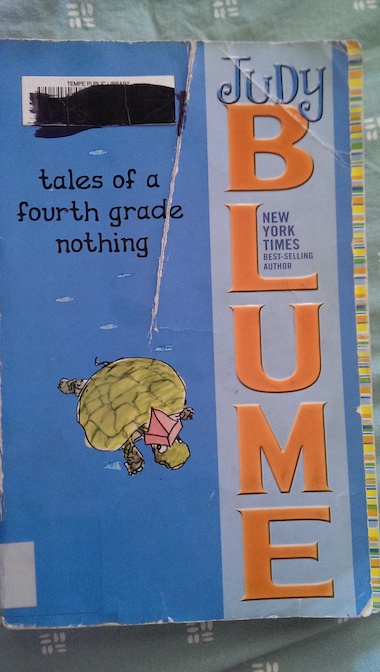
 Tales of a Fourth Grade Nothing by Judy Blume, 1972.
Fourth-grader Peter Hatcher is being driven crazy by his younger brother, Farley, who everyone calls Fudge because he hates his name. People think that two-year-old Fudge (he turns three during the book) is cute, and his mother sometimes spoils him or gives in to his tantrums. To Peter, Fudge is a little terror, and he feels like his parents don’t care as much about him as they do about Fudge.
Most of the book is kind of like a series of short stories about Fudge’s antics which take place over the course of several months.
When Fudge goes through a phase of refusing to eat unless he gets to eat on the floor under the table, like a dog, their mother allows Fudge to get away with it, even patting him like a dog. Peter thinks that his mother would be better to let Fudge not eat until he gets hungry, and Fudge’s doctor gives her the same advice, but his mother lets Fudge’s behavior continue until their father gets tired of it and dumps a bowl of cereal on Fudge’s head, declaring, “Eat it or wear it!”
Fudge sometimes gets Peter into trouble, too. Peter’s mother takes them to the park along with Peter’s friend Jimmy and Sheila, a girl they know from school who also lives in the same apartment building as Peter. Their mother has to run back to the apartment for a moment, so Sheila volunteers to baby-sit Fudge. Mrs. Hatcher only allows it on the condition that Peter help her. Of course, Sheila, who is a pest, decides to chase Peter and tease him about having cooties, so no one is watching Fudge until he falls off the playground equipment and knocks out a couple of teeth. Peter can’t help but notice that he gets more of the blame for that from his mother than Sheila does, even though she was supposed to be the main baby-sitter.
Fudge’s third birthday party is a disaster, with other little kids as messy and troublesome as Fudge himself. He gets into Peter’s room and messes things up, including a project Peter was working on for school. For many of Fudge’s antics, Peter is able to laugh about them in the end, but there is frequently frustration at his mother’s inability to stop Fudge from doing some of the things he does or her willingness to put up with them and her seeming favoritism at times for the cute younger sibling.
Then, Fudge does the worst thing he could possibly do and eats Peter’s pet turtle, Dribble, the one he won at his friend Jimmy’s birthday party. Peter loved Dribble, talking to him throughout the book when he didn’t want to talk to his parents, and while everyone else is concerned for Fudge’s health and giving him presents for getting better, Peter is angry that his pet is now dead and no one seems to care about him . . . or about Peter himself. Or so Peter thinks.
There is one more present from Peter’s parents and grandmother: a pet that Fudge would never be able to eat, and it’s for Peter alone.
Peter’s parents do care about him, even though they can get so caught up in Fudge’s antics and rescuing Fudge from them that it can be difficult to show it. Most of the time, Peter is able to laugh with his parents at Fudge’s antics, which are pretty funny, but once in awhile, he also needs them to understand how the things that Fudge does affect him, too.
Reading it again as an adult, I sometimes find myself getting a little annoyed with the mother in the story. Being a mother of a young child isn’t easy, but Mrs. Hatcher does take out her frustrations on Peter (something she even admits to at one point when he confronts her about blaming him for Fudge’s playground accident and she apologizes), and I take issue with some of her priorities and assumptions about Fudge’s behavior. Sometimes, it seems like she doesn’t know her own child as well as his brother does and she doesn’t take take pragmatic steps in dealing with him and preventing problems before they start. At times, I found myself thinking, “She’s making a mistake here. Does she really not see this coming?” Admittedly, I’ve read the book before, so I have an advantage, but putting a three-year-old into a suit he hates for his birthday party with other three-year-olds? Seriously? Suits are things adults are interested in, not three-year-olds, and many adults try to avoid wearing formal wear whenever they can. She was trying to dress him up like a doll, not a real small child, and it was more for her sake than for his. Sometimes, Mrs. Hatcher is reluctant to punish Fudge (admittedly, he is pretty young for most punishments), although she does spank him once when he ruins Peter’s school project, showing that she can stand up to him when it’s important.
Possibly, Peter was a different, calmer child when he was young, and Mrs. Hatcher sometimes expects Fudge to be the same way when he isn’t. That might also explain the episode when Mr. Hatcher invites a business associate to stay with them for awhile, not considering that not everyone is used to putting up with a young child and some of the chaos that goes with it.
The age difference between Peter and Fudge is also important to the story. Fudge looks up to Peter and wants to do a lot of the things he can do and have things like the stuff Peter has. Having two kids with very different ages also makes family life a little harder because the children are in different phases of life and have different needs and interests.


 Jestress's Forgotten Books and Stories