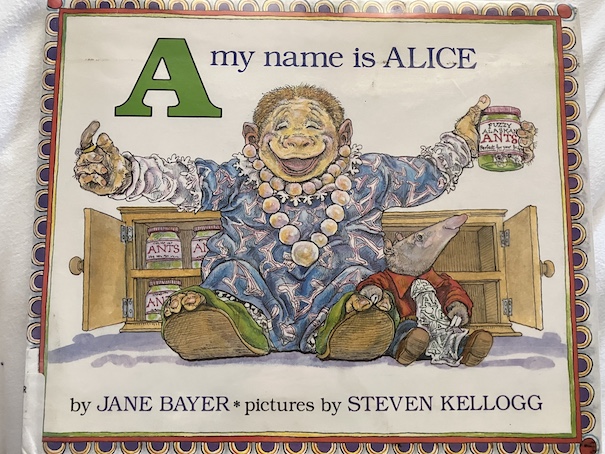
A My Name is Alice

I remember this book from when I was a kid! I always liked the pictures in the book, which are by Steven Kellogg, who also did the pictures for The Day Jimmy’s Boa Ate the Wash.

This book isn’t a story. It’s based on a talking game that’s often played on car rides called A My Name is Alice or Alphabet Chant. Like many casual folk games or childhood playground/car games, it goes by different names and has variable rules. In the back of the book, the author, Jane Bayer, says that she learned the game on a playground when she was a child in the 1950s. When she played it, they would bounce a ball while playing. This book was a favorite of mine when I was little because it was the first place I learned about this game.
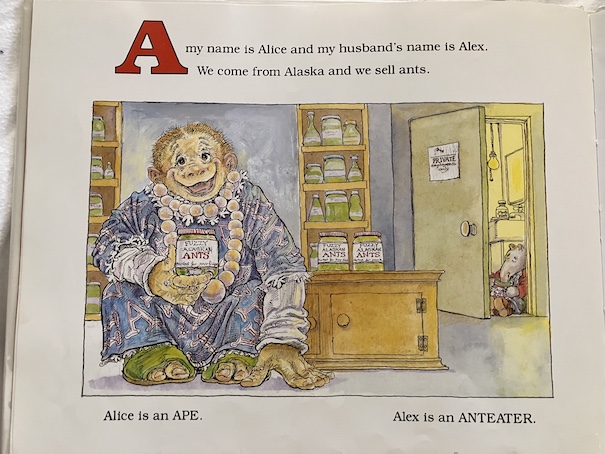
This game is an alphabet game where players have to follow the alphabet, giving the names of people, objects, and places all according to which letter of the alphabet they were currently on, using the following format: “(Letter) my name is (female name) and my husband’s name is (male name). We come from (place name), and we sell (object name).” (Because the rules vary, some people who have played this game with a slightly different format, possibly using the male name first.) First, you give all A names and words in this format, then you do the same for the letter B, then C, and so on to the end of the alphabet. (Or until you reach your destination, get stuck, get bored, etc.)
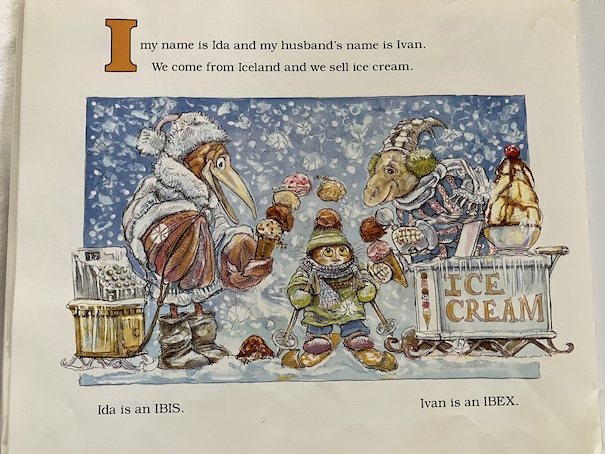
The fun of the game is that you can be as silly as you want with the names, places, and things to sell. The challenge is that it’s harder to think of names, places, and objects for certain letters than it is for others. Many kids playing this name will use the most common words they can think of first, took keep the game going quickly. However, the author deliberately goes for silly and unusual, which makes the book and the pictures fun and interesting.
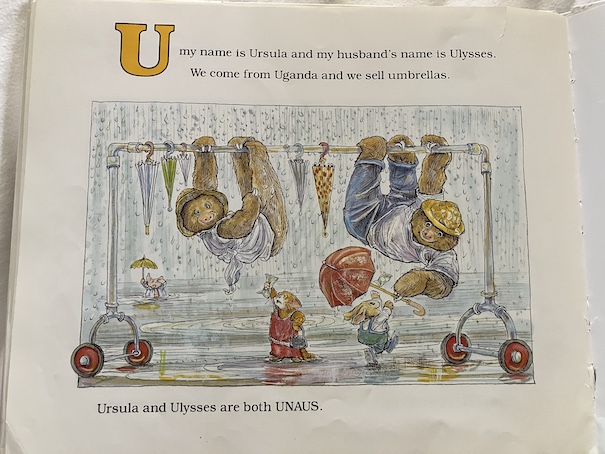
She also adds the element that all of the “people” she’s talking about are animals, and the types of animals they are also fits the alphabet theme. It can be difficult to think of animals for certain letters of the alphabet, but again, she goes for the unusual ones. The husband/wife pairs being named aren’t always the same animal, either. When they match, it’s usually because it was too difficult to come up with two different animal names for particular letters. The types of animals are given under each picture.
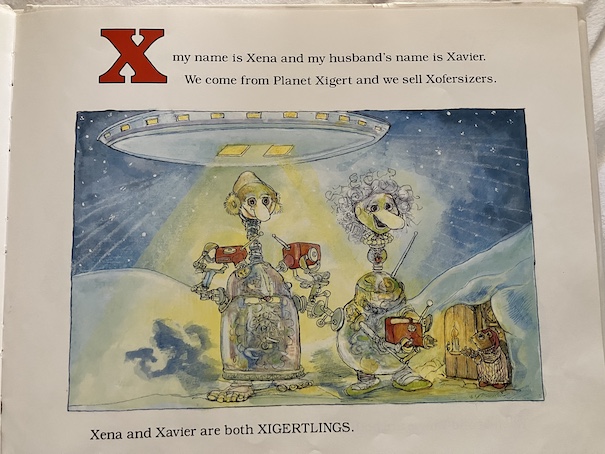
X is always the most difficult letter in an alphabet game because there aren’t many words or names that start with X. However, I liked the way the author dealt with it, just using aliens!

The book is available to borrow and read for free online through Internet Archive.
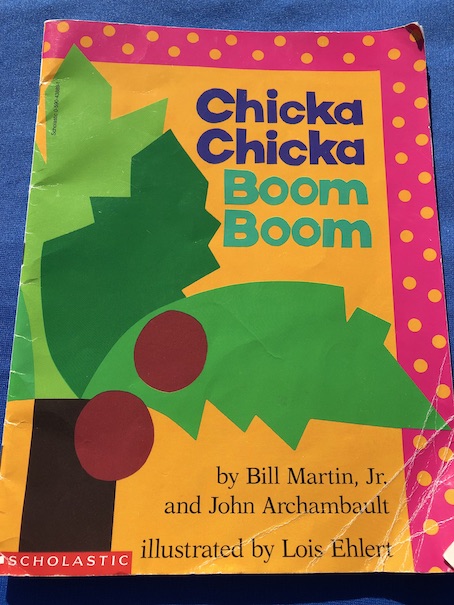
Chicka Chicka Boom Boom

Chicka Chicka Boom Boom by Bill Martin, Jr. and John Archambault, illustrated by Lois Ehlert, 1989.

This is an alphabet book for young children, but it’s not like most alphabet books.  Most alphabet books try to tie letters of the alphabet to words that young children know, to emphasize the sounds that the letters make, like in A, My Name is Alice or the letter-themed tongue twisters in Animalia.

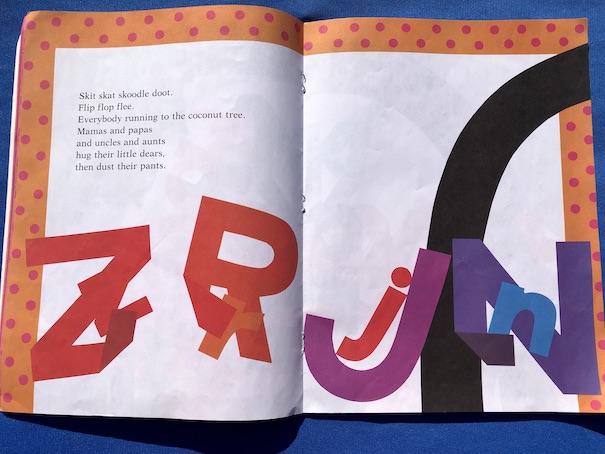
In Chicka Chicka Boom Boom, the letters of the alphabet decide to climb to the top of a coconut tree.  (Why not?)  They go up the tree in alphabetical order.

But, by the time they reach the end of the alphabet, there are too many letters in the tree, and they all fall out.

The uppercase versions of the letters are the adults of the story, like parents and aunts and uncles, and they comfort the lowercase letters who fell out of the tree.

At the end of the book, the letter ‘a’ tries to convince the others to climb the tree again.

As I said, this book struck me as unusual for an alphabet book because it doesn’t try to tie any of the letters to associated words.  Mostly, it just emphasizes the order of the letters, first in the order that they go up the tree, and then in the order that they recover from falling out.

The story is told in rhyme, and the “Chicka Chicka Boom Boom” part is just sounds that fill out the story/rhyme, like it’s part of a song. At the end of the book, there’s a page with all of the letters of the alphabet, both upper and lowercase.

The book is currently available online through Internet Archive.

Animalia

Animalia

Animalia by Graeme Base, 1986.

The best part about this book is the pictures.  They are absolutely beautiful and contain many small details for readers to spot.

On the surface, the book is about the alphabet, each page featuring a single sentence with every or almost every word starting with the same letter, and all of the pages are in alphabetical order.  (If you’re wondering what the author used for ‘X’, it’s a fox.  ‘X’ is an exception because all of the letters in that sentence end with ‘X’ instead of starting with it.)  The sentences and pictures are about animals, some real and some mythical.

AnimaliaGorillas

However, there is also a game that you can play with the book which is explained in a poem on the title page:

“Within the pages of this book
You may discover, if you look
Beyond the spell of written words,
A hidden land of beasts and birds.
For many things are ‘of a kind’,
And those with keenest eyes will find
A thousand things, or maybe more–
It’s up to you to keep the score.
A final word before we go;
There’s one more thing you ought to know:
In Animalia, you see,
It’s possible you might find me.”

Readers are invited to notice all of the other things in the pictures which start with the designated letter, and the author himself appears throughout the book, hiding in the pictures. There is a picture of him on the title page so you know who to look for.

The book is currently available online through Internet Archive.

AnimaliaLions

AnimaliaPeacocks