Witch Week

This is the third book in the Chrestomanci series.  In this series, there are many different worlds, and in each of those different worlds, there is a copy of every person.  Different versions of our world can differ dramatically in their history, and individual people’s lives can differ dramatically between the worlds. However, there is one person in each generation who has no duplicates in any of the other worlds.  This person is called the Chrestomanci.  All of the talents, abilities, and lives that would have been spread across the other worlds are now centered on that one person, giving that person, literally, nine lives.  The Chrestomanci fills an important role, being better able than anyone else to travel across the dimensions and between worlds, and he acts to keep a balance between them and make sure that the different worlds keep their proper course.

This story takes place in a world where witches are being burned at the stake in the 1980s. At a boarding school for troubled children and orphans, everyone is aware of what an accusation of witchcraft can mean. One day, one of the teachers finds a note in a social studies book saying that one of the students in class 6B is a witch. It’s a serious accusation, but how seriously should anyone take it? This is, after all, a school for troubled children, and children in general play pranks. Mr. Crossly finds the note worrying. Some of the teachers are convinced that this is just a prank or someone playing up for attention. Miss Hodge says that there is a sick mind in class 6B. Mr. Wentworth, whose own son, Brian, is in that class, says that he’s sure that all of the kids in class 6B have sick minds, but that’s just typical. He thinks it’s best if the teachers take no notice of the note. But, the note is correct. There is a witch in class 6B.

Strange things start happening in class 6B and to the students in that class. A flock of assorted birds swarms into their music class. In gym class, Nan Pilgrim can’t manage to climb the rope, no matter how hard she tries. When she and two other students are called to have lunch with the headmistress, Nan finds herself making disgusting comments about the food without her even wanting to say anything, but for some reason, the headmistress can’t hear a thing she says, even though the other students can. Then, it is revealed that Nan’s real name is Dulcinea, which is the name of a famous witch. Could Nan secretly be the witch in class 6B?

Although she can’t openly admit it, Nan is descended from the famous witch Dulcinea, who tried to stop the persecution of witches, and she is also what is called a “witch orphan”, meaning that her parents were witches. However, Nan insists that she’s not a witch herself, and Nan isn’t the only suspicious student in the class. Everyone there is troubled in some way. Brian Wentworth is often picked on for being the son of a teacher. Simon Silverson, Dan Smith, and Theresa Mullet are bullies. They are all eager to point fingers at Nan for being a witch, but could that be to cover up for themselves?

Charles Morgan was sent to the boarding school because his parents think that he is troubled and disobedient and a bad influence on his younger brother. In a way, he is very troubled, but he can’t explain what is really troubling him. When he was younger, he witnessed a witch being burned, something that still traumatizes him. Then, he helped another witch who was being hunted to escape. He can’t admit to his parents that he helped this witch because it was illegal, but the witch promised him good luck for doing so. So far, he hasn’t noticed any good luck, and he feels terrible every time he hears about another witch being burned, thinking that it might be his witch. It all makes him angry and depressed, and he hates the boarding school and everyone there.

Miss Hodge tries to investigate the students by having them act out witchcraft inquisitions. Since most of the children don’t know what happens at an inquisition and aren’t very good actors, most of them are terrible at it. But, she comes to think maybe Charles is the witch because he gets angry at Nan over all the disgusting things she said at lunch and taunts her about them in a way that makes it sound like he’s saying some kind of spell.

When Miss Hodge tries to tell Mr. Wentworth about it, he shrugs it off because he also heard the things Nan said at lunch. Mr. Wentworth interviews Nan about why she said all those things at lunch, but she can’t explain herself. She doesn’t know what made her say those things. Sometimes, she just can’t seem to help herself, and she felt almost possessed. Mr. Wentworth knows about her family’s history and warns her to be careful.

Then, when Charles is trying to escape from some bullies, he somehow manages to turn himself invisible. He doesn’t understand it, but he tries to do something else magical as a test. Since Dan Smith hid his spiked shoes earlier, Charles tries making Dan’s spiked shoes disappear. To Charles’s horror and astonishment, he succeeds! Somehow, he has apparently been a witch the whole time without knowing it. Charles thinks maybe he did some of the other strange things without knowing it, too. He’s always heard that witches are evil, and he thinks maybe he has secretly been evil this whole time and had better confess. An accidental mix-up when he goes looking for the headmistress stops him from confessing immediately, but it leaves him unsure what to do.

Mr. Wentworth has a private conversation with Charles about Miss Hodge’s suspicions about him. He knows what Charles was really talking about when he was arguing with Nan, but he points out to Charles how bad it might sound to someone who didn’t know what he was talking about. Information about witches and the past witch uprisings is drastically censored. There is almost nothing about it in the school library, but Mr. Wentworth understands the situation and explains it to Charles in a no-nonsense way. Nan’s ancestress, Dulcinea Wilkes, had been an advocate for witch’s rights in the 18th century, particularly the right not to be murdered. She said that witches couldn’t help being witches because they were born that way, and it wasn’t fair for them to be murdered for something they just couldn’t help. She said that witches would only use their powers in good ways if people would stop hunting them and burning them, but the murders and burnings continued, and Dulcinea lost her temper. She retaliated with violent spells that frightened people so much that they also murdered Dulcinea by burning her. In remembrance of that, people still continue to burn effigies of her, like they do of Guy Fawkes. Mr. Wentworth says that he thinks what happened to Dulcinea was unfair, but he is worried about his students because there has never been so much stigma against witches at any earlier point in history. Although his students wouldn’t remember it, there was a major witch uprising around the time they were all born. The news of this uprising was largely hushed-up, but the witches attempted to take over the entire government. The revolutionaries were all civil servants, and they were all burned when the uprising was crushed, but the government has been paranoid about anyone with any sign of witchcraft since. When they learned that the leader of the uprisings started showing signs of witchcraft when he was about 11 years old, they even started allowing children to be arrested for witchcraft, even on slight suspicion. The inquisitors have powers that go largely unchecked. Mr. Wentworth knows that any of his students can be hauled away and executed with little recourse.

Even though Mr. Wentworth is concerned with protecting Charles, Charles gets angry with him for giving him a black mark as a reminder to control his behavior, and he glares at Mr. Wentworth. It’s a terrible mistake. It turns out that Charles has the evil eye, and it seems like he accidentally makes Mr. Wentworth disappear. Although Charles tries to pretend like everything is normal, he is desperate on the inside. Soon, someone will realize that Mr. Wentworth is missing and that Charles was the last person to see him. He even tries burning his own finger on a candle to remind himself that burning hurts, and he needs to control himself to avoid being burned to death. When he tries to fix what he’s done with magic, Mr. Wentworth does return, but everyone’s shoes mysteriously disappear.

To Charles’s surprise, the memories of the witch he saw burned and the witch he helped to escape stop bothering him so much after he knows and accepts that he is a witch himself. It’s like he’s always known, inside, that he would be a witch, and once he becomes reconciled to his true nature, he becomes calmer and more self-confident. He knows that he can’t stop being a witch. He can only try to avoid being caught. However, it turns out that he is not the only student who has witchcraft, and when the desperate students seek help or a method of escape from this prison-like school, they accidentally summon Chrestomanci to straighten everything out.

The book is available to borrow and read for free online through Internet Archive (multiple copies, including some in different languages).

Like all of the books in the Chrestomanci series, this book takes place in an alternate world or alternate reality. It explores not only the suspicion and paranoia that go with witch hunts but also the mechanism by which these alternate worlds or realities are created. When the students who have realized that they are witches try to escape, they are given a spell that calls Chrestomanci from his world to theirs. Chrestomanci is accustomed to being summoned to random places on short notice (it’s just one of the hassles that come with the job), but he finds this particular world puzzling. He knows from the similarities between this world and others in the series of worlds that contains his own that he must be in that particular series of worlds, but he recognizes immediately that there is something wrong with it. It has way too many similarities with the world that is “our” world in the series, but yet, there shouldn’t be any witch trials or burnings in the 1980s. He explains that alternate worlds are created when there is some major event that has only two outcomes with an equal chance of happening. Every time that happens, the world splits into two separate worlds where each of the possibilities happen. Because this world is so much like the world that is “ours”, he knows that whatever event caused the split happened fairly recently in history, but for some reason, the split wasn’t complete. There is no real magic in “our” world, but this odd, dysfunctional, split-off world is full of it.

By talking to the students about what they know about the history of their world, Chrestomanci is able to pinpoint the event that caused the problem. As with other Chrestomanci books, Chrestomanci doesn’t just magically solve the problem all by himself, but once he understands the situation, he shows the students at the school where the problem lies and what they need to do to fix it themselves, making use of their own powers, and even some of the mistakes they’ve made, to set their world right and re-integrate their world with “our” world. Once their world is repaired, it’s as if all the witch trials never happened. People who were burned are alive again, and people who were in prison are living perfectly normal lives. The children must sacrifice their magical abilities and all or most of their memories of their old lives to join with our world, which some of them are initially reluctant to do, but once they do it, all of their lives change for the better. Orphans have their parents back, the school is now a day school instead of a boarding school where the children were basically prisoners, and the children are all much friendlier toward each other now that they are no longer part of that toxic atmosphere, where suspicions always surrounded them and everyone is afraid of exposure.

Parts of the story were stressful because of the bullying among the students and the constant threat of imprisonment or death for any child who was proven to be a witch. Most of the adults are not that concerned with the welfare of the students because this entire society is engulfed with paranoia, and everyone is desperate to protect themselves at all cost. The adults are often so preoccupied with saving themselves that they would be willing to throw the children to the wolves rather than face imprisonment or death themselves. The major exception is Mr. Wentworth, who tries to warn children who show signs of witchcraft that they need to be careful. His efforts to protect the children are touching because he has more to lose than some of the other teachers who play along with the politics and paranoia of their society. (Spoiler!) Mr. Wentworth and his son Brian are both witches, and Mr. Wentworth is being blackmailed for most of his salary by the headmistress. Mr. Wentworth advocates self-control to the students as the best way to avoid being caught, but it soon becomes apparent that nobody with witchcraft abilities can fight using them forever. That’s why some of the children’s abilities come out unconsciously, without them even being fully aware of what they’re doing. That’s where the mystery of the story comes in.

Chrestomanci books always contain an element of mystery in some way or other, and from the beginning of the story, there are the questions of who wrote the note about there being a witch in class and who the witch is. We never learn who wrote the note (I don’t remember that being definitely revealed), and in the end, it doesn’t really matter. When Charles realizes that he is a witch, that seems like the answer. However, Charles is not the only witch in class. As one of the other students points out, all of the weird things that have been happening at the school are very different in character, so there is more than one person involved. By the end of the book, it is revealed that (spoiler) the vast majority of the students at the school are witches. Some have been doing magical things unconsciously as their powers have started asserting themselves, and some have done things on purpose because they know they can. Chrestomanci realizes that many more people in their society in general are witches than these paranoid people ever suspected, and witches are only regarded as a minority because of the atmosphere of fear they live in. Everyone has been trying so hard to conceal any sign of abnormality that they all have a warped view of who they all really are and what their society is actually like.

I couldn’t help but notice that, witch or not, absolutely nobody in this society can be called an innocent person. Everybody is doing something illegal, unethical, or simply deceptive. They all have secrets, and they all do things to cover up what they’re doing. Even non-witches are often doing horrible things that they have to cover up. The apparently sweet and proper headmistress is actually a cold-hearted blackmailer. Teachers are manipulative for personal and professional reasons. The so-called “normal” (or “real”, as Nan thinks of it) children are all either secret witches or just horrible bullies and rotten human beings. Like their elders, the “normal” children are sneakily manipulative and practice blackmail and brutality against the other students, knowing that’s the way to get to top of their social heap. As I said, the entire society is toxic, not just the school, and everything the children do is a reflection of their elders (and vice versa, when you think about it). Grown-up witch hunters are like overgrown child bullies, and people like the headmistress probably started their blackmail and manipulation at a young age, just like the students, as tools of survival and self-promotion in this cold, toxic, pitiless world.

The normalization of the toxic parts of this world is both stressful and worrying. People can adjust to many awful things if they are not given any alternative, and that’s what this dysfunctional world represents. There are moments of lightness, though, and some characters are more caring than others. The story is told from the point-of-view of different characters, and much of this book is a psychological study in the different ways people deal with bullying, suspicion, and paranoia. As I said, Mr. Wentworth risks himself sometimes to help students in danger and make them see the seriousness of their situation. Some of the students band together to try to help each other survive their mutual risk, while others are more self-centered, prepared to throw each other under the bus to save themselves. It’s a relief to see all of that end when the world is set right, but it occurs to me that the story has exposed all of the characters’ true characters, what each of them are capable of doing in extreme circumstances. The extreme circumstances brought out the worst in some characters, while others were more creative and caring in spite of everything.

The Magicians of Caprona

The Magicians of Caprona by Diana Wynne Jones, 1980.

This is the second book in the Chrestomanci series.  In this series, there are many different dimensions with different worlds, and in each of those different worlds, there is a copy of every person.  Different versions of our world can differ dramatically in their history across the dimensions, and individual people’s lives can differ dramatically between the worlds. There is one person in each generation who has no duplicates in any of the other worlds.  This person is called the Chrestomanci.  All of the talents, abilities, and lives that would have been spread across the other worlds are now centered on that one person, giving that person, literally, nine lives.  The Chrestomanci fills an important role, being better able than anyone else to travel across the dimensions, and he acts to keep a balance between them and make sure that the different worlds keep their proper course. This book begins with a brief explanation, although most of this was established in the first book in the series, Charmed Life.

In the world where the Chrestomanci lives, magic not only exists but is a known and accepted profession, and society is a little more old-fashioned than in our world. Also, there is a kind of alternate history, and some of the countries are organized differently. This story is set in Italy, which is not a unified country in this world, but a series of small dukedoms. The Chrestomanci series is a somewhat loose series, meaning that, while Chrestomanci appears in the different books and always plays some kind of role, he is not always one of the main characters. This story sets up a Shakespearean kind of feud between two families.

The dukedom of Caprona is known to having the best spell-makers in the world. The problem is that the best spell-makers belong to two particular families, the Montanas and the Petrocchis, who have a long-standing feud. The adults in the families never explain how, exactly, the feud started. They just warn the children to avoid to avoid the children of the other family. When members of the two families meet in public, they usually ignore each other, although sometimes fights break out. The fights are particularly bad when they use magic. Locals and tourists alike are alarmed by these fights and get out of the way to avoid being caught up in them.

Because the adults don’t talk about the cause of the feud, the children of the two families tell each other stories about it. In the Montana family, the children say that it started because the Duke of Caprona favored their family over the Petrocchis. The children also tell each other stories about the other family’s atrocious habits. Young Rosa Montana particularly likes telling her siblings and cousins scandalous stories about how the Petrocchis never bathe and sometimes kill their unwanted babies or eat their own family members. Because the members of the two families almost never see each other, the other Montana children can only suppose that the stories they hear about the Petrocchis are true.

When young Tonino Montana starts school, he is very upset. Things don’t seem to come as easily to him as they do to his siblings and cousins, and he feels awkward when the teacher tells him to do things differently from the way he’s always been taught to do them or repeats things that he’s already learned. When Tonino runs off into the city by himself because he’s upset, the rest of his family worries about him. Old Niccolo, the head of the family, talks to Benvenuto, the head cat in the Montana household, about Tonino. The Montana family keeps cats, who help them at their spell-making, but not everyone in the family has the ability to talk to the cats and understand them. Old Niccolo can communicate with the cats, but even Tonino’s father, Antonio, can’t. Benvenuto tells Niccolo that he will look after Tonino and not to worry about him. Tonino, like Niccolo, can talk to cats, and he hasn’t fully appreciated the talent yet.

Benvenuto becomes Tonino’s special friend. He helps Tonino to understand that, like the kittens he talks to, he’s still young and learning. Tonino needs to give himself time to develop. Benvenuto also tells Tonino that it’s fine to tell his teachers what he already knows, and Tonino comes to realize that he is far ahead of the other students in some ways, having already learned to read. His talent for talking to the cats also gives him a special place in his family. Benvenuto also allows Tonino to give him brushings, which he would never allow from any other family member before, so he becomes more well-cared for.

As time goes on, however, Tonino comes to realize that the adults in the Montana family are worried about the state of their family and the state of Caprona itself. Other dukedoms around them are becoming more powerful, and some of the old spells that the two families made to protect Caprona are breaking down. Of course, the Montanas blame the Petrocchis for the weakness of the spells and for not maintaining them properly, but Tonino realizes that the old Montana spells are breaking down as well. It’s not, as the older Montanas said, that they have had to bear the weight of making up for the weak Petrocchi spells.

Tonino gets his first look at the Petrocchis when both families are summoned to the duke’s palace to discuss the state of their spells and the rival states that are seeking to conquer Caprona. Speaking together for the first time in a long time, both families come to realize that, even though they have separately been working to make their spells stronger, each year, the protective spells they cast on Caprona have been getting weaker. There is a rumor that there is an evil enchanter who has been working against them on behalf of their enemies. Naturally, both Petrocchis and the Montanas secretly suspect each other of being involved. They also can’t help but notice that something is seriously wrong with the duke himself. He seems strangely childlike, and his wife seems to be running everything.

The Montana family offers a solution that even they aren’t sure they can fulfill. There is an old story that all of the children know about an angel who once protected Caprona with a magical song. Everyone thinks that, as along as the song is sung, Caprona will be safe. The children learn this song in school, but what they don’t know is that the words they learn to the song aren’t the original words to the song. The tune is original, but the original words were lost to time. The Montanas know that the song is a powerful spell, but it won’t function correctly until the original words to the song are restored. In their pride against the Petrocchis and their worry about the state of Caprona, the Montanas have pledged that they will find the original words to the song. Also, naturally, the Petrocchis have promised the same. Neither family knows exactly how they will do that, but they are each determined to somehow do it before the other family can.

There is only one person both of the families accept and who can work with either family without earning the resentment of the other: Chrestomanci. The situation is serious, war is pending, and Chrestomanci has also been summoned for help. As the most powerful enchanter in the world, he has the respect of all sides. Since Chrestomanci is British, he admits that he is somewhat limited in how far he can interfere in Italian affairs. His main interest is in the evil enchanter and their misuse of magic, although he will help Caprona and his friends in the magical families, if he can.

Chrestomanci notices that, aside from being able to talk to cats, Tonino also has an ability to tell when someone is an enchanter without being told. Chrestomanci says that he needs to go to Rome to make some inquiries, and he asks Tonino to stay close to his grandfather when his grandfather has to meet with anyone, to see if he can spot the evil enchanter. However, the evil enchanter already knows too much about the two families and about Tonino in particular.

When Tonino is kidnapped by the evil enchanter, his family immediately blames the Petroccis and sets out to confront them … only to be met halfway by the Petrocchi family, on their way to confront the Montanas about kidnapping one of their children, Angelica. The feud between the two families becomes worse than ever, but an accidental encounter between Tonino’s brother Paolo and Angelica’s sister Renata reveals that neither family has kidnapped anyone. The evil enchanter is playing both of the families against each other to distract them from what they really need to do: find the children and prepare to defend Caprona from its enemies. Paolo and Renata have trouble convincing either of their families of the truth because they are already too convinced that the other family is their real enemy, so they struggle to figure out how to save Tonino and Angelica themselves.

Meanwhile, Tonino and Angelica team up in captivity to find a way to escape and tell their families where to find the secret words to the angel’s song. While they are being held captive together, Tonino and Angelica argue about the nature of their families, but by talking together, they come to realize that each of their families has held half of the answer to the problem all along. If only the children can get together and reach their families to tell them the truth about the angel’s song and the identity of the evil enchanter!

The book is available to borrow and read for free online through Internet Archive (multiple copies, including some in different languages).

My Reaction

During the course of the story, we never learn the original cause of the feud between the two families. It might have been something with one family thinking that the other was being favored by a past duke, or maybe it was some private quarrel between the heads of the two families. The cause is less important than the result. For generations, each family has been quietly maligning the other to the children of the family, who have continued to pass on the stories.

When the younger members of both families finally meet and talk to each other, they are initially offended that the other family has been saying the same horrible things about them that they’ve been saying about the other family, but it’s also an eye-opening experience. The two families are actually very similar to each other, both in their professional work and in their private family life. In fact, they live nearly identical lifestyles. The fact is that both families have been contributing to the spells maintaining their city for centuries, working together since before their feud began. Their spells were always intertwined and made to work together. Since the feud started and the families stopped working together, they have still had to work together in the service of their city and duke, but the feud has also served as a distraction from the real sources of danger.

As with other Chrestomanci stories, Chrestomanci doesn’t solve all of the problems of the story himself. Instead, he acts as a helper, revealing key information and providing guidance to help the other characters to solve their own problems. As a neutral observer, Chrestomanci sees both of the families and their quarrel for what they really are. He also helps to reveal the true villain of the story for who they really are.

Chrestomanci also points out the hidden talents of the children in the story. Although Tonino doesn’t think he’s as good as magic as others in his family, he does have other talents and magical abilities. At the end of the story, he goes to England with Chrestomanci to study for a while. His adventures in England are part of one of the short stories in Mixed Magics.

The Merchant of Death

Pendragon

The Merchant of Death by D.J. MacHale, 2002.

Bobby Pendragon is a normal fourteen-year-old boy, or at least he thought he was.  One day, his mysterious Uncle Press shows up at his house right before he’s supposed to leave for an important basketball game at school and tells him that he needs his help and that Bobby must come with him right away. 

Although Bobby doesn’t know what is going on, he goes with his uncle and begins a terrifying journey to another world.  His uncle reveals to him that they are both Travelers, members of a select group of people who can use gateways called flumes to travel across time and space to other worlds.  Worlds everywhere are in chaos, and an evil Traveler called Saint Dane is manipulating events to cause more chaos and destruction.  On the world of Denduron, the decadent Bedoowan society is oppressing the Milago miners, and thanks to Saint Dane, their world is about to erupt in warfare unless Bobby and his uncle can stop it.

Bobby and his uncle are separated for a while when some Bedoowans capture Uncle Press, and Bobby meets up with fellow travelers Osa, Loor, and Alder.  Osa, the most experienced Traveler, is killed trying to protect Bobby, and Bobby makes some mistakes that make the situation worse, including having his friends back home send him some items that are advanced technology to the people of Denduron. 

The Milago have discovered an explosive mineral called Tak, and they are using it to build a super weapon to wipe out the Bedoowan.  Saint Dane is trying to increase tensions between the two groups of people so that they will use this weapon, which will lead to the destruction of their world … unless Bobby and his friends can stop it.

This series reminds me a little of old movie serials, like Flash Gordon, where the good guys must defeat an evil overlord, free people from oppression, and bring peace to warring groups.  However, like with Flash Gordon’s evil nemesis, Ming the Merciless, Saint Dane has a way of escaping even when our heroes have put a stop to his plans. By the time matters are straightened out with the Bedoowans and the Milago, Saint Dane has escaped to another world, and Bobby and his companions must find him and stop him from causing further destruction.

The book is available to borrow for free online through Internet Archive.

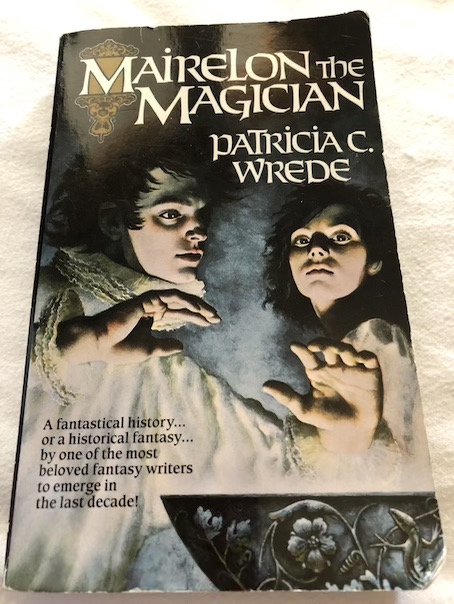
Mairelon the Magician

Mairelon the Magician by Patricia C. Wrede, 1991.

This young adult book takes place in an alternate history version of Regency England.  In this world, magic is a normal and accepted part of society.  “Wizard” is an accepted profession, and there is even a Royal College of Wizards dedicated to magic.  Not everyone can be a wizard because not everyone has the ability to use magic.  It is a skill that people are either born with or born without, similar to people who have an innate talent for art or music, compared to people who are born tone-deaf or color-blind.

In this early 19th century world, there is a teenage girl, Kim, who lives on the streets and survives by her own wits, taking whatever jobs she can and committing a little petty thievery whenever she needs to.  She has spent most of her life dressing like a boy and pretending that she is one because life on the streets is even more precarious for a girl.  For a time, she was part of a gang of child thieves run by a woman call Mother Tibb.  As far back as Kim can remember, Mother Tibb was the only one who took care of her as a child.  Kim has no memory of her parents or any knowledge about what happened to them.  She doesn’t even have a last name.  However, before the story begins, Mother Tibb was caught and hanged for her crimes.  Some of the other child thieves were apprehended and put in prison or exiled to Australia, but Kim managed to escape.  Since then, she has been on her own.  So far, she has managed to avoid being pressured in to joining up with other gangs or turning to prostitution to survive, but the fear of that haunts her. Her future is uncertain.

At the beginning of the book, Kim is hired to sneak into the wagon of a traveling magician who is performing in the market and to see what he keeps among his belongings.  The man who hired her doesn’t want her to take anything, but he is particularly eager to see if the magician has a particular silver bowl in possession.  It’s a strange request, but the money that the man offers Kim is too good to pass up.

However, the magician, who calls himself Mairelon, isn’t quite what he seems.  He is not just an ordinary traveling entertainer using some sleight of hand to amuse people in the market.  Kim discovers that he can do real magic as she searches his wagon and is knocked unconscious by a real magical spell that Mairelon uses to protect his belongings.

When Kim wakes up, Mairelon and his servant, called Hunch, have tied her up.  Unlike Hunch, Mairelon has also realized that Kim is actually a girl, not a boy.  The two of them question Kim about why she sneaked into the wagon, and she tells them the truth about being hired to do it.  When she describes the man who hired her, it seems that Mairelon recognizes the description.  The part about the silver bowl also unnerves him.

Surprisingly, Mairelon makes Kim an offer to come with him and Hunch when they leave London.  He is fascinated by Kim’s skills in picking locks, even the lock on the booby-trapped trunk that knocked her unconscious, and he thinks that Kim might be useful to him and Hunch, perhaps helping with the magic act.  In return, he offers to teach Kim some of his magic tricks.  Hunch is dubious about Kim because she has obviously been a thief, and Kim also isn’t sure what to make of Mairelon.  She knows that he’s hiding something, but she isn’t sure what.  No one with real magical abilities like him would ordinarily be making a living with simple magic tricks in the market. 

However, Kim does accept the offer because she’s been worried about one of the major criminals in the area, Dan Laverham, who has been showing too much interest in recruiting her. He is heavily involved with a number of criminal activities, and he knows that Kim is a skilled lock pick.  If he found out that she was a girl, he would probably also press her into prostitution. Dan Laverham would be a good reason to get out of London for a while.  Also, Kim realizes that if she learns a few magic tricks from Mairelon, she might be able to set herself up as an entertainer and make an honest living, safe no matter who finds out that she’s female.  Besides, Kim realizes that if she’s not satisfied with the situation, she could always run away later.

Before leaving London with Mairelon, she returns to the man who hired her, at Mairelon’s suggestion, and tells him that she didn’t see a silver bowl in Mairelon’s wagon (which is true because she was knocked unconscious and didn’t see anything in the trunk).  The man is angry, but Mairelon, who followed her in disguise, helps to create a distraction so that she can get away from the man.  They leave London in the middle of the night because Mairelon says that he was spotted by someone who recognized him when he went out to get magic ingredients.

On the journey, Kim gradually gets to know Mairelon and his situation.  The silver bowl, which Mairelon does have, is actually part of a set of magical objects which, when used together, can compel people to tell the truth without interfering with their ability to answer questions intelligently.  Mairelon’s real name is Richard Merrill, and he is, or was, part of the Royal College of Wizards.  Years earlier, the Royal College of Wizards was analyzing this particular set of magical objects and the unique spell that they control, when they were suddenly stolen, and Merrill was framed for the theft.  At the time, Merrill was unable to prove his innocence (at least not without sounding as if he had done something inappropriate with a lady, which he also did not do – they were just together at the time of the theft because she was helping him and another friend with a magical experiment), but he was also recruited by his friend in the government to be a spy against the French, so the story of his supposed theft gave him a plausible reason for wanting to leave the country.  In the time since then, he and his friend have continued to look into the matter of the theft, and they have made some progress in tracking down the other pieces of the magical set.  At the time that Kim met him, he was on his way to the next piece of the set, a silver platter.

To their surprise, however, they soon discover that someone has been making copies of the platter.  The copies are not magical, but they do confuse the issue.  Who is making the copies and why would they want copies, since they do not have the powers that the original has?  As Kim and Mairelon investigate, they crash a house party at a lavish country estate and spy on a meeting of a rather inept society of druids.  All the while, they are getting closer and closer to finding the original thief.

I loved the combination of mystery, fantasy, history, and humor in this book!  It’s one of my all-time favorites.  It has a happy ending with Mairelon’s name cleared and the thief caught.  They also discover that Kim has the ability to use magic, and Mairelon offers to take her on as his apprentice, saving her from the streets forever.  There is a sequel to this book called Magician’s Ward, about Kim’s life and adventures as Mairelon’s student.  The hints of romance in this book are also much stronger in the next one.  There are only two books in this series, which is disappointing because the characters are so much fun, and I think that there is a lot more room for their development.  By the end of the next book, Kim’s future is looking more certain, but her past is still murky.  Originally, I had expected that there would be secrets revealed about Kim’s past because of her ability to use magic, possibly something that was passed on to her by her parents.  However, by the end of the second book, Kim still doesn’t know who her parents were/are, and it doesn’t look like there’s any chance that she will ever know.  Perhaps it doesn’t really matter. Sometimes, secrets are more tantalizing when you imagine the answers than when you actually find out.

The book is currently available online through Internet Archive.