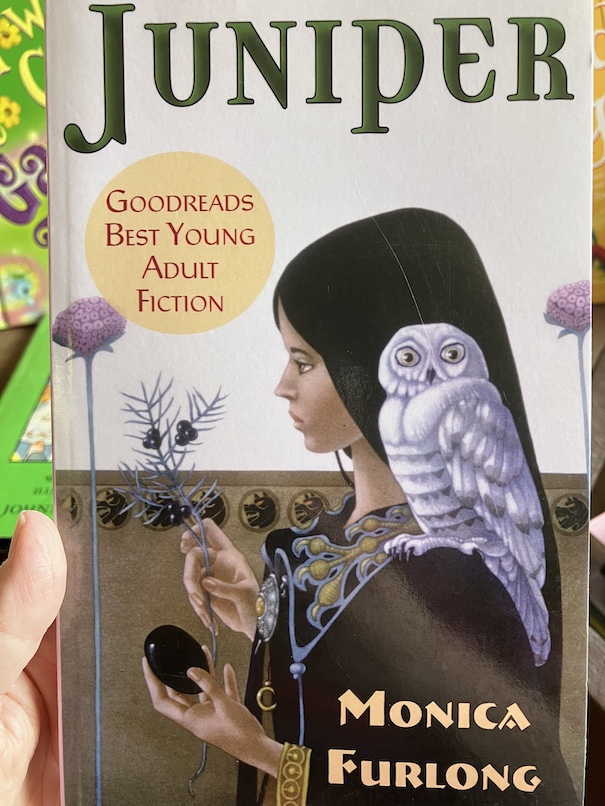
Juniper

Young Ninnoc was born the daughter of a chieftan in Cornwall. She was raised as a princess in her father’s castle and educated as young royalty. She is generally loved and cared for, but there is one person in her father’s household who doesn’t like her, her father’s sister, her aunt Meroot. Ninnoc doesn’t know why her aunt hates her, but she knows early in life she can’t trust her. Meroot isn’t even nice to her own young son. She has ambitions for her son to be a great warrior, so she forces him to start training him early and purposely keeps him hungry and in discomfort to toughen him up. Ninnoc is friends with her cousin, and she and her nurse offer him food and comfort in secret. Her cousin really wants to be a musician, but his mother would never allow such a thing.

As the only daughter of a king, it initially seems that Ninnoc’s eventual fate will be to marry and to rule after her father, along with her future husband. However, Ninnoc begins showing signs early in life that she has other talents. It begins when she playfully joins a group of men who are dowsing for water, and she is the one who finds it. As she grows older, she also discovers a talent for healing when she heals her cousin’s wounds after his battle training. She adopts an orphaned baby owl as a pet, and when she realizes that she can hear it talking to her, both she and her cousin realize that Ninoc has a talent for magic. Strangely, her cousin comments that his mother also seems to have this ability, something that makes Ninnoc uneasy.

Ninnoc’s father trusts Meroot more than he should because he is strangely fond of his older sister, but Ninnoc and his mother know that Meroot harbors deep resentment toward them. Ninnoc’s father made Meroot one of Ninnoc’s godmothers, although her mother didn’t really approve. Ninnoc’s other godmother is a strange woman called Euny, who lives in a cottage in the wild areas outside of the protection of Ninnoc’s father. Ninnoc doesn’t like Euni when she meets her because she’s raggedy and unkempt, and for some reason, she insists on calling Ninnoc by the name “Juniper.” Ninnoc’s mother says that Euny is a wise woman and that she calls Ninnoc “Juniper” because she says that is her true name. Both of Ninnoc’s parents trust Euny because she has special abilities. Ninnoc’s mother explains that there are different kinds of power in the world. Some people have power like Ninnoc’s father does, with armies of knights and political authority, but Euny has a different kind of power.

Ninnoc isn’t sure what kind of power that is, but she realizes that this is something that she wants to understand it. As a young princess, she is accustomed to be around power and has the sense that she wants to grow into a position of power, expecting that she will probably be queen one day, but at the same time, she realizes that she isn’t a warrior like her father and his knights. Euny’s kind of power might be the kind of power that Ninnoc will one day need. Still, when Ninnoc’s father tells her that she will have to go live with Euny for a year and a day and study with her, Ninnoc doesn’t really want to go. She doesn’t want to be away from her parents, her cousin, and her friends at her father’s castle, and she doesn’t really like Euny. However, the more Ninnoc begins to sense her own growing powers and to become concerned about what powers her aunt might have, the more she realizes that she needs whatever knowledge Euny has to offer her.

When Ninnoc decides that it’s time to go to Euny for training, she is surprised and a little hurt that Euni doesn’t seem too happy to receive her. Euny explains to her that the power she has is that of a Doran, someone who is very in touch with the natural world and the rhythms of life, but she doesn’t explain too much about what that means. In fact, Euny’s lack of explanations and kind treatment almost cause Ninnoc to give up on the idea of training with Euny entirely.

Euny’s small cottage in the countryside is uncomfortable. It’s often cold, and Euny doesn’t feed her much, telling her that she needs to learn what it’s like for people who are born without privilege. Ninnoc tries to bear it as long as she can, but it seems like Euny uses her more as a servant than anything else and doesn’t really explain anything to her. Euny takes her to gather herbs and plants, but she doesn’t initially explain what they are or what they’re for. Euni questions Ninnoc about her observations of the natural world, and Ninnoc’s observations of the world increase, but somehow, Euny never seems satisfied with her improvement. It seems that Ninnoc has been left to endure this treatment and dig out what training she can, but Ninnoc hardly knows just what it is that she’s even supposed to be learning.

Things change for the better then Euny takes Ninnoc with her to visit another Doran friend, Angharad, and her apprentice. Angharad and her apprentice live simply but far more comfortably than Euny and Ninnoc. Angharad has at least provided her apprentice, another girl about Ninnoc’s age, with a proper bed to sleep in, a warm house, and adequate food, which Euny has not. Ninnoc can tell that Euny is uncomfortable at how much Ninnoc prefers Angharad, and she is embarrassed when Angharad insists that she leave Ninnoc with her for the winter. It’s only then that Euny awkwardly admits to Ninnoc that she really does care about her, even though she’s never said so before.

During that winter, Ninnoc comes to some important understandings of herself and what the path of a Doran can be like through her time with Angharad and her apprentice. However, Angharad says that Euny still has some important lessons to teach her. When Ninnoc complains about Euni’s lack of teaching, Angharad encourages Ninnoc to pay attend to Euny and dig out the lessons for herself. Euny has had a hard life, since she was orphaned and homeless at a young age, and she isn’t great at explaining herself or showing her emotions, but Angharad says that she’s still a powerful Doran and that Ninnoc can learn a lot from her. By the time Ninnoc is ready to return to Euny, she has come to understand more about Euny and is more sure of her path as a Doran, and Euny, for her part, comes to realize that the way she was treating her apprentice wasn’t helpful to her. Euny helps Ninnoc to increase her learning of the healing arts, saying that this will be important to her path in life. Ninnoc begins to embrace her true identity as Juniper the Doran.

When the year and a day are over, Ninnoc returns to her parents, but she is growing up and must now make some important decisions about the course her life will take and how to use her abilities. When she first returns home, she can tell that things have been bad while she was away. The harvest has failed, which is something her father says has happened before, but it seems especially bad. In spite of that, her aunt has decided to remarry and insists on a big wedding feast. Ninnoc is suspicious of her aunt and, because of her training, comes to suspect that Meroot used an evil curse to ruin the harvest.

Having learned things about power and how people crave it or grasp it, Ninnoc begins to understand her aunt in ways she didn’t before. Meroot has always been bitter because, as a princess, she was deprived of her chance to rule when her younger brother, Ninnoc’s father, was born. For a time, she harbored a hope that Ninnoc’s father might not have children, but because he married and had Ninnoc, Meroot found her chances of ever having the throne dwindling. In some ways, Ninnoc shares the feeling that it isn’t fair for a girl to be deprived of her place in succession just because she has a brother or that the “manly” powers of fighting and war are prized more for rules than the powers of wisdom and healing. Yet, she can’t allow Meroot to harm others because of that.

Using her own Doran healing abilities, Ninnoc is able to help undo Meroot’s curse. The land becomes prosperous again, but Ninnoc’s own destiny and desire for power and position are tested when she learns that her mother is expecting another baby and that she thinks it will be a boy. Ninnoc feels some of the jealousy Meroot has always felt at being deprived of power and position, displaced by a younger brother. With Euny’s help, Ninnoc/Juniper begins to see another destiny for herself besides the one she always assumed she would have as her father’s heir, but she must overcome her feelings to protect her mother and younger brother and find her real place in the world as Juniper the Doran.

This book is a prequel to the book Wise Child, written after it but showing Wise Child’s mentor Juniper and her own coming-of-age story. The book is available to borrow and read for free online through Internet Archive.

I remember reading this book as a teenager, after I read Wise Child, and I liked it then, although I have some different perspectives now on the story and some of the characters. I think it’s important to note that the “Dorans” in the story are sort of pseudo-proto-Wiccans, but they’re not really historically accurate. “Doran” isn’t an historical term for a witch or wise woman; it’s just invented for this particular fantasy series.

I had forgotten how much Euny neglected and deprived Juniper during her time as her student. I remember that Juniper was initially a little spoiled from being raised as a princess, but as Angharad realizes, Euny’s lessons in living as an ordinary person and getting in touch with nature go beyond what is actually good for Juniper, keeping her underfed and inadequately housed. That level of neglect isn’t really necessary for Juniper’s path as a Doran, as her time with Angharad and her apprentice make her realize. The true is that Euny is a bad cook and housekeeper and settles for just barely scraping by in her life. Even though Juniper is initially inexperienced with cooking and cleaning, she soon realizes that she’s better at it than Euny is, partly because Euny hardly tries. Angharad says that Euny is a good teacher, but objectively, she really isn’t. What she’s actually good at is getting in touch with the powers of the natural world and healing, but she’s initially bad at explaining things, and her treatment of Juniper is actually preventing her from learning.

The book doesn’t explicitly say this, but Euny seems jealous of Juniper at first for her privileged early life. No matter what Juniper does, she seems determined to mock and humiliate Juniper as the privileged princess, and she is gleeful when Juniper realizes that she’s treating her less as a student and more as a servant because she relishes the role reversal. Euny has lived a life of deprivation, and I think some part of her is still bitter about it. Juniper knows that her father has offered Euny a nice place to live in the grounds of his castle and other gifts that she has refused. She lives the way she does because she has chosen this lifestyle. Juniper’s time with Angharad causes Euny to reconsider her treatment of Juniper and what she’s really been teaching her, so when she comes to reclaim Juniper from Angharad, things change between then. It’s partly due to Juniper’s growing understanding of the path she’s choosing in life, but I think it’s also due to Euny coming to understand the real relationship between herself and Juniper and to reconcile her own feelings. I think it’s important to consider that angle of things because it helps lay the groundwork for Juniper’s later struggle with her own emotions regarding her place in the world.

The society the characters live in relies heavily on social status or power of one kind or another. Juniper’s parents love her, but when her little brother is born, Juniper immediately knows that she is out of the line of succession for her father’s position. It hurts her, and Juniper has to acknowledge and come to terms with that hurt. It’s partly the hurt of being replaced and partly the loss of power, something which matters so much in their society. However, Juniper doesn’t want to become like her aunt, twisted by greed for the one kind of power and authority she can’t have and failing to use the powers she does have in the right way. Meroot uses her powers to manipulate and hurt others, while Juniper genuinely wants to heal and protect others. While it does hurt that others no longer see her as her father’s heir and that she won’t have that type of power, as she once thought she might, Juniper comes to appreciate the power that she does have and that she can use it to create a new destiny for herself.

I still hate the part in the story where Euny makes Juniper kill the pig for food. Like Juniper, I know, intellectually, that the pig is an important food source and that’s what it’s being raised for, but it’s still a bloody business, and I hated reading about it. When Euny neglects Juniper emotionally, Juniper bonds with the pig as one of the few animals Euny keeps, making killing him even harder for her, and it just seems like a cruel manipulation from Euny to make her do it.

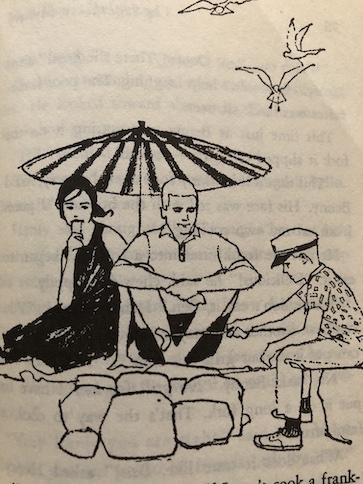
The Lighthouse Mystery

The Boxcar Children

The Lighthouse Mystery by Gertrude Chandler Warner, 1962, 1994.

The Boxcar Children and their grandfather have been visiting the children’s Aunt Jane. They are there to see her get married, and now they’re on their way home again. While driving home, they stop to look at a lighthouse and see a For Sale sign. The children are intrigued at the idea of owning a lighthouse, and their wealthy grandfather decides to ask a nearby storekeeper what he knows about the place. It turns out that the storekeeper has recently purchased the lighthouse himself, so it’s no longer for sale, but he’s willing to rent it out to visitors. The children’s grandfather is as fascinated at the idea of living in a lighthouse as the children are, so he decides to rent it for them to stay in.

During their first night at the lighthouse, the children’s dog, Watch, suddenly starts barking and growling. They can’t figure out what is upsetting watch, although Benny thinks that he smells food. They wonder if someone could be cooking something at the little old house near the lighthouse, but after a while, Watch calms down, and they all decide to go back to bed and check out the situation in the morning.

The next day, they go shopping for food, and the children find themselves looking suspiciously at everyone they meet, wondering if someone was near the lighthouse the night before. The first suspicious person they see is a man who almost knocks Violet over because he’s not looking where he’s going. Then, they meet a young man who seems angry about something. The storekeeper says that the young man graduated from high school early because he’s very smart, but his father won’t let him go to college. Grandfather Alden explains to the storekeeper that they had a prowler the night before, and he’s thinking about talking to the police about it. The children persuade their grandfather not to talk to the police because they want to investigate the mystery themselves.

The next night, the children see a woman outside the lighthouse, but when they investigate, they can’t find anyone. They think maybe she went into the little house nearby. Later, they look through the windows of the old house, which are mostly boarded-up. Inside, they see food and cooking equipment, which means that someone might have been cooking there the night that Watch started barking. Strangely, they also see a microscope, seaweed, and something that looks like its glowing. They think maybe someone is doing an experiment of some kind. It could be the woman they saw, or it could be the clever but angry boy who isn’t allowed to go to college, Larry Cook.

When the town holds a special Village Supper, the children learn that Larry loves to cook. They make friends with him while helping him to prepare the food. As the kids become friendlier with Larry and talk with other people in town, they learn more about Larry’s father’s opposition to him attending college and how Larry has been trying to study on his own. They’re pretty sure that Larry is the one who’s been conducting some kind of experiment in the little old house, but what is he trying to do?

The book is available to borrow and read for free online through Internet Archive (multiple copies).

My Reaction and Spoilers

This is one of the early Boxcar Children books, written by the original author. Because it’s one of the early books, the children in the story age. In the books written by other authors after the original author’s death, the children’s ages are frozen, and Henry is always 14, but in this book, he’s in college. That means that he’s not too different in age from Larry, and the kids find out that the college Larry wants to attend is the same one that Henry attends.

At first, I thought that Larry’s father objects to him attending college because they can’t afford tuition, but someone else who knows the family says that Mr. Cook is just a selfish man. I’ve noticed that some people who never went to college take other people’s levels of higher education as some kind of personal insult, like people who go to college are just trying to make them look bad or somehow discredit their personal life choices. It doesn’t seem to occur to them that people might do things for themselves and make decisions for the sake of their own lives that have nothing to do with them in any way. I think that might be the kind of selfishness that the story is trying to describe. Mr. Cook is one of those people who makes everything about himself and feels the need to control other people’s lives to make himself feel good or justify his choices. I’ve also noticed that people who haven’t been to college often don’t understand how changing technology and job requirements cause people to need more education to do jobs that used to require less. They also don’t have the imagination to see how more education can help someone progress further and faster in their field or how it might open the door to new fields they haven’t experienced or even thought about. Because they haven’t sought more education themselves and aren’t accustomed to stretching themselves and looking for new ways to skill up, they don’t think that there might be possibilities beyond their scope. Mr. Cook even admits all of that later, saying, “I just made up my mind that he couldn’t go, and I hated to give in. You see I never had a chance for much schooling. I’ve done all right. I couldn’t see why Larry needed to go to college. A waste of money, I thought. I guess I’m quick to lose my temper and slow to change my mind.”

In spite of his selfishness, this acquaintance says that he thinks Mr. Cook really loves his son. He’s just accustomed to putting his son and his son’s future second to himself. What causes Mr. Cook to change is when Larry is in danger, out on the family’s boat in a storm. Faced with the prospect of losing his son completely, Mr. Cook promises that, if Larry is rescued, Larry can have whatever he want. College turns out to be the right course for Larry. It not only helps him to pursue his field of study but to connect with professors and students who also share his passions and love of learning. It suits him and the life he wants to live.

In some ways, this story is more adventure than mystery. By the time that Larry is rescued from the storm, the Aldens think they have a pretty good idea what Larry is trying to do, but Larry explains it all to them after his rescue rather than the Aldens needing to prove anything themselves. There is also no crime in this story. The mystery part is more about unexplained or mysterious circumstances. Larry hasn’t done anything wrong or illegal. He’s not even trespassing in the little house because his family owns it. Larry’s experiments combine his love of science with his love of cooking. He’s trying to produce new kinds of foods using seaweed and plankton that can help to feed the world.

Ben’s Trumpet

Ben’s Trumpet by Rachel Isadora, 1979.

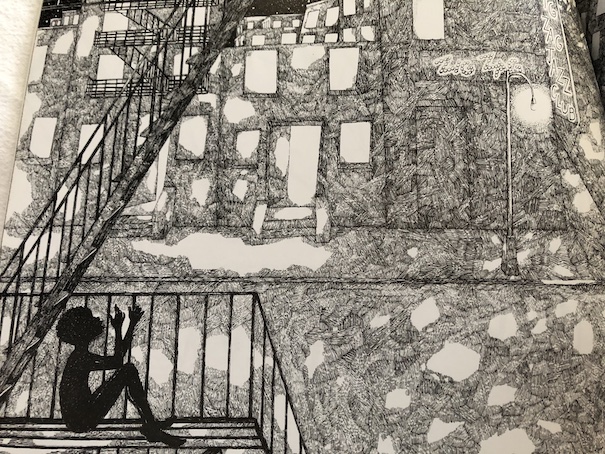
A boy named Ben likes to listen to the music coming from the nearby jazz club at night.

During the day, Ben stops by the club on his way home from school so he can watch the musicians practice.

Ben’s favorite instrument is the trumpet. Ben doesn’t have a trumpet himself, but he imagines that he does and that he can play for his family or play along with the musicians from the club.

Some of the other kids in the neighborhood laugh at Ben for playing an imaginary trumpet, but the trumpeter from the club doesn’t laugh. When he sees Ben playing his imaginary horn, he compliments him.

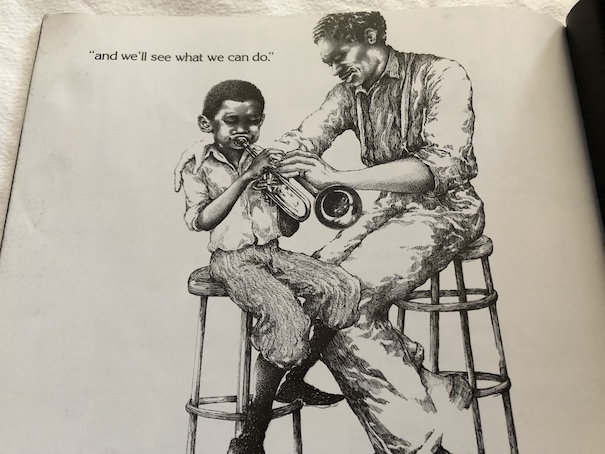
Later, when he sees Ben watching the club, the trumpeter invites Ben inside and lets him try his trumpet for real.

This book is a Caldecott Honor Book. It’s available to borrow and read for free online through Internet Archive (multiple copies).

My Reaction

I thought this was a nice story about an adult who understands a boy’s dream and is willing to take him under his wing. Both Ben and the trumpeter understand the love of music, and the trumpeter sees how badly Ben wants to be a real musician. We don’t know whether Ben eventually becomes a professional musician or not because the story ends with him trying a real trumpet for the first time, but the story implies that the trumpeter may become a mentor to Ben and that this might be the beginning of Ben realizing his dream.

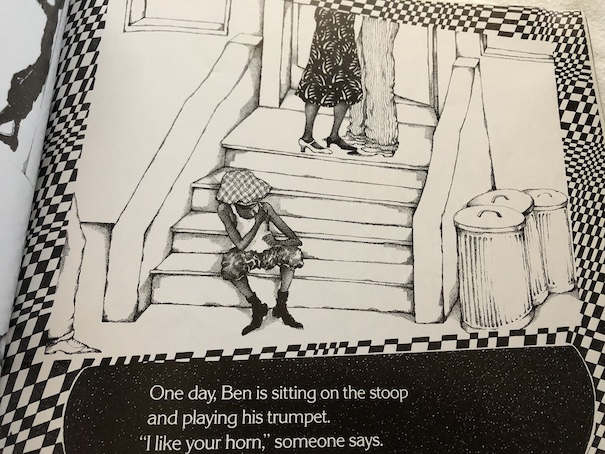
The book doesn’t give a specific date for the story, but the illustrations and use of terms like “the cat’s meow” indicate that it takes place in the 1920s. The illustrations not only give the story its 1920s vibe, but the abstract lines included in the pictures help to convey the sounds of the music and echo the art deco style popular during the 1920s.

There are a couple of things in the pictures that adults should be aware of. There is one picture where Ben’s baby brother is completely naked, for some reason, and there are adults with cigarettes. Other than that, I can’t think of anything else about the book that would be a cause for concern. There is no specific location given for the story, but it takes place in a city, and all of the characters are African American.

Deadline at Spook Cabin

Deadline at Spook Cabin by Eugenia Miller, 1958.

Twelve-year-old Mitch Adams is a newsboy for the summer, but the bicycle that he uses to deliver his newspapers is old and frequently breaks down. He often has to stop and fix it, which means that getting anywhere and delivering his papers takes him longer than it does for the other newsboys. If he doesn’t do something about it soon, his bike might break down completely, and he won’t be able to keep his paper route.

However, the paper he works for is having a contest for the newsboys, and the prize is a new bicycle. If Mitch can win the new bike, his problems will be solved. He’s been saving some money that he could use to get a new bike, but he’s hoping that, if he wins the new bike, he can use the money to buy a special present for his mother – a piano to replace the one they had to sell because they needed money after his father died. It’s an important present because his mother now has a job playing the piano for a dance studio, and she’s been thinking that, if she had a piano of her own again, she could also give piano lessons. In order to win the newspaper contest, Mitch has to be on time with his route, not get any complaints from customers, and sign up more new subscribers this month than any of the other newsboys. Mitch has been working hard at it, and by his count, he’s tied for first place with another boy. If he can keep up the good work to the end of the week, he stands a good chance of winning.

Mitch also has ambitions of becoming a reporter some day. When one of the best reporters for the paper, Jim McCain, says he wants to talk to Mitch about something, Mitch is delighted. Jim invites Mitch to meet him at the newspaper office early the next day so he can show him how the reporters get information from the police and fire department for their stories. Mitch is excited because he’s been asking Jim about that and agrees to meet Jim the next morning.

The next day, Jim actually lets Mitch do some of the calling to the fire department himself after first coaching him about what to say. In particular, he teaches Mitch to base his questions around the “five W’s” – who, what, when, where, and why – that make up a story. Because they live in a small town, there isn’t any particularly startling news from the fire department or the police, but Jim explains that people will want to know what’s happening in the area anyway. Some people may have heard the sounds of a fire engine recently, so they’ll check the newspaper to find out where the fire was, even if it was just a little brush fire.

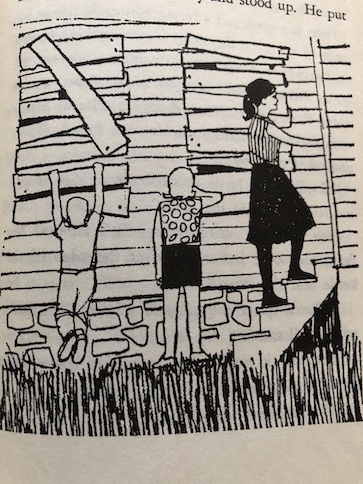
After Mitch is done with his work for the newspaper, he meets his friend Lyle and Lyle’s younger brother Beanie for a bike ride and a cookout. As they look for a good place to set up a camp fire, they find an abandoned cabin in the woods and decide to take a look inside. There’s not much there, and the boys think that it might be fun to fix it up like it’s their secret hideout and camp there some night. They give the old house the nickname “Spook Cabin” because Beanie thinks it’s kind of creepy. Exploring a little further, they also discover that there’s a tree house in one of the trees surrounding the cabin that’s hard to see from the ground.

Soon, some exciting news comes to Mitch’s paper after all. There was bank robbery in a nearby town. One of the robbers got away, and the police are searching for him. Police officers patrol the town, on the lookout for the fugitive.

Then, a report about a campfire that was left unattended comes from the local fire department. From the description of the campfire, Mitch knows that his friends were the ones who set it because they made it the way they said they would for sending smoke signals. However, they never would have left their fire unattended. Mitch knows that something bad must have happened, and his friends need his help!

The book is available to borrow and read for free online through Internet Archive.

My Reaction

This is a pretty short chapter book, and I thought it was pretty obvious where the missing bank robber was going to end up, but I really liked the story. The part I liked best was all of the information about how a newspaper works, or rather, how it worked in the mid-20th century. The book would have been educational for its time, and it still is, but many of the processes involved in putting together a newspaper would be done electronically now, using computers. The characters in the story are using manual typewriters, printing presses, and teletype machines. There’s a scene where Mitch asks Jim how the teletype machines work, and Jim explains that they’re “a combination telegraph and typewriter.” The machines in the story would be considered antiques or at least somewhat outdated now, but Jim’s tips for asking the right questions to write a story still apply. When I was a kid, though, my teachers usually said it as the “five W’s and an H” – to write a story or essay, you need to know who, what, when, where, why, and sometimes how something happened.