Kiki’s Delivery Service by Eiko Kadono, English translation by Lynne E. Riggs, 1985, 2003.
More Americans would probably recognize the title as the title of a Studio Ghibli animated film for children than as a book title, but the book came before the movie, and it is actually the first in a series, which continues the story about Kiki’s life and adventures, although I don’t think the later books in the series have been translated into English (at least, I haven’t found them in English). The original Japanese version of this book was written in 1985, and I read the English translation from 2003.
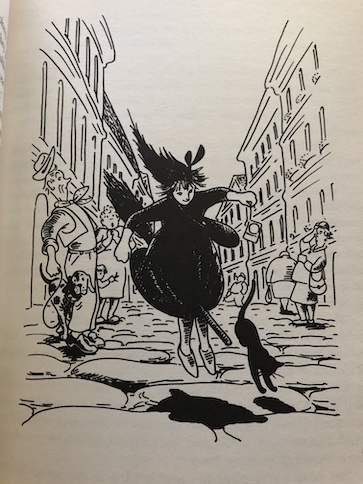
Kiki is a young witch, and in keeping with the traditions of young witches, she is expected to leave home at age 13 and live for a year in a city with no other witches. It will be a test of her developing skills and a coming-of-age experience, helping her to recognize her talents and find her place in the world.
When Kiki sets out for her journey with her cat, Jiji, she doesn’t know exactly where she is going to go or what she will find when she gets there. Some young witches know early on what their talents are and how they plan to support themselves during their year away from home, but Kiki is less sure (like so many of us who “don’t know what we want to be when we grow up”). The term “witch” just refers to a person’s ability to do magic. It’s not a job title by itself, and witches are expected to develop a specialization, such as brewing potions or telling the future. Kiki’s mother has tried to teach Kiki her trade, growing herbs and making medicines from them, but Kiki hasn’t had much patience with it. The only major ability Kiki has is flying, which is something that witches are expected to do anyway. Still, she has an adventurous spirit and is eager to set out and see what life has to offer.
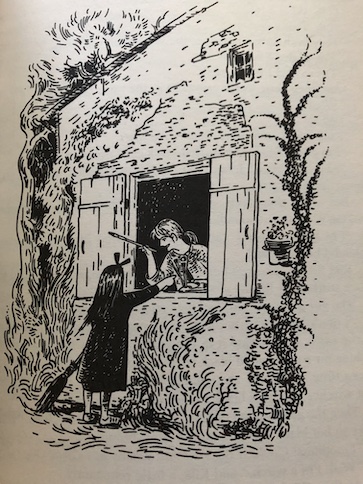
Once Kiki locates a city with no other witches, she has to find a place to stay and a job to earn money. She finds a city by the sea, which seems exciting to her. As she explores the city, she meets Osono, a woman who owns a bakery with her husband. When she helps deliver a baby’s pacifier to a bakery customer who left it behind, flying to the customer’s house on her on her broom, Osono offers to let her stay in a small apartment attached to the bakery. Kiki feels a little overwhelmed by the big city at first, but she realizes that, in a large city like this, there are probably a lot of people who have small delivery errands that wouldn’t be covered by ordinary parcel delivery services.
Kiki opens a delivery service, delivering small packages and running errands for people around the city. At first, business is slow, and some people are afraid of her as a witch. During a trip to the beach, a curious boy borrows her broom and breaks it. Kiki is distressed, and the boy apologizes. The boy’s name is Tombo, and he is part of a club of other kids who are interested in flying. He has made a study of flight and had hoped to learn more about how witches fly by trying Kiki’s broom, but Kiki expains that only witches can fly with brooms and that the ability is inherited. Kiki has to make a new broom, and it takes her a while to break it in, but it actually works to her benefit. People who were initially afraid of her for being a witch become less afraid of her and more concerned about her when they see that she is just a young girl, clumsily trying to master a new broom. Kiki gets some additional support and business from people who feel moved to help a struggling young witch. Tombo also makes it up to her and becomes a friend when he helps Kiki to figure out a way to carry a difficult object on her broom.
During her very first delivery assignment, Kiki was supposed to carry a toy cat to a boy who was having a birthday, but she accidentally dropped it. When she searched for it, she met a young artist, who was enchanted by Kiki as a young witch and painted a portrait of Kiki with Jiji. When the artist asks Kiki to take the painting to the place where it will be on exhibit, Kiki isn’t sure how to carry it at first. It’s kind of a bulky object to carry on her broom. Remembering that Tombo has made a study of flying, she asks him for help. Tombo ties balloons onto the painting to make it float and tells Kiki that she can now pull the painting along on a leash, as if it were a dog. The idea works, and when people see Kiki pulling a painting of herself along through the sky with balloons tied to it, it acts as advertising, bringing her more business.
Some of Kiki’s new jobs are difficult or awkward, and some customers are more difficult to deal with than others. There are times when Kiki finds herself missing home or trying to remember how her mother did certain things, wishing that she had been better at watching and remembering what her mother did. Still, Kiki learns many new things from her experiences and acquires new skills.
Kiki’s experiences also help her to realize a few things about herself and life in general. Like other girls, Kiki worries about how boys see her. When Tombo makes a comment that he can talk to her when he can’t talk to other girls, Kiki worries that he doesn’t see her as a girl at all. A job delivering a surprise present to a boy from another girl her age helps Kiki to realize that everyone is a little shy and uncertain about romance and even people who act confident feel a little awkward about first relationships.
As her first year away from home comes to an end, Kiki wonders how much she’s really changed over the year. Although she has successfully started a new business and done well living away from her parents, she still experiences a sense of imposter syndrome, where she doesn’t quite feel like she’s really done all of the things she’s done. Her first visit home to her parents reminds her that her new town has really become her new home. She has become a part of the place, and she feels her new business and friends calling her to return.
In 2018, the author, Eiko Kadono, was awarded the Hans Christian Anderson for her contributions to children’s literature.
My Reaction
I think of this story as one of those stories that takes on more meaning the older you get. Young adults can recognize Kiki’s struggles to make her own way in the world and establish herself in life as ones that we all go through when we start our working lives and gain our first independence. It can be a scary, uncertain time, when we often wonder if we really know what we’re doing. (Life Spoiler: No, we don’t, but no one else completely does, either, so it’s normal and manageable. Some things just have to be lived to be really understood, and that’s kind of the point of Kiki spending a year on her own, to see something of life and how she can fit into it.) However, it’s also a time of fun and adventure as we try new things, build new confidence, make new friends, and learn new things about ourselves. Like so many of us, Kiki doesn’t always do everything right, but she learns a lot and endears herself to the people of her new town.
The Miyazaki movie captures the feel of the story well, although the plot isn’t completely the same. There are incidents and characters that are different between the book and the movie. Tombo appears in both the book and the movie, but there are other characters who appear in the book who weren’t in the movie. In the book, Kiki makes friends with a girl named Mimi, who is her age, and the two of them discuss crushes on boys and how each of them was a little envious of the other because, while each of them is struggling with their own uncertainties in life, they each thought that the other acted more confident. The movie version developed the character of the young artist more. Kiki also didn’t lose her powers during the book, although that might be a part of one of the other books in the series, since I haven’t had the chance to read the others yet.
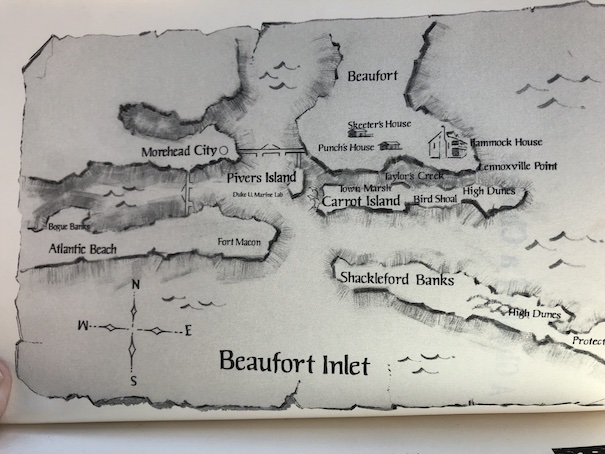
Punch (real name Philip) Wagner and his family are spending the summer by the sea in North Carolina, and his parents have let his friend Tom Ellis come with them. The 12-year-old boys are looking forward to exploring the area by themselves, but Punch’s father has arranged for the son of a friend of his to be their guide. At first, Punch isn’t thrilled about his father arranging for them to be led around by a boy they don’t know. Punch’s father has a very different personality from Punch. His father is a professor, very academic, so Punch doesn’t feel like he can take his father’s word that they’ll get along with this new boy. Punch and Tom particularly wanted their independence and a chance to make some plans of their own.
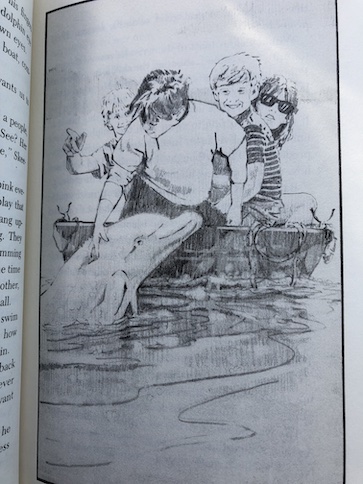
However, Punch is surprised to discover that his father’s old friend is a laid-back, jovial man who calls his father “old crawdad.” His son, Skeeter Grace, is a little younger than Punch and Tom, which makes Punch even less enthusiastic about having him as a guide. Skeeter Grace doesn’t seem to be any more excited about hanging out with Punch and Tom as they are with him, but the adults suggest that Skeeter take the other boys for a boat ride. Punch’s pretty older sister, Lila, says that she’d like to go with them. Punch warms up to Skeeter when he finds out that he participates in dolphin watches run by Duke University because he loves dolphins, although he considers Skeeter a bit of a know-it-all.
When Punch tries to ask Skeeter if he plans to work with the dolphin researchers when he grows up, Skeeter becomes oddly touchy. Punch mentions it to his father, and his father explains that nobody in Skeeter’s family has been to college before. His father is a carpenter, and it isn’t expected that Skeeter will attend college, either. Punch’s father points out that it must be difficult for Skeeter to want something that he doubts he’ll ever be able to get.
Punch is particularly interested in an old house nearby where Blackbeard once lived. He tries to persuade Skeeter to come with him and Tom to check it out, but Skeeter warns them not to go there. For one thing, that house is owned by somebody who wouldn’t like them trespassing, and for another, Skeeter is firmly convinced that the house is haunted by the ghost of Blackbeard. Lila says she doesn’t know why the boys are so interested in Blackbeard because he was a horrible person who killed people and “used women” (no details given, but you get the idea). Punch’s main interest is the stories about Blackbeard’s hidden treasure. He wants to be the one to find it.
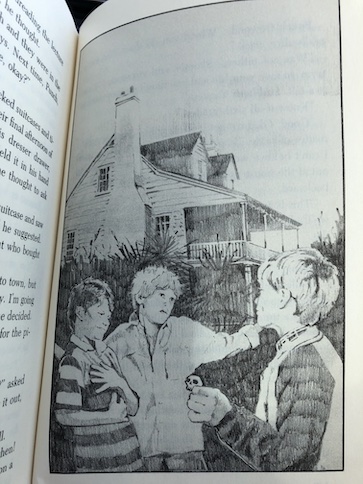
The boys go by Blackbeard’s old house, now called Hammock House, and they’re started by the sound of something hitting the roof and dropping down to the ground. When Punch picks up the small object, he discovers that it’s a small plastic skull with glittering red eyes. It’s startling, but it doesn’t seem likely that a real pirate ghost would toss them a plastic skull. Tom thinks maybe it’s some kind of warning, but Punch thinks that Skeeter probably tossed the little toy skull in the air when they weren’t looking, just to scare them.
Punch eventually persuades Skeeter to help him and Tom search for the treasure by pointing out to him that he would be able to afford college if they found Blackbeard’s treasure. He sees how badly Skeeter wants to go to college when Skeeter jumps on the project, bringing along a metal detector and helping the other boys dig and do research. At first, Punch just thought of the project as a fun summer adventure, but when he realizes what a big difference it would make to Skeeter to really find the treasure, the hunt becomes much more serious. Punch knows that searching for the treasure is a long shot, and it would be disappointing if they never found anything. Since it will be several more years before Skeeter will be old enough for college, they don’t have to succeed this summer, and the boys discuss making it an annual project every summer.
To make the most of this summer, they want to spend some time camping out and searching for treasure. Punch’s mother is reluctant to let the boys do that until Lila says that she’ll go with them. Lila knows that the boys are searching for treasure, and she encourages them to get into the mindset of being pirates as much as possible.
While the boys are using a metal detector, they find an old metal box. The contents don’t look like pirate treasure, but they appear to be someone’s treasure. There’s an old Bible, some jewelry, and a couple of tarnished silver baby spoons. On one hand, the boys are pleased to have found something, but on the other, it’s not as grand as what they had hoped to find. Lila says that the jewelry could be valuable, and the boys think that the local historical society might be interested in the old Bible. Skeeter explains that there used to be an old whaling community in the area they’re searching, but it was often damaged by storms. He says people sometimes buried valuables, knowing that their homes could be damaged or destroyed by storms. He figures that the owner of this particular box could have been killed in one of the storms, which is why he never returned for his box. They find some other boxes that appear to have been lost in a shipwreck, including one with spices and one with bottles of alcohol, but none of them are what they’re really looking for.
More and more, Punch becomes convinced that the only place where they should be looking for Blackbeard’s treasure is around his old house. He finally persuades Tom and Skeeter to come with him and have a look.
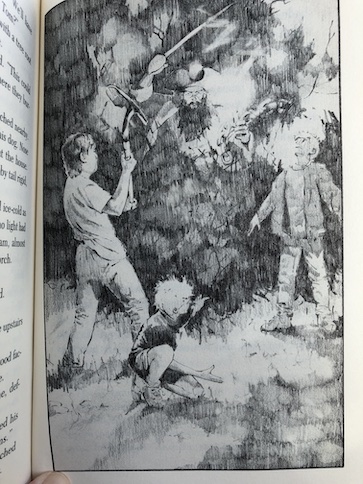
However, the house doesn’t seem as empty as the boys assumed it would be. Punch’s dog seems afraid of the house, and they still don’t know where the little plastic skull came from. Then, the boys hear a frightening scream, like the screams of a girl who was supposedly murdered by Blackbeard years ago. Is the house really haunted?
My Reaction and Spoilers
For most of the book, the boys are doing things like watching the dolphins, camping out, and digging for treasure in various places. The question of whether or not Blackbeard’s old house is haunted is the main mystery of the story, but the story doesn’t really become about that until almost the end of the book. Punch has the little skull to puzzle over before that, but it isn’t until the boys return to Hammock House to look for buried treasure that they become truly concerned with the ghosts that seem to be haunting the place.
There is a logical explanation behind the hauntings, at least some of them, making this the kind of Scooby-Doo Pseudo-Ghost Story that I always liked as a kid. In a way, this story is also a kind of MacGuffin story. It’s not so much what the kids find as the adventures that they have during the search that are important. The boys’ fathers understand because they later confess that they also hunted for Blackbeard’s treasure when they were young. It seems that, even though Punch thinks of his professorial father as being very different from him, when he was young, he was much the same sort of boy that Punch is now. Skeeter’s dreams of studying marine biology also do not depend on finding Blackbeard’s treasure. When his father finds out that’s what Skeeter really wants to do, he’s supportive, and Punch’s father, as a professor, offers some useful advice about scholarships.
There is some alcohol use in the book. There is a part of the story where the boys find a box with old liquor bottles and drink the contents, pretending like they’re pirates drinking rum. The boys get drunk and make themselves sick, and when Lila catches them, she lectures them about how they could have died. My first thought was that only an idiot drinks from random bottles that they just find. Even though they thought they were probably whiskey bottles, “probably” doesn’t seem good enough to just start drinking it. Also, Lila is right that they could have killed themselves from drinking too much. It is possible to die from alcohol poisoning by drinking way too much liquor of any kind all in one sitting, as kids they would be hit much harder than full-sized adults, and not having any prior experience with alcohol, they have no sense of their own limits. I’ve heard of college parties where people have died from alcohol overdose because they were new to drinking, didn’t know when they were going too far, and were in an environment where people were encouraging drinking to excess rather than learning restraint. What I’m saying is that the boys were in real danger because they were too young and inexperienced to understand the danger they were in. Fortunately, the boys learn their lesson without any lasting harm, and making themselves sick means that they’re unlikely to make the same mistake again.
Mystery of the Inca Cave by Lilla M. Waltch, 1968.
Thirteen-year-old Richard Granville has been living in Peru for the last two years. His family moved from California to a mining town in the Andes because his father is a manager for a mining company. Richard enjoys living in Peru because he’s developed an interest in archaeology and the history of the Incan civilization. Richard feels like the mountains are a connection to the distant past, and he loves the historical feel of the place. His parents don’t understand how he feels and would rather see him work harder at his schoolwork instead of spending all of his time exploring the mountains. Richard’s father tells him that he won’t become an archaeologist if he doesn’t apply himself to his studies, and his mother worries that something could happen to him in the mountains. They think he should finish school first and then decide if he wants to go into archaeology or not, but Richard’s mind is already made up, and he doesn’t want to waste this golden opportunity to do what he loves most right now. Richard feels hurt that his parents don’t really listen to him, don’t share his interests, and don’t appreciate the finds he’s already made.
Richard loves to explore the area with his friend, Todd Reilly, and see if they can find pieces of Incan relics. They’ve found some interesting bits of pottery and broken tools, but one day, they make a particularly exciting discovery – an ancient stone road mostly covered with grass. Although Richard knows that there are many other remains of Incan roads, this one is particularly tantalizing because it seems more hidden than most. Richard is fascinated with how neatly the stones of the road fit together so precisely without mortar, and he wonders where the road leads.
The boys explore the old road further, but they discover that at least part of the road was buried in a landslide. Todd doubts that they’ll ever be able to find where the road leads, but Richard wants to keep trying. When they return to the spot to try again, Richard spots the remains of an ancient building! Richard is sure that the building was once a chasqui station (also called tambos), which was a place where Incan messengers could stop, rest, and trade off with other messengers, who would continue to carry messages along the route, like the members of the Pony Express used to trade off with each other. Richard knows that stations like that were placed about 2.5 miles apart along roads, so there might be other stations located along this route.
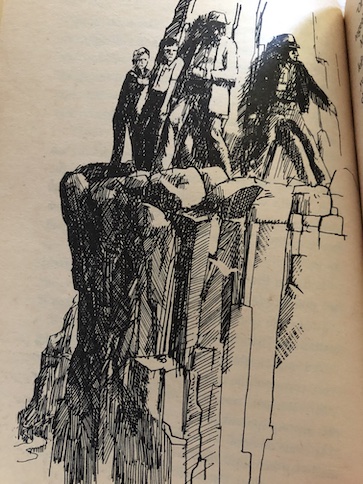
The boys go a little further and find a stairway leading up the side of a cliff to a cave. On the stairs, Richard finds a small doll. The doll is puzzling because Richard isn’t sure if it’s an Incan relic that somehow managed to survive or if it’s a more modern doll made by the South American Indians in the area. He has trouble believing that any more modern person could have been at this spot recently because it’s pretty isolated and rough territory. It looks like other landslides could happen. He can’t tell his parents about his discovery because they probably wouldn’t let him return to the area to explore it further if they knew how dangerous it was, and he can’t bring himself to abandon the most exciting discovery he’s ever made.
On a trip to the marketplace, Richard and Todd spot a mine foreman, Jeb Harbison, yelling at a boy in Quechua. He stops as soon as he sees the other boys watching, and they wonder what that was about. Then, the boys spot a merchant selling dolls that are similar to the one they found at the ruins. They ask the merchant where the dolls came from and who made them, and he gives them the name of the doll maker, a woman named Deza. Todd thinks that the most likely explanation for the doll they found is that some young girl living in the area got a doll from the same doll maker, and she lost it while playing around the cave. However, Richard doesn’t think that’s likely because the cave is such an out-of-the-way place, not somewhere a young child could easily reach alone.
On another visit to the area of their discovery, the boys find a mine shaft that doesn’t belong to the company their fathers work for, even though it’s on land that they know the company owns. There are signs that someone is actively mining there, but who?
The boys also discover that the activity at the cave is connected to the mine when they see some men there, breaking up rocks and stuffing them inside of little dolls, like the one they found earlier. It seems like the miners are smuggling gold or other minerals in the dolls, but when the boys talk to Richard’s dad about what they’ve seen, the situation points to a possibly larger conspiracy.
The book is available to borrow and read for free online through Internet Archive. The book was originally titled Cave of the Incas.
My Reaction
The first thing that I liked about this book was the pieces of information about the ancient Incas. Our knowledge of ancient civilizations has increased since the 1960s, but the information in this book is still good. I liked the book’s descriptions of Inca building techniques, how they used closely-fitted stones instead of mortar, and how their system of messengers was organized. There are also points where the characters notice parallels between the way the ancient Incas lived and the way their descendants live, such as their system of cooperative farming.
However, this story is also about human relationships as well as adventure, mystery, and ancient civilizations. Through most of the book, Richard is troubled about his relationship with his parents, especially his father. His parents are frustrated with him because he is absorbed by his interest in archaeology and exploring the countryside and isn’t applying himself to his schoolwork. At the same time, Richard hates it that his parents don’t understand what interests him and only seem to want him to focus on what they want. They’re having a clash of priorities.
When I was a kid, I hated homework with a vengeance. That might be a surprising revelation about an adult who willingly does what are essentially book reports on a regular basis as a hobby. Reading is fun. Research produces interesting information. I like knowing things and writing to other people about them. Basically, I was always good at the skills necessary for homework, so that wasn’t the problem. The problem is that there were many other things I wanted to do, and homework got in the way. I didn’t always get to read about what I wanted to read about in school because someone else was always choosing the school material for me, and I frequently hated their choices. Even the arts and crafts weren’t always the ones I wanted to learn, and I was usually told what to make instead of getting to make what I wanted. Because I was a good student, I ended up in the honors classes, so I always had more homework to do than everyone else. I was proud that I was a good student, but at the same time, I also hated it because I found it stifling. I’ve always been interested in many different subjects and handicrafts, but all through my childhood, I felt like I could never just take up all the different projects I wanted to do because I had to do my never-ending supply of homework first. Everything I wanted to do always had to wait. Even after I graduated, it was difficult for me to shake off the feeling that I had to wait on things I wanted to do , which was also kind of irritating.
I could sympathize with Richard’s attitude toward his own studies. He knows what he really wants to do, and he finds it infuriating that his parents want him to put it off and finish his homework and his education first. There is something to be said for making the most of finding himself in the very place he wants to be with direct access to what he knows he wants to study seriously. The move to Peru was an enriching experience for Richard that gave him a direction and life ambition, and I think he would regret it forever if he didn’t use this opportunity to explore it as much as possible. At the same time, though, my adult self knows that there is truth to what Richard’s parents say about his explorations in the mountains. The mountains are dangerous, like Richard’s mother says, and even Richard knows it. Also, Richard’s father is correct that if Richard seriously wants to be a professional archaeologist, he’s going to have to finish his education.
Nobody in modern times becomes a serious, professional archaeologist without a college degree, and even archaeologists need to study things beyond their specialist field. Archaeology isn’t just wandering around, digging, and seeing what you find. You have to recognize what you find, study its context, understand its significance, and know how to treat it to preserve it. You can’t study past lives and interpret artifacts without having real life and world knowledge. Archaeology is also where science and history intersect. Archaeologists need to know mathematics, geology, and how humans are affected by climate (which can and does change over time, for various reasons) and access to resources. There are legal and ethical principles to archaeology that Richard will also have to understand. Archaeologists can also benefit from learning drawing and photography to record and interpret finds and perfecting their writing skills to present their findings to the world. Richard has made a good start in his field of interest, but to get serious about it, he will need more education and greater depth and breadth of knowledge.
As annoying and stifling as homework feels, the skills it imparts are necessary for doing many more interesting things. Getting through the studying phase can be a pain, but sometimes, you really have to lay a solid foundation before you can build something solid on it. I still think that my past school assignments could have been more interesting and less stressful if I’d had more flexibility about them and more time for personal projects in between. However, I have realized over the years that, once you’ve really learned something, you will use it, even if you only use it indirectly as part of something else. I don’t regret learning the things I learned because, as hard as it was along the way, I have used things I learned in more interesting ways later in life. I’ve also realized that, if I had spent less time and emotions complaining about how stifling my homework situations were, I also could have used the time I spent lamenting about homework and procrastinating about it to accomplish some of the other things that I complained that I never had enough time to do. Not all of them, but more than I did when I was too busy being upset and resentful about homework. That’s also a lesson that Richard learns in the story.
At one point, Richard talks to Todd about his relationship with his own father, and Todd says that they get along pretty well. Richard realizes that Todd and his father don’t fight over his studies because Todd is an easy-going type who doesn’t mind doing his homework much and takes care of things without making anybody nag him to do it. Todd just accepts that there are some things that just need to be done, so he doesn’t waste time complaining or procrastinating about them. That’s harder for Richard because he feels the strong pull of what he really wants to do.
Todd admits that he and his parents don’t always get along perfectly because he doesn’t always do what he’s supposed to do. There are times when he leaves messes or physically fights with his brother or talks back to his mother, and his parents get angry or irritated about it. When Richard asks Todd what he does in those instances, Todd says that, eventually, after the initial argument, he typically apologizes or cleans up his mess or does whatever he needs to do to fix the situation. Todd’s reasoning is that, while people aren’t perfect and don’t always do what they should, “when you’re wrong, you’re wrong.” He accepts that, sometimes, he screws up and needs to do something to fix it without getting too overwrought about having been in the wrong. He sees it as just a normal part of life. When it happens, he can correct himself and move past it.
In the case of Richard and his father, each of them has to admit to being a little wrong and accept that the other is partly right. Both of them have to do some work to fix their relationship. Richard has to admit to his father that he does need to continue his education and apply himself to getting his work done. In return, his father needs to try harder to understand Richard’s interest in archaeology and allow him some time and opportunities to make the most of his time in Peru, getting the firsthand knowledge and experience he needs for the future he really wants and that won’t come from the standard classes he’s taking.
Through their adventures in the course of the story, Richard and his father come to a better understanding of each other and have an honest conversation about how to manage the conflicts in their relationship. Richard’s father admits that he needs to stop looking at his son as being just a younger version of himself and to see Richard for the independent person he is, with his own interests and goals in life. Meanwhile, Richard connects somewhat to his father’s interests through their investigation of the illegal mining operation he and Todd discovered.
This mystery story is a little unusual for children’s books, where kids often investigate mysteries on their own, having adventures without the adults, because Richard’s father joins the boys in their investigations and he stands up for them and what they’ve discovered when their discovery is challenged. The shared adventure becomes a bonding experience for Richard and his dad. At the end of the story, Richard’s father helps Richard connect with a museum curator, who helps the whole family to see the true value and significance of Richard’s archaeological finds. The curator also emphasizes to Richard that, while he has the potential to excel in his chosen field, he’s going to have to study and move on to higher education to get where he wants to go. Richard agrees, now having a greater understanding of its importance and satisfied that his parents understand the direction he’s chosen for his life.
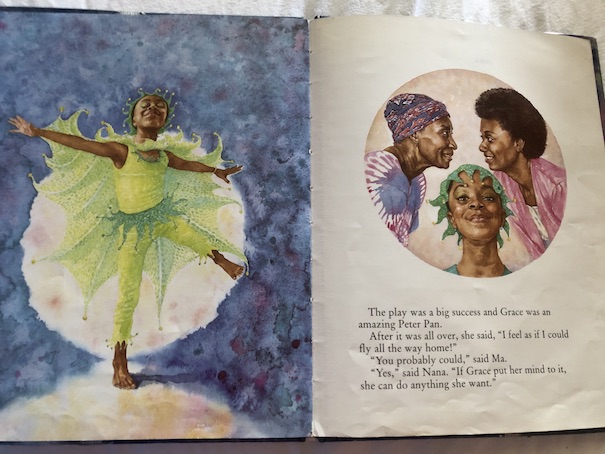
Grace loves stories, both hearing them and acting them out. She is imaginative, and likes playing games of pretend and acting out adventures.
When Grace’s teacher tells the class that they are going to perform the play Peter Pan and will be holding auditions for parts in the play, Grace wants the title role of Peter Pan. A couple of the other kids think that it’s odd for her to want to be Peter Pan because she is both a girl and black, which is exactly the opposite of how they usually see the character.
However, Grace still wants to play Peter Pan. When she tells her mother and grandmother what the other kids said, they reassure her that she can get the part if she really wants it and puts her mind to it.
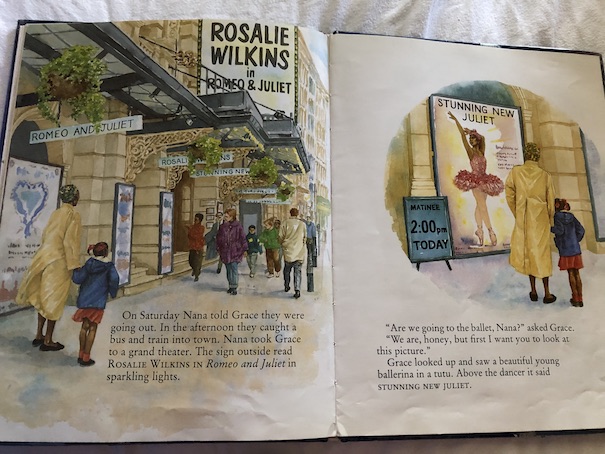
To prove to Grace that a young black girl can get starring roles, her grandmother takes her to see a ballet where the granddaughter of a friend of hers from Trinidad is playing the role of Juliet in Romeo and Juliet.
Seeing the performance cheers Grace up and gives her the confidence to audition for the part of Peter Pan. When her classmates see how good she is when she performs, they all agree that Grace should have the role of Peter Pan.
The message that young girls like Grace can do what they set their minds to, even if the roles they want in life aren’t quite traditional, is a good one. As I read the story, I was also thinking that the objection that Grace can’t be Peter Pan actually doesn’t make much sense if you know that Peter Pan, of all roles in plays, is one that is often played by a female. I remember that when I was a kid in elementary school, there was a girl who played the part of Peter Pan, and one of the teachers explained that women sometimes play Peter Pan, especially when the actors are all adults, because women have the higher-pitched voices that the part really needs. I would liked it if the teacher in the story also mentioned that. Also, acting is about capturing the spirit of the character in the story, thinking and feeling like they would think and feel and acting the way they would act. I would have liked it if they had mentioned that. Grace may not look quite the way people might picture Peter Pan, but if she can capture the character in her performance, she’s a good actor.
I liked the pictures in the book for their realism. In a couple of the pictures which show how Grace like to act out fantasies, she is shirtless, but she is very young and it isn’t possible to really see anything, so I don’t consider it inappropriate, but I thought that I would mention it.
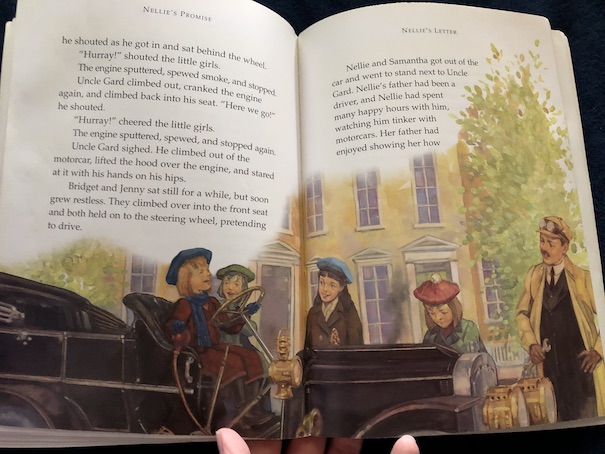
This book is a companion book to the Samantha, An American Girl series, focusing on Samantha’s best friend, Nellie. Personally, I don’t like the companion books to the main American Girls books as well as the original books, but this book does follow up on the events to the main series. At the end of Samantha’s series, Samantha’s aunt and uncle took in Nellie and her sisters, Bridget and Jenny, after their parents died. Nellie and her sisters were from a poor family and had to start working from a young age before their parents died. After their parents died, their disreputable uncle abandoned them, and they were sent to an orphanage before Samantha discovered where they were. Samantha’s aunt and uncle are wealthy, and the girls’ lives have improved considerably.
Nellie’s happiness is threatened by the sudden reappearance of her Uncle Mike. Uncle Mike sees Nellie walking down the street in her nice new clothes and wants to know what rich family the girls are living with. Nellie runs away from him, but he threatens to find out where she’s living and to take her and her sisters back, saying that it’s his right as her uncle. He says that he means to put the girls to work earning money for him. Nellie is afraid that he might be able to reclaim them from Uncle Gard and Aunt Cornelia because he is a blood relative.
At first, Nellie is afraid to tell anyone that she’s seen her uncle and that he threatened to take her and her sisters back. Before her parents died, her mother made her promise to look after her younger sisters, so Nellie makes up her mind that’s what she’s going to do.
Nellie worries about the future for her and her sisters. She feels like she doesn’t fit in with the wealthy girls at Samantha’s school, who have had very different lives from hers, and the lessons they learn are the type of lessons for fine young ladies who will marry rich men and spend most of their time raising families, overseeing a house with servants, and entertaining friends and their husbands’ business associates, not preparing for practical professions outside the home. Nellie thinks that it’s important that she have some kind of job skills because the future can be very uncertain, and she wants to know that she can provide for her sisters, no matter what happens.
Samantha senses that Nellie is unhappy, and she asks her if she likes living with Uncle Gard and Aunt Cornelia. Nellie tells her that she does, but she hesitates to explain what’s really worrying her. Instead, she lets Samantha think that she just wants to feel like she’s doing something useful for the family. Before her parents died, Nellie used to get sewing lessons at a settlement house (a place where immigrant families could go to learn English, new job skills, and other skills they would need in their new lives in the United States) run by Miss Brennan. Aunt Cornelia is involved with many good causes, and she wants to visit a settlement house and get an introduction to Miss Brennan. Because Nellie knows Miss Brennan, she can help arrange that. It’s in a rough part of town, but Nellie is more accustomed to navigating rough neighborhoods than Samantha or her aunt. It also occurs to Nellie that she could ask Miss Brennan what to do about Uncle Mike.
Miss Brennan is glad to see Nellie, and she lets her show Aunt Cornelia and Samantha around the settlement house. They have many different types of classes for children as well as adults. Nellie says that she likes the practical classes that she used to have there, and even the types of dances that they do seem more practical than the more purely artistic ones that they do at the school she now attends with Samantha. Aunt Cornelia is pleased with the classes that they offer for women, and because she is interested in women’s education, decides that she wants to help out at the settlement house. However, the visit to the settlement house leaves Samantha irritated for reasons that Nellie doesn’t fully understand.
As Nellie begins spending more time with Aunt Cornelia at the settlement house, Samantha begins spending more time with Bridget and Jenny, and Nellie becomes jealous of how Samantha seems more like their older sister than she is. However, the others still don’t know about Uncle Mike’s reappearance, and Nellie is still fearful of what he might do and what will happen to her and her sisters if Uncle Mike tries to take them away. She feels like her only option is to try to prepare herself for a better job than that of factory worker.
When Nellie finally gets the courage to tell Miss Brennan about her worries, Miss Brennan tells her that she needs to discuss the situation with Uncle Gard. Uncle Gard is a good man, but he’s also a lawyer, and he will know how to legally stop Uncle Mike from trying to take custody of the girls. However, Miss Brennan adds that, whatever else happens, Nellie will still need to make some decisions about her future and what she wants to do with her life and education. The more Nellie thinks about it, the more certain she is about what she wants to do. She wants to become a teacher, like Miss Brennan.
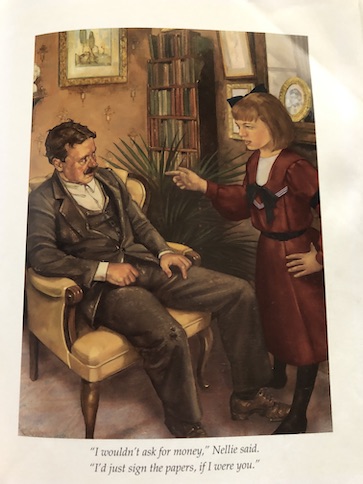
Nellie provokes more drama by applying to the boarding school in Boston where Miss Brennan said that she trained to be a teacher without talking to Aunt Cornelia, Uncle Gard, or Samantha about her decision or about her uncle. However, when the truth comes out about Uncle Mike, everyone understands that she was trying to hide and protect her sisters from him. It turns out that Uncle Gard has actually been looking for Uncle Mike because he already has the documents that he needs to legally adopt Nellie, Bridget, and Jenny, and he just needs Uncle Mike to legally release them into his custody. At first, Uncle Mike tries to extort money from Uncle Gard for the girls, but Nellie gets up the courage to tell him off, promising that if he doesn’t sign the papers and leave, she’ll tell everyone about how he stole all of their money and abandoned them to freeze the last time they were in his custody. The book ends happily, with Aunt Cornelia and Uncle Gard adopting the girls and understanding Nellie’s ambition to be a teacher. They enroll Nellie in a school in New York that teaches the skills she really wants so that she can continue living with them and not go to Boston. It also turns out that Samantha was mostly uncomfortable at the settlement house because she felt so sorry for the young children there and that spending time taking care of Bridget and Jenny was part of her way of trying to help Nellie by leaving her more free to do some of the things that she felt like she had to do. With everything out in the open, Nellie and her sisters are able to more fully become part of the family.
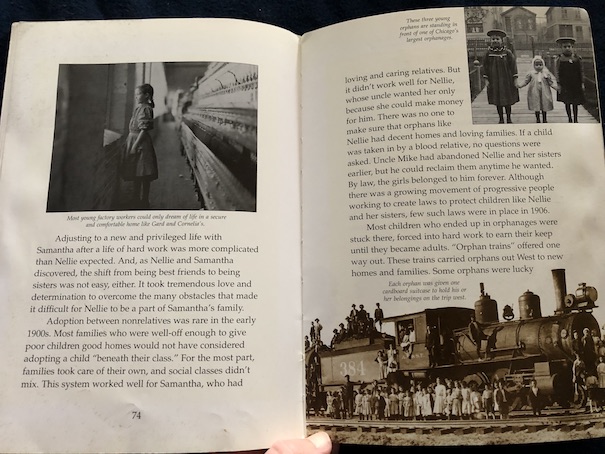
In the back of the book, there is a section with historical information about orphans and adoption in the early 1900s. There were not many laws and regulations governing care of orphans. Usually, orphans would be taken in by relatives, like Samantha was when her parents died. If a child didn’t have any relatives who were willing and able to take them, the child might be sent to an orphanage and possibly sent west on an orphan train as Nellie almost was at the end of the Samantha series. Families didn’t usually adopt children from different levels of society.
Settlement houses were important resources for poor immigrant families, and the education they received allowed immigrants to enter higher professions than servant or factory worker, which had been the primary source of income for many of them. It was common for settlement houses to help train young women to become teachers. There are still similar institutions and organizations in operation in 21st century America.
The book is available to borrow for free online through Internet Archive.
My Reaction and Further Historical Information
Part of the reason why I don’t like the companion books as much as the original American Girls series is that they tend to get more dramatic than the original books, and sometimes, I feel like the attitudes of the characters are less realistic for their time periods than they were in the original books. I think what made the original books more realistic was the restraint of the stories – they had their share of excitement and sometimes drama, but they never went overboard. The return of Nellie’s disreputable uncle struck me as both unlikely and unnecessary to Nellie’s and Samantha’s larger stories.
The historical details in this book are good. What they say about orphans of the time is basically true, although they note in the historical information section in the back of the book that Nellie’s experience of being adopted by a wealthier family was not typical of the time, and I think that’s part of what bothers me. Adoptions in general during the early 1900s were less formal than they are in modern times, and the idea of Uncle Gard hiring a private detective to find Uncle Mike and get him to sign legal documents doesn’t seem entirely realistic. I think it would have been more realistic to me the way that the last Samantha book ended, with Uncle Mike leaving and the assumption that none of the characters would see him again.
The reason why Nellie and her sisters were sent to the orphanage and why the orphanage was considering sending Nellie west on the orphan train was that no one expected that Uncle Mike would ever want to see the girls again. He’d already taken everything he could from them and left with them with no concern for what would happen to them. In the time that has passed since then, I would have expected that Uncle Mike would already have gotten into trouble that would keep him busy and out of their lives, maybe ended up in prison for being drunk and disorderly or hopping from job to job or begging for money as their little money ran out. Even if Uncle Mike had some thought of finding the girls, I don’t think it’s likely that he would have succeeded or even gotten close on his own because he is not that bright and he is not the kind of person who makes friends in places where he’s been before. I doubt that his former neighbor who took his nieces to the orphanage would have told him much if he had shown up again, looking for them. She knew that he was a drunk who abandoned the girls, and she made it clear that she didn’t like him. The people at the orphanage would have probably sent him away with no information because they would probably view the situation as closed since the girls are already placed out and Mike may not even have any proof of his identity and relationship to the girls. There is no such thing as a driver’s license during this period and many people did not even have birth certificates, so it’s possible that the people at the orphanage could simply choose to disbelieve this disreputable character and send him away. When I was watching a documentary about the orphan trains, former orphan train riders said that the orphanages that sent them west deliberately took notes from them that had their living parents’ addresses and otherwise cut off contact with living parents because they wanted the children to sever their ties to their difficult pasts and devote their attention to their new families, not maintain contact with the parents who were unable to care for them financially, so I wouldn’t expect that anyone at the orphanage in these books would go out of their way to reunite the orphaned girls with a rather shady uncle when they knew that the girls were already placed with a wealthy family and no longer their responsibility. Without help, which would be unlikely to be forthcoming, it doesn’t seem likely that Uncle Mike would be able to stumble on the girls by accident. As mentioned in Changes for Samantha, New York is a big city, people can be difficult to find if you don’t have a hint of where to look, and the wealthier part of the city where Nellie and her sisters live now is not a part of town where a guy like Uncle Mike would be likely to hang out. They could all easily live in New York City for years without meeting each other.
I feel like the situations in the story were a little contrived. By now, I would have thought that Nellie would know that Uncle Gard is a lawyer and would be the best person to ask about the laws. I don’t recall the earlier books saying what Uncle Gard did for a living, but Nellie lives with him now, and I would think that someone would have mentioned Uncle Gard’s profession by now. In the book, it oddly seems like as much of a surprise to Nellie as it is to the readers. I could believe that Nellie would go to the settlement house and do volunteer work there with Aunt Cornelia because it was already established in the previous books that Aunt Cornelia supports good causes, and although women of her level of society didn’t usually work for living, supporting good causes and charitable works would have been acceptable. Nellie’s level of knowledge seems a little odd, considering that she needed extra tutoring in basic subjects, like reading, in Samantha Learns a Lesson. In that book, Nellie never mentioned settlement house lessons, which she would have done if it hadn’t been a sudden decision to insert that this in book. Here, Nellie talks about classes that she had at the settlement house, where I would have expected to have more lessons to improve her reading, and it seems like she learned more there than she seemed to know before, even knowing a few words of foreign languages. In Samantha Learns a Lesson, one of Nellie’s skills was her ability to do math quickly handle money because she used to do the shopping for her mother, and in this book, she mentions that she helped to teach immigrants about American money, which she never mentioned before. These things are necessarily contradictory, but it all just seems a little off because they don’t quite fit into Nellie’s established character and history, and it implies that Nellie has had more education and training than she seemed to have before. It’s not necessarily impossible for a girl of Nellie’s time to know some of these things, but it’s the departure from what was already established about Nellie and her situation in life than kind of grates on me.
I think it could be reasonable for Nellie to develop the ambition to be a teacher. Even Samantha has previously some interest in that direction, having helped to tutor Nellie before. Not all women of this time went on to higher education, but those who did might attend a normal school, which is basically a college that focuses on training teachers. By contrast, the daughters of wealthy, high society families would be more likely attend a finishing school that emphasized social skills and entertaining more than academics. Both Samantha and Nellie are about twelve years old during this story and would be a little young for either of these options, but Samantha’s school seems to be more inclined toward preparing the girls for a finishing school. Given Aunt Cornelia’s interest in education and social causes and Uncle Gard’s support of it, I would expect that Samantha would be more likely to attend a women’s liberal arts college when she gets older, preparing her to marry a well-educated and culturally aware man as well as a wealthy one and probably engage in some form of social work and/or the arts in her spare time, but that’s just a guess. (I discussed some of this already in my review of Happy Birthday, Samantha. See also the book Daddy-Long-Legs for a description of what that might have been like for a girl of Samantha’s and Nellie’s time. The book was written a little later in than the time period of this book, but it’s set at about the right time for Samantha and Nellie to be old enough for college and includes characters of approximately their social backgrounds.) This book doesn’t really go into the subject, but if that’s the case, Samantha’s future might not be as different from Nellie’s as it first seems, and there might be a kind of middle path that both of them could choose. The Finch College in Manhattan, which was a fairly new preparatory school in Samantha’s and Nellie’s time, seems like it would have been a good option for both Samantha and Nellie, catering to upper-class girls while focusing on a more practical liberal arts education than the less academic finishing schools. Its founder, Jessica Finch, was a women’s rights activist and may have moved in similar circles to Aunt Cornelia. Her attempts to balance theoretical and practical knowledge sound like they would have appealed to the characters in the story. I’m not an expert on the Finch College, only having heard a little about it, but I think a school like that would present an intriguing possibility for the girls’ futures.
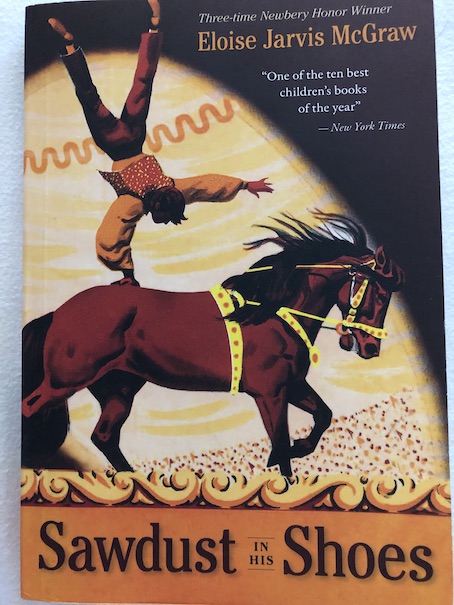
Sawdust in his Shoes by Eloise Jarvis McGraw, 1950, 1977.
Disclosure: I am using a newer edition of the book, published by Plough Publishing House. Plough sent a copy to me for review purposes, but the opinions in the review are my own.
At fifteen years old, Joe Lang is a rising star in the circus, a trick rider. Circus life is the only life he’s ever known because his father is a lion tamer. Many of the children whose parents work for the circus also work for the circus, competing for the spotlight and top billing, and Joe loves that type of life, even though it means hard training, an element of risk, and constantly moving.
Unfortunately, things change for Joe when his father is killed during an accident in one of his performances. (Mercifully, the accident is not described in the book. Joe does not witness his father’s death. In the story, he hears screams from the circus patrons and is shortly informed that his father has been killed.) Because Joe is still only fifteen, his father’s death raises the question of who will have custody of Joe. Joe’s mother is dead, and his stepmother, who did not grow up with the circus herself, was never fond of circus life or of Joe. After the death of Joe’s father, his stepmother leaves to go live with her sister, and Joe never hears from her again. Mo Shapely, an older man who works for the circus as a clown, wants to assume responsibility for Joe, and Joe would be happy with that because Mo is an old family friend who helped raise and train him. However, the local authorities are not convinced that Mo is a suitable guardian for the boy because of his age, his unsettled lifestyle, and lack of savings.
Mo waits in town with Joe while the authorities make up their minds, but they soon run short of money, and Mo is forced to catch up with the circus and return to his job. Since Joe’s guardianship is still unsettled, the authorities send him to the County Industrial School for Boys, where he will stay until Judge Reynolds has completed his inquiries into Mo’s background. The boarding school offers vocational training, but Joe finds the place dull and bleak and the people unfriendly. When the other boys find out that he used to be with the circus, they are envious and tease him, and even the teacher mocks him. Only one boy tries to be friendly with him, and Joe asks him if any boys ever escape from the school. The boy tells him that some have tried, but no one has succeeded. However, Joe realizes that he just can’t stand life at the school, and all he wants to do is run away and try to rejoin the circus.
When Joe runs away from the school, he cuts across some farmland, loses his way, and ends up getting caught on some barbed wire, where he is found by the Dawson family. The Dawsons treat his wound, and Joe despairs, realizing that he has gone the wrong way and that he has no chance to catch up with the circus before they move on. The Dawsons ask Joe what his name is and offer to help him get home, but Joe is reluctant to tell them the full truth because he doesn’t want to be sent back to the horrible school. Instead, he tells them that he has no home or parents but that he’s worked before, since he was young, and that he hopes to find a job when he’s recovered from his wounds and exhaustion. The Dawsons are concerned about Joe and curious about his mysterious past and vague answers, but Mr. Dawson decides to offer Joe a position as farm hand. Joe is surprised at the offer and a little suspicious, and he asks Mr. Dawson why he’s so willing to take in a perfect stranger. Mr. Dawson answers him in an equally vague way, saying that if Joe really feels like he needs to steal their silver, he must need it more than they do, and he’s welcome to it. Joe decides to accept Mr. Dawson’s offer of employment.
Joe isn’t used to farm work, but he’s strong from his work with the circus (Mr. Dawson had noticed his athletic build), and he is good with horses and other animals. Although Mrs. Dawson is concerned that they know so little about Joe or his background, Mr. Dawson tells his family to allow Joe to have his privacy and not question him too much about his past. Still, Joe can’t resist showing off and trying one of his old tricks on horseback one day, accidentally making his injury worse because it isn’t healed yet. He begins to worry that the injury might be bad enough that he’ll never be able to be a trick rider again. By the time he has fully recovered, he is also long out of practice.
Eventually, Joe’s secrets are exposed, and he must make some choices about his future. Although Joe had lived many different places when he traveled with the circus, living on the Dawsons’ farm provides him with new experiences and broadens his horizons in unexpected ways. He had never had much respect for non-circus people before (partly because of his bad experiences with his non-circus stepmother). He still dislikes some of the Dawsons’ neighbors for their unfriendliness and suspicious toward him, but the Dawsons themselves are very different from most of the people Joe has met before. Joe comes to realize that he has not forgotten everything that he learned from his old life and that he can apply his old skills in new ways. He even starts to consider that there are more ways of living than he had previously thought, and he begins to see the appeal of non-circus life. Still, the circus is what he always loved first, and he feels torn between what he’s always wanted and the people who have loved and supported him when he needed it the most.
Children today probably don’t look at the circus in the same way as past generations. Some of the larger, mainstay circuses, like Ringling Brothers and Barnum and Bailey, have closed. People make jokes about how scary clowns are, and animal acts aren’t considered humane to the animals. Circuses still exist in the early 21st century, but they’re not quite what they used to be, and they aren’t looked at in quite the same way. Even when I was a young child, in the 1980s and early 1990s, I wasn’t particularly wild about the circus. A large part of that is temperament. I’m not fond of loud noises or large crowds, and I tend to avoid places where there are both. I’m very different from my grandmother, who absolutely loved circuses and parades and excitement of all kinds, dragging her children with her, even when they didn’t always feel like going. In my grandmother’s youth (1910s and early 1920s), there were few things more exciting than a circus coming to town!
However, this story isn’t just about love of circuses or a look back on the forms of entertainment that people used to enjoy. There’s always some nostalgia of that type to vintage books, but this book is about more than that. This is about a person finding his way in life and facing an unpredictable future, who has to decide what’s really important to him. I’m sometimes fascinated by people who seem to know what they want to do in life from an early age. They are born to parents with a profession they want to follow or who have connections to a profession they want to follow, and they start training very early for something they truly love. At first, that seems to be Joe’s situation in life. He loves the circus, he was born into that kind of life, he gets that early training, and there’s nothing else he would rather do. Some people like that become early success stories, just being lucky enough to be born in the right place and with the right connections for the life they want to live, and it all looks like smooth sailing. Most people aren’t that lucky, though, and even for people who think they know what they want, life has a way of throwing a monkey-wrench into their plans. That is what this story is really about.
Joe’s life abruptly changes when his father dies and his guardianship remains in limbo. Things often happen in our lives that we can’t fully control, taking us down paths we never thought that we’d travel. There are times when many of us start to question what we really want out of life, whether our first choices were really the best ones, or if there’s something else that we really want. Sometimes, these unexpected detours make us feel like we’re headed for a dead end, like when Joe fears that he has lost his skill and he’ll never live the life he once dreamed he would. However, sometimes, these things are just a temporary bend in the road. In some ways, an adult who has been through this sort of process would understand it better, but even children know what it is to have a dream and not know whether or not it will become reality.
Children need time to discover and develop their talents, and, as they grow and step into the wider world, they routinely discover that they have to make other decisions that they knew nothing about before. Children also know what it’s like to be at the mercy of adults who can either help guide them on their way or who stand as an obstacle to their dreams and efforts, like the judge who takes so long to decide what he thinks is best for Joe that Joe feels he must take his fortune into his own hands. Right up until the very end, Joe’s ultimate choice remains uncertain as readers wonder what he’s really going to decide to do and what his destiny is going to be. At first, Joe seems like he’s in a bad situation, with limited options, but his experiences show him that his options in life are broader than he thinks. It seems like saying yes to one of the choices confronting him means saying no to something else he cares about, but even that isn’t as straight-forward as it seems. I think this is one of those timeless books that can appeal to all ages because what it’s really about is a person finding his way in life and discovering that a difficult, unpredictable path may be just the path he needs to take.
In the end, it’s not just about what Joe chooses or where he ends up; it’s about what he does along the way. When Joe runs away from the school, he is the one who is injured and in need of help, but he also has a positive impact on the people who were kind enough to help him when he needed it. In fact, there are some situations that would have turned out much worse for everyone if Joe hadn’t been there and been able to help. Joe’s unexpected detour in life changed everyone else’s lives as well, and it was well worth doing, in spite of the struggle.
This book is available to borrow for free online through Internet Archive, but it’s also back in print and available for purchase through Plough. If you borrow the book and like it, consider buying a copy of your own!
The year is 1925, and what 14-year-old Ida Bidson wants most is to graduate from her community’s small, one-room schoolhouse so that she can go to high school in a nearby city. She dreams of becoming a teacher when she grows up, and she knows that she can’t do that without more education. The problem is that, in her rural community in Colorado, not everyone thinks that higher education is important, especially for girls.
When their teacher’s mother becomes ill toward the end of the school year and the teacher has to leave, the man in charge of the local school board, Mr. Jordan, doesn’t want to bother to hire a new teacher to finish off the year. In fact, it seems a little dubious about whether they’ll even get a new teacher in the fall. Ida is crushed because, without a teacher, she can’t graduate this year as planned, and she had just about persuaded her parents to let her attend high school in the fall. Her friend, Tom, is in a similar position. More than anything, he wants to work with radio, the latest technological development of their time, and he also needs to attend high school. (So far, he’s just been teaching himself by reading Popular Mechanics – the magazine started in 1902 and is still in circulation today.) However, Tom comes up with a plan that could help everyone: What if Ida becomes their teacher?
Ida
knows that there’s no way that Mr. Jordan would actually hire her as the new
teacher. Everyone knows that he’s a
miser and that a large part of the reason they’re not getting a new teacher is
that he doesn’t want to have to pay for one.
Besides, what school board would hire a 14-year-old girl who hasn’t yet
graduated? After discussing it with the other
children, they make the decision to keep their school open secretly with Ida as
their secret teacher. Although Ida
confesses the truth about what they’re doing to her parents, most of the others
don’t, figuring that they’ll wait to tell them when the school year officially ends
in another month.
Although
it’s a daunting challenge, going from student to teacher while still continuing
her own studies, Ida sees it as the only way to get what she wants. She does her best to act out the part of
teacher, telling her friends to call her “Miss Bidson” when she’s teaching
instead of “Ida”, giving them their assignments to study, and checking their
work.
Most of
the other children agree to her terms as their new, secret teacher, although
one boy, Herbert, deliberately gives her a hard time. Herbert’s future ambitions don’t include
higher education, and he was originally looking forward to having an early
summer break. At first, he delights in
trying to push Ida, to see how she’ll deal with him as a discipline problem. Ida partly earns his cooperation by pointing out
with him that their secret school is voluntary, that no one is making him come,
that they had all voted to make her the teacher, and that if he makes problems
for the other students, they can also vote him out of the school. The thought of being rejected by his friends
for making problems keeps him more or less in line.
Then, a
woman from the County Education Office, Miss Sedgewick, comes to the school and
finds Ida teaching there. She is the one
who administers tests to graduating students, and she has come to ask how many
students will be tested this year. Ida
is forced to admit her circumstances to Miss Sedgewick. Miss Sedgewick is surprised to discover that
Ida is both teacher and student and says that she isn’t quite sure if she can
give the exams if the local school board has officially closed the school. She leaves, promising to look into the matter. What she eventually tells them is that they
can keep the school open with Ida as the teacher, but in order for the children
to get credit for their work, they will all have to take exams at the end of
the year, not just Tom and Ida.
As the
end of the school year approaches, Ida does her best to prepare the other
children for the exams and thinks about how her relationships with them have
changed. Tom, her best friend, has become
more her student and less her friend, which feels uncomfortable to her. She also has her own studying to do if she
hopes to pass the exams herself, which is difficult both with her teaching work
and the work that she must do on her family’s sheep farm.
Then,
Herbert’s father, who doesn’t value education at all and just wants Herbert
home to work their farm, finds out what they’re doing and gets Mr. Jordan to
shut the school down for good. Ida feels
like all her dreams and hard work have been for nothing. However, a talk with Herbert changes her
mind. Herbert knows that his father
fears his education. Herbert’s father is
afraid that Herbert will look down on him for not having as much education or
that Herbert will want to leave him.
Herbert admits that he’s been very unhappy at home because his father is
a bitter, angry man who doesn’t treat him much better than he does other
people. Herbert has actually learned
more than he pretends at school and really does have plans to leave home. Herbert also tells Ida that his father and
Mr. Jordan are planning a secret meeting to close the local school permanently,
purposely telling only people they know will agree about it, not local people
who value education.
Knowing about the secret meeting gives Ida’s parents, as well as other parents in the community who support their children’s education, to show their support for their children’s hard work. Faced with their opposition, Mr. Jordan agrees to let the school remain open while the children take their final exams. Ida not only does better on the final exam than she had feared, but she finds an ally in Miss Sedgewick, who will help her fulfill her wish to attend high school and become a real teacher.
The book is available to borrow for free online through Internet Archive (multiple copies).
Jeffrey lives with his widowed mother in a Medieval village (not a realistic one, this is a fairy tale type story), where his mother supports the both of them by selling her knitting. However, when his mother breaks both of her arms after falling off of a cart, eleven-year-old Jeffrey must find a job and earn some money. As a young boy from a poor family, there aren’t many options for him at first, and he doesn’t try very hard for the ones that are available because what he really wants to do is to be a knight. As a boy from a non-noble family, it isn’t likely that he’d ever actually become a knight, but it’s all that Jeffrey has ever dreamed of.
One
day, after Jeffrey has failed to get the jobs that were available in a nearby
town of Axington, he is walking home, sad and worried about what his mother
will say, he meets a knight. In fact, it’s
not just any knight but a famous one, Sir Walter! Jeffrey is thrilled to meet him. Sir Walter asks Jeffrey for directions and
invites him to join him for supper.
The two
of them discuss what it’s like to be a knight.
Sir Walter tells Jeffrey that it’s not all as glamorous as people think
it is. Some parts are very difficult,
and he has to travel a lot on his various assignments, keeping him away from
his family for extended periods. Unlike
real, historical knights, who would work for a lord, Sir Walter works for an
agency in Axington called Free Lance Rescue Services Limited, which gives him
his assignments. They send knights like
Sir Walter to rescue damsels in distress or deal with dragons or ogres. Although it’s not easy work, Jeffrey likes
the sound of it!
When Jeffrey returns home and his mother finds out that he didn’t get a job, she is upset. Jeffrey tells her about his meeting with Sir Walter, and she points out that, even though it’s exciting, he really needs to focus on finding work because they’re running out of money. Seeing his mother so upset, Jeffrey lies to make her feel better, telling her that Sir Walter has recommended him for a job with his rescue agency. His mother is doubtful at first, knowing that knights are usually from noble families and that her small son hasn’t had any training or shown any fighting ability. Jeffrey reassures her that he’ll probably just be helping in the office until he gets more training. To Jeffrey’s shame, his mother believes him and is proud of the job that he doesn’t have.
The
next day, after his mother sends him off to his first day on his new “job,”
Jeffrey decides that the only thing to do is to go to the agency in Axington
and try to find out if he can get a job there, or failing that, anywhere he can
in order to make things right with his mother.
When he gets to Axington, he is hungry, so he asks at a food stand in
the marketplace if he can help out for a while in exchange for some food. He spends the morning peeling potatoes in
exchange for lunch. However, although it’s
boring work, Jeffrey does get a good meal out of it, and he catches the eye of
a leatherworker, who compliments him for working hard. Jeffrey confides in the leatherworker that he’s
really hoping to get a job at the rescue agency, and the leatherworker tells
him that his fiancé is the secretary there.
He gives Jeffrey a message to take to the secretary, and Jeffrey sees it
as his opportunity to ask for a job.
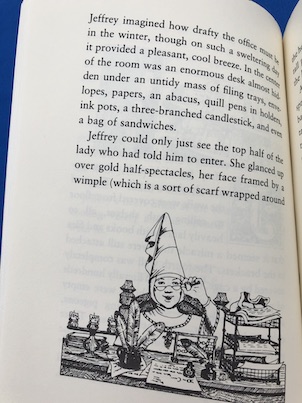
When Jeffrey delivers the message to the secretary (which is an invitation to join her fiancé for lunch), the secretary tells him that the rescue agency has no job openings at the moment, but that she’ll pay him a penny to watch the office and her mother’s rambunctious dog, Lancelot, while she’s at lunch. It’s not much, but a penny is enough to buy his mother a nice dinner, so Jeffrey takes the job. The secretary tells him a little about how the office works, but she doesn’t expect anything to happen while she’s at lunch because nothing ever does.
However,
while the secretary is away, a message comes in that Sir Walter is in
trouble! Sir Walter is in the cave of an
evil ogre and needs help at once! Jeffrey
tries to find the secretary to tell her and ask what to do. When he can’t figure out where she went to
lunch, Jeffrey decides that there’s no time to waste and that he must rescue
Sir Walter himself!
Although Jeffrey is eager to help Sir Walter, he does worry about the lies that he has told his mother about his new “job”, the fact that he isn’t really qualified for what he’s doing and doesn’t even have permission to be doing it, that the ogre might well end up eating him as well as Sir Walter, and that he left a mess in the office when he ran off on his rescue mission and is currently in possession of a dog that doesn’t belong to him. The book is a fun adventure story, but it makes some good points about truthfulness and responsibility as well.
Although Jeffrey really only brought the dog along because he had nowhere else to leave him, it is really Lancelot who defeats the ogre, partly by accident. At first, Jeffrey is tempted to claim the victory for himself, but he decides to be honest and admits the truth about the ogre’s defeat to Sir Walter. Still, Sir Walter is grateful and offers to sponsor Jeffrey for knight school and give him a part-time job polishing his armor. Jeffrey accepts, and he also gets to keep Lancelot, who needed a new home anyway, although his mother says that he will have to be responsible for the dog and its training.
The book is available to borrow and read for free online through Internet Archive.


















 Jestress's Forgotten Books and Stories