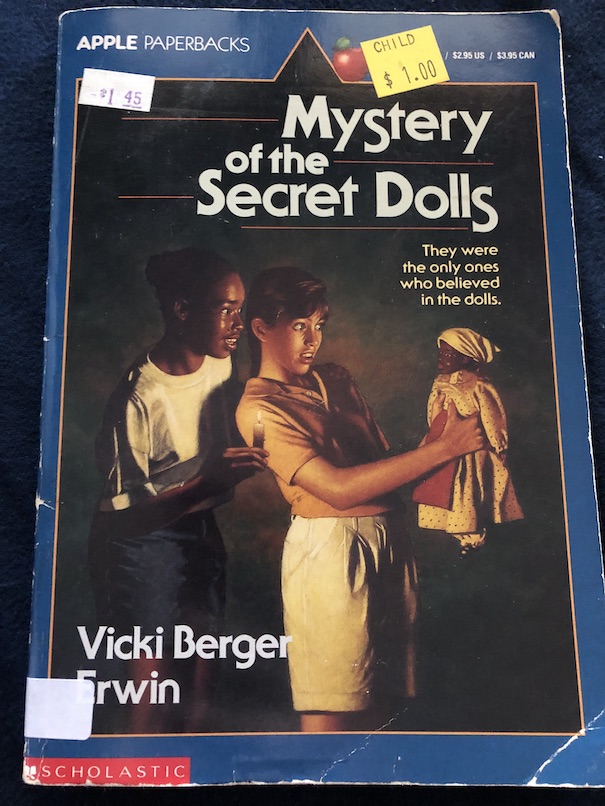
Mystery of the Secret Dolls

Mystery of the Secret Dolls Cover

Mystery of the Secret Dolls by Vicki Berger Erwin, 1993.

Bonnie Scott is visiting her great-aunts, Nell and Mollie, in Callaway County over the summer. Aunt Nell invited her to come and help set up her new doll museum, but Bonnie also wants to take advantage of the trip to work on a project about family history. Aunt Mollie has a restaurant, and Bonnie wants to talk to her about old family recipes that she uses and make a book about them. Unfortunately, when Bonnie arrives in her aunts’ town, she learns that Aunt Mollie has closed her restaurant and is helping Aunt Nell with her doll museum. From Bonnie’s awkward arrival, when no one comes to meet her at the bus stop and Marc, the grandson of the local doctor, Dr. Allen, has to help her find her way to her aunts’ house, she begins to see that things aren’t quite what she thought they were in her family and in her aunts’ town.

The reason why no one came to meet Bonnie is that Aunt Nell accidentally injured herself when she fell off a table she was standing on in order to change a light bulb. She broke her leg and had to go to the doctor. Now that Aunt Nell is in a wheelchair, she says that she will especially need Bonnie’s help, although Aunt Nell and Aunt Mollie also have a young black girl, Lynette Key, staying with them and helping out. Lynette is the daughter of an old family friend, and her family’s history is intertwined with Bonnie’s family. Through her aunts and Lynette, Bonnie comes to understand a little more about her family’s history with dolls and the relationship between Aunt Nell and Aunt Mollie.

Aunt Nell is the older of the two sisters, and she’s been bossing Aunt Mollie around for years, and she’s apparently the one who convinced Mollie to close her restaurant and help her with the doll museum project. The old family home belongs to both of them, although Mollie lived in another house while her husband was still alive. Now that both women are childless widows and Mollie has moved back into the family home, Nell has gone back to her old ways of bossing Mollie around. Bonnie is alarmed when Mollie reveals that there has been a break-in, vandalism, and a fire, apparently deliberate, at the museum, and she thinks that Nell should put off the opening, but Nell is trying to ignore the situation and charge ahead with the project, dragging Mollie and Bonnie with her. The aunts are going to have a security system installed at the museum.

Aunt Nell says their family, the Scotts, have made dolls for about 150 years. She shows Bonnie her doll collection, including the portrait dolls, startlingly realistic dolls made of every member of their family, including Bonnie’s ancestors, like her great-great-great-grandfather who fought for the Confederacy during the Civil War. Aunt Nell apparently strongly identifies with the South and Confederacy because she keeps trying to blame the troubles at the museum on “some Yankee.” Not in a specific sense and not necessarily with any particular person in mind (although there is one person who is also labeled as a Yankee who is a suspect for awhile), it’s more that she just generally associates Yankees with bad stuff, and she says that she hopes that Bonnie hasn’t turned into a Yankee from living in a big city like St. Louis. Although the dolls belong to both of the sisters, Aunt Nell really thinks of the dolls as being hers, and she’s determined to make Bonnie’s family history project about the dolls, whether Bonnie wants it to be or not. Aunt Nell says that Lynette’s grandmother used to work for her, making dolls, and she’s pleased that Lynette shares her interest in dolls, but Lynette privately tells Bonnie that the situation goes deeper than that.

As you might have guessed, Aunt Nell’s mental version of history, including the history of her own family, isn’t entirely accurate. Marc lends Bonnie a history book about the area written by his grandfather, but Lynette tells Bonnie not to let Aunt Nell see it because she and Dr. Allen have very different views about history, and Dr. Allen is a “Yankee.” Bonnie asks her what she means by that, and Lynette says that the Scotts have never gotten over being on the losing side of the Civil War. Dr. Allen, by contrast, believes that the Civil War turned out just fine with the South losing, which makes him a Yankee. It matters because Aunt Nell’s interpretation and attitude toward the past is affecting life in the present.

Although Aunt Nell is mentally on the side of the Confederacy, she doesn’t say anything in support of the idea of slavery and doesn’t seem to have bad feelings about Lynette being black. Nell is actually very fond of Lynette, treating her almost like a young niece, and I suspect that Nell probably mentally replaces the word “slave” with “servant” in her head, as some of the other characters in the book do until Lynette reminds them that there’s a difference and it matters. Nell’s attachment to her family’s grand history (which may not be quite what she makes it out to be) and her feeling that the doll-making business must pass to a blood relative keep her from fully seeing the potential that Lynette has to continue the doll-making traditions that their families both share, something that Lynette really wants to do.

Lynette says that women in her family have worked for the Scott women for generations, making dolls. They were originally slaves belonging to the Scott family, and they even shared the same last name because slaves were sometimes given the surnames of their masters. (In my home town, I’ve met black people with the surname White, which might seem a little odd and contradictory, but this is the probable reason why they have that last name.) Some slaves changed their last names after Emancipation, but not all. Lynette says that even after her ancestors were freed from slavery, one of her ancestors, Rosa, chose to keep the last name Scott because of her connection to the doll-making business.

Lynette points out a section in Dr. Allen’s history book about the Scott dolls having a connection to the Underground Railroad because some of them seemed to have been used as signals for escaping slaves. Margaret Scott, an ancestor of Bonnie’s, used to make black dolls, each with a distinctive little red heart sewn on the chest, and after she made one, a slave would mysteriously disappear. She eventually had to stop doing it because people in the area were getting suspicious of her and put pressure on her to stop. In fact, Lynette says Margaret’s own father, the Confederate colonel, tried forced her to stop, saying that he’d close down her doll-making business if she didn’t, but that Margaret and Rosa actually continued making the black dolls in secret, something that Aunt Nell doesn’t believe. The history book notes that the dolls are rare and valuable collectors’ items. Lynette says that Aunt Nell only has one of these black dolls, and she keeps it locked up for safe-keeping, denying that there even are others, but Lynette is sure that there are more, possibly hidden somewhere. Lynette wants to find these dolls, not only because they are valuable but because they can help prove her family’s connection to the Scott doll-making business. Lynette says that her ancestors never got the credit for the beautiful dolls they made because they were only ever slaves or employees of the Scotts, and the entire doll business was in the Scott family name.

Lynette wants to become a doll maker herself, but Aunt Nell really wants Bonnie to take over the family tradition, even though Bonnie has never really been interested in dolls and would prefer to talk cooking and recipes with Aunt Mollie. The realistic dolls portrait dolls actually kind of give Bonnie the creeps, but Lynette has a sentimental attachment to them because she’s been around them all her life, since her grandmother was a doll maker. Once Bonnie understands the history between her family and Lynette’s and Lynette’s doll-making ambitions, she sees why Lynette seemed a little cold to her at their first meeting, but she isn’t interested in learning the doll business or competing with Lynette to be Aunt Nell’s successor. Even though Aunt Nell is bossy and doesn’t understand Lynette’s deep desire to be a doll maker and continue the Scott doll-making business, Lynette kind of likes her and wants to show her that she is just as attached to the doll-making traditions as she is. Lynette and Bonnie make a deal that Lynette will help Bonnie get the recipes she wants from Aunt Mollie if Bonnie will talk to Aunt Nell about the black dolls and try to get more information about them.

Bonnie thinks that hunting for the long-lost dolls sounds exciting. It occurs to her that the valuable dolls might be the reason why someone broke into the doll museum. The aunts’ old house is spooky, right next to a graveyard, and on Bonnie’s first night there, someone leaves Margaret’s portrait doll (which looks a great deal like Bonnie) in Bonnie’s room with a note that says, “Don’t believe everything you hear.” What does the note mean? Who left the doll, and is it connected to the other strange things happening around the doll museum? Is someone trying to scare Bonnie? Are the missing black dolls still somewhere nearby, and can Bonnie and Lynette find them? What is the real truth about the dolls and what happened in Callaway years ago?

The book is available to borrow and read for free online through Internet Archive.

My Reaction and Spoilers

Although this story doesn’t quite deal with racism in the sense of people hating other people because of race, there is a lot in here about the nature of prejudice, on several levels. Aunt Nell has many preconceived notions about her family and how things in her family ought to be. She assumes from the beginning, when Bonnie contacts her aunts to talk about family history, that Bonnie will do her project about the dolls and the family’s doll-making history and that Bonnie will help her with her doll museum and eventually take over the dolls from her. Aunt Nell started out their relationship with a lot of assumptions, and her assumptions about Bonnie have blinded her to the possibility that Lynette could be the successor to the doll-making business and doll museum that she really wants because they share a common love of dolls and skill in making them. Lynette has already started learning the doll-making business, first from her grandmother and then from Nell, because she loves it, and she is willing to work at developing her skills. She has a similar vision to Nell about the doll business and museum, and the two of them get along well, in spite of Aunt Nell’s bossy personality. It’s only Aunt Nell’s narrow vision of family and sense that the doll-making business should pass to family that keep her from considering the possibility at first. Meanwhile, Bonnie and Mollie are both being forced to go along with Nell’s plans because of what Nell thinks they should do as family, while they both have very different interests and would like the freedom to pursue them. Aunt Nell also has been assuming many things about her sister Mollie for years.

Over 100 years earlier, Margaret Scott also belonged to a family that did not share her interests and her vision of the future. Although she used slave labor in building her doll-making business, she and Rosa found a way to use their craft to help escaping slaves. The Scott family took pride in the doll-making business for generations, but there were sides to Margaret and the dolls that they didn’t understand and appreciate. Before the end of the book, Aunt Nell comes to understand that their family has more variety than she had ever considered and that her goals might not be everyone’s goals.

The ending of the story makes sense and is realistic, but I’ll admit that there were a couple of points that I might have clarified or done differently if I had written the ending. Sometimes, when I’m not entirely satisfied by the ending of a book, I like to say what I would have changed about it, but it’s difficult to do that here without giving too much away. Part that I can say is that I wished that Nell and Mollie had thought of more creative ways to combine their separate interests, like how Bonnie’s final family history project ends up being a combination of both – a cookbook of family recipes, illustrated with pictures of the portrait dolls that represent the people who invented or enjoyed the different recipes. In fact, a cookbook of historical recipes with pictures of historical dolls sounds like a book that many people would actually be interested in buying if they published it professionally and even sold copies through the doll museum, and I found myself wishing that one of the characters would mention that before the end of the book.

The story ends with the impression that Lynette will keep working with Nell and the dolls because, while Bonnie says that she’ll come back and visit, she doesn’t have the interest in doll-making that Lynette does, but I also kind of wished that they would clarify more definitely that Lynette would be continuing the doll-making business. The girls are young yet, so maybe they didn’t feel the need to decide their futures definitely, and it’s enough just to show that’s how things are looking at the end of the book. I had half expected that it would turn out that Lynette and Bonnie are actually related because sometimes slave owners did have children with their slaves, and I suspected that one of the Scott family secrets might have been that Rosa was actually a blood relative and that was part of the reason why she was so close to Margaret and why she kept the Scott family name. The story doesn’t bring up that possibility, focusing on a different secret relationship instead, but I’m still keeping it in mind as a private theory. I like the idea because, if it was true, then it would strengthen Lynette’s ties to the doll-making business she loves, and I think that Nell would appreciate the idea of bringing her more fully into the business as a relative. But, perhaps it’s enough that they just both share the same interest in life

Molly’s Surprise

American Girls

MollySuprise

Molly’s Surprise by Valerie Tripp, 1986.

MollySurpriseFamily

Christmas hasn’t been the same in the McIntire house since Molly’s father went overseas as a doctor during World War II.  As Molly writes her father a letter before Christmas, she and her mother and siblings talk about whether or not he might send them presents.  Molly is sure that he’ll send something and adds a “thank you” to the letter she’s writing, but her older sister, Jill, is less sure and worries that he’ll feel bad if Molly thanks him for presents that he was unable to send.  The boys talk about whether or not any presents that he might send could be shot down before reaching them, and Brad, the youngest child in the family worries about whether Santa might get shot down, too.  The children’s mother reassures them, but it’s just another sign of how the war has changed the feeling of Christmas.

MollySurpriseTreeBuying

Jill tries to be realistic and tells Molly that she should be, too.  Jill thinks that there probably won’t be many presents this year, and what they get will be mostly practical things, handmade gifts, or hand-me-downs because of war rationing and the family’s need to be frugal.  Everyone is determined to be practical and patriotic, but Molly finds all this “realistic” talk depressing.  When her father was home, Christmas was always a time of surprises, and she likes to believe that, somehow, he will still find a way to surprise them.

When the children’s grandparents call and say that they won’t be able to come after all because of car trouble, and they won’t be able to bring them a Christmas tree as promised.  The kids are depressed, but Molly says that they’ll just have to do as their mother told her earlier and rely on themselves to make their own Christmas surprises this year.  Jill, Ricky, and Molly pool their money and go out to buy a tree.  As in the Charlie Brown Christmas special, the only tree they can afford is small and scrawny, but it’s better than no tree at all.

MollySurprisePackage

Once they get the tree decorated, it looks much better.  As they decorate the tree, Jill admits that some of her attitudes about how this Christmas should be different and more simple from others is because she really misses their father, and when everything looks the same as it did before he left, it just reminds her of how much she misses him.  Molly also admits that she doesn’t really care what presents their father sends; she’s only worried that, if a package doesn’t arrive, it might mean that something bad had happened to him.  All of the kids want the reassurance that their father is still okay.

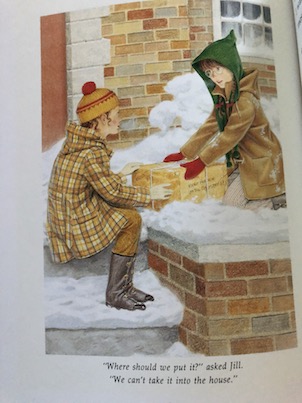
The next day, when the children go out to play in the snow, they find the package from their father that they’ve been waiting for!  However, there is a note on the package that says, “KEEP HIDDEN UNTIL CHRISTMAS DAY!”  Probably, their father wanted their mother to hide the package from the children, but since Molly and Jill are the first to find it, they decide to do the hiding themselves, putting the box in the storage room above the garage.  Jill thinks they should tell their mother about it, but Molly persuades her to wait because she doesn’t want to ruin their father’s surprise.

MollySurpriseRadio

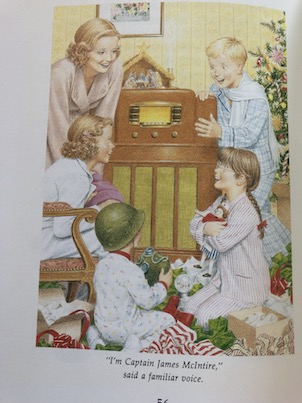
On Christmas Eve, the girls retrieve the box and put it under the tree after everyone else is asleep.  However, that’s not the end of the Christmas surprises.  Their father has one more special surprise for them . . .

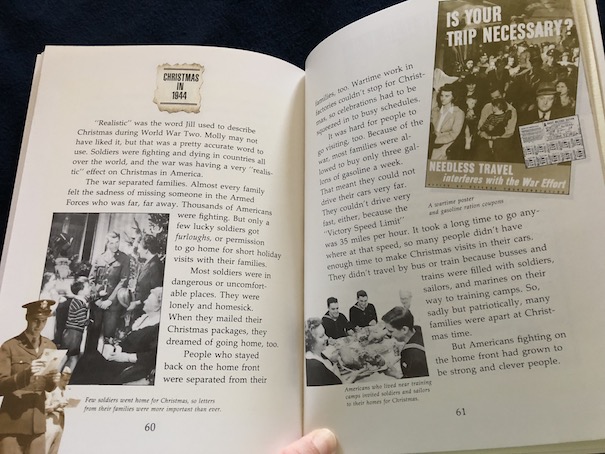
There is a section in the back of the book with historical information about Christmas during World War II.  Many families couldn’t be together during the war because families members were overseas and because many civilians limited their traveling during the war in order to save gasoline.  In fact, speed limits were greatly reduced in order to save gas – the “Victory Speed Limit” restricted people to driving no faster than 35 mph.  Public transit, like trains and buses, was often needed to transport soldiers, so civilians avoided traveling as much as possible.

MollySurpriseHistorical

People also had to get creative about Christmas treats because some essential ingredients, like butter and sugar, were rationed.  People also made their own decorations.  The selection of toys was somewhat limited because factories had been converted to making war materials, and many families gave their children practical gifts. However, there were still toys available, and people managed to give their children a few special surprises.

The book is currently available online through Internet Archive.

Molly’s Pilgrim

MollysPilgrim

Molly’s Pilgrim by Barbara Cohen, 1983.

Molly has been unhappy since her family moved to the smaller town of Winter Hill, New Jersey so that her father could get a better job. In New York City, there were other Jewish girls like her, and she didn’t feel so strange and out-of-place. The Winter Hollow girls don’t understand her at all and don’t like her. Molly’s family fled Russia to escape persecution, and they’ve only been living in America for about a year.  Molly still has a Yiddish accent and doesn’t quite speak proper English yet.  Molly is constantly teased about the way she talks and her unfamiliarity with American habits.

MollysPilgrimSchool

One girl in particular, Elizabeth, makes up rhymes to make fun of Molly, even following her home from school like a creepy stalker, to continue singing them at her. The other girls follow Elizabeth’s lead because they kind of admire her and because she is always giving them candy.

MollysPilgrimBullies

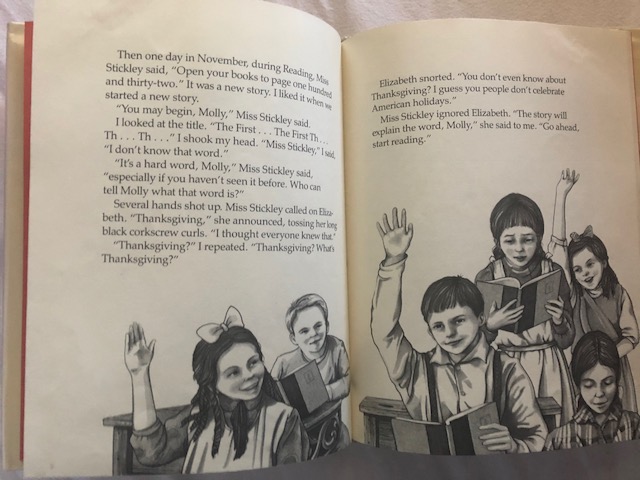
Then, one day, the girls’ teacher begins teaching them about Thanksgiving. Of course, Elizabeth makes a big deal about the fact that Molly has never heard about Thanksgiving before. But, Molly finds the story about the pilgrims interesting. The teacher says that for their Thanksgiving activity, instead of making paper turkeys like they usually do, the children are going to make clothespin dolls to look like American Indians and pilgrims, so they can create a scene like the first Thanksgiving.

MollysPilgrimClass

When Molly gets home and explains the assignment to her mother, she has to tell her mother what a “pilgrim” is. She explains it by saying that they were people who came from across the ocean in search of religious freedom. Her mother understands that and offers to help Molly with the doll.

However, when Molly sees what her mother has done with the doll, she is worried. The doll is beautiful, but her mother has dressed the doll in the clothes of a Russian refugee, like Molly’s family, not in the traditional Puritan garb of the pilgrims. At first, Molly is sure that she’ll be teased more than ever at school when she shows up with a doll wearing the wrong clothes and that people will think that she’s stupid for not understanding how pilgrims dressed.

MollysPilgrimDoll

But, Molly’s mother is correct in pointing out that their family are modern pilgrims, coming to America for the same reasons that the original pilgrims did. Molly does get some teasing from Elizabeth (that’s not a surprise, since it’s Elizabeth, after all), but when the teacher asks Molly about the meaning of her doll, it leads everyone to a better understanding, both of the holiday and where Molly and her family fit in with their new country and its history.

Molly’s teacher points out that the holiday of Thanksgiving wasn’t entirely an original idea that the pilgrims invented all by themselves but that they took their inspiration from a much older Jewish tradition from the Old Testament.  Human beings do not exist in a vacuum, and we all regularly take ideas that we’re exposed to and build on them in our own lives.  Although Puritans were generally known for their belief in religious “purity” (hence, their name) and noted for their intolerance to different religions and beliefs, they also strongly believed in education, which frequently involves taking past ideas and knowledge and applying them toward new situations.  Their Thanksgiving celebration was just an example of that, an older idea that they used for their own purpose, adapted to the lives of the people who adopted the tradition.  It was their celebration, but not their sole intellectual property.

The book is currently available online through Internet Archive (multiple copies).

There is also a sequel to this book called Make a Wish, Molly, in which Molly learns about birthday parties in the United States.

My Reaction and Additional Information

The book doesn’t mention it, but the word “pilgrim” itself is also much older than the early Puritan colonists in America.  Before the development of the America colonies, it referred to any religious traveler on their way to a holy place, and many people still use it in that sense.  A person on a pilgrimage could be just about anyone from anywhere going to anywhere else as long as the journey has spiritual significance.  The Puritan colonists used that term for themselves to emphasize the reasons why they were seeking new homes in a new land.  For them, it was a kind of pilgrimage to a place where they could start again.  Molly’s family came to America in search of religious freedom, just as the Puritans did.  Their journeys weren’t quite the same, but they shared a common purpose and ended up in the same place (more or less).

By showing the links between Molly and her family and the pilgrims, Molly’s mother and her teacher help the other students to understand that Molly really does fit in, that her being there makes sense, and that she has a place in their class and in their celebration of Thanksgiving.

This story was also made into a short film. I remember seeing it in school when I was a kid in the early 1990s.  I checked on YouTube, and there are trailers posted for this film.  One thing that I hadn’t remembered from when I was a kid was that the time period of the book was earlier than the film.  In the film, the characters are shown to be contemporary with the time the film was made, but the style of dress of the girls in the book’s pictures and the things that Molly’s mother says about why the family left Russia indicate that the book probably takes place during the late 19th century or early 20th century, possibly around the same time as the events in the famous play/movie Fiddler on the Roof.

As a side note, if you’re wondering why the girl is named Molly, which doesn’t sound particularly Russian, Molly is typically a nickname for Mary and other, similar-sounding, related names.  Molly’s mother also calls her Malkeleh, which may be her original name or perhaps another variant, if her original name was Malka, as another reviewer suggests.

In spite of the warning on that last site I linked to about reading a book with your child that may be covered in class, I say to go ahead and read it anyway.  It’s hard to say what books may or may not be used in classes by individual teachers, and if your child’s teacher doesn’t happen to use this one, it’s still a good story.  Perhaps just warn your child not to say something that would spoil the ending for their classmates who haven’t read it yet.

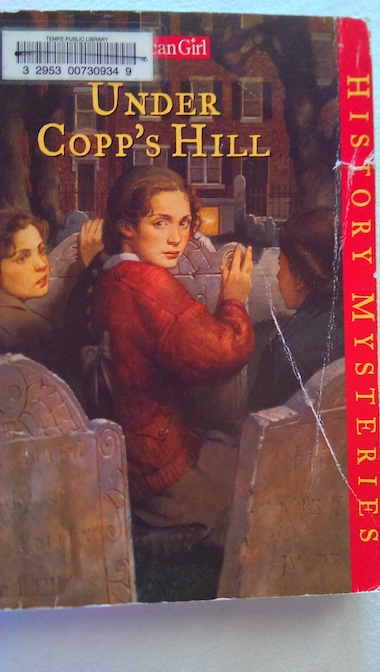
Under Copp’s Hill

UnderCoppsHill

Under Copp’s Hill by Katherine Ayres, 2000.

This book is part of the American Girl History Mysteries series.

The year is 1908, and eleven-year-old Innocenza Moretti lives with her relatives in Boston.  They are immigrants from Italy.  Innie, as her family calls her, is an orphan.  According to the story that her grandmother told her, she was the only one of her parents’ children to survive infancy, her siblings being born prematurely and dying shortly after birth.  Innie’s mother was so grateful that Innie survived that she promised her to the Holy Mother at her baptism.  Then, Innie’s parents died in a fire in their tenement building when she was about two years old.  Innie and her grandmother, Nonna, survived the fire only because little Innie had started crying in the night, and she took her outside to walk her around so that she wouldn’t wake her parents.  Because of that experience, Nonna is deathly afraid of fire and also has become convinced that the Holy Mother must have spared Innie (as well as herself).  She thinks that Innie is destined to become a nun and has continued to promise her to the Holy Mother in prayer, repeating the promise regularly.  Although Nonna thinks that the miracles surrounding Innie’s life are signs of a future life in the Church for Innie, her grandmother’s promises in prayer terrify Innie.

Innie feels trapped by her grandmother’s expectations for her, expectations that the rest of her family don’t even know about.  She doesn’t want to be a nun, but her grandmother is sure that she will be.  Because of her fears that her grandmother may force her to become a nun when she grows up, Innie is never on her best behavior.  She thinks that if she gets a reputation as a trouble-maker, the Church will decide that she is unsuited for a religious life.  Unfortunately, Innie’s long-practiced habit of ignoring rules and her problem child reputation lead her to be suspected of something worse than just minor misbehaving.

Innie’s family owns a boardinghouse where they provide food and lodging for young immigrant men.  Innie and Nonna live on the ground floor, and Innie’s aunt, uncle, and cousins live above them.  Innie spends a lot of time with her cousins, especially Teresa, who is about her age.  Her older cousin, Carmela, persuades both Teresa and Innie to join a library club at a new settlement house with her.  The settlement house helps girls and young women from immigrant families by teaching them work skills and aspects of American culture that they can use as they become American citizens in exchange for some of the work that the girls do on behalf of the settlement house.  Carmela has taken a new job as a pottery painter there and tells her parents that it will be good for Teresa and Innie to go there as well because they will receive help with their schoolwork and they will also have classes to teach them skills like sewing, knitting, and pottery, that they can use to make money later.  However, the real attraction of the club for the girls is that they get to listen to music, have dancing lessons, read books, and socialize with other girls about their age.  The prospect of sewing classes isn’t appealing for Innie, but she loves books and looks forward to borrowing some from the settlement house library.

At the settlement house, Innie meets a variety of girls from other immigrant families, not just Italian ones.  In particular, Innie makes friends with a girl named Matela, who is a Jewish girl from Russia.  As the girls talk about a recent, large fire in town, Matela talks about the czar’s soldiers burning things back in Russia and how she misses her grandfather, who is still there.  Innie understands Matela’s feelings because she knows what it’s like to miss someone.  She doesn’t really remember her parents, but she feels the lack of them in her life.  Teresa also becomes friends with Matela, but the three girls agree to keep their friendship secret because each of their families prefers them to associate with girls from backgrounds similar to their own.  Innie’s uncle wants the girls to spend time with other Italians, and Matela admits that her father prefers her to spend time with other Jewish girls.  The adults don’t really understand the cultural mix at the settlement house.

However, from the very first day that the girls begin going to events at the house, strange things start happening.  Things disappear or are oddly moved about.  Food disappears.  A silver teapot belonging to the ladies who run the settlement house is stolen.  Then, someone steals some pottery and a shawl.

To Innie’s horror, she ends up becoming the prime suspect for the thefts because she was caught snooping in an area of the house where she didn’t belong and because she accidentally broke one of the pieces of pottery that the others girls made and tried to sweep it up without telling anyone.  When she and her friends snoop around and try to find the missing objects, Innie discovers one of the missing pottery pieces.  However, instead of being happy for the clue, the ladies who run the house just think that Innie must have broken more of the pottery and tried to cover it up, like she did before, by hiding the rest of the set.  After all, if she was doing some things she shouldn’t have been doing, it’s plausible that she could be a thief, too.

If Innie is going to remain a member of the library club (and continue to have access to books that she can read), she’s going to have to prove her innocence.  In fact, proving her innocence may also be important for Carmela, who is supposed to have a citizenship hearing soon.  If Innie’s bad reputation causes problems for her at work, she may lose her job and be denied American citizenship!

Matela thinks that the thief could be a ghost from the nearby Copp’s Hill graveyard, but Innie is sure that it must be a human being.  There are secrets at the settlement house that even the ladies who run it are unaware of and someone who desperately needs help and can’t ask for it.

Teresa and Matela continue to help Innie, and in the process, Innie confesses to Matela her fears about becoming a nun.  It is Matela who helps Innie to find the solution to her problem, urging her to step outside of the small community of Italian immigrants that her family clings to and to seek advice from a priest in the Irish area of the city.  As a priest, he has the knowledge that Innie needs to understand her faith, and because he doesn’t know Innie’s family personally, he has the objectivity to help Innie to see her grandmother’s promise in a new light and to understand that her future destiny is still in her own hands.  No one can speak for another person or make important promises on their behalf.  A religious vocation is a serious decision that only a mature adult can make for herself, or not make, as the case may be.  The priest tells her that, as young as she is, Innie should focus on learning to be a good person, and then she will see what direction life leads her.  With that knowledge, of course, Innie realizes that she will have to put more effort into behaving herself, but it’s a relief to her to realize that she doesn’t need to purposely misbehave in order to control her life.
Eventually, Innie’s aunt also learns about the grandmother’s promise and Innie’s worries and reassures her that, although her grandmother can be an intimidating woman with what she wants, Innie’s family loves her and that she shouldn’t be afraid to come to them with her questions and concerns. Innie has thought of herself as parentless, at the mercy of her grandmother’s wishes and expectations, but her aunt says that she loves Innie like she does her own daughters and that Innie is as much a part of their family as they are.  If Innie has problems, her aunt will be there for her, helping her find whatever answers she needs.

There is also a subplot about how girls in immigrant families (at least, in ones like Innie’s family) aren’t as highly-regarded as boys.  When the family is discussing important matters, Innie often tries to comment on what she thinks, but her grandmother keeps telling her to be quiet because it isn’t a girl’s place to comment on business that men should handle and her male cousins sneer at her because they don’t think she knows anything.  However, when Innie’s uncle is worried about the legal papers he has to sign in order to open his new grocery business because his English still isn’t good enough to understand them, Innie points out that Carmela’s English is the best of the family because of all the books she had to read and the paperwork she had to complete when she was applying for citizenship and that she would be the best person to study the paperwork.  At first, her grandmother makes her try to be quiet and her male cousins laugh, but Carmela speaks up and says that she can help her father, if he wants her to, and her father agrees, on the condition that she act as translator and adviser and let him make the final decisions about the business.  Carmela is happy because the arrangement allows her to use her skills without taking her away from the pottery painting that she loves.  The point of this part of the story is about acknowledging the talents that people possess and not disregarding them because they are outside of the usual roles and expectations.  It fits in with the subplot about the grandmother’s expectations for Innie’s future, which are not really in keeping with either her talents or character.  The young people in the story are growing up under different circumstances than their parents, and they will have to learn to find their own way in life, using the abilities they have and the education they can find.

In the back of the book, there is a section with historical information about Boston in 1908.  The fire that happens around the time that the story takes place was a real event.  The settlement house with its library club was also real, and the ladies who run the settlement house, Miss Brown and Miss Guerrier, were also real people.  The book explains more about what life was like for immigrant families like Innie’s and about what the future held for girls like her.  Many of the girls who attended the library clubs later became librarians and teachers themselves, which may be Innie’s eventual destiny when she grows up.  The book also mentions that the area of Boston where Innie’s family lived still has many Italian restaurants and groceries that were started by immigrant families like Innie’s, so we can imagine that the grocery store that Innie’s uncle wants to open will be successful.

The book is currently available online through Internet Archive.

The True Tale of Johnny Appleseed

JohnnyAppleseed

The True Tale of Johnny Appleseed by Margaret Hodges, 1997.

This American folktale was based on the life of a real person, John Chapman.

Johnny Appleseed was born as Johnny Chapman in 1774. His family lived in Massachusetts. There were plenty of apple trees there, and Johnny loved them. When he was grown, he started traveling west with the idea of spreading apple trees.

He carried very little with him, and some people said that he wore the pot that he used to cook his meals on his head as he walked. Everywhere he went, he planted apple seeds.

His reputation spread, and although people thought that traveling around just to plant apple seeds sounded crazy, they sometimes let him stay with them on his travels. Even Native Americans seemed to like him because he was friendly and helpful and interested in learning their languages. His legacy continued long after his death with trees that were enjoyed by generations of families across the Midwest.

There is a section in the back of the book that explains more about the history behind Johnny Appleseed’s story, including the end of the Revolutionary War and the beginning of westward migration in America. One of the things they mention is the effect that the War of 1812 had on relations between pioneers and Native Americans. Because pioneers were already pushing into the territory of Native Americans in the area that later became Ohio, the tribes there sided with the British in the war, hoping to push out the invading pioneers. After the war was over, though, the pioneers continued to come west, and when they did, they retaliated against the tribes that had been on the side of the British. The pioneers could be brutal, and part of the reason that Native Americans liked Johnny Appleseed was that he was different. He wasn’t trying to hurt anyone or take land for himself; he just wanted to plant trees. After he planted trees, he would build fences around them to keep animals from eating them while they were growing.

John Chapman’s life was unconventional.  He never married, and he acted as a Christian missionary in his travels as well as a planter.  Although he could be regarded as something of an oddball in the itinerant way he lived his life, he became a legend.

The book is currently available online through Internet Archive.

Paul Bunyan and Babe the Blue Ox

PaulBunyan

Paul Bunyan and Babe the Blue Ox by Jan Gleiter and Kathleen Thompson, 1985.

This story is based on an American folktale that was used to promote the logging industry. The book doesn’t explain the background to the story, but in a very literal sense, it is a “tall tale.”  The book is part of a series about legendary figures from history and myth.

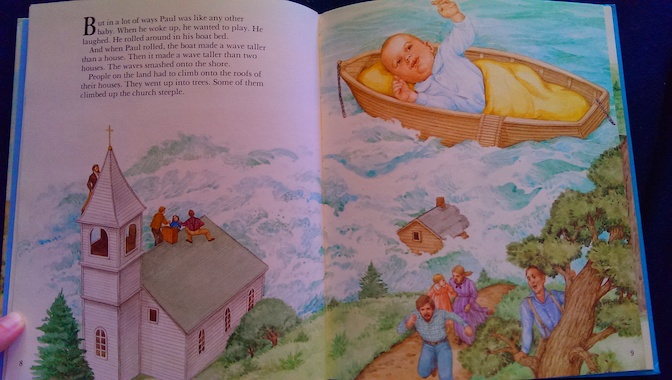
Paul Bunyan is a giant of a man, and he was a giant since he was a baby, even though his parents were both of normal human size (no explanation given). Because he was never small enough to fit in his parents’ house, they made a large boat for him to sleep in as a cradle, rocking him to sleep on a river. Needless to say, having a giant baby complicates everything and can pose a real risk to everyone. His parents had to teach him early about what he could and couldn’t do so that he would avoid hurting people.

PaulBunyanBaby

However, Paul discovered early that he was skilled with an ax, and because of his great size and strength, he realizes that he is good at cutting down trees. Because this was the frontier days in America, good loggers were in demand because trees were plentiful and wood was needed to build houses and railroads. (Paul Bunyan would not be such a hero for cutting down whole forests today.)

However, a giant of a man can also be lonely when there’s no one around his own size. Paul finds a companion in a giant blue ox. (Yep, that’s part of the traditional story.) He found the ox partly buried in a blizzard. After he dug it out, he named it Babe, and the two of them became lifelong friends.

PaulBunyanBabe

Part of the story is that the Mississippi River and all the lakes in Minnesota were caused by Babe accidentally spilling water that he was carrying on his back. Paul also supposedly dug the Grand Canyon by accident by dragging his ax behind him when he walked to California.

PaulBunyanBabeSpill

Paul also meets a man named Hals Halvorsen who is almost his size. After trees get cut down, Paul and Hals pound the stumps into the ground with their fists to finish clearing the land. Then, they try planting some corn to see how good the land is for farming, but the corn stalk grows up so high that Hals nearly starves to death while climbing it to try to find the top of it.

PaulBunyanHals

The part of the story I liked the best as a kid was when they made gigantic pancakes for Paul Bunyan and Babe, greasing their giant griddle by basically skating across its surface with grease strapped to their feet.

PaulBunyanPancakes

I can’t say that this was one of my favorite folktales as a kid, and my feelings as an adult about deforestation don’t make me feel good about it now. Still, it is an interesting piece of Americana and a little nostalgic.  As a side note, Paul Bunyan was used as a mascot for a pancake restaurant in an episode of Disney’s Phineas and Ferb (which has also been done in real life).  In that episode, Norm, a giant robot, accidentally gets the head of the Babe statue outside the restaurant stuck on his head, causing Phineas and Ferb to think that they are being chased by a Minotaur.  Now that I think about it, this joke’s use of Paul Bunyan and Babe the Blue Ox makes me smile more than the original version of the story.

The book is currently available online through Internet Archive.

Addy Saves the Day

American Girls

AddySummer

Addy Saves the Day by Connie Porter, 1994.

Now that the Civil War is over, families are looking forward to the soldiers returning home and reuniting with loved ones.  Some families have been split forever because loved ones died in the war.  Addy‘s family still doesn’t know what happened to her brother Sam or her little sister Esther.  She and her parents have been making inquiries at various aid societies that have been helping people who were sick, injured, or displaced by the war, but so far, they haven’t received any word about Sam or Esther.  To help raise more money for their search, they’ve started growing vegetables in a community garden that they can sell.

The Walkers aren’t the only family in this position, and their church has decided to hold a public fair to raise money for victims of the war and families in need.  Addy and Sarah are looking forward to taking part in the fair, but they are annoyed because they’ll have to work with bossy Harriet, a snobby girl from their school.  Harriet’s family is wealthier than most black families, and Harriet loves to brag about the things they have that others don’t.  Although many families, like Addy’s, are worried about not knowing where their relatives are or whether they are alive or dead, Harriet brags about knowing exactly which army unit her uncle is in and what a distinguished career he has had.  Harriet is eager to take part in the fair and tell the other children what to do, but her family doesn’t need any charity themselves.

Harriet tries to tell the children’s group at the church what they should do for their act at the fair, and it mainly involves her being the star of the show.  However, the group decides to take Addy’s suggestion instead.  They are going to make puppets out of old thread spools and put on a puppet show.  They can also sell some of the puppets they make.  Addy is proud that her idea was the one that the group chose because she thinks of it as a victory over snobby Harriet, but her parents remind her that the fair isn’t supposed to be a contest.

The purpose of the fair is to raise money to help people, and no one is supposed to compete with anyone.  If the act for the fair is going to be a success, Addy and Harriet will have to find a way of working together to make it happen.  When Harriet picks a fight with Addy while the children are making their puppets, the minister’s wife tells them that she’s going to make them work with each other at the puppet show, forcing them to sort out their differences.

It isn’t until Harriet receives some bad news that she comes to understand the pain that other families, like Addy’s, have been feeling, and Addy comes to see that, in the end, Harriet is just an ordinary person, a little girl with feelings that can be hurt.  With a new understanding of each other, the girls find the motivation that they need to work together and make the fair a success.  Then, when someone tries to steal their group’s hard-earned money, the two of them find a way to stop the thief and get the money back!

This is the book where Addy’s brother rejoins the family.  When he was freed from slavery, he joined the Union army and lost his arm to a battle wound.  He shows up at the fair and recognizes the jokes and riddles Addy tells at the puppet show as ones that he used to tell her.

In the back of the book, there is a section with historical information about the changes taking place in American society around the time of the Civil War with increased immigration and urbanization.  It describes public parks and monuments built after the war.  Since this book took place in summer, it also talks about what people would do in order to cool off from the summer heat.  Wealthier people would travel to resorts, but poorer people would make do with enjoying the relatively cool public parks, swimming (less so for women and girls than men and boys), and taking part in outdoor activities.  In all cases, the various summer activities were still segregated by race with separate areas in public parks and sports teams for black people.

AddySummerHistorical

Meet Addy

American Girls

MeetAddy

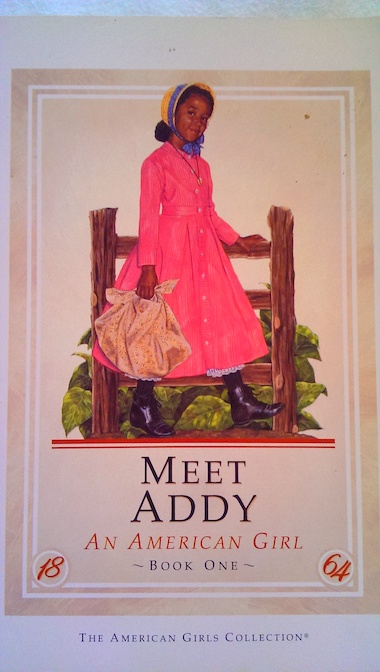
Meet Addy by Connie Porter, 1993.

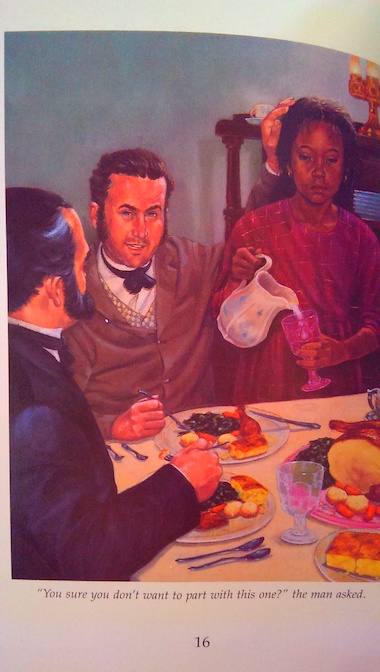
MeetAddySlaveBuyerAddy is nine years old, and she has lived her entire life so far as a slave on a plantation in North Carolina.  It is the time of the American Civil War, and Addy’s parents are worried about the future of their children.

One night, she hears her father saying to her mother that they ought to take the whole family and run away.  Her mother is worried that it’s too dangerous.  She hopes that soon the war will end, and they will be freed.  However, Addy’s father is worried that the family might be split up before that can happen because there is talk that the plantation owner, Master Stevens, might sell some of his slaves, and families wouldn’t necessarily be sold together.

His fears turn out to be justified because, soon after, while Addy is helping to serve dinner to a guest at the plantation house, she finds out that Master Stevens is planning to sell her father and brother to someone else.  She tries to get to them and tell them to run away before they can be taken away, but the overseer stops her.  Addy sees her father and brother taken away in chains.

With Addy’s father and brother gone, her mother has a serious talk with Addy about their future.  The two of them can follow the plan and run away to the North, establishing a new life for themselves and hopefully arranging for their family to be reunited later.  If they don’t take this opportunity to leave, there is the possibility that the family will be fractured further.  The man Master Stevens sold Addy’s father and brother to has already said that he might like to buy Addy as well.

MeetAddyMotherSisterAlthough Addy and her mother are frightened at the idea of running away, they decide that this is their only chance to escape together.  Addy is upset when her mother tells her that they can’t bring her baby sister with them.  She is too young for the journey, and if she cries, it might give them away.  Instead, they will leave little Esther with their close friends, Auntie Lula and Uncle Solomon Morgan.  They plan to find a way to send for them when the war is over.

Addy and her mother have to seek out the woman that Addy’s father had talked about, Miss Caroline.  She’s a member of the Underground Railroad and can help them get out of North Carolina and go to Philadelphia, where Addy’s father had planned to take the family.

They leave in the middle of the night and travel by night.  The journey is hazardous, and there are times when they are almost caught.  At one point, Addy’s mother nearly drowns crossing a river.  But, together, they face the dangers, knowing that a better life awaits them at the end of their journey.  Even when they reach Miss Caroline, Addy’s story is really just beginning.

In the back, there is a section with historical information about the origins of slavery in North America and what the lives of slaves were like.  One thing that I kind of wish they had mentioned was about how widely indentured servitude was used in early American history and how it helped to make the idea of slavery more appealing in early America, which was something one of my old college professors once talked about.


Indentured servitude is when someone works off a debt by working for someone else for free for certain period of time.  Often, this was how poor people could pay for passage to America during Colonial times.  In exchange for someone paying the price of their passage on a ship, they would work for them for awhile.  When that time was over, the indentured servant could move on to new employment or had to be paid for his work.  When plantation owners started buying slaves, what they were really saying was that they wanted permanent indentured servants, ones that could never leave them, that wouldn’t have any end to their servitude because it wasn’t based on any debt.  It couldn’t be based on any debt because the slaves owed them nothing.  The issue for the plantation owners was that they couldn’t build plantations the size they wanted and pay the labor to support them at the same time, so their solution to the problem was free labor — or at least, labor that cost no more than an indentured servant would: one initial outlay for the purchase and then some basic food and clothing to keep the workers going.

The practice of slavery is disgusting, but for me, it’s the attitude behind it that’s the real problem.  The plantation owners didn’t have any right to anyone’s free labor, and they knew there was no debt involved.  They just didn’t want to pay people, and just not wanting to pay people was a good enough reason for them.  In the end, whatever they said about race and their own superiority, it was all really about the money all along.  They would have said anything, done anything, to turn more profit for themselves, and because no one stopped them for a long time, that’s exactly what they did.  The rest was basically excuses piled upon justifications piled on more self-entitled excuses and more self-centered justifications.  They did what they did mainly because they could get away with it, and the fact that they could get away with it made them feel like it was all right.  It wasn’t.