Fannie in the Kitchen

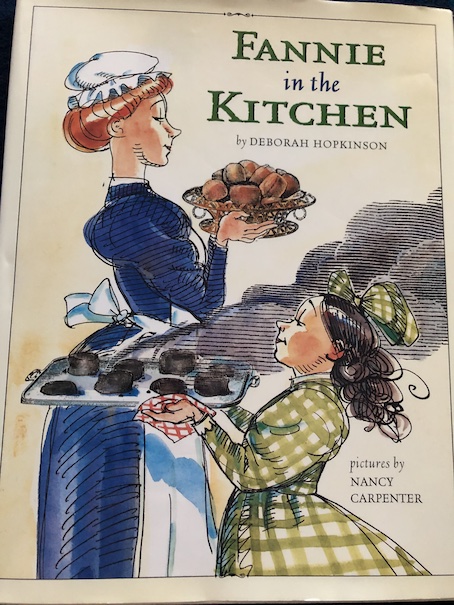
Fannie in the Kitchen by Deborah Hopkinson, 2001.

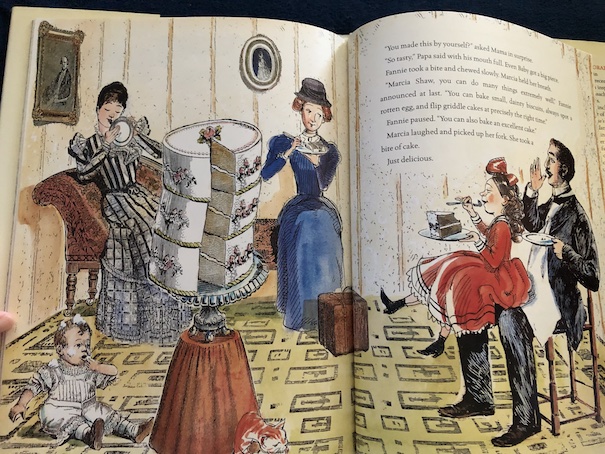
This is the story of Fannie Farmer and her famous and popular cookbook! When I first heard of the Fannie Farmer Cookbook (originally The Boston Cooking-School Cook Book (1896)), I wasn’t sure whether Fannie Farmer was a real person or if that was just a pseudonym or a marketing name for the cookbook, but Fannie Farmer was a real person in the late 19th century, and that was her real name. The story in this picture book is based on her real life, although details may be fictionalized, and the pictures give the story humorous twists.

In the beginning of the story, a little girl named Marcia Shaw prides herself on how many things she can do around the house and how much help she can give to her mother. However, she’s still a little girl, and there are some things she doesn’t know how to do well. In particular, Marcia doesn’t know how to cook. Now that her mother is expecting another baby, Marcia’s mother decides that she needs to hire some extra household help, especially with the cooking.

Marcia is a little offended that her mother considers her inadequate to help by herself, but when the new help arrives, a young woman named Fannie Farmer, Marcia has to admit that she’s a good cook. Even better for Marcia, Fannie doesn’t consider her cooking techniques trade secrets. She enjoys letting Marcia help in the kitchen and teaching her cooking tips.

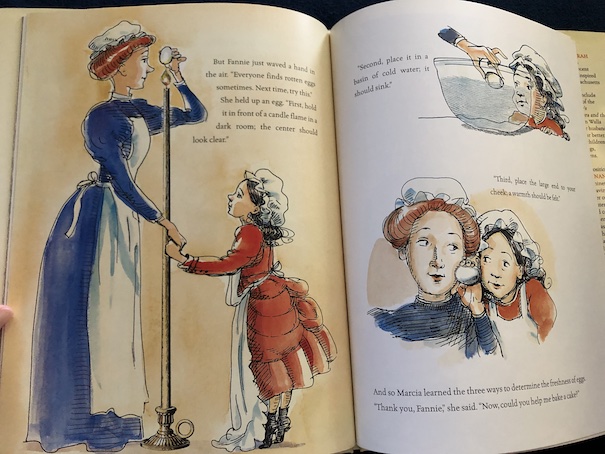
Under Fannie’s tutelage, Marcia’s cooking skills improve. Fannie teaches her many important pieces of information about cooking, like how to measure ingredients and how to tell when ingredients are fresh or if they’ve gone bad.

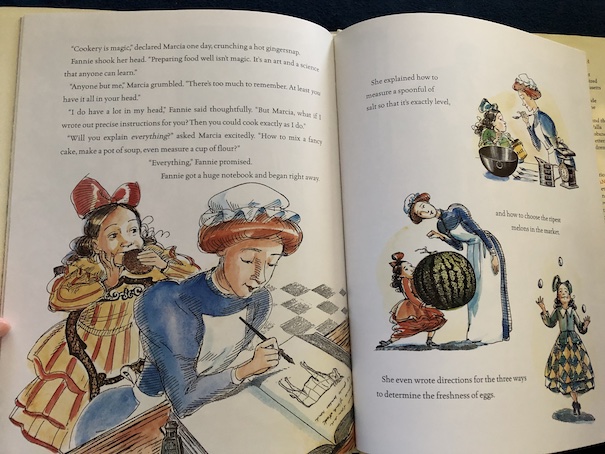
Marcia enjoys learning to cook with Fannie, but she thinks that she’ll never be as good as Fannie because there’s just too much to remember. She doubts that she’ll ever be able to memorize it all. Marcia is amazed that Fannie can keep all of that cooking information in her head. To help Marcia, Fannie decides to write out a notebook with recipes and cooking instructions, including all of the specific measurements for ingredients and detailed information about cooking techniques to make the recipes come out just right.

This is what makes Fannie Farmer and her cookbook so unique for their time period. If you’ve ever seen a very old recipe book or even just old family recipes written down, they often don’t have all of the amounts of ingredients written down, or the amounts are written in very vague terms. Old recipes also offer little to no cooking techniques, like how to tell when it’s time to turn a griddle cake over or how to tell if a cake is done baking. The assumption was that girls (usually girls for this time period) would learn to cook by watching their mothers and by learning from their examples. However, that assumes that their mothers knew all of these cooking tips themselves, that the mothers remembered to tell their daughters what they knew and explained it well enough for them to understand (some people don’t have much of a talent for teaching, even when it’s a subject they know themselves), and that the daughters understood or remembered everything their mothers said. Otherwise, the vague directions in cookbooks and family recipes were of little help, and new cooks had to learn through experimentation or trial and error. Fannie’s approach to cooking, as explained in the story, is an art and a science that anybody can learn if someone explains it well enough, so she puts her focus on recording all of the necessary details of her recipes.

Fannie’s recipe book, started for Marcia, turns out to be very popular with both the Shaw family and their friends and neighbors. As word spreads about it, people start coming by to borrow recipes or get cooking advice. Fannie realizes that there is a lot of demand for better teaching of cooking techniques, and she really enjoys teaching cooking, so she decides to accept a job at the Boston Cooking School.

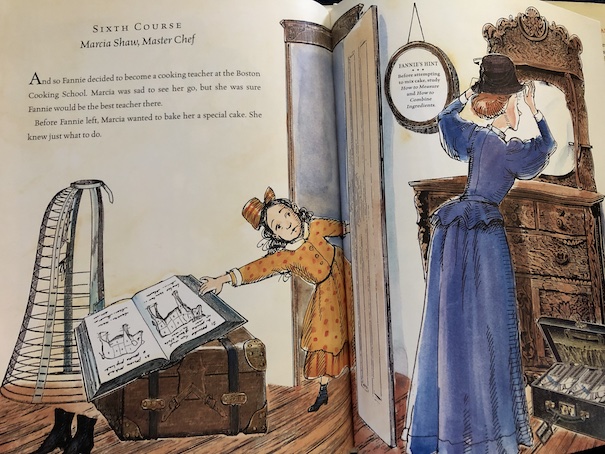
Before Fannie leaves the Shaws, Marcia borrows the cooking notebook and makes a special cake for Fannie to show her what she’s learned. The cake comes out just right because Marcia has followed Fannie’s directions.

There are hints from the Fannie Farmer cookbook throughout the book, and there is a section in the back of the book with historical information about Fannie Farmer. It also includes a sample recipe for Griddle Cakes.

The book is available to borrow and read for free online through Internet Archive (multiple copies). New and used copies are also available on Amazon. You can also buy the original Fannie Farmer Cookbook through Amazon or read it online through Internet Archive (multiple copies).

My Reaction

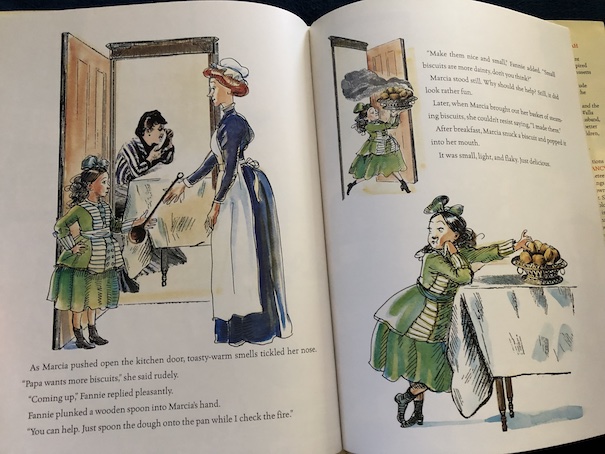
One of the things I liked about this book is the illustrations. There are eccentric details in the pictures that add humor to the story, like how Marcia stacks a bunch of chairs on top of each other while making candles, so she can make them extra long, and one of her extra long candles appears later, when Fannie shows her how to tell if an egg is fresh by holding it up to a light. For some reason, Marcia’s mother also has a weird habit of licking her dishes when she’s eating one of the yummy recipes, and there is one picture where it looks like she’s lost control of the baby carriage, and it’s rolling away with the baby. I’m sure these aren’t historical details and were just thrown in to be funny.

I think it’s also important to point out that the real-life Fannie Farmer lived an unconventional life for someone of her time period. She was plagued with health problems from a fairly young age. At some points in her life, she was unable to walk, possibly because of a stroke, and when she walked, she had a limp. She never married, but she built a fulfilling career around her talent for cooking. and achieved lasting fame because she wanted to share her knowledge with others. She is credited with establishing exact and level measurements in cooking in the United States, and she was also a strong believer in quality food and proper nutrition, especially for people with health problems.

Revolutionary War on Wednesday

Magic Tree House

Revolutionary War on Wednesday by Mary Pope Osborne, 2000.

The story begins with a prologue that explains things that have happened in the series up to this point, saying that Jack and Annie are currently undertaking a series of missions to four special types of writing for the library at Camelot. These missions cover books #21-24 in the series, and in this book, Jack and Annie need to find a piece of writing that represents “something to send.” To find this piece of writing, they’re off to the time of the American Revolutionary War!

When they arrive, it’s winter, and they find a camp of soldiers nearby. At first, they’re not sure which side the soldiers are on, so they sneak up to the camp to get a look at them. The soldiers catch them spying on the camp, but it’s okay because they’re Patriots, not British Redcoats. The soldiers tell the children that they had better go home, thinking that they’re just ordinary children from their time.

After Jack reads a little further in their book about the Revolutionary War, he realizes that this is December 25, 1776, and that they are about to witness the famous crossing of the Delaware River in Pennsylvania. This was a mission carried out in secret by George Washington and his men. The children listen while George Washington delivers an inspirational speech to the soldiers (“These are the times that try men’s souls.”), but a captain tells them that they had better leave because they don’t want children getting in the way of the mission. However, he asks them to do one favor before they leave. He asks them to take a letter to his family back in Frog Creek. He says that it’s a farewell letter, and they should only deliver it if they hear that the mission has failed and many soldiers were lost. Jack accepts the letter, realizing that this letter represents “something to send.”

Since the children know from their book that the mission will be successful, they can safely keep the letter. Jack thinks that their mission is over, but Annie has other thoughts. She climbs into one of the soldiers’ boats because she wants to spend more time with George Washington. George Washington tries to send the children back, but when the snow gets worse and he considers canceling the mission, the children have to persuade him to continue.

At first, the soldiers think that the children might be enemy spies because they seem to know too much about their mission, and one of them saw Jack writing something down earlier. However, Jack convinces them otherwise when he shows that he copied George Washington’s inspirational speech. He reminds George Washington about what he told his men about perseverance. Jack’s words inspire George Washington to take his own advice.

There is a section in the back of the book with more information about the Revolutionary War and places and people mentioned in the story.

The book is available to borrow and read for free online through Internet Archive.

My Reaction

I didn’t often read prologues to books when I was a kid, and I remember skipping over sections that explained the story background and past events in series that I followed regularly, but in this case, I was glad that the prologue explained the children’s mission. I’ve read books in this series out of order, although I don’t really recommend doing that. The books in the Magic Tree House series are very linear, and there are story arcs that extend over multiple books. If you skip around too much, it can spoil some surprises or disrupt the thread of the story.

I liked how this book introduced children both to the historical event of Washington crossing the Delaware and to the famous speech that he made. The lesson about perseverance was good.

The Wright Brothers

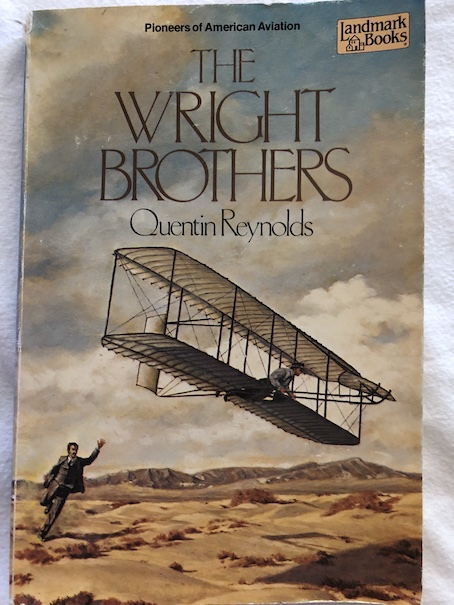
The Wright Brothers by Quentin Reynolds, 1950.

This book is part of the nonfiction history series Landmark Books, which focus on events and famous people in American history. This biography of the Wright Brothers, inventors of the airplane, is told in story format with dialog between characters. I’m not sure how accurate the dialog is, but it’s compelling way of presenting historical figures to children. I remember that I actually used this book for a report that I did about the Wright Brothers back in elementary school.

According to the story, the Wright Brothers’ mother, Susan, was responsible for inspiring their love of science and inventing things because she encouraged their curiosity and enjoyed answering their questions about how the world works, introducing them to concepts like wind resistance when explaining how birds fly and how to walk when you have to walk into the wind. Susan Wright was very good at math and had a talent for planning things out on paper that she taught to her children. She was accustomed to making her own patterns for clothes, and she showed the children how to apply similar principles to planning how to build a sled by drawing out their plan and figuring out, mathematically, the sizes of each piece of the sled. The boys learned a lot from her and applied what she taught them to their later projects, like building a wagon they could use in their first job, working for the local junk man. The boys would gather scrap materials in their wagon that the junk man would buy from them and sell to others. The junk man also gave them some supplies to work with and some tips for building their projects.

The Wright brothers enjoy flying kites with their friends, and now that they’re learning more about making things, they decide to try making their own kites. Their first attempt doesn’t work well, but by studying what went wrong, they learn how to modify different parts of the kite to get better results. Their second kite turns out better than the store-bought kites that the other boys have, and the brothers begin making and selling kites to the other boys.

When they were young, the boys were quite athletic, particularly Wilbur, who played both football and hockey. However, when he was a teenager, he was injured badly during a hockey game. A puck hit him in the face and knocked out several of his teeth. To make matters worse, the injury became infected, and the infection damaged his heart. His doctor advised him not to return to sports or athletics and not to pursue any line of work that involved hard physical work or heavy lifting to avoid further strain on his heart. It was a heavy blow, but it wad also a turn point in the brothers’ lives.

While Wilbur was resting and recovering from his injury and infection, their father gave him a drawing set and a small wood-working kit that included a book about the properties and uses of different types of wood. Wilbur had never been very interested in books before, but he discovered how useful they could be, and the boys used the new knowledge Wilbur gained in their projects. Orville made a good partner for Wilbur because he was happiest doing the actual assembly work of everything they built and had little interest in books and studying. He could handle the heavy work that Wilbur could no longer do while Wilbur studied design techniques and mapped out plans for their projects. In this way, the boys made a chair for their mother as a present. Wilbur came up with the basic concept and then discussed and worked out the plan with Orville. Orville gathered the materials and assembled the chair according to the plan, discussing the results with Wilbur. As Wilbur recovered further, he was able to get out of bed and help Orville more in their workshop in the family’s barn, but they continued to keep this partnership system that worked well for them, with Wilbur focusing on studying and planning and Orville handling the heaviest parts of the assembly.

The boys’ father was a minister, and for a time, he was the editor of a church newsletter. He gave Wilbur the job of folding the papers, with Orville helping. When they realized just how long it took to fold individual papers, they came up with the concept of building a paper-folding machine. Their machine worked incredibly well, finishing all the folding that ordinary took them a couple of days in the space of a couple of hours. Their father was amazed and realized that the boys could have a future as inventors.

In high school, Orville helped a friend of theirs, Ed Sines, with managing the school newspaper, which was printed on a very small printing press. He and Wilbur discussed making a larger press and starting their own newspaper with their friend. This was a harder job that required the boys to work with metal instead of just wood, but they accomplished it. There was one other obstacle, though. They had their own press, but before they could begin printing anything or selling advertising space in their paper, they needed to buy other supplies, like ink and paper. They realized that they and their friend would have to get other jobs to raise the money. Wilbur was the older of the two brothers by four years, and he thought he could get a job delivering groceries. However, Orville was worried that the job might be too difficult physically for his brother because it involved heavy lifting. He suggested that Wilbur get the job and then let him help with the heavier parts of the work. It turned out to be a good idea because they were able to gather pieces of news as they traveled to farms in the area and talked to people as they delivered groceries.

Their newspaper was successful, particularly after they started taking side jobs, using their printing press to print signs, flyers, and bulletins for local businesses and churches. Because it was just a small business, they underbid some of the bigger, established printers. However, the brothers soon became bored with the newspaper and printing press because what they really loved most was building things and fixing things. They sold their share in the printing business and newspaper to their friend, Ed Sines, and they decided to open a bicycle shop, where they could build and repair bicycles.

Orville had the idea of promoting their bicycle business with a bike race. His thought was that he could enter it himself and show off how their methods of cleaning and repairing bicycles improved their speed and performance. Unfortunately, the bike race didn’t turn out well. Although Orville’s bike was in excellent condition, they neglected to put new tires on it. He was just about to win when he blew a tire, and his loss of the race cost them business. People weren’t confident that they would do a good job repairing their bikes if they couldn’t properly take care of their own. However, a local businessman loved the bicycle race so much that he decided to sponsor another one, and Orville easily beat all of the other bicycles in that race. Customers’ confidence in their business was restored, and they learned that, when building or repairing any machine, they couldn’t afford to neglect any part of it or take it for granted that everything was right without checking for certain.

The Wright brothers began building their own bicycles, which they called Wright Fliers, and their mother bought an interest in the business to give them some money to get started. One of the features of their service that drew customers was their promise to repair any bike they sold for free for a full year after the purchase. When their mother died, they threw themselves even more into their business to work through their grief.

Then, Orville became ill with typhoid. It was a frightening and often deadly disease, and Wilbur and their sister Kate feared for him. The book (which was written in 1950, remember) discusses how typhoid was little understood at the time. Doctors at the time didn’t fully understand how it was transmitted. (Answer: It’s a bacterial infection spread through food or water contaminated with Salmonella Typhi. Besides vaccines, water purification methods, pasteurization of milk, and other food safety measures help prevent the spread.) They had no cure for it (which would be antibiotics later), only medicines that they could use to treat the symptoms, to try to help the sick through the worst of it. The book further notes that, by the time the book was written, most parents had their children vaccinated against typhoid and other dangerous diseases, like smallpox, but that wasn’t an option for the Wright brothers because those vaccines had not yet been developed in their time. (The book adds that, “Every single soldier in World War II was inoculated against typhoid fever, and very few of them caught the disease.” The author of this book was aware that this particular vaccine was not 100% effective and didn’t prevent 100% of cases, which is common among vaccines in general, but it was still massively effective and made a major difference in curbing the spread of the disease, even in wartime conditions, which are often unsanitary. The earliest typhoid vaccine dates back to 1896, and that was the year given for Orville’s illness, but the implication is that he caught the disease before he had access to the new vaccine. Missed it by that much.)

Orville’s illness was severe. He spent about two weeks just sleeping, and when he was awake, he was delirious because of his high fever. Wilbur and Kate looked after him with the help of a hired nurse. The doctor told them that there was little that he could do and that the fever had to “run its course.” (The book says at this point that, “You never hear a doctor say, “This disease has to run its course” today. Today doctors know how to fight many kinds of diseases, and they have medicines and drugs to kill the germs that cause the disease.” By 1950, when this book was written, the invention of antibiotics had made an enormous difference in treating infections, and the author of the book would have been aware of the difference it made in quality of life and the treatment and survival rate of diseases. However, I have to admit that it’s not true that all diseases have a cure, even in the 21st century. We have ways of treating viruses, but we still can’t really cure viruses, and most of those also have to run their course. For most of my life, people considered most viruses relatively mild compared to bacterial infections, but the coronavirus of the early 2020s challenged that assumption. It’s just interesting to me to compare these different expectations regarding illness and medicine in three different time periods: the late 1800s, the 1950s, and the 21st century.)

After about three weeks, Orville’s fever finally broke, and they knew that he was going to survive. He had lost weight, and he was very weak, and his doctor told him that he would have to rest in bed for two months. For a young man as active as Orville, that was going to be difficult, but Wilbur told him that he would read to him to keep him entertained. In particular, Wilbur had a book that he knew Orville would love: Experiments in Soaring by Otto Lilienthal. Ever since they had been making kites as boys, they had dreamed of one day building a kite big enough to allow them to fly in it, and that was basically what Lilienthal had done. Lilienthal had invented a glider. (Sadly, he was killed in a glider accident while trying to perfect his design in 1896, the same year of Orville’s illness.) Lilienthal was only one of many people who were experimenting with the concept of flight and flying machines in the late 19th century, but he had been one of the most successful with his designs up to that point. The brothers acquired other books and magazines about flight and the attempts people were making at building flying machines. Neither of the Wright brothers had actually graduated from high school, but their extensive reading and practical experimentation made up for the lack of formal education. Based on their reading, they developed a new goal: to build a glider that would fly farther than any that had so far been created.

At first, they didn’t want to tell anyone else other than their sister what they were working on because they didn’t know for sure that they would succeed, and they thought that everyone would think that they were crazy for trying to fly. A trip to the circus, where they saw an exhibit of a “horseless carriage” (an early automobile), gave them the idea that they might be able to attach an engine to some kind of glider to propel it. Their logic was that if it could work for carriages and boats, it might work for a flying machine. They imagined that an engine could propel the glider through the air as an engine could move a boat through water, and then, the flying machine would be less dependent on the wind, which could be variable.

When they had a glider design that satisfied them, they knew the only way to know for sure how well it would work would be to try it. They didn’t want to try it in Ohio, where they lived, because there were too many hills and trees that would get in the way. They wanted a flat place with few trees and where they could find a reliably steady wind. Since they had acquired their reading materials by writing to the Smithsonian Institute, they wrote to the Smithsonian Institute to ask if they had information about places with the conditions they required. The Smithsonian Institute forwarded the letter to the United States Weather Bureau, which recommended a few places, including Kitty Hawk, North Carolina. (Fun Fact: Kitty Hawk is just a little north of Roanoke Island, the site of the infamous vanished Roanoke Colony. It’s not important to the story, but I just wanted to tell you.)

As with their first kite, their first experiment with the glider was only partly successful. It glided for 100 feet before crashing. They fixed the glider and tried again, but it again ended with a crash because they couldn’t steer the glider. Just as they did with their first kite, they decided to build a new one, using what they had learned from the experiment and refining the design. They knew there were risks in their experiments because of Lilienthal’s death, but they were careful not to test their gliders at a very high altitude. They also added both vertical and horizontal rudders so they could not only steer from side to side but also move up and down, giving them greater control over the movement of the glider. What made their experiments different from others’ is that they ultimately wanted to create a “heavier than air” flying machine, propelled by an engine.

After their successful test at Kitty Hawk in 1903, in which Wilbur flew for 59 seconds, a record time, few people believe it at first. They were angry at first that their own neighbors thought that they made up the story about flying. They continued to work on their flying machine, and when they produced one that flew over a cow pasture near their town for 39 minutes, local people started believing them. Word was also spreading through the international scientific community. President Theodore Roosevelt first learned about the Wright brothers from an article in Scientific American, and he arranged for them to demonstrate their flying machine to the Secretary of War at Fort Myer, Virginia. During that demonstration, Orville flew their airplane for a whole hour, ending with a successful landing. Then, when a young soldier said that he wished he could fly, too, Orville took him for a ride with him on a second flight. The book ends with the Secretary of War hiring the Wright brothers to make bigger, more powerful airplane for the US Army, and the Wright brothers accepting an invitation to dinner from President Roosevelt.

The book is available to borrow and read for free online through Internet Archive (multiple copies).

My Reaction

I used this book for a school report about the Wright Brothers when I was a kid, and I think it holds up with time. Part of what I like about the Wright Brothers is their partnership as brothers. They had friends outside of the family, but their greatest friendship was always with each other because they had so many interests in common, even though there was an age gap of four years between them. They often felt like nobody understood them or their projects as well as they understood each other, and they could talk about things with each other that their other friends just wouldn’t understand because they weren’t into building things or studying technical methods and inventions. Not all siblings get along so well, but they really understood each other and complemented each other well. When Wilbur could no longer do some of the heavier work that he did when he was younger, Orville was happy to do the heavier physical work, which he preferred to the reading and studying that Wilbur discovered he really loved. They learned from a young age how to use their strengths to help each other and carry out their projects, and that’s real teamwork!

When I was a kid, I didn’t pay any attention to the About the Author section, but it’s interesting by itself. Quentin Reynolds was a famous war correspondent during World War II, which is part of the reason why he makes multiple references to World War II and World War II airplanes during the book. He also wrote other nonfiction books for adults and children, including four other books in the Landmark series.

Invincible Louisa

Invincible Louisa by Cornelia Meigs, 1933.

This is the story of Louisa May Alcott, the famous 19th century author who wrote Little Women and other books for children.

The book begins with Louisa May Alcott’s birth on November 29, 1832 in Pennsylvania and explains about her parents’ backgrounds. When Louisa’s mother, Abba (short for Abigail), had first become engaged to her father, Amos Bronson Alcott, people advised her not to go through with the marriage because Bronson didn’t seem like a very practical man and nobody really expected that he would amount to much. However, Abba genuinely loved him and understood him. They shared similar ideals, including Abolitionism and the practice of service and charity to others, although they didn’t agree about everything. Bronson was a scholarly man who worked as a teacher, although he struggled to get an education himself when he was young because he was born to a family of poor farmers. As a young man, he had worked as a traveling salesman and had seen much of life across the country. He was good at talking to people and was very good at speaking to children, which led him to eventually settle down to teaching.

The Alcott family was happy where Bronson Alcott was teaching in Germantown, but the death of his school’s patron was a heavy blow. Without his patron’s backing, the school didn’t last, so the Alcott family left Germantown and moved to Boston. Little Louisa enjoyed the busy city of Boston, but the book also describes a harrowing situation in which she almost drowned after falling into Frog Pond. This incident was a traumatic memory for Louisa, but it wasn’t just the trauma that left a mark on her. The person who rescued her from drowning was a black boy. (The book uses the word “Negro.”) Louisa never knew the boy’s name, but her gratitude toward her rescuer influenced her feelings toward black people for the better at a time when the country was heading toward Civil War over the issue of slavery.

The Alcott family had ties to some important people. Her father was friends with Ralph Waldo Emerson and Elizabeth Peabody, who was instrumental in the development of kindergarten education in the United States, worked at his school in Boston. Her mother’s elderly aunt, known as the formidable Aunt Hancock, had been the wife of the famous John Hancock. However, in spite of connections, Bronson met with opposition to his teaching when parents of the students learned that he was an Abolitionist. A friend of his, William Lloyd Garrison, was almost lynched by an angry mob for airing his views about ending slavery. When Bronson admitted a black boy as a student to his school, it was the last straw, and many parents withdrew their children. Louisa later remembered discovering that her parents helped to hide runaway slaves when she was young, but it isn’t clear at which of their homes they were doing this.

After his school in Boston closed, he moved the family to Concord. He didn’t have the heart to open another school, so he supported this family through farming. They were poor and lived very simply, but they enjoyed living in the countryside. However, her father did maintain some scholarly contacts and was involved with the Transcendentalist movement. In 1843, the family moved yet again to join a community of Transcendentalists, experimenting with a more isolated lifestyle. (A footnote in the book, added decades after the original writing, compares it to the communes of the 1960s and 1970s.) However, the community was not a success. When one of the leaders of the community suggested that Bronson give up his wife and daughters to live in the style of Shakers, Bronson discussed the situation with his family, and they all came to the conclusion that this community was asking too much. Giving up on his experimental lifestyle was difficult for Bronson, but Abba’s brother understood the situation and helped the family move to a new home. Eventually, the family resettled in Concord.

Compared to her sisters, Louisa was a boisterous and temperamental child. She loved running wild in the countryside, and her curiosity and impulsiveness sometimes got her into scrapes. She wasn’t as good at housework as her older sister, Anna. However, she was always imaginative. When the family returned to Concord, Louisa was able to have a room to herself for the first time, and she used her new privacy for writing stories. She created plays for her and her sisters to perform.

As she grew up, Louisa became increasingly aware of her family’s poverty and her father’s lack of understanding for the ways of the world. Her mother was frequently worn out from trying to make do and take care of the four girls in the family. She began making plans early that she would find a way to provide for her parents and her sisters when she got older.

At Concord, her family continued their friendships with Thoreau and Emerson, and Ralph Waldo Emerson allowed Louisa to read books from his library, She developed a kind of hero-worship of him as a teenager. The Alcott girls also attended a regular school for the first time. Louisa often felt awkward because she was taller than the other girls at school, but she was also very athletic. She frequently wished that she had been born a boy instead of a girl.

At age 16, Louisa began her professional life, giving lessons to Emerson’s children. She was a good teacher, although as an active person, she found quiet study and teaching for extended periods difficult. Her mind often wandered to ideas for romantic stories, and she wrote a collection of little stories for Ellen Emerson. However, the family was badly in need of money, and they had to leave Concord and return to Boston, where they would live with her mother’s brother.

In Boston, Louisa continued teaching and found work as a governess. She also picked up other odd jobs to help support her family. One of them, a job as a live-in companion for an invalid, turned out especially badly because the job had been misrepresented and turned out to be hard labor. She was paid very little for it, too. It was during this time that her father discovered the little stories that Louisa had written for Ellen Emerson. He took one of them to a publisher he knew, and the story was published. Encouraged, Louisa and her father had the rest of the stories published in a collection called Flower Fables, Louisa’s very first book.

This did not bring her instant success as a writer, though. The family’s lives were filled with ups and downs, and they moved house multiple times. Louisa left her family to pursue an independent living for a time, although she made very little money, taking teaching jobs, sewing, and anything she could find. It was during this time that Louisa’s two younger sisters became ill with scarlet fever while the family was engaging in their usual charity work. Elizabeth had it particularly badly, and her health was never good after that. Louisa rejoined the family when they once again returned to Concord, where Elizabeth passed away. Elizabeth’s death was reflected in Louisa’s semi-autobiographical Little Women with the death of Jo’s sister Beth.

The Alcotts had been such a tight-knit family that separations of the sisters were bitterly painful, but every family experiences change over time. After Elizabeth’s death, Anna became engaged to marry John Pratt. It upset Louisa because it felt like she was losing another sister. Louisa once again set out to try to make her own living, but for a long time, it seemed like nothing would go right for her. It was difficult for her to find work, and opportunities seemed to disappear when she was about to take them. At one point, she was in such despair that she even considered suicide. Fortunately, after hearing an uplifting sermon about girls who were in her position, she renewed her determination to succeed, and she received a job offer from someone she had worked for before. Meanwhile, her father was finally starting to have some success with his educational lectures, and he even became superintendent of schools in Concord.

During all of these trials and tribulations for Louisa and the Alcott family, the country was headed toward Civil War. The Alcotts were still Abolitionists, and Louisa’s father had even been involved in a riot in Boston where a mob of citizens had tried to rescue a runaway slave who was about to be returned to the slave owner. After the war started, Louisa felt the urge to do something to help the side of the Union, so she volunteered as a nurse. Conditions were rough at the hospital where she worked, and she was put to work immediately with no training. She had some talent for nursing and a good bedside manner, having nursed Elizabeth through her final illness, but nothing could have prepared her for dealing with the war wounded. It was difficult and often heart-wrenching work, and it took a toll on her own health. After only about a month of working there, she caught typhoid, and her father was summoned to come and take her home.

Louisa eventually recovered from her illness. She felt like a failure for not being able to complete the full term she had originally promised to the hospital, but her nursing experiences helped further her writing career. The letters that she had written to her family about the people she met and her experiences at the hospital were so interesting that they had them published as “Hospital Sketches”, and they were extremely popular. So many people had friends or family who had gone away to war that they were anxious to know as much as they could about what was happening to them and others like them. The success of the “Hospital Sketches” led publishers to ask Louisa for further writings.

When Louisa recovered further, she felt restless, so she accepted a position as a nurse/companion to a friend’s daughter, who was unwell but wanted to go on a trip to Europe. Traveling as a nurse/companion didn’t give Louisa all of the freedom she would have liked to see and do everything she wanted, but she did get to see many things in Europe. She was able to visit the home of the German philosopher Goethe, and she attended a public reading by Charles Dickens. During their travels, she also met the young man who would be the inspiration for Laurie in Little Women.

She started writing Little Women after she returned home from Europe, at the suggestion of her publisher, who thought that she should write books for girls. When her publisher read it, he wasn’t sure that it would be successful at first because its tone was different from the popular children’s books for girls at the time. He tested it out by giving copies to his niece and some other girls who were about the same age, and they all loved it, so he went ahead and published it. It was so successful that it provided Louisa and her parents with financial stability for the first time, and readers wanted more! Much of the story was based on Louisa’s own life with her sisters and on people they knew, but she changed some parts for the sake of the story. Since the real Louisa never married, she made up a fictional husband for her story counterpart, Jo. In the story, Jo marries a German professor, and in the sequel, she and her husband start a school for boys based on Louisa’s father’s theories about the ideal school. Many of her father’s theories about education were very progressive for the time, and since he never got the chance to try all of them, Jo and her husband did in the story.

Even though she never fully recovered her health after having typhoid, she continued to write books for children, and she visited schools to speak to children. The book explains how these other books were also inspired by aspects of Louisa’s life. She and her youngest sister, May, took another trip to Europe together. May always had a talent for art, and Louisa funded her further travels and studies in Europe. May eventually married, but sadly, she died not long after the birth of her only child, a daughter named after Louisa. In accordance with her wishes, May’s infant daughter was brought to Louisa to raise, and Louisa treated her like her own daughter, calling her Lulu as a nickname. The book ends with Louisa’s death, mentioning that she made one of Anna’s sons her heir to perpetuate her copyrights. In the back of the book, there is a chronology of events from Louisa May Alcott’s life.

The book is a Newbery Medal winner. It is available to borrow and read for free online through Internet Archive (multiple copies).

My Reaction

I bought my copy of this book at a Scholastic Book Fair back in the 1990s, but I didn’t notice until I was an adult that the book was originally published in the early 1930s. I think part of the reason why the author was interested in doing a biography of Louisa May Alcott at that particular time was that it was around the 100th anniversary of her birth. I appreciated how later reprintings of this book also tried to keep it up-to-date and relevant for modern readers, including the addition of the footnote in the book about communes of the 1960s and 1970s.

Something that shows how 19th century society was different from modern society is the qualifications required for certain types of jobs. In the past, there were relatively few professional and educations qualifications required for teachers and nurses. In the 21st century, both teachers and nurses are required to have college degrees and relevant certifications to apply for their jobs. Nobody in the 21st century gets those jobs without having the requisite professional credentials (with the exception of homeschooling families, where the teachers are the parents). It would be useless to apply for such careers without having all of the education and certification required. In the 19th century, it was sometimes more important to just find someone willing to do the job, whether they had any particular qualifications to do it or not. Where the need was sufficiently great, like in the hospitals tending to the war wounded, they would take almost anyone who showed up and was willing to take the job with the hardships and blood involved. (There is one episode where Louisa witnesses an applicant being turned down because, while this person wanted to help the war effort, they didn’t have the stomach or stamina for the demands of the job. Next to that, medical knowledge was less important.) I explained dame schools when I reviewed Going to School in 1776, and the concept still applied in the mid-19th century. Dame schools were informal schools set up by people, often women, who were simply willing to take on the job of teaching local children. They got the jobs chiefly because they were the people who were willing to do them in the area. The quality of education these informal teachers could provide varied drastically, depending on the individual teacher. Some of them were actually well-read individuals with a gift for teaching (this is what Louisa and her father were like, in spite of their relative lack of formal education), while others provided little more than day care while the children’s parents worked. In the section of this book that explains Bronson Alcott’s history, there is some discussion of how education levels and quality varied across the country in the mid-1800s.

Parts of this book and the lives of the Alcott family also offer a different perspective on what it means to be successful in life. Through most of their lives, the family has little money, and Louisa and her father often struggle to find jobs and get recognition for their work. Louisa May Alcott is famous now, but early in her life, she felt like a failure. She struggled to find and keep jobs and had health problems that interfered with her ability to find and keep work. In the end, it wasn’t having money that made her famous but her talent and perseverance. There were times when she wanted to give up, and she even felt suicidal at one point, but she kept going in spite of everything. Even her father eventually managed to carve out a career for himself that suited his real talents. Their early problems didn’t mean that they were worthless or incapable. Their talents were just unusual, and they needed time to find their proper niche in life, the right circumstances to demonstrate what they could do, and the right people to recognize and appreciate their abilities.

The Story of Ruby Bridges

The Story of Ruby Bridges by Robert Coles, illustrated by George Ford, 1995.

This is a beautifully illustrated picture book about Ruby Bridges, one of the first black children to attend a school that was formerly all-white during the desegregation of schools that took place during the Civil Rights Movement. The story is told in the form of the memories of Ruby and other people, looking back on their experiences, rather than as a first-person account.

When the book begins, it introduces Ruby as the child of a poor family who moved to the city after her father lost his job picking crops when farmers began using mechanical pickers instead. After her family moved to New Orleans in 1957, her father worked as a janitor, and her mother became a cleaner at a bank.

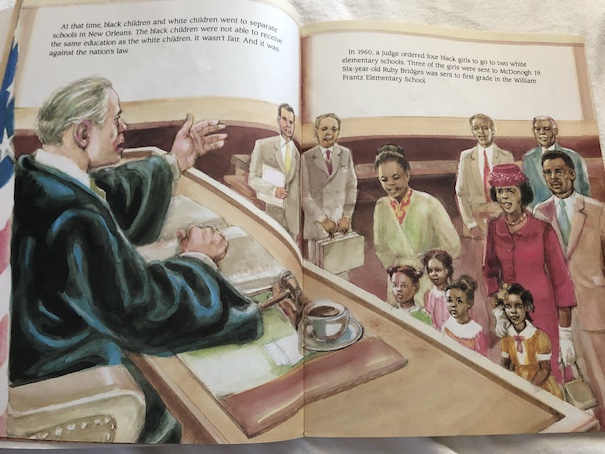
The book explains briefly that schools were segregated at the time, and that black children were not given an education that was equal to what was offered in white schools. Because the book is for children, it doesn’t go deep into detail about the Civil Rights Movement and desegregation or exactly how Ruby Bridges’s family became involved. (Ruby was selected as one of the children because she passed a test for academic aptitude, showing that she could keep up with a class of white children, who had better early education.) It simply says that, in 1960, a judge decided that four young black girls would be sent to schools that had been for just white children and that six-year-old Ruby Bridges was one of them.

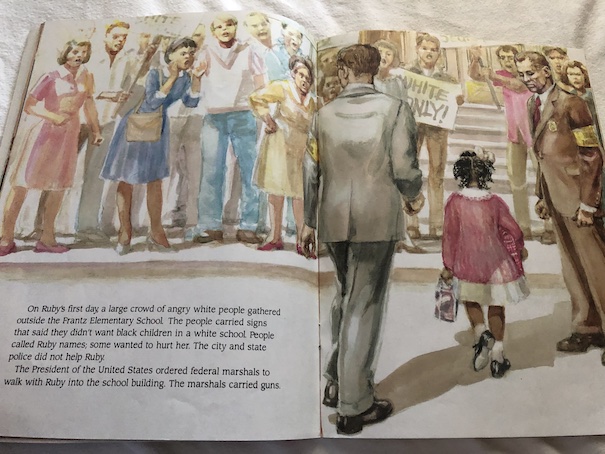
It was a harrowing experience for young Ruby. There were protesters outside the school, yelling angrily and threatening the little girl. For her safety, she had to be escorted by armed federal marshals.

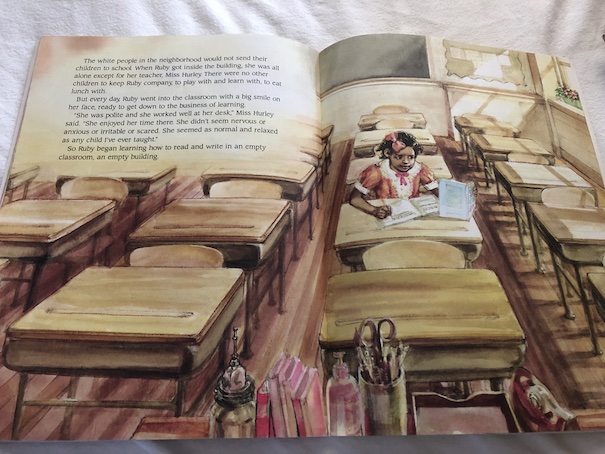
Parents in the area refused to send their children to school so they wouldn’t be in the same classroom with a black child, so Ruby Bridges was literally in a class all by herself. Her teacher, Miss Hurley taught Ruby in an otherwise empty classroom. Miss Hurley was surprised at how Ruby was able to keep a good attitude in spite of the angry protestors and the lack of other children.

One day, Miss Hurley was looking out the window as Ruby approached the school, and she thought she saw Ruby saying something to the angry crowd before coming inside. When Miss Hurley asked Ruby what she said to them, Ruby said that she was talking to them; she was praying for them. Miss Hurley hadn’t realized it before, but Ruby had a ritual of praying for the people who were angry and hated her every day before school. This was just the first time that Miss Hurley had seen her doing it.

Ruby also said the same prayer after school. This prayer was part of what helped her get through those difficult days of hostility and loneliness.

The book ends by explaining that the parents soon began to send their children to school again and let them join Ruby’s class because they realized that life had to continue and that keeping their children from their education was hurting them. The angry protestors gradually gave up. Ruby continued going to school and eventually graduated from high school. She later married a building contractor and had four sons of her own. She founded the Ruby Bridges Educational Foundation to help parents become more involved with their children’s education and to promote equality in education.

The book is available to borrow and read for free online through Internet Archive (multiple copies).

My Reaction

I’ve heard the story before of Ruby Bridges praying for the people threatening her and protesting against her. This particular rendition is very good, although there is one thing that confuses me. According to this book, her teacher’s name is Miss Hurley, but I understood her name was Barbara Henry. I thought perhaps Hurley was her maiden name and that she later got married, but I haven’t been able to find anything to confirm that. I haven’t found anything to explain where the name Hurley came from at all. I’m not the only reviewer who questions the name confusion.

Ruby Bridges wrote books herself about her experiences, at different reading levels, and they’re also available on Internet Archive.

Little House in the Big Woods

Little House on the Prairie Series

Little House in the Big Woods by Laura Ingalls Wilder, 1932.

The story begins “60 years ago”, in a little house in the woods in Wisconsin, where a little girl named Laura lives with her parents and her two sisters, Mary and Carrie. Mary is older than Laura, and Carrie is younger. Their father hunts for meat for the family in the woods, and although Laura worries about the wolves in the woods, she and her family are safe in their little house.

Much of the family’s time is occupied with getting and preserving food. Food preservation is important because not every hunting trip is successful, and they need to make sure that they make the best use of every animal they get, as well as dairy products and produce. Laura and Carrie like to play among the food being stored in the attic. One of their favorite chores is helping their mother mold butter into shape with their butter mold, and often, the highlight of their day is getting something special to eat.

The story begins in winter, and Christmas is coming. The girls help their mother to prepare some special foods and treats, like apple pie and vinegar pie. They make candy by pouring a molasses syrup over snow to freeze it. The girls’ aunt, uncle, and cousins come to visit, staying overnight. The children have fun playing in the snow, making what they call “pictures” by throwing themselves down in the snow and seeing what type of shapes they can make with their bodies. The family has a feast, during which the children are not allowed to talk because “children should be seen and not heard”, but they don’t really mind because the food is really good, and they can have as much as they like. The children believe in Santa, and they are happy with the simple presents they receive: a pair of red mittens and a peppermint stick each.

Laura also receives a very special present: her first real rag doll. Her older sister already has a rag doll, but up to this point, Laura didn’t. Her only doll was made from a corn cob. Children of their time don’t get many presents, and the youngest children don’t get any at all or only have improvised toys. The other children aren’t angry or jealous because Laura has received this extra present because she is younger than they are. Only the babies in the family are younger than Laura, and the older chidren know that Laura didn’t already have a doll, like they do. Laura isn’t being favored; it’s just that she is now old enough to get this kind of present.

Although the family is safe when they’re in their log cabin, there is a genuine risk of attack from wild animals when they’re outside. Members of the family talk about close encounters they or other people had with panthers or bears. Laura’s Pa has a humorous encounter with a tree stump that he mistakes for a bear in the snow, while Ma actually slaps a bear because she mistook it for the family cow.

As the seasons change, the family activities change. They help relatives make maple syrup, and they have a dance. The girls have their first trip to town with their parents. Pa gathers honey, and Ma makes straw hats. Pa helps a relative with his harvest, and a cousin who plays mean tricks instead of helping gets his comeuppance.

I couldn’t find a copy of this book to read online, probably because of the racial language in the story, but there are shorter books on Internet Archive based on individual incidents in this story, like the winter and Christmas scenes. I thought those were the best parts of the story anyway. I would recommend those shorter books and picture books over the original for young children.

My Reaction

Things I Liked and Didn’t Like

It’s been a long time since I first read this book, and honestly, I didn’t like it as much as I did the first time. I remembered kind of liking it when I was a teen. I can’t remember exactly how old I was the first time I read it, I might have been a young teen or tween, but I know I didn’t read Little House on the Prairie books as a young child. My mother wasn’t really into the series herself, so she didn’t read them to me or recommend them much. (She preferred Nancy Drew, and really, so did I.) I know I lost interest in the series after reading only one or two more books because it seemed like that poor family was always getting sick everywhere they moved, and I found that depressing. This book series is one of the reasons why I don’t believe that exercise and organic food by themselves keep a person from being sick. This family had both, and it never helped them. During the course of the series, they catch everything from malaria to scarlet fever or meningoencephalitis, whichever it was that eventually made Mary go blind. It’s like all of the diseases my characters died from in the Oregon Trail computer game but in book form. Come to think of it, people on the Oregon Trail were also exercising and eating organic, and I’ve seen the real tombstones of pioneer children. I believe in sanitation and vaccinations.

As an adult, I found much of the first half this particular book boring or frustrating. That’s surprising because I usually like books with details about life in the past, and many of the details in this particular book echo stories passed down in my own family. (I also had ancestors with strict traditions about not working on Sundays, and they also ate cold meals on Sundays because they had to do all the Sunday cooking the day before.) I found some of the early parts of this story grating. The main reason is that this book is not actually a single story. There is no real, over-arching plot. It’s basically a collection of episodic reminiscences and family stories. I found some of them interesting, but not the early parts.

The book isn’t bad because the writing quality is pretty good, but in the first part of the book, there are long descriptions of hunting and food. I hated the descriptions of how they processed animals they hunted and butchered. I’m sure they’re true-to-life, but I’m the squeamish type. The parts where they talk about foods they like are better. They have kind of a cozy feel, with homemade meals and goodies that have kind of a nostalgic feel. However, I’m not that much of a foodie, and I’m not into “food porn” or long detailed descriptions of things other people are eating. There are limits to how much of that I can take before I start wanting more plot to happen. I think food descriptions are good when used to add color and atmosphere to a story, but it’s too much when they start turning into the story itself. Ideally, a good food description in the book will make me think of a story I liked the next time I eat that particular food. When it’s too overwhelming, there isn’t much of a story to be transported to. Part of the reason why Laura dwells on the subject of food is that this family has to struggle and work hard to get it. It’s not always guaranteed, and when there is something extra, there’s reason for celebration. They are poor, and treats are rare. I think that part of the reason why this book was so popular during the 1930s, when it was first published, was that many other children were growing up in a similar situation during the Great Depression.

When there is more action in the first part story, it’s typically that someone has a close encounter with a dangerous wild animal, like a panther or a bear. Most of this isn’t something that little Laura witnesses directly, but people will tell her stories about family members who had this happen to them. It happens repeatedly throughout the book. One really exciting encounter with a wild animal who wants to eat someone makes for a good adventure story, but when it happens repeatedly, the novelty goes out of it. It starts to become more like, “Oh, another animal attack incident story. Everybody’s got one.” Ma slapping the bear was something special, though. After the other descriptions of animal attacks, Pa’s mistaking a stump for a bear and Ma actually slapping a real bear felt like the punchline of a joke.

People in Laura’s family carry guns with them whenever they go out both for hunting purposes and because they are living in a real wilderness full of dangerous animals, and there is always a real possibility that they might have to defend themselves from a bear, panther, or wolf. They also eat bear when they can get one, and Laura likes the way it tastes. One of the chores that the kids find fun is when they help their father make his own bullets using molten lead in a bullet mold. I actually know someone who does this in modern times. Some modern gun hobbyists do, but I’m not into guns myself, so I didn’t find that as interesting as other types of home crafts. As the book continued and the seasons changed, there was more variety in activities for the family, and I started getting more interested.

The books in this series are semi-autobiographical, based on the real life and childhood of the author, Laura Ingalls Wilder. Laura Ingalls Wilder is actually the Laura from the book. That’s partly why the book isn’t structured liked a story so much as a collection of reminiscences, because this is just about what she remembers from her early life and family. I appreciated some of the small details of daily life, like the log cabin where the family lives, the butter mold with the strawberry shape, the trundle bed where the girls sleep, the lanterns they use for lighting, the family’s Sunday traditions, how the ladies prepared for their dance, and how they made maple syrup and straw hats. The parts of the story that I didn’t like so well were the parts where she goes on about the parts of life in the past that interest me the least. I don’t like hunting, I have no interest in guns, I don’t like hearing about butchering animals, and I’m not the kind of person who gets excited about animal attacks. (I never liked watching them on National Geographic, and I refuse to watch Shark Week or anything like it.) The parts I liked better were about using items that people just don’t use anymore and often don’t even have in their homes and the things the family did for fun and entertainment or celebrating holidays.

One of best scenes in the book, which is probably many people’s favorite, is the Christmas episode. It’s charming how Laura and her family make candy by pouring molasses syrup over snow. People can still do this today if they want to try an old-fashioned treat. It’s also heart-warming that they spend Christmas with visiting relatives, playing outside in the snow and enjoying a few simple presents, mostly handmade. They take great pleasure in simple activities and small presents because much of the rest of their lives were about chores and basic survival, and special treats and presents of any kind were rare. I thought about this book during the covid pandemic, when many people couldn’t safely visit with family or friends for Christmas. This is just one household of people, with just a few relatives visiting for a day, enjoying a few simple pleasures and homemade food and fun. It can be possible to enjoy very simple, homemade activities if you take the time to fully appreciate them and really throw yourself into making the most of them. The Christmas scene was the one that really stayed with me from my first reading when I was young, and it was the main reason why I wanted to read it again. I forgot most of the rest of the book.

Racial Language Issues

One thing that many people find distasteful about the Little House on the Prairie books these days is that books in the series have inappropriate racial language. This sort of thing went completely over my head when I was a kid because I didn’t know what some of these words meant, but it really jumps out at me now. At one point in the story, Laura’s father plays his fiddle and sings a folk song called Uncle Ned (that link is to a page from Missouri State University with words and music), which is about a black man who dies and uses the word “darkey” repeatedly. To be completely honest, I listened to the entire recording of this song, and I have no idea why anybody would like it. It’s not the only song Pa sings in the story about someone dying, and I can’t figure out why he thinks any songs like that are fun. They just sound depressing to me. But, Uncle Ned stands out from the other songs because of the racial slur.

I want to stress that it definitely is a slur. “Darkey” was not a polite term even during the time the story was set. People said it, but it was rude and insulting slang, not a word for polite conversation. Black people did have feelings about racial terms, and there were terms that were preferred and polite and terms that were considered demeaning and insulted and were known to be deliberately condescending. This particular term belongs to the second category. Black people weren’t always able to openly express their real feelings about the rude terms because of threatened violence for anything they might say, but their inability to speak openly about the issue doesn’t change the reality of the issue. There were 19th century white people who were well aware of what terms were polite and which were impolite, and they made active efforts to teach children to speak politely, such as the editors of this 19th century children’s magazine and Rev. Jacob Abbott, author of the Stories of Rainbow and Lucky (1859-1860), among other children’s books. Both of those sources are older than Laura Ingalls Wilder, pre-Civil War. Abbott made it a point to include a conversation between a grandfather and grandson in one of his Rainbow and Lucky stories to teach children the polite way to address black people of their time (“black” was one of the less preferred terms until the Civil Rights era, when people wanted to distance themselves from older racial terms and their accompanying emotional baggage, but the advice to care about others’ feelings and what they want to be called still holds true):

“I don’t know who they are, grandfather,” said he, after gazing at Handie and Rainbow a moment intently. “One of them is a black fellow.”
“Call him a colored fellow, Jerry,” said the old man. “They all like to be called colored people, and not black people. Every man a right to be called by whatever name he likes best himself.”
“But this is a boy,” replied Jerry.
“The same rule holds good in respect to boys,” added the old man. “Never call a boy by any name you think he don’t like; it only makes ill blood.”

True politeness requires consideration for others’ feelings, not denial of them, which would be the exact opposite of politeness by literal definition. Politeness is about avoiding what would offend others and emphasizing behaviors others find pleasant, not about doing only what pleases oneself or choosing to take personal offense at the idea of considering another’s feelings.

So, what’s the deal with Pa Ingalls? If other white adults of this era cared and tried to teach their children to care, why doesn’t he? Some people might point out that he’s just singing a song and that he didn’t write the song, which is true. In this particular instance, he’s effectively quoting someone else. That being said, this is just the first instance of questionable racial terms and attitudes in this series, and some of the later ones are worse. After thinking it over, I think what it comes down to is that the Ingalls family has little need to consider how people of other races feel specifically because of the way they live. Most of the time, there are simply no “others” in their lives to consider.

Nobody thinks anything of this type of language in the story or comments on it because, remember, this family lives in a log cabin in the woods with no close neighbors. They rarely go to town, and when they visit with other people, it’s usually other relatives, like the children’s aunt and uncle or grandparents. What I’m saying is that, when you live alone much of the time or surrounded only by people like you, especially close relatives, you don’t have to put much energy or thought into how to live with other people. The Ingalls family doesn’t have to think about any of this, so they just don’t think about any of this. But, when it comes right down to it, that’s certainly not the kind of life I’ve lived or the kind of life modern 21st century children live.

Since my first encounter with this book, I grew up in a city, in multicultural society full of people to interact with every day, and I got a higher education with a heavy focus on cultural issues. Some of the words in this book went over my head the first time, but I grew up. This book did not grow with me, and the racial language is one of the parts that not only doesn’t hold up but feels worse when you’re older and know better. This is not a book that has greater depth and provides more insight when you go back and read it as an adult with more life experience, as some children’s books do. Instead, it brings out some uncomfortable realizations about characters you liked before and the lives they live.

I’ve read that some newer printings of these books have changed the problematic parts, which is actually very common with older classic children’s books that are still in print. The same thing was done to old Stratemeyer Syndicate books like the Bobbsey Twins, Mary Poppins books, and various books by Enid Blyton. I was surprised when I found out what some of the original editions of those books were like. However, I haven’t seen a new copy of any of the Little House on the Prairie books to know how much has changed. There are parts of this series that I remembered from reading them the first time, mostly the Christmas scenes, but I’m just not really into this series. There are others I like better. Overall, I really prefer the Grandma’s Attic series to the Little House on the Prairie series because it also has details of daily life in the past, but I feel like it has more variety and warm humor to the stories in those books, and there are no inappropriate racial terms. My own grandmother grew up on a farm in Indiana, and she specifically recommended the Grandma’s Attic series to me, saying that it reminded her of her youth. She never mentioned or recommended Little House on the Prairie books, so I suppose she wasn’t as into those, either.

Sing Down the Moon

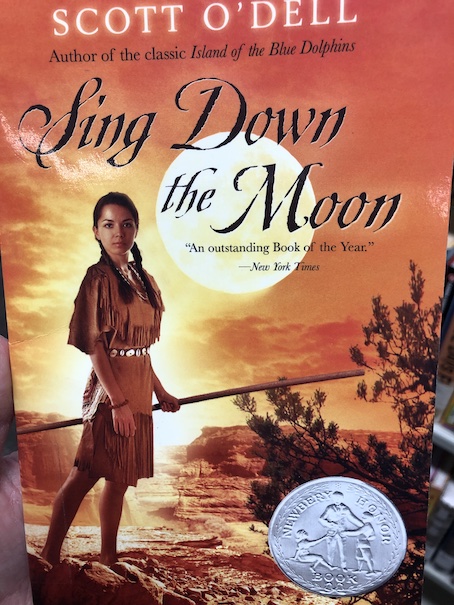
Sing Down the Moon cover

Sing Down the Moon by Scott O’Dell, 1970.

The story begins with a young Navajo girl, Bright Morning, admiring the beginning of spring, but she is caught in a storm and hurries home without the sheep she was supposed to be tending. When the girl’s mother realizes that she abandoned the sheep, she takes the girl back to the sheep, and they watch them all night. The sheep are very important to the family, and the girl’s mother refuses to allow her to take the sheep out by herself again for the rest of that spring.

When Bright Morning finally proves that she can be responsible and not leave the sheep to tend themselves, she is allowed to take them out again. Bright Morning likes to talk to the other girls, Running Bird and White Deer, as they watch all of their sheep together. The girls like to talk about their futures, who they will marry and what kind of children they have. They like to tease each other. Bright Morning’s friends know that she is likely to marry a young man called Tall Boy. The rumor is that Tall Boy’s parents want him to marry her because her mother owns so many fine sheep. Bright Morning knows that her friends tease because they are curious about Tall Boy and want her to talk about him, but she refuses. The girls know that he is supposed to be riding out with the warriors soon, and they tease that maybe he will bring back some other girl from the Ute tribe, but Bright Morning ignores them.
After the warriors have left for their raid on the Utes, the girls see some white men on horses approaching the village. The girls recognize them as oldiers and are worried that their village could be vulnerable to attack without the warriors. Later, the girls encounter more white men, but these men are not dressed as soldiers. They stop to talk to Bright Morning and Running Bird, asking them for directions, but the girls realize that they are slavers. They kidnap both girls and ride away with them!

They take the girls to a town of Spanish people and separate them from each other. They sell Bright Morning to a woman who uses her as a servant. The woman has other Native American girls as slaves, including a younger girl called Rosita. Rosita doesn’t mind her captivity or her life as a servant much. She came from a tribe that was very poor, and since she was brought to this woman’s household to work for her, she has had better food and clothing than she did at home. Rosita tells Bright Morning that the family they work for isn’t bad, and Bright Morning is allowed to keep her dog, who followed her when she was abducted. However, Bright Morning can’t stand her captivity. The woman who owns the house gives her new clothes, but Bright Morning doesn’t care. All she wants to do is find a way to go home.
Bright Morning is reunited with Running Bird when another captive girl comes up with a plan for the three of them to escape. They manage to steal horses and ride away from the town. Along the way, they meet up with Tall Boy and one of his friends, and the boys help fight off the Spaniards who are pursuing the girls. Unfortunately, Tall Boy is badly injured in the fight. He loses the use of one of his arms, and the other Navajos know that he can no longer be a warrior. Bright Morning still cares about Tall Boy, but her mother and sister tell her that she should no longer consider marrying him.

However, the Navajos’ troubles are just beginning. They haven’t heard the last of the soldiers. The American soldiers return and drive the Navajos off their land. They destroy all of their homes and eventually round them up and start them on a long march with little food, where many of them die. The Navajos fear that all of them will die. How will Bright Morning and her family survive, and will they ever see their homeland again?

The book is a Newbery Honor book. It’s available to borrow and read for free online through Internet Archive (multiple copies).

My Reaction

I remember reading this book when I was about 13 years old, in middle school! It takes place in my home state, the northern part, where the Navajo reservation is now, in the Four Corners region. I’ve been to Canyon de Chelly (“Chelly” is pronounced like “shay”, like in French) before, although I hadn’t been there at the time when I first read this book. Since I read this book as a kid, I’ve been to places and seen things that helped me understand the setting of the story better. As an adult, I appreciate the historical aspects of the story even more because I know more about the background. The book doesn’t give a date for the story until the postscript at the very end of the book, but the death march described in the story is Long Walk of 1863 to 1865.

The second half of the book is very depressing because there are horrible conditions and many deaths, including the deaths of children. I wasn’t sure that I really wanted to revisit this book at first because I remembered that it was depressing, but the book is well-written. The narrator describes events in an exciting, compelling way.

I had forgotten many details of the story, but there were some things that jumped out at me as an adult that I hadn’t noticed the first time. The postscript at the end of the story explains how life and Navajo culture changed after this traumatic event. If you see photographs of Navajo in “traditional” costumes now, they often include velveteen clothing, but that’s actually a relatively new tradition. The velveteen was adopted from white people during their captivity because they didn’t have access to wool to make their older style of traditional clothing. When Bright Morning was held captive in the Spanish town, she was given velveteen clothing there.

Another odd topic that is touched on only very briefly but that I know more about from other sources concerns the subject of flour. The book mentions that the Navajo were unused to eating wheat flour until it was their only form of rations during the Long Walk. Until then, their staple grain was corn, and when they started eating wheat flour, it made them feel sick. Their bodies just weren’t used to it. The book doesn’t explicitly explain this, but I know from other sources that the Long Walk and those flour rations were the origins of Navajo fry bread. Fry bread was not part of Navajo diet until that point. I grew up eating it on special occasions as a treat because it is greasy but good with powdered sugar, and it’s often served at carnivals and fairs here. However, as an adult, I came to realize that its origins as a food come from a very dark source. It was starvation food. It can keep you alive if there’s nothing else, but it’s not going to keep you healthy if you eat nothing else. It’s greasy and fatty, and it has little nutritional quality. Even now, I don’t have as much tolerance for it as I did when I was a kid. I can’t stomach it well these days if it’s too greasy or I eat too much.

That’s actually not a bad metaphor for the events described in this book. They’re heavy, and the more of it you understand and absorb, the sicker you feel. I absorb much more now than when I was a kid and only half understood the full significance of the events, and it makes me feel much worse than I did the first time.

So, do I recommend this book for kids? Actually, yes. I’m not a fan of depressing books with a lot of death, and I struggled through some depressing books when I was in school. If you had asked my 13-year-old self whether books with this much death and suffering were worth it, she might have had trouble answering that question, but time and further understanding have changed the way my adult self feels. There are some depressing topics that are worth the struggle to absorb them, but if I were the one teaching the lessons, I think I would do it a little differently than my teachers did for me back then.

I think this book is still a good introduction to topics that can be difficult to discuss. It’s worth reading once to understand the historical background of these events and what they really meant to the people who experienced them directly. It’s painful to read the bad parts, but it’s the kind of pain that leads to something better: real understanding. I recommend the book for kids in their early teens because I think that’s the best level for understanding it and accepting the bad parts. I think it should also be accompanied by nonfiction history lessons about the time period and events and discussion about their feelings about the story and historical events. I remember being told some of the history the first time I read this book, but I think that maybe there should have been more discussion about feelings.

I think it’s important to discuss feelings because they’re the hardest part of this book and they’re also the reason why it’s difficult to study some of the darker parts of history. I had a hard time with this when I was younger, and I still do in some respects, but I think understanding what causes those feelings is key to handling them. Reading books like this while discussing tools to handle difficult feelings could help students to better handle their emotions in other areas of life as well.

One of the first points that I think is important to understand and which my teachers didn’t really explain to me is that it’s natural to feel bad when you hear about bad things happening to other people, even when the bad things happened generations before you were born or even when those individual characters are fictional. (Bright Morning and her friends and family are fictional characters even though the events around them are historical. Real Navajos did experience what they experienced.) Empathy is a natural human emotion, and it’s an important tool for living with other people. Humans are social creatures. We live as part of larger groups, and we need at least some empathy to understand other people’s emotions and circumstances, how our actions affect them, and how to treat other people as we ourselves would truly like to be treated. The ability to experience empathy is a sign that you are mentally and emotionally healthy. It’s really only worrying when someone can’t feel it.

One of the most disturbing feelings about this story comes from realizing that the soldiers who are inflicting all of this death and pain either don’t feel empathy for the people they are harming or have actively chosen to ignore it to further their own purposes. That’s not a sign of being mentally or emotionally healthy or behaving in a moral way. When the readers feel repulsed by the soldiers and what they’re doing, it’s because they recognize that these people are a serious danger to others, and they are not functioning in a normal way. Your brain is warning you of a threat. It’s a past threat rather than an immediate one, but if you find the soldiers and their actions upsetting, it’s a sign that your brain has accurately assessed the risk associated with these people and the harm they do. You have accurately connected the suffering of other people for whom you feel empathy with the people who are the direct cause. I’m not saying that the soldiers were necessarily psychopaths, but lack of empathy and remorse and calculated manipulation are all symptoms of psychopathy and should raise alarms for anyone confronted with those signs. So, feeling bad about this situation and the people causing it is a sign that you yourself are mentally and emotionally healthy and have correctly recognized the seriousness of the situation and the harm being done to other people. What I’m saying is that, even when you’re feeling bad, it’s for good reasons, and that deserves recognition.

When I was young, I felt angry and frustrated by stories where people were doing terrible things to others. I still do because that’s part of empathy, but I also came to realize that part of my frustration when it came to historical situations came from my inability to change the situation. When harm has been done, it’s impossible to undo it. What was done was done. I can’t help the people who died, and I can’t even punish the wrong-doers because they’re dead now, too. It’s frustrating to find yourself confronted by a situation where nothing can change. But, I think it’s important to realize that change has happened and is currently happening. History is being written all the time, not even just through writing but through the ways that people live their lives every day. Even when a particular event is over, events and people keep moving. Bad events can cast long shadows, causing harm long after the initial event. That’s part of what makes them so bad. However, as time moves on, new people enter the scene, and new things happen, including things that people in the past would never have foreseen. It eventually reaches a point where the things that continue to happen rely on what we, the living, continue to do or allow to be done. History takes the long view, and I think people need to be reminded of that.

Do you suppose that the people in this story who act as villains thought of themselves like that? Further point, how much does it matter how they thought of themselves? Maybe they thought of themselves as winners at the time because they were getting their way and the people they were hurting were unable to stop them from hurting and killing them, but is that really “winning”? Lazy historians frequently brush things off by saying that “history is written by the victors“, but if that were really true, would we even be hearing or reading stories like this? Would we ever hear about slaves or care about the victims of war and atrocity? Would we ever consider the perspectives of people who died at all? Or does it change your mind about what “winning” really is and who’s really a “winner”? Maybe, in life and history, there aren’t any “winners” because neither of those was ever really a contest to begin with. (Or, as some put it, life is a collection of contests that people can simultaneously be both winning and losing. Personally, I think life is just for living, not for winning against someone else who is also trying to just live and probably couldn’t care less about you “winning” or not.) Apparent victories aren’t always real accomplishments, and people who see that reality are the ones who write the most accurate histories. Individual human lives only last so long, so any apparent “win” by an individual or group is never more than temporary. Our sense of what history includes and what people in the past were really like changes as we increase our knowledge of it and reconsider the context, not unlike the way my 40-year-old self has a deeper understanding of this book than my 13-year-old self did.

Remember that, at the beginning of this particular story, the Navajo warriors were going to raid the Utes. We never really find out in the book why they were going to do this, but does it matter anymore when the Navajos themselves get raided and subjected to something that might be even worse than what they were originally planning to do to their enemies? The story drops this subplot when the march begins. Life is like that, constantly moving, ever changing. History goes on and on. Sometimes, a young warrior who was praised for his prowess gets shot in the arm and can’t pull a bow anymore. Sometimes, a 40-year-old woman from the 21st century looks back on 19th century soldiers who may have thought of themselves as heroes and wants to tell them, to their faces, that they couldn’t be more wrong about that. If they’re not evil psychopaths, they’re doing a dang good job of pretending, and I never once thought of them as being “heroes” in my entire life. That’s life for you. Each of the people who have read this book or ever will read it are among the new people entering the story and its sequels, and we all have the ability to decide what role we want to play in the on-going story of history.

What happens after the book ends, is important, too. If I were teaching this, I would follow up this particular chapter of Native American and Navajo history by talking about some of the developments that continued to happen in their history, including some of the better moments, like the development of the written form of the Navajo language (for much of it’s history, Navajo was only a written language – that’s why the soldiers in the story couldn’t leave a written message in Navajo) and how code talkers used the Navajo language during WWII. The people who realized that these things were possible and something worth working toward were creative individuals. Rather than seeking to destroy something or repress it, they found creative ways to make use of what was there and put people’s talents to good use, helping others. The worst moments of history have been when people without empathy use others or seek to destroy them for personal gain, but the triumphant moments are when people take what they have and find a way to make it better. Noting these positive moments doesn’t make the bad parts of history any better than they actually were, but what we want is more of these positive moments of creativity and development and the type of people who are willing to work to make them happen.

It helps to balance out the explanations of what went wrong and people who did wrong with examples of what was better. Some teachers stress how we teach the bad moments so people learn from the past and don’t repeat it, and that’s true. However, I think we also need to add on what has worked and what we want people to do instead. A “don’t do this” needs to be followed up by “do this instead” to be an effective instruction. As a society, we don’t want more destroyers and takers. We want innovators and makers. We want creative people who find new uses for resources, including human resources and talents, and who are dedicated to truly helping others and human society as a whole instead of merely helping themselves to what others have that they want. This book demonstrates the dark side of humanity, but as I said, history is still being written every day with new players.

On the lighter side of this story, I enjoyed the descriptions of the coming-of-age ceremony for young women that Bright Morning has and the marriage ceremony later. During her time in captivity in the Spanish town, Bright Morning also attends Easter celebrations. She doesn’t understand Christianity and has never heard of Jesus before, and she doesn’t understand what the holiday is about or what’s going on. Rosita tries to explain to her who Jesus is in terms of Navajo religion. I found the explanation fascinating, but Bright Morning is still confused.

Native Americans

Native Americans by Jay Miller, 1993.

This book is part of the New True Books series, a series of nonfiction picture books on a variety of topics. This particular book gives an overview of the history and culture of Native Americans.

The book starts with some basic definitions and broad explanations of certain aspects of Native American culture, beginning with the explanation of why Native Americans are sometimes called “Indians.” The book notes that each tribe of Native Americans also has a name for itself. Each tribe has had its own culture, which it thought was better than other tribes’ cultures, but throughout history, tribes have interacted and traded with each other. One factor that made Native American cultures different from each other was whether tribes relied mainly on farming or hunting and gathering for food.

The book refers to hunter-gatherers as “caretakers”, a term that I can’t recall seeing before for hunter-gatherers. The reason why they use the term “caretakers” is they say that hunter-gatherers took care of their environments and only took the plants and animals they needed for survival, not wasting anything.

There are sections of the book that discuss some general aspects of Native American culture, like types of homes and tribal leaders. Of course, as the book notes, many cultural aspects varied, depending on the tribe, the environment where they lived, and whether they were mainly farmers or “caretakers.”

The book also has sections about the Native America tribes of various regions of North America, like the Northeast, the Southeast, the Southwest, the Northwest Coast, and the Plains.

The book ends with a brief section called Changes, which explains how Native American cultures were impacted by the arrival of Europeans in North America.

The book is available to borrow and read for free online through Internet Archive.

Stepping on the Cracks

Stepping on the Cracks by Mary Downing Hahn, 1991.

This is the first book in the Gordy Smith series, although the book really focuses on a girl named Margaret. Gordy Smith is the neighborhood bully and her nemesis. The series shifts to focus more on Gordy after the full story behind his awful behavior is revealed. This story begins in August 1944 because, although they don’t mention the year, the characters talk about seeing the story about the Liberation of Paris in Life Magazine.

Eleven-year-old Margaret and her best friend, Elizabeth, both have brothers who are fighting in World War II. Margaret’s brother is in the army in Europe, and Elizabeth’s brother is in the navy in the Pacific. The two girls have their own special ritual of stepping on the cracks in the sidewalk to “break Hitler’s back”, in a twist on the old stepping on a crack childhood superstition. Margaret knows that the war is Hitler’s fault, and she blames him personally for her brother, Jimmy, having to go away and fight and for the changes in her household since then. Since the war started and her brother went away, Margaret’s father has been very grim, and she knows that her mother sometimes cries when she thinks that Margaret can’t hear her. Her parents are happiest when they imagine what life will be like when the war finally ends. Margaret keeps a scrapbook of letters Jimmy has written to her and war-related news clippings and cartoons that she’s saved that remind her of things her brother has told her about his time in the army. Margaret hates Hitler and the Nazis with a vengeance.

At the same time, Margaret thinks about how odd it is that the war doesn’t seem entirely real. She knows that people in her community have already been killed in the war overseas, and her parents are worried about Jimmy. However, apart from the missing people in the community, like Jimmy, and the stars in people’s windows to signify people who are in the armed forces or who have been killed in battle, there are few outward signs that there is a war happening. They hear about battles, but their own town of College Hill, Maryland, is peaceful. There are some shortages of things because of war rationing, but otherwise, Margaret’s life has been continuing very much as before. She’s seen pictures of starving children in war zones, and she sometimes wonders why they suffer so much, and she doesn’t.

A neighborhood bully, Gordy Smith, gives the girls trouble, and Margaret thinks of him has being like a Nazi because he’s so mean. He calls Margaret and Elizabeth “Baby Magpie” and “Lizard”, pulls their hair, and gets his friends to gang up on them. At one point, he tries to force Elizabeth to kiss him. (One of those weirdos who are clearly interested in girls but have no idea how to be charming to girls.) Gordy brags about his brother in the army, saying that his brother has killed more Nazis than the girls’ brothers and that he’s going to join the army and kill Hitler when he’s older.

Margaret tells her mother about Gordy and says that she hates his guts. However, her mother tells her that young ladies shouldn’t say words like “guts” and that she should have some sympathy for Gordy because of the kind of family he lives in and what his father is like. (Personally, I don’t think sympathy alone is what’s called for to fix Gordy’s problems, but more about that later.) Elizabeth’s father is a policeman and has arrested Gordy’s father more than once for being drunk and disorderly. People in the community think of the Smith family as being “poor white trash” and wish they would move away. The other kids in the family are as nasty and troublesome as Gordy. Margaret doesn’t think Gordy’s family circumstances should excuse his awful behavior and still hates him.

One day in late summer, before school starts, Gordy and his two friends chase the girls out of the treehouse they built. They steal the comic books they like from the girls and rip up the ones they don’t like, tossing them from the top on the tree on top of the girls. Then, they start ripping up the boards from the platform in the tree so they can use them themselves, saying that girls can’t build anything well. It takes much less time and effort for them to destroy what the girls built than it did for the girls to build it. (This is always true of any kind of destruction, so that doesn’t mean anything complimentary about the destroyers, especially if they aren’t smart enough to realize that and think they’ve got some kind of special talent that’s better than building abilities – just saying because it’s true. All this stuff from the boys is just bluster and gaslighting to intimidate the girls into letting them have what they want by implying that they never deserved the things they actually owned and built themselves.) Margaret yells for help from her mother, but her mother doesn’t hear her. Elizabeth tells the boys that their act of sabotage makes them traitors and worse than Nazis, but they laugh it off.

Elizabeth tells Margaret that they’ll get even with Gordy and the other boys for this, but Margaret can’t imagine what they could do. She would rather stay away from Gordy. That’s easier said than done because Gordy steals the next set of boards the girls try to use to rebuild their tree house, too. One day, the girls see the boys going into the woods. They know that the boys have built a hut to use as a clubhouse with the boards they’ve stolen from the girls, and Elizabeth suggests that they follow the boys to find out where their hut is. Elizabeth thinks that it would be great revenge to find their hut, take it apart, and reclaim the stolen boards. After all, they have a right to their own boards. Margaret is more hesitant because they’re not supposed to cross the train tracks into the woods, and the woods are lonely. The boys have air rifles, and if the boys caught the girls trying to take back the boards, they could do all sorts of horrible things to them with no one around to save them. However, Elizabeth impulsively dashes off into the woods, and Margaret feels like she has no choice but to go with her.

The boys catch the girls spying on them at their hideout when Margaret accidentally sneezes. At first, Margaret is sure that the boys are going to kill them when they catch them. Instead, Gordy tries to scare the girls with a story about how he and his friends have actually saved the girls from the crazy man who lives in the woods. There’s an experimental farm near the woods used by the agricultural department at the local university, and Gordy spins a story about how the army was using the farm for an experiment on soldiers, using chemicals to try to make them stronger and braver. Gordy insists that the man they used in the experiment went crazy and broke out of the farm and has been hiding in the woods ever since, ready to attack anybody who finds him. Elizabeth says the story is a fake because she never heard anyone else say that, but Gordy insists that he saw the crazy man standing behind the girls with a knife. Gordy tells the girls that they better stay out of the woods or the crazy man might get them next time.

Elizabeth knows that Gordy must be lying, but Margaret is sure that the story must be true when she sees a wild-looking man with shaggy hair behind the boys in the woods. Margaret screams and runs for home with Elizabeth behind her. Unfortunately, Elizabeth didn’t see the wild-looking man herself. She thinks that Margaret was just being a chicken, falling for Gordy’s story and imagining that she saw something, and she teases Margaret about it. Margaret asks her mother about the experimental farm and Gordy’s story, without admitting that she was in the woods, and her mother says that it’s nonsense, that the farm is only used for agriculture. Her mother thinks that, if there is a strange man in the woods, it’s probably just some old tramp.

It does seem like a logical explanation, that maybe there was just some old tramp hanging around the woods who didn’t know that Gordy was going to tell some wild story about a murderous crazy man and just happened to wander by at the right moment to look scary. However, Margaret just can’t convince herself that’s all there is to it.

When the girls finally get up the nerve to go back to the boys’ hut, there are unmistakable signs that someone has been living there. There is also a knife, like the one Gordy said the crazy man had. Who is staying in the boys’ hut, and what are the boys really hiding?

My Reaction and Spoilers

I mostly think of Mary Downing Hahn for her ghost stories, like Wait Till Helen Comes and The Doll in the Garden, but this was actually the first book that I ever read by this author. I think I read it when I was in elementary or middle school. Because of some of the serious subjects of the book and some of the language used, this isn’t a book for young kids. It’s probably best for middle school.

America in the 1940s

This book is a realistic portrayal of life on the American home front during the war. I enjoyed the mentions of little things that were common in 1940s America, like the popular radio programs that people liked to listen to (like the Lone Ranger, the mystery horror show Inner Sanctum, and the children’s program Let’s Pretend), comic books and newspaper cartoons, magazines like Life and The Saturday Evening Post, and “Kilroy was here” graffiti. Sometimes, characters mention 1940s celebrities. After Gordy tries to make Elizabeth kiss him, she tells Margaret that a star like Joan Crawford would slap any guy who got “fresh” with her. Later, the girls overhear the boys talking about which pin-up girls they think are the most sexy, mentioning Betty Grable and Rita Hayworth.

Note: The boys’ “sexy” talk is at a realistically juvenile level, laughing over pictures of pin-up girls with big breasts and using the word “hubba-hubba.” An adult hearing a conversation like this knows that the boys probably feel grown-up for secretly smoking cigarettes at their hideout while talking about sexy women, but at the same time, they plainly sound like little boys who use words like “hubba-hubba” because that’s as sophisticated as they know how to be. They have nothing else to say on this subject. As Elizabeth and Margaret could attest, these boys have never successfully kissed a girl at this point in their lives because they’ve been making themselves unappealing to the girls in their vicinity by the mean and obnoxious ways they act. When the girls later go inside the boys’ hut, they see that the boys have defaced their pin-up pictures by giving all the girls beards and blackened teeth. They are definitely not young Casanovas.

This was the first book that introduced me to the concept of putting banners with stars in the window as a sign that someone in the family is in the armed forces. A blue star indicated (and still indicates) a living service member or veteran. A gold star means that the service member died in action. That’s important to the story because, even at the beginning of the book, Margaret knows what the blue stars and gold stars mean, and she already knows people in her community who were killed in the war. One of the people in the community who has died in the war was a young man called Butch who was killed only months after he got married. His widow, Barbara, gave birth to their son after his death, so Butch never saw him. Margaret is sad when she thinks about Butch and his family because she can remember when Butch was a local hero as quarterback on the high school football team. Later, Margaret’s brother, Jimmy, is also killed in the war, and the family replaces his blue star with a gold one, while Elizabeth’s family still has a blue star because Elizabeth’s brother, Joe, is still alive.

Danger and Safety

There are a lot of themes about safety and danger in the story, both real and perceived. When Margaret thinks about the crazy man Gordy says is living in the woods, she thinks that she would feel safer if Jimmy was home because Jimmy would protect her. Yet, when she thinks about Butch getting killed, Margaret realizes that, when big, strong, young men can be suddenly killed, nobody is ever really safe. Even the strongest men she knows are not completely invulnerable, and there are big, frightening, unpredictable things happening in the world.

At one point in the story, the girls talk about what they would do if girls were sent away to war like their brothers. Elizabeth brags about how brave she would be, but Margaret freely admits that she’s a coward and everyone knows it. Margaret imagines that, if she were out on a battlefield, she would probably drop to the ground and play dead until it was all over.

Later, when the girls learn the truth about Gordy, it brings the full realities of the war home to them and challenges everything that Elizabeth thinks about bravery and cowardice. The truth is that Gordy built the hut to hide his brother, Stuart. While one of Gordy’s brothers really did become a soldier and Gordy brags about him, Stuart became an army deserter. When Elizabeth finds out, she’s furious because her brother and Margaret’s are risking their lives, and she thinks that Stuart is a coward, letting others die for him and their country because he’s too afraid to fight. However, when the girls confront Stuart, Gordy, and the other boys about the situation, they learn that it’s more complicated than that. It takes Elizabeth longer to see how complicated the situation really is, but Margaret understands when Stuart describes his feelings.

Stuart is a pacifist. He’s not a coward or a Nazi sympathizer, as Elizabeth first accuses him. His logic is that two wrongs don’t make a right. While Hitler might want to take over the world and send people out to kill others, Stuart knows that the men who get sent away to be soldiers mostly don’t want to be soldiers at all and have no real desire to kill anyone else. If they had their choice, they would just be living their own lives and minding their own business at home. His speech makes Margaret really think for the first time about the war from the point of view of the soldiers on the ground. When her brother was drafted, Margaret never asked him how he felt about going away to war, just assuming that he’d want to defend his country and beat the Nazis. Now, she regrets not asking him about his feelings and wonders if he was scared or if he went reluctantly. For the first time, she also has to confront the reality that her brother has been actively killing or helping to kill other people. Stuart deserted because he simply couldn’t face the prospect of killing someone. He shows the girls a letter he got from their other brother, Donald, the one who became a soldier, telling him how horrible the war is and how they’ve sometimes killed civilians and even allies because of mistakes they’ve made. Stuart also introduces the girls to the poem The Man He Killed by Thomas Hardy. Margaret wonders how Jimmy felt about the idea of killing other people and if it’s really sane to be okay with the idea of killing. Margaret has always looked up to her older brother, seeing him as a protector, never thinking of him as a killer, but yet, he is actively engaging in killing. He doesn’t tell Margaret that part of things in his letters to her, but she realizes that’s what actually happening in Europe.

Finding out about Stuart creates a real problem for the girls. Because army desertion is illegal, the girls know they should tell someone about Stuart, but Gordy tells them that the hard reality is that deserters either get arrested or shot. If they report Stuart, they could be sending him to his death. Elizabeth, being the more brash and hard-hearted one, says that she doesn’t care because it would be no more than what he deserves (although she later takes that back). Instead, she settles for blackmailing Gordy and his friends into stopping their bullying of the girls and helping them rebuild their tree house.

However, the kids soon realize that Stuart can’t stay their secret forever. Stuart has gotten sick, and if he doesn’t get help, he could just die in the woods. Stuart was hoping that the war might just end, and people would stop caring about whether he’d joined the army or deserted, but nobody in 1944 knows when that’s going to happen. From their perspective, it could be months (close to the reality) or years. The war has been going on for years already. Stuart won’t survive in the woods for that long.

The kids also confront the reality that, while two wrongs don’t make a right when it comes to fighting, just standing back and doing nothing while other people are doing wrong is also wrong. Elizabeth is the first of the children to point out that the entire reason why desertion is illegal is that, if everyone just decided to opt out of fighting, people like Hitler would run overrun everyone because no one would put up a resistance. Leaving aside what the characters decide to do about Stuart for the moment, that brings me to the problems with Gordy and the people who should be responsible for him and aren’t.

Gordy’s Problems

I’m frequently the first to say, as Margaret does in the story, that just coming from a bad background shouldn’t allow a person to get a free pass on being a bully themselves. Two wrongs really don’t make a right, and to my way of thinking, people who bully others because they’ve been bullied themselves are bad because they’re doing to completely innocent people what they already know they hate being done to themselves. However, unlike what Margaret’s mother said earlier about how she wishes Margaret would have more sympathy for Gordy, I quickly realized that, first, sympathy is insufficient in situations like this, and second, Margaret’s mother is not really motivated by sympathy for Gordy. She has other, less admirable reasons for looking the other way, even when she knows exactly what’s going on in Gordy’s family and that he is actively abusing her own daughter.

Gordy frequently gets away with his bullying because people are afraid of both him and his father. On the way to school, when Gordy rips up Elizabeth’s homework and stomps on her school supplies to break them, and the crossing guards see it happen. However, even though it’s part of their duty to report things like this, they don’t want to do it. When Elizabeth asks them if they’re going to report it to their teacher, they make excuses about how that might be tattling and make their teacher mad and how it would be just their word against Gordy’s (ignoring the evidence of the ripped papers and broken school supplies). The reality is that they’re afraid of Gordy doing something to them in revenge. Elizabeth asks them if that means that she’s just going to have to suffer what Gordy does to her while Gordy gets away with it because they’re too afraid to said anything. The crossing guards are further afraid to give her a straight answer because everyone involved knows that the answer is, yes, that’s exactly what’s going to happen, and that’s exactly the reason why it’s going to happen. The crossing guards know that Gordy is going to continue being an abusive bully, and they know they’re going to let him do it without saying a word, and they know the reason why they’re going to do that is because they are scared. They’re not willing to put themselves on the line to protect Elizabeth even though that is a part of their job. Elizabeth, knowing all of this, tells them they’re cowards, and it’s the truth. Unfortunately, there are times when apparent cowardice can also be necessary self-preservation from a greater insanity, and much as I hate to admit it, this might be one of those situations.

There is the underlying problem in this community, and that’s the behavior of the adults. Part of the reason why the young crossing guards are so cowardly about the class bully is that they know darn well that no adult in their community is likely to act on anything they tell them about Gordy. Even if their teacher punishes Gordy temporarily by suspending him from school, Gordy will come back, mean and horrible as ever, with revenge on his mind. No adult is going to get to the real root of Gordy’s problems and solve them, so Gordy will continue to be a problem. It appears to be common knowledge in the community that Gordy’s father is an abusive drunk. Elizabeth and Margaret know it, and I think his teacher probably knows it, too. Gordy comes to school with a black eye. Barbara talks about it with the girls, saying that Stuart used to help protect Gordy from the worst of his father’s abuse and that Gordy needs someone to take care of him. Nobody can avoid knowing that the Smiths are an extremely troubled family. After Margaret and Elizabeth go to Gordy’s house to find him and witness Gordy’s father’s behavior for themselves, Margaret tries to talk to her mother about it, and her mother just says that what people do in their own houses is their business and they can’t interfere. That, right there, is part of the root of Gordy’s problems. The first root is his father’s drunken abuse, the second root is knowing that the adults in his community are aware of the situation and are deliberately looking the other way, and the third root are his own choices that prevent other people from getting close enough to help.

For the moment, I’d like to focus on Margaret’s mother and her non-interference policy when it comes to child abuse. A major part of the reason why Gordy continues to be abused by his father and why Gordy is able continue bullying and abusing other kids is exactly this policy of looking the other way. I think all of the adults in this community feel similarly, and I think a major part of the reason they do it is because the adults are scared of Gordy’s father and what he might do to them. Letting him beat his wife and children probably doesn’t feel great, but these adults excuse themselves for allowing that to repeatedly happen with their full knowledge by saying out loud that it’s none of their business while quietly thinking that letting a kid be beaten is better than being beaten or killed by this crazy man themselves. Apart from occasionally arresting Mr. Smith for getting publicly drunk and disorderly, after which he is released when he sobers up, nobody in the community, not even Elizabeth’s police officer father, does anything. The kids are the most active characters in the story, and the adults, like Margaret’s mother, want to shut them down from talking about it so they won’t have to feel like they should be doing something when they’re not. It doesn’t make the problem go away, but it does allow the adults to lie to themselves and pretend like it’s not a problem that they will have to deal with eventually, which is almost the same in the adults’ minds.

It is fitting that this is a World War II story because the situation with Gordy has parallels within the war itself. The United States initially didn’t want to become involved with the war because they saw what Hitler was doing as a European matter. People in the US didn’t want to become involved in the war because they knew it would mean risking their lives, and it wasn’t something they wanted to do if it wasn’t their problem and if it could be resolved without them. Self-preservation is a sign of sanity, but the problem with that mindset is that it doesn’t take into account the larger picture and the full, hard realities of the situations. Sometimes, even when you don’t go looking for trouble, trouble can come looking for you. The US wasn’t officially involved in the war effort except as a supplier until Pearl Harbor. That attack on the US naval fleet brought it home to the American public that it didn’t matter whether they wanted to be involved or not if another country decided to actively involve them.

It’s a similar situation with Gordy. Nobody wants Gordy to bully them, but he does it anyway. It doesn’t matter if the girls are in their own tree house in Margaret’s front yard, minding their own business; Gordy comes after them to destroy the tree house and steal the boards. Margaret’s parents know what happened, but they do nothing. All through the book, Margaret has times when she feels unsafe, but her parents don’t protect her from the closest and most obvious dangers, even when she tells her mother about them. Margaret’s parents don’t protect her because they are scared themselves and don’t want to get involved, even though they are already involved because it’s their daughter being abused … not unlike a deserter who flees the army to avoid fighting when his country is attacked.

Margaret would be the first to admit that she’s not the bravest person around, but yet, she is braver than many others around her because she can and will take action even when she’s scared. For most of the book, Margaret only gets into scrapes when she’s goaded into them by Elizabeth, but even Elizabeth observes that Margaret follows through once she starts something or sees that something needs to be done. The adults in the community can’t say the same. The abuse going on in the Smith household hasn’t stayed privately in the Smith household at all. It’s gone out into the community through Gordy and the other Smith children. It’s a public matter because Mr. Smith is repeatedly drunk and disorderly and intimidating to every adult in the community. It’s everyone’s business because everyone is suffering the results. However, the adults find it easier to keep telling themselves that they don’t need to do anything about it because they can’t deal with the discomfort that would come from a professional community intervention (or tell themselves they can’t deal with it, which isn’t quite the same thing), which is the one and only thing that could probably save the Smith family at this point, and by extension, everyone who’s been suffering from the second-hand bullying and abuse delivered by Gordy. While one person alone would genuinely be in danger from standing up to Gordy’s father, a concerted community effort including the police, local medical professionals, and the principal and teachers from the school showing a united front would be a safer and saner option. There is safety in numbers, provided that the “numbers” can get up the nerve to join the numbers.

I think Gordy should be held accountable for the things he’s done, and I think some reasonable adult should also point out to him that he’s been a fool to cultivate enemies instead of allies. Although Margaret and Elizabeth eventually become his allies for this adventure, sympathetic to the abuse that Gordy has suffered and to Stuart’s situation, if he had been nicer to them from the beginning, he would have gotten help for himself and his brother much sooner. Gordy is bitter toward other people in the community because he’s fully aware that they all refer to him and his family as “white trash”, although I think he should also be aware that it’s their behavior that causes people to look at them that way. Gordy himself has partly caused and perpetuated that image because of everything he does on a daily basis. While Gordy can’t help that his father is an abusive drunk, he can help being a bully himself, and as long as he acts like that, people will treat him as the bully he is and try to avoid him rather than give him the help he really needs. His father is his worst enemy, the adults in this town are largely useless, and Gordy is not only hurting others but sabotaging himself. Even when the girls try to help Gordy, they find it hard because he’s still mean to them and fights them every step of the way.

One final note I have is to point out that, while I’ve heard many kinds of insults and racial slurs in my life, the term “white trash” is possibly the only term I know that’s both an insulting slur to the people it’s used against and to an entire group of people who aren’t explicitly mention in the slur at the exact same time. That didn’t occur to me when I was a kid, but as an adult, I realize now the reason why the modifier “white” is added to the insult. The modifier implies a comparison. The implication is that the person using the term thinks that non-white people are “trash”, and they’re telling another white person that they’re also a kind of “trash” like that, as bad or maybe worse because, as a white person, they should be able to help their situation but aren’t helping themselves because they’re somehow inferior. It’s true that Gordy and others in his family haven’t been helping matters because they make it difficult for other people to help them, but it’s still a very weird dual insult.

The Matchlock Gun

The Matchlock Gun by Walter D. Edmonds, illustrated by Paul Lantz, 1941, 1969.

Ten-year-old Edward Van Alstyne lives with his family on the mid-18th century American frontier in upstate New York, not far from Albany, during the French and Indian War. His father is captain of the Guilderland militia. Edward has had a long fascination for the large, old matchlock gun that his great-grandfather brought to America from Holland and wonders why his father never uses, preferring his smaller musket. His father shows him the old matchlock gun and explains to him how it works and how it’s old-fashioned, very large, and more difficult to use than his musket.

While Edward’s father, Teunis, prepares to go out on duty, Edward’s mother, Gertrude, worries about what will happen if Indians (Native Americans) attack while he is gone. Teunis doesn’t think that’s likely, but he says that Gertrude can take the children and go to his mother’s house. Gertrude and Edward’s grandmother do not get along because Edward’s grandmother has never approved of her. His grandmother never thought she was good enough for her son because she doesn’t come from a Dutch background, like they do, and because her family is poor. Gertrude would rather not turn to her for help except as a last resort, and Teunis doesn’t blame her.

Gertrude is still nervous after Teunis leaves, and she refuses to let Edward take some butter over to his grandmother’s house, as he often does. She doesn’t want the children going too far from the house, in case there’s trouble. Then, a family friend, John Mynderse, stops by with a message from Teunis, saying that he is fine, but the “French Indians” (the Native Americans aren’t actually French, but they’re allies of the French – I’ll explain below) have burned settlements, and he won’t be home tonight. It’s worrying news. Later, they see smoke on the horizon and worry about how far away it is, unsure of the exact distance.

Although Gertrude tries to be brave, she admits to Edward that she thinks that the fires are close. Edward asks if they should go to his grandmother’s house, but Gertrude would prefer to stay in their own house and wait for Teunis to arrive home. Privately, Gertrude has realized that the old brick house where the grandmother lives is more visible from the main road than their small wooden house. She doesn’t think that there’s anything they can do to help Edward’s grandmother, but she is hoping that she and the children will be overlooked if the Indians come through their area.

Gertrude begins coming up with a plan for defending their house, and she asks Edward if he would be afraid of firing the big, old matchlock gun. Edward wouldn’t mind firing the big gun, but it’s so big, he doesn’t know if he could manage to hold it. Gertrude says that she has a plan for that. Although they are inexperienced, Gertrude and Edward manage to get the gun loaded, and Gertrude chops a hole in the side of their house that they can fire through. Gertrude doesn’t expect Edward to actually aim the gun or hit anything. They just prop it up at the hole, and Gertrude tells Edward that, if she calls his name, he must use a candle to light the powder in the gun. When the powder is lit, Gertrude says that the big gun will go off with a huge bang and might scare off any attackers.

The Indians do come and attack the old brick house, and then, they come for the house where Gertrude and the children are. Gertrude is struck by a tomahawk as she runs for the house as the Indians approach, but she calls out to Edward, and Edward fires the gun. The attackers are killed in by the explosion from the gun, but the family’s house is set on fire. The children manage to drag their injured mother to safety, and Edward rescues the matchlock gun from the burning house.

When Edward’s father and the militia arrive, Gertrude is injured but still alive. The old brick house did not burn, as Gertrude had thought, but the barns were destroyed. The grandmother and her slaves barricaded themselves in the brick house. Edward is praised as a hero for defending his family at such a young age and for killing more Indians by himself than the adults did. (That last part is a little creepy, but they do praise him for that.)

This book is a Newbery Medal winner. It is available to borrow and read for free online through Internet Archive.

My Reaction

The Backstory

This is one of those books where I find the backstory much more interesting than the book itself. This is one of those historical novels for children written and published during World War II that looks back on American history and past conflicts, trying to reinforce historical lessons, instill patriotic feelings, and help children come to terms with the war that was happening around them at the time this book was new. This particular story takes place in the Hudson Valley in New York, not far from Albany, before the American Revolution in a community that’s largely settled by people of Dutch descent.

The family in the story is based on the real Van Alstyne family, and the incident with young Edward helping to protect his family from attackers by firing the family’s old matchlock gun really happened. The story emphasizes the family’s Dutch background. The mother of the family, Gertrude, is described as having a Palatine background, which means that her family was Germanic, but the major emphasis is on the Dutch influences in their background. There are Dutch words and phrases throughout the story.

The Foreword to the story explains the family’s history, but I actually recommend that readers save reading the Foreword last instead of reading it before reading the story. It explains not only the family’s past, but what happened to the family after the incident in the book. Little Trudy grew up and married a man named Hogle, and she became known as an excellent spinner, or spinster, in the professional sense rather that the unmarried sense. Her spinning ability was attributed to having to help her mother from a young age because her mother’s shoulder was permanently damaged from the tomahawk injury she suffered in the story. Trudy is credited as the one who passed on the story about her brother and the matchlock gun to future generations.

When interviewed about his historical novels, which were more for adults than children before he wrote this particular book for children, the author said:

“I want my readers to get out of my books a sense of the relation of history to the present day. History is often taught as a study of dead things and people; or else, and worse, from the debunking angle. What I want to show are the qualities of mind and spirit of plain, ordinary people, who after all carry the burden of human progress. I want to know about people, how they lived, what they hoped for, what they feared. I want to know what it was like to be born into this time or that, and what a man left behind when he died.”

I see the point about focusing on the lives of ordinary people because history is largely made up of daily life. Much of my historical education had this focus as well, not just focusing on the famous people or the major events, which are usually a reflection and extension of what’s happening on the ordinary and every day level. Much historical writing these days also does focus on debunking, which requires prior knowledge of what’s being debunked and why to be really effective, so I don’t think it works too well on level of children.

My personal approach to history, however, is to put things into context. I’ve given you the context of WWII, when this book was written and published, and the author’s view, but to get the full story behind this story, it helps to understand the French and Indian War. In the book, the attacking American Indians are just shown in their role as attackers, attacking innocent women and children and burning their homes. It’s a savage image that leaves a bad taste in the mouths of modern people, but it helps to understand what’s happening in the larger conflict.

In spite of its name, the French and Indian War was not fought between French people and American Indians. Instead, the French and Indian War, also called the Seven Years’ War (1754-1763), was fought between the British and the French, with the French aided by Native American allies. Both the French and the British were claiming territories for colonies in North America to support their empires, and as rivals for territory, each side was trying to assert its authority and control over certain regions. The Native Americans enter into the conflict because each side had Native American allies.

The reasons why Native Americans were willing to ally with these foreign powers and actively fight and risk their lives in the conflict were based on their perceptions of the treatment they were likely to receive from each side and the other tribes that were already allying with each side because of the war and their estimates of how the war was likely to affect their own territories and which side’s victory would be most likely benefit them. When European colonists entered North America, started their colonies, and began instigating these territorial conflicts, they were already entering a land inhabited by groups of people who had their own home territories and their own systems of alliances, relationships, and conflicts with each other. Essentially, the European colonists and this French and British conflict were destabilizing and unsettling Native American groups, and those Native American groups were trying to both work out new alliances with some of these newcomers that would grant them a greater degree of security and to push out groups of newcomers who seemed to represent the greatest threat to them and their territory. What each of these Native American groups wanted most out of this conflict was whatever they thought would best allow them to hold their own territory and put them in the strongest possible position to defend against rivals for that territory. Not all groups were eager to join this fight, but those who did believed that it was their best opportunity to protect themselves. In Walter D. Edmonds’s words, this is “what they hoped for, what they feared,” and this is what they were willing to kill and die for.

The reason why this war is important to American history is not only because it was a territorial struggle between major powers but also because it was one of the events that led to the American Revolution against Britain. The British colonist disputed having to pay Britain’s expenses for this war. The treaty and settlement that ended the war helped shape westward expansion that continued after the Revolutionary War. This war was also part of George Washington‘s early military experience, before he became the famous general of the American Revolution.

Part of what makes the Van Alstyne family’s experiences of this war both fascinating and tragic are that they belong to neither of the major sides of the war. They are not British or French. They are primarily of Dutch descent. That is emphasized repeatedly in the story. It’s how they think of themselves, and they are living among other colonists and settlers of similar backgrounds. Their misfortune is that they are living in one of the regions that is under dispute by larger powers. I think that’s part of the reason why the concept this story appealed to the author of the book. It’s about ordinary people caught up in larger events, and it shows the effect that larger conflicts have on ordinary people.

However, since the main hero of this story is a ten-year-old boy, I have to admit that it does make sense that the boy probably didn’t understand much about the larger conflict going on around him. The story only takes place over a little more than a day. His father leaves one evening, the children go to bed, the family is nervous the end day, they are attacked that night, and then, the father comes home. From the boy’s perspective, this attack on his family might have been the conflict in a nutshell. The territorial disputes between larger colonial powers was likely beyond him, which is why he doesn’t think about them during the course of the story. I still think that readers should understand it even if the characters don’t, though.

A Slave-Owning Family

One other thing that I think is important to mention is that there is slavery in the story, and Edward’s own family has slaves. In particular, Edward’s grandmother uses slaves. The slaves are not actually shown as characters in the story, but they are discussed. At one point in the story, Edward’s younger sister, Trudy, asks their mother why their grandmother has slaves and they don’t. Their mother explains that the old brick house where their grandmother lives and the land and slaves connected to it actually belong to the children’s father, as his father’s heir. So, technically, the slaves actually do belong to Edward’s father. However, their grandmother is very attached to the old brick house, so their father lets her live there and use the slaves to manage the house and estate.

A major reason why they explain all of this is so readers understand the setting of the story better and the relationship that this family has with the grandmother. Teunis built the wooden house where he lives with his wife and children so they could have some independence from his mother. He is willing to let his mother live by herself in the family’s big, old house with slaves to look after her and run the place, but it’s really better for his wife and children if they don’t live with her because of her attitudes. In particular, it’s her attitudes toward the mother of the family that make life difficult for them and leave them not wanting to get closer to her, not her attitudes about slaves. Teunis and Gertrude are willing to manage their smaller house without the help of slaves because it’s worth it to them to have to do without extra help in exchange for some separation from Teunis’s disapproving mother, which tells readers a few things about the grandmother we never see and the relationship the rest of the family has with her. Edward’s grandmother seems to be an overbearing and disapproving woman. While Teunis cares about her and her feelings, their relationship with her is better when they don’t live together in the bigger house, even though they could, making use of the household slaves themselves.

No one in the story disapproves of the idea of slavery, which also leaves a bad taste in the mouths of modern readers. Modern heroes and people who really believe in the ideals of freedom would have sympathy for enslaved people, not people actively practicing slavery itself. Since the family in the story is based on a real family, and keeping slaves was something that this real family actually did, it’s understandable from an historical viewpoint that the Van Alstynes are being described as they actually were. It’s important to acknowledge the way things actually were, even when they weren’t pleasant. But, there’s nothing that says that modern readers have like it. Just because the Van Alstynes are the main characters of this story doesn’t mean that you have to like everything about them or everything they do.

The focus of the story is a young boy who did a brave thing during an emergency situation and saved both his own life and the lives of his mother and little sister in the process. That’s ultimately what the author wanted the children of his time to take away from this story. His focus is on the boy and his family, and he doesn’t explain anything about larger social issues or even the background of the conflict they find themselves in. This is fairly short chapter book, a little less than 100 pages, and it seems aimed at younger elementary school students, not dealing with anything more complex than the main incident and adventure of the story. However, outside the story, readers can understand the wider context of things that happen in the story, and they can feel any way they want about that. If you understand the broader situation enough to have feelings about it, I think that’s a good thing.

For another review of this book, I recommend trying this one. It’s much shorter than mine, but it also has some thoughts about how people feel about historical aspects of this story.