Addy’s Surprise

American Girls

AddySuprise

Addy’s Surprise by Connie Porter, 1993.

Christmas is coming, and although Addy and her mother have started to establish a new life for themselves in Philadelphia, they miss the rest of their family, whose whereabouts are still unknown.  Money is tight, and Addy’s mother is trying to save up for a new lamp for their room at Mrs. Ford’s.  Addy wants to buy her mother a pretty red scarf at the second-hand shop for Christmas, but saving up the tips she earns delivering packages for Mrs. Ford is slow.  Addy still wishes that they could afford beautiful dresses, like the rich women who visit the dress shop.One thing that Addy is looking forward to is the Christmas celebration at their church.  Her new friend, Sarah, has told her all about it.  She describes the potluck dinner, the beautiful decorations, and the shadow play they have to entertain the children.


Then, at church, the Reverend Drake tells everyone that more “freedmen,” people who have just come out of slavery, will be arriving in the city soon.  Reverend Drake asks the congregation to help, just as many of them received help when they first arrived.  Like Addy and her mother, these new people will be arriving with almost nothing, not knowing where to go and what to do, and will need money for food and clothes and places to live.  Addy and her mother decide that they want to help, although it means stretching their already-tight finances even tighter.

Addy is reluctant to part with the little money she’s been saving to buy the scarf for her mother, so she offers to help out in greeting the new arrivals and taking them to the church instead.  When Addy and Sarah go to the pier to meet them and guide them to the church, Addy feels badly at seeing the condition they are in.  This particular group is made up of slaves who were freed because the owner of their plantation was under pressure from the war.  He simply turned them loose with only the clothes on their backs and little idea of where to go or how to get help in establishing a new life.  Some of them are sick or injured, some have no shoes in the winter cold, and none of them have had enough to eat.  Addy reassures them that the church will help them.  The baby in the group particularly makes Addy think of her little sister, Esther, who is still in slavery in the South.  Addy begins to feel like the things she was worried about before, like dresses, a new lamp, and the scarf aren’t as important as she once thought they were.  When Addy has finally collected enough money for the scarf for her mother, she decides to donate the money to help the others instead.

It looks like Addy and her mother won’t be getting the special things that they had hoped for at Christmas, but Christmas is a time of surprises.  Through their own hard work, they’ve made some special friends in Philadelphia who care about them, and other, unexpected circumstances allow Addy to not only get the special Christmas dress she’s been dreaming of  (a customer returns a dress to the shop because her daughter can’t fit into it anymore) but to make a scarf of her own to replace the one that she was going to buy for her mother.  The Christmas party at the church is as wonderful as Addy expected, but there’s an even more wonderful surprise to come: Addy’s father has finally made it to Philadelphia!


I like the way Addy and her mother showed generosity and consideration to others in the story, even though they are also somewhat struggling themselves.  Through their own hard work and ingenuity, they manage to make their own Christmas presents with scraps from the dress shop, and Mrs. Ford shows her appreciation for their hard work by buying them the lamp they need.  Good things come to those who work for them!

AddySurpriseHistorical

There is a section in the back with historical information about Christmas celebrations around the time of the Civil War.  Because of the war, families weren’t always able to get or afford things they could before.  People sometimes raised money for soldiers or send them special care packages.  Slaves were allowed small celebrations, being released from work for a new days and given small gifts from the plantation owners.
Addy Learns a Lesson

American Girls

AddyLesson

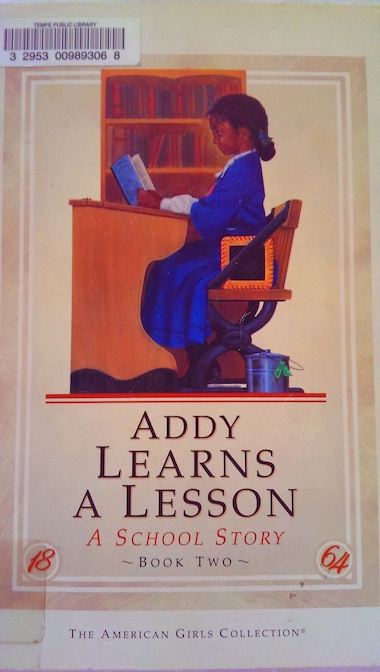
Addy Learns a Lesson by Connie Porter, 1993.

AddyLessonArrivalAfter escaping from slavery, Addy and her mother finally arrive in Philadelphia, Pennsylvania, where they will start a new life.  Philadelphia is a big city, and at first, Addy feels lost, not knowing where to go and what to do.  They have no family or friends to turn to, and neither she or her mother can even read the street signs, never having been taught to read.  They are dependent on help from other free black people, former slaves who have already established themselves in the community.

The first people they meet in Philadelphia are Mrs. Moore and her daughter, Sarah.  They are part of the Freedom Society of Trinity A.M.E. Church, which helps new arrivals escaping from slavery, like Addy and her mother.  The Moores take them to the church, where they attend a church supper, along with some other new arrivals.  Mrs. Moore asks Addy’s mother what work skills she has, and when she says that she can sew, Mrs. Moore says that she might be able to get a job in a dress shop.  Mrs. Ford, the white woman who owns the shop, is strict and fussy, but she hires Addy’s mother and gives them a room to live in.

Life in freedom isn’t as glamorous as Addy thought it would be at first.  Her mother works hard for little pay, and the attic room where they live is small and uncomfortable. She misses the rest of their family and still doesn’t know where her father and brother are.  There are also things that black people in Philadelphia can’t do, even though they aren’t slaves, like riding on the streetcar.

However, there is one thing that Addy is looking forward to: going to school for the first time.  Sarah Moore is Addy’s age, and she tells Addy about her family escaped from slavery in Virginia.  Like Addy, she couldn’t read when she first arrived, but now, Sarah attends school.  Addy is excited about attending the same school as Sarah and happy that she has made a new friend.  Addy’s new teacher, Miss Dunn, was also a former slave from North Carolina, and she reassures Addy that, although she hasn’t been to school before or learned to read yet, it won’t be long before she learns.


All of the other children at school are black, many of them former slaves.  However, Addy can’t help but notice that some of their families are more prosperous than others.  In particular, a girl named Harriet wears beautiful dresses, the kind that Addy has dreamed of having herself.  Sarah and Harriet don’t get along because Harriet is snobbish, but Addy is fascinated by her, wishing that she could have things like Harriet has.  Harriet says that her family were never slaves, and as bossy as Harriet is, Addy can’t help but admire her.  Harriet is nice to Addy at first, bragging about how smart she is and how much she can help Addy, but she isn’t as patient or as helpful to Addy as Sarah is.

When there is a spelling match at school, Addy accepts Harriet’s invitation to go to her house to study.  Harriet always seems to do well in class, and Addy is curious to see what her house is like.  However, Harriet and her friends force Addy to be their “flunky,” carrying all of their books, and they say insulting things about Sarah.  Then, Harriet retracts the invitation to study.

As Addy sees the way Harriet takes advantage of her, she comes to realize some important things about the way people act and about herself and the type of friends she really wants in her new life.  Unlike Harriet, Sarah is Addy’s real friend.  Addy realizes that she doesn’t need to admire people like Harriet because she is smart and works hard and can do just fine without Harriet’s false friendship.


In the back of the book, there is a section of historical information about education during the American Civil War, especially for black children.  It was actually against the law to teach slaves to read during Addy’s time, although some were able to learn in secret.  Even for free blacks in the North, there were few educational opportunities.  Black children couldn’t go to school with white children, and the schools for black children were poor, unable to afford many supplies.  Over time, more and more black people were able to get an education, in spite of the difficulties involved, and education helped to improve their lives.  However, segregated schools remained the norm until the 20th century.

I liked the way they showed the medal that Addy wins in the spelling bee.  Students who particularly excelled at a subject in class were sometimes given a small medal on a pin to wear as a badge of honor, something that people don’t do in modern times.


Meet Addy

American Girls

MeetAddy

Meet Addy by Connie Porter, 1993.

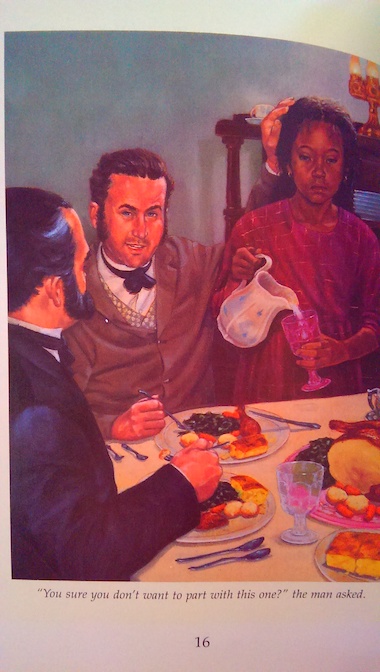
MeetAddySlaveBuyerAddy is nine years old, and she has lived her entire life so far as a slave on a plantation in North Carolina.  It is the time of the American Civil War, and Addy’s parents are worried about the future of their children.

One night, she hears her father saying to her mother that they ought to take the whole family and run away.  Her mother is worried that it’s too dangerous.  She hopes that soon the war will end, and they will be freed.  However, Addy’s father is worried that the family might be split up before that can happen because there is talk that the plantation owner, Master Stevens, might sell some of his slaves, and families wouldn’t necessarily be sold together.

His fears turn out to be justified because, soon after, while Addy is helping to serve dinner to a guest at the plantation house, she finds out that Master Stevens is planning to sell her father and brother to someone else.  She tries to get to them and tell them to run away before they can be taken away, but the overseer stops her.  Addy sees her father and brother taken away in chains.

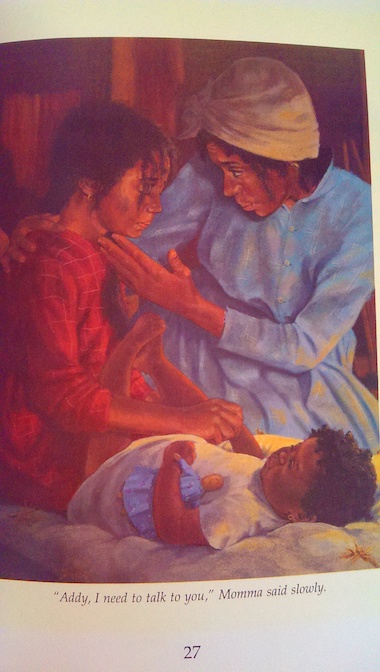
With Addy’s father and brother gone, her mother has a serious talk with Addy about their future.  The two of them can follow the plan and run away to the North, establishing a new life for themselves and hopefully arranging for their family to be reunited later.  If they don’t take this opportunity to leave, there is the possibility that the family will be fractured further.  The man Master Stevens sold Addy’s father and brother to has already said that he might like to buy Addy as well.

MeetAddyMotherSisterAlthough Addy and her mother are frightened at the idea of running away, they decide that this is their only chance to escape together.  Addy is upset when her mother tells her that they can’t bring her baby sister with them.  She is too young for the journey, and if she cries, it might give them away.  Instead, they will leave little Esther with their close friends, Auntie Lula and Uncle Solomon Morgan.  They plan to find a way to send for them when the war is over.

Addy and her mother have to seek out the woman that Addy’s father had talked about, Miss Caroline.  She’s a member of the Underground Railroad and can help them get out of North Carolina and go to Philadelphia, where Addy’s father had planned to take the family.

They leave in the middle of the night and travel by night.  The journey is hazardous, and there are times when they are almost caught.  At one point, Addy’s mother nearly drowns crossing a river.  But, together, they face the dangers, knowing that a better life awaits them at the end of their journey.  Even when they reach Miss Caroline, Addy’s story is really just beginning.

In the back, there is a section with historical information about the origins of slavery in North America and what the lives of slaves were like.  One thing that I kind of wish they had mentioned was about how widely indentured servitude was used in early American history and how it helped to make the idea of slavery more appealing in early America, which was something one of my old college professors once talked about.


Indentured servitude is when someone works off a debt by working for someone else for free for certain period of time.  Often, this was how poor people could pay for passage to America during Colonial times.  In exchange for someone paying the price of their passage on a ship, they would work for them for awhile.  When that time was over, the indentured servant could move on to new employment or had to be paid for his work.  When plantation owners started buying slaves, what they were really saying was that they wanted permanent indentured servants, ones that could never leave them, that wouldn’t have any end to their servitude because it wasn’t based on any debt.  It couldn’t be based on any debt because the slaves owed them nothing.  The issue for the plantation owners was that they couldn’t build plantations the size they wanted and pay the labor to support them at the same time, so their solution to the problem was free labor — or at least, labor that cost no more than an indentured servant would: one initial outlay for the purchase and then some basic food and clothing to keep the workers going.

The practice of slavery is disgusting, but for me, it’s the attitude behind it that’s the real problem.  The plantation owners didn’t have any right to anyone’s free labor, and they knew there was no debt involved.  They just didn’t want to pay people, and just not wanting to pay people was a good enough reason for them.  In the end, whatever they said about race and their own superiority, it was all really about the money all along.  They would have said anything, done anything, to turn more profit for themselves, and because no one stopped them for a long time, that’s exactly what they did.  The rest was basically excuses piled upon justifications piled on more self-entitled excuses and more self-centered justifications.  They did what they did mainly because they could get away with it, and the fact that they could get away with it made them feel like it was all right.  It wasn’t.


Felicity Saves the Day

American Girls

FelicitySummer

Felicity Saves the Day by Valerie Tripp, 1992.

This is part of the Felicity, An American Girl series.

FelicitySummerPlantationFelicity’s grandfather is a wealthy man who owns the Kings Cross Plantation.  Every summer, Felicity and her family go to visit him there, and Felicity loves it.  Her grandfather teaches her a lot of things, like which plants can be used for food and medicine, and takes her for horse rides around his estate.
This year, while Felicity’s father and his apprentice Ben are minding the store at home,  Felicity has a special surprise.  As her grandfather inspects a group of horses that a friend wants to sell him, Felicity is stunned to recognize Penny, the horse she freed from an abusive owner in the first book of the series.  Penny is a little thin and dirty but otherwise well, to Felicity’s relief!  Her grandfather purchases Penny for Felicity and promises to keep her safely at his plantation so that Felicity can visit her and ride her regularly.

Felicity is happier than she’s been in a long time and writes an enthusiastic letter home to tell her father and Ben, but soon, she learns that Ben is not at home with her father.  Felicity and her siblings have set up a bird bottle, a special bottle that acts like a bird house for birds to nest in, and she checks it daily to see if there are any birds to show to her little brother.  One day, she finds a message in the bottle from Ben, pleading for help, along with a map to a place in the woods and Ben’s whistle.  When Felicity goes to the spot in the woods and blows the whistle, Ben comes out of hiding.

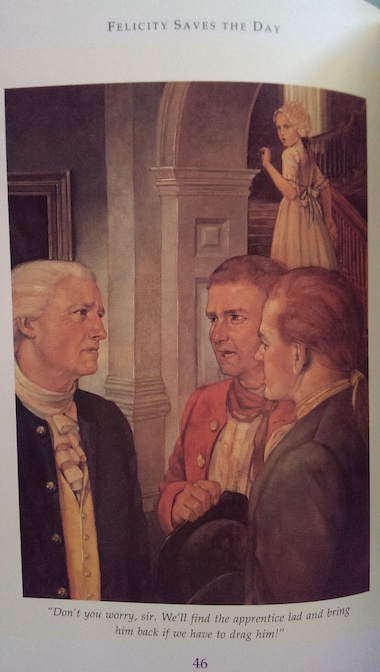
FelicitySummerBountyHuntersBen tells Felicity that he ran away from his apprenticeship to join the revolutionary army.  He wants badly to fight for the colonies’ freedom from England, but he had a bad fall while traveling and hurt his leg.  Felicity tries to convince Ben to let her get help for him and to return to her father to finish his apprenticeship, but Ben doesn’t want Felicity’s grandfather to find out that he’s there or why he ran away because he knows that he disapproves of the revolutionaries.  Because Ben kept her secret when she used to sneak out to see Penny, Felicity reluctantly agrees to keep Ben’s presence a secret for awhile, sneaking him some food and supplies.  She tells Ben that, while she thinks that standing up for what he believes is good, he’s going about it in the wrong way because breaking his apprenticeship was dishonest.

Then, Felicity learns that her father has placed an advertisement in the newspaper with a reward for anyone who can find Ben, and some rough-looking bounty hunters show up at the plantation to inquire about it.  Felicity knows that she must try to convince Ben to return on his own before he gets hurt worse than he already has!

A large part of the Felicity books is about taking responsibility and whether or not it’s right to break rules in the name of a good cause.  Felicity herself broke the rules to befriend Penny and later free her from a master who would probably have killed her.  This story raises the question of whether Ben’s form of rule-breaking is similar to what Felicity did or not.  Their situations and the reasons for their rule-breaking are different.  In her situation, Felicity had tried to behave as lawfully as she could until it became apparent that the only way to save Penny’s life was through rule-breaking.  In Ben’s situation, although he wants to help what he sees as a good cause, his rule-breaking isn’t strictly necessary, and he never tried to discuss his feelings with Felicity’s father and to work out an arrangement before running away because he thought that he already knew what Mr. Merriman would say.  Felicity points these things out to Ben, along with the fact that Ben is not in any real position to help the cause that he supports because he is injured, wanted, and in hiding.  He started on this venture ill-prepared and inconsiderate of the other people who depend on him back home and his own future, and while his belief in the revolutionary cause is genuine, he is also afraid of admitting his mistakes and needs to be urged to make things right.

In the back of the book, there is a section that talks about what people in Colonial America would do during summertime.  The weather in Virginia is hot and humid during the summer, and not everyone would get a chance to travel to the countryside, like Felicity’s family did.  The book talks about various ways colonists would use to cope with heat (keeping the kitchen with its fire separate from the house, eating in an open breezeway in the house, wearing lighter clothes, boys would go swimming although girls didn’t, etc.).  It also talks about life on Virginia plantations, including slavery.

The Secret of the Strawbridge Place

SecretStrawbridgePlace

SecretStrawbridgePlacePic1The Secret of the Strawbridge Place by Helen Pierce Jacob, 1976.
This story takes place in Ashtabula, Ohio during the Great Depression. Kate is frightened of the hobos who pass through town looking for work, but at the beginning of summer, her brother Josh dares her to come with him to spy on the hobo camp. The two of them witness a fight between three hobos, and in their haste to get away, Kate falls and breaks her arm. At first, she is sure that her summer is ruined, but when she considers the place where she fell, she realizes that she has stumbled on an important clue to a secret surrounding the old house where they live.

Locals say that during the Civil War, the Strawbridge family, who lived in the house before Kate’s family, were part of the Underground Railroad, hiding runaway slaves. However, no one has ever been able to find the place where the slaves were hidden. When Kate fell, she discovered the opening to a cave near the river that she never knew was there before.

SecretStrawbridgePlacePic2Oscar, a boy visiting his grandfather nearby, becomes Kate’s friend. Since he was also injured in one of Josh’s escapades (having broken his leg when the kids were fooling around in the haymow), she invites him to join her in the search for the secret. They form a partnership called Cripples Incorporated and have fun inventing code words and writing secret messages about what they’ve discovered. Pursuing the secret comes with some risks, and before Kate can discover the whole truth about Strawbridge Place, she has a serious brush with danger.

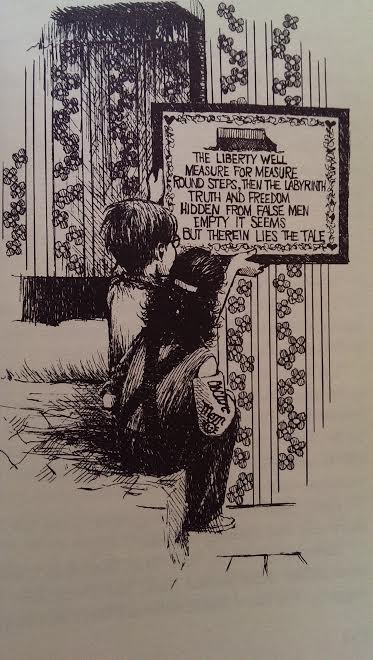
It’s an interesting mystery that invites readers to try to figure out the clues along with Kate and Oscar as they ponder the sampler with the strange motto left behind by the Strawbridge twins. Oscar also introduces Kate to Sherlock Holmes stories, one of which provides her with the inspiration to solve the mystery. Kate also develops better feelings for the hobos, who, like the runaway slaves, turn out to be mostly ordinary people just looking for a better life.

The book is available to borrow and read for free online through Internet Archive.  There is also a prequel book that focuses on the original adventures of the Strawbridge family when the house was operating as a stop on the Underground Railroad called The Diary of the Strawbridge Place.