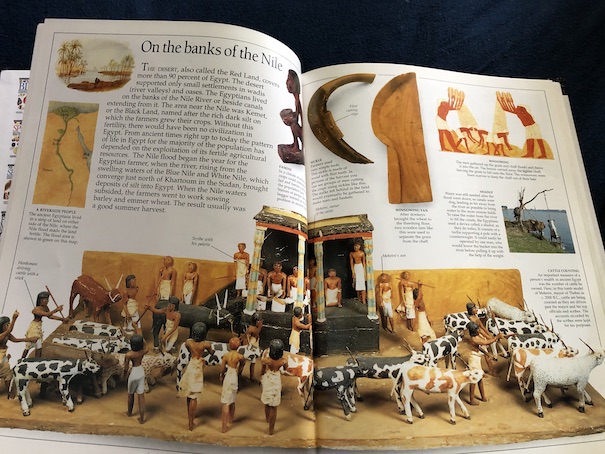
I love the way this book, like others in the Eyewitness series, shows photographs of artifacts so readers can not only read about how people lived but see the objects that they used. Each photograph in the book has a caption to explain what it is.
The book begins with an explanation about the origins of Ancient Egyptian civilization thousands of years ago, before there were pharaohs. Then, it explains about the geography of Egypt and the Nile and how the Nile floods and fertile lands along the river made Egyptian civilization possible.
The book then explains the concept of the Egyptian king as a “pharaoh.” The title of “pharaoh” comes from an Ancient Egyptian word meaning “great house”, referring to the palace where the king lived, so the king was the one who lived in the “great house.” However, the pharaoh was more than just the an important man living in a palace; he was also regarded as being a god. Most Egyptian rulers were male, although queens also sometimes ruled and were also regarded as divine. The book shows pictures of statues depicting pharaohs and explains a little more about some of the most famous pharaohs and queens. Then, it goes on to discuss life in the royal court.
Of course, no book about Ancient Egypt is complete without a discussion of mummies and tombs. Much of what we know about Ancient Egypt comes from what the Ancient Egyptians left in their tombs because Ancient Egyptians believed in life after death. They developed methods of preserving their bodies after death, and they stocked their tombs with things that they wanted to have with them in the next life. The book explains the embalming process, what pyramids and royal tombs were like, who the Egyptian gods and goddesses were, and what Egyptians believed about the journey to the afterlife.
I liked how the book not only explains different types of gods and goddesses in Ancient Egypt but also the roles of priests and temples in Egyptian society, types of religious rituals, and the role of religion and magical rituals in Ancient Egyptian medicine.
As the book covers a wide variety of different topics in Egyptian society, including scribes and writing, weaponry, and trading. I particularly like the parts focusing on daily life, like what Egyptian homes were like and some of the tools and details of different trades, like carpentry. The book has details about foods Ancient Egyptians ate, what music and dancing were like, and types of clothing and jewelry they had.
One of my favorite sections in the book is about toys and games in Ancient Egypt. We don’t know all of the details of games that were played in Ancient Egypt, but we do know that they had board games because they were found in tombs. Children’s toys were whimsical and included moving parts. Some of the games children played are similar to ones that children play today, like versions of leapfrog and tug-of-war and spinning tops.
The book is available to borrow and read for free online through Internet Archive (multiple copies, including some in different languages)
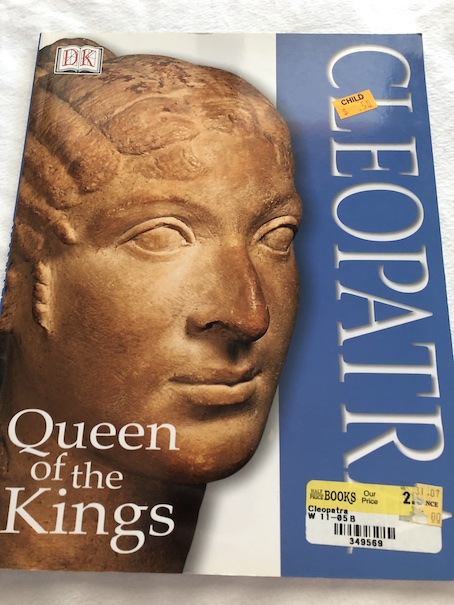
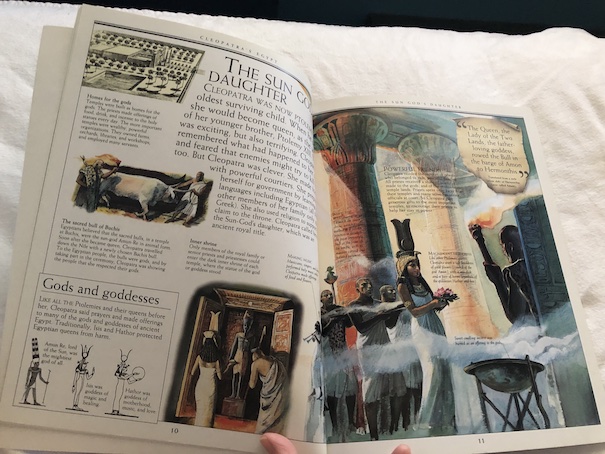
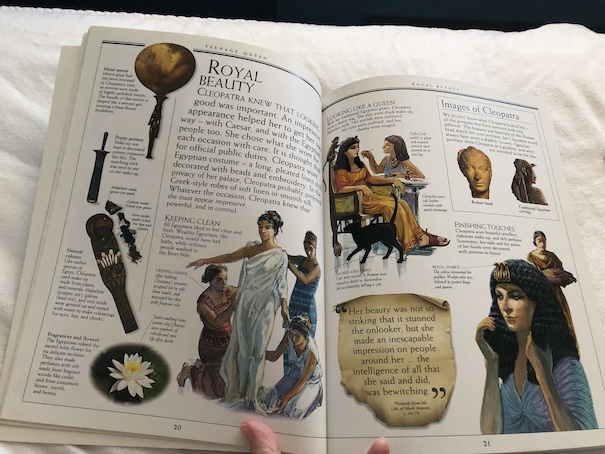
Cleopatra: Queen of the Kings by Fiona MacDonald, illustrated by Chris Molan, 1998, 2003.
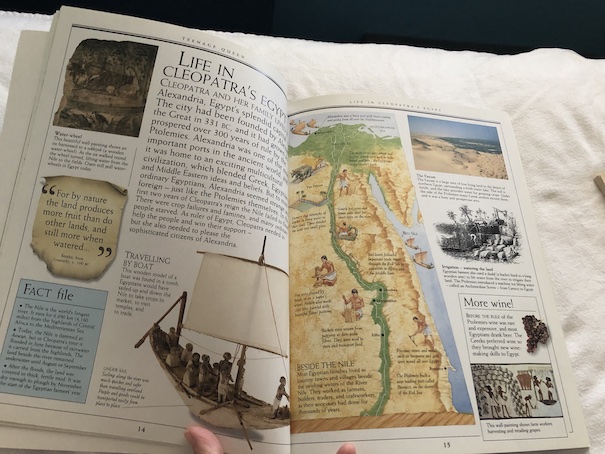
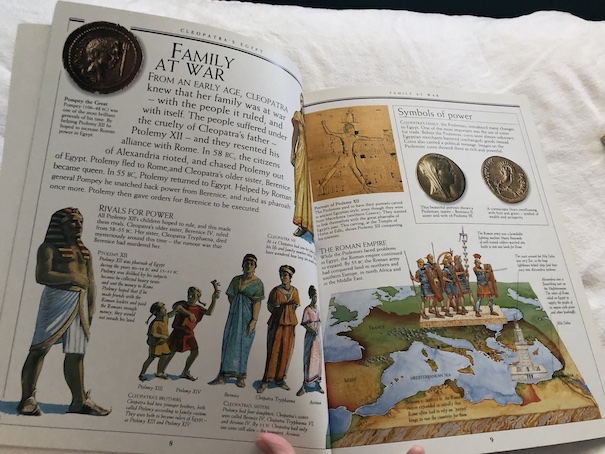
I always like books from DK Publishing because they have great illustrations, and they do a good job of helping to explain nonfiction topics, including different periods of history. However, one thing that’s important to realize is that you really have to read all of the small text that accompanies even the small pictures in order to get the full story. If you don’t, you may miss important details. Although this is a picture book, the detailed nature of the information and some of the dark subject matter make it inappropriate for young children.
This particular book is about the life of Cleopatra, the famous Egyptian queen. The queen we know as simply Cleopatra was actually Cleopatra VII. She was part of a dynasty of Egyptian rulers who were originally from Macedonia, a region of Greece. This dynasty was known as the Ptolemaic Dynasty because all of the kings in the dynasty were named Ptolemy, including Cleopatra’s father, Ptolemy XII. There were certain names that were repeated in every generation of the family and even within generations, like Ptolemy (Cleopatra’s two brothers both had this name), Cleopatra (Cleopatra also had a sister who was also named Cleopatra), and Arsinoe (Cleopatra’s younger sister). The book doesn’t fully explain why they came from Macedonia, but one of Cleopatra’s ancestors, Ptolemy I, was a Macedonian nobleman and a friend of Alexander the Great. Ptolemy I went with Alexander the Great on his military campaigns. Through his service to Alexander the Great, Ptolemy I was made the Greek governor of Egypt, ruling from the city Alexandria, which had been established by Alexander the Great. Alexandria was an important port city as well as the seat of the royal family. It was a gathering place of traders, scholars, and people from different cultures in Egypt, although average Egyptian citizens viewed it more as city of foreigners, just as the royal family itself was also foreign. That’s an abbreviated explanation of the family’s history, but it helps to understand that, while the family ruled Egypt for generations, they remained culturally Greek. The book mentions that most of the members of Cleopatra’s family only spoke Greek and that Cleopatra departed from the norm by learning to speak Egyptian.
Cleopatra was born into tumultuous times in the history of Egypt and her family. Her father was known as a cruel ruler who taxes his people heavily and sent large amounts of money to Rome, attempting to befriend Roman leaders and bribe them not to invade Egypt. In 58 BC, Alexandrian citizens had enough of Ptolemy XII and the way he catered to Rome, and they revolted, forcing Ptolemy XII to flee the city for Rome. Cleopatra was only fourteen years old at the time. Members of the family were left behind in Alexandria when Ptolemy XII fled, and Cleopatra’s oldest sister, Berenice claimed the throne in her father’s absence. The Ptolemies were always focused on maintaining their power, even in the face of competition or opposition from family members, and they were not afraid to fight or even kill each other to maintain control. Berenice may have murdered another of her sisters during her time as queen because she died under mysterious circumstances. However, when Ptolemy XII returned to Egypt a few years later, he had Berenice executed as a rival for the throne. By then, Cleopatra was the oldest surviving child of the family, with only her youngest sister and her brothers still alive.
A few years later, Ptolemy XII died, and Cleopatra acted quickly and prudently to secure both her life and her power. Her younger brother, Ptolemy XIII, had a claim to the throne, but he was still only twelve years old, and Cleopatra was eighteen. Asserting her authority over her child brother, Cleopatra took the throne as the oldest remaining offspring of Ptolemy XII and married her brother in order to turn her brother from a rival for power into a further source of her own authority. She could then rule on her brother’s behalf as his wife as well as his older sister. (Other Egyptian rulers had married close relatives for reasons like that. Tutankhamen was similarly the result of an incestuous royal relationship.) As queen, Cleopatra called herself the Sun God’s Daughter, an old royal title that tied her image to rulers of the past and the gods of Ancient Egypt.
From the beginning, being queen was a difficult task for Cleopatra. There were famines in Egypt during the beginning of her reign, and Cleopatra had to manage a response that would satisfy the citizens that she was doing her job as ruler. Family rivalries were also an ever-present danger. Cleopatra knew that she had enemies in her court, including people who favored her brother over her. As her brother got older, he became dissatisfied with the way his sister was ruling without sharing power and authority with him. For a time, Ptolemy XIII forced Cleopatra to flee Egypt and go to Syria. Cleopatra took her sister Arsinoe with her, both to protect her from their brother and to prevent her from trying to seize power herself. (In the Ptolemy dynasty, either could be a possibility. When family members weren’t in danger from each other, they could be a danger to each other.)
In the meantime, Julius Caesar came to Egypt to collect a debt that he claimed that Cleopatra’s father had owed him. He arrived during the power struggle between Cleopatra and Ptolemy XIII, and he decided that it would be for the best to try to mediate peace treaty with the two of them. He wanted to meet with both Cleopatra and Ptolemy XIII together, but Cleopatra knew that there was a risk that she might be killed if she showed up for a meeting. Yet, she did want to meet with Caesar because she recognized that he could be an important friend and source of protection for her. She ended up visiting Caesar in secret. According to legend, she had herself delivered to Caesar’s room in a rolled-up carpet. Caesar was charmed by Cleopatra and became her ally. When the news of their alliance spread, it tipped the balance of power in the royal family. Caesar learned that Ptolemy XIII’s adviser was plotting against him and had him executed. Ptolemy XIII fled with Arsinoe to join the Egyptian army and was later killed and found dead in Alexandria’s harbor. Getting rid of her brother/husband and his advisers secured Cleopatra’s position. She had one remaining brother, Ptolemy XIV, who was only eleven years old at the time, so she married him, too, further solidifying her power. As her ally (and possible lover), Caesar provided her with guards for her safety.
Cleopatra had a son named Caesarion, who was rumored to be Caesar’s son as well. However, Romans feared that Julius Caesar would proclaim Caesarion as his heir. They didn’t want him as the future ruler of Rome, citizens were appalled at the way Arsinoe was paraded through the streets as a war prize, and people generally began to fear that Caesar was becoming too powerful. In 44 BC, Caesar was assassinated by a group of senators. Cleopatra was in Rome when Caesar was killed, and she fled back to Egypt with her son. Around this time, Ptolemy XIV disappeared, and he may have been murdered by Cleopatra. With a son to inherit her throne, Cleopatra no longer needed Ptolemy XIV. However, her Roman protector was now gone, and Cleopatra still had enemies at court. Cleopatra’s remaining sibling, Arsinoe, sided with Caesar’s enemies and plotted against her sister and Caesarion.
Nobody knows exactly what Cleopatra looked like (statues and carvings of her don’t always look alike, and they may have been idealized images of her), but she took care of her appearance as part of her image as queen. Apparently, Cleopatra was more striking than beautiful, and what struck people about her the most was her intelligence and personality. Her charm was one of her most important tools in winning allies, and she used it again to win over a new ally to replace Caesar. She found a new ally in Marcus Antonius (also known as Mark Antony), one of the candidates to replace Caesar in Rome.
Mark Antony needed the control of Egypt and its resources and the support of Cleopatra for his own political purposes. To win his support for her purposes, Cleopatra began a romantic relationship with Mark Antony that eventually became a major part of the legends around Cleopatra. Although Mark Antony already had a wife in Rome, he became devoted to Cleopatra and fathered a set of twins with her and, later, a third child.
When Caesar’s nephew, Octavian, learned that Antony had divorced his wife and was conspiring against him, he declared war on Egypt to take down both Antony and Cleopatra. Cleopatra and Antony’s forces were defeated at the Battle of Actium although the two of the escaped. Feeling that the end was probably near, Cleopatra had stoneworkers hurry to complete her tomb. She began experimenting with poisons, and she and Antony swore to each other that they would die together. When Antony’s soldiers turned against him and refused to fight, Antony was disgraced and forced to flee. He ended up taking his own life by stabbing himself. Cleopatra had retreated into her own mausoleum, planning to die, but Octavian allowed her to remain there as a prisoner while she arranged Antony’s funeral. The exact cause of Cleopatra’s death has never been confirmed, but according to legend, she arranged her own death by the bite of an asp and sent a note to Octavian, asking that she be buried with Antony.
It’s a tragic end to a story that was full of treachery and family rivalries from the very beginning. Octavian refused to allow any of Cleopatra’s children to assume the throne of Egypt, ending the reign of pharaohs forever. Rome took control of Egypt, and Cleopatra’s children were sent to be raised by Antony’s first wife in Rome, Octavia (who was also Octavian’s younger sister). Caesarion tried to flee to Syria, but he was caught and executed by Octavian’s orders. No one knows what happened to Cleopatra’s other two sons because they disappear from historical records after this point, so they may have died young (or were murdered, given how things went in the powerful circles in which they lived). However, Cleopatra’s daughter survived, grew up, and eventually married the King of Mauretania, a region in North Africa. The book mentions that she had a son that she also named Ptolemy, but it doesn’t mention that this Ptolemy was the last king of Mauretania and was assassinated by Caligula. Caligula and Ptolemy were distant relatives of each other because Ptolemy of Mauretania was a grandson of Antony, and Caligula was descended from both Antony and Octavian. In many ways, it seems like this family’s greatest misfortunes were themselves and each other. Fortunately, the death of death of Ptolemy of Mauretania didn’t end the family line. It’s unknown whether or not Cleopatra has living descendants today, but Ptolemy of Mauretania did have a sister (the details of her life are unknown) and a daughter named Drusilla, who apparently grew up, married, and continued the family line. Further down the family tree, relationships and offspring become harder to trace.
Something I particularly liked about this book was the separation between the legends of Cleopatra and the her known history. As with other ancient historical figures, the history and legends go hand-in-hand, and it can become difficult to separate the two. The book is pretty open about which parts of her life are known, what can’t be firmly established, and which parts of her story come to us from legend and may or may not be reality. The final section in the book discusses the known facts and fiction about Cleopatra and possible confusions between her and other Cleopatras in her family (which may be another reason why not all of the images of Cleopatra look alike). It also explains the information about Cleopatra in Plutarch‘s biography of Mark Antony and how his stories inspired Shakespeare’s play and modern movies about Cleopatra.
The book is available to borrow and read for free online through Internet Archive.
The First Book of Tales of Ancient Egypt by Charles Mozley, 1960.
The book begins with a section “About this book” that introduces the stories, but I felt like it could have said a little more. The introductory section points out how amazing it is that these folktales and myths from Ancient Egypt have survived thousands of years to reach us, but there’s a bit more to the story than that. For a long time, people were unable to read texts written in Ancient Egypt because knowledge of ancient writing was lost when Egyptian culture changed and developed new writing systems. Modern people eventually regained the lost knowledge of Ancient Egyptian writing when the Rosetta Stone was discovered because the Rosetta Stone contains the same message written in three different systems of writing – Ancient Greek, Ancient Egyptian hieroglyphics, and Ancient Egyptian demotic script. Because European scholars knew Ancient Greek at the time the Rosetta Stone was discovered, they were able to use the Ancient Greek portion of the stone to learn how to read the rest of it. It took years of study for them to fully understand not only the message on the stone in all three writing systems but to learn to apply the rules of Ancient Egyptian writing to other messages and carvings and decipher what each of them meant. Even in modern times, scholars are still working on translations of Ancient Egyptian writing and publishing new books of Ancient Egyptian stories that modern people have not read in English. It’s not just that these stories have survived for thousands of years to reach us; it’s also that people worked very hard to learn exactly what did survive for those thousands of years and make it possible for ordinary people to understand it. This book for children would not have been possible without many years of scholarly research.
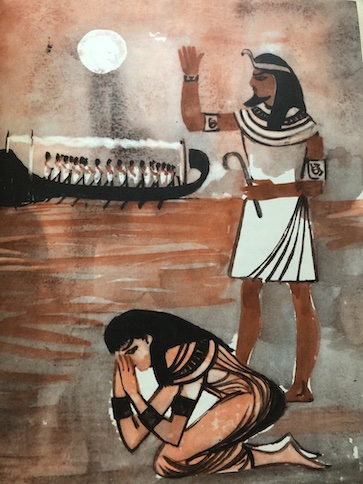
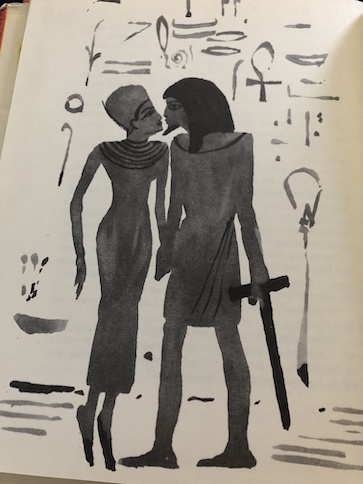
The pictures in the book are sometimes monochromatic in different colors and sometimes full color.
The book is available to borrow and read for free online through Internet Archive.
The stories in the book are:
The Magic Crocodile – When King Khu-fu is bored and nothing seems to please him, his sons tell him stories to amuse him.
In his first son’s story, in the distant past, during King Nebka’s reign, magic was commonplace, and King Nebka had a young magician named Uba-na-ner at his court. At first, the magician was very happy, but then, the woman he was going to marry ran off with another man. Angry, the young magician made a magical crocodile out of wax and sent it to attack his former fiance’s new husband. After the crocodile killed the new husband, the magician’s former fiance went to the kind and accused the magician of murder. Faced with the king’s questions, the magician confessed what he had done. The magician expressed remorse and turned over the box where he kept the wax crocodile. The king pardoned him because of his remorse but hid the box with the wax crocodile so it couldn’t be used again. That seems to be letting a magical murderer off lightly, and King Khu-fu doesn’t find the story very interesting.
In the second son’s story, there is a powerful wizard named Zaza-man-khu in the reign of King Sene-fe-ru. When Sene-fe-ru is feeling down, he asks Zaza-man-khu for something to cheer him up. Zaza-man-khu suggests a boating trip on the palace lake, rowed by singing maidens. At first, the trip is pleasant, but then, something happens that upsets all of the maidens, and they stop singing and start crying. Soon, everyone is crying so hard that it’s difficult for the king or his wizard to find out what’s wrong. It turns out that one of the maidens lost a precious jewel in the water, and it was some kind of lucky amulet. Now, she’s worried that something bad will happen to her, and all of the other girls are crying in sympathy with her. The king promises that he will give the maiden plenty new jewels if she stops crying, but she says that she needs that particular amulet, and none of the other maidens will start rowing the boat again until they figure out what to do. The king’s wizard is able to retrieve the lost jewel by parting the waters in the lake so he can walk out across the bottom of the lake and find it. King Khu-fu finds the story mildly interesting and says that it would be impressive if there was such a wizard in their time.
King Khu-fu’s eldest son says that he knows of such a wizard, a man named Didi, who is supposed to be 110 years old. Interested at last, King Khu-fu says that he wants to meet Didi. According to stories about Didi, he can restore life to a person or animal after it’s been beheaded, but how far will they make him go to prove it?
Isis and the Secret Name of Ra – This story explains the origins of the goddess Isis. In the beginning, Isis is not a goddess but a clever young woman. Although she is clever and has extensive magical knowledge, it isn’t enough for her. She wants to learn the secret name of the sun god Ra (Ra isn’t the secret name itself) to gain power over the whole world. People call Ra by many different names, but Isis is aware that he has one secret name that no one knows and from which he derives his power. Isis creates a magical snake that bites Ra, and Ra experiences pain for the first time. Isis offers to help heal him from the bite (that she caused), but she says that she needs to know Ra’s secret name. Ra says that if she knows the name, she will also become immortal, and Isis says that she’ll try to bear it (wink, wink). So, Isis becomes immortal and heals Ra from the poisonous snake wound.
After she becomes a goddess, Isis continues living as a mortal woman for awhile, but then she marries King Osiris. Osiris is a great king who teaches his people how to farm, and Isis teaches them healing arts. Their kingdom is great and peaceful, and Osiris and Isis have a son they name Horus. For a long time, no one, not even Osiris, knows that Isis is actually an immortal goddess. However, Isis’s powers allow her to sense evil and deception from Osiris’s jealous brother, Set. Osiris can’t believe that his brother is evil. Then, Set tricks Osiris into getting into a chest and throws him into the river and drowns him.
When Isis realizes what has happened, she realizes that she has the power to restore Osiris to life. At first, Isis is unsuccessful in her attempt to bring Osiris back to life because too much time has gone by since his death, but Thoth, the god of wisdom, has pity on her and Osiris and raises Osiris to serve as king of deserving spirits among the dead.
King Setnau and the Assyrians – King Setnau is a gentle and peaceful king, so even though Egypt has enemies, he does not try to improve Egypt’s army. Although most citizens love King Setnau, his generals don’t. When the King of Assyria decides to invade, seeing Egypt as easy prey, the angry Egyptian army refuses to obey the king and fight for Egypt. In despair, King Setnau prays at the temple and then tells his people about the army’s refusal to obey him. The ordinary citizens decide that they will be the king’s new army themselves. They are untrained and have mostly improvised weapons, and Egypt’s official army doesn’t take them seriously. However, King Setnau is appreciative of their loyalty and prays the he will be a suitable leader to them so they can save their kingdom. In the end, they are successful with a little help from the gods and a swarm of field mice.
The Wonder Child – King Usi-ma-res has a son who is a wise sage, Sat-ni. However, Sat-ni is unhappy because he and his wife have been unable to have a child, and they want one more than anything. Sat-ni’s wife prays for a child, and finally, she gives birth to a son, Se-Osiris. Se-Osiris turns out to be remarkably intelligent and learns very quickly. As he progresses in his studies, he begins learning magic, and by the age of twelve, he is already a master magician.
One day, a man from Ethiopia comes to the pharaoh’s court with a challenge: he has a sealed book and he wants to see Egyptian wizards attempt to read the book without breaking the seal. The pharaoh consults with all of his wizards and magicians about the book challenge, and Sat-ni says that he suspects that the book and its contents are protected by some kind of spell that will prevent the Egyptian wizards from reading it. However, Se-Osiris insists that he can read the book. To demonstrate, he proves to his father that he can read any book from his father’s library even though he has never seen it before while his father holds it sealed in another room. Pleased and amazed with his son’s skill, Sat-ni brings Se-Osiris to court to answer the challenge.
At first, the Ethiopian man sneers at the young boy who claims that he can answer his magical challenge, but the pharaoh says that it’s a sign of how great Egyptian magic is that even a twelve-year-old Egyptian can answer any challenge that Ethiopia could set. In front of everyone, Se-Osiris reads the book without even touching it, telling an ancient story about three Nubian magicians and their boasting of the ways that they would punish the King of Egypt for the amusement of their king and how the King of Egypt gets revenge.
However, the story doesn’t end there. The mysterious Ethiopian turns out to be the spirit of one of the magicians from the story in the book, who was disgraced through the magic of the Egyptian magicians and who has come back to settle the score. Se-Osiris must now face him in a magical duel.
The Thief and the King’s Treasure – King Rhamp-si-ni-tes loves gold and treasure more than anything. He loves it so much, he allows criminals and corrupt official to buy their way out of trouble. The king compromises law and justice in the land, thinking only of getting more gold and jewels. He neglects the state of his kingdom and even his own daughter. Soon, the king also becomes paranoid, constantly afraid that someone might take some of his beautiful treasures. Finally, the king hires an architect to design a safe place to keep his treasure, a vault no thief could enter.
However, the king is a terrible ruler and also a dishonest man. He pays the architect only a fraction of the money he promised him, so the architect clever engineers a secret entrance to the treasure vault so he and his sons can enter any time they want and help themselves to the money that the king owes them and all of his other subjects.
For awhile, it works, but then, the king notices that someone has been taking some of his treasures. He has some metal workers build a terrible mantrap that traps one of the architects sons. When it becomes clear that he is hopelessly trapped and their whole family may suffer the king’s wrath once he realizes who has been stealing from him and how it was done, the trapped son tells his brother there is only one, terrible solution – his brother must cut off his head. The trapped brother will die anyway because the king will have him killed, but if his brother removes his head, no one will be able to identify him, and the rest of their family will be safe. Reluctantly, his brother does as he asks.
However, the fact that the head was removed from the body tells the king that the dead thief must have had a confederate. He has his guards display the body of the thief publicly on a hill and watch for anyone who shows grief at seeing it. The dead man’s mother quietly grieves at the loss of her son, and when she says that she wants to see her son properly buried, his brother figures out a clever way to retrieve the body.
The king is enraged, but his neglected daughter decides that she also wants to find the thief, seeing it as her chance to secure her future in spite of her father’s neglect. She promises her father that she can find the thief but only if he promises her that she can have whatever she wants afterward. The king promises, not realizing that the one thing that the princess wants is to marry the thief.









 Jestress's Forgotten Books and Stories