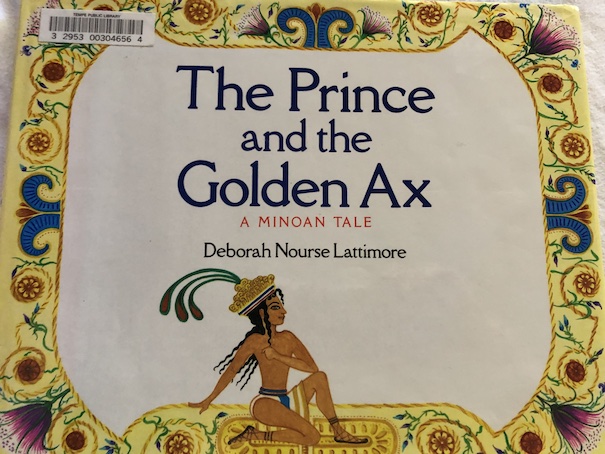
The Prince and the Golden Ax by Deborah Nourse Lattimore, 1988.
This story is based around the ancient Minoan civilization and the destruction of the island of Thera. Thera was a real place, and it was actually destroyed, but the story itself is fiction, based upon the pieces of information that the Minoans left behind about their culture.
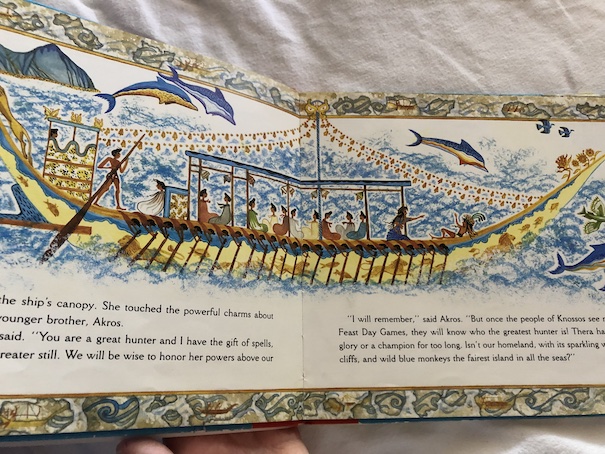
When the story begins, the city of Knossos on Crete is the home of the Goddess Diktynna. Princess Illyra and her brother, Akros, are on their way to Crete from Thera with their fleet of ships. Akros is eager to show off his skills at the games on this feast day, although Illyra cautions him to not show off too much and to remember to honor the goddess.
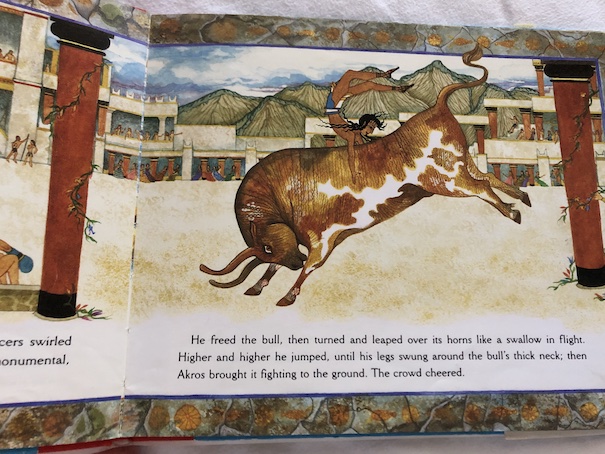
When they arrive at Crete, they are shown the goddess’s shrine with her statue holding the golden ax that is the source of her power. Akros is impressed by the golden ax and begins to think that if he had the ax, he could use it to bring glory to Thera. At the feast games, Akros shows off his ability to wrestle a bull. Full of pride for himself, he declares that he’s even better than the goddess because he did it without a golden ax. The goddess is angered by his comments and causes an earthquake.
The priestess says that Akros has challenged the goddess, and in order to make amends, Akros must find the golden-scaled fish of the Eastern Isle and obtain a bronze ax. If he fails to complete this task, the goddess’s golden ax will destroy Thera. Akros has no choice but to accept the challenge.
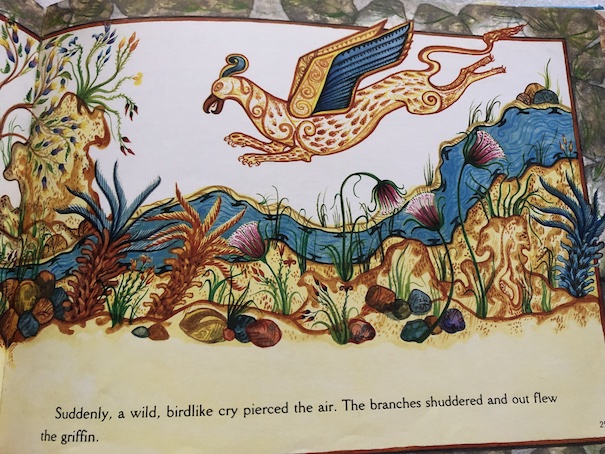
Illyria has the ability to use magic, and she helps her brother to complete the task successfully, but Akros can’t resist bragging about how easy it all was, angering the goddess again. This boast earns him a more difficult task, to capture a griffin and earn a silver ax.
Once again, Illyria helps Akros to succeed in his task, but when he is presented with the silver ax, Akros insists that it’s not good enough for him and that he wants the golden ax. The priestess says that only a godlike hunter can have that ax, and if he tries to get it, his homeland will be destroyed. Still, Akros insists that he can prove that he’s good enough by catching a creature that no one, man or god, has ever caught before.
What Akros has in mind is catching the blue monkeys on the island of Thera. This time, Illyria refuses to help him because the blue monkeys are sacred. At first, Akros thinks that he’s managed to capture the blue monkeys without her help, but they have abilities that he never expected. As promised, when Akros fails to accomplish his boast, the island of Thera is destroyed, and Illyria and Akros only narrowly escape.
The book ends with the discovery of the remains of the palace of Knossos centuries later, when the image of the goddess and a small ax are discovered.
My Reaction
I knew at the beginning of the story that there couldn’t be a happy ending because I already knew what happened to the real island of Thera, now called Santorini. The island was largely destroyed by a volcanic eruption during the Minoan period, a cataclysm that may have sparked the legend of the sunken island of Atlantis. However, this story does not mention Atlantis, instead using the statue of a goddess found in the remains of the palace of Knossos as inspiration. In spite of the ending, I wouldn’t call this a sad story. The book doesn’t dwell on the aftermath of the destruction of Thera, and we don’t actually see much of the civilization of Thera, so there isn’t much for us to miss when it’s destroyed. The colorful pictures throughout the book are beautiful and actually feel rather cheery.
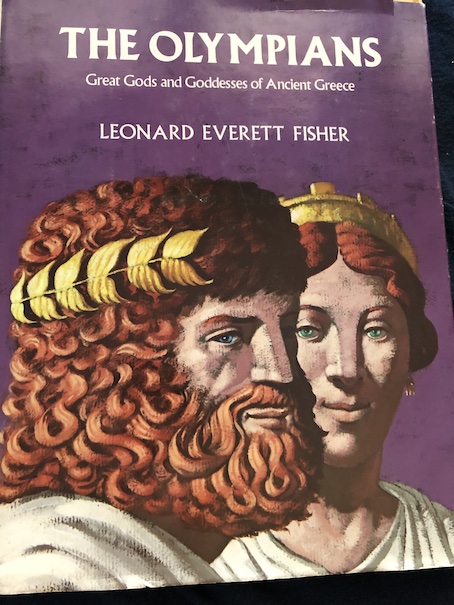
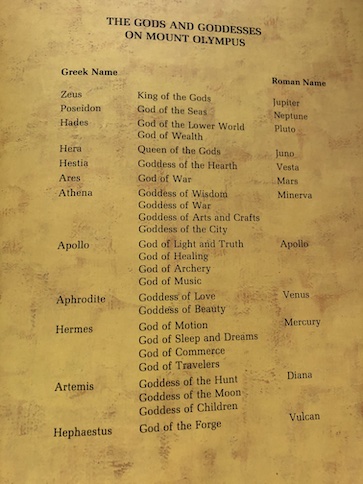
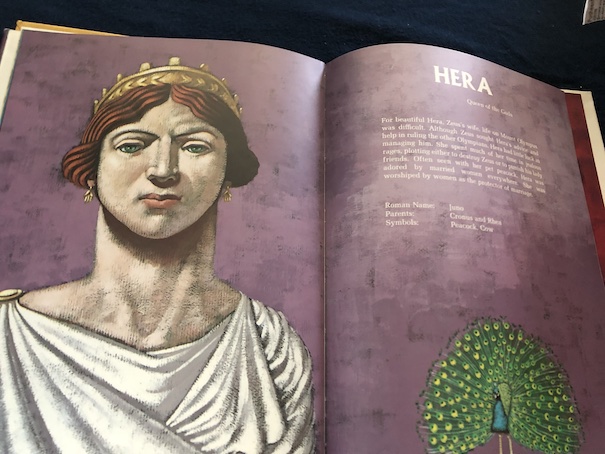
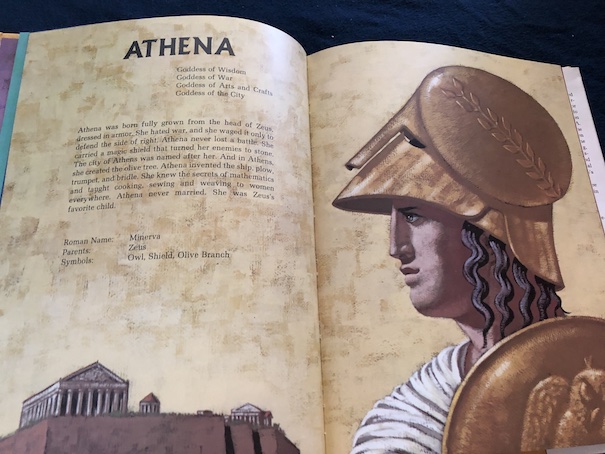
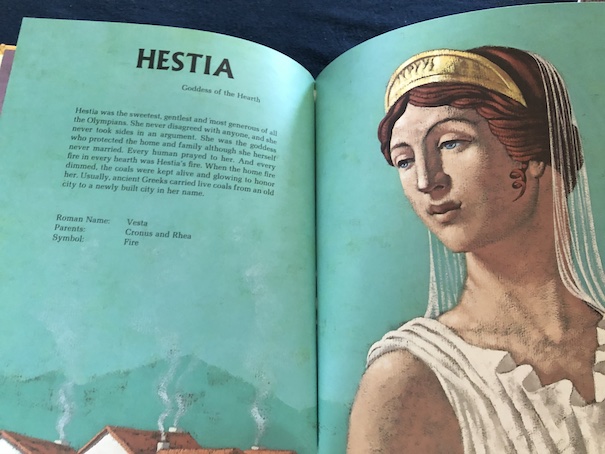
This picture book was my very first introduction to mythology when I was a kid! The book presents profiles of twelve Greek/Roman gods and goddesses. The Ancient Greeks and Romans worshiped the same gods and goddesses, but they used different names for them. At the beginning of the book, there is a list of gods and goddesses that gives both their Greek and Roman names. However, the rest of the book mainly uses the Greek names because the emphasis is on Greece. The gods and goddesses were called the Olympians because their legends state that they lived on Mount Olympus in Greece. It’s useful to know the Roman names, though, because the planets in our solar system were given the Roman names of gods.
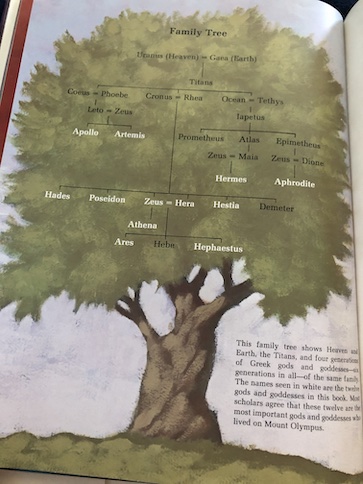
The back of the book has a family tree because all of the gods and goddesses were canonically related to each other. As a kid, I just accepted that. I don’t remember questioning it. The names of the gods and goddesses in the book are written in white.
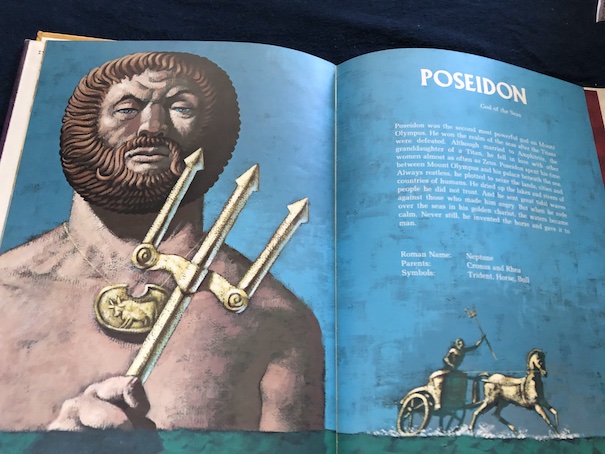
Each god and goddess in the book has a page of information and a full-page, full-color picture. Their profiles explain their personalities, their roles among the gods, and symbols that are commonly associated with them.
The pictures in the book are colorful. Although the faces of the gods and goddesses have a somewhat chiseled appearance, I like them.
When I was a kid, I think I had a fascination for Artemis and Apollo because they were twins, and I found twins fascinating. Because I was a girl, I generally liked the female goddesses better than the male ones. I think I sometimes tried to imagine which one I would be if I could pick one. I think, for a time, I liked Athena because she was the goddess of wisdom and was represented by owls, and I also happen to like owls.
As I was rereading the book this time, I became more interested in the page about the goddess Hestia. As the goddess of the hearth and home, she might not seem as exciting and well-known as the others, but I like her picture, and her profile has some interesting facts. It mentions that Ancient Greeks would carry live coals from an old city to a new one that had been recently built in her honor.
The book is available to borrow and read for free online through Internet Archive (multiple copies).
How Did They Live? Greece edited by Raymond Fawcett, 1951, 1953.
This is a non-fiction book, part of a series about life in the past, but it’s told in the form of a story where the readers are visiting a man living in ancient Athens named Simonides. The story is told from the point of view of “we” as “we” visit Simonides, and he shows us around Athens.
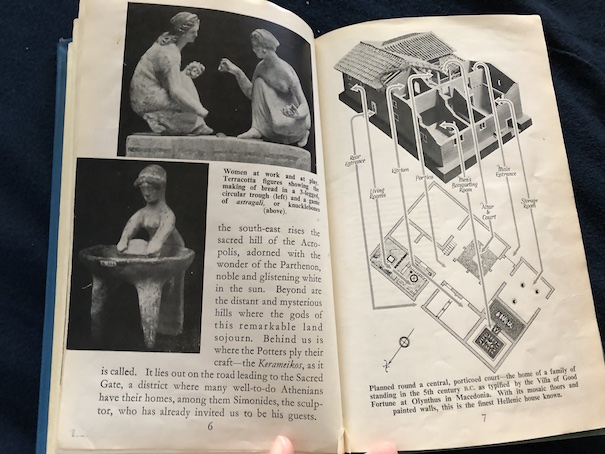
At the beginning of the story, Simonides meets us at the Temple of Hephaestus. The book provides a map and a description of the city so we know our way around. Simonides is a sculptor, and he lives in a nice house in an area of the city with well-to-do people. The book provides a map of the interior of Simonides’s home. His house is bigger and nicer than those of poorer people, and he also owns slaves. (The women playing a game on this page are playing Knucklebones, a precursor to modern Jacks but played with animal bones.)
Athens, like other cities in Greece at this time, is actually a city-state, an independent state with its own government, separate from other Greek city-states. Simonides explains that he served in Athens’s army when he was younger. Now, as a sculptor, he works with an artist producing public art in Athens. During a war with Sparta, many homes and buildings were badly damaged, so they’ve been rebuilding what was ruined and creating new public monuments.
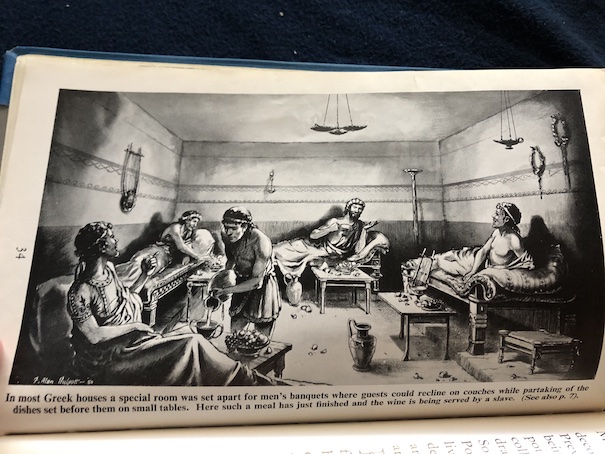
Simonides takes his guests into a special dining room, where we can relax. Guests are only allowed into areas of the men’s quarters of the house. The women’s quarters are strictly private, and we are told that the women in Athens spend most of their time at home, tending to household tasks. Usually, they only go out for special occasions, like festivals or plays. The Athenian women do not have the rights to property and having a say in public life that the men do. However, women from wealthy families lead comfortable lives and authority with in their houses. The book puts it, “Besides running the household she has her little vanities and the universal feminine interest in dress and adornment to help her and, in spite of her seclusion, she contrives to keep herself pretty well informed about what is going on in the city.” The part about the “little vanities” seemed a little insulting to me because I personally don’t like vain and shallow women who can’t think outside of the clothes closet, and I know plenty of women who aren’t in clothes and fashion. It seems like one of those cases where interest in these things might not really be “universal” but it’s something that women do because there just isn’t that much else for them to do. If they had more options of other activities, some of them might have found other things to do. The book goes on to describe various styles of women’s dress, hair, and makeup.
As the guests, we are invited to spend the night at Simonides’s house, and the next day, slaves bring us water to wash in and a breakfast of pieces of bread in wine. Then, we visit the agora (marketplace) with Simonides. There are people hanging around, socializing with friends, and the book describes the tunics and mantles they wear. After Simonides makes his purchases, he has his slaves carry them home. As we wander through the public meeting places, Simonides explains about the local philosophical groups that meet there, like the Stoics. We even meet Socrates as a young man.
After the shopping and visiting the public meeting places, we return to Simonides’s house for the midday meal of fish, vegetables, fruit, and bread. After the meal, Simonides’s wife, Hestia, explains more about the lives of women and children in Athens. As explained before, women have fewer rights than men, and female children do not receive as much education and training as boys do. Children younger than seven are all raised in the women’s quarters of the house. They play with toys like rattles, dolls, balls, spinning tops. Girls like to play on swings and see-saws and learn to dance, while boys play with kites, hoops, and hobby-horses. They all listen to stories like Aesop’s Fables to learn moral lessons. At the age of eight, boys begin to go to school, and at the age of eighteen, they join the army. Meanwhile, girls are taught to handle domestic tasks.
After that, we make a visit to the Acropolis to see the Parthenon, which is the Temple of Athena. The carved figures in the pediments of the building tell stories from the life of Athena. That evening, Simonides invites some friends to the house for a dinner party in his banquet room, where people eat while reclining on couches.
The next day, we learn about pottery and how it is made. The book describes the types of pictures and designs painted on pottery and says that the style with red figures painted on a black background is a newer style. Before, black figures were painted on a red background.
Toward the end of the book, we attend the Panathenaic Festival, which is meant to honor Athena. The festival includes athletic competitions and music and literature contests. There is a procession of important public officials and animals to be sacrificed to Athena. We (the guests) ask Simonides to explain more about the religion and gods of Ancient Greece, and he does. Religion is an important part of public life in Athens, but the book includes a suggestion that Simonides might not actually believe in the gods and goddesses of Ancient Greece: “We do not ask Simonides if he himself believes in these gods. But we have an idea that, like many other Grees, he may not do so, for he suggests that a knowledge of the gods has been handed down from the poets of old and the sculptors have clothed the ancient myths in beautiful forms.” That’s not much of an explanation, although I suppose it’s reasonable that people would believe in the religion of Ancient Greece to varying degrees, and there would have been at least some disbelievers. That’s found in pretty much every religion. There are also people around the world in modern times who engage in religious traditions less out of personal belief than out of civic or cultural participation (like this description of Shinto in modern Japan), which is the implication about the people in this story.
The book ends with a visit to Olympia to see the ancient Olympic Games.
My Reaction
I love books that explain daily life in different time periods, and I thought this one was pretty well done. It covers a few days in the life of Ancient Athens and also does a good job of explaining the wider society of Athens. Most of the perspective is on a fairly wealthy family and their slaves. I found parts about the descriptions of the lives of women and slaves distasteful, but the descriptions and attitudes of the people seem pretty accurate for the time and place. My feelings were more about not liking the lifestyle and circumstances than about disagreeing with the author. There are more details about the raising and schooling of children and about food and clothing than I’ve included in this description.
I particularly liked the maps of the city and the interior of the house. I also liked the way they included Greek words and explained their meanings, like kerameikos (pottery, note the resemblance to the word “ceramics“). Even though I took a philosophy class in college and learned about the Stoics, I didn’t remember the professor explaining that the origin of the word “Stoics” was the stoa, the public gathering place like a covered porch where they would meet.
I was confused for a moment when the book explained that Simonides doesn’t bow when he meets people “as we would do.” As an American, I wondered, “Who’s ‘we’?” Americans aren’t in the habit of bowing to random people we meet on the street, either. I checked, and the book was printed in England. British spellings in the book (“honour” vs. “honor”) also confirm that this is a British book. I didn’t think that people in England in the 1950s bowed to people either, except maybe during important events with royalty and nobility. The most I would ordinarily expect would be a nod or bow of the head to acknowledge other people, and people in the US do that, too.







 Jestress's Forgotten Books and Stories