Lilly’s Purple Plastic Purse

Lilly’s Purple Plastic Purse by Kevin Henkes, 1996.

Lilly loves going to school, and she especially loves her teacher, Mr. Slinger. Everyone in class thinks that he’s great, and he inspires a lot of them, including Lilly, to want to be teachers themselves.

One day, after a special shopping trip with her grandmother, Lilly gains a some special new treasures: movie star sunglasses, some quarters, and a purple plastic purse that plays a tune when she opens it. Eager to show off her new things to her friends, Lilly brings them to school. However, she just can’t wait until recess or Sharing Time to show everyone. She keeps trying to draw attention to these things while the teacher is talking and opening the purse so it keeps playing its tune.
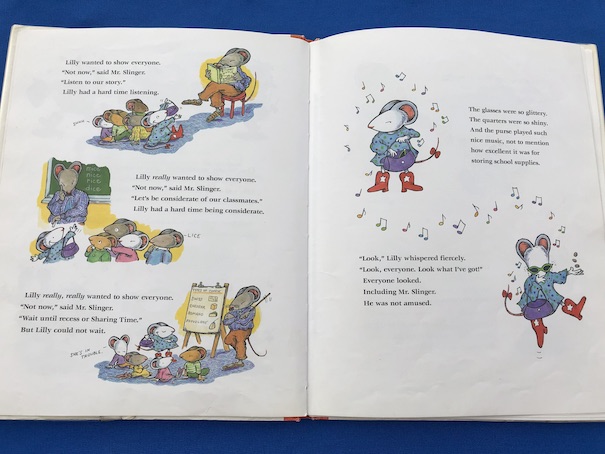
Finally, after repeated warnings, Mr. Slinger is forced to confiscate Lilly’s purse with its other treasures. Lilly is hurt and feels betrayed by her favorite teacher. Sad and angry at having her treasures taken from her, she draws a mean picture of her teacher as a purse thief, leaving the picture where she knows he will find it.

However, Mr. Slinger isn’t as mean as Lilly thinks that he is when he takes her purse. After he gives the purse back to her, she discovers a nice note from him inside, telling her that tomorrow will be a better day, and there’s even a little bag of snacks. Now, Lilly feels guilty about her mean picture. It’s too late to get it back, and she worries that her teacher will never forgive her.

The story is really good at showing how Lilly’s emotions change through the course of the day and how her sadness and anger grow more urgent the more she thinks and worries about them. It’s a good story to use when talking about feelings with young children (through the course of the story, Lilly is happy, excited, sad, betrayed, angry, guilty, worried, and embarrassed – some of these are stated explicitly and some are more implied) and how to deal with emotions. Adults can talk to children how one kind of emotion can lead to another (like how Lilly’s sadness turns to anger at her teacher for making her feel sad by confiscating her purse) and how some ways of dealing with emotions are better than others. It is both creative and appropriate that Lilly used her drawing ability to both insult her teacher and, later, apologize to him.
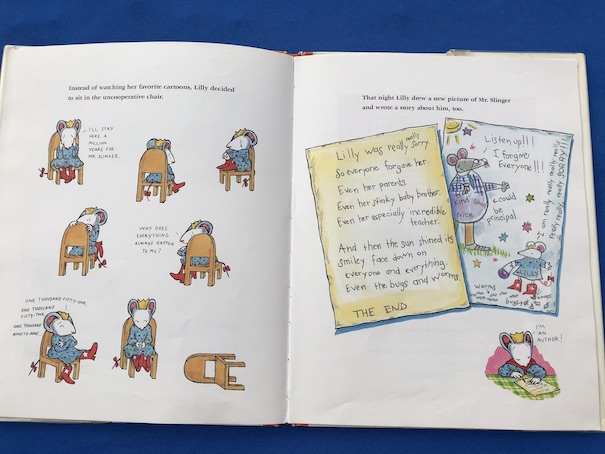
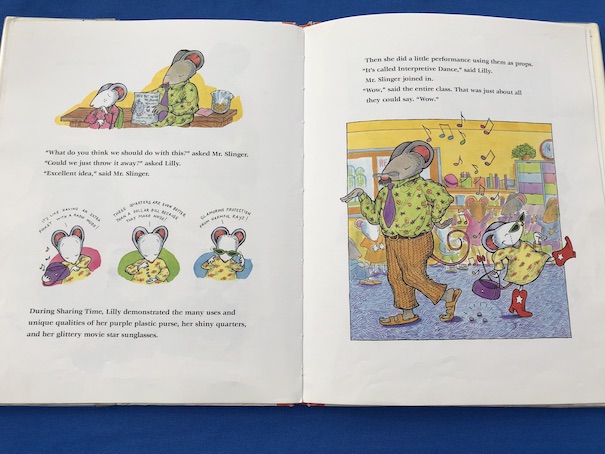
Fortunately, both Lilly’s parents and her teacher are very understanding. Her parents reassure her that her teacher will forgive her. Lilly draws a new, nicer picture of her teacher to go with her apology to him, and her parents give her some snacks to give to him as well. He does forgive her, and she finally gets to show everyone her amazing purple plastic purse at Sharing Time (being careful not to disturb anyone with them at other times.
The book is currently available online through Internet Archive. It is part of Mouse Books series.

Caleb’s Story

Caleb’s Story by Patricia MacLachlan, 2001.

This book is part of the Sarah, Plain and Tall Series, but while the first two books are narrated by Anna, this book is narrated by her brother, Caleb.

When the book begins, Caleb says that Anna is now going to live in town, finishing school and working for the local doctor.  Her boyfriend, Justin, is the doctor’s son, and he has gone to Europe to fight in World War I.  Sarah worries about Anna because of the influenza epidemic.  Anna has given him a journal in order to write about the things happening on the farm while she’s away.  Caleb isn’t as much of a writer as Anna, and he can’t imagine what he’ll find to write about, but Anna assures him that he’ll find something.

While Caleb is play hide and seek with his little half-sister, Cassie (who is now four and a half years old), Cassie says that she saw a man behind their barn who asked her about their father.  At first, Caleb thinks that Cassie imagined the whole thing, but she insists that she didn’t.  However, Caleb later finds the man in the barn, suffering from cold.  The family brings him inside to warm up, and he says that his name is John.  They try to ask John about who he is and where he came from, but he is evasive at first.  He says that he used to be a farmer, and he starts to help a little with farm chores.

The truth about John comes out when Jacob returns from taking Anna to town.  John is actually John Witting, Jacob’s father.  For years, Jacob believed that his father was dead.  It comes as a terrible shock to see him suddenly, after all this time.  Jacob is angry that John apparently abandoned his family and left him to believe that he was dead.

The children have many questions about their grandfather and where he’s been all these years, but John remains evasive for some time.  Sarah tries to encourage Jacob to talk to his father and learn what he needs to know about him, but Jacob resists because he’s too angry.  Caleb notices his grandfather taking pills, and Sarah discovers that it’s heart medicine.

The imagery in the story is pretty bleak, compared to the other books, even the drought descriptions from Skylark.  It’s winter, and people are dying during the influenza epidemic.  People have black wreaths on their doors, some because of influenza deaths and some because they have relatives who died fighting in World War I.  At one point, they see a bonfire in the cemetery because the ground is frozen, and they need to thaw it enough to dig a new grave.  When they get closer, they see that it’s a baby’s coffin, which upsets Sarah.

When Jacob finally demands that his father explain himself and his presence there, John says that he wanted to see how things turned out.  The two men argue and push each other, and Jacob accidentally falls over a plow and breaks his leg.  John sets the broken leg, saying that he’s done it before, but Jacob is still angry with him.

Eventually, John talks to Caleb about his past, admitting that he was wrong to leave years ago and saying that he can’t really blame Jacob for how he feels about it because his bad decision has affected Jacob’s whole life.  John quarreled with his wife years ago, and he felt like the two of them couldn’t live together anymore. (I have to admit that, after John had earlier tried to tell Jacob that things weren’t the way he thought they were, I was really disappointed because this explanation is exactly the way I figured it was.)  Jacob keeps saying that John could have at least written, but the truth is that John can’t read or write until Caleb begins teaching him. (If this is what John meant by things not being the way Jacob thought they were, it’s a little less disappointing.)  When Sarah is accidentally lost in a snow storm outside, and John helps Jacob save her, the father and son finally make peace with each other.

The movie version of this book is called Winter’s End, and it is the last of the series to be made into a movie. Actually, I think that the movie may have actually been made before the book (I’m a little confused by the movie’s date, but it looks like it was first). The movie and the book are pretty close to each other. The book is available to borrow and read for free online through Internet Archive.

The Wizard’s Apprentice

WizardsApprentice

The Wizard’s Apprentice by S.P. Somtow, 1993.

WizardsApprenticePic1Sixteen-year-old Aaron Maguire thinks of himself as a typical teenager, even though his family is far from typical.  His mother is a buyer for a fashion boutique, and his father does special effects for monster movies in Hollywood.  They’re also officially “separated” and preparing for a divorce, even though they’re still living in the same house.  So far, they’ve just kind of divided the house in two in order to have their own space.  Aaron goes back and forth between the two halves of the same house as his parents share him.  It’s a little weird (and, to Aaron, also a little depressing), but there’s weirder to come.

An old man approaches Aaron and tells him that he’s destined to be a wizard and that he will teach Aaron what he needs to know.  At first, Aaron thinks this man is nuts and probably homeless, but what he says is true.  The old man is the wizard Anaxagoras.  Anaxagoras demonstrates to Aaron how the skateboarding maneuver he had just pulled off defies the laws of physics and tells Aaron things about his personal life that no one should know (how angry he is with his parents about their separation and about his crush on Penelope Karpovsky, a girl he knows from biology class).  He also changes the dollar Aaron had offered him into a $100 bill and shows him that they can travel to magical lands and even through time.  Although Aaron still has trouble believing what he sees (his father does special effects for a living, after all), he becomes Anaxagoras’s apprentice.

Partly because Aaron still has doubts and needs something physical to convince him of the wizard’s powers and trustworthiness, Anaxagoras gives him a mirror.  It looks basically like an ordinary pocket mirror with a neon pink frame, but Anaxagoras invites him to ponder it and figure out what it does, telling him that what he does with it is important.

WizardsApprenticePic2However, when Aaron meets the divine Penelope for pizza and she asks to borrow a mirror to check her hair, Aaron lets her borrow Anaxagoras’s mirror.  He instantly regrets it because the mirror suddenly changes in Penelope’s hands.  Now, it has a tortoiseshell frame and is shaped like a heart.  Penelope, who has low self-esteem in spite of her prettiness, is suddenly really happy when she looks in the mirror and refuses to give it back, insisting that she wants to borrow it for a few days.  Because Aaron is in love with Penelope, he finally agrees to let her keep it for awhile.

When Aaron tries to tell Anaxagoras about Penelope borrowing the mirror, he doesn’t seem concerned.  He just hurries Aaron on to his next lesson, which involves a plumbing problem.  Anaxagoras’s lessons are pretty weird, although Aaron finds himself learning that there is more magic in the everyday world than he ever suspected.

Aaron later attempts his own feat of magical plumbing at the studio where his dad is working and encounters a creature of darkness.  The mirror gets out of his hands, and he enchants a car in order to chase it down.  Finally, a dare from some classmates causes him to unleash a dragon on the unsuspecting city, one that only Aaron can understand and defeat, once he realizes the true nature of his magical mirror.

Aaron has a distinctive voice as a California teenager, and his first experiments with magic lead him to some surprising discoveries about himself which help him to understand and reconcile his feelings about his parents’ divorce.