Home for a Bunny

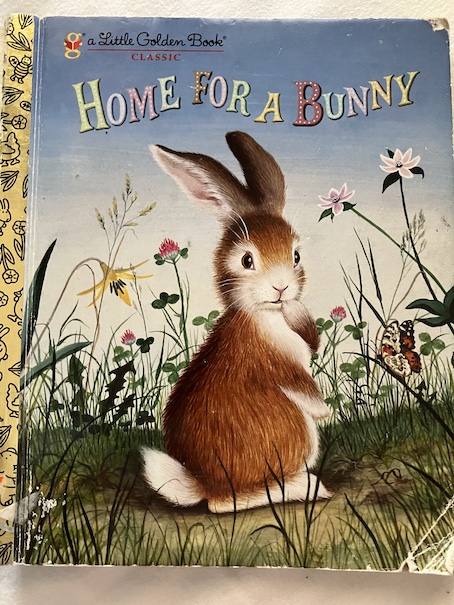
It’s springtime, and a little bunny is searching for a new place to call home.
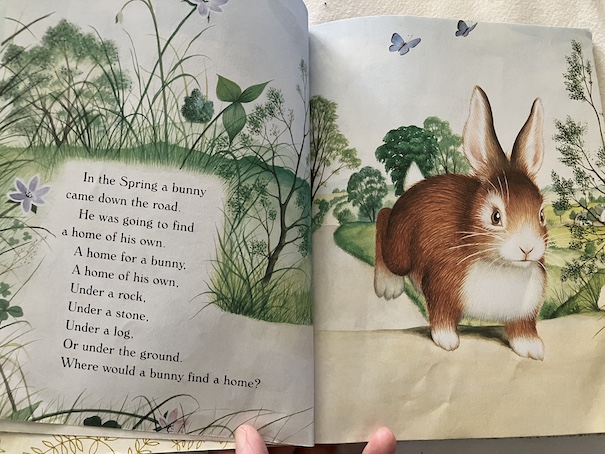
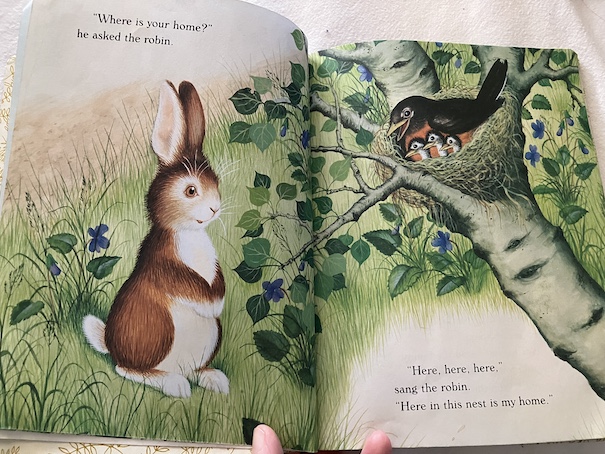
As he looks for a place that might suit him, he asks the other animals about their homes. However, most of the homes of other animals wouldn’t work for him. The bunny knows he couldn’t live in a nest like the birds or in a bog like a frog.
There is a point when the bunny thinks another animal’s home might suit him, when he talks to a groundhog who lives in a log, but the groundhog is not willing to have him as a housemate.
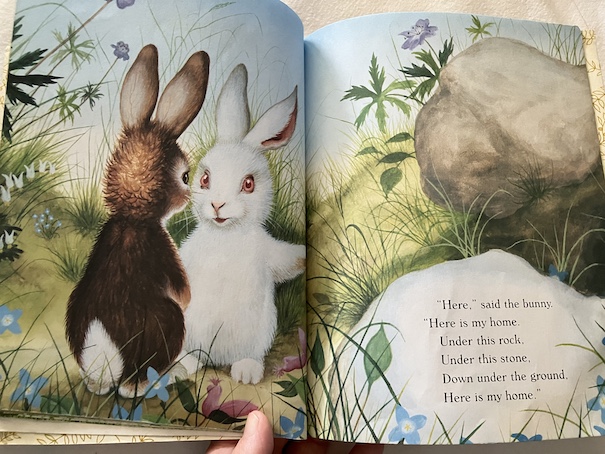
The bunny finally finds his home when he meets another bunny, who invites him to stay!

The book is available to borrow and read for free online through Internet Archive (multiple copies).

This vintage Little Golden Book is a calm and sweet story about a little bunny finding a home that’s just right for him. I liked how the bunny looks at other animals’ homes to figure out if any of them would be right for him because it shows young children how each animal’s home has conditions that are right for that animal but wouldn’t be right for a different type of animal. The bunny realizes that a nest in tree wouldn’t work for him because, unlike birds, he can’t fly and would fall out of the nest. Similarly, he can’t live in a bog with a frog because he’s not amphibious and would drown. (The book doesn’t use the term amphibian or amphibious, but I think kids would get the idea that some animals are better able to live in and around water than others.)
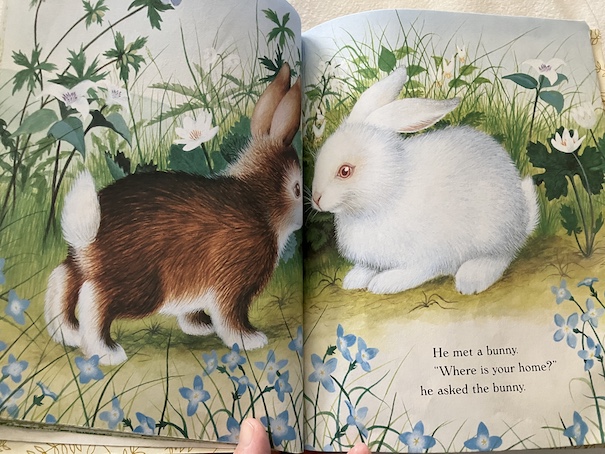
The story also includes the idea is that what makes a home is also who shares that home. The bunny thinks that the place where the groundhog lives could work for him, but he’s not a groundhog and the groundhog doesn’t want to share his home with the bunny. The place where the bunny eventually finds is rabbit hole he can share with another bunny, who is happy to have him as a companion. It’s a calm story with a happy ending because there is a home for everyone and someone for everyone.
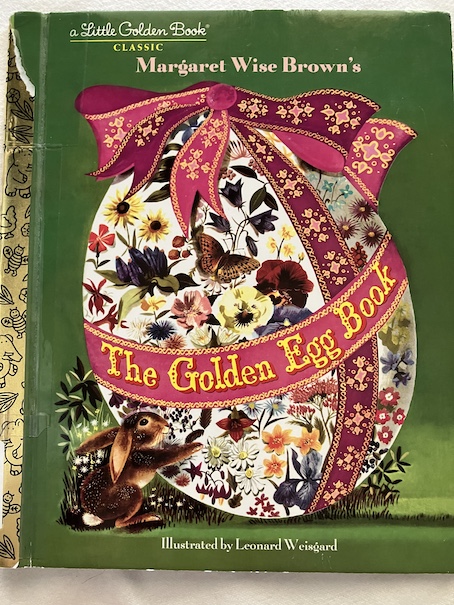
The Golden Egg Book

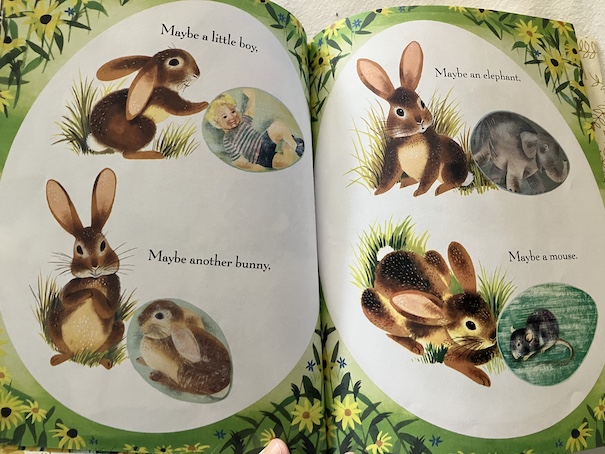
One day, a little bunny finds a blue egg. He knows there’s something inside the egg because he can hear it moving, but he doesn’t know what kind of egg it is. He imagines all the different creatures that could be inside the egg.

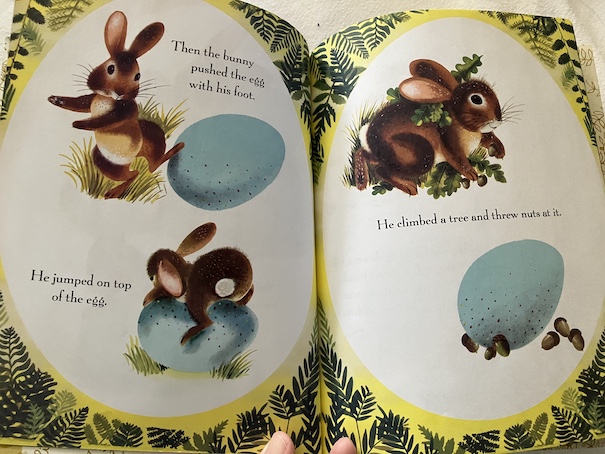
He tries to figure out how to get the egg open. He shakes it, kicks it, jumps on it, rolls it down a hill, and throws nuts and small rocks at it. Nothing he does causes the egg to open.

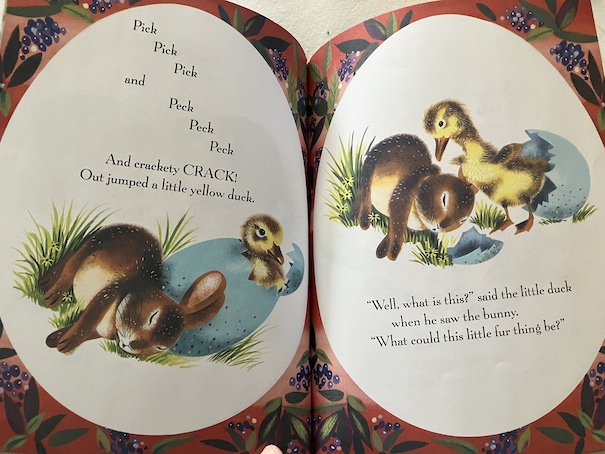
Eventually, the bunny falls asleep next to the egg, and while he’s asleep, the egg hatches! The animal that hatches out becomes the bunny’s best friend!

This is a vintage Little Golden Book, originally printed in the 1940s, about two young animals trying to figure each other out. The bunny apparently knows that some things hatch from eggs, but he’s not sure exactly how that happens or what sort of things might come from an egg. Even little kids will know that the things that the little bunny thinks might come from an egg are silly, like a little boy or an elephant, but that’s part of the fun of it.

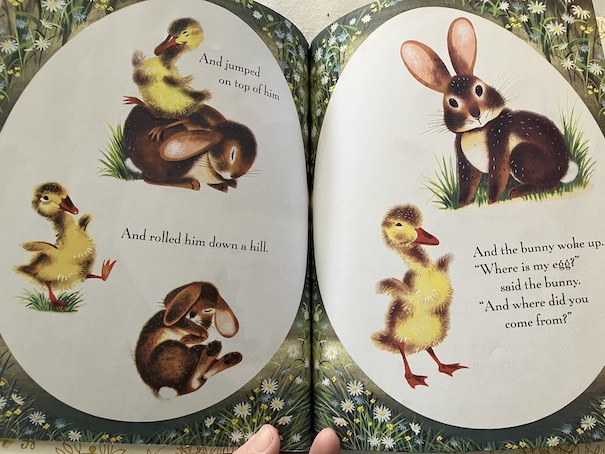
There’s some repetition in the story, which young children enjoy, because when the duckling hatches out of the egg and finds the bunny asleep, he tries some of the steps that the bunny tried on his egg to get the bunny to wake up, like pushing the bunny with his foot, jumping on him, or rolling him down the hill.

Fortunately, neither animal hurts the other in their attempts to hatch the egg or wake up the bunny, and the two become friends. It’s just a cute little picture book that might be fun for springtime or Easter!

Jennie’s Hat

JenniesHat

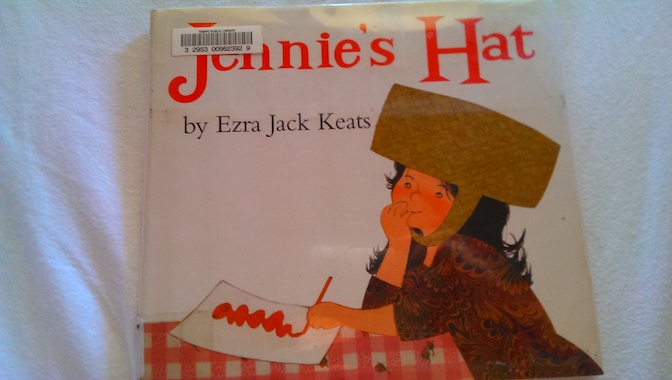
Jennie’s Hat by Ezra Jack Keats, 1966.

When Jennie’s aunt tells her that she’s going to send her a new hat as a present, Jennie is excited.  She imagines that her new hat is going to be big and fancy and covered with flowers.  However, when the hat arrives, it’s just a very plain, ordinary hat with a single ribbon.

JenniesHatGift

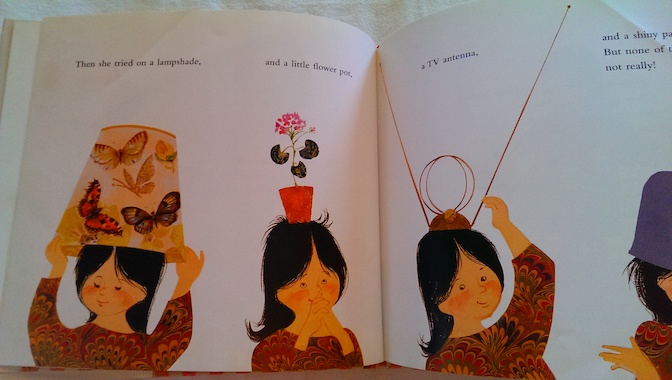
Even though her mother thinks the new hat is nice, Jennie wishes for something fancier, more unusual.  She tries on various other things, like a basket, a lampshade, and a pot to see how they would be as hats.  Of course, none of them really work.

JenniesHatExperiments

Jennie has a habit of feeding the birds, and while she’s coming home after feeding them one day, she wishes out loud that her hat could be fancier.

JenniesHatFeedingBirds

Her bird friends, hearing her wish, decide to help her.  The next day, as she is leaving church, they bring her the things she’s been wishing for so that she can have the hat of her dreams!

JenniesHatChurch

The best part of the story is Jennie’s friendship with the birds and how they repay her for feeding them.  The pictures of all the amazing things they give her for her hat are fun, too!

JenniesHatDecoration

I also liked the unusual artwork style.  Jennie’s clothes are often a cutout of a patterned piece of paper, while the rest of her body is drawn in.

Something Queer in the Wild West

SQWest

Something Queer in the Wild West by Elizabeth Levy, illustrated by Mordicai Gerstein, 1997.

Gwen and Jill go to visit Gwen’s Uncle Dale, who owns a ranch in New Mexico. The girls enjoy learning to ride horses, but Fletcher seems to be interested in an old barn.  C. J., who works on the ranch, tells the girls that the barn is supposed to be haunted by the spirit of a wild horse and that they should stay away from it.  Uncle Dale confirms the old legend, but the girls think there’s more to the story.

They have hear strange sounds coming from the old barn.  Then, the girls notice that Fletcher seems to be sneaking out during the night.  One night, they see a white horse roaming around when Uncle Dale doesn’t own a white horse. Could it be the spirit of the wild horse, or could it have something to do with a recent horse theft?

Fletcher’s odd behavior is a clue, and there is more to the old barn than the ghost story, as the girls suspected.  The “theft” isn’t quite theft, and the thief is actually trying to do something noble.  In the end, the girls decide to help, but they need Fletcher’s help to do it.

This book is part of the Something Queer Mysteries.  It is currently available online through Internet Archive.

SQWestPic2