
Understood Betsy by Dorothy Canfield Fisher, 1916.
Elizabeth Ann is an orphan who lives with her Great-Aunt Harriet and her first-cousin-once-removed Frances, who she calls Aunt Frances. Her relatives took her in when she was only a baby, after her parents died, and her life with them is the only one she has ever known. Her relatives love her, and Aunt Frances is particularly devoted to her. Ever since Elizabeth Ann came to live with them, she has devoted her entire attention to the little girl. She reads anything she can find about how to parent a child and makes it a point to know everything that’s going on in Elizabeth Ann’s life at school and sympathize with her over ever difficulty and misfortune she encounters. Elizabeth Ann certainly doesn’t lack for attention and affection, but Aunt Frances’s devotion and sympathy often go a little too far.
Aunt Frances is rather an anxious person, and she has unintentionally transferred many of her worries and anxieties to Elizabeth Ann, making her a rather timid and fearful little girl. She has also made it such a point to shield Elizabeth Ann with so much attention that Elizabeth Ann is never allowed to go anywhere or do anything by herself, making her feel like she can’t do things alone. Aunt Frances tries so hard to shield Elizabeth Ann from anything difficult or unpleasant that any difficulty she does encounter seems unbearable. While Aunt Frances’s intentions are good, and she tries hard to always understand and sympathize with Elizabeth Ann about everything, but there are some things about both Elizabeth Ann and herself that Aunt Frances doesn’t really understand. Then, when Elizabeth Ann is nine years old, something happens that changes her life forever.

When Great-Aunt Harriet gets sick, the doctor says that she must go to a warm climate and that Aunt Frances is going to have to take care of her. However, the doctor is adamant that Elizabeth Ann shouldn’t go with them because he doesn’t want to risk the girl catching Great-Aunt Harriet’s disease. Elizabeth Ann can’t imagine life without Aunt Frances, and Aunt Frances worries about where Elizabeth Ann will stay. Her relatives in Vermont, the Putneys, say that they are eager to have her. They would have taken her when she was a baby, but Great-Aunt Harriet and Aunt Frances never trusted the Putneys. They say that they are not sympathetic enough and that life on their farm would be too harsh for the delicate, sensitive little girl they have decided that Elizabeth Ann is. Instead, they decide that she should go live with some other cousins who live in the same city they do.
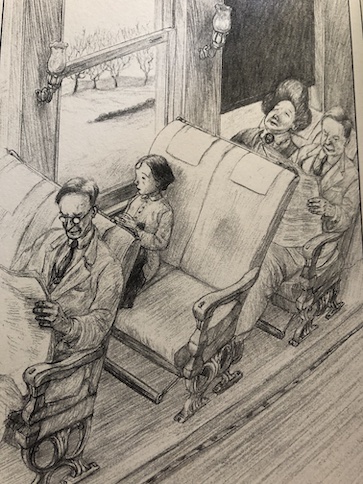
However, these relatives aren’t particularly eager to have her, and after Great-Aunt Harriet and Aunt Frances have already left town on their train, they discover that a member of their household has come down with scarlet fever (what strep throat can turn into if it isn’t treated with antibiotics) and that the household must be quarantined. There is a brief moment of panic when they realize that they can’t even bring the girl into their house. Then, they remember the Putneys. If Great-Aunt Harriet and Aunt Frances couldn’t bring themselves to send Elizabeth Ann to these other relatives, these cousins can. In fact, they must, and there’s no way Elizabeth Ann can argue, even though she is afraid of the Putneys because of all the negative things she’s heard her aunts say about them.
A relative who is traveling on business takes Elizabeth Ann partway by train and then makes sure that she gets on the right train to go to the Putney’s town in Vermont alone. Timid, fearful little Elizabeth Ann finds herself traveling completely alone for the first time to go to a place she’s never been and meet relatives she is sure she won’t like. Fortunately, many of Elizabeth Ann’s preconceived ideas are turned on their head from the first moment she steps off the train and is greeted by Great-Uncle Henry.
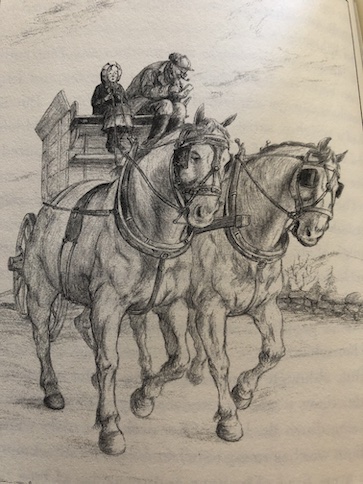
If it had been Aunt Frances greeting her, Aunt Frances would have immediately worried and fussed over her and asked her how she stood the ordeal of traveling. However, Uncle Henry acts like Elizabeth Ann hasn’t been through any ordeal at all. Instead, he just greets her cheerfully and helps her into his wagon. In fact, as they drive along, he unexpectedly gives the horses’ reins to Elizabeth Ann and lets her drive while he does some math. (We don’t know why he needs to do this; he just says he does.) He just tells her to pull on the left rein to make the horses turn left and the right rein to make them go right. Being handed this unexpected responsibility is terrifying for timid little Elizabeth Ann, and she has a moment of panic, worrying that she doesn’t always remember her left from her right. Then, Elizabeth Ann has an unexpected revelation: it doesn’t really matter if she doesn’t remember the names for the directions or which is which because she can just look and see where she wants the horses to go and pull the reins in that direction, no matter what that direction is called. After all, it’s not like horses really understand the words “left” and “right” anyway, just the direction of the pulling. This is an important revelation for Elizabeth Ann, who is usually accustomed to Aunt Frances doing everything for her, including her thinking. She has never really had to figure out things by herself before. When she voices this revelation to Uncle Henry, he simply agrees that she is correct, and Elizabeth Ann feels a rare sense of pride in her accomplishment.
When they reach the Putney Farm, Great-Aunt Abigail and Cousin Ann are glad to see her, but they don’t overly fuss, either. They call Elizabeth Ann “Betsy” and show her the hook where she can hang her cloak. Betsy is a little offended that they don’t help her take it off and hang it up for her the way Aunt Frances did. Their lack of fussing and expecting her to do things for herself makes her feel at first as if they don’t really care about her. Their farmhouse is also fairly small, it’s lit with kerosene lamps, and they do their own cooking instead of having a servant, like Great-Aunt Harriet and Aunt Frances did. These things make Betsy realize that the Putneys are poor, and she has a moment where she is overcome, thinking that she will be miserable in a poor, deprived household. Then, Aunt Abigail hands Betsy a kitten and tells her that, if she likes it, it can be her cat.
Betsy always wanted a kitten, but Aunt Frances would never let her have one because she was afraid that they would carry disease. Betsy forget her worries and misery while playing with the kitten, which she names Eleanor. She is also relieved that her relatives don’t fuss about her not liking certain foods. Aunt Frances always tried to make her eat her beans for nutrition, but the Putneys don’t care when she avoids them because she has a good appetite for everything else on the table. In fact, Betsy eats much more at the Putney farm than she ordinarily does because she is allowed to eat more of what she likes and nobody fusses over how much she’s eating or if she’s eating the right things. For her first night at the farm, Betsy has to sleep with Aunt Abigail because her room isn’t ready yet, but she ends up finding Aunt Abigail’s presence reassuring.
In the morning, her relatives decide to let her sleep in because she’s tired from traveling. When Betsy wakes up, she lies in bed for a while, waiting for someone to tell her to get up. When no one does, she get the idea, for the first time, that she can get up when she’s ready and doesn’t need for someone to tell her to do it. She also dresses herself and does her own hair for the first time. In a way, it’s a little thrilling because Betsy realizes that she can do her hair the way she wants it instead of the way Aunt Frances does it, and she copies a hairstyle she envied on one of her old classmates. However, it does bother her a little that her relatives don’t seem to care about whether or not she needs help and aren’t stepping forward to help her automatically. She does fine, but she’s accustomed to an adult hovering over her as a sign of caring.
Her relatives explain that they were letting her sleep as late as she wanted that day because they knew she would be tired. Cousin Ann gives her breakfast and lets her have as much milk as she wants because, unlike in the city, they produce their own milk from cows rather than buying it in quarts, so they don’t have strict limits on how much they can have in a day. Betsy is pleased by this, but she has another moment of panic when Cousin Ann tells her to wash her dishes after breakfast. Betsy has never washed her own dishes before and doesn’t know how. Seeing Betsy’s hesitation, Cousin Ann offers a view brief instructions, and Betsy accomplishes the task.

On her first day, she also sees Aunt Abigail making butter, something that Betsy has never seen before. She is accustomed to buying butter, not making it, and she didn’t even know before what butter is made from. Aunt Abigail is astonished that Betsy doesn’t know these things, but Uncle Henry points out that city life is different, and Betsy has probably seen things they haven’t, like how roads are paved. Betsy gets excited because roads being paved is a familiar sight to her, but she becomes embarrassed and confused when her aunt and uncle try to ask her questions about how the workmen do it. While she has seen roads being paved before, she took the sight for granted and never really noticed the details. Aunt Abigail suggests to her that she watch the butter making process closely and even take part in it so, if someone asks her later how it’s done, she can tell them all about it. Betsy accepts the lesson and even has fun making butter.
Then, her relatives surprise her by telling her that it’s time for her to go to school for afternoon lessons. They let her miss the morning lessons so she could rest, but now that she’s rested and had some time to look around the farm, she should go to the afternoon lessons. Worse still, they tell her that she should walk there by herself. Betsy panics again because Aunt Frances never let her walk to school by herself, but her relatives just give her a few directions to the school and a sugar cookie to take with her and send her out the door. Betsy could balk at this and say that she can’t do this and won’t, but their expectation that she can and will and her hesitancy to tell them differently make her walk down the road in the direction they say.
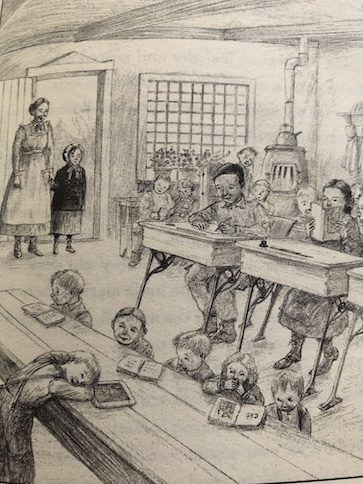
She almost misses the schoolhouse because it’s a much smaller building that she expected. Her school in the city was a multi-story building, but the local school is just a small, one-room schoolhouse. Fortunately, the teacher has been expecting her and looking out for her arrival, so she calls Betsy inside as she passes. Betsy is astonished at how few students there are, compared to her old school, and because there are so few, all the grades are just in that one schoolroom.
Even more confusingly, Betsy learns that this little school doesn’t do grades the way her old school did. Because there are so few students, and they’re all sharing the same room, it doesn’t matter too much what grade each student is studying in which subject. The teacher just moves them up and down as necessary to help them learn at their own, individual levels. At her age, Betsy knows that she should be in the third grade at school, but when the teacher has her read out loud with the other students at the third grade level, Betsy does much better than they do. She loves reading, and she reads all the time on her own, so she has progressed much faster in her reading skills than other children her age. Her teachers at her old school just never noticed because they were trying to keep track of so many students that they couldn’t pay that much attention to individual students’ progress. Her new teacher decides that she can read at a seventh grade level. Betsy is stunned and proud. The idea that she could move up multiple grade levels at once never occurred to her before as an option, but then, she worries that she can’t move up to seventh grade because she isn’t very good at math. She tries to explain this to the teacher, but the teacher isn’t concerned because she doesn’t make students study at one, consistent grade level for every subject. They can move ahead faster in some subjects than in others. When they’re struggling with one subject, she holds them back in that subject alone until they’ve mastered it. She does put Betsy back one grade level in math when she sees that Betsy is struggling, telling her that she can move up later when she’s had some time to review the material and improve.
It’s what Betsy really needs, but Betsy finds it disorienting that she isn’t part of one, consistent grade level at school. She says that she doesn’t know what that makes her, and the teacher replies that she is simply Elizabeth. Before, Betsy’s concept of school was that, every year, the students would simply move up one grade level, and that the goal of school was just for the students to move up through the levels appropriate to their age. Now, she is being introduced to the concept that the goal of education is for her to master the concepts being taught to her, regardless of the grade level, so that she will have the ability to do things like math, reading, and spelling. As long as she can learn to do these to a satisfactory level and keep improving, her specific grade doesn’t matter. In fact, when Betsy is upset later about failing an examination at school because she was nervous and made a lot of mistakes, Cousin Ann tells her that there’s no need to be nervous and that her grade on a single examination doesn’t matter because, regardless of how she did on that particular test, she knows that she actually does know the material and can use that knowledge in daily situations.

Betsy is also unexpectedly given the responsibility of looking out for a younger girl at the school, Molly. Because Molly is so good at reading, the teacher has Betsy listen to Molly read at the first grade level and asks her option of how Molly did and if she seems like she could manage the second grade level reading. Betsy has never had an adult ask her to supervise anyone younger before, and she unexpectedly discovers that she likes it and likes teaching someone younger. Later, Betsy is asked to hold Molly’s hand while they cross a log over a stream because the teacher wants older children to hold the hands of the younger ones and help them. Actually, holding Molly’s hand helps Betsy more than it helps Molly because Molly has walked on this log before and Betsy hasn’t, but being responsible for someone younger makes Betsy more bold. Although she would have been afraid to walk that log if she had to do it by herself, she can’t refuse when she has the responsibility of helping Molly. Later, she also helps to rescue Molly when Molly falls in a hole and needs help to get out. Betsy wanted to run for help at first, but when Molly begged her not to leave her alone, Betsy decides that she should do what Cousin Ann would do and figure out how she can use the things around her to solve the problem, spotting a branch that helps the younger girl climb out. Even though Betsy gets scared, when she has someone smaller than herself depending on her, she finds her courage.
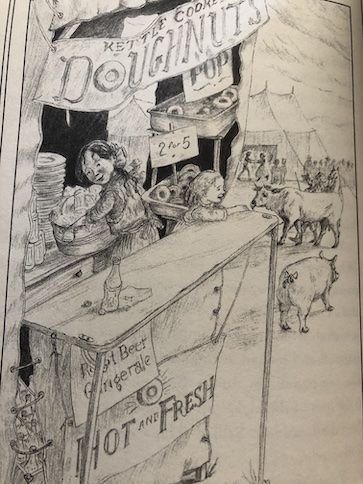
Betsy has other adventures with Molly and her other new friends while living with the Putneys. When Molly’s mother becomes ill and has to go to the hospital, Molly is upset because she will have to move in with some cousins in the city who don’t really want her. Having been in this type of situation before herself, Betsy is immediately sympathetic, and she gets her relatives to agree to let Molly stay with them. Molly becomes like a little sister to Betsy, and they share in other adventures together. Along with some other girls from their school, they form a sewing circle to make some clothes for a poor boy at their school who lives with a stepfather who spends all of his money on alcohol. The book doesn’t shy away from describing how the boy is neglected, and the girls in the sewing circle are moved to tears when they go to the boy’s house to deliver the new clothes and see the circumstances he lives in. The Putneys also become concerned about the boy’s welfare, and they help arrange for him to be adopted by a man they know who has been talking about adopting a boy. Later, for Betsy’s birthday, Betsy and Molly go to the fair with some neighbors, but they are accidentally left behind when the people who were supposed to give them a ride home had to leave to tend to an emergency. Betsy is terrified, but with Molly to look after, Betsy manages to keep her head and think of a way to earn some money so they can buy train tickets home.
Betsy has been living with the Putneys for about a year when she gets a letter from Aunt Frances, who says that she will arrive soon to reclaim her. Aunt Frances thinks that Betsy must have been having a miserable time without her, but Betsy has actually come to think of the farm as home and loves it there. She doesn’t want to hurt Aunt Frances’s feelings or seem ungrateful for all the love and attention that Aunt Frances has lavished on her over the years. It seems like Betsy has to resign herself to returning to her old life in the city … unless Aunt Frances has also been making some changes to her own life since they were last together. When Betsy and Aunt Frances meet again, they truly come to understand each other, and they find a way for them all to live their best lives.
This book is now public domain and is available to read for free online through Project Gutenberg and Internet Archive (multiple copies, including audiobooks).
My Reaction
Educational Themes
I really enjoyed this book! I’d heard about it for years and never got around to reading it before. Dorothy Canfield Fisher was an early advocate of the Montessori method of education in the United States, and in particular, this book presents many of the principles of the Montessori method and how it can help children. The educational themes in the story are obvious when Betsy sees the differences between the one-room schoolhouse in the country and her old school in the city.
The benefits of the smaller class size are immediately obvious. Betsy loves reading but she always hated her reading class in school because each student took turns reading, so the most any particular student could read was one or two sentences, and even then, they might not get a turn if the class ran out of time before they got to all of the students. This description feels like an exaggeration of how reading classes might have gone at a bigger school, but there may be some truth in it. When I was at school, my classes typically had about 20 to 30 students in them, and when we took turns reading, we did more than that. It’s difficult to say for sure because I don’t think Betsy ever said exactly how many students were in her class, but I would think they would have to have at least twice as many as that to be as bad as she described. According to Going to School in 1876, some large city schools could have classes of 50 to 60 students during the late 1800s, so that is possible for a class in the early 1900s or 1910s as well. I do take the point that it’s easier for a teacher to keep track of the progress of individual students when the class size is smaller.
I also appreciated what the teacher said about allowing students to progress faster in subjects that are their strengths, even if they have to take extra time for problem areas in other subjects. When I reviewed The Beast in Ms. Rooney’s Room, there is a boy in that book who was held back a year in school because of his problems in reading, and he was embarrassed about not moving to the next grade with his classmates. If he could have moved forward in some subjects, it might not be so embarrassing for him to be held back in the one subject that gave him the most trouble. The problem is that he couldn’t do that because the classes at his elementary school are organized the way the ones at my old elementary school were – one single teacher at a particular grade level teaching all of the subjects for that grade level. Under that system, remaining at a particular grade level in one subject means remaining at that grade level, with that teacher for all subjects.
There is only one teacher at the one room schoolhouse in the story, so there’s no conflict about a student seeing one teacher for some subjects and another teacher for other subjects at a different grade level. All of the students are in just that one room with one teacher all the time, so the only difference when a student moves up or down in level for a subject is the book that the teacher gives them to study. That means that changes in grade level can be done informally for any or all subjects, whenever the teacher decides that a student is ready to move to the next level. The student just turns in their old book and gets a different one to study. If most grade levels were determined that easily for different subjects, I think there would be fewer parents who would be concerned about the prospect of holding a child back a grade temporarily to give them a better grounding for moving forward later, and students would experience less embarrassment about problem subjects if they could receive acknowledgement for better skills in other subjects. However, I can see that this system would be complicated in bigger public schools, and there would have to be a point when the student would have to master their series of subjects at a particular level to know when they could graduate from their school. I think that’s part of the purpose of the examinations Betsy describes in the book, but because the book only covers a single year, we don’t see what happens when a student is ready for graduation.
Emotional Management
In the beginning, Aunt Frances, in spite of all of her good intentions and research into psychology and raising children, unintentionally transfers her personal anxieties to Betsy without really giving her the tools that she needs to manage them, so they feel overwhelming to Betsy. The solution to this problem, as presented in the book, seems to be mostly being around people who do not express worries about things (if they’re nervous about anything, they mostly cover it up and don’t talk about it, except for one time, which I’m going to talk about) and who present manageable challenges to Betsy to show her that she can handle more than she thinks she can. I like the part about giving Betsy manageable challenges and some basic instructions for how to accomplish them when she doesn’t seem to quite know what to do. If they had just thrown challenges at her with no instruction at all, in a kind of sink-or-swim fashion, I think she would have been just overwhelmed and more panicky. However, I think there’s a point in the story that could use more clarification.
The differences between Betsy’s sets of relatives is initially presented, particularly by the aunts she’s been living with, as one of understanding and sympathy. Great-Aunt Harriet and Aunt Frances initially don’t like the Putneys because they don’t seem sympathetic enough, especially with people who are sensitive and nervous. Aunt Frances dedicates herself to sympathizing with Betsy about everything and talking to her about everything in her life, and the book presents this as a negative because their sympathetic conversations about the worries they have end up being a way of making each other more nervous. I think, in real life, there’s a happy medium between never talking about worries and wallowing in them.
The first problem with Aunt Frances’s attempts to sympathize with Betsy is that she makes assumptions that things that bother her will also bother Betsy, and this becomes the way that she accidentally transfers her anxieties to Betsy. Second, when Aunt Frances sympathizes with Betsy about worries or problems, she tends to dwell too much on the problem itself and how bad it feels, magnifying the issue and making Betsy feel worse. What I’m trying to say is that Aunt Frances’s attempts to sympathize would have worked much better if she had been willing to listen to Betsy’s concerns and sympathize a little about how certain things can make a person nervous but then move on to offering practical tips to deal with these feelings and different ways of looking at situations to take some of the anxiety out of them.
I didn’t like it when Cousin Ann seemed to shut Betsy down when she was talking about how tests at school make her nervous because I don’t like the idea of shutting people down when they’re talking about something important to them, but what made it better to me was that she did listen to Betsy for a bit before that and had already offered her a different way to look at tests that makes them seem more fun and less scary. When Cousin Ann cuts the conversation short seems to be the point when discussing and sympathizing is about to turn into brooding and dwelling on the negative. My only thought on that conversation is that it might have helped for Cousin Ann to point that out. Rather than asking if Betsy really wanted to keep talking about this, which makes it sound like disinterest in what Betsy’s saying, I think it might have been better to point out that, if she keeps dwelling on the parts of the experience that make her feel bad, she won’t let herself move forward, to see the parts of the experience that could be exciting opportunities and possible triumphs. Perhaps, it would be good to add that one poor test experience doesn’t mean that others will feel the same way or that she can’t do better the next time, especially if she spends her time in between tests focusing on how much she enjoys what she’s learning and how it can be fun to show others what she’s learned and what she enjoys about her lessons, putting herself in a better frame of mind for the next time someone asks her questions about what she’s learned. I just think that approach would help emphasize the lesson that Cousin Ann would really like to teach Betsy about reframing challenges in her mind and also help clarify that she’s not ending the conversation because she’s not sympathetic but because it’s better to give the positive thoughts time to take hold rather than dwell on the worries.
I think it’s also important for both Betsy and Aunt Frances to recognize that it’s okay to feel nervous but that it’s possible to handle situations even though they make them nervous. As someone who has had life-long issues with anxiety, I can also attest that one of the best approaches is learning not to be afraid of feeling afraid of something. That is, learning to recognize that being nervous isn’t a sign that a situation is unmanageable or that the feeling of anxiety itself is necessarily going to be overwhelming, something that Betsy learns through practical experience in the story. There are still times in the story where Betsy is afraid and has to handle difficult situations, but she learns that she can proceed and do what she needs to do even though she’s nervous and isn’t sure at first how things will work out. It isn’t explicitly spelled out in the story, but this is probably the most important lesson that Betsy was missing from her time living with Aunt Frances.
Betsy’s Family
There are no villains in this story. Although readers can see at the beginning that living with Great-Aunt Harriet and Aunt Frances has caused some emotional complications for Betsy because she has taken on their worries and anxieties, they do mean well and have made real efforts to understand Betsy and support her, as best they know how. Great-Aunt Harriet and Aunt Frances just have very different, more timid personalities than the Putneys and don’t find their style of communication reassuring or appealing. However, Betsy discovers, to her surprise, that she does come to appreciate the Putneys and that they are a good influence on her, helping her to come out of her shell, discover new abilities and interests, and develop some self-confidence.
At first, Betsy is a little offended that her Putney relatives don’t fuss over her like Aunt Frances did, and it makes her feel like they don’t care about her, but they do care. They are just more low-key in showing the ways that they care. They are a family that doesn’t like to fuss about anything. Personally, I thought that Cousin Ann should have let Betsy talk a little more when Betsy was distressed about doing badly on her exam, but I do see her point that Betsy’s talking about it seemed to be upsetting her more because she was dwelling on the problem rather than consoling herself and looking for solutions or new ways of thinking about the situation. Cousin Ann points out that exams aren’t always negative, and even when one doesn’t turn out so well, it’s not the end of the world, giving Betsy a new way of looking at the situation and defusing Betsy’s sense that every little setback is a tragedy.
The Putneys show how much they truly care when Betsy and Molly are accidentally left behind at the fair. When Betsy manages to get Molly home, she sees her relatives rattled and upset for the first time when they realized that the girls were lost, and they do some rare fussing over the girls, praising Betsy for her ingenuity in handling the situation. Although the Putneys normally make it a point to deal with things coolly and calmly, they do care about the girls and can get upset if they think there is a serious problem. They are not without feelings. They are also genuinely upset when they think Aunt Frances is going to take Betsy away, each finding their own way to show Betsy how much they care and how much they will miss her.
Spoilers
Fortunately, Betsy is allowed to stay with the Putneys in the end. When Aunt Frances comes to get her, she reveals that, in the year they’ve been apart, she has met a man and fallen in love. She is going to marry him, but marrying him means making some changes to her life, the greatest one being that they are not going to return to their old house. Great-Aunt Harriet has recovered from her earlier illness and has gone to live with another relative, and because her new husband has to travel constantly for business, Aunt Frances won’t be keeping a settled house at all. Aunt Frances, although usually timid, is actually looking forward to doing some traveling. She is still afraid of things like animals and would never be an outdoor/country kind of person, but travel to different cities sounds like her kind of excitement. However, she can see the difficulty of traveling with Betsy. Constantly moving would be difficult for her education, a complication that I was surprised that the characters didn’t spell out when they were talking to each other, given the educational themes of the story.
Betsy and Aunt Frances come to a new understanding of each other and the differences in the lives they want to live when they talk about what these changes would mean for their lives. Aunt Frances doesn’t want to simply abandon Betsy to the Putneys if she isn’t happy with them, but she can see that Betsy does like living there and would be happy to stay. Betsy hadn’t wanted to make Aunt Frances feel abandoned and unappreciated by telling her in the beginning that she wanted to stay with the Putneys, but when she learns that Aunt Frances will be happily married and enjoying the new experience of travel, she is able to tell Aunt Frances that she can see that having her come along would be inconvenient for her and that she would be happy to stay with the Putneys. Neither of them is offended or worried about living apart now because they can see that each of them will be happier with Betsy living with the Putneys. Aunt Frances is now free to get married and go where she wishes with her husband, assured that Betsy is doing fine and living in a stable home with people who care about her, even if it’s not quite living the lifestyle that she would like herself. Aunt Frances also promises to come visit sometimes, so it’s not a permanent goodbye.
 My Crazy Cousin Courtney by Judi Miller, 1993.
 Jestress's Forgotten Books and Stories